Presented by: Bareque Hussain
Rajesh Das
Raman Bang
Subham Jaiswal
INTRODUCTION
• FMCG sector generally deals with FMCG products or “Fast Moving Consumer
Goods”
• FMCG products have a quick turnover and relatively low cost
• India’s FMCG sector is 4th largest sector in the economy and contribute to
around 3 million employment opportunities
• It includes household care, personal care, food and beverages
• FMCG industry is characterized by a well established distribution network, low
operating cost, lower per capita consumption and intense competition
between the organized and unorganized segments
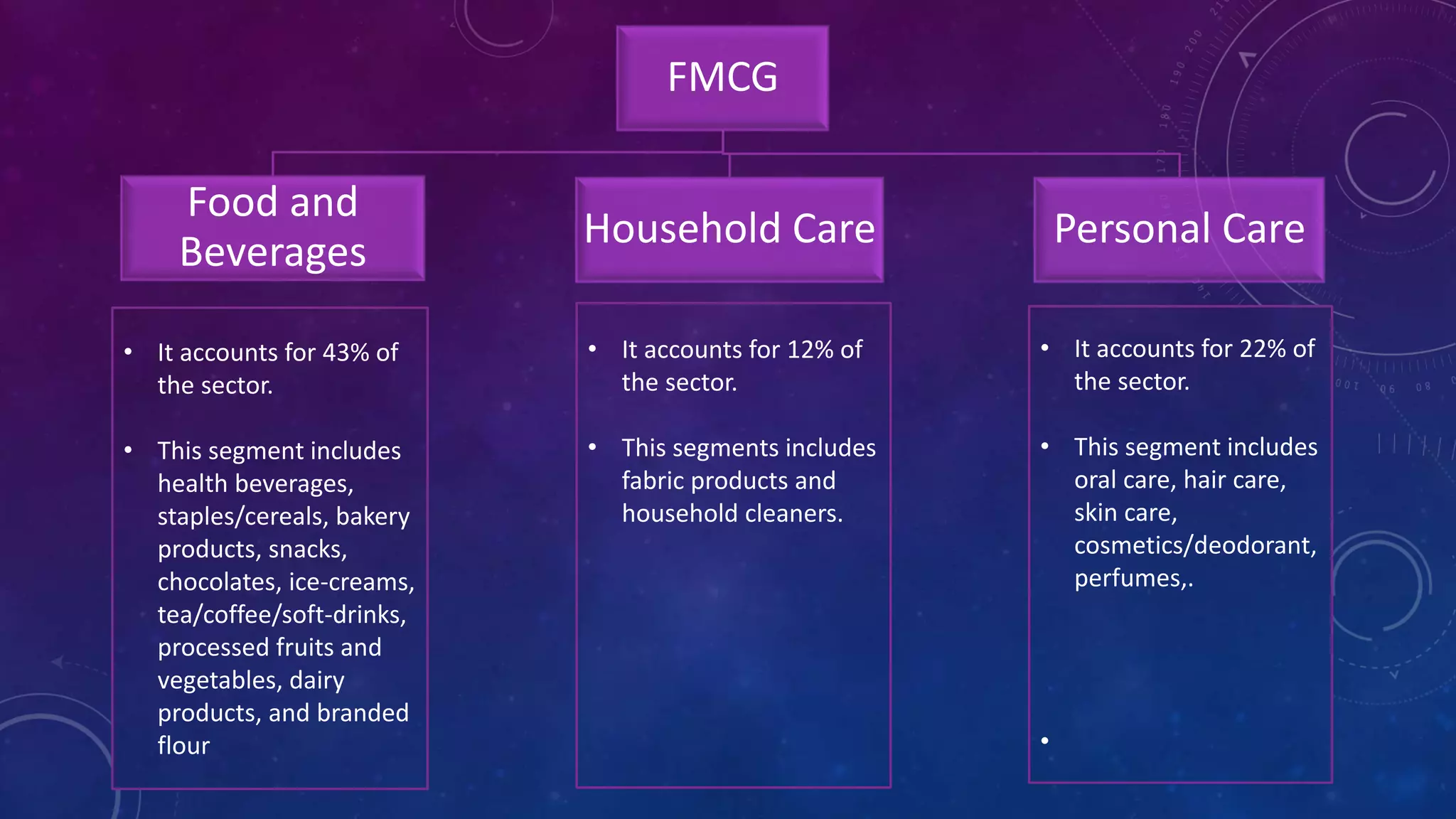
FMCG
Food and
Beverages
Household Care Personal Care
• It accounts for 43% of
the sector.
• This segment includes
health beverages,
staples/cereals, bakery
products, snacks,
chocolates, ice-creams,
tea/coffee/soft-drinks,
processed fruits and
vegetables, dairy
products, and branded
flour
• It accounts for 12% of
the sector.
• This segments includes
fabric products and
household cleaners.
• It accounts for 22% of
the sector.
• This segment includes
oral care, hair care,
skin care,
cosmetics/deodorant,
perfumes,.
•
STRONG GROWTH IN INDIAN FMCG SECTOR
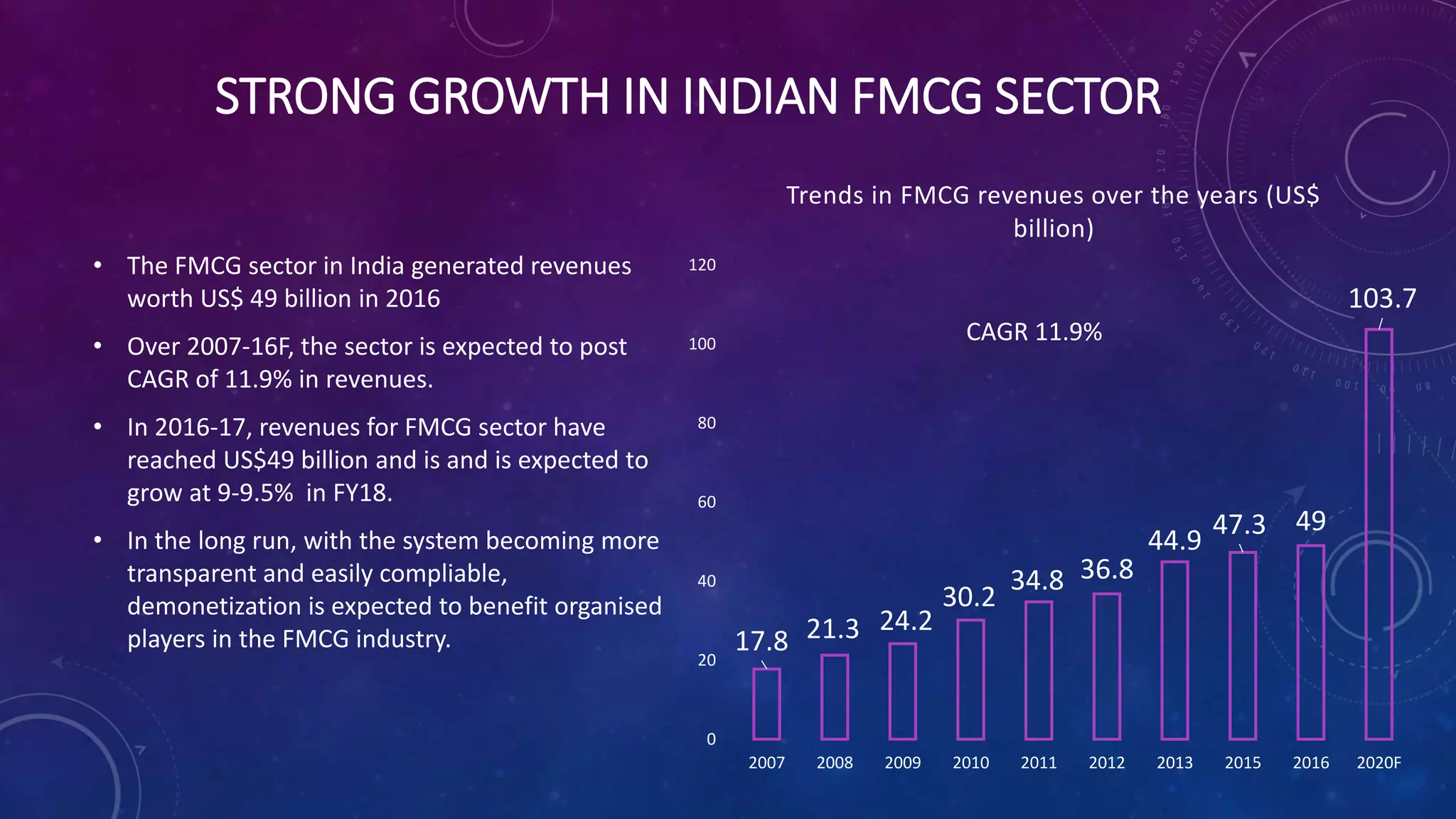
• The FMCG sector in India generated revenues
worth US$ 49 billion in 2016
• Over 2007-16F, the sector is expected to post
CAGR of 11.9% in revenues.
• In 2016-17, revenues for FMCG sector have
reached US$49 billion and is and is expected to
grow at 9-9.5% in FY18.
• In the long run, with the system becoming more
transparent and easily compliable,
demonetization is expected to benefit organised
players in the FMCG industry. 17.8 21.3 24.2
30.2
34.8 36.8
44.9
47.3 49
103.7
0
20
40
60
80
100
120
2007 2008 2009 2010 2011 2012 2013 2015 2016 2020F
Trends in FMCG revenues over the years (US$
billion)
CAGR 11.9%
URBAN MARKET ACCOUNTS FOR MAJOR CHUNK OF REVENUES
• Accounting for a revenue share of around
60%, urban segment is the largest
contributor to the overall revenue
generated by the FMCG sector in India and
recorded a market size of around US$ 29.4
billion in 2016-17.
• Semi-urban and rural segments are growing
at a rapid pace and accounted for a
revenue share of 40% in the overall
revenues recorded by FMCG sector in India
• In the last few years, the FMCG market has
grown at a faster pace in rural India
compared with urban India
40%
60%
URBAN - RURAL INDUSTRY BREAKUP
(2016)
Rural Urban
US$ 49 billion
TOP TEN FMCG COMPANIES IN INDIA 2017
• Hindustan Unilever (HUL)
• Patanjali
• ITC
• Nestle
• Godrej
• Britannia
• Dabur
• Tata Global Beverages
• Marico
• Colgate Palmolive
30782
10561 10336
9159 9134 8844 7961 6963
5918
4010
HUL Patanjali ITC Nestle Godrej Britannia Dabur Tata
Global
Beverages
Marico Colgate
Patmolive
TOP 10 COMPANIES IN FMCG
Revenue(cr)
PORTER’S FIVE FORCE ANALYSIS
Bargaining Power of Suppliers
• Low – Big FMCG companies are able to
dictate the prices through local sourcing
from a fragmented group of key
commodity suppliers
Threat of substitutes
• High – Presence of multiple brands
• Price war
• Narrow Product differentiation under
many brands
Threat of New Entrants
• Medium – Huge investments in setting up
distribution network and promoting
brands
• Spending on advertisements is aggressive
Bargaining Power of Buyers
• High – Low switching cost induces the
customer’s product shift
• Influence of marketing strategies
• Availability of same or similar
alternatives
Competitive Rivalry
• High - Private level brands by retailers
are priced at a discount to mainframe
brand limits competition for the weak
brands
• Highly fragmented industry as more
MNC’s are entering
Positive Impact
Negative Impact
Neutral Impact
•Rural employment Volume-
driven growth in rural
market
•Major young population can
increase revenue
•Technology has been
simplified and available in
the industry
•Foreign players helps in
high technological
development
• GDP rate increases
• Increase in disposable
income at 10% annually
for next 8 years
• GST Regime
• Restriction in
Import Policies
Political Economical
SocialTechnological
PEST Analysis
GROWTH OPPORTUNITIES IN THE INDIAN FMCG INDUSTRY
Rural
Market
• Leading players of consumer products have a strong distribution network in rural India and also they stand to
gain from the contribution of technological advances like internet and e-commerce to better logistics
Innovative
Products
• Indian consumers are highly adaptable to new and innovative products. For ex. Men’s fairness cream, cuppa
mania noodles etc.
Premium
Products
• With the rise in disposable incomes, mid and high income consumers in urban area have shifted their purchase
trend from essential to premium products.
Sourcing
Base
• India and multinational FMCG players can leverage India as a strategic sourcing hub for cost-competitive
product development and manufacturing to cater to international markets.
Penetration
• Low penetration levels offer room for growth across consumption categories.
Align
Partnership
• ITC partnered with farmers of MP to improve the living conditions in village .
FMCG Industry Analysis

FMCG Industry Analysis

  • 1.
    Presented by: BarequeHussain Rajesh Das Raman Bang Subham Jaiswal
  • 2.
    INTRODUCTION • FMCG sectorgenerally deals with FMCG products or “Fast Moving Consumer Goods” • FMCG products have a quick turnover and relatively low cost • India’s FMCG sector is 4th largest sector in the economy and contribute to around 3 million employment opportunities • It includes household care, personal care, food and beverages • FMCG industry is characterized by a well established distribution network, low operating cost, lower per capita consumption and intense competition between the organized and unorganized segments
  • 3.
    FMCG Food and Beverages Household CarePersonal Care • It accounts for 43% of the sector. • This segment includes health beverages, staples/cereals, bakery products, snacks, chocolates, ice-creams, tea/coffee/soft-drinks, processed fruits and vegetables, dairy products, and branded flour • It accounts for 12% of the sector. • This segments includes fabric products and household cleaners. • It accounts for 22% of the sector. • This segment includes oral care, hair care, skin care, cosmetics/deodorant, perfumes,. •
  • 4.
    STRONG GROWTH ININDIAN FMCG SECTOR • The FMCG sector in India generated revenues worth US$ 49 billion in 2016 • Over 2007-16F, the sector is expected to post CAGR of 11.9% in revenues. • In 2016-17, revenues for FMCG sector have reached US$49 billion and is and is expected to grow at 9-9.5% in FY18. • In the long run, with the system becoming more transparent and easily compliable, demonetization is expected to benefit organised players in the FMCG industry. 17.8 21.3 24.2 30.2 34.8 36.8 44.9 47.3 49 103.7 0 20 40 60 80 100 120 2007 2008 2009 2010 2011 2012 2013 2015 2016 2020F Trends in FMCG revenues over the years (US$ billion) CAGR 11.9%
  • 5.
    URBAN MARKET ACCOUNTSFOR MAJOR CHUNK OF REVENUES • Accounting for a revenue share of around 60%, urban segment is the largest contributor to the overall revenue generated by the FMCG sector in India and recorded a market size of around US$ 29.4 billion in 2016-17. • Semi-urban and rural segments are growing at a rapid pace and accounted for a revenue share of 40% in the overall revenues recorded by FMCG sector in India • In the last few years, the FMCG market has grown at a faster pace in rural India compared with urban India 40% 60% URBAN - RURAL INDUSTRY BREAKUP (2016) Rural Urban US$ 49 billion
  • 6.
    TOP TEN FMCGCOMPANIES IN INDIA 2017 • Hindustan Unilever (HUL) • Patanjali • ITC • Nestle • Godrej • Britannia • Dabur • Tata Global Beverages • Marico • Colgate Palmolive 30782 10561 10336 9159 9134 8844 7961 6963 5918 4010 HUL Patanjali ITC Nestle Godrej Britannia Dabur Tata Global Beverages Marico Colgate Patmolive TOP 10 COMPANIES IN FMCG Revenue(cr)
  • 7.
    PORTER’S FIVE FORCEANALYSIS Bargaining Power of Suppliers • Low – Big FMCG companies are able to dictate the prices through local sourcing from a fragmented group of key commodity suppliers Threat of substitutes • High – Presence of multiple brands • Price war • Narrow Product differentiation under many brands Threat of New Entrants • Medium – Huge investments in setting up distribution network and promoting brands • Spending on advertisements is aggressive Bargaining Power of Buyers • High – Low switching cost induces the customer’s product shift • Influence of marketing strategies • Availability of same or similar alternatives Competitive Rivalry • High - Private level brands by retailers are priced at a discount to mainframe brand limits competition for the weak brands • Highly fragmented industry as more MNC’s are entering Positive Impact Negative Impact Neutral Impact
  • 8.
    •Rural employment Volume- drivengrowth in rural market •Major young population can increase revenue •Technology has been simplified and available in the industry •Foreign players helps in high technological development • GDP rate increases • Increase in disposable income at 10% annually for next 8 years • GST Regime • Restriction in Import Policies Political Economical SocialTechnological PEST Analysis
  • 9.
    GROWTH OPPORTUNITIES INTHE INDIAN FMCG INDUSTRY Rural Market • Leading players of consumer products have a strong distribution network in rural India and also they stand to gain from the contribution of technological advances like internet and e-commerce to better logistics Innovative Products • Indian consumers are highly adaptable to new and innovative products. For ex. Men’s fairness cream, cuppa mania noodles etc. Premium Products • With the rise in disposable incomes, mid and high income consumers in urban area have shifted their purchase trend from essential to premium products. Sourcing Base • India and multinational FMCG players can leverage India as a strategic sourcing hub for cost-competitive product development and manufacturing to cater to international markets. Penetration • Low penetration levels offer room for growth across consumption categories. Align Partnership • ITC partnered with farmers of MP to improve the living conditions in village .