Fall 2017
(Released in December; survey conducted in October)
Export Development Canada’s
Trade Confidence Index
A pulse check of Canada’s exporters
2
› EDC’s survey of 1,000 Canadian exporters, conducted twice
a year
› Uncovers issues not available in traditional trade statistics,
such as Canadian exporters’:
- expectations for the future
- evolving international operations and strategies
- views on emerging issues
About the Trade Confidence Index (TCI)
3
› Despite elevated trade policy uncertainty, the overall TCI
score was down only marginally in the Fall 2017 survey, with
most respondents expecting conditions to remain the same or
improve over the next six months.
› Almost one quarter of Canadian exporters said the on-going
NAFTA talks are having a negative impact on their Canadian
operations.
› With CETA now provisionally in force, Canadian companies
are paying more attention to the European market.
Some Key Findings
4
72.3
73.9
73.5
55
60
65
70
75
80
85
90
Spring1999
Fall1999
Spring2000
Fall2000
Spring2001
Fall2001
Spring2002
Fall2002
Spring2003
Fall2003
Spring2004
Fall2004
Spring2005
Fall2005
Spring2006
Fall2006
Spring2007
Fall2007
Spring2008
Fall2008
Spring2009
Fall2009
Spring2010
Fall2010
Spring2011
Fall2011
Spring2012
Fall2012
Spring2013
Fall2013
Spring2014
Fall2014
Spring2015
Fall2015
Spring2016
Fall2016
Spring2017
Fall2017
EDC’s overall Trade Confidence Index
decreased slightly in Fall 2017…
5
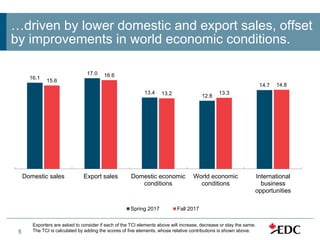
…driven by lower domestic and export sales, offset
by improvements in world economic conditions.
16.1
17.0
13.4
12.8
14.7
15.6
16.6
13.2 13.3
14.8
Domestic sales Export sales Domestic economic
conditions
World economic
conditions
International
business
opportunities
Spring 2017 Fall 2017
Exporters are asked to consider if each of the TCI elements above will increase, decrease or stay the same.
The TCI is calculated by adding the scores of five elements, whose relative contributions is shown above.
6
Nonetheless, most Canadian exporters expect
conditions to remain the same or improve over the
next six months
94% 95%
79%
75%
88%
93% 94%
79% 80%
87%
Domestic sales Export sales Domestic economic
conditions
World economic
conditions
International
business
opportunities
Spring 2017 Fall 2017
7
Large firms experienced the biggest decline
73.9
73.6
73.7
74.0
73.5
73.4
74.5
71.6
TCI
Small
Medium
Large
Spring 2017 Fall 2017
Note: “Small” companies report under $10 million in annual sales; “medium” $10-$50 million; “large” >$50 million.
8
By sector, extractive had the largest decline; ICT and
infrastructure and environment experienced increases
73.9
80.6
74.5
73.2
73.9
71.7
73.0
73.5
77.1
74.8
75.7
73.3
70.5
71.0
TCI
Extractive
Information & Communication
Technology
Infrastructure & Environment
Light Manufacturing
Resources
Transportation
Spring 2017 Fall 2017
9
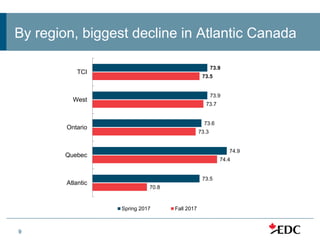
By region, biggest decline in Atlantic Canada
73.9
73.9
73.6
74.9
73.5
73.5
73.7
73.3
74.4
70.8
TCI
West
Ontario
Quebec
Atlantic
Spring 2017 Fall 2017
10
High export intensity among respondents,
with most selling goods internationally
34%
22%
44%
Fall 2017
Percentage of total sales outside Canada
(percentage of companies)
Less than 25% Between 25% and 50% More than 50%
71%
13%
16%
Fall 2017
Percentage of international sales by type
(percentage of companies)
Goods Services Both
11
Fewer exporters indicated an increase in new orders
from U.S. customers over the past six months
16% 17%
44% 47%
40% 36%
Spring 2017 Fall 2017
In the past six months, orders from U.S. customers have…
Decreased Remained the same Increased
12
Most exporters import and expect to in the
future
84%
Fall 2017
Percentage of companies that import
3%
60%
36%
Fall 2017
Expectations that imports
over the next six months will…
(percentage of companies)
Decrease Remain the same Increase
13
6% 71% 23%
positive no impact negative
Impact of NAFTA renegotiation on
company’s Canadian operations
About one quarter of exporters indicate that NAFTA talks
are having a negative impact on their Canadian operations
26%
23%
19%
14%
13%
(Consider) Move(moving) Canadian operations inside the
US market
Attempt to diversify exports or investments into other
markets
Nothing
Delay investment
Delay hiring
Actions Negatively-Affected Companies Have Taken/Are Considering Taking
14
Since 2015, the shares of Canadian exporters that
have started exporting to new countries, or are
planning to do so, have trended down
25%
30%
35%
40%
45%
50%
55%
60%
FALL 2012 SPRING
2013
FALL 2013 SPRING
2014
FALL 2014 SPRING
2015
FALL 2015 SPRING
2016
FALL 2016 SPRING
2017
FALL 2017
Shares of Canadian companies that have started exported to new countries,
or are planning to do so
Started exporting in last two years Planning in next two years
15
Top 5 new export markets; past and future
two years
16%
11%
10%
8%
8%
U.S.
Australia
U.K.
China
Mexico
Started exporting
past two years
15%
13%
12%
10%
10%
U.K.
China
Germany
France
Mexico
Planning to export
next two years
16
** specific European markets shown on the next slide.
Question: In September 2017, the Comprehensive Economic and Trade Agreement or CETA between Canada and the European Union provisionally
came into force. Among other things, this reduced tariffs on Canadian exports to the EU. As a result of this trade agreement, is your company:
With CETA’s implementation, Canadian
exporters are paying more attention to Europe
26%
18%
15%
11%
11%
56%
Paying more attention to European market
Developing new products, services or production
proceses to start selling to Europe*
Increasing production to expand existing export
volumes to Europe*
Starting to importing inputs from Europe
Increasing the use of imported European
production inputs
Trade agreements don't affect my company's
exporting strategy
17
Of those Canadian exporters keying on European
markets, these are the top 5 destinations
41%
26%
17%
17%
14%
Germany
France
United Kingdom
Italy
Spain
Countries companies are increasing production
to expand existing export volumes in Europe
42%
36%
27%
15%
12%
Germany
France
United Kingdom
Italy
Spain
Countries companies are developing new
products, services or production processes
to start selling to Europe
18
Question: What challenges does your company face exporting to or investing in China?
133 respondents
28%
21%
21%
20%
16%
Conforming with local regulations or
standards
Protecting intellectual property
Language and cultural differences
Building relationships
Obtaining market information
Top 5 challenges for current Canadian
exporters in the Chinese market
19
Exchange rate matters for Canadian
exporters’ ability to compete abroad
11%
33%
57%
Importance of the current level of Canadian dollar
to compete in foreign markets
(percentage of companies)
Not at all important Somewhat important Very important
20
Stronger Canadian dollar may weigh on
exports going forward
3% 5%
51%
59%
46%
36%
Spring 2017 Fall 2017
Companies’ expectations of export sales if the Canadian dollar stays around
current level for the next two years
(percentage of companies)
Decrease Remain the same Increase
21
4% 76% 21%
positive no impact negative
Impact of higher interest rates on export sales
About one-fifth of exporters say higher interest rates
have had a negative impact on their export sales
48% of those who indicate higher interest rates will have a negative
impact on export sales, say it will cost them more and result in lower
profit margins.
13% of those who indicate higher interest rates will have a negative
impact on export sales, say it will force them to raise their prices or
will make them less competitive.
22
Top 5 destinations for Canadian investments
abroad
69%
13%
8%
5%
4%
U.S.
China
U.K.
Mexico
Brazil
In the Fall 2017 Survey,
11% of Canadian exporters
had investments abroad
23
Top 5 reasons for having investments outside
of Canada
21%
15%
9%
8%
8%
Increase market penetration
Proximity/access to clients/partners
Company's expansion/growth
Deal with logistics/regulations/increase
efficiency/lower costs
Improve customer service/experience
24
Top 5 challenges with investments abroad
14%
9%
6%
5%
5%
Complying with local laws and
regulations
Hiring staff/labour shortages
Lack of capital/financing
Transportation issues/costs
Taxation/tax policies
25
Fewer exporters expect foreign affiliate sales and
investments to increase over the next six months
72%
66%
Spring 2017 Fall 2017
Expect that sales by foreign affiliates will
increase over the next six months
(percentage of companies)
44%
39%
Spring 2017 Fall 2017
Expect that outward investments will
increase over the next six months
(percentage of companies)
26
Exporters indicate increased difficulty
accessing skilled labour
27%
49%
24%25%
45%
30%
Not difficult at all Moderately difficult Very difficult
Getting access to skilled labour
(percentage of companies)
Spring 2017 Fall 2017
27
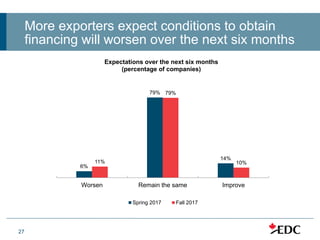
More exporters expect conditions to obtain
financing will worsen over the next six months
6%
79%
14%
11%
79%
10%
Worsen Remain the same Improve
Expectations over the next six months
(percentage of companies)
Spring 2017 Fall 2017
28
Methodological details
› Conducted twice a year since 1999, the Trade Confidence Index (TCI) is a pulse check of Canadian
exporters’ level of confidence and their projections around international trade opportunities in the next
six months.
› Sample size: 1,002
› Fall 2017 TCI sample size: 746 (respondents must respond to all five TCI questions for a TCI score)
› Respondents: decision makers who are knowledgeable about their company’s export activities
› Methodology: telephone (CATI)
› Language: respondent’s choice of English or French
› Data collection: October 2, 2017 to October 25, 2017
› Fieldwork completed by MRIA Gold Seal provider; EDC named as the sponsor of the survey
› Sampling approach: convenience sample from EDC databases
› Quotas: soft quotas of plus or minus 5% by business size, EDC customer base, region and market
sector
› Target distributions: 70% small-sized companies and 30% medium- and large-sized companies;
customer base of 20% EDC customers and 80% non-customers; distributions by region and market
sector are based on Canada’s export population.
› Don’t know responses were excluded from the calculations.
› For more information about the survey, please contact Jennifer Topping at jtopping@edc.ca
29
Ce document est également disponible en français.
This document is a compilation of publicly available information. It is not intended to provide
specific advice and should not be relied on as such. It is intended as an overview only. No
action or decision should be taken without detailed independent research and professional
advice concerning the specific subject matter of such action or decision. While Export
Development Canada (EDC) has made reasonable commercial efforts to ensure that the
information contained in this document is accurate, EDC does not represent or warrant the
accurateness, timeliness or completeness of the information contained herein. This
document or any part of it may become obsolete at any time. It is the user’s responsibility to
verify any information contained herein before relying on such information. EDC is not liable
in any manner whatsoever for any loss or damage caused by or resulting from any
inaccuracies, errors or omissions in the information contained in this document. This
document is not intended to and does not constitute legal or tax advice. For legal or tax
advice, please consult a qualified professional. EDC is the owner of trademarks and official
marks. Any use of an EDC trademark or official mark without written permission is strictly
prohibited. All other trademarks appearing in this document are the property of their
respective owners. The information presented is subject to change without notice. EDC
assumes no responsibility for inaccuracies contained herein. Copyright © 2017 Export
Development Canada. All rights reserved.
Disclaimer

Export Development Canada - Trade Confidence Index Fall 2017

  • 1.
    Fall 2017 (Released inDecember; survey conducted in October) Export Development Canada’s Trade Confidence Index A pulse check of Canada’s exporters
  • 2.
    2 › EDC’s surveyof 1,000 Canadian exporters, conducted twice a year › Uncovers issues not available in traditional trade statistics, such as Canadian exporters’: - expectations for the future - evolving international operations and strategies - views on emerging issues About the Trade Confidence Index (TCI)
  • 3.
    3 › Despite elevatedtrade policy uncertainty, the overall TCI score was down only marginally in the Fall 2017 survey, with most respondents expecting conditions to remain the same or improve over the next six months. › Almost one quarter of Canadian exporters said the on-going NAFTA talks are having a negative impact on their Canadian operations. › With CETA now provisionally in force, Canadian companies are paying more attention to the European market. Some Key Findings
  • 4.
  • 5.
    5 …driven by lowerdomestic and export sales, offset by improvements in world economic conditions. 16.1 17.0 13.4 12.8 14.7 15.6 16.6 13.2 13.3 14.8 Domestic sales Export sales Domestic economic conditions World economic conditions International business opportunities Spring 2017 Fall 2017 Exporters are asked to consider if each of the TCI elements above will increase, decrease or stay the same. The TCI is calculated by adding the scores of five elements, whose relative contributions is shown above.
  • 6.
    6 Nonetheless, most Canadianexporters expect conditions to remain the same or improve over the next six months 94% 95% 79% 75% 88% 93% 94% 79% 80% 87% Domestic sales Export sales Domestic economic conditions World economic conditions International business opportunities Spring 2017 Fall 2017
  • 7.
    7 Large firms experiencedthe biggest decline 73.9 73.6 73.7 74.0 73.5 73.4 74.5 71.6 TCI Small Medium Large Spring 2017 Fall 2017 Note: “Small” companies report under $10 million in annual sales; “medium” $10-$50 million; “large” >$50 million.
  • 8.
    8 By sector, extractivehad the largest decline; ICT and infrastructure and environment experienced increases 73.9 80.6 74.5 73.2 73.9 71.7 73.0 73.5 77.1 74.8 75.7 73.3 70.5 71.0 TCI Extractive Information & Communication Technology Infrastructure & Environment Light Manufacturing Resources Transportation Spring 2017 Fall 2017
  • 9.
    9 By region, biggestdecline in Atlantic Canada 73.9 73.9 73.6 74.9 73.5 73.5 73.7 73.3 74.4 70.8 TCI West Ontario Quebec Atlantic Spring 2017 Fall 2017
  • 10.
    10 High export intensityamong respondents, with most selling goods internationally 34% 22% 44% Fall 2017 Percentage of total sales outside Canada (percentage of companies) Less than 25% Between 25% and 50% More than 50% 71% 13% 16% Fall 2017 Percentage of international sales by type (percentage of companies) Goods Services Both
  • 11.
    11 Fewer exporters indicatedan increase in new orders from U.S. customers over the past six months 16% 17% 44% 47% 40% 36% Spring 2017 Fall 2017 In the past six months, orders from U.S. customers have… Decreased Remained the same Increased
  • 12.
    12 Most exporters importand expect to in the future 84% Fall 2017 Percentage of companies that import 3% 60% 36% Fall 2017 Expectations that imports over the next six months will… (percentage of companies) Decrease Remain the same Increase
  • 13.
    13 6% 71% 23% positiveno impact negative Impact of NAFTA renegotiation on company’s Canadian operations About one quarter of exporters indicate that NAFTA talks are having a negative impact on their Canadian operations 26% 23% 19% 14% 13% (Consider) Move(moving) Canadian operations inside the US market Attempt to diversify exports or investments into other markets Nothing Delay investment Delay hiring Actions Negatively-Affected Companies Have Taken/Are Considering Taking
  • 14.
    14 Since 2015, theshares of Canadian exporters that have started exporting to new countries, or are planning to do so, have trended down 25% 30% 35% 40% 45% 50% 55% 60% FALL 2012 SPRING 2013 FALL 2013 SPRING 2014 FALL 2014 SPRING 2015 FALL 2015 SPRING 2016 FALL 2016 SPRING 2017 FALL 2017 Shares of Canadian companies that have started exported to new countries, or are planning to do so Started exporting in last two years Planning in next two years
  • 15.
    15 Top 5 newexport markets; past and future two years 16% 11% 10% 8% 8% U.S. Australia U.K. China Mexico Started exporting past two years 15% 13% 12% 10% 10% U.K. China Germany France Mexico Planning to export next two years
  • 16.
    16 ** specific Europeanmarkets shown on the next slide. Question: In September 2017, the Comprehensive Economic and Trade Agreement or CETA between Canada and the European Union provisionally came into force. Among other things, this reduced tariffs on Canadian exports to the EU. As a result of this trade agreement, is your company: With CETA’s implementation, Canadian exporters are paying more attention to Europe 26% 18% 15% 11% 11% 56% Paying more attention to European market Developing new products, services or production proceses to start selling to Europe* Increasing production to expand existing export volumes to Europe* Starting to importing inputs from Europe Increasing the use of imported European production inputs Trade agreements don't affect my company's exporting strategy
  • 17.
    17 Of those Canadianexporters keying on European markets, these are the top 5 destinations 41% 26% 17% 17% 14% Germany France United Kingdom Italy Spain Countries companies are increasing production to expand existing export volumes in Europe 42% 36% 27% 15% 12% Germany France United Kingdom Italy Spain Countries companies are developing new products, services or production processes to start selling to Europe
  • 18.
    18 Question: What challengesdoes your company face exporting to or investing in China? 133 respondents 28% 21% 21% 20% 16% Conforming with local regulations or standards Protecting intellectual property Language and cultural differences Building relationships Obtaining market information Top 5 challenges for current Canadian exporters in the Chinese market
  • 19.
    19 Exchange rate mattersfor Canadian exporters’ ability to compete abroad 11% 33% 57% Importance of the current level of Canadian dollar to compete in foreign markets (percentage of companies) Not at all important Somewhat important Very important
  • 20.
    20 Stronger Canadian dollarmay weigh on exports going forward 3% 5% 51% 59% 46% 36% Spring 2017 Fall 2017 Companies’ expectations of export sales if the Canadian dollar stays around current level for the next two years (percentage of companies) Decrease Remain the same Increase
  • 21.
    21 4% 76% 21% positiveno impact negative Impact of higher interest rates on export sales About one-fifth of exporters say higher interest rates have had a negative impact on their export sales 48% of those who indicate higher interest rates will have a negative impact on export sales, say it will cost them more and result in lower profit margins. 13% of those who indicate higher interest rates will have a negative impact on export sales, say it will force them to raise their prices or will make them less competitive.
  • 22.
    22 Top 5 destinationsfor Canadian investments abroad 69% 13% 8% 5% 4% U.S. China U.K. Mexico Brazil In the Fall 2017 Survey, 11% of Canadian exporters had investments abroad
  • 23.
    23 Top 5 reasonsfor having investments outside of Canada 21% 15% 9% 8% 8% Increase market penetration Proximity/access to clients/partners Company's expansion/growth Deal with logistics/regulations/increase efficiency/lower costs Improve customer service/experience
  • 24.
    24 Top 5 challengeswith investments abroad 14% 9% 6% 5% 5% Complying with local laws and regulations Hiring staff/labour shortages Lack of capital/financing Transportation issues/costs Taxation/tax policies
  • 25.
    25 Fewer exporters expectforeign affiliate sales and investments to increase over the next six months 72% 66% Spring 2017 Fall 2017 Expect that sales by foreign affiliates will increase over the next six months (percentage of companies) 44% 39% Spring 2017 Fall 2017 Expect that outward investments will increase over the next six months (percentage of companies)
  • 26.
    26 Exporters indicate increaseddifficulty accessing skilled labour 27% 49% 24%25% 45% 30% Not difficult at all Moderately difficult Very difficult Getting access to skilled labour (percentage of companies) Spring 2017 Fall 2017
  • 27.
    27 More exporters expectconditions to obtain financing will worsen over the next six months 6% 79% 14% 11% 79% 10% Worsen Remain the same Improve Expectations over the next six months (percentage of companies) Spring 2017 Fall 2017
  • 28.
    28 Methodological details › Conductedtwice a year since 1999, the Trade Confidence Index (TCI) is a pulse check of Canadian exporters’ level of confidence and their projections around international trade opportunities in the next six months. › Sample size: 1,002 › Fall 2017 TCI sample size: 746 (respondents must respond to all five TCI questions for a TCI score) › Respondents: decision makers who are knowledgeable about their company’s export activities › Methodology: telephone (CATI) › Language: respondent’s choice of English or French › Data collection: October 2, 2017 to October 25, 2017 › Fieldwork completed by MRIA Gold Seal provider; EDC named as the sponsor of the survey › Sampling approach: convenience sample from EDC databases › Quotas: soft quotas of plus or minus 5% by business size, EDC customer base, region and market sector › Target distributions: 70% small-sized companies and 30% medium- and large-sized companies; customer base of 20% EDC customers and 80% non-customers; distributions by region and market sector are based on Canada’s export population. › Don’t know responses were excluded from the calculations. › For more information about the survey, please contact Jennifer Topping at jtopping@edc.ca
  • 29.
    29 Ce document estégalement disponible en français. This document is a compilation of publicly available information. It is not intended to provide specific advice and should not be relied on as such. It is intended as an overview only. No action or decision should be taken without detailed independent research and professional advice concerning the specific subject matter of such action or decision. While Export Development Canada (EDC) has made reasonable commercial efforts to ensure that the information contained in this document is accurate, EDC does not represent or warrant the accurateness, timeliness or completeness of the information contained herein. This document or any part of it may become obsolete at any time. It is the user’s responsibility to verify any information contained herein before relying on such information. EDC is not liable in any manner whatsoever for any loss or damage caused by or resulting from any inaccuracies, errors or omissions in the information contained in this document. This document is not intended to and does not constitute legal or tax advice. For legal or tax advice, please consult a qualified professional. EDC is the owner of trademarks and official marks. Any use of an EDC trademark or official mark without written permission is strictly prohibited. All other trademarks appearing in this document are the property of their respective owners. The information presented is subject to change without notice. EDC assumes no responsibility for inaccuracies contained herein. Copyright © 2017 Export Development Canada. All rights reserved. Disclaimer