Feasible and regionally contextualized guidelines for
measuring, mapping, monitoring and reporting on
SOC stocks and SOC changes (MRV-RECSOIL)
RECSOIL-MRV
Background
• There is a growing need for standardized, credible,
reliable, cost effective and feasible MRV platform for
SOC changes.
OBJECTIVE:
To develop a feasible MRV protocol for the GSP
RECSOIL initiative, to be used as a standard
protocol for carbon offset projects at farm scale.
RECSOIL-MRV
General Characteristics:
 Focus on soil carbon sequestration at farm and field level;
 Designed for specified SSM management practices, in croplands and
grasslands;
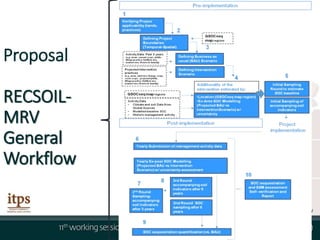
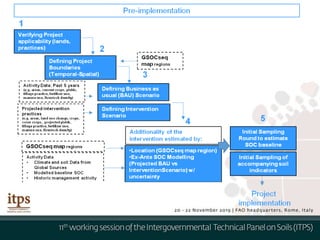
 SOC sequestration assessed vs . Business As Usual practice (BAU) (last 5
years records);
 Additionality assessed considering project location within GSOCseq map and
Ex-ante SOC modelling;
 Monitoring scheme:
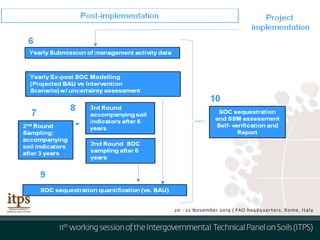
 Combines modelling (yearly) and in-situ SOC measurements (SOC stocks
every 6 years)
 Includes accompanying SSM indicators (every 3 years)
Proposal
RECSOIL-
MRV
General
Workflow
RECSOIL-MRV Protocol
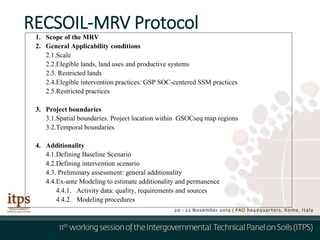
1. Scope of the MRV
2. General Applicability conditions
2.1.Scale
2.2.Elegible lands, land uses and productive systems
2.3. Restricted lands
2.4.Elegible intervention practices: GSP SOC-centered SSM practices
2.5.Restricted practices
3. Project boundaries
3.1.Spatial boundaries. Project location within GSOCseq map regions
3.2.Temporal boundaries
4. Additionality
4.1.Defining Baseline Scenario
4.2.Defining intervention scenario
4.3. Preliminary assessment: general additionality
4.4.Ex-ante Modeling to estimate additionality and permanence
4.4.1. Activity data: quality, requirements and sources
4.4.2. Modeling procedures
5. Monitoring of project implementation
5.1.Determination of Baseline and SOC stocks
RECSOIL-MRV Protocol
4.4.Ex-ante Modeling to estimate additionality and permanence
4.4.1. Activity data: quality, requirements and sources
4.4.2. Modeling procedures
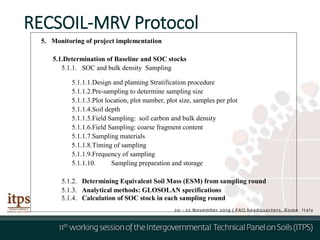
5. Monitoring of project implementation
5.1.Determination of Baseline and SOC stocks
5.1.1. SOC and bulk density Sampling
5.1.1.1.Design and planning Stratification procedure
5.1.1.2.Pre-sampling to determine sampling size
5.1.1.3.Plot location, plot number, plot size, samples per plot
5.1.1.4.Soil depth
5.1.1.5.Field Sampling: soil carbon and bulk density
5.1.1.6.Field Sampling: coarse fragment content
5.1.1.7.Sampling materials
5.1.1.8.Timing of sampling
5.1.1.9.Frequency of sampling
5.1.1.10. Sampling preparation and storage
5.1.2. Determining Equivalent Soil Mass (ESM) from sampling round
5.1.3. Analytical methods: GLOSOLAN specifications
5.1.4. Calculation of SOC stock in each sampling round
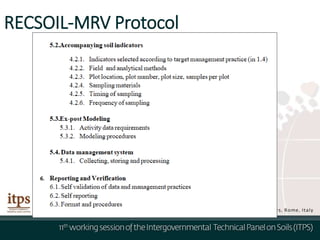
5.2.Accompanying soil indicators
RECSOIL-MRV Protocol
RECSOIL  MRV

RECSOIL MRV

  • 1.
    Feasible and regionallycontextualized guidelines for measuring, mapping, monitoring and reporting on SOC stocks and SOC changes (MRV-RECSOIL) RECSOIL-MRV
  • 2.
    Background • There isa growing need for standardized, credible, reliable, cost effective and feasible MRV platform for SOC changes. OBJECTIVE: To develop a feasible MRV protocol for the GSP RECSOIL initiative, to be used as a standard protocol for carbon offset projects at farm scale.
  • 3.
    RECSOIL-MRV General Characteristics:  Focuson soil carbon sequestration at farm and field level;  Designed for specified SSM management practices, in croplands and grasslands;  SOC sequestration assessed vs . Business As Usual practice (BAU) (last 5 years records);  Additionality assessed considering project location within GSOCseq map and Ex-ante SOC modelling;  Monitoring scheme:  Combines modelling (yearly) and in-situ SOC measurements (SOC stocks every 6 years)  Includes accompanying SSM indicators (every 3 years)
  • 4.
  • 7.
    RECSOIL-MRV Protocol 1. Scopeof the MRV 2. General Applicability conditions 2.1.Scale 2.2.Elegible lands, land uses and productive systems 2.3. Restricted lands 2.4.Elegible intervention practices: GSP SOC-centered SSM practices 2.5.Restricted practices 3. Project boundaries 3.1.Spatial boundaries. Project location within GSOCseq map regions 3.2.Temporal boundaries 4. Additionality 4.1.Defining Baseline Scenario 4.2.Defining intervention scenario 4.3. Preliminary assessment: general additionality 4.4.Ex-ante Modeling to estimate additionality and permanence 4.4.1. Activity data: quality, requirements and sources 4.4.2. Modeling procedures 5. Monitoring of project implementation 5.1.Determination of Baseline and SOC stocks
  • 8.
    RECSOIL-MRV Protocol 4.4.Ex-ante Modelingto estimate additionality and permanence 4.4.1. Activity data: quality, requirements and sources 4.4.2. Modeling procedures 5. Monitoring of project implementation 5.1.Determination of Baseline and SOC stocks 5.1.1. SOC and bulk density Sampling 5.1.1.1.Design and planning Stratification procedure 5.1.1.2.Pre-sampling to determine sampling size 5.1.1.3.Plot location, plot number, plot size, samples per plot 5.1.1.4.Soil depth 5.1.1.5.Field Sampling: soil carbon and bulk density 5.1.1.6.Field Sampling: coarse fragment content 5.1.1.7.Sampling materials 5.1.1.8.Timing of sampling 5.1.1.9.Frequency of sampling 5.1.1.10. Sampling preparation and storage 5.1.2. Determining Equivalent Soil Mass (ESM) from sampling round 5.1.3. Analytical methods: GLOSOLAN specifications 5.1.4. Calculation of SOC stock in each sampling round 5.2.Accompanying soil indicators
  • 9.