Face Value Report
AN AN ALYS IS O F IN FLU E N C E R
M AR K E TIN G IN TH E FA S T M OV IN G
C O NSU M E R GOO DS (FM C G) IN D US TRY
Face Value Report
Nearly a quarter of FMCG companies suffered a $100,000-
$250,000 loss from a negative influencer experience
By 2021 almost half of FMCG companies are set to spend
30-50% of marketing budget on influencers
More than one in 10 FMCG companies gained $1.1mn-$5mn
from their most successful influencer campaign
Duff & Phelps2
Face Value Report
Devotion to our digital devices has skyrocketed
during the coronavirus lockdown and has
supercharged an already booming part of the
marketing industry.
In less than a decade, the influencer profession has leapt from a standing start to
what is expected to be a $15 billion global industry by 20221
.
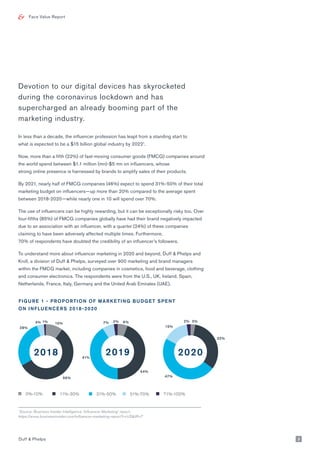
Now, more than a fifth (22%) of fast-moving consumer goods (FMCG) companies around
the world spend between $1.1 million (mn)-$5 mn on influencers, whose
strong online presence is harnessed by brands to amplify sales of their products.
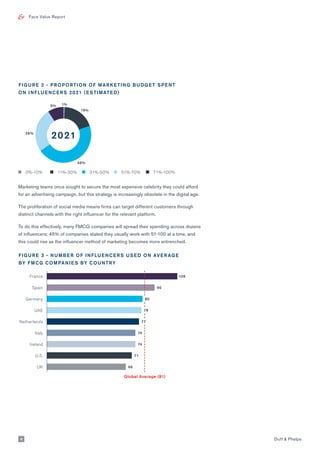
By 2021, nearly half of FMCG companies (46%) expect to spend 31%-50% of their total
marketing budget on influencers—up more than 20% compared to the average spent
between 2018-2020—while nearly one in 10 will spend over 70%.
The use of influencers can be highly rewarding, but it can be exceptionally risky too. Over
four-fifths (85%) of FMCG companies globally have had their brand negatively impacted
due to an association with an influencer, with a quarter (24%) of these companies
claiming to have been adversely affected multiple times. Furthermore,
70% of respondents have doubted the credibility of an influencer’s followers.
To understand more about influencer marketing in 2020 and beyond, Duff & Phelps and
Kroll, a division of Duff & Phelps, surveyed over 900 marketing and brand managers
within the FMCG market, including companies in cosmetics, food and beverage, clothing
and consumer electronics. The respondents were from the U.S., UK, Ireland, Spain,
Netherlands, France, Italy, Germany and the United Arab Emirates (UAE).
1
Source: Business Insider Intelligence ‘Influencer Marketing’ report:
https://www.businessinsider.com/influencer-marketing-report?r=US&IR=T
FIGURE 1 - PROPORTION OF MARKETING BUDGET SPENT
ON INFLUENCERS 2018-2020
Duff & Phelps 3
10%
56%
28%
4% 1%
2018
6%
44%
41%
7% 2%
2019
3%2%
32%
47%
15%
2020
0%-10% 11%-30% 31%-50% 51%-70% 71%-100%
Face Value Report
FIGURE 2 - PROPORTION OF MARKETING BUDGET SPENT
ON INFLUENCERS 2021 (ESTIMATED)
FIGURE 3 - NUMBER OF INFLUENCERS USED ON AVERAGE
BY FMCG COMPANIES BY COUNTRY
Marketing teams once sought to secure the most expensive celebrity they could afford
for an advertising campaign, but this strategy is increasingly obsolete in the digital age.
The proliferation of social media means firms can target different customers through
distinct channels with the right influencer for the relevant platform.
To do this effectively, many FMCG companies will spread their spending across dozens
of influencers; 45% of companies stated they usually work with 51-100 at a time, and
this could rise as the influencer method of marketing becomes more entrenched.
1%
19%
46%
26%
9%
2021
Duff & Phelps4
France
Spain
Germany
UAE
Netherlands
Italy
Ireland
U.S.
UK
109
90
80
79
77
74
74
71
66
0%-10% 11%-30% 31%-50% 51%-70% 71%-100%
Global Average (81)
Face Value Report
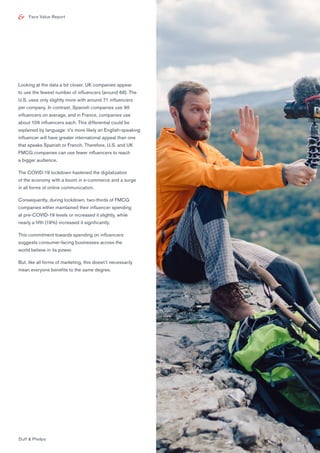
Looking at the data a bit closer, UK companies appear
to use the fewest number of influencers (around 66). The
U.S. uses only slightly more with around 71 influencers
per company. In contrast, Spanish companies use 90
influencers on average, and in France, companies use
about 109 influencers each. This differential could be
explained by language: it’s more likely an English-speaking
influencer will have greater international appeal than one
that speaks Spanish or French. Therefore, U.S. and UK
FMCG companies can use fewer influencers to reach
a bigger audience.
The COVID-19 lockdown hastened the digitalization
of the economy with a boom in e-commerce and a surge
in all forms of online communication.
Consequently, during lockdown, two-thirds of FMCG
companies either maintained their influencer spending
at pre-COVID-19 levels or increased it slightly, while
nearly a fifth (19%) increased it significantly.
This commitment towards spending on influencers
suggests consumer-facing businesses across the
world believe in its power.
But, like all forms of marketing, this doesn’t necessarily
mean everyone benefits to the same degree.
Duff & Phelps 5
Face Value Report
Securing Success
COUNTRY
COST PER
INFLUENCER IN
USD/YEAR
SALES INCREASE
TO EXPENSE RATIO
UAE $15,612 82%
UK $18,602 73%
U.S. $13,153 56%
France $22,104 52%
Germany $22,622 51%
Global Average $22,151 46%
Spain $24,861 43%
Netherlands $26,337 36%
Ireland $24,952 32%
Italy $29,972 19%
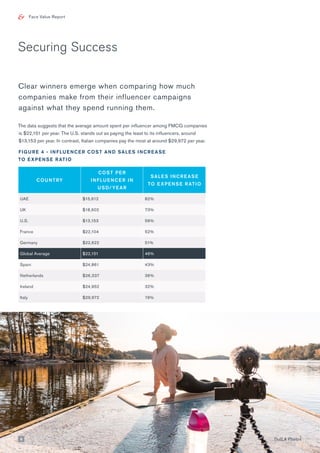
FIGURE 4 - INFLUENCER COST AND SALES INCREASE
TO EXPENSE RATIO
Clear winners emerge when comparing how much
companies make from their influencer campaigns
against what they spend running them.
The data suggests that the average amount spent per influencer among FMCG companies
is $22,151 per year. The U.S. stands out as paying the least to its influencers, around
$13,153 per year. In contrast, Italian companies pay the most at around $29,972 per year.
Duff & Phelps6
Face Value Report
UAE 82%
U.S. 56%
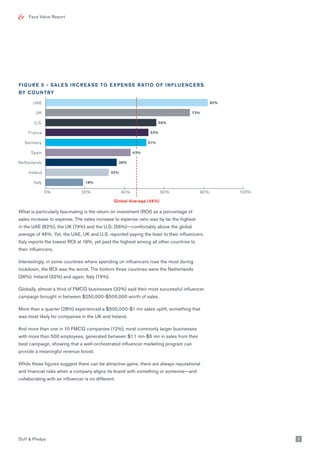
What is particularly fascinating is the return on investment (ROI) as a percentage of
sales increase to expense. The sales increase to expense ratio was by far the highest
in the UAE (82%), the UK (74%) and the U.S. (56%)—comfortably above the global
average of 46%. Yet, the UAE, UK and U.S. reported paying the least to their influencers.
Italy reports the lowest ROI at 19%, yet paid the highest among all other countries to
their influencers.
Interestingly, in some countries where spending on influencers rose the most during
lockdown, the ROI was the worst. The bottom three countries were the Netherlands
(36%), Ireland (32%) and again, Italy (19%).
Globally, almost a third of FMCG businesses (32%) said their most successful influencer
campaign brought in between $250,000-$500,000 worth of sales.
More than a quarter (28%) experienced a $500,000-$1 mn sales uplift, something that
was most likely for companies in the UK and Ireland.
And more than one in 10 FMCG companies (12%), most commonly larger businesses
with more than 500 employees, generated between $1.1 mn-$5 mn in sales from their
best campaign, showing that a well-orchestrated influencer marketing program can
provide a meaningful revenue boost.
While these figures suggest there can be attractive gains, there are always reputational
and financial risks when a company aligns its brand with something or someone—and
collaborating with an influencer is no different.
FIGURE 5 - SALES INCREASE TO EXPENSE RATIO OF INFLUENCERS
BY COUNTRY
Global Average (46%)
UK 73%
France 52%
Germany 51%
Spain 43%
Ireland 32%
Netherlands 36%
Italy 19%
Duff & Phelps 7
0% 20% 40% 60% 80% 100%
Face Value Report
U.S.UAE UKFrance GermanySpain IrelandNetherlandsItaly
Relationship Problems
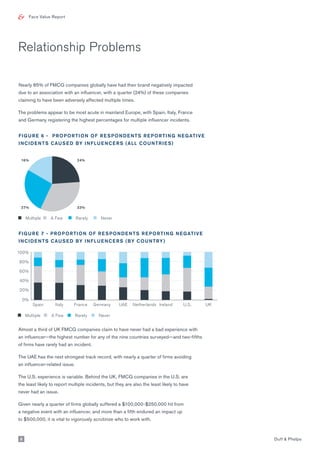
FIGURE 6 - PROPORTION OF RESPONDENTS REPORTING NEGATIVE
INCIDENTS CAUSED BY INFLUENCERS (ALL COUNTRIES)
FIGURE 7 - PROPORTION OF RESPONDENTS REPORTING NEGATIVE
INCIDENTS CAUSED BY INFLUENCERS (BY COUNTRY)
Almost a third of UK FMCG companies claim to have never had a bad experience with
an influencer—the highest number for any of the nine countries surveyed—and two-fifths
of firms have rarely had an incident.
The UAE has the next strongest track record, with nearly a quarter of firms avoiding
an influencer-related issue.
The U.S. experience is variable. Behind the UK, FMCG companies in the U.S. are
the least likely to report multiple incidents, but they are also the least likely to have
never had an issue.
Given nearly a quarter of firms globally suffered a $100,000-$250,000 hit from
a negative event with an influencer, and more than a fifth endured an impact up
to $500,000, it is vital to vigorously scrutinize who to work with.
Nearly 85% of FMCG companies globally have had their brand negatively impacted
due to an association with an influencer, with a quarter (24%) of these companies
claiming to have been adversely affected multiple times.
The problems appear to be most acute in mainland Europe, with Spain, Italy, France
and Germany registering the highest percentages for multiple influencer incidents.
0%
100%
20%
40%
60%
80%
24%
33%27%
16%
Duff & Phelps8
Multiple A Few Rarely Never
Face Value Report
Don’t Take it at Face Value
Every business decision requires due diligence,
including selecting the right influencer to represent
your brand to a particular type of consumer.
It is easy for an influencer to overstate their importance by exaggerating their social
media following—a central concern for firms that use this form of marketing.
Our research showed that more than two-thirds (69%) of FMCG companies
had doubted an influencer’s follower count on one or multiple occasions compared
to just a quarter (26%) who never had any concerns.
It is noteworthy that in the UK, where just over half of businesses (51%) had never had
such doubts about followers, the use of third-party influencer verification specialists
was among the highest.
Proving direct causation here would be extremely difficult, but such a correlation
is also visible in the Netherlands.
Conversely in Germany, where only 4% of businesses have never had an issue, firms
are more likely to use their marketing agencies to vet influencers for them rather than
a specialist.
The largest proportion of FMCG firms globally employ a dedicated person or team
to vet their prospective influencers, suggesting that companies understand the
importance of investing in this skill, regardless of how they go about it.
Duff & Phelps 9
Face Value Report
Sizeable Impact
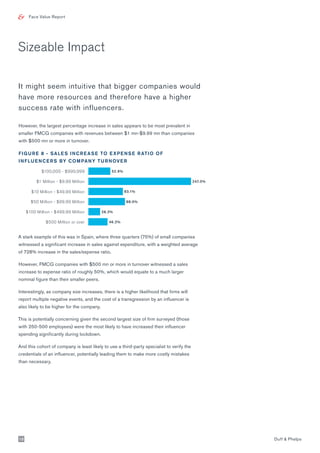
A stark example of this was in Spain, where three quarters (75%) of small companies
witnessed a significant increase in sales against expenditure, with a weighted average
of 728% increase in the sales/expense ratio.
However, FMCG companies with $500 mn or more in turnover witnessed a sales
increase to expense ratio of roughly 50%, which would equate to a much larger
nominal figure than their smaller peers.
Interestingly, as company size increases, there is a higher likelihood that firms will
report multiple negative events, and the cost of a transgression by an influencer is
also likely to be higher for the company.
This is potentially concerning given the second largest size of firm surveyed (those
with 250-500 employees) were the most likely to have increased their influencer
spending significantly during lockdown.
And this cohort of company is least likely to use a third-party specialist to verify the
credentials of an influencer, potentially leading them to make more costly mistakes
than necessary.
It might seem intuitive that bigger companies would
have more resources and therefore have a higher
success rate with influencers.
However, the largest percentage increase in sales appears to be most prevalent in
smaller FMCG companies with revenues between $1 mn-$9.99 mn than companies
with $500 mn or more in turnover.
$100,000 - $999,999
$1 Million - $9.99 Million
$10 Million - $49.99 Million
$50 Million - $99.99 Million
$100 Million - $499.99 Million
$500 Million or over
52.9%
247.0%
83.1%
88.0%
28.3%
46.2%
FIGURE 8 - SALES INCREASE TO EXPENSE RATIO OF
INFLUENCERS BY COMPANY TURNOVER
Duff & Phelps10
Face Value Report
Sector Influence
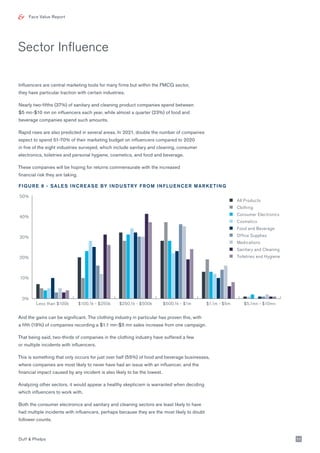
FIGURE 9 - SALES INCREASE BY INDUSTRY FROM INFLUENCER MARKETING
And the gains can be significant. The clothing industry in particular has proven this, with
a fifth (19%) of companies recording a $1.1 mn-$5 mn sales increase from one campaign.
That being said, two-thirds of companies in the clothing industry have suffered a few
or multiple incidents with influencers.
This is something that only occurs for just over half (55%) of food and beverage businesses,
where companies are most likely to never have had an issue with an influencer, and the
financial impact caused by any incident is also likely to be the lowest.
Analyzing other sectors, it would appear a healthy skepticism is warranted when deciding
which influencers to work with.
Both the consumer electronics and sanitary and cleaning sectors are least likely to have
had multiple incidents with influencers, perhaps because they are the most likely to doubt
follower counts.
Influencers are central marketing tools for many firms but within the FMCG sector,
they have particular traction with certain industries.
Nearly two-fifths (37%) of sanitary and cleaning product companies spend between
$5 mn-$10 mn on influencers each year, while almost a quarter (23%) of food and
beverage companies spend such amounts.
Rapid rises are also predicted in several areas. In 2021, double the number of companies
expect to spend 51-70% of their marketing budget on influencers compared to 2020
in five of the eight industries surveyed, which include sanitary and cleaning, consumer
electronics, toiletries and personal hygiene, cosmetics, and food and beverage.
These companies will be hoping for returns commensurate with the increased
financial risk they are taking.
Less than $100k $100.1k - $250k $250.1k - $500k $500.1k - $1m $1.1m - $5m $5.1mn - $10mn
0%
20%
30%
40%
10%
50%
Duff & Phelps 11
All Products
Cosmetics
Toiletries and Hygiene
Office Supplies
Sanitary and Cleaning
Food and Beverage
Medications
Clothing
Consumer Electronics
Face Value Report
Who Can You Trust?
2
Source: CHEQ report – ‘The Economic Cost of Bad Actors on the Internet’
https://www.cheq.ai/affiliatefraudcosts
Nearly all mega-influencers (97%) often or always hit the targets set for them by the
brand they are representing, although nano-influencers perform strongly too, with
almost three-quarters (74%) of them often or always achieving the stated aims.
However, companies should be most cautious when working with nano-influencers.
Of the companies surveyed, 84% have had at least a few issues with this group. What’s
more worrying is every FMCG company surveyed who uses nano-influencers has had at
least one negative incident with the group. Micro-influencers were the second most likely
to cause a negative incident among FMCG companies, with 66% stating that this group
had either caused a few or multiple incidents.
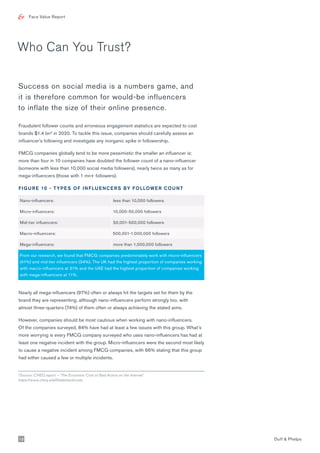
FIGURE 10 - TYPES OF INFLUENCERS BY FOLLOWER COUNT
Nano-influencers: less than 10,000 followers
Micro-influencers: 10,000-50,000 followers
Mid-tier influencers: 50,001-500,000 followers
Macro-influencers: 500,001-1,000,000 followers
Mega-influencers: more than 1,000,000 followers
From our research, we found that FMCG companies predominately work with micro-influencers
(41%) and mid-tier influencers (34%). The UK had the highest proportion of companies working
with macro-influencers at 31% and the UAE had the highest proportion of companies working
with mega-influencers at 11%.
Success on social media is a numbers game, and
it is therefore common for would-be influencers
to inflate the size of their online presence.
Fraudulent follower counts and erroneous engagement statistics are expected to cost
brands $1.4 bn2
in 2020. To tackle this issue, companies should carefully assess an
influencer’s following and investigate any inorganic spike in followership.
FMCG companies globally tend to be more pessimistic the smaller an influencer is:
more than four in 10 companies have doubted the follower count of a nano-influencer
(someone with less than 10,000 social media followers), nearly twice as many as for
mega-influencers (those with 1 mn+ followers).
Duff & Phelps12
Face Value Report
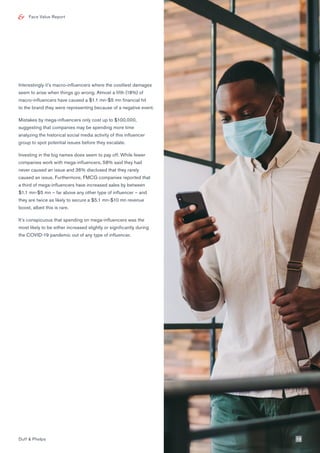
Interestingly it’s macro-influencers where the costliest damages
seem to arise when things go wrong. Almost a fifth (18%) of
macro-influencers have caused a $1.1 mn-$5 mn financial hit
to the brand they were representing because of a negative event.
Mistakes by mega-influencers only cost up to $100,000,
suggesting that companies may be spending more time
analyzing the historical social media activity of this influencer
group to spot potential issues before they escalate.
Investing in the big names does seem to pay off. While fewer
companies work with mega-influencers, 58% said they had
never caused an issue and 36% disclosed that they rarely
caused an issue. Furthermore, FMCG companies reported that
a third of mega-influencers have increased sales by between
$1.1 mn-$5 mn – far above any other type of influencer – and
they are twice as likely to secure a $5.1 mn-$10 mn revenue
boost, albeit this is rare.
It’s conspicuous that spending on mega-influencers was the
most likely to be either increased slightly or significantly during
the COVID-19 pandemic out of any type of influencer.
Duff & Phelps 13
Face Value Report
Brand Protection
Companies spend years creating a brand that engenders trust and loyalty,
characteristics that are hard-fought for but easily lost, and very difficult to get back.
When a negative incident with an influencer occurs, the reputational damage for the
company that follows can have long-term commercial impacts: from loss of sales to
surmounting legal fees or reduced share price.
The potential danger of using influencers is potent enough that some firms listed on the
stock exchange cite the use of social media influencers as a potential financial and
reputational risk for would-be investors.
Damages caused by an influencer from a single incident can continue to flare up long
after the occurrence has passed and could permanently alienate valuable customers.
This suggests every company, whether listed or not, should thoroughly research the
person it is entrusting with its brand to ensure it maximizes the chances of success and
mitigates the likelihood of reputational damage.
Many companies are now taking a more proactive approach to managing influencer risk.
Firms like Kroll can provide services to identify potentially sensitive issues on both
standard and audio-visual platforms, including those posted many years ago, to allow
brands to establish whether or not an influencer’s values match their own.
Duff & Phelps14
Face Value Report
Contact Kroll, a division of Duff & Phelps for
more information about Social Media Influencer
Risk Assessments.
Contact Duff & Phelps for more information
about Valuation Services.
Methodology
Duff & Phelps and Kroll commissioned a survey of 917 marketing/brand managers
working in fast moving consumer goods (FMCG) businesses across the UK, U.S.,
France, Germany, Ireland, Netherlands, Spain, Italy and the United Arab Emirates, to
assess the current state of influencer marketing for FMCG brands and establish whether
the COVID-19 pandemic had an impact on marketing spend. The research was
conducted via an anonymous survey in June 2020.
Contact
Duff & Phelps 15
About Duff & Phelps
Duff & Phelps is the world’s premier provider of governance, risk and transparency
solutions. We work with clients across diverse sectors in the areas of valuation,
corporate finance, disputes and investigations, cyber security, claims administration
and regulatory compliance. With Kroll, the leading global provider of risk solutions,
and Prime Clerk, the leader in complex business services and claims administration,
our firm has nearly 4,000 professionals in 25 countries around the world. For more
information, visit www.duffandphelps.com.
© 2020 Duff & Phelps, LLC. All rights reserved. DP203003
About Kroll:
Kroll is the leading global provider of risk solutions. For more than 45 years, Kroll
has helped clients make confident risk management decisions about people, assets,
operations and security through a wide range of investigations, cyber security, due
diligence and compliance, physical and operational security, and data and
information management services. For more information, visit www.kroll.com.

The Face Value Report by Duff & Phelps and Kroll

  • 1.
    Face Value Report ANAN ALYS IS O F IN FLU E N C E R M AR K E TIN G IN TH E FA S T M OV IN G C O NSU M E R GOO DS (FM C G) IN D US TRY
  • 2.
    Face Value Report Nearlya quarter of FMCG companies suffered a $100,000- $250,000 loss from a negative influencer experience By 2021 almost half of FMCG companies are set to spend 30-50% of marketing budget on influencers More than one in 10 FMCG companies gained $1.1mn-$5mn from their most successful influencer campaign Duff & Phelps2
  • 3.
    Face Value Report Devotionto our digital devices has skyrocketed during the coronavirus lockdown and has supercharged an already booming part of the marketing industry. In less than a decade, the influencer profession has leapt from a standing start to what is expected to be a $15 billion global industry by 20221 . Now, more than a fifth (22%) of fast-moving consumer goods (FMCG) companies around the world spend between $1.1 million (mn)-$5 mn on influencers, whose strong online presence is harnessed by brands to amplify sales of their products. By 2021, nearly half of FMCG companies (46%) expect to spend 31%-50% of their total marketing budget on influencers—up more than 20% compared to the average spent between 2018-2020—while nearly one in 10 will spend over 70%. The use of influencers can be highly rewarding, but it can be exceptionally risky too. Over four-fifths (85%) of FMCG companies globally have had their brand negatively impacted due to an association with an influencer, with a quarter (24%) of these companies claiming to have been adversely affected multiple times. Furthermore, 70% of respondents have doubted the credibility of an influencer’s followers. To understand more about influencer marketing in 2020 and beyond, Duff & Phelps and Kroll, a division of Duff & Phelps, surveyed over 900 marketing and brand managers within the FMCG market, including companies in cosmetics, food and beverage, clothing and consumer electronics. The respondents were from the U.S., UK, Ireland, Spain, Netherlands, France, Italy, Germany and the United Arab Emirates (UAE). 1 Source: Business Insider Intelligence ‘Influencer Marketing’ report: https://www.businessinsider.com/influencer-marketing-report?r=US&IR=T FIGURE 1 - PROPORTION OF MARKETING BUDGET SPENT ON INFLUENCERS 2018-2020 Duff & Phelps 3 10% 56% 28% 4% 1% 2018 6% 44% 41% 7% 2% 2019 3%2% 32% 47% 15% 2020 0%-10% 11%-30% 31%-50% 51%-70% 71%-100%
  • 4.
    Face Value Report FIGURE2 - PROPORTION OF MARKETING BUDGET SPENT ON INFLUENCERS 2021 (ESTIMATED) FIGURE 3 - NUMBER OF INFLUENCERS USED ON AVERAGE BY FMCG COMPANIES BY COUNTRY Marketing teams once sought to secure the most expensive celebrity they could afford for an advertising campaign, but this strategy is increasingly obsolete in the digital age. The proliferation of social media means firms can target different customers through distinct channels with the right influencer for the relevant platform. To do this effectively, many FMCG companies will spread their spending across dozens of influencers; 45% of companies stated they usually work with 51-100 at a time, and this could rise as the influencer method of marketing becomes more entrenched. 1% 19% 46% 26% 9% 2021 Duff & Phelps4 France Spain Germany UAE Netherlands Italy Ireland U.S. UK 109 90 80 79 77 74 74 71 66 0%-10% 11%-30% 31%-50% 51%-70% 71%-100% Global Average (81)
  • 5.
    Face Value Report Lookingat the data a bit closer, UK companies appear to use the fewest number of influencers (around 66). The U.S. uses only slightly more with around 71 influencers per company. In contrast, Spanish companies use 90 influencers on average, and in France, companies use about 109 influencers each. This differential could be explained by language: it’s more likely an English-speaking influencer will have greater international appeal than one that speaks Spanish or French. Therefore, U.S. and UK FMCG companies can use fewer influencers to reach a bigger audience. The COVID-19 lockdown hastened the digitalization of the economy with a boom in e-commerce and a surge in all forms of online communication. Consequently, during lockdown, two-thirds of FMCG companies either maintained their influencer spending at pre-COVID-19 levels or increased it slightly, while nearly a fifth (19%) increased it significantly. This commitment towards spending on influencers suggests consumer-facing businesses across the world believe in its power. But, like all forms of marketing, this doesn’t necessarily mean everyone benefits to the same degree. Duff & Phelps 5
  • 6.
    Face Value Report SecuringSuccess COUNTRY COST PER INFLUENCER IN USD/YEAR SALES INCREASE TO EXPENSE RATIO UAE $15,612 82% UK $18,602 73% U.S. $13,153 56% France $22,104 52% Germany $22,622 51% Global Average $22,151 46% Spain $24,861 43% Netherlands $26,337 36% Ireland $24,952 32% Italy $29,972 19% FIGURE 4 - INFLUENCER COST AND SALES INCREASE TO EXPENSE RATIO Clear winners emerge when comparing how much companies make from their influencer campaigns against what they spend running them. The data suggests that the average amount spent per influencer among FMCG companies is $22,151 per year. The U.S. stands out as paying the least to its influencers, around $13,153 per year. In contrast, Italian companies pay the most at around $29,972 per year. Duff & Phelps6
  • 7.
    Face Value Report UAE82% U.S. 56% What is particularly fascinating is the return on investment (ROI) as a percentage of sales increase to expense. The sales increase to expense ratio was by far the highest in the UAE (82%), the UK (74%) and the U.S. (56%)—comfortably above the global average of 46%. Yet, the UAE, UK and U.S. reported paying the least to their influencers. Italy reports the lowest ROI at 19%, yet paid the highest among all other countries to their influencers. Interestingly, in some countries where spending on influencers rose the most during lockdown, the ROI was the worst. The bottom three countries were the Netherlands (36%), Ireland (32%) and again, Italy (19%). Globally, almost a third of FMCG businesses (32%) said their most successful influencer campaign brought in between $250,000-$500,000 worth of sales. More than a quarter (28%) experienced a $500,000-$1 mn sales uplift, something that was most likely for companies in the UK and Ireland. And more than one in 10 FMCG companies (12%), most commonly larger businesses with more than 500 employees, generated between $1.1 mn-$5 mn in sales from their best campaign, showing that a well-orchestrated influencer marketing program can provide a meaningful revenue boost. While these figures suggest there can be attractive gains, there are always reputational and financial risks when a company aligns its brand with something or someone—and collaborating with an influencer is no different. FIGURE 5 - SALES INCREASE TO EXPENSE RATIO OF INFLUENCERS BY COUNTRY Global Average (46%) UK 73% France 52% Germany 51% Spain 43% Ireland 32% Netherlands 36% Italy 19% Duff & Phelps 7 0% 20% 40% 60% 80% 100%
  • 8.
    Face Value Report U.S.UAEUKFrance GermanySpain IrelandNetherlandsItaly Relationship Problems FIGURE 6 - PROPORTION OF RESPONDENTS REPORTING NEGATIVE INCIDENTS CAUSED BY INFLUENCERS (ALL COUNTRIES) FIGURE 7 - PROPORTION OF RESPONDENTS REPORTING NEGATIVE INCIDENTS CAUSED BY INFLUENCERS (BY COUNTRY) Almost a third of UK FMCG companies claim to have never had a bad experience with an influencer—the highest number for any of the nine countries surveyed—and two-fifths of firms have rarely had an incident. The UAE has the next strongest track record, with nearly a quarter of firms avoiding an influencer-related issue. The U.S. experience is variable. Behind the UK, FMCG companies in the U.S. are the least likely to report multiple incidents, but they are also the least likely to have never had an issue. Given nearly a quarter of firms globally suffered a $100,000-$250,000 hit from a negative event with an influencer, and more than a fifth endured an impact up to $500,000, it is vital to vigorously scrutinize who to work with. Nearly 85% of FMCG companies globally have had their brand negatively impacted due to an association with an influencer, with a quarter (24%) of these companies claiming to have been adversely affected multiple times. The problems appear to be most acute in mainland Europe, with Spain, Italy, France and Germany registering the highest percentages for multiple influencer incidents. 0% 100% 20% 40% 60% 80% 24% 33%27% 16% Duff & Phelps8 Multiple A Few Rarely Never Multiple A Few Rarely Never
  • 9.
    Face Value Report Don’tTake it at Face Value Every business decision requires due diligence, including selecting the right influencer to represent your brand to a particular type of consumer. It is easy for an influencer to overstate their importance by exaggerating their social media following—a central concern for firms that use this form of marketing. Our research showed that more than two-thirds (69%) of FMCG companies had doubted an influencer’s follower count on one or multiple occasions compared to just a quarter (26%) who never had any concerns. It is noteworthy that in the UK, where just over half of businesses (51%) had never had such doubts about followers, the use of third-party influencer verification specialists was among the highest. Proving direct causation here would be extremely difficult, but such a correlation is also visible in the Netherlands. Conversely in Germany, where only 4% of businesses have never had an issue, firms are more likely to use their marketing agencies to vet influencers for them rather than a specialist. The largest proportion of FMCG firms globally employ a dedicated person or team to vet their prospective influencers, suggesting that companies understand the importance of investing in this skill, regardless of how they go about it. Duff & Phelps 9
  • 10.
    Face Value Report SizeableImpact A stark example of this was in Spain, where three quarters (75%) of small companies witnessed a significant increase in sales against expenditure, with a weighted average of 728% increase in the sales/expense ratio. However, FMCG companies with $500 mn or more in turnover witnessed a sales increase to expense ratio of roughly 50%, which would equate to a much larger nominal figure than their smaller peers. Interestingly, as company size increases, there is a higher likelihood that firms will report multiple negative events, and the cost of a transgression by an influencer is also likely to be higher for the company. This is potentially concerning given the second largest size of firm surveyed (those with 250-500 employees) were the most likely to have increased their influencer spending significantly during lockdown. And this cohort of company is least likely to use a third-party specialist to verify the credentials of an influencer, potentially leading them to make more costly mistakes than necessary. It might seem intuitive that bigger companies would have more resources and therefore have a higher success rate with influencers. However, the largest percentage increase in sales appears to be most prevalent in smaller FMCG companies with revenues between $1 mn-$9.99 mn than companies with $500 mn or more in turnover. $100,000 - $999,999 $1 Million - $9.99 Million $10 Million - $49.99 Million $50 Million - $99.99 Million $100 Million - $499.99 Million $500 Million or over 52.9% 247.0% 83.1% 88.0% 28.3% 46.2% FIGURE 8 - SALES INCREASE TO EXPENSE RATIO OF INFLUENCERS BY COMPANY TURNOVER Duff & Phelps10
  • 11.
    Face Value Report SectorInfluence FIGURE 9 - SALES INCREASE BY INDUSTRY FROM INFLUENCER MARKETING And the gains can be significant. The clothing industry in particular has proven this, with a fifth (19%) of companies recording a $1.1 mn-$5 mn sales increase from one campaign. That being said, two-thirds of companies in the clothing industry have suffered a few or multiple incidents with influencers. This is something that only occurs for just over half (55%) of food and beverage businesses, where companies are most likely to never have had an issue with an influencer, and the financial impact caused by any incident is also likely to be the lowest. Analyzing other sectors, it would appear a healthy skepticism is warranted when deciding which influencers to work with. Both the consumer electronics and sanitary and cleaning sectors are least likely to have had multiple incidents with influencers, perhaps because they are the most likely to doubt follower counts. Influencers are central marketing tools for many firms but within the FMCG sector, they have particular traction with certain industries. Nearly two-fifths (37%) of sanitary and cleaning product companies spend between $5 mn-$10 mn on influencers each year, while almost a quarter (23%) of food and beverage companies spend such amounts. Rapid rises are also predicted in several areas. In 2021, double the number of companies expect to spend 51-70% of their marketing budget on influencers compared to 2020 in five of the eight industries surveyed, which include sanitary and cleaning, consumer electronics, toiletries and personal hygiene, cosmetics, and food and beverage. These companies will be hoping for returns commensurate with the increased financial risk they are taking. Less than $100k $100.1k - $250k $250.1k - $500k $500.1k - $1m $1.1m - $5m $5.1mn - $10mn 0% 20% 30% 40% 10% 50% Duff & Phelps 11 All Products Cosmetics Toiletries and Hygiene Office Supplies Sanitary and Cleaning Food and Beverage Medications Clothing Consumer Electronics
  • 12.
    Face Value Report WhoCan You Trust? 2 Source: CHEQ report – ‘The Economic Cost of Bad Actors on the Internet’ https://www.cheq.ai/affiliatefraudcosts Nearly all mega-influencers (97%) often or always hit the targets set for them by the brand they are representing, although nano-influencers perform strongly too, with almost three-quarters (74%) of them often or always achieving the stated aims. However, companies should be most cautious when working with nano-influencers. Of the companies surveyed, 84% have had at least a few issues with this group. What’s more worrying is every FMCG company surveyed who uses nano-influencers has had at least one negative incident with the group. Micro-influencers were the second most likely to cause a negative incident among FMCG companies, with 66% stating that this group had either caused a few or multiple incidents. FIGURE 10 - TYPES OF INFLUENCERS BY FOLLOWER COUNT Nano-influencers: less than 10,000 followers Micro-influencers: 10,000-50,000 followers Mid-tier influencers: 50,001-500,000 followers Macro-influencers: 500,001-1,000,000 followers Mega-influencers: more than 1,000,000 followers From our research, we found that FMCG companies predominately work with micro-influencers (41%) and mid-tier influencers (34%). The UK had the highest proportion of companies working with macro-influencers at 31% and the UAE had the highest proportion of companies working with mega-influencers at 11%. Success on social media is a numbers game, and it is therefore common for would-be influencers to inflate the size of their online presence. Fraudulent follower counts and erroneous engagement statistics are expected to cost brands $1.4 bn2 in 2020. To tackle this issue, companies should carefully assess an influencer’s following and investigate any inorganic spike in followership. FMCG companies globally tend to be more pessimistic the smaller an influencer is: more than four in 10 companies have doubted the follower count of a nano-influencer (someone with less than 10,000 social media followers), nearly twice as many as for mega-influencers (those with 1 mn+ followers). Duff & Phelps12
  • 13.
    Face Value Report Interestinglyit’s macro-influencers where the costliest damages seem to arise when things go wrong. Almost a fifth (18%) of macro-influencers have caused a $1.1 mn-$5 mn financial hit to the brand they were representing because of a negative event. Mistakes by mega-influencers only cost up to $100,000, suggesting that companies may be spending more time analyzing the historical social media activity of this influencer group to spot potential issues before they escalate. Investing in the big names does seem to pay off. While fewer companies work with mega-influencers, 58% said they had never caused an issue and 36% disclosed that they rarely caused an issue. Furthermore, FMCG companies reported that a third of mega-influencers have increased sales by between $1.1 mn-$5 mn – far above any other type of influencer – and they are twice as likely to secure a $5.1 mn-$10 mn revenue boost, albeit this is rare. It’s conspicuous that spending on mega-influencers was the most likely to be either increased slightly or significantly during the COVID-19 pandemic out of any type of influencer. Duff & Phelps 13
  • 14.
    Face Value Report BrandProtection Companies spend years creating a brand that engenders trust and loyalty, characteristics that are hard-fought for but easily lost, and very difficult to get back. When a negative incident with an influencer occurs, the reputational damage for the company that follows can have long-term commercial impacts: from loss of sales to surmounting legal fees or reduced share price. The potential danger of using influencers is potent enough that some firms listed on the stock exchange cite the use of social media influencers as a potential financial and reputational risk for would-be investors. Damages caused by an influencer from a single incident can continue to flare up long after the occurrence has passed and could permanently alienate valuable customers. This suggests every company, whether listed or not, should thoroughly research the person it is entrusting with its brand to ensure it maximizes the chances of success and mitigates the likelihood of reputational damage. Many companies are now taking a more proactive approach to managing influencer risk. Firms like Kroll can provide services to identify potentially sensitive issues on both standard and audio-visual platforms, including those posted many years ago, to allow brands to establish whether or not an influencer’s values match their own. Duff & Phelps14
  • 15.
    Face Value Report ContactKroll, a division of Duff & Phelps for more information about Social Media Influencer Risk Assessments. Contact Duff & Phelps for more information about Valuation Services. Methodology Duff & Phelps and Kroll commissioned a survey of 917 marketing/brand managers working in fast moving consumer goods (FMCG) businesses across the UK, U.S., France, Germany, Ireland, Netherlands, Spain, Italy and the United Arab Emirates, to assess the current state of influencer marketing for FMCG brands and establish whether the COVID-19 pandemic had an impact on marketing spend. The research was conducted via an anonymous survey in June 2020. Contact Duff & Phelps 15
  • 16.
    About Duff &Phelps Duff & Phelps is the world’s premier provider of governance, risk and transparency solutions. We work with clients across diverse sectors in the areas of valuation, corporate finance, disputes and investigations, cyber security, claims administration and regulatory compliance. With Kroll, the leading global provider of risk solutions, and Prime Clerk, the leader in complex business services and claims administration, our firm has nearly 4,000 professionals in 25 countries around the world. For more information, visit www.duffandphelps.com. © 2020 Duff & Phelps, LLC. All rights reserved. DP203003 About Kroll: Kroll is the leading global provider of risk solutions. For more than 45 years, Kroll has helped clients make confident risk management decisions about people, assets, operations and security through a wide range of investigations, cyber security, due diligence and compliance, physical and operational security, and data and information management services. For more information, visit www.kroll.com.