In 1973, Henry Mintzberg – a
Canadian academic and author on
business and management published a
book called ‘The Nature of
Managerial Work’. He found that
managers could not stick to one task
since they were constantly being
interrupted either by a phone call or
a crisis. Over the years, managerial
roles have become busier and more
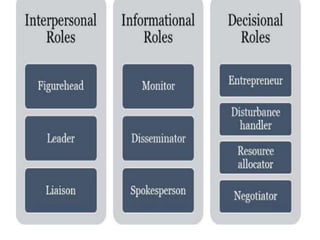
stressful. So, Mintzberg categorized
all activities into ten managerial roles
performed over the course of a day.
These are as follows:
It covers behaviors and
responsibilities related to
interactions with employees and
other stakeholders. Through these
interactions, the manager can
achieve organizational goals.
Role of a Figurehead
• The figurehead role is a symbolic one.
When managers meet prospective clients
or attend conferences, they act as the face
of the company, promoting its brand and
ethos.
• Under this role, the manager has to
perform the following activities:
• To represent the organization at
social festivities.
• To welcome the visitors.
• To be present at the marriage
ceremonies of the employees.
• To have a meal with some
important customer.
Role of a leader
• The leader managerial role refers to your duty as a
manager to oversee the performance of your staff.
Overall, you aim to manage the team and the
responsibilities of each member to ensure you reach
objectives effectively. Some of your duties in this role
include providing guidance, developing and motivating
staff and performing evaluations.
• For example, your team may have a specific sales goal it
aims to reach one month. As a leader, you would
communicate your expectations to team members and
ensure they understand them. Throughout the month,
you would check in with them regularly to monitor their
progress and may provide resources or delegate tasks as
needed to help them achieve the goal.
Role of a liaison officer
Under this role, a manager gets
much information by establishing
contact with the manager of other
departments. This role of the
manager becomes helpful in
establishing sweet relationship
among all the departments in the
organization.
This category represents situations
when a manager generates,
receives or shares knowledge with
employees and higher-level
colleagues to accomplish
objectives. The managerial roles
included in this category are
monitor, disseminator and
spokesperson.
Role of a monitor
• As a monitor the manager keeps an eye on the
internal and the external environment of the
organisation.
• It includes both internal and external sources.
Once a manager gather all the relevant
information, he will analyze it to identify and
solve potential problems. Monitoring
responsibilities also include assessing the
current operations of the organization and
identifying potential opportunities for
improvement.
Role of a disseminator
• In the role of a disseminator a manager
provides that information to his subordinates
which is beyond their reach. This information
can be concerning the internal and external
environment.
• He can transmit this information in both
verbal and written formats. Usually, this
situation refers to valuable or otherwise
important information that will benefit the
organization or provides guidance on tasks
their employees need to complete.
Role of a Spokesman
• In the role of spokesman the manager acts as a
representative of the organisation in his
relation with the people outside the
organisation.
• For example, AS a spokesperson's
responsibilities may require manager to attend
the annual shareholder's meeting. At this
meeting, he may inform the attendees about
the quantifiable results or achievements his
team achieved that year, such as sales numbers.
He may also discuss the strategic business goals
that aim to achieve within the next year.
This category describes a
manager's responsibility to use
the information they gain to form
business and strategic decisions.
The managerial roles included in
this category are entrepreneur,
disturbance-handler, resource-
allocator and negotiator.
Role of an entrepreneur
• The entrepreneur role involves
responsibilities related to organizing and
running business processes. These
responsibilities may include solving
problems and developing and implementing
new ideas or strategies. As an entrepreneur,
manager’s ideas or decisions often promote
innovative solutions that move the
organization forward.
Role of a resource allocator
• The resources (capital, material, machinery
etc.) in every organisation are limited. It is the
duty of the manager to put these limited
resources to the maximum use. This is possible
only when the resources are properly
distributed.
• In the resource allocator role, manager is
responsible for managing and distributing
resources. He makes the decisions on how those
materials will best be used or applied
throughout the organization or team.
Role of a disturbance handler
When an organization or team faces
unexpected challenges, manager takes the
role of a disturbance handler to help
manage the issue. These challenges can be
both external or internal—whether a client
backs out of a contract or manager
discovers a conflict between colleagues. In
these situations, employees will expect from
manager to take charge to solve the issue
and maintain productivity.
Role of a negotiator
• In the negotiator role, manager participates in or direct
negotiation situations. These negotiations may occur
with external parties, where he will represent the
interests of the organization. He may also host
negotiations with internal parties, such as other
departments or team members. Successful negotiations
will require him to gain buy-in by appealing to the
interests and needs of the other party.
• For example, manager may enter a negotiation with an
employee over their salary. If he cannot meet their
monetary request, he may negotiate a lower number but
provide additional benefits such as more vacation days
to make the offer more attractive.
• In order to perform various
functions of management
effectively, a manager must possess
certain skills.
• Skills refers to an individual’s
ability to translate knowledge into
action.
• Skill is not necessarily inborn, it
can be developed through practice.
Managerial skills fall
into three basic
categories:
•Conceptual skills
•Human skills
•Technical skills
• It refers to the ability of a manager to take a broad
and farsighted view of the organisation.
• Conceptual skills enable a manager to use their
knowledge or ability for more abstract thinking.
That means they can easily envisage the whole by
means of analysis and diagnosis of the different
states. As such, they would be in a position to predict
the future of a business or department as a whole.
• Conceptual skills are vital for top managers, less
critical for mid-level managers and not required for
first-level managers. As we go from the bottom of
the managerial hierarchy to the top, the importance
of these skills will rise.
Human/Interpersonal skills
• It refers to the ability of a manger to
interact effectively with people.
• Human or interpersonal management skills
facilitate a manager’s knowledge and ability
to work with people. One of the most
critical management tasks is working with
people. Without people, the existence of
management and managers becomes
redundant.
These skills enable managers to
become leaders and motivate
employees for better
accomplishments. Additionally,
they help them to make more
effective use of human potential in
the company. Simply said, they
are essential skills for all
hierarchical levels in the company.
• It refers to a manager’s knowledge and
proficiency in handling any type of process or
technique.
• In other words, these skills give the
manager knowledge and ability to use different
techniques to achieve what they want to
achieve. Technical skills are not related only to
machines, production tools or other equipment,
but they are also skills that will be required to
increase sales, design different types of
products and services, market the products

Basic Managerial Roles.pptx

  • 2.
    In 1973, HenryMintzberg – a Canadian academic and author on business and management published a book called ‘The Nature of Managerial Work’. He found that managers could not stick to one task since they were constantly being interrupted either by a phone call or a crisis. Over the years, managerial roles have become busier and more stressful. So, Mintzberg categorized all activities into ten managerial roles performed over the course of a day. These are as follows:
  • 4.
    It covers behaviorsand responsibilities related to interactions with employees and other stakeholders. Through these interactions, the manager can achieve organizational goals.
  • 5.
    Role of aFigurehead • The figurehead role is a symbolic one. When managers meet prospective clients or attend conferences, they act as the face of the company, promoting its brand and ethos. • Under this role, the manager has to perform the following activities:
  • 6.
    • To representthe organization at social festivities. • To welcome the visitors. • To be present at the marriage ceremonies of the employees. • To have a meal with some important customer.
  • 7.
    Role of aleader • The leader managerial role refers to your duty as a manager to oversee the performance of your staff. Overall, you aim to manage the team and the responsibilities of each member to ensure you reach objectives effectively. Some of your duties in this role include providing guidance, developing and motivating staff and performing evaluations. • For example, your team may have a specific sales goal it aims to reach one month. As a leader, you would communicate your expectations to team members and ensure they understand them. Throughout the month, you would check in with them regularly to monitor their progress and may provide resources or delegate tasks as needed to help them achieve the goal.
  • 8.
    Role of aliaison officer Under this role, a manager gets much information by establishing contact with the manager of other departments. This role of the manager becomes helpful in establishing sweet relationship among all the departments in the organization.
  • 9.
    This category representssituations when a manager generates, receives or shares knowledge with employees and higher-level colleagues to accomplish objectives. The managerial roles included in this category are monitor, disseminator and spokesperson.
  • 10.
    Role of amonitor • As a monitor the manager keeps an eye on the internal and the external environment of the organisation. • It includes both internal and external sources. Once a manager gather all the relevant information, he will analyze it to identify and solve potential problems. Monitoring responsibilities also include assessing the current operations of the organization and identifying potential opportunities for improvement.
  • 11.
    Role of adisseminator • In the role of a disseminator a manager provides that information to his subordinates which is beyond their reach. This information can be concerning the internal and external environment. • He can transmit this information in both verbal and written formats. Usually, this situation refers to valuable or otherwise important information that will benefit the organization or provides guidance on tasks their employees need to complete.
  • 12.
    Role of aSpokesman • In the role of spokesman the manager acts as a representative of the organisation in his relation with the people outside the organisation. • For example, AS a spokesperson's responsibilities may require manager to attend the annual shareholder's meeting. At this meeting, he may inform the attendees about the quantifiable results or achievements his team achieved that year, such as sales numbers. He may also discuss the strategic business goals that aim to achieve within the next year.
  • 13.
    This category describesa manager's responsibility to use the information they gain to form business and strategic decisions. The managerial roles included in this category are entrepreneur, disturbance-handler, resource- allocator and negotiator.
  • 14.
    Role of anentrepreneur • The entrepreneur role involves responsibilities related to organizing and running business processes. These responsibilities may include solving problems and developing and implementing new ideas or strategies. As an entrepreneur, manager’s ideas or decisions often promote innovative solutions that move the organization forward.
  • 15.
    Role of aresource allocator • The resources (capital, material, machinery etc.) in every organisation are limited. It is the duty of the manager to put these limited resources to the maximum use. This is possible only when the resources are properly distributed. • In the resource allocator role, manager is responsible for managing and distributing resources. He makes the decisions on how those materials will best be used or applied throughout the organization or team.
  • 16.
    Role of adisturbance handler When an organization or team faces unexpected challenges, manager takes the role of a disturbance handler to help manage the issue. These challenges can be both external or internal—whether a client backs out of a contract or manager discovers a conflict between colleagues. In these situations, employees will expect from manager to take charge to solve the issue and maintain productivity.
  • 17.
    Role of anegotiator • In the negotiator role, manager participates in or direct negotiation situations. These negotiations may occur with external parties, where he will represent the interests of the organization. He may also host negotiations with internal parties, such as other departments or team members. Successful negotiations will require him to gain buy-in by appealing to the interests and needs of the other party. • For example, manager may enter a negotiation with an employee over their salary. If he cannot meet their monetary request, he may negotiate a lower number but provide additional benefits such as more vacation days to make the offer more attractive.
  • 19.
    • In orderto perform various functions of management effectively, a manager must possess certain skills. • Skills refers to an individual’s ability to translate knowledge into action. • Skill is not necessarily inborn, it can be developed through practice.
  • 20.
    Managerial skills fall intothree basic categories: •Conceptual skills •Human skills •Technical skills
  • 21.
    • It refersto the ability of a manager to take a broad and farsighted view of the organisation. • Conceptual skills enable a manager to use their knowledge or ability for more abstract thinking. That means they can easily envisage the whole by means of analysis and diagnosis of the different states. As such, they would be in a position to predict the future of a business or department as a whole. • Conceptual skills are vital for top managers, less critical for mid-level managers and not required for first-level managers. As we go from the bottom of the managerial hierarchy to the top, the importance of these skills will rise.
  • 22.
    Human/Interpersonal skills • Itrefers to the ability of a manger to interact effectively with people. • Human or interpersonal management skills facilitate a manager’s knowledge and ability to work with people. One of the most critical management tasks is working with people. Without people, the existence of management and managers becomes redundant.
  • 23.
    These skills enablemanagers to become leaders and motivate employees for better accomplishments. Additionally, they help them to make more effective use of human potential in the company. Simply said, they are essential skills for all hierarchical levels in the company.
  • 24.
    • It refersto a manager’s knowledge and proficiency in handling any type of process or technique. • In other words, these skills give the manager knowledge and ability to use different techniques to achieve what they want to achieve. Technical skills are not related only to machines, production tools or other equipment, but they are also skills that will be required to increase sales, design different types of products and services, market the products