PRESENTATION
ON
POWER GENERATION
Presented By:
Shivani Nandwana
Jv-u/12/5396
1
CONTENTS
• Introduction of company
• Overview of Combine Cycle
• Gas Turbine
• Waste Heat Recovery Boiler
• Steam Turbine
• Cooling Tower
• Vission and Mission 2
Introduction of company
• NATIONAL THERMAL POWER
CORPORATION(NTPC).
• NTPC limited is the largest power generating
company in INDIA.
• A public sector company, it was incorporated in the
year 1975.
• It has an electric power generating capacity of
34,754MW.
• It is one of the seven maharatna companies.
3
CONT.........
• There are four main parts of NTPC :
 Combine Cycle
 Gas Turbine
 Waste Heat Recovery Boiler
 Steam Turbine
4
FIGURE 1: NTPC ANTA
5
Overview of Combine Cycle
• Combine cycle power plant integrates two power
conversion cycle:
1. Brayton Cycle (for Gas Turbine)
2. Rankine Cycle (for Steam Turbine)
6
Figure 2:Combine Cycle Power Plant
%
Air Fuel
Exhaust gas
Steam
Turbine
Steam
%
WHRB
15%
100%
33%
16%
36%
Gas Turbine
Input
Condensor
7
GT
WHRB
+
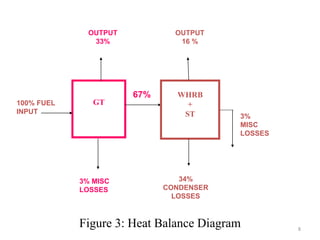
ST 3%
MISC
LOSSES
100% FUEL
INPUT
OUTPUT
33%
67%
OUTPUT
16 %
3% MISC
LOSSES
34%
CONDENSER
LOSSES
Figure 3: Heat Balance Diagram 8
Gas Turbine
• Gas Turbine is a heat engine, working on the air
standard Brayton cylcle. The process include :
1. Compressor
2. Combustion
3. Expansion
9
Gas Turbine Components
• Air intake system
• Compressor
• Combustion chamber
• Turbine
• generator
• Naphtha fuel system
10
Figure 4: Gas Turbine
11
Waste Heat Recovery Boiler
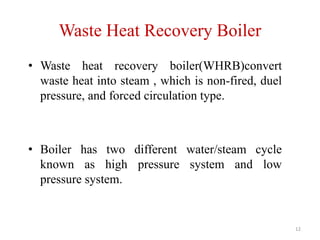
• Waste heat recovery boiler(WHRB)convert
waste heat into steam , which is non-fired, duel
pressure, and forced circulation type.
• Boiler has two different water/steam cycle
known as high pressure system and low
pressure system.
12
FIGURE 5 : WHRB
13
Steam Turbine
• Steam turbine process include:
Pressurization : pressurization of working medium
(water) by Boiler feed water pump.
Heating: phase change of working medium (from
water to heating) and superheating at constant
pressure in Boiler.
Expansion: Expansion of steam in the Turbine.
Condenstation : condenstation of steam by cooling
water.
14
COOLING TOWER
• Remove heat from the water discharge from the
condenser so that the water can be discharge to
the river or re-circulated and re-used.
15
Figure 6: Cooling Tower 16
VISSION and MISSION
VISSION :
To be the world’s largest and best power
producer.
MISSION :
Develop and provide reliable power.
17
CONCLUSION
I have studied about the power plant, specially in
ANTA. Studied about gas power plant, specially
natural gas could be use for power generation in gas
power plant. It is very economical but less efficient.
mainly methane (CH4) is used as fuel. It is very
profitable in case of pollution. It is very less polluted.
18
REFERENCE
• Industrial Electronics Society, 2005. IECON
2005. 31st Annual Conference of IEEE
• Power Tech Conference Proceedings, 2003
IEEE Bologna
• Applied Power Electronics Conference and
Exposition, 2002. APEC 2002. Seventeenth
Annual IEEE
19
20
ANY QUERIES
21

NTPC anta

  • 1.
  • 2.
    CONTENTS • Introduction ofcompany • Overview of Combine Cycle • Gas Turbine • Waste Heat Recovery Boiler • Steam Turbine • Cooling Tower • Vission and Mission 2
  • 3.
    Introduction of company •NATIONAL THERMAL POWER CORPORATION(NTPC). • NTPC limited is the largest power generating company in INDIA. • A public sector company, it was incorporated in the year 1975. • It has an electric power generating capacity of 34,754MW. • It is one of the seven maharatna companies. 3
  • 4.
    CONT......... • There arefour main parts of NTPC :  Combine Cycle  Gas Turbine  Waste Heat Recovery Boiler  Steam Turbine 4
  • 5.
  • 6.
    Overview of CombineCycle • Combine cycle power plant integrates two power conversion cycle: 1. Brayton Cycle (for Gas Turbine) 2. Rankine Cycle (for Steam Turbine) 6
  • 7.
    Figure 2:Combine CyclePower Plant % Air Fuel Exhaust gas Steam Turbine Steam % WHRB 15% 100% 33% 16% 36% Gas Turbine Input Condensor 7
  • 8.
    GT WHRB + ST 3% MISC LOSSES 100% FUEL INPUT OUTPUT 33% 67% OUTPUT 16% 3% MISC LOSSES 34% CONDENSER LOSSES Figure 3: Heat Balance Diagram 8
  • 9.
    Gas Turbine • GasTurbine is a heat engine, working on the air standard Brayton cylcle. The process include : 1. Compressor 2. Combustion 3. Expansion 9
  • 10.
    Gas Turbine Components •Air intake system • Compressor • Combustion chamber • Turbine • generator • Naphtha fuel system 10
  • 11.
    Figure 4: GasTurbine 11
  • 12.
    Waste Heat RecoveryBoiler • Waste heat recovery boiler(WHRB)convert waste heat into steam , which is non-fired, duel pressure, and forced circulation type. • Boiler has two different water/steam cycle known as high pressure system and low pressure system. 12
  • 13.
    FIGURE 5 :WHRB 13
  • 14.
    Steam Turbine • Steamturbine process include: Pressurization : pressurization of working medium (water) by Boiler feed water pump. Heating: phase change of working medium (from water to heating) and superheating at constant pressure in Boiler. Expansion: Expansion of steam in the Turbine. Condenstation : condenstation of steam by cooling water. 14
  • 15.
    COOLING TOWER • Removeheat from the water discharge from the condenser so that the water can be discharge to the river or re-circulated and re-used. 15
  • 16.
  • 17.
    VISSION and MISSION VISSION: To be the world’s largest and best power producer. MISSION : Develop and provide reliable power. 17
  • 18.
    CONCLUSION I have studiedabout the power plant, specially in ANTA. Studied about gas power plant, specially natural gas could be use for power generation in gas power plant. It is very economical but less efficient. mainly methane (CH4) is used as fuel. It is very profitable in case of pollution. It is very less polluted. 18
  • 19.
    REFERENCE • Industrial ElectronicsSociety, 2005. IECON 2005. 31st Annual Conference of IEEE • Power Tech Conference Proceedings, 2003 IEEE Bologna • Applied Power Electronics Conference and Exposition, 2002. APEC 2002. Seventeenth Annual IEEE 19
  • 20.
  • 21.