Learning Prototype Classifiers for Long-Tailed Recognition
Saurabh
Sharma1
1 University of California Santa Barbara, USA
Ning
Yu3
Yongqin
Xian2
Ambuj
Singh1
2 Google, Switzerland
3 Salesforce Research, USA
{saurabhsharma,ambuj}@cs.ucsb.edu
yxian@google.com ning.yu@salesforce.com
IJCAI 23, Macao
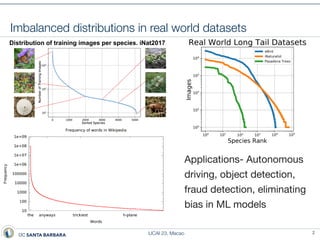
Imbalanced distributions in real world datasets
2
Distribution of training images per species. iNat2017
Applications- Autonomous
driving, object detection,
fraud detection, eliminating
bias in ML models
IJCAI 23, Macao
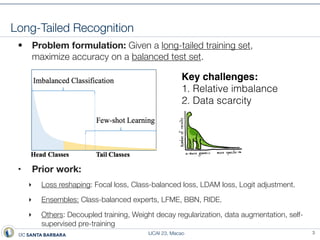
Long-Tailed Recognition
• Problem formulation: Given a long-tailed training set,
maximize accuracy on a balanced test set.
• Prior work:
‣ Loss reshaping: Focal loss, Class-balanced loss, LDAM loss, Logit adjustment.
‣ Ensembles: Class-balanced experts, LFME, BBN, RIDE.
‣ Others: Decoupled training, Weight decay regularization, data augmentation, self-
supervised pre-training
3
Key challenges:
1. Relative imbalance
2. Data scarcity
IJCAI 23, Macao
LTR Using Biased Linear Softmax
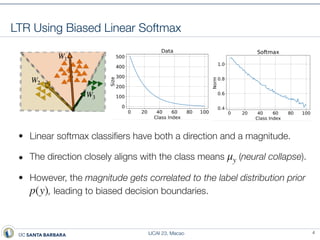
• Linear softmax classi
fi
ers have both a direction and a magnitude.
• The direction closely aligns with the class means (neural collapse).
• However, the magnitude gets correlated to the label distribution prior
, leading to biased decision boundaries.
μy
p(y)
4
IJCAI 23, Macao
Prototype Classi
fi
ers for LTR
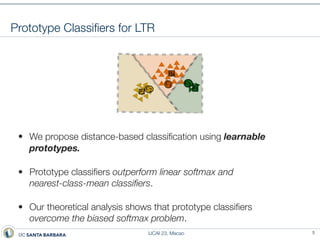
• We propose distance-based classi
fi
cation using learnable
prototypes.
• Prototype classi
fi
ers outperform linear softmax and
nearest-class-mean classi
fi
ers.
• Our theoretical analysis shows that prototype classi
fi
ers
overcome the biased softmax problem.
5
IJCAI 23, Macao
Learning Prototype Classi
fi
ers
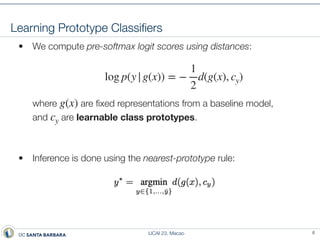
• We compute pre-softmax logit scores using distances:
where are
fi
xed representations from a baseline model,
and are learnable class prototypes.
• Inference is done using the nearest-prototype rule:
log p(y|g(x)) = −
1
2
d(g(x), cy)
g(x)
cy
6
IJCAI 23, Macao
Choice of distance metric
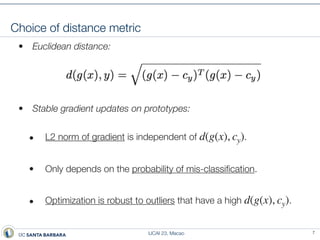
• Euclidean distance:
• Stable gradient updates on prototypes:
• L2 norm of gradient is independent of .
• Only depends on the probability of mis-classi
fi
cation.
• Optimization is robust to outliers that have a high .
d(g(x), cy)
d(g(x), cy)
7
IJCAI 23, Macao
Addressing the biased softmax problem
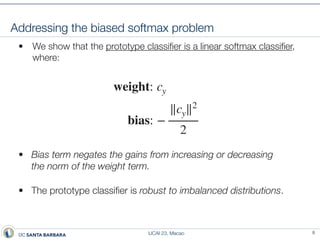
• We show that the prototype classi
fi
er is a linear softmax classi
fi
er,
where:
• Bias term negates the gains from increasing or decreasing
the norm of the weight term.
• The prototype classi
fi
er is robust to imbalanced distributions.
8
weight: cy
bias: −
∥cy∥2
2
IJCAI 23, Macao
Channel-dependent temperatures
• As distance scales vary along each channel, we use
channel-dependent temperatures:
• High T Low sensitivity
Low T High sensitivity
• Generalized Mahalanobis distance metric.
⟹
⟹
9
IJCAI 23, Macao
Prototype Classi
fi
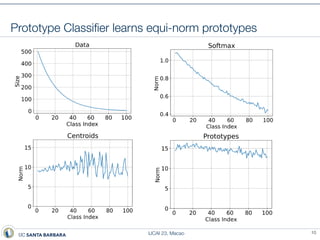
er learns equi-norm prototypes
10
IJCAI 23, Macao
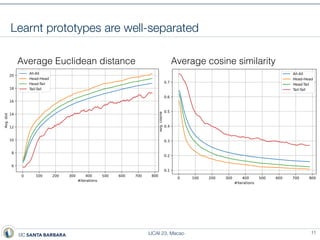
Learnt prototypes are well-separated
11
Average Euclidean distance Average cosine similarity
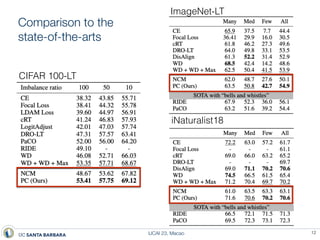
IJCAI 23, Macao 12
CIFAR 100-LT
ImageNet-LT
iNaturalist18
Comparison to the
state-of-the-arts
IJCAI 23, Macao
Conclusion
• We present Learnable Prototype Classi
fi
ers for LTR.
• Prototype Classi
fi
ers overcome the intrinsic bias of linear softmax
classi
fi
ers and are robust to imbalanced distributions.
• Euclidean distance based prototype classi
fi
ers are robust to outliers
because of its stable gradient property.
• Learnt prototypes are equi-norm and well-separated.
• For more details, please take a look below:
13
Code
Paper

Learning Prototype Classifiers for Long-Tailed Recognition

  • 1.
    Learning Prototype Classifiersfor Long-Tailed Recognition Saurabh Sharma1 1 University of California Santa Barbara, USA Ning Yu3 Yongqin Xian2 Ambuj Singh1 2 Google, Switzerland 3 Salesforce Research, USA {saurabhsharma,ambuj}@cs.ucsb.edu yxian@google.com ning.yu@salesforce.com
  • 2.
    IJCAI 23, Macao Imbalanceddistributions in real world datasets 2 Distribution of training images per species. iNat2017 Applications- Autonomous driving, object detection, fraud detection, eliminating bias in ML models
  • 3.
    IJCAI 23, Macao Long-TailedRecognition • Problem formulation: Given a long-tailed training set, maximize accuracy on a balanced test set. • Prior work: ‣ Loss reshaping: Focal loss, Class-balanced loss, LDAM loss, Logit adjustment. ‣ Ensembles: Class-balanced experts, LFME, BBN, RIDE. ‣ Others: Decoupled training, Weight decay regularization, data augmentation, self- supervised pre-training 3 Key challenges: 1. Relative imbalance 2. Data scarcity
  • 4.
    IJCAI 23, Macao LTRUsing Biased Linear Softmax • Linear softmax classi fi ers have both a direction and a magnitude. • The direction closely aligns with the class means (neural collapse). • However, the magnitude gets correlated to the label distribution prior , leading to biased decision boundaries. μy p(y) 4
  • 5.
    IJCAI 23, Macao PrototypeClassi fi ers for LTR • We propose distance-based classi fi cation using learnable prototypes. • Prototype classi fi ers outperform linear softmax and nearest-class-mean classi fi ers. • Our theoretical analysis shows that prototype classi fi ers overcome the biased softmax problem. 5
  • 6.
    IJCAI 23, Macao LearningPrototype Classi fi ers • We compute pre-softmax logit scores using distances: where are fi xed representations from a baseline model, and are learnable class prototypes. • Inference is done using the nearest-prototype rule: log p(y|g(x)) = − 1 2 d(g(x), cy) g(x) cy 6
  • 7.
    IJCAI 23, Macao Choiceof distance metric • Euclidean distance: • Stable gradient updates on prototypes: • L2 norm of gradient is independent of . • Only depends on the probability of mis-classi fi cation. • Optimization is robust to outliers that have a high . d(g(x), cy) d(g(x), cy) 7
  • 8.
    IJCAI 23, Macao Addressingthe biased softmax problem • We show that the prototype classi fi er is a linear softmax classi fi er, where: • Bias term negates the gains from increasing or decreasing the norm of the weight term. • The prototype classi fi er is robust to imbalanced distributions. 8 weight: cy bias: − ∥cy∥2 2
  • 9.
    IJCAI 23, Macao Channel-dependenttemperatures • As distance scales vary along each channel, we use channel-dependent temperatures: • High T Low sensitivity Low T High sensitivity • Generalized Mahalanobis distance metric. ⟹ ⟹ 9
  • 10.
    IJCAI 23, Macao PrototypeClassi fi er learns equi-norm prototypes 10
  • 11.
    IJCAI 23, Macao Learntprototypes are well-separated 11 Average Euclidean distance Average cosine similarity
  • 12.
    IJCAI 23, Macao12 CIFAR 100-LT ImageNet-LT iNaturalist18 Comparison to the state-of-the-arts
  • 13.
    IJCAI 23, Macao Conclusion •We present Learnable Prototype Classi fi ers for LTR. • Prototype Classi fi ers overcome the intrinsic bias of linear softmax classi fi ers and are robust to imbalanced distributions. • Euclidean distance based prototype classi fi ers are robust to outliers because of its stable gradient property. • Learnt prototypes are equi-norm and well-separated. • For more details, please take a look below: 13 Code Paper