The ReeKross™ catheter to treat long infragenicular vessel occlusion 
Courtesy of Dr. M Anderson, Dr. A D Platts, Department of Radiology, Royal Free Hospital NHS Trust, London NW3 2QG 
Introduction 
Subintimal recanalisation, also called percutaneous 
intentional extraluminal (subintimal) recanalisation 
(PIER) has been recognised as an important option 
in the treatment of chronic critical limb ischemia 
since 1990, when Bolia et al described their results 
in patients with femoropopliteal occlusion. This 
entailed intentionally entering the subintimal space 
with a guide wire from an antegrade approach, 
creating a loop in the lead portion of the guide wire 
and advancing the guide wire distally in the 
subintimal space until it re-entered the true lumen 
beyond the occlusion. Balloon angioplasty was then 
performed in the subintimal space to create an 
extraluminal channel to perfuse the lower leg (Ref 1). 
In 1994, Bolia et al reported the use of PIER in the 
treatment of tibial occlusions and this technique was 
soon adopted for infrageniculate vessels with good 
results (Ref 2-4). Difficulty often arises, particularly 
in vessels below the knee, when attempting to 
advance the loop and balloon catheter along the 
subintimal plane. This can fail to propagate and 
lead to extravasation and thrombus formation. The 
ReeKross™ catheter has been shown to facilitate this 
stage in supra-genicular vessels due to its very high 
pushability and the puncture-resistance of the 
balloon. Here we demonstrate the same benefits of 
the new ReeKross™ 3mm diameter balloon catheter 
used below the knee. 
Patient History 
An 81 year old female patient presented with an 
infected non-healing ulcer on the right 4th toe and 
dorsum of the foot due to chronic lower limb 
ischemia. A Duplex scan found diffuse proximal 
atheroma without severe stenosis and advanced 
infragenicular small vessel disease. Angiography 
after antegrade puncture showed no significant 
proximal disease to the distal popliteal artery. 
There was no continuous infragenicular vessel to 
the foot. The peroneal artery was patent, filling a 
good calibre dorsalis pedis via distal collaterals. 
The posterior tibial artery was occluded throughout 
and the anterior tibial artery (ATA) was occluded 
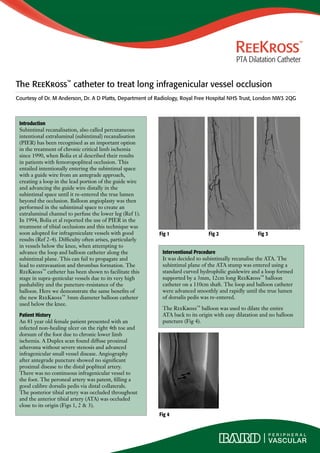
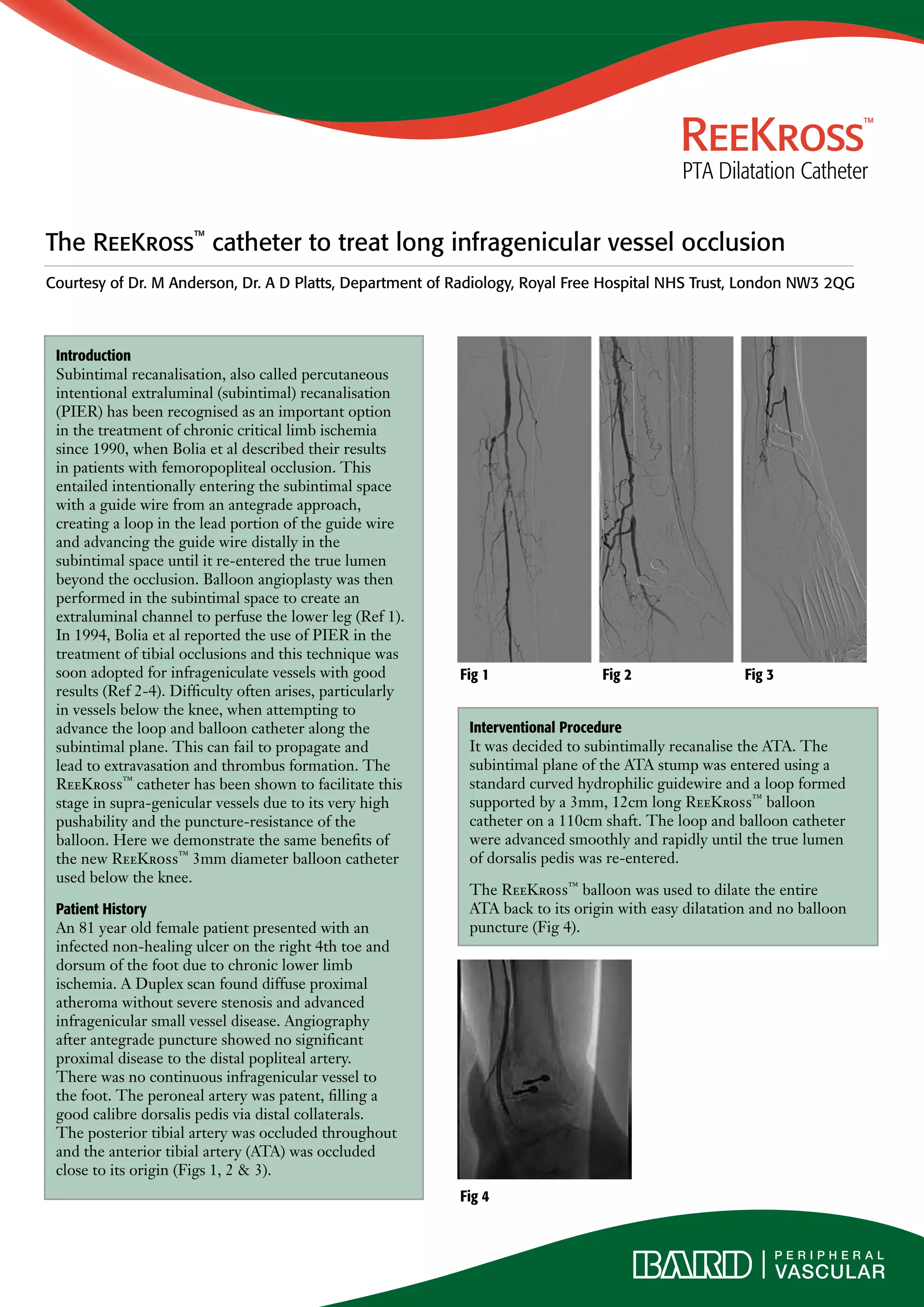
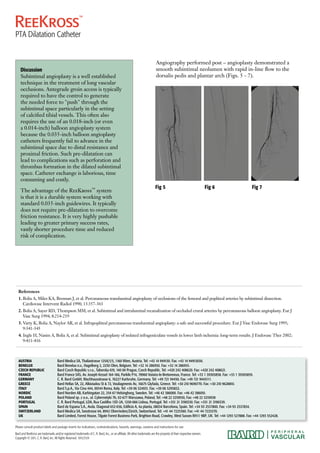
close to its origin (Figs 1, 2 & 3). 
Fig 1 Fig 2 
Fig 1 Fig 2 Fig 3 
Interventional Procedure 
It was decided to subintimally recanalise the ATA. The 
subintimal plane of the ATA stump was entered using a 
standard curved hydrophilic guidewire and a loop formed 
supported by a 3mm, 12cm long ReeKross™ balloon 
catheter on a 110cm shaft. The loop and balloon catheter 
were advanced smoothly and rapidly until the true lumen 
of dorsalis pedis was re-entered. 
The ReeKross™ balloon was used to dilate the entire 
ATA back to its origin with easy dilatation and no balloon 
puncture (Fig 4). 
Fig 4
Discussion 
Subintimal angioplasty is a well established 
technique in the treatment of long vascular 
occlusions. Antegrade groin access is typically 
required to have the control to generate 
the needed force to "push" through the 
subintimal space particularly in the setting 
of calcified tibial vessels. This often also 
requires the use of an 0.018-inch (or even 
a 0.014-inch) balloon angioplasty system 
because the 0.035-inch balloon angioplasty 
catheters frequently fail to advance in the 
subintimal space due to distal resistance and 
proximal friction. Such pre-dilatation can 
lead to complications such as perforation and 
thrombus formation in the dilated subintimal 
space. Catheter exchange is laborious, time 
consuming and costly. 
The advantage of the ReeKross™ system 
is that it is a durable system working with 
standard 0.035-inch guidewires. It typically 
does not require pre-dilatation to overcome 
friction resistance. It is very highly pushable 
leading to greater primary success rates, 
vastly shorter procedure time and reduced 
risk of complication. 
Angiography performed post – angioplasty demonstrated a 
smooth subintimal neolumen with rapid in-line flow to the 
dorsalis pedis and plantar arch (Figs. 5 - 7). 
Fig 5 Fig 6 
References 
1. Bolia A, Miles KA, Brennan J, et al. Percutaneous transluminal angioplasty of occlusions of the femoral and popliteal arteries by subintimal dissection. 
Cardiovasc Intervent Radiol 1990; 13:357-363 
2. Bolia A, Sayer RD, Thompson MM, et al. Subintimal and intraluminal recanalization of occluded crural arteries by percutaneous balloon angioplasty. Eur J 
Vasc Surg 1994; 8:214-219 
3. Varty K, Bolia A, Naylor AR, et al. Infrapopliteal percutaneous transluminal angioplasty: a safe and successful procedure. Eur J Vasc Endovasc Surg 1995; 
9:341-345 
4. Ingle H, Nasim A, Bolia A, et al. Subintimal angioplasty of isolated infrageniculate vessels in lower limb ischemia: long-term results. J Endovasc Ther 2002; 
9:411-416 
AUSTRIA Bard Medica SA, Thaliastrasse 125A/1/5, 1160 Wien, Austria. Tel: +43 14 949130. Fax: +43 14 94913030. 
BENELUX Bard Benelux n.v., Hagelberg 2, 2250 Olen, Belgium. Tel: +32 14 286950. Fax: +32 14 286955. 
CZECH REPUBLIC Bard Czech Republic s.r.o., Taborska 619, 140 00 Prague, Czech Republic. Tel: +420 242 408620. Fax: +420 242 408621. 
FRANCE Bard France SAS, Av. Joseph Kessel 164-166, Parkile P14, 78960 Voisins-le-Bretonneux, France. Tel: +33 1 39305858. Fax: +33 1 39305859. 
GERMANY C. R. Bard GmbH, Wachhausstrasse 6, 76227 Karlsruhe, Germany. Tel: +49 721 94450. Fax: +49 721 9445111. 
GREECE Bard Hellas SA, 22, Alkiviadou St & 72, Vouliagmenis Av, 16675 Glyfada, Greece. Tel: +30 210 9690770. Fax: +30 210 9628810. 
ITALY Bard S.p.A., Via Cina 444, 00144 Roma, Italy. Tel: +39 06 524931. Fax: +39 06 5295852. 
NORDIC Bard Norden AB, Karbingatan 22, 254 67 Helsingborg, Sweden. Tel: +46 42 386000. Fax: +46 42 386010. 
POLAND Bard Poland sp. z o.o., ul. Cybernetyki 7b, 02-677 Warszawa, Poland, Tel: +48 22 3210930, Fax: +48 22 3210938 
PORTUGAL C. R. Bard Portugal, LDA, Rua Castilho 13D-2A, 1250-066 Lisboa, Portugal. Tel: +351 21 3190330. Fax: +351 21 3190339. 
SPAIN Bard de Espana S.A., Avda. Diagonal 652-656, Edificio A, 4a planta, 08034 Barcelona, Spain. Tel: +34 93 2537800. Fax: +34 93 2537834. 
SWITZERLAND Bard Medica SA, Seestrasse 64, 8942 Oberrieden/Zürich, Switzerland. Tel: +41 44 7225360. Fax: +41 44 7225370. 
UK Bard Limited, Forest House, Tilgate Forest Business Park, Brighton Road, Crawley, West Sussex RH11 9BP, UK. Tel: +44 1293 527888. Fax: +44 1293 552428. 
Please consult product labels and package inserts for indications, contraindications, hazards, warnings, cautions and instructions for use. 
Bard and ReeKross are trademarks and/or registered trademarks of C. R. Bard, Inc., or an affiliate. All other trademarks are the property of their respective owners. 
Copyright © 2011, C. R. Bard, Inc. All Rights Reserved. 1011/3134 
Fig 7

Reekros

  • 1.
    The ReeKross™ catheterto treat long infragenicular vessel occlusion Courtesy of Dr. M Anderson, Dr. A D Platts, Department of Radiology, Royal Free Hospital NHS Trust, London NW3 2QG Introduction Subintimal recanalisation, also called percutaneous intentional extraluminal (subintimal) recanalisation (PIER) has been recognised as an important option in the treatment of chronic critical limb ischemia since 1990, when Bolia et al described their results in patients with femoropopliteal occlusion. This entailed intentionally entering the subintimal space with a guide wire from an antegrade approach, creating a loop in the lead portion of the guide wire and advancing the guide wire distally in the subintimal space until it re-entered the true lumen beyond the occlusion. Balloon angioplasty was then performed in the subintimal space to create an extraluminal channel to perfuse the lower leg (Ref 1). In 1994, Bolia et al reported the use of PIER in the treatment of tibial occlusions and this technique was soon adopted for infrageniculate vessels with good results (Ref 2-4). Difficulty often arises, particularly in vessels below the knee, when attempting to advance the loop and balloon catheter along the subintimal plane. This can fail to propagate and lead to extravasation and thrombus formation. The ReeKross™ catheter has been shown to facilitate this stage in supra-genicular vessels due to its very high pushability and the puncture-resistance of the balloon. Here we demonstrate the same benefits of the new ReeKross™ 3mm diameter balloon catheter used below the knee. Patient History An 81 year old female patient presented with an infected non-healing ulcer on the right 4th toe and dorsum of the foot due to chronic lower limb ischemia. A Duplex scan found diffuse proximal atheroma without severe stenosis and advanced infragenicular small vessel disease. Angiography after antegrade puncture showed no significant proximal disease to the distal popliteal artery. There was no continuous infragenicular vessel to the foot. The peroneal artery was patent, filling a good calibre dorsalis pedis via distal collaterals. The posterior tibial artery was occluded throughout and the anterior tibial artery (ATA) was occluded close to its origin (Figs 1, 2 & 3). Fig 1 Fig 2 Fig 1 Fig 2 Fig 3 Interventional Procedure It was decided to subintimally recanalise the ATA. The subintimal plane of the ATA stump was entered using a standard curved hydrophilic guidewire and a loop formed supported by a 3mm, 12cm long ReeKross™ balloon catheter on a 110cm shaft. The loop and balloon catheter were advanced smoothly and rapidly until the true lumen of dorsalis pedis was re-entered. The ReeKross™ balloon was used to dilate the entire ATA back to its origin with easy dilatation and no balloon puncture (Fig 4). Fig 4
  • 2.
    Discussion Subintimal angioplastyis a well established technique in the treatment of long vascular occlusions. Antegrade groin access is typically required to have the control to generate the needed force to "push" through the subintimal space particularly in the setting of calcified tibial vessels. This often also requires the use of an 0.018-inch (or even a 0.014-inch) balloon angioplasty system because the 0.035-inch balloon angioplasty catheters frequently fail to advance in the subintimal space due to distal resistance and proximal friction. Such pre-dilatation can lead to complications such as perforation and thrombus formation in the dilated subintimal space. Catheter exchange is laborious, time consuming and costly. The advantage of the ReeKross™ system is that it is a durable system working with standard 0.035-inch guidewires. It typically does not require pre-dilatation to overcome friction resistance. It is very highly pushable leading to greater primary success rates, vastly shorter procedure time and reduced risk of complication. Angiography performed post – angioplasty demonstrated a smooth subintimal neolumen with rapid in-line flow to the dorsalis pedis and plantar arch (Figs. 5 - 7). Fig 5 Fig 6 References 1. Bolia A, Miles KA, Brennan J, et al. Percutaneous transluminal angioplasty of occlusions of the femoral and popliteal arteries by subintimal dissection. Cardiovasc Intervent Radiol 1990; 13:357-363 2. Bolia A, Sayer RD, Thompson MM, et al. Subintimal and intraluminal recanalization of occluded crural arteries by percutaneous balloon angioplasty. Eur J Vasc Surg 1994; 8:214-219 3. Varty K, Bolia A, Naylor AR, et al. Infrapopliteal percutaneous transluminal angioplasty: a safe and successful procedure. Eur J Vasc Endovasc Surg 1995; 9:341-345 4. Ingle H, Nasim A, Bolia A, et al. Subintimal angioplasty of isolated infrageniculate vessels in lower limb ischemia: long-term results. J Endovasc Ther 2002; 9:411-416 AUSTRIA Bard Medica SA, Thaliastrasse 125A/1/5, 1160 Wien, Austria. Tel: +43 14 949130. Fax: +43 14 94913030. BENELUX Bard Benelux n.v., Hagelberg 2, 2250 Olen, Belgium. Tel: +32 14 286950. Fax: +32 14 286955. CZECH REPUBLIC Bard Czech Republic s.r.o., Taborska 619, 140 00 Prague, Czech Republic. Tel: +420 242 408620. Fax: +420 242 408621. FRANCE Bard France SAS, Av. Joseph Kessel 164-166, Parkile P14, 78960 Voisins-le-Bretonneux, France. Tel: +33 1 39305858. Fax: +33 1 39305859. GERMANY C. R. Bard GmbH, Wachhausstrasse 6, 76227 Karlsruhe, Germany. Tel: +49 721 94450. Fax: +49 721 9445111. GREECE Bard Hellas SA, 22, Alkiviadou St & 72, Vouliagmenis Av, 16675 Glyfada, Greece. Tel: +30 210 9690770. Fax: +30 210 9628810. ITALY Bard S.p.A., Via Cina 444, 00144 Roma, Italy. Tel: +39 06 524931. Fax: +39 06 5295852. NORDIC Bard Norden AB, Karbingatan 22, 254 67 Helsingborg, Sweden. Tel: +46 42 386000. Fax: +46 42 386010. POLAND Bard Poland sp. z o.o., ul. Cybernetyki 7b, 02-677 Warszawa, Poland, Tel: +48 22 3210930, Fax: +48 22 3210938 PORTUGAL C. R. Bard Portugal, LDA, Rua Castilho 13D-2A, 1250-066 Lisboa, Portugal. Tel: +351 21 3190330. Fax: +351 21 3190339. SPAIN Bard de Espana S.A., Avda. Diagonal 652-656, Edificio A, 4a planta, 08034 Barcelona, Spain. Tel: +34 93 2537800. Fax: +34 93 2537834. SWITZERLAND Bard Medica SA, Seestrasse 64, 8942 Oberrieden/Zürich, Switzerland. Tel: +41 44 7225360. Fax: +41 44 7225370. UK Bard Limited, Forest House, Tilgate Forest Business Park, Brighton Road, Crawley, West Sussex RH11 9BP, UK. Tel: +44 1293 527888. Fax: +44 1293 552428. Please consult product labels and package inserts for indications, contraindications, hazards, warnings, cautions and instructions for use. Bard and ReeKross are trademarks and/or registered trademarks of C. R. Bard, Inc., or an affiliate. All other trademarks are the property of their respective owners. Copyright © 2011, C. R. Bard, Inc. All Rights Reserved. 1011/3134 Fig 7