


Choosing the correct source of
funding
SOY JOSEPH
Director, SAS Partners Corporate Advisors
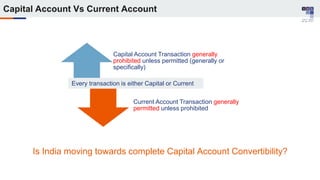
Capital Account Transaction generally
prohibited unless permitted (generally or
specifically)
Current Account Transaction generally
permitted unless prohibited
Is India moving towards complete Capital Account Convertibility?
Every transaction is either Capital or Current
Capital Account Vs Current Account
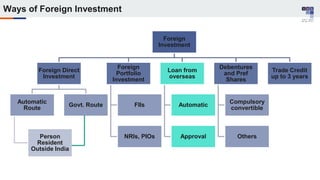
Ways of Foreign Investment
Foreign
Investment
Foreign Direct
Investment
Automatic
Route
Person
Resident
Outside India
Govt. Route
Foreign
Portfolio
Investment
FIIs
NRIs, PIOs
Loan from
overseas
Automatic
Approval
Debentures
and Pref
Shares
Compulsory
convertible
Others
Trade Credit
up to 3 years
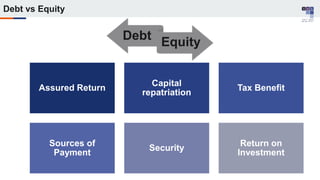
Debt vs Equity
Debt Equity
Assured Return
Capital
repatriation
Tax Benefit
Sources of
Payment
Security
Return on
Investment
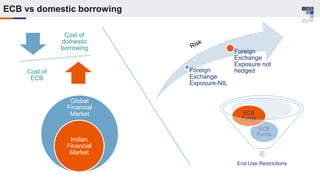
External Commercial Borrowing
Cost of
domestic
borrowing
Cost of
ECB
Global
Financial
Market
Indian
Financial
Market
Foreign
Exchange
Exposure-NIL
Foreign
Exchange
Exposure not
hedged
End Use Restrictions
ECB
Funds
ECB
Funds
ECB vs domestic borrowing
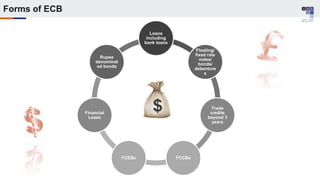
Forms of ECB
Loans
including
bank loans
Floating/
fixed rate
notes/
bonds/
debenture
s
Trade
credits
beyond 3
years
FCCBsFCEBs
Financial
Lease
Rupee
denominat
ed bonds
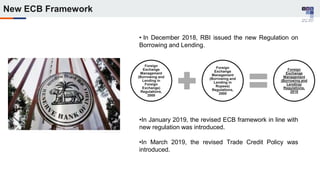
New ECB Framework
Foreign
Exchange
Management
(Borrowing and
Lending in
Foreign
Exchange)
Regulations,
2000
Foreign
Exchange
Management
(Borrowing and
Lending in
Rupees)
Regulations,
2000
Foreign
Exchange
Management
(Borrowing and
Lending)
Regulations,
2018
• In December 2018, RBI issued the new Regulation on
Borrowing and Lending.
•In January 2019, the revised ECB framework in line with
new regulation was introduced.
•In March 2019, the revised Trade Credit Policy was
introduced.
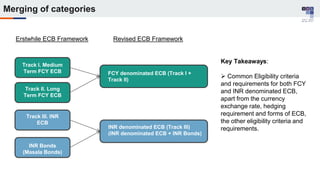
Key Takeaways:
 Common Eligibility criteria
and requirements for both FCY
and INR denominated ECB,
apart from the currency
exchange rate, hedging
requirement and forms of ECB,
the other eligibility criteria and
requirements.
Track I. Medium
Term FCY ECB
Track II. Long
Term FCY ECB
Track III. INR
ECB
FCY denominated ECB (Track I +
Track II)
INR denominated ECB (Track III)
(INR denominated ECB + INR Bonds)
Erstwhile ECB Framework Revised ECB Framework
Merging of categories
INR Bonds
(Masala Bonds)
Erstwhile ECB Framework Revised ECB Framework
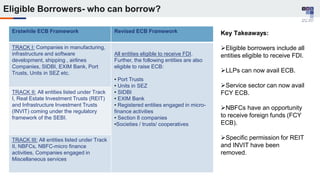
TRACK I: Companies in manufacturing,
infrastructure and software
development, shipping , airlines
Companies, SIDBI, EXIM Bank, Port
Trusts, Units in SEZ etc.
All entities eligible to receive FDI.
Further, the following entities are also
eligible to raise ECB:
• Port Trusts
• Units in SEZ
• SIDBI
• EXIM Bank
• Registered entities engaged in micro-
finance activities
• Section 8 companies
•Societies / trusts/ cooperatives
TRACK II: All entities listed under Track
I, Real Estate Investment Trusts (REIT)
and Infrastructure Investment Trusts
(INVIT) coming under the regulatory
framework of the SEBI.
TRACK III: All entities listed under Track
II, NBFCs, NBFC-micro finance
activities, Companies engaged in
Miscellaneous services
Key Takeaways:
Eligible borrowers include all
entities eligible to receive FDI.
LLPs can now avail ECB.
Service sector can now avail
FCY ECB.
NBFCs have an opportunity
to receive foreign funds (FCY
ECB).
Specific permission for REIT
and INVIT have been
removed.
Eligible Borrowers- who can borrow?
Erstwhile ECB Framework Revised ECB Framework
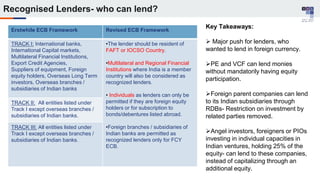
TRACK I: International banks,
International Capital markets,
Multilateral Financial Institutions,
Export Credit Agencies,
Suppliers of equipment, Foreign
equity holders, Overseas Long Term
investors, Overseas branches /
subsidiaries of Indian banks
•The lender should be resident of
FAFT or IOCSO Country.
•Multilateral and Regional Financial
Institutions where India is a member
country will also be considered as
recognized lenders.
• Individuals as lenders can only be
permitted if they are foreign equity
holders or for subscription to
bonds/debentures listed abroad.
•Foreign branches / subsidiaries of
Indian banks are permitted as
recognized lenders only for FCY
ECB.
TRACK II: All entities listed under
Track I except overseas branches /
subsidiaries of Indian banks.
TRACK III: All entities listed under
Track I except overseas branches /
subsidiaries of Indian banks.
Key Takeaways:
 Major push for lenders, who
wanted to lend in foreign currency.
PE and VCF can lend monies
without mandatorily having equity
participation.
Foreign parent companies can lend
to its Indian subsidiaries through
RDBs- Restriction on investment by
related parties removed.
Angel investors, foreigners or PIOs
investing in individual capacities in
Indian ventures, holding 25% of the
equity- can lend to these companies,
instead of capitalizing through an
additional equity.
Recognised Lenders- who can lend?
Erstwhile ECB framework Revised ECB framework
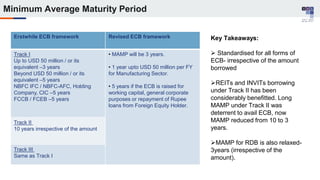
Track I
Up to USD 50 million / or its
equivalent –3 years
Beyond USD 50 million / or its
equivalent –5 years
NBFC IFC / NBFC-AFC, Holding
Company, CIC –5 years
FCCB / FCEB –5 years
• MAMP will be 3 years.
• 1 year upto USD 50 million per FY
for Manufacturing Sector.
• 5 years if the ECB is raised for
working capital, general corporate
purposes or repayment of Rupee
loans from Foreign Equity Holder.
Track II
10 years irrespective of the amount
Track III
Same as Track I
Key Takeaways:
 Standardised for all forms of
ECB- irrespective of the amount
borrowed
REITs and INVITs borrowing
under Track II has been
considerably benefitted. Long
MAMP under Track II was
deterrent to avail ECB, now
MAMP reduced from 10 to 3
years.
MAMP for RDB is also relaxed-
3years (irrespective of the
amount).
Minimum Average Maturity Period
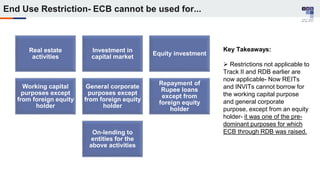
Real estate
activities
Investment in
capital market
Equity investment
Working capital
purposes except
from foreign equity
holder
General corporate
purposes except
from foreign equity
holder
Repayment of
Rupee loans
except from
foreign equity
holder
On-lending to
entities for the
above activities
Key Takeaways:
 Restrictions not applicable to
Track II and RDB earlier are
now applicable- Now REITs
and INVITs cannot borrow for
the working capital purpose
and general corporate
purpose, except from an equity
holder- it was one of the pre-
dominant purposes for which
ECB through RDB was raised.
End Use Restriction- ECB cannot be used for...
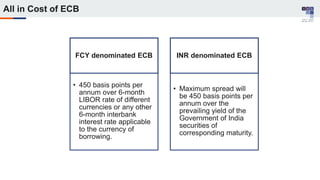
All in Cost of ECB
FCY denominated ECB
• 450 basis points per
annum over 6-month
LIBOR rate of different
currencies or any other
6-month interbank
interest rate applicable
to the currency of
borrowing.
INR denominated ECB
• Maximum spread will
be 450 basis points per
annum over the
prevailing yield of the
Government of India
securities of
corresponding maturity.
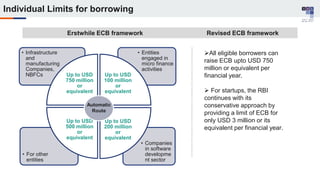
• Companies
in software
developme
nt sector
• For other
entities
• Entities
engaged in
micro finance
activities
• Infrastructure
and
manufacturing
Companies,
NBFCs Up to USD
750 million
or
equivalent
Up to USD
100 million
or
equivalent
Up to USD
200 million
or
equivalent
Up to USD
500 million
or
equivalent
All eligible borrowers can
raise ECB upto USD 750
million or equivalent per
financial year.
 For startups, the RBI
continues with its
conservative approach by
providing a limit of ECB for
only USD 3 million or its
equivalent per financial year.
Automatic
Route
Erstwhile ECB framework Revised ECB framework
Individual Limits for borrowing
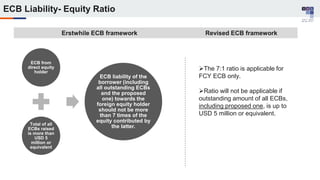
Automatic
Route
The 7:1 ratio is applicable for
FCY ECB only.
Ratio will not be applicable if
outstanding amount of all ECBs,
including proposed one, is up to
USD 5 million or equivalent.
Erstwhile ECB framework Revised ECB framework
ECB Liability- Equity Ratio
ECB from
direct equity
holder
Total of all
ECBs raised
is more than
USD 5
million or
equivalent
ECB liability of the
borrower (including
all outstanding ECBs
and the proposed
one) towards the
foreign equity holder
should not be more
than 7 times of the
equity contributed by
the latter.
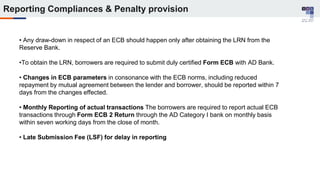
Reporting Compliances & Penalty provision
• Any draw-down in respect of an ECB should happen only after obtaining the LRN from the
Reserve Bank.
•To obtain the LRN, borrowers are required to submit duly certified Form ECB with AD Bank.
• Changes in ECB parameters in consonance with the ECB norms, including reduced
repayment by mutual agreement between the lender and borrower, should be reported within 7
days from the changes effected.
• Monthly Reporting of actual transactions The borrowers are required to report actual ECB
transactions through Form ECB 2 Return through the AD Category I bank on monthly basis
within seven working days from the close of month.
• Late Submission Fee (LSF) for delay in reporting
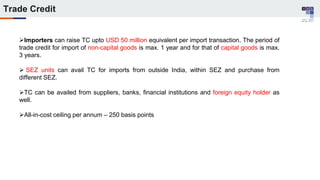
Trade Credit
Trade Credit
Importers can raise TC upto USD 50 million equivalent per import transaction. The period of
trade credit for import of non-capital goods is max. 1 year and for that of capital goods is max.
3 years.
 SEZ units can avail TC for imports from outside India, within SEZ and purchase from
different SEZ.
TC can be availed from suppliers, banks, financial institutions and foreign equity holder as
well.
All-in-cost ceiling per annum – 250 basis points
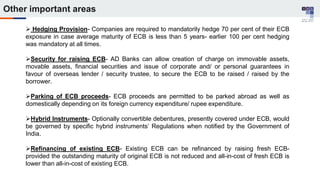
 Hedging Provision- Companies are required to mandatorily hedge 70 per cent of their ECB
exposure in case average maturity of ECB is less than 5 years- earlier 100 per cent hedging
was mandatory at all times.
Security for raising ECB- AD Banks can allow creation of charge on immovable assets,
movable assets, financial securities and issue of corporate and/ or personal guarantees in
favour of overseas lender / security trustee, to secure the ECB to be raised / raised by the
borrower.
Parking of ECB proceeds- ECB proceeds are permitted to be parked abroad as well as
domestically depending on its foreign currency expenditure/ rupee expenditure.
Hybrid Instruments- Optionally convertible debentures, presently covered under ECB, would
be governed by specific hybrid instruments’ Regulations when notified by the Government of
India.
Refinancing of existing ECB- Existing ECB can be refinanced by raising fresh ECB-
provided the outstanding maturity of original ECB is not reduced and all-in-cost of fresh ECB is
lower than all-in-cost of existing ECB.
Other important areas
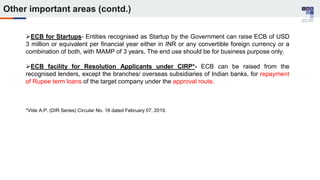
ECB for Startups- Entities recognised as Startup by the Government can raise ECB of USD
3 million or equivalent per financial year either in INR or any convertible foreign currency or a
combination of both, with MAMP of 3 years. The end use should be for business purpose only.
ECB facility for Resolution Applicants under CIRP*- ECB can be raised from the
recognised lenders, except the branches/ overseas subsidiaries of Indian banks, for repayment
of Rupee term loans of the target company under the approval route.
*Vide A.P. (DIR Series) Circular No. 18 dated February 07, 2019.
Other important areas (contd.)
www.saspartners.com

Financing Options for foreign companies in India

  • 1.
    Choosing the correctsource of funding SOY JOSEPH Director, SAS Partners Corporate Advisors
  • 2.
    Capital Account Transactiongenerally prohibited unless permitted (generally or specifically) Current Account Transaction generally permitted unless prohibited Is India moving towards complete Capital Account Convertibility? Every transaction is either Capital or Current Capital Account Vs Current Account
  • 3.
    Ways of ForeignInvestment Foreign Investment Foreign Direct Investment Automatic Route Person Resident Outside India Govt. Route Foreign Portfolio Investment FIIs NRIs, PIOs Loan from overseas Automatic Approval Debentures and Pref Shares Compulsory convertible Others Trade Credit up to 3 years
  • 4.
    Debt vs Equity DebtEquity Assured Return Capital repatriation Tax Benefit Sources of Payment Security Return on Investment
  • 5.
  • 6.
  • 7.
    Forms of ECB Loans including bankloans Floating/ fixed rate notes/ bonds/ debenture s Trade credits beyond 3 years FCCBsFCEBs Financial Lease Rupee denominat ed bonds
  • 8.
    New ECB Framework Foreign Exchange Management (Borrowingand Lending in Foreign Exchange) Regulations, 2000 Foreign Exchange Management (Borrowing and Lending in Rupees) Regulations, 2000 Foreign Exchange Management (Borrowing and Lending) Regulations, 2018 • In December 2018, RBI issued the new Regulation on Borrowing and Lending. •In January 2019, the revised ECB framework in line with new regulation was introduced. •In March 2019, the revised Trade Credit Policy was introduced.
  • 9.
    Key Takeaways:  CommonEligibility criteria and requirements for both FCY and INR denominated ECB, apart from the currency exchange rate, hedging requirement and forms of ECB, the other eligibility criteria and requirements. Track I. Medium Term FCY ECB Track II. Long Term FCY ECB Track III. INR ECB FCY denominated ECB (Track I + Track II) INR denominated ECB (Track III) (INR denominated ECB + INR Bonds) Erstwhile ECB Framework Revised ECB Framework Merging of categories INR Bonds (Masala Bonds)
  • 10.
    Erstwhile ECB FrameworkRevised ECB Framework TRACK I: Companies in manufacturing, infrastructure and software development, shipping , airlines Companies, SIDBI, EXIM Bank, Port Trusts, Units in SEZ etc. All entities eligible to receive FDI. Further, the following entities are also eligible to raise ECB: • Port Trusts • Units in SEZ • SIDBI • EXIM Bank • Registered entities engaged in micro- finance activities • Section 8 companies •Societies / trusts/ cooperatives TRACK II: All entities listed under Track I, Real Estate Investment Trusts (REIT) and Infrastructure Investment Trusts (INVIT) coming under the regulatory framework of the SEBI. TRACK III: All entities listed under Track II, NBFCs, NBFC-micro finance activities, Companies engaged in Miscellaneous services Key Takeaways: Eligible borrowers include all entities eligible to receive FDI. LLPs can now avail ECB. Service sector can now avail FCY ECB. NBFCs have an opportunity to receive foreign funds (FCY ECB). Specific permission for REIT and INVIT have been removed. Eligible Borrowers- who can borrow?
  • 11.
    Erstwhile ECB FrameworkRevised ECB Framework TRACK I: International banks, International Capital markets, Multilateral Financial Institutions, Export Credit Agencies, Suppliers of equipment, Foreign equity holders, Overseas Long Term investors, Overseas branches / subsidiaries of Indian banks •The lender should be resident of FAFT or IOCSO Country. •Multilateral and Regional Financial Institutions where India is a member country will also be considered as recognized lenders. • Individuals as lenders can only be permitted if they are foreign equity holders or for subscription to bonds/debentures listed abroad. •Foreign branches / subsidiaries of Indian banks are permitted as recognized lenders only for FCY ECB. TRACK II: All entities listed under Track I except overseas branches / subsidiaries of Indian banks. TRACK III: All entities listed under Track I except overseas branches / subsidiaries of Indian banks. Key Takeaways:  Major push for lenders, who wanted to lend in foreign currency. PE and VCF can lend monies without mandatorily having equity participation. Foreign parent companies can lend to its Indian subsidiaries through RDBs- Restriction on investment by related parties removed. Angel investors, foreigners or PIOs investing in individual capacities in Indian ventures, holding 25% of the equity- can lend to these companies, instead of capitalizing through an additional equity. Recognised Lenders- who can lend?
  • 12.
    Erstwhile ECB frameworkRevised ECB framework Track I Up to USD 50 million / or its equivalent –3 years Beyond USD 50 million / or its equivalent –5 years NBFC IFC / NBFC-AFC, Holding Company, CIC –5 years FCCB / FCEB –5 years • MAMP will be 3 years. • 1 year upto USD 50 million per FY for Manufacturing Sector. • 5 years if the ECB is raised for working capital, general corporate purposes or repayment of Rupee loans from Foreign Equity Holder. Track II 10 years irrespective of the amount Track III Same as Track I Key Takeaways:  Standardised for all forms of ECB- irrespective of the amount borrowed REITs and INVITs borrowing under Track II has been considerably benefitted. Long MAMP under Track II was deterrent to avail ECB, now MAMP reduced from 10 to 3 years. MAMP for RDB is also relaxed- 3years (irrespective of the amount). Minimum Average Maturity Period
  • 13.
    Real estate activities Investment in capitalmarket Equity investment Working capital purposes except from foreign equity holder General corporate purposes except from foreign equity holder Repayment of Rupee loans except from foreign equity holder On-lending to entities for the above activities Key Takeaways:  Restrictions not applicable to Track II and RDB earlier are now applicable- Now REITs and INVITs cannot borrow for the working capital purpose and general corporate purpose, except from an equity holder- it was one of the pre- dominant purposes for which ECB through RDB was raised. End Use Restriction- ECB cannot be used for...
  • 14.
    All in Costof ECB FCY denominated ECB • 450 basis points per annum over 6-month LIBOR rate of different currencies or any other 6-month interbank interest rate applicable to the currency of borrowing. INR denominated ECB • Maximum spread will be 450 basis points per annum over the prevailing yield of the Government of India securities of corresponding maturity.
  • 15.
    • Companies in software developme ntsector • For other entities • Entities engaged in micro finance activities • Infrastructure and manufacturing Companies, NBFCs Up to USD 750 million or equivalent Up to USD 100 million or equivalent Up to USD 200 million or equivalent Up to USD 500 million or equivalent All eligible borrowers can raise ECB upto USD 750 million or equivalent per financial year.  For startups, the RBI continues with its conservative approach by providing a limit of ECB for only USD 3 million or its equivalent per financial year. Automatic Route Erstwhile ECB framework Revised ECB framework Individual Limits for borrowing
  • 16.
    Automatic Route The 7:1 ratiois applicable for FCY ECB only. Ratio will not be applicable if outstanding amount of all ECBs, including proposed one, is up to USD 5 million or equivalent. Erstwhile ECB framework Revised ECB framework ECB Liability- Equity Ratio ECB from direct equity holder Total of all ECBs raised is more than USD 5 million or equivalent ECB liability of the borrower (including all outstanding ECBs and the proposed one) towards the foreign equity holder should not be more than 7 times of the equity contributed by the latter.
  • 17.
    Reporting Compliances &Penalty provision • Any draw-down in respect of an ECB should happen only after obtaining the LRN from the Reserve Bank. •To obtain the LRN, borrowers are required to submit duly certified Form ECB with AD Bank. • Changes in ECB parameters in consonance with the ECB norms, including reduced repayment by mutual agreement between the lender and borrower, should be reported within 7 days from the changes effected. • Monthly Reporting of actual transactions The borrowers are required to report actual ECB transactions through Form ECB 2 Return through the AD Category I bank on monthly basis within seven working days from the close of month. • Late Submission Fee (LSF) for delay in reporting
  • 18.
  • 19.
    Trade Credit Importers canraise TC upto USD 50 million equivalent per import transaction. The period of trade credit for import of non-capital goods is max. 1 year and for that of capital goods is max. 3 years.  SEZ units can avail TC for imports from outside India, within SEZ and purchase from different SEZ. TC can be availed from suppliers, banks, financial institutions and foreign equity holder as well. All-in-cost ceiling per annum – 250 basis points
  • 20.
     Hedging Provision-Companies are required to mandatorily hedge 70 per cent of their ECB exposure in case average maturity of ECB is less than 5 years- earlier 100 per cent hedging was mandatory at all times. Security for raising ECB- AD Banks can allow creation of charge on immovable assets, movable assets, financial securities and issue of corporate and/ or personal guarantees in favour of overseas lender / security trustee, to secure the ECB to be raised / raised by the borrower. Parking of ECB proceeds- ECB proceeds are permitted to be parked abroad as well as domestically depending on its foreign currency expenditure/ rupee expenditure. Hybrid Instruments- Optionally convertible debentures, presently covered under ECB, would be governed by specific hybrid instruments’ Regulations when notified by the Government of India. Refinancing of existing ECB- Existing ECB can be refinanced by raising fresh ECB- provided the outstanding maturity of original ECB is not reduced and all-in-cost of fresh ECB is lower than all-in-cost of existing ECB. Other important areas
  • 21.
    ECB for Startups-Entities recognised as Startup by the Government can raise ECB of USD 3 million or equivalent per financial year either in INR or any convertible foreign currency or a combination of both, with MAMP of 3 years. The end use should be for business purpose only. ECB facility for Resolution Applicants under CIRP*- ECB can be raised from the recognised lenders, except the branches/ overseas subsidiaries of Indian banks, for repayment of Rupee term loans of the target company under the approval route. *Vide A.P. (DIR Series) Circular No. 18 dated February 07, 2019. Other important areas (contd.)
  • 22.