WHITE PAPER
PRIVILEGED ACCESS MANAGEMENT
WHY SUDO IS NO LONGER ENOUGH
Fox Technologies, Inc. | www.foxt.com | sales@foxt.com | 616.438.0840
Privileged Access Management: Why Sudo Is No Longer Enough
Fox Technologies, Inc. | www.foxt.com | sales@foxt.com | 616.438.0840 2
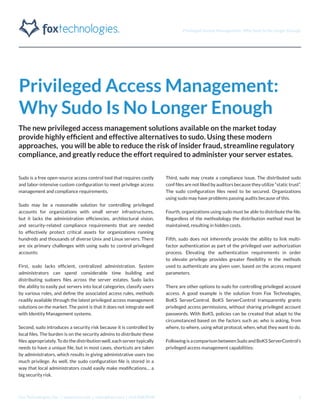
Sudo is a free open-source access control tool that requires costly
and labor-intensive custom configuration to meet privilege access
management and compliance requirements.
Sudo may be a reasonable solution for controlling privileged
accounts for organizations with small server infrastructures,
but it lacks the administration efficiencies, architectural vision,
and security-related compliance requirements that are needed
to effectively protect critical assets for organizations running
hundreds and thousands of diverse Unix and Linux servers. There
are six primary challenges with using sudo to control privileged
accounts:
First, sudo lacks efficient, centralized administration. System
administrators can spend considerable time building and
distributing sudoers files across the server estates. Sudo lacks
the ability to easily put servers into local categories, classify users
by various roles, and define the associated access rules, methods
readily available through the latest privileged access management
solutions on the market. The point is that it does not integrate well
with Identity Management systems.
Second, sudo introduces a security risk because it is controlled by
local files. The burden is on the security admins to distribute these
files appropriately. To do the distribution well, each server typically
needs to have a unique file, but in most cases, shortcuts are taken
by administrators, which results in giving administrative users too
much privilege. As well, the sudo configuration file is stored in a
way that local administrators could easily make modifications… a
big security risk.
Third, sudo may create a compliance issue. The distributed sudo
conf files are not liked by auditors because they utilize “static trust”.
The sudo configuration files need to be secured. Organizations
using sudo may have problems passing audits because of this.
Fourth, organizations using sudo must be able to distribute the file.
Regardless of the methodology the distribution method must be
maintained, resulting in hidden costs.
Fifth, sudo does not inherently provide the ability to link multi-
factor authentication as part of the privileged user authorization
process. Elevating the authentication requirements in order
to elevate privilege provides greater flexibility in the methods
used to authenticate any given user, based on the access request
parameters.
There are other options to sudo for controlling privileged account
access. A good example is the solution from Fox Technologies,
BoKS ServerControl. BoKS ServerControl transparently grants
privileged access permissions, without sharing privileged account
passwords. With BoKS, policies can be created that adapt to the
circumstanced based on the factors such as: who is asking, from
where, to where, using what protocol, when, what they want to do.
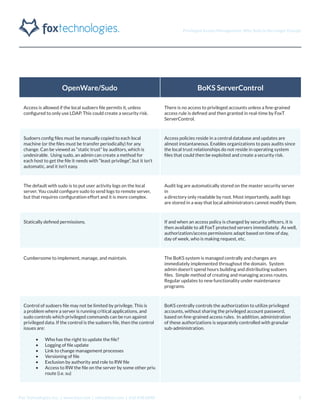
FollowingisacomparisonbetweenSudoandBoKSServerControl’s
privileged access management capabilities:
Privileged Access Management:
Why Sudo Is No Longer Enough
The new privileged access management solutions available on the market today
provide highly efficient and effective alternatives to sudo. Using these modern
approaches, you will be able to reduce the risk of insider fraud, streamline regulatory
compliance, and greatly reduce the effort required to administer your server estates.
Privileged Access Management: Why Sudo Is No Longer Enough
Fox Technologies, Inc. | www.foxt.com | sales@foxt.com | 616.438.0840 3
OpenWare/Sudo BoKS ServerControl
Access is allowed if the local sudoers file permits it, unless
configured to only use LDAP. This could create a security risk.
There is no access to privileged accounts unless a fine-grained
access rule is defined and then granted in real-time by FoxT
ServerControl.
Sudoers config files must be manually copied to each local
machine (or the files must be transfer periodically) for any
change. Can be viewed as “static trust” by auditors, which is
undesirable. Using sudo, an admin can create a method for
each host to get the file it needs with “least privilege”, but it isn’t
automatic, and it isn’t easy.
Access policies reside in a central database and updates are
almost instantaneous. Enables organizations to pass audits since
the local trust relationships do not reside in operating system
files that could then be exploited and create a security risk.
The default with sudo is to put user activity logs on the local
server. You could configure sudo to send logs to remote server,
but that requires configuration effort and it is more complex.
Audit log are automatically stored on the master security server
in
a directory only readable by root. Most importantly, audit logs
are stored in a way that local administrators cannot modify them.
Statically defined permissions. If and when an access policy is changed by security officers, it is
then available to all FoxT protected servers immediately. As well,
authorization/access permissions adapt based on time of day,
day of week, who is making request, etc.
Cumbersome to implement, manage, and maintain. The BoKS system is managed centrally and changes are
immediately implemented throughout the domain. System
admin doesn’t spend hours building and distributing sudoers
files. Simple method of creating and managing access routes.
Regular updates to new functionality under maintenance
programs.
Control of sudoers file may not be limited by privilege. This is
a problem where a server is running critical applications, and
sudo controls which privileged commands can be run against
privileged data. If the control is the sudoers file, then the control
issues are:
•	 Who has the right to update the file?
•	 Logging of file update
•	 Link to change management processes
•	 Versioning of file
•	 Exclusion by authority and role to RW file
•	 Access to RW the file on the server by some other priv.
route (i.e. su)
BoKS centrally controls the authorization to utilize privileged
accounts, without sharing the privileged account password,
based on fine-grained access rules. In addition, administration
of these authorizations is separately controlled with granular
sub-administration.
Privileged Access Management: Why Sudo Is No Longer Enough
Fox Technologies, Inc. | www.foxt.com | sales@foxt.com | 616.438.0840 4
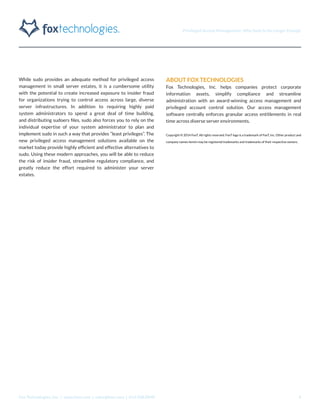
While sudo provides an adequate method for privileged access
management in small server estates, it is a cumbersome utility
with the potential to create increased exposure to insider fraud
for organizations trying to control access across large, diverse
server infrastructures. In addition to requiring highly paid
system administrators to spend a great deal of time building,
and distributing sudoers files, sudo also forces you to rely on the
individual expertise of your system administrator to plan and
implement sudo in such a way that provides “least privileges”. The
new privileged access management solutions available on the
market today provide highly efficient and effective alternatives to
sudo. Using these modern approaches, you will be able to reduce
the risk of insider fraud, streamline regulatory compliance, and
greatly reduce the effort required to administer your server
estates.
ABOUT FOX TECHNOLOGIES
Fox Technologies, Inc. helps companies protect corporate
information assets, simplify compliance and streamline
administration with an award-winning access management and
privileged account control solution. Our access management
software centrally enforces granular access entitlements in real
time across diverse server environments.
Copyright © 2014 FoxT. All rights reserved. FoxT logo is a trademark of FoxT, Inc. Other product and
company names herein may be registered trademarks and trademarks of their respective owners.

Sudo is no longer enough

  • 1.
    WHITE PAPER PRIVILEGED ACCESSMANAGEMENT WHY SUDO IS NO LONGER ENOUGH Fox Technologies, Inc. | www.foxt.com | sales@foxt.com | 616.438.0840
  • 2.
    Privileged Access Management:Why Sudo Is No Longer Enough Fox Technologies, Inc. | www.foxt.com | sales@foxt.com | 616.438.0840 2 Sudo is a free open-source access control tool that requires costly and labor-intensive custom configuration to meet privilege access management and compliance requirements. Sudo may be a reasonable solution for controlling privileged accounts for organizations with small server infrastructures, but it lacks the administration efficiencies, architectural vision, and security-related compliance requirements that are needed to effectively protect critical assets for organizations running hundreds and thousands of diverse Unix and Linux servers. There are six primary challenges with using sudo to control privileged accounts: First, sudo lacks efficient, centralized administration. System administrators can spend considerable time building and distributing sudoers files across the server estates. Sudo lacks the ability to easily put servers into local categories, classify users by various roles, and define the associated access rules, methods readily available through the latest privileged access management solutions on the market. The point is that it does not integrate well with Identity Management systems. Second, sudo introduces a security risk because it is controlled by local files. The burden is on the security admins to distribute these files appropriately. To do the distribution well, each server typically needs to have a unique file, but in most cases, shortcuts are taken by administrators, which results in giving administrative users too much privilege. As well, the sudo configuration file is stored in a way that local administrators could easily make modifications… a big security risk. Third, sudo may create a compliance issue. The distributed sudo conf files are not liked by auditors because they utilize “static trust”. The sudo configuration files need to be secured. Organizations using sudo may have problems passing audits because of this. Fourth, organizations using sudo must be able to distribute the file. Regardless of the methodology the distribution method must be maintained, resulting in hidden costs. Fifth, sudo does not inherently provide the ability to link multi- factor authentication as part of the privileged user authorization process. Elevating the authentication requirements in order to elevate privilege provides greater flexibility in the methods used to authenticate any given user, based on the access request parameters. There are other options to sudo for controlling privileged account access. A good example is the solution from Fox Technologies, BoKS ServerControl. BoKS ServerControl transparently grants privileged access permissions, without sharing privileged account passwords. With BoKS, policies can be created that adapt to the circumstanced based on the factors such as: who is asking, from where, to where, using what protocol, when, what they want to do. FollowingisacomparisonbetweenSudoandBoKSServerControl’s privileged access management capabilities: Privileged Access Management: Why Sudo Is No Longer Enough The new privileged access management solutions available on the market today provide highly efficient and effective alternatives to sudo. Using these modern approaches, you will be able to reduce the risk of insider fraud, streamline regulatory compliance, and greatly reduce the effort required to administer your server estates.
  • 3.
    Privileged Access Management:Why Sudo Is No Longer Enough Fox Technologies, Inc. | www.foxt.com | sales@foxt.com | 616.438.0840 3 OpenWare/Sudo BoKS ServerControl Access is allowed if the local sudoers file permits it, unless configured to only use LDAP. This could create a security risk. There is no access to privileged accounts unless a fine-grained access rule is defined and then granted in real-time by FoxT ServerControl. Sudoers config files must be manually copied to each local machine (or the files must be transfer periodically) for any change. Can be viewed as “static trust” by auditors, which is undesirable. Using sudo, an admin can create a method for each host to get the file it needs with “least privilege”, but it isn’t automatic, and it isn’t easy. Access policies reside in a central database and updates are almost instantaneous. Enables organizations to pass audits since the local trust relationships do not reside in operating system files that could then be exploited and create a security risk. The default with sudo is to put user activity logs on the local server. You could configure sudo to send logs to remote server, but that requires configuration effort and it is more complex. Audit log are automatically stored on the master security server in a directory only readable by root. Most importantly, audit logs are stored in a way that local administrators cannot modify them. Statically defined permissions. If and when an access policy is changed by security officers, it is then available to all FoxT protected servers immediately. As well, authorization/access permissions adapt based on time of day, day of week, who is making request, etc. Cumbersome to implement, manage, and maintain. The BoKS system is managed centrally and changes are immediately implemented throughout the domain. System admin doesn’t spend hours building and distributing sudoers files. Simple method of creating and managing access routes. Regular updates to new functionality under maintenance programs. Control of sudoers file may not be limited by privilege. This is a problem where a server is running critical applications, and sudo controls which privileged commands can be run against privileged data. If the control is the sudoers file, then the control issues are: • Who has the right to update the file? • Logging of file update • Link to change management processes • Versioning of file • Exclusion by authority and role to RW file • Access to RW the file on the server by some other priv. route (i.e. su) BoKS centrally controls the authorization to utilize privileged accounts, without sharing the privileged account password, based on fine-grained access rules. In addition, administration of these authorizations is separately controlled with granular sub-administration.
  • 4.
    Privileged Access Management:Why Sudo Is No Longer Enough Fox Technologies, Inc. | www.foxt.com | sales@foxt.com | 616.438.0840 4 While sudo provides an adequate method for privileged access management in small server estates, it is a cumbersome utility with the potential to create increased exposure to insider fraud for organizations trying to control access across large, diverse server infrastructures. In addition to requiring highly paid system administrators to spend a great deal of time building, and distributing sudoers files, sudo also forces you to rely on the individual expertise of your system administrator to plan and implement sudo in such a way that provides “least privileges”. The new privileged access management solutions available on the market today provide highly efficient and effective alternatives to sudo. Using these modern approaches, you will be able to reduce the risk of insider fraud, streamline regulatory compliance, and greatly reduce the effort required to administer your server estates. ABOUT FOX TECHNOLOGIES Fox Technologies, Inc. helps companies protect corporate information assets, simplify compliance and streamline administration with an award-winning access management and privileged account control solution. Our access management software centrally enforces granular access entitlements in real time across diverse server environments. Copyright © 2014 FoxT. All rights reserved. FoxT logo is a trademark of FoxT, Inc. Other product and company names herein may be registered trademarks and trademarks of their respective owners.