OBLIQUE
DRAWING
OBLIQUE DRAWING :
In an oblique drawing the front view is drawn
true size, and the receding surfaces are drawn on an
angle to give it a pictorial appearance. This form of
projection has the advantage of showing One View
(the Front View) of the object without distortion.
Generally, the face with the greatest detail faces the
front.
This type of drawing is similar to Isometric
drawing. The only difference is two of its axes are
perpendicular to each other such as one of its
planes (views) is parallel to the ground.
The angle of elevation of the receding side of
an oblique drawing is normally angled at 450 from
the ground line.
Types of OBLIQUE Drawing
• Cavalier Oblique
• Cabinet Oblique
• General Oblique
– There are three types of oblique drawing. The receding
side, or the diagonal axis is scaled differently for each of the
three types.
– These oblique drawings are the:
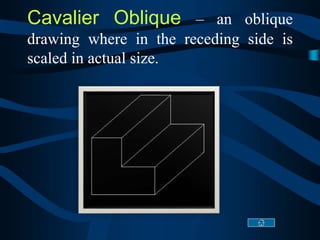
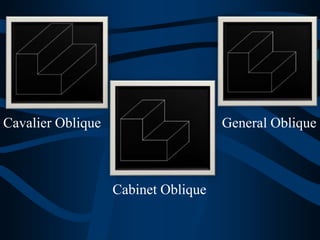
Cavalier Oblique – an oblique
drawing where in the receding side is
scaled in actual size.
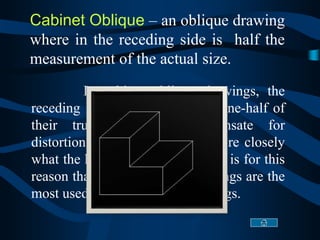
Cabinet Oblique – an oblique drawing
where in the receding side is half the
measurement of the actual size.
In cabinet oblique drawings, the
receding lines are shortened by one-half of
their true length to compensate for
distortion and to approximate more closely
what the human eye would see. It is for this
reason that cabinet oblique drawings are the
most used form of oblique drawings.
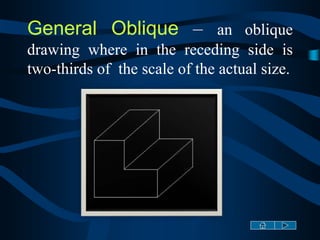
General Oblique – an oblique
drawing where in the receding side is
two-thirds of the scale of the actual size.
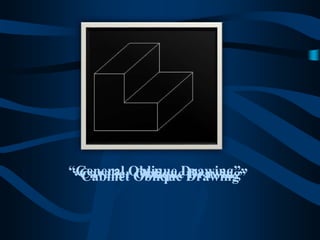
“Cavalier Oblique Drawing”“Cabinet Oblique Drawing”“General Oblique Drawing”
Cavalier Oblique
Cabinet Oblique
General Oblique
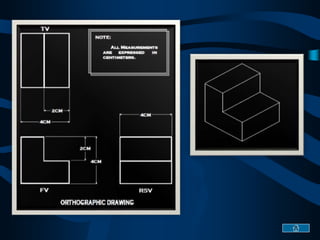
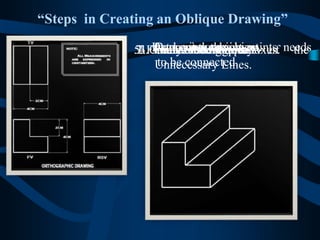
“Steps in Creating an Oblique Drawing”
1. Create the Oblique Axes.2. Create the Oblique Box.3. Transfer the Views.4. Analyze the figure.Determine which points needs
to be connected.
Connect the points.5. Finalize the figure by:Darkening the object.And Erasing all of the
Unnecessary Lines.
OBLIQUE
DRAWING
presented by
Reymer G. Melendres

Oblique drawing

  • 1.
  • 2.
    OBLIQUE DRAWING : Inan oblique drawing the front view is drawn true size, and the receding surfaces are drawn on an angle to give it a pictorial appearance. This form of projection has the advantage of showing One View (the Front View) of the object without distortion. Generally, the face with the greatest detail faces the front. This type of drawing is similar to Isometric drawing. The only difference is two of its axes are perpendicular to each other such as one of its planes (views) is parallel to the ground. The angle of elevation of the receding side of an oblique drawing is normally angled at 450 from the ground line.
  • 3.
    Types of OBLIQUEDrawing • Cavalier Oblique • Cabinet Oblique • General Oblique – There are three types of oblique drawing. The receding side, or the diagonal axis is scaled differently for each of the three types. – These oblique drawings are the:
  • 5.
    Cavalier Oblique –an oblique drawing where in the receding side is scaled in actual size.
  • 6.
    Cabinet Oblique –an oblique drawing where in the receding side is half the measurement of the actual size. In cabinet oblique drawings, the receding lines are shortened by one-half of their true length to compensate for distortion and to approximate more closely what the human eye would see. It is for this reason that cabinet oblique drawings are the most used form of oblique drawings.
  • 7.
    General Oblique –an oblique drawing where in the receding side is two-thirds of the scale of the actual size.
  • 8.
    “Cavalier Oblique Drawing”“CabinetOblique Drawing”“General Oblique Drawing”
  • 9.
  • 10.
    “Steps in Creatingan Oblique Drawing” 1. Create the Oblique Axes.2. Create the Oblique Box.3. Transfer the Views.4. Analyze the figure.Determine which points needs to be connected. Connect the points.5. Finalize the figure by:Darkening the object.And Erasing all of the Unnecessary Lines.
  • 11.