MYANMAR
MYANMAR
• Myanmar was known as Burma until 1989. The country’s
name was officially changed by the military
government that took over in 1988. Early civilization in
Myanmar dates back to the 1st century with
archaeological evidences of the Pyu Kingdoms of
Thayekhittaya (Sri Ksetra), Beithano (Visnu), and Hanlin.
• The music of Myanmar (or Burma) has similarities with
many other musical traditions in the region, including
Chinese music and Thai music, probably because its
longest land border is shared with China.
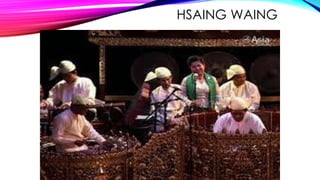
• The hsaing waing is Myanmar’s traditional folk music
ensemble. It is made up mainly of different gongs and
drums as well as other instruments depending on the
nature of the performance.
HSAING WAING
• Myanmar’s musical instruments are categorized into two
types, the loud sounding and soft sounding. The loud
sounding instruments are performed in open-air
ensembles at ceremonies and festivals. Most of the
hsaing waing instruments belong to the loud sounding
category.
OTHER INSTRUMENTS
IN THE HSAING
WAING ARE THE:
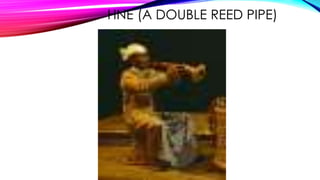
HNE (A DOUBLE REED PIPE)
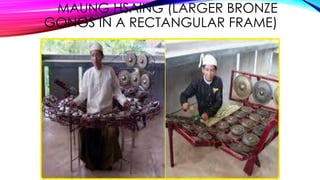
MAUNG HSAING (LARGER BRONZE
GONGS IN A RECTANGULAR FRAME)
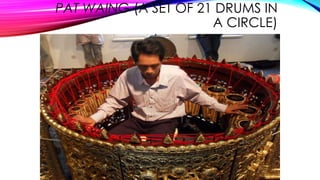
PAT WAING (A SET OF 21 DRUMS IN
A CIRCLE)
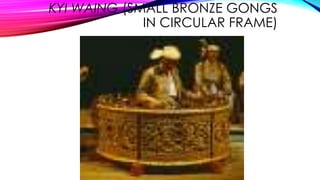
KYI WAING (SMALL BRONZE GONGS
IN CIRCULAR FRAME)
• For more formal and classical performances that are
performed indoors, the ensemble may be
accompanied by the saung gauk (13-string angular
harp with soft sound) the national instrument of
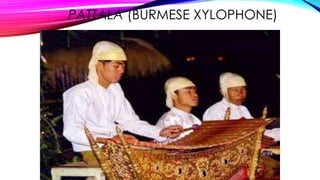
Myanmar, the pattala (Burmese xylophone), or the
piano and violin, both introduced during colonial rule.
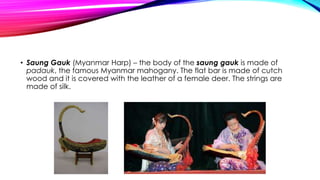
• Saung Gauk (Myanmar Harp) – the body of the saung gauk is made of
padauk, the famous Myanmar mahogany. The flat bar is made of cutch
wood and it is covered with the leather of a female deer. The strings are
made of silk.
PATTALA (BURMESE XYLOPHONE)
• Myanmar not only has musical ensembles but also an extensive collection of
classical songs called the mahagita. These songs are divided into different
types like the oldest repertoires, royal court music, songs of longing, horses’
dance songs, worship songs for Burmese spirits, and songs of sorrow and
music adapted from Ayutthaya and the Mon people. The saung gauk
usually accompanies these songs.

Grade 8: Myanmar Music

  • 1.
  • 2.
  • 3.
    • Myanmar wasknown as Burma until 1989. The country’s name was officially changed by the military government that took over in 1988. Early civilization in Myanmar dates back to the 1st century with archaeological evidences of the Pyu Kingdoms of Thayekhittaya (Sri Ksetra), Beithano (Visnu), and Hanlin.
  • 4.
    • The musicof Myanmar (or Burma) has similarities with many other musical traditions in the region, including Chinese music and Thai music, probably because its longest land border is shared with China.
  • 5.
    • The hsaingwaing is Myanmar’s traditional folk music ensemble. It is made up mainly of different gongs and drums as well as other instruments depending on the nature of the performance.
  • 6.
  • 7.
    • Myanmar’s musicalinstruments are categorized into two types, the loud sounding and soft sounding. The loud sounding instruments are performed in open-air ensembles at ceremonies and festivals. Most of the hsaing waing instruments belong to the loud sounding category.
  • 8.
    OTHER INSTRUMENTS IN THEHSAING WAING ARE THE:
  • 9.
    HNE (A DOUBLEREED PIPE)
  • 10.
    MAUNG HSAING (LARGERBRONZE GONGS IN A RECTANGULAR FRAME)
  • 11.
    PAT WAING (ASET OF 21 DRUMS IN A CIRCLE)
  • 12.
    KYI WAING (SMALLBRONZE GONGS IN CIRCULAR FRAME)
  • 13.
    • For moreformal and classical performances that are performed indoors, the ensemble may be accompanied by the saung gauk (13-string angular harp with soft sound) the national instrument of Myanmar, the pattala (Burmese xylophone), or the piano and violin, both introduced during colonial rule.
  • 14.
    • Saung Gauk(Myanmar Harp) – the body of the saung gauk is made of padauk, the famous Myanmar mahogany. The flat bar is made of cutch wood and it is covered with the leather of a female deer. The strings are made of silk.
  • 15.
  • 16.
    • Myanmar notonly has musical ensembles but also an extensive collection of classical songs called the mahagita. These songs are divided into different types like the oldest repertoires, royal court music, songs of longing, horses’ dance songs, worship songs for Burmese spirits, and songs of sorrow and music adapted from Ayutthaya and the Mon people. The saung gauk usually accompanies these songs.