Demonetization & Human Development
Why Need Case study ?
Why Need Debate and Discussion in INDIA.
Why did government appeal every Institute,
college, media, NGO etc. for Discuss and
Debate .
What is Demonetization?
Demonetization is the act of stripping a currency unit of its
status as legal tender.
It is the process of ceasing to produce and circulate particular
forms of currency.
This is necessary whenever there is a change of national
currency. The old unit of currency is retired and replaced with a
new currency unit.
Legal tender is a medium of payment recognized by a legal
system to be valid for meeting a financial obligation.
 January 1946- Rs.1,000 and Rs.10,000 banknotes, which were
in circulation were demonetized primarily to curb unaccounted
money.
 1978- The higher denomination banknotes in Rs 1,000, Rs
5,000 and Rs 10,000 were reintroduced in the year 1954 and
these banknotes were again demonetized in January 1978.
 Denominations of 1, 2, 3, 5, 10, 20 & 25 paise were in
circulation till June 30, 2011 but were then withdrawn. While
the 50 paise coins are still in circulation. They are called small
coins while the other denominations are known as rupee coins.
History of demonetization in India
Reasons for Demonetization
 Governments across the world have decided
to ban currency notes in circulation,
rendering huge amounts of cash useless
overnight, due to a plethora of reasons.
 a)Fight against counterfeiting currencies
 b)Stop funding for terror activities
 c)Battling black money
Why ban Rs 500 and Rs 1000
(large value) notes?
The Financial Action Task Force, a global body that
looks at the criminal use of the international financial
system notes that high-value bills are used in money
laundering schemes, racketeering, and drug and
people trafficking.
A Centre for Media Studies report showed that
nearly Rs 30,000 crore was spent during the 2014
general election, while official spending only
accounted for Rs 7,000-Rs 8,000 crore.
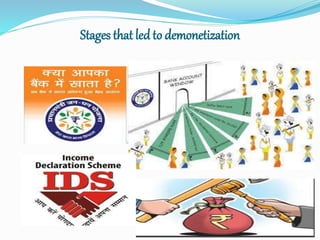
Stages that led to demonetization
Challenges for RBI
 The logjam may be particularly acute in rural areas where
both bank branches and ATMs are in short supply.
 While rural India reportedly has 6 lakh villages and had 44
crore savings account holders, they were home to just
48,000 bank branches.
 The 12 lakh ATMs that are in operation across the country
will also need to be reconfigured to dispense the new
denominations.
Challenges for the Government
 There is no good estimate for how much of India’s black
money is in forms other than currency/physical notes such as
gold, jewelry, land or any other form of wealth.
 At a time when private investment has been hit and with
factory output contracting, scrapping high-value notes may
prolong the economic pain.
 The challenge is not just in pulling out 85 per cent of the
high-value currencies in circulation but also to ensure a
culture of compliance.
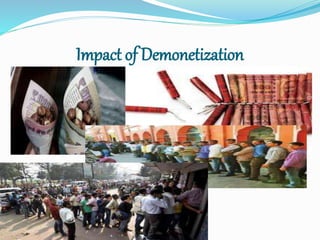
Impact of Demonetization
The effect of this policy is not going to be uniform
across the economy. Sectors that have a larger cash
component in their transactions will be hit harder,
such as real estate, movie production, campaign
finance, etc.
This will then be followed by a correction in these
markets. Whether these corrections are deflationary
(reducing prices) or contractionary (reduce business)
is something to watch closely.
Impact of Demonetization
Short-term Impact
Negative Effect:-
 Low number of bank accounts in remote, small
villages and supply-chain disruptions could affect
demand for consumer staples for a brief while, believe
analysts.
 The demand impact of large-ticket consumer durables
items such as apparels, white goods, apparel and the
likes could also head south.
Positive Effect
 This could also have the effect of bringing down deposit
and lending rates further without the RBI having to cut its
repo rate. A rise in deposit base will allow banks to lower
the blended cost of funds
 Rising use of credit/debit cards, net banking and other
online payment mechanisms will be another positive, as
these would not only lower transaction costs but some of
these could help earn some fee income as well.
Long Term Impact
 It also provides a boost to the government’s financial
inclusion drive, pushing more households towards
efficient banking and payment infrastructure.
 Tax revenues will increase.
 Bank deposits will increase and they will have more
capacity to support the economy. It will boost growth as it
will expand and clean the formal gross domestic product.
Conclusion
Conclusion
 Despite having many positives such as rising tax to GDP,
higher GDP growth, lower inflation, higher financial
savings, this demonetization move may not curb the root
cause of black money.
 “This initiative addresses the ‘stock’ of black money but
not necessarily the flow/fresh creation of black money
unless some mechanism is built to track the movement of
the new high-value currency notes.
Demonetization and human development

Demonetization and human development

  • 2.
    Demonetization & HumanDevelopment Why Need Case study ? Why Need Debate and Discussion in INDIA. Why did government appeal every Institute, college, media, NGO etc. for Discuss and Debate .
  • 3.
    What is Demonetization? Demonetizationis the act of stripping a currency unit of its status as legal tender. It is the process of ceasing to produce and circulate particular forms of currency. This is necessary whenever there is a change of national currency. The old unit of currency is retired and replaced with a new currency unit. Legal tender is a medium of payment recognized by a legal system to be valid for meeting a financial obligation.
  • 4.
     January 1946-Rs.1,000 and Rs.10,000 banknotes, which were in circulation were demonetized primarily to curb unaccounted money.  1978- The higher denomination banknotes in Rs 1,000, Rs 5,000 and Rs 10,000 were reintroduced in the year 1954 and these banknotes were again demonetized in January 1978.  Denominations of 1, 2, 3, 5, 10, 20 & 25 paise were in circulation till June 30, 2011 but were then withdrawn. While the 50 paise coins are still in circulation. They are called small coins while the other denominations are known as rupee coins. History of demonetization in India
  • 5.
  • 6.
    Reasons for Demonetization Governments across the world have decided to ban currency notes in circulation, rendering huge amounts of cash useless overnight, due to a plethora of reasons.  a)Fight against counterfeiting currencies  b)Stop funding for terror activities  c)Battling black money
  • 7.
    Why ban Rs500 and Rs 1000 (large value) notes? The Financial Action Task Force, a global body that looks at the criminal use of the international financial system notes that high-value bills are used in money laundering schemes, racketeering, and drug and people trafficking. A Centre for Media Studies report showed that nearly Rs 30,000 crore was spent during the 2014 general election, while official spending only accounted for Rs 7,000-Rs 8,000 crore.
  • 8.
    Stages that ledto demonetization
  • 9.
    Challenges for RBI The logjam may be particularly acute in rural areas where both bank branches and ATMs are in short supply.  While rural India reportedly has 6 lakh villages and had 44 crore savings account holders, they were home to just 48,000 bank branches.  The 12 lakh ATMs that are in operation across the country will also need to be reconfigured to dispense the new denominations.
  • 10.
    Challenges for theGovernment  There is no good estimate for how much of India’s black money is in forms other than currency/physical notes such as gold, jewelry, land or any other form of wealth.  At a time when private investment has been hit and with factory output contracting, scrapping high-value notes may prolong the economic pain.  The challenge is not just in pulling out 85 per cent of the high-value currencies in circulation but also to ensure a culture of compliance.
  • 11.
    Impact of Demonetization Theeffect of this policy is not going to be uniform across the economy. Sectors that have a larger cash component in their transactions will be hit harder, such as real estate, movie production, campaign finance, etc. This will then be followed by a correction in these markets. Whether these corrections are deflationary (reducing prices) or contractionary (reduce business) is something to watch closely.
  • 12.
  • 13.
  • 14.
    Short-term Impact Negative Effect:- Low number of bank accounts in remote, small villages and supply-chain disruptions could affect demand for consumer staples for a brief while, believe analysts.  The demand impact of large-ticket consumer durables items such as apparels, white goods, apparel and the likes could also head south.
  • 15.
    Positive Effect  Thiscould also have the effect of bringing down deposit and lending rates further without the RBI having to cut its repo rate. A rise in deposit base will allow banks to lower the blended cost of funds  Rising use of credit/debit cards, net banking and other online payment mechanisms will be another positive, as these would not only lower transaction costs but some of these could help earn some fee income as well.
  • 16.
    Long Term Impact It also provides a boost to the government’s financial inclusion drive, pushing more households towards efficient banking and payment infrastructure.  Tax revenues will increase.  Bank deposits will increase and they will have more capacity to support the economy. It will boost growth as it will expand and clean the formal gross domestic product.
  • 17.
  • 18.
    Conclusion  Despite havingmany positives such as rising tax to GDP, higher GDP growth, lower inflation, higher financial savings, this demonetization move may not curb the root cause of black money.  “This initiative addresses the ‘stock’ of black money but not necessarily the flow/fresh creation of black money unless some mechanism is built to track the movement of the new high-value currency notes.