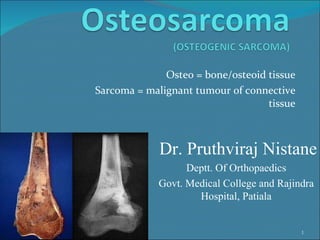
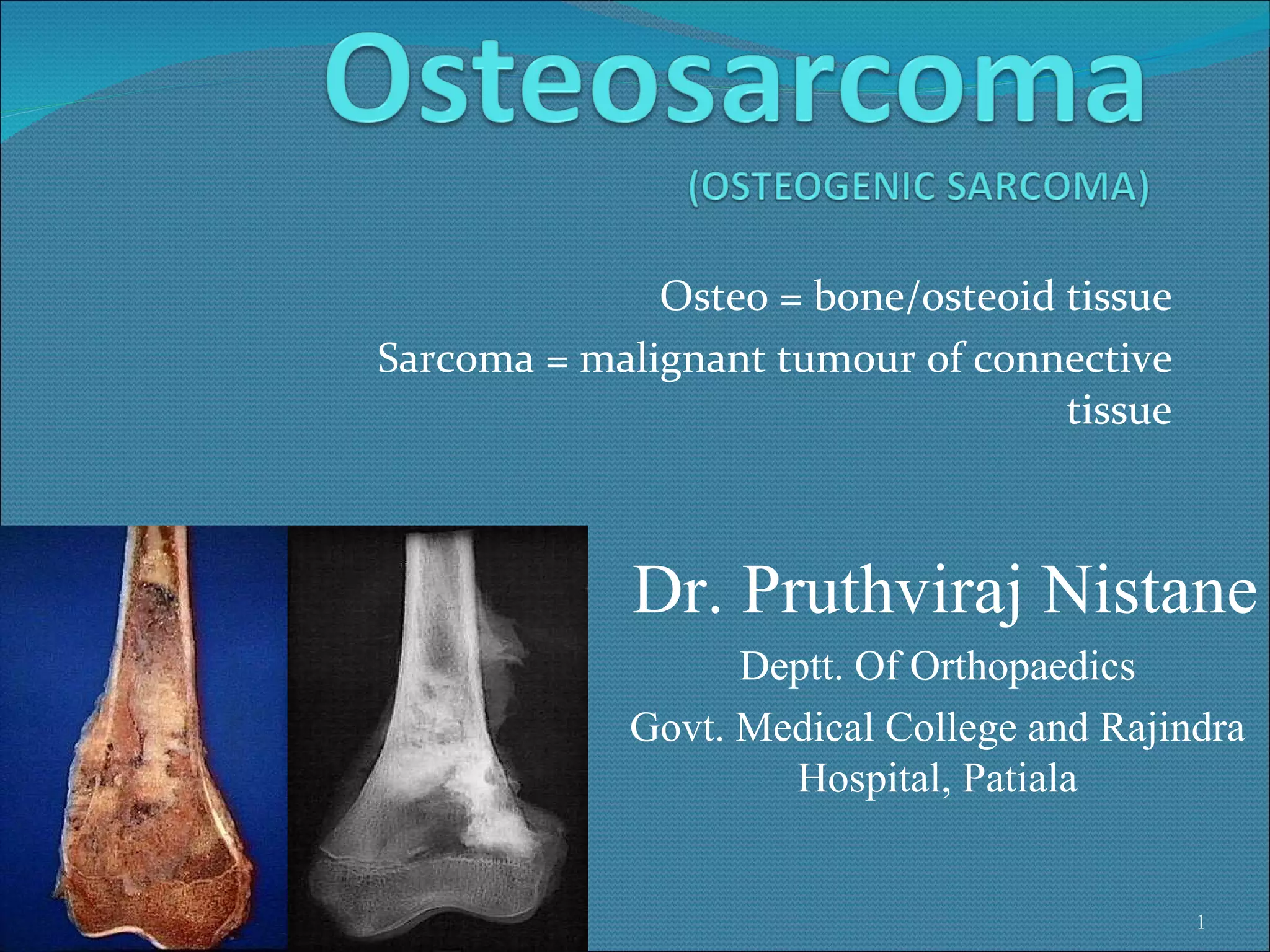
Osteo = bone/osteoid tissue Sarcoma = malignant tumour of connective tissue 02/04/12 Dr. Pruthviraj Nistane Deptt. Of Orthopaedics Govt. Medical College and Rajindra Hospital, Patiala
Overview Definition Epidemiology Pathogenesis Skeletal distribution Clinical presentation Evaluation Classification Investigations  Treatment Prognosis
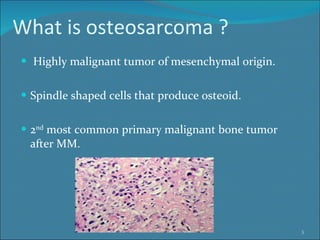
What is osteosarcoma ? Highly malignant tumor of mesenchymal origin. Spindle shaped cells that produce osteoid. 2 nd  most common primary malignant bone tumor after MM.
Epidemiology Incidence โ€“ 1 to 3 per million per year Any age But 75%  in 12-25yrs of age Almost equal in both sexes, slightly more in males .
Epidemiology Associated  syndromes Hereditary form of retinoblastoma Li-Fraumeni syndrome (p53) Rothmund-Thomson syndrome (8q24)
Pathogenesis Unknown Modal incidence correlates with rapid bone growth Radiation >2000 rads Chemicals โ€“ chlorantherene, AAF, Be compounds

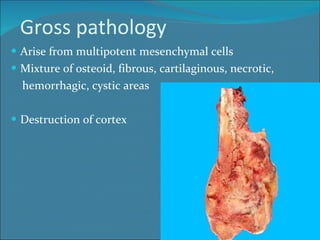
Gross pathology Arise from multipotent mesenchymal cells Mixture of osteoid, fibrous, cartilaginous, necrotic,  hemorrhagic, cystic areas Destruction of cortex
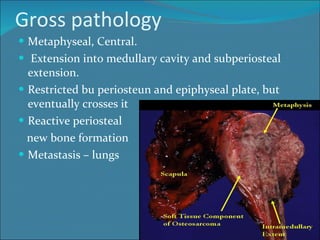
Gross pathology Metaphyseal, Central. Extension into medullary cavity and subperiosteal extension.  Restricted bu periosteun and epiphyseal plate, but eventually crosses it Reactive periosteal  new bone formation Metastasis โ€“ lungs
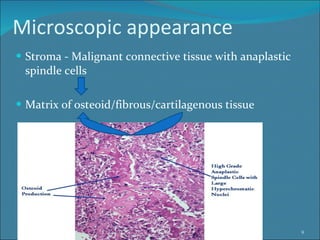
Microscopic appearance Stroma - Malignant connective tissue with anaplastic spindle cells Matrix of osteoid/fibrous/cartilagenous tissue
Classification PRIMARY or SECONDARY PRIMARY OSTEOSARCOMAS are Conventional /classic  osteosarcoma (high  grade, intra medullar y)  Low-grade intramedullary osteosarcoma  Parosteal osteosarcoma Periosteal osteosarcoma High-grade surface osteosarcoma Telangiectatic osteosarcoma, and  Small cell osteosarcoma.
Classification SECONDARY OSTEOSARCOMAS Osteosarcomas occurring at the site of another disease  process.  more common in >50 years of age The most common causes are  Paget disease  Previous radiation treatment  Other associated conditions are  Fibrous dysplasia  Bone infarcts Osteochondromas Chronic osteomyelitis Dedifferentiated chondrosarcomas Osteogenesis imperfecta
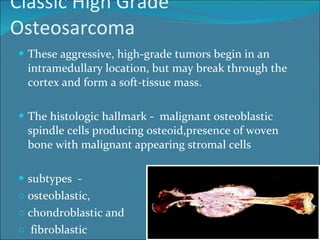
Classic High Grade Osteosarcoma These aggressive, high-grade tumors begin in an intramedullary location, but may break through the cortex and form a soft-tissue mass. The histologic hallmark -  malignant osteoblastic spindle cells producing osteoid,presence of woven bone with malignant appearing stromal cells subtypes  -  osteoblastic,  chondroblastic and fibroblastic
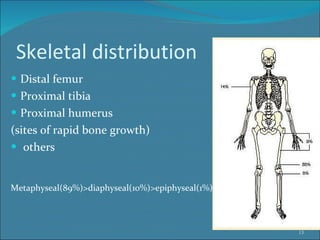
Skeletal distribution Distal femur Proximal tibia Proximal humerus (sites of rapid bone growth) others Metaphyseal(89%)>diaphyseal(10%)>epiphyseal(1%)
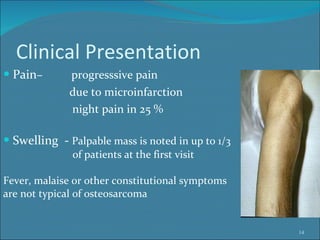
Clinical Presentation Pain โ€“  progresssive pain due to microinfarction  night pain in 25 % Swelling  -  Palpable mass is noted in up to 1/3  of patients at the first visit Fever, malaise or other constitutional symptoms  are not typical of osteosarcoma
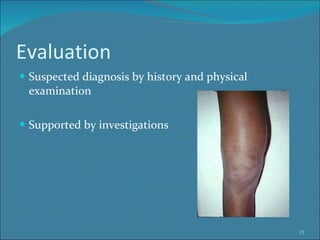
Evaluation Suspected diagnosis by history and physical examination Supported by investigations
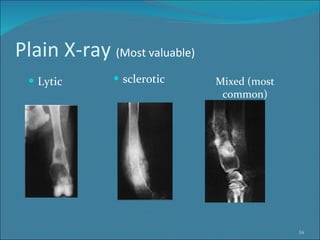
Plain X-ray  (Most valuable) sclerotic Lytic Mixed (most common)
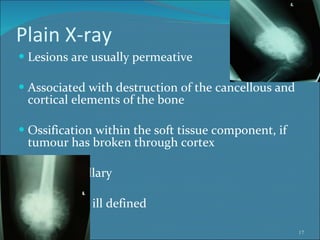
Plain X-ray Lesions are usually permeative Associated with destruction of the cancellous and cortical elements of the bone Ossification within the soft tissue component, if tumour has broken through cortex Intra medullary Borders are ill defined
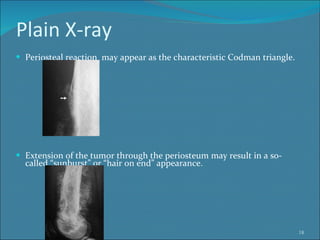
Plain X-ray Periosteal reaction  may appear as the characteristic Codman triangle.  Extension of the tumor through the periosteum may result in a so-called โ€œsunburstโ€ or โ€œhair on endโ€ appearance.
Other investigations MRI CT Angiogram Bone scan Laboratory studies Biopsy
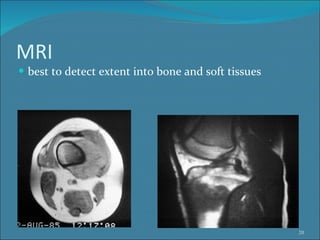
MRI  best to detect extent into bone and soft tissues
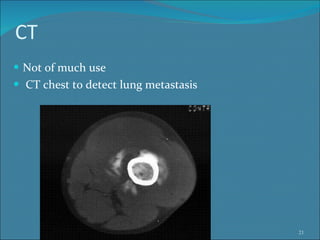
CT Not of much use CT chest to detect lung metastasis
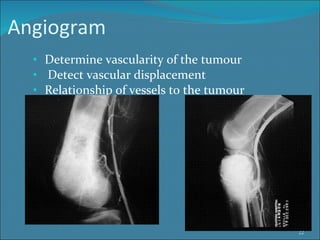
Angiogram Determine vascularity of the tumour Detect vascular displacement Relationship of vessels to the tumour
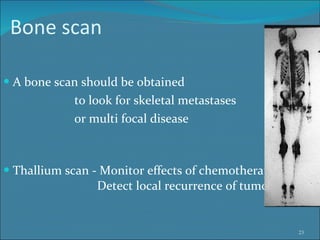
Bone scan  A bone scan should be obtained to look for skeletal metastases  or multi focal disease Thallium scan - Monitor effects of chemotherapy   Detect local recurrence of tumor
laboratory studies Full blood count, ESR, CRP.  LDH (elevated level is associated with poor    prognosis)  ALP (highly osteogenic) Platelet count  Electrolyte levels Liver function tests Renal function tests Urinalysis
Biopsy to conform the diagnosis. Types Fine needle aspiration  Core needle biopsy  Open  incisional biopsy
Enneking staging system The staging system is typically depicted as follows Stage I: Low grade tumors I-A intra compartmental I-B extra compartmental Stage II: High grade tumors II-A intra compartmental II-B extra compartmental Stage III: Any tumors with evidence of  metastasis
Differential Dx Giant Cell Tumor Chondrosarcoma Fibrosarcoma Aneursymal Bone Cyst Ewings sarcoma Osteoblastoma Metastasis Lymphoma Osteomyelitis Chondroblastoma Post traumatic callus Other variants
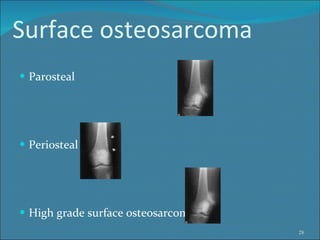
Surface osteosarcoma Parosteal Periosteal High grade surface osteosarcoma
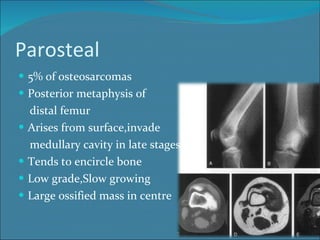
Parosteal 5% of osteosarcomas Posterior metaphysis of distal femur Arises from surface,invade medullary cavity in late stages Tends to encircle bone Low grade,Slow growing  Large ossified mass in centre
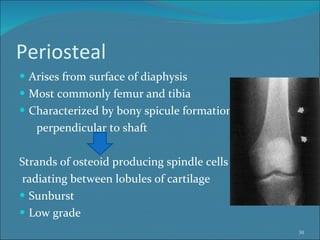
Periosteal  Arises from surface of diaphysis Most commonly femur and tibia Characterized by bony spicule formation perpendicular to shaft Strands of osteoid producing spindle cells radiating between lobules of cartilage Sunburst Low grade
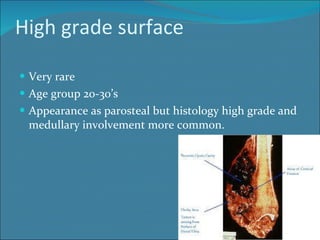
High grade surface Very rare Age group 20-30โ€™s Appearance as parosteal but histology high grade and medullary involvement more common.
Telangiectatic Osteosarcoma Aggressive  Presents with pathological fracture  5% of all osteosarcomas  arises within the diaphysis  Radiology Often entirely osteolyticย   Bone and cortex destruction  Periosteal reaction  Codman's triangles  Pathology Gross appearance is a multi-cystic similar to an aneurysmal bone cyst.  Microscopically it has large blood filled spaces and thin septation. Within the septa there is scanty osteoid production by the pleomorphic malignant cells
Prognostic Factors   Extent of the disease Pts with pulmonary, non pulmonry (bone) or skip metastasis have poor prognosis Grade of the tumor High grade tumor have poor prognosis Size of the primary lesion Large size tumors have worse prognosis then small size tumors Skeletal location proximal tumors do worse than distal tumors.  Secondary osteosarcoma:  Poor prognosis
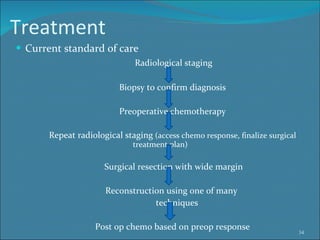
Treatment  Current standard of care   Radiological staging Biopsy to confirm diagnosis Preoperative chemotherapy Repeat radiological staging   (access chemo response, finalize surgical treatment plan)    Surgical resection with wide margin Reconstruction using one of many    techniques Post op chemo based on preop response
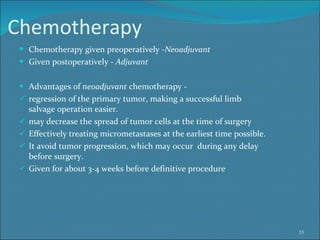
Chemotherapy Chemotherapy given preoperatively - Neoadjuvant  Given postoperatively -  Adjuvant  Advantages of  neoadjuvant  chemotherapy -  regression of the primary tumor, making a successful limb    salvage operation easier.  may decrease the spread of tumor cells at the time of surgery Effectively treating micrometastases at the earliest time possible. It avoid tumor progression, which may occur  during any delay    before surgery. Given for about 3-4 weeks before definitive procedure
Chemotherapy The drugs used most often to treat osteosarcoma are: Methotrexate with leucovorin (folinic acid)  Doxorubicin (Adriamycin)  Cisplatin or carboplatin  Etoposide  Ifosfamide  Cyclophosphamide  Actinomycin D (dactinomycin)  Bleomycin
Surgery The  main goal of surgery is to safely and completely remove the tumor.  Historically โ€“ amputation. Over the past few years -  limb-sparing procedures have become the standard, mainly due to advances in chemotherapy and sophisticated imaging techniques Limb salvage procedures now can provide rates of local control and long-term survival equal to amputation.
Surgery choice Surgical procedures fall into three basic categories: Amputation  Limb salvage Rotationplasty
Decision ??? If the tumor can be removed safely while retaining a viable extremity, a limb sparing procedure may be appropriate.  If major nerves or blood vessels are involved, or if complete tumor removal results in significant loss of function, amputation may be a better choice.  Patientโ€™s age, desired level of function, cosmetic preference and long-term prognosis must also be considered.
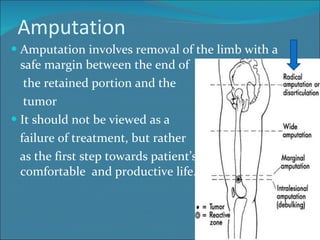
Amputation Amputation involves removal of the limb with a safe margin between the end of  the retained portion and the  tumor It should not be viewed as a  failure of treatment, but rather as the first step towards patientโ€™s return to a more comfortable  and productive life.
Amputation  Indication 1. Grossly displaced pathologic fracture  2. Encasement of neurovascular bundle 3. Tumor that enlarges during preop chemo and  is adjacent to neurovascular bundle 4. Palliative measure in metastatic disease 5. If the tumor has caused massive necrosis,  fungation, infection, or vascular compromise.
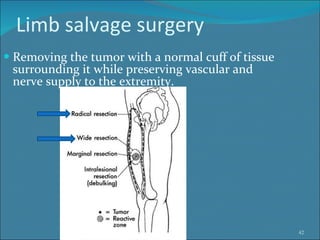
Limb salvage surgery Removing the tumor with a normal cuff of tissue surrounding it while preserving vascular and nerve supply to the extremity.
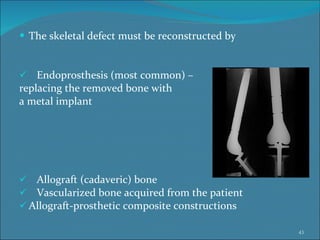
The skeletal defect must be reconstructed by Endoprosthesis (most common) โ€“  replacing the removed bone with  a metal implant  Allograft (cadaveric) bone  Vascularized bone acquired from the patient Allograft-prosthetic composite constructions
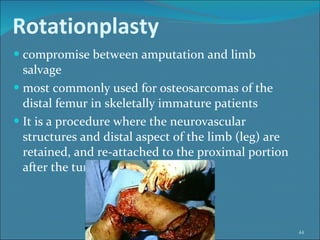
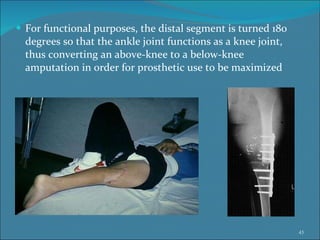
Rotationplasty compromise between amputation and limb salvage most commonly used for osteosarcomas of the distal femur in skeletally immature patients It is a procedure where the neurovascular structures and distal aspect of the limb (leg) are retained, and re-attached to the proximal portion after the tumor has been removed.
For functional purposes, the distal segment is turned 180 degrees so that the ankle joint functions as a knee joint, thus converting an above-knee to a below-knee amputation in order for prosthetic use to be maximized
Radiotherapy Radiation therapy has no major role in osteosarcoma Radiation therapy may be useful in some cases where the tumor cannot be completely removed by surgery. E.g. in pelvic bones or in the bones of the face.  Megavoltage (upto 6000-8000 rads)
Follow up and Prognosis Signs of recurrence, metastasis and treatment related complications Physical examination,radiographs of the primary site, serial chest imaging,bone scans and laboratory examinations  50 % cases with high grade osteosarcoma have some type of relapse in 5 months If recurrence is detected, additional surgery  (radical amputation)and chemotherapy may be warranted.  5 year survival rate is 5% - 23%
THANK YOU !

Osteosarcoma (1)

  • 1.
    Osteo = bone/osteoidtissue Sarcoma = malignant tumour of connective tissue 02/04/12 Dr. Pruthviraj Nistane Deptt. Of Orthopaedics Govt. Medical College and Rajindra Hospital, Patiala
  • 2.
    Overview Definition EpidemiologyPathogenesis Skeletal distribution Clinical presentation Evaluation Classification Investigations Treatment Prognosis
  • 3.
    What is osteosarcoma? Highly malignant tumor of mesenchymal origin. Spindle shaped cells that produce osteoid. 2 nd most common primary malignant bone tumor after MM.
  • 4.
    Epidemiology Incidence โ€“1 to 3 per million per year Any age But 75% in 12-25yrs of age Almost equal in both sexes, slightly more in males .
  • 5.
    Epidemiology Associated syndromes Hereditary form of retinoblastoma Li-Fraumeni syndrome (p53) Rothmund-Thomson syndrome (8q24)
  • 6.
    Pathogenesis Unknown Modalincidence correlates with rapid bone growth Radiation >2000 rads Chemicals โ€“ chlorantherene, AAF, Be compounds
  • 7.
    Gross pathology Arisefrom multipotent mesenchymal cells Mixture of osteoid, fibrous, cartilaginous, necrotic, hemorrhagic, cystic areas Destruction of cortex
  • 8.
    Gross pathology Metaphyseal,Central. Extension into medullary cavity and subperiosteal extension. Restricted bu periosteun and epiphyseal plate, but eventually crosses it Reactive periosteal new bone formation Metastasis โ€“ lungs
  • 9.
    Microscopic appearance Stroma- Malignant connective tissue with anaplastic spindle cells Matrix of osteoid/fibrous/cartilagenous tissue
  • 10.
    Classification PRIMARY orSECONDARY PRIMARY OSTEOSARCOMAS are Conventional /classic osteosarcoma (high grade, intra medullar y) Low-grade intramedullary osteosarcoma Parosteal osteosarcoma Periosteal osteosarcoma High-grade surface osteosarcoma Telangiectatic osteosarcoma, and Small cell osteosarcoma.
  • 11.
    Classification SECONDARY OSTEOSARCOMASOsteosarcomas occurring at the site of another disease process. more common in >50 years of age The most common causes are Paget disease Previous radiation treatment Other associated conditions are Fibrous dysplasia Bone infarcts Osteochondromas Chronic osteomyelitis Dedifferentiated chondrosarcomas Osteogenesis imperfecta
  • 12.
    Classic High GradeOsteosarcoma These aggressive, high-grade tumors begin in an intramedullary location, but may break through the cortex and form a soft-tissue mass. The histologic hallmark - malignant osteoblastic spindle cells producing osteoid,presence of woven bone with malignant appearing stromal cells subtypes - osteoblastic, chondroblastic and fibroblastic
  • 13.
    Skeletal distribution Distalfemur Proximal tibia Proximal humerus (sites of rapid bone growth) others Metaphyseal(89%)>diaphyseal(10%)>epiphyseal(1%)
  • 14.
    Clinical Presentation Painโ€“ progresssive pain due to microinfarction night pain in 25 % Swelling - Palpable mass is noted in up to 1/3 of patients at the first visit Fever, malaise or other constitutional symptoms are not typical of osteosarcoma
  • 15.
    Evaluation Suspected diagnosisby history and physical examination Supported by investigations
  • 16.
    Plain X-ray (Most valuable) sclerotic Lytic Mixed (most common)
  • 17.
    Plain X-ray Lesionsare usually permeative Associated with destruction of the cancellous and cortical elements of the bone Ossification within the soft tissue component, if tumour has broken through cortex Intra medullary Borders are ill defined
  • 18.
    Plain X-ray Periostealreaction may appear as the characteristic Codman triangle. Extension of the tumor through the periosteum may result in a so-called โ€œsunburstโ€ or โ€œhair on endโ€ appearance.
  • 19.
    Other investigations MRICT Angiogram Bone scan Laboratory studies Biopsy
  • 20.
    MRI bestto detect extent into bone and soft tissues
  • 21.
    CT Not ofmuch use CT chest to detect lung metastasis
  • 22.
    Angiogram Determine vascularityof the tumour Detect vascular displacement Relationship of vessels to the tumour
  • 23.
    Bone scan A bone scan should be obtained to look for skeletal metastases or multi focal disease Thallium scan - Monitor effects of chemotherapy Detect local recurrence of tumor
  • 24.
    laboratory studies Fullblood count, ESR, CRP. LDH (elevated level is associated with poor prognosis) ALP (highly osteogenic) Platelet count Electrolyte levels Liver function tests Renal function tests Urinalysis
  • 25.
    Biopsy to conformthe diagnosis. Types Fine needle aspiration Core needle biopsy Open incisional biopsy
  • 26.
    Enneking staging systemThe staging system is typically depicted as follows Stage I: Low grade tumors I-A intra compartmental I-B extra compartmental Stage II: High grade tumors II-A intra compartmental II-B extra compartmental Stage III: Any tumors with evidence of metastasis
  • 27.
    Differential Dx GiantCell Tumor Chondrosarcoma Fibrosarcoma Aneursymal Bone Cyst Ewings sarcoma Osteoblastoma Metastasis Lymphoma Osteomyelitis Chondroblastoma Post traumatic callus Other variants
  • 28.
    Surface osteosarcoma ParostealPeriosteal High grade surface osteosarcoma
  • 29.
    Parosteal 5% ofosteosarcomas Posterior metaphysis of distal femur Arises from surface,invade medullary cavity in late stages Tends to encircle bone Low grade,Slow growing Large ossified mass in centre
  • 30.
    Periosteal Arisesfrom surface of diaphysis Most commonly femur and tibia Characterized by bony spicule formation perpendicular to shaft Strands of osteoid producing spindle cells radiating between lobules of cartilage Sunburst Low grade
  • 31.
    High grade surfaceVery rare Age group 20-30โ€™s Appearance as parosteal but histology high grade and medullary involvement more common.
  • 32.
    Telangiectatic Osteosarcoma Aggressive Presents with pathological fracture 5% of all osteosarcomas arises within the diaphysis Radiology Often entirely osteolyticย  Bone and cortex destruction Periosteal reaction Codman's triangles Pathology Gross appearance is a multi-cystic similar to an aneurysmal bone cyst. Microscopically it has large blood filled spaces and thin septation. Within the septa there is scanty osteoid production by the pleomorphic malignant cells
  • 33.
    Prognostic Factors Extent of the disease Pts with pulmonary, non pulmonry (bone) or skip metastasis have poor prognosis Grade of the tumor High grade tumor have poor prognosis Size of the primary lesion Large size tumors have worse prognosis then small size tumors Skeletal location proximal tumors do worse than distal tumors. Secondary osteosarcoma: Poor prognosis
  • 34.
    Treatment Currentstandard of care Radiological staging Biopsy to confirm diagnosis Preoperative chemotherapy Repeat radiological staging (access chemo response, finalize surgical treatment plan) Surgical resection with wide margin Reconstruction using one of many techniques Post op chemo based on preop response
  • 35.
    Chemotherapy Chemotherapy givenpreoperatively - Neoadjuvant Given postoperatively - Adjuvant Advantages of neoadjuvant chemotherapy - regression of the primary tumor, making a successful limb salvage operation easier. may decrease the spread of tumor cells at the time of surgery Effectively treating micrometastases at the earliest time possible. It avoid tumor progression, which may occur during any delay before surgery. Given for about 3-4 weeks before definitive procedure
  • 36.
    Chemotherapy The drugsused most often to treat osteosarcoma are: Methotrexate with leucovorin (folinic acid) Doxorubicin (Adriamycin) Cisplatin or carboplatin Etoposide Ifosfamide Cyclophosphamide Actinomycin D (dactinomycin) Bleomycin
  • 37.
    Surgery The main goal of surgery is to safely and completely remove the tumor. Historically โ€“ amputation. Over the past few years - limb-sparing procedures have become the standard, mainly due to advances in chemotherapy and sophisticated imaging techniques Limb salvage procedures now can provide rates of local control and long-term survival equal to amputation.
  • 38.
    Surgery choice Surgicalprocedures fall into three basic categories: Amputation Limb salvage Rotationplasty
  • 39.
    Decision ??? Ifthe tumor can be removed safely while retaining a viable extremity, a limb sparing procedure may be appropriate. If major nerves or blood vessels are involved, or if complete tumor removal results in significant loss of function, amputation may be a better choice. Patientโ€™s age, desired level of function, cosmetic preference and long-term prognosis must also be considered.
  • 40.
    Amputation Amputation involvesremoval of the limb with a safe margin between the end of the retained portion and the tumor It should not be viewed as a failure of treatment, but rather as the first step towards patientโ€™s return to a more comfortable and productive life.
  • 41.
    Amputation Indication1. Grossly displaced pathologic fracture 2. Encasement of neurovascular bundle 3. Tumor that enlarges during preop chemo and is adjacent to neurovascular bundle 4. Palliative measure in metastatic disease 5. If the tumor has caused massive necrosis, fungation, infection, or vascular compromise.
  • 42.
    Limb salvage surgeryRemoving the tumor with a normal cuff of tissue surrounding it while preserving vascular and nerve supply to the extremity.
  • 43.
    The skeletal defectmust be reconstructed by Endoprosthesis (most common) โ€“ replacing the removed bone with a metal implant Allograft (cadaveric) bone Vascularized bone acquired from the patient Allograft-prosthetic composite constructions
  • 44.
    Rotationplasty compromise betweenamputation and limb salvage most commonly used for osteosarcomas of the distal femur in skeletally immature patients It is a procedure where the neurovascular structures and distal aspect of the limb (leg) are retained, and re-attached to the proximal portion after the tumor has been removed.
  • 45.
    For functional purposes,the distal segment is turned 180 degrees so that the ankle joint functions as a knee joint, thus converting an above-knee to a below-knee amputation in order for prosthetic use to be maximized
  • 46.
    Radiotherapy Radiation therapyhas no major role in osteosarcoma Radiation therapy may be useful in some cases where the tumor cannot be completely removed by surgery. E.g. in pelvic bones or in the bones of the face. Megavoltage (upto 6000-8000 rads)
  • 47.
    Follow up andPrognosis Signs of recurrence, metastasis and treatment related complications Physical examination,radiographs of the primary site, serial chest imaging,bone scans and laboratory examinations 50 % cases with high grade osteosarcoma have some type of relapse in 5 months If recurrence is detected, additional surgery (radical amputation)and chemotherapy may be warranted. 5 year survival rate is 5% - 23%
  • 48.