1ELISA: Basics & Technical Tips
ELISA
Basics and Technical Tips
www.ptglab.com
2ELISA: Basics & Technical Tips
CONTENTS
Definition
ELISA Types
ELISA Factors
ELISA Results
FAQs
Troubleshooting
Contact Us
3
4–8
9
10
11
12
13
www.ptglab.com
3ELISA: Basics & Technical Tips
DEFINITION
www.ptglab.com
ELISA: Enzyme-Linked Immuno-Sorbent Assay
–– First described in 1971 by Engvall and Perlmann.
–– Characteristic feature of an ELISA: Antigen is directly coated
	 to a well.
–– Three main different types of ELISA are currently available.
Why is an ELISA a great research tool?
–– A biochemical test that detects and measures antibodies
	 in your blood and antibodies related to certain infectious
	 conditions. ELISA tests are mainly used in immunology.
4ELISA: Basics & Technical Tips
ELISA TYPES
www.ptglab.com
The ELISA technique is divided into:
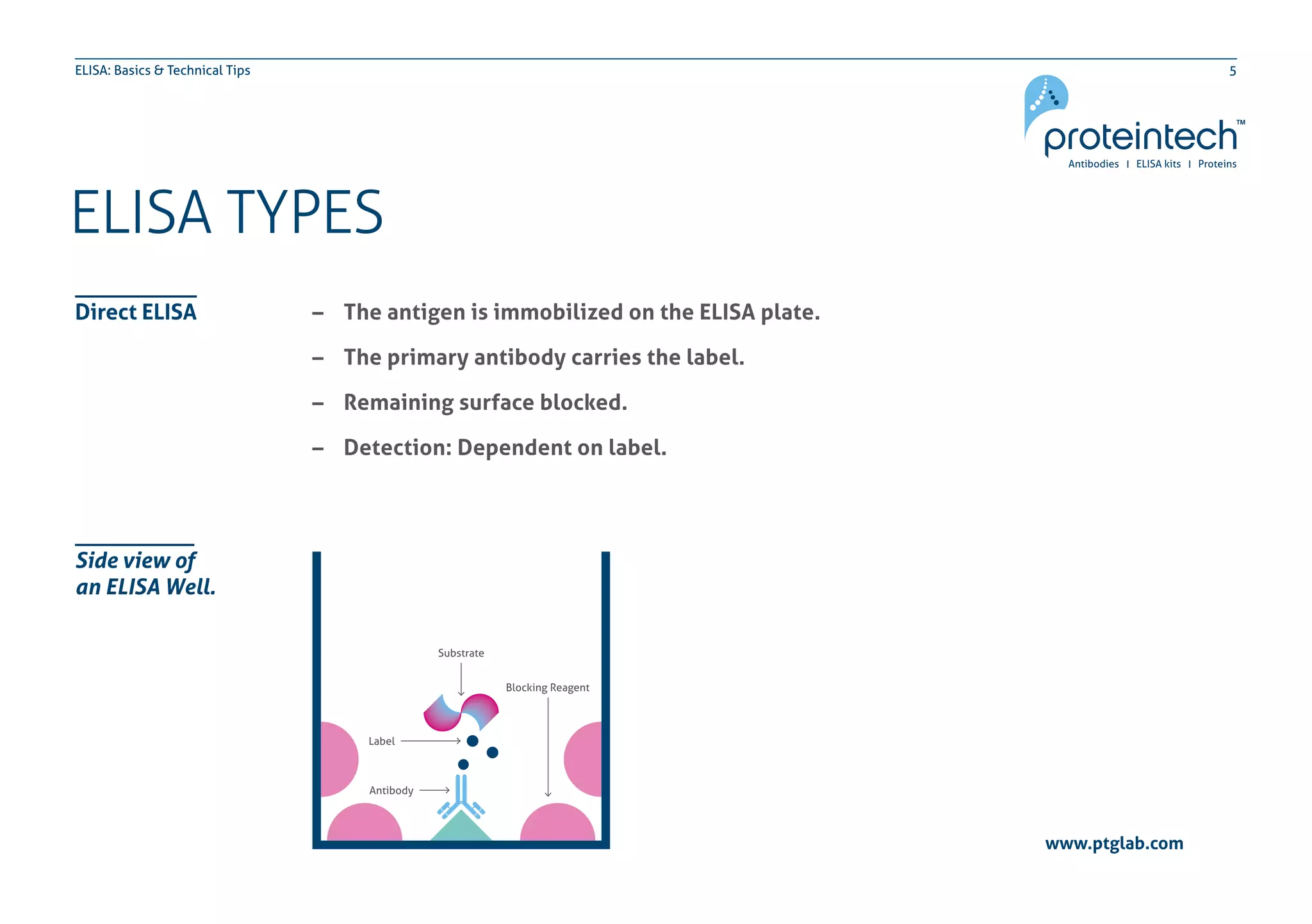
–– Direct ELISA:
	 The antigen is immobilized on the ELISA plate. The primary 		
	 antibody carries the label.
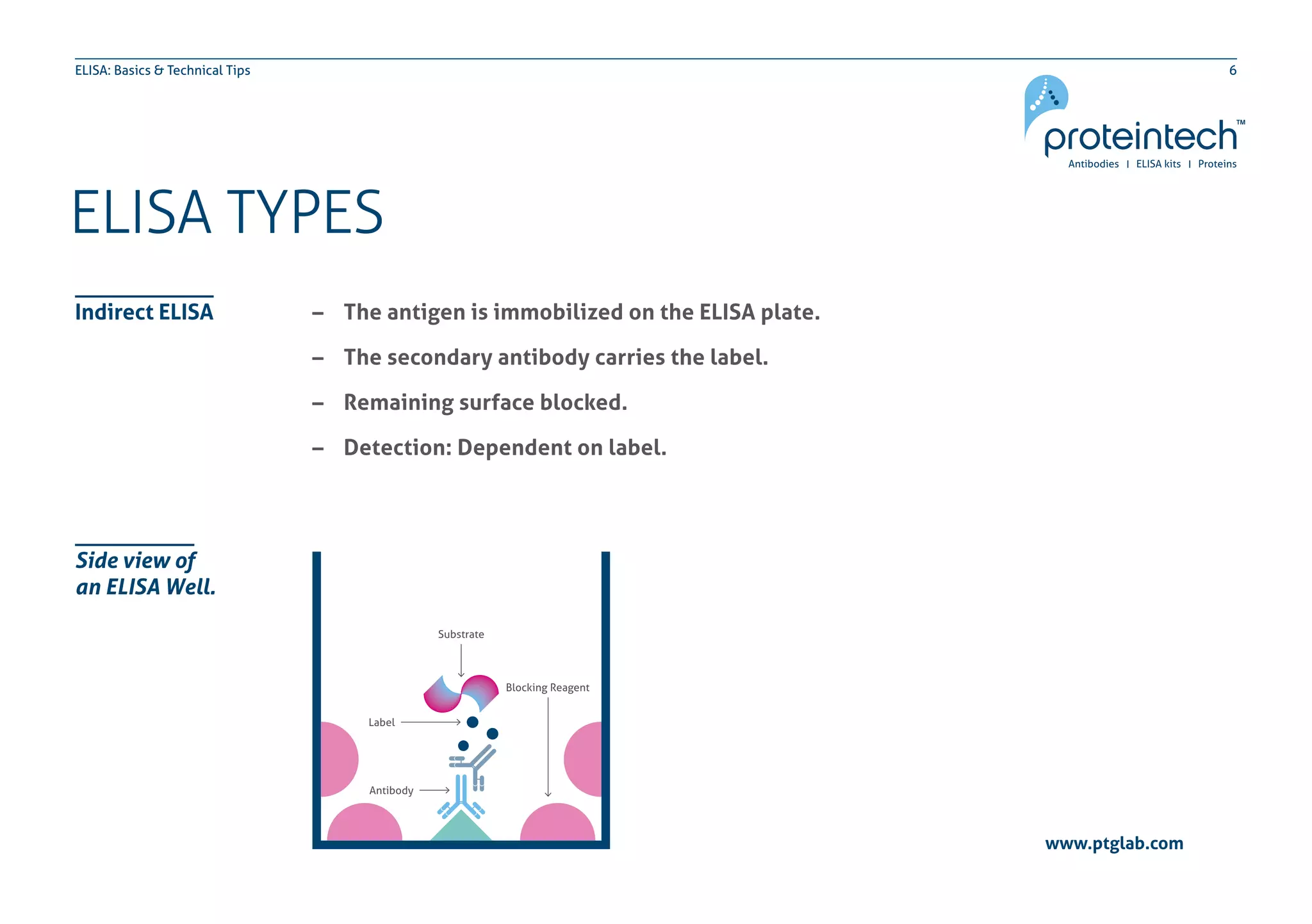
–– Indirect ELISA:
	 The antigen is immobilized on the ELISA plate. The secondary 	
	 antibody carries the label.
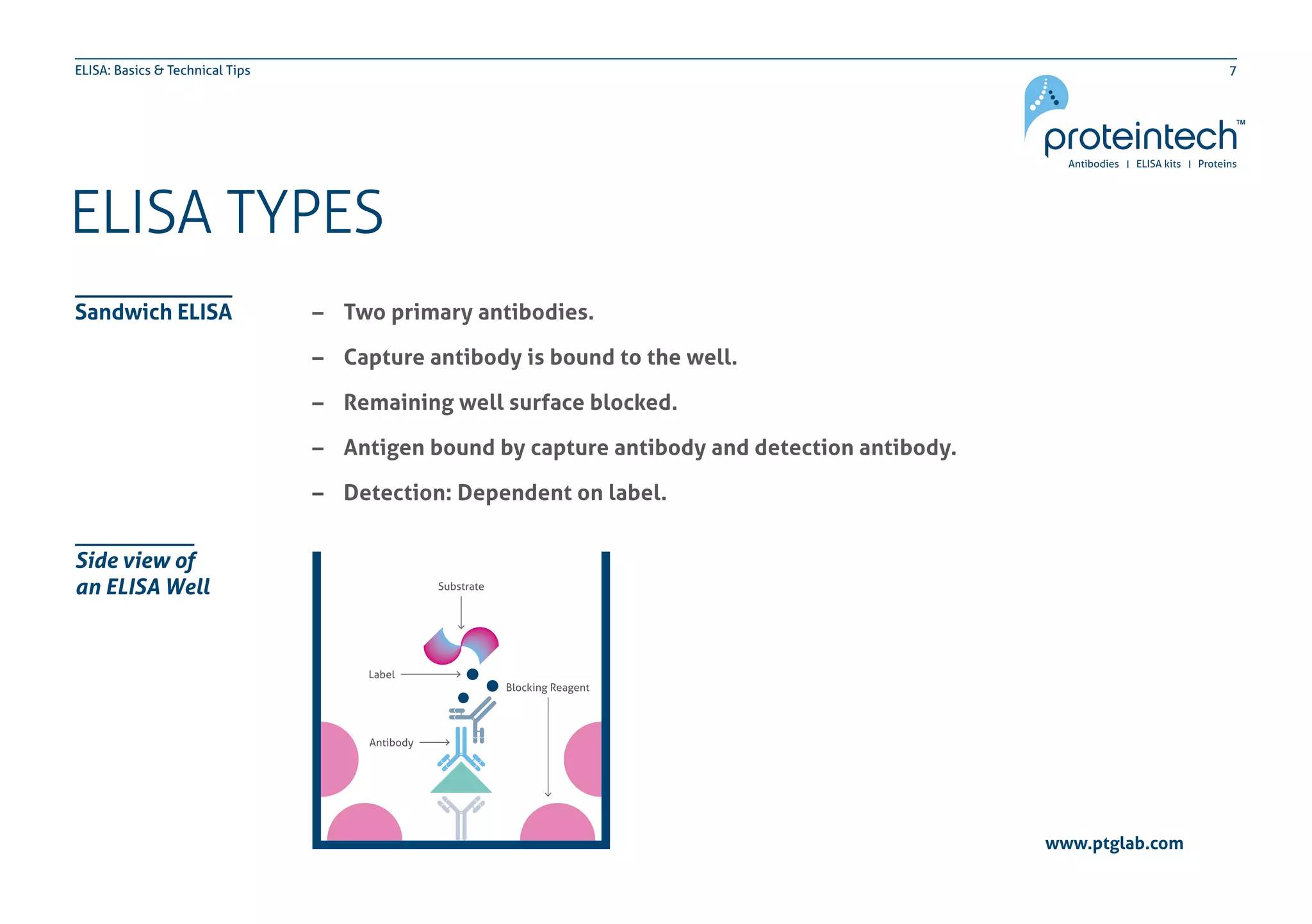
–– Sandwich ELISA:
	 Two primary antibodies (for capture and detection) embed the 	
	 antigen, forming a "sandwich." The complex is then recognized
	 by a secondary labelled antibody.
5ELISA: Basics & Technical Tips
www.ptglab.com
Direct ELISA
ELISA TYPES
–– The antigen is immobilized on the ELISA plate.
–– The primary antibody carries the label.
–– Remaining surface blocked.
–– Detection: Dependent on label.
Side view of
an ELISA Well.
6ELISA: Basics & Technical Tips
www.ptglab.com
Indirect ELISA
ELISA TYPES
–– The antigen is immobilized on the ELISA plate.
–– The secondary antibody carries the label.
–– Remaining surface blocked.
–– Detection: Dependent on label.
Side view of
an ELISA Well.
7ELISA: Basics & Technical Tips
www.ptglab.com
Sandwich ELISA
ELISA TYPES
–– Two primary antibodies.
–– Capture antibody is bound to the well.
–– Remaining well surface blocked.
–– Antigen bound by capture antibody and detection antibody.
–– Detection: Dependent on label.
Side view of
an ELISA Well
8ELISA: Basics & Technical Tips
www.ptglab.com
Advantages
& Disadvantages
ELISA TYPES
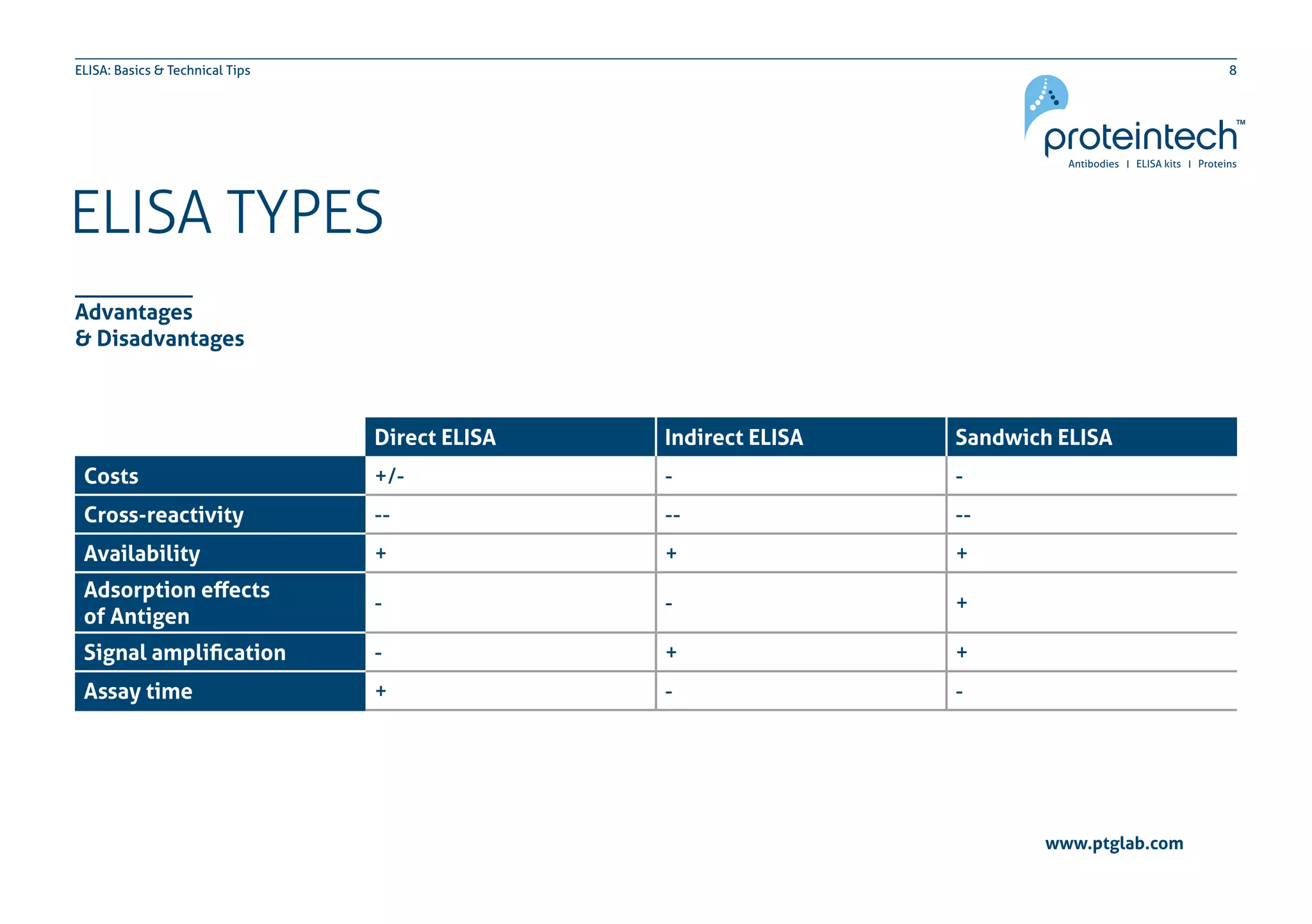
Direct ELISA Indirect ELISA Sandwich ELISA
Costs +/- - -
Cross-reactivity -- -- --
Availability + + +
Adsorption effects
of Antigen
- - +
Signal amplification - + +
Assay time + - -
9ELISA: Basics & Technical Tips
www.ptglab.com
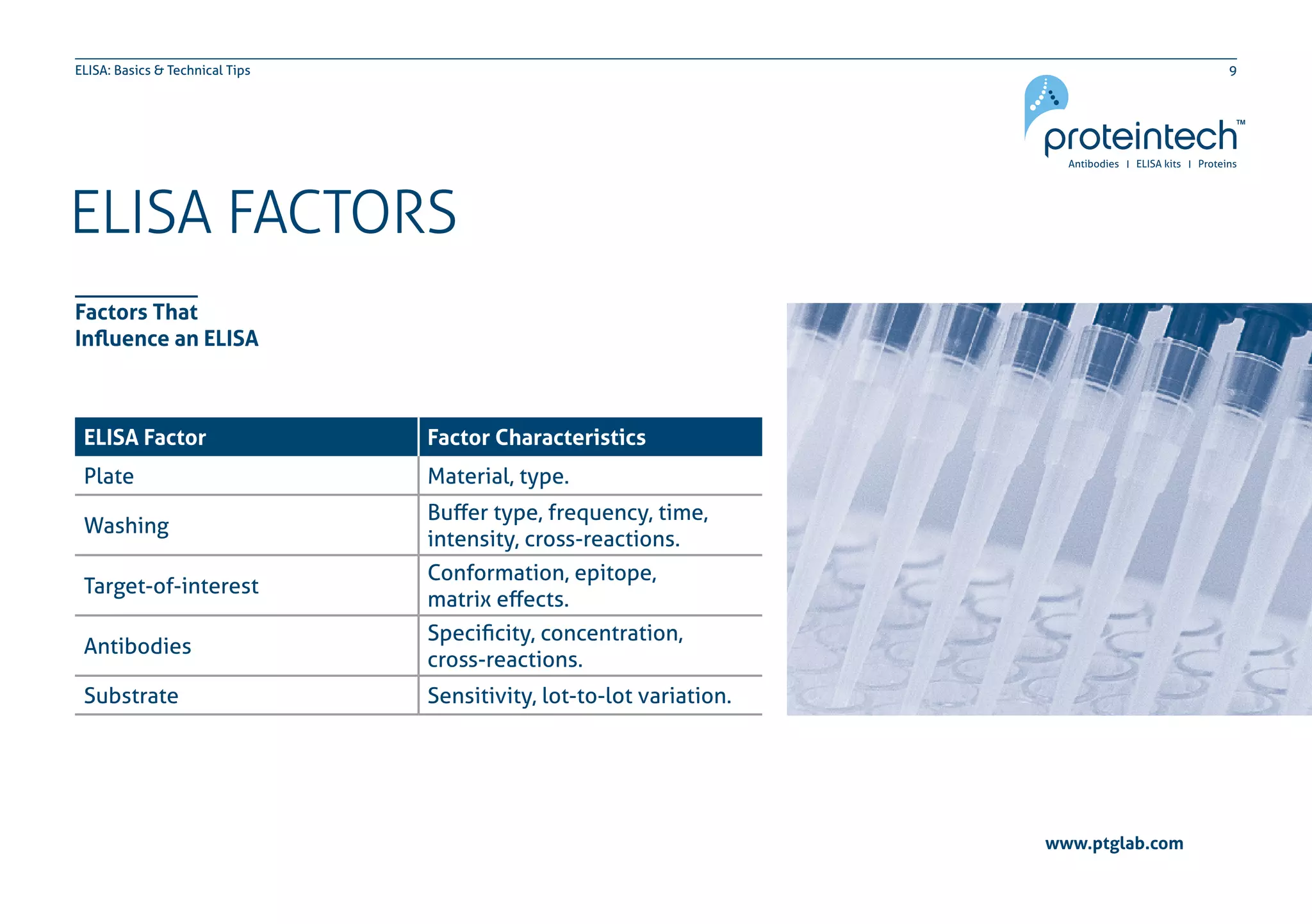
ELISA FACTORS
Factors That
Influence an ELISA
ELISA Factor Factor Characteristics
Plate Material, type.
Washing
Buffer type, frequency, time,
intensity, cross-reactions.
Target-of-interest
Conformation, epitope,
matrix effects.
Antibodies
Specificity, concentration,
cross-reactions.
Substrate Sensitivity, lot-to-lot variation.
10ELISA: Basics & Technical Tips
www.ptglab.com
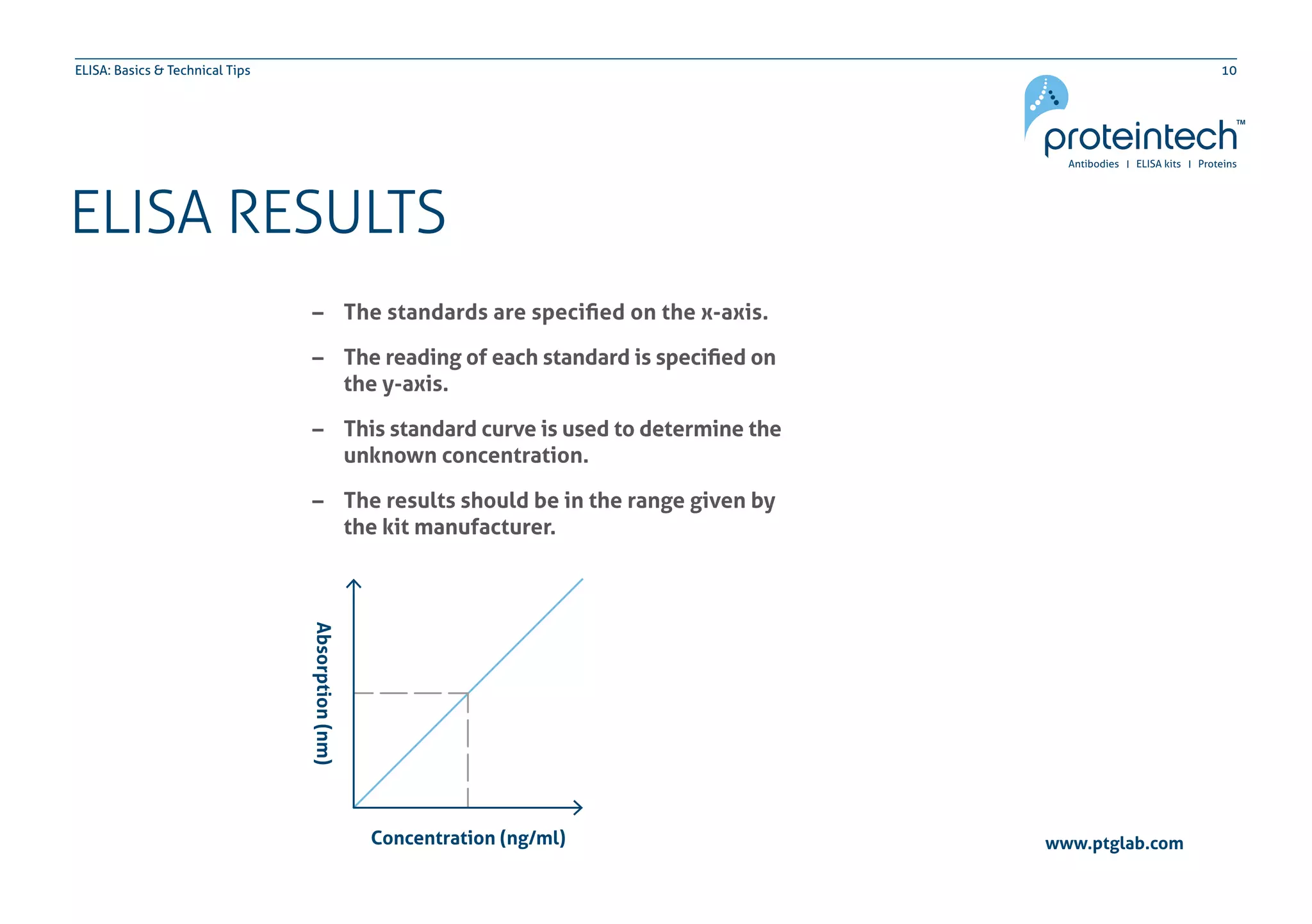
ELISA RESULTS
–– The standards are specified on the x-axis.
–– The reading of each standard is specified on
	 the y-axis.
–– This standard curve is used to determine the
	 unknown concentration.
–– The results should be in the range given by
	 the kit manufacturer.
Residue Number
11ELISA: Basics & Technical Tips
FAQs
www.ptglab.com
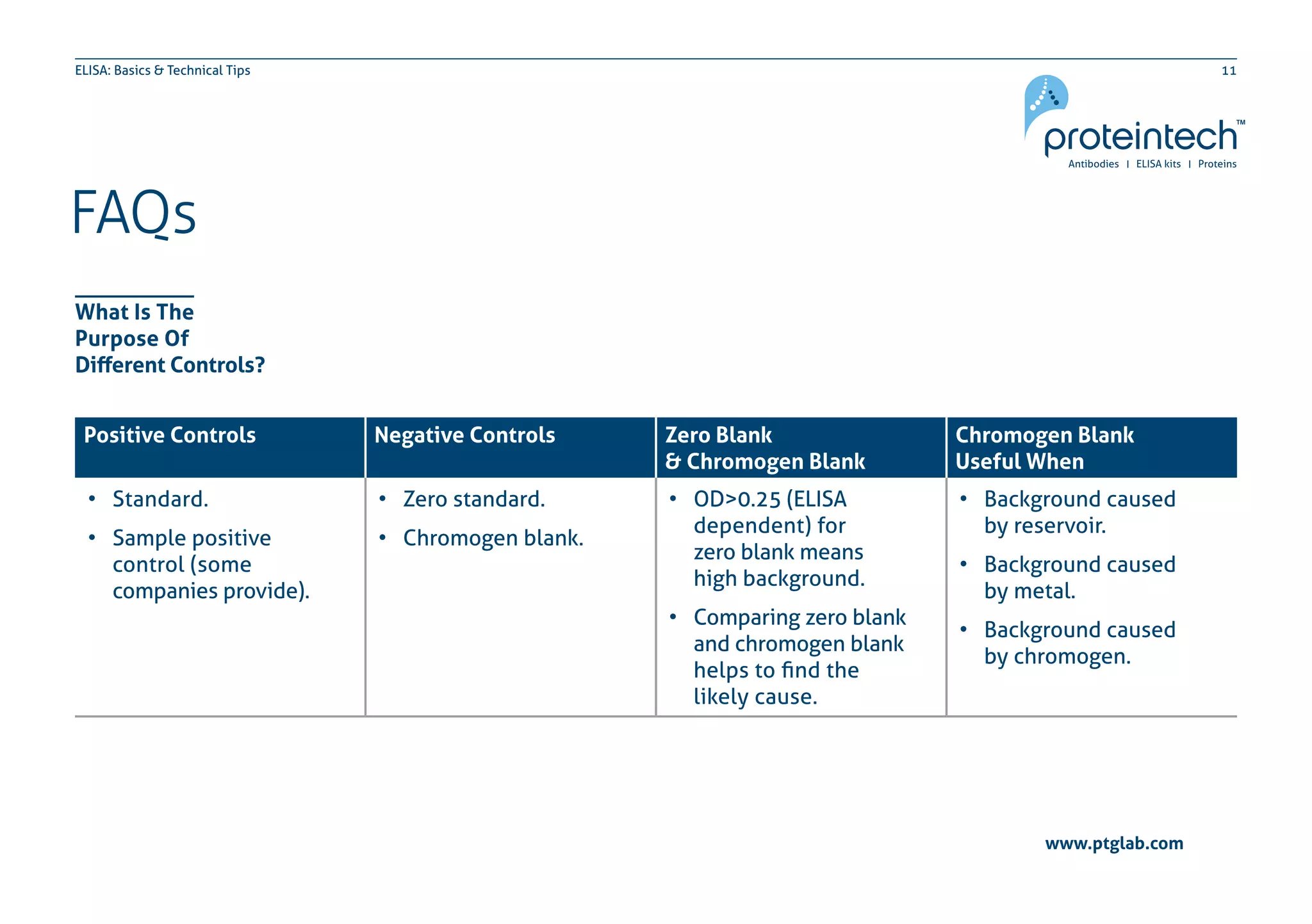
Positive Controls Negative Controls Zero Blank
& Chromogen Blank
Chromogen Blank
Useful When
•	 Standard.
•	 Sample positive 		
	 control (some 		
	 companies provide).
•	 Zero standard.
•	 Chromogen blank.
•	 OD>0.25 (ELISA 		
	 dependent) for 		
	 zero blank means
	 high background.
•	 Comparing zero blank 	
	 and chromogen blank 	
	 helps to find the
	 likely cause.
•	 Background caused
	 by reservoir.
•	 Background caused
	 by metal.
•	 Background caused
	 by chromogen.
What Is The
Purpose Of
Different Controls?
12ELISA: Basics & Technical Tips
TROUBLESHOOTING
www.ptglab.com
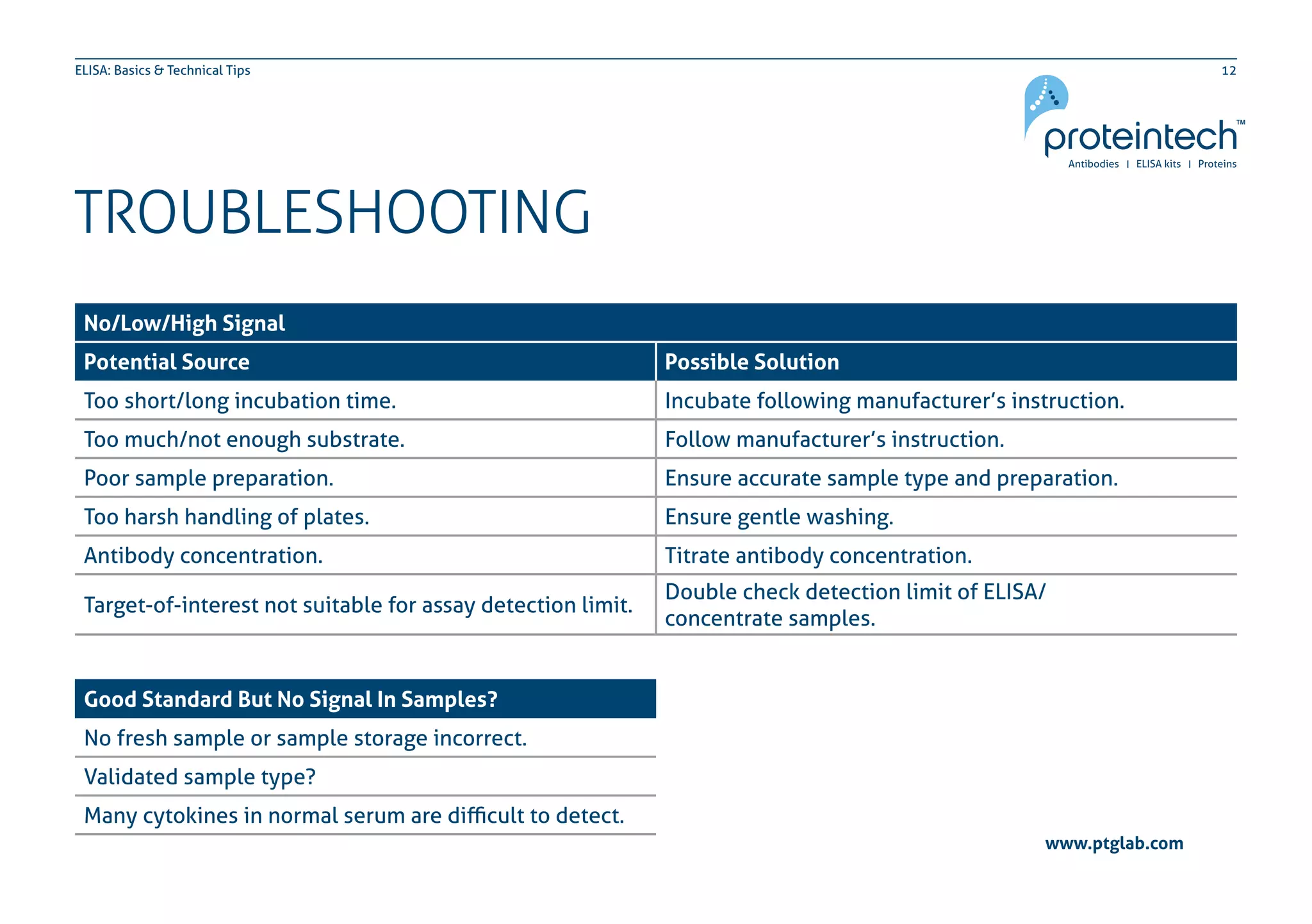
No/Low/High Signal
Potential Source Possible Solution
Too short/long incubation time. Incubate following manufacturer’s instruction.
Too much/not enough substrate. Follow manufacturer’s instruction.
Poor sample preparation. Ensure accurate sample type and preparation.
Too harsh handling of plates. Ensure gentle washing.
Antibody concentration. Titrate antibody concentration.
Target-of-interest not suitable for assay detection limit.
Double check detection limit of ELISA/
concentrate samples.
Good Standard But No Signal In Samples?
No fresh sample or sample storage incorrect.
Validated sample type?
Many cytokines in normal serum are difficult to detect.
13ELISA: Basics & Technical Tips
CONTACT US
proteintech@ptglab.com
europe@ptglab.com
service@ptglab.com
Available 24 hours via Live Chat and 9–5
(CDT) via phone.
Proteintech Group
Proteintech Europe
Proteintech
Support
US Head Office
United Kingdom
China Office
Please visit us at www.ptglab.com for
more information about our antibodies
and technical tips.
www.ptglab.com

ELISA - Basics and Technical tips

  • 1.
    1ELISA: Basics &Technical Tips ELISA Basics and Technical Tips www.ptglab.com
  • 2.
    2ELISA: Basics &Technical Tips CONTENTS Definition ELISA Types ELISA Factors ELISA Results FAQs Troubleshooting Contact Us 3 4–8 9 10 11 12 13 www.ptglab.com
  • 3.
    3ELISA: Basics &Technical Tips DEFINITION www.ptglab.com ELISA: Enzyme-Linked Immuno-Sorbent Assay –– First described in 1971 by Engvall and Perlmann. –– Characteristic feature of an ELISA: Antigen is directly coated to a well. –– Three main different types of ELISA are currently available. Why is an ELISA a great research tool? –– A biochemical test that detects and measures antibodies in your blood and antibodies related to certain infectious conditions. ELISA tests are mainly used in immunology.
  • 4.
    4ELISA: Basics &Technical Tips ELISA TYPES www.ptglab.com The ELISA technique is divided into: –– Direct ELISA: The antigen is immobilized on the ELISA plate. The primary antibody carries the label. –– Indirect ELISA: The antigen is immobilized on the ELISA plate. The secondary antibody carries the label. –– Sandwich ELISA: Two primary antibodies (for capture and detection) embed the antigen, forming a "sandwich." The complex is then recognized by a secondary labelled antibody.
  • 5.
    5ELISA: Basics &Technical Tips www.ptglab.com Direct ELISA ELISA TYPES –– The antigen is immobilized on the ELISA plate. –– The primary antibody carries the label. –– Remaining surface blocked. –– Detection: Dependent on label. Side view of an ELISA Well.
  • 6.
    6ELISA: Basics &Technical Tips www.ptglab.com Indirect ELISA ELISA TYPES –– The antigen is immobilized on the ELISA plate. –– The secondary antibody carries the label. –– Remaining surface blocked. –– Detection: Dependent on label. Side view of an ELISA Well.
  • 7.
    7ELISA: Basics &Technical Tips www.ptglab.com Sandwich ELISA ELISA TYPES –– Two primary antibodies. –– Capture antibody is bound to the well. –– Remaining well surface blocked. –– Antigen bound by capture antibody and detection antibody. –– Detection: Dependent on label. Side view of an ELISA Well
  • 8.
    8ELISA: Basics &Technical Tips www.ptglab.com Advantages & Disadvantages ELISA TYPES Direct ELISA Indirect ELISA Sandwich ELISA Costs +/- - - Cross-reactivity -- -- -- Availability + + + Adsorption effects of Antigen - - + Signal amplification - + + Assay time + - -
  • 9.
    9ELISA: Basics &Technical Tips www.ptglab.com ELISA FACTORS Factors That Influence an ELISA ELISA Factor Factor Characteristics Plate Material, type. Washing Buffer type, frequency, time, intensity, cross-reactions. Target-of-interest Conformation, epitope, matrix effects. Antibodies Specificity, concentration, cross-reactions. Substrate Sensitivity, lot-to-lot variation.
  • 10.
    10ELISA: Basics &Technical Tips www.ptglab.com ELISA RESULTS –– The standards are specified on the x-axis. –– The reading of each standard is specified on the y-axis. –– This standard curve is used to determine the unknown concentration. –– The results should be in the range given by the kit manufacturer. Residue Number
  • 11.
    11ELISA: Basics &Technical Tips FAQs www.ptglab.com Positive Controls Negative Controls Zero Blank & Chromogen Blank Chromogen Blank Useful When • Standard. • Sample positive control (some companies provide). • Zero standard. • Chromogen blank. • OD>0.25 (ELISA dependent) for zero blank means high background. • Comparing zero blank and chromogen blank helps to find the likely cause. • Background caused by reservoir. • Background caused by metal. • Background caused by chromogen. What Is The Purpose Of Different Controls?
  • 12.
    12ELISA: Basics &Technical Tips TROUBLESHOOTING www.ptglab.com No/Low/High Signal Potential Source Possible Solution Too short/long incubation time. Incubate following manufacturer’s instruction. Too much/not enough substrate. Follow manufacturer’s instruction. Poor sample preparation. Ensure accurate sample type and preparation. Too harsh handling of plates. Ensure gentle washing. Antibody concentration. Titrate antibody concentration. Target-of-interest not suitable for assay detection limit. Double check detection limit of ELISA/ concentrate samples. Good Standard But No Signal In Samples? No fresh sample or sample storage incorrect. Validated sample type? Many cytokines in normal serum are difficult to detect.
  • 13.
    13ELISA: Basics &Technical Tips CONTACT US proteintech@ptglab.com europe@ptglab.com service@ptglab.com Available 24 hours via Live Chat and 9–5 (CDT) via phone. Proteintech Group Proteintech Europe Proteintech Support US Head Office United Kingdom China Office Please visit us at www.ptglab.com for more information about our antibodies and technical tips. www.ptglab.com