PRASHANT KUMAR
15NA30014
Bulbous Bow
Historical Origin
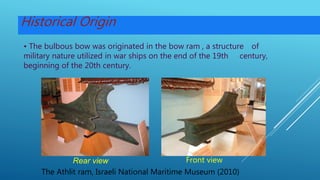
• The bulbous bow was originated in the bow ram , a structure of
military nature utilized in war ships on the end of the 19th century,
beginning of the 20th century.
Rear view Front view
The Athlit ram, Israeli National Maritime Museum (2010)
Introduction of the Bulbous Bow
• The first bulbous bows appeared in the 1920s with the “Bremen”
and the “Europa”, two German passenger ships built to operate
in the North Atlantic. The “Bremen”, built in 1929, won the Blue
Riband of the crossing of the Atlantic with the speed of 27.9
knots.
• In 1935, the “Normandie”, built with bulbous bow, attained the
30 knots.
Its Wave Resistance Factor
• The wave system
generated by the bulb
interferes with the wave
system of the ship.
• The length of the bulb
defines the phase of
interference and its
volume determines the
width of its wave system.
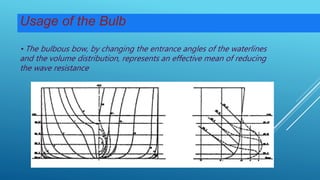
Usage of the Bulb
• The bulbous bow, by changing the entrance angles of the waterlines
and the volume distribution, represents an effective mean of reducing
the wave resistance
• The usefulness of the bulb is in the interval 0.238 ≤ Fn ≤ 0.563
• Generally at low speeds the effect of the bulb is negative. When the
Froude Number (FN) increases, its effect becomes positive and
increases up to a maximum value.
Types of Bulb Sections
Integration in the Hull
• Addition Bulbs
– The bulb shape is completely independent from the hull
shape
– Typically there is a knuckle resulting from the intersection
of the bulb and the hull
• Implicit Bulbs
– Sectional Area Curve is changed, part of the volume of
the bulb is distributed aft of the FP– No knuckles required
Addition bulb of with a knuckle in the intersection with the hull.
Implicit Bulbs
Aspects of the Initial Bulb Design
• The bulb shall never emerge completely. The point at the forward
extremity shall be at the level of the waterline
• Distribution of the bulb volume
– Too much immersion does not produce any effect
– Volume concentrated longitudinally near the free surface
increases the effect of interference in waves
Advantages of the Bulbous Bow
– Reduces the bow wave, due to the wave generated by the bulb
itself, making the ship more efficient in terms of energy
– Works as a robust “bumper" in the event of a collision
– Allows the installation of the bow thrusters at a foremost
position, making it more efficient
– Allows a larger reserve of flotation or a larger ballast capacity
Forward
– Reduces the pitch movement
– The bulb is advantageous in ice navigation – the ice blocks
slide along the bulb with their “wet” side, which has a lower
friction coefficient
Bulbous bow with
bow thruster
Bulb for Navigation in Ice
Presents a low resistance in ice and simultaneously a low
resistance in open waters
Aircraft Carrier George
Washington

BULBOUS BOW

  • 1.
  • 2.
    Historical Origin • Thebulbous bow was originated in the bow ram , a structure of military nature utilized in war ships on the end of the 19th century, beginning of the 20th century. Rear view Front view The Athlit ram, Israeli National Maritime Museum (2010)
  • 3.
    Introduction of theBulbous Bow • The first bulbous bows appeared in the 1920s with the “Bremen” and the “Europa”, two German passenger ships built to operate in the North Atlantic. The “Bremen”, built in 1929, won the Blue Riband of the crossing of the Atlantic with the speed of 27.9 knots. • In 1935, the “Normandie”, built with bulbous bow, attained the 30 knots.
  • 4.
    Its Wave ResistanceFactor • The wave system generated by the bulb interferes with the wave system of the ship. • The length of the bulb defines the phase of interference and its volume determines the width of its wave system.
  • 5.
    Usage of theBulb • The bulbous bow, by changing the entrance angles of the waterlines and the volume distribution, represents an effective mean of reducing the wave resistance
  • 6.
    • The usefulnessof the bulb is in the interval 0.238 ≤ Fn ≤ 0.563 • Generally at low speeds the effect of the bulb is negative. When the Froude Number (FN) increases, its effect becomes positive and increases up to a maximum value.
  • 7.
    Types of BulbSections
  • 9.
    Integration in theHull • Addition Bulbs – The bulb shape is completely independent from the hull shape – Typically there is a knuckle resulting from the intersection of the bulb and the hull • Implicit Bulbs – Sectional Area Curve is changed, part of the volume of the bulb is distributed aft of the FP– No knuckles required
  • 10.
    Addition bulb ofwith a knuckle in the intersection with the hull.
  • 11.
  • 12.
    Aspects of theInitial Bulb Design • The bulb shall never emerge completely. The point at the forward extremity shall be at the level of the waterline • Distribution of the bulb volume – Too much immersion does not produce any effect – Volume concentrated longitudinally near the free surface increases the effect of interference in waves
  • 13.
    Advantages of theBulbous Bow – Reduces the bow wave, due to the wave generated by the bulb itself, making the ship more efficient in terms of energy – Works as a robust “bumper" in the event of a collision – Allows the installation of the bow thrusters at a foremost position, making it more efficient – Allows a larger reserve of flotation or a larger ballast capacity Forward – Reduces the pitch movement
  • 14.
    – The bulbis advantageous in ice navigation – the ice blocks slide along the bulb with their “wet” side, which has a lower friction coefficient
  • 15.
  • 16.
    Bulb for Navigationin Ice Bulb for Navigation in Ice Presents a low resistance in ice and simultaneously a low resistance in open waters
  • 18.