
DRUG EXCRETION
PRAJJWAL, M.Pharma
ADVANCE PHARMACOLOGY-1
BADDI UNIVERSITY OF EMERGING SCIENCE AND TECHNOLOGY, BADDI
I N D E X
Introduction
Organ Involved
Renal Excretion
Biliary Secretion
Pulmonary & Faecal Excretion
Other Excretion
Factors Affecting Drug Excretion
Reference
INTRODUCTION
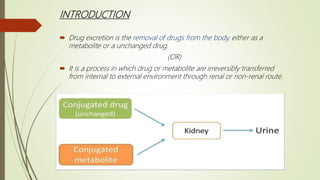
 Drug excretion is the removal of drugs from the body, either as a
metabolite or a unchanged drug.
(OR)
 It is a process in which drug or metabolite are irreversibly transferred
from internal to external environment through renal or non-renal route.
ORGAN INVOLVED
• Major Route
 Kidney(Renal)
 Biliary/Hepatic
 Pulmonary
 Faecal
• Minor Route
 Saliva
 Skin, sweat
 Tears
 Breast milk
 Vaginal fluid
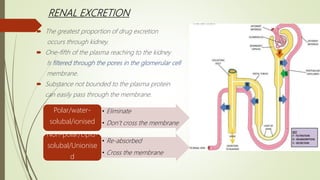
RENAL EXCRETION
 The greatest proportion of drug excretion
occurs through kidney.
 One-fifth of the plasma reaching to the kidney
Is filtered through the pores in the glomerular cell
membrane.
 Substance not bounded to the plasma protein
can easily pass through the membrane.
• Eliminate
• Don’t cross the membrane
Polar/water-
solubal/ionised
• Re-absorbed
• Cross the membrane
Non-polar/Lipid-
solubal/Unionise
d
RENAL EXCRETION
 Renal excretion determined by three processos;
✓ Glomerular Filtration:
* Glomerular capillaries have large pores.
* Lipid soluble drugs are filtered through it.
* Glomerular filteration depends upon; Molecular size, Plasma protein binding, Renal
blood flow.
* Normal GFR is 120ml/min.
✓ Tubular Re-absorption:
*Process by which the nephron removes water and solute from the tubular fluid and
return them to circulating blood.
* Occurs by passive diffusion and depends on; Lipid solubility, pH of urine, pKa of drug.
✓ Tubular Secretion:
* Occurs via active diffusion.
* Important for water removal and acid-base balance.
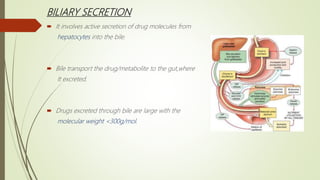
BILIARY SECRETION
 It involves active secretion of drug molecules from
hepatocytes into the bile.
 Bile transport the drug/metabolite to the gut,where
It excreted.
 Drugs excreted through bile are large with the
molecular weight <300g/mol.
PULMONARY EXCRETION
 The lung is the major organ of excretion for gaseous and volatile substances.
 The breathalyzer test is based on a quantitative pulmonary excretion of ethanol.
 Most of the gaseous anesthetics are extensively eliminated in expired air.
FAECAL EXCRETION
 Orally absorbed drug which aren’t absorbed.
e.g. Magnesium sulphate, Neomycin.
OTHER EXCRETION
 Skin,
1. Arsenicc and heavy metal like mercy gets eliminated by skin through sweating.
2. Griseofulvin secreted through keratin precursor cells.
 Hair follicles: iodide, mercury, arsenic
 Saliva: Iodine, potassium iodide, lithium
 Sweat: Rifampicin, urea derivatives
FACTORS AFFECTING EXCRETION OF DRUG
 Physiological properties of drug;
1. Molecular weight
2. Lipid solubility
3. Degree of ionisation
4. Volume of distribution
 Biological factos; e.g. Age
 Disease state
 Urine pH
REFERENCE
1. https://www.sciencedirect.com/topics/biochemistry-genetics-and-molecular-biology/drug-
excretion
2. https://www.pharmacologyeducation.org/pharmacology/drug-excretion
3. https://en.m.wikipedia.org/wiki/Reabsorption#:~:text=In%20renal%20physiology%2C%20reabs
orption%20or,them%20to%20the%20circulating%20blood.
4. https://www.sciencedirect.com/topics/medicine-and-dentistry/biliary-excretion
5. https://www.boomer.org/c/p1/Ch16/Ch1604.html#:~:text=The%20lung%20is%20the%20major,e
xtensively%20eliminated%20in%20expired%20air.
6. http://www.slideshare.net/nasertadvi/drug-excretion-new?from_m_app=android
THANK YOU

drug excretion

  • 1.
    DRUG EXCRETION PRAJJWAL, M.Pharma ADVANCEPHARMACOLOGY-1 BADDI UNIVERSITY OF EMERGING SCIENCE AND TECHNOLOGY, BADDI
  • 2.
    I N DE X Introduction Organ Involved Renal Excretion Biliary Secretion Pulmonary & Faecal Excretion Other Excretion Factors Affecting Drug Excretion Reference
  • 3.
    INTRODUCTION  Drug excretionis the removal of drugs from the body, either as a metabolite or a unchanged drug. (OR)  It is a process in which drug or metabolite are irreversibly transferred from internal to external environment through renal or non-renal route.
  • 4.
    ORGAN INVOLVED • MajorRoute  Kidney(Renal)  Biliary/Hepatic  Pulmonary  Faecal • Minor Route  Saliva  Skin, sweat  Tears  Breast milk  Vaginal fluid
  • 5.
    RENAL EXCRETION  Thegreatest proportion of drug excretion occurs through kidney.  One-fifth of the plasma reaching to the kidney Is filtered through the pores in the glomerular cell membrane.  Substance not bounded to the plasma protein can easily pass through the membrane. • Eliminate • Don’t cross the membrane Polar/water- solubal/ionised • Re-absorbed • Cross the membrane Non-polar/Lipid- solubal/Unionise d
  • 6.
    RENAL EXCRETION  Renalexcretion determined by three processos; ✓ Glomerular Filtration: * Glomerular capillaries have large pores. * Lipid soluble drugs are filtered through it. * Glomerular filteration depends upon; Molecular size, Plasma protein binding, Renal blood flow. * Normal GFR is 120ml/min. ✓ Tubular Re-absorption: *Process by which the nephron removes water and solute from the tubular fluid and return them to circulating blood. * Occurs by passive diffusion and depends on; Lipid solubility, pH of urine, pKa of drug. ✓ Tubular Secretion: * Occurs via active diffusion. * Important for water removal and acid-base balance.
  • 7.
    BILIARY SECRETION  Itinvolves active secretion of drug molecules from hepatocytes into the bile.  Bile transport the drug/metabolite to the gut,where It excreted.  Drugs excreted through bile are large with the molecular weight <300g/mol.
  • 8.
    PULMONARY EXCRETION  Thelung is the major organ of excretion for gaseous and volatile substances.  The breathalyzer test is based on a quantitative pulmonary excretion of ethanol.  Most of the gaseous anesthetics are extensively eliminated in expired air. FAECAL EXCRETION  Orally absorbed drug which aren’t absorbed. e.g. Magnesium sulphate, Neomycin.
  • 9.
    OTHER EXCRETION  Skin, 1.Arsenicc and heavy metal like mercy gets eliminated by skin through sweating. 2. Griseofulvin secreted through keratin precursor cells.  Hair follicles: iodide, mercury, arsenic  Saliva: Iodine, potassium iodide, lithium  Sweat: Rifampicin, urea derivatives
  • 10.
    FACTORS AFFECTING EXCRETIONOF DRUG  Physiological properties of drug; 1. Molecular weight 2. Lipid solubility 3. Degree of ionisation 4. Volume of distribution  Biological factos; e.g. Age  Disease state  Urine pH
  • 11.
    REFERENCE 1. https://www.sciencedirect.com/topics/biochemistry-genetics-and-molecular-biology/drug- excretion 2. https://www.pharmacologyeducation.org/pharmacology/drug-excretion 3.https://en.m.wikipedia.org/wiki/Reabsorption#:~:text=In%20renal%20physiology%2C%20reabs orption%20or,them%20to%20the%20circulating%20blood. 4. https://www.sciencedirect.com/topics/medicine-and-dentistry/biliary-excretion 5. https://www.boomer.org/c/p1/Ch16/Ch1604.html#:~:text=The%20lung%20is%20the%20major,e xtensively%20eliminated%20in%20expired%20air. 6. http://www.slideshare.net/nasertadvi/drug-excretion-new?from_m_app=android
  • 12.