Syncing up with asyncio for (micro)service development
Joir-dan Gumbs - Senior Software Engineer
IBM San Francisco
twitter: @jagumbs
blog: tasteandtrace.co
what is asyncio?
what it isn’t
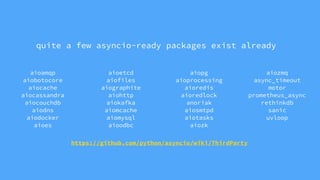
aioamqp
aiobotocore
aiocache
aiocassandra
aiocouchdb
aiodns
aiodocker
aioes
aioetcd
aiofiles
aiographite
aiohttp
aiokafka
aiomcache
aiomysql
aioodbc
aiopg
aioprocessing
aioredis
aioredlock
anoriak
aiosmtpd
aiotasks
aiozk
aiozmq
async_timeout
motor
prometheus_async
rethinkdb
sanic
uvloop
https://github.com/python/asyncio/wiki/ThirdParty
quite a few asyncio-ready packages exist already
building (micro)services
aiohttp
asyncio web framework
sanic
flask-like web server
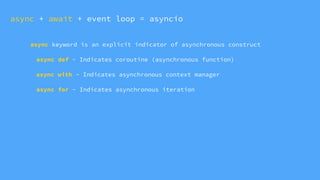
async keyword is an explicit indicator of asynchronous construct
async def - Indicates coroutine (asynchronous function)
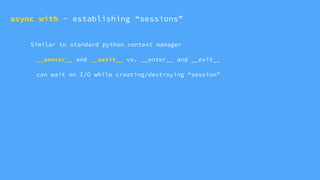
async with - Indicates asynchronous context manager
async for - Indicates asynchronous iteration
async + await + event loop = asyncio
await keyword is an explicit asynchronous “checkpoint”
Signal to swap to different coroutine
Will resume from checkpoint when task completed and has regained context
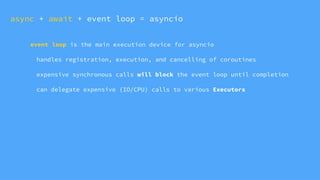
async + await + event loop = asyncio
event loop is the main execution device for asyncio
handles registration, execution, and cancelling of coroutines
expensive synchronous calls will block the event loop until completion
can delegate expensive (IO/CPU) calls to various Executors
async + await + event loop = asyncio
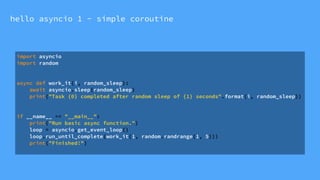
hello asyncio 1 - simple coroutine
import asyncio
import random
async def work_it(i, random_sleep):
await asyncio.sleep(random_sleep)
print("Task {0} completed after random sleep of {1} seconds".format(i, random_sleep))
if __name__ == "__main__":
print("Run basic async function.")
loop = asyncio.get_event_loop()
loop.run_until_complete(work_it(1, random.randrange(1, 5)))
print("Finished!")
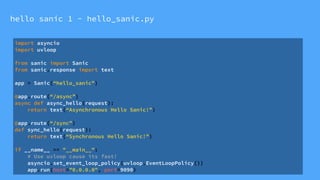
hello sanic 1 - hello_sanic.py
import asyncio
import uvloop
from sanic import Sanic
from sanic.response import text
app = Sanic(“hello_sanic”)
@app.route(“/async”)
async def async_hello(request):
return text(“Asynchronous Hello Sanic!”)
@app.route(“/sync”)
def sync_hello(request):
return text(“Synchronous Hello Sanic!”)
if __name__ == "__main__":
# Use uvloop cause its fast!
asyncio.set_event_loop_policy(uvloop.EventLoopPolicy())
app.run(host="0.0.0.0", port=9090)
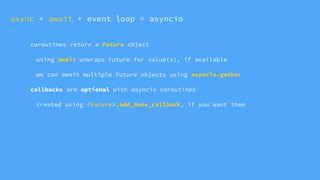
coroutines return a Future object
using await unwraps Future for value(s), if available
we can await multiple Future objects using asyncio.gather
callbacks are optional with asyncio coroutines
created using <Future>.add_done_callback, if you want them
async + await + event loop = asyncio
hello asyncio 2 - coroutine collection
import asyncio
import random
async def work_it(i, random_sleep):
await asyncio.sleep(random_sleep)
print("Task {0} completed after random sleep of {1} seconds".format(i, random_sleep))
if __name__ == "__main__":
print("Run basic async function with grouping.")
loop = asyncio.get_event_loop()
futures = [work_it(i, random.randrange(1, 5)) for i in range(0, 10)]
group_future = asyncio.gather(*futures)
loop.run_until_complete(group_future)
print("Finished!")
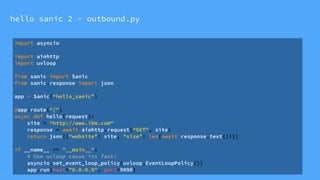
hello sanic 2 - outbound.py
import asyncio
import aiohttp
import uvloop
from sanic import Sanic
from sanic.response import json
app = Sanic(“hello_sanic”)
@app.route(“/”)
async def hello(request):
site = “http://www.ibm.com"
response = await aiohttp.request(“GET”, site)
return json({“website”: site, “size”: len(await response.text())})
if __name__ == "__main__":
# Use uvloop cause its fast!
asyncio.set_event_loop_policy(uvloop.EventLoopPolicy())
app.run(host="0.0.0.0", port=9090)
executors help us use synchronous functions asynchronously
<event_loop>.run_in_executor(executor, fn, *args) is our friend!
use functools.partial if you require **kwargs
works with concurrent.futures.[ThreadPoolExecutor, ProcessPoolExecutor]
defaults to ThreadPoolExecutor when None
asynci-oh no! - executors to the rescue
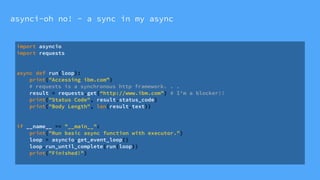
asynci-oh no! - a sync in my async
import asyncio
import requests
async def run(loop):
print("Accessing ibm.com”)
# requests is a synchronous http framework. . .
result = requests.get(“http://www.ibm.com”) # I’m a blocker!!
print("Status Code", result.status_code)
print("Body Length", len(result.text))
if __name__ == "__main__":
print("Run basic async function with executor.")
loop = asyncio.get_event_loop()
loop.run_until_complete(run(loop))
print("Finished!")
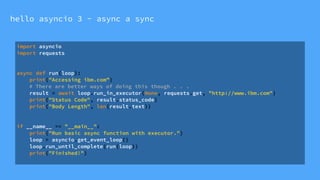
hello asyncio 3 - async a sync
import asyncio
import requests
async def run(loop):
print("Accessing ibm.com”)
# There are better ways of doing this though . . .
result = await loop.run_in_executor(None, requests.get, "http://www.ibm.com")
print("Status Code", result.status_code)
print("Body Length", len(result.text))
if __name__ == "__main__":
print("Run basic async function with executor.")
loop = asyncio.get_event_loop()
loop.run_until_complete(run(loop))
print("Finished!")
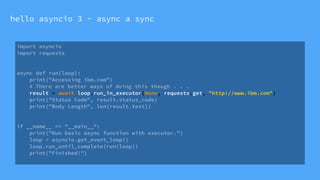
hello asyncio 3 - async a sync
import asyncio
import requests
async def run(loop):
print("Accessing ibm.com”)
# There are better ways of doing this though . . .
result = await loop.run_in_executor(None, requests.get, "http://www.ibm.com")
print("Status Code", result.status_code)
print("Body Length", len(result.text))
if __name__ == "__main__":
print("Run basic async function with executor.")
loop = asyncio.get_event_loop()
loop.run_until_complete(run(loop))
print("Finished!")
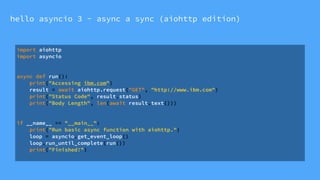
hello asyncio 3 - async a sync (aiohttp edition)
import aiohttp
import asyncio
async def run():
print("Accessing ibm.com")
result = await aiohttp.request("GET", "http://www.ibm.com")
print("Status Code", result.status)
print("Body Length", len(await result.text()))
if __name__ == "__main__":
print("Run basic async function with aiohttp.")
loop = asyncio.get_event_loop()
loop.run_until_complete(run())
print("Finished!")
hello asyncio 6 - amethyst
Go to code
https://github.com/SakuraSound/amethyst
Similar to standard python context manager
__aenter__ and __aexit__ vs. __enter__ and __exit__
can wait on I/O while creating/destroying “session”
async with - establishing “sessions”
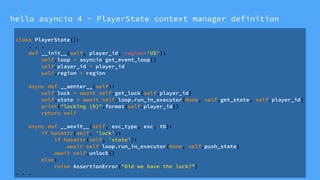
hello asyncio 4 - PlayerState context manager definition
class PlayerState():
. . .
def __init__(self, player_id, region='US'):
self.loop = asyncio.get_event_loop()
self.player_id = player_id
self.region = region
async def __aenter__(self):
self.lock = await self.get_lock(self.player_id)
self.state = await self.loop.run_in_executor(None, self.get_state, self.player_id)
print("locking {0}".format(self.player_id))
return self
async def __aexit__(self, exc_type, exc, tb):
if hasattr(self, 'lock'):
if hasattr(self, 'state'):
await self.loop.run_in_executor(None, self.push_state)
await self.unlock()
else:
raise AssertionError("Did we have the lock?”)
. . .
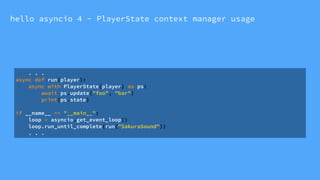
hello asyncio 4 - PlayerState context manager usage
. . .
async def run(player):
async with PlayerState(player) as ps:
await ps.update("foo", "bar")
print(ps.state)
if __name__ == "__main__":
loop = asyncio.get_event_loop()
loop.run_until_complete(run("SakuraSound"))
. . .
Looping construct for handling iterators and generators
iterators must implement __aiter__ and __anext__
async for - iterate and generate
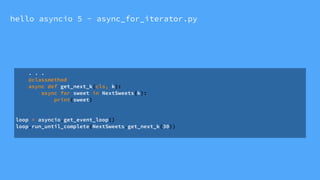
hello asyncio 5 - async_for_iterator.py
import asyncio
import random
class NextSweets(object):
__sprites__ = ["bonbon", "taffy", "mochi", "cookie", "cake"]
def __init__(self, to):
self.curr = 0
self.to = to
async def __anext__(self):
if self.curr >= self.to:
raise StopAsyncIteration
self.curr += 1
i = random.randint(0, len(NextSweets.__sprites__) - 1)
await asyncio.sleep(1)
return NextSweets.__sprites__[i]
async def __aiter__(self):
return self
. . .
hello asyncio 5 - async_for_iterator.py
. . .
@classmethod
async def get_next_k(cls, k):
async for sweet in NextSweets(k):
print(sweet)
loop = asyncio.get_event_loop()
loop.run_until_complete(NextSweets.get_next_k(30))
hello asyncio 6 - async_for_generator.py
import asyncio
import random
async def next_k_sweets(k, sweets):
for i in range(k):
# Simulating blocking call (DB? Service?)
await asyncio.sleep(1)
pos = random.randint(0, len(sweets) - 1)
yield sweets[pos]
async def run():
sweets = ["bonbon", "taffy", "mochi", "cookie", "cake", "ice_cream"]
async for sweet in next_k_sweets(50, sweets):
print(sweet)
hello asyncio 6 - starcraft_replay_processing
Go to code
https://github.com/SakuraSound/replay_parsing
not everything has to be a
coroutine!
try to use asyncio packages
when available...
...and use executors if they
aren’t.
questions?

Syncing up with Python’s asyncio for (micro) service development, Joir-dan Gumbs

  • 1.
    Syncing up withasyncio for (micro)service development Joir-dan Gumbs - Senior Software Engineer IBM San Francisco twitter: @jagumbs blog: tasteandtrace.co
  • 2.
  • 3.
  • 4.
  • 5.
  • 6.
  • 7.
    async keyword isan explicit indicator of asynchronous construct async def - Indicates coroutine (asynchronous function) async with - Indicates asynchronous context manager async for - Indicates asynchronous iteration async + await + event loop = asyncio
  • 8.
    await keyword isan explicit asynchronous “checkpoint” Signal to swap to different coroutine Will resume from checkpoint when task completed and has regained context async + await + event loop = asyncio
  • 9.
    event loop isthe main execution device for asyncio handles registration, execution, and cancelling of coroutines expensive synchronous calls will block the event loop until completion can delegate expensive (IO/CPU) calls to various Executors async + await + event loop = asyncio
  • 10.
    hello asyncio 1- simple coroutine import asyncio import random async def work_it(i, random_sleep): await asyncio.sleep(random_sleep) print("Task {0} completed after random sleep of {1} seconds".format(i, random_sleep)) if __name__ == "__main__": print("Run basic async function.") loop = asyncio.get_event_loop() loop.run_until_complete(work_it(1, random.randrange(1, 5))) print("Finished!")
  • 11.
    hello sanic 1- hello_sanic.py import asyncio import uvloop from sanic import Sanic from sanic.response import text app = Sanic(“hello_sanic”) @app.route(“/async”) async def async_hello(request): return text(“Asynchronous Hello Sanic!”) @app.route(“/sync”) def sync_hello(request): return text(“Synchronous Hello Sanic!”) if __name__ == "__main__": # Use uvloop cause its fast! asyncio.set_event_loop_policy(uvloop.EventLoopPolicy()) app.run(host="0.0.0.0", port=9090)
  • 12.
    coroutines return aFuture object using await unwraps Future for value(s), if available we can await multiple Future objects using asyncio.gather callbacks are optional with asyncio coroutines created using <Future>.add_done_callback, if you want them async + await + event loop = asyncio
  • 13.
    hello asyncio 2- coroutine collection import asyncio import random async def work_it(i, random_sleep): await asyncio.sleep(random_sleep) print("Task {0} completed after random sleep of {1} seconds".format(i, random_sleep)) if __name__ == "__main__": print("Run basic async function with grouping.") loop = asyncio.get_event_loop() futures = [work_it(i, random.randrange(1, 5)) for i in range(0, 10)] group_future = asyncio.gather(*futures) loop.run_until_complete(group_future) print("Finished!")
  • 14.
    hello sanic 2- outbound.py import asyncio import aiohttp import uvloop from sanic import Sanic from sanic.response import json app = Sanic(“hello_sanic”) @app.route(“/”) async def hello(request): site = “http://www.ibm.com" response = await aiohttp.request(“GET”, site) return json({“website”: site, “size”: len(await response.text())}) if __name__ == "__main__": # Use uvloop cause its fast! asyncio.set_event_loop_policy(uvloop.EventLoopPolicy()) app.run(host="0.0.0.0", port=9090)
  • 15.
    executors help ususe synchronous functions asynchronously <event_loop>.run_in_executor(executor, fn, *args) is our friend! use functools.partial if you require **kwargs works with concurrent.futures.[ThreadPoolExecutor, ProcessPoolExecutor] defaults to ThreadPoolExecutor when None asynci-oh no! - executors to the rescue
  • 16.
    asynci-oh no! -a sync in my async import asyncio import requests async def run(loop): print("Accessing ibm.com”) # requests is a synchronous http framework. . . result = requests.get(“http://www.ibm.com”) # I’m a blocker!! print("Status Code", result.status_code) print("Body Length", len(result.text)) if __name__ == "__main__": print("Run basic async function with executor.") loop = asyncio.get_event_loop() loop.run_until_complete(run(loop)) print("Finished!")
  • 17.
    hello asyncio 3- async a sync import asyncio import requests async def run(loop): print("Accessing ibm.com”) # There are better ways of doing this though . . . result = await loop.run_in_executor(None, requests.get, "http://www.ibm.com") print("Status Code", result.status_code) print("Body Length", len(result.text)) if __name__ == "__main__": print("Run basic async function with executor.") loop = asyncio.get_event_loop() loop.run_until_complete(run(loop)) print("Finished!")
  • 18.
    hello asyncio 3- async a sync import asyncio import requests async def run(loop): print("Accessing ibm.com”) # There are better ways of doing this though . . . result = await loop.run_in_executor(None, requests.get, "http://www.ibm.com") print("Status Code", result.status_code) print("Body Length", len(result.text)) if __name__ == "__main__": print("Run basic async function with executor.") loop = asyncio.get_event_loop() loop.run_until_complete(run(loop)) print("Finished!")
  • 19.
    hello asyncio 3- async a sync (aiohttp edition) import aiohttp import asyncio async def run(): print("Accessing ibm.com") result = await aiohttp.request("GET", "http://www.ibm.com") print("Status Code", result.status) print("Body Length", len(await result.text())) if __name__ == "__main__": print("Run basic async function with aiohttp.") loop = asyncio.get_event_loop() loop.run_until_complete(run()) print("Finished!")
  • 20.
    hello asyncio 6- amethyst Go to code https://github.com/SakuraSound/amethyst
  • 21.
    Similar to standardpython context manager __aenter__ and __aexit__ vs. __enter__ and __exit__ can wait on I/O while creating/destroying “session” async with - establishing “sessions”
  • 22.
    hello asyncio 4- PlayerState context manager definition class PlayerState(): . . . def __init__(self, player_id, region='US'): self.loop = asyncio.get_event_loop() self.player_id = player_id self.region = region async def __aenter__(self): self.lock = await self.get_lock(self.player_id) self.state = await self.loop.run_in_executor(None, self.get_state, self.player_id) print("locking {0}".format(self.player_id)) return self async def __aexit__(self, exc_type, exc, tb): if hasattr(self, 'lock'): if hasattr(self, 'state'): await self.loop.run_in_executor(None, self.push_state) await self.unlock() else: raise AssertionError("Did we have the lock?”) . . .
  • 23.
    hello asyncio 4- PlayerState context manager usage . . . async def run(player): async with PlayerState(player) as ps: await ps.update("foo", "bar") print(ps.state) if __name__ == "__main__": loop = asyncio.get_event_loop() loop.run_until_complete(run("SakuraSound")) . . .
  • 24.
    Looping construct forhandling iterators and generators iterators must implement __aiter__ and __anext__ async for - iterate and generate
  • 25.
    hello asyncio 5- async_for_iterator.py import asyncio import random class NextSweets(object): __sprites__ = ["bonbon", "taffy", "mochi", "cookie", "cake"] def __init__(self, to): self.curr = 0 self.to = to async def __anext__(self): if self.curr >= self.to: raise StopAsyncIteration self.curr += 1 i = random.randint(0, len(NextSweets.__sprites__) - 1) await asyncio.sleep(1) return NextSweets.__sprites__[i] async def __aiter__(self): return self . . .
  • 26.
    hello asyncio 5- async_for_iterator.py . . . @classmethod async def get_next_k(cls, k): async for sweet in NextSweets(k): print(sweet) loop = asyncio.get_event_loop() loop.run_until_complete(NextSweets.get_next_k(30))
  • 27.
    hello asyncio 6- async_for_generator.py import asyncio import random async def next_k_sweets(k, sweets): for i in range(k): # Simulating blocking call (DB? Service?) await asyncio.sleep(1) pos = random.randint(0, len(sweets) - 1) yield sweets[pos] async def run(): sweets = ["bonbon", "taffy", "mochi", "cookie", "cake", "ice_cream"] async for sweet in next_k_sweets(50, sweets): print(sweet)
  • 28.
    hello asyncio 6- starcraft_replay_processing Go to code https://github.com/SakuraSound/replay_parsing
  • 30.
    not everything hasto be a coroutine!
  • 31.
    try to useasyncio packages when available...
  • 32.
    ...and use executorsif they aren’t.
  • 33.