Download as PDF, PPTX
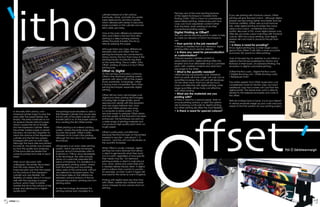

An early 20th century printer discovered offset printing by accident. When his printing press ran out of paper, the ink transferred to the rubber impression cylinder. When he added more paper without cleaning the cylinder, the back sides printed with higher quality than the front sides. This was because the flexible rubber reacted well to the paper surface, better transferring the ink. The printer's discovery led his printing house to create the first offset printer, which used an additional blanket cylinder to transfer ink indirectly from the plate to the paper. Offset printing then developed and is now the dominant printing system, though digital printing competition is increasing. Key differences between offset and digital include speed, customization ability, cost effectiveness based on quantity, and color accuracy.


