A Very Short Introduction to
Computational Design
An outline of essential topics
Ir. Pirouz Nourian
PhD Candidate, Researcher & Instructor
@TU Delft/A+BE/AE+T/Design Informatics
Email: p.nourian@tudelft.nl
Mega (High-rise workshop) 2016
About Me
Mega (High-rise workshop) 2016
 PhD Candidate, Researcher & Instructor:
@ AE+T/Design Informatics
@ Urbanism/Urban Design
@ Urbanism/3D Geoinfo
 MSc in Architecture & Urban Planning 2009
 BSc in Control Engineering (EE) 2005
languages
 C#.NET (reader, writer & speaker)
 VB.NET (reader, writer & speaker)
 Python (reader)
areas of expertise and/or interest
 Urban/Architectural Design and Modelling Algorithms
 Computational Design Support Systems
 Spatial Analysis & Spatial Planning
 Computational Geometry, Topology, and Graph Theory
 Computational Analysis, Simulation and Optimization
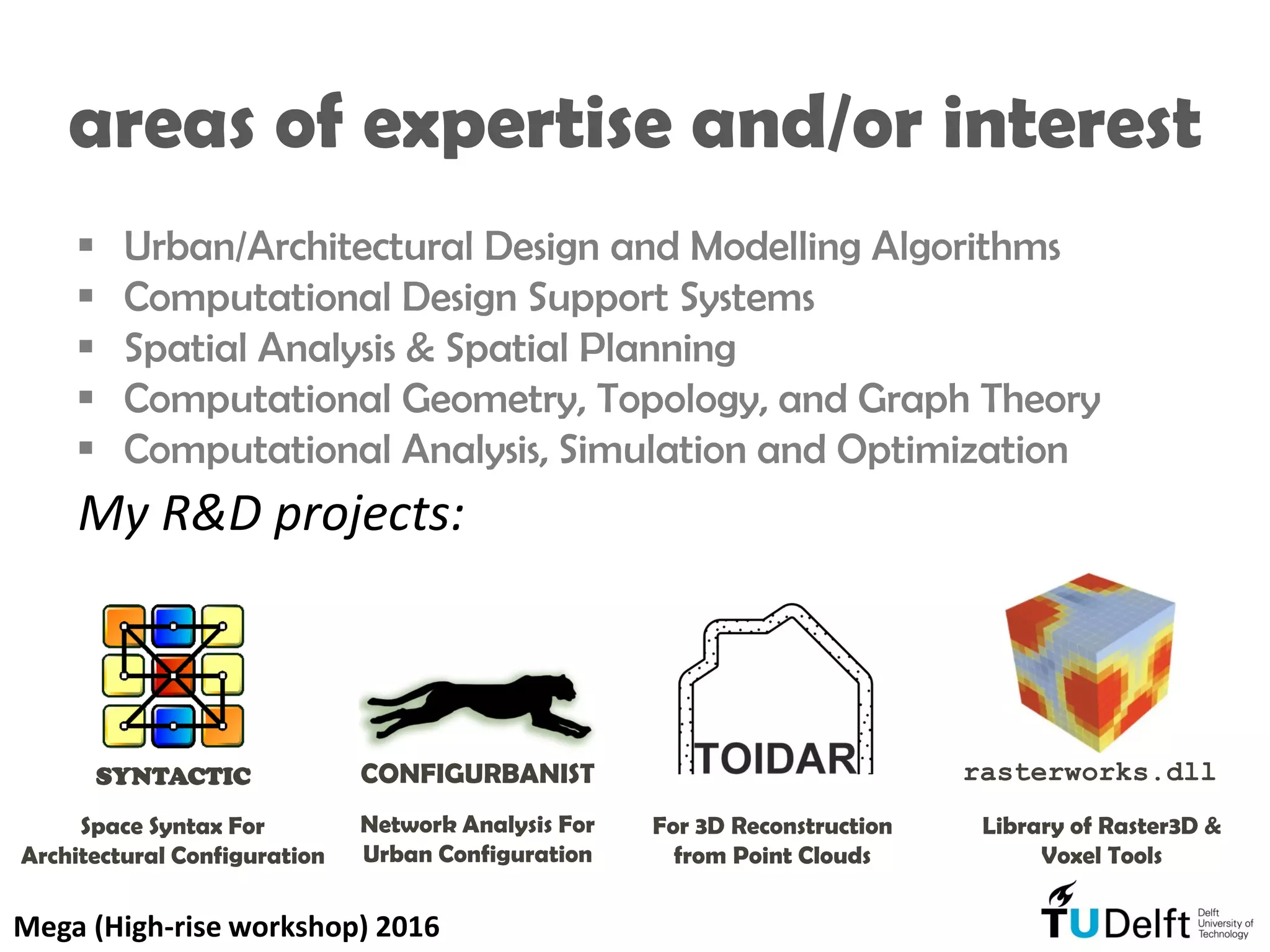
CONFIGURBANISTSYNTACTIC
Space Syntax For
Architectural Configuration
Network Analysis For
Urban Configuration
For 3D Reconstruction
from Point Clouds
rasterworks.dll
Library of Raster3D &
Voxel Tools
My R&D projects:
Mega (High-rise workshop) 2016
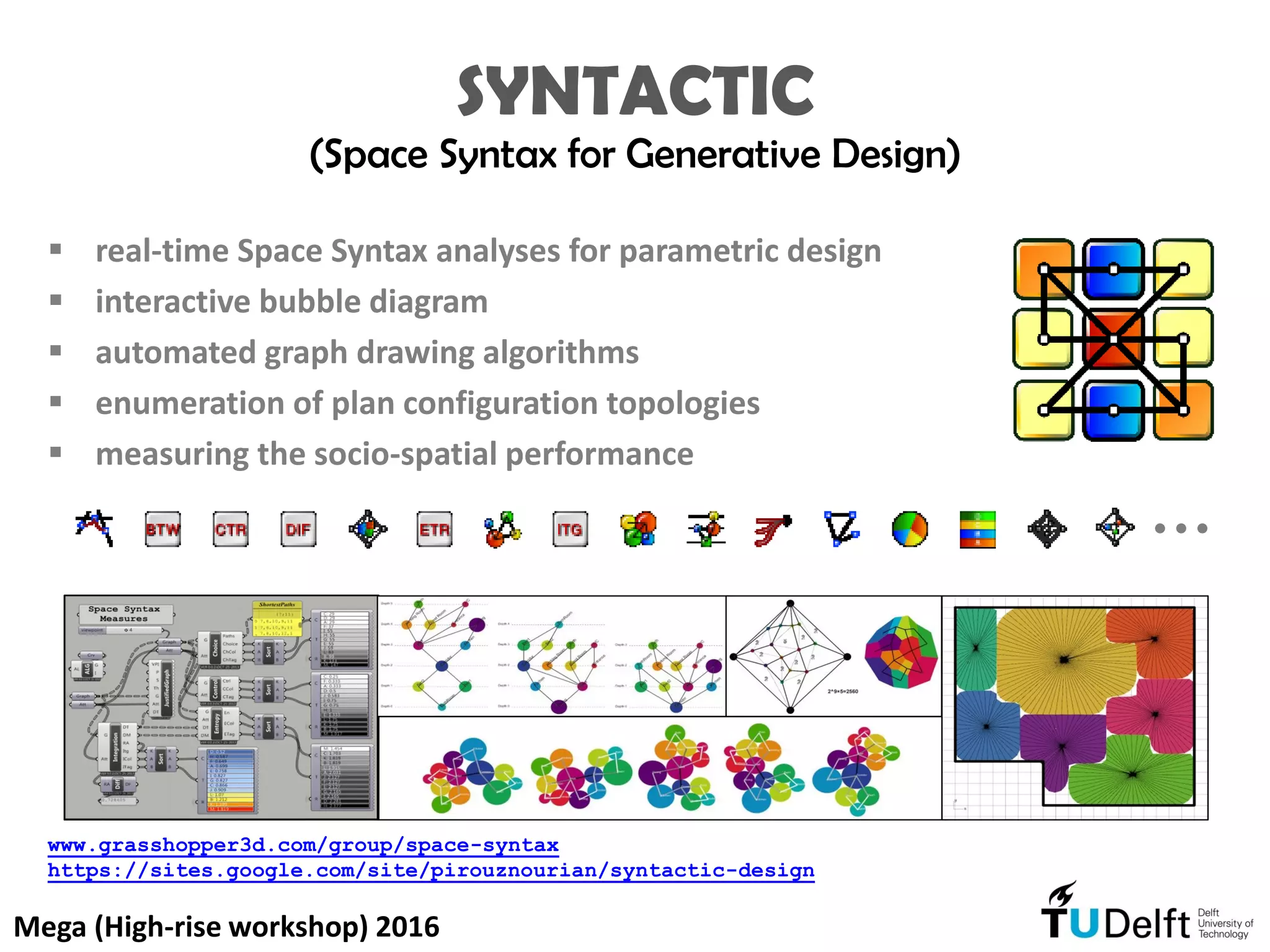
(Space Syntax for Generative Design)
 real-time Space Syntax analyses for parametric design
 interactive bubble diagram
 automated graph drawing algorithms
 enumeration of plan configuration topologies
 measuring the socio-spatial performance
www.grasshopper3d.com/group/space-syntax
https://sites.google.com/site/pirouznourian/syntactic-design
SYNTACTIC
Mega (High-rise workshop) 2016
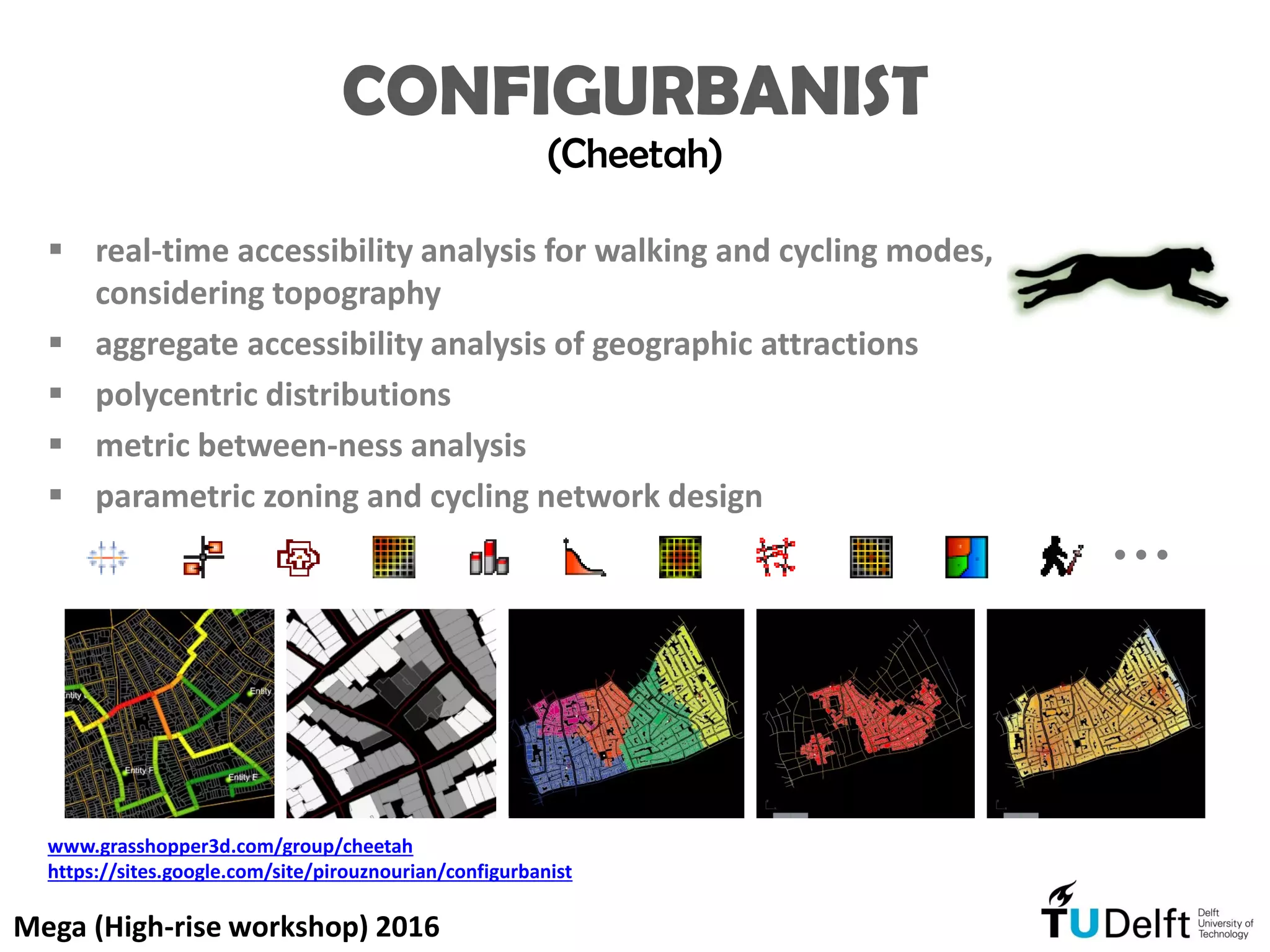
 real-time accessibility analysis for walking and cycling modes,
considering topography
 aggregate accessibility analysis of geographic attractions
 polycentric distributions
 metric between-ness analysis
 parametric zoning and cycling network design
www.grasshopper3d.com/group/cheetah
https://sites.google.com/site/pirouznourian/configurbanist
CONFIGURBANIST
(Cheetah)
Mega (High-rise workshop) 2016
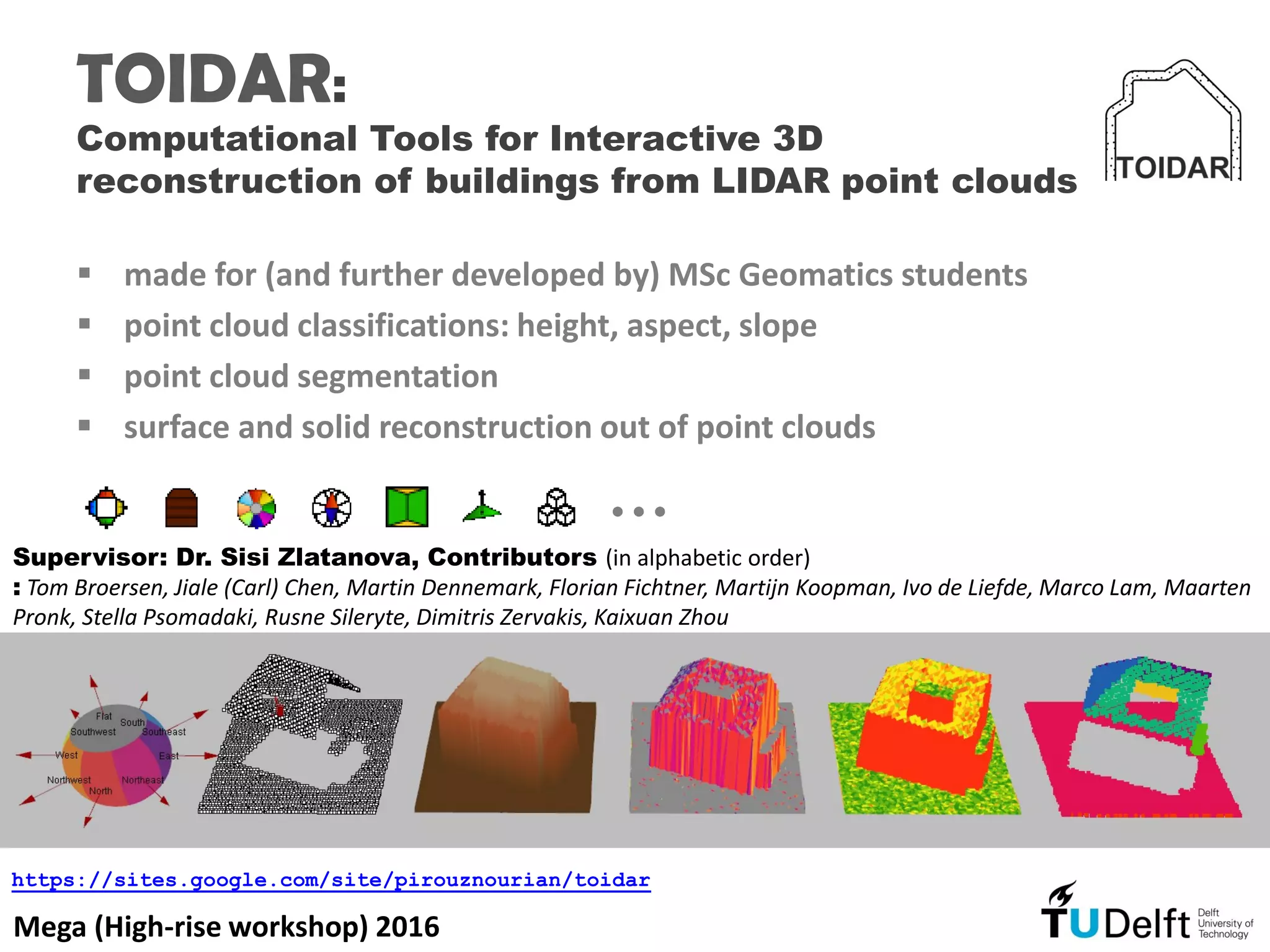
TOIDAR:
Computational Tools for Interactive 3D
reconstruction of buildings from LIDAR point clouds
 made for (and further developed by) MSc Geomatics students
 point cloud classifications: height, aspect, slope
 point cloud segmentation
 surface and solid reconstruction out of point clouds
Supervisor: Dr. Sisi Zlatanova, Contributors (in alphabetic order)
: Tom Broersen, Jiale (Carl) Chen, Martin Dennemark, Florian Fichtner, Martijn Koopman, Ivo de Liefde, Marco Lam, Maarten
Pronk, Stella Psomadaki, Rusne Sileryte, Dimitris Zervakis, Kaixuan Zhou
https://sites.google.com/site/pirouznourian/toidar
Mega (High-rise workshop) 2016
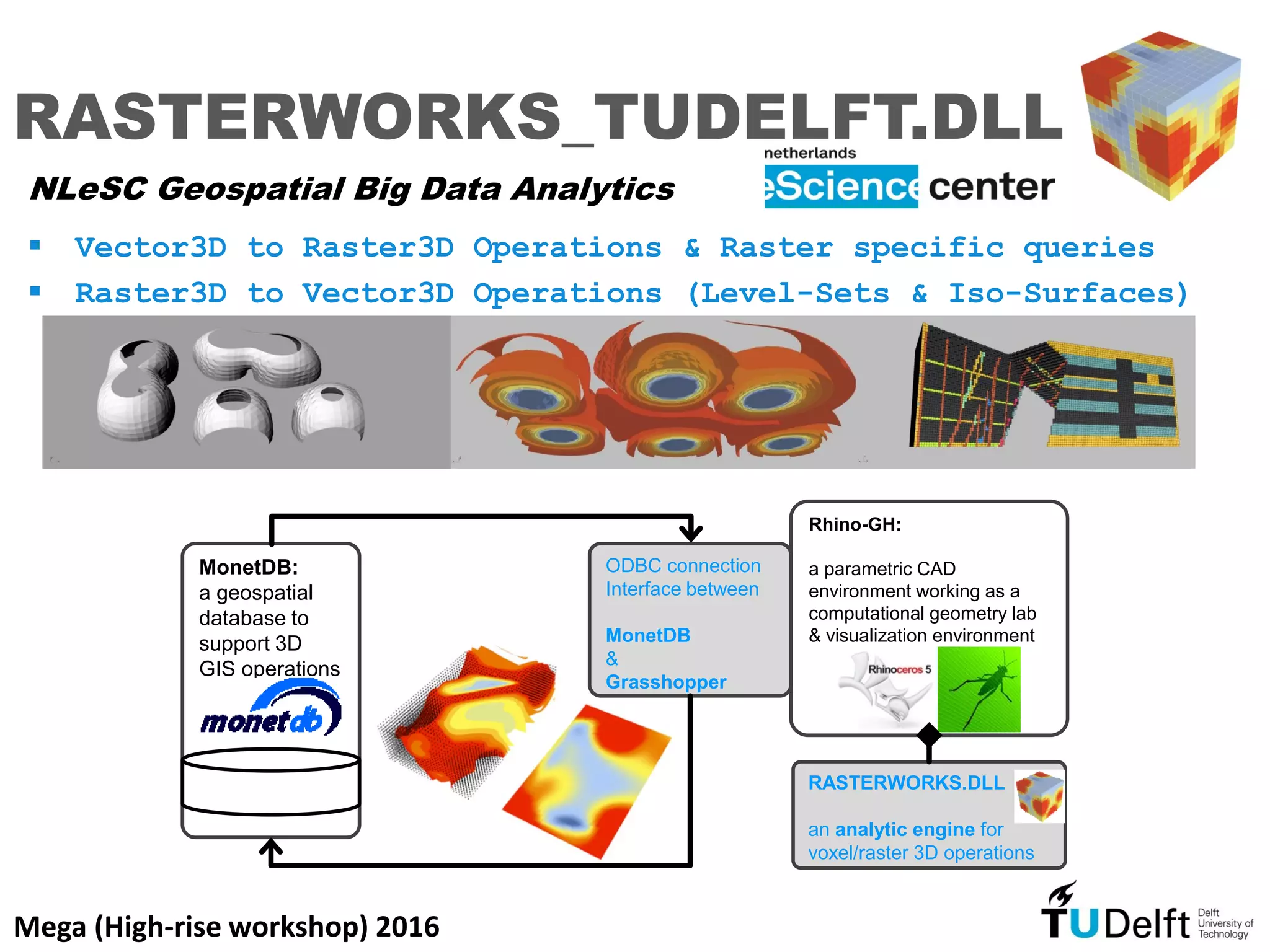
RASTERWORKS_TUDELFT.DLL
 Vector3D to Raster3D Operations & Raster specific queries
 Raster3D to Vector3D Operations (Level-Sets & Iso-Surfaces)
MonetDB:
a geospatial
database to
support 3D
GIS operations
Rhino-GH:
a parametric CAD
environment working as a
computational geometry lab
& visualization environment
ODBC connection
Interface between
MonetDB
&
Grasshopper
RASTERWORKS.DLL
an analytic engine for
voxel/raster 3D operations
NLeSC Geospatial Big Data Analytics
Mega (High-rise workshop) 2016
This lecture:
Part 1: terminology, design process & methods
Part 2: course requirements and workshops
Mega (High-rise workshop) 2016
This lecture:
Part 1: terminology, design process & methods
• Intellectual Design Process
• What is computational design?
• Computation
• Parametric Modelling
• Computational Analysis
• Performance Simulation
• Performance Evaluation
• Design Space Exploration
Part 2: course requirements and workshops
• What is expected
• Study materials
• Agenda
Mega (High-rise workshop) 2016
Common Misconceptions!
• we can automate the design process!
• parametric design is another architectural style!
• parametric design= grasshopper!
• computational design is a magic art!
• computational design is for geek guys!
Mega (High-rise workshop) 2016
Design Process
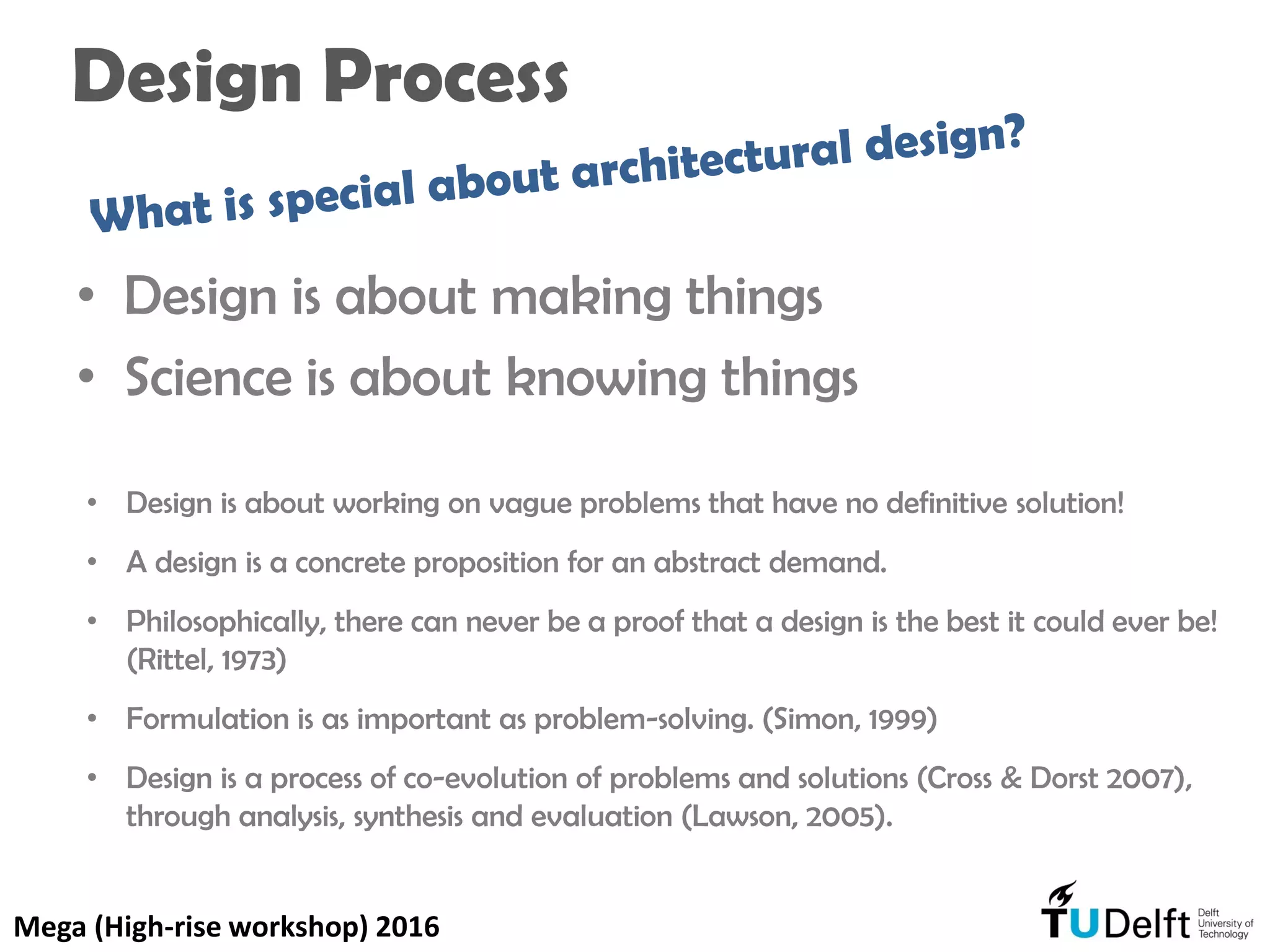
• Design is about making things
• Science is about knowing things
• Design is about working on vague problems that have no definitive solution!
• A design is a concrete proposition for an abstract demand.
• Philosophically, there can never be a proof that a design is the best it could ever be!
(Rittel, 1973)
• Formulation is as important as problem-solving. (Simon, 1999)
• Design is a process of co-evolution of problems and solutions (Cross & Dorst 2007),
through analysis, synthesis and evaluation (Lawson, 2005).
Mega (High-rise workshop) 2016
Design Process
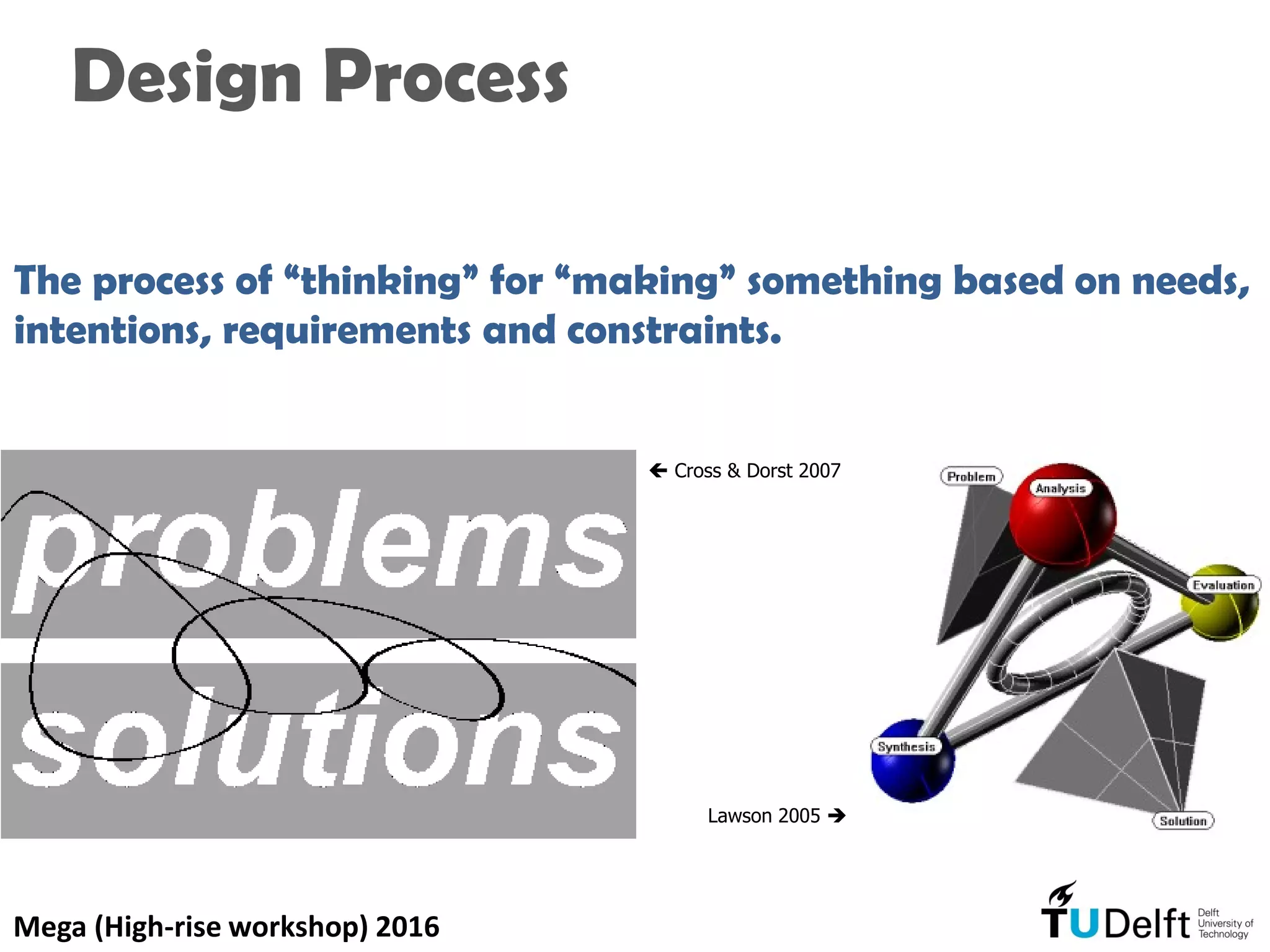
The process of “thinking” for “making” something based on needs,
intentions, requirements and constraints.
 Cross & Dorst 2007
Lawson 2005 
Mega (High-rise workshop) 2016
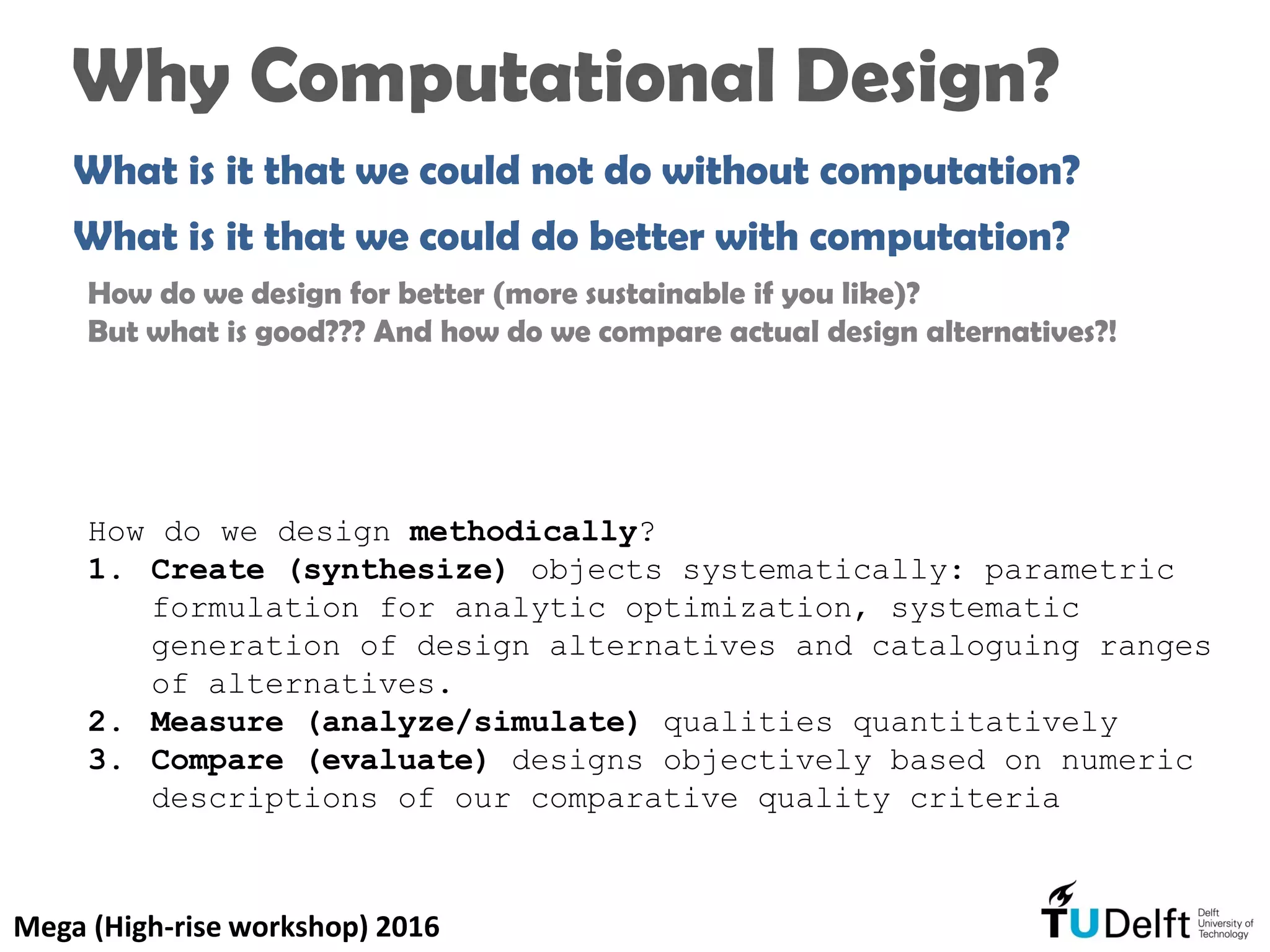
Why Computational Design?
What is it that we could not do without computation?
How do we design methodically?
1. Create (synthesize) objects systematically: parametric
formulation for analytic optimization, systematic
generation of design alternatives and cataloguing ranges
of alternatives.
2. Measure (analyze/simulate) qualities quantitatively
3. Compare (evaluate) designs objectively based on numeric
descriptions of our comparative quality criteria
How do we design for better (more sustainable if you like)?
But what is good??? And how do we compare actual design alternatives?!
Mega (High-rise workshop) 2016
What is it that we could do better with computation?
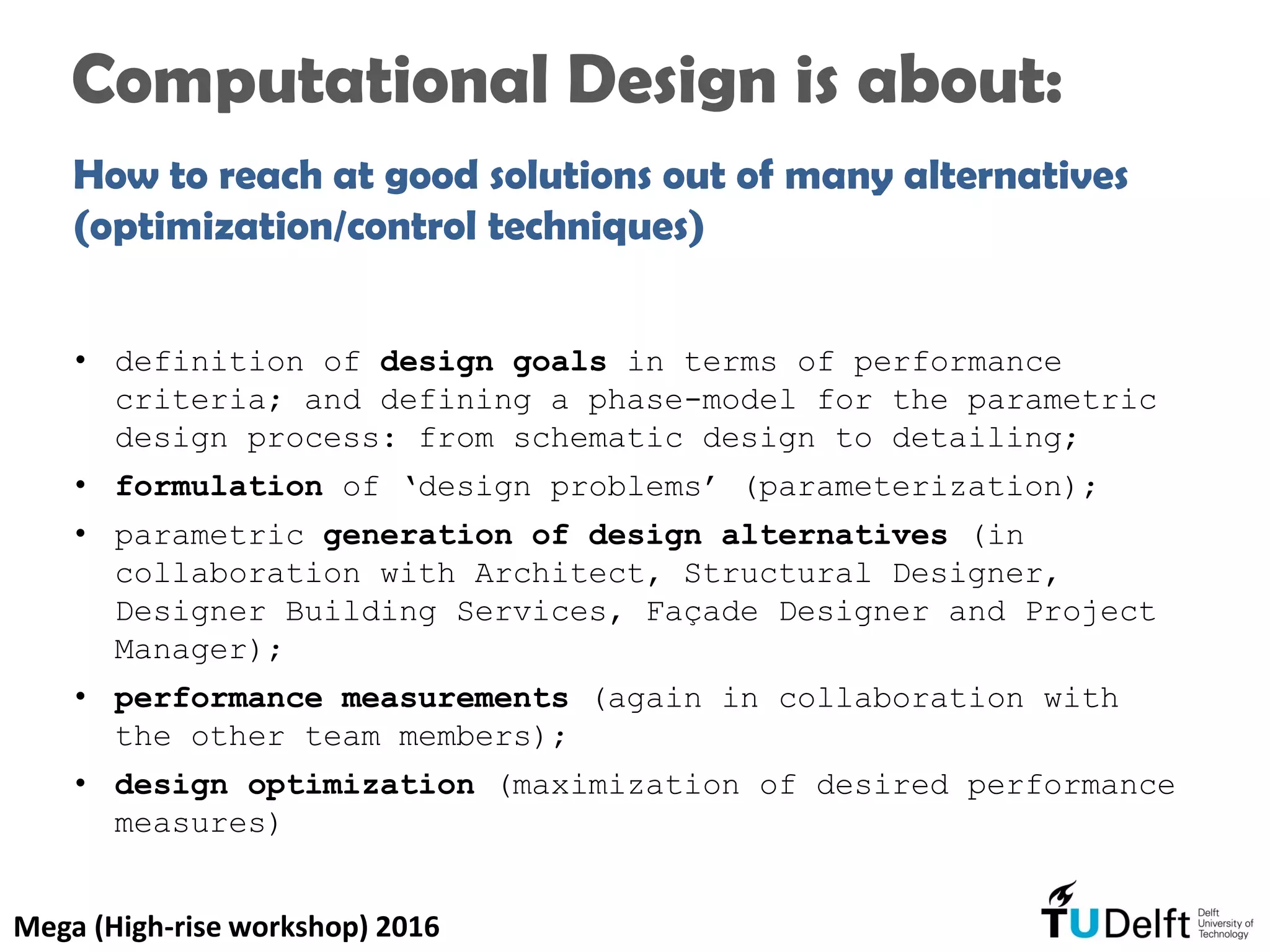
Computational Design is about:
How to reach at good solutions out of many alternatives
(optimization/control techniques)
• definition of design goals in terms of performance
criteria; and defining a phase-model for the parametric
design process: from schematic design to detailing;
• formulation of ‘design problems’ (parameterization);
• parametric generation of design alternatives (in
collaboration with Architect, Structural Designer,
Designer Building Services, Façade Designer and Project
Manager);
• performance measurements (again in collaboration with
the other team members);
• design optimization (maximization of desired performance
measures)
Mega (High-rise workshop) 2016
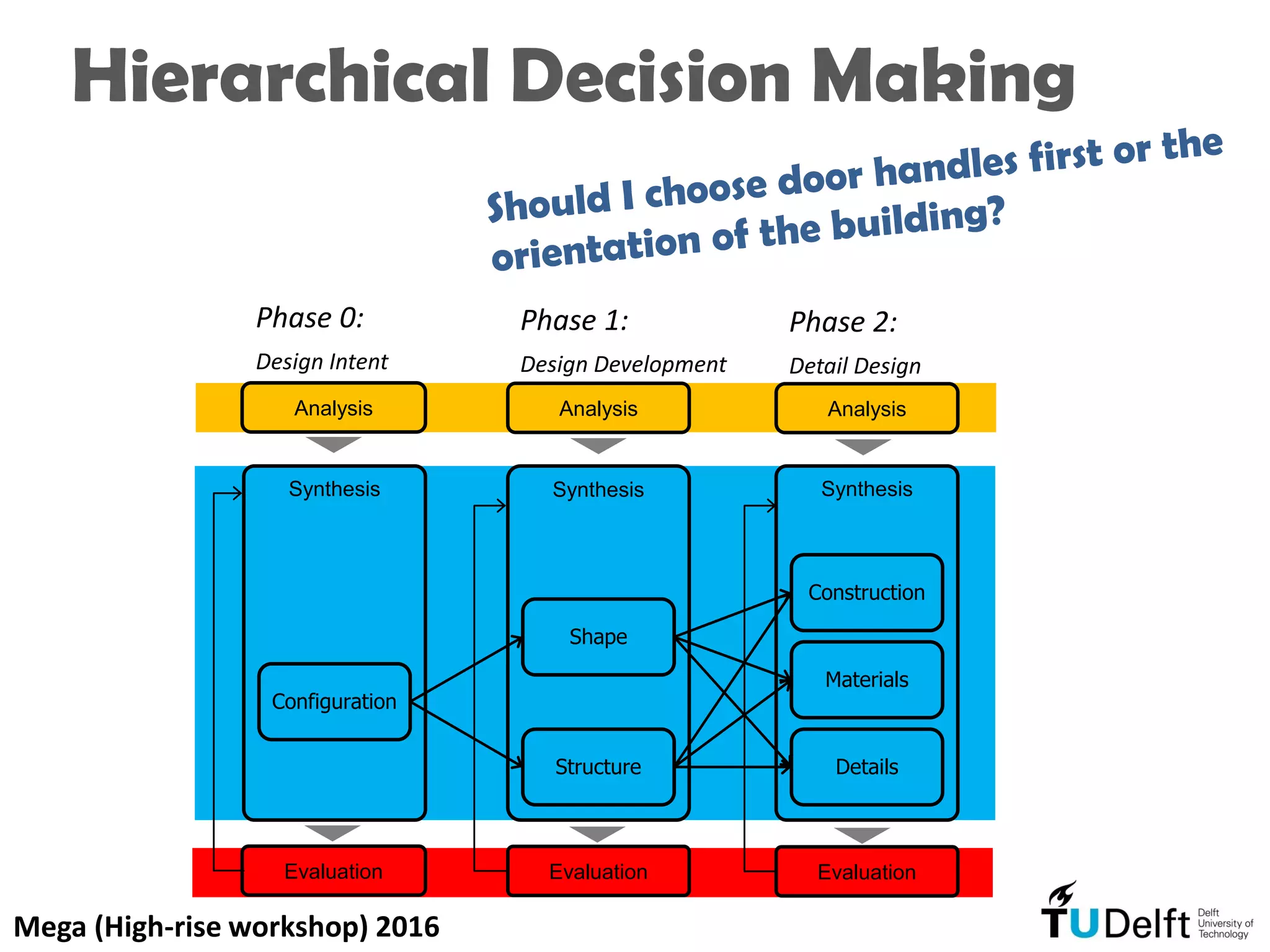
Hierarchical Decision Making
Synthesis SynthesisSynthesis
Evaluation Evaluation Evaluation
Configuration
Shape
Structure Details
Materials
Construction
Analysis Analysis Analysis
Phase 0:
Design Intent
Phase 1:
Design Development
Phase 2:
Detail Design
Mega (High-rise workshop) 2016
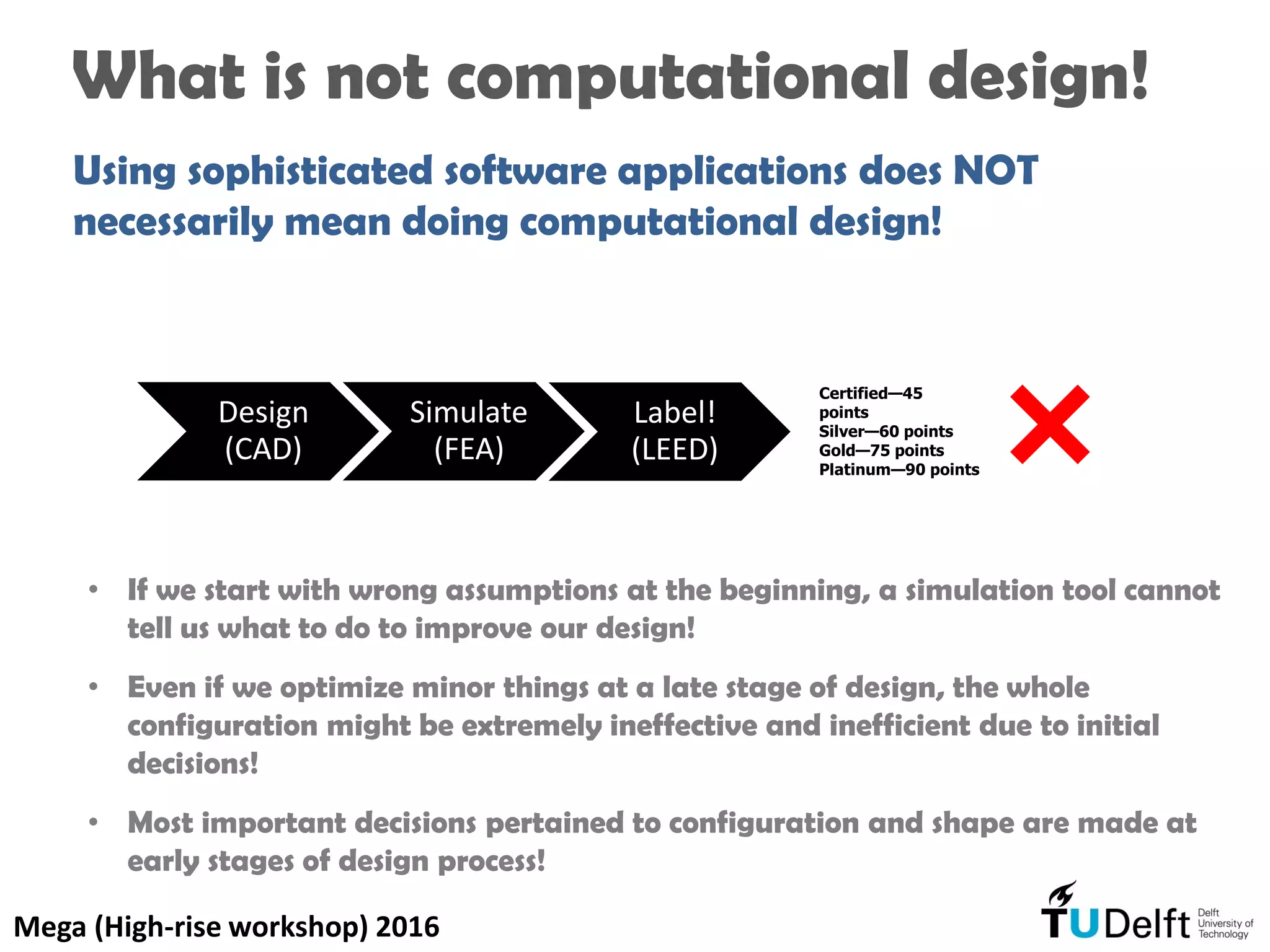
What is not computational design!
Using sophisticated software applications does NOT
necessarily mean doing computational design!
• If we start with wrong assumptions at the beginning, a simulation tool cannot
tell us what to do to improve our design!
• Even if we optimize minor things at a late stage of design, the whole
configuration might be extremely ineffective and inefficient due to initial
decisions!
• Most important decisions pertained to configuration and shape are made at
early stages of design process!
Design
(CAD)
Simulate
(FEA)
Label!
(LEED)
Certified—45
points
Silver—60 points
Gold—75 points
Platinum—90 points
Mega (High-rise workshop) 2016
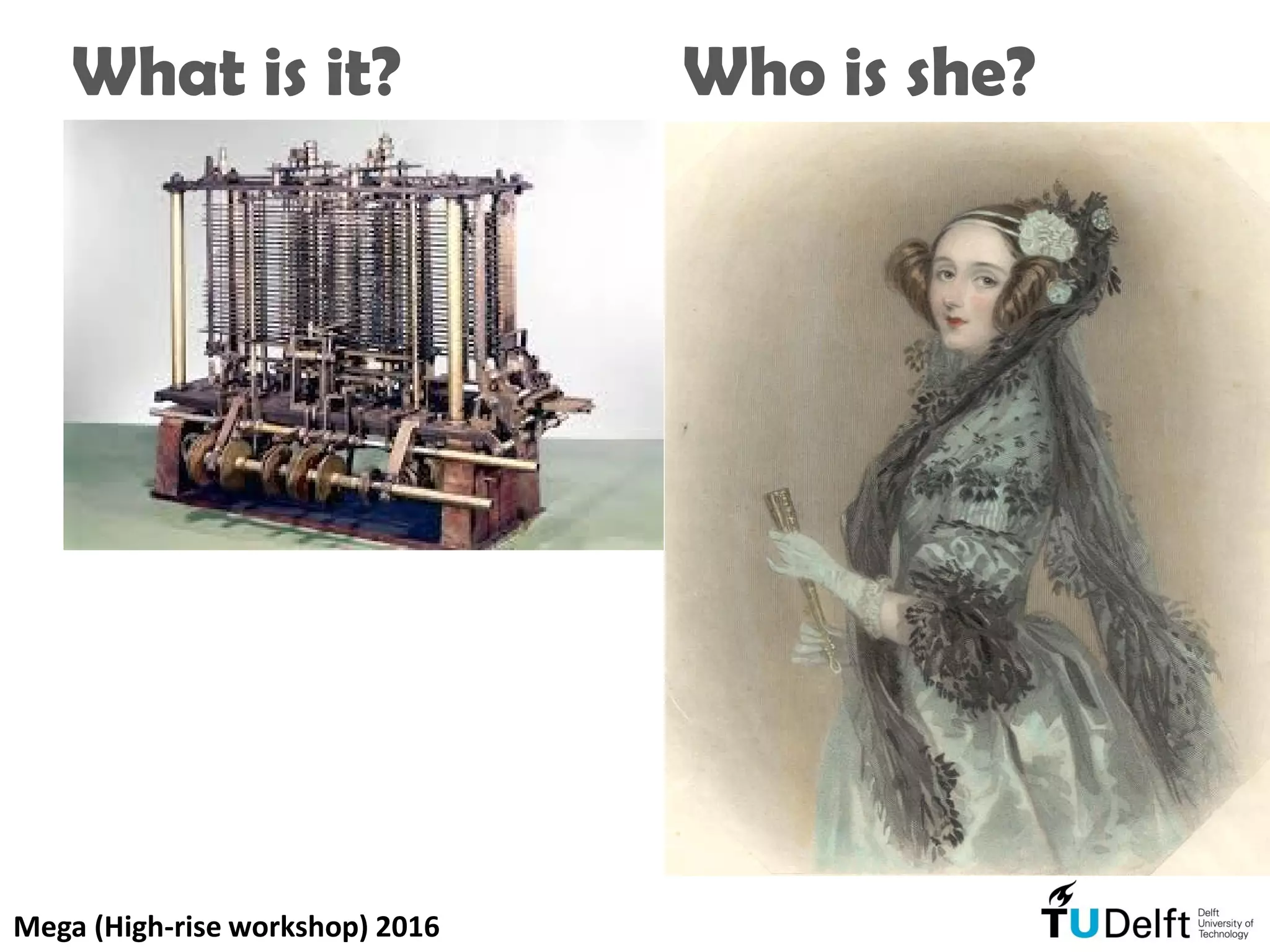
What is it? Who is she?
Mega (High-rise workshop) 2016
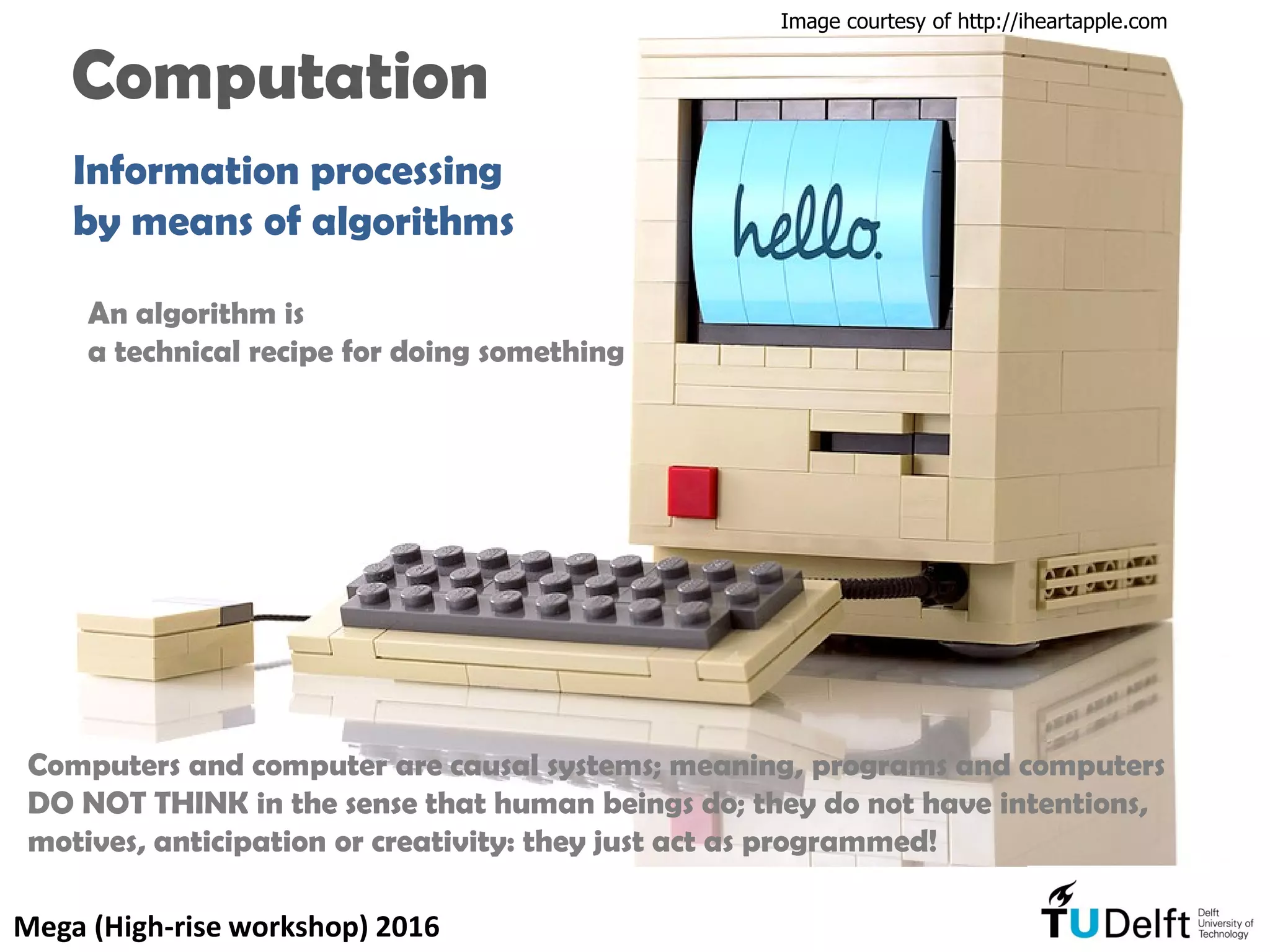
Computation
Computers and computer are causal systems; meaning, programs and computers
DO NOT THINK in the sense that human beings do; they do not have intentions,
motives, anticipation or creativity: they just act as programmed!
Information processing
by means of algorithms
An algorithm is
a technical recipe for doing something
Image courtesy of http://iheartapple.com
Mega (High-rise workshop) 2016
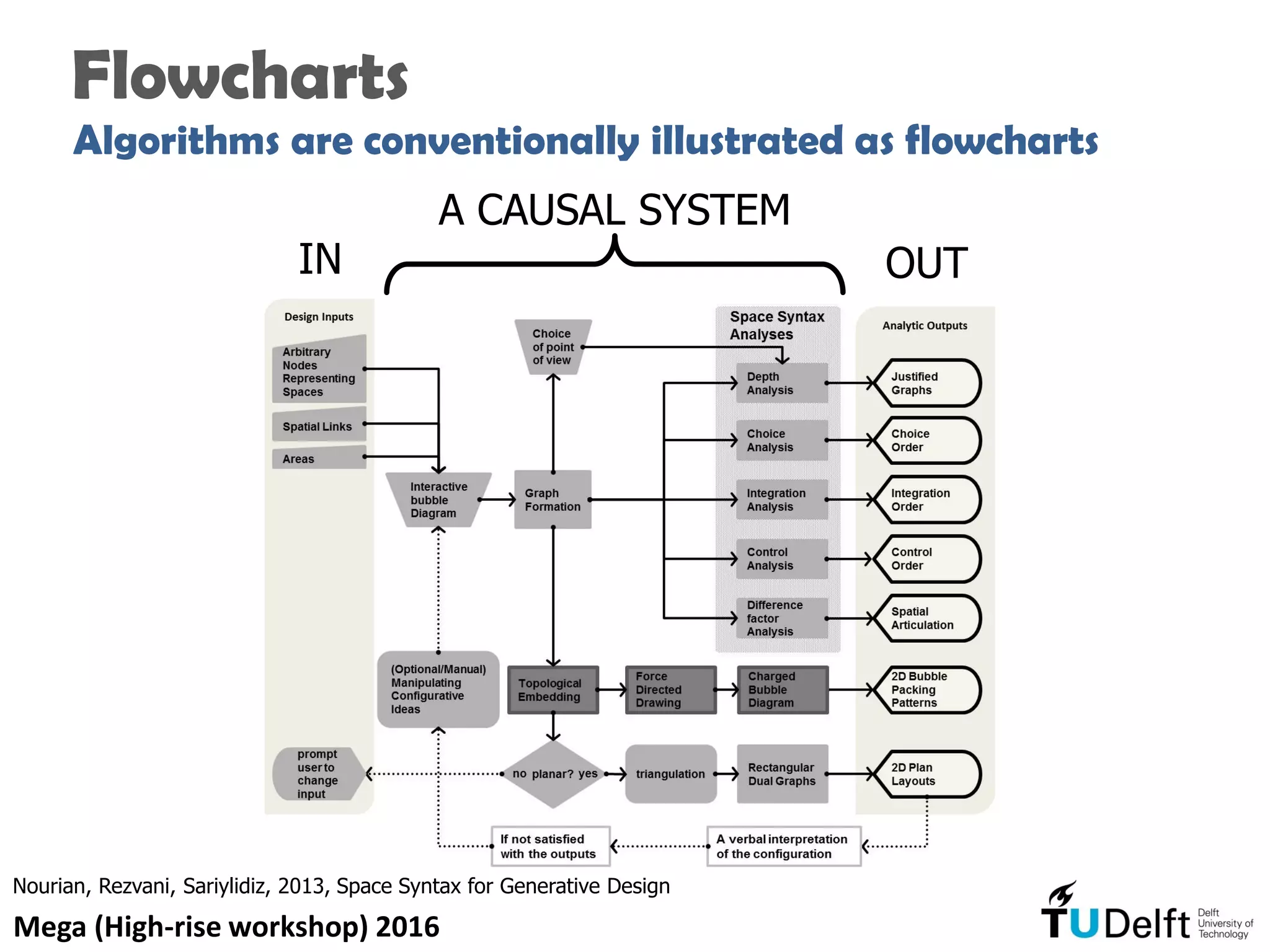
Flowcharts
Algorithms are conventionally illustrated as flowcharts
IN OUT
A CAUSAL SYSTEM
Nourian, Rezvani, Sariylidiz, 2013, Space Syntax for Generative Design
Mega (High-rise workshop) 2016
Parametric Modeling & Design
• Thinking of parameters instead of numbers!
• Same rationales, many alternatives!
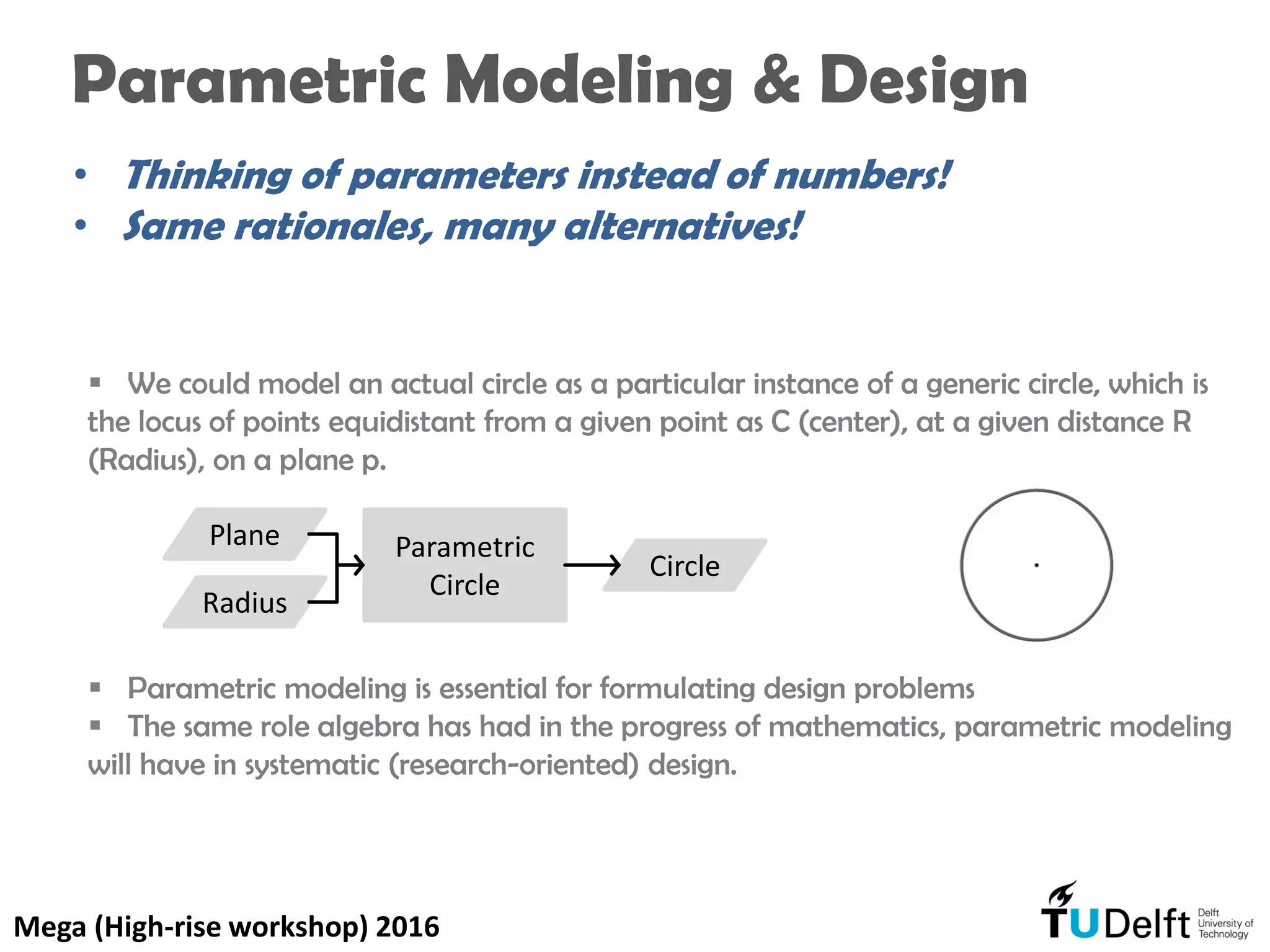
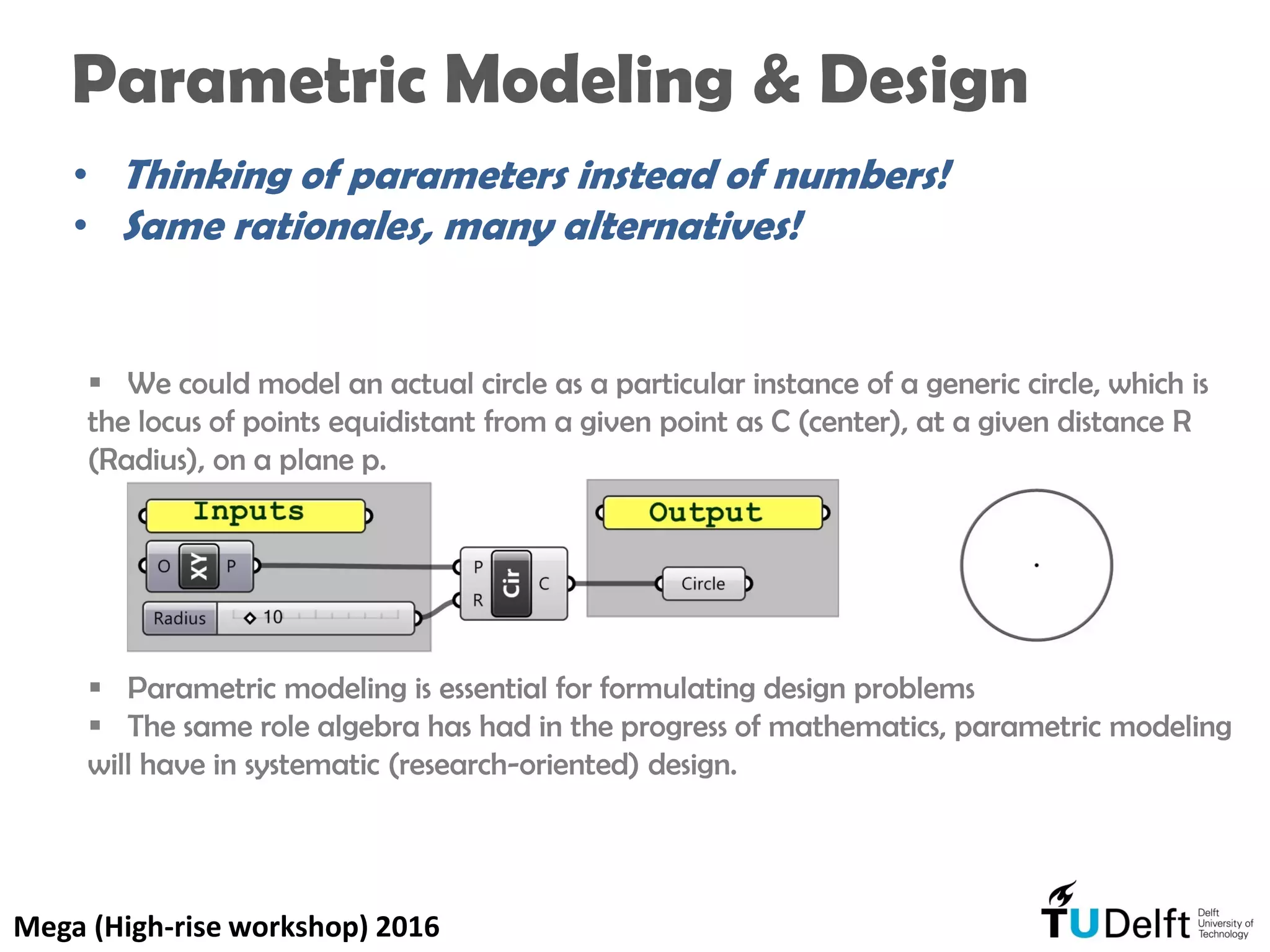
 We could model an actual circle as a particular instance of a generic circle, which is
the locus of points equidistant from a given point as C (center), at a given distance R
(Radius), on a plane p.
 Parametric modeling is essential for formulating design problems
 The same role algebra has had in the progress of mathematics, parametric modeling
will have in systematic (research-oriented) design.
Mega (High-rise workshop) 2016
Parametric
Circle
Plane
Radius
Circle
Parametric Modeling & Design
• Thinking of parameters instead of numbers!
• Same rationales, many alternatives!
 We could model an actual circle as a particular instance of a generic circle, which is
the locus of points equidistant from a given point as C (center), at a given distance R
(Radius), on a plane p.
 Parametric modeling is essential for formulating design problems
 The same role algebra has had in the progress of mathematics, parametric modeling
will have in systematic (research-oriented) design.
Mega (High-rise workshop) 2016
𝑥 = 𝑟𝑐𝑜𝑠(𝑡)
𝑦 = 𝑟𝑠𝑖𝑛 𝑡
𝑡 ∈ [0,2𝜋]
𝑡 =
2𝜋𝑖
𝑛
|𝑖 ∈[1,n]⊂ ℕ
Plane
Radius
Circle
Parametric Modeling & Design
• Thinking of parameters instead of numbers!
• Same rationales, many alternatives!
 We could model an actual circle as a particular instance of a generic circle, which is
the locus of points equidistant from a given point as C (center), at a given distance R
(Radius), on a plane p.
 Parametric modeling is essential for formulating design problems
 The same role algebra has had in the progress of mathematics, parametric modeling
will have in systematic (research-oriented) design.
Mega (High-rise workshop) 2016
Computational Analysis
Measuring qualities and features of [geometric] objects
• Continuous Models:
Analytic measurements using
mathematical models of objects, e.g.
curvature analysis
• Discrete Models:
Algorithmic analysis of discrete models,
e.g. finding distances on a network
using shortest path algorithms
Mega (High-rise workshop) 2016
Performance Simulation
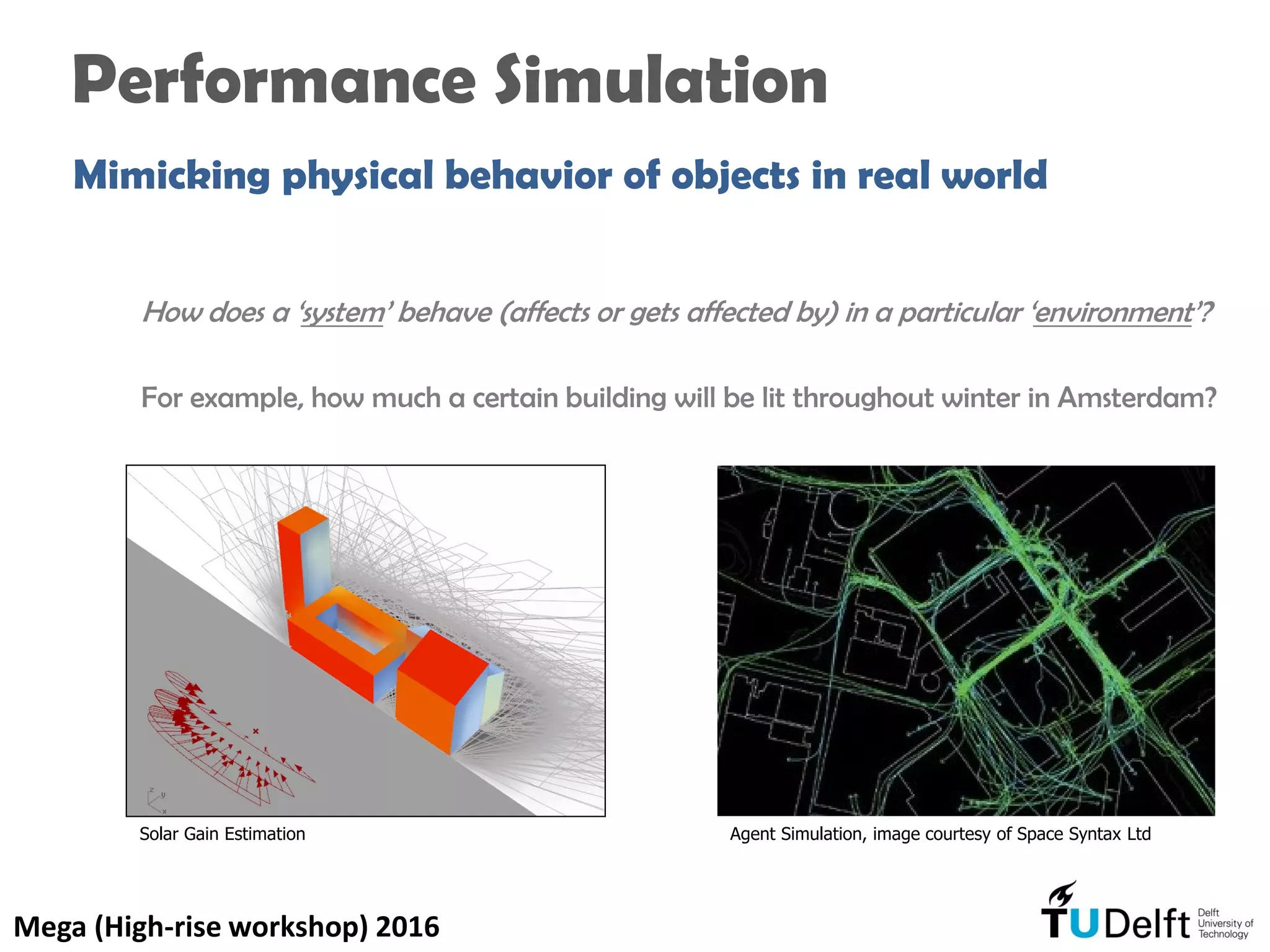
Mimicking physical behavior of objects in real world
How does a ‘system’ behave (affects or gets affected by) in a particular ‘environment’?
For example, how much a certain building will be lit throughout winter in Amsterdam?
Agent Simulation, image courtesy of Space Syntax LtdSolar Gain Estimation
Mega (High-rise workshop) 2016
Performance Evaluation
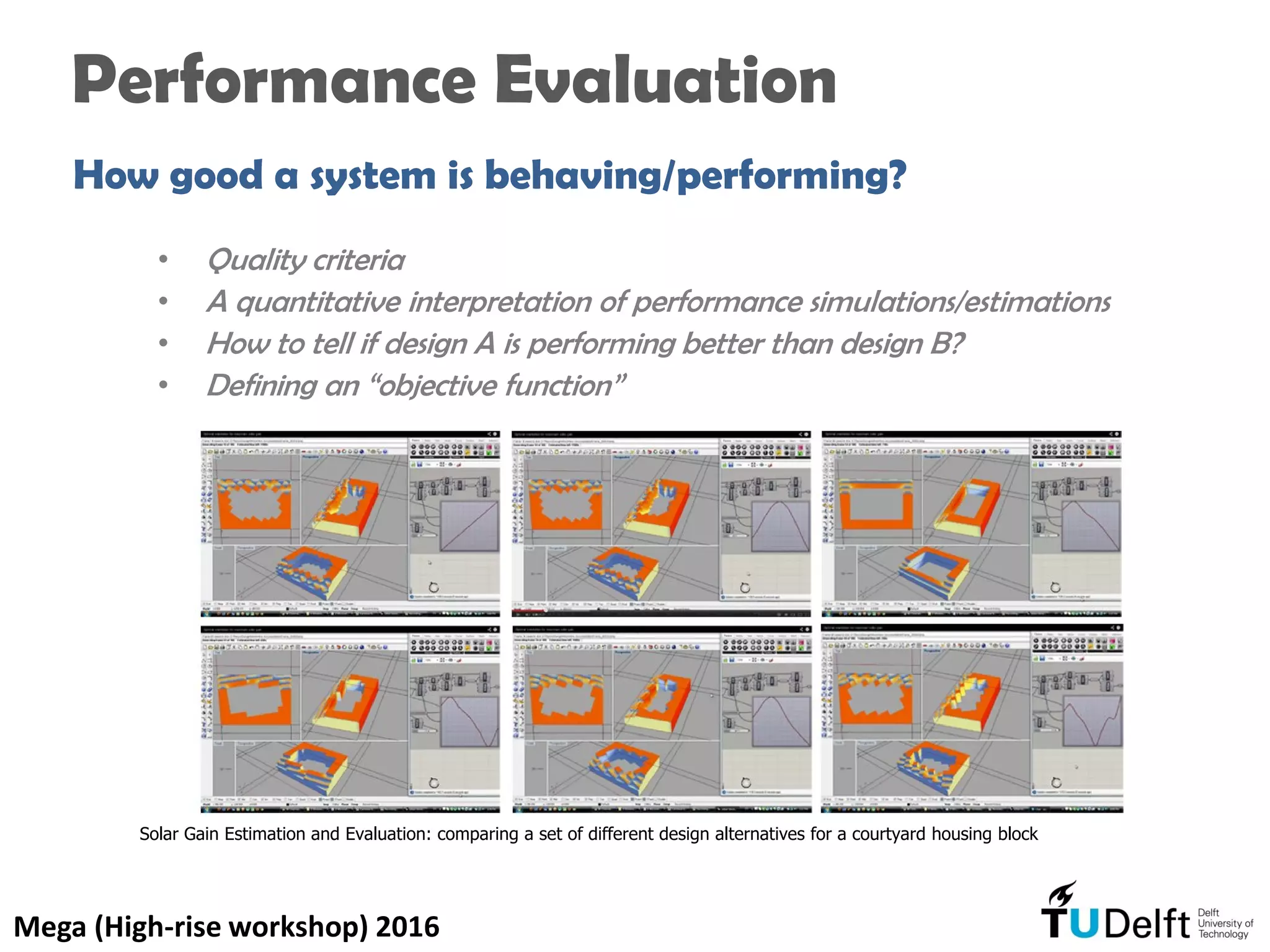
How good a system is behaving/performing?
• Quality criteria
• A quantitative interpretation of performance simulations/estimations
• How to tell if design A is performing better than design B?
• Defining an “objective function”
Solar Gain Estimation and Evaluation: comparing a set of different design alternatives for a courtyard housing block
Mega (High-rise workshop) 2016
Design Space Exploration
How to reach at good solutions out of many alternatives
(optimization/control techniques)
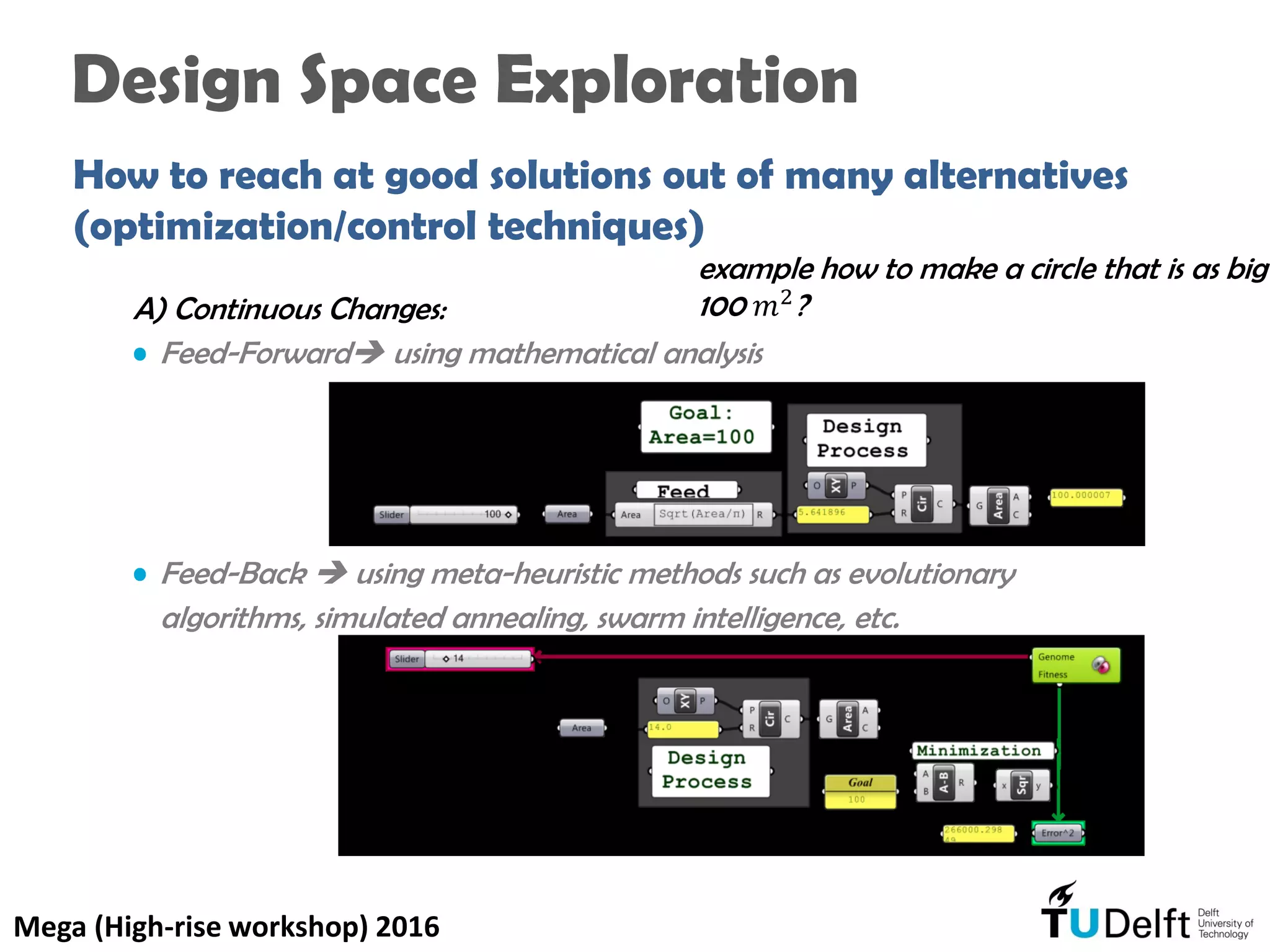
A) Continuous Changes:
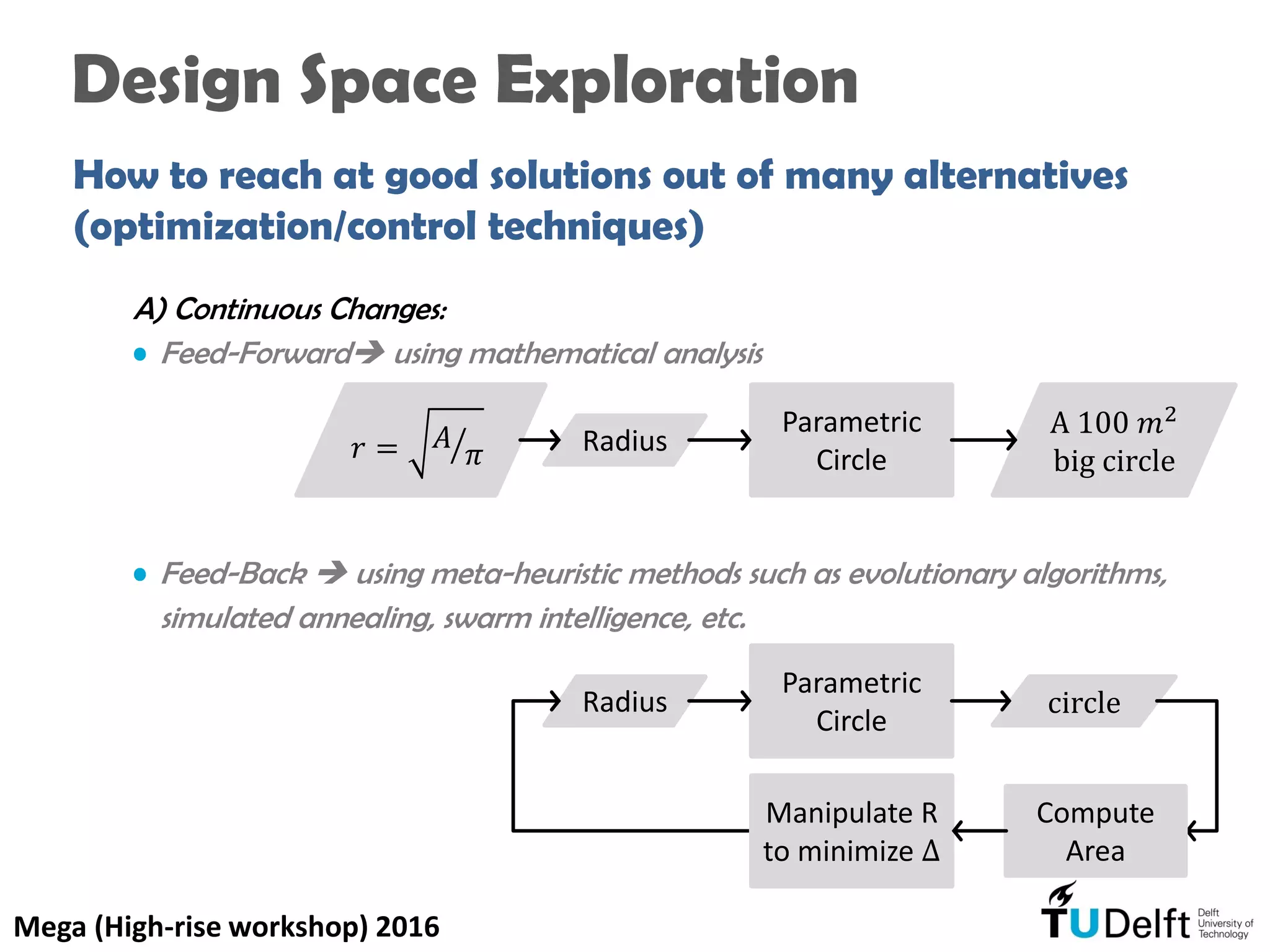
• Feed-Forward using mathematical analysis
• Feed-Back  using meta-heuristic methods such as evolutionary algorithms,
simulated annealing, swarm intelligence, etc.
Mega (High-rise workshop) 2016
Parametric
Circle
Radius𝑟 = 𝐴
𝜋
A 100 𝑚2
big circle
Parametric
Circle
Radius circle
Manipulate R
to minimize Δ
Compute
Area
Design Space Exploration
How to reach at good solutions out of many alternatives
(optimization/control techniques)
A) Continuous Changes:
• Feed-Forward using mathematical analysis
• Feed-Back  using meta-heuristic methods such as evolutionary
algorithms, simulated annealing, swarm intelligence, etc.
Mega (High-rise workshop) 2016
example how to make a circle that is as big
100 𝑚2?
Design Space Exploration
How to reach at good solutions out of many alternatives
(optimization/control techniques)
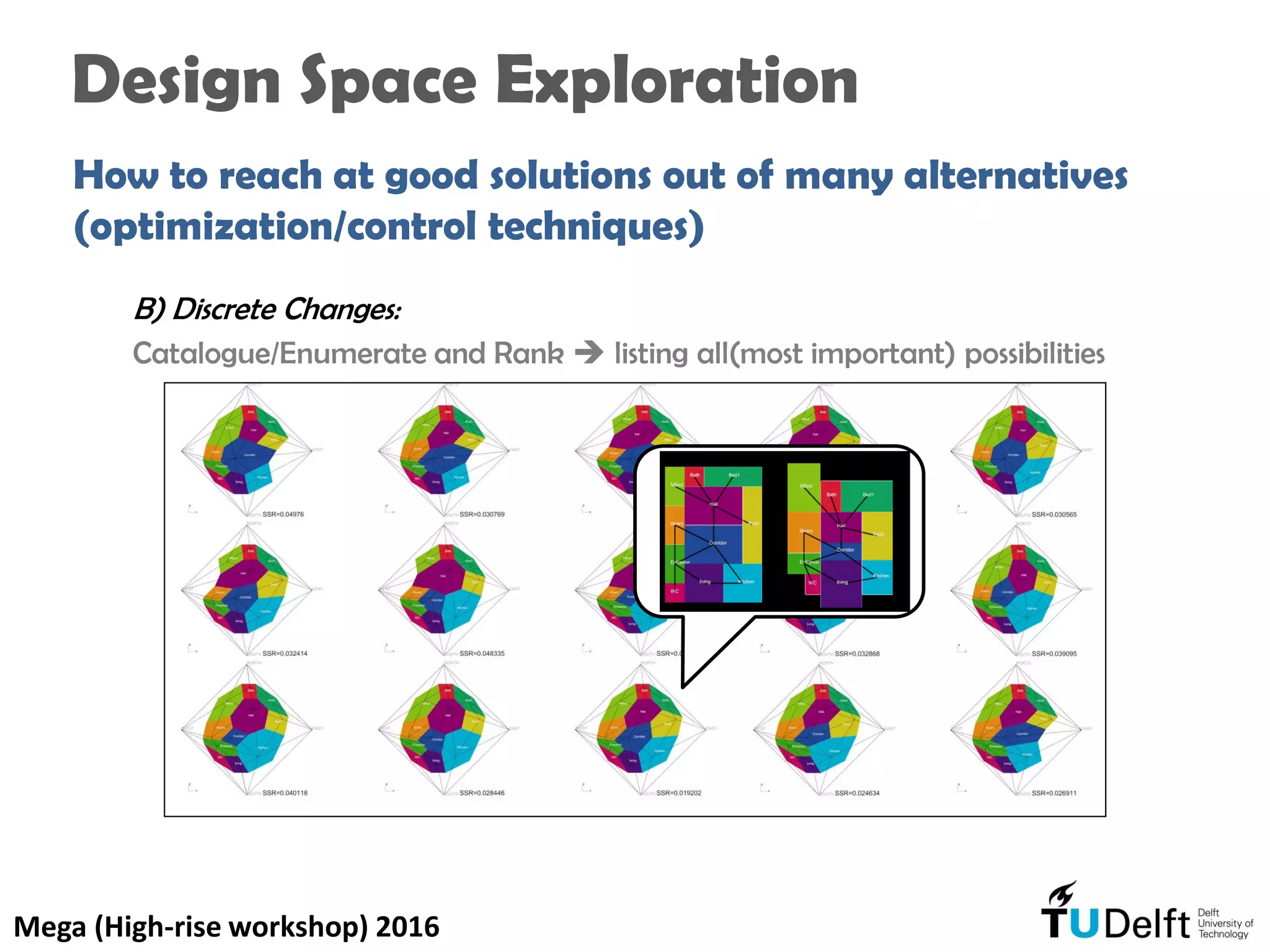
B) Discrete Changes:
Catalogue/Enumerate and Rank  listing all(most important) possibilities
Mega (High-rise workshop) 2016
Plugins that we recommend:
Structural Design Computations:
• Kangaroo
• Millipede
• Karamba
• Geometry Gym (export to GSA)
Plugins that we recommend:
Climatic Design Computations:
• Ladybug
• DIVA
Plugins that we recommend:
BIM Plugins Syntactic
• Geometry Gym
• GH>>Revit
• Visual ARQ
• Chameleon
Plugins that we recommend:
Façade Design Computations:
• Mesh Edit (UTO)
• Weaver Bird
• Mesh(+)
Plugins that we recommend:
Architectural Design Computations:
• Spider Web
• Syntactic
Part 2: Course Requirements
Deliverables and Matters to Consult
• definition of design goals in terms of performance
criteria; and defining a phase-model for the parametric
design process: from schematic design to detailing;
• formulation of ‘design problems’ (parameterization);
• parametric generation of design alternatives (in
collaboration with Architect, Structural Designer,
Designer Building Services, Façade Designer and Project
Manager);
• performance measurements (again in collaboration with
the other team members);
• design optimization (maximization of desired performance
measures)
Mega (High-rise workshop) 2016
Formulation Examples
Think about the followings:
• How would you define a concept such as “compactness”?
• How would you measure the aptitude of a building in
terms of solar gain?
• How would you define structural goodness of a building?
• How would you define functional performance of a
building?
Mega (High-rise workshop) 2016
Agenda of Workshops
0. An introduction to Computational Design
1. Geometry and Topology
2. Data Structure and Algorithms
3. Performance Analysis, Evaluation & Optimization
Mega (High-rise workshop) 2016
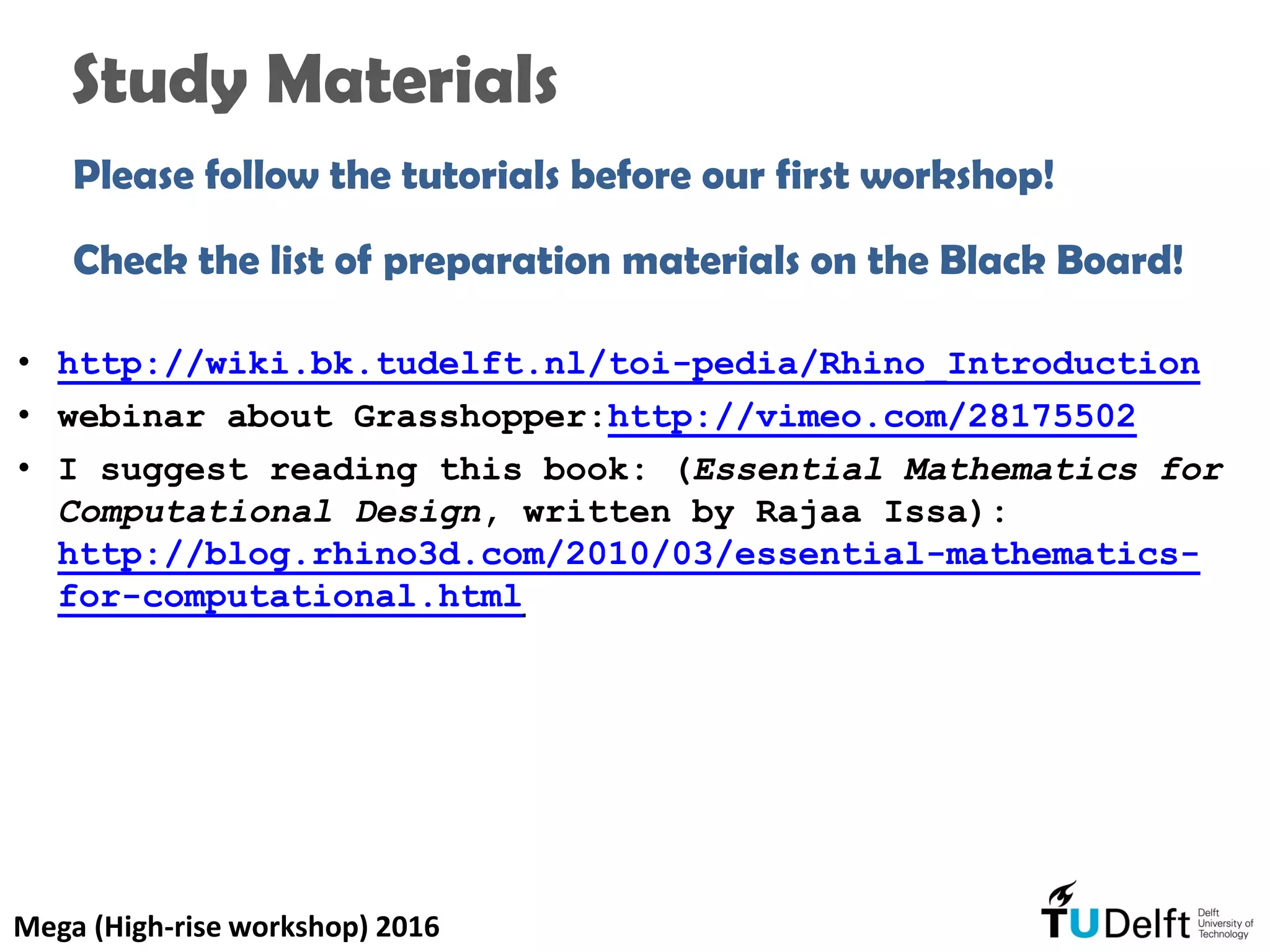
Study Materials
Please follow the tutorials before our first workshop!
• http://wiki.bk.tudelft.nl/toi-pedia/Rhino_Introduction
• webinar about Grasshopper:http://vimeo.com/28175502
• I suggest reading this book: (Essential Mathematics for
Computational Design, written by Rajaa Issa):
http://blog.rhino3d.com/2010/03/essential-mathematics-
for-computational.html
Mega (High-rise workshop) 2016
Check the list of preparation materials on the Black Board!
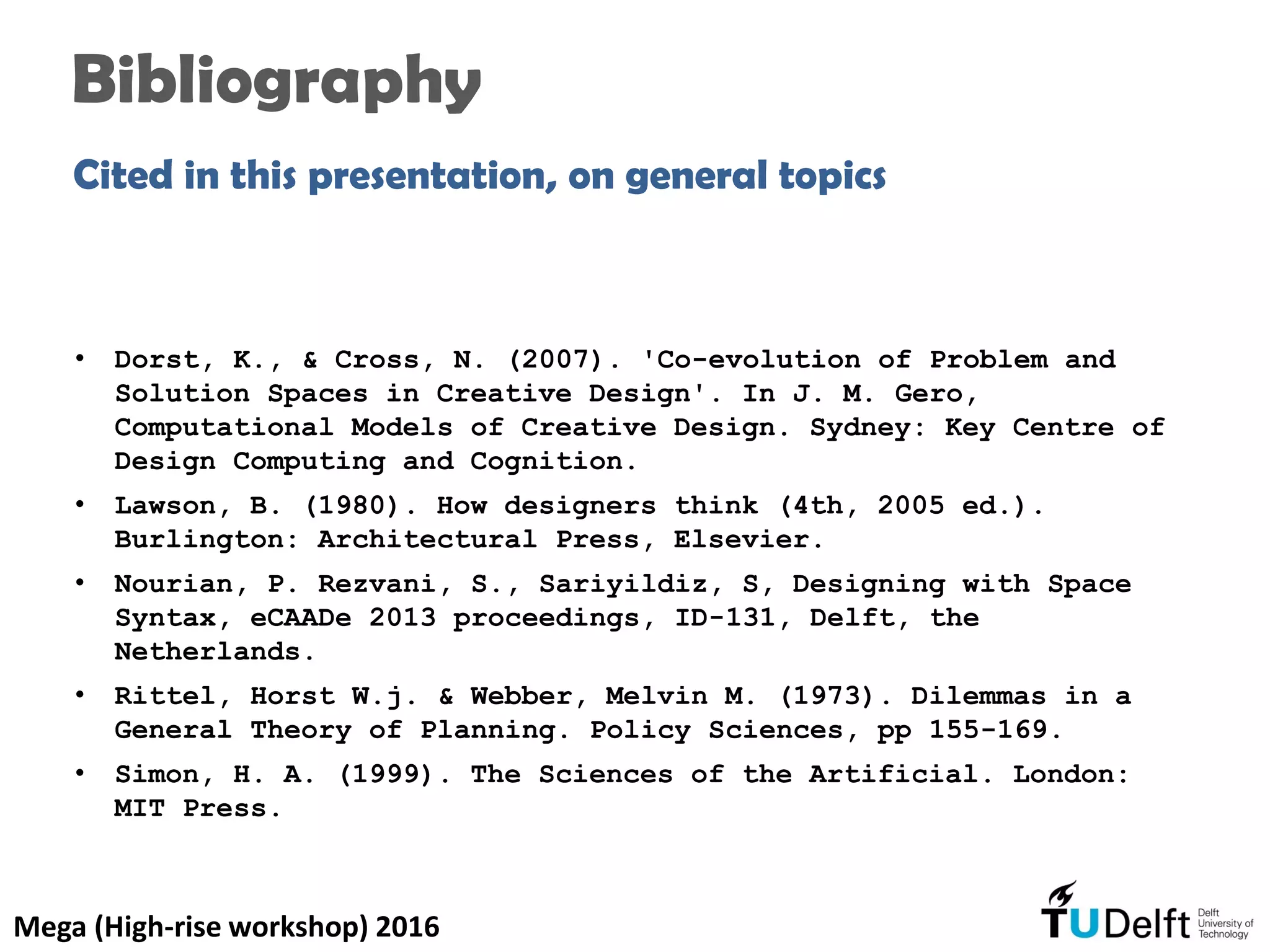
Bibliography
Cited in this presentation, on general topics
• Dorst, K., & Cross, N. (2007). 'Co-evolution of Problem and
Solution Spaces in Creative Design'. In J. M. Gero,
Computational Models of Creative Design. Sydney: Key Centre of
Design Computing and Cognition.
• Lawson, B. (1980). How designers think (4th, 2005 ed.).
Burlington: Architectural Press, Elsevier.
• Nourian, P. Rezvani, S., Sariyildiz, S, Designing with Space
Syntax, eCAADe 2013 proceedings, ID-131, Delft, the
Netherlands.
• Rittel, Horst W.j. & Webber, Melvin M. (1973). Dilemmas in a
General Theory of Planning. Policy Sciences, pp 155-169.
• Simon, H. A. (1999). The Sciences of the Artificial. London:
MIT Press.
Mega (High-rise workshop) 2016
Food for Thought
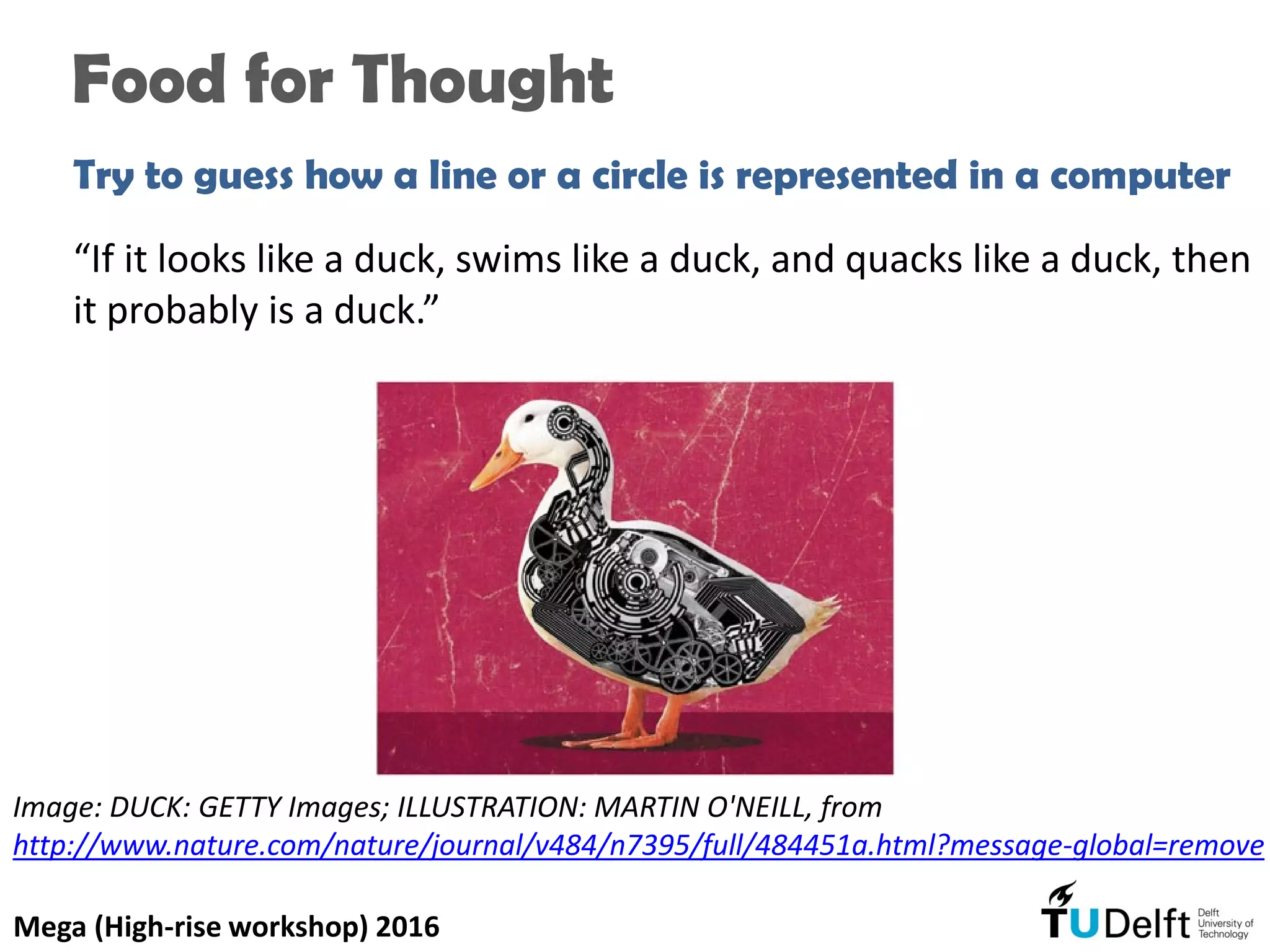
Try to guess how a line or a circle is represented in a computer
Mega (High-rise workshop) 2016
“If it looks like a duck, swims like a duck, and quacks like a duck, then
it probably is a duck.”
Image: DUCK: GETTY Images; ILLUSTRATION: MARTIN O'NEILL, from
http://www.nature.com/nature/journal/v484/n7395/full/484451a.html?message-global=remove
Food for Thought
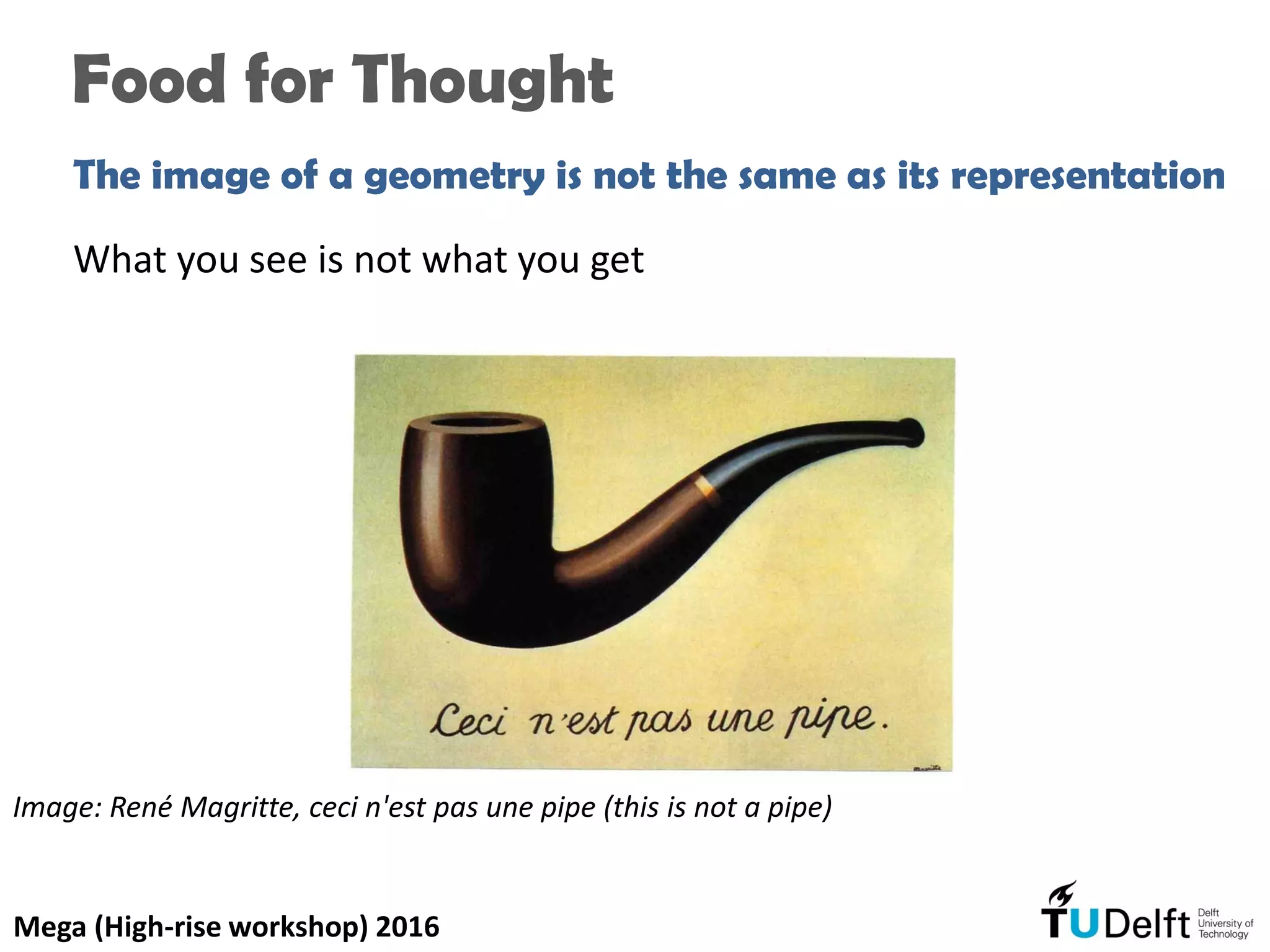
The image of a geometry is not the same as its representation
Mega (High-rise workshop) 2016
What you see is not what you get
Image: René Magritte, ceci n'est pas une pipe (this is not a pipe)
THANKS
FOR
YOUR
ATTENTION
Mega (High-rise workshop) 2016

Intro computational design_mega2016_1_with_recommendedplugins

  • 1.
    A Very ShortIntroduction to Computational Design An outline of essential topics Ir. Pirouz Nourian PhD Candidate, Researcher & Instructor @TU Delft/A+BE/AE+T/Design Informatics Email: p.nourian@tudelft.nl Mega (High-rise workshop) 2016
  • 2.
    About Me Mega (High-riseworkshop) 2016  PhD Candidate, Researcher & Instructor: @ AE+T/Design Informatics @ Urbanism/Urban Design @ Urbanism/3D Geoinfo  MSc in Architecture & Urban Planning 2009  BSc in Control Engineering (EE) 2005 languages  C#.NET (reader, writer & speaker)  VB.NET (reader, writer & speaker)  Python (reader)
  • 3.
    areas of expertiseand/or interest  Urban/Architectural Design and Modelling Algorithms  Computational Design Support Systems  Spatial Analysis & Spatial Planning  Computational Geometry, Topology, and Graph Theory  Computational Analysis, Simulation and Optimization CONFIGURBANISTSYNTACTIC Space Syntax For Architectural Configuration Network Analysis For Urban Configuration For 3D Reconstruction from Point Clouds rasterworks.dll Library of Raster3D & Voxel Tools My R&D projects: Mega (High-rise workshop) 2016
  • 4.
    (Space Syntax forGenerative Design)  real-time Space Syntax analyses for parametric design  interactive bubble diagram  automated graph drawing algorithms  enumeration of plan configuration topologies  measuring the socio-spatial performance www.grasshopper3d.com/group/space-syntax https://sites.google.com/site/pirouznourian/syntactic-design SYNTACTIC Mega (High-rise workshop) 2016
  • 5.
     real-time accessibilityanalysis for walking and cycling modes, considering topography  aggregate accessibility analysis of geographic attractions  polycentric distributions  metric between-ness analysis  parametric zoning and cycling network design www.grasshopper3d.com/group/cheetah https://sites.google.com/site/pirouznourian/configurbanist CONFIGURBANIST (Cheetah) Mega (High-rise workshop) 2016
  • 6.
    TOIDAR: Computational Tools forInteractive 3D reconstruction of buildings from LIDAR point clouds  made for (and further developed by) MSc Geomatics students  point cloud classifications: height, aspect, slope  point cloud segmentation  surface and solid reconstruction out of point clouds Supervisor: Dr. Sisi Zlatanova, Contributors (in alphabetic order) : Tom Broersen, Jiale (Carl) Chen, Martin Dennemark, Florian Fichtner, Martijn Koopman, Ivo de Liefde, Marco Lam, Maarten Pronk, Stella Psomadaki, Rusne Sileryte, Dimitris Zervakis, Kaixuan Zhou https://sites.google.com/site/pirouznourian/toidar Mega (High-rise workshop) 2016
  • 7.
    RASTERWORKS_TUDELFT.DLL  Vector3D toRaster3D Operations & Raster specific queries  Raster3D to Vector3D Operations (Level-Sets & Iso-Surfaces) MonetDB: a geospatial database to support 3D GIS operations Rhino-GH: a parametric CAD environment working as a computational geometry lab & visualization environment ODBC connection Interface between MonetDB & Grasshopper RASTERWORKS.DLL an analytic engine for voxel/raster 3D operations NLeSC Geospatial Big Data Analytics Mega (High-rise workshop) 2016
  • 8.
    This lecture: Part 1:terminology, design process & methods Part 2: course requirements and workshops Mega (High-rise workshop) 2016
  • 9.
    This lecture: Part 1:terminology, design process & methods • Intellectual Design Process • What is computational design? • Computation • Parametric Modelling • Computational Analysis • Performance Simulation • Performance Evaluation • Design Space Exploration Part 2: course requirements and workshops • What is expected • Study materials • Agenda Mega (High-rise workshop) 2016
  • 10.
    Common Misconceptions! • wecan automate the design process! • parametric design is another architectural style! • parametric design= grasshopper! • computational design is a magic art! • computational design is for geek guys! Mega (High-rise workshop) 2016
  • 11.
    Design Process • Designis about making things • Science is about knowing things • Design is about working on vague problems that have no definitive solution! • A design is a concrete proposition for an abstract demand. • Philosophically, there can never be a proof that a design is the best it could ever be! (Rittel, 1973) • Formulation is as important as problem-solving. (Simon, 1999) • Design is a process of co-evolution of problems and solutions (Cross & Dorst 2007), through analysis, synthesis and evaluation (Lawson, 2005). Mega (High-rise workshop) 2016
  • 12.
    Design Process The processof “thinking” for “making” something based on needs, intentions, requirements and constraints.  Cross & Dorst 2007 Lawson 2005  Mega (High-rise workshop) 2016
  • 13.
    Why Computational Design? Whatis it that we could not do without computation? How do we design methodically? 1. Create (synthesize) objects systematically: parametric formulation for analytic optimization, systematic generation of design alternatives and cataloguing ranges of alternatives. 2. Measure (analyze/simulate) qualities quantitatively 3. Compare (evaluate) designs objectively based on numeric descriptions of our comparative quality criteria How do we design for better (more sustainable if you like)? But what is good??? And how do we compare actual design alternatives?! Mega (High-rise workshop) 2016 What is it that we could do better with computation?
  • 14.
    Computational Design isabout: How to reach at good solutions out of many alternatives (optimization/control techniques) • definition of design goals in terms of performance criteria; and defining a phase-model for the parametric design process: from schematic design to detailing; • formulation of ‘design problems’ (parameterization); • parametric generation of design alternatives (in collaboration with Architect, Structural Designer, Designer Building Services, Façade Designer and Project Manager); • performance measurements (again in collaboration with the other team members); • design optimization (maximization of desired performance measures) Mega (High-rise workshop) 2016
  • 15.
    Hierarchical Decision Making SynthesisSynthesisSynthesis Evaluation Evaluation Evaluation Configuration Shape Structure Details Materials Construction Analysis Analysis Analysis Phase 0: Design Intent Phase 1: Design Development Phase 2: Detail Design Mega (High-rise workshop) 2016
  • 16.
    What is notcomputational design! Using sophisticated software applications does NOT necessarily mean doing computational design! • If we start with wrong assumptions at the beginning, a simulation tool cannot tell us what to do to improve our design! • Even if we optimize minor things at a late stage of design, the whole configuration might be extremely ineffective and inefficient due to initial decisions! • Most important decisions pertained to configuration and shape are made at early stages of design process! Design (CAD) Simulate (FEA) Label! (LEED) Certified—45 points Silver—60 points Gold—75 points Platinum—90 points Mega (High-rise workshop) 2016
  • 17.
    What is it?Who is she? Mega (High-rise workshop) 2016
  • 18.
    Computation Computers and computerare causal systems; meaning, programs and computers DO NOT THINK in the sense that human beings do; they do not have intentions, motives, anticipation or creativity: they just act as programmed! Information processing by means of algorithms An algorithm is a technical recipe for doing something Image courtesy of http://iheartapple.com Mega (High-rise workshop) 2016
  • 19.
    Flowcharts Algorithms are conventionallyillustrated as flowcharts IN OUT A CAUSAL SYSTEM Nourian, Rezvani, Sariylidiz, 2013, Space Syntax for Generative Design Mega (High-rise workshop) 2016
  • 20.
    Parametric Modeling &Design • Thinking of parameters instead of numbers! • Same rationales, many alternatives!  We could model an actual circle as a particular instance of a generic circle, which is the locus of points equidistant from a given point as C (center), at a given distance R (Radius), on a plane p.  Parametric modeling is essential for formulating design problems  The same role algebra has had in the progress of mathematics, parametric modeling will have in systematic (research-oriented) design. Mega (High-rise workshop) 2016 Parametric Circle Plane Radius Circle
  • 21.
    Parametric Modeling &Design • Thinking of parameters instead of numbers! • Same rationales, many alternatives!  We could model an actual circle as a particular instance of a generic circle, which is the locus of points equidistant from a given point as C (center), at a given distance R (Radius), on a plane p.  Parametric modeling is essential for formulating design problems  The same role algebra has had in the progress of mathematics, parametric modeling will have in systematic (research-oriented) design. Mega (High-rise workshop) 2016 𝑥 = 𝑟𝑐𝑜𝑠(𝑡) 𝑦 = 𝑟𝑠𝑖𝑛 𝑡 𝑡 ∈ [0,2𝜋] 𝑡 = 2𝜋𝑖 𝑛 |𝑖 ∈[1,n]⊂ ℕ Plane Radius Circle
  • 22.
    Parametric Modeling &Design • Thinking of parameters instead of numbers! • Same rationales, many alternatives!  We could model an actual circle as a particular instance of a generic circle, which is the locus of points equidistant from a given point as C (center), at a given distance R (Radius), on a plane p.  Parametric modeling is essential for formulating design problems  The same role algebra has had in the progress of mathematics, parametric modeling will have in systematic (research-oriented) design. Mega (High-rise workshop) 2016
  • 23.
    Computational Analysis Measuring qualitiesand features of [geometric] objects • Continuous Models: Analytic measurements using mathematical models of objects, e.g. curvature analysis • Discrete Models: Algorithmic analysis of discrete models, e.g. finding distances on a network using shortest path algorithms Mega (High-rise workshop) 2016
  • 24.
    Performance Simulation Mimicking physicalbehavior of objects in real world How does a ‘system’ behave (affects or gets affected by) in a particular ‘environment’? For example, how much a certain building will be lit throughout winter in Amsterdam? Agent Simulation, image courtesy of Space Syntax LtdSolar Gain Estimation Mega (High-rise workshop) 2016
  • 25.
    Performance Evaluation How gooda system is behaving/performing? • Quality criteria • A quantitative interpretation of performance simulations/estimations • How to tell if design A is performing better than design B? • Defining an “objective function” Solar Gain Estimation and Evaluation: comparing a set of different design alternatives for a courtyard housing block Mega (High-rise workshop) 2016
  • 26.
    Design Space Exploration Howto reach at good solutions out of many alternatives (optimization/control techniques) A) Continuous Changes: • Feed-Forward using mathematical analysis • Feed-Back  using meta-heuristic methods such as evolutionary algorithms, simulated annealing, swarm intelligence, etc. Mega (High-rise workshop) 2016 Parametric Circle Radius𝑟 = 𝐴 𝜋 A 100 𝑚2 big circle Parametric Circle Radius circle Manipulate R to minimize Δ Compute Area
  • 27.
    Design Space Exploration Howto reach at good solutions out of many alternatives (optimization/control techniques) A) Continuous Changes: • Feed-Forward using mathematical analysis • Feed-Back  using meta-heuristic methods such as evolutionary algorithms, simulated annealing, swarm intelligence, etc. Mega (High-rise workshop) 2016 example how to make a circle that is as big 100 𝑚2?
  • 28.
    Design Space Exploration Howto reach at good solutions out of many alternatives (optimization/control techniques) B) Discrete Changes: Catalogue/Enumerate and Rank  listing all(most important) possibilities Mega (High-rise workshop) 2016
  • 29.
    Plugins that werecommend: Structural Design Computations: • Kangaroo • Millipede • Karamba • Geometry Gym (export to GSA)
  • 30.
    Plugins that werecommend: Climatic Design Computations: • Ladybug • DIVA
  • 31.
    Plugins that werecommend: BIM Plugins Syntactic • Geometry Gym • GH>>Revit • Visual ARQ • Chameleon
  • 32.
    Plugins that werecommend: Façade Design Computations: • Mesh Edit (UTO) • Weaver Bird • Mesh(+)
  • 33.
    Plugins that werecommend: Architectural Design Computations: • Spider Web • Syntactic
  • 34.
    Part 2: CourseRequirements Deliverables and Matters to Consult • definition of design goals in terms of performance criteria; and defining a phase-model for the parametric design process: from schematic design to detailing; • formulation of ‘design problems’ (parameterization); • parametric generation of design alternatives (in collaboration with Architect, Structural Designer, Designer Building Services, Façade Designer and Project Manager); • performance measurements (again in collaboration with the other team members); • design optimization (maximization of desired performance measures) Mega (High-rise workshop) 2016
  • 35.
    Formulation Examples Think aboutthe followings: • How would you define a concept such as “compactness”? • How would you measure the aptitude of a building in terms of solar gain? • How would you define structural goodness of a building? • How would you define functional performance of a building? Mega (High-rise workshop) 2016
  • 36.
    Agenda of Workshops 0.An introduction to Computational Design 1. Geometry and Topology 2. Data Structure and Algorithms 3. Performance Analysis, Evaluation & Optimization Mega (High-rise workshop) 2016
  • 37.
    Study Materials Please followthe tutorials before our first workshop! • http://wiki.bk.tudelft.nl/toi-pedia/Rhino_Introduction • webinar about Grasshopper:http://vimeo.com/28175502 • I suggest reading this book: (Essential Mathematics for Computational Design, written by Rajaa Issa): http://blog.rhino3d.com/2010/03/essential-mathematics- for-computational.html Mega (High-rise workshop) 2016 Check the list of preparation materials on the Black Board!
  • 38.
    Bibliography Cited in thispresentation, on general topics • Dorst, K., & Cross, N. (2007). 'Co-evolution of Problem and Solution Spaces in Creative Design'. In J. M. Gero, Computational Models of Creative Design. Sydney: Key Centre of Design Computing and Cognition. • Lawson, B. (1980). How designers think (4th, 2005 ed.). Burlington: Architectural Press, Elsevier. • Nourian, P. Rezvani, S., Sariyildiz, S, Designing with Space Syntax, eCAADe 2013 proceedings, ID-131, Delft, the Netherlands. • Rittel, Horst W.j. & Webber, Melvin M. (1973). Dilemmas in a General Theory of Planning. Policy Sciences, pp 155-169. • Simon, H. A. (1999). The Sciences of the Artificial. London: MIT Press. Mega (High-rise workshop) 2016
  • 39.
    Food for Thought Tryto guess how a line or a circle is represented in a computer Mega (High-rise workshop) 2016 “If it looks like a duck, swims like a duck, and quacks like a duck, then it probably is a duck.” Image: DUCK: GETTY Images; ILLUSTRATION: MARTIN O'NEILL, from http://www.nature.com/nature/journal/v484/n7395/full/484451a.html?message-global=remove
  • 40.
    Food for Thought Theimage of a geometry is not the same as its representation Mega (High-rise workshop) 2016 What you see is not what you get Image: René Magritte, ceci n'est pas une pipe (this is not a pipe)
  • 41.