Marie Puren (Inria)
Laurent Romary (Inria, DARIAH)
OPEN ACCESS AS PRACTICE
IN THE HUMANITIES
126/10/17 Open Access as practice in the Humanities
Open Access and the Humanities
“The American Historical Association strongly
encourages graduate programs and university libraries to
adopt a policy that allows the embargoing of completed
history PhD dissertations in digital form for as many as
six years.”
American Historical Association Statement on Policies Regarding the
Embargoing of Completed History PhD Dissertations, June 2013
226/10/17 Open Access as practice in the Humanities
Open Access and the Humanities
• Something needs to be done
• Differences in awareness (linguistics – history)
• The culture of the book
• But the general principles and message is the same all over the
scholarly spectrum
326/10/17 Open Access as practice in the Humanities
Overview
• A couple of initial topics
• Digital sovereignty
• Publishing in the digital world
• Data in the publishing continuum
• Why open access at all?
• Looking at possible benefits for the Humanities researcher
• DARIAH’s recommendations for the Humanities
researchers
• Back to Jussieu
• Let’s talk about money…
426/10/17 Open Access as practice in the Humanities
A COUPLE OF INITIAL
TOPICS
26/10/17 Open Access as practice in the Humanities 5
Digital sovereignty
• Open access as practice
• Let us forget about business models for a while
• Open access is a normal component of the scientific
process
• Dissemination of scientific knowledge without barriers
• Science is a public common good
• Scientific results must be stored and curated on trusted (public)
platforms
• Scientific actors are responsible for this
• Researchers, research institutions, states (research policies)
626/10/17 Open Access as practice in the Humanities
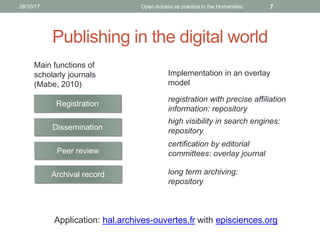
Publishing in the digital world
Main functions of
scholarly journals
(Mabe, 2010)
Registration
Dissemination
Peer review
Archival record
Implementation in an overlay
model
registration with precise affiliation
information: repository
high visibility in search engines:
repository
certification by editorial
committees: overlay journal
long term archiving:
repository
Application: hal.archives-ouvertes.fr with episciences.org
726/10/17 Open Access as practice in the Humanities
Data in the publishing continuum
• Another dimension in complexity
• Nothing resembles less to data than data
• From digital editions of medieval manuscripts to meteorological
simulations
• Various sources, formats, sizes, conditions of use
• Same principles apply
• Openness and citation
• Cf. FAIR principles
• Findable, accessible, interoperable, reusable
• We need this for publications as well
826/10/17 Open Access as practice in the Humanities
WHY OPEN ACCESS FOR
HUMANITIES?
A couple of concrete benefits
926/10/17 Open Access as practice in the Humanities
What are the benefits of OA for the
Humanities researchers?
Finding ways to release knowledge more widely
and more quickly stands to bring great benefits
also to the Humanities.
26/10/17 Open Access as practice in the Humanities 10
A new demand for openness
• Made by
• Research institutions
• Funders
• Society at large
• OA mandates and policies : ROARMAP
• Open Access for publications produced in the framework of H2020-
funded projects
• France, Loi Pour une République Numérique: “secondary rights of
use”
26/10/17 Open Access as practice in the Humanities 11
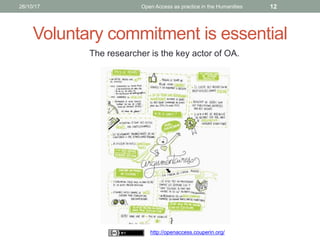
Voluntary commitment is essential
26/10/17 Open Access as practice in the Humanities 12
The researcher is the key actor of OA.
http://openaccess.couperin.org/
26/10/17 Open Access as practice in the Humanities 13
Impact and visibility
• Depositing documents in open archives
• Rapidly made available online
• More viewed and dowloaded
1426/10/17 Open Access as practice in the Humanities
Sustainability
• Enabling sustainable (self-)archiving of documents
• Repositories, duplications, re-publishing
1526/10/17 Open Access as practice in the Humanities
Discoverability
• Opening research up to greater discoverability, via full text data
mining of open resources
• Cf. on-going legal limitations in the mining of scientific publications
• Legal success in the UK; Progress in France (Loi pour une république
numérique); Stalled situation in the EU
1626/10/17 Open Access as practice in the Humanities
Citability
• With metadata harvesting, documents deposited in open
archives are more easily referenced.
• Swan A. “The Open Access citation advantage: Studies and results to
date”. Eprints. 2010. http://eprints.soton.ac.uk/268516/
• Gargouri Y, Hajjem C, Larivière V, Gingras Y, Carr L, Brody T, Harnad S.
“Self-selected or mandated, open access increases citation impact for
higher quality research”. PLoS One. 2010. doi:
10.1371/journal.pone.0013636
1726/10/17 Open Access as practice in the Humanities
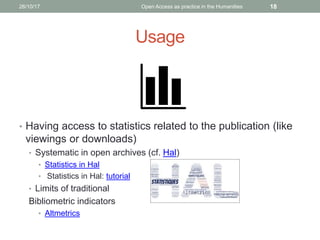
Usage
• Having access to statistics related to the publication (like
viewings or downloads)
• Systematic in open archives (cf. Hal)
• Statistics in Hal
• Statistics in Hal: tutorial
• Limits of traditional
Bibliometric indicators
• Altmetrics
1826/10/17 Open Access as practice in the Humanities
Precedence
• Establishing new ideas more quickly
• True even if you are not concerned with patents…
• Clear datation
1926/10/17 Open Access as practice in the Humanities
Scholarly dialogue
• Receiving feedback from colleagues prior to peer review
• Early citations, early feedback
2026/10/17 Open Access as practice in the Humanities
Reducing publication costs
• Open access ≠ free access
• Essentially additional access costs = non-existent for
authors and readers
2126/10/17 Open Access as practice in the Humanities
Various scientific contents
• Enabling the deposit of any kind of scientific contents
• All types of scholarly production
• Articles, books, posters, conference papers, reports, working
documents….etc
• Doctoral and master’s thesis: easily published in OA + more visible
2226/10/17 Open Access as practice in the Humanities
Digital sovereignty
• Personal sovereignty as scholars
• Increasing the impact and visibility of Humanities research work
individually and collectively
• Retaining their moral rights to their contents
2326/10/17 Open Access as practice in the Humanities
WHAT CAN THE HUMANITIES
RESEARCHERS DO?
DARIAH’s recommandations to promote Open Access
within Humanities
26/10/17 Open Access as practice in the Humanities 24
Principle 1
• Systematically deposit your work in an open archive,
institutional or otherwise.
• Use a sustainable, free and open archive such as HAL, Zenodo, or
your own university environment
• Avoid private scientific social networks
• No guarantees of sustainability and free access in the long run
2526/10/17 Open Access as practice in the Humanities
Principle 2
• Deposit your work as soon as possible
• As soon as it sent to your publisher
• Possible to deposit you past publications and non-peer reviewed
materials (or preprints)
2626/10/17 Open Access as practice in the Humanities
Principle 3
Release your work under a license as open as possible
• CC-BY is your friend
2726/10/17 Open Access as practice in the Humanities
Principle 4
Deposit your work, even if you have published in a so-
called open access journal
• Deposit the full text of the author’s version
• Trust your institution not your trader
• Do not pay APCs (Article Processing Charges) in hybrid journals
2826/10/17 Open Access as practice in the Humanities
L’ESPRIT DE JUSSIEU
2926/10/17 Open Access as practice in the Humanities
L’appel de Jussieu
• Jussieu Call for Open science and bibliodiversity
• http://jussieucall.org
• Objectives
• Promoting a scientific publishing open-access model
• Fostering bibliodiversity and innovation
• Avoiding the exclusive transfer of journal subscription monies to APC
payments
• Towards a vision which is not entirely based upon a
preservation of publishers’ sales revenue
• “The development of innovative scientific publishing models must
be a budget priority because it represents an investment into
services meeting the genuine needs of researchers in our digital
age”
3026/10/17 Open Access as practice in the Humanities
Where to experiment?
• writing practices (publishing associated data)
• refereeing (open peer-reviewing)
• content editorial services (beyond-pdf web publishing)
• additional services (text mining)
3126/10/17 Open Access as practice in the Humanities
Where could the money come from?
• We call on research organizations and their libraries to
secure and earmark as of now a share of their
acquisition budgets to support the development of
scientific publishing activities, which are genuinely open
and innovative, and address the needs of the scientific
community.
3226/10/17 Open Access as practice in the Humanities
Where to go from here?
• Think different!
• Be open to novel ideas and models in the digital world
• Don’t be afraid
• Will my ideas be stolen if I deposit a pre-print?
• Is peer review an essential aspect of science?
• Do I have to cite the data sources I use?
• Is CC-BY-NC-SA-ND-please-do-not-use an open licence?
3326/10/17 Open Access as practice in the Humanities

OpenAIRE webinars during OA week 2017: Humanities and Open Science

  • 1.
    Marie Puren (Inria) LaurentRomary (Inria, DARIAH) OPEN ACCESS AS PRACTICE IN THE HUMANITIES 126/10/17 Open Access as practice in the Humanities
  • 2.
    Open Access andthe Humanities “The American Historical Association strongly encourages graduate programs and university libraries to adopt a policy that allows the embargoing of completed history PhD dissertations in digital form for as many as six years.” American Historical Association Statement on Policies Regarding the Embargoing of Completed History PhD Dissertations, June 2013 226/10/17 Open Access as practice in the Humanities
  • 3.
    Open Access andthe Humanities • Something needs to be done • Differences in awareness (linguistics – history) • The culture of the book • But the general principles and message is the same all over the scholarly spectrum 326/10/17 Open Access as practice in the Humanities
  • 4.
    Overview • A coupleof initial topics • Digital sovereignty • Publishing in the digital world • Data in the publishing continuum • Why open access at all? • Looking at possible benefits for the Humanities researcher • DARIAH’s recommendations for the Humanities researchers • Back to Jussieu • Let’s talk about money… 426/10/17 Open Access as practice in the Humanities
  • 5.
    A COUPLE OFINITIAL TOPICS 26/10/17 Open Access as practice in the Humanities 5
  • 6.
    Digital sovereignty • Openaccess as practice • Let us forget about business models for a while • Open access is a normal component of the scientific process • Dissemination of scientific knowledge without barriers • Science is a public common good • Scientific results must be stored and curated on trusted (public) platforms • Scientific actors are responsible for this • Researchers, research institutions, states (research policies) 626/10/17 Open Access as practice in the Humanities
  • 7.
    Publishing in thedigital world Main functions of scholarly journals (Mabe, 2010) Registration Dissemination Peer review Archival record Implementation in an overlay model registration with precise affiliation information: repository high visibility in search engines: repository certification by editorial committees: overlay journal long term archiving: repository Application: hal.archives-ouvertes.fr with episciences.org 726/10/17 Open Access as practice in the Humanities
  • 8.
    Data in thepublishing continuum • Another dimension in complexity • Nothing resembles less to data than data • From digital editions of medieval manuscripts to meteorological simulations • Various sources, formats, sizes, conditions of use • Same principles apply • Openness and citation • Cf. FAIR principles • Findable, accessible, interoperable, reusable • We need this for publications as well 826/10/17 Open Access as practice in the Humanities
  • 9.
    WHY OPEN ACCESSFOR HUMANITIES? A couple of concrete benefits 926/10/17 Open Access as practice in the Humanities
  • 10.
    What are thebenefits of OA for the Humanities researchers? Finding ways to release knowledge more widely and more quickly stands to bring great benefits also to the Humanities. 26/10/17 Open Access as practice in the Humanities 10
  • 11.
    A new demandfor openness • Made by • Research institutions • Funders • Society at large • OA mandates and policies : ROARMAP • Open Access for publications produced in the framework of H2020- funded projects • France, Loi Pour une République Numérique: “secondary rights of use” 26/10/17 Open Access as practice in the Humanities 11
  • 12.
    Voluntary commitment isessential 26/10/17 Open Access as practice in the Humanities 12 The researcher is the key actor of OA. http://openaccess.couperin.org/
  • 13.
    26/10/17 Open Accessas practice in the Humanities 13
  • 14.
    Impact and visibility •Depositing documents in open archives • Rapidly made available online • More viewed and dowloaded 1426/10/17 Open Access as practice in the Humanities
  • 15.
    Sustainability • Enabling sustainable(self-)archiving of documents • Repositories, duplications, re-publishing 1526/10/17 Open Access as practice in the Humanities
  • 16.
    Discoverability • Opening researchup to greater discoverability, via full text data mining of open resources • Cf. on-going legal limitations in the mining of scientific publications • Legal success in the UK; Progress in France (Loi pour une république numérique); Stalled situation in the EU 1626/10/17 Open Access as practice in the Humanities
  • 17.
    Citability • With metadataharvesting, documents deposited in open archives are more easily referenced. • Swan A. “The Open Access citation advantage: Studies and results to date”. Eprints. 2010. http://eprints.soton.ac.uk/268516/ • Gargouri Y, Hajjem C, Larivière V, Gingras Y, Carr L, Brody T, Harnad S. “Self-selected or mandated, open access increases citation impact for higher quality research”. PLoS One. 2010. doi: 10.1371/journal.pone.0013636 1726/10/17 Open Access as practice in the Humanities
  • 18.
    Usage • Having accessto statistics related to the publication (like viewings or downloads) • Systematic in open archives (cf. Hal) • Statistics in Hal • Statistics in Hal: tutorial • Limits of traditional Bibliometric indicators • Altmetrics 1826/10/17 Open Access as practice in the Humanities
  • 19.
    Precedence • Establishing newideas more quickly • True even if you are not concerned with patents… • Clear datation 1926/10/17 Open Access as practice in the Humanities
  • 20.
    Scholarly dialogue • Receivingfeedback from colleagues prior to peer review • Early citations, early feedback 2026/10/17 Open Access as practice in the Humanities
  • 21.
    Reducing publication costs •Open access ≠ free access • Essentially additional access costs = non-existent for authors and readers 2126/10/17 Open Access as practice in the Humanities
  • 22.
    Various scientific contents •Enabling the deposit of any kind of scientific contents • All types of scholarly production • Articles, books, posters, conference papers, reports, working documents….etc • Doctoral and master’s thesis: easily published in OA + more visible 2226/10/17 Open Access as practice in the Humanities
  • 23.
    Digital sovereignty • Personalsovereignty as scholars • Increasing the impact and visibility of Humanities research work individually and collectively • Retaining their moral rights to their contents 2326/10/17 Open Access as practice in the Humanities
  • 24.
    WHAT CAN THEHUMANITIES RESEARCHERS DO? DARIAH’s recommandations to promote Open Access within Humanities 26/10/17 Open Access as practice in the Humanities 24
  • 25.
    Principle 1 • Systematicallydeposit your work in an open archive, institutional or otherwise. • Use a sustainable, free and open archive such as HAL, Zenodo, or your own university environment • Avoid private scientific social networks • No guarantees of sustainability and free access in the long run 2526/10/17 Open Access as practice in the Humanities
  • 26.
    Principle 2 • Deposityour work as soon as possible • As soon as it sent to your publisher • Possible to deposit you past publications and non-peer reviewed materials (or preprints) 2626/10/17 Open Access as practice in the Humanities
  • 27.
    Principle 3 Release yourwork under a license as open as possible • CC-BY is your friend 2726/10/17 Open Access as practice in the Humanities
  • 28.
    Principle 4 Deposit yourwork, even if you have published in a so- called open access journal • Deposit the full text of the author’s version • Trust your institution not your trader • Do not pay APCs (Article Processing Charges) in hybrid journals 2826/10/17 Open Access as practice in the Humanities
  • 29.
    L’ESPRIT DE JUSSIEU 2926/10/17Open Access as practice in the Humanities
  • 30.
    L’appel de Jussieu •Jussieu Call for Open science and bibliodiversity • http://jussieucall.org • Objectives • Promoting a scientific publishing open-access model • Fostering bibliodiversity and innovation • Avoiding the exclusive transfer of journal subscription monies to APC payments • Towards a vision which is not entirely based upon a preservation of publishers’ sales revenue • “The development of innovative scientific publishing models must be a budget priority because it represents an investment into services meeting the genuine needs of researchers in our digital age” 3026/10/17 Open Access as practice in the Humanities
  • 31.
    Where to experiment? •writing practices (publishing associated data) • refereeing (open peer-reviewing) • content editorial services (beyond-pdf web publishing) • additional services (text mining) 3126/10/17 Open Access as practice in the Humanities
  • 32.
    Where could themoney come from? • We call on research organizations and their libraries to secure and earmark as of now a share of their acquisition budgets to support the development of scientific publishing activities, which are genuinely open and innovative, and address the needs of the scientific community. 3226/10/17 Open Access as practice in the Humanities
  • 33.
    Where to gofrom here? • Think different! • Be open to novel ideas and models in the digital world • Don’t be afraid • Will my ideas be stolen if I deposit a pre-print? • Is peer review an essential aspect of science? • Do I have to cite the data sources I use? • Is CC-BY-NC-SA-ND-please-do-not-use an open licence? 3326/10/17 Open Access as practice in the Humanities

Editor's Notes

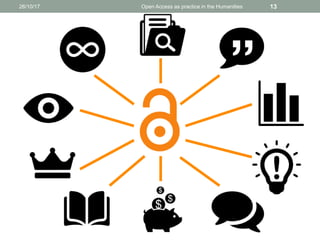
  • #14 Scientifics contents disseminated in Open Access are : Visible Sustainable Discoverable Citable Evaluable Datable Quickly improved and verified Less expensive, and most of the time free Various The expression of our digital sovereignty as scholars