JOSEPH SCHUMPETER – THE
‘GODFATHER’ OF INNOVATION
STUDIES

Edita Macikaitė EBMmfs3-01
J.Schumpeter (1883 – 1950)


Who he is: Austrian - American
economist and political scientist;



Born in: Třešť, Moravia, Austria–Hungary
(now Czech Republic);



Alma mater: University of Vienna;



Institutions:
Harvard University 1932-50
University of Bonn 1925-32
Biedermann Bank 1921-24
University of Graz 1912-14
University of Czernowitz 1909-11
Major Contributions


Schumpeter is on of the greatest 20thcentury economists;



He describes the process of the creative destruction;



It continues to be the foudation for economics development.

Creative destruction:


A process of development that continuously alters the economic
structures by destroying the old and creating the new
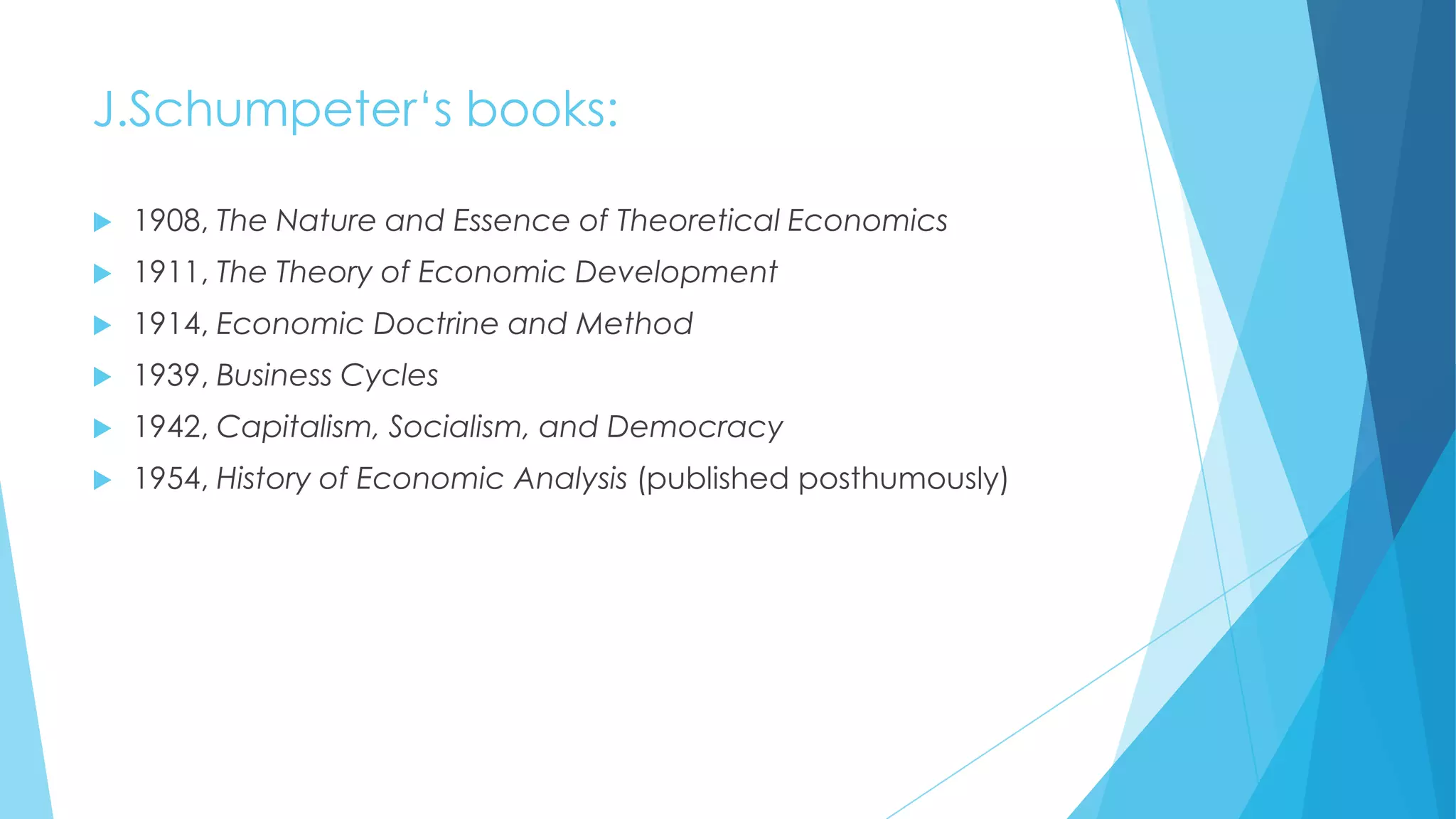
J.Schumpeter„s books:


1908, The Nature and Essence of Theoretical Economics



1911, The Theory of Economic Development



1914, Economic Doctrine and Method



1939, Business Cycles



1942, Capitalism, Socialism, and Democracy



1954, History of Economic Analysis (published posthumously)
Schumpeters Theory Of Innovation
J.Schumpeter – The „Godfather“ Of
Innovation
Definition of innovation - “new combinations” of new or existing
knowledge, resources, equipment and so on.
5 types of innovation:
1. New goods (product innovation);
2. New methods of production (process innovation);
3. New markets;
4. New sources of inputs;

5. New organization.
Thank You For Your Attention!

Joseph schumpeter

  • 1.
    JOSEPH SCHUMPETER –THE ‘GODFATHER’ OF INNOVATION STUDIES Edita Macikaitė EBMmfs3-01
  • 2.
    J.Schumpeter (1883 –1950)  Who he is: Austrian - American economist and political scientist;  Born in: Třešť, Moravia, Austria–Hungary (now Czech Republic);  Alma mater: University of Vienna;  Institutions: Harvard University 1932-50 University of Bonn 1925-32 Biedermann Bank 1921-24 University of Graz 1912-14 University of Czernowitz 1909-11
  • 3.
    Major Contributions  Schumpeter ison of the greatest 20thcentury economists;  He describes the process of the creative destruction;  It continues to be the foudation for economics development. Creative destruction:  A process of development that continuously alters the economic structures by destroying the old and creating the new
  • 4.
    J.Schumpeter„s books:  1908, TheNature and Essence of Theoretical Economics  1911, The Theory of Economic Development  1914, Economic Doctrine and Method  1939, Business Cycles  1942, Capitalism, Socialism, and Democracy  1954, History of Economic Analysis (published posthumously)
  • 5.
  • 6.
    J.Schumpeter – The„Godfather“ Of Innovation Definition of innovation - “new combinations” of new or existing knowledge, resources, equipment and so on. 5 types of innovation: 1. New goods (product innovation); 2. New methods of production (process innovation); 3. New markets; 4. New sources of inputs; 5. New organization.
  • 7.
    Thank You ForYour Attention!

Editor's Notes

  • #3 Josef Schumpeter was born in 1883 in the then Austrian empire and diedin 1950 in the United States.Schumpeter began his career studying law at the University of Vienna.In 1909, he became a professor ofeconomics and government at the University of Czernowitz. In 1911 he joined the University of Graz.In 1919-1920, he served as the Austrian Minister of Finance, with some success, and in1920-1924, as president of the private Biedermann Bank. From 1925-1932, he held a chair at the University of Bonn, Germany also heHe lectured at Harvard. Because of the rise of Nazism in Germany he moved to the United States.
  • #5 Intheliterturetherewerementionedmanyshumpetr‘sworks, books, sointhis slide i justmentionedmostpopularofthem. Mostlydiscusedisthisboldone – Capitalizm, socialism, Democrasy.
  • #6 Actuallythispersonintheliteratureiscalledaspioneerininnovationmanagementandveryoftengodfatherofinnovation.
  • #7 Around 1930s Shumpeterstartedstudyinghowthecapitalistsystemswaseffectedbymarketinnovations.he added a definition of innovation , whichsaysthatinnovationistheconceptofoldorganizationsandprocessesdisappearingandthey are replacedwithnewideas, productivitymethodsandcapabilities.Afteranalysingthecapitalistmodel, shumpetertried to understandwhatcompanieswould be betterposition to innovate.Also shumpeterconsidered 5 differentaspectsofinnovation :According to Schumpeter there are 5 cases of new combinations: 1.production of new types of goods, or change of properties of the existing goods; 2. introduction of the new method of production, that may be based on the new scientific discovery; 3. opening of a new market; 4. use of the new sources of  of raw materials and intermediate goods; 5. new organization of production.