INNOVATION THEORY
GROUP 8
OBJECTIVES:
01
03
02
04
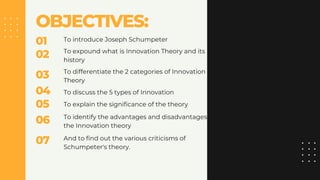
To introduce Joseph Schumpeter
To differentiate the 2 categories of Innovation
Theory
To discuss the 5 types of Innovation
To explain the significance of the theory
To identify the advantages and disadvantages of
the Innovation theory
And to find out the various criticisms of
Schumpeter's theory.
To expound what is Innovation Theory and its
history
05
06
07
VILLAMATER,
MELODY
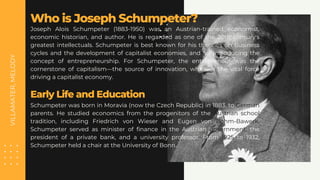
Joseph Alois Schumpeter (1883-1950) was an Austrian-trained economist,
economic historian, and author. He is regarded as one of the 20th century's
greatest intellectuals. Schumpeter is best known for his theories on business
cycles and the development of capitalist economies, and for introducing the
concept of entrepreneurship. For Schumpeter, the entrepreneur was the
cornerstone of capitalism—the source of innovation, which is the vital force
driving a capitalist economy.
Who is Joseph Schumpeter?
Schumpeter was born in Moravia (now the Czech Republic) in 1883, to German
parents. He studied economics from the progenitors of the Austrian school
tradition, including Friedrich von Wieser and Eugen von Bohm-Bawerk.
Schumpeter served as minister of finance in the Austrian government, the
president of a private bank, and a university professor. From 1925 to 1932,
Schumpeter held a chair at the University of Bonn.
Early Life and Education
LUSANTA,
PRECIOUS
ANNE
Notable Accomplishments and Theories
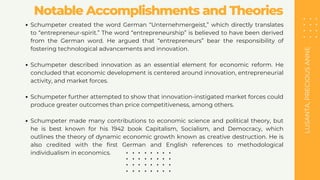
Schumpeter created the word German “Unternehmergeist,” which directly translates
to “entrepreneur-spirit.” The word “entrepreneurship” is believed to have been derived
from the German word. He argued that “entrepreneurs” bear the responsibility of
fostering technological advancements and innovation.
Schumpeter described innovation as an essential element for economic reform. He
concluded that economic development is centered around innovation, entrepreneurial
activity, and market forces.
Schumpeter further attempted to show that innovation-instigated market forces could
produce greater outcomes than price competitiveness, among others.
Schumpeter made many contributions to economic science and political theory, but
he is best known for his 1942 book Capitalism, Socialism, and Democracy, which
outlines the theory of dynamic economic growth known as creative destruction. He is
also credited with the first German and English references to methodological
individualism in economics.
MEDALLADA,
MARY
GRACE
What is
Innovation
Theory?
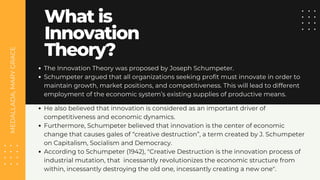
The Innovation Theory was proposed by Joseph Schumpeter.
Schumpeter argued that all organizations seeking profit must innovate in order to
maintain growth, market positions, and competitiveness. This will lead to different
employment of the economic system’s existing supplies of productive means.
He also believed that innovation is considered as an important driver of
competitiveness and economic dynamics.
Furthermore, Schumpeter believed that innovation is the center of economic
change that causes gales of “creative destruction”, a term created by J. Schumpeter
on Capitalism, Socialism and Democracy.
According to Schumpeter (1942), "Creative Destruction is the innovation process of
industrial mutation, that incessantly revolutionizes the economic structure from
within, incessantly destroying the old one, incessantly creating a new one".
REBONG,
ANGEL
ANN
History of Innovation Theory
The origin of theory of innovation seems to be as rich as the
combination of technology. Aristotle and Plato, and some others,
used the word kainotomia, that comes from the Greek words
kainós (new) and tom (radical craftsmanship).
Some influential works, such as Rogers' the Diffusion of
Innovation and Freeman's Technological Change, only made
brief references to Schumpeter. Their work is unlikely to be
deeply affected by Schumpeter's work, but rather by the
economic philosophers on whom Schumpeter also focused his
work.
DE
MESSA,
APRILLE
JALLA,
JOANA
JOY
Two Categories:
Operations that reduce the overall cost of production
Activity that increases the demand for a product
Introduction of a new production techniques, introduction of
new machinery, innovative methods of organizing the industry,
and so on, fall under the first category of innovation theory.
Introduction of a new commodity or high-quality goods, the
emergence or opening of a new market, the discovery of new
raw material sources, the development of a new product variety
or design, and so on.
TAN,
TRISHA
MAE
5 Types of
Innovation
01 Product
The introduction of a new good.
02 Process
The introduction of a new method of production.
04 Source of Supply
03 Business Model
05 Mergers and Divesment
The opening of a new market.
The conquest of a new source of supply of raw materials.
The carrying out of the new organization of any industry.
MENORCA,
JASMINE
Significance of
Innovation Theory
Schumpeter believed that the was to introduce
successful, well, innovations. The innovation theory of
profit claims that the main function of an entrepreneur is
to introduce, well, innovations—which Schumpeter
defined as any new policy that reduces the overall cost of
production or increases the demand for products.
Advantages
OYALES,
VERONICA
Improved productivity
Reduced costs
Increased competitiveness
Improved brand recognition and value
New partnerships and relationships
Increased turnover and improved
profitability
Disadvantages
LEOPARTE,
RHOSELA
It is not only difficult but also impossible to
conduct an objective review of Schumpeter's
business cycle theory because its conclusions are
founded more on sociological than economic
variables.
Schumpeter's theory differs from the over-
investment theory only in terms of the cause of
variation in investment when the economy is in
stable equilibrium.
This theory, like other business cycle theories,
ignores other factors that cause fluctuations in
economic activity. Innovation is not the only
factor that causes economic fluctuations; rather, it
is one of several.
ABOGADO,
JEREMY
GARCIA,
KYLA
Criticisms of Innovation Theory
1. This theory concentrates only on innovation, which is only one of
the many functions of the entrepreneur and not the only factor.
2. This theory does not consider profit as the reward for risk-taking.
According to Schumpeter it is the capitalist not the entrepreneur
who undertakes risk.
3. This theory has ignored the importance of uncertainty bearing
which is one of the factors that determines profit.
4. This theory attributes profit only to innovation ignoring other
functions of entrepreneur.
DE
MESSA,
APRILLE
JALLA,
JOANA
JOY
Criticisms of Innovation Theory
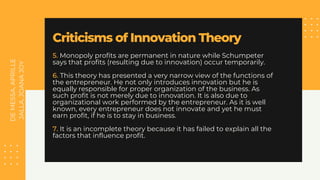
5. Monopoly profits are permanent in nature while Schumpeter
says that profits (resulting due to innovation) occur temporarily.
6. This theory has presented a very narrow view of the functions of
the entrepreneur. He not only introduces innovation but he is
equally responsible for proper organization of the business. As
such profit is not merely due to innovation. It is also due to
organizational work performed by the entrepreneur. As it is well
known, every entrepreneur does not innovate and yet he must
earn profit, if he is to stay in business.
7. It is an incomplete theory because it has failed to explain all the
factors that influence profit.
LUSANTA,
PRECIOUS
ANNE
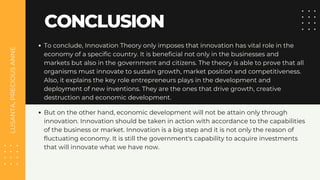
CONCLUSION
To conclude, Innovation Theory only imposes that innovation has vital role in the
economy of a specific country. It is beneficial not only in the businesses and
markets but also in the government and citizens. The theory is able to prove that all
organisms must innovate to sustain growth, market position and competitiveness.
Also, it explains the key role entrepreneurs plays in the development and
deployment of new inventions. They are the ones that drive growth, creative
destruction and economic development.
But on the other hand, economic development will not be attain only through
innovation. Innovation should be taken in action with accordance to the capabilities
of the business or market. Innovation is a big step and it is not only the reason of
fluctuating economy. It is still the government's capability to acquire investments
that will innovate what we have now.
Thank You
Prepared by: Precious Anne Lusanta
GROUP 8

GROUP-8.pdf

  • 1.
  • 2.
    OBJECTIVES: 01 03 02 04 To introduce JosephSchumpeter To differentiate the 2 categories of Innovation Theory To discuss the 5 types of Innovation To explain the significance of the theory To identify the advantages and disadvantages of the Innovation theory And to find out the various criticisms of Schumpeter's theory. To expound what is Innovation Theory and its history 05 06 07
  • 3.
    VILLAMATER, MELODY Joseph Alois Schumpeter(1883-1950) was an Austrian-trained economist, economic historian, and author. He is regarded as one of the 20th century's greatest intellectuals. Schumpeter is best known for his theories on business cycles and the development of capitalist economies, and for introducing the concept of entrepreneurship. For Schumpeter, the entrepreneur was the cornerstone of capitalism—the source of innovation, which is the vital force driving a capitalist economy. Who is Joseph Schumpeter? Schumpeter was born in Moravia (now the Czech Republic) in 1883, to German parents. He studied economics from the progenitors of the Austrian school tradition, including Friedrich von Wieser and Eugen von Bohm-Bawerk. Schumpeter served as minister of finance in the Austrian government, the president of a private bank, and a university professor. From 1925 to 1932, Schumpeter held a chair at the University of Bonn. Early Life and Education
  • 4.
    LUSANTA, PRECIOUS ANNE Notable Accomplishments andTheories Schumpeter created the word German “Unternehmergeist,” which directly translates to “entrepreneur-spirit.” The word “entrepreneurship” is believed to have been derived from the German word. He argued that “entrepreneurs” bear the responsibility of fostering technological advancements and innovation. Schumpeter described innovation as an essential element for economic reform. He concluded that economic development is centered around innovation, entrepreneurial activity, and market forces. Schumpeter further attempted to show that innovation-instigated market forces could produce greater outcomes than price competitiveness, among others. Schumpeter made many contributions to economic science and political theory, but he is best known for his 1942 book Capitalism, Socialism, and Democracy, which outlines the theory of dynamic economic growth known as creative destruction. He is also credited with the first German and English references to methodological individualism in economics.
  • 5.
    MEDALLADA, MARY GRACE What is Innovation Theory? The InnovationTheory was proposed by Joseph Schumpeter. Schumpeter argued that all organizations seeking profit must innovate in order to maintain growth, market positions, and competitiveness. This will lead to different employment of the economic system’s existing supplies of productive means. He also believed that innovation is considered as an important driver of competitiveness and economic dynamics. Furthermore, Schumpeter believed that innovation is the center of economic change that causes gales of “creative destruction”, a term created by J. Schumpeter on Capitalism, Socialism and Democracy. According to Schumpeter (1942), "Creative Destruction is the innovation process of industrial mutation, that incessantly revolutionizes the economic structure from within, incessantly destroying the old one, incessantly creating a new one".
  • 6.
    REBONG, ANGEL ANN History of InnovationTheory The origin of theory of innovation seems to be as rich as the combination of technology. Aristotle and Plato, and some others, used the word kainotomia, that comes from the Greek words kainós (new) and tom (radical craftsmanship). Some influential works, such as Rogers' the Diffusion of Innovation and Freeman's Technological Change, only made brief references to Schumpeter. Their work is unlikely to be deeply affected by Schumpeter's work, but rather by the economic philosophers on whom Schumpeter also focused his work.
  • 7.
    DE MESSA, APRILLE JALLA, JOANA JOY Two Categories: Operations thatreduce the overall cost of production Activity that increases the demand for a product Introduction of a new production techniques, introduction of new machinery, innovative methods of organizing the industry, and so on, fall under the first category of innovation theory. Introduction of a new commodity or high-quality goods, the emergence or opening of a new market, the discovery of new raw material sources, the development of a new product variety or design, and so on.
  • 8.
    TAN, TRISHA MAE 5 Types of Innovation 01Product The introduction of a new good. 02 Process The introduction of a new method of production. 04 Source of Supply 03 Business Model 05 Mergers and Divesment The opening of a new market. The conquest of a new source of supply of raw materials. The carrying out of the new organization of any industry.
  • 9.
    MENORCA, JASMINE Significance of Innovation Theory Schumpeterbelieved that the was to introduce successful, well, innovations. The innovation theory of profit claims that the main function of an entrepreneur is to introduce, well, innovations—which Schumpeter defined as any new policy that reduces the overall cost of production or increases the demand for products.
  • 10.
    Advantages OYALES, VERONICA Improved productivity Reduced costs Increasedcompetitiveness Improved brand recognition and value New partnerships and relationships Increased turnover and improved profitability
  • 11.
    Disadvantages LEOPARTE, RHOSELA It is notonly difficult but also impossible to conduct an objective review of Schumpeter's business cycle theory because its conclusions are founded more on sociological than economic variables. Schumpeter's theory differs from the over- investment theory only in terms of the cause of variation in investment when the economy is in stable equilibrium. This theory, like other business cycle theories, ignores other factors that cause fluctuations in economic activity. Innovation is not the only factor that causes economic fluctuations; rather, it is one of several.
  • 12.
    ABOGADO, JEREMY GARCIA, KYLA Criticisms of InnovationTheory 1. This theory concentrates only on innovation, which is only one of the many functions of the entrepreneur and not the only factor. 2. This theory does not consider profit as the reward for risk-taking. According to Schumpeter it is the capitalist not the entrepreneur who undertakes risk. 3. This theory has ignored the importance of uncertainty bearing which is one of the factors that determines profit. 4. This theory attributes profit only to innovation ignoring other functions of entrepreneur.
  • 13.
    DE MESSA, APRILLE JALLA, JOANA JOY Criticisms of InnovationTheory 5. Monopoly profits are permanent in nature while Schumpeter says that profits (resulting due to innovation) occur temporarily. 6. This theory has presented a very narrow view of the functions of the entrepreneur. He not only introduces innovation but he is equally responsible for proper organization of the business. As such profit is not merely due to innovation. It is also due to organizational work performed by the entrepreneur. As it is well known, every entrepreneur does not innovate and yet he must earn profit, if he is to stay in business. 7. It is an incomplete theory because it has failed to explain all the factors that influence profit.
  • 14.
    LUSANTA, PRECIOUS ANNE CONCLUSION To conclude, InnovationTheory only imposes that innovation has vital role in the economy of a specific country. It is beneficial not only in the businesses and markets but also in the government and citizens. The theory is able to prove that all organisms must innovate to sustain growth, market position and competitiveness. Also, it explains the key role entrepreneurs plays in the development and deployment of new inventions. They are the ones that drive growth, creative destruction and economic development. But on the other hand, economic development will not be attain only through innovation. Innovation should be taken in action with accordance to the capabilities of the business or market. Innovation is a big step and it is not only the reason of fluctuating economy. It is still the government's capability to acquire investments that will innovate what we have now.
  • 15.
    Thank You Prepared by:Precious Anne Lusanta GROUP 8