The Role of the AOP Framework in Knowledge
Management and Trust Building
Jason O’Brien
Molecular Ecotoxicologist
Environment and Climate Change Canada
Co-chair:
AOP Handbook, Guidance and Gardening Sub-Group
Member:
AOP Knowledge Base Subgroup
Councilor:
Society of the Advancement of AOPs
Outline
Part I: The AOP Framework, in Brief
Part II: AOPs, Knowledge Management and Trust Building
What is
The Adverse Outcome Pathway (AOP) framework?
CONTEXT:
• Global pressures to
• Increase efficiency of chemical risk assessment
• Reduce reliance on animal-based tests
• Proposed Solution: New Approach Methodologies (NAMs)
• In silico, in chemico, and in vitro assays
• High throughput and high-content methods
• Toxicokinetic and toxicodynamic modeling
What is
The Adverse Outcome Pathway (AOP) framework?
Challenge for regulatory adoption NAMs:
• Interpreting their Human and Environmental Health Relevance
• Relationship between NAM test result and health outcomes?
• How strong is the evidence for these relationships?
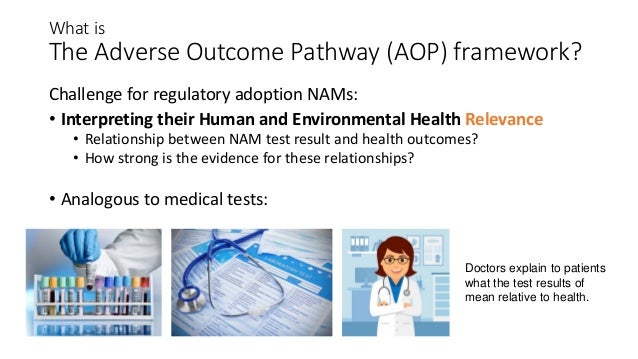
• Analogous to medical tests:
Doctors explain to patients
what the test results of
mean relative to health.
• Primary goal: To establish and communicate the health-relevance of NAMs (and other biological measurements)
• A Knowledge Management Framework to aggregate and evaluate evidence for causal relationships between
• What we can measure, and  Health outcomes of regulatory concern
What is
The Adverse Outcome Pathway (AOP) framework?
• Primary goal: To establish and communicate the health-relevance of NAMs (and other biological measurements)
• A Knowledge Management Framework to aggregate and evaluate evidence for causal relationships between
• What we can measure, and  Health outcomes of regulatory concern
• Basic Structure:
MIE KE AO
KE
KER KER
KER
What is
The Adverse Outcome Pathway (AOP) framework?
• Key Event (KE): Things we can measure
Including:
• Molecular initiating event (MIE)
• Adverse Outcome (AO)
MIE KE AO
KE
KER KER
KER
Measurable Events
What is
The Adverse Outcome Pathway (AOP) framework?
• Primary goal: To establish and communicate the health-relevance of NAMs (and other biological measurements)
• A Knowledge Management Framework to aggregate and evaluate evidence for causal relationships between
• What we can measure, and  Health outcomes of regulatory concern
• Basic Structure:
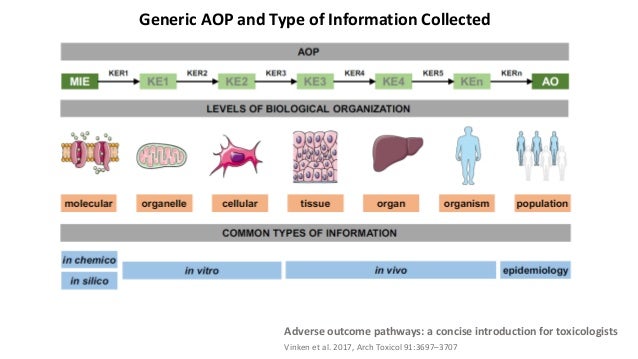
Generic AOP and Type of Information Collected
Adverse outcome pathways: a concise introduction for toxicologists
Vinken et al. 2017, Arch Toxicol 91:3697–3707
Generic AOP and Type of Information Collected
Adverse outcome pathways: a concise introduction for toxicologists
Vinken et al. 2017, Arch Toxicol 91:3697–3707
• Key Event (KE): Things we can measure
Including:
• Molecular initiating event (MIE)
• Adverse Outcome (AO)
MIE KE AO
KE
KER KER
KER
Measurable Events
What is
The Adverse Outcome Pathway (AOP) framework?
• Primary goal: To establish and communicate the health-relevance of NAMs (and other biological measurements)
• A Knowledge Management Framework to aggregate and evaluate evidence for causal relationships between
• What we can measure, and  Health outcomes of regulatory concern
• Basic Structure:
• Key Event (KE): Things we can measure
Including:
• Molecular initiating event (MIE)
• Adverse Outcome (AO)
• Key Event Relationship (KER): collection and
synthesis of evidence supporting causal relationship
between upstream KE and downstream KE
MIE KE AO
KE
KER KER
KER
Measurable Events
EVIDENCE OF CAUSAL RELATIONSHIPS
Transparent Documentation and Evaluation
(mostly academic data)
What is
The Adverse Outcome Pathway (AOP) framework?
• Primary goal: To establish and communicate the health-relevance of NAMs (and other biological measurements)
• A Knowledge Management Framework to aggregate and evaluate evidence for causal relationships between
• What we can measure, and  Health outcomes of regulatory concern
• Basic Structure:
KERs convert Data into Evidence
• Modified Bradford Hill Criteria for Causality:
• A set of criteria for evaluating the statement: “A causes B”
• Biological Plausibility and Empirical Evidence
• Weight of Evidence (WoE) Evaluation:
• assess multiple lines of evidence for or against a hypothesis
• based on criteria of data quality and strength of causal linkages
• Key Event (KE): Things we can measure
Including:
• Molecular initiating event (MIE)
• Adverse Outcome (AO)
• Key Event Relationship (KER): collection and
synthesis of evidence supporting causal relationship
between upstream KE and downstream KE
MIE KE AO
KE
KER KER
KER
Measurable Events
EVIDENCE OF CAUSAL RELATIONSHIPS
Transparent Documentation and Evaluation
(mostly academic data)
What is
The Adverse Outcome Pathway (AOP) framework?
• Primary goal: To establish and communicate the health-relevance of NAMs (and other biological measurements)
• A Knowledge Management Framework to aggregate and evaluate evidence for causal relationships between
• What we can measure, and  Health outcomes of regulatory concern
• Basic Structure:
Gather existing information
Problem formulation
Weight of Evidence Assessment:
Adequate information for decision-making?
Generate additional information
Weight of Evidence assessment:
Adequate information for decision-making?
Regulatory
conclusion
YES
NO
YES
NO
AOPs
MIE
KE1
KE2
KE3
AO
• AOPs are NOT risk assessments
(not chemical-specific)
• Can be COUPLED to risk
assessment framework
(e.g. IATA)
AOPs are tools to support risk assessment
• AOPwiki.org
• Guidance Documents
• Review and Endorsement
Implementation: The OECD AOP Program
• AOPwiki.org
• Guidance Documents
• Review and Endorsement
KER Pages
• Title
• Description
• Biological plausibility
• Empirical support
• Inconsistencies and
uncertainties
• Quantitative
understanding
KE Pages
• Description
• Measurement/ detection
• Domain of applicability
AOP Pages
• Description
• Key Events
• Key Event Relationships
• Domain of applicability
• Evidence Assessment
Implementation: The OECD AOP Program
• AOPwiki.org
• Collaborative development of AOPs
• Free access to all
• Guidance Documents
• Review and Endorsement
Implementation: The OECD AOP Program
• AOPwiki.org
• Collaborative development of AOPs
• Free access to all
• Guidance and Support
• AOP Developers Handbook
• Online Support
• Mentoring (coaching)
• Review and Endorsement AOP DEVELOPERS HANDBOOK FAQs, Forum, Online support
?
Implementation: The OECD AOP Program
AOP DEV COACHING
• AOPwiki.org
• Collaborative development of AOPs
• Free access to all
• Guidance and Support
• AOP Developers Handbook
• Online Support
• Mentoring (coaching)
• Review and Endorsement
• Compliance Review
• Subject Matter Expert Review
• OECD Endorsement Fully Transparent Review Process
• All names and comments are made public
• Collaborative (reviewers and authors may interact)
OECD
Endorsement
Scientific
Review
Compliance
Review
Implementation: The OECD AOP Program
• AOPwiki.org
• Collaborative development of AOPs
• Free access to all
• Guidance and Support
• AOP Developers Handbook
• Online Support
• Mentoring (coaching)
• Review and Endorsement
• Compliance Review
• Subject Matter Expert Review
• OECD Endorsement
• New: Partner Program with Journals
OECD
Endorsement
Scientific
Review
Compliance
Review
Implementation: The OECD AOP Program
Recap: What is the Framework?
• A Knowledge Management Framework
• Documentation of Causal Evidence between:
• Biological measurements  Adverse Effects or Regulatory Concern
• Tool to support risk assessment (and research!)
• OECD AOP Program:
• Aopwiki.org
• User Support
• Peer Review
The Role of the AOP Framework in
Knowledge Management and Trust Building
V2.4
Current Version
V3.0
Target 2023-2024
• How does the OECD AOP program addresses the
recommendations of the report?
• In the current version of the AOP program?
• In planned updates, and beyond?
Main Recommendations
A POINT OF CONTINUITY FOR FURTHER ACTIONS IN:
1) EDUCATION
2) COLLABORATION
3) ENGAGEMENT
• Consists of making connections between different approaches or
methods by highlighting existing connections or by forging new ones
The AOP Framework in Knowledge Management and Trust Building
Bridging and Comparison
• Two main areas where bridging is needed:
The AOP Framework in Knowledge Management and Trust Building
Bridging and Comparison
• Two main areas where bridging is needed:
The AOP Framework in Knowledge Management and Trust Building
Bridging and Comparison
Primary goal:
To establish causal relationship between
• measured endpoints (NAMs) and
• endpoints of regulatory concern
(often quantified by “established tests”)
• Two main areas where bridging is needed:
The AOP Framework in Knowledge Management and Trust Building
Bridging and Comparison
Primary goal:
To establish causal relationship between
• measured endpoints (NAMs) and
• endpoints of regulatory concern
(often quantified by “established tests”)
• Two main areas where bridging is needed:
The AOP Framework in Knowledge Management and Trust Building
Bridging and Comparison
By aggregating relevant data and evaluating evidence
Formalized by:
• the “Modified Bradford Hill Criteria for Causality”
• WoE Evaluation
• A set of rules that converts data  evidence
Primary goal:
To establish causal relationship between
• measured endpoints (NAMs) and
• endpoints of regulatory concern
(often quantified by “established tests”)
• access to all relevant information by all parties
• the declaration of potential conflicts of interest.
• also tries to make explicit the reasoning behind it
The AOP Framework in Knowledge Management and Trust Building
Transparency Plus
Data Evidence
Bradford Hill
WOE Evaluation
V3.0
Target 2023-2024
• Adopt “Systematic” Approaches
• Enhanced transparency of data collection strategies
• Enhanced annotation of evidence
• To date, design has been generally targeted to AOP developers
• Priority was generating content!
The AOP Framework in Knowledge Management and Trust Building
User-Centric Design
800
900
1000
1100
1200
1300
1400
1500
1600
200
220
240
260
280
300
320
340
360
380
Events
or
Relationships
(n)
AOPs
(n)
Survey Date
AOPs Key Events Relationships
• To date, design has been generally targeted to AOP developers
• Priority was generating content!
• Major focus for V3.0 will be design targeting Knowledge Consumers
• Improved data structure 
• Improved Findability
• Improved interoperability
• Improved transparency
• Improved vizualization
The AOP Framework in Knowledge Management and Trust Building
User-Centric Design
V3.0
Target 2023-2024
• strong appetite for visual rendering of knowledge to make it more digestible.
• intermediary role between perspectives, productive discussions and agreement
• Because they play such a pivotal role, their design is extremely important
The AOP Framework in Knowledge Management and Trust Building
Intuitive Visualization
https://uplandsoftware.com/kapost/resources/blog/visual-content/
• AOPs are frequently mistaken as representing biological pathways
• Can deflect from the real value of the framework.
• Important to disambiguate the emblematic diagrams of the framework
• differentiate between diagrams used for:
• knowledge management and
• depicting or modelling biology
The AOP Framework in Knowledge Management and Trust Building
Intuitive Visualization
MIE KE AO
KE
KER KER
KER
• Current Activities: Planning “focus groups” on visualization of AOPs
• Examine user interactions with visual representations of AOPs
• Will provide useful guidance for visual upgrades in AOP V3.0
The AOP Framework in Knowledge Management and Trust Building
Intuitive Visualization
V3.0
Lack of consensus regarding the methods for obtaining data
Disagreements about the trustworthiness of the data
• Recommendation: Make the role of methods more explicit
The AOP Framework in Knowledge Management and Trust Building
Methods
V2.4
Current Version
All Key Events have a
“How is it Measured?” Section
• Very brief descriptions
• With appropriate references
V3.0
Target 2023-2024
More Explicit Role
• Creation of new “Methods”
object in the data model
• Much more info including
status of validation efforts
• Link to other method DBs
• Validation is the gatekeeper of acceptance
• The main obstacles to the adoption of new
methods is their lack of validation
• “Validation should be placed front and center of
knowledge management.”
The AOP Framework in Knowledge Management and Trust Building
Validation
V2.4
Current Version
Peer review and endorsement by
reputable organizations are forms of
validation that are already
represented in the AOP Framework
V3.0
Target 2023-2024
validation of methods should be
made more explicit in the
knowledge framework
Roberts and Patlewicz. 2018. J Appl. Toxicol. 38: 41-50.
Patlewicz et al. 2014. Regult. Toxicol. Pharmacol. 69: 529-524.
Direct Peptide
Reactivity Assay
(DPRA)
QSAR
Assay 1
Keratinocyte
response
KeratinoSens Assay
In vitro
Assay 2
Dendritic Cells human
Cell Line Activation
Test (h-CLAT)
In vitro
Assay 3
• AOP-based testing approach based on:
• In silico, in chemico or in vitro assays
• Combination of assays from multiple KEs
• Validated against animal and human data
• Conclusion: provides the same or more
information than the equivalent animal test.
Validation: Skin Sensitization Test Guideline, Case Study
https://www.oecd.org/chemicalsafety/guideline-no-497-defined-approaches-on-skin-sensitisation-b92879a4-en.htm
• Areas where the AOP program excels!
• Education:
• Education, Training and Outreach subgroup (co-chairs Bette Meek, Mirjam Luijten)
• Variety of training courses
• Beginning to appear in University programs
• Collaboration:
• Many successful cross-disciplinary collaborations (e.g. CIAO, ROS, inflammation, etc..)
• Yet room for improvement: reduce barriers for participation
• Engagement:
• open to deliberative participation of the public,
• Engaging end users and other stakeholders will be critical at improving the “user-centric” design of the
AOP framework
Point of Continuity in
Education, Collaboration and Engagement
Main Recommendations
A POINT OF CONTINUITY FOR FURTHER ACTIONS IN:
1) EDUCATION
2) COLLABORATION
3) ENGAGEMENT
THANK YOU!

Adverse outcome pathway framework in knowledge management and trust building: Jason O’Brien from the National Wildlife Research Centre, Canada

  • 1.
    The Role ofthe AOP Framework in Knowledge Management and Trust Building Jason O’Brien Molecular Ecotoxicologist Environment and Climate Change Canada Co-chair: AOP Handbook, Guidance and Gardening Sub-Group Member: AOP Knowledge Base Subgroup Councilor: Society of the Advancement of AOPs
  • 2.
    Outline Part I: TheAOP Framework, in Brief Part II: AOPs, Knowledge Management and Trust Building
  • 3.
    What is The AdverseOutcome Pathway (AOP) framework? CONTEXT: • Global pressures to • Increase efficiency of chemical risk assessment • Reduce reliance on animal-based tests • Proposed Solution: New Approach Methodologies (NAMs) • In silico, in chemico, and in vitro assays • High throughput and high-content methods • Toxicokinetic and toxicodynamic modeling
  • 4.
    What is The AdverseOutcome Pathway (AOP) framework? Challenge for regulatory adoption NAMs: • Interpreting their Human and Environmental Health Relevance • Relationship between NAM test result and health outcomes? • How strong is the evidence for these relationships? • Analogous to medical tests: Doctors explain to patients what the test results of mean relative to health.
  • 5.
    • Primary goal:To establish and communicate the health-relevance of NAMs (and other biological measurements) • A Knowledge Management Framework to aggregate and evaluate evidence for causal relationships between • What we can measure, and  Health outcomes of regulatory concern What is The Adverse Outcome Pathway (AOP) framework?
  • 6.
    • Primary goal:To establish and communicate the health-relevance of NAMs (and other biological measurements) • A Knowledge Management Framework to aggregate and evaluate evidence for causal relationships between • What we can measure, and  Health outcomes of regulatory concern • Basic Structure: MIE KE AO KE KER KER KER What is The Adverse Outcome Pathway (AOP) framework?
  • 7.
    • Key Event(KE): Things we can measure Including: • Molecular initiating event (MIE) • Adverse Outcome (AO) MIE KE AO KE KER KER KER Measurable Events What is The Adverse Outcome Pathway (AOP) framework? • Primary goal: To establish and communicate the health-relevance of NAMs (and other biological measurements) • A Knowledge Management Framework to aggregate and evaluate evidence for causal relationships between • What we can measure, and  Health outcomes of regulatory concern • Basic Structure:
  • 8.
    Generic AOP andType of Information Collected Adverse outcome pathways: a concise introduction for toxicologists Vinken et al. 2017, Arch Toxicol 91:3697–3707
  • 9.
    Generic AOP andType of Information Collected Adverse outcome pathways: a concise introduction for toxicologists Vinken et al. 2017, Arch Toxicol 91:3697–3707
  • 10.
    • Key Event(KE): Things we can measure Including: • Molecular initiating event (MIE) • Adverse Outcome (AO) MIE KE AO KE KER KER KER Measurable Events What is The Adverse Outcome Pathway (AOP) framework? • Primary goal: To establish and communicate the health-relevance of NAMs (and other biological measurements) • A Knowledge Management Framework to aggregate and evaluate evidence for causal relationships between • What we can measure, and  Health outcomes of regulatory concern • Basic Structure:
  • 11.
    • Key Event(KE): Things we can measure Including: • Molecular initiating event (MIE) • Adverse Outcome (AO) • Key Event Relationship (KER): collection and synthesis of evidence supporting causal relationship between upstream KE and downstream KE MIE KE AO KE KER KER KER Measurable Events EVIDENCE OF CAUSAL RELATIONSHIPS Transparent Documentation and Evaluation (mostly academic data) What is The Adverse Outcome Pathway (AOP) framework? • Primary goal: To establish and communicate the health-relevance of NAMs (and other biological measurements) • A Knowledge Management Framework to aggregate and evaluate evidence for causal relationships between • What we can measure, and  Health outcomes of regulatory concern • Basic Structure:
  • 12.
    KERs convert Datainto Evidence • Modified Bradford Hill Criteria for Causality: • A set of criteria for evaluating the statement: “A causes B” • Biological Plausibility and Empirical Evidence • Weight of Evidence (WoE) Evaluation: • assess multiple lines of evidence for or against a hypothesis • based on criteria of data quality and strength of causal linkages
  • 13.
    • Key Event(KE): Things we can measure Including: • Molecular initiating event (MIE) • Adverse Outcome (AO) • Key Event Relationship (KER): collection and synthesis of evidence supporting causal relationship between upstream KE and downstream KE MIE KE AO KE KER KER KER Measurable Events EVIDENCE OF CAUSAL RELATIONSHIPS Transparent Documentation and Evaluation (mostly academic data) What is The Adverse Outcome Pathway (AOP) framework? • Primary goal: To establish and communicate the health-relevance of NAMs (and other biological measurements) • A Knowledge Management Framework to aggregate and evaluate evidence for causal relationships between • What we can measure, and  Health outcomes of regulatory concern • Basic Structure:
  • 14.
    Gather existing information Problemformulation Weight of Evidence Assessment: Adequate information for decision-making? Generate additional information Weight of Evidence assessment: Adequate information for decision-making? Regulatory conclusion YES NO YES NO AOPs MIE KE1 KE2 KE3 AO • AOPs are NOT risk assessments (not chemical-specific) • Can be COUPLED to risk assessment framework (e.g. IATA) AOPs are tools to support risk assessment
  • 15.
    • AOPwiki.org • GuidanceDocuments • Review and Endorsement Implementation: The OECD AOP Program
  • 16.
    • AOPwiki.org • GuidanceDocuments • Review and Endorsement KER Pages • Title • Description • Biological plausibility • Empirical support • Inconsistencies and uncertainties • Quantitative understanding KE Pages • Description • Measurement/ detection • Domain of applicability AOP Pages • Description • Key Events • Key Event Relationships • Domain of applicability • Evidence Assessment Implementation: The OECD AOP Program
  • 17.
    • AOPwiki.org • Collaborativedevelopment of AOPs • Free access to all • Guidance Documents • Review and Endorsement Implementation: The OECD AOP Program
  • 18.
    • AOPwiki.org • Collaborativedevelopment of AOPs • Free access to all • Guidance and Support • AOP Developers Handbook • Online Support • Mentoring (coaching) • Review and Endorsement AOP DEVELOPERS HANDBOOK FAQs, Forum, Online support ? Implementation: The OECD AOP Program AOP DEV COACHING
  • 19.
    • AOPwiki.org • Collaborativedevelopment of AOPs • Free access to all • Guidance and Support • AOP Developers Handbook • Online Support • Mentoring (coaching) • Review and Endorsement • Compliance Review • Subject Matter Expert Review • OECD Endorsement Fully Transparent Review Process • All names and comments are made public • Collaborative (reviewers and authors may interact) OECD Endorsement Scientific Review Compliance Review Implementation: The OECD AOP Program
  • 20.
    • AOPwiki.org • Collaborativedevelopment of AOPs • Free access to all • Guidance and Support • AOP Developers Handbook • Online Support • Mentoring (coaching) • Review and Endorsement • Compliance Review • Subject Matter Expert Review • OECD Endorsement • New: Partner Program with Journals OECD Endorsement Scientific Review Compliance Review Implementation: The OECD AOP Program
  • 21.
    Recap: What isthe Framework? • A Knowledge Management Framework • Documentation of Causal Evidence between: • Biological measurements  Adverse Effects or Regulatory Concern • Tool to support risk assessment (and research!) • OECD AOP Program: • Aopwiki.org • User Support • Peer Review
  • 22.
    The Role ofthe AOP Framework in Knowledge Management and Trust Building V2.4 Current Version V3.0 Target 2023-2024 • How does the OECD AOP program addresses the recommendations of the report? • In the current version of the AOP program? • In planned updates, and beyond?
  • 23.
    Main Recommendations A POINTOF CONTINUITY FOR FURTHER ACTIONS IN: 1) EDUCATION 2) COLLABORATION 3) ENGAGEMENT
  • 24.
    • Consists ofmaking connections between different approaches or methods by highlighting existing connections or by forging new ones The AOP Framework in Knowledge Management and Trust Building Bridging and Comparison
  • 25.
    • Two mainareas where bridging is needed: The AOP Framework in Knowledge Management and Trust Building Bridging and Comparison
  • 26.
    • Two mainareas where bridging is needed: The AOP Framework in Knowledge Management and Trust Building Bridging and Comparison Primary goal: To establish causal relationship between • measured endpoints (NAMs) and • endpoints of regulatory concern (often quantified by “established tests”)
  • 27.
    • Two mainareas where bridging is needed: The AOP Framework in Knowledge Management and Trust Building Bridging and Comparison Primary goal: To establish causal relationship between • measured endpoints (NAMs) and • endpoints of regulatory concern (often quantified by “established tests”)
  • 28.
    • Two mainareas where bridging is needed: The AOP Framework in Knowledge Management and Trust Building Bridging and Comparison By aggregating relevant data and evaluating evidence Formalized by: • the “Modified Bradford Hill Criteria for Causality” • WoE Evaluation • A set of rules that converts data  evidence Primary goal: To establish causal relationship between • measured endpoints (NAMs) and • endpoints of regulatory concern (often quantified by “established tests”)
  • 29.
    • access toall relevant information by all parties • the declaration of potential conflicts of interest. • also tries to make explicit the reasoning behind it The AOP Framework in Knowledge Management and Trust Building Transparency Plus Data Evidence Bradford Hill WOE Evaluation V3.0 Target 2023-2024 • Adopt “Systematic” Approaches • Enhanced transparency of data collection strategies • Enhanced annotation of evidence
  • 30.
    • To date,design has been generally targeted to AOP developers • Priority was generating content! The AOP Framework in Knowledge Management and Trust Building User-Centric Design 800 900 1000 1100 1200 1300 1400 1500 1600 200 220 240 260 280 300 320 340 360 380 Events or Relationships (n) AOPs (n) Survey Date AOPs Key Events Relationships
  • 31.
    • To date,design has been generally targeted to AOP developers • Priority was generating content! • Major focus for V3.0 will be design targeting Knowledge Consumers • Improved data structure  • Improved Findability • Improved interoperability • Improved transparency • Improved vizualization The AOP Framework in Knowledge Management and Trust Building User-Centric Design V3.0 Target 2023-2024
  • 32.
    • strong appetitefor visual rendering of knowledge to make it more digestible. • intermediary role between perspectives, productive discussions and agreement • Because they play such a pivotal role, their design is extremely important The AOP Framework in Knowledge Management and Trust Building Intuitive Visualization https://uplandsoftware.com/kapost/resources/blog/visual-content/
  • 33.
    • AOPs arefrequently mistaken as representing biological pathways • Can deflect from the real value of the framework. • Important to disambiguate the emblematic diagrams of the framework • differentiate between diagrams used for: • knowledge management and • depicting or modelling biology The AOP Framework in Knowledge Management and Trust Building Intuitive Visualization MIE KE AO KE KER KER KER
  • 34.
    • Current Activities:Planning “focus groups” on visualization of AOPs • Examine user interactions with visual representations of AOPs • Will provide useful guidance for visual upgrades in AOP V3.0 The AOP Framework in Knowledge Management and Trust Building Intuitive Visualization V3.0
  • 35.
    Lack of consensusregarding the methods for obtaining data Disagreements about the trustworthiness of the data • Recommendation: Make the role of methods more explicit The AOP Framework in Knowledge Management and Trust Building Methods V2.4 Current Version All Key Events have a “How is it Measured?” Section • Very brief descriptions • With appropriate references V3.0 Target 2023-2024 More Explicit Role • Creation of new “Methods” object in the data model • Much more info including status of validation efforts • Link to other method DBs
  • 36.
    • Validation isthe gatekeeper of acceptance • The main obstacles to the adoption of new methods is their lack of validation • “Validation should be placed front and center of knowledge management.” The AOP Framework in Knowledge Management and Trust Building Validation V2.4 Current Version Peer review and endorsement by reputable organizations are forms of validation that are already represented in the AOP Framework V3.0 Target 2023-2024 validation of methods should be made more explicit in the knowledge framework
  • 37.
    Roberts and Patlewicz.2018. J Appl. Toxicol. 38: 41-50. Patlewicz et al. 2014. Regult. Toxicol. Pharmacol. 69: 529-524. Direct Peptide Reactivity Assay (DPRA) QSAR Assay 1 Keratinocyte response KeratinoSens Assay In vitro Assay 2 Dendritic Cells human Cell Line Activation Test (h-CLAT) In vitro Assay 3 • AOP-based testing approach based on: • In silico, in chemico or in vitro assays • Combination of assays from multiple KEs • Validated against animal and human data • Conclusion: provides the same or more information than the equivalent animal test. Validation: Skin Sensitization Test Guideline, Case Study https://www.oecd.org/chemicalsafety/guideline-no-497-defined-approaches-on-skin-sensitisation-b92879a4-en.htm
  • 38.
    • Areas wherethe AOP program excels! • Education: • Education, Training and Outreach subgroup (co-chairs Bette Meek, Mirjam Luijten) • Variety of training courses • Beginning to appear in University programs • Collaboration: • Many successful cross-disciplinary collaborations (e.g. CIAO, ROS, inflammation, etc..) • Yet room for improvement: reduce barriers for participation • Engagement: • open to deliberative participation of the public, • Engaging end users and other stakeholders will be critical at improving the “user-centric” design of the AOP framework Point of Continuity in Education, Collaboration and Engagement
  • 39.
    Main Recommendations A POINTOF CONTINUITY FOR FURTHER ACTIONS IN: 1) EDUCATION 2) COLLABORATION 3) ENGAGEMENT
  • 40.