International Conference on Systems Biology 2014, Melbourne
From art to engineering:
15 years of standards and tools
towards digital organisms
Nicolas Le Novère
Babraham Institute,
Cambridge, UK
n.lenovere@gmail.com
International Conference on Systems Biology 2014, Melbourne
What is the goal of using mathematical models?
Describe
1917
International Conference on Systems Biology 2014, Melbourne
What is the goal of using mathematical models?
Describe Explain
1917 1952
International Conference on Systems Biology 2014, Melbourne
What is the goal of using mathematical models?
Describe Explain Predict
1917 1952 2000
International Conference on Systems Biology 2014, Melbourne
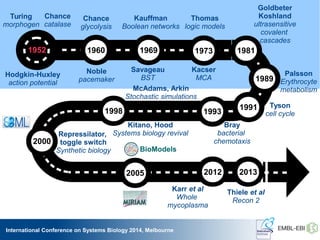
1952 1960 1969 1981
1973
1991
1993
1998
2000
2005 2012
Turing
morphogen
Hodgkin-Huxley
action potential
Chance
catalase
Chance
glycolysis
Noble
pacemaker
Kauffman
Boolean networks
Savageau
BST
Kacser
MCA
Thomas
logic models
Goldbeter
Koshland
ultrasensitive
covalent
cascades
Tyson
cell cycle
Bray
bacterial
chemotaxis
Karr et al
Whole
mycoplasma
McAdams, Arkin
Stochastic simulations
Kitano, Hood
Systems biology revival
Repressilator,
toggle switch
Synthetic biology
2013
Thiele et al
Recon 2
BioModels
1989
Palsson
Erythrocyte
metabolism
International Conference on Systems Biology 2014, Melbourne
1952 1960 1969 1981
1973
1991
1993
1998
2000
2005 2012
Turing
morphogen
Hodgkin-Huxley
action potential
Chance
catalase
Chance
glycolysis
Noble
pacemaker
Kauffman
Boolean networks
Savageau
BST
Kacser
MCA
Thomas
logic models
Goldbeter
Koshland
ultrasensitive
covalent
cascades
Tyson
cell cycle
Bray
bacterial
chemotaxis
Karr et al
Whole
mycoplasma
McAdams, Arkin
Stochastic simulations
Kitano, Hood
Systems biology revival
Repressilator,
toggle switch
Synthetic biology
2013
Thiele et al
Recon 2
BioModels
1989
Palsson
Erythrocyte
metabolism
International Conference on Systems Biology 2014, Melbourne
1952 1960 1969 1981
1973
1991
1993
1998
2000
2005 2012
Turing
morphogen
Hodgkin-Huxley
action potential
Chance
catalase
Chance
glycolysis
Noble
pacemaker
Kauffman
Boolean networks
Savageau
BST
Kacser
MCA
Thomas
logic models
Goldbeter
Koshland
ultrasensitive
covalent
cascades
Tyson
cell cycle
Bray
bacterial
chemotaxis
Karr et al
Whole
mycoplasma
McAdams, Arkin
Stochastic simulations
Kitano, Hood
Systems biology revival
Repressilator,
toggle switch
Synthetic biology
2013
Thiele et al
Recon 2
BioModels
1989
Palsson
Erythrocyte
metabolism
International Conference on Systems Biology 2014, Melbourne
1952 1960 1969 1981
1973
1991
1993
1998
2000
2005 2012
Turing
morphogen
Hodgkin-Huxley
action potential
Chance
catalase
Chance
glycolysis
Noble
pacemaker
Kauffman
Boolean networks
Savageau
BST
Kacser
MCA
Thomas
logic models
Goldbeter
Koshland
ultrasensitive
covalent
cascades
Tyson
cell cycle
Bray
bacterial
chemotaxis
Karr et al
Whole
mycoplasma
McAdams, Arkin
Stochastic simulations
Kitano, Hood
Systems biology revival
Repressilator,
toggle switch
Synthetic biology
2013
Thiele et al
Recon 2
BioModels
1989
Palsson
Erythrocyte
metabolism
BioModels Database growth (published models branch) since its creation
Computational models on the rise
http://www.ebi.ac.uk/biomodels/
20 relationships
per model
500 relationships
per model
International Conference on Systems Biology 2014, Melbourne
Designed
Many
Standard
Automated production
Collaboration
Workflow
Robust
Improvised
One off
Unique
Manually produced
One or few artists
Produced in one go
Fragile
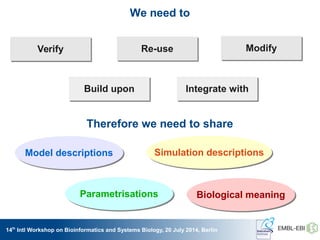
Parametrisations
Parametrisations
Simulation descriptions
Model descriptions
Model descriptions
We need to
Therefore we need to share
Re-use
Re-use
Build upon
Build upon
Verify
Verify Modify
Modify
Integrate with
Integrate with
14th
Intl Workshop on Bioinformatics and Systems Biology, 20 July 2014, Berlin
Biological meaning
Biological meaning
Three types of standards
Minimal
requirements
Data-models
Terminologies
What to encode in order to
share experiments and
understand results
How to encode the information defined
above in a computer-readable manner
Structured representations
of knowledge, with
concept definitions
and their relationships
OBO
foundry
WHAT
HOW
14th
Intl Workshop on Bioinformatics and Systems Biology, 20 July 2014, Berlin
International Conference on Systems Biology 2014, Melbourne
A language to describe computational models in biology
Data-models
SBRML
Born in Caltech 2000
Model
descriptions
Mike
Hucka
Hamid
Bolouri
Andrew
Finney
Herbert
Sauro
Hiroaki
Kitano
John
Doyle
Hucka et al. (2003)
International Conference on Systems Biology 2014, Melbourne
A
A very simple
SBML file
B
http://sbml.org
International Conference on Systems Biology 2014, Melbourne
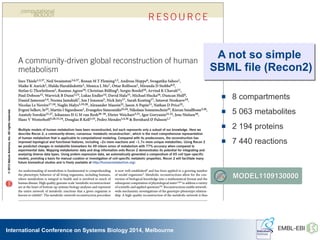
 8 compartments
 5 063 metabolites
 2 194 proteins
 7 440 reactions
A not so simple
SBML file (Recon2)
MODEL1109130000
MODEL1109130000
International Conference on Systems Biology 2014, Melbourne
Adding the semantics to the syntax
Minimal
requirements
Data-models
SBRML
Terminologies
Model
descriptions Born in Heidelberg 2004
Le Novère et al. (2005), Courtot et al. (2011)
International Conference on Systems Biology 2014, Melbourne
Encoded in public standard format
Single reference description
Reflect biological processes
Simulatable and reproduce results
Model creators details
Time of creation and last modification
Precise terms of distribution
Model components identified
Cross reference as triplets {collection, record, qualifier}
Collection and record in one agreed-upon URI










http://co.mbine.org/standards/miriam
International Conference on Systems Biology 2014, Melbourne
Encoded in public standard format
Single reference description
Reflect biological processes
Simulatable and reproduce results
Model creators details
Time of creation and last modification
Precise terms of distribution
Model components identified
Cross reference as triplets {collection, record, qualifier}
Collection and record in one agreed-upon URI










International Conference on Systems Biology 2014, Melbourne
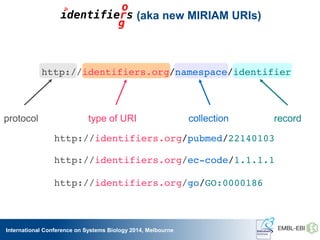
(aka new MIRIAM URIs)
http://identifiers.org/namespace/identifier
protocol type of URI collection record
Camille Laibe Nick Juty Sarala Wimalaratne
Juty et al. (2012)
International Conference on Systems Biology 2014, Melbourne
http://identifiers.org/namespace/identifier
http://identifiers.org/pubmed/22140103
http://identifiers.org/ec­code/1.1.1.1
http://identifiers.org/go/GO:0000186
(aka new MIRIAM URIs)
protocol type of URI collection record
International Conference on Systems Biology 2014, Melbourne
http://www.ebi.ac.uk/miriam/
http://identifiers.org/registry
Laibe et al. (2007)
International Conference on Systems Biology 2014, Melbourne
Unique Persistent
Resolvable
Homogeneous
Human
readable
Maintained
International Conference on Systems Biology 2014, Melbourne
SBML and Identifiers.org cross-references
International Conference on Systems Biology 2014, Melbourne
Surely, this is enough?
International Conference on Systems Biology 2014, Melbourne
Simulation experiment = model + what to do with it
Edelstein et al 1996 (BIOMD0000000002)
Huang & Ferrell (BIOMD0000000009)
Ueda, Hagiwara, Kitano 2001 (BIOMD0000000022)
Bornheimer et al 2004 (BIOMD0000000086)
International Conference on Systems Biology 2014, Melbourne
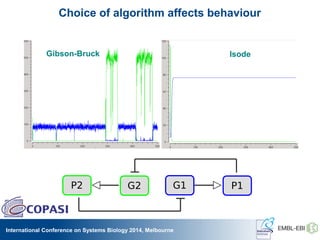
Choice of algorithm affects behaviour
G1 P1
P2 G2
lsode
Gibson-Bruck
International Conference on Systems Biology 2014, Melbourne
Minimal
requirements
Data-models SBRML
Description of simulations and analyses
Born in Hinxton 2007
Simulations
and analysis
Terminologies
Model
descriptions
Dagmar Waltemath
Anna Zhukova
Waltemath et al. (2011, 2011), Courtot et al (2011)
International Conference on Systems Biology 2014, Melbourne
Provide models or mean of access
Equations, parameter values and necessary conditions
Standard formats, code available or full description
Modifications required before simulation
Simulation steps, algorithms, order, processing
Information for correct implementation of all steps
If not open source, all information to rewrite
If dependent on platform, how to use this platform
Post-processing steps to generate final results
How to compare results to get insights










http://co.mbine.org/standards/miase
International Conference on Systems Biology 2014, Melbourne
Simulation Experiment Description Markup Language
http://sed-ml.org
Any XML format
International Conference on Systems Biology 2014, Melbourne
Minimal
requirements
Data-models NuML
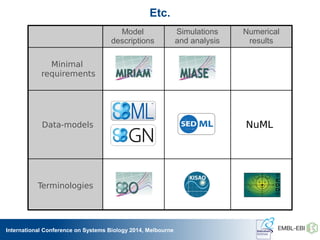
Etc.
Simulations
and analysis
Terminologies
Model
descriptions
Numerical
results
International Conference on Systems Biology 2014, Melbourne
That looks very useful.
Where can I find those?
International Conference on Systems Biology 2014, Melbourne
Camille
Laibe
Marco
Donizelli
Viji Chelliah
Le Novère et al. (2006), Li et al (2010)
http://www.ebi.ac.uk/biomodels
International Conference on Systems Biology 2014, Melbourne
>140 000 models
>10 millions math relations
~ 200 millions cross-refs
> 300 journals advise deposition
~ 1000 citations
1 million page requests per year
International Conference on Systems Biology 2014, Melbourne
Biochemical models
Fernandez et al. DARPP-32 is a
robust integrator of dopamine
and glutamate signals
PLoS Comput Biol (2006) 2: e176.
BIOMD0000000153
BIOMD0000000153
reaction:
International Conference on Systems Biology 2014, Melbourne
Pharmacometrics models
Tham et al (2008) A pharmacodynamic
model for the time course of tumor
shrinkage by gemcitabine + carboplatin in
non-small cell lung cancer patients.
Clin Cancer Res. 2008 14(13): 4213-8.
assignment rule:
rate rule:
BIOMD0000000234
BIOMD0000000234
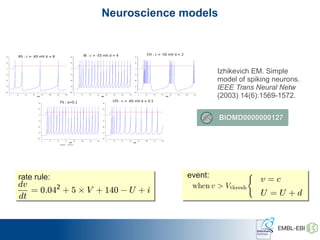
Neuroscience models
Izhikevich EM. Simple
model of spiking neurons.
IEEE Trans Neural Netw
(2003) 14(6):1569-1572.
rate rule:
dv
dt
= 0:042
+ 5 £ V + 140 ¡ U + i
event:
v = c
U = U + d
BIOMD0000000127
BIOMD0000000127
International Conference on Systems Biology 2014, Melbourne
Was it worth it?
International Conference on Systems Biology 2014, Melbourne
“You should not develop standards and easy to use
modelling software. This allows biologists to write models,
and they don't know how to do it properly.”
Biomathematician, 2007
“By developing BioModels you harmed the cause of
modelling in biology. My students do not learn how to make
a model, they download it ready to use instead”
Theoretical biologist, 2006
International Conference on Systems Biology 2014, Melbourne
REUSE
International Conference on Systems Biology 2014, Melbourne
Erb receptor signalling
International Conference on Systems Biology 2014, Melbourne
DISCOVER
International Conference on Systems Biology 2014, Melbourne
Clustering models (and data)
based on metadata
Schulz et al. (2011)
International Conference on Systems Biology 2014, Melbourne
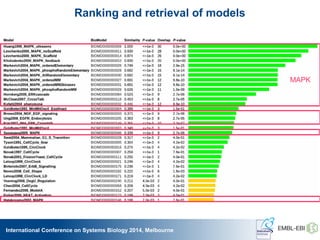
Ranking and retrieval of models
MAPK
International Conference on Systems Biology 2014, Melbourne
Retrieval of models using gene expression
International Conference on Systems Biology 2014, Melbourne
BUILD
International Conference on Systems Biology 2014, Melbourne
Chemical kinetics models
metabolic pathways
Flux Balance Analysis
whole genome reconstructions
Logical models
signalling pathways
Büchel et al. (2013)
Path2Models
International Conference on Systems Biology 2014, Melbourne
Are-we ready to develop comprehensive models of
whole cells, organs and organisms?
International Conference on Systems Biology 2014, Melbourne
9 orders of
magnitude
24 orders of
magnitude
Theoretical and
Computational
roadblockers
Coupled
multi-scale
models
Challenge 1: scales
Castiglione et al. (2014)
International Conference on Systems Biology 2014, Melbourne
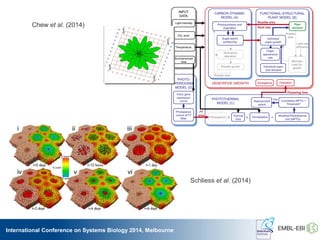
Schliess et al. (2014)
Chew et al. (2014)
International Conference on Systems Biology 2014, Melbourne
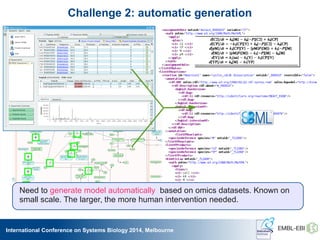
Challenge 2: automatic generation
Need to generate model automatically based on omics datasets. Known on
small scale. The larger, the more human intervention needed.
International Conference on Systems Biology 2014, Melbourne
Challenge 3:
Modularity is
mandatory
International Conference on Systems Biology 2014, Melbourne
Why is modularity important?
 Different parts can be modelled with different approaches
 Alternative modules representing the same biological process
with different granularities or different modelling approaches
 Model families with alternative parts: avoid combinatorial
explosion
 Modules can be developed at their own pace; easier versioning
 Distributed maintenance. No single individual or group can
master the entirety of the project.
International Conference on Systems Biology 2014, Melbourne
Challenge 4: Single software not sufficient
hybrid simulation system
discrete event detection
adaptive synchronization
modular model
International Conference on Systems Biology 2014, Melbourne
Whole cell:
Whole cell: e
electro-biochemical models
lectro-biochemical models
Mattioni et al (2012, 2013)
1504 spines
4761 compartments
16362 channels
International Conference on Systems Biology 2014, Melbourne
1504 spines
4761 compartments
16362 channels
Mattioni et al (2012, 2013)
International Conference on Systems Biology 2014, Melbourne
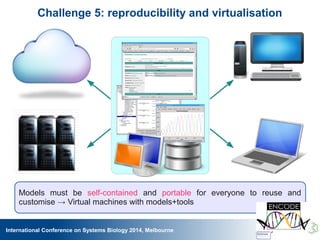
Challenge 5: reproducibility and virtualisation
Models must be self-contained and portable for everyone to reuse and
customise → Virtual machines with models+tools
archive
http://co.mbine.org/standards/omex
14th
Intl Workshop on Bioinformatics and Systems Biology, 20 July 2014, Berlin
Bergman et al. Under revision
International Conference on Systems Biology 2014, Melbourne
The numerous
scientists who
participated to
discussions
The community of
Computational
Systems Biology
You!
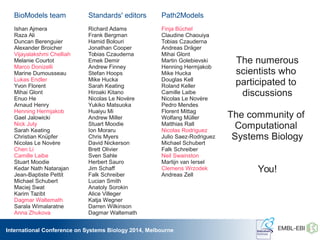
BioModels team
Ishan Ajmera
Raza Ali
Duncan Berenguier
Alexander Broicher
Vijayalakshmi Chelliah
Melanie Courtot
Marco Donizelli
Marine Dumousseau
Lukas Endler
Yvon Florent
Mihai Glont
Enuo He
Arnaud Henry
Henning Hermjakob
Gael Jalowicki
Nick Juty
Sarah Keating
Christian Knüpfer
Nicolas Le Novère
Chen Li
Camille Laibe
Stuart Moodie
Kedar Nath Natarajan
Jean-Baptiste Pettit
Michael Schubert
Maciej Swat
Karim Tazibt
Dagmar Waltemath
Sarala Wimalaratne
Anna Zhukova
Standards' editors
Richard Adams
Frank Bergman
Hamid Bolouri
Jonathan Cooper
Tobias Czauderna
Emek Demir
Andrew Finney
Stefan Hoops
Mike Hucka
Sarah Keating
Hiroaki Kitano
Nicolas Le Novère
Yukiko Matsuoka
Huaiyu Mi
Andrew Miller
Stuart Moodie
Ion Moraru
Chris Myers
David Nickerson
Brett Olivier
Sven Sahle
Herbert Sauro
Jim Schaff
Falk Schreiber
Lucian Smith
Anatoly Sorokin
Alice Villeger
Katja Wegner
Darren Wilkinson
Dagmar Waltemath
Path2Models
Finja Büchel
Claudine Chaouiya
Tobias Czauderna
Andreas Dräger
Mihai Glont
Martin Golebievski
Henning Hermjakob
Mike Hucka
Douglas Kell
Roland Keller
Camille Laibe
Nicolas Le Novère
Pedro Mendes
Florent Mittag
Wolfang Müller
Matthias Rall
Nicolas Rodriguez
Julio Saez-Rodriguez
Michael Schubert
Falk Schreiber
Neil Swainston
Martijn van Iersel
Clemens Wrzodek
Andreas Zell
International Conference on Systems Biology 2014, Melbourne
PhD studentships
(stem cells, epigenetics, metabolism)
Post-doc
(lipidomics, transcriptomics,
metabolic modelling)
developers, curators
(BioModels, SBML support)
International Conference on Systems Biology 2014, Melbourne

Keynote ICSB 2014

  • 1.
    International Conference onSystems Biology 2014, Melbourne From art to engineering: From art to engineering: 15 years of standards and tools 15 years of standards and tools towards digital organisms towards digital organisms Nicolas Le Novère Babraham Institute, Cambridge, UK n.lenovere@gmail.com
  • 2.
    International Conference onSystems Biology 2014, Melbourne What is the goal of using mathematical models? Describe 1917
  • 3.
    International Conference onSystems Biology 2014, Melbourne What is the goal of using mathematical models? Describe Explain 1917 1952
  • 4.
    International Conference onSystems Biology 2014, Melbourne What is the goal of using mathematical models? Describe Explain Predict 1917 1952 2000
  • 5.
    International Conference onSystems Biology 2014, Melbourne 1952 1960 1969 1981 1973 1991 1993 1998 2000 2005 2012 Turing morphogen Hodgkin-Huxley action potential Chance catalase Chance glycolysis Noble pacemaker Kauffman Boolean networks Savageau BST Kacser MCA Thomas logic models Goldbeter Koshland ultrasensitive covalent cascades Tyson cell cycle Bray bacterial chemotaxis Karr et al Whole mycoplasma McAdams, Arkin Stochastic simulations Kitano, Hood Systems biology revival Repressilator, toggle switch Synthetic biology 2013 Thiele et al Recon 2 BioModels 1989 Palsson Erythrocyte metabolism
  • 6.
    International Conference onSystems Biology 2014, Melbourne 1952 1960 1969 1981 1973 1991 1993 1998 2000 2005 2012 Turing morphogen Hodgkin-Huxley action potential Chance catalase Chance glycolysis Noble pacemaker Kauffman Boolean networks Savageau BST Kacser MCA Thomas logic models Goldbeter Koshland ultrasensitive covalent cascades Tyson cell cycle Bray bacterial chemotaxis Karr et al Whole mycoplasma McAdams, Arkin Stochastic simulations Kitano, Hood Systems biology revival Repressilator, toggle switch Synthetic biology 2013 Thiele et al Recon 2 BioModels 1989 Palsson Erythrocyte metabolism
  • 7.
    International Conference onSystems Biology 2014, Melbourne 1952 1960 1969 1981 1973 1991 1993 1998 2000 2005 2012 Turing morphogen Hodgkin-Huxley action potential Chance catalase Chance glycolysis Noble pacemaker Kauffman Boolean networks Savageau BST Kacser MCA Thomas logic models Goldbeter Koshland ultrasensitive covalent cascades Tyson cell cycle Bray bacterial chemotaxis Karr et al Whole mycoplasma McAdams, Arkin Stochastic simulations Kitano, Hood Systems biology revival Repressilator, toggle switch Synthetic biology 2013 Thiele et al Recon 2 BioModels 1989 Palsson Erythrocyte metabolism
  • 8.
    International Conference onSystems Biology 2014, Melbourne 1952 1960 1969 1981 1973 1991 1993 1998 2000 2005 2012 Turing morphogen Hodgkin-Huxley action potential Chance catalase Chance glycolysis Noble pacemaker Kauffman Boolean networks Savageau BST Kacser MCA Thomas logic models Goldbeter Koshland ultrasensitive covalent cascades Tyson cell cycle Bray bacterial chemotaxis Karr et al Whole mycoplasma McAdams, Arkin Stochastic simulations Kitano, Hood Systems biology revival Repressilator, toggle switch Synthetic biology 2013 Thiele et al Recon 2 BioModels 1989 Palsson Erythrocyte metabolism
  • 9.
    BioModels Database growth(published models branch) since its creation Computational models on the rise http://www.ebi.ac.uk/biomodels/ 20 relationships per model 500 relationships per model
  • 10.
    International Conference onSystems Biology 2014, Melbourne Designed Many Standard Automated production Collaboration Workflow Robust Improvised One off Unique Manually produced One or few artists Produced in one go Fragile
  • 11.
    Parametrisations Parametrisations Simulation descriptions Simulation descriptions Modeldescriptions Model descriptions We need to Therefore we need to share Re-use Re-use Build upon Build upon Verify Verify Modify Modify Integrate with Integrate with 14th Intl Workshop on Bioinformatics and Systems Biology, 20 July 2014, Berlin Biological meaning Biological meaning
  • 12.
    Three types ofstandards Minimal requirements Data-models Terminologies What to encode in order to share experiments and understand results How to encode the information defined above in a computer-readable manner Structured representations of knowledge, with concept definitions and their relationships OBO foundry WHAT HOW 14th Intl Workshop on Bioinformatics and Systems Biology, 20 July 2014, Berlin
  • 13.
    International Conference onSystems Biology 2014, Melbourne A language to describe computational models in biology Data-models SBRML Born in Caltech 2000 Model descriptions Mike Hucka Hamid Bolouri Andrew Finney Herbert Sauro Hiroaki Kitano John Doyle Hucka et al. (2003)
  • 14.
    International Conference onSystems Biology 2014, Melbourne A A very simple SBML file B http://sbml.org
  • 16.
    International Conference onSystems Biology 2014, Melbourne  8 compartments  5 063 metabolites  2 194 proteins  7 440 reactions A not so simple SBML file (Recon2) MODEL1109130000 MODEL1109130000
  • 17.
    International Conference onSystems Biology 2014, Melbourne
  • 18.
    International Conference onSystems Biology 2014, Melbourne Adding the semantics to the syntax Minimal requirements Data-models SBRML Terminologies Model descriptions Born in Heidelberg 2004 Le Novère et al. (2005), Courtot et al. (2011)
  • 19.
    International Conference onSystems Biology 2014, Melbourne Encoded in public standard format Single reference description Reflect biological processes Simulatable and reproduce results Model creators details Time of creation and last modification Precise terms of distribution Model components identified Cross reference as triplets {collection, record, qualifier} Collection and record in one agreed-upon URI           http://co.mbine.org/standards/miriam
  • 20.
    International Conference onSystems Biology 2014, Melbourne Encoded in public standard format Single reference description Reflect biological processes Simulatable and reproduce results Model creators details Time of creation and last modification Precise terms of distribution Model components identified Cross reference as triplets {collection, record, qualifier} Collection and record in one agreed-upon URI          
  • 21.
    International Conference onSystems Biology 2014, Melbourne (aka new MIRIAM URIs) http://identifiers.org/namespace/identifier protocol type of URI collection record Camille Laibe Nick Juty Sarala Wimalaratne Juty et al. (2012)
  • 22.
    International Conference onSystems Biology 2014, Melbourne http://identifiers.org/namespace/identifier http://identifiers.org/pubmed/22140103 http://identifiers.org/ec­code/1.1.1.1 http://identifiers.org/go/GO:0000186 (aka new MIRIAM URIs) protocol type of URI collection record
  • 23.
    International Conference onSystems Biology 2014, Melbourne http://www.ebi.ac.uk/miriam/ http://identifiers.org/registry Laibe et al. (2007)
  • 24.
    International Conference onSystems Biology 2014, Melbourne Unique Persistent Resolvable Homogeneous Human readable Maintained
  • 25.
    International Conference onSystems Biology 2014, Melbourne SBML and Identifiers.org cross-references
  • 26.
    International Conference onSystems Biology 2014, Melbourne Surely, this is enough?
  • 27.
    International Conference onSystems Biology 2014, Melbourne Simulation experiment = model + what to do with it Edelstein et al 1996 (BIOMD0000000002) Huang & Ferrell (BIOMD0000000009) Ueda, Hagiwara, Kitano 2001 (BIOMD0000000022) Bornheimer et al 2004 (BIOMD0000000086)
  • 28.
    International Conference onSystems Biology 2014, Melbourne Choice of algorithm affects behaviour G1 P1 P2 G2 lsode Gibson-Bruck
  • 29.
    International Conference onSystems Biology 2014, Melbourne Minimal requirements Data-models SBRML Description of simulations and analyses Born in Hinxton 2007 Simulations and analysis Terminologies Model descriptions Dagmar Waltemath Anna Zhukova Waltemath et al. (2011, 2011), Courtot et al (2011)
  • 30.
    International Conference onSystems Biology 2014, Melbourne Provide models or mean of access Equations, parameter values and necessary conditions Standard formats, code available or full description Modifications required before simulation Simulation steps, algorithms, order, processing Information for correct implementation of all steps If not open source, all information to rewrite If dependent on platform, how to use this platform Post-processing steps to generate final results How to compare results to get insights           http://co.mbine.org/standards/miase
  • 31.
    International Conference onSystems Biology 2014, Melbourne Simulation Experiment Description Markup Language http://sed-ml.org Any XML format
  • 32.
    International Conference onSystems Biology 2014, Melbourne Minimal requirements Data-models NuML Etc. Simulations and analysis Terminologies Model descriptions Numerical results
  • 33.
    International Conference onSystems Biology 2014, Melbourne That looks very useful. Where can I find those?
  • 34.
    International Conference onSystems Biology 2014, Melbourne Camille Laibe Marco Donizelli Viji Chelliah Le Novère et al. (2006), Li et al (2010) http://www.ebi.ac.uk/biomodels
  • 35.
    International Conference onSystems Biology 2014, Melbourne >140 000 models >10 millions math relations ~ 200 millions cross-refs > 300 journals advise deposition ~ 1000 citations 1 million page requests per year
  • 36.
    International Conference onSystems Biology 2014, Melbourne
  • 37.
    Biochemical models Fernandez etal. DARPP-32 is a robust integrator of dopamine and glutamate signals PLoS Comput Biol (2006) 2: e176. BIOMD0000000153 BIOMD0000000153 reaction:
  • 38.
    International Conference onSystems Biology 2014, Melbourne Pharmacometrics models Tham et al (2008) A pharmacodynamic model for the time course of tumor shrinkage by gemcitabine + carboplatin in non-small cell lung cancer patients. Clin Cancer Res. 2008 14(13): 4213-8. assignment rule: rate rule: BIOMD0000000234 BIOMD0000000234
  • 39.
    Neuroscience models Izhikevich EM.Simple model of spiking neurons. IEEE Trans Neural Netw (2003) 14(6):1569-1572. rate rule: dv dt = 0:042 + 5 £ V + 140 ¡ U + i event: v = c U = U + d BIOMD0000000127 BIOMD0000000127
  • 40.
    International Conference onSystems Biology 2014, Melbourne Was it worth it?
  • 41.
    International Conference onSystems Biology 2014, Melbourne “You should not develop standards and easy to use modelling software. This allows biologists to write models, and they don't know how to do it properly.” Biomathematician, 2007 “By developing BioModels you harmed the cause of modelling in biology. My students do not learn how to make a model, they download it ready to use instead” Theoretical biologist, 2006
  • 42.
    International Conference onSystems Biology 2014, Melbourne REUSE
  • 43.
    International Conference onSystems Biology 2014, Melbourne
  • 44.
    International Conference onSystems Biology 2014, Melbourne Erb receptor signalling
  • 45.
    International Conference onSystems Biology 2014, Melbourne DISCOVER
  • 46.
    International Conference onSystems Biology 2014, Melbourne Clustering models (and data) based on metadata Schulz et al. (2011)
  • 47.
    International Conference onSystems Biology 2014, Melbourne Ranking and retrieval of models MAPK
  • 48.
    International Conference onSystems Biology 2014, Melbourne Retrieval of models using gene expression
  • 49.
    International Conference onSystems Biology 2014, Melbourne BUILD
  • 50.
    International Conference onSystems Biology 2014, Melbourne Chemical kinetics models metabolic pathways Flux Balance Analysis whole genome reconstructions Logical models signalling pathways Büchel et al. (2013) Path2Models
  • 51.
    International Conference onSystems Biology 2014, Melbourne Are-we ready to develop comprehensive models of whole cells, organs and organisms?
  • 52.
    International Conference onSystems Biology 2014, Melbourne 9 orders of magnitude 24 orders of magnitude Theoretical and Computational roadblockers Coupled multi-scale models Challenge 1: scales Castiglione et al. (2014)
  • 53.
    International Conference onSystems Biology 2014, Melbourne Schliess et al. (2014) Chew et al. (2014)
  • 54.
    International Conference onSystems Biology 2014, Melbourne Challenge 2: automatic generation Need to generate model automatically based on omics datasets. Known on small scale. The larger, the more human intervention needed.
  • 55.
    International Conference onSystems Biology 2014, Melbourne Challenge 3: Modularity is mandatory
  • 56.
    International Conference onSystems Biology 2014, Melbourne Why is modularity important?  Different parts can be modelled with different approaches  Alternative modules representing the same biological process with different granularities or different modelling approaches  Model families with alternative parts: avoid combinatorial explosion  Modules can be developed at their own pace; easier versioning  Distributed maintenance. No single individual or group can master the entirety of the project.
  • 57.
    International Conference onSystems Biology 2014, Melbourne Challenge 4: Single software not sufficient hybrid simulation system discrete event detection adaptive synchronization modular model
  • 58.
    International Conference onSystems Biology 2014, Melbourne Whole cell: Whole cell: e electro-biochemical models lectro-biochemical models Mattioni et al (2012, 2013) 1504 spines 4761 compartments 16362 channels
  • 59.
    International Conference onSystems Biology 2014, Melbourne 1504 spines 4761 compartments 16362 channels Mattioni et al (2012, 2013)
  • 60.
    International Conference onSystems Biology 2014, Melbourne Challenge 5: reproducibility and virtualisation Models must be self-contained and portable for everyone to reuse and customise → Virtual machines with models+tools
  • 61.
    archive http://co.mbine.org/standards/omex 14th Intl Workshop onBioinformatics and Systems Biology, 20 July 2014, Berlin Bergman et al. Under revision
  • 62.
    International Conference onSystems Biology 2014, Melbourne The numerous scientists who participated to discussions The community of Computational Systems Biology You! BioModels team Ishan Ajmera Raza Ali Duncan Berenguier Alexander Broicher Vijayalakshmi Chelliah Melanie Courtot Marco Donizelli Marine Dumousseau Lukas Endler Yvon Florent Mihai Glont Enuo He Arnaud Henry Henning Hermjakob Gael Jalowicki Nick Juty Sarah Keating Christian Knüpfer Nicolas Le Novère Chen Li Camille Laibe Stuart Moodie Kedar Nath Natarajan Jean-Baptiste Pettit Michael Schubert Maciej Swat Karim Tazibt Dagmar Waltemath Sarala Wimalaratne Anna Zhukova Standards' editors Richard Adams Frank Bergman Hamid Bolouri Jonathan Cooper Tobias Czauderna Emek Demir Andrew Finney Stefan Hoops Mike Hucka Sarah Keating Hiroaki Kitano Nicolas Le Novère Yukiko Matsuoka Huaiyu Mi Andrew Miller Stuart Moodie Ion Moraru Chris Myers David Nickerson Brett Olivier Sven Sahle Herbert Sauro Jim Schaff Falk Schreiber Lucian Smith Anatoly Sorokin Alice Villeger Katja Wegner Darren Wilkinson Dagmar Waltemath Path2Models Finja Büchel Claudine Chaouiya Tobias Czauderna Andreas Dräger Mihai Glont Martin Golebievski Henning Hermjakob Mike Hucka Douglas Kell Roland Keller Camille Laibe Nicolas Le Novère Pedro Mendes Florent Mittag Wolfang Müller Matthias Rall Nicolas Rodriguez Julio Saez-Rodriguez Michael Schubert Falk Schreiber Neil Swainston Martijn van Iersel Clemens Wrzodek Andreas Zell
  • 63.
    International Conference onSystems Biology 2014, Melbourne
  • 64.
    International Conference onSystems Biology 2014, Melbourne PhD studentships (stem cells, epigenetics, metabolism) Post-doc (lipidomics, transcriptomics, metabolic modelling) developers, curators (BioModels, SBML support)
  • 65.
    International Conference onSystems Biology 2014, Melbourne