StartupLandia Unplugged
“We each have a choice in life: work for somebody, or start something.” - Neal Dikeman
“Anyone can be an expert on anything, given 5 years.” - Bill Salathiel, PhD
Concerned that your
startup is not flying
or your town is weak
on startups?
Let’s explore what
makes a startup tick
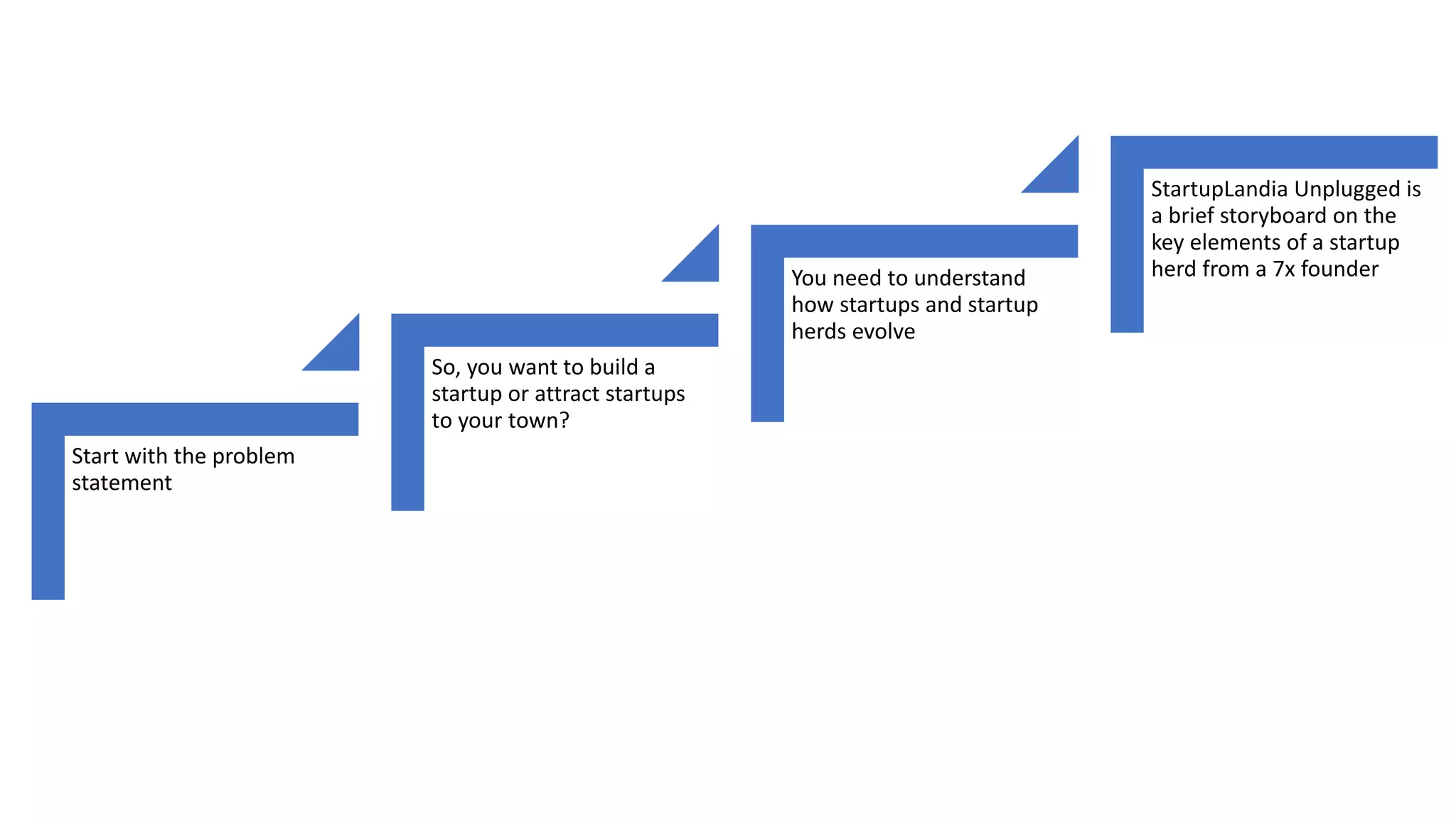
Start with the problem
statement
So, you want to build a
startup or attract startups
to your town?
You need to understand
how startups and startup
herds evolve
StartupLandia Unplugged is
a brief storyboard on the
key elements of a startup
herd from a 7x founder
Herd
Herds are just an aggregation of individual startups. Herds
evolve and move fast – customer interest, competitor
progress, and investor demand. To build or compete in a
Herd, you have to move fast, or evolve, too.
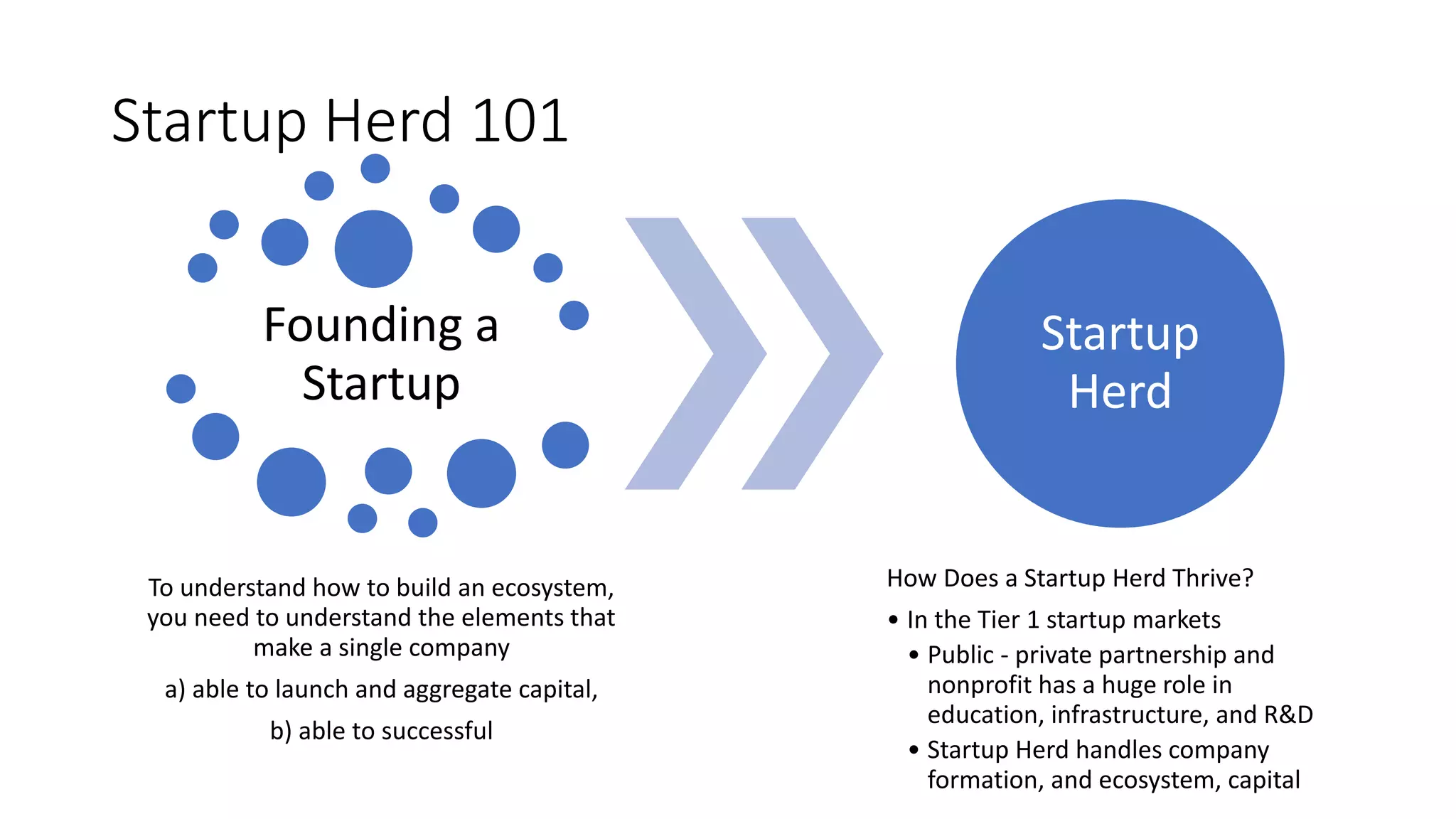
Startup Herd 101
Founding a
Startup
To understand how to build an ecosystem,
you need to understand the elements that
make a single company
a) able to launch and aggregate capital,
b) able to successful
Startup
Herd
How Does a Startup Herd Thrive?
• In the Tier 1 startup markets
• Public - private partnership and
nonprofit has a huge role in
education, infrastructure, and R&D
• Startup Herd handles company
formation, and ecosystem, capital
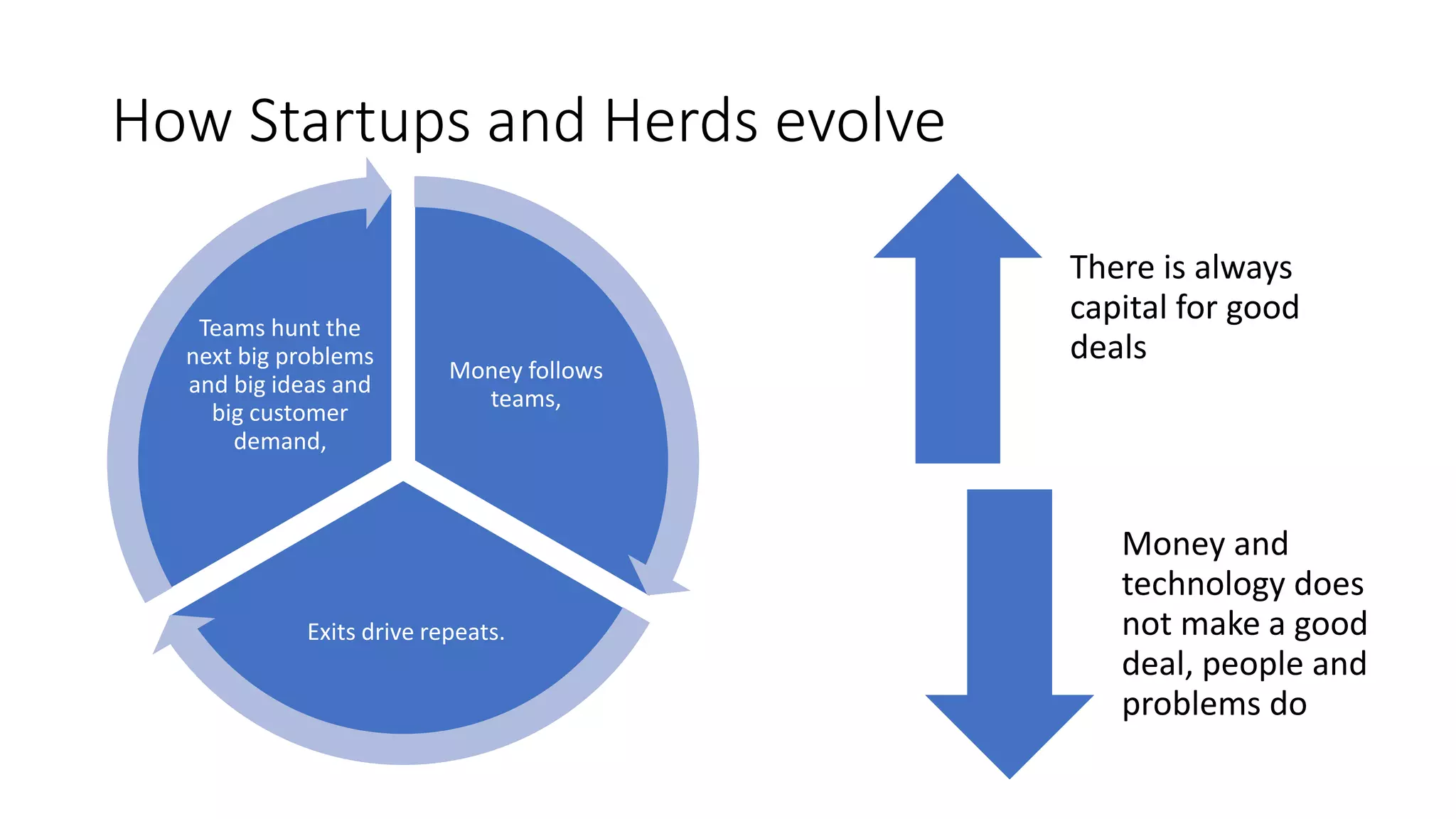
Money follows
teams,
Exits drive repeats.
Teams hunt the
next big problems
and big ideas and
big customer
demand,
How Startups and Herds evolve
There is always
capital for good
deals
Money and
technology does
not make a good
deal, people and
problems do
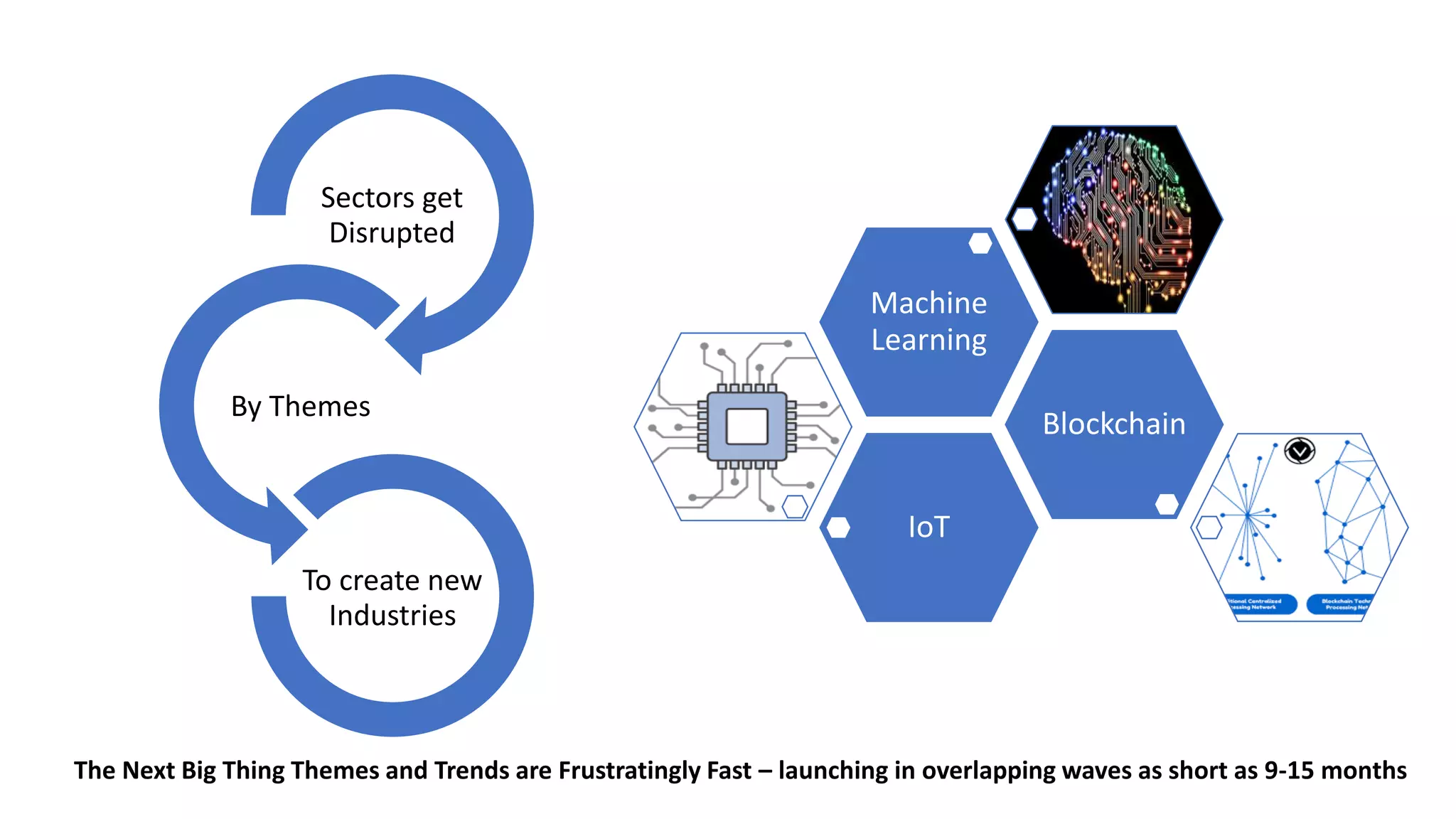
Sectors get
Disrupted
By Themes
To create new
Industries
IoT
Blockchain
Machine
Learning
The Next Big Thing Themes and Trends are Frustratingly Fast – launching in overlapping waves as short as 9-15 months
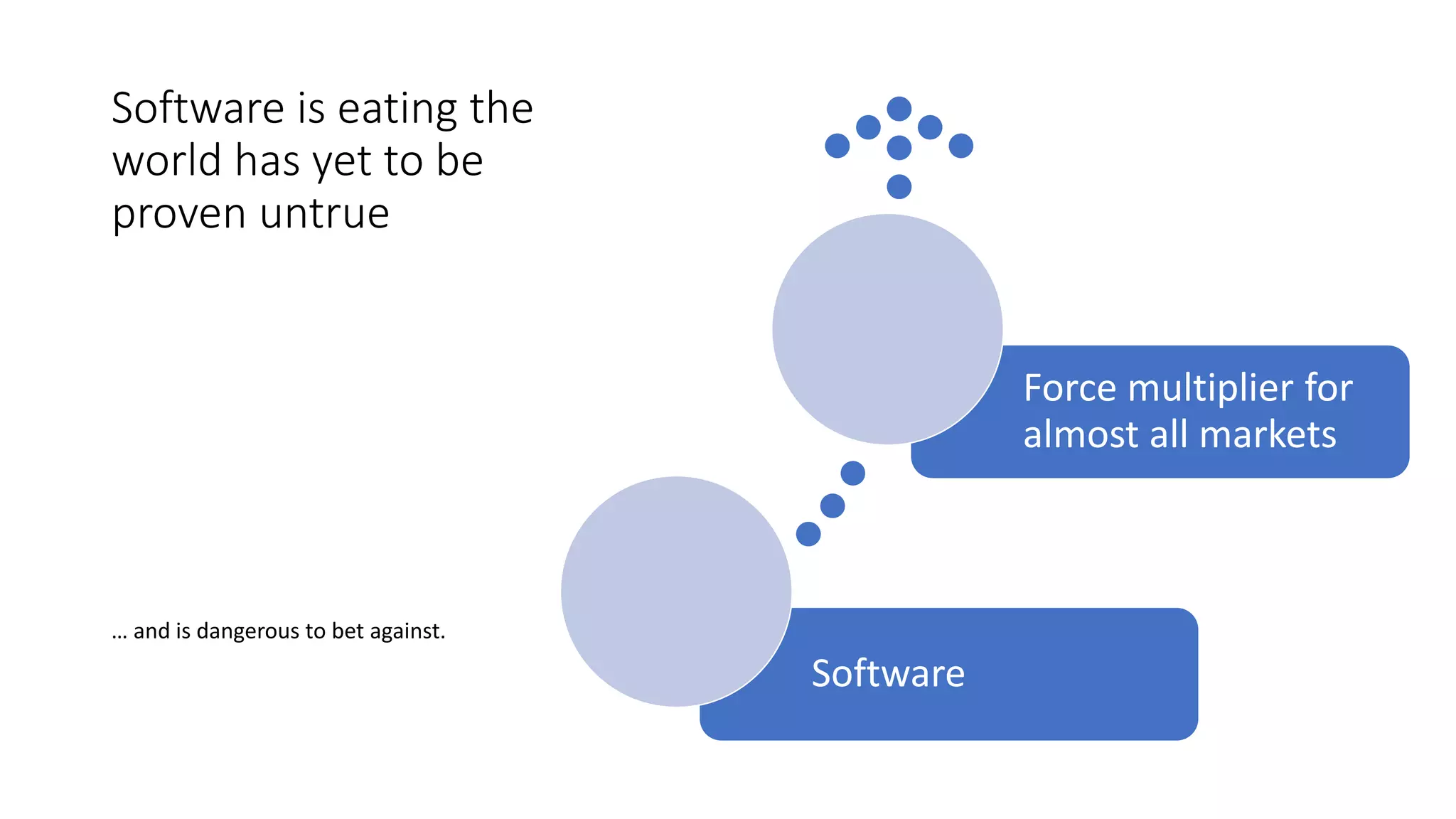
Software is eating the
world has yet to be
proven untrue
… and is dangerous to bet against.
Software
Force multiplier for
almost all markets
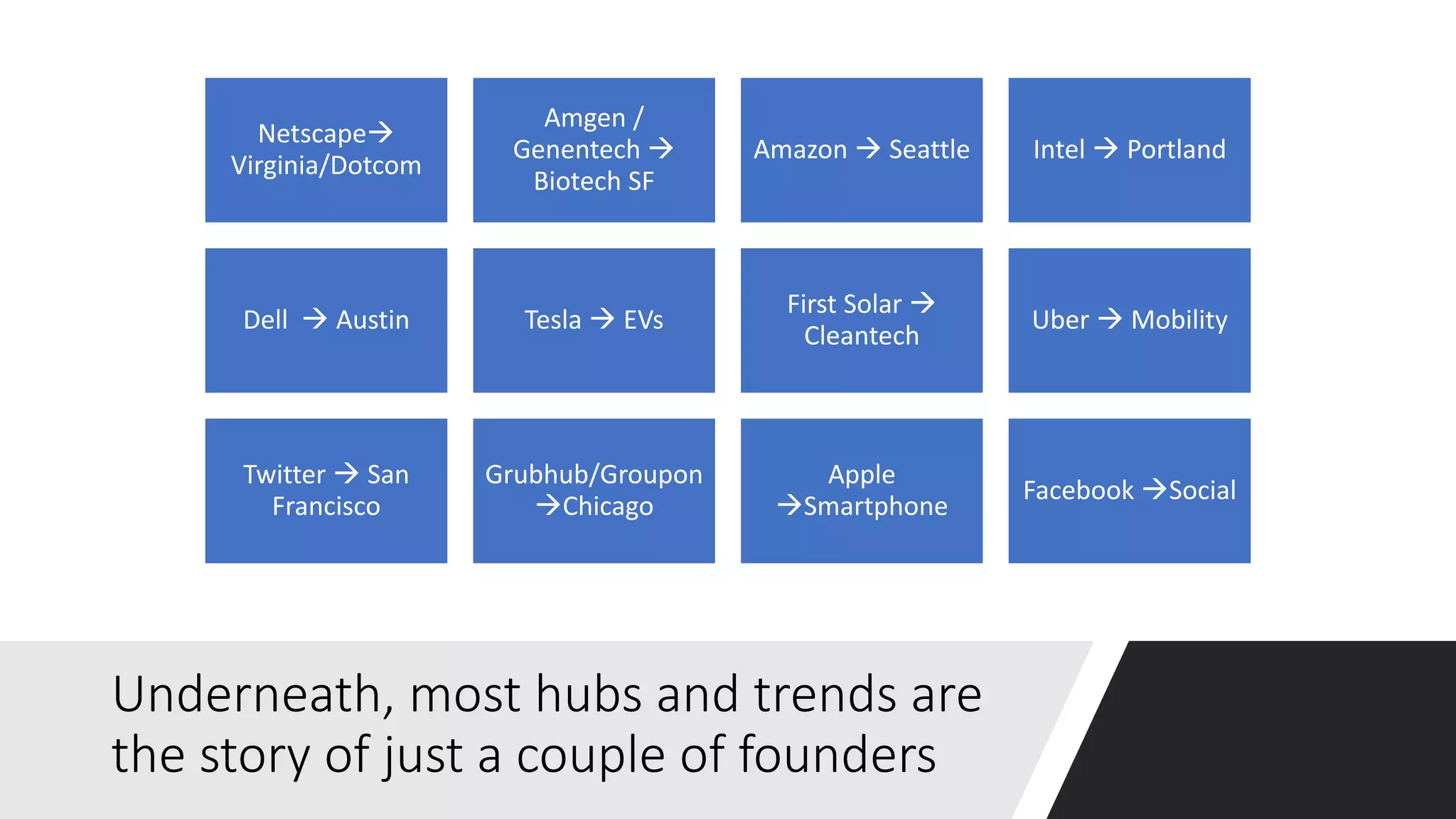
Underneath, most hubs and trends are
the story of just a couple of founders
Netscape
Virginia/Dotcom
Amgen /
Genentech 
Biotech SF
Amazon  Seattle Intel  Portland
Dell  Austin Tesla  EVs
First Solar 
Cleantech
Uber  Mobility
Twitter  San
Francisco
Grubhub/Groupon
Chicago
Apple
Smartphone
Facebook Social
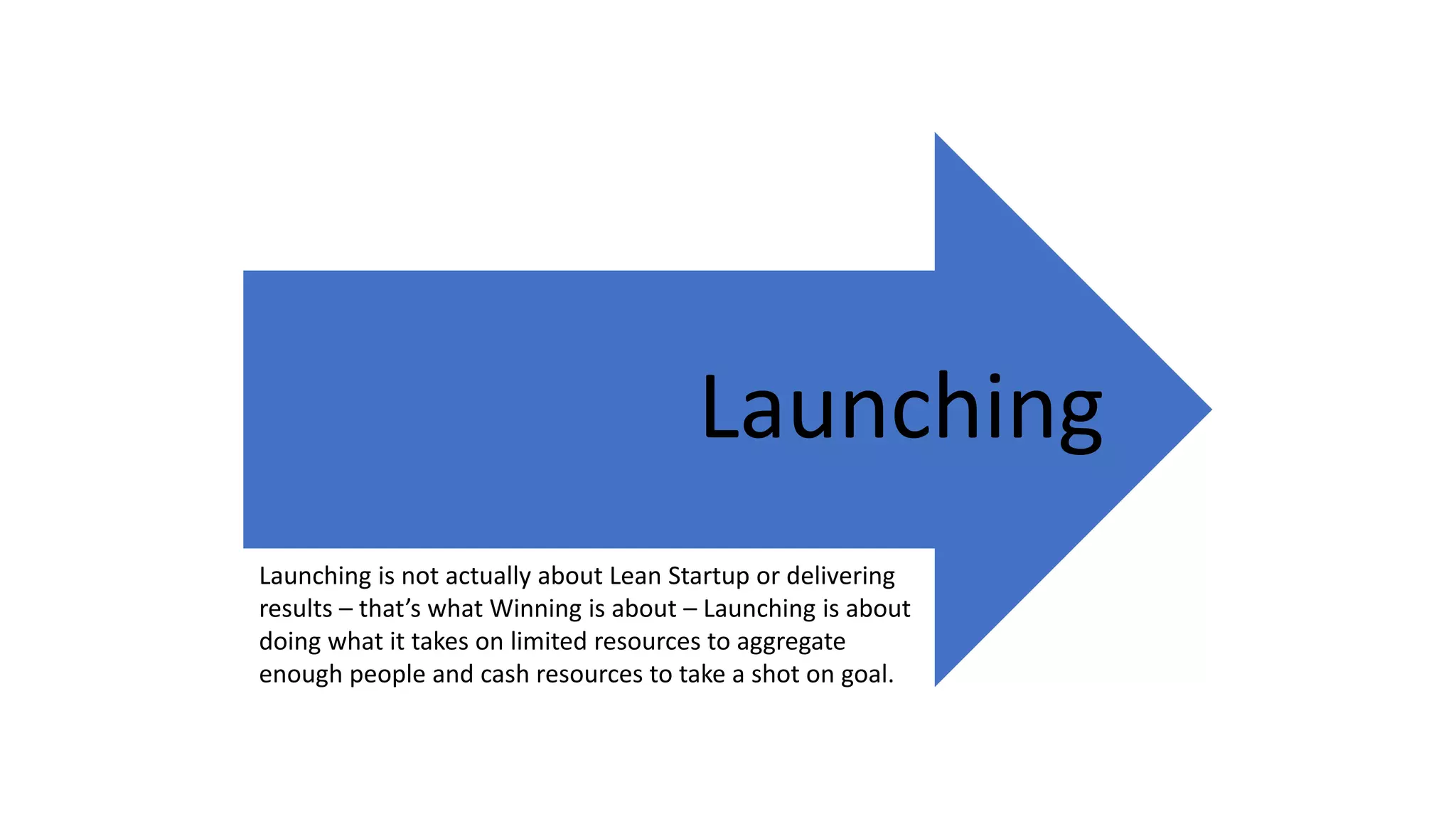
Launching
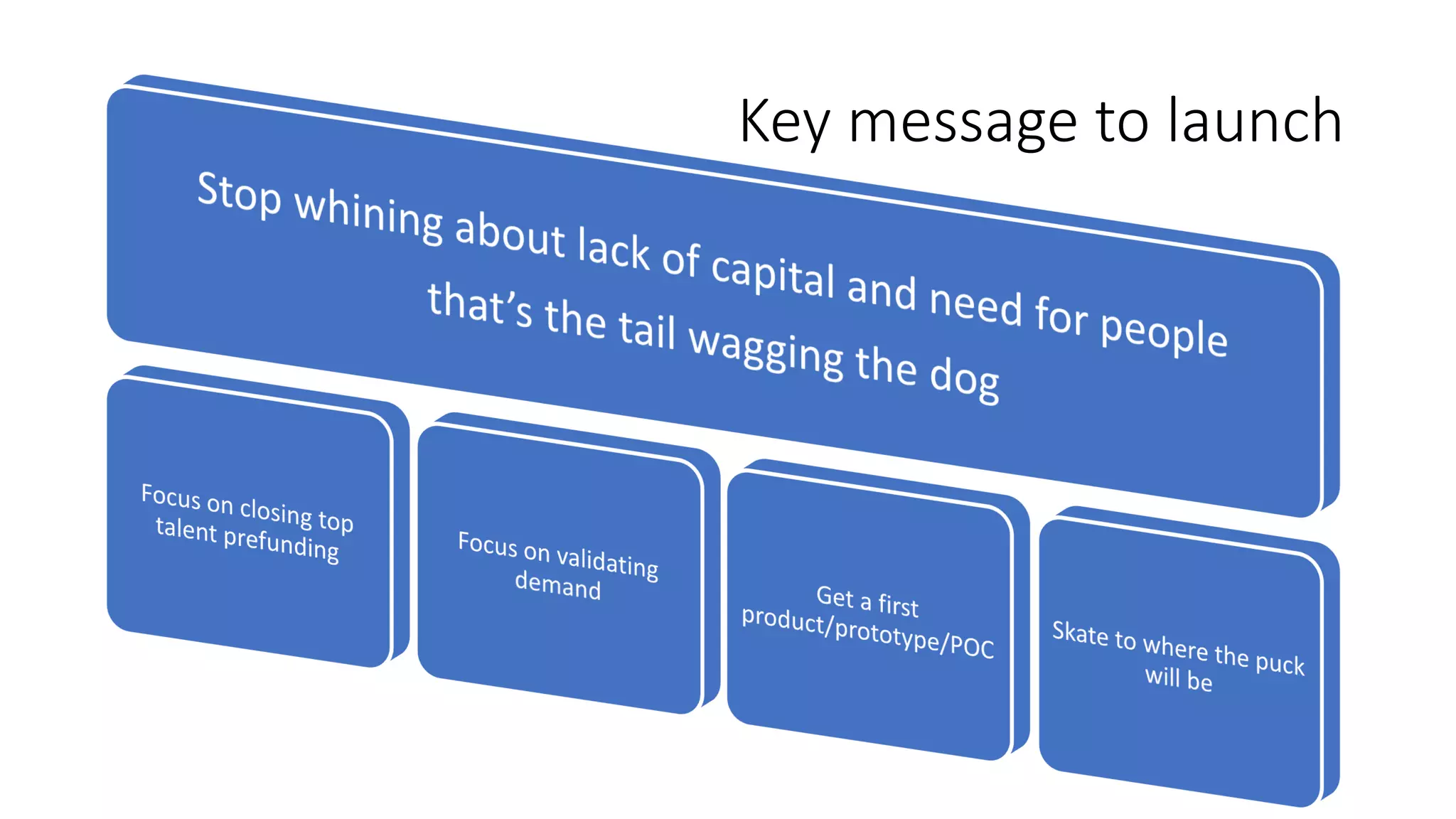
Launching is not actually about Lean Startup or delivering
results – that’s what Winning is about – Launching is about
doing what it takes on limited resources to aggregate
enough people and cash resources to take a shot on goal.
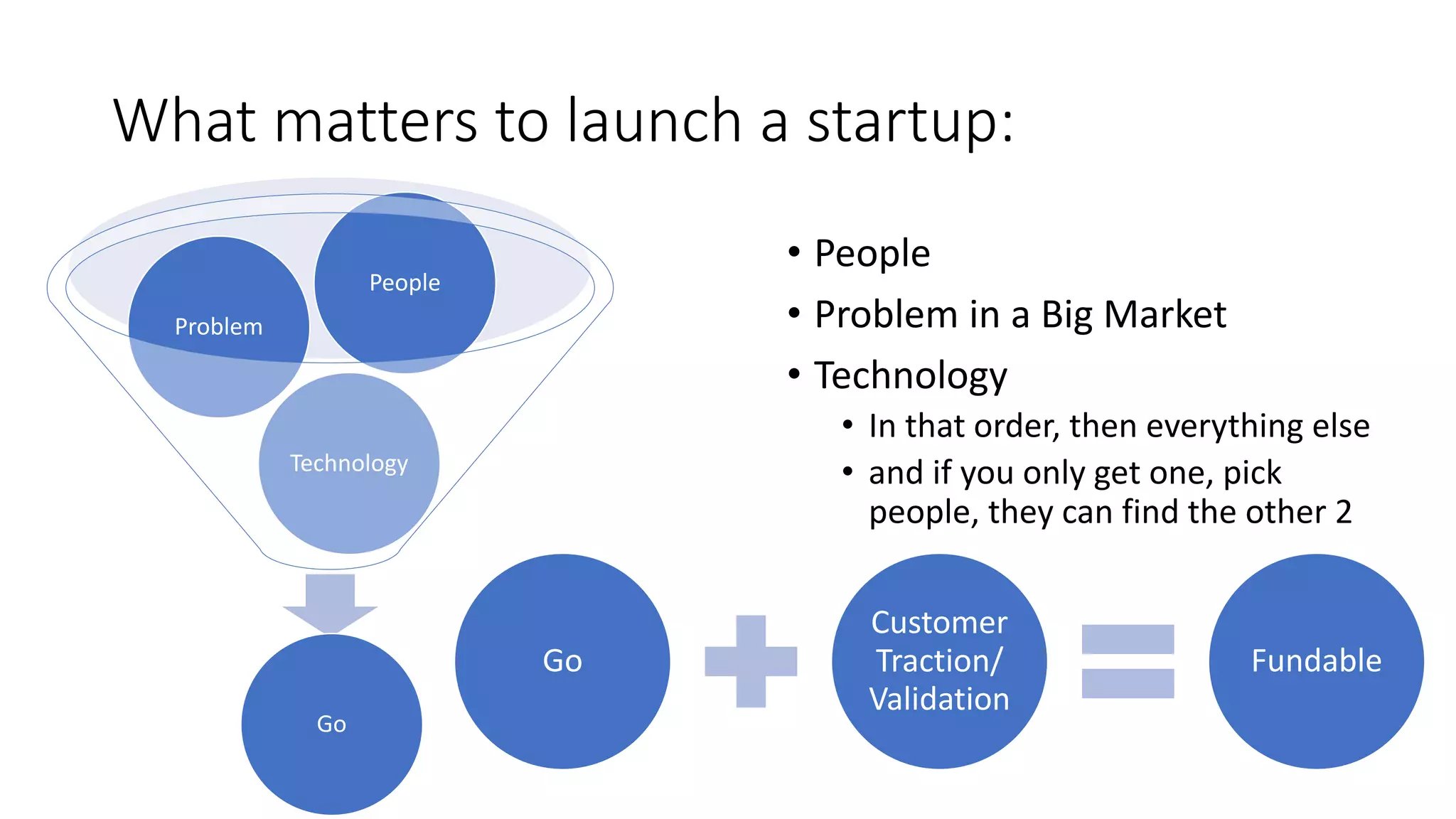
What matters to launch a startup:
• People
• Problem in a Big Market
• Technology
• In that order, then everything else
• and if you only get one, pick
people, they can find the other 2
Go
Technology
Problem
People
Go
Customer
Traction/
Validation
Fundable
Go
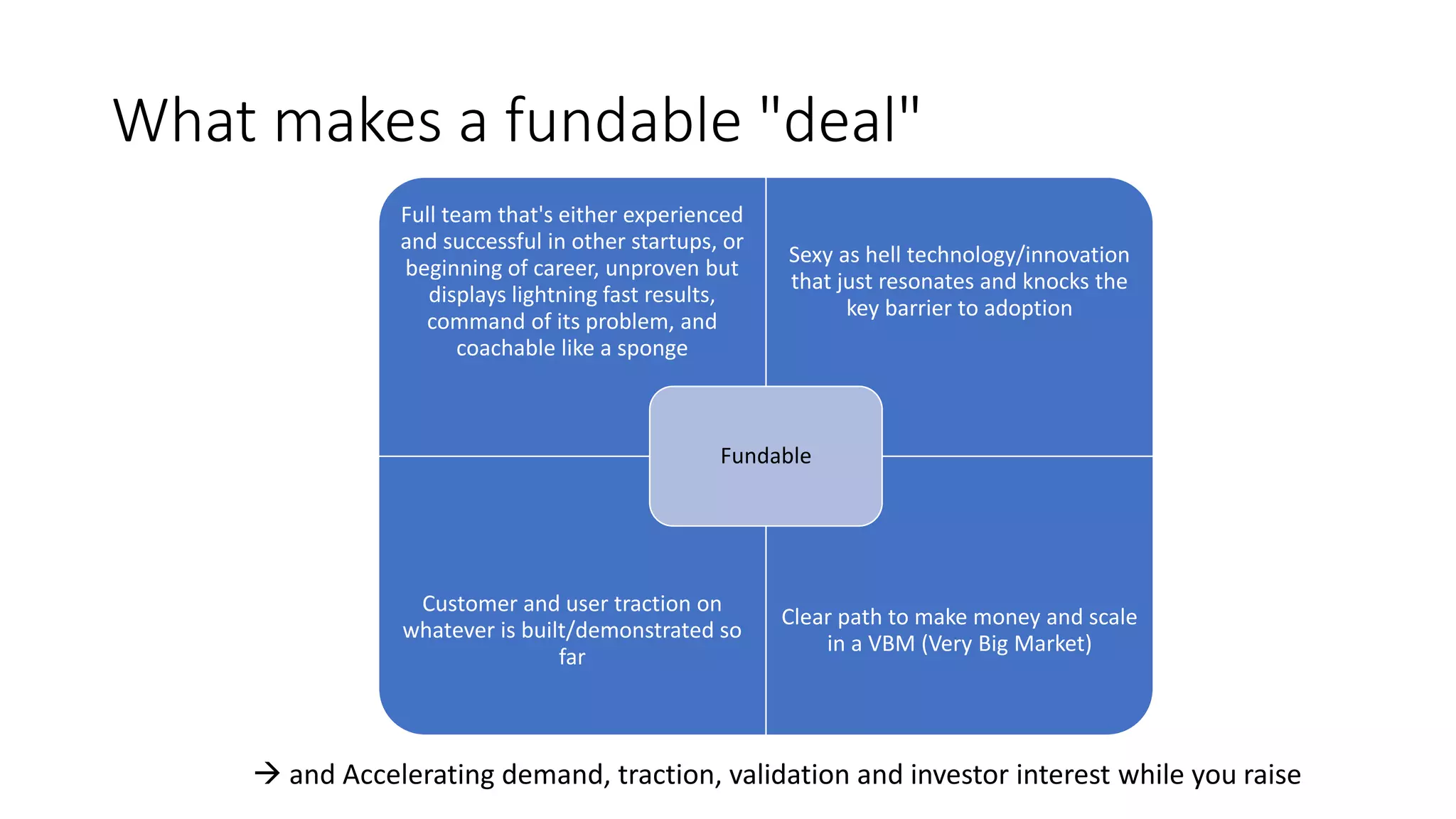
What makes a fundable "deal"
 and Accelerating demand, traction, validation and investor interest while you raise
Full team that's either experienced
and successful in other startups, or
beginning of career, unproven but
displays lightning fast results,
command of its problem, and
coachable like a sponge
Sexy as hell technology/innovation
that just resonates and knocks the
key barrier to adoption
Customer and user traction on
whatever is built/demonstrated so
far
Clear path to make money and scale
in a VBM (Very Big Market)
Fundable
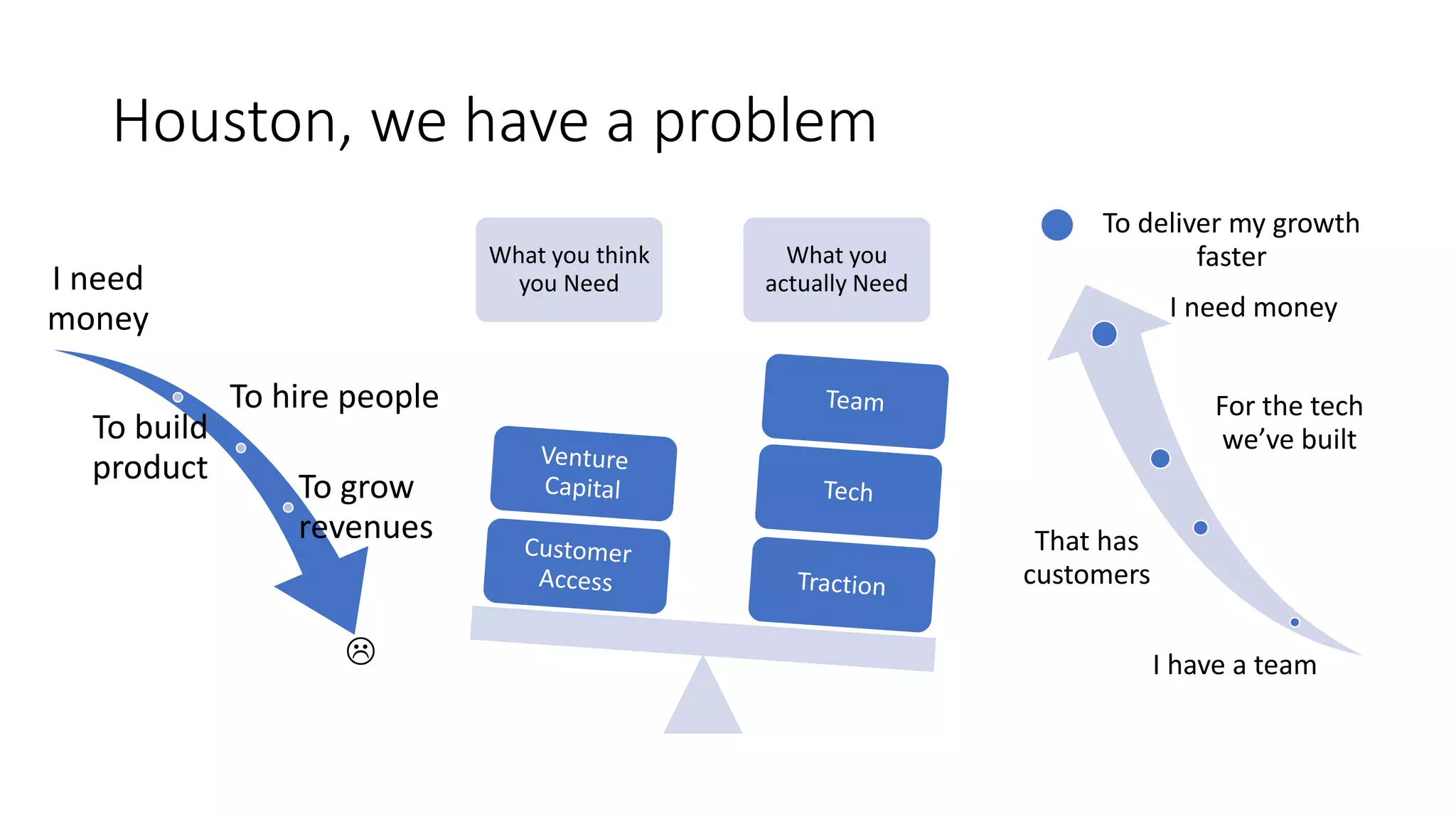
Houston, we have a problem
What you think
you Need
What you
actually NeedI need
money
To hire people
To build
product
To grow
revenues
 I have a team
That has
customers
For the tech
we’ve built
I need money
To deliver my growth
faster
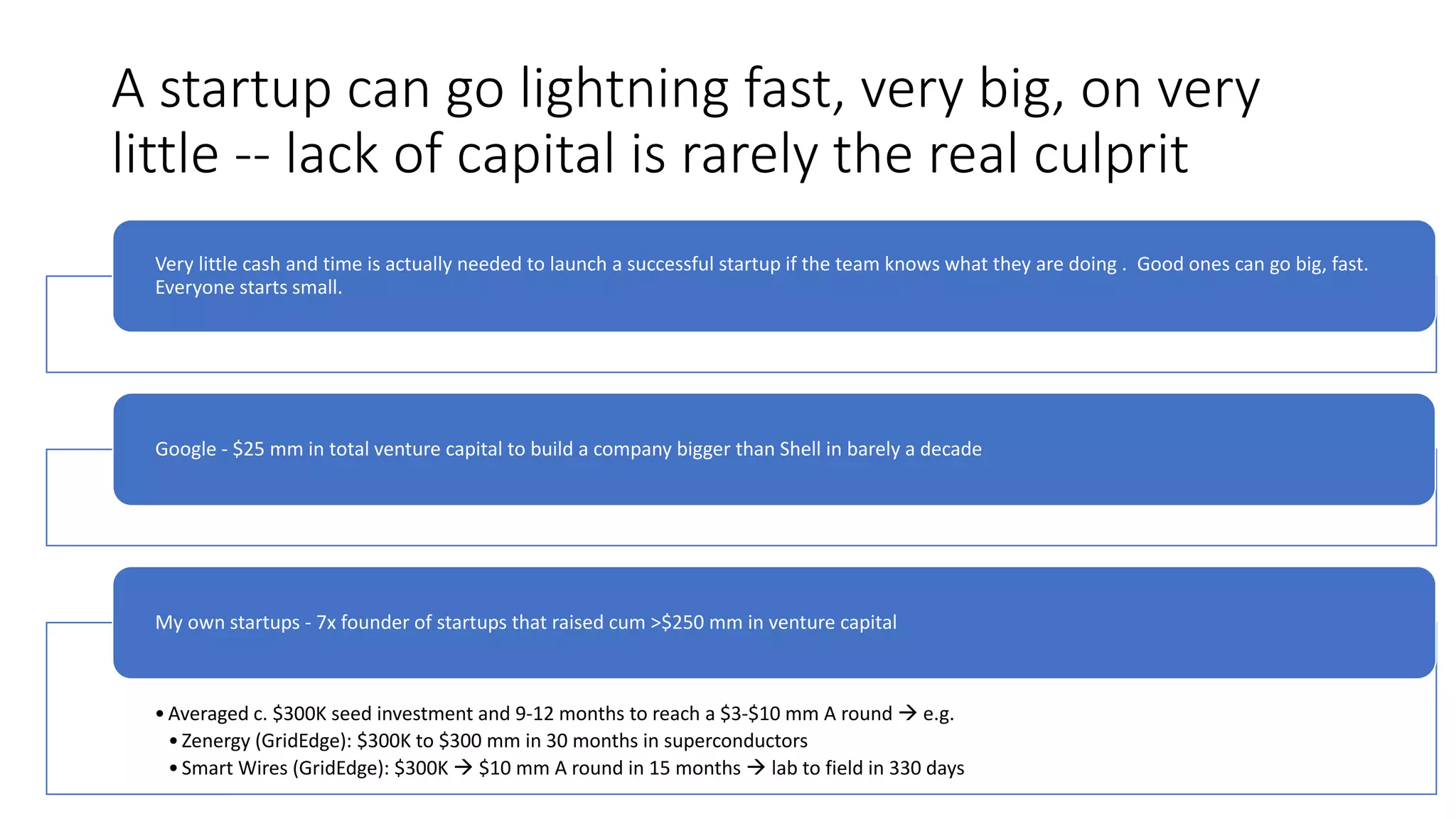
A startup can go lightning fast, very big, on very
little -- lack of capital is rarely the real culprit
Very little cash and time is actually needed to launch a successful startup if the team knows what they are doing . Good ones can go big, fast.
Everyone starts small.
Google - $25 mm in total venture capital to build a company bigger than Shell in barely a decade
•Averaged c. $300K seed investment and 9-12 months to reach a $3-$10 mm A round  e.g.
•Zenergy (GridEdge): $300K to $300 mm in 30 months in superconductors
•Smart Wires (GridEdge): $300K  $10 mm A round in 15 months  lab to field in 330 days
My own startups - 7x founder of startups that raised cum >$250 mm in venture capital
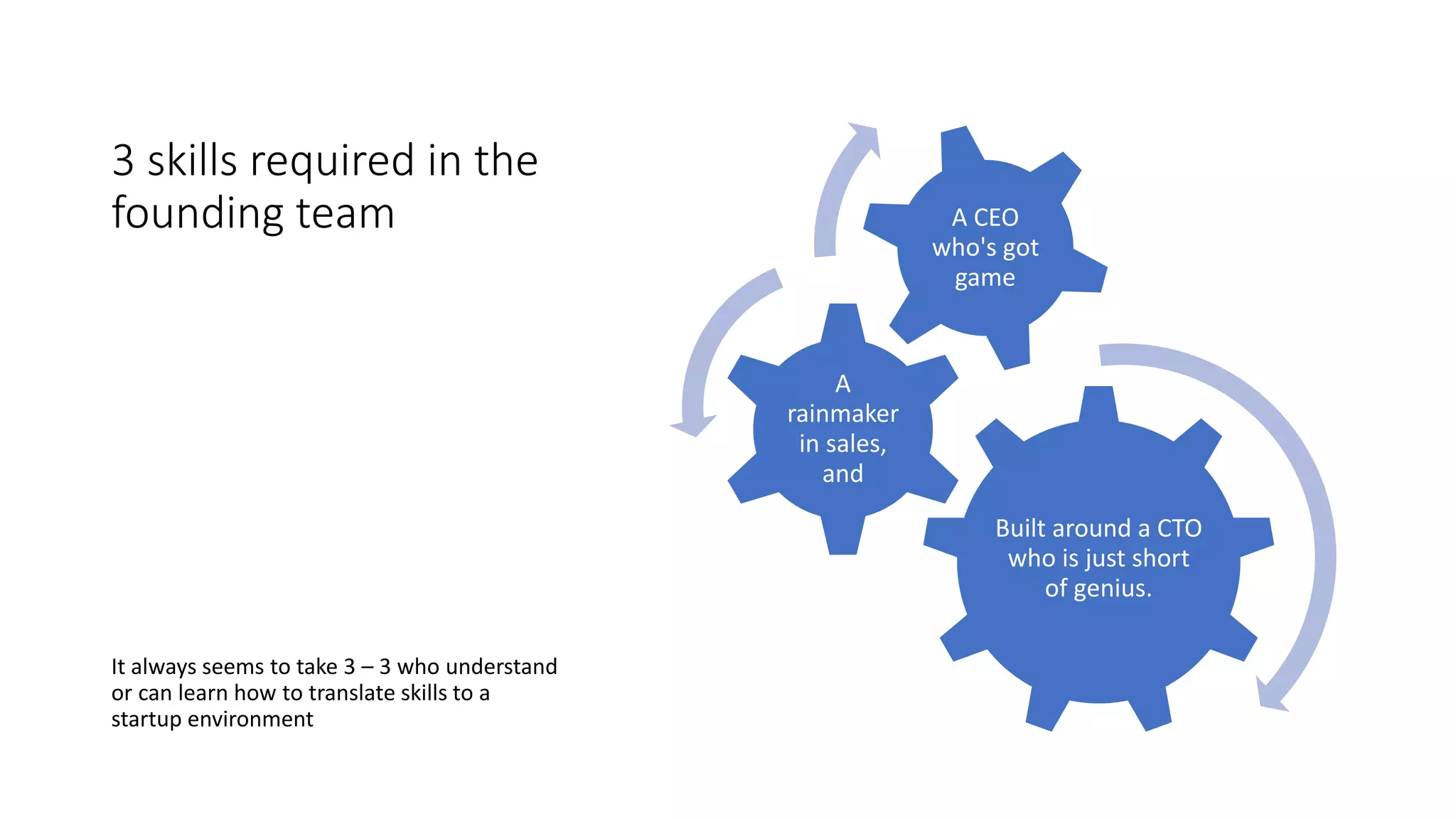
3 skills required in the
founding team
It always seems to take 3 – 3 who understand
or can learn how to translate skills to a
startup environment
Built around a CTO
who is just short
of genius.
A
rainmaker
in sales,
and
A CEO
who's got
game
People first 
• If the founders can't pull an A team, there is no startup, and
he/she/they are no founder
Key message to launch
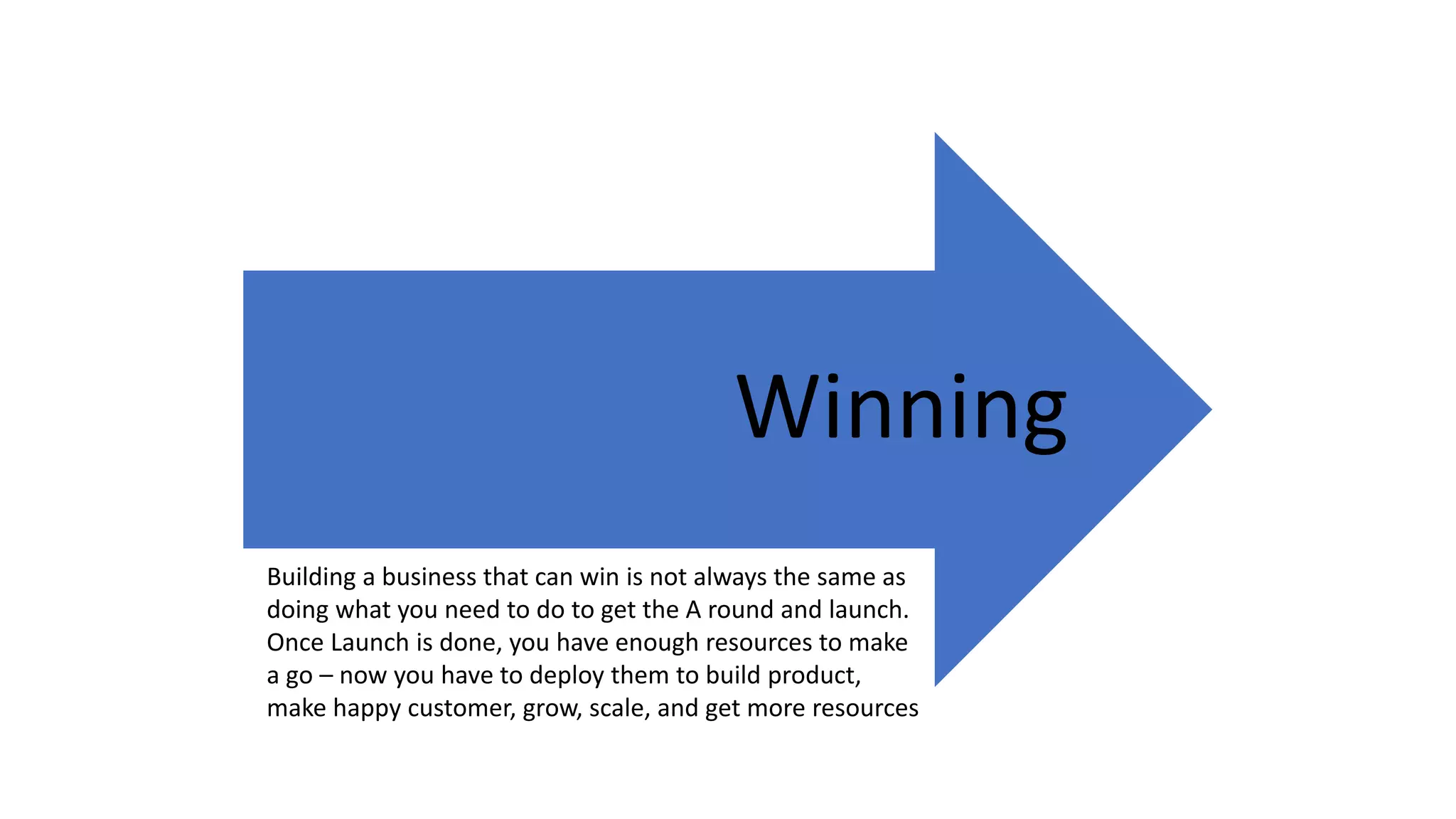
Winning
Building a business that can win is not always the same as
doing what you need to do to get the A round and launch.
Once Launch is done, you have enough resources to make
a go – now you have to deploy them to build product,
make happy customer, grow, scale, and get more resources
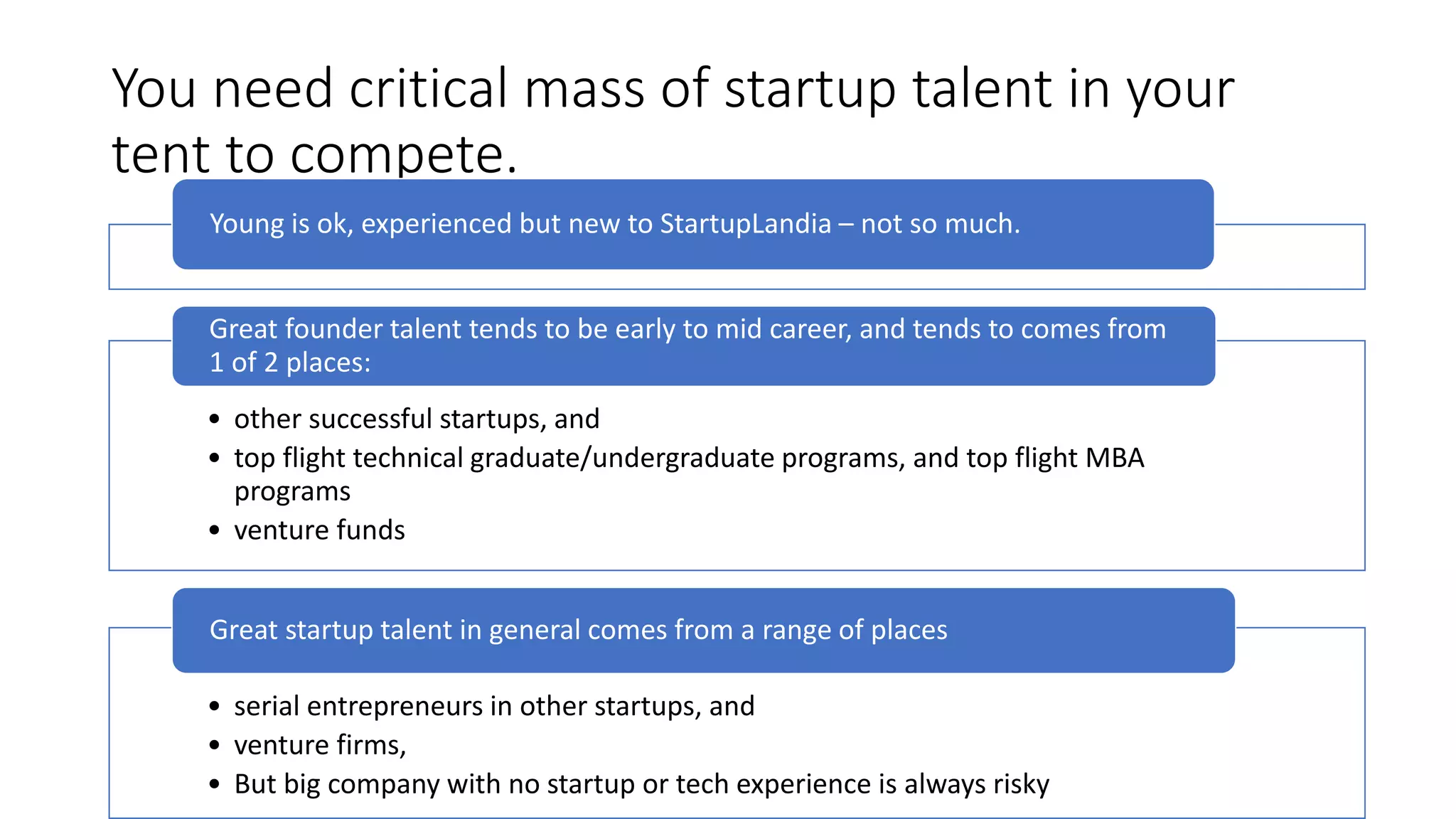
You need critical mass of startup talent in your
tent to compete.
Young is ok, experienced but new to StartupLandia – not so much.
• other successful startups, and
• top flight technical graduate/undergraduate programs, and top flight MBA
programs
• venture funds
Great founder talent tends to be early to mid career, and tends to comes from
1 of 2 places:
• serial entrepreneurs in other startups, and
• venture firms,
• But big company with no startup or tech experience is always risky
Great startup talent in general comes from a range of places
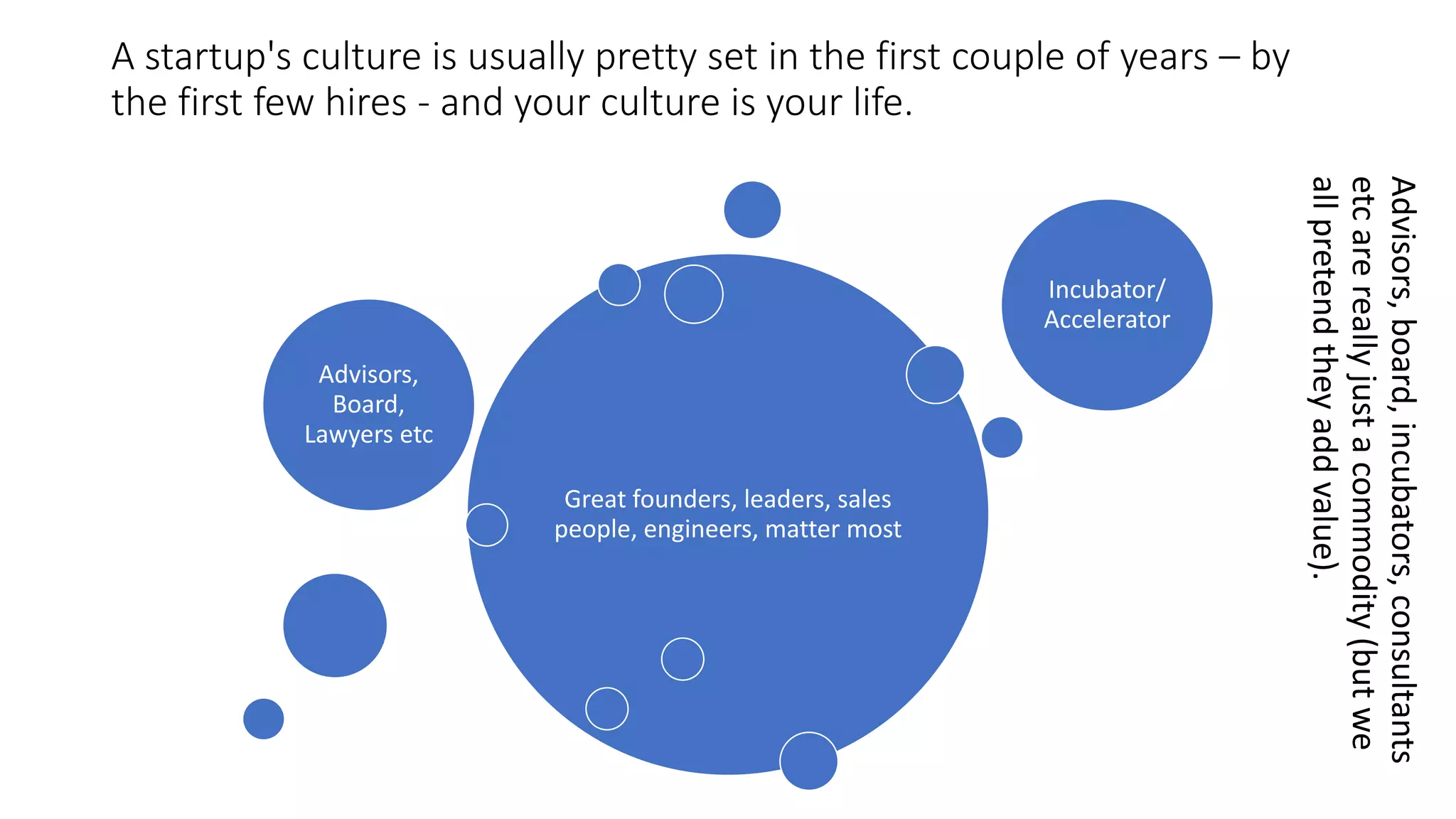
A startup's culture is usually pretty set in the first couple of years – by
the first few hires - and your culture is your life.
Advisors,board,incubators,consultants
etcarereallyjustacommodity(butwe
allpretendtheyaddvalue).
Great founders, leaders, sales
people, engineers, matter most
Advisors,
Board,
Lawyers etc
Incubator/
Accelerator
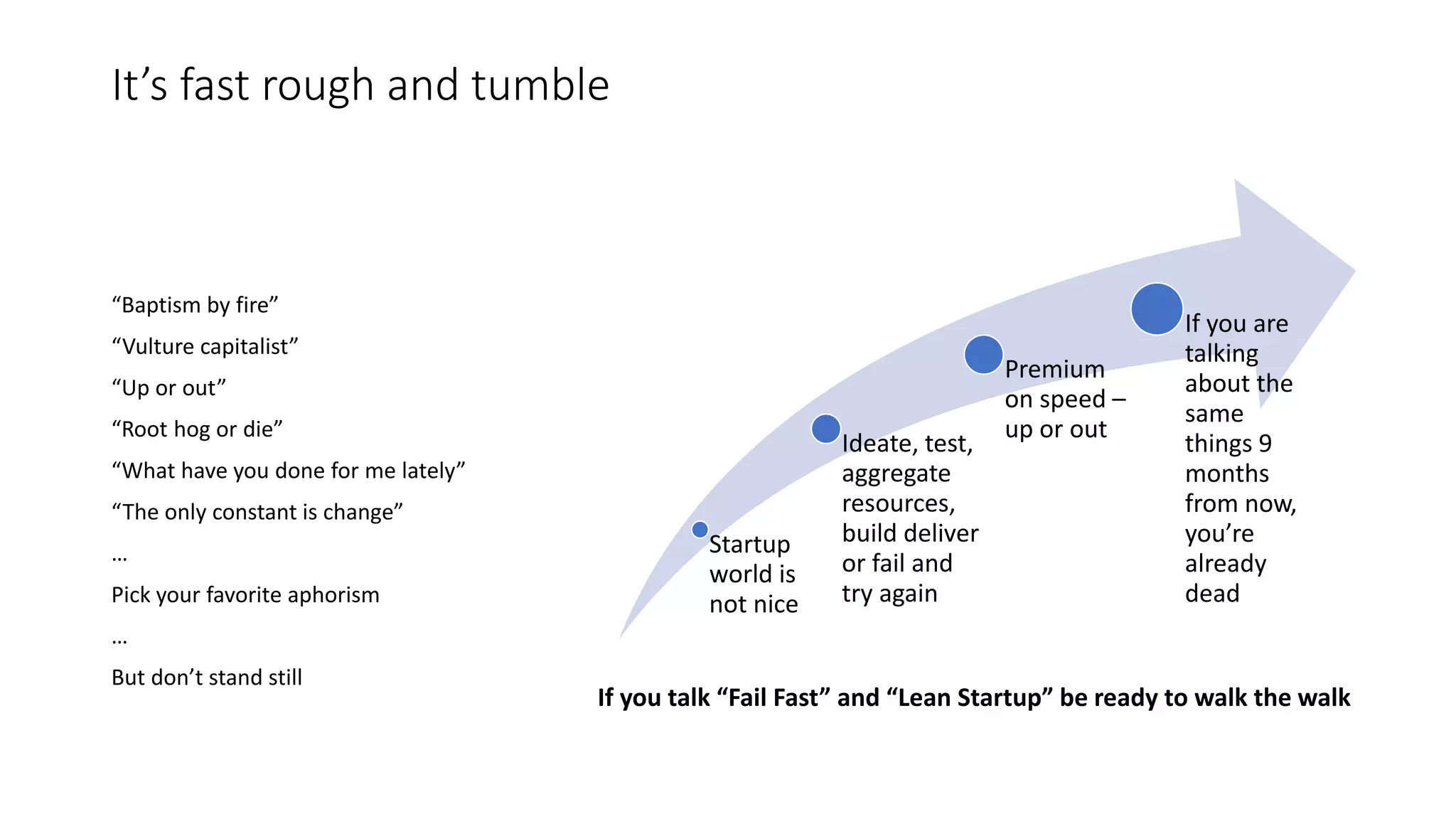
It’s fast rough and tumble
Startup
world is
not nice
Ideate, test,
aggregate
resources,
build deliver
or fail and
try again
Premium
on speed –
up or out
If you are
talking
about the
same
things 9
months
from now,
you’re
already
dead
“Baptism by fire”
“Vulture capitalist”
“Up or out”
“Root hog or die”
“What have you done for me lately”
“The only constant is change”
…
Pick your favorite aphorism
…
But don’t stand still
If you talk “Fail Fast” and “Lean Startup” be ready to walk the walk
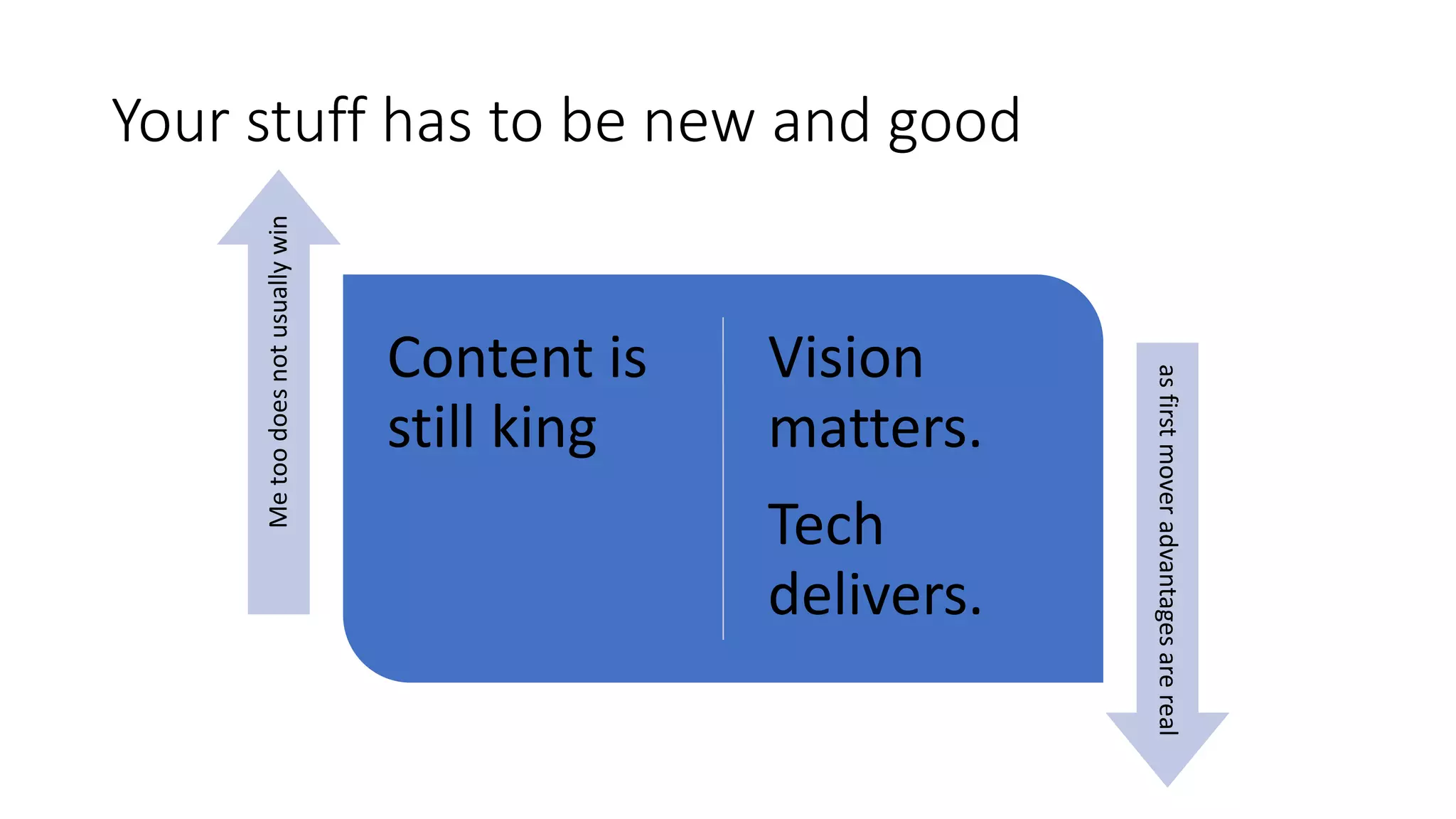
Your stuff has to be new and good
Content is
still king
Vision
matters.
Tech
delivers.
Metoodoesnotusuallywin
asfirstmoveradvantagesarereal
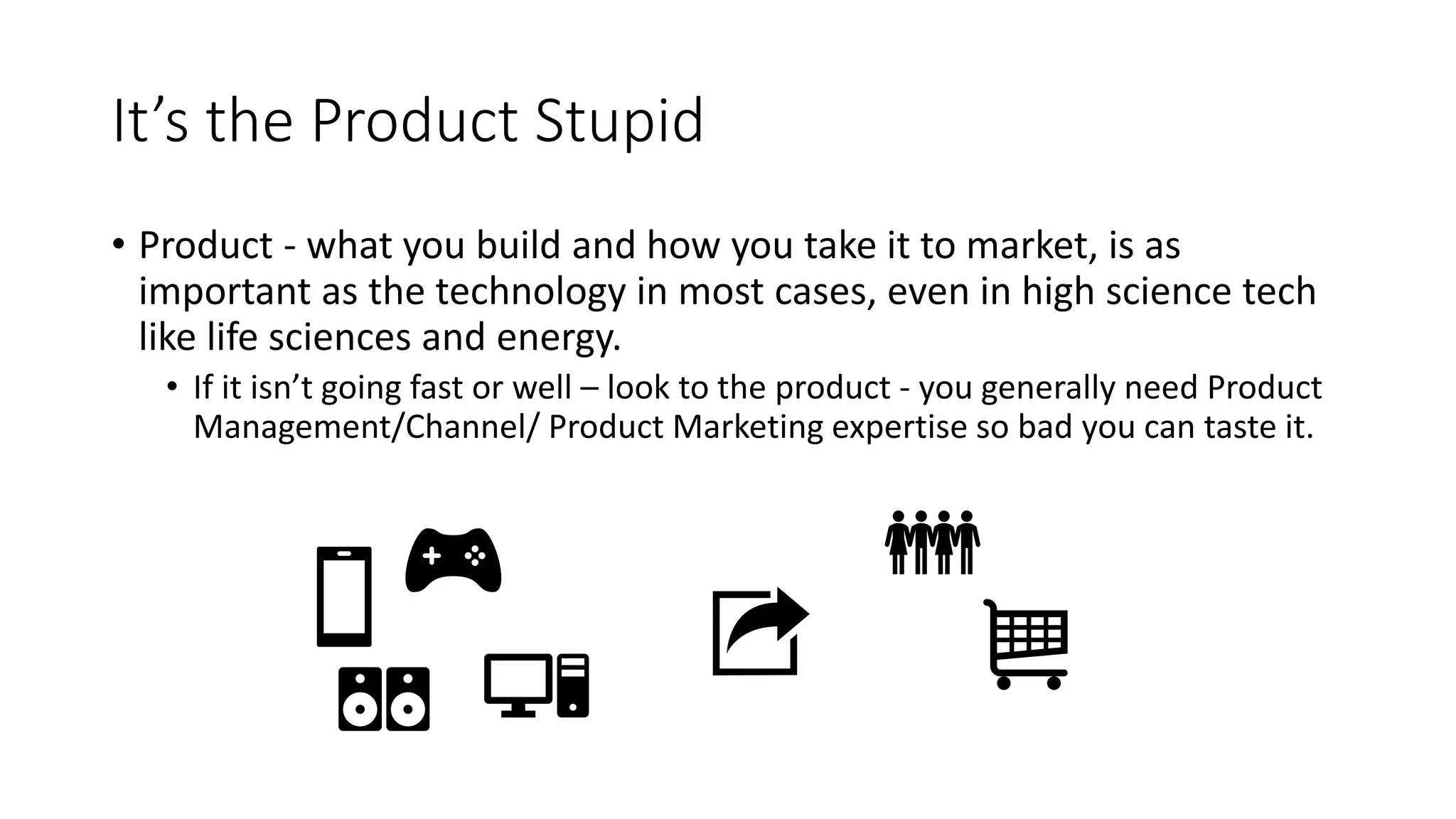
It’s the Product Stupid
• Product - what you build and how you take it to market, is as
important as the technology in most cases, even in high science tech
like life sciences and energy.
• If it isn’t going fast or well – look to the product - you generally need Product
Management/Channel/ Product Marketing expertise so bad you can taste it.
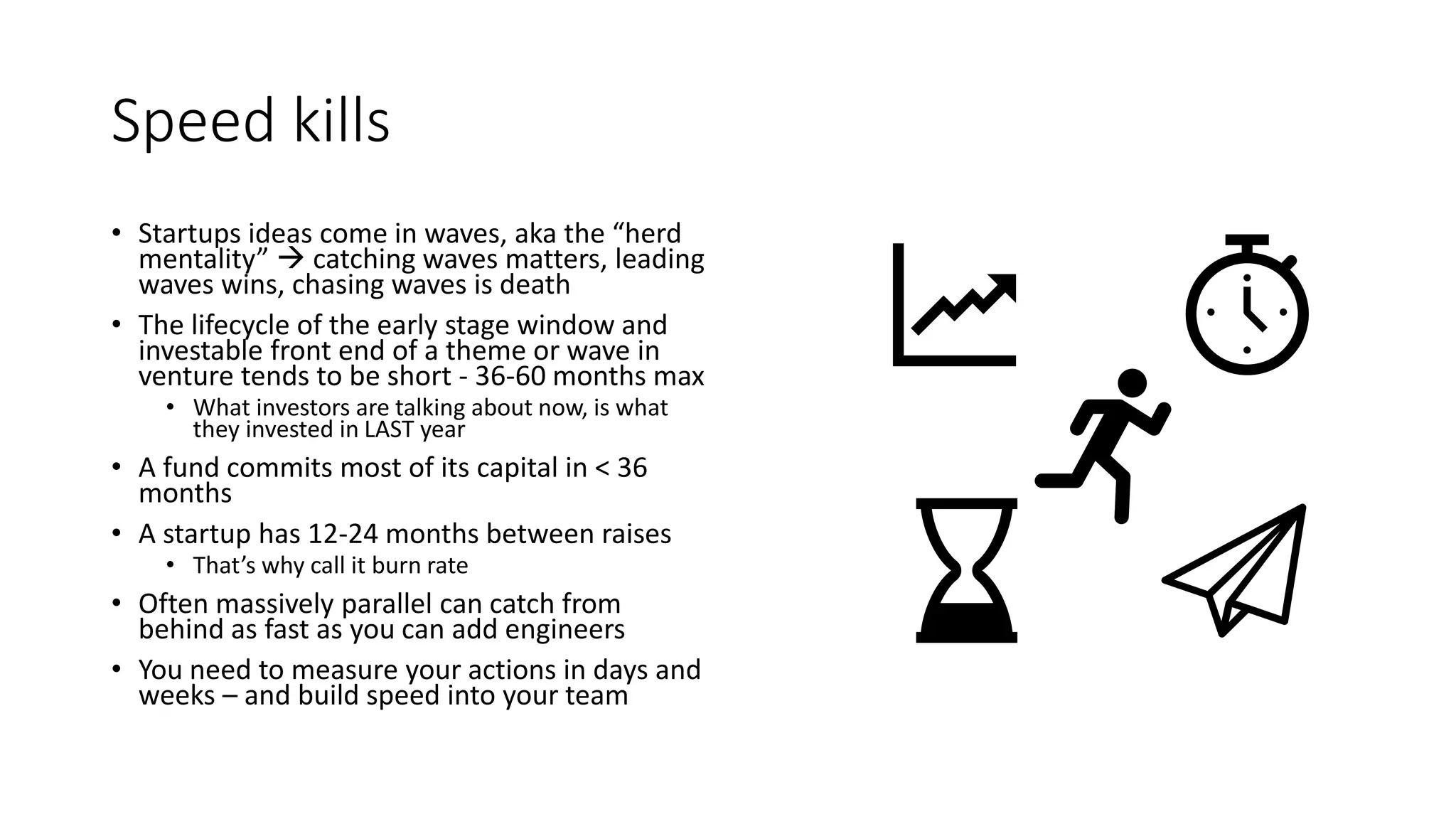
Speed kills
• Startups ideas come in waves, aka the “herd
mentality”  catching waves matters, leading
waves wins, chasing waves is death
• The lifecycle of the early stage window and
investable front end of a theme or wave in
venture tends to be short - 36-60 months max
• What investors are talking about now, is what
they invested in LAST year
• A fund commits most of its capital in < 36
months
• A startup has 12-24 months between raises
• That’s why call it burn rate
• Often massively parallel can catch from
behind as fast as you can add engineers
• You need to measure your actions in days and
weeks – and build speed into your team
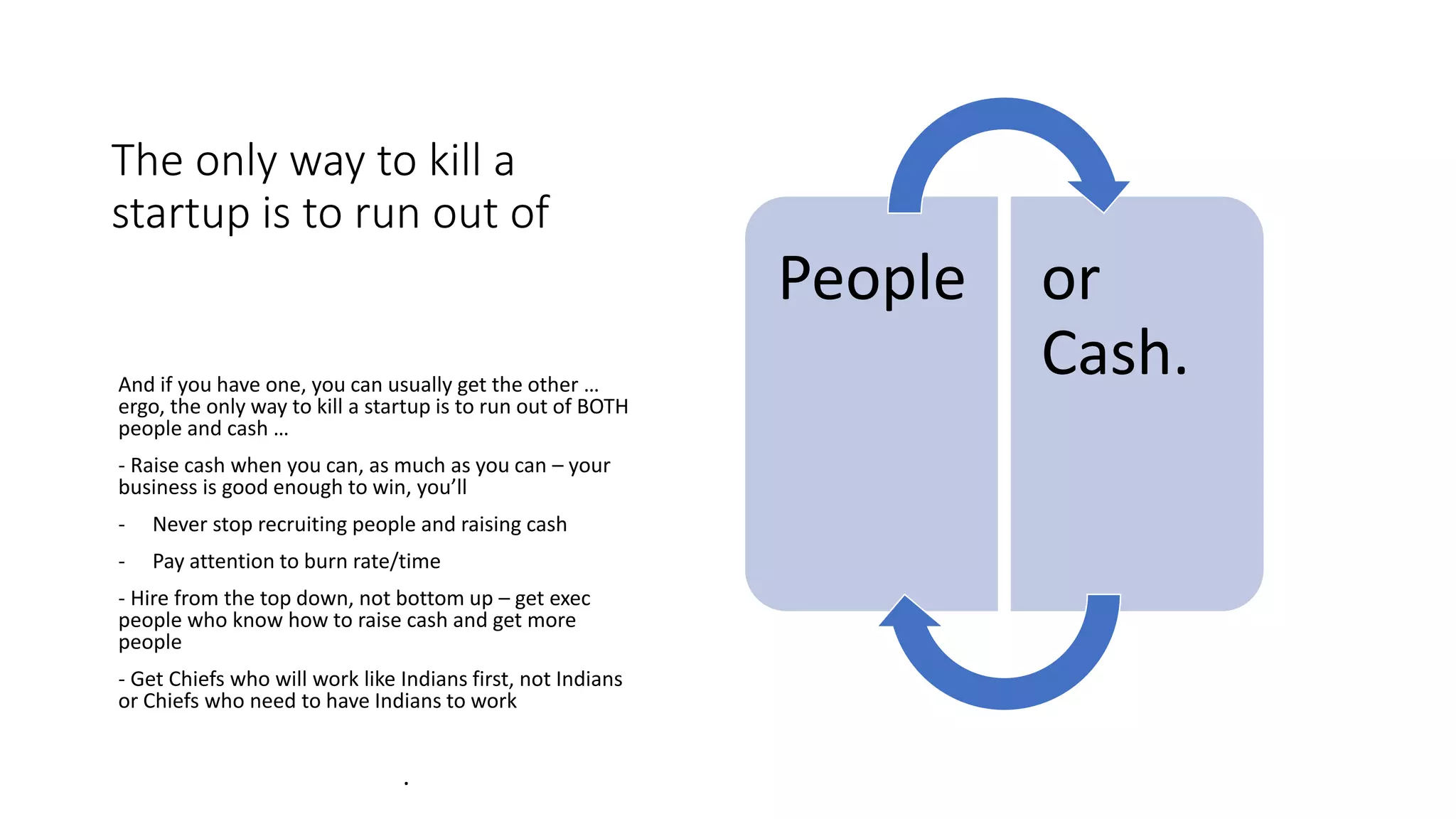
The only way to kill a
startup is to run out of
And if you have one, you can usually get the other …
ergo, the only way to kill a startup is to run out of BOTH
people and cash …
- Raise cash when you can, as much as you can – your
business is good enough to win, you’ll
- Never stop recruiting people and raising cash
- Pay attention to burn rate/time
- Hire from the top down, not bottom up – get exec
people who know how to raise cash and get more
people
- Get Chiefs who will work like Indians first, not Indians
or Chiefs who need to have Indians to work
People or
Cash.
.
Bigger stakes, better field
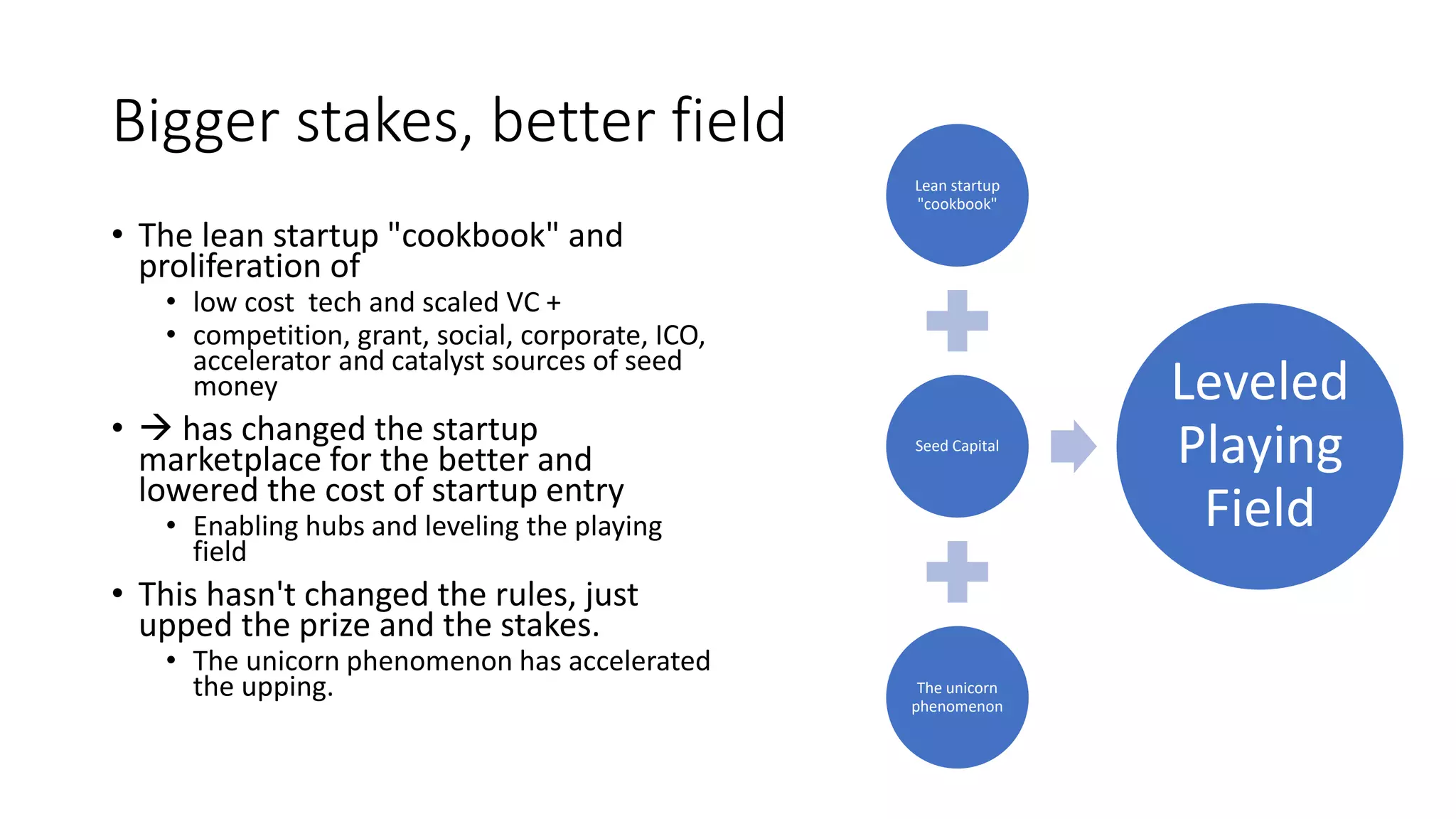
• The lean startup "cookbook" and
proliferation of
• low cost tech and scaled VC +
• competition, grant, social, corporate, ICO,
accelerator and catalyst sources of seed
money
•  has changed the startup
marketplace for the better and
lowered the cost of startup entry
• Enabling hubs and leveling the playing
field
• This hasn't changed the rules, just
upped the prize and the stakes.
• The unicorn phenomenon has accelerated
the upping.
Lean startup
"cookbook"
Seed Capital
The unicorn
phenomenon
Leveled
Playing
Field
Massively parallel R&D/
commercialization vs
stage gate style
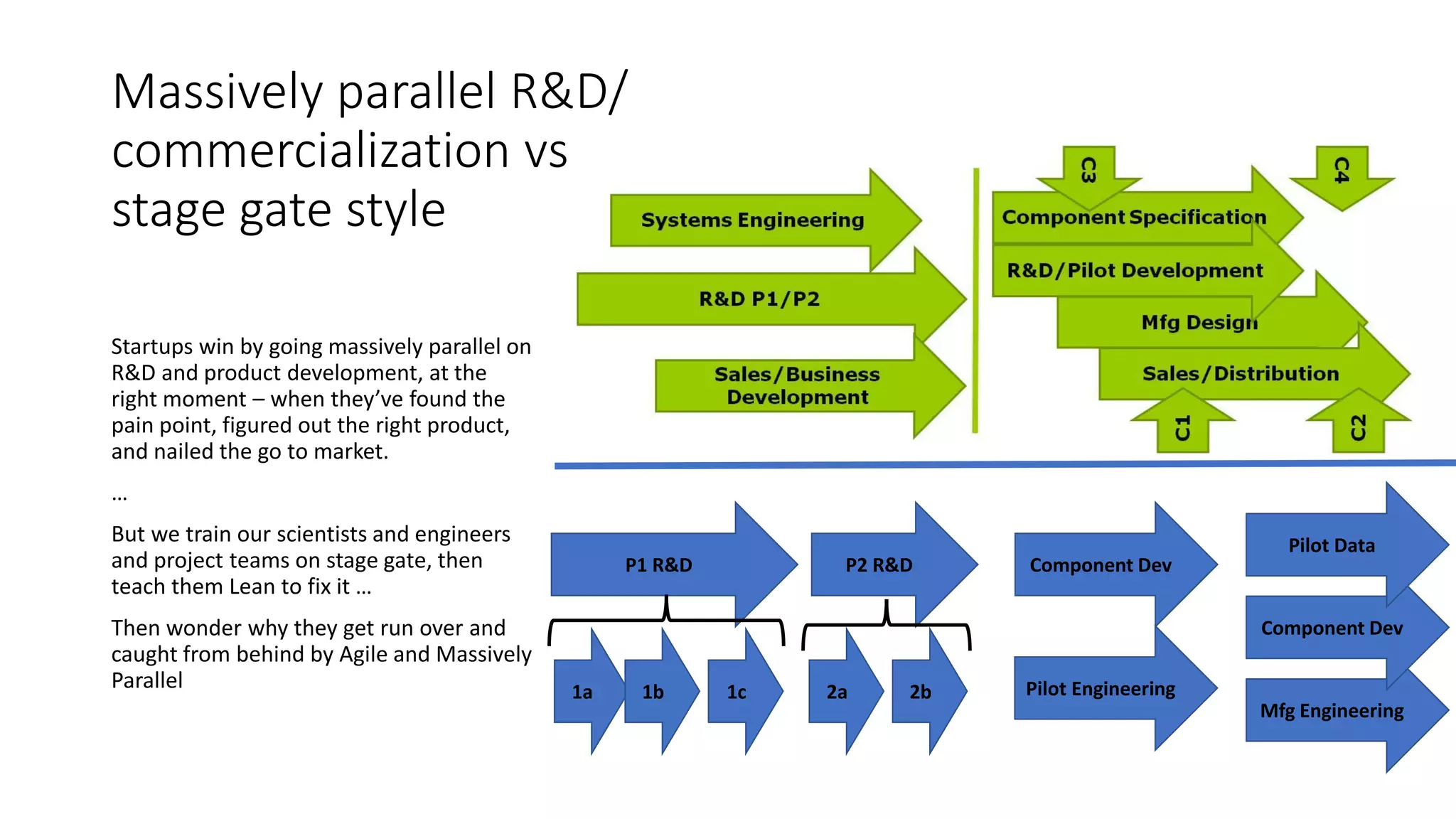
Startups win by going massively parallel on
R&D and product development, at the
right moment – when they’ve found the
pain point, figured out the right product,
and nailed the go to market.
…
But we train our scientists and engineers
and project teams on stage gate, then
teach them Lean to fix it …
Then wonder why they get run over and
caught from behind by Agile and Massively
Parallel
Component DevP1 R&D P2 R&D
1a 1b 1c 2a
Mfg Engineering
Component Dev
Pilot Data
2b Pilot Engineering
Startup resource & skills math
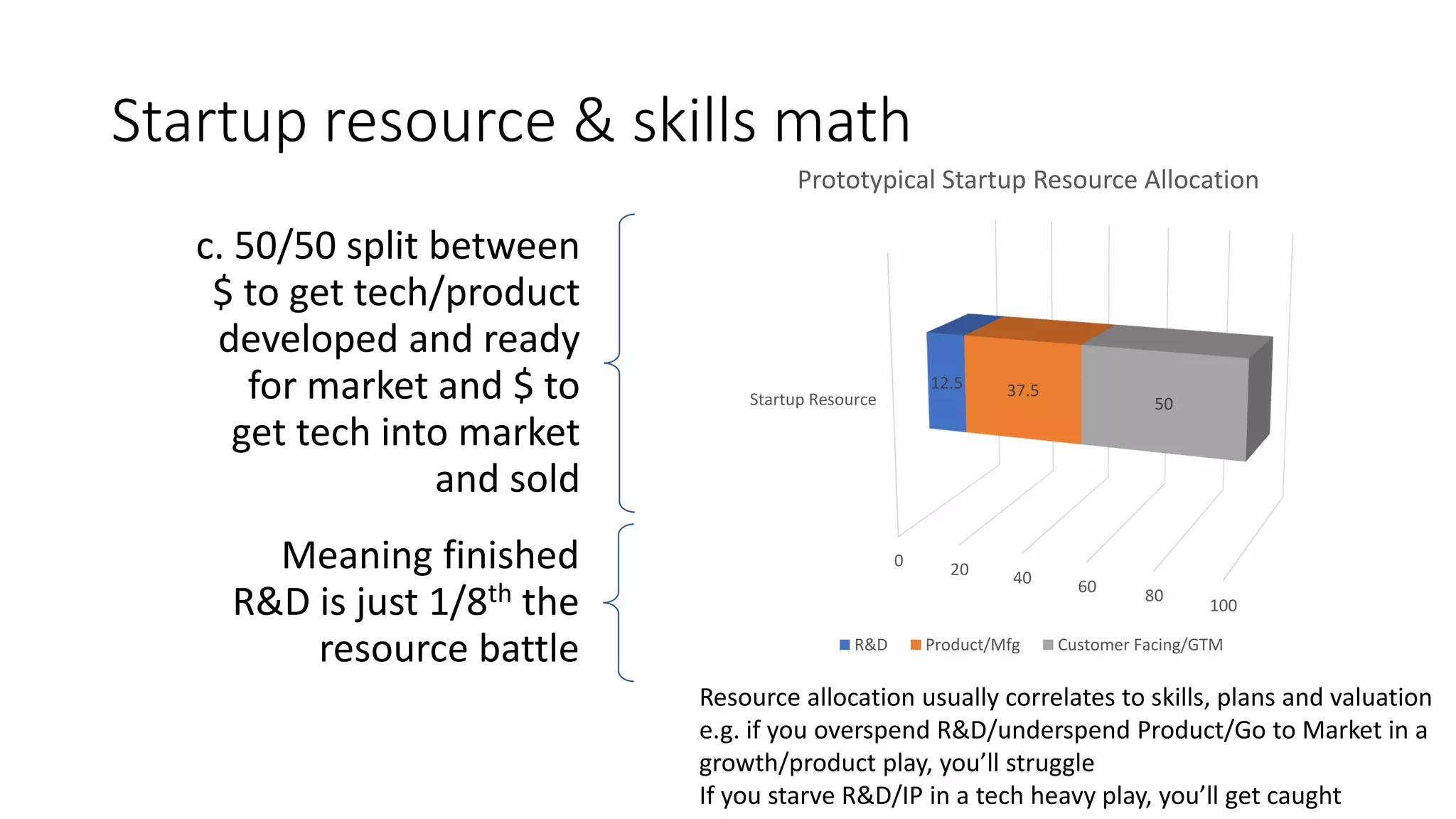
c. 50/50 split between
$ to get tech/product
developed and ready
for market and $ to
get tech into market
and sold
Meaning finished
R&D is just 1/8th the
resource battle
0 20 40 60 80
100
Startup Resource
12.5 37.5
50
Prototypical Startup Resource Allocation
R&D Product/Mfg Customer Facing/GTM
Resource allocation usually correlates to skills, plans and valuation
e.g. if you overspend R&D/underspend Product/Go to Market in a
growth/product play, you’ll struggle
If you starve R&D/IP in a tech heavy play, you’ll get caught
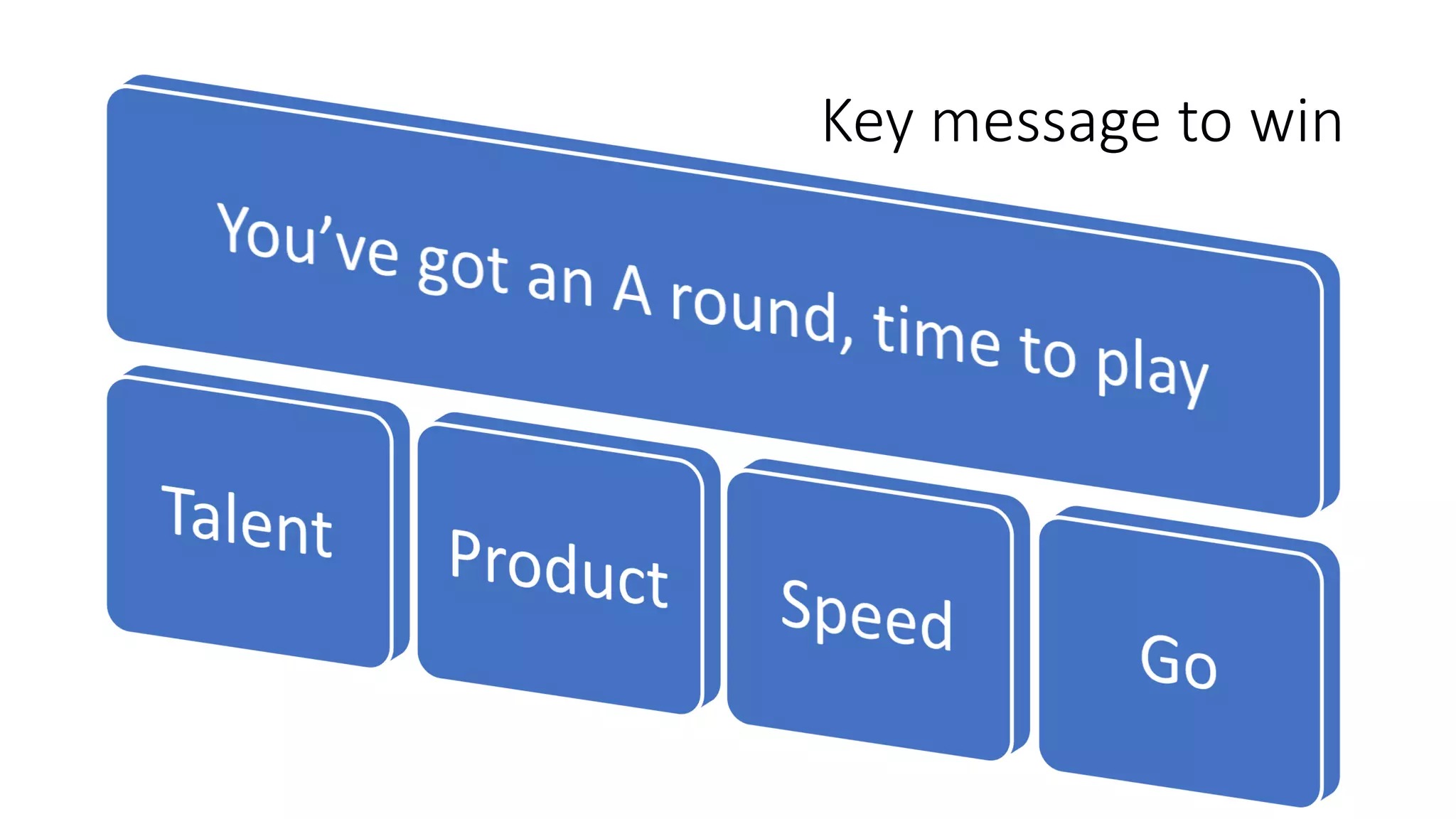
Key message to win
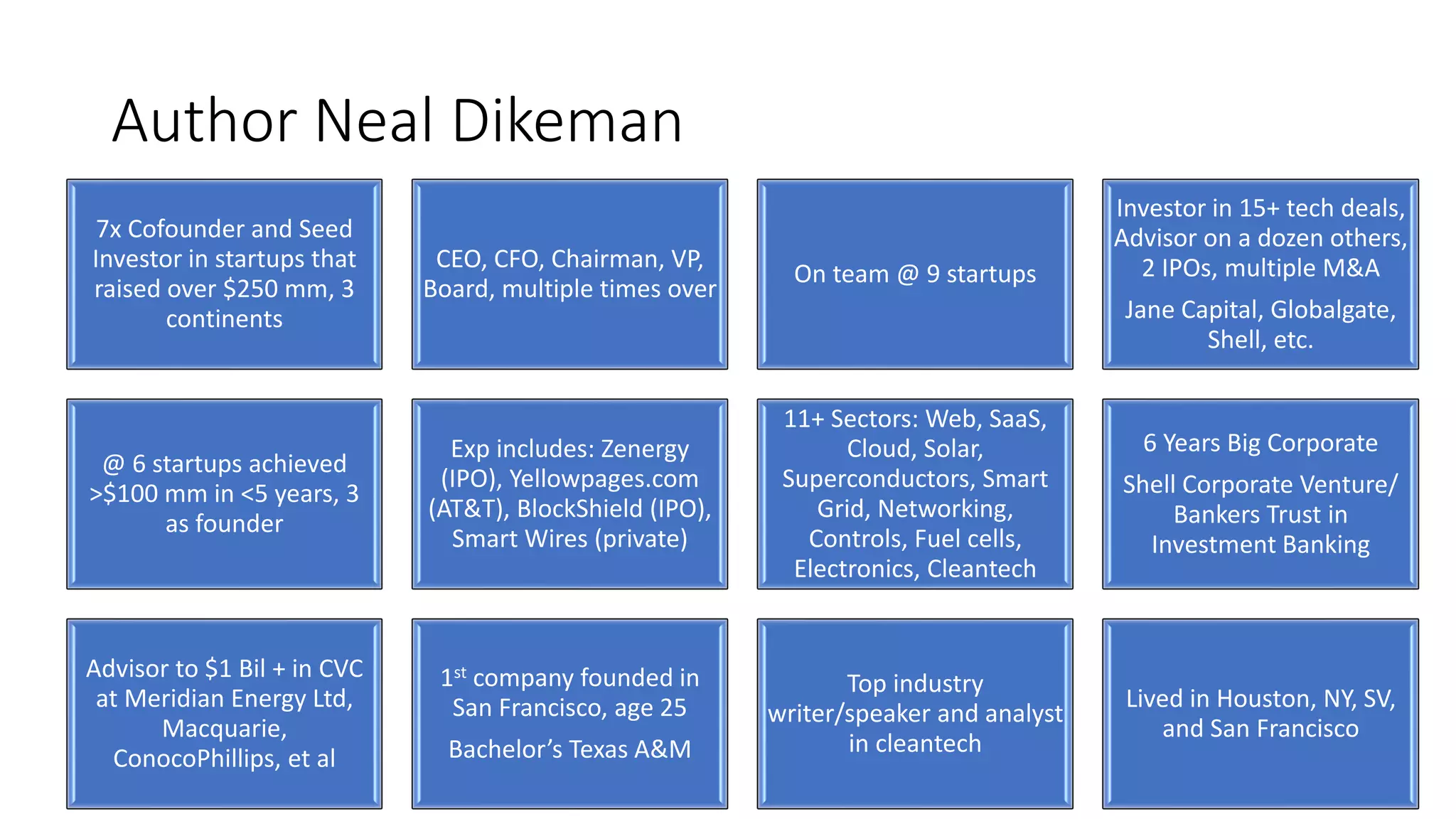
Author Neal Dikeman
7x Cofounder and Seed
Investor in startups that
raised over $250 mm, 3
continents
CEO, CFO, Chairman, VP,
Board, multiple times over
On team @ 9 startups
Investor in 15+ tech deals,
Advisor on a dozen others,
2 IPOs, multiple M&A
Jane Capital, Globalgate,
Shell, etc.
@ 6 startups achieved
>$100 mm in <5 years, 3
as founder
Exp includes: Zenergy
(IPO), Yellowpages.com
(AT&T), BlockShield (IPO),
Smart Wires (private)
11+ Sectors: Web, SaaS,
Cloud, Solar,
Superconductors, Smart
Grid, Networking,
Controls, Fuel cells,
Electronics, Cleantech
6 Years Big Corporate
Shell Corporate Venture/
Bankers Trust in
Investment Banking
Advisor to $1 Bil + in CVC
at Meridian Energy Ltd,
Macquarie,
ConocoPhillips, et al
1st company founded in
San Francisco, age 25
Bachelor’s Texas A&M
Top industry
writer/speaker and analyst
in cleantech
Lived in Houston, NY, SV,
and San Francisco

Startuplandia Unplugged - How to do a Startup

  • 1.
    StartupLandia Unplugged “We eachhave a choice in life: work for somebody, or start something.” - Neal Dikeman “Anyone can be an expert on anything, given 5 years.” - Bill Salathiel, PhD
  • 2.
    Concerned that your startupis not flying or your town is weak on startups? Let’s explore what makes a startup tick
  • 3.
    Start with theproblem statement So, you want to build a startup or attract startups to your town? You need to understand how startups and startup herds evolve StartupLandia Unplugged is a brief storyboard on the key elements of a startup herd from a 7x founder
  • 4.
    Herd Herds are justan aggregation of individual startups. Herds evolve and move fast – customer interest, competitor progress, and investor demand. To build or compete in a Herd, you have to move fast, or evolve, too.
  • 5.
    Startup Herd 101 Foundinga Startup To understand how to build an ecosystem, you need to understand the elements that make a single company a) able to launch and aggregate capital, b) able to successful Startup Herd How Does a Startup Herd Thrive? • In the Tier 1 startup markets • Public - private partnership and nonprofit has a huge role in education, infrastructure, and R&D • Startup Herd handles company formation, and ecosystem, capital
  • 6.
    Money follows teams, Exits driverepeats. Teams hunt the next big problems and big ideas and big customer demand, How Startups and Herds evolve There is always capital for good deals Money and technology does not make a good deal, people and problems do
  • 7.
    Sectors get Disrupted By Themes Tocreate new Industries IoT Blockchain Machine Learning The Next Big Thing Themes and Trends are Frustratingly Fast – launching in overlapping waves as short as 9-15 months
  • 8.
    Software is eatingthe world has yet to be proven untrue … and is dangerous to bet against. Software Force multiplier for almost all markets
  • 9.
    Underneath, most hubsand trends are the story of just a couple of founders Netscape Virginia/Dotcom Amgen / Genentech  Biotech SF Amazon  Seattle Intel  Portland Dell  Austin Tesla  EVs First Solar  Cleantech Uber  Mobility Twitter  San Francisco Grubhub/Groupon Chicago Apple Smartphone Facebook Social
  • 10.
    Launching Launching is notactually about Lean Startup or delivering results – that’s what Winning is about – Launching is about doing what it takes on limited resources to aggregate enough people and cash resources to take a shot on goal.
  • 11.
    What matters tolaunch a startup: • People • Problem in a Big Market • Technology • In that order, then everything else • and if you only get one, pick people, they can find the other 2 Go Technology Problem People Go Customer Traction/ Validation Fundable Go
  • 12.
    What makes afundable "deal"  and Accelerating demand, traction, validation and investor interest while you raise Full team that's either experienced and successful in other startups, or beginning of career, unproven but displays lightning fast results, command of its problem, and coachable like a sponge Sexy as hell technology/innovation that just resonates and knocks the key barrier to adoption Customer and user traction on whatever is built/demonstrated so far Clear path to make money and scale in a VBM (Very Big Market) Fundable
  • 13.
    Houston, we havea problem What you think you Need What you actually NeedI need money To hire people To build product To grow revenues  I have a team That has customers For the tech we’ve built I need money To deliver my growth faster
  • 14.
    A startup cango lightning fast, very big, on very little -- lack of capital is rarely the real culprit Very little cash and time is actually needed to launch a successful startup if the team knows what they are doing . Good ones can go big, fast. Everyone starts small. Google - $25 mm in total venture capital to build a company bigger than Shell in barely a decade •Averaged c. $300K seed investment and 9-12 months to reach a $3-$10 mm A round  e.g. •Zenergy (GridEdge): $300K to $300 mm in 30 months in superconductors •Smart Wires (GridEdge): $300K  $10 mm A round in 15 months  lab to field in 330 days My own startups - 7x founder of startups that raised cum >$250 mm in venture capital
  • 15.
    3 skills requiredin the founding team It always seems to take 3 – 3 who understand or can learn how to translate skills to a startup environment Built around a CTO who is just short of genius. A rainmaker in sales, and A CEO who's got game
  • 16.
    People first  •If the founders can't pull an A team, there is no startup, and he/she/they are no founder
  • 17.
  • 18.
    Winning Building a businessthat can win is not always the same as doing what you need to do to get the A round and launch. Once Launch is done, you have enough resources to make a go – now you have to deploy them to build product, make happy customer, grow, scale, and get more resources
  • 19.
    You need criticalmass of startup talent in your tent to compete. Young is ok, experienced but new to StartupLandia – not so much. • other successful startups, and • top flight technical graduate/undergraduate programs, and top flight MBA programs • venture funds Great founder talent tends to be early to mid career, and tends to comes from 1 of 2 places: • serial entrepreneurs in other startups, and • venture firms, • But big company with no startup or tech experience is always risky Great startup talent in general comes from a range of places
  • 20.
    A startup's cultureis usually pretty set in the first couple of years – by the first few hires - and your culture is your life. Advisors,board,incubators,consultants etcarereallyjustacommodity(butwe allpretendtheyaddvalue). Great founders, leaders, sales people, engineers, matter most Advisors, Board, Lawyers etc Incubator/ Accelerator
  • 21.
    It’s fast roughand tumble Startup world is not nice Ideate, test, aggregate resources, build deliver or fail and try again Premium on speed – up or out If you are talking about the same things 9 months from now, you’re already dead “Baptism by fire” “Vulture capitalist” “Up or out” “Root hog or die” “What have you done for me lately” “The only constant is change” … Pick your favorite aphorism … But don’t stand still If you talk “Fail Fast” and “Lean Startup” be ready to walk the walk
  • 22.
    Your stuff hasto be new and good Content is still king Vision matters. Tech delivers. Metoodoesnotusuallywin asfirstmoveradvantagesarereal
  • 23.
    It’s the ProductStupid • Product - what you build and how you take it to market, is as important as the technology in most cases, even in high science tech like life sciences and energy. • If it isn’t going fast or well – look to the product - you generally need Product Management/Channel/ Product Marketing expertise so bad you can taste it.
  • 24.
    Speed kills • Startupsideas come in waves, aka the “herd mentality”  catching waves matters, leading waves wins, chasing waves is death • The lifecycle of the early stage window and investable front end of a theme or wave in venture tends to be short - 36-60 months max • What investors are talking about now, is what they invested in LAST year • A fund commits most of its capital in < 36 months • A startup has 12-24 months between raises • That’s why call it burn rate • Often massively parallel can catch from behind as fast as you can add engineers • You need to measure your actions in days and weeks – and build speed into your team
  • 25.
    The only wayto kill a startup is to run out of And if you have one, you can usually get the other … ergo, the only way to kill a startup is to run out of BOTH people and cash … - Raise cash when you can, as much as you can – your business is good enough to win, you’ll - Never stop recruiting people and raising cash - Pay attention to burn rate/time - Hire from the top down, not bottom up – get exec people who know how to raise cash and get more people - Get Chiefs who will work like Indians first, not Indians or Chiefs who need to have Indians to work People or Cash. .
  • 26.
    Bigger stakes, betterfield • The lean startup "cookbook" and proliferation of • low cost tech and scaled VC + • competition, grant, social, corporate, ICO, accelerator and catalyst sources of seed money •  has changed the startup marketplace for the better and lowered the cost of startup entry • Enabling hubs and leveling the playing field • This hasn't changed the rules, just upped the prize and the stakes. • The unicorn phenomenon has accelerated the upping. Lean startup "cookbook" Seed Capital The unicorn phenomenon Leveled Playing Field
  • 27.
    Massively parallel R&D/ commercializationvs stage gate style Startups win by going massively parallel on R&D and product development, at the right moment – when they’ve found the pain point, figured out the right product, and nailed the go to market. … But we train our scientists and engineers and project teams on stage gate, then teach them Lean to fix it … Then wonder why they get run over and caught from behind by Agile and Massively Parallel Component DevP1 R&D P2 R&D 1a 1b 1c 2a Mfg Engineering Component Dev Pilot Data 2b Pilot Engineering
  • 28.
    Startup resource &skills math c. 50/50 split between $ to get tech/product developed and ready for market and $ to get tech into market and sold Meaning finished R&D is just 1/8th the resource battle 0 20 40 60 80 100 Startup Resource 12.5 37.5 50 Prototypical Startup Resource Allocation R&D Product/Mfg Customer Facing/GTM Resource allocation usually correlates to skills, plans and valuation e.g. if you overspend R&D/underspend Product/Go to Market in a growth/product play, you’ll struggle If you starve R&D/IP in a tech heavy play, you’ll get caught
  • 29.
  • 30.
    Author Neal Dikeman 7xCofounder and Seed Investor in startups that raised over $250 mm, 3 continents CEO, CFO, Chairman, VP, Board, multiple times over On team @ 9 startups Investor in 15+ tech deals, Advisor on a dozen others, 2 IPOs, multiple M&A Jane Capital, Globalgate, Shell, etc. @ 6 startups achieved >$100 mm in <5 years, 3 as founder Exp includes: Zenergy (IPO), Yellowpages.com (AT&T), BlockShield (IPO), Smart Wires (private) 11+ Sectors: Web, SaaS, Cloud, Solar, Superconductors, Smart Grid, Networking, Controls, Fuel cells, Electronics, Cleantech 6 Years Big Corporate Shell Corporate Venture/ Bankers Trust in Investment Banking Advisor to $1 Bil + in CVC at Meridian Energy Ltd, Macquarie, ConocoPhillips, et al 1st company founded in San Francisco, age 25 Bachelor’s Texas A&M Top industry writer/speaker and analyst in cleantech Lived in Houston, NY, SV, and San Francisco