Datanomics
Costs, Benefits, and Value of Research Data
Neil Beagrie
(Charles Beagrie Ltd)
Digital Assets and Digital Liabilities: the Value of Data
DPC/Jisc Invitational Workshop, Glasgow, February 2019
Some (KRDS) Partners
Presentation Outline
• Costs
• Benefits (Qualitative Approaches)
• Valuing Intangible Assets (Quantitive Approaches)
• Where Do We Go From Here?
»“What to Keep” study
»Infonomics – an industry perspective
• Concluding thoughts
Costs
Costs
Activity Cost Models
• Many examples – a few generic (intended for broadly
based community), most organisation-specific (derived)
• Substantial effort to create
Activity Cost Data
• Can be created in a consistent form using a ACM
• Cost Data still takes significant effort to collect and may
be incomplete. “Total Costs of Curation” can be
distributed across many budget centres/departments
Cost Trends
• Cost data can give trends and “Laws” or “rules of
thumb” that are very powerful tools
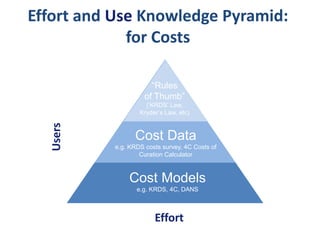
Effort and Use Knowledge Pyramid:
for Costs
Cost Models
e.g. KRDS, 4C, DANS
Cost Data
e.g. KRDS costs survey, 4C Costs of
Curation Calculator
“Rules
of Thumb”
(‘KRDS’ Law,
Kryder’s Law, etc)
Effort
Users
Costs Rules of Thumb (1)
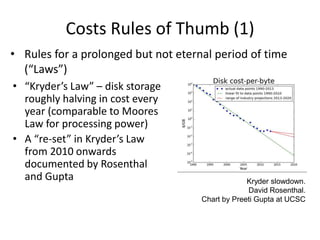
• “Kryder’s Law” – disk storage
roughly halving in cost every
year (comparable to Moores
Law for processing power)
• A “re-set” in Kryder’s Law
from 2010 onwards
documented by Rosenthal
and Gupta
• Rules for a prolonged but not eternal period of time
(“Laws”)
Kryder slowdown.
David Rosenthal.
Chart by Preeti Gupta at UCSC
Costs: KRDS Laws/Rules of Thumb
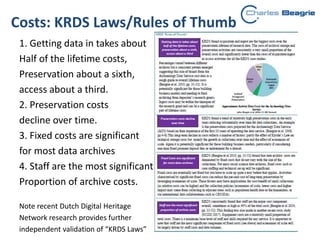
1. Getting data in takes about
Half of the lifetime costs,
Preservation about a sixth,
access about a third.
2. Preservation costs
decline over time.
3. Fixed costs are significant
for most data archives
4. Staff are the most significant
Proportion of archive costs.
Note recent Dutch Digital Heritage
Network research provides further
independent validation of “KRDS Laws”
Benefits
(Qualitative)
Assessing Benefits
• A number of qualitative methods for conveying
institutional benefits of different types e.g. Balanced
Scorecard
• A specific method developed for conveying benefits of
research data is the KRDS Benefits Framework
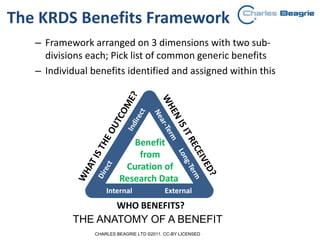
The KRDS Benefits Framework
– Framework arranged on 3 dimensions with two sub-
divisions each; Pick list of common generic benefits
– Individual benefits identified and assigned within this
Internal External
WHO BENEFITS?
Benefit
from
Curation of
Research Data
THE ANATOMY OF A BENEFIT
CHARLES BEAGRIE LTD ©2011. CC-BY LICENSED
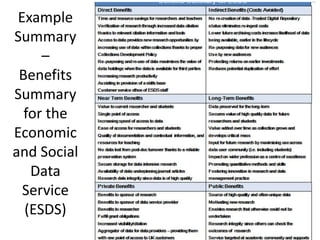
Example
Summary
–
Benefits
Summary
for the
Economic
and Social
Data
Service
(ESDS)
Valuing Intangible Assets
• Valuable approach to digital preservation and
intangibles by Laurie Hunter and since adapted for
research data
• We measure value of data services not just data alone
• Measuring value of intangible assets is hard – much
harder than for physical assets
• Economic methods are well established but difficult to
get the cost and value data to use in them
• Counter-factuals – a baseline – are important
• Collaboration with John Houghton to move beyond
qualitative value to financial measures of value
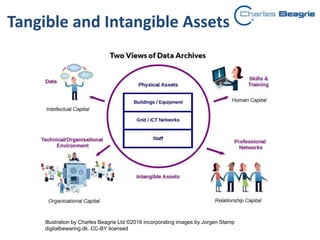
Tangible and Intangible Assets
Illustration by Charles Beagrie Ltd ©2016 incorporating images by Jorgen Stamp
digitalbewaring.dk. CC-BY licensed
John Houghton (Victoria University) + Neil Beagrie (Charles Beagrie
Ltd) 4 joint studies. Methods applied to:
Economic & Social Data Service (ESDS)
Archaeology Data Service
British Atmospheric Data Centre
European Bioinformatics Institute
Value + Economic Impact Analysis s
s of Data Services
• Investment value: annual operational funding plus the costs
that depositors face in preparing data for deposit and in making
those deposits
• Use value: weighted average user access costs multiplied by the
number of accesses
• Contingent value: the amount users are "willing to pay“ for or
“willing to accept” in return for giving up access
• Efficiency gain: user estimates of time saved by using the Data
Service resources
• Return on Investment in the data service: standard ROI
• Return on investment in the data creation: the estimated
increase in return on investment to the funder(s) in the data
creation due to the additional use facilitated by the data service
Economic Metrics Used
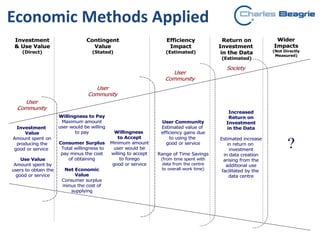
Economic Methods Applied
Investment
& Use Value
(Direct)
Contingent
Value
(Stated)
Efficiency
Impact
(Estimated)
Return on
Investment
in the Data
(Estimated)
User
Community
User
Community
Society
Wider
Impacts
(Not Directly
Measured)
?
Investment
Value
Amount spent on
producing the
good or service
Use Value
Amount spent by
users to obtain the
good or service
Willingness to Pay
Maximum amount
user would be willing
to pay
Consumer Surplus
Total willingness to
pay minus the cost
of obtaining
Net Economic
Value
Consumer surplus
minus the cost of
supplying
Willingness
to Accept
Minimum amount
user would be
willing to accept
to forego
good or service
User Community
Estimated value of
efficiency gains due
to using the
good or service
Range of Time Savings
(from time spent with
data from the centre
to overall work time)
Increased
Return on
Investment
in the Data
Estimated increase
in return on
investment
in data creation
arising from the
additional use
facilitated by the
data centre
User
Community
ESDS Value/Impact Analysis
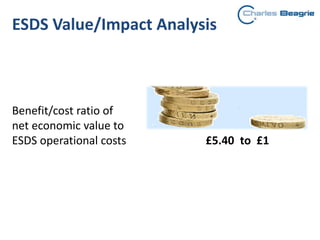
Benefit/cost ratio of
net economic value to
ESDS operational costs £5.40 to £1
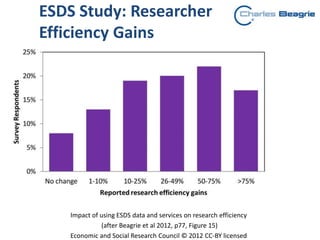
ESDS Study: Researcher
Efficiency Gains
Impact of using ESDS data and services on research efficiency
(after Beagrie et al 2012, p77, Figure 15)
Economic and Social Research Council © 2012 CC-BY licensed
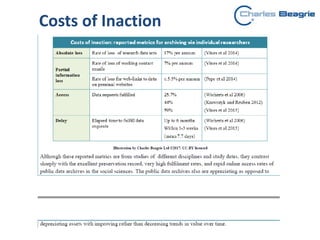
Counter-factuals – “Costs of Inaction”
“Ideally, economic impact assessments should estimate
the counterfactual – i.e. what would occur in the
absence of the facility…However, counterfactuals are
rarely addressed in the [c.100] studies reviewed due to
lack of data. We found two exceptions that address this
issue partially. One is the evaluation of the economic
impacts of ESDS (2012) which partially explores the
counterfactual through a users’ survey…Another
exception is a review of economic impacts of large-scale
science facilities in the UK (SQW, 2008) … however, this
estimation is not done rigorously and relies mostly on
the estimation of the local benefits.”
Big Science and Innovation - Report to BIS - Technopolis
2013
Costs of Inaction
Where Could We Go From
Here?
What to Keep
New Jisc research data study
• Recommendation 4: Investigate the relative
costs and benefits of differential curation
levels, storage, or appraisal for what to keep
for the two major use cases (Research
Integrity, and Reuse) identified in the study.
Recommendations
Levels of Curation
US National Science Board 2005 Long-lived Data Collections
two-tier system with differential curation levels used by the
UKDS or the DANS data archive’s systems - DataverseNL for
short-term data management (up to 10 years) and EASY for
long-term archiving, in the Netherlands. Both these examples
in the UK and the Netherlands have different time horizons
(how long the data is kept), costs in terms of metadata and
preservation care (how it is kept) for their two systems, with
the option to move from short-term to long-term systems and
curation levels after future appraisal (or alternatively be
maintained in their existing short-term system/ or deleted).
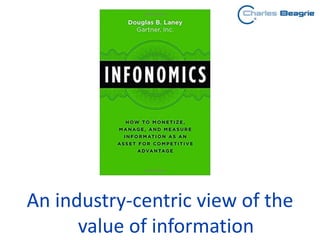
An industry-centric view of the
value of information
Accounting for Information
Some Infonomics Quotes
• “Five or six decades since the beginning of the
Information Age, the namesake of this age, and the
major asset driving today’s economy, is still not
considered an accounting asset”
• “Corporations typically exhibit greater discipline in
tracking and accounting for their office furniture
than their data”
• Bottom line - Data stewards are not alone in seeing
this as an anomaly. There are others pressing for
changes to insurance and accounting practices.
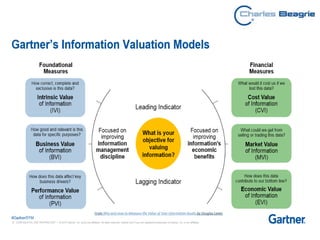
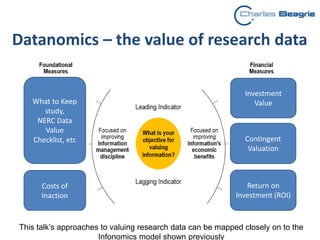
Costs of
Inaction
Investment
Value
Contingent
Valuation
Return on
Investment (ROI)
What to Keep
study,
NERC Data
Value
Checklist, etc
Datanomics – the value of research data
This talk’s approaches to valuing research data can be mapped closely on to the
Infonomics model shown previously
Conclusions
• We can use collections of cost data to look for trends –
rules of thumb are probably the most widely useful cost
information.
• “Datanomics” and “Infonomics” have synergies - we may
be able to leverage efforts within our community and
industry.
• Need to investigate the relative costs and benefits of
differential curation levels, storage, or appraisal for the
two major use cases (Research Integrity, and Reuse)
identified in the What to Keep study.
• We have Hierarchical Storage Management in IT – in
time can we look towards automating some decisions as
Hierarchical Curation Management?
Further Information
• Costs, Benefits, and ROI for Research Data
– CESSDA SaW Cost-Benefit Advocacy Toolkit,
http://dx.doi.org/10.18448/16.0013
• Economic Impact Studies of Research Data Services
– The Value and Impact of Data Sharing and Curation: A synthesis
of three recent studies of UK research data centres
http://repository.jisc.ac.uk/5568/1/iDF308_-
_Digital_Infrastructure_Directions_Report%2C_Jan14_v1-
04.pdf
• What to Keep: a Jisc research data study
https://repository.jisc.ac.uk/7262/
• Douglas B. Laney 2017 Infonomics: How to Monetize, Manage, and
Measure Information as an Asset for Competitive Advantage
– ISBN-13: 978-1138090385

Datanomics: the value of research data.

  • 1.
    Datanomics Costs, Benefits, andValue of Research Data Neil Beagrie (Charles Beagrie Ltd) Digital Assets and Digital Liabilities: the Value of Data DPC/Jisc Invitational Workshop, Glasgow, February 2019
  • 2.
  • 3.
    Presentation Outline • Costs •Benefits (Qualitative Approaches) • Valuing Intangible Assets (Quantitive Approaches) • Where Do We Go From Here? »“What to Keep” study »Infonomics – an industry perspective • Concluding thoughts
  • 4.
  • 5.
    Costs Activity Cost Models •Many examples – a few generic (intended for broadly based community), most organisation-specific (derived) • Substantial effort to create Activity Cost Data • Can be created in a consistent form using a ACM • Cost Data still takes significant effort to collect and may be incomplete. “Total Costs of Curation” can be distributed across many budget centres/departments Cost Trends • Cost data can give trends and “Laws” or “rules of thumb” that are very powerful tools
  • 6.
    Effort and UseKnowledge Pyramid: for Costs Cost Models e.g. KRDS, 4C, DANS Cost Data e.g. KRDS costs survey, 4C Costs of Curation Calculator “Rules of Thumb” (‘KRDS’ Law, Kryder’s Law, etc) Effort Users
  • 7.
    Costs Rules ofThumb (1) • “Kryder’s Law” – disk storage roughly halving in cost every year (comparable to Moores Law for processing power) • A “re-set” in Kryder’s Law from 2010 onwards documented by Rosenthal and Gupta • Rules for a prolonged but not eternal period of time (“Laws”) Kryder slowdown. David Rosenthal. Chart by Preeti Gupta at UCSC
  • 8.
    Costs: KRDS Laws/Rulesof Thumb 1. Getting data in takes about Half of the lifetime costs, Preservation about a sixth, access about a third. 2. Preservation costs decline over time. 3. Fixed costs are significant for most data archives 4. Staff are the most significant Proportion of archive costs. Note recent Dutch Digital Heritage Network research provides further independent validation of “KRDS Laws”
  • 9.
  • 10.
    Assessing Benefits • Anumber of qualitative methods for conveying institutional benefits of different types e.g. Balanced Scorecard • A specific method developed for conveying benefits of research data is the KRDS Benefits Framework
  • 11.
    The KRDS BenefitsFramework – Framework arranged on 3 dimensions with two sub- divisions each; Pick list of common generic benefits – Individual benefits identified and assigned within this Internal External WHO BENEFITS? Benefit from Curation of Research Data THE ANATOMY OF A BENEFIT CHARLES BEAGRIE LTD ©2011. CC-BY LICENSED
  • 12.
  • 13.
  • 14.
    Valuing Intangible Assets •Valuable approach to digital preservation and intangibles by Laurie Hunter and since adapted for research data • We measure value of data services not just data alone • Measuring value of intangible assets is hard – much harder than for physical assets • Economic methods are well established but difficult to get the cost and value data to use in them • Counter-factuals – a baseline – are important • Collaboration with John Houghton to move beyond qualitative value to financial measures of value
  • 15.
    Tangible and IntangibleAssets Illustration by Charles Beagrie Ltd ©2016 incorporating images by Jorgen Stamp digitalbewaring.dk. CC-BY licensed
  • 16.
    John Houghton (VictoriaUniversity) + Neil Beagrie (Charles Beagrie Ltd) 4 joint studies. Methods applied to: Economic & Social Data Service (ESDS) Archaeology Data Service British Atmospheric Data Centre European Bioinformatics Institute Value + Economic Impact Analysis s s of Data Services
  • 17.
    • Investment value:annual operational funding plus the costs that depositors face in preparing data for deposit and in making those deposits • Use value: weighted average user access costs multiplied by the number of accesses • Contingent value: the amount users are "willing to pay“ for or “willing to accept” in return for giving up access • Efficiency gain: user estimates of time saved by using the Data Service resources • Return on Investment in the data service: standard ROI • Return on investment in the data creation: the estimated increase in return on investment to the funder(s) in the data creation due to the additional use facilitated by the data service Economic Metrics Used
  • 18.
    Economic Methods Applied Investment &Use Value (Direct) Contingent Value (Stated) Efficiency Impact (Estimated) Return on Investment in the Data (Estimated) User Community User Community Society Wider Impacts (Not Directly Measured) ? Investment Value Amount spent on producing the good or service Use Value Amount spent by users to obtain the good or service Willingness to Pay Maximum amount user would be willing to pay Consumer Surplus Total willingness to pay minus the cost of obtaining Net Economic Value Consumer surplus minus the cost of supplying Willingness to Accept Minimum amount user would be willing to accept to forego good or service User Community Estimated value of efficiency gains due to using the good or service Range of Time Savings (from time spent with data from the centre to overall work time) Increased Return on Investment in the Data Estimated increase in return on investment in data creation arising from the additional use facilitated by the data centre User Community
  • 19.
    ESDS Value/Impact Analysis Benefit/costratio of net economic value to ESDS operational costs £5.40 to £1
  • 20.
    ESDS Study: Researcher EfficiencyGains Impact of using ESDS data and services on research efficiency (after Beagrie et al 2012, p77, Figure 15) Economic and Social Research Council © 2012 CC-BY licensed
  • 21.
    Counter-factuals – “Costsof Inaction” “Ideally, economic impact assessments should estimate the counterfactual – i.e. what would occur in the absence of the facility…However, counterfactuals are rarely addressed in the [c.100] studies reviewed due to lack of data. We found two exceptions that address this issue partially. One is the evaluation of the economic impacts of ESDS (2012) which partially explores the counterfactual through a users’ survey…Another exception is a review of economic impacts of large-scale science facilities in the UK (SQW, 2008) … however, this estimation is not done rigorously and relies mostly on the estimation of the local benefits.” Big Science and Innovation - Report to BIS - Technopolis 2013
  • 22.
  • 23.
    Where Could WeGo From Here?
  • 24.
    What to Keep NewJisc research data study
  • 25.
    • Recommendation 4:Investigate the relative costs and benefits of differential curation levels, storage, or appraisal for what to keep for the two major use cases (Research Integrity, and Reuse) identified in the study. Recommendations
  • 26.
    Levels of Curation USNational Science Board 2005 Long-lived Data Collections two-tier system with differential curation levels used by the UKDS or the DANS data archive’s systems - DataverseNL for short-term data management (up to 10 years) and EASY for long-term archiving, in the Netherlands. Both these examples in the UK and the Netherlands have different time horizons (how long the data is kept), costs in terms of metadata and preservation care (how it is kept) for their two systems, with the option to move from short-term to long-term systems and curation levels after future appraisal (or alternatively be maintained in their existing short-term system/ or deleted).
  • 27.
    An industry-centric viewof the value of information
  • 28.
    Accounting for Information SomeInfonomics Quotes • “Five or six decades since the beginning of the Information Age, the namesake of this age, and the major asset driving today’s economy, is still not considered an accounting asset” • “Corporations typically exhibit greater discipline in tracking and accounting for their office furniture than their data” • Bottom line - Data stewards are not alone in seeing this as an anomaly. There are others pressing for changes to insurance and accounting practices.
  • 30.
    Costs of Inaction Investment Value Contingent Valuation Return on Investment(ROI) What to Keep study, NERC Data Value Checklist, etc Datanomics – the value of research data This talk’s approaches to valuing research data can be mapped closely on to the Infonomics model shown previously
  • 31.
    Conclusions • We canuse collections of cost data to look for trends – rules of thumb are probably the most widely useful cost information. • “Datanomics” and “Infonomics” have synergies - we may be able to leverage efforts within our community and industry. • Need to investigate the relative costs and benefits of differential curation levels, storage, or appraisal for the two major use cases (Research Integrity, and Reuse) identified in the What to Keep study. • We have Hierarchical Storage Management in IT – in time can we look towards automating some decisions as Hierarchical Curation Management?
  • 32.
    Further Information • Costs,Benefits, and ROI for Research Data – CESSDA SaW Cost-Benefit Advocacy Toolkit, http://dx.doi.org/10.18448/16.0013 • Economic Impact Studies of Research Data Services – The Value and Impact of Data Sharing and Curation: A synthesis of three recent studies of UK research data centres http://repository.jisc.ac.uk/5568/1/iDF308_- _Digital_Infrastructure_Directions_Report%2C_Jan14_v1- 04.pdf • What to Keep: a Jisc research data study https://repository.jisc.ac.uk/7262/ • Douglas B. Laney 2017 Infonomics: How to Monetize, Manage, and Measure Information as an Asset for Competitive Advantage – ISBN-13: 978-1138090385