Kidney Care
Getting it right:
End of life care in
advanced kidney disease
MARCH 2012
Better Kidney Care for All


 Reader Page

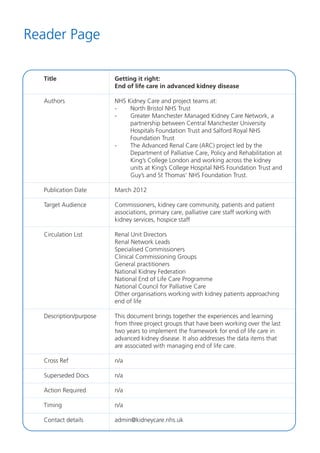
Title Getting it right:
End of life care in advanced kidney disease
Authors  NHS Kidney Care and project teams at:
­ North Bristol NHS Trust
­ Greater Manchester Managed Kidney Care Network, a 
partnership between Central Manchester University 
Hospitals Foundation Trust and Salford Royal NHS 
Foundation Trust
­ The Advanced Renal Care (ARC) project led by the 
Department of Palliative Care, Policy and Rehabilitation at
King’s College London and working across the kidney 
units at King’s College Hospital NHS Foundation Trust and
Guy’s and St Thomas’ NHS Foundation Trust.
Publication Date March 2012
Target Audience  Commissioners, kidney care community, patients and patient
associations, primary care, palliative care staff working with
kidney services, hospice staff
Circulation List Renal Unit Directors
Renal Network Leads
Specialised Commissioners
Clinical Commissioning Groups
General practitioners
National Kidney Federation
National End of Life Care Programme
National Council for Palliative Care
Other organisations working with kidney patients approaching
end of life
Description/purpose This document brings together the experiences and learning
from three project groups that have been working over the last
two years to implement the framework for end of life care in
advanced kidney disease. It also addresses the data items that
are associated with managing end of life care.
Cross Ref n/a
Superseded Docs  n/a
Action Required n/a
Timing n/a
Contact details  admin@kidneycare.nhs.uk 


Contents

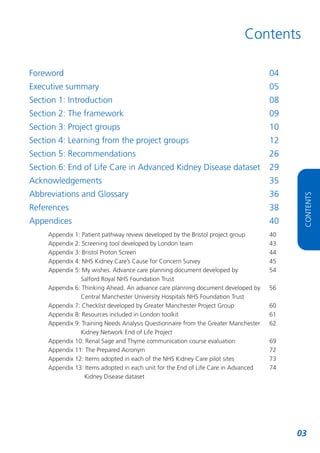
Foreword 04
Executive summary 05
Section 1: Introduction 08

Section 2: The framework 09

Section 3: Project groups 10

Section 4: Learning from the project groups 12

Section 5: Recommendations 26

Section 6: End of Life Care in Advanced Kidney Disease dataset 29

Acknowledgements 35

Abbreviations and Glossary 36

References 38

Appendices 40

Appendix 1: Patient pathway review developed by the Bristol project group 40

Appendix 2: Screening tool developed by London team 43

Appendix 3: Bristol Proton Screen 44

Appendix 4: NHS Kidney Care’s Cause for Concern Survey 45

Appendix 5: My wishes. Advance care planning document developed by 54

Salford Royal NHS Foundation Trust

Appendix 6: Thinking Ahead. An advance care planning document developed by 56

Central Manchester University Hospitals NHS Foundation Trust

Appendix 7: Checklist developed by Greater Manchester Project Group 60

Appendix 8: Resources included in London toolkit 61

Appendix 9: Training Needs Analysis Questionnaire from the Greater Manchester 62

Kidney Network End of Life Project

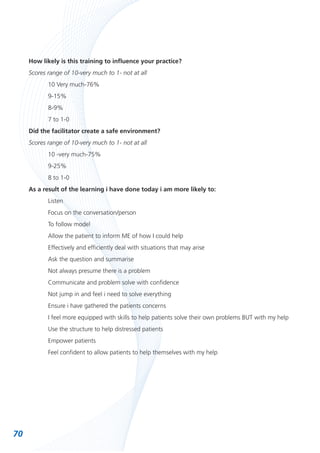
Appendix 10: Renal Sage and Thyme communication course evaluation
 69
Appendix 11: The Prepared Acronym 72
Appendix 12: Items adopted in each of the NHS Kidney Care pilot sites 73
Appendix 13: Items adopted in each unit for the End of Life Care in Advanced 74
Kidney Disease dataset
CONTENTS

03
Foreword

In the NHS we care for people from the cradle to the grave. The care and compassion offered to
people at the end of their life is just as important as that provided to help them stay healthy.  
In kidney care, we are well placed to identify patients who may be nearing the end of life and to work
with them, their families and carers, and other health and care services to help them live as full a life as
possible and to die with dignity in a setting of their own choice.
Kidney services have led the way in improving end of life care. The National Service Framework for
Renal Services was the first to talk about death and dying. We built on this, and the momentum
around the national pathway for end of life care, to develop a specific end of life care framework for
patients with advanced kidney disease. It explores the kidney­specific issues of end of life care,
focusing on patients opting for conservative kidney management and those “deteriorating despite”
dialysis, supporting services to offer high quality end of life care.
This report describes the experience of three projects groups – in Bristol, Greater Manchester and at
King’s Health Partners in London – who have been working with NHS Kidney Care to implement the
framework. It describes their approaches, the challenges they have overcome and the lessons that their
experience can teach others seeking to improve end of life care for patients.
It shows how a systematic approach to the identification of patients, sensitive discussions with patients
and carers, a structured process for recording patient’s wishes, key link workers to co­ordinate care,
and improved training and education for staff can all make a real difference to the care we provide our
patients at the end of life.
I would like to thank colleagues in the project groups and the End of Life Care in Advanced Kidney
Disease board for their tremendous efforts, their achievements, and the enormous contribution they
have made to improving end of life care. I hope that colleagues across the NHS will find the
experiences and learning outlined in this report valuable in informing their own efforts to improve this
vital aspect of care for kidney patients.
Beverley Matthews
Director
NHS Kidney Care
04


Executive Summary 

The National Service Framework for Renal Services, published in 2004 and 2005, was the first to
tackle the issues of death and dying. It includes an aim to support those with established kidney
disease to live as full a life as possible and to die with dignity in a setting of their own choice.
Further work on the importance of end of life care led to the publication of the National End of Life
Care Strategy in 2008 which set out a National End of Life Care Clinical Pathway, and, in 2011, an
end of life care quality standard from NICE.
In 2008, a Kidney Supportive and End of Life Care Steering Group was established to develop a
framework to specifically meet the needs of those with advanced kidney disease and in 2009, End of
Life Care in Advanced Kidney Disease: A Framework for Implementation was published.
The overarching aim of the framework is to help people with advanced kidney disease make
informed choices about their needs for supportive and end of life care. Key elements of the
framework are timely recognition that the end of life phase is approaching; sensitive communication
with and involvement of patients and carers; co­ordinated multi­professional working across
boundaries; clinical leadership; local action planning; and the appropriate training and education for
healthcare staff.
NHS Kidney Care supported project groups in Bristol, Greater Manchester and at King’s Health Partners
in London to implement the framework and evaluate their approaches so that their learning and
experiences could be shared more widely. This report brings together the key findings of the project
groups, focusing in particular on:
Achieving best practice
•	 How to identify patients approaching end of life
•	 Creating and using a register of these patients within kidney units to facilitate delivery of

palliative and supportive care

•	 The use of advance care planning to provide end of life care sensitive to an individual’s

requirements

•	 Co­ordination of care across organisational boundaries
•	 Support for families and carers through the end of life period and beyond
Workforce considerations
•	 Identifying key staff to champion and pioneer this work
•	 Understanding the training needs of staff in kidney units and developing effective ways to meet
these training requirements
The report concludes with a number of recommendations based on the work of the project groups,
which will be useful for other renal units and networks seeking to offer the very best end of life care.
EXECUTIVE SUMMARY

05
Recommendations
Achieving Best Practice
i How to identify patients approaching end of life
Establish a systematic unit wide approach to identification of patients
A systematic approach can be taken to identify patients who may be approaching end of life. This allows
staff to move across work areas and still be familiar with the process. A number of examples are
described in this report and kidney units developing registers, in partnership with primary care colleagues,
could adopt part or all of any of those that have been shown to be useful in the project groups.
Ensure that all patient groups are included
All kidney patients may benefit from end of life care support and consideration should be given to
spreading the use of patient identification for the register beyond those on conservative care.  
ii Creating and using a register
Recognise that a change in culture may be required as well as organisational changes
A cultural change will take time to mature within a unit, and all the project groups emphasised the
need for dedicated staff to lead and demonstrate new approaches to supportive and palliative care.
Consider the name of your register
Consider the name to be given to a register and what that might convey to staff and patients using
it. All the project groups have chosen to move away from “cause for concern”.
Use IT systems that will enable the best access for all staff
If possible, adapt local IT systems to hold the register and keep abreast of opportunities within the
healthcare community for sharing electronic records more widely. A number of pilots are taking place
across the country within healthcare communities that will enable sharing of patient information,
including preferences for end of life. 
Consider who will agree registration with the patient and when
For one of the groups, registration was dependent on a discussion with the patient at an out­patient
appointment, which led to delay in registration if appointments were several months away and
subsequently to some patients dying before reaching the registration discussion. Consideration
should be given how best to fit with local processes to ensure that registration is discussed with
patients in a timely manner in a suitable location with an appropriate staff member.
iii Advance Care Planning
Offer advance care planning to all dialysis patients
Patients were found to appreciate the opportunity to take part in advance care planning (ACP) even if
they did not immediately wish to take it up. A number of documents are available for use in
introducing ACP for patients that can be adapted to suit local circumstances and facilities. The use of
appropriate documentation helps to give staff confidence in approaching patients. Recording patient
preferences for place of care and death allows policies and procedures to be established that will help
this be achieved.
06


Take account of the time that advance care planning will require
The groups found that ACP could take more than one discussion with a patient and that for some
patients the discussion may take some time and may require revisiting at a future date. If possible,
involve families and carers in these discussions.
iv Coordination of care
Consider methods of raising awareness and establishing links with local organisations 
involved with end of life care
A number of approaches (stakeholder events, staff exchanges, attending meetings) were taken by
the groups to build on their relationships with other organisations working with kidney patients. This
helped to ensure communications remained open and effective to ensure patients received the
services they required.
Consider creation of a resource with details of local organisations involved with end of life care
The groups found that an easily accessed resource with details of contact information, key workers
and guidance regarding end of life care for kidney patients was very useful to kidney unit staff.
v Support for families and carers through the end of life period and beyond
Consider methods to support bereaved families, carers and staff
A number of approaches to bereavement support were taken by the groups including letters and
cards, annual services, and, for staff, training sessions from pastoral colleagues.
Workforce considerations
i Identifying key staff to champion the work
Establish key/link workers 
Identification of link staff who may receive additional training and education about end of life care
processes within a unit can provide support for all staff. A key worker allocated to individual patients
may also act as a co­ordinator with other services
ii Training needs of kidney unit staff 
Resource training for staff
All groups found training and education were crucial to the success of their projects to give staff the
knowledge and confidence to raise issues with patients. A number of approaches were adopted
including taking advantage of training already within the trust, courses run by local palliative/hospice
staff and national initiatives for training in end of life care. The groups found that, where possible,
providing kidney­specific training was the most successful.
Training should be designed and delivered at different levels, according to the previous training and
experiences of the renal professionals, and the extent they will be responsible for end of life care.
Kidney­specific advanced communication skills training has been developed, and should become more
widely available.
The consistent recording and sharing of care planning information has been identified as one of the main
ways to enable improved end of life care for patients. This report also includes a review of the learning
from the project groups and the National End of Life Care Programme on establishing a core dataset.
EXECUTIVE SUMMARY

07
1: Introduction

The National Service Framework (NSF) for Renal Services1
was the first to tackle the issues of death
and dying. Part two includes an aim to support those with established kidney disease to live as full a
life as possible and to die with dignity in a setting of their own choice. The quality requirement states
that people with established kidney failure should:
“… receive timely evaluation of their prognosis, information about the choices available to 
them, and for those near the end of life a jointly agreed palliative care plan, built around their 
individual needs and preferences.”
The NSF was followed by the publication of reports describing proposals for delivery of services and
the strategic vision for the NHS2,3
that further emphasised the importance of end of life care,
culminating in the publication of the National End of Life Care Strategy4
. The strategy described the
need for high quality care for all adults, regardless of age, condition, diagnosis or place of care, and
set down the National End of Life Care Clinical Pathway (see below). In November 2011, NICE
published a quality standard for end of life care, which sets out 16 statements that describe
aspirational but achievable care for adult patients who are approaching the end of their life.
To build on the NSF and the national strategy to develop them specifically for kidney patients, a
workshop was organised by NHS Kidney Care in April 2008 to identify key themes. These were then
taken forward to a Kidney Supportive and End of Life Care Steering Group to identify the
characteristics which a kidney specific pathway would require. The culmination of the steering
group’s work was the publication in 2009 of End of Life Care in Advanced Kidney Disease: A
Framework for Implementation5
– referred to as the framework in this document.
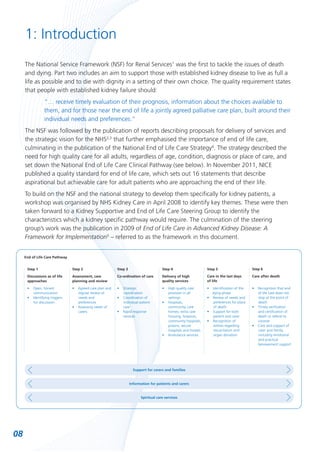
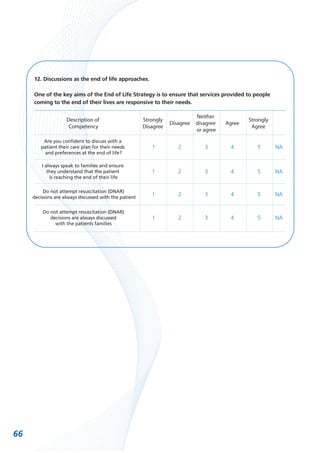
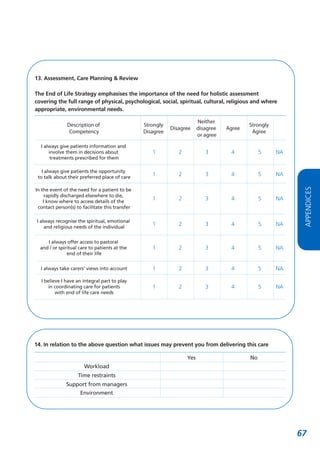
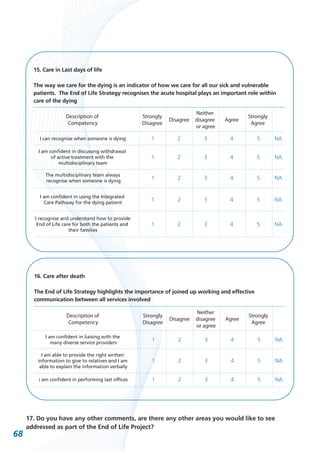
End of Life Care Pathway
Step 1 Step 2 Step 3 Step 4 Step 5 Step 6
Discussions as of life
approaches
Assessment, care
planning and review
Co-ordination of care Delivery of high
quality services
Care in the last days
of life
Care after death
• Open, honest
communication
• Identifying triggers
for discussion
• Agreed care plan and
regular review of
needs and
preferences
• Assessing needs of
carers
• Strategic
coordination
• Coordination of
individual patient
care
• Rapid response
services
• High quality care
provision in all
settings
• Hospitals,
community, care
homes, extra care
housing, hospices,
community hospitals,
prisons, secure
hospitals and hostels
• Ambulance services
• Identification of the
dying phase
• Review of needs and
preferences for place
of death
• Support for both
patient and carer
• Recognition of
wishes regarding
resuscitation and
organ donation
• Recognition that end
of life care does not
stop at the point of
death
• Timely verification
and certification of
death or referal to
coroner
• Care and support of
carer and family,
including emotional
and practical
bereavement support
Support for carers and families
Information for patients and carers
Spiritual care services
08


2: The Framework

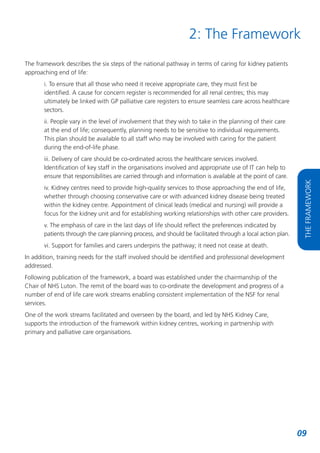
The framework describes the six steps of the national pathway in terms of caring for kidney patients
approaching end of life:
i. To ensure that all those who need it receive appropriate care, they must first be 
identified. A cause for concern register is recommended for all renal centres; this may 
ultimately be linked with GP palliative care registers to ensure seamless care across healthcare 
sectors.
ii. People vary in the level of involvement that they wish to take in the planning of their care 
at the end of life; consequently, planning needs to be sensitive to individual requirements.
This plan should be available to all staff who may be involved with caring for the patient
during the end­of­life phase.
iii. Delivery of care should be co­ordinated across the healthcare services involved.
Identification of key staff in the organisations involved and appropriate use of IT can help to
ensure that responsibilities are carried through and information is available at the point of care.
iv. Kidney centres need to provide high­quality services to those approaching the end of life,
whether through choosing conservative care or with advanced kidney disease being treated
within the kidney centre. Appointment of clinical leads (medical and nursing) will provide a 
focus for the kidney unit and for establishing working relationships with other care providers.
v. The emphasis of care in the last days of life should reflect the preferences indicated by 
patients through the care planning process, and should be facilitated through a local action plan.
vi. Support for families and carers underpins the pathway; it need not cease at death.
In addition, training needs for the staff involved should be identified and professional development
addressed.
Following publication of the framework, a board was established under the chairmanship of the
Chair of NHS Luton. The remit of the board was to co­ordinate the development and progress of a
number of end of life care work streams enabling consistent implementation of the NSF for renal
services.
One of the work streams facilitated and overseen by the board, and led by NHS Kidney Care,
supports the introduction of the framework within kidney centres, working in partnership with
primary and palliative care organisations.
THE FRAMEWORK

09
3: Project groups

An initial project to implement the framework supported by NHS Kidney Care was established in
Bristol in May 2009, led by a palliative care physician working closely with the Richard Bright Renal
Unit (referred to in this report as ”Bristol”). NHS Kidney Care then sent out a call for expressions of
interest for additional project groups to implement the framework and demonstrate:
•   The development of a supportive and palliative care (cause for concern) register in the renal 

unit shared with primary care

•   An increase in the number of conservatively­managed patients with assessment and advance    
care planning in place
•   A proportional increase in the number of renal staff educated and trained in advance care 
planning and the assessment skills to meet the supportive and palliative care needs of patients 
and their relatives/carers
•   An increase in the number of patients with an end of life plan
•   A percentage increase in the number of patients achieving their preferred place of care
•   A greater level of satisfaction for patients and carers
A number of proposals were submitted from which two additional project groups from kidney units
were selected and the Bristol group continued with their project. The additional projects were: 
•  The Greater Manchester Managed Kidney Care Network, a partnership between Central 

Manchester University Hospitals Foundation Trust and Salford Royal NHS Foundation Trust 
(referred to in this report as “Greater Manchester”).  
•   The Advanced Renal Care (ARC) project led by the Department of Palliative Care, Policy and Rehabilitation   
at King’s College London and working across the kidney units at King’s College Hospital NHS Foundation 
Trust and Guy’s and St Thomas’ NHS Foundation Trust (referred to in this report as “King’s Health Partners”).
Funding for 18 months work was awarded to the project groups.
To support the groups in carrying out their projects, NHS Kidney Care established a learning network
where the project groups could discuss issues of mutual interest, raise problems, share learning and
experience. An online forum was set up for project group and board members to enable sharing
documents and discussion outside of meetings.
The first task for the project groups was to appoint staff to take their work forward and the next
sections of this report represent the work and consequential learning and experience from these
facilitators, the kidney units and other healthcare staff they worked with.
At the time that the projects were being carried out, the National End of Life Care Programme
(NEoLCP)  was developing a number of core data items that they could recommend for end of life
care registers and which would become a national information standard. NHS Kidney Care has used
this work and that of the pilots to consider how kidney registers can best fit with national
developments. The findings from this work are described in Section 6.
10


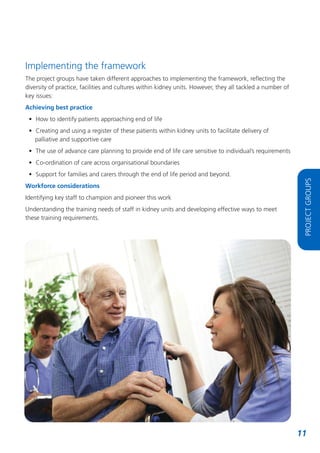
Implementing the framework
The project groups have taken different approaches to implementing the framework, reflecting the
diversity of practice, facilities and cultures within kidney units. However, they all tackled a number of
key issues:
Achieving best practice
•	 How to identify patients approaching end of life
•	 Creating and using a register of these patients within kidney units to facilitate delivery of

palliative and supportive care

•	 The use of advance care planning to provide end of life care sensitive to individual’s requirements
•	 Co­ordination of care across organisational boundaries
•	 Support for families and carers through the end of life period and beyond.
Workforce considerations
Identifying key staff to champion and pioneer this work
Understanding the training needs of staff in kidney units and developing effective ways to meet
these training requirements.
PROJECT GROUPS

11
4: Learning from the project groups

Achieving best practice
i How to identify patients approaching end of life
This is the first step in ensuring that patients approaching end of life benefit from the 
additional supportive care they may require during the last six to twelve months of life. The 
project groups also needed to consider not only how they would identify patients 
approaching end of life (which criteria to use), but also to which patient groups they would 
apply the criteria.
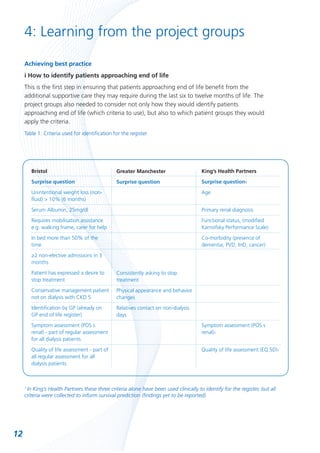
Table 1: Criteria used for identification for the register
Bristol Greater Manchester King’s Health Partners
Surprise question Surprise question Surprise question1
Unintentional weight loss (non- Age
fluid) > 10% (6 months)
Serum Albumin, 25mg/dl Primary renal diagnosis
Requires mobilisation assistance Functional status, (modified
e.g. walking frame, carer for help Karnofsky Performance Scale)
In bed more than 50% of the Co-morbidity (presence of
time dementia, PVD, IHD, cancer)
≥2 non-elective admissions in 3
months
Patient has expressed a desire to Consistently asking to stop
stop treatment treatment
Conservative management patient Physical appearance and behavior
not on dialysis with CKD 5 changes
Identification by GP (already on Relatives contact on non-dialysis
GP end of life register) days
Symptom assessment (POS s Symptom assessment (POS s
renal) - part of regular assessment renal)1
for all dialysis patients
Quality of life assessment - part of Quality of life assessment (EQ 5D)1
all regular assessment for all
dialysis patients
1 
In King’s Health Partners these three criteria alone have been used clinically to identify for the register, but all
criteria were collected to inform survival prediction (findings yet to be reported)
12


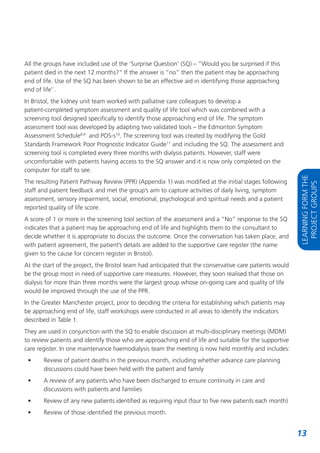
All the groups have included use of the ‘Surprise Question’ (SQ) – “Would you be surprised if this
patient died in the next 12 months?” If the answer is “no” then the patient may be approaching
end of life. Use of the SQ has been shown to be an effective aid in identifying those approaching
end of life6,7
.
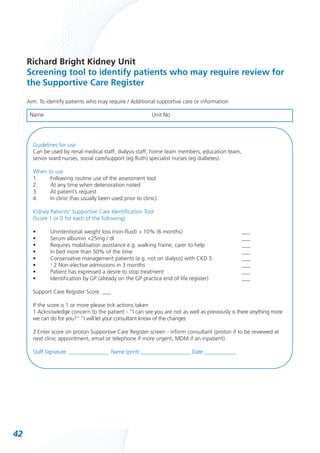
In Bristol, the kidney unit team worked with palliative care colleagues to develop a
patient­completed symptom assessment and quality of life tool which was combined with a
screening tool designed specifically to identify those approaching end of life. The symptom
assessment tool was developed by adapting two validated tools – the Edmonton Symptom
Assessment Schedule8,9
and POS­s10
. The screening tool was created by modifying the Gold
Standards Framework Poor Prognostic Indicator Guide11
and including the SQ. The assessment and
screening tool is completed every three months with dialysis patients. However, staff were
uncomfortable with patients having access to the SQ answer and it is now only completed on the
computer for staff to see.
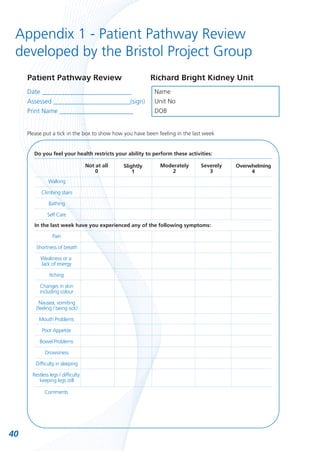
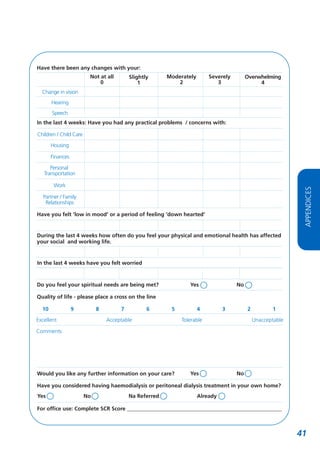
The resulting Patient Pathway Review (PPR) (Appendix 1) was modified at the initial stages following
staff and patient feedback and met the group’s aim to capture activities of daily living, symptom
assessment, sensory impairment, social, emotional, psychological and spiritual needs and a patient
reported quality of life score.
A score of 1 or more in the screening tool section of the assessment and a “No” response to the SQ
indicates that a patient may be approaching end of life and highlights them to the consultant to
decide whether it is appropriate to discuss the outcome. Once the conversation has taken place, and
with patient agreement, the patient’s details are added to the supportive care register (the name
given to the cause for concern register in Bristol).
At the start of the project, the Bristol team had anticipated that the conservative care patients would
be the group most in need of supportive care measures. However, they soon realised that those on
dialysis for more than three months were the largest group whose on­going care and quality of life
would be improved through the use of the PPR.
In the Greater Manchester project, prior to deciding the criteria for establishing which patients may
be approaching end of life, staff workshops were conducted in all areas to identify the indicators
described in Table 1.
They are used in conjunction with the SQ to enable discussion at multi­disciplinary meetings (MDM)
to review patients and identify those who are approaching end of life and suitable for the supportive
care register. In one maintenance haemodialysis team the meeting is now held monthly and includes:
•	 Review of patient deaths in the previous month, including whether advance care planning

discussions could have been held with the patient and family

•	 A review of any patients who have been discharged to ensure continuity in care and

discussions with patients and families

•	 Review of any new patients identified as requiring input (four to five new patients each month)
•	 Review of those identified the previous month.
LEARNING FORM THE

PROJECT GROUPS

13
A number of clinical areas within Greater Manchester are now holding cause for concern meetings
and others are working towards a similar format.
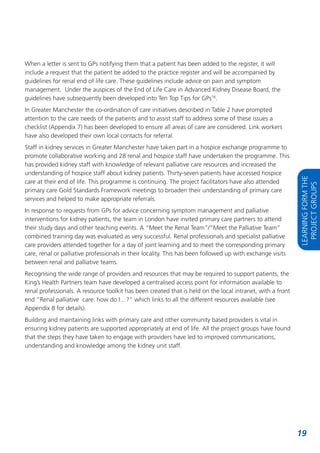
The team from King’s Health Partners, when considering the criteria that would enable them to
identify those approaching the end of life, looked at the evidence on the usefulness of variables as a
predictor of survival and then whether those variables were readily captured in the clinical context.
This led them to identify the variables in Table 1 as the most suitable predictors of those approaching
end of life.
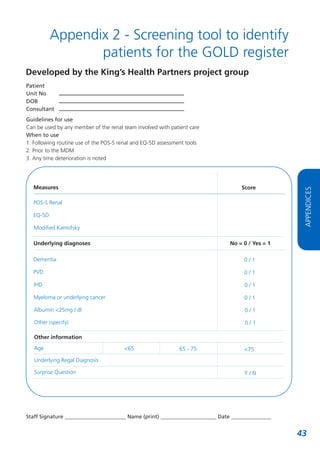
These variables were used to create a screening tool to identify patients for registration. Following
consultation with patients and carers, patient reported measures of symptoms and quality of life
were also included. Systematic and routine completion of symptom and quality of life scores by
patients takes some time to introduce but advantages identified include:
•	 It signals the importance of symptoms and quality of life to both patients and professionals,

giving patients ‘permission’ to raise these concerns

•	 It ensures a patient­centred approach to identification for the register.
Using these measures also provides a starting point for holistic palliative needs assessment. POS­s
renal10
was selected as the measure of symptoms and EQ5D12
for quality of life.
The above were combined to create a screening tool (Appendix 2) used at multi­disciplinary meetings
(MDM) to determine whether patients should be approached about entry on the register. It has been
rolled out across the two kidney centres, and within six months was introduced in both main units
and ten satellite units for all dialysis patients and conservatively managed patients with an eGFR <
15mL/min.
The team from King’s Health Partners will be evaluating which of the criteria adopted in Table 1
correlate most closely to high symptom burden and/or poor quality of life. They will also measure
which of the variables are the best predictors of survival, but are currently using a total POS­s score ≥
30, EQ5D overall score < 60 and the SQ answered ‘no’ to determine whether patients should be
approached regarding registration. These criteria may be refined following evaluation which will be
published separately.
14


ii Creating and using a register 
All project groups have different IT systems available to store their register and data associated with
end of life. Section 6 describes the approaches taken to recording registration and items associated
with end of life care. It also looks at the national picture regarding a national end of life care dataset
and the items it may contain.
One of the challenges identified by the project groups when introducing a register was to change
the culture of thinking of staff who, although very sensitive to individual patient needs, may not
have the opportunity to consider the patient as whole, reflect with them on their overall progress,
and to assess where they might be on their illness trajectory. Barriers to cultural change of thinking
about palliative and supportive care within kidney units include:
• Fear of upsetting patients and families
• Lack of knowledge amongst professionals about the evidence
• Genuine as well as perceived lack of time to spend discussing these issues
• Limited resources to provide supportive and palliative interventions.
Introducing a change in thinking can take time and needs to ensure that both an active disease focus
and holistic ‘supportive’ focus are achieved within a kidney centre. All the project groups agreed that
it was imperative to have dedicated staff to lead and demonstrate the palliative and supportive
approach and found that by introducing a register and the other recommendations of the
framework they were able to provide a focus to drive forward changes.
While developing their register, the Bristol project group used a “Think Aloud” approach with
consultant staff. The PPR system described above was explained to each consultant and their
concerns and suggestions for it were recorded and then used to shape it and the training required.
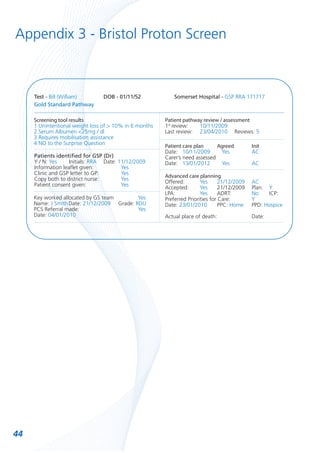
Registration is recorded on the local IT system (Proton) together with items such as the screening tool
results and whether leaflets have been provided to the patient (Appendix 3). Registration often
triggers actions such as a letter being sent to the GP requesting the patient be added to their Gold
Standards Framework and includes guidelines for renal end of life care including advice on pain and
symptom management specific to kidney patients.
The two Greater Manchester trusts are working with their local IT systems to develop electronic
recording of their registers. In London, specific pages have been created in the Renalware system at
King’s College Hospital to collect data associated with the project and work is on­going to create
alerts for high symptom scores and poor quality of life scores. These alerts flag up high symptom
scores and/or poor quality of life scores, so that (regardless of whether the patient fulfils all criteria
for the register) symptoms and quality of life concerns are addressed at the next clinical review. The
renal unit at Guy’s has a different IT system and it has not been possible to tailor it for electronic data
collection; however some progress has been made on particular aspects with the POS­s renal being
incorporated in the hospital’s electronic patient record.
LEARNING FORM THE

PROJECT GROUPS

15
All groups are looking at methods of linking their registers with other local healthcare services and
Greater Manchester and King’s Health Partners are working on linking with the “Coordinate my
Care” initiative and Bristol with Adastra. These systems would enable healthcare organisations and
staff, for example ambulance staff, to access end of life care information about patients. 
The framework recommends that a cause for concern register is established in all kidney centres.
However, the project groups have found that the name “cause for concern” is not always suitable
and Bristol and Greater Manchester have preferred to call it “supportive care register”. This has been
found to be more acceptable and conveys some of the register’s function to patients. The register
used by King’s Health Partners is called the GOLD register. In all groups, registration is discussed with
patients, sometimes within an outpatient consultation or while they are attending for dialysis.
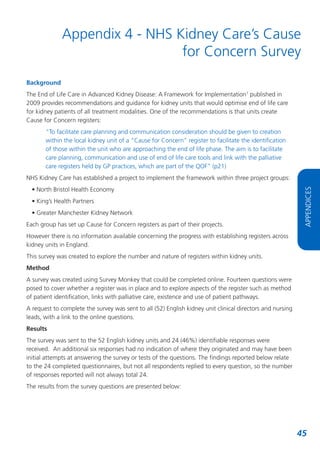
NHS Kidney Care conducted an online survey of English kidney units to establish whether cause for
concern registers were in place and to explore aspects of the registers such as where the register was
held, method of patient identification and what links with palliative care existed. The full findings of
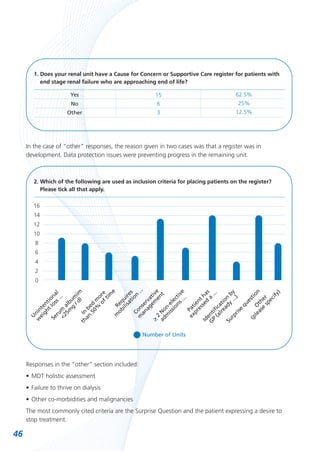
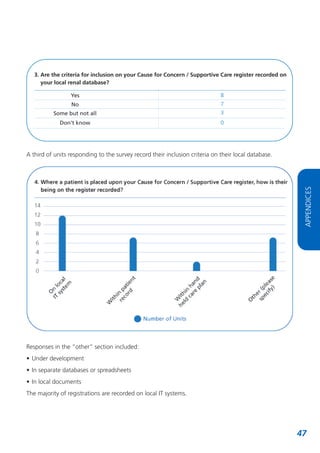
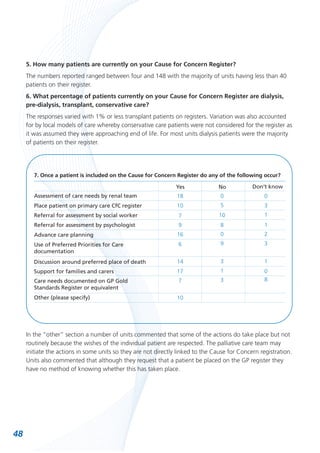
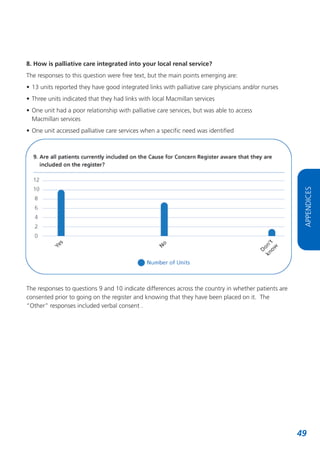
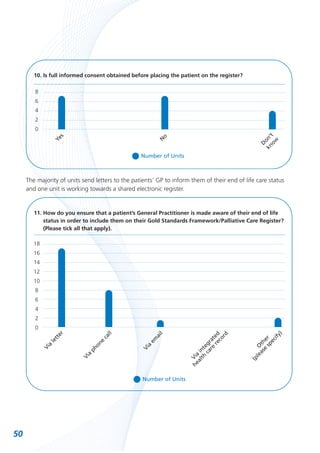
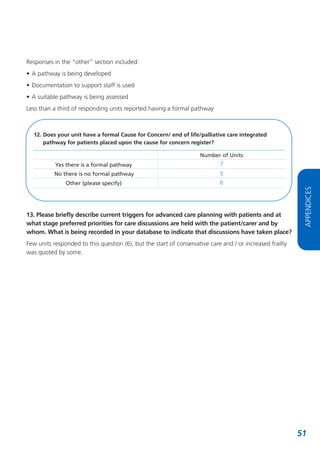
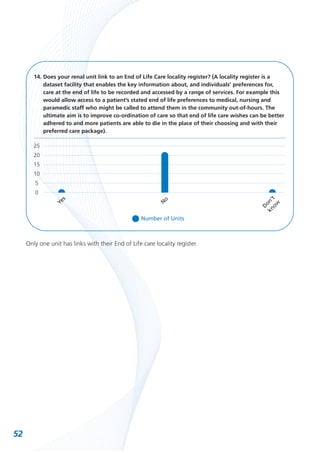
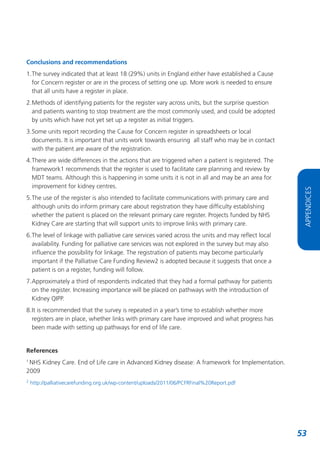
the survey are reported in Appendix 4 and the main findings from the 24 (46% of kidney units in
England) were:
•	 63% of the units have established a register and three units are in the process of setting one up
•	 50% hold their register on the local IT system
•	 The most commonly cited criteria for inclusion on the register were the SQ and the patient

expressing a desire to stop treatment

•	 Most reported good links with palliative care physicians and/or nurses.
iii Advance care planning
The framework indicates that patients vary in the level of involvement that they wish to take in the
planning of their care at the end of life; consequently, planning needs to be sensitive to individual
requirements. The project groups implemented advance care planning (ACP) for those who wished
to use it and developed a number of leaflets and information resources for patients.
Following a pilot in one satellite dialysis area, all dialysis patients are given the opportunity at any
point to discuss ACP in Bristol, 100% of the patients giving feedback indicated that it was useful to
be aware of their options even if they didn’t want to take part immediately. A leaflet”Planning Your
Future Care”13
is available in each unit. For those who choose to engage with ACP, a record is made
on the local IT system and their preferred place of care and death is recorded. Carers’ needs may also
be assessed and a record made that they have been discussed (see screen in Appendix 3). At the time
of writing, 81% of patients who had died and recorded a preference during the project period had
achieved their preferred place of death. 
The NEoLCP have a document “Preferred Priorities for Care”14
that can be used as a basis for
discussion with patients about their wishes. Use of this document was piloted at both kidney centres
in Greater Manchester, however it did not fully meet the requirements of staff and patients and new
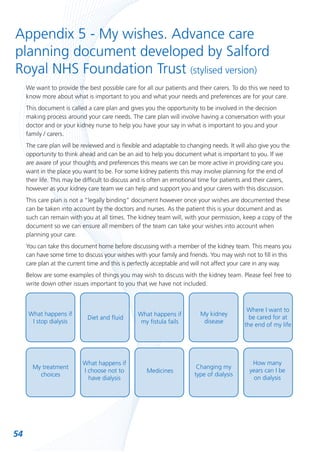
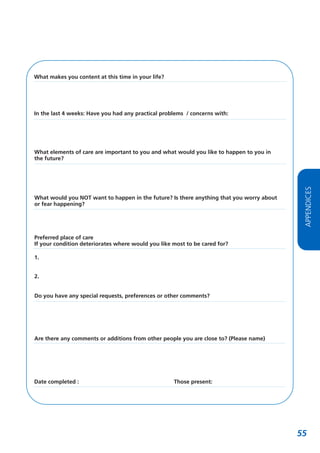
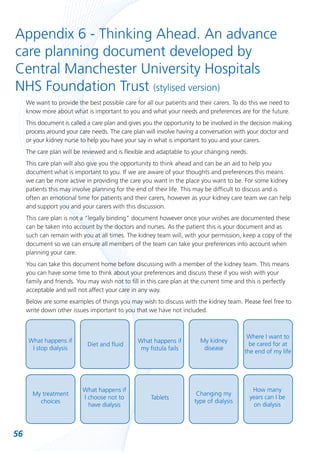
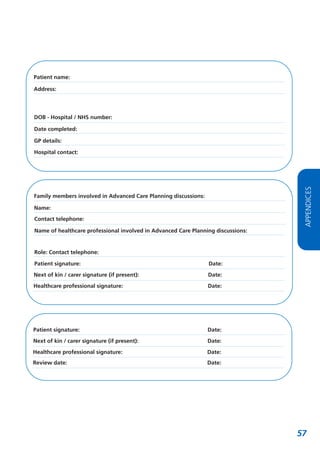
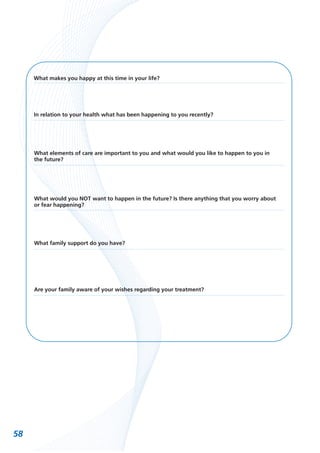
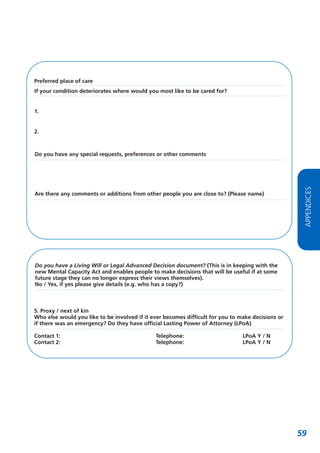
documents were developed at each centre – “My Wishes” in Salford and “Thinking Ahead” in
Central Manchester (Appendix 5, 6).
16


These documents have been introduced in a number of areas leading to approximately half of
patients participating in completing them. The feedback from patients has been very positive, for
example:
“I can say what I want to say it’s my opportunity”
“I am just so glad someone has asked me about what I think regarding my care for the future”
“It helps to write it down”
The King’s Health Partners project team used the Holistic Common Assessment (new 15) to support
renal professionals in assessing the needs of patients approaching end of life. This includes ACP,
exploring their priorities and preferences for the future and optimising planning to accommodate
these priorities. The team developed and used an insert for the Kidney Care plan to help open up
conversations about priorities and preferences. They have also designed a ‘Guide to Gold’, a
guidance document for all healthcare workers approaching ACP discussions with renal patients,
which covers preparing for the discussion, carrying out ACP, and follow up and documentation. An
evaluation of these interventions is being carried out through patient experience surveys and
in­depth qualitative interviews with patients and carers. The findings of this evaluation will be
published separately.
All units have emphasised the staff time that needs to be dedicated to raising and discussing these
issues with patients and then following through with the planning process. This needs to be factored
in to ensure that patients are given the opportunity to fully consider their options and wishes, and
may require more than one discussion.
The availability of suitable documents for patients has helped to give staff in all areas, including
in­patient wards, the confidence to raise these matters with patients.
The use of ACP also prompts those involved to develop closer working relationships with other
healthcare organisations caring for kidney patients at end of life such as rapid discharge teams,
Macmillan services and local hospices.
One group also found some uncertainty amongst patients regarding some of the terminology
associated with renal supportive care including “preferred priorities for care” and the meaning of
“key worker”.
LEARNING FORM THE

PROJECT GROUPS

17
iv Co­ordination of care
The framework emphasises the importance of co­ordinating care to ensure patients receive high quality
care at the end of life. All the sections above describe aspects of care which contribute to this, but
co­ordination of care across health boundaries is also required to ensure that the many needs of
patients at end of life are met. This in turn requires an understanding of where services are located,
what services are available and engagement with palliative care, primary care and social care providers.
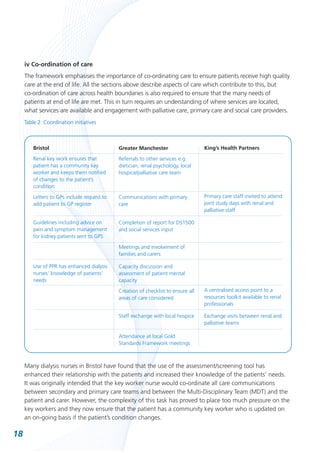
Table 2: Coordination initiatives
Bristol Greater Manchester
Renal key work ensures that
patient has a community key
worker and keeps them notified
of changes to the patient’s
condition
Referrals to other services e.g.
dietician, renal psychology, local
hospice/palliative care team
Letters to GPs include request to
add patient to GP register
Communications with primary
care
Guidelines including advice on
pain and symptom management
for kidney patients sent to GPS
Completion of report for DS1500
and social services input
Meetings and involvement of
families and carers
Use of PPR has enhanced dialysis
nurses’ knowledge of patients’
needs
Capacity discussion and
assessment of patient mental
capacity
Creation of checklist to ensure all
areas of care considered
Staff exchange with local hospice
Attendance at local Gold
Standards Framework meetings
King’s Health Partners
Primary care staff invited to attend
joint study days with renal and
palliative staff
A centralised access point to a
resources toolkit available to renal
professionals
Exchange visits between renal and
palliative teams
Many dialysis nurses in Bristol have found that the use of the assessment/screening tool has
enhanced their relationship with the patients and increased their knowledge of the patients’ needs.
It was originally intended that the key worker nurse would co­ordinate all care communications
between secondary and primary care teams and between the Multi­Disciplinary Team (MDT) and the
patient and carer. However, the complexity of this task has proved to place too much pressure on the
key workers and they now ensure that the patient has a community key worker who is updated on
an on­going basis if the patient’s condition changes.  
18


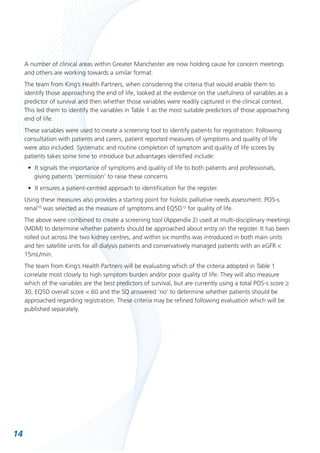
When a letter is sent to GPs notifying them that a patient has been added to the register, it will
include a request that the patient be added to the practice register and will be accompanied by
guidelines for renal end of life care. These guidelines include advice on pain and symptom
management. Under the auspices of the End of Life Care in Advanced Kidney Disease Board, the
guidelines have subsequently been developed into Ten Top Tips for GPs16
.
In Greater Manchester the co­ordination of care initiatives described in Table 2 have prompted
attention to the care needs of the patients and to assist staff to address some of these issues a
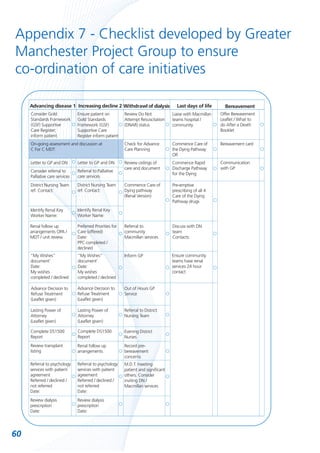
checklist (Appendix 7) has been developed to ensure all areas of care are considered. Link workers
have also developed their own local contacts for referral.
Staff in kidney services in Greater Manchester have taken part in a hospice exchange programme to
promote collaborative working and 28 renal and hospice staff have undertaken the programme. This
has provided kidney staff with knowledge of relevant palliative care resources and increased the
understanding of hospice staff about kidney patients. Thirty­seven patients have accessed hospice
care at their end of life. This programme is continuing. The project facilitators have also attended
primary care Gold Standards Framework meetings to broaden their understanding of primary care
services and helped to make appropriate referrals.
In response to requests from GPs for advice concerning symptom management and palliative
interventions for kidney patients, the team in London have invited primary care partners to attend
their study days and other teaching events. A “Meet the Renal Team”/”Meet the Palliative Team”
combined training day was evaluated as very successful. Renal professionals and specialist palliative
care providers attended together for a day of joint learning and to meet the corresponding primary
care, renal or palliative professionals in their locality. This has been followed up with exchange visits
between renal and palliative teams.
Recognising the wide range of providers and resources that may be required to support patients, the
King’s Health Partners team have developed a centralised access point for information available to
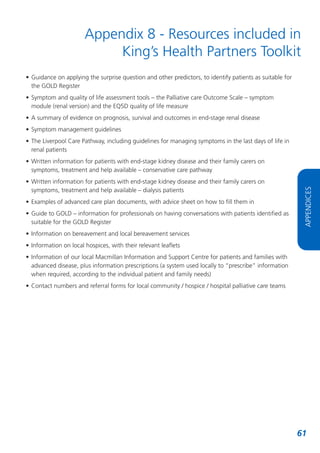
renal professionals. A resource toolkit has been created that is held on the local intranet, with a front
end “Renal palliative  care: how do I…?” which links to all the different resources available (see
Appendix 8 for details).
Building and maintaining links with primary care and other community based providers is vital in
ensuring kidney patients are supported appropriately at end of life. All the project groups have found
that the steps they have taken to engage with providers have led to improved communications,
understanding and knowledge among the kidney unit staff.
LEARNING FORM THE

PROJECT GROUPS

19
v. Support for families and carers through the end of life period and beyond 
Depending on patient preference, families and carers may be involved at any or all stages of
supporting patients approaching end of life.
When leaflets to help patients consider their preferences for end of life care are provided to patients
they are encouraged to discuss their wishes with families and carers. Many of the units encourage
family and carers to be involved in the discussions. However a “no visiting” policy in some dialysis
areas can be a barrier to family and carer involvement.
Patients who are admitted close to the end of life in Bristol are cared for using the Renal Integrated
Care Pathway (ICP). This is a trust document adapted for renal care, derived from the Liverpool Care
Pathway17
, and promotes holistic care by guiding staff to recognise and act on pain and other
symptoms, as well as attending to care and comfort needs, and supporting family and carers. At this
stage, patients may also receive input from the palliative care team. All renal ward­based nursing
staff are trained in the use of this pathway. Patients still attending for dialysis, but approaching end
of life, may be assessed using the PPR more frequently, for example monthly.
In Greater Manchester, the use of ACP has led to development of close working partnership with
organisations supporting patients at the end of life including the trust’s rapid discharge team to
facilitate patients discharge to die in the place of their choosing if it is not hospital. 
Bereavement
The death of a kidney patient affects not only the patient’s family, but may also affect the staff and
other patients where they have been receiving regular dialysis.
The Bristol team carried out a staff survey on bereavement during their project. This showed that
nurses with less than two years post­registration experience were not very comfortable with the
discussions or practices around death or afterwards. Subsequently, the project team carried out short
training sessions in the ward and the pastoral staff conducted two training sessions on spiritual and
cultural considerations at the end of life. Other changes in bereavement practice were initiated
following the survey:
•	 The consultant writes a personal letter to the family when they have been involved in the care,
offering condolences and the opportunity to talk about the treatment and care of their relative
•	 The carers of all dialysis patients receive a card from their dialysis unit from staff who knew the
patient well, including the opportunity to speak to staff
•	 Staff from the dialysis unit endeavour to attend the funeral
•	 The approach to informing other patients varies across the dialysis units but there is a common
emphasis on encouraging support and discussion with those close to the patient.
The use of the Renal ICP on inpatient wards has included informing GPs of a death and supporting
families and carers after death.
20


Consideration is being given in Bristol to setting up an annual memorial service for the families of all
dialysis patients that have died during the preceding year.
A remembrance service for the bereaved families of kidney patients has been taking place annually,
arranged by Central Manchester University Hospitals Foundation Trust kidney unit, and at both units
in the King’s Health Partners group.
This is a non­denominational service to remember dialysis patients who have died during the year.
Family members are joined by staff from the renal team including doctors, nurses, administrative
staff and chaplains. The intention is to provide an opportunity to remember loved ones and draw
comfort from others. The numbers attending has increased each year and over 200 friends and
relatives attended in 2011 in Manchester.
The King’s Health Partners group routinely sends bereavement letters to next of kin, and one of the
Greater Manchester project groups is working with the local kidney patients association to design
cards to be sent to bereaved families of dialysis patients. The King’s Health Partners team have also
developed a bereavement resource folder which can be accessed by all renal professionals,
containing signposts to existing bereavement support services in Trusts, primary care, palliative care
and through Cruse.
Workforce considerations
i Identifying key staff to champion and pioneer the work
All the groups appointed staff to carry through the work of their project, with a view to changes in
practice and tools developed becoming embedded within their kidney units when the projects are
completed.
Training of staff (which is covered in detail in Section 4.v) was identified as a major challenge in all
units and the Bristol group found that the identification of one or two link nurses in each dialysis
team was helpful. These link nurses attended project meetings and were given more intensive
teaching on the aims of the project so that they could support the staff in their respective teams.
Also, within the dialysis teams, the nurse or healthcare professional co­ordinating the patient’s care
and ensuring community key workers are updated if the patient’s condition changes, is called the
“key worker”.
In Greater Manchester, a network of end of life workers has been established that has supported
learning and sharing of experiences and provided support during the project. Staff who had
previously shown an interest in end of life care were encouraged to be involved in the project as the
end of life care link workers. A register of all the link workers has been created including name and
contact details and is available on the renal pages and can be accessed on the trust intranet. The
project facilitators have also been able to build on relationships outside the kidney teams and raise
awareness of the project and the support needs of kidney patients approaching end of life.
LEARNING FORM THE

PROJECT GROUPS

21
At King’s Health Partners, link renal nurses within each dialysis unit, supported by the project team,
have been carrying through much of the holistic assessment of palliative and supportive needs, and
follow up work with patients. This has been incorporated into the MDMs where the key worker is
identified to take forward assessment, care planning and advance care planning. The link nurses
have adapted the processes to best fit their unit and continue the flagging and follow­through with
patients and families, thereby embedding the process into their unit.
All groups emphasised the time that needs to be dedicated by link workers to fully assess patients’
needs and wishes, as this may take place over a number of consultations and at a pace and
frequency dictated by the patient.
All staff will potentially be involved in caring for patients as end of life approaches. However, the
identification of staff who can support their colleagues and share knowledge and skills has been
found to be very important in the project groups when pressures on all staff may be great.
ii Training needs of kidney unit staff
Early in the project, all groups identified that training for staff in kidney units would be crucial to the
delivery of the project. A number of approaches have been taken in all the centres to meet the needs
of various staff groups and roles.
• Raising awareness of the projects within the units
• Specific education about assessing and addressing palliative and supportive needs of kidney patients
• Communication skills training for all renal professionals
• Advanced communications training for those with key roles.
In Bristol, education was directed through the link workers, who were given intensive training in the
aims of the project, the tools that were being utilised and the planned roll out across the centre. The
project nurses also visited the dialysis areas regularly to support staff, help with use of the IT
developed, and maintain awareness.  Regular updates on the project were given at audit meetings.
Education in primary care included a guideline that is included when GPs are informed that a patient
is added to the register. This guidance has now evolved into Ten Top Tips for GPs16
. 
During the project, a staff survey was conducted to establish how widespread knowledge of the
tools and documents was. This indicated that most staff who participated knew “a lot” or “some”
about the tools and documents developed. The document that was least familiar to staff was the GP
guidelines. Recommendations following the survey included that more and regular teaching and
education was still required and could be delivered in targeted areas.
An initial stakeholder event was held in Greater Manchester to describe the aims of the project with
healthcare professionals from secondary, primary, tertiary and voluntary care sectors attending. This
event also enabled working relationships to be established with many organisations that have since
been built on and continue. The awareness­raising also resulted in end of life care becoming a
standing item on many agendas including business and finance meetings, governance meetings and
senior nurse meetings. The project facilitators also attended ward and unit manager’s meetings to
keep staff up­to­date with the progress of the project and training strategy.
22


The King’s Health Partners team regularly updated staff about the project to ensure extensive
understanding of the purpose, plans and findings. This awareness raising was built on through
education about prognosis and survival of dialysis and conservative care patients and emphasis of the
importance of the holistic assessment approach being taken. The team had previously found that
physicians in non­renal specialties were unfamiliar with conservative care leading to an interpretation
of conservative care as inappropriate refusal of dialysis and consequent attempts to change the
patients’ choice of treatment. To spread understanding of conservative care, a “Conservative Care
Grand Round” was instituted and led to increased understanding and confidence in other clinicians
that this was an active pathway for patients.
As well as raising awareness of the projects and the tools and documents associated with them, the
teams also identified that staff required training in the aspects of end of life care that were being
introduced. The main focus of training was on communications skills and advance care planning.
A number of the nephrology consultants in Bristol attended specialist communication skills training
over two half­days run by an advanced communications training facilitator with role play with actors.
The same training facilitator also ran communications training days for renal nurses on two occasions.
An advance care planning day run by a local hospice was attended by a number of renal nurses.
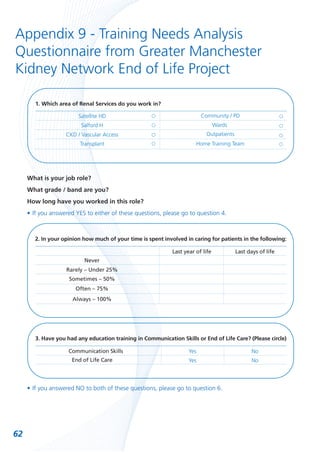
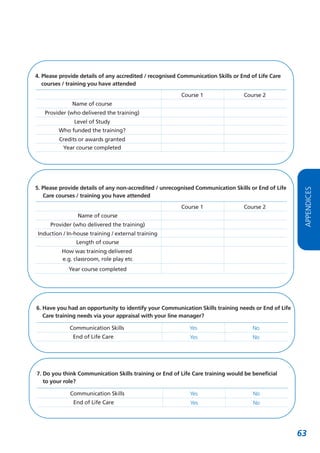
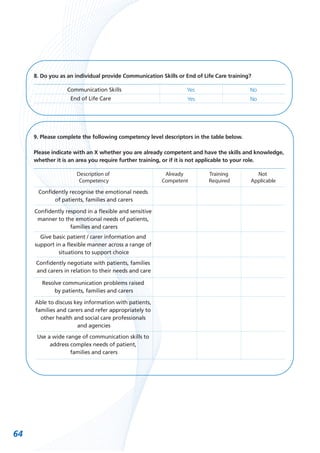
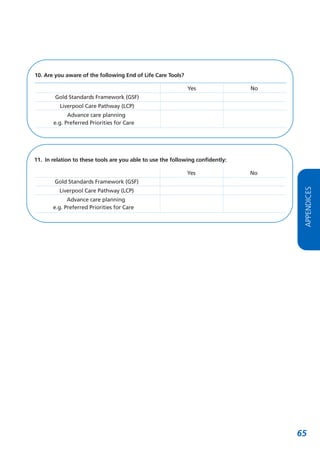
At the start of their project, the Greater Manchester team conducted a training needs assessment
across all sites using a self­reporting questionnaire (Appendix 9). Ninety­one per cent of the
responses were from nursing staff and eight per cent from medical staff. Approximately a third of
respondents had received training in communications skills and nearly 30% training in end of life
care skills. However, only 11% of this training had occurred within the last three years. The results
from this survey prompted exploration of training facilities available locally.
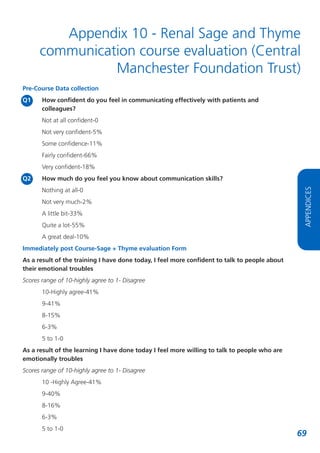
At this time, several trusts in the North West were investing in the SAGE & THYME® foundation
communication skills course aimed at all grades of staff and taking three hours. Sage and Thyme is a
model to enable health and social care professionals to listen to concerned or distressed people, and
to respond in a way that empowers the distressed person. In order to accelerate access to this course
for renal staff, a number of staff took the “train the trainer” course and adaptations have been
made to provide renal specific Sage and Thyme training. The adaptations include advance care
planning scenarios with role play. Approximately 200 staff have now taken the course with positive
feedback (Appendix 10), including renal consultants, other medical staff and clerical staff.
Sage and Thyme training provides a basic grounding in communications skills, but more advanced
skills are required for key and link workers. Communication skills training at enhanced and advanced
level has been accessed via the Greater Manchester and Cheshire Cancer Network and this has been
delivered to 17 staff across the project group. In addition, the project group based in SRFT have
provided a workshop “The Simple Tools to Start the Conversation” from the Conversations for Life
programme. Delegates included specialist registrars and nursing staff and was well received. The
project groups have also found that staff exchanges with local hospices have increased knowledge
and confidence in end of life care.
LEARNING FORM THE

PROJECT GROUPS

23
Some training was also required for the project staff and the palliative care consultants have
attended some courses related to communications skills and advance care planning. 
Sage and Thyme training is also available to staff in the London trusts and the team decided to
concentrate on developing and implementing advanced communication skills training for renal staff.
A focus group was conducted to identify training needs and whether Advanced Communication
Skills training needed to be renal specific or more generic. A number of key areas were highlighted
that were distinct for renal professionals as compared with, for instance, oncology. These are
described in Figure 1.
Figure 1: Advanced Communication Skills Training – challenges specific for renal professionals 
The availability of dialysis
Dialysis is often seen in a “black and white” way, as an active intervention which prolongs life or the 

withdrawal of dialysis which brings death. This distinct ‘life saving or life prolonging’ intervention is not 

available in other conditions in the same way.

Public perception of renal disease
Patients, families and friends often consider that dialysis offers ‘complete’ replacement for a failing kidney,
with less awareness of limitations.
Family issues or pressures
These may emerge early on, or may emerge only as a patient deteriorates, or as dialysis decisions are made.
Early introduction of palliative approach
Engaging in a palliative approach from diagnosis can be difficult, as the path is sometimes very active at the
start.
The importance of definining roles
Who has the difficult conversations and when. Many of the dialysis patients spend a lot of time in the dialysis
units and are very well known to the staff. They may be seen infrequently by more senior staff. Implementing
a clear process for ‘who’ should conduct some of the more sensitive and difficult conversations (and ‘when’)
was felt to be important.
Nephrology as a highly technical specialty
The more technological aspects (for example, blood results) may represent more familiar and secure ground
for staff, while aspects such as communication and advance planning may be perceived as less of a priority,
and less comfortable.
Issues around cognitive impairment
While not specific to kidney disease, cognitive impairment may be more frequent in advancing kidney
disease, and this impacts on the importance of early introduction of palliative approaches, and subsequent
scope for detailed discussions and decision-making.
24


Based on these findings, they designed and rolled out an Advanced Communication Skills Training
Programme for Renal Professionals, consisting of one full­day training, followed by two half days
training, based on the model of similar training in advanced cancer18,19,20,21
. The full day included a
session where invited patients/family carers attended and shared their experience of
communications, particularly with regard to communicative style and manner. A session on
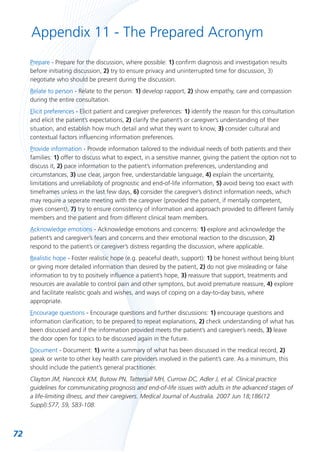
communication skills includes a focus on the PREPARED acronym developed by Clayton and
colleagues22
to communicate about prognosis and end of life issues with adults with a life­limiting
illness (Appendix 11). Participants were also offered the opportunity for role play to trial the
communication skills techniques. This programme has been run for all renal link nurses and a
shortened version has been adapted for consultants. In general, the training programme was very
well received by participants, with the sessions on patient and carer experience, and the opportunity
for role­play in a ‘safe’ environment both highly valued.
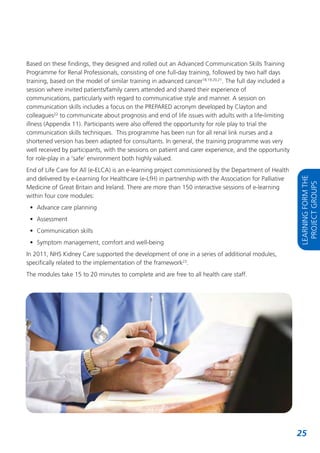
End of Life Care for All (e­ELCA) is an e­learning project commissioned by the Department of Health
and delivered by e­Learning for Healthcare (e­LfH) in partnership with the Association for Palliative
Medicine of Great Britain and Ireland. There are more than 150 interactive sessions of e­learning
within four core modules:
• Advance care planning
• Assessment
• Communication skills
• Symptom management, comfort and well­being
In 2011, NHS Kidney Care supported the development of one in a series of additional modules,
specifically related to the implementation of the framework23
.
The modules take 15 to 20 minutes to complete and are free to all health care staff.
LEARNING FORM THE

PROJECT GROUPS

25
5: Recommendations

Achieving Best Practice
The framework has proved a very useful basis for the project groups establishing end of life care for
kidney patients. The experience and learning described above show that the challenges have been
tackled and achieved in different ways to fit the diverse working practices in the project areas.
Kidney units that implement the framework will ensure that they are well positioned for achieving
the quality statements set out in the NICE standard24
for end of life care. 
The following recommendations are based on the learning and experience from the work of the
project groups.
i How to identify patients approaching end of life
Establish a systematic unit wide approach to identification of patients
A systematic approach can be taken to identify patients who may be approaching end of life. This
allows staff to move across work areas and still be familiar with the process. A number of examples
have been described above and kidney units developing registers, in partnership with primary care
colleagues, could adopt part or all of any of those that have been shown to be useful in the project
groups.
Ensure that all patient groups are included
All kidney patients may benefit from end of life care support and consideration should be given to
spreading the use of patient identification for the register beyond those on conservative care.  
ii Creating and using a register
Recognise that a change in culture may be required as well as organisational changes
A cultural change will take time to mature within a unit, and all the project groups emphasised the
need for dedicated staff to lead and demonstrate new approaches to supportive and palliative care.
Consider the name of your register
Consider the name to be given to a register and what that might convey to staff and patients using
it. All the project groups have chosen to move away from “cause for concern”.
Use IT systems that will enable the best access for all staff
If possible, adapt local IT systems to hold the register and keep abreast of opportunities within the
healthcare community for sharing electronic records more widely. A number of pilots are taking place
across the country within healthcare communities that will enable sharing of patient information
including preferences for end of life. 
Consider who will agree registration with the patient and when
For one of the groups, registration was dependent on a discussion with the patient at an out­patient
appointment which led to delay in registration if appointments were several months away and
subsequently to some patients dying before reaching the registration discussion. Consideration
should be given how best to fit with local processes to ensure that registration is discussed with
patients in a timely manner in a suitable location with an appropriate staff member.
26


iii Advance Care Planning
Offer advance care planning to all dialysis patients
Patients were found to appreciate the opportunity to take part in advance care planning (ACP) even
if they did not immediately wish to take it up. A number of documents are available for use in
introducing ACP for patients that can be adapted to suit local circumstances and facilities. The use of
appropriate documentation helps to give staff confidence in approaching patients. Recording patient
preferences for place of care and death allows policies and procedures to be established that will
help this be achieved.
Take account of the time that advance care planning will require
The groups found that ACP could take more than one discussion with a patient and that for some
patients the discussion may take some time and may require revisiting at a future date. If possible,
involve families and carers in these discussions.
iv Coordination of care
Consider methods of raising awareness and links with local organisations involved with
end of life care
A number of approaches (stakeholder events, staff exchanges, attending meetings) were taken by
the groups to build on their relationships with other organisations working with kidney patients. This
helped to ensure communications remained open and effective to ensure patients received the
services they required.
Consider creation of a resource with details of local organisations involved with end of life care
The groups found that an easily accessed resource with details of contact information, key workers
and guidance regarding end of life care for kidney patients was very useful to kidney unit staff
v Support for families and carers through the end of life period and beyond
Consider methods to support bereaved families, carers and staff
A number of approaches to bereavement support were taken by the groups including letters and
cards, annual services, and, for staff, training sessions from pastoral colleagues. RECOMMENDATIONS

27
Workforce considerations
i Identifying key staff to champion the work
Establish key/link workers
Identification of link staff who may receive additional training and education about end of life care
processes within a unit can provide support for all staff. A key worker allocated to individual patients
may also act as a co­ordinator with other services.
ii Training needs of kidney unit staff 
Resource training for staff
All groups found training and education were crucial to the success of their projects to give staff the
knowledge and confidence to raise issues with patients. A number of approaches were adopted
including taking advantage of training already within the trust, courses run by local palliative/hospice
staff and national initiatives for training in end of life care. The groups found that, where possible,
providing kidney specific  training was the most successful.
Training should be designed and delivered at different levels, according to the previous training and
experience of the renal professionals, and the extent to which they will be responsible for end of life
care. Kidney­specific advanced communication skills training has been developed, and should
become more widely available.
28


6: End of life care in advanced
kidney care dataset
End of life care for patients with advanced kidney disease is an emerging theme which naturally
connects with other developments over the last two years in the wider end of life care community.
One of the ways to improve end of life care for patients is to maximise the opportunities to record
elements of the care plan in a consistent manner. In doing so, it becomes possible to communicate
and share that plan over a much wider range of people and settings than it would if the care plan
was unstructured. Better informed patients and their carers makes “right care” much more likely
and can reduce distressing and wasteful health activities.
Over the last two years, the National End of Life Care Programme (NEoLCP) has been developing a
set of core items which could be unified to enable better communication. At their most basic, this
set of items can form a register of people who are reaching the end of their life who require more or
different interventions or care. Such a register could be used to prompt discussion in
multi­disciplinary meetings even if it was just constrained to one clinical setting (such as a renal unit).
Large gains come from sharing information however, and the NEoLCP piloted the use of a shared
end of life care register between settings. The final report and their evaluation gives a useful
summary of their learning and some clear recommendations about how to make a success of
implementing a shared care plan25
.
Even within the NEoLCP pilot schemes there were differences in the breadth and depth of the
information recorded and the range of services that could access the shared record. In the most
developed pilots, the end of life care register became much more than a prompt to multi­disciplinary
discussion, forming a fully developed care plan which was shared between primary care, secondary
care, specialist palliative care, out of hours services and the ambulance service.
In parallel with the NEoLCP pilots, and before the publication of the final report and
recommendations, the three NHS Kidney Care End of Life Care (EoLC) pilot sites undertook to
implement a local end of life care register and to then test its value in clinical practice and for clinical
audit. Many English renal units have implemented or are developing such registers.
Each of the pilot sites had different IT tools at their disposal to hold their register. For example, in
the Bristol pilot the register was contained with the renal unit clinical computer system, was
developed in­house using existing expertise in that system, and became an integrated part of the
routine assessment and tracking of all patients’ care needs in the dialysis units which adopted the
system. The scope to share the record outside the renal service is limited however. In contrast, in the
West Manchester pilot the register was developed as part of other work to share care records for all
specialities between primary and secondary care. The resulting register was less specific to patients
with kidney disease, but has greater potential to share and inform care decisions in other settings.
The purpose of this part of the report is to summarise the learning from the kidney care pilots of the
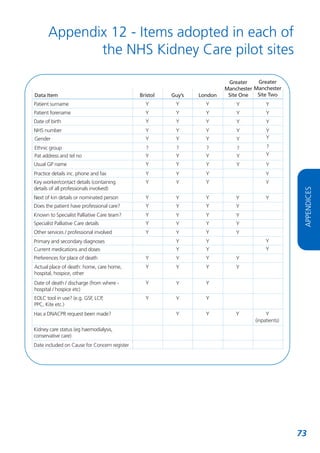
NEoLCP register. The End of Life Care Locality Register Pilot Programme Core Data Set is described in
Appendix 12.
DATASET

29
Description of the IT systems in the pilot areas
Bristol
The single pilot run in the Bristol renal centre and surrounding units used the standalone renal clinical
computer system in widespread use throughout that renal unit (Proton). The register was developed
between clinicians in the pilot and the local IT system manager. 
Manchester (Salford)
The register was constructed between the clinical team and the IT support for the electronic patient
record already in use throughout the Salford Royal NHS Foundation Trust, and progressively being
shared with other clinical settings in the community.
Manchester (Central)
Clinical Vision 4 (CV4) IT system was utilised to establish the register, allowing access to information
across all renal settings within Central Manchester including renal out patients’ clinics and renal
satellite units.
Kings
The register was constructed with a locally developed renal standalone IT system with strong clinical
support and buy in.
Guy’s
Guy’s and St Thomas’ NHS Foundation Trust has extensively developed a locally configured version of
the iSoft clinical manager software which has incorporated the renal unit clinical computing
requirements and is progressively being shared with the surrounding community.
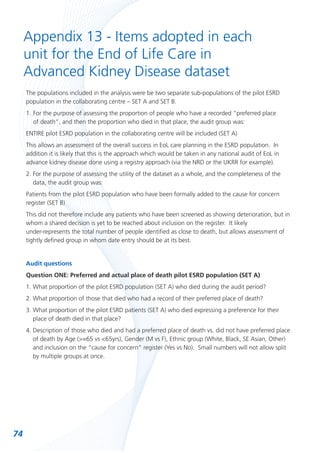
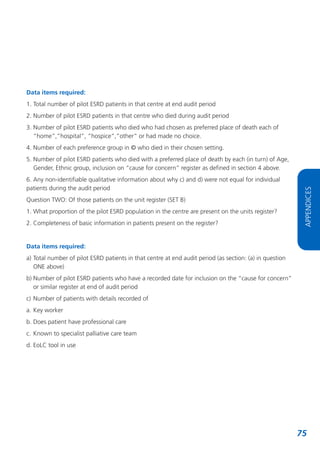
The items adopted in each unit are described in Appendix 13.
30


Summary of the learning from developing and implementing renal end of life care registers
The conclusions from the End of Life Care in Advanced Kidney Disease pilots register project is
presented using the same heading as the key finding and recommendation from the NEoLCP; the
headlines are the same, but here renal examples are given to illustrate the points. The conclusions
from the audit of the data held will be presented separately.
Engage with all stakeholders early
Developing the register requires dedicated clinical and IT input
The three centres in the pilot all had a combination of a clinical champion (or champions) and an IT
partner who was also engaged in developing the register.
Establish what is expected from the register
Is this an internal register to drive multidisciplinary discussion within the renal unit, or is it a
communication tool with other care settings?
Establish the data requirements
It was clear from the audit of the data on the care registers that some information was more likely to
be recorded than others. If the items being proposed are audit steps, care should be taken to ensure
they fall on the natural clinical care pathway for most patients, otherwise the item is unlikely to be
reported. Free text allows the subtlety of a care discussion, but a Y/N is required in order to
unequivocally record whether a particular decision has been reached, or a particular action has been
carried out.
Think about what to call the register
In Bristol the register evolved, and although initially called the “Gold Standards Register” this was
found to be poorly understood by patients and staff, and was renamed as “supportive care register”.
Before selecting an IT platform and approach, think through the needs of the different stakeholders.
Renal units have an established track record of developing their existing clinical computer system to
meet the changing patient pathways and interventions that have been adopted over the last 30
years. Developing a register in the renal clinical computer system is therefore the course which is
easiest to implement at minimal cost, and is accessible and understood by most members of the
renal multi­disciplinary team. However, many secondary care providers are developing alternative
systems to communicate with primary care and share letters and results. If the primary goal is to
share information outside the renal unit then utilising such a system, or at least adopting a standard
set of data items and using such technology to share these items, might be more appropriate.
Before selecting an IT platform, map out what systems are already in use in your area
All of the pilots tried to use the IT systems which were already available to them. It is very unlikely
that a single unifying system will now be implemented in the NHS, and instead the philosophy is one
of integrating existing and new technologies. Focusing instead on using standard items defined in a
consistent manner is the key to ensure that the most can be made of the information in the future.
DATASET

31
Establish who has responsibility for the accuracy of the patient record
An opt­in model of consent is almost universally felt to be necessary
This was found in the three kidney care pilots also, although it is not universally adopted in all renal
centres using end of life care registers.  Formal or informal, a clear step which ensures that a patient
realises what the end of life care register is, and how it could benefit their care seems necessary for
the register to work effectively and with transparency in all subsequent consultations.  
Consider how to present the issue of how binding the register is
Whilst this is true for all decision making about care in advanced CKD it is perhaps most obvious in
the decision making around whether or not to start on renal dialysis.  Mentally competent individuals
are entitled to change their minds at any stage in their care process, and the reassurance that this is
possible regardless of what is on the EoLC register is important to communicate.
It is vital that end users are trained both in the IT and the clinical skills required to use the register
It is clear from all the pilot sites that staff training is essential to successful conversations and
effective care planning at the end of someone’s life.  This is true of the EoLC care register also; staff
training to ensure everyone is clear how the information on the register drives future care decisions is
necessary if they are to complete the register consistently.
Provide staff with the evidence of the benefits of the register
Staff in renal units are aware of the benefits of recording electronic information for the benefit of
themselves and others already, as most clinical staff in a renal unit will update the renal computer
system with information several times per day, and use it to look up much more information entered
by others.  Unless the information added to the EoLC register is seen to be used to drive direct clinical
care, or improve standards through audit, it will be poorly utilised except by pockets of enthusiasts.
End of life care registers as an audit tool
In addition to establishing EoLC care registers, and providing feedback on implementation, each of
the pilot sites was asked to provide information to allow the register to be tested as a potential tool
for local and national audit.  The National Service Framework (NSF) for renal services published in
2004 and 2005 included guidance on the standards of care expected for patients with end­stage
renal disease (ESRD), and specifically to this report those with advanced chronic kidney disease (CKD)
at the end of their lives.   It led to the development of a National Renal Dataset (NRD) which
mandated the collection of approximately 900 items to monitor the implementation of the NSF in
patients with ESRD.  However, the NRD contains very few items which allow for monitoring and
quality improvement for patients with CKD at the end of their lives.  It was expected that
information from the pilot sites could help inform the development of such items.
Analysis populations
“Pilot ESRD population” in the audit was defined as patients with ESRD in the centre who were
cared for by a clinical team who had agreed to the pilot and were already involved in the broader
NHS Kidney Care pilots implementing the framework.
32


The populations included in the analysis were two separate sub­populations of the pilot ESRD population
in the collaborating centre – SET A and SET B. Appendix 14 shows the sets and audit questions.
Audit findings
All sites had implemented a register for end of life care. Data were received from each of the three
pilot areas covering activity between 1 August 2011 and 31 October 2011, although two sites in
each of the pilot areas was not able to provide summary data for comparison in time for publication.
Gratifyingly few patients died during the short audit period. Sub group analysis by age, gender or
race on each site was therefore not possible.
Table 3: Summary of audit findings
Site A Site B Site C
Number ESRD pts 679 505 1035
Question One
Number ESRD pts who
died
28 13 34
Died in hospital 14 6 8
Died in hospice 1 2 1
Died at home
(inc residential care)
12 5 2
Not known 1 0 23 (those not on register)
Number who died who
were on register
11 (and 1 who was offered
but declined)
5 11
Number who expressed a
preferred place of death
12 5 6
Number who died in that
preferred place
9 5 6
Question Two
Number of patients 611 16 1141
on EoLC register (Total on register) (Added during audit)
Number with a key
worker completed
98 NA NA
Known to specialist
palliative care
NA NA
EoLC tool in use 5522 NA NA
NA informationonthis notavailable
†
May include a small number of patients not with ESRD. In addition seven patients were identified by staff, but
declined the recommendation to join the register.
1
A very high proportion of patients did express a preferred place of death. Although it is noted that this decision
often evolves as the EoLC conversations progress it is estimated by this site to be the preference of at least 39% of
their patients to die at home.
2
Although not part of the original audit question this is the number of patients actively screened to assess whether
a further discussion was needed about end of life care needs.
DATASET

33
Audit discussion
Previous work suggests that a disproportionate number of patients with advanced CKD at the end of
their life die in hospital. These patients are often well known to their renal teams and it is not always
a surprise that a patient who is already admitted to hospital when a decision to stop treatment is
made might opt to remain in hospital. In addition, some patients died either unexpectedly without
the opportunity to plan, or whilst undergoing full medical intervention to save their life.  In this
context it is very encouraging to note that a third of all patients (half those in two sites) who died
during the audit did so at home or in a hospice. This reflects well on the efforts in the pilot sites to
enable and enact patient choice. 
Of those patients who expressed a choice of where they wanted to die, the majority were able to die
in that place. This measure is a complex measure which incorporates several key steps in the care
pathways.  Patients need to have undergone a choice process, and had their decision recorded. The
patient system then needs to facilitate the fulfilment of that care plan when the correct moment
comes and the place of death also needs to be recorded. This simple measure of the completeness of
the preferred and actual place of death, coupled with a measure of how many times the two are
equal, seems a very effective measure of a successful end of life care process.
Recommendations
Evidence from the NHS Kidney Care pilot sites supports the recommendations to:
1. Establish a register to allow co­ordination of care between professions and across care boundaries
2. To use the national heading to allow consistency of recording and future integration if a national 
Information Standard is established
3. Record where a patient with ESRD or conservative care dies, and, in those identified in advance, 
where their preferred place of death is
4. Locally establish an audit programme which compares these answers
5. Nationally discussions take place with the UKRR and the NRD management board on adopting 
items for the patient place of death and preferred place of death to allow national comparison 
34


Acknowledgements

This report was produced by NHS Kidney Care incorporating the reports of its project by the teams at:
•	 North Bristol NHS Trust
•	 The Greater Manchester Managed Kidney Care Network, a partnership between the Central
Manchester University Hospitals Foundation Trust and Salford Royal NHS Foundation Trust
•	 The Advanced Renal Care (ARC) project led by the Department of Palliative Care, Policy and
Rehabilitation at King’s College London and working across the renal units at King’s College
Hospital NHS Foundation Trust and Guy’s and St Thomas’ NHS Foundation Trust
Thanks to the following for their contribution and comments on the draft report:
Ann Banks Katherine Bristowe Susan Heatley
Clare Kendall Louise Long James Medcalf
Fliss Murtagh Hilary Robinson Kate Shepherd
ACKNOWLEDGEMENTS

35
Abbreviations and glossary

Term or
abbreviation
NSF
NEoLCP
SQ
POS-s
MDM / MDT
Karnofsky
Performance
scale
EQ5D
NICE

Description
National Service Framework - The
National Service Framework sets
standards and identifies markers of good
practice which will help the NHS and its
partners manage demand, increase
fairness of access and improve choice
and quality in kidney services.
National End of Life Care Programme -
works with health and social care
services across all sectors in England to
improve end of life care for adults by
implementing the Department of
Health’s End of Life Care Strategy.
Surprise Question – “Would you be
surprised if this patient died in the next
12 months?”
The Palliative care Outcome Scale (POS) is
a tool to measure patients' physical
symptoms, psychological, emotional and
spiritual needs, and provision of
information and support at the end of life.
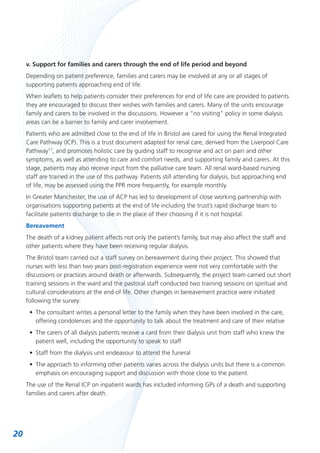
POS is a validated instrument that can
be used in clinical care, audit, research
and training.
Multi-disciplinary meeting /
Multi-disciplinary team.
The Karnofsky Performance Scale Index is
used to quantify patients' general
well-being and activities of daily life.
EQ-5D™ is a standardised instrument for
use as a measure of health outcome.
Applicable to a wide range of health
conditions and treatments, it provides a
simple descriptive profile and a single
index value for health status.
National Institute for Health and Clinical
Excellence.
Source (if applicable)
http://www.dh.gov.uk/en/Publicationsan
dstatistics/Publications/PublicationsPolicy
AndGuidance/DH_4070359
http://www.dh.gov.uk/en/Publicationsan
dstatistics/Publications/PublicationsPolicy
AndGuidance/DH_4101902
http://www.endoflifecareforadults.nhs.uk/
Refs 6,7
http://pos-pal.org/
http://www.euroqol.org/home.html
http://www.nice.org.uk/
36
GSF Gold Standards Framework - The Gold
Standards Framework (GSF) is a systematic
evidence based approach to optimising the
care for patients nearing the end of life
delivered by generalist providers. It is
concerned with helping people to live well
until the end of life and includes care in
the final years of life for people with any
end stage illness in any setting.
http://www.goldstandardsframework.org.uk
ACP Advance Care Planning – a voluntary
process to help an individual who has
capacity to anticipate how their condition
may affect them in the future and record
choices about care and treatment and / or
an advance decision to refuse treatment.
http://www.endoflifecareforadults.nhs.uk/
publications/pubacpguide
PPC Preferred Priorities for Care – a tool to
give patients the opportunity to think,
talk and record their preferences, wishes
and what is important to them. It is not
intended for the recording of refusal of
specific medical treatments.
http://www.endoflifecareforadults.nhs.uk
/tools/core-tools/preferredprioritiesforcare
e-LfH E Learning for Healthcare - an e-learning
programme providing national, quality
assured online training content for
healthcare professionals.
http://www.e-lfh.org.uk/index.html
e-ELCA E End of life care for all – an online
resource that provides training and
education for those involved in delivering
end of life care. Free for all NHS staff.
http://www.e-lfh.org.uk/projects/e-elca/
launch/index.html
ICP Integrated Care Pathway.
EOLCinAKD End of Life Care in Advanced
Kidney Disease.
LCP Liverpool Care Pathway - an integrated
care pathway that is used at the bedside
to drive up sustained quality of the dying
in the last hours and days of life.
http://www.mcpcil.org.uk/liverpool­
care-pathway/
Cruse A charity that provides support
following bereavement.
www.crusebereavementcare.org.uk
ABBREVIATIONS

AND GLOSSARY

37
References

1
Department of Health. National Service Framework for Renal Services – Part Two: Chronic kidney
disease acute renal failure and end of life care. 2005 [viewed 2012 Feb 13] Available from:
http://www.dh.gov.uk/prod_consum_dh/groups/dh_digitalassets/@dh/@en/documents/digitalasset/dh_4102680.pdf 
2
Department of Health. Our Health, Our Care, Our Say: a new direction for community services.
2008 [viewed 2012 Jan 24] Available from:
http://www.dh.gov.uk/en/Publicationsandstatistics/Publications/PublicationsPolicyAndGuidance/DH_4127453  
3
Department of Health. High Quality Care for All Our NHS Our future: NHS next stage review final
report. 2008 [viewed 2012 Jan 24] Available from:
http://www.dh.gov.uk/prod_consum_dh/groups/dh_digitalassets/@dh/@en/documents/digitalasset/dh_085828.pdf 
4
Department of Health. End of Life Care Strategy. 2008 [viewed 2012 Jan 24] Available from:
http://www.dh.gov.uk/prod_consum_dh/groups/dh_digitalassets/@dh/@en/documents/digitalasset/dh_086345.pdf 
5
NHS Kidney Care. End of Life Care in Advanced Kidney Disease: A Framework for Implementation.
2009 [viewed 2012 Feb 13]. Available from: http://www.kidneycare.nhs.uk/Library/endoflifecarefinal.pdf     
6
Moss AH, Ganjoo J, Shaema S, Gansor J, Senft S, Weaner B, Dalton C, MacKay K, Pellegrino B,
Anantharaman P, Schmidt R. Utility of the “Surprise” Question to Identify Dialysis Patients with High
Mortality. Clinical Journal of American Society of Nephrology 2008; 3(5):1379­1384
7
Cohen LM, Ruthazer R, Moss AH, Germain MJ. Predicting Six­Month Mortality for Patients Who Are
on Maintenance Haemodialysis. Clinical Journal of American Society of Nephrology. 2010; 5(1):72­79
8
The Edmonton Symptom assessment system. [Internet] 2012 [viewed 2012 Feb 13]. Available from:
http://www.palliative.org/PC/ClinicalInfo/AssessmentTools/AssessmentToolsIDX.html 
9
Richardson LA, Jones GW. A review of the reliability and validity of the Edmonton Symptom
Assessment System.  Current Oncology. 2009; 16(1): 55.
10
POS ­ S ­ Palliative care Outcome Scale – Symptoms. [Internet] 2012 [viewed 2012 Feb 13].
Available from:  http://www.csi.kcl.ac.uk/pos­s.html
11
Information about the Gold Standards Framework. [Internet] 2012 [viewed 2012 Feb 13]. Available
from:  www.goldstandardsframework.org.uk 
12
EQ5D. [Internet] 2012 [viewed 2012 Feb 13]. Available from: http://www.euroqol.org/home.html
13
National End of Life Care Programme. Planning for Your Future Care. Revised 2012 [viewed 2012
Feb 13]. Available from:  http://www.endoflifecareforadults.nhs.uk/publications/planningforyourfuturecare 
14
National End of Life Care Programme: Preferred Priorities for Care. Revised 2007 [viewed 2012 Feb
13]. Available from: http://www.endoflifecareforadults.nhs.uk/tools/core­tools/preferredprioritiesforcare
38


15
National End of Life care programme: Holistic common assessment of supportive and palliative
care needs for adults requiring end of life care. March 2010 [viewed 2012 Feb 21]. Available from:
http://www.endoflifecareforadults.nhs.uk/publications/holisticcommonassessment
16
NHS Kidney Care. Caring for Patients with Advanced Kidney Disease at the End of Life – Ten Top
Tips. 2011 [viewed 2012 Jan 24]. Available from: http://www.kidneycare.nhs.uk/Library/EoLCTenTopTips.pdf
17
Liverpool Care Pathway for the Dying Patient (LCP). [Internet] 2012 [viewed 2012 Feb 13].
Available from: http://www.mcpcil.org.uk/liverpool­care­pathway/index.htm
18
Stewart MA. Effective physician­patient communication and health outcomes: a review. Canadian
Medical Association Journal. 1995; 152(9):1423­33
19
Wilkinson S, Roberts A, Aldridge J. Nurse­patient communication in palliative care: an evaluation
of a communication skills programme. Palliative Medicine.1998; 12(1):13­22
20
Wilkinson S, Bailey K, Aldridge J, Roberts A. A longitudinal evaluation of a communication skills
programme. Palliative Medicine. 1999; 13(4):341­8
21
Jenkins V, Fallowfield L. Can communication skills training alter physicians’beliefs and behavior in
clinics? Journal of Clinical Oncology. 2002; 20(3):765­9
22
Clayton JM, Hancock KM, Butow PN, Tattersall MH, Currow DC, Adler J, et al. Clinical practice
guidelines for communicating prognosis and end­of­life issues with adults in the advanced stages of
a life­limiting illness, and their caregivers. Medical Journal of Australia. 2007 Jun 18; 186(12
Suppl):S77, S9, S83­108.
23
End of Life Care in Advanced Kidney Disease: A Framework for Implementation – interactive
session within the ‘Integrating Learning’ module. [Internet] 2012 [viewed 2012 Jan 24]. Available
from: http://www.e­lfh.org.uk/projects/e­elca/index.html
24
National Institute for Health and Clinical Excellence. Quality standard for end of life care for adults.
2011 [viewed 2012 Feb 13]. Available from:
http://www.nice.org.uk/guidance/qualitystandards/endoflifecare/home.jsp?domedia=1&mid=E9C7F836­19B9­E0B5­D4B49B5A7
149F081
25
National End of Life Care Programme. End of Life Locality Register Evaluation. Final Report June
2011 [viewed 2012 Feb 13]. Available from:
http://www.endoflifecareforadults.nhs.uk/publications/localities­registers­report
REFERENCES

39
Appendix 1 ­ Patient Pathway Review

developed by the Bristol Project Group

Patient Pathway Review Richard Bright Kidney Unit

Date ____________________________ Name
Assessed ________________________(sign) Unit No
Print Name _______________________ DOB
Please put a tick in the box to show how you have been feeling in the last week
Do you feel your health restricts your ability to perform these activities:
Not at all Moderately Severely OverwhelmingSlightly
0 2 3 41
Walking

Climbing stairs

Bathing

Self Care

In the last week have you experienced any of the following symptoms:
Pain

Shortness of breath

Weakness or a
lack of energy

Itching

Changes in skin

including colour
Nausea, vomiting

(feeling / being sick)

Mouth Problems

Poor Appetite

Bowel Problems

Drowsiness

Difficulty in sleeping

Restless legs / difficulty
keeping legs still
Comments
40
Have there been any changes with your:
Not at all
0
Slightly
1
Moderately
2
Severely
3
Overwhelming
4
Change in vision
Hearing
Speech
In the last 4 weeks: Have you had any practical problems / concerns with:
Children / Child Care
Housing
Finances
Personal
Transportation
Work
Partner / Family
Relationships
Have you felt ‘low in mood’ or a period of feeling ‘down hearted’
APPENDICES

During the last 4 weeks how often do you feel your physical and emotional health has affected
your social and working life.
In the last 4 weeks have you felt worried
Do you feel your spiritual needs are being met? Yes No
Quality of life - please place a cross on the line
10 9 8 7 6 5 4 3 2 1
Excellent Acceptable Tolerable Unacceptable
Comments
NoWould you like any further information on your care? Yes
Have you considered having haemodialysis or peritoneal dialysis treatment in your own home?
Yes No Na Referred Already
For office use: Complete SCR Score _________________________________________________________
41
Richard Bright Kidney Unit
Screening tool to identify patients who may require review for
the Supportive Care Register
Aim: To identify patients who may require / Additional supportive care or information
Name Unit No
Guidelines for use
Can be used by renal medical staff, dialysis staff, home team members, education team,
senior ward nurses, social care/support (eg Ruth) specialist nurses (eg diabetes).
When to use
1. Following routine use of the assessment tool
2. At any time when deterioration noted
3. At patient’s request
4. In clinic (has usually been used prior to clinic)
Kidney Patients’ Supportive Care Identification Tool
(Score 1 or 0 for each of the following)
• Unintentional weight loss (non-fluid) > 10% (6 months) ___
• Serum albumin <25mg / dl ___
• Requires mobilisation assistance e.g. walking frame, carer to help ___
• In bed more than 50% of the time ___
• Conservative management patients (e.g. not on dialysis) with CKD 5 ___
• >
2 Non-elective admissions in 3 months ___
• Patient has expressed a desire to stop treatment ___
• Identification by GP (already on the GP practice end of life register) ___
Support Care Register Score ___
If the score is 1 or more please tick actions taken
1 Acknowledge concern to the patient - “I can see you are not as well as previously is there anything more
we can do for you?” “I will let your consultant know of the changes
2 Enter score on proton Supportive Care Register screen - inform consultant (proton if to be reviewed at
next clinic appointment, email or telephone if more urgent, MDM if an inpatient).
Staff Signature _______________ Name (print) ___________________ Date ____________
42
       
 
Appendix 2 ­ Screening tool to identify
patients for the GOLD register
Developed by the King’s Health Partners project group
Patient
Unit No
DOB
Consultant
Guidelines for use
Can be used by any member of the renal team involved with patient care
When to use
1. Following routine use of the POS-S renal and EQ-5D assessment tools
2. Prior to the MDM
3. Any time deterioration is noted
Measures Score
POS-S Renal
EQ-5D
Modified Kamofsky
Underlying diagnoses No = 0 / Yes = 1
Dementia
PVD
IHD
Myeloma or underlying cancer
Albumin <25mg / dl
Other (specify)
0 / 1
0 / 1
0 / 1
0 / 1
0 / 1
0 / 1
Other information
Age <65 65 - 75 <75
Underlying Regal Diagnosis
Surprise Question Y / N
APPENDICES

Staff Signature _______________________ Name (print) _____________________ Date _______________
43
Appendix 3 ­ Bristol Proton Screen

Test - Bill (William) DOB - 01/11/52
Gold Standard Pathway
Screening tool results
1 Unintentional weight loss of > 10% in 6 months
2 Serum Albumen <25mg / dl
3 Requires mobilisation assistance
4 NO to the Surprise Question
Patients identified for GSP (Dr)
Y / N: Yes Initials: RRA Date: 11/12/2009
Information leaflet given: Yes
Clinic and GSP letter to GP: Yes
Copy both to district nurse: Yes
Patient consent given: Yes
Key worked allocated by GS team Yes
Name: J Smith Date: 21/12/2009 Grade: RDU
PCS Referral made: Yes
Date: 04/01/2010
Somerset Hospital - GSP RRA 171717
Patient pathway review / assessment
1st
review: 10/11/2009
Last review: 23/04/2010 Reviews: 5
Patient care plan Agreed Init
Date: 10/11/2009 Yes AC
Carer’s need assessed
Date: 13/01/2012 Yes AC
Advanced care planning
Offered: Yes 21/12/2009
Accepted: Yes 21/12/2009
LPA: Yes ADRT:
Preferred Priorities for Care:
Date: 23/01/2010 PPC: Home
AC
Plan:
No
Y
PPD: Hospice
Y
ICP:
Actual place of death: Date:
44


Appendix 4 ­ NHS Kidney Care’s Cause
for Concern Survey
Background
The End of Life Care in Advanced Kidney Disease: A Framework for Implementation1
published in
2009 provides recommendations and guidance for kidney units that would optimise end of life care
for kidney patients of all treatment modalities. One of the recommendations is that units create
Cause for Concern registers:
“To facilitate care planning and communication consideration should be given to creation
within the local kidney unit of a “Cause for Concern” register to facilitate the identification
of those within the unit who are approaching the end of life phase. The aim is to facilitate 
care planning, communication and use of end of life care tools and link with the palliative 
care registers held by GP practices, which are part of the QOF” (p21)
NHS Kidney Care has established a project to implement the framework within three project groups:
• North Bristol Health Economy
• King’s Health Partners
• Greater Manchester Kidney Network
Each group has set up Cause for Concern registers as part of their projects.
However there is no information available concerning the progress with establishing registers across
kidney units in England.

This survey was created to explore the number and nature of registers within kidney units.

Method
A survey was created using Survey Monkey that could be completed online. Fourteen questions were
posed to cover whether a register was in place and to explore aspects of the register such as method
of patient identification, links with palliative care, existence and use of patient pathways.
A request to complete the survey was sent to all (52) English kidney unit clinical directors and nursing
leads, with a link to the online questions.
Results
The survey was sent to the 52 English kidney units and 24 (46%) identifiable responses were
received. An additional six responses had no indication of where they originated and may have been
initial attempts at answering the survey or tests of the questions. The findings reported below relate
to the 24 completed questionnaires, but not all respondents replied to every question, so the number
of responses reported will not always total 24.
The results from the survey questions are presented below:
APPENDICES

45
U
nintentional
w
eightloss...
Serum
album
im
<25m
g
/dl
Requires
In
bed
m
ore
m
obilisation
...
than
50%
oftim
e
Conservative
m
anagem
ent
>
2
N
on-elective
adm
issions...
Patienthas
expressed
a
...
Identification
by
G
P
(already
...)
Surprise
questionO
ther
(please
specify)
1. Does your renal unit have a Cause for Concern or Supportive Care register for patients with
end stage renal failure who are approaching end of life?
Yes 15 62.5%
No 6 25%
Other 3 12.5%
In the case of “other” responses, the reason given in two cases was that a register was in
development. Data protection issues were preventing progress in the remaining unit.
2. Which of the following are used as inclusion criteria for placing patients on the register?
Please tick all that apply.
16
14
12
10
8
6
4
2
0
Number of Units
Responses in the “other” section included:
• MDT holistic assessment
• Failure to thrive on dialysis
• Other co­morbidities and malignancies
The most commonly cited criteria are the Surprise Question and the patient expressing a desire to
stop treatment.
46


3. Are the criteria for inclusion on your Cause for Concern / Supportive Care register recorded on
your local renal database?
Yes 8
No 7
Some but not all 3
Don’t know 0
A third of units responding to the survey record their inclusion criteria on their local database.
APPENDICES
Responses in the “other” section included:
• Under development
• In separate databases or spreadsheets
• In local documents

The majority of registrations are recorded on local IT systems.

47
5. How many patients are currently on your Cause for Concern Register?
The numbers reported ranged between four and 148 with the majority of units having less than 40
patients on their register.
6. What percentage of patients currently on your Cause for Concern Register are dialysis,
pre­dialysis, transplant, conservative care?
The responses varied with 1% or less transplant patients on registers. Variation was also accounted
for by local models of care whereby conservative care patients were not considered for the register as
it was assumed they were approaching end of life. For most units dialysis patients were the majority
of patients on their register.
7. Once a patient is included on the Cause for Concern Register do any of the following occur?
Yes No Don’t know
Assessment of care needs by renal team 18 0 0
Place patient on primary care CfC register 10 5 3
Referral for assessment by social worker 7 10 1
Referral for assessment by psychologist 9 8 1
Advance care planning 16 0 2
Use of Preferred Priorities for Care 6 9 3
documentation
Discussion around preferred place of death 14 3 1
Support for families and carers 17 1 0
Care needs documented on GP Gold 7 3 8
Standards Register or equivalent
Other (please specify) 10
In the “other” section a number of units commented that some of the actions do take place but not
routinely because the wishes of the individual patient are respected. The palliative care team may
initiate the actions in some units so they are not directly linked to the Cause for Concern registration.
Units also commented that although they request that a patient be placed on the GP register they
have no method of knowing whether this has taken place.
48


8. How is palliative care integrated into your local renal service?
The responses to this question were free text, but the main points emerging are:
• 13 units reported they have good integrated links with palliative care physicians and/or nurses
• Three units indicated that they had links with local Macmillan services
• One unit had a poor relationship with palliative care services, but was able to access 
Macmillan services
• One unit accessed palliative care services when a specific need was identified
APPENDICES
The responses to questions 9 and 10 indicate differences across the country in whether patients are
consented prior to going on the register and knowing that they have been placed on it. The
“Other” responses included verbal consent .
49
Yes
N
o
D
on’t
know
Via
letter
Via
em
ail
Via
phone
call
Via
integrated
health
care
record
O
ther
(please
specify)
10. Is full informed consent obtained before placing the patient on the register?
8
6
4
2
0
Number of Units
The majority of units send letters to the patients’ GP to inform them of their end of life care status
and one unit is working towards a shared electronic register.
11. How do you ensure that a patient’s General Practitioner is made aware of their end of life
status in order to include them on their Gold Standards Framework/Palliative Care Register?
(Please tick all that apply).
18
16
14
12
10
8
6
4
2
0

Number of Units
50


Responses in the “other” section included:
• A pathway is being developed
• Documentation to support staff is used
• A suitable pathway is being assessed
Less than a third of responding units reported having a formal pathway
12. Does your unit have a formal Cause for Concern/ end of life/palliative care integrated
pathway for patients placed upon the cause for concern register?
Number of Units
Yes there is a formal pathway 7
No there is no formal pathway 5
Other (please specify) 6
13. Please briefly describe current triggers for advanced care planning with patients and at
what stage preferred priorities for care discussions are held with the patient/carer and by
whom. What is being recorded in your database to indicate that discussions have taken place?
Few units responded to this question (6), but the start of conservative care and / or increased frailty
was quoted by some.
APPENDICES

51
Yes
N
o
D
on’t
know
14. Does your renal unit link to an End of Life Care locality register? (A locality register is a
dataset facility that enables the key information about, and individuals’ preferences for,
care at the end of life to be recorded and accessed by a range of services. For example this
would allow access to a patient’s stated end of life preferences to medical, nursing and
paramedic staff who might be called to attend them in the community out-of-hours. The
ultimate aim is to improve co-ordination of care so that end of life care wishes can be better
adhered to and more patients are able to die in the place of their choosing and with their
preferred care package).
25
20
15
10
5
0
Number of Units
Only one unit has links with their End of Life care locality register.
52


Conclusions and recommendations
1.The survey indicated that at least 18 (29%) units in England either have established a Cause 
for Concern register or are in the process of setting one up. More work is needed to ensure 
that all units have a register in place.
2.Methods of identifying patients for the register vary across units, but the surprise question
and patients wanting to stop treatment are the most commonly used, and could be adopted
by units which have not yet set up a register as initial triggers.
3.Some units report recording the Cause for Concern register in spreadsheets or local 
documents. It is important that units work towards ensuring all staff who may be in contact
with the patient are aware of the registration.
4.There are wide differences in the actions that are triggered when a patient is registered. The 
framework1 recommends that the register is used to facilitate care planning and review by 
MDT teams. Although this is happening in some units it is not in all and may be an area for
improvement for kidney centres.
5.The use of the register is also intended to facilitate communications with primary care and
although units do inform primary care about registration they have difficulty establishing
whether the patient is placed on the relevant primary care register. Projects funded by NHS 
Kidney Care are starting that will support units to improve links with primary care.
6.The level of linkage with palliative care services varied across the units and may reflect local 
availability. Funding for palliative care services was not explored in the survey but may also
influence the possibility for linkage. The registration of patients may become particularly 
important if the Palliative Care Funding Review2 is adopted because it suggests that once a 
patient is on a register, funding will follow.
7.Approximately a third of respondents indicated that they had a formal pathway for patients 
on the register. Increasing importance will be placed on pathways with the introduction of
Kidney QIPP.
8.It is recommended that the survey is repeated in a year’s time to establish whether more 
registers are in place, whether links with primary care have improved and what progress has 
been made with setting up pathways for end of life care.
References
1
NHS Kidney Care. End of Life care in Advanced Kidney disease: A framework for Implementation.
2
http://palliativecarefunding.org.uk/wp­content/uploads/2011/06/PCFRFinal%20Report.pdf
APPENDICES

53
2009
Appendix 5 ­ My wishes. Advance care
planning document developed by Salford
Royal NHS Foundation Trust (stylised version)
We want to provide the best possible care for all our patients and their carers. To do this we need to
know more about what is important to you and what your needs and preferences are for your care.
This document is called a care plan and gives you the opportunity to be involved in the decision
making process around your care needs. The care plan will involve having a conversation with your
doctor and or your kidney nurse to help you have your say in what is important to you and your
family / carers.
The care plan will be reviewed and is flexible and adaptable to changing needs. It will also give you the
opportunity to think ahead and can be an aid to help you document what is important to you. If we
are aware of your thoughts and preferences this means we can be more active in providing care you
want in the place you want to be. For some kidney patients this may involve planning for the end of
their life. This may be difficult to discuss and is often an emotional time for patients and their carers,
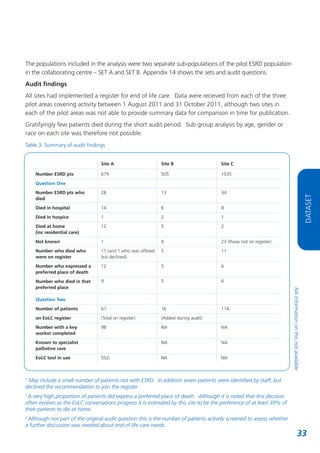
however as your kidney care team we can help and support you and your carers with this discussion.
This care plan is not a “legally binding” document however once your wishes are documented these
can be taken into account by the doctors and nurses. As the patient this is your document and as
such can remain with you at all times. The kidney team will, with your permission, keep a copy of the
document so we can ensure all members of the team can take your wishes into account when
planning your care.
You can take this document home before discussing with a member of the kidney team. This means you
can have some time to discuss your wishes with your family and friends. You may wish not to fill in this
care plan at the current time and this is perfectly acceptable and will not affect your care in any way.
Below are some examples of things you may wish to discuss with the kidney team. Please feel free to
write down other issues important to you that we have not included.
What happens if

I stop dialysis

My treatment

choices

What happens if
Diet and fluid
my fistula fails
What happens if
I choose not to Medicines
have dialysis
My kidney
disease
Changing my
type of dialysis
Where I want to
be cared for at
the end of my life
How many
years can I be
on dialysis
54
What makes you content at this time in your life?
In the last 4 weeks: Have you had any practical problems / concerns with:
What elements of care are important to you and what would you like to happen to you in
the future?
What would you NOT want to happen in the future? Is there anything that you worry about
or fear happening?
Preferred place of care

If your condition deteriorates where would you like most to be cared for?

1.

2.

Do you have any special requests, preferences or other comments?

Are there any comments or additions from other people you are close to? (Please name)
Date completed : Those present:
APPENDICES

55
Appendix 6 ­ Thinking Ahead. An advance
care planning document developed by
Central Manchester University Hospitals
NHS Foundation Trust (stylised version)
We want to provide the best possible care for all our patients and their carers. To do this we need to
know more about what is important to you and what your needs and preferences are for the future.
This document is called a care plan and gives you the opportunity to be involved in the decision making
process around your care needs. The care plan will involve having a conversation with your doctor and
or your kidney nurse to help you have your say in what is important to you and your carers.
The care plan will be reviewed and is flexible and adaptable to your changing needs.
This care plan will also give you the opportunity to think ahead and can be an aid to help you
document what is important to you. If we are aware of your thoughts and preferences this means
we can be more active in providing the care you want in the place you want to be. For some kidney
patients this may involve planning for the end of their life. This may be difficult to discuss and is
often an emotional time for patients and their carers, however as your kidney care team we can help
and support you and your carers with this discussion.
This care plan is not a “legally binding” document however once your wishes are documented these
can be taken into account by the doctors and nurses. As the patient this is your document and as
such can remain with you at all times. The kidney team will, with your permission, keep a copy of the
document so we can ensure all members of the team can take your preferences into account when
planning your care.
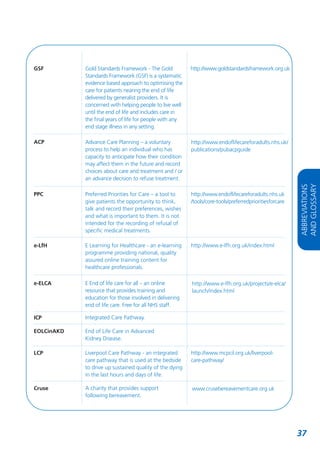
You can take this document home before discussing with a member of the kidney team. This means
you can have some time to think about your preferences and discuss these if you wish with your
family and friends. You may wish not to fill in this care plan at the current time and this is perfectly
acceptable and will not affect your care in any way.
Below are some examples of things you may wish to discuss with the kidney team. Please feel free to
write down other issues important to you that we have not included.
Where I want to
What happens if What happens if My kidney
Diet and fluid be cared for at
I stop dialysis my fistula fails disease
the end of my life
What happens if How many
My treatment Changing my
I choose not to Tablets years can I be
choices type of dialysis
have dialysis on dialysis
56
Address:
Patient name:
DOB - Hospital / NHS number:
Date completed:
Hospital contact:
GP details:
Name:
Family members involved in Advanced Care Planning discussions:
Contact telephone:
Name of healthcare professional involved in Advanced Care Planning discussions:
Patient signature: Date:
Next of kin / carer signature (if present): Date:
Healthcare professional signature: Date:
Role: Contact telephone:
Patient signature: Date:
Next of kin / carer signature (if present): Date:
Healthcare professional signature: Date:
Review date: Date:
APPENDICES

57
What makes you happy at this time in your life?
In relation to your health what has been happening to you recently?
What elements of care are important to you and what would you like to happen to you in
the future?
What would you NOT want to happen in the future? Is there anything that you worry about
or fear happening?
What family support do you have?
Are your family aware of your wishes regarding your treatment?
58
If your condition deteriorates where would you most like to be cared for?
1.
2.
Preferred place of care
Do you have any special requests, preferences or other comments
Are there any comments or additions from other people you are close to? (Please name)
Do you have a Living Will or Legal Advanced Decision document? (This is in keeping with the
new Mental Capacity Act and enables people to make decisions that will be useful if at some
future stage they can no longer express their views themselves).
No / Yes, if yes please give details (e.g. who has a copy?)
5. Proxy / next of kin
Who else would you like to be involved if it ever becomes difficult for you to make decisions or
if there was an emergency? Do they have official Lasting Power of Attorney (LPoA)
Contact 1: Telephone: LPoA Y / N
Contact 2: Telephone: LPoA Y / N
APPENDICES

59
Appendix 7 ­ Checklist developed by Greater
Manchester Project Group to ensure
co­ordination of care initiatives
Advancing disease 1
Consider Gold
Standards Framework
(GSF) Supportive
Care Register;
inform patient.
Increasing decline 2 Withdrawl of dialysis
Ensure patient on Review Do Not
Gold Standards Attempt Resuscitation
Framework (GSF) (DNAR) status
Supportive Care
Register inform patient
On-going assessment and discussion at Check for Advance
C For C MDT: Care Planning
Letter to GP and DN Letter to GP and DN Review ceilings of
Consider referral to
care and document
Referral to Palliative
Palliative care services care services
District Nursing Team District Nursing Team Commence Care of
ref. Contact: ref. Contact: Dying pathway
(Renal Version)
Identify Renal Key Identify Renal Key
Worker Name: Worker Name:
Renal follow up Preferred Priorities for Referral to
arrangements OPA / Care (offered) community
MDT / unit review Date: Macmillan services
PPC completed /
declined
“My Wishes” “My Wishes” Inform GP
document’ document’
Date: Date:
My wishes My wishes
completed / declined completed / declined
Advance Decision to Advance Decision to Out of Hours GP
Refuse Treatment Refuse Treatment Service
(Leaflet given) (Leaflet given)
Lasting Power of Lasting Power of Referral to District
Attorney Attorney Nursing Team
(Leaflet given) (Leaflet given)
Complete DS1500 Complete DS1500 Evening District
Report Report Nurses
Review transplant Renal follow up Record pre-
listing arrangements bereavement
concerns
Referral to psychology Referral to psychology M.D.T. meeting
services with patient services with patient patient and significant
agreement agreement others. Consider
Referred / declined / Referred / declined / inviting DN /
not referred not referred Macmillan services
Date: Date:
Review dialysis Review dialysis
prescription prescription
Date: Date:
Last days of life Bereavement
Liaise with Macmillan Offer Bereavement
teams hospital / Leaflet / What to
community do After a Death
Booklet
Commence Care of Bereavement card
the Dying Pathway
OR
Commence Rapid Communication
Discharge Pathway with GP
for the Dying
Pre-emptive
prescribing of all 4
Care of the Dying
Pathway drugs
Discuss with DN
team
Contacts:
Ensure community
teams have renal
services 24 hour
contact
60


Appendix 8 ­ Resources included in
King’s Health Partners Toolkit
• Guidance on applying the surprise question and other predictors, to identify patients as suitable for
the GOLD Register
• Symptom and quality of life assessment tools – the Palliative care Outcome Scale – symptom
module (renal version) and the EQ5D quality of life measure
• A summary of evidence on prognosis, survival and outcomes in end­stage renal disease
• Symptom management guidelines
• The Liverpool Care Pathway, including guidelines for managing symptoms in the last days of life in
renal patients
• Written information for patients with end­stage kidney disease and their family carers on
symptoms, treatment and help available – conservative care pathway
• Written information for patients with end­stage kidney disease and their family carers on
symptoms, treatment and help available – dialysis patients
• Examples of advanced care plan documents, with advice sheet on how to fill them in
• Guide to GOLD – information for professionals on having conversations with patients identified as 
suitable for the GOLD Register
• Information on bereavement and local bereavement services
• Information on local hospices, with their relevant leaflets
• Information of our local Macmillan Information and Support Centre for patients and families with
advanced disease, plus information prescriptions (a system used locally to “prescribe” information
when required, according to the individual patient and family needs)
• Contact numbers and referral forms for local community / hospice / hospital palliative care teams
APPENDICES

61
Appendix 9 ­ Training Needs Analysis
Questionnaire from Greater Manchester
Kidney Network End of Life Project
1. Which area of Renal Services do you work in?
Community / PD
Salford H
Satellite HD
Wards
CKD / Vascular Access Outpatients
Transplant Home Training Team
What is your job role?  
What grade / band are you? 

How long have you worked in this role? 

• If you answered YES to either of these questions, please go to question 4.
2. In your opinion how much of your time is spent involved in caring for patients in the following:
Last year of life Last days of life
Never

Rarely – Under 25%

Sometimes – 50%

Often – 75%

Always – 100%

3. Have you had any education training in Communication Skills or End of Life Care? (Please circle)
Communication Skills Yes No
End of Life Care Yes No
• If you answered NO to both of these questions, please go to question 6.
62
4. Please provide details of any accredited / recognised Communication Skills or End of Life Care
courses / training you have attended
Course 1 Course 2
Name of course
Provider (who delivered the training)
Level of Study
Who funded the training?
Credits or awards granted
Year course completed
5. Please provide details of any non-accredited / unrecognised Communication Skills or End of Life
Care courses / training you have attended
Course 1 Course 2
Name of course
Provider (who delivered the training)
Induction / In-house training / external training
Length of course
How was training delivered
e.g. classroom, role play etc
Year course completed
6. Have you had an opportunity to identify your Communication Skills training needs or End of Life
Care training needs via your appraisal with your line manager?
End of Life Care
Communication Skills Yes No
Yes No
7. Do you think Communication Skills training or End of Life Care training would be beneficial
to your role?
End of Life Care
Communication Skills Yes No
Yes No
APPENDICES

63
8. Do you as an individual provide Communication Skills or End of Life Care training?
Communication Skills Yes No
End of Life Care Yes No
9. Please complete the following competency level descriptors in the table below.
Please indicate with an X whether you are already competent and have the skills and knowledge,
whether it is an area you require further training, or if it is not applicable to your role.
Description of Already Training Not
Competency Competent Required Applicable
Confidently recognise the emotional needs
of patients, families and carers
Confidently respond in a flexible and sensitive
manner to the emotional needs of patients,
families and carers
Give basic patient / carer information and
support in a flexible manner across a range of
situations to support choice
Confidently negotiate with patients, families
and carers in relation to their needs and care
Resolve communication problems raised
by patients, families and carers
Able to discuss key information with patients,
families and carers and refer appropriately to
other health and social care professionals
and agencies
Use a wide range of communication skills to
address complex needs of patient,
families and carers
64
10. Are you aware of the following End of Life Care Tools?
Yes No
Gold Standards Framework (GSF)
Liverpool Care Pathway (LCP)
Advance care planning
e.g. Preferred Priorities for Care
11. In relation to these tools are you able to use the following confidently:
Yes No
Gold Standards Framework (GSF)
Liverpool Care Pathway (LCP)
Advance care planning
e.g. Preferred Priorities for Care
APPENDICES

65
12. Discussions as the end of life approaches.
One of the key aims of the End of Life Strategy is to ensure that services provided to people
coming to the end of their lives are responsive to their needs.
Neither
Description of
Competency
Strongly
Disagree
Disagree disagree
or agree
Agree
Strongly
Agree
Are you confident to discuss with a
patient their care plan for their needs 1 2 3 4 5 NA
and preferences at the end of life?
I always speak to families and ensure
they understand that the patient 1 2 3 4 5 NA
is reaching the end of their life
Do not attempt resuscitation (DNAR)
decisions are always discussed with the patient
1 2 3 4 5 NA
Do not attempt resuscitation (DNAR)
decisions are always discussed 1 2 3 4 5 NA
with the patients families
66
13. Assessment, Care Planning & Review
The End of Life Strategy emphasises the importance of the need for holistic assessment
covering the full range of physical, psychological, social, spiritual, cultural, religious and where
appropriate, environmental needs.
Neither
Description of Strongly Strongly
Disagree disagree Agree
Competency Disagree Agree
or agree
I always give patients information and

involve them in decisions about
 1 2 3 4 5 NA
treatments prescribed for them
I always give patients the opportunity
1 2 3 4 5 NAto talk about their preferred place of care
In the event of the need for a patient to be
rapidly discharged elsewhere to die,
1 2 3 4 5 NAI know where to access details of the

contact person(s) to facilitate this transfer

I always recognise the spiritual, emotional
1 2 3 4 5 NAand religious needs of the individual
I always offer access to pastoral

and / or spiritual care to patients at the
 1 2 3 4 5 NA
end of their life
I always take carers' views into account 1 2 3 4 5 NA
I believe I have an integral part to play

in coordinating care for patients
 1 2 3 4 5 NA
with end of life care needs
14. In relation to the above question what issues may prevent you from delivering this care
Yes No
Workload
Time restraints
Support from managers
Environment
APPENDICES

67
15. Care in Last days of life
The way we care for the dying is an indicator of how we care for all our sick and vulnerable
patients. The End of Life Strategy recognises the acute hospital plays an important role within
care of the dying
Neither
Description of Strongly Strongly
Disagree disagree Agree
Competency Disagree Agree
or agree
I can recognise when someone is dying 1 2 3 4 5 NA
I am confident in discussing withdrawal
of active treatment with the 1 2 3 4 5 NA
multidisciplinary team
The multidisciplinary team always
recognise when someone is dying
1 2 3 4 5 NA
I am confident in using the Integrated
Care Pathway for the dying patient
1 2 3 4 5 NA
I recognise and understand how to provide
End of Life care for both the patients and 1 2 3 4 5 NA
their families
16. Care after death
The End of Life Strategy highlights the importance of joined up working and effective
communication between all services involved
Neither
Description of Strongly Strongly
Disagree disagree Agree
Competency Disagree Agree
or agree
I am confident in liaising with the
many diverse service providers
1 2 3 4 5 NA
I am able to provide the right written
information to give to relatives and I am
able to explain the information verbally
1 2 3 4 5 NA
i am confident in performing last offices 1 2 3 4 5 NA
17. Do you have any other comments, are there any other areas you would like to see
addressed as part of the End of Life Project?
68


Appendix 10 ­ Renal Sage and Thyme
communication course evaluation (Central
Manchester Foundation Trust)
Pre­Course Data collection
Q1	 How confident do you feel in communicating effectively with patients and
colleagues?
Not at all confident­0

Not very confident­5%

Some confidence­11%

Fairly confident­66%

Very confident­18%

Q2 How much do you feel you know about communication skills?
Nothing at all­0

Not very much­2%

A little bit­33%

Quite a lot­55%

A great deal­10%

Immediately post Course­Sage + Thyme evaluation Form
As a result of the training I have done today, I feel more confident to talk to people about
their emotional troubles
Scores range of 10­highly agree to 1­ Disagree
10­Highly agree­41%

9­41%

8­15%

6­3%

5 to 1­0

As a result of the learning I have done today I feel more willing to talk to people who are
emotionally troubles
Scores range of 10­highly agree to 1­ Disagree
10 ­Highly Agree­41%

9­40%

8­16%

6­3%

5 to 1­0

APPENDICES

69
How likely is this training to influence your practice?
Scores range of 10­very much to 1­ not at all
10 Very much­76%

9­15%

8­9%

7 to 1­0

Did the facilitator create a safe environment?
Scores range of 10­very much to 1­ not at all
10 ­very much­75%

9­25%

8 to 1­0

As a result of the learning i have done today i am more likely to:
Listen
Focus on the conversation/person
To follow model
Allow the patient to inform ME of how I could help
Effectively and efficiently deal with situations that may arise
Ask the question and summarise
Not always presume there is a problem
Communicate and problem solve with confidence
Not jump in and feel i need to solve everything
Ensure i have gathered the patients concerns
I feel more equipped with skills to help patients solve their own problems BUT with my help
Use the structure to help distressed patients
Empower patients
Feel confident to allow patients to help themselves with my help
70


As a result of the learning i have done today, i am less likely to:
Go off focus when dealing with stressful patient situations
Allow the patient to investigate how i can help
Spend long periods in stressful situations­use model
Assure i know what a patients main concerns are
More aware of the need for ME not to ‘fix’ everything for the patients
Wade in and try to solve all the problems
‘Fix’ things myself and then miss the main concerns of the patient
Avoid conversations with difficult patients
Ignore patient problems, have confidence to go in and open discussion
Would you recommend the training to a colleague?
Yes­100%
APPENDICES
71
Appendix 11 ­ The Prepared Acronym

Prepare ­ Prepare for the discussion, where possible: 1) confirm diagnosis and investigation results
before initiating discussion, 2) try to ensure privacy and uninterrupted time for discussion, 3)
negotiate who should be present during the discussion.
Relate to person ­ Relate to the person: 1) develop rapport, 2) show empathy, care and compassion
during the entire consultation.
Elicit preferences ­ Elicit patient and caregiver preferences: 1) identify the reason for this consultation
and elicit the patient’s expectations, 2) clarify the patient’s or caregiver’s understanding of their
situation, and establish how much detail and what they want to know, 3) consider cultural and
contextual factors influencing information preferences.
Provide information ­ Provide information tailored to the individual needs of both patients and their
families: 1) offer to discuss what to expect, in a sensitive manner, giving the patient the option not to
discuss it, 2) pace information to the patient’s information preferences, understanding and
circumstances, 3) use clear, jargon free, understandable language, 4) explain the uncertainty,
limitations and unreliabiloty of prognostic and end­of­life information, 5) avoid being too exact with
timeframes unless in the last few days, 6) consider the caregiver’s distinct information needs, which
may require a seperate meeting with the caregiver (provided the patient, if mentally competent,
gives consent), 7) try to ensure consistency of information and approach provided to different family
members and the patient and from different clinical team members.
Acknowledge emotions ­ Acknowledge emotions and concerns: 1) explore and acknowledge the
patient’s and caregiver’s fears and concerns and their emotional reaction to the discussion, 2)
respond to the patient’s or caregiver’s distress regarding the discussion, where applicable.
Realistic hope ­ Foster realistic hope (e.g. peaceful death, support): 1) be honest without being blunt
or giving more detailed information than desired by the patient, 2) do not give misleading or false
information to try to positvely influence a patient’s hope, 3) reassure that support, treatments and
resources are available to control pain and other symptons, but avoid premature reassure, 4) explore
and facilitate realistic goals and wishes, and ways of coping on a day­to­day basis, where
appropriate.
Encourage questions ­ Encourage questions and further discussions: 1) encourage questions and
information clarification; to be prepared to repeat explanations, 2) check understanding of what has
been discussed and if the information provided meets the patient’s and caregiver’s needs, 3) leave
the door open for topics to be discussed again in the future.
Document ­ Document: 1) write a summary of what has been discussed in the medical record, 2)
speak or write to other key health care providers involved in the patient’s care. As a minimum, this
should include the patient’s general practitioner. 
Clayton JM, Hancock KM, Butow PN, Tattersall MH, Currow DC, Adler J, et al. Clinical practice
guidelines for communicating prognosis and end­of­life issues with adults in the advanced stages of
a life­limiting illness, and their caregivers. Medical Journal of Australia. 2007 Jun 18;186(12
Suppl):S77, S9, S83­108.
72
         
 
Appendix 12 ­ Items adopted in each of
the NHS Kidney Care pilot sites
Greater Greater
Manchester Manchester
Data Item Bristol Guy’s London Site One Site Two
Patient surname Y Y Y Y Y
Patient forename Y Y Y Y Y
Date of birth Y Y Y Y Y
NHS number Y Y Y Y Y
Gender Y Y Y Y Y
Ethnic group ? ? ? ? ?
Pat address and tel no Y Y Y Y Y
Usual GP name Y Y Y Y Y
Practice details inc. phone and fax Y Y Y Y
Key worker/contact details (containing
details of all professionals involved)
Y Y Y Y
Next of kin details or nominated person Y Y Y Y Y
Does the patient have professional care? Y Y Y Y
Known to Specialist Palliative Care team? Y Y Y Y
Specialist Palliative Care details Y Y Y Y
Other services / professional involved Y Y Y Y
Primary and secondary diagnoses Y Y Y
Current medications and doses Y Y Y
Preferences for place of death Y Y Y Y
Actual place of death: home, care home,
hospital, hospice, other
Y Y Y Y
Date of death / discharge (from where ­
hospital / hospice etc)
Y Y Y
EOLC tool in use? (e.g. GSF, LCP,
PPC, Kite etc.)
Y Y Y
Has a DNACPR request been made? Y Y Y Y
(inpatients)
Kidney care status (eg haemodialysis,
conservative care)
Date included on Cause for Concern register
APPENDICES

73
Appendix 13 ­ Items adopted in each
unit for the End of Life Care in
Advanced Kidney Disease dataset
The populations included in the analysis were be two separate sub­populations of the pilot ESRD
population in the collaborating centre – SET A and SET B.  
1. For the purpose of assessing the proportion of people who have a recorded “preferred place 
of death”, and then the proportion who died in that place, the audit group was:
ENTIRE pilot ESRD population in the collaborating centre will be included (SET A)
This allows an assessment of the overall success in EoL care planning in the ESRD population.  In
addition it is likely that this is the approach which would be taken in any national audit of EoL in
advance kidney disease done using a registry approach (via the NRD or the UKRR for example).
2. For the purpose of assessing the utility of the dataset as a whole, and the completeness of the
data, the audit group was:
Patients from the pilot ESRD population who have been formally added to the cause for concern
register (SET B)
This did not therefore include any patients who have been screened as showing deterioration, but in
whom a shared decision is yet to be reached about inclusion on the register.  It likely
under­represents the total number of people identified as close to death, but allows assessment of
tightly defined group in whom date entry should be at its best.
Audit questions
Question ONE: Preferred and actual place of death pilot ESRD population (SET A)
1. What proportion of the pilot ESRD population (SET A) who died during the audit period?
2. What proportion of those that died who had a record of their preferred place of death?
3. What proportion of the pilot ESRD patients (SET A) who died expressing a preference for their 
place of death died in that place?
4. Description of those who died and had a preferred place of death vs. did not have preferred place 
of death by Age (>=65 vs <65yrs), Gender (M vs F), Ethnic group (White, Black, SE Asian, Other) 
and inclusion on the “cause for concern” register (Yes vs No).  Small numbers will not allow split 
by multiple groups at once.
74


Data items required:
1. Total number of pilot ESRD patients in that centre at end audit period
2. Number of pilot ESRD patients in that centre who died during audit period
3. Number of pilot ESRD patients who died who had chosen as preferred place of death each of
“home”,”hospital”, “hospice”,”other” or had made no choice.
4. Number of each preference group in © who died in their chosen setting.
5. Number of pilot ESRD patients who died with a preferred place of death by each (in turn) of Age,
Gender, Ethnic group, inclusion on “cause for concern” register as defined in section 4 above.
6. Any non­identifiable qualitative information about why c) and d) were not equal for individual
patients during the audit period
Question TWO: Of those patients on the unit register (SET B)
1. What proportion of the pilot ESRD population in the centre are present on the units register?
2. Completeness of basic information in patients present on the register?
Data items required:
a) Total number of pilot ESRD patients in that centre at end audit period (as section: (a) in question
ONE above)
b) Number of pilot ESRD patients who have a recorded date for inclusion on the “cause for concern”
or similar register at end of audit period
c) Number of patients with details recorded of
a. Key worker
b. Does patient have professional care
c. Known to specialist palliative care team
d. EoLC tool in use
APPENDICES

75
www.kidneycare.nhs.uk

Getting it right: end of life care in advanced kidney disease