The document outlines the development of an online real estate management system designed to facilitate property transactions between buyers and builders. It includes features for user registration, property listing, management, and real-time interaction between users and admins, aiming to streamline property buying and renting processes. The system is built with functionalities to ensure reliability and usability while targeting growth in the online real estate market.
WEBSITE DEVELOPMENT ONONLINE REAL ESTATE
BUSINESS
Presented By:-
Kumar Narayan
Sanjeev Kumar jha
Guided By-
Mrs. Latika Jain
3.
ABSTRACT
Our project“ONLINE REAL ESTATE BUSINESS” is related to online application of estate.
Real estate management system is advanced solution for his/her estate problem.
User shows all the properties of Buyer that are secure & verify & send them to the Builder.
Real System Buy the property &verify them and the online service is provided by us free of charge.
Here registration is also free of cost. So user can registration by using Real System then Buy the property & verify them.
After few hours or days our guys put the estate solution.
The software is so reliable to user .Our main concept is give best & quick result to user.
4.
Index
Introduction
SystemRequirement Specifications
System Design
Data modeling
Testing
Result
Conclusion and Disussion
References/Bibliography
5.
Introduction
1.1 Projectpurpose
This website is a Online real estate business website through which a user can
access its information and manage all the adding, updating, deleting the assets
and some of its tasks.
The Admin user can change the update the information regarding property
selling and buying and cancellation. The system is very useful for the
companies who develop apartments, hotels, villa, residential properties and
commercial properties. Companies or individual agents can also advertise
their property.
6.
1.2 Projectscope
The real of World Wide Web have spread across millions of household, so naturally, Internet
has become by far the best platform for real estate marketing today.
Now days when everything is online, how is it possible that real estate left web application
behind. There are lot of real estate companies who advertise their property online so idea
behind developing this application is that their property can also sell, or buy rental property
using this. These application are not widely popular but in future, they have large scope of
growth.
This website is a online real estate management through which individual agents or buyer can
maintain their property document keeping and managing property registration and also access
its information and manage all the adding, updating, deleting the as and some of its tasks.
The Admin user can inform their agents for regarding to property and update the information
regarding property and cancellation of property or changing buyer choice.
The system is very useful for the companies or builders that can post and edit their properties
and their personal info and admin can monitor records of all of them.
7.
1.3 ProjectObjectives
The system should have a login. A login box should appear when the system
is invoked.
The Admin should have all the type of authority.
The Admin should maintain property .Admin identify property type as it is
residential or commercial property.
The Admin user can inform their agents for regarding to property and update
the information regarding property and cancellation of property or changing
buyer choice.
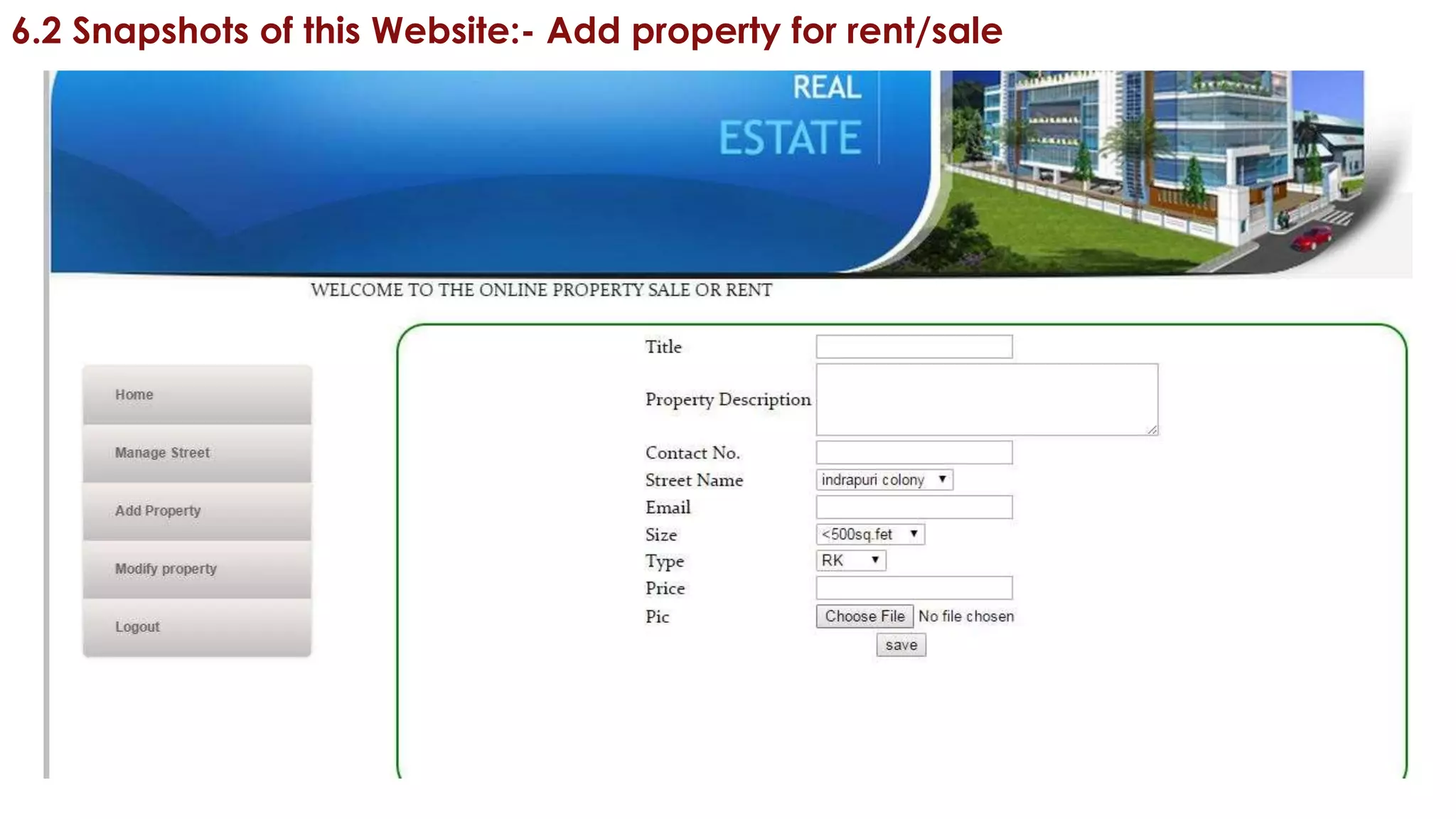
The user should book the property for sell or rent with detail of property.
The system is very useful for the companies or builders that can post and edit
their properties and their personal info and admin can monitor records of all
of them.
8.
1.4 ProjectGoals
Planned approach towards working: - The working in the organization will
be well planned and organized. The data will be stored properly in data stores,
which will help in retrieval of information as well as its storage.
Accuracy: - The level of accuracy in the proposed system cannot be decided.
Because here user buy and another user build the home. There is no
guarantee.
Reliability: - The reliability of the proposed system will be high due to the
above stated reasons. The reason for the increased reliability of the system is
that now there would be proper storage of information.
9.
System Requirement Specifications
2.1 Scope:
The real of World Wide Web have spread across millions of household, so naturally, Internet
has become by far the best platform for real estate marketing today.
Now a days when everything is online, how is it possible that real estate left web application
behind? There are lots of real estate companies who advertise their property online so idea
behind developing this application is that their property can also sell, or buy or even rent
property using this. These applications are not widely popular but in future, they have large
scope of growth.
This website is an online real estate management through which individual agents or buyer
can maintain their property document keeping and managing property registration and also
access its information and manage all the adding, updating, deleting the ads and some of its
tasks. The Admin user can inform their agents for regarding to property and update the
information regarding property and cancellation of property or changing buyer choice.
The system is very useful for the companies or builders that can post and edit the information
of their properties and their personal info and admin can monitor records of all of them.
10.
2.2 Objectives
The system should have a login. A login box should appear when the
system is invoked.
The Admin should have all the type of authority.
The Admin should maintain property. Admin identify property type as it is
residential or commercial property.
The Admin user can inform their agents for regarding to property and
update the information regarding property and cancellation of property
or changing buyer choice.
The user should book the property for sell or rent with detail of property.
The system is very useful for the companies or builders that can post and
edit their properties and their personal info and admin can monitor
records of all of them.
11.
2.3 Overall description:
2.3.1 Product Prospective:
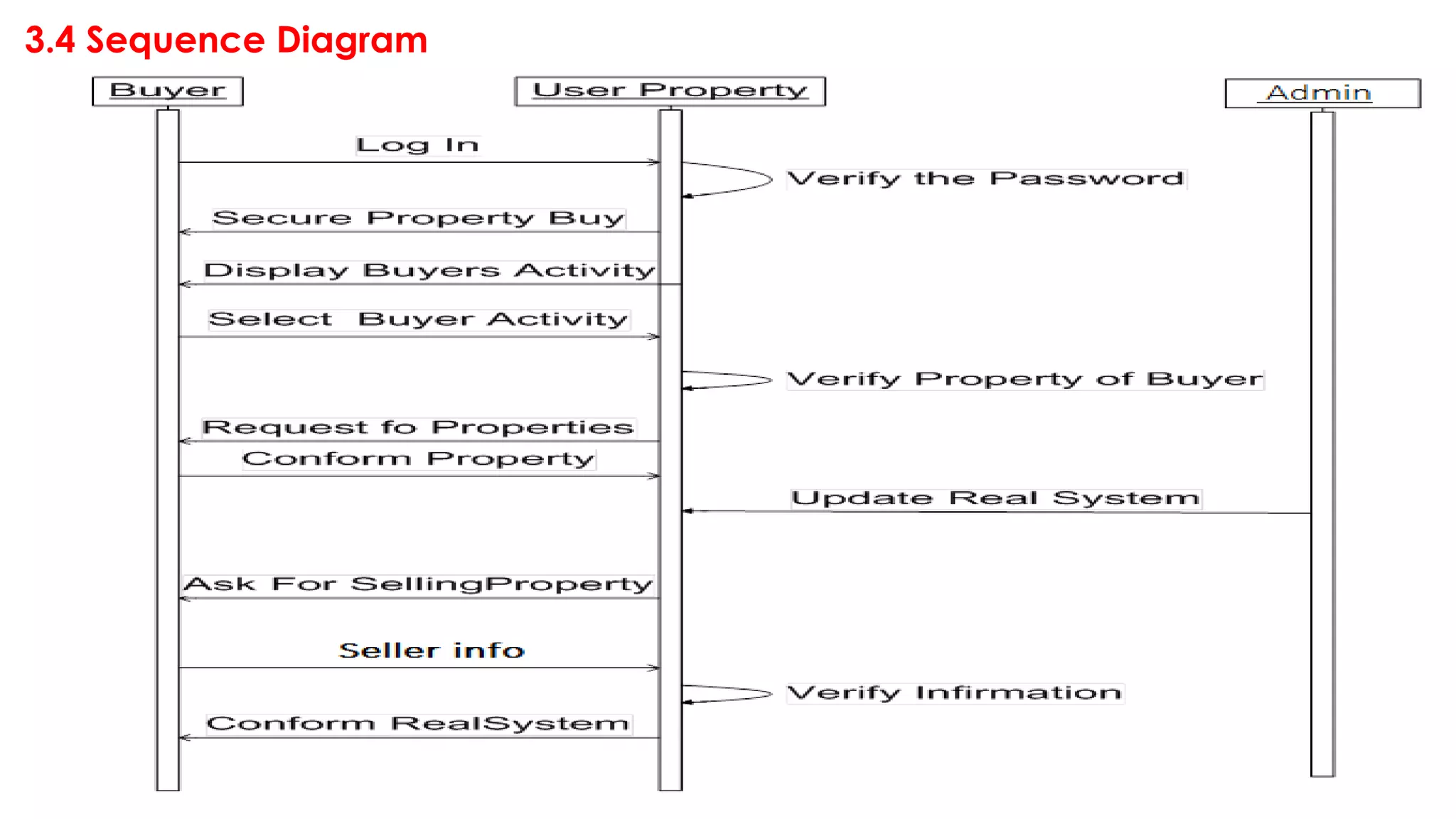
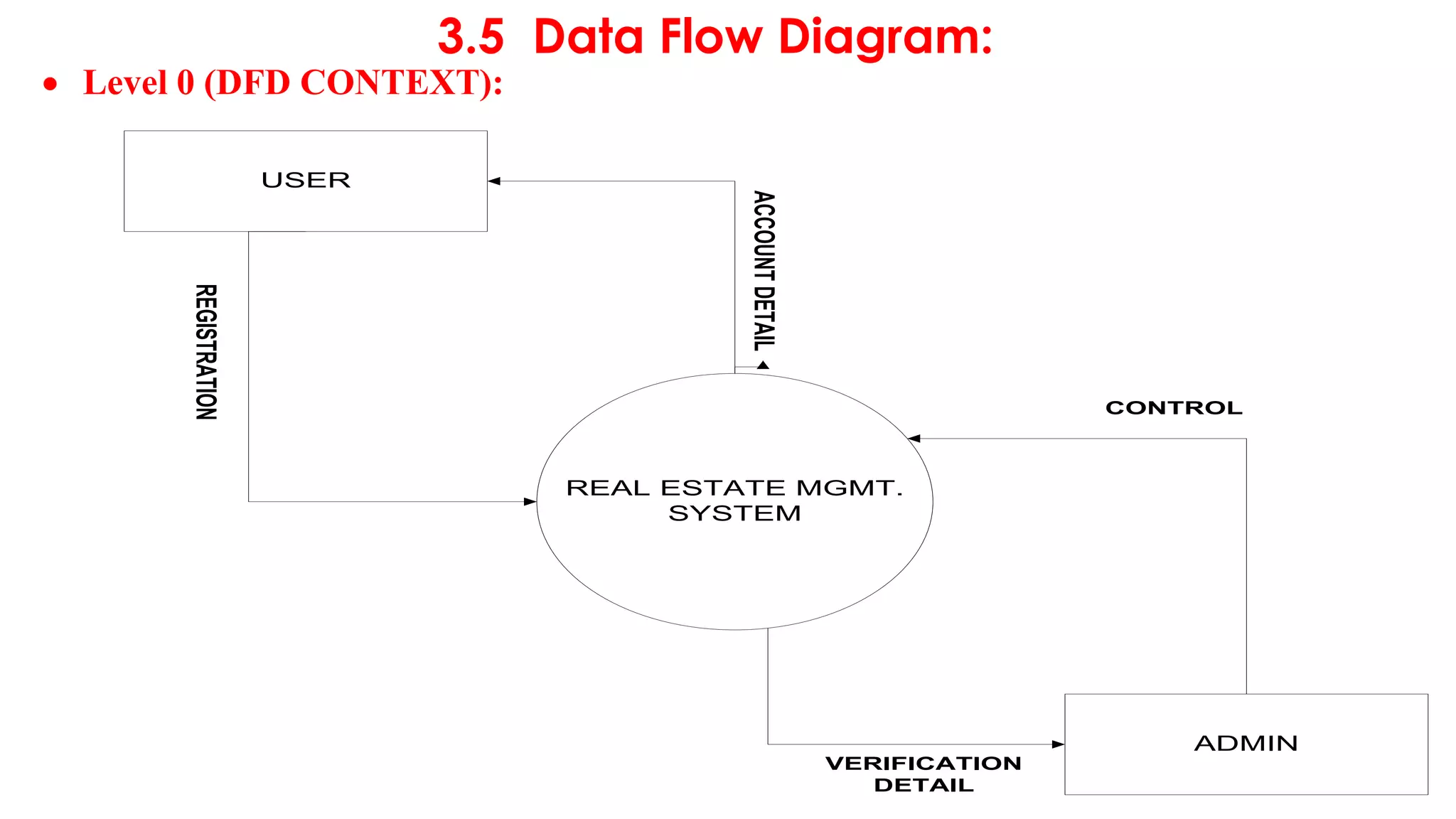
Admin’s interface: Admin is a person who will handle the entire website. For
that person has to give the user name and password to enter the admin
page. After entering right password admin person can enter the admin
home area. Here user buy different property & sell them to the system. Buyer
user property & builder verify each-other & make reliable communication to
each other.
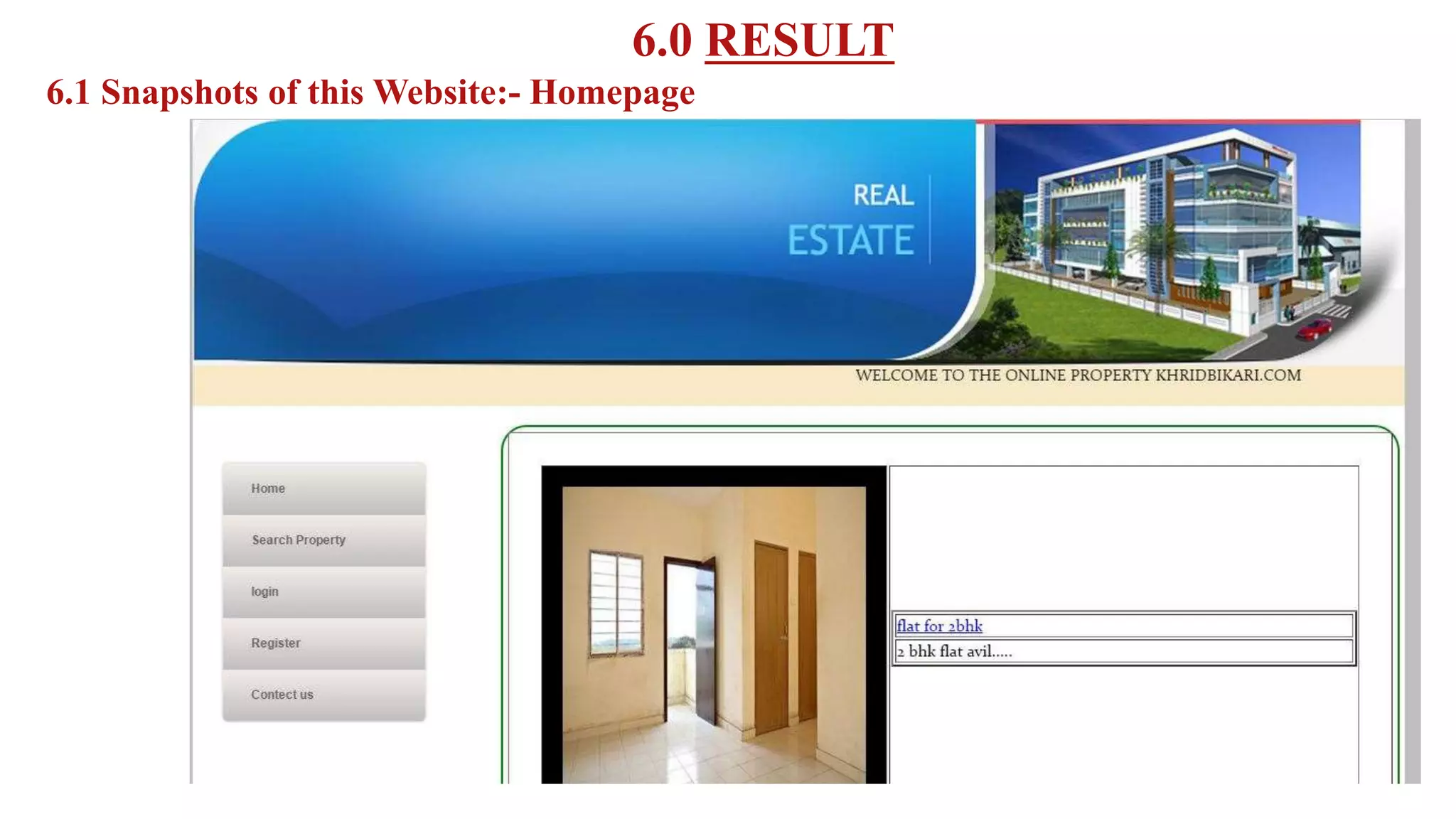
User’s interface: User can visit the home page of real estate in which first the
introduction of our site mention first. The registered user can login from the
login module. Here guest can register free account to sell and buy property
&buyer verify each-other & make reliable communication to each other.
User can search the property and it can find the type of property and its
budget and also find the location of property.
12.
2.3.2 Assumptionsand Dependencies:
Assumptions:
The code should be free with compilation errors/syntax errors.
The product must have an interface which is simple enough to understand.
Dependencies:
All necessary hardware and software are available for implementing and use
of the tool.
The proposed system would be designed, developed and implemented
based on the software requirements specifications document.
End users should have basic knowledge of computer and we also assure that
the users will be given software training documentation and reference
material.
The system is not required to save generated reports.
13.
2.4 SpecificRequirements:
Software requirements:
Any Version of browser after Mozilla Firefox 4.0, Internet Explorer 6.0 , Google
Chrome, Safari, UC.
Adobe Flash Player 10.0
Hardware requirements:
Any processor after Pentium 4.
Any version of Windows 7 or later, Linux 14.04 etc.
14.
2.5 FunctionalAnd Non-Functional Requirement:
Functional Requirements :
Since this project uses database and control, it needs the retrieval of
information from the database. It needs access of Database from a front end,
as PHP, it provides easy linking to the database, along with the flexibility
required to develop a user-friendly front end.
Functional Requirements
Usability: The interface should use terms and concepts, which are drawn
from the experience of the people who will make most of the system.
Efficiency: The system must provide easy and fast access without consuming
more cost.
Reliability: User should never be surprised by the behavior of the system and
it‘s easy to use to stored data.
15.
2.6 Systemattributes:
Reliability
This system is designed to have very simple database just to cater the exact need of
real estate management. It is tested for all the constraints at development stage.
Availability
This system will only available till the system on which it is installed is running.
Security
This system is provided with authentication without which no user can pass.
Maintainability
There will be no maintenance required for the software. The database is provided by
the end-user and therefore is maintained by this user.
Portability
The system is not portable as it is a standalone application running on single system
with no shared database.
3.2 Use-Case Diagram
3.2.1ADMIN Use-Case
ADMIN
Client Regestration
Vendor Regestration
Advertisement/
Banner
Managing Property
Generate Offer
Letter
Update/Delete Client
Booking Information
REAL ESTATE MANAGEMENT SYSTEM
18.
3.2.2 USER Use-Case
USER
SearchProperty
Booking Property
Cancellation
Property
Manage/List
Property
Post Requirement
Enquiry Property
REAL ESTATE MANAGEMENT SYSTEM
4.0 Data modeling
4.1Data Dictionary
Data Dictionaries are an integral component of analysis, since data flow diagram by him or she does not fully describe the
subjects of the investigation.
A data dictionary is a catalog of the element in as system. This element centers on data and the way are structured to meet user‘s
requirements and needs. The major elements are dataflow, data stores and processes. Data dictionary stores details and
description of these elements.
It is developed during data analysis and assists analysis involved in determining the system. Four main reasons of analysis are:
• To manage the details in large system.
• To communicate a common meaning for all system elements.
• To document the features of the system.
• To locate the errors and omissions in the system.
The data dictionary contains two types of descriptions as following:
1. Data Elements: The most fundamental data level is the data element. Data element is the building block
for all others in the system.
2. Data Structure: A data structure is a set of items that are related to one another that describes
components in the system.
24.
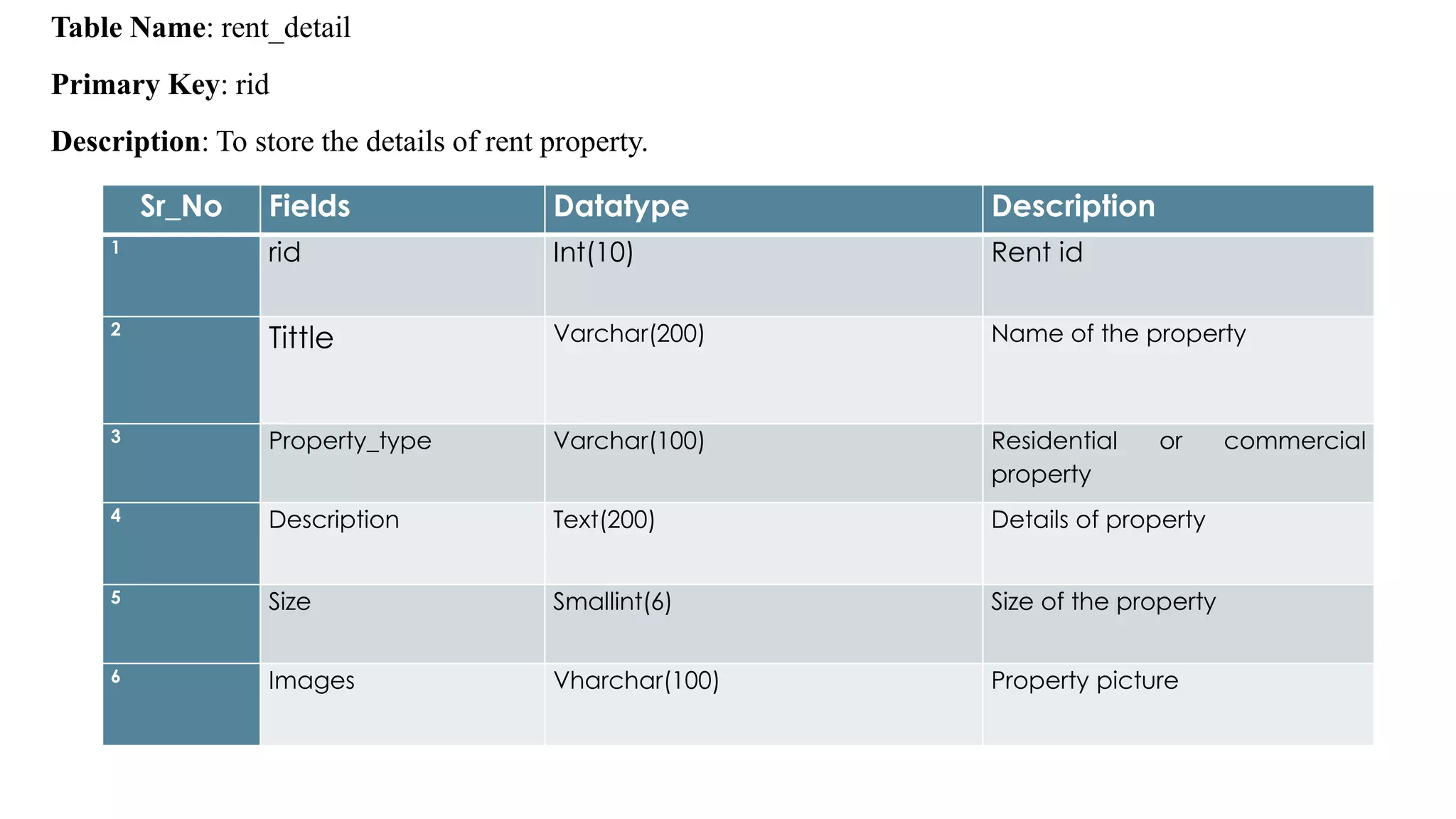
Sr_No Fields DatatypeDescription
1 rid Int(10) Rent id
2
Tittle Varchar(200) Name of the property
3 Property_type Varchar(100) Residential or commercial
property
4 Description Text(200) Details of property
5 Size Smallint(6) Size of the property
6 Images Vharchar(100) Property picture
Table Name: rent_detail
Primary Key: rid
Description: To store the details of rent property.
25.
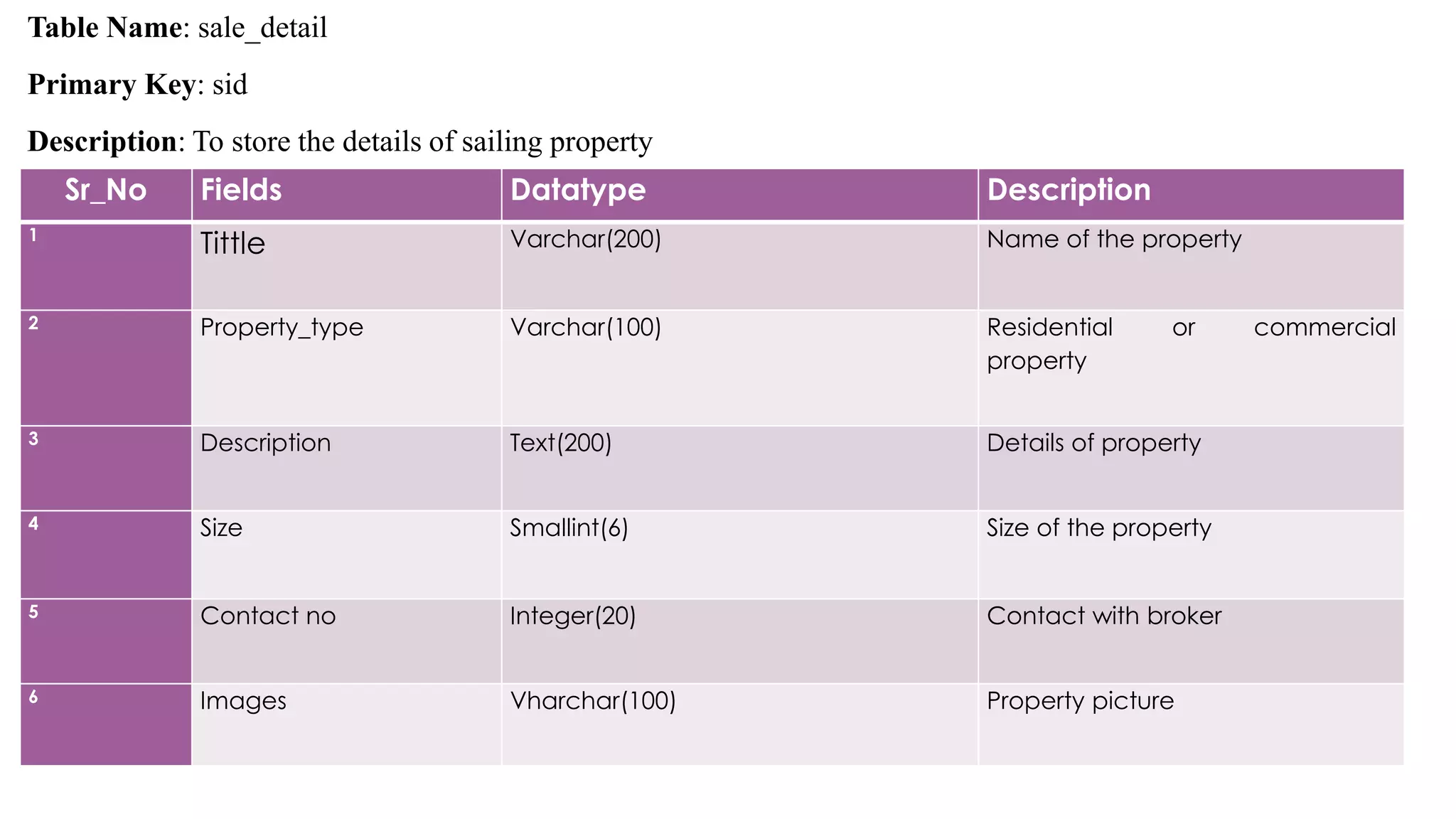
Table Name: sale_detail
PrimaryKey: sid
Description: To store the details of sailing property
Sr_No Fields Datatype Description
1
Tittle Varchar(200) Name of the property
2 Property_type Varchar(100) Residential or commercial
property
3 Description Text(200) Details of property
4 Size Smallint(6) Size of the property
5 Contact no Integer(20) Contact with broker
6 Images Vharchar(100) Property picture
26.
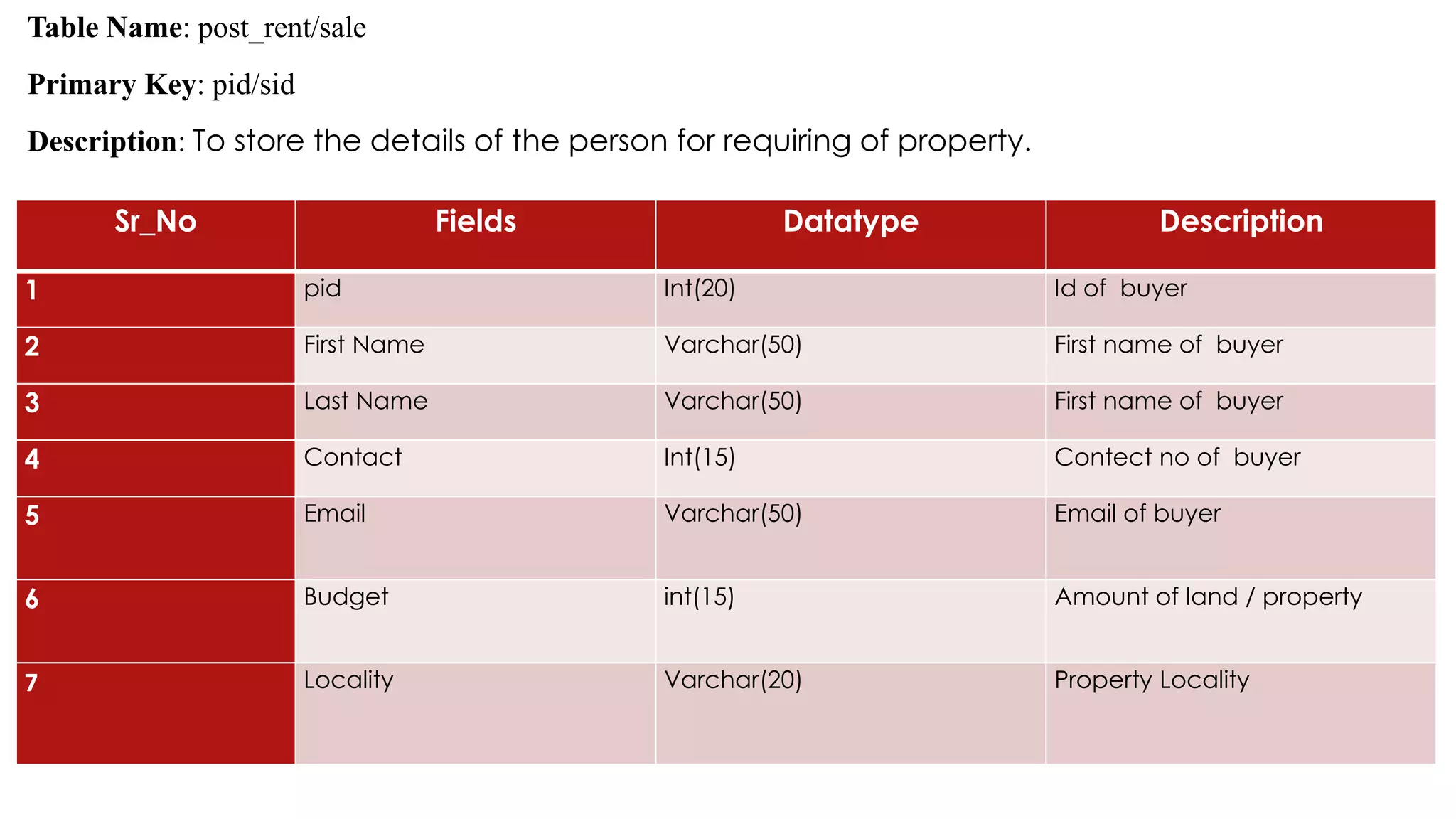
Table Name: post_rent/sale
PrimaryKey: pid/sid
Description: To store the details of the person for requiring of property.
Sr_No Fields Datatype Description
1 pid Int(20) Id of buyer
2 First Name Varchar(50) First name of buyer
3 Last Name Varchar(50) First name of buyer
4 Contact Int(15) Contect no of buyer
5 Email Varchar(50) Email of buyer
6 Budget int(15) Amount of land / property
7 Locality Varchar(20) Property Locality
27.
5.0 TESTING
5.1 TESTCASES:
Unit Testing: This is the lowest level of testing that is conducted to remove syntax & logic errors from a single unit.
Individual components are tested to ensure that they operate correctly. Each component is tested independently, without other
system components.
Module testing: A module is a collection of dependent components such as an object class, an abstract data type or some
looser collection of procedures & functions. A module encapsulates related components, so can be tested without other
system modules.
Sub-System testing: This phase involves testing collections of modules, which have been integrated into sub-systems. This
tests for problems that arise from component interactions. This testing should begin as soon as usable versions of some of the
system components are available.
• System testing: The sub-systems are integrated to make up the system. The system as a complete entity is tested over here.
This process is concerned with finding errors that result from unanticipated interactions between sub-systems. It is also
concerned with validating that the system meets its functional & non-functional requirements & testing the emergent system
properties.
• Acceptance testing: This is the final stage in the testing process before the system is accepted for operational use. The system
is tested with data supplied by the system customer rather than simulated test data. Acceptance testing may reveal errors &
omissions in the system requirements definition because the real data exercise the system in different ways from the test data.
It may also reveal requirements problems where the system’s facilities do not really meet the user’s needs or the system
performance is unacceptable.
7.0 CONCLUSION ANDDISCUSSION
7.1. Self-Analysis of Project Viabilities
Definitely, it's cheaper to use online Mobile shopping for both personal and business use because most of it is usually
free.
7.2. Problem Encountered and Possible Solutions
Hardware Limitations
The only limitation posed is when the disk space is exhausted. And it can be solved by extending the disk space.
Internet speed
Internet connection speed should be minimum 128 kbps.
7.3. Summary of Project work
In whole procedure to prepare project, we first gather the requirement of the project and decide the time schedule. After
planning we design the documentation of project. After the design we generate the code of system. In design the code we do
the error estimation and effort estimation. If error is occur then solve it. Finally when code is designed then test the project
and decide the cost of project.