Starting a Vineyard
In the Rio Grande Valley
Costs & Layout
Rio Farms, Inc.
Monte Alto, Texas
February 10, 2023
Fran Pontasch, Viticulture Program Specialist
Why Do You Want to Grow Grapes?
• Sell grapes commercially
• Make Wine Commercially
• Scenery for an Event Center
• Make Wine for Family & Friends
• Lifestyle - Physical & Mental Health
Grapes to Wine in Volume
1 Ton = 160 gallons wine
3 Tons = 480 gallons wine
480 gal = 1,817 liters ~ 200 cases
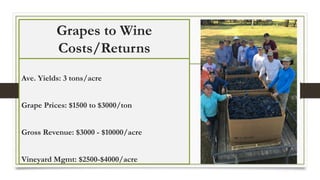
Grapes to Wine
Costs/Returns
Ave. Yields: 3 tons/acre
Grape Prices: $1500 to $3000/ton
Gross Revenue: $3000 - $10000/acre
Vineyard Mgmt: $2500-$4000/acre
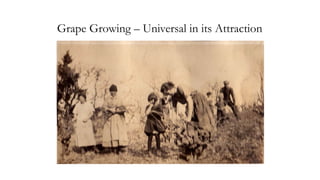
Grape Growing – Universal in its Attraction
Early Grapes in Texas
Mission Grape
• Hernando Cortes brought the Mission grape to Mexico for sacramental use
• Franciscan missionaries planted Mission grapes in El Paso area in 1600’s
Convent Grape
Nuns from France carried vines to Canada and eventually to Brownsville & Corpus Christi
Possibly Ingleside
Herbemont
Grown in Bellville 1860-1900
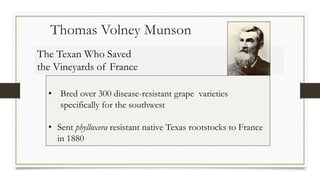
The Texan Who Saved
the Vineyards of France
Thomas Volney Munson
• Bred over 300 disease-resistant grape varieties
specifically for the southwest
• Sent phylloxera resistant native Texas rootstocks to France
in 1880
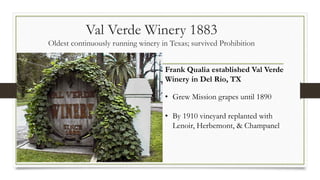
Val Verde Winery 1883
Oldest continuously running winery in Texas; survived Prohibition
Frank Qualia established Val Verde
Winery in Del Rio, TX
• Grew Mission grapes until 1890
• By 1910 vineyard replanted with
Lenoir, Herbemont, & Champanel
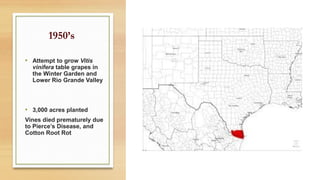
1950’s
• Attempt to grow Vitis
vinifera table grapes in
the Winter Garden and
Lower Rio Grande Valley
• 3,000 acres planted
Vines died prematurely due
to Pierce’s Disease, and
Cotton Root Rot
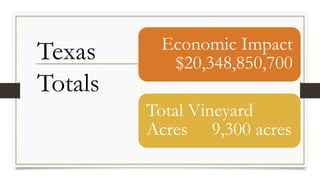
Texas
Totals
Economic Impact
$20,348,850,700
Total Vineyard
Acres 9,300 acres
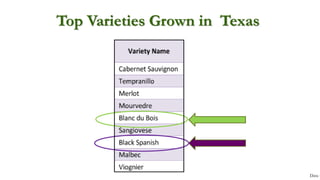
Data f
Top Varieties Grown in Texas
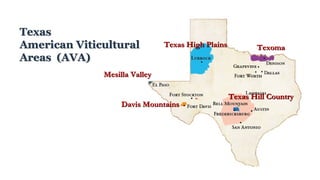
Texas
American Viticultural
Areas (AVA)
Davis Mountains
Mesilla Valley
Texas High Plains Texoma
Texas Hill Country
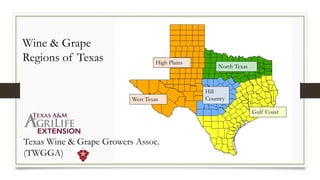
Hill
Country
High Plains
North Texas
Gulf Coast
West Texas
Wine & Grape
Regions of Texas
Texas Wine & Grape Growers Assoc.
(TWGGA)
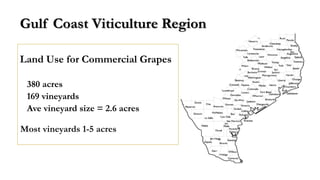
Most vineyards 1-5 acres
Gulf Coast Viticulture Region
Land Use for Commercial Grapes
380 acres
169 vineyards
Ave vineyard size = 2.6 acres
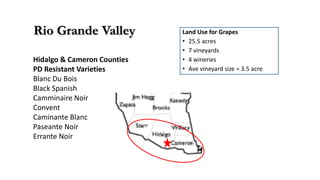
Rio Grande Valley Land Use for Grapes
• 25.5 acres
• 7 vineyards
• 4 wineries
• Ave vineyard size = 3.5 acre
Hidalgo & Cameron Counties
PD Resistant Varieties
Blanc Du Bois
Black Spanish
Camminaire Noir
Convent
Caminante Blanc
Paseante Noir
Errante Noir
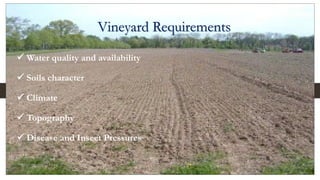
Vineyard Requirements
 Water quality and availability
 Soils character
 Climate
 Topography
 Disease and Insect Pressures
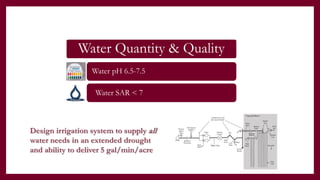
Design irrigation system to supply all
water needs in an extended drought
and ability to deliver 5 gal/min/acre
Water Quantity & Quality
Water pH 6.5-7.5
Water SAR < 7
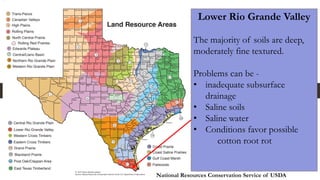
Lower Rio Grande Valley
The majority of soils are deep,
moderately fine textured.
Problems can be -
• inadequate subsurface
drainage
• Saline soils
• Saline water
• Conditions favor possible
cotton root rot
National Resources Conservation Service of USDA
http://soiltesting.tamu.edu
(979) 845-4816
Soil & Water Testing
Recommended Tests:
Soil: Collect (2) soil samples per distinct area: topsoil (0-8”) and subsoil (8-24”)
Analysis #5: Routine + Micro
Analysis #7: Routine + Boron + Organic Matter (in Calcareous, Sandy Soils, NTX)
Water: Collect water in clean, new plastic bottle, or emptied water bottle.
Analysis #3: Drip irrigation in vineyard
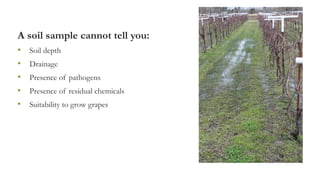
A soil sample cannot tell you:
• Soil depth
• Drainage
• Presence of pathogens
• Presence of residual chemicals
• Suitability to grow grapes
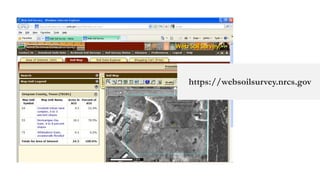
https://websoilsurvey.nrcs.gov
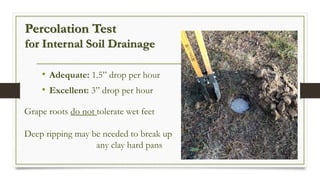
Percolation Test
for Internal Soil Drainage
• Adequate: 1.5” drop per hour
• Excellent: 3” drop per hour
Grape roots do not tolerate wet feet
Deep ripping may be needed to break up
any clay hard pans
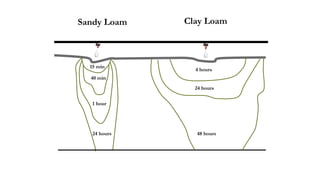
15 min
40 min
1 hour
24 hours 48 hours
24 hours
4 hours
Sandy Loam Clay Loam
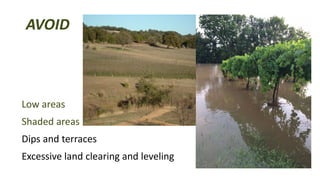
AVOID
Low areas
Shaded areas
Dips and terraces
Excessive land clearing and leveling
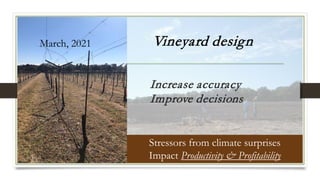
March, 2021
Increase accuracy
Improve decisions
Stressors from climate surprises
Impact Productivity & Profitability
Vineyard design
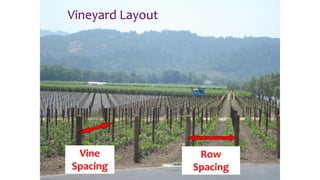
Row
Spacing
Vine
Spacing
Vineyard Layout
Vine Row spacing (ft)
spacing (ft) 6 7 8 9 10 11 12
4 1815 1556 1361 1210 1089 990 908
5 1452 1245 1089 968 871 792 726
6 1210 1037 908 807 726 660 605
7 1037 889 778 691 622 566 519
8 908 778 681 605 545 495 454
9 807 691 605 538 484 440 403
Number of vines per acre at different row and vine spacing
Most Common for Single Canopy
Calculated by: 43,560 divided by [row spacing (ft) x vine spacing (ft)]
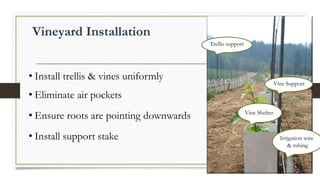
Vineyard Installation
• Install trellis & vines uniformly
• Eliminate air pockets
• Ensure roots are pointing downwards
• Install support stake Irrigation wire
& tubing
Vine Shelter
Trellis support
Vine Support
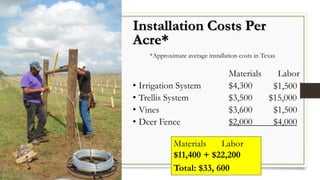
Installation Costs Per
Acre*
Materials Labor
• Irrigation System $4,300
• Trellis System $3,500 $15,000
• Vines $3,600 $1,500
• Deer Fence $2,000 $4,000
Materials Labor
$11,400 + $22,200
Total: $33, 600
$1,500
*Approximate average installation costs in Texas
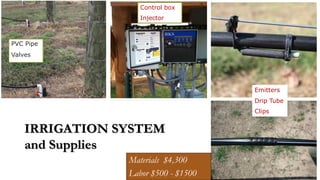
PVC Pipe
Valves
Control box
Injector
Emitters
Drip Tube
Clips
IRRIGATION SYSTEM
and Supplies
Materials $4,300
Labor $500 - $1500
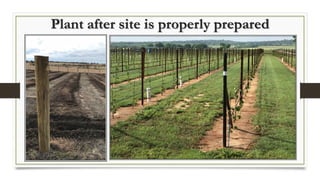
Plant after site is properly prepared
Vine orders
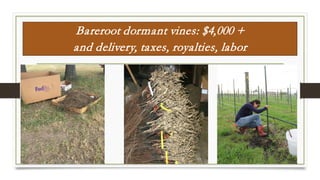
Bareroot dormant vines: $4,000 +
and delivery, taxes, royalties, labor
• Certified Dormant bareroot vines
• 1-2 years in advance.
• Order 1 year for ungrafted ownrooted vines, and 2 years for grafted
vines
• Order requires deposit.
• Vines delivered usually via UPS or FedEx
• With moist wood shavings.
• Keep moist & dark until
• Bring them to shady spot 7 days prior to planting
When Ordering Dormant Bareroot Vines…
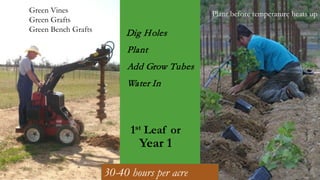
Dig Holes
Plant
Add Grow Tubes
Water In
1st Leaf or
Year 1
30-40 hours per acre
Plant before temperature heats up
Green Vines
Green Grafts
Green Bench Grafts
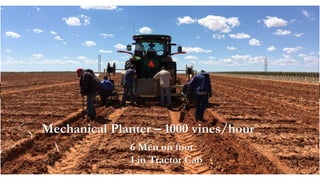
Mechanical Planter – 1000 vines/hour
6 Men on foot
1 in Tractor Cab
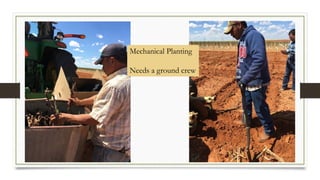
Mechanical Planting
Needs a ground crew
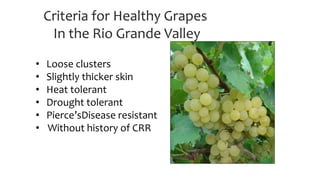
Criteria for Healthy Grapes
In the Rio Grande Valley
• Loose clusters
• Slightly thicker skin
• Heat tolerant
• Drought tolerant
• Pierce’sDisease resistant
• Without history of CRR
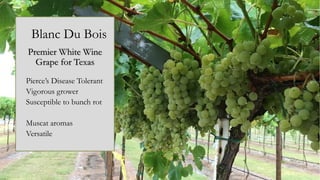
Blanc Du Bois
Premier White Wine
Grape for Texas
Pierce’s Disease Tolerant
Vigorous grower
Susceptible to bunch rot
Muscat aromas
Versatile
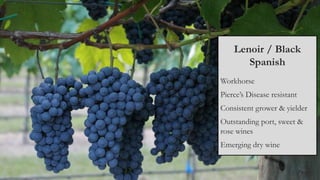
Lenoir / Black
Spanish
Workhorse
Pierce’s Disease resistant
Consistent grower & yielder
Outstanding port, sweet &
rose wines
Emerging dry wine
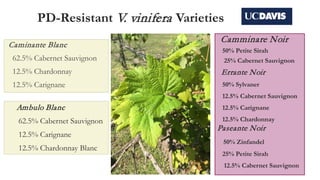
PD-Resistant V. vinifera Varieties
Camminare Noir
50% Petite Sirah
25% Cabernet Sauvignon
Paseante Noir
50% Zinfandel
25% Petite Sirah
12.5% Cabernet Sauvignon
Errante Noir
50% Sylvaner
12.5% Cabernet Sauvignon
12.5% Carignane
12.5% Chardonnay
Ambulo Blanc
62.5% Cabernet Sauvignon
12.5% Carignane
12.5% Chardonnay Blanc
Caminante Blanc
62.5% Cabernet Sauvignon
12.5% Chardonnay
12.5% Carignane
Blanc Du Soleil
• Pierce’s Disease Resistant
• Anthracnose & Downy Mildew Resistant
• Wines are smooth
• Rate of growth highly dependent on terroir
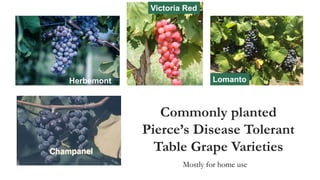
Commonly planted
Pierce’s Disease Tolerant
Table Grape Varieties
Herbemont
Victoria Red
Lomanto
Mostly for home use
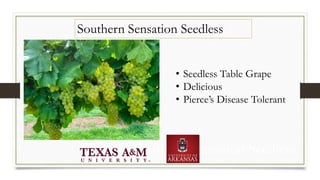
Southern Sensation Seedless
• Seedless Table Grape
• Delicious
• Pierce’s Disease Tolerant
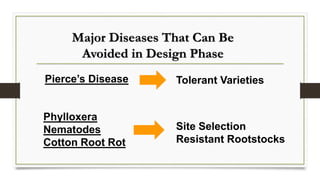
Major Diseases That Can Be
Avoided in Design Phase
Phylloxera
Nematodes
Cotton Root Rot
Tolerant Varieties
Site Selection
Resistant Rootstocks
Pierce’s Disease
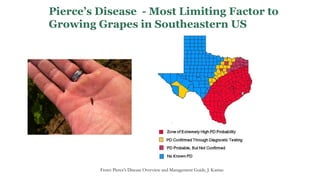
From: Pierce’s Disease Overview and Management Guide, J. Kamas
Pierce’s Disease - Most Limiting Factor to
Growing Grapes in Southeastern US
From: Pierce’s Disease Overview and Management Guide, J. Kamas
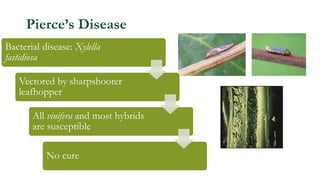
Pierce’s Disease
Bacterial disease: Xylella
fastidiosa
Vectored by sharpshooter
leafhopper
All vinifera and most hybrids
are susceptible
No cure
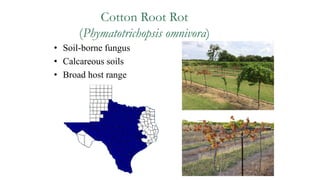
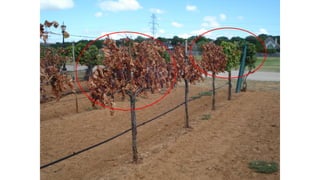
Cotton Root Rot
(Phymatotrichopsis omnivora)
• Soil-borne fungus
• Calcareous soils
• Broad host range
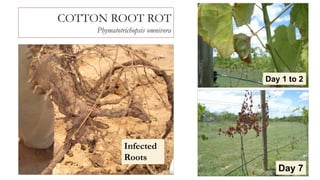
COTTON ROOT ROT
Phymatotrichopsis omnivora
Day 7
Infected
Roots
Day 1 to 2
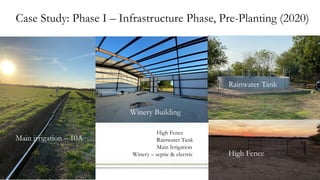
Case Study: Phase I – Infrastructure Phase, Pre-Planting (2020)
Winery Building
Rainwater Tank
Main irrigation – 10A
High Fence
Rainwater Tank
Main Irrigation
Winery – septic & electric High Fence
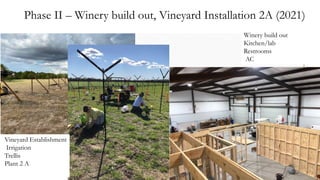
Phase II – Winery build out, Vineyard Installation 2A (2021)
Winery build out
Kitchen/lab
Restrooms
AC
Vineyard Establishment
Irrigation
Trellis
Plant 2 A
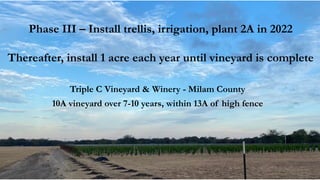
Triple C Vineyard & Winery - Milam County
10A vineyard over 7-10 years, within 13A of high fence
Phase III – Install trellis, irrigation, plant 2A in 2022
Thereafter, install 1 acre each year until vineyard is complete
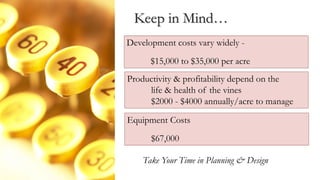
Keep in Mind…
Development costs vary widely -
$15,000 to $35,000 per acre
Productivity & profitability depend on the
life & health of the vines
$2000 - $4000 annually/acre to manage
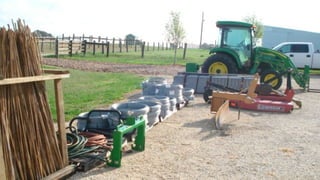
Equipment Costs
$67,000
Take Your Time in Planning & Design
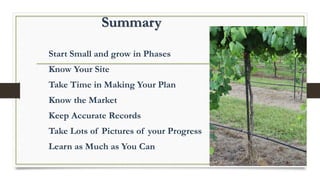
Summary
Start Small and grow in Phases
Know Your Site
Take Time in Making Your Plan
Know the Market
Keep Accurate Records
Take Lots of Pictures of your Progress
Learn as Much as You Can
THANK YOU!
Fran Pontasch, Frances.Pontasch@agnet.tamu.edu
fmpontasch@tamu.edu

RGV_Starting a Vineyard_LayoutCosts.pdf

  • 1.
    Starting a Vineyard Inthe Rio Grande Valley Costs & Layout Rio Farms, Inc. Monte Alto, Texas February 10, 2023 Fran Pontasch, Viticulture Program Specialist
  • 2.
    Why Do YouWant to Grow Grapes? • Sell grapes commercially • Make Wine Commercially • Scenery for an Event Center • Make Wine for Family & Friends • Lifestyle - Physical & Mental Health
  • 3.
    Grapes to Winein Volume 1 Ton = 160 gallons wine 3 Tons = 480 gallons wine 480 gal = 1,817 liters ~ 200 cases
  • 4.
    Grapes to Wine Costs/Returns Ave.Yields: 3 tons/acre Grape Prices: $1500 to $3000/ton Gross Revenue: $3000 - $10000/acre Vineyard Mgmt: $2500-$4000/acre
  • 5.
    Grape Growing –Universal in its Attraction
  • 6.
    Early Grapes inTexas Mission Grape • Hernando Cortes brought the Mission grape to Mexico for sacramental use • Franciscan missionaries planted Mission grapes in El Paso area in 1600’s Convent Grape Nuns from France carried vines to Canada and eventually to Brownsville & Corpus Christi Possibly Ingleside Herbemont Grown in Bellville 1860-1900
  • 7.
    The Texan WhoSaved the Vineyards of France Thomas Volney Munson • Bred over 300 disease-resistant grape varieties specifically for the southwest • Sent phylloxera resistant native Texas rootstocks to France in 1880
  • 8.
    Val Verde Winery1883 Oldest continuously running winery in Texas; survived Prohibition Frank Qualia established Val Verde Winery in Del Rio, TX • Grew Mission grapes until 1890 • By 1910 vineyard replanted with Lenoir, Herbemont, & Champanel
  • 9.
    1950’s • Attempt togrow Vitis vinifera table grapes in the Winter Garden and Lower Rio Grande Valley • 3,000 acres planted Vines died prematurely due to Pierce’s Disease, and Cotton Root Rot
  • 10.
  • 11.
    Data f Top VarietiesGrown in Texas
  • 12.
    Texas American Viticultural Areas (AVA) DavisMountains Mesilla Valley Texas High Plains Texoma Texas Hill Country
  • 13.
    Hill Country High Plains North Texas GulfCoast West Texas Wine & Grape Regions of Texas Texas Wine & Grape Growers Assoc. (TWGGA)
  • 14.
    Most vineyards 1-5acres Gulf Coast Viticulture Region Land Use for Commercial Grapes 380 acres 169 vineyards Ave vineyard size = 2.6 acres
  • 15.
    Rio Grande ValleyLand Use for Grapes • 25.5 acres • 7 vineyards • 4 wineries • Ave vineyard size = 3.5 acre Hidalgo & Cameron Counties PD Resistant Varieties Blanc Du Bois Black Spanish Camminaire Noir Convent Caminante Blanc Paseante Noir Errante Noir
  • 16.
    Vineyard Requirements  Waterquality and availability  Soils character  Climate  Topography  Disease and Insect Pressures
  • 17.
    Design irrigation systemto supply all water needs in an extended drought and ability to deliver 5 gal/min/acre Water Quantity & Quality Water pH 6.5-7.5 Water SAR < 7
  • 18.
    Lower Rio GrandeValley The majority of soils are deep, moderately fine textured. Problems can be - • inadequate subsurface drainage • Saline soils • Saline water • Conditions favor possible cotton root rot National Resources Conservation Service of USDA
  • 19.
  • 20.
    Soil & WaterTesting Recommended Tests: Soil: Collect (2) soil samples per distinct area: topsoil (0-8”) and subsoil (8-24”) Analysis #5: Routine + Micro Analysis #7: Routine + Boron + Organic Matter (in Calcareous, Sandy Soils, NTX) Water: Collect water in clean, new plastic bottle, or emptied water bottle. Analysis #3: Drip irrigation in vineyard
  • 21.
    A soil samplecannot tell you: • Soil depth • Drainage • Presence of pathogens • Presence of residual chemicals • Suitability to grow grapes
  • 22.
  • 23.
    Percolation Test for InternalSoil Drainage • Adequate: 1.5” drop per hour • Excellent: 3” drop per hour Grape roots do not tolerate wet feet Deep ripping may be needed to break up any clay hard pans
  • 24.
    15 min 40 min 1hour 24 hours 48 hours 24 hours 4 hours Sandy Loam Clay Loam
  • 25.
    AVOID Low areas Shaded areas Dipsand terraces Excessive land clearing and leveling
  • 26.
    March, 2021 Increase accuracy Improvedecisions Stressors from climate surprises Impact Productivity & Profitability Vineyard design
  • 27.
  • 28.
    Vine Row spacing(ft) spacing (ft) 6 7 8 9 10 11 12 4 1815 1556 1361 1210 1089 990 908 5 1452 1245 1089 968 871 792 726 6 1210 1037 908 807 726 660 605 7 1037 889 778 691 622 566 519 8 908 778 681 605 545 495 454 9 807 691 605 538 484 440 403 Number of vines per acre at different row and vine spacing Most Common for Single Canopy Calculated by: 43,560 divided by [row spacing (ft) x vine spacing (ft)]
  • 29.
    Vineyard Installation • Installtrellis & vines uniformly • Eliminate air pockets • Ensure roots are pointing downwards • Install support stake Irrigation wire & tubing Vine Shelter Trellis support Vine Support
  • 30.
    Installation Costs Per Acre* MaterialsLabor • Irrigation System $4,300 • Trellis System $3,500 $15,000 • Vines $3,600 $1,500 • Deer Fence $2,000 $4,000 Materials Labor $11,400 + $22,200 Total: $33, 600 $1,500 *Approximate average installation costs in Texas
  • 31.
    PVC Pipe Valves Control box Injector Emitters DripTube Clips IRRIGATION SYSTEM and Supplies Materials $4,300 Labor $500 - $1500
  • 32.
    Plant after siteis properly prepared
  • 33.
    Vine orders Bareroot dormantvines: $4,000 + and delivery, taxes, royalties, labor
  • 34.
    • Certified Dormantbareroot vines • 1-2 years in advance. • Order 1 year for ungrafted ownrooted vines, and 2 years for grafted vines • Order requires deposit. • Vines delivered usually via UPS or FedEx • With moist wood shavings. • Keep moist & dark until • Bring them to shady spot 7 days prior to planting When Ordering Dormant Bareroot Vines…
  • 35.
    Dig Holes Plant Add GrowTubes Water In 1st Leaf or Year 1 30-40 hours per acre Plant before temperature heats up Green Vines Green Grafts Green Bench Grafts
  • 36.
    Mechanical Planter –1000 vines/hour 6 Men on foot 1 in Tractor Cab
  • 37.
  • 38.
    Criteria for HealthyGrapes In the Rio Grande Valley • Loose clusters • Slightly thicker skin • Heat tolerant • Drought tolerant • Pierce’sDisease resistant • Without history of CRR
  • 39.
    Blanc Du Bois PremierWhite Wine Grape for Texas Pierce’s Disease Tolerant Vigorous grower Susceptible to bunch rot Muscat aromas Versatile
  • 40.
    Lenoir / Black Spanish Workhorse Pierce’sDisease resistant Consistent grower & yielder Outstanding port, sweet & rose wines Emerging dry wine
  • 41.
    PD-Resistant V. viniferaVarieties Camminare Noir 50% Petite Sirah 25% Cabernet Sauvignon Paseante Noir 50% Zinfandel 25% Petite Sirah 12.5% Cabernet Sauvignon Errante Noir 50% Sylvaner 12.5% Cabernet Sauvignon 12.5% Carignane 12.5% Chardonnay Ambulo Blanc 62.5% Cabernet Sauvignon 12.5% Carignane 12.5% Chardonnay Blanc Caminante Blanc 62.5% Cabernet Sauvignon 12.5% Chardonnay 12.5% Carignane
  • 42.
    Blanc Du Soleil •Pierce’s Disease Resistant • Anthracnose & Downy Mildew Resistant • Wines are smooth • Rate of growth highly dependent on terroir
  • 43.
    Commonly planted Pierce’s DiseaseTolerant Table Grape Varieties Herbemont Victoria Red Lomanto Mostly for home use
  • 44.
    Southern Sensation Seedless SouthernSensation Seedless • Seedless Table Grape • Delicious • Pierce’s Disease Tolerant
  • 45.
    Major Diseases ThatCan Be Avoided in Design Phase Phylloxera Nematodes Cotton Root Rot Tolerant Varieties Site Selection Resistant Rootstocks Pierce’s Disease
  • 46.
    From: Pierce’s DiseaseOverview and Management Guide, J. Kamas Pierce’s Disease - Most Limiting Factor to Growing Grapes in Southeastern US
  • 47.
    From: Pierce’s DiseaseOverview and Management Guide, J. Kamas Pierce’s Disease Bacterial disease: Xylella fastidiosa Vectored by sharpshooter leafhopper All vinifera and most hybrids are susceptible No cure
  • 48.
    Cotton Root Rot (Phymatotrichopsisomnivora) • Soil-borne fungus • Calcareous soils • Broad host range
  • 49.
    COTTON ROOT ROT Phymatotrichopsisomnivora Day 7 Infected Roots Day 1 to 2
  • 51.
    Case Study: PhaseI – Infrastructure Phase, Pre-Planting (2020) Winery Building Rainwater Tank Main irrigation – 10A High Fence Rainwater Tank Main Irrigation Winery – septic & electric High Fence
  • 52.
    Phase II –Winery build out, Vineyard Installation 2A (2021) Winery build out Kitchen/lab Restrooms AC Vineyard Establishment Irrigation Trellis Plant 2 A
  • 53.
    Triple C Vineyard& Winery - Milam County 10A vineyard over 7-10 years, within 13A of high fence Phase III – Install trellis, irrigation, plant 2A in 2022 Thereafter, install 1 acre each year until vineyard is complete
  • 54.
    Keep in Mind… Developmentcosts vary widely - $15,000 to $35,000 per acre Productivity & profitability depend on the life & health of the vines $2000 - $4000 annually/acre to manage Equipment Costs $67,000 Take Your Time in Planning & Design
  • 56.
    Summary Start Small andgrow in Phases Know Your Site Take Time in Making Your Plan Know the Market Keep Accurate Records Take Lots of Pictures of your Progress Learn as Much as You Can
  • 57.
    THANK YOU! Fran Pontasch,Frances.Pontasch@agnet.tamu.edu fmpontasch@tamu.edu