Customised Data as a Service for
multiple and conflicting data intensive
applications in cloud/edge
environments
13th Cloud Control Workshop, 13-15 June 2018
Discussion session on
Vitali Monica, Politecnico di Milano
monica.vitali@polimi.it
What???
Cloud computing is getting old but edge is still too young
We need to manage both data and computation between heterogeneous
resources
Heterogeneous customers = heterogeneous requirements
GOAL
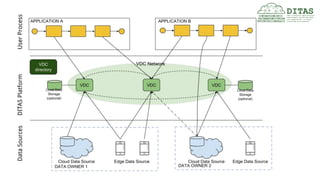
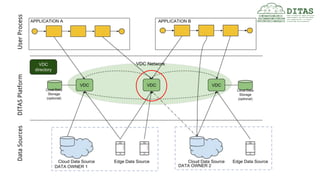
Distributed management and allocation of computation and data with
heterogeneous resources
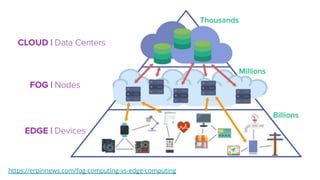
Some definitions
Edge Computing
The network layer encompassing the end devices and their users, to provide, for
example, local computing capability on a sensor, metering or some other devices that
are network-accessible.
Fog Computing
A layered model for enabling ubiquitous access to a shared continuum of scalable
computing resources. The model facilitates the deployment of distributed,
latency-aware applications and services
REF: Fog Computing Conceptual Model, Recommendations of the National Institute of Standards and
Technology https://doi.org/10.6028/NIST.SP.500-325
https://erpinnews.com/fog-computing-vs-edge-computing
Challenges and research directions
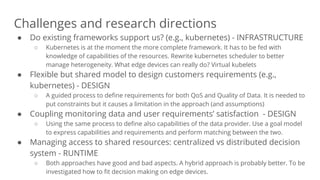
● Do existing frameworks support us? (e.g., kubernetes) - INFRASTRUCTURE
○ Kubernetes is at the moment the more complete framework. It has to be fed with
knowledge of capabilities of the resources. Rewrite kubernetes scheduler to better
manage heterogeneity. What edge devices can really do? Virtual kubelets
● Flexible but shared model to design customers requirements (e.g.,
kubernetes) - DESIGN
○ A guided process to define requirements for both QoS and Quality of Data. It is needed to
put constraints but it causes a limitation in the approach (and assumptions)
● Coupling monitoring data and user requirements’ satisfaction - DESIGN
○ Using the same process to define also capabilities of the data provider. Use a goal model
to express capabilities and requirements and perform matching between the two.
● Managing access to shared resources: centralized vs distributed decision
system - RUNTIME
○ Both approaches have good and bad aspects. A hybrid approach is probably better. To be
investigated how to fit decision making on edge devices.

DITAS@CCW2018

  • 1.
    Customised Data asa Service for multiple and conflicting data intensive applications in cloud/edge environments 13th Cloud Control Workshop, 13-15 June 2018 Discussion session on Vitali Monica, Politecnico di Milano monica.vitali@polimi.it
  • 2.
    What??? Cloud computing isgetting old but edge is still too young We need to manage both data and computation between heterogeneous resources Heterogeneous customers = heterogeneous requirements GOAL Distributed management and allocation of computation and data with heterogeneous resources
  • 3.
    Some definitions Edge Computing Thenetwork layer encompassing the end devices and their users, to provide, for example, local computing capability on a sensor, metering or some other devices that are network-accessible. Fog Computing A layered model for enabling ubiquitous access to a shared continuum of scalable computing resources. The model facilitates the deployment of distributed, latency-aware applications and services REF: Fog Computing Conceptual Model, Recommendations of the National Institute of Standards and Technology https://doi.org/10.6028/NIST.SP.500-325
  • 4.
  • 7.
    Challenges and researchdirections ● Do existing frameworks support us? (e.g., kubernetes) - INFRASTRUCTURE ○ Kubernetes is at the moment the more complete framework. It has to be fed with knowledge of capabilities of the resources. Rewrite kubernetes scheduler to better manage heterogeneity. What edge devices can really do? Virtual kubelets ● Flexible but shared model to design customers requirements (e.g., kubernetes) - DESIGN ○ A guided process to define requirements for both QoS and Quality of Data. It is needed to put constraints but it causes a limitation in the approach (and assumptions) ● Coupling monitoring data and user requirements’ satisfaction - DESIGN ○ Using the same process to define also capabilities of the data provider. Use a goal model to express capabilities and requirements and perform matching between the two. ● Managing access to shared resources: centralized vs distributed decision system - RUNTIME ○ Both approaches have good and bad aspects. A hybrid approach is probably better. To be investigated how to fit decision making on edge devices.