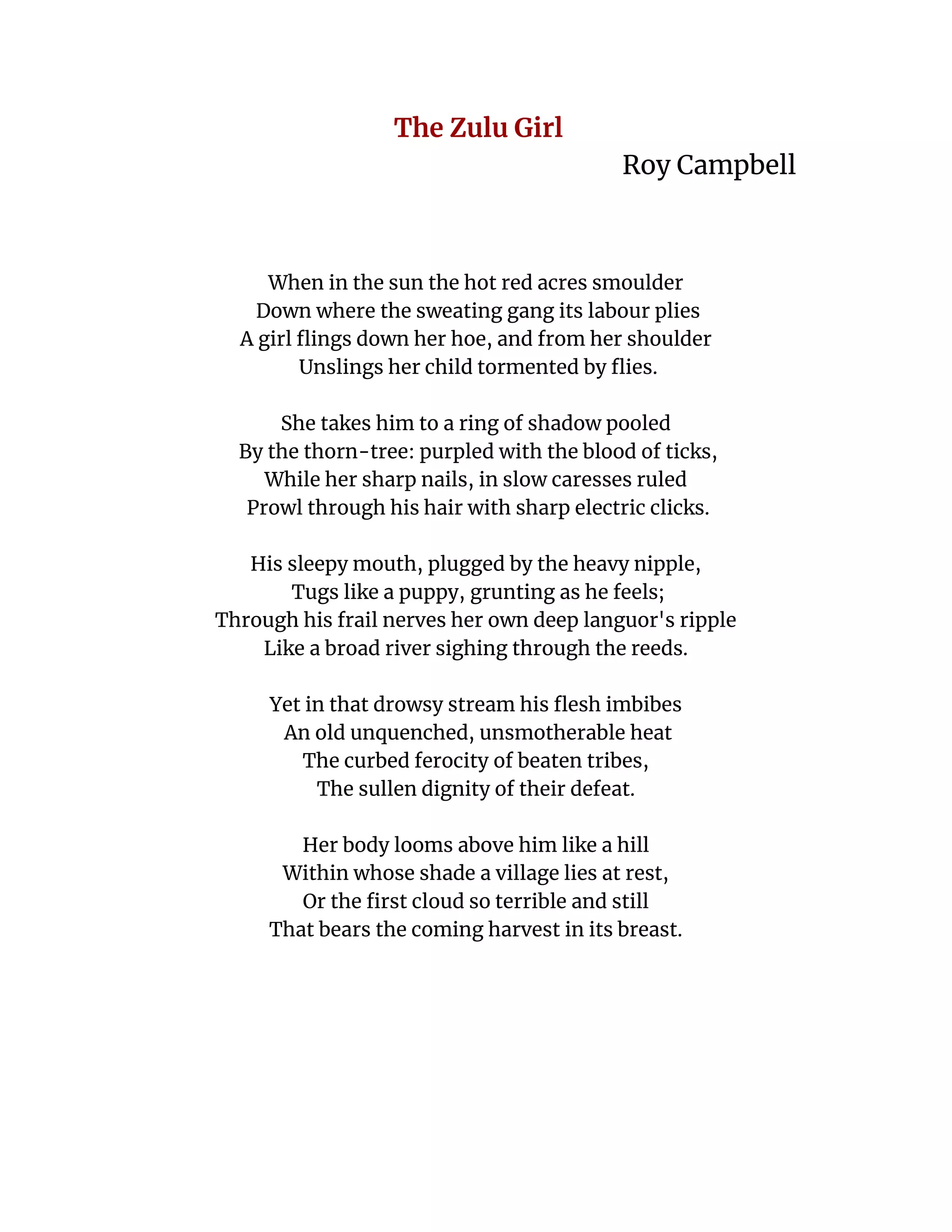
The Zulu Girl
Roy Campbell
When in the sun the hot red acres smoulder
Down where the sweating gang its labour plies
A girl flings down her hoe, and from her shoulder
Unslings her child tormented by flies.
She takes him to a ring of shadow pooled
By the thorn-tree: purpled with the blood of ticks,
While her sharp nails, in slow caresses ruled
Prowl through his hair with sharp electric clicks.
His sleepy mouth, plugged by the heavy nipple,
Tugs like a puppy, grunting as he feels;
Through his frail nerves her own deep languor's ripple
Like a broad river sighing through the reeds.
Yet in that drowsy stream his flesh imbibes
An old unquenched, unsmotherable heat
The curbed ferocity of beaten tribes,
The sullen dignity of their defeat.
Her body looms above him like a hill
Within whose shade a village lies at rest,
Or the first cloud so terrible and still
That bears the coming harvest in its breast.
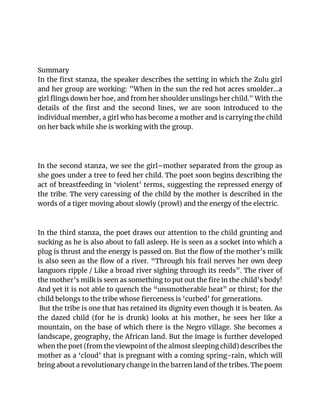
Summary
In the first stanza, the speaker describes the setting in which the Zulu girl
and her group are working: "When in the sun the red hot acres smolder...a
girl flings down her hoe, and from her shoulder unslings her child." With the
details of the first and the second lines, we are soon introduced to the
individual member, a girl who has become a mother and is carrying the child
on her back while she is working with the group.
In the second stanza, we see the girl–mother separated from the group as
she goes under a tree to feed her child. The poet soon begins describing the
act of breastfeeding in ‘violent’ terms, suggesting the repressed energy of
the tribe. The very caressing of the child by the mother is described in the
words of a tiger moving about slowly (prowl) and the energy of the electric.
In the third stanza, the poet draws our attention to the child grunting and
sucking as he is also about to fall asleep. He is seen as a socket into which a
plug is thrust and the energy is passed on. But the flow of the mother’s milk
is also seen as the flow of a river. “Through his frail nerves her own deep
languors ripple / Like a broad river sighing through its reeds”. The river of
the mother’s milk is seen as something to put out the fire in the child’s body!
And yet it is not able to quench the “unsmotherable heat” or thirst; for the
child belongs to the tribe whose fierceness is ‘curbed’ for generations.
But the tribe is one that has retained its dignity even though it is beaten. As
the dazed child (for he is drunk) looks at his mother, he sees her like a
mountain, on the base of which there is the Negro village. She becomes a
landscape, geography, the African land. But the image is further developed
when the poet (from the viewpoint of the almost sleeping child) describes the
mother as a ‘cloud’ that is pregnant with a coming spring-rain, which will
bring about a revolutionary change in the barren land of the tribes. The poem
thus ends with a clear hint of a coming revolution. It simply proves that a poet does
not need a special subject to write an extraordinary poem.

zulu poem Summary.docx

  • 1.
    The Zulu Girl RoyCampbell When in the sun the hot red acres smoulder Down where the sweating gang its labour plies A girl flings down her hoe, and from her shoulder Unslings her child tormented by flies. She takes him to a ring of shadow pooled By the thorn-tree: purpled with the blood of ticks, While her sharp nails, in slow caresses ruled Prowl through his hair with sharp electric clicks. His sleepy mouth, plugged by the heavy nipple, Tugs like a puppy, grunting as he feels; Through his frail nerves her own deep languor's ripple Like a broad river sighing through the reeds. Yet in that drowsy stream his flesh imbibes An old unquenched, unsmotherable heat The curbed ferocity of beaten tribes, The sullen dignity of their defeat. Her body looms above him like a hill Within whose shade a village lies at rest, Or the first cloud so terrible and still That bears the coming harvest in its breast.
  • 2.
    Summary In the firststanza, the speaker describes the setting in which the Zulu girl and her group are working: "When in the sun the red hot acres smolder...a girl flings down her hoe, and from her shoulder unslings her child." With the details of the first and the second lines, we are soon introduced to the individual member, a girl who has become a mother and is carrying the child on her back while she is working with the group. In the second stanza, we see the girl–mother separated from the group as she goes under a tree to feed her child. The poet soon begins describing the act of breastfeeding in ‘violent’ terms, suggesting the repressed energy of the tribe. The very caressing of the child by the mother is described in the words of a tiger moving about slowly (prowl) and the energy of the electric. In the third stanza, the poet draws our attention to the child grunting and sucking as he is also about to fall asleep. He is seen as a socket into which a plug is thrust and the energy is passed on. But the flow of the mother’s milk is also seen as the flow of a river. “Through his frail nerves her own deep languors ripple / Like a broad river sighing through its reeds”. The river of the mother’s milk is seen as something to put out the fire in the child’s body! And yet it is not able to quench the “unsmotherable heat” or thirst; for the child belongs to the tribe whose fierceness is ‘curbed’ for generations. But the tribe is one that has retained its dignity even though it is beaten. As the dazed child (for he is drunk) looks at his mother, he sees her like a mountain, on the base of which there is the Negro village. She becomes a landscape, geography, the African land. But the image is further developed when the poet (from the viewpoint of the almost sleeping child) describes the mother as a ‘cloud’ that is pregnant with a coming spring-rain, which will bring about a revolutionary change in the barren land of the tribes. The poem
  • 3.
    thus ends witha clear hint of a coming revolution. It simply proves that a poet does not need a special subject to write an extraordinary poem.