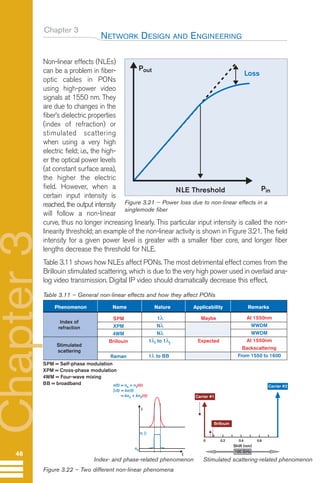
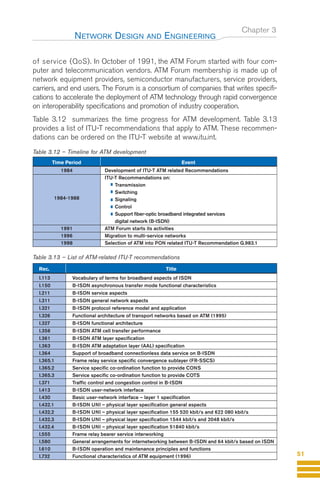
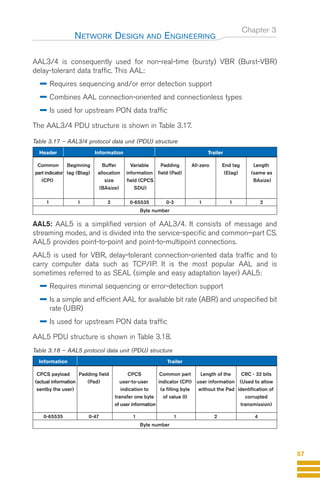
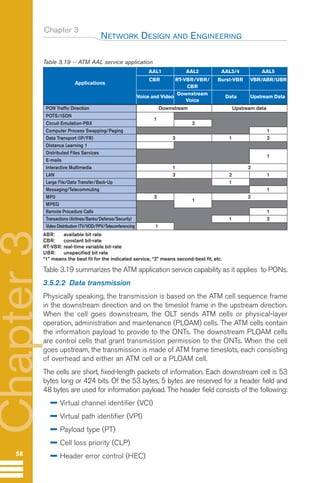
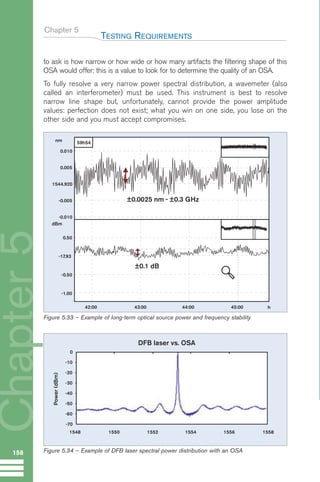
Fiber-optic telecommunications began generating
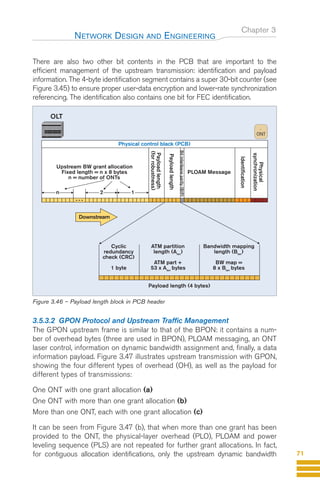
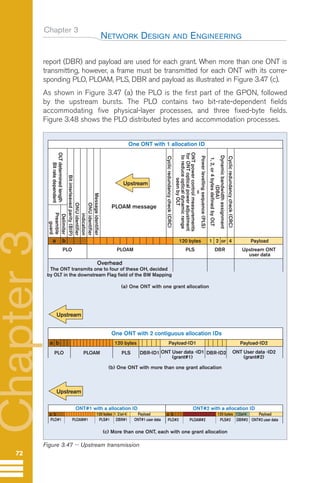
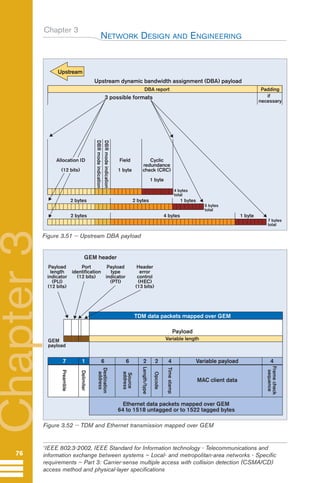
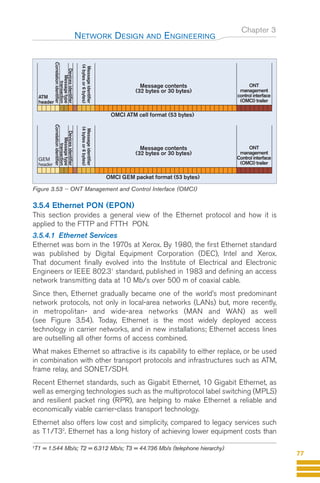
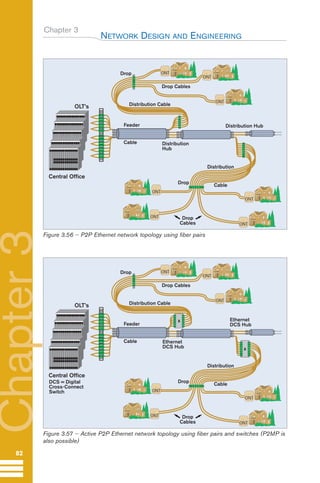
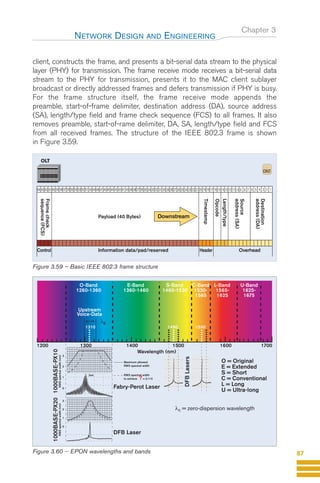
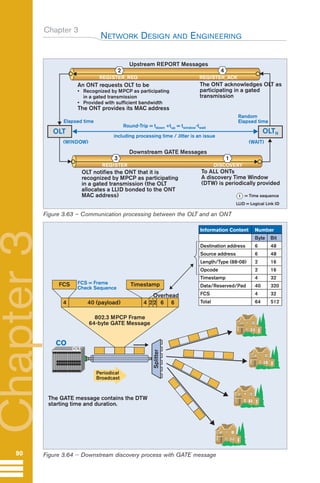
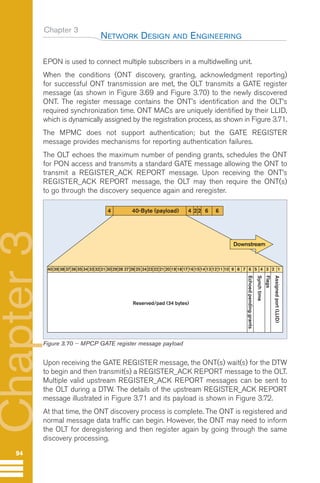
interest in the late 70s, but it wasn’t until the mid-90s
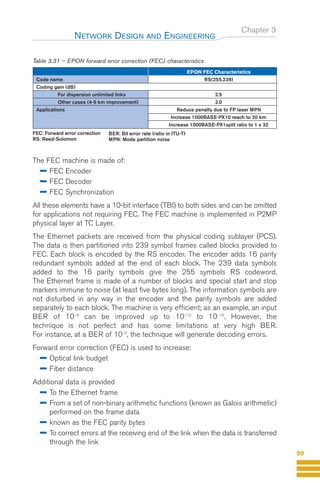
that the real breakthough occurred. The optical
amplifier and narrowband filter, for example, were the
basis of WDM and DWDM, which would become some
of the biggest buzzwords of all time. Indeed, the era
of wavelength- and dense wavelength-division
multiplexing was born and it would change the
telecommunications world forever.
The success of these innovations caused a
tremendous increase in communication traffic and,
consequently, constant bandwidth demand and
growth. This quickly led service providers to respond
by bringing the optical fiber closer and closer to the
premises, and finally to the premises itself and directly
to home. New buzzwords –FTTx and PON– have
emerged and a new era is beginning.
Telecom engineers, technicians, managers and
scholars alike will find in this book a detailed review
of what has been done so far in this relatively new
area of expertise, including all technical aspects,
specifications, and performance requisites of the
passive optical network. It also covers the different
types of PONs (broadband, Gigabit-capable and
Ethernet-ready) and, for each type, discusses, the
optical and protocol network layers in great detail.
In addition, related testing requirements and solutions
are presented and illustrated not only from the point
of view of the network service provider, but also from
the installers and maintainers’ standpoint. Finally, the
reader will also find a list of available international
standards, as well as useful definitions and acronyms.
FTTx
FTTx
PON
A detailed review of system performances, issues and testing solutions.
CORPORATE HEADQUARTERS
400 Godin Avenue, Quebec City, Quebec
G1M 2K2 CANADA
Tel.: 1 418 683-0211
Fax: 1 418 683-2170
EXFO AMERICA
3701 Plano Parkway, Suite 160
Plano, TX 75075 USA
Tel.: 1 800 663-3936
Fax: 1 972 836-0164
EXFO ASIA
151 Chin Swee Road, #03-29
Manhattan House
SINGAPORE 169876
Tel.: +65 6333 8241
Fax: +65 6333 8242
EXFO CHINA
Tower C, Beijing Global Trade Center
Room 1207
36 North Third Ring Road East,
Dongcheng District
Beijing 100013 P. R. CHINA
Tel.: +86 (10) 5825 7755
Fax: +86 (10) 5825 7722
EXFO EUROPE
Omega Enterprise Park, Electron Way
Chandlers Ford, Hampshire
S053 4SE ENGLAND
Tel.: +44 2380 246810
Fax: +44 2380 246801
EXFO NETHAWK
Elektroniikkatie 2
FI-90590 Oulu FINLAND
Tel.: +358 (0)403 010 300
Fax: +358 (0)8 564 5203
EXFO SERVICE ASSURANCE
270 Billerica Road
Chelmsford, MA 01824 USA
Tel.: +1 978 367-5600
Fax: +1 978 367-5700
info@EXFO.com
www.EXFO.com
US$69.95
PON
Technology
and
Testing
Andre Girard, Ph.D.,
EXFO Electro-Optical Engineering Inc.
A unique industry reference
for the deployment and
maintenance of PONs
Technology and Testing
Couverture:Couverture 11/06/10 15:01 Page 1
André Girard, Ph.D., Senior Member of Technical Staff
EXFO Electro-Optical Engineering
Dr. Girard is Convenor of the IEC Working Group (WG) 7 on Passive Components.
WG 7 falls under Subcommittee SC-86B on Fibre Optic Interconnecting Devices
and Passive Components which, in turn, comes under Technical Committee (TC)- 86
on Fibre Optics1
. The main objective of WG 7 is developing performance standards
and specifications for fiber-optic passive components such as WDM devices,
attenuators, isolators, branching devices and switches.
In addition, Dr. Girard is a delegate at the IEC TC 86 with active participation in
SC 86B on Passive Components (task leader on PMD and ITU liaison officer) and
SC 86C on Optical Fibre, Active Devices and Systems (Chairman of the Canadian
SC 86C National Committee). As well, he is the task leader on general information
documentation on PMD.
Dr. Girard is also a member of the TIA and Secretary of TIA FO-4.3 Subcommittee
on Fiber-Optic Interconnecting Devices of Technical Committee FO-4 on Fiber Optics2
.
Finally, Dr. Girard is a delegate at the ITU-T, Study Group (SG) 15, on Optical and
Other Transport Networks. Within SG 15, he is the Editor of Recommendations
G.671 on Transmission Characteristics of Optical Components and Subsystems,
G.661 on Definitions and Test Methods for the Relevant Generic Parameters of
Optical Amplifier Devices and Subsystems, and G.662 on Generic Characteristics
of Optical Amplifier Devices and Subsystems.
Dr. Girard holds a Ph.D. and M.Sc. in lasers from the Quebec National Scientific
Research Institute and a B.Sc. in physics from Laval University in Canada. He has
over 30 years of experience and expertise in optics.
1
ITU and IEC use UK English
2
TIA uses US English
ABOUT THE AUTHOR
I
Preface:Layout 1 09/06/10 09:58 Page I
© 2005 EXFO Electro-Optical Engineering Inc., Quebec City, Canada. All Rights Reserved.
FTTx PON Technology and Testing
No part of this guide may be reproduced in any form
or by any means without the prior written permission of EXFO.
Printed and bound in Canada
ISBN 1-55342-006-3
Legal Deposit—National Library of Canada 2005
Legal Deposit—National Library of Quebec 2005
II
Preface:Layout 1 09/06/10 09:58 Page II
As the author of this book, I would like to express my deepest gratitude to the
numerous people involved in this endeavor.
Firstly, this volume would not have been possible without the support of EXFO’s
senior management; namely, Etienne Gagnon, Vice-President of Optical-Layer
Product Management. Also key in the realization of the project was the collaboration
of our Communications group; particularly, Nathalie Coulombe, Lina Perri, Martin
Bédard and Isabelle Rodrigue.
Secondly, from a technical standpoint, I would like to thank the following people for
their valuable contribution and comments, which helped me to provide the more
specific details presented in this book.
(a) EXFO personnel:
Stéphane Chabot – Manager, Product Management Group, NSP Market
Benoît Masson – Senior Product Manager, NSP Market
Scott Sumner – Strategic Marketing Manager, Protocol Market
François Marcotte – Application Engineer, Protocol Market
Mike Andrews – Application Engineer, NSP Market
Jon Bradley, Ph.D. – Director of Sales, Europe, Middle East and Africa
(b) External contributors, reviewers and people with whom I had technical discussions:
Jimmy Salinas, Ph.D. – Area Manager, NTS SBC Network Services Staff,
SBC Communications Inc.
Yang Liu, Ph.D. – Access Network Products Department, Fiberhome
Technologies Co., Ltd.
Prof. Xue Chen, Ph.D. – Director of Optical Communications Center, Beijing
University of Posts and Telecommunication
Numerous experts worldwide, whom I met during a world tour in the spring and
summer of 2005.
Members and Directors of the FTTH Council (www.ftthcouncil.org)
Fellow members, colleagues and friends from international standards organizations
such as ITU-T SG-15, IEC TC-86 and TIA FO-4.
Raymond Medland, Professional Technical Writer and Reviser
Philippe Bisson, Graphic Designer
Tony Côté, Graphic Designer
Although it is difficult to enumerate all the people who have contributed, I would like
to take this opportunity to sincerely thank everyone who participated.
Finally, I would like to thank my family for their enduring patience and support throughout
the production of this work. There are no words to thank them sufficiently.
September 2005
ACKNOWLEDGEMENTS
III
André Girard
Preface:Layout 1 09/06/10 09:58 Page III
Since the publication of EXFO’s first book (Guide to WDM Technology and Testing)
in 2000, there has been a tremendous amount of progress in the global
telecommunications industry, and in fiber-optic telecommunications in particular.
Many of the related terms or buzzwords, such as broadband, very high bit rate and
access are now quite common.
EXFO, too, has evolved during this period, and the company has published
several guides and application notes covering different aspects of our field (these
documents can be found and/or ordered at www.exfo.com). Although we are still
very focused on our original mission of being a leader in telecom testing equipment,
it is the expertise behind the instruments and our collaboration with customers that
are at the heart of our company values. EXFO’s slogan, Expertise Reaching Out,
appropriately reflects our ongoing commitment to the industry and is representative
of the spirit in which this book was written.
The timing of the publication is also of great importance, as this is the moment when
telecom professionals are showing an increasing interest in learning more about
this progressive area; i.e., the development and deployment of fiber-to-the-home
(FTTH) using passive optical networks (PONs).
Indeed, FTTx and PON are some of today’s most popular buzzwords, and just
as a new wine matures, this book is a more seasoned follow-up to EXFO’s
pocket-sized FTTx PON Guide: Testing Passive Optical Networks, first published for
the industry in February 2004.
The present work is more extensive than our pocket guide and further introduces
telecom managers, engineers, technicians, professors and students to the fascinating
world of passive networking technology. FTTx PON Technology and Testing
presents a detailed description of PON architecture, its basic system configurations,
topologies, components, and performance characteristics, both at the physical layer
and at the protocol transport layer. The book also contains several accompanying
illustrations and tables to support the text and thus facilitate assimilation.
Other topics covered include the equipment located at the central office and at the
subscribers’ premises; the various outside plant components and their installation;
as well as the development of the new set of international standards that such a
technology requires. Finally, the book proposes an in-depth study of the related test
procedures for PON installation service activation, operation and maintenance, some
of which will be unfamiliar and very challenging for installers and operators of PONs.
We hope that this book will provide you with a deeper understanding of passive
optical networking technology, which, in the near future, may again change our way
of life as high-speed and WDM networks have changed the way we use our
computers and the Internet.
EXFO is a Platinum Member of the FTTH Council
PREFACE
IV
Preface:Layout 1 09/06/10 09:58 Page IV
ABOUT THE AUTHOR . . . . . . . . . . . . . . . . . . . . . . . . . . . . . . . . . . . . . . . . . . . . . . . . . .I
ACKNOWLEDGEMENTS . . . . . . . . . . . . . . . . . . . . . . . . . . . . . . . . . . . . . . . . . . . . . . .II
PREFACE . . . . . . . . . . . . . . . . . . . . . . . . . . . . . . . . . . . . . . . . . . . . . . . . . . . . . . . . . . .IV
INTRODUCTION . . . . . . . . . . . . . . . . . . . . . . . . . . . . . . . . . . . . . . . . . . . . . . . . . . . . . .1
1.1 CURRENT BANDWIDTH USAGE WORLDWIDE . . . . . . . . . . . . . . . . . . . . . . . . . . . . . . . .2
1.2 NETWORK TECHNOLOGIES . . . . . . . . . . . . . . . . . . . . . . . . . . . . . . . . . . . . . . . . . . . . . . . . . .4
1.3 HISTORICAL DEVELOPMENT OF FTTH . . . . . . . . . . . . . . . . . . . . . . . . . . . . . . . . . . . . . .11
2 FTTH PON ARCHITECTURES AND TOPOLOGY . . . . . . . . . . . . . . . . . . . . . . . .15
3 NETWORK DESIGN AND ENGINEERING . . . . . . . . . . . . . . . . . . . . . . . . . . . . .21
3.1 PON TECHNOLOGY . . . . . . . . . . . . . . . . . . . . . . . . . . . . . . . . . . . . . . . . . . . . . . . . . . . . . . . . .22
3.2 ACTIVE EQUIPMENT . . . . . . . . . . . . . . . . . . . . . . . . . . . . . . . . . . . . . . . . . . . . . . . . . . . . . . . .29
3.2.1 OLT and ONT . . . . . . . . . . . . . . . . . . . . . . . . . . . . . . . . . . . . . . . . . . . . . . . . . . . . . . . . . .32
3.3 PASSIVE OPTICAL COMPONENTS . . . . . . . . . . . . . . . . . . . . . . . . . . . . . . . . . . . . . . . . . .35
3.3.1 Coupler . . . . . . . . . . . . . . . . . . . . . . . . . . . . . . . . . . . . . . . . . . . . . . . . . . . . . . . . . . . . . . . .38
3.3.2 Splitter . . . . . . . . . . . . . . . . . . . . . . . . . . . . . . . . . . . . . . . . . . . . . . . . . . . . . . . . . . . . . . . .39
3.3.3 Connectors . . . . . . . . . . . . . . . . . . . . . . . . . . . . . . . . . . . . . . . . . . . . . . . . . . . . . . . . . . . .42
3.3.4 Enclosures . . . . . . . . . . . . . . . . . . . . . . . . . . . . . . . . . . . . . . . . . . . . . . . . . . . . . . . . . . . . .43
3.4 FIBER AND RELATED ISSUES . . . . . . . . . . . . . . . . . . . . . . . . . . . . . . . . . . . . . . . . . . . . . .44
3.4.1 Optical Issues . . . . . . . . . . . . . . . . . . . . . . . . . . . . . . . . . . . . . . . . . . . . . . . . . . . . . . . . . .44
3.4.2 Mechanical Issues . . . . . . . . . . . . . . . . . . . . . . . . . . . . . . . . . . . . . . . . . . . . . . . . . . . . . .47
3.4.3 Fiber Cable Types Used in P2MP PONs . . . . . . . . . . . . . . . . . . . . . . . . . . . . . . . . .49
3.5 PON PROTOCOLS . . . . . . . . . . . . . . . . . . . . . . . . . . . . . . . . . . . . . . . . . . . . . . . . . . . . . . . . . . .49
3.5.1 Overview . . . . . . . . . . . . . . . . . . . . . . . . . . . . . . . . . . . . . . . . . . . . . . . . . . . . . . . . . . . . . .49
3.5.2 Broadband PON (BPON) . . . . . . . . . . . . . . . . . . . . . . . . . . . . . . . . . . . . . . . . . . . . . . .50
3.5.2.1 ATM Protocol . . . . . . . . . . . . . . . . . . . . . . . . . . . . . . . . . . . . . . . . . . . . . . . . . . . .50
3.5.2.2 Data Transmission . . . . . . . . . . . . . . . . . . . . . . . . . . . . . . . . . . . . . . . . . . . . . . . .58
3.5.3 Gigabit PON (GPON) . . . . . . . . . . . . . . . . . . . . . . . . . . . . . . . . . . . . . . . . . . . . . . . . . .66
3.5.3.1 GPON TC Frame Structure . . . . . . . . . . . . . . . . . . . . . . . . . . . . . . . . . . . . . . .67
3.5.3.2 GPON Protocol and Upstream Traffic Management . . . . . . . . . . . . . . . .71
3.5.4 Ethernet PON (EPON) . . . . . . . . . . . . . . . . . . . . . . . . . . . . . . . . . . . . . . . . . . . . . . . . .77
3.5.4.1 Ethernet Services . . . . . . . . . . . . . . . . . . . . . . . . . . . . . . . . . . . . . . . . . . . . . . . .77
3.5.4.2 IEEE 802.3ah-2004 . . . . . . . . . . . . . . . . . . . . . . . . . . . . . . . . . . . . . . . . . . . . . .79
3.5.4.3 Ethernet PON Transport Architecture . . . . . . . . . . . . . . . . . . . . . . . . . . . . . .80
3.5.4.4 Downstream Data Broadcast Mode from OLT . . . . . . . . . . . . . . . . . . . . . .97
3.5.4.5 Upstream Transmission from ONT . . . . . . . . . . . . . . . . . . . . . . . . . . . . . . . . .97
3.5.4.6 Forward Error Correction (FEC) in EPON . . . . . . . . . . . . . . . . . . . . . . . . . .98
3.5.4.7 Operation, Administration and Maintenance (OAM) . . . . . . . . . . . . . . . .101
3.5.4.8 Summary of Ethernet Architectures . . . . . . . . . . . . . . . . . . . . . . . . . . . . . .101
4 DESCRIPTION OF OUTSIDE PLANT EQUIPMENT . . . . . . . . . . . . . . . . . . .103
4.1 OSP INSTALLATION . . . . . . . . . . . . . . . . . . . . . . . . . . . . . . . . . . . . . . . . . . . . . . . . . . . . . . . .107
4.1.1 Fiber Cable . . . . . . . . . . . . . . . . . . . . . . . . . . . . . . . . . . . . . . . . . . . . . . . . . . . . . . . . . . .108
4.1.2 Splice Enclosures, Patch Panels and Fiber Management . . . . . . . . . . . . . . . .108
4.1.3 Drop Terminals . . . . . . . . . . . . . . . . . . . . . . . . . . . . . . . . . . . . . . . . . . . . . . . . . . . . . . .111
4.1.4 ONT Installation . . . . . . . . . . . . . . . . . . . . . . . . . . . . . . . . . . . . . . . . . . . . . . . . . . . . . .112
TABLE OF CONTENTS
V
Preface:Layout 1 09/06/10 09:58 Page V
5 TESTING REQUIREMENTS . . . . . . . . . . . . . . . . . . . . . . . . . . . . . . . . . . . . . . . .115
5.1 PHYSICAL LAYER . . . . . . . . . . . . . . . . . . . . . . . . . . . . . . . . . . . . . . . . . . . . . . . . . . . . . . . . . .116
5.1.1 Installation . . . . . . . . . . . . . . . . . . . . . . . . . . . . . . . . . . . . . . . . . . . . . . . . . . . . . . . . . . . .120
5.1.1.1 Loss Measurement . . . . . . . . . . . . . . . . . . . . . . . . . . . . . . . . . . . . . . . . . . . . . .121
5.1.1.2 Link Characterization . . . . . . . . . . . . . . . . . . . . . . . . . . . . . . . . . . . . . . . . . . . .126
5.1.2 Service Activation . . . . . . . . . . . . . . . . . . . . . . . . . . . . . . . . . . . . . . . . . . . . . . . . . . . . .133
5.1.2.1 OLT (initial service activation only) . . . . . . . . . . . . . . . . . . . . . . . . . . . . . . . .133
5.1.2.2 Optical Network Terminals (ONT) . . . . . . . . . . . . . . . . . . . . . . . . . . . . . . . .133
5.1.3 Troubleshooting . . . . . . . . . . . . . . . . . . . . . . . . . . . . . . . . . . . . . . . . . . . . . . . . . . . . . . .136
5.2 PROTOCOL LAYER . . . . . . . . . . . . . . . . . . . . . . . . . . . . . . . . . . . . . . . . . . . . . . . . . . . . . . . . .139
5.2.1 ATM Service Activation and Provisioning . . . . . . . . . . . . . . . . . . . . . . . . . . . . . . .139
5.2.1.1 ATM Performance Parameters . . . . . . . . . . . . . . . . . . . . . . . . . . . . . . . . . . .142
5.2.1.2 ATM QoS Testing . . . . . . . . . . . . . . . . . . . . . . . . . . . . . . . . . . . . . . . . . . . . . . .142
5.2.2 EPON Service Activation and Provisioning . . . . . . . . . . . . . . . . . . . . . . . . . . . . .144
5.2.2.1 Quality and Performance . . . . . . . . . . . . . . . . . . . . . . . . . . . . . . . . . . . . . . . .144
5.2.2.2 Ethernet Performance Verification . . . . . . . . . . . . . . . . . . . . . . . . . . . . . . . .145
5.2.2.3 RFC 2544 Tests . . . . . . . . . . . . . . . . . . . . . . . . . . . . . . . . . . . . . . . . . . . . . . . .146
5.2.2.4 Throughput . . . . . . . . . . . . . . . . . . . . . . . . . . . . . . . . . . . . . . . . . . . . . . . . . . . . .147
5.2.2.5 Burst (back-to-back) . . . . . . . . . . . . . . . . . . . . . . . . . . . . . . . . . . . . . . . . . . . .148
5.2.2.6 Frame Loss . . . . . . . . . . . . . . . . . . . . . . . . . . . . . . . . . . . . . . . . . . . . . . . . . . . . .148
5.2.2.7 Latency . . . . . . . . . . . . . . . . . . . . . . . . . . . . . . . . . . . . . . . . . . . . . . . . . . . . . . . .149
5.2.2.8 BERT over Ethernet . . . . . . . . . . . . . . . . . . . . . . . . . . . . . . . . . . . . . . . . . . . . .150
5.2.2.9 Ethernet Service Acceptance Testing . . . . . . . . . . . . . . . . . . . . . . . . . . . . .150
5.2.2.10 Test Configurations . . . . . . . . . . . . . . . . . . . . . . . . . . . . . . . . . . . . . . . . . . . .151
5.3 COMPONENT MANUFACTURING . . . . . . . . . . . . . . . . . . . . . . . . . . . . . . . . . . . . . . . . .152
5.3.1 Passive Components . . . . . . . . . . . . . . . . . . . . . . . . . . . . . . . . . . . . . . . . . . . . . . . . . .152
5.3.1.1 Test Methods Based on Broadband Light Sources (BBS) . . . . . . . . .152
5.3.1.2 Test Methods Based on Swept-Delay System . . . . . . . . . . . . . . . . . . . . .153
5.3.1.3 Test Methods Based on Swept-Wavelength (or frequency) System .153
5.3.1.4 Compromise Between Testing Time and System Complexity . . . . . . .154
5.3.1.5 Polarization-Dependent Loss . . . . . . . . . . . . . . . . . . . . . . . . . . . . . . . . . . . .156
5.3.2 Active Components . . . . . . . . . . . . . . . . . . . . . . . . . . . . . . . . . . . . . . . . . . . . . . . . . . .157
6 CONCLUSION . . . . . . . . . . . . . . . . . . . . . . . . . . . . . . . . . . . . . . . . . . . . . . . . . . . .159
7 GLOSSARY . . . . . . . . . . . . . . . . . . . . . . . . . . . . . . . . . . . . . . . . . . . . . . . . . . . . . . .163
8 ABBREVIATIONS AND ACRONYMS . . . . . . . . . . . . . . . . . . . . . . . . . . . . . . . . .173
9 BIBLIOGRAPHY . . . . . . . . . . . . . . . . . . . . . . . . . . . . . . . . . . . . . . . . . . . . . . . . . .185
9.1 ITU-T RECOMMENDATIONS . . . . . . . . . . . . . . . . . . . . . . . . . . . . . . . . . . . . . . . . . . . . . . .186
9.1.1 PON-Related Recommendations . . . . . . . . . . . . . . . . . . . . . . . . . . . . . . . . . . . . . .186
9.1.2 Other Useful Recommendations . . . . . . . . . . . . . . . . . . . . . . . . . . . . . . . . . . . . . . .188
9.2 USEFUL PON-RELATED IEC STANDARDS . . . . . . . . . . . . . . . . . . . . . . . . . . . . . . . .188
9.3 IEEE ACCESS NETWORK STANDARDS (EPON) . . . . . . . . . . . . . . . . . . . . . . . . . . .189
9.4 TELCORDIA . . . . . . . . . . . . . . . . . . . . . . . . . . . . . . . . . . . . . . . . . . . . . . . . . . . . . . . . . . . . . . .189
9.5 OTHER REFERENCES . . . . . . . . . . . . . . . . . . . . . . . . . . . . . . . . . . . . . . . . . . . . . . . . . . . .190
TABLE OF CONTENTS
VI
Preface:Layout 1 09/06/10 09:58 Page VI
INTRODUCTION
Chapter
1
Guide FTTH-p1-68:Layout 1 09/06/10 09:13 Page 1
Chapter 1
Since the development of optical fiber, fiber-optic telecommunications, the
personal computer (PC) and the Internet, our lives have been dominated by
bandwidth consumption. Although many of us do not realize it, daily activities
that are now considered trivial consume a significant amount of bandwidth.
The most demanding of these applications is the use of video, especially
high-definition television (HDTV), followed by standard-definition television
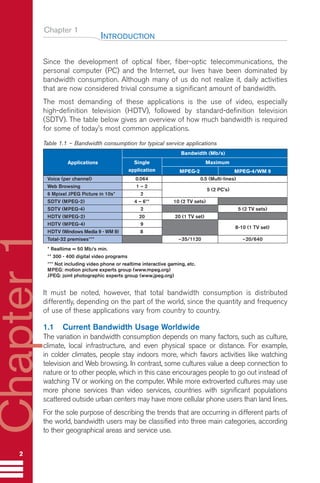
(SDTV). The table below gives an overview of how much bandwidth is required
for some of today’s most common applications.
Table 1.1 – Bandwidth consumption for typical service applications
It must be noted, however, that total bandwidth consumption is distributed
differently, depending on the part of the world, since the quantity and frequency
of use of these applications vary from country to country.
1.1 Current Bandwidth Usage Worldwide
The variation in bandwidth consumption depends on many factors, such as culture,
climate, local infrastructure, and even physical space or distance. For example,
in colder climates, people stay indoors more, which favors activities like watching
television and Web browsing. In contrast, some cultures value a deep connection to
nature or to other people, which in this case encourages people to go out instead of
watching TV or working on the computer. While more extroverted cultures may use
more phone services than video services, countries with significant populations
scattered outside urban centers may have more cellular phone users than land lines.
For the sole purpose of describing the trends that are occurring in different parts of
the world, bandwidth users may be classified into three main categories, according
to their geographical areas and service use.
INTRODUCTION
2
Chapter
1
Single Maximum
Applications
application MPEG-2 MPEG-4/WM 9
Voice (per channel) 0.064 0.5 (Multi-lines)
Web Browsing 1 – 2
5 (2 PC’s)
6 Mpixel JPEG Picture in 10s* 2
SDTV (MPEG-2) 4 – 6** 10 (2 TV sets)
SDTV (MPEG-4) 2 5 (2 TV sets)
HDTV (MPEG-2) 20 20 (1 TV set)
HDTV (MPEG-4) 9
8-10 (1 TV set)
HDTV (Windows Media 9 - WM 9) 8
Total-32 premises*** ~35/1120 ~20/640
* Realtime = 50 Mb/s min.
** 300 - 400 digital video programs
*** Not including video phone or realtime interactive gaming, etc.
MPEG: motion picture experts group (www.mpeg.org)

JPEG: joint photographic experts group (www.jpeg.org)
Bandwidth (Mb/s)
Guide FTTH-p1-68:Layout 1 09/06/10 09:13 Page 2
Chapter 1
For instance, in the US and Canada, technology, productivity and convenience has
played a major role in society since the industrial revolution. Today, in this part of the
world, television remains the biggest and most popular vehicle of culture, perhaps
more so than anywhere else. In some areas, the colder climate has further
reinforced the trend, inciting people to stay indoors and do more things at home.
For example, over the past 15 years, computers and the Internet have increasingly
become an integral part of the average American and Canadian’s daily life; not only at
work or at school, but also at home, be it for business or leisure. In terms of geography,
most families live outside urban areas, which typically means long commutes to work every
day. This growing phenomenon, along with the now common computer requirements in
schools, has encouraged many people to have home offices to save time and
facilitate schoolwork and business. Of course, many people simply enjoy surfing the
Web or playing computer games just for fun as well. All this translates into extensive
bandwidth demand for services to the home, so we can call them Telhomers.
Figure 1-1 illustrates the
typical connections and
uses of the common
upper-middle-class
home in the US and
Canada. These houses
have many phones and
more than one TV;
typically, one per floor
(some homes may also
have one or more HDTV
sets). Several PCs are also common; often, there is one for the parents, one for the
children and possibly one more if there is an office in the house (known as small
office home office or SOHO, which usually includes a separate phone line,
independent from that of the residential family line).
In contrast, while Asia, too, consists of industrialized societies in which technology
and productivity play a major role, most Asian countries also have significant rural
populations that do not have access to television. They do, however, have access to
telephone services (especially cellular phones) and the Internet, which contributes
to bandwidth consumption even in remote locations.
In urban areas, the dense populations and lack of physical space have led to the
construction of mega apartment buildings, which although may limit the per-capita
use of bandwidth (compared to the multiple connections in a North American home,
for example), it certainly does not limit the frequency and quantity of use. In fact, in
China alone, there are more than 100 million Internet subscribers. For this reason,
we can call this group the Telenese.
Figure 1-2 illustrates a common type of apartment complex in Asia, which houses
hundreds, sometimes thousands of people, most of whom have Internet connections
and phone services.
INTRODUCTION
3
The telecom home:
The Telhomers
Many phones (3+)
Many TV Sets (2+)
Many PCs (2+)
Figure 1.1 – The American model for consumption of
broadband telecom services
Guide FTTH-p1-68:Layout 1 09/06/10 09:13 Page 3
Chapter 1
In Europe, the situation
is somehow a little
different. Although the
usual services such as
telephone, Internet and
television are deployed
massively, in some
countries, the high cost
of residential telephone
lines and scattered
populations in remote
areas have caused the
number of cellular phone
users to surpass the
number of land lines.
Internet connections are
also a big portion of
the European bandwidth
consumption, whereas
television services, on
the other hand, are used
much less frequently
than they are in America,
for instance. Culturally,
many European societies
prefer going out and
getting together to staying
in and watching television. They often meet in cafes for casual conversation or gather
in large groups to watch football (soccer) games. For these reasons, we can call
European bandwidth users Cafeneans. Figure 1-3 illustrates a busy European cafe.
The above is, of course, but a brief and simplified overview of service usage over
three continents. Nonetheless, it provides a general backdrop for the following sections,
allowing the reader to better understand the context of the information provided.
1.2 Network Technologies
In order to support the service applications enumerated in Table 1-1 above, a number
of network technologies are proposed, each with advantages and drawbacks.
Table 1-2 lists available transport solutions (such as copper or optical fiber) for
supporting the applications in the access market. Before going any further, it must
be noted that the actual “transporting” is done by what is known as bandwidth,
which refers not only to the quantity of data it can carry, but also to the speed at
which the signals travel; bandwidth is measured in megabits or gigabits per second
(abbreviated Mb/s, Mbps or Mbit/s, and Gb/s, Gbps or Gbit/s, respectively; Mb/s
and Gb/s will be used herein).
INTRODUCTION
4
Chapter
1
Figure 1.3 – The European model for consumption of
broadband telecom services
The Cafeneans
Figure 1.2 – The Asian model for consumption of broadband
telecom services
China = 100,000,000 Internet Subscribers: The Telenese
Guide FTTH-p1-68:Layout 1 22/06/10 08:24 Page 4
Chapter 1
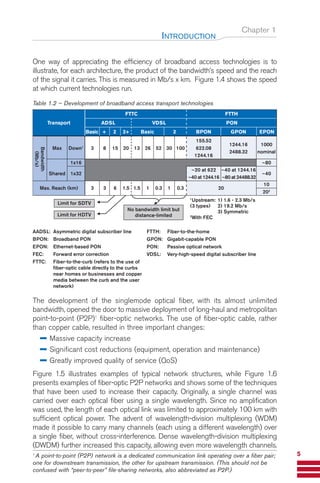
One way of appreciating the efficiency of broadband access technologies is to
illustrate, for each architecture, the product of the bandwidth’s speed and the reach
of the signal it carries. This is measured in Mb/s x km. Figure 1.4 shows the speed
at which current technologies run.
Table 1.2 – Development of broadband access transport technologies
The development of the singlemode optical fiber, with its almost unlimited
bandwidth, opened the door to massive deployment of long-haul and metropolitan
point-to-point (P2P)1
fiber-optic networks. The use of fiber-optic cable, rather
than copper cable, resulted in three important changes:
Massive capacity increase
Significant cost reductions (equipment, operation and maintenance)
Greatly improved quality of service (QoS)
Figure 1.5 illustrates examples of typical network structures, while Figure 1.6
presents examples of fiber-optic P2P networks and shows some of the techniques
that have been used to increase their capacity. Originally, a single channel was
carried over each optical fiber using a single wavelength. Since no amplification
was used, the length of each optical link was limited to approximately 100 km with
sufficient optical power. The advent of wavelength-division multiplexing (WDM)
made it possible to carry many channels (each using a different wavelength) over
a single fiber, without cross-interference. Dense wavelength-division multiplexing
(DWDM) further increased this capacity, allowing even more wavelength channels.
INTRODUCTION
5
FTTC FTTH
Transport ADSL VDSL PON
Basic + 2 2+ Basic 2 BPON GPON EPON
155.52
Max Down1
3 8 15 20 13 26 52 30 100 622.08
1244.16 1000
1244.16
2488.32 nominal
1x16 ~80
Shared 1x32
~20 at 622 ~40 at 1244.16
~40
~40 at 1244.16 ~80 at 24488.32
Max. Reach (km) 3 3 6 1.5 1.5 1 0.3 1 0.3 20
10
202
Bandwidth
(Mb/s)
Limit for SDTV
Limit for HDTV
No bandwidth limit but
distance-limited
1
Upstream: 1) 1.6 - 2.3 Mb/s
(3 types) 2) 19.2 Mb/s
3) Symmetric
2
With FEC
AADSL: Asymmetric digital subscriber line
BPON: Broadband PON
EPON: Ethernet-based PON
FEC: Forward error correction
FTTC: Fiber-to-the-curb (refers to the use of
fiber-optic cable directly to the curbs
near homes or businesses and copper
media between the curb and the user
network)
FTTH: Fiber-to-the-home
GPON: Gigabit-capable PON
PON: Passive optical network
VDSL: Very-high-speed digital subscriber line
1
A point-to-point (P2P) network is a dedicated communication link operating over a fiber pair;
one for downstream transmission, the other for upstream transmission. (This should not be
confused with “peer-to-peer” file-sharing networks, also abbreviated as P2P.)
Guide FTTH-p1-68:Layout 1 09/06/10 09:13 Page 5
Chapter 1
In addition, the use of erbium-doped fiber amplifiers (EDFAs), which amplify optical
signals directly, without optical-electrical-optical conversion, allowed for the
construction of long-haul P2P networks with few or no electronic components.
Metropolitan-area networks (MANs) are also fiber-based and make use of lower-cost
coarse wavelength-division multiplexing (CWDM) to transmit multiple channels
(typically 18 over low-water-peak fiber) per fiber over relatively short P2P links.
Although most access networks serving small businesses and residential
customers are still copper-based, subscribers in a few countries around the world
have a P2P fiber-optic connection to a central office (CO). As shown in Figure 1.6(c),
this requires a dedicated optical line terminal (OLT) at the CO, as well as a pair of
optical fibers for each subscriber where an optical network unit (ONU2
) is connected
to the fiber pair.
In spite of its advantages, optical fiber has not been widely used in the “last mile”
(i.e., the segment of the network that extends from the CO directly to the
subscriber). Because of the high cost and limited availability of optical access
services, this segment is typically copper-based (as shown in Figure 1.7), and the
high-speed services available to residential clients and small businesses are
limited to generic digital subscriber lines (xDSL) and hybrid fiber coax (HFC).
The main alternative to fiber optics — wireless transmission with direct broadcast
service (DBS) — requires an antenna and a receiver (as shown in Figure 1-5).
Therefore, current services present the following shortcomings:
They provide limited bandwidth in a context where there is an explosive growth
in demand for more bandwidth, higher-speed services and longer reach.
They use different media and transmission equipment requiring multiple
installations and extensive maintenance.
They allow carriers to provide triple-play (voice, video and data)
services and other high-speed interactive applications to residential
customers, but they require considerable compression techniques. Copper
networks have a shorter reach, increasing the life-cycle cost substantially.
Although fiber optics overcomes most of these limitations, one of the obstacles to
providing fiber-optic services directly to residences and small businesses, including
small offices and home offices (SOHOs), has been the high cost of connecting
each subscriber to the CO (i.e., the cost of deploying the fiber cable). A high number
of point-to-point (P2P) connections would require many active components and a
high-fiber-count cable, thus leading to prohibitive installation and maintenance
costs, compared to a traditional copper distribution network (which is getting very
old and requires maintenance). Figure 1.8 shows different optical fiber connections
used in the access network.
While also supporting P2P architecture, fiber-to-the-home (FTTH), also called
fiber-to-the-premises (FTTP), provides a point-to-multipoint (P2MP3
) connection
that offers an attractive solution to these problems. With FTTH P2MP PONs, there
INTRODUCTION
6
Chapter
1
2
The ONU is called optical network terminal when it is connected to the user network interface
3
A point-to-multipoint network provides a link from one upstream terminal to multiple
downstream terminals.
Guide FTTH-p1-68:Layout 1 09/06/10 09:13 Page 6
Chapter 1
are no active components between the CO and each subscriber, allowing several
subscribers to share the same connection. This is accomplished by using one or
more passive splitters to connect, in some cases, up to 32 subscribers to the same
feeder fiber. This P2MP architecture dramatically reduces the network installation,
management, and maintenance costs.
INTRODUCTION
7
1000000
10000
1000
100
10
1
GPON2.5G
GPON1.25G
BPON1.25G
BPON622M
BPON155M
EPON1G
VDSL2
VDSL
ADSL2+
ADSL2
ADSL+
ADSL
Figure 1.4 – Assessment of the efficiency of various access network technologies
Long-haul
Metro core
Metro access
Premise
xDSL or cable modem PSTN/cellular
40G
Wireless
ATM
ethernet
Figure 1.5 – Terrestrial fiber-optic networks
xDSL: generic digital subscriber line
SONET: synchronous optical network
PTSN: public switched telephone network
ATM: asynchronous transfer mode
Guide FTTH-p1-68:Layout 1 09/06/10 09:13 Page 7
Chapter 1
INTRODUCTION
8
Chapter
1
~100 km
O-E-O
conversion
O-E-O
conversion
Point-to-point Up to STM-16
1 wavelength Up to +17 dBm
~100 km link Voice/Data
Originally
P2P original 1 wavelength network
Long-haul P2P DWDM network
Metropolitan P2P CWDM network
CO
Class
5
TDM
switch
OC-3/OC-12
ATM
switch
Router
Internet
Clec
PSTN
Tx (λ1)
Tx (λ2)
OLT1
EDFA
Rx (λ2)
Rx (λ1)
Rx (λ2)
Tx (λ2)
ONT1
Tx (λ1)
Tx (λ2)
OLT2
EDFA
Rx (λ2)
Rx (λ1)
Rx (λ2)
Tx (λ2)
ONT2
Tx (λ1)
Tx (λ2)
OLT3
EDFA
Rx (λ2)
Rx (λ1)
Rx (λ2)
Tx (λ2)
ONT3
CO
Subscribers
Access network
Point-To-Point PON
20km maximum distance
Up to: STM-16/OC-48
1 fiber pair
2 wavelengths:
1310nm (voice/data)
1550nm (video)
Tx (λ1) Rx (λ1) Tx (λ1) Rx (λ1) Tx (λ1)
Rx (λ1) Tx (λ1) Rx (λ1) Tx (λ1) Rx (λ1)
Up to STM-64/OC-192
Now STM-256/OC-768
Up to +17 dBm
Voice/Data
Point-to-point
1 wavelength
~100 km link
400-600 km link
Repeater
EDFA
EDFA
EDFA
EDFA
EDFA
EDFA
EDFA
EDFA
O-E-O
conversion
CO
Class
5
TDM
switch
OC-3/OC-12
ATM
switch
Router
Internet
Clec
PSTN
Tx (λ1)
Tx (λ2)
Tx (λ3)
Tx (λ4)
Tx (λ5)
Tx (λ6)
Tx (λ7)
Tx (λ8)
Tx (λ1)
Tx (λ2)
Tx (λ3)
Tx (λ4)
Tx (λ5)
Tx (λ6)
Tx (λ7)
Tx (λ8)
Rx (λ1)
Rx (λ2)
Rx (λ3)
Rx (λ4)
Rx (λ5)
Rx (λ6)
Rx (λ7)
Rx (λ8)
Rx (λ1)
Rx (λ2)
Rx (λ3)
Rx (λ4)
Rx (λ5)
Rx (λ6)
Rx (λ7)
Rx (λ8)
Rx (λ1)
Rx (λ2)
Rx (λ3)
Rx (λ4)
Rx (λ5)
Rx (λ6)
Rx (λ7)
Rx (λ8)
Rx (λ1)
Rx (λ2)
Rx (λ3)
Rx (λ4)
Rx (λ5)
Rx (λ6)
Rx (λ7)
Rx (λ8)
EDFA
EDFA
EDFA
EDFA
EDFA
EDFA
EDFA
EDFA
Tx (λ1)
Tx (λ2)
Tx (λ3)
Tx (λ4)
Tx (λ5)
Tx (λ6)
Tx (λ7)
Tx (λ8)
Tx (λ1)
Tx (λ2)
Tx (λ3)
Tx (λ4)
Tx (λ5)
Tx (λ6)
Tx (λ7)
Tx (λ8)
Up to STM-16/OC-48
Up to +2 dBm per wavelength
Voice/Data
Repeater
CO
Class
5
TDM
switch
OC-3/OC-12
ATM
switch
Router
Internet
Clec
PSTN
Tx (λ1)
Tx (λ2)
Tx (λ3)
Tx (λ4)
Tx (λ5)
Tx (λ6)
Tx (λ7)
Tx (λ8)
Rx (λ1)
Rx (λ2)
Rx (λ3)
Rx (λ4)
Rx (λ5)
Rx (λ6)
Rx (λ7)
Rx (λ8)
O-E-O
conversion
Tx (λ1)
Tx (λ2)
Tx (λ3)
Tx (λ4)
Tx (λ5)
Tx (λ6)
Tx (λ7)
Tx (λ8)
Rx (λ1)
Rx (λ2)
Rx (λ3)
Rx (λ4)
Rx (λ5)
Rx (λ6)
Rx (λ7)
Rx (λ8)
Rx (λ1)
Rx (λ2)
Rx (λ3)
Rx (λ4)
Rx (λ5)
Rx (λ6)
Rx (λ7)
Rx (λ8)
Tx (λ1)
Tx (λ2)
Tx (λ3)
Tx (λ4)
Tx (λ5)
Tx (λ6)
Tx (λ7)
Tx (λ8)
Multiplexer
Multiplexer
Multiplexer
Tx (λ1)
Tx (λ2)
Tx (λ3)
Tx (λ4)
Tx (λ5)
Tx (λ6)
Tx (λ7)
Tx (λ8)
Multiplexer
Demultiplexer
Rx (λ1)
Rx (λ2)
Rx (λ3)
Rx (λ4)
Rx (λ5)
Rx (λ6)
Rx (λ7)
Rx (λ8)
Demultiplexer
Demultiplexer
Demultiplexer
Repeater and additional
section may not be needed:
it depends on the size of the
city; most often not needed
STM: synchronous transfer mode
(a) P2P single-channel and multichannel
WDM (DWDM) long-haul networks
(b) P2P multichannel
WDM (CWDM)
metropolitan
network
(c) P2P passive optical access network (PON)
Figure 1.6 – Examples of point-to-point (P2P) optical networks
Guide FTTH-p1-68:Layout 1 09/06/10 09:13 Page 8
Chapter 1
Figure 1.9 shows examples of a P2MP PON. In this figure, each OLT at the CO
is connected through a single feeder fiber to a splitter, which is in turn connected
to all subscribers sharing the available bandwidth. Each subscriber has a
connection to a single fiber, and different wavelengths are used on this fiber
for upstream and downstream transmission of voice and data, as well as
downstream video transmission4
.
The difference between P2P and P2MP networks is summarized in Table 1.3.
Table 1.3 – Differences between P2P and P2MP PON
INTRODUCTION
9
Store
Store
Circuit
switch
Residential area
Small
businesses
Apartment
building
Office park
Copper distribution network
Copper feeder
Central Office
Figure 1.7 – Traditional copper-based access network
Parameter P2P P2MP
Traffic direction/fiber One way Both ways
Number of fibers/subscriber Two One
Bandwidth access Direct Shared
Low-cost available equipment Established To be proven
Maintenance More Less
Active components More Fewer
Passive components Fewer More
Laser power Lower Higher
Cost Limitation Fiber Passive Components
Active Components
ONU
Maintenance
Tx: transmitter Rx: receiver OSP: outside plant
4
In some PONs, where sufficient fiber has already been laid, broadcast video may be carried
by a dedicated fiber. In this case, each subscriber would be connected using two fibers.
Guide FTTH-p1-68:Layout 1 09/06/10 09:13 Page 9
Chapter 1
INTRODUCTION
10
Chapter
1
Copper
Optical cabled fiber
Access network
Server
networks
User
network
Fiber-to-the-Curb (FTTC)
Fiber-to-the-Building (FTTB)
Fiber-to-the-Cabinet (FTTCab)
Fiber-to-the-Premises (FTTP)
Fiber-to-the-Home (FTTH)
Figure 1.8 – Variations of the access network architecture
CO
Tree/branch scheme
One splitter
Tx (λ1)
Tx (λ2)
OLT1
EDFA
Rx (λ2)
Tx (λ1)
Tx (λ2)
OLT3
EDFA
Rx (λ2)
Tx (λ1)
Tx (λ2)
OLT2
EDFA
Rx (λ2)
Splitter
32
premises
Up
to
32
premises
CO Cascade scheme
Different splitter combinations
Tx (λ1)
Tx (λ2)
OLT1
EDFA
Rx (λ2)
Tx (λ1)
Tx (λ2)
OLT3
EDFA
Rx (λ2)
Tx (λ1)
Tx (λ2)
OLT2
EDFA
Rx (λ2)
Splitter
1 x 4
1 x 8
1 x 8
1 x 8
1 x 8
Figure 1.9 – Examples of point-to-multipoint (P2MP) networks
(a) P2MP single-splitter (tree-branched) PON
(b) P2MP cascade-design PON
Guide FTTH-p1-68:Layout 1 09/06/10 09:13 Page 10
Chapter 1
1.3 Historical Development of FTTH
In the mid 90s, a group of international network service providers
gathered to develop standards documents that would eventually define the new
fiber-to-the-home passive optical network. It would allow them to offer
cost-effective connections to subscribers, open a new market, and help
incumbent service providers to better compete in their market by developing
standardized equipment. The group created the full-service access network
(FSAN)5
. Furthermore, the US legislature signed the Telecommunications Act
of 1996 to “promote and reduce regulation in order to secure lower prices
and higher-quality services for American telecommunications consumers and
encourage the rapid deployment of new telecommunications technology.”
This policy as been followed by many other countries around the world.
The International Telecommunication Union’s telecommunications standardization
sector (ITU-T)6
turned FSAN specifications into recommendations. The FSAN
specification for asynchronous transfer mode (ATM)7
-based PONs became ITU-T
Recommendation G.983.1 in 1998 [see PON-related ITU-T recommendations
in Bibliography].
In 2001, the FTTH Council was formed to promote FTTH in North America
and to advise the US legislature. This resulted in the Broadband Internet
Access Act of 2001, which provides tax incentives to companies that invest in
next-generation broadband equipment. The term broadband denotes an access
bandwidth to the user comparable to xDSL and above; i.e., a few Mb/s and
higher. It is expected that the capacity required by new applications may
increase to 1 Gb/s by 2015.
INTRODUCTION
11
5
www.fsanweb.org
6
www.itu.int
7
ATM is a network technology based on transferring data in cells of a fixed size.
ONT
Store
Store
Circuit
switch
Residential area
Small
businesses
Office building
Apartment
building
Office park
Central office
OLT
Drop
Splitter
Figure 1.10 – Example of FTTH PON in new housing (Greenfield) development
Guide FTTH-p1-68:Layout 1 09/06/10 09:13 Page 11
Chapter 1
In 2003, the US Federal Communication Commission (FCC) removed unbundling
requirements on FTTH networks, freeing regional Bell operating companies
(RBOCs) from their obligation to allow competitive local-exchange carriers
(CLECs) to use their network infrastructures, and thus making the technology
more attractive to major carriers. This means that RBOCs can now invest in
last-mile fiber infrastructure without having to share it with competitors, which
should provide a major incentive towards the deployment of FTTH networks.
Some predict a US$1 billion market for FTTH networks for RBOCs alone.
Table 1.4 summarizes the evolution of international standards (also refer to the
bibliography section, which lists many PON standards as well as the date that
each standard was released).
Table 1.4 – Timeline for the development of PON
INTRODUCTION
12
Chapter
1
Time Period Event Comments
1995 FSAN initiative Seven international network operators
(Bellsouth, British Telecom,
Deutsch Telekom, France Telecom,
GTE, NTT, Telecom Italia) join together
First formal PON activity
Goal: common equipment standards
1998 FSAN system specification = First PON international standard
IT U-T Recommendation G.983.1 to be followed by many more
Broadband optical access systems based
on Passive Optical Networks (PON)
Deployment initiated in Asia (mainly Japan and Korea) and in Europe (mainly Sweden
and more to follow)
1999 Ethernet PON (EPON) emerges in the Institute of Electrical and Electronic Engineers (IEEE)
2000 IEEE 802.3 Ethernet Working Group creates the 802.3ah Ethernet in the First Mile
(EFM) task force
2001 ITU-T Study Group 15 Working Party 1 Question 2 initiates work on Gigabit PON (GPON)
US Broadband Internet Access Act Tax incentives for investment
in next-generation broadband equipment
2003 US FCC removes RBOCs not forced anymore to allow CLECs
unbundling requirements using their new networks infrastructures
Major incentive towards PON deployment
RBOCs to invest in new last-mile FO
infrastructures
Verizon/SBC/Bellsouth publishing a
Request For Proposals (RFP)
on PON deployment
ITU-T publishes Recommendation G.984.1 First GPON standard
2004 IEEE publishers IEEE 802.3ah standards First EPON standard
Start of a huge FTTH PON deployment in the USA
2005 Issues regarding video franchising in PON
All public Telegraph and Telephone (PTTs) companies of the western world start to
look into FTTH PON
Guide FTTH-p1-68:Layout 1 09/06/10 09:13 Page 12
Chapter 1
As a result of all these recent developments, interest in FTTH has spurred
exponentially:
SOHOs are demanding more bandwidth and more services.
FTTH PON offers the high-bandwidth capability of optical fibers and a wide
diversity of services (data, voice, and video) at a low cost because a number
of end users can share bandwidth on a single fiber, and because all
outside plant equipment is passive.
New standards such as those established by the ITU-T and the Institute of
Electronic and Electrical Engineers (IEEE)8
have greatly increased the
design commonality, capacity, survivability, security and versatility of PONs,
opening the opportunity for mass economy of scale and tremendously
lower costs that were not conceivable before.
FTTH PON can now be offered by many different types of carriers:
Incumbent local exchange carriers (ILECs) and RBOCs
Rural local exchange carriers (RLECs)
CLECs
Utility companies
Municipalities, etc.
FTTH PONs are increasingly installed in new housing (Greenfield)
developments (see Figure 1.10)
In addition, many countries in Asia (China, Japan, Korea, Singapore and
Taiwan) and Europe are presently testing or deploying PONs, and the
IEEE-802.3ah [see IEEE access network standards in Bibliography] task force9
has currently drafted standards an for Ethernet-based PON (EPON). From a
worldwide market perspective, PON revenues surged 240% from 2002 to
2003 to US$ 182 million.
Table 1.5 describes a number of available services typically supported by FTTH
PONs. Voice communication over the PON can be provided using conventional
switched circuits or voice-over-Internet protocol (VoIP). Similarly, video can be
provided using radio-frequency (RF) cable-TV broadcast standards or IPTV
(digital TV transmitted using the Internet protocol; the expression video-over-IP
is also used).
INTRODUCTION
13
8
www.ieee.org
9
grouper.ieee.org/groups/802/3/efm
Guide FTTH-p1-68:Layout 1 09/06/10 09:13 Page 13
Chapter 1
INTRODUCTION
14
Chapter
1
Table 1.5 – Available PON services
As shown in Table 1-5, there are a lot of telecommunication applications
available over access networks. However, experts believe that an application
requiring as much bandwidth upstream as downstream, called the “killer
application” in FTTH jargon, has yet to surface.
Data Voice Video
High-Speed Internet Switched circuits Digital and Analog Broadcast
Legacy Data to Corporate Customers or voice over IP (VoIP) Video or Internet protocol TV (IPTV)
Private Lines High-Definition Television (HDTV)
Frame Relay Single or Multiple Video-on-Demand (VOD)
ATM C onnections Phone Lines Interactive TV/Pay Per View
Interactive Gaming Real-time video
Monitoring and Security Systems phone/video conference
Future Services
Guide FTTH-p1-68:Layout 1 09/06/10 09:13 Page 14
FTTH PON ARCHITECTURES
AND TOPOLOGY
Chapter
2
Guide FTTH-p1-68:Layout 1 09/06/10 09:13 Page 15
Chapter 2
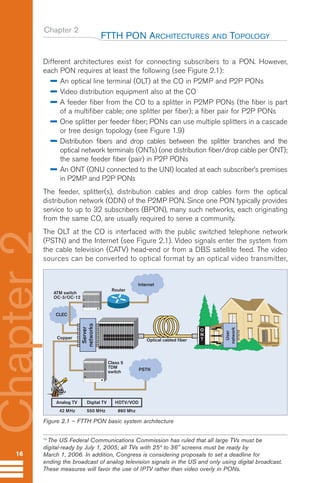
Different architectures exist for connecting subscribers to a PON. However,
each PON requires at least the following (see Figure 2.1):
An optical line terminal (OLT) at the CO in P2MP and P2P PONs
Video distribution equipment also at the CO
A feeder fiber from the CO to a splitter in P2MP PONs (the fiber is part
of a multifiber cable; one splitter per fiber); a fiber pair for P2P PONs
One splitter per feeder fiber; PONs can use multiple splitters in a cascade
or tree design topology (see Figure 1.9)
Distribution fibers and drop cables between the splitter branches and the
optical network terminals (ONTs) (one distribution fiber/drop cable per ONT);
the same feeder fiber (pair) in P2P PONs
An ONT (ONU connected to the UNI) located at each subscriber’s premises
in P2MP and P2P PONs
The feeder, splitter(s), distribution cables and drop cables form the optical
distribution network (ODN) of the P2MP PON. Since one PON typically provides
service to up to 32 subscribers (BPON), many such networks, each originating
from the same CO, are usually required to serve a community.
The OLT at the CO is interfaced with the public switched telephone network
(PSTN) and the Internet (see Figure 2.1). Video signals enter the system from
the cable television (CATV) head-end or from a DBS satellite feed. The video
sources can be converted to optical format by an optical video transmitter,
FTTH PON ARCHITECTURES AND TOPOLOGY
16
Chapter
2
CLEC
ATM switch
OC-3/OC-12
Class 5
TDM
switch
O
N
T
User
network
Server
networks
Router
Copper
Analog TV
Internet
PSTN
Optical cabled fiber
Digital TV HDTV/VOD
42 MHz 550 MHz 860 Mhz
Figure 2.1 – FTTH PON basic system architecture
10
The US Federal Communications Commission has ruled that all large TVs must be
digital-ready by July 1, 2005; all TVs with 25“ to 36” screens must be ready by
March 1, 2006. In addition, Congress is considering proposals to set a deadline for
ending the broadcast of analog television signals in the US and only using digital broadcast.
These measures will favor the use of IPTV rather than video overly in PONs.
Guide FTTH-p1-68:Layout 1 09/06/10 09:13 Page 16
Chapter 2
amplified and coupled
through a wide wave-
length-division multi-
plexing (WWDM) cou-
pler (not shown in
Figure 2.1) to the opti-
cal signal from the OLT.
Alternatively, the video
signals can be inter-
faced with the OLT in
digital form for IPTV10
or
in analog form for over-
lay. These signals are
transmitted downstream
along the same optical
fiber. Voice and data can
be transmitted upstream
from the ONTs11
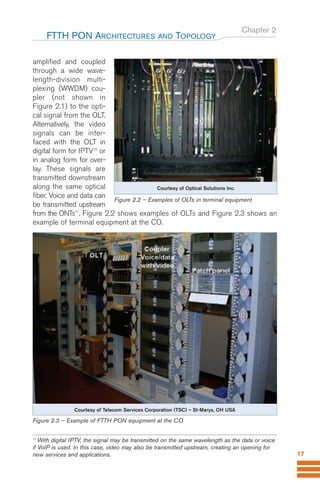
. Figure 2.2 shows examples of OLTs and Figure 2.3 shows an
example of terminal equipment at the CO.
FTTH PON ARCHITECTURES AND TOPOLOGY
17
Courtesy of Telecom Services Corporation (TSC) – St-Marys, OH USA
Figure 2.3 – Example of FTTH PON equipment at the CO
Figure 2.2 – Examples of OLTs in terminal equipment
Courtesy of Optical Solutions Inc.
11
With digital IPTV, the signal may be transmitted on the same wavelength as the data or voice
if VoIP is used. In this case, video may also be transmitted upstream, creating an opening for
new services and applications.
Guide FTTH-p1-68:Layout 1 09/06/10 09:13 Page 17
Chapter 2
The feeder fiber from the CO is
brought to a fiber distribution hub
(FDH), where one or more splitters
are located; typically, near a group of
customers (a km or so). From that
point, one or more passive splitters
(depending on the splitter topology)
are used to connect customers. Each
customer premises is provided with
an ONT (see Figure 2.4) connected
to one splitter branch. The ONT
provides connections for the different
services (voice, Ethernet, and video).
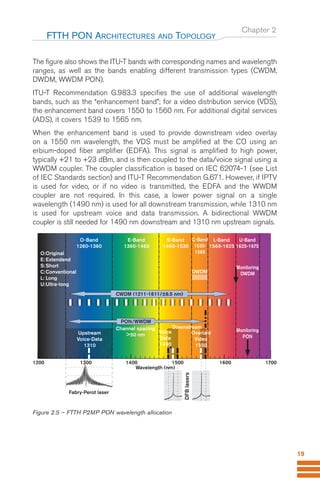
Figure 2.5 illustrates the P2MP PON
wavelength allocation based on ITU-T
Recommendation G.983.3 (BPON). The OLT provides voice and data
downstream transmission using a 1490 nm wavelength band, while the ONT
provides voice and data upstream transmission on a 1310 nm wavelength band.
Analog video overlay is also possible using the 1550 nm band. This use of wide
wavelength-division multiplexing (WWDM) allows non-interfering bidirectional
transmission over the same fiber.
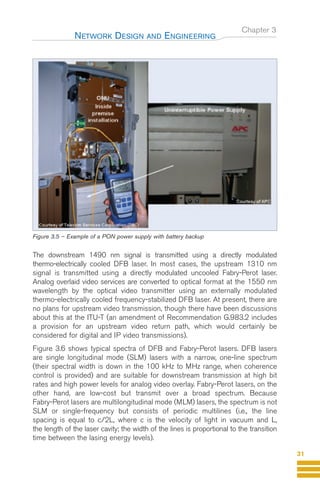
Figure 2.6 shows the types of lasers used for upstream and downstream
transmission. A cooled directly modulated, narrow-spectrum distributed-
feedback (DFB) laser is used for downstream voice and data transmission
from the CO, whereas a low-cost uncooled directly modulated multifrequency
Fabry-Perot (FP) laser is used in the ONTs for upstream voice and data
transmission. The analog overlaid video is transported by a cooled externally
modulated DFB laser.
FTTH PON ARCHITECTURES AND TOPOLOGY
18
Chapter
2
Figure 2.4 – Example of FTTH PON ONT
Courtesy of Optical Solutions
Guide FTTH-p1-68:Layout 1 09/06/10 09:13 Page 18
Chapter 2
The figure also shows the ITU-T bands with corresponding names and wavelength
ranges, as well as the bands enabling different transmission types (CWDM,
DWDM, WWDM PON).
ITU-T Recommendation G.983.3 specifies the use of additional wavelength
bands, such as the “enhancement band”; for a video distribution service (VDS),
the enhancement band covers 1550 to 1560 nm. For additional digital services
(ADS), it covers 1539 to 1565 nm.
When the enhancement band is used to provide downstream video overlay
on a 1550 nm wavelength, the VDS must be amplified at the CO using an
erbium-doped fiber amplifier (EDFA). This signal is amplified to high power,
typically +21 to +23 dBm, and is then coupled to the data/voice signal using a
WWDM coupler. The coupler classification is based on IEC 62074-1 (see List
of IEC Standards section) and ITU-T Recommendation G.671. However, if IPTV
is used for video, or if no video is transmitted, the EDFA and the WWDM
coupler are not required. In this case, a lower power signal on a single
wavelength (1490 nm) is used for all downstream transmission, while 1310 nm
is used for upstream voice and data transmission. A bidirectional WWDM
coupler is still needed for 1490 nm downstream and 1310 nm upstream signals.
FTTH PON ARCHITECTURES AND TOPOLOGY
19
O:Original
E: Extendend
S:Short
C:Conventional
L: Long
U:Ultra-long
O-Band
1260-1360
E-Band
1360-1460
S-Band
1460-1530
Fabry-Perot laser
Wavelength (nm)
1200 1300 1400 1500 1600 1700
Monitoring
PON
DWDM
Monitoring
DWDM
L-Band
1565-1625
U-Band
1625-1675
C-Band
1530-
1565
Channel spacing
50 nm
<
PON/WWDM
CWDM (1211-1611/±6.5 nm)
DFB
lasers
Upstream
Voice-Data
1310
Downstream
Voice
Data
1490
Overlaid
Video
1550
Figure 2.5 – FTTH P2MP PON wavelength allocation
Guide FTTH-p1-68:Layout 1 09/06/10 09:13 Page 19
Chapter 2
FTTH PON ARCHITECTURES AND TOPOLOGY
20
Chapter
2
Guide FTTH-p1-68:Layout 1 09/06/10 09:13 Page 20
NETWORK DESIGN AND ENGINEERING
Chapter
3
Guide FTTH-p1-68:Layout 1 09/06/10 09:13 Page 21
Chapter 3
This chapter examines the detailed architecture used in FTTH PONs; namely,
the design and engineering of a PON, including a detailed description of the
various components and protocols used.
3.1 PON Technology
At the CO, the public switched telephone network (PSTN) and Internet services
are interfaced with the optical distribution network (ODN) via the OLT. In a P2MP
PON, the downstream 1490 nm wavelength and upstream 1310 nm wavelength
are used to transmit data and voice. The downstream 1550 nm wavelength can
be used for analog video overlay. Multiple ONTs are connected to each PON
through one or more splitters. In a P2P system, the voice and data are transmitted
on the same 1310 nm wavelength downstream and upstream because it uses a
fiber pair; one fiber downstream and another one upstream. For analog overlay
video, 1550 nm is still used in the same configuration as for P2MP.
Figure 3.1 shows a detailed view of the main components of a PON, and
Figure 3.2 shows an example of the physical-layer P2MP FTTH PON topology.
NETWORK DESIGN AND ENGINEERING
22
Chapter
3
EDFA
1310 nm Rx
Service
interface
1550 nm Tx
Voice/Data
Video
1550 nm Rx
Video
OLT
Central office
Premise
ONT
1310 nm Tx
WWDM
coupler
Fiber
management
system
Fiber
management
system
Service
interface
1310 nm Tx
Voice/Data
1310 nm Rx
WWDM
Coupler
Fiber pair
EDFA
Service
interface
1550 nm Tx
Voice/Data
Video
1490 nm Tx
WWDM
coupler
OLT
ONT
Fiber management
system
Central office
Premise
Single fiber
1550 nm Rx
Video
1310 nm Tx
Voice/Data
1490 nm Rx
Service
interface
WWDM
coupler
Splitter
Fiber distribution
hub
Drop
(a) P2P
(b) P2MP PON
1310 nm Rx
WWDM
coupler
WWDM
coupler
Figure 3.1 – Main PON components – basic system architecture [Pv1_37]
Guide FTTH-p1-68:Layout 1 09/06/10 09:13 Page 22
Chapter 3
NETWORK DESIGN AND ENGINEERING
23
(a) P2P PON
(b) P2MP PON
Central office
Drop
cables
Feeder cable
Distribution cable
Drop
Drop
Drop cables
Distribution
hub
Distribution hub
Distribution cable
OLT’s
ONT
ONT
ONT
ONT
ONT
ONT
ONT
Drop
cables
Feeder cable
Distribution cable
Distribution cable
Drop
Drop
Drop cables
Distribution
hub
Distribution hub
ONT
ONT
ONT
ONT
ONT
ONT
ONT
Central office
OLT’s
Figure 3.2 –Physical-layer PON topology
Guide FTTH-p1-68:Layout 1 09/06/10 09:13 Page 23
Chapter 3
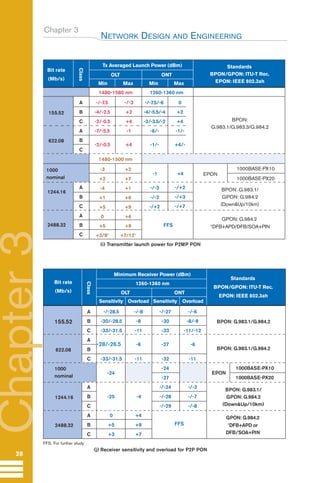
There are different types of PONs currently being deployed, each based on
different technologies and standards. For P2P PONs, standards specify
transmitting different types of services (voice and data) on the same
wavelength over a fiber pair, whereas for P2MP PONs, two wavelengths with
channel spacing wider than 50 nm (i.e., WWDM) are used to transmit the
services over a single fiber. In both cases, this applies to upstream and
downstream transmission. Also, any existing video signal is transported over
a different wavelength (1550 nm), currently in an overlaid analog format.
One of the most mature and currently used PON systems is broadband PON
(BPON), based on the ITU-T G.983 series of recommendations. BPON uses
ATM as the transport protocol (see Table 3.1) with symmetric and asymmetric
data rate combinations of 155.52 and 622.08 Mb/s. Later, 1244.16 Mb/s
was also added, but for asymmetric downstream transmission only. BPON
transparently transports any type of data, regardless of the type of data link frame.
Another system that was added on after BPON is Gigabit-capable PON
(GPON). GPON is based on the ITU T G.984 series of recommendations.
It provides a great deal of flexibility, transporting any type of data using ATM
and/or GPON encapsulation method (GEM), which encapsulates different
types of data. GPON provides several possible combinations of upstream
and downstream data rates (up to 2488.32 Mb/s downstream) and may use
forward error correction (FEC), if required.
Ethernet PON (EPON), on the other hand, is based on the IEEE 802.3ah-2004
specification developed by the Ethernet in the First Mile Alliance (EFMA)
community12
. EPON is designed for simplicity and allows packet-based
transmission upstream and downstream at a symmetric rate of 1250 Mb/s
(1000 Mb/s nominal) with optional FEC. The multipoint media access control
(MAC) protocol (MPCP) in EPON controls access to a P2MP architecture
(1000BASE-PX10 for up to 10 km reach, and 1000BASE-PX20 for up to
20 km), making the P2MP network appear to the higher protocol layers as a
collection of P2P links (P2P link emultion).
FEC is used by the transport layer in communication systems and is based on
transmitting data in an encoded format (block-based code). The most common
code uses the Reed-Solomon format, and is 255 bytes long. It introduces redun-
dancy (adds an extra 16 redundant overhead bits at the end of a constant-size
block of 239 data bytes), allowing the decoder to detect and correct transmission
errors (BER from 10-4
– the worst case – to an improved 10-15
). FEC can be used
with GPON and EPON using Fabry-Perot lasers, especially to reduce system
penalty due to the mode partitioning noise (MPN) typical of that laser and,
consequently, to increase the maximum reach (maximum distance between the
OLT and the ONTs) and/or the split ratio using the same transceiver equipment
(but at the expense of some loss of capacity, as it introduces extra overhead).
NETWORK DESIGN AND ENGINEERING
24
Chapter
3
12
www.efma.org
Guide FTTH-p1-68:Layout 1 09/06/10 09:13 Page 24
Chapter 3
For all three types of PONs, downstream voice/data transmission is performed
over a continuous bit stream. Upstream transmission, from one ONT at a time,
is performed either over a delayed or burst bit stream, as shown in Table 3.1.
Table 3.1 – PON requirement characteristics
NETWORK DESIGN AND ENGINEERING
25
Bit
Stream
Protocol/
Modes
X
X
X
X
ATM
Ethernet
802.3
MPCP
(FEC
optional)
BPON : ITU -T Rec. G.983 .x
GPON : ITU -T Rec. G.984 .x
EPON : IEEE802.3ah -2004
Burst
Delayed
Continuous
Down
Traffic
Direction BPON GPON EPON
Standards
Recommendations
Up
ATM
GEM
Dual
ATM
GEM
155.52
622.08
1244.16
2488.32
1000 nominal
Bit Rates
(Mb/s)
In ITU-T
Rec. G.983.1
In ITU-T
G.984.2
In IEEE802.3ah
Down
Traffic
Direction BPON GPON EPON
Up
155.52
155.52
622.08
155.52
622.08
1244.16
622.08
1244.16
1244.16
2488.32
2488.32
2488.32
Logical/
Maximum
Physical
Distance
(km)
GPON: G.984.2
EPON: IEEE802.3ah
1000BASE-PX10
EPON: IEEE802.3ah
1000BASE-PX20
BPON: G.983.1
FFS: For further study
GPON: Maximum LOLT-LastONU
= 60 km
Maximum LOLT-LastONU
= 20 km
GPON: G.984.2
Standards
Recommendations
Notes
BPON GPON EPON
10
10
Fabry-Perot laser
1244.6+ Mb/s
Different fiber
types / FFS
20
60/20
20
(a) Bit stream and protocol
(b) Bit rates
(c) Maximum reach
Guide FTTH-p1-68:Layout 1 09/06/10 09:13 Page 25
Chapter 3
NETWORK DESIGN AND ENGINEERING
26
Chapter
3
100BASE-PX10
100BASE-PX20
IEEE802.3ah
ITU-T G.983.1
ITU-T G.984.2
Standards
Recommendations
Notes
Split Ratio
BPON GPON EPON
16/321 1
with FEC
16/32/64
16/32
16
I
ITU-T Rec. G.652A/C; Rec. G.982
Standards
Recommendations
Type/Specifications
Fiber
IEC 60793-2 Optical Fibers
- Part 2-50: Product specifications
- Sectional specification for class B
single-mode fibers
IEC 60793-2-50 Type B1.1 Dispersion
un-shifted single-mode fiber
IEC 60793-2-50 Type B1.3 Dispersion
un-shifted low-water peak single-mode fiber
W
Wavelength Bands
Tx-Rx Types
BPON GPON EPON
1550-Enhancement band/ADS
Downstream/TBS
TBS/FFU
Downstream/TBS
Downstream/TBS
1260-1360 nm1
Tx
Rx
1360-1480 nm
Tx/Rx
1480-1500 nm
Tx
Rx
1480-1580 nm
Tx/Rx
1539-1565 nm
Tx/Rx
1550-1560 nm
Tx
Rx
L-band
Tx/Rx
Upstream
FP DMU
PIN
1550-Basic band
Downstream: DFB DMC (10km/GPON/EPON = FP DMU)
PIN (APD = GPON 2.5G/EPON 20km)
1550-Enhancement band/VDS
DFB EMC
APD
Intermediate band/FFU
Downstream/TBS
1
The wavelength is also used
downstream in P2P PON
ADS: Additional digital services
APD: Avalanche photodiode
DFB: Distributed feedback
DMC: Directly modulated, cooled
DMU: Directly modulated, uncooled
EMC: Externally modulated, cooled
FFU: For future use
FP: Fabry-Perot
Rx: Receiver
Tx: Transmitter
TBS: To be specified
VDS: Video distribution service
(d) P2MP split ratio
(e) Fiber
(f) Wavelength Bands
Guide FTTH-p1-68:Layout 1 09/06/10 09:13 Page 26
Chapter 3
NETWORK DESIGN AND ENGINEERING
27
Min/Max
Class
Class
ITU-T
G.983.1
G.9821
G.983.3
G.984.2
BPON GPON
Link ORL
Link
attenuation2
PX10 PX20
EPON
Specifications
(dB)
32
5/20
10/25
15/30
A
B
C
IEEE 802.3ah-2004
1000BASE-
20/15
5/19.5D;20U
10/23.5D;24U
C
Class
Bit rate
(Mb/s)
155.52
622.08
1244.16
2488.32
1000
nominal
Tx Averaged Launch Power (dBm)
OLT
Min Max Min Max
ONT
1260-1360 nm
Standards
BPON/GPON: ITU-T Rec.
EPON: IEEE 802.3ah
BPON/GPON:
G.983.1/G.984.2
EPON
1000BASE-PX10
1000BASE-PX20
BPON: G.983.1/
GPON: G.984.2
(Down&Up/10km)
GPON: G.984.2
1
DFB+APD/DFB/SOA+PIN
-
-4/-
-2/-
-7/-
-3
+2
-4
+1
+5
0
+5
+3/+81
-2/-
-
+1/-
+3/-
-2/-
+2
+7
+1
+6
+9
+4
+9
+7/121
+3/-
-/-6
-4
-2
-6
-/-3
-/-2
-/+2
-1
-1
-/-1
+1
+3
-1
-/+2
-/+3
-/+7
+4
+4
FFS
A
B
C
A
B
C
A
B
C
A
B
C
1
ITU-T Rec. G.982, “Optical access networks to support services up to the ISDN primary rate
or equivalent bit rates” (11/96)
2
IEEE uses channel loss instead of link attenuation in ITU-T
(g) Link optical return loss and attenuation
(h) Transmitter launch power for P2P PON
Guide FTTH-p1-68:Layout 1 09/06/10 09:13 Page 27
Chapter 3
NETWORK DESIGN AND ENGINEERING
28
Chapter
3
Class
155.52
622.08
1000
nominal
1244.16
2488.32
Tx Averaged Launch Power (dBm)
OLT
1480-1580 nm
1480-1500 nm
1260-1360 nm
Min Max Min Max
ONT
Standards
BPON/GPON: ITU-T Rec.
EPON: IEEE 802.3ah
BPON:
G.983.1/G.983.3/G.984.2
BPON: G.983.1/
GPON: G.984.2
(Down&Up/10km)
EPON
1000BASE-PX10
1000BASE-PX20
GPON: G.984.2
1
DFB+APD/DFB/SOA+PIN
-/-7.5
-4/-2.5
-2/-0.5
-7/-5.5
-3
+2
-4
+1
+5
0
+5
+3/81
+2
+7
+1
+6
+9
+4
+9
+7/121
-2/-0.5
-/-3
+2
+4
-1
+4
0
+2
+4
-1/-
-/+2
-/+3
-/+7
+4/-
-/-7.5/-6
-4/-5.5/-4
-2/-3.5/-2
-6/-
-/-3
-/-2
-/+2
-1/-
-1
FFS
+4
A
B
C
A
B
C
A
B
C
A
B
C
Bit rate
(Mb/s)
(i) Transmitter launch power for P2MP PON
Class
Bit rate
(Mb/s)
155.52
622.08
1244.16
2488.32
1000
nominal
Minimum Receiver Power (dBm)
OLT
Sensitivity Overload Sensitivity Overload
ONT
1260-1360 nm
Standards
BPON/GPON: ITU-T Rec.
EPON: IEEE 802.3ah
BPON: G.983.1/G.984.2
EPON
1000BASE-PX10
1000BASE-PX20
BPON: G.983.1/
GPON: G.984.2
(Down&Up/10km)
GPON: G.984.2
1
DFB+APD or
DFB/SOA+PIN
-/-28.5
-30/-28.5
-33/-31.5
-33/-31.5
0
+5
+3
-/-8
-8
-11
-11
+4
+9
+7
-/-27
-30
-33
-32
-24
-27
-/-24
-/-28
-/-29
-/-6
-8/-9
-11/-12
-11
-/-3
-/-7
-/-8
-28/-26.5 -6 -6
-27
-24
-25 -4
FFS
A
B
C
A
B
C
A
B
C
A
B
C
(j) Receiver sensitivity and overload for P2P PON
FFS: For further study
Guide FTTH-p1-68:Layout 1 09/06/10 09:13 Page 28
Chapter 3
NETWORK DESIGN AND ENGINEERING
29
Class
Bit rate
(Mb/s)
155.52
622.08
1244.16
2488.32
1000
nominal
Minimum Receiver Power (dBm)
OLT(1480-1500 nm)
Sensitivity Overload Sensitivity Overload
ONT(1480-1500 nm)
Standards
BPON/GPON: ITU-T Rec.
EPON: IEEE 802.3ah
B-PON: G.983.1/G.984.3
B-PON: G.983.1/G.983.3
EPON
1000BASE-PX10
1000BASE-PX20
B-PON: G.983.1/
G-PON: G.984.2
(Down&Up/10km)
G-PON: G.984.2
1
DFB+APD or
DFB/SOA+PIN
-/-28.5
-30/-28.5
-33/-31.5
-33/-31.5
0
+5
+3
-/-8
-8/-8
-11/-11
-11/-11
+4
+9
+71
-/-28.5
-30/-31.5
-33/-34.5
-32
-24
-27
-/-5
-8/-8
-11/-11
-11
-28/-26.5 -6/-6 -6
-27
-24
-25/-25
-26/-26
-4/-4
FFS
A
B
C
A
B
C
A
B
C
A
B
C
(k) Receiver sensitivity and overload for P2MP PON
FFS: For further study
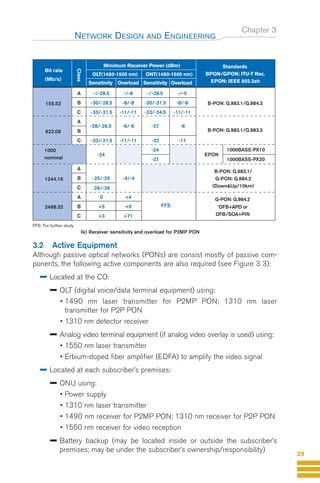
3.2 Active Equipment
Although passive optical networks (PONs) are consist mostly of passive com-
ponents, the following active components are also required (see Figure 3 3):
Located at the CO:
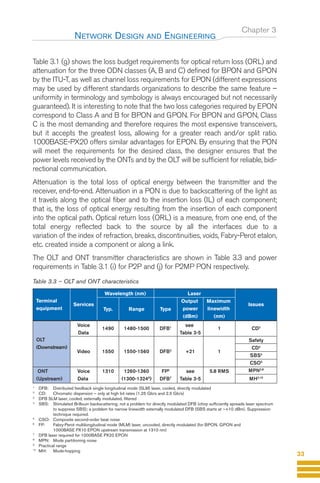
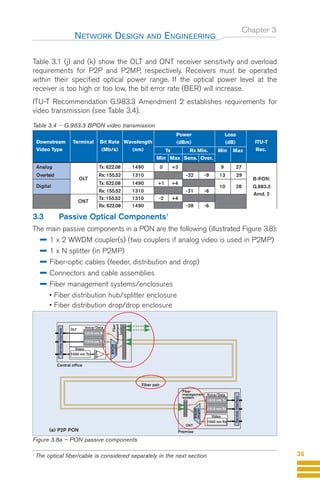
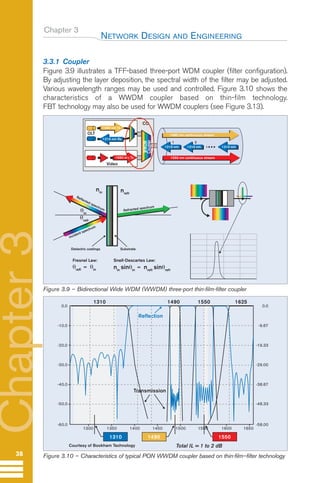
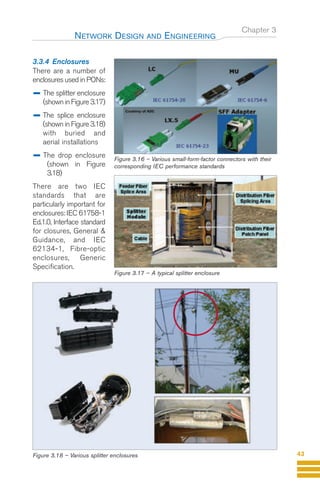
OLT (digital voice/data terminal equipment) using:
• 1490 nm laser transmitter for P2MP PON; 1310 nm laser
transmitter for P2P PON
• 1310 nm detector receiver
Analog video terminal equipment (if analog video overlay is used) using:
• 1550 nm laser transmitter
• Erbium-doped fiber amplifier (EDFA) to amplify the video signal
Located at each subscriber’s premises:
ONU using:
• Power supply
• 1310 nm laser transmitter
• 1490 nm receiver for P2MP PON; 1310 nm receiver for P2P PON
• 1550 nm receiver for video reception
Battery backup (may be located inside or outside the subscriber’s
premises; may be under the subscriber’s ownership/responsibility)
Guide FTTH-p1-68:Layout 1 09/06/10 09:13 Page 29
Chapter 3
The drop fiber is brought to the ONT and the services are delivered inside the
premises using conventional copper cabling, as shown in Figure 3.4. Figure 3.5
shows an example of an ONT whose power supply contains battery back-up.
NETWORK DESIGN AND ENGINEERING
30
Chapter
3
EDFA
1310 nm Rx
Service
interface
1550 nm Tx
Voice/Data
Video
1490 nm Tx
WWDM
coupler
OLT
Fiber management
system
Central office
ONT
Premise
1550 nm Rx
Video
1310 nm Tx
Voice/Data
1490 nm Rx
Service
interface
WWDM
coupler
Power battery
back-up
EDFA
1310 nm Rx
Service
interface
1550 nm Tx
Voice/Data
Video
OLT
Central office
1310 nm Tx
WWDM
coupler
Fiber
management
system
1550 nm Tx
Video
Power battery
back-up
Premise
(a) P2P PON
(b) P2MP PON
ONT
Fiber
management
system
Service
interface
1310 nm Tx
Voice/Data
1310 nm Rx
WWDM
coupler
Figure 3.3 – PON active equipment for both P2P (a) and P2MP (b)
Figure 3.4 – Example of a PON ONT
Guide FTTH-p1-68:Layout 1 09/06/10 09:13 Page 30
Chapter 3
The downstream 1490 nm signal is transmitted using a directly modulated
thermo-electrically cooled DFB laser. In most cases, the upstream 1310 nm
signal is transmitted using a directly modulated uncooled Fabry-Perot laser.
Analog overlaid video services are converted to optical format at the 1550 nm
wavelength by the optical video transmitter using an externally modulated
thermo-electrically cooled frequency-stabilized DFB laser. At present, there are
no plans for upstream video transmission, though there have been discussions
about this at the ITU-T (an amendment of Recommendation G.983.2 includes
a provision for an upstream video return path, which would certainly be
considered for digital and IP video transmissions).
Figure 3.6 shows typical spectra of DFB and Fabry-Perot lasers. DFB lasers
are single longitudinal mode (SLM) lasers with a narrow, one-line spectrum
(their spectral width is down in the 100 kHz to MHz range, when coherence
control is provided) and are suitable for downstream transmission at high bit
rates and high power levels for analog video overlay. Fabry-Perot lasers, on the
other hand, are low-cost but transmit over a broad spectrum. Because
Fabry-Perot lasers are multilongitudinal mode (MLM) lasers, the spectrum is not
SLM or single-frequency but consists of periodic multilines (i.e., the line
spacing is equal to c/2L, where c is the velocity of light in vacuum and L,
the length of the laser cavity; the width of the lines is proportional to the transition
time between the lasing energy levels).
NETWORK DESIGN AND ENGINEERING
31
Figure 3.5 – Example of a PON power supply with battery backup
Guide FTTH-p1-68:Layout 1 09/06/10 09:13 Page 31
Chapter 3
NETWORK DESIGN AND ENGINEERING
32
Chapter
3
dBm
0.00
-20.00
-40.00
-60.00
-80.00
1540.000 1560.000 1580.000 16000.000 nm
Figure 3.6 – Examples of wavelength spectra of the lasers used in FTTH PONs
dBm
0.00
-20.00
-40.00
-60.00
-80.00
1260.000 1280.000 1300.000 1320.000 1340.000 nm
(a) DFB laser
(b) Fabry-Perot laser
Voice/Data
DFB
Video
DFB
Mid High
Yes
Voice/Data
Fabry-Perot
Downstream Upstream
Center Wavelength/Frequency
Spectral Width
Frequency stability/Temperature control
Output power stability control
Reliability
Environmental category
Cost
Tight
Narrow
Yes
High
Controlled
Loose
Wide
No
Critical
Outside plant
Uncontrolled
Low
EPON 1000BASE-PX20 will use a DFB laser for upstream transmission
Table 3.2 – Critical transmitter issues
Table 3.2 shows some of the critical issues concerning the downstream and
upstream laser transmitters.
3.2.1 OLT and ONT
Because the downstream power is divided among the ONTs by the splitter,
FTTH P2MP PONs have considerable optical loss. In order to ensure that each
branch of the P2MP PON will operate correctly and meet all specifications, the
network designer must establish an optical loss budget. The loss budget specifies
the minimum and maximum amount of loss (margin) that can be tolerated in the
PON between the OLT and any ONT (the same case applies to P2P PON).
Guide FTTH-p1-68:Layout 1 09/06/10 09:13 Page 32
Chapter 3
Table 3.1 (g) shows the loss budget requirements for optical return loss (ORL) and
attenuation for the three ODN classes (A, B and C) defined for BPON and GPON
by the ITU-T, as well as channel loss requirements for EPON (different expressions
may be used by different standards organizations to describe the same feature –
uniformity in terminology and symbology is always encouraged but not necessarily
guaranteed). It is interesting to note that the two loss categories required by EPON
correspond to Class A and B for BPON and GPON. For BPON and GPON, Class
C is the most demanding and therefore requires the most expensive transceivers,
but it accepts the greatest loss, allowing for a greater reach and/or split ratio.
1000BASE-PX20 offers similar advantages for EPON. By ensuring that the PON
will meet the requirements for the desired class, the designer ensures that the
power levels received by the ONTs and by the OLT will be sufficient for reliable, bidi-
rectional communication.
Attenuation is the total loss of optical energy between the transmitter and the
receiver, end-to-end. Attenuation in a PON is due to backscattering of the light as
it travels along the optical fiber and to the insertion loss (IL) of each component;
that is, the loss of optical energy resulting from the insertion of each component
into the optical path. Optical return loss (ORL) is a measure, from one end, of the
total energy reflected back to the source by all the interfaces due to a
variation of the index of refraction, breaks, discontinuities, voids, Fabry-Perot etalon,
etc. created inside a component or along a link.
The OLT and ONT transmitter characteristics are shown in Table 3.3 and power
requirements in Table 3.1 (i) for P2P and (j) for P2MP PON respectively.
Table 3.3 – OLT and ONT characteristics
NETWORK DESIGN AND ENGINEERING
33
1
DFB: Distributed feedback single longitudinal mode (SLM) laser, cooled, directly modulated
2
CD: Chromatic dispersion – only at high bit rates (1.25 Gb/s and 2.5 Gb/s)
3
DFB SLM laser, cooled, externally modulated, filtered
4
SBS: Stimulated Brillouin backscattering; not a problem for directly modulated DFB (chirp sufficiently spreads laser spectrum
to suppress SBS); a problem for narrow linewidth externally modulated DFB (SBS starts at ~+10 dBm). Suppression
technique required.
5
CSO: Composite second-order beat noise
6
FP: Fabry-Perot multilongitudinal mode (MLM) laser, uncooled, directly modulated (for BPON, GPON and
1000BASE PX10 EPON upstream transmission at 1310 nm)
7
DFB laser required for 1000BASE PX20 EPON
8
MPN: Mode partitioning noise
9
Practical range
10
MH: Mode-hopping
Terminal
Services
Wavelength (nm) Laser
Issues
equipment Typ. Range Type
Output Maximum
power linewidth
(dBm) (nm)
OLT
Voice see
(Downstream)
Data
1490 1480-1500 DFB1
Table 3-5
1 CD2
Safety
Video 1550 1550-1560 DFB3
+21 1
CD2
SBS4
CSO5
ONT Voice 1310 1260-1360 FP6
see 5.8 RMS MPN2,8
(Upstream) Data (1300-13249
) DFB7
Table 3-5 MH2,10
Guide FTTH-p1-68:Layout 1 09/06/10 09:13 Page 33
Chapter 3
The OLT and ONT lasers consist of DFB and FP lasers, both of which are
semiconductor lasers (called diode lasers or laser diodes). The difference
between the two types is essentially related to the DFB design, in which a grating
is inscribed in the semiconductor in order to select only one mode from the lasing
process (typically, in a FP laser if no grating is used, mode-hopping occurs).
Figure illustrates the lasing mechanisms from the spontaneous emission to the
stimulated emission. The figures below also show the typical single transverse
mode that is spatially generated from the laser cavity.
NETWORK DESIGN AND ENGINEERING
34
Chapter
3
SDL regime
stimulated emission
Popt
Popt
= Constant • (I-Ith
)
Ithreshold
Current I
Wavelength
Laser spectra
LED regime
spontaneous
emission
1280.000 1290.000 1300.000 1310.000 nm
Popt
Current I
Direct
modulation
input
Output
Digital
modulation
Analog
modulation
Optical
output
(hv)
(hv)
Lasing by stimulated emission
p p n
Electrode
Electrode -
E2
Production of photons by spontaneous emission
Distance
Index
of
refraction
(IOR)
Electric Field
Spatial Profile
Mode Field
+
Injection
electrons
Holes
E1
(a) Photon generation
(b) Spectrum generation
(c) Lasing mechanism and direct modulation process
Figure 3.7 – Lasing mechanism in a semiconductor
Guide FTTH-p1-68:Layout 1 09/06/10 09:13 Page 34
1
The optical fiber/cable is considered separately in the next section
Chapter 3
Table 3.1 (j) and (k) show the OLT and ONT receiver sensitivity and overload
requirements for P2P and P2MP, respectively. Receivers must be operated
within their specified optical power range. If the optical power level at the
receiver is too high or too low, the bit error rate (BER) will increase.
ITU-T Recommendation G.983.3 Amendment 2 establishes requirements for
video transmission (see Table 3.4).
Table 3.4 -- G.983.3 BPON video transmission
3.3 Passive Optical Components1
The main passive components in a PON are the following (illustrated Figure 3.8):
1 x 2 WWDM coupler(s) (two couplers if analog video is used in P2MP)
1 x N splitter (in P2MP)
Fiber-optic cables (feeder, distribution and drop)
Connectors and cable assemblies
Fiber management systems/enclosures
• Fiber distribution hub/splitter enclosure
• Fiber distribution drop/drop enclosure
NETWORK DESIGN AND ENGINEERING
35
Downstream Terminal Bit Rate Wavelength
Power Loss
ITU-T
Video Type (Mb/s) (nm)
(dBm) (dB)
Rec.
Tx Rx Min. Min Max
Min Max Sens. Over.
Analog
OLT
Tx: 622.08 1490 0 +3 9 27
Overlaid Rx: 155.52 1310 -32 -9 13 29
Digital
Tx: 622.08 1490 +1 +4
10 28
B-PON:
Rx: 155.52 1310 -31 -6
G.983.3
ONT
Tx: 155.52 1310 -2 +4
Amd. 2
Rx: 622.08 1490 -28 -6
EDFA
1310 nm Rx
Service
interface
1550 nm Tx
Voice/Data
Video
1550 nm Rx
Video
OLT
Central office
Premise
ONT
1310 nm Tx
WWDM
coupler
Fiber
management
system
Fiber
management
system
Service
interface
1310 nm Tx
Voice/Data
1310 nm Rx
WWDM
coupler
Fiber pair
(a) P2P PON
Figure 3.8a – PON passive components
Guide FTTH-p1-68:Layout 1 09/06/10 09:13 Page 35
Chapter 3
The two most critical passive optical components in the FTTH P2MP PON are
the WWDM coupler(s) and the splitter.
The 1 x 2 WWDM coupler used in a P2MP PON is bidirectional and typically
exhibits an insertion loss (IL) of 0.7 to 1.0 dB. This component is used in a controlled
environment inside the CO and in an uncontrolled environment inside the ONU.
At the CO, the coupler has high input power at 1550 nm (the one after the
EDFA can be subject to +21 dBm at its input).
The functions of the WWDM coupler are the following:
Couples the high power video signal with the OLT voice/data signal for
downstream transmission at the CO
• 1550 nm and 1310 nm in P2P on one of the two fibers
• 1550 nm and 1310 nm/1490 nm in P2MP on the single fiber
Couples the video signal with voice/data signal in the ONT
• 1550 nm and 1310 nm in P2P on the same fiber above from the CO
• 1550 nm and 1310 nm/1490 nm in P2MP
Couples the voice/data signal for downstream and upstream transmissions
• Not necessary in P2P
• 1310 nm and 1490 nm in P2MP
Transmits the upstream voice/data signal to the receiver in the OLT
Used in an uncontrolled outside plant environment (enclosure protected), the
splitter in a P2MP PON is typically a bidirectional, broadband component with
high loss (up to 18 dB for 1:32 split ratio) and average input power at 1550 nm
and 1310 nm (could be high power at 1550 nm if close to CO).
The 1 x N splitter functions (only in P2MP) are the following:
NETWORK DESIGN AND ENGINEERING
36
Chapter
3
EDFA
Service
interface
1550 nm Tx
Voice/Data
Video
1490 nm Tx
WWDM
coupler
OLT
ONT
Fiber management
system
Central office
Premise
Single fiber
1550 nm Rx
Video
1310 nm Tx
Voice/Data
1490 nm Rx
Service
interface
WWDM
coupler
Splitter
Fiber distribution
hub
Drop
1310 nm Rx
WWDM
coupler
WWDM
Coupler
Figure 3.8b – PON passive components
(b) P2MP PON
Guide FTTH-p1-68:Layout 1 09/06/10 09:13 Page 36
Chapter 3
Splits the downstream coupled video and voice/data signals to N
subscriber ONTs
Transmits the upstream voice/data signal from N subscriber ONTs to the OLT
Table 3.5 presents critical performance requirements for both the coupler and the splitter.
Table 3.5 – Examples of PON coupler and splitter technical requirements
Various technologies are available for coupler and splitter designs:
Thin-film filter (TFF)
Gratings
• Bulk diffraction grating (BDG)
• Fiber Bragg grating (FBG)
Fiber-based
• Fused biconic tapered (FBT) fiber
Waveguides based on a planar lightwave circuit (PLC)
These technologies have various advantages and disadvantages as shown in Table 3.6.
Table 3.6 – WWDM coupler and splitter technology comparisons
NETWORK DESIGN AND ENGINEERING
37
Parameters WWDM Coupler Splitter
Coupling/Splitting ratio (as example) 2x1 1x4; 1x8; 1x16; 1x32
Upstream 1260-1360
Wavelength range (nm)
Downstream
1480-15001
1550-1560
Insertion loss (IL) (dB) < 1 < 18 (1x32)
Loss uniformity (dB) < 0.5 < 1.3 (1x32)
ORL (dB) > 55
Directivity (dB) > 55
Polarization dependent loss (PDL) (dB) < 0.2
Packaging As small as possible
Reliability As high as possible at affordable cost
Network support Survivability and protection
Technology Particularities Advantages Disadvantages
Fused biconic
tapered (FBT) Fiber
Grating
Thin-film filter
(TFF)
Planar lightwave
circuit (PLC)
-deposition
-ion-exchange
Bulk Diffraction
Fiber Bragg
Technology known for
years
Semiconductor chip
fabrication technology
Two specialty fibers
fused within a specific
coupling/splitting region
Complex design at large
coupling/splitting ratio
Non-recurring cost during
design phase
Polarization effects for
deposition techniques
Connectivity with fiber for
deposition techniques
Complex design at large
coupling/WDM ratio
Operate by reflection
Complex expensive design
Operate by reflection
Fiber based
Economy of scale
Cost effective at large
coupling/splitting ratio
Cost effective at small
coupling/WDM ratio
Mastered technology
Fiber based
Guide FTTH-p1-68:Layout 1 09/06/10 09:13 Page 37
Chapter 3
3.3.1 Coupler
Figure 3.9 illustrates a TFF-based three-port WDM coupler (filter configuration).
By adjusting the layer deposition, the spectral width of the filter may be adjusted.
Various wavelength ranges may be used and controlled. Figure 3.10 shows the
characteristics of a WWDM coupler based on thin-film technology.
FBT technology may also be used for WWDM couplers (see Figure 3.13).
NETWORK DESIGN AND ENGINEERING
38
Chapter
3
CO
OLT
Video
Fresnel Law:
= θin
θrefl
Snell-Descartes Law:
=
nin
sinθin
nrefr
sinθrefr
1550 nm Tx
1490 nm Tx
1310 nm Rx
WWDM
Coupler
1490 nm continuous stream
1550 nm continuous stream
1310 nm 1310 nm 1310 nm
1 2
nin
Dielectric coatings Substrate
Reflected spectrum Refracted spectrum
Incident spectrum
θin
θrefr
nrefr
Figure 3.9 – Bidirectional Wide WDM (WWDM) three-port thin-film-filter coupler
Total IL = 1 to 2 dB
Transmission
Courtesy of Bookham Technology
0.0
-10.0
-20.0
-30.0
-40.0
-50.0
-60.0
0.0
-9.67
-19.33
-29.00
-38.67
-48.33
-58.00
1300 1350 1400 1450 1500 1550 1600 1650
1310 1490 1550 1625
Reflection
1310 1490 1550
Figure 3.10 – Characteristics of typical PON WWDM coupler based on thin-film–filter technology
Guide FTTH-p1-68:Layout 1 09/06/10 09:13 Page 38
Chapter 3
3.3.2 Splitter
In order for the subscribers to share the available total bandwidth, a bidirectional 1xN
splitter is used in a P2MP PON. Figure 3.11 illustrates a typical splitter configuration.
NETWORK DESIGN AND ENGINEERING
39
1490 nm continuous stream
1550 nm continuous stream
1310 nm 1310 nm 1310 nm
1310 nm
1550 nm 1490 nm
1 2
1
1310 nm
1550 nm 1490 nm 2
1310 nm
1550 nm 1490 nm 32
Up to 32
Fiber
Distribution
Hub
Splitter
Figure 3.11 – Bidirectional 1 x N PON splitter
1 x 32
up
to
32
Figure 3.12 – Examples of various 1 x 32 PON splitter topology
Guide FTTH-p1-68:Layout 1 09/06/10 09:13 Page 39
Chapter 3
The splitter is a bidirectional broadband branching device that has one input
port and multiple output ports. The input (downstream) optical signal is divided
among the output ports, allowing multiple users to share a
single optical fiber and consequently share the available bandwidth of that fiber.
In the upstream direction, optical signals from a number of ONTs are combined
into the single fiber.
Splitters are passive devices because they require no external energy source
other than the incident light beam. They are broadband and only add loss,
mostly due to the fact that they divide the input (downstream) power.
Splitter loss is usually expressed in dB and depends mainly on the number of
output ports (about 3 dB for each 1 x 2 split). It should be noted that, contrary
to what one might expect, the splitter adds approximately the same loss for light
traveling in the upstream direction as it does for downstream direction.
There may be one splitter or several cascaded splitters in an FTTH PON,
depending on the network topology (see Figure 3.12). ITU-T Recommendation
G.983 currently allows split ratios up to 32, while Recommendation G.984
extends this to up to 64 splits. Regardless of the topology, the splitter must
accommodate the allowed optical loss budget (Table 3.1 (g)).
Splitters can be packaged in different shapes and sizes depending on the basic
technology used. The most common types are the planar waveguide (typically
used for high split counts) and the fused biconic tapered (FBT) fiber coupler
(typically used for relatively low split counts). Both types are manufactured for
mounting in closure tray assemblies.
NETWORK DESIGN AND ENGINEERING
40
Chapter
3
Output
Output
Fused
Biconic
Taper
Courtesy of
Corning Cable Systems
β = kn
Input
Input
3
1
2
Figure 3.13 – Splitter design based on fused biconic tapered fiber (2 x N ratio is possible)
Guide FTTH-p1-68:Layout 1 09/06/10 09:13 Page 40
Chapter 3
Figure 3.13 illustrates the FBT fiber technology. The amount of light coupled
varies with the core-to-core proximity (1), the interaction length (2) and phase ß (3).
Table 3.7 shows typical specifications for this type of splitter.
Table 3.7 -- Typical specifications of a fused biconic tapered (FTB) splitter
Figure 3.14 below illustrates
the planar lightwave circuit
(PLC) technology. The
PLC splitter consists of
an optical circuit on a
wafer (Si, for instance)
made using tools and
processes from the semi-
conductor industry. Two
techniques are used:
deposition (such as
chemical vapor deposition)
and ion-exchange. Wafers
offer economy of scale
since multiple components
are fabricated and inter-
connected at once.
However, they are sensi-
tive to polarization effects.
NETWORK DESIGN AND ENGINEERING
41
Parameter
Wavelength (nm)
Bandpass (nm)
ILmax
(dB)
Uniformitymax
(dB)
PDLmax
(dB)
Directivity (dB)
Return Loss (dB)
Tº (ºC) Storage
Operating
1x4
7.7
0.9
0.3
1x8
10.75
1.25
0.5
1x16
14.8
1.7
0.6
1x32
18.5
2.4
0.7
1310/1550
±40
>55
-40 to 85
Courtesy of Gould Fiber Optics
Note: Splitter configuration of 0xN may also b used
for PON redundancy protection
Cladding
Molten
salt bath
Metal
Mask
Core Pattern
Waveguide
front view
Waveguide
back view
Waveguide production
by deposition technique
such as Chemical Vapor
Deposition (CVD)
Waveguide production
by
ion-exchange
Etching
Clading
Substrate
Core
Mask
Surface
channel
Glass
Molten
salt bath
Metal
Mask
Glass
Asymetrical elliptical core
Na+ Ag+
Circular
core
DC
Voltage
Figure 3.14 – Splitter design based on a planar lightwave
circuit (PLC)
Guide FTTH-p1-68:Layout 1 09/06/10 09:13 Page 41
Chapter 3
Table 3.8 illustrates the critical issues of PON passive components.
Table 3.8 – Major optical issues for passive components [Pv1_54]
3.3.3 Connectors
Because of the high-power analog video signal that PONs will carry, the APC
connector was chosen. The APC connector is an angled (8o
) connector
(as shown in Figure 3.15) and as such provides very low reflection (ORL) of
65 dB or better.
Small-form-factor connectors as shown in Figure 3.16 are preferable for PONs.
NETWORK DESIGN AND ENGINEERING
42
Chapter
3
IL: insertion loss
RL: return loss
PDL: polarization dependent loss
APC: angled physical contact/angled polished connector
* +21 to +23 dBm at 1550 nm at Video EDFA output
Issues Coupler Splitter Connectors Closures
IL (bidirectional) very high 1x32
RL (bidirectional) APC
Others
PDL
Group delay +
1310 nm FP laser/high bit rate
ripple
High optical
1550 nm 1550 nm close to CO close to CO
power*
Cleanliness if connectorized
Environment in closure ONT
Negligible
Critical for specified case
Very critical
N/A
Endface
~8º
Ferrule Ferrule Ferrule Ferrule
PC Connector
Reflection
Input
Fiber Fiber Fiber Fiber
APC Connector
Figure 3 15 – Difference between PC and APC connectors
Guide FTTH-p1-68:Layout 1 09/06/10 09:13 Page 42
Chapter 3
3.3.4 Enclosures
There are a number of
enclosures used in PONs:
The splitter enclosure
(shown inFigure 3.17)
The splice enclosure
(shown in Figure 3.18)
with buried and
aerial installations
The drop enclosure
(shown in Figure
3.18)
There are two IEC
standards that are
particularly important for
enclosures: IEC 61758-1
Ed.1.0, Interface standard
for closures, General &
Guidance, and IEC
62134-1, Fibre-optic
enclosures, Generic
Specification.
NETWORK DESIGN AND ENGINEERING
43
Figure 3.16 – Various small-form-factor connectors with their
corresponding IEC performance standards
Figure 3.17 – A typical splitter enclosure
Figure 3.18 – Various splitter enclosures
Guide FTTH-p1-68:Layout 1 09/06/10 09:13 Page 43
Chapter 3
3.4 Fiber and Related Issues
The optical fiber cable is another key component of a PON (P2P and P2MP).
The general critical issues related to a fiber can be divided into two categories,
as follows1:
Optical
• Absorption/attenuation
• Chromatic dispersion and polarization mode dispersion (CD and PMD)
• Non-linear effects
Mechanical
• Bending
• Connection/joint
3.4.1 Optical Issues
The fiber of choice for PONs is the singlemode dispersion unshifted fiber, based
on ITU-T Recommendation G.652 (see Table 3.9) or IEC 60793-2-50 Ed 2.
Figure 3.19 illustrates the typical geometry of this fiber type.
Table 3.9 -- Attenuation characteristics of ITU-T Rec. G.652 singlemode optical fiber (A, B, C
and D Categories) and link
NETWORK DESIGN AND ENGINEERING
44
Chapter
3
Figure 3.19 – Typical geometry of singlemode dispersion unshifted fiber used in PON
Attribute Range
Specifications
A B C D
1260 -1360 nm 0.5 (Link)
1310 nm; Max. 0.5 0.4
1530 -1565 nm 0.275 (Link)
α 1550 nm; Max. 0.4 0.35 0.3
(dB/km) 1565 -1625 nm 0.35 (Link)
1625 nm; Max. 0.4
1310 -1625 nm; Max. 0.4
1383 ± 3 nm; Max.
1310 value
after H2 ageing
≥
Guide FTTH-p1-68:Layout 1 09/06/10 09:13 Page 44
Chapter 3
Figure 3.20 shows the spectral attenuation and chromatic dispersion (CD) of
the G.652 fiber. Two types of fibers are available for PON, depending on
whether or not the 1383 nm water peak is present. It is important to note that
there are no CD and PMD impairments for PONs (CD may be an issue only
when FP lasers are used at very high bit rate).
The table below shows CD and PMD performance parameters required for ITU-T
Recommendation G.652 fiber.
Table 3.10 – Chromatic (CD) and polarization mode (PMD dispersion characteristics of ITU-T
Rec. G.652 singlemode optical fiber (A, B, C and D Categories)
NETWORK DESIGN AND ENGINEERING
45
Wavelength (nm)
Attenuation
α
(dB/km)
Chromatic
dispersion
CD
(ps/nm
•
km
1260
0.1 -10
-5
0
5
10
15
20
25
1.0
10.0
1310 1360 1384 1420 1470 1520 1570 1620 1670
α-1310 ≤ 0.39 dB/km
D0 = 0±3 ps/nm • km
S0 ≈ 0.093 ps/nm2 • km
α-1550 ≤ 0.25 dB/km
D1550 ≈ 17 ps/nm • km
S1550 ≈ 0.056 ps/nm2 • km
α-1310 ≤ 0.39
D0 = 0±3 ps
S0 ≈ 0.093 p
1260 - 1360 nm
1480 - 1500 nm
1550 - 1560 nm
G.652.C/.D
G.652.A/.B
α
D
S
Figure 3.20 – Typical chromatic dispersion and spectral attenuation of FTTH PON fiber
Attribute Parameter Specifications
A B C D
0.5 0.2 0.5 0.2
λ0min
(nm)
λ0max
(nm)
S0min
(ps/nm2 • km)
D (ps/nm • km)
S (ps/nm2 • km)
Nob. of cables, M
Q(%)
Max PMDQ
(ps/√km)
1300
1324
0.093
+17 (1550)
0.056 (1550)
20
0.01
CD
Cabled Fiber PMD
λ0 = Zero - dispersion wavelength D = CD value
S0 = CD slope at zero dispersion S = CD sope at stated wavelength
1
For further reading on fiber characteristics and test methods, see Girard A., Measuring Fiber
Characteristics, Encyclopedia of Modern Optics, Ed. Robert D. Guenther, Duncan G. Steel
and Leopold Bayvel, Elsevier, Oxford, pp. 449-467, 2004. ISBN 0-12-227600-0
(www.elsevierphysics.com/emo).
Guide FTTH-p1-68:Layout 1 09/06/10 09:13 Page 45
Chapter 3
Non-linear effects (NLEs)
can be a problem in fiber-
optic cables in PONs
using high-power video
signals at 1550 nm. They
are due to changes in the
fiber’s dielectric properties
(index of refraction) or
stimulated scattering
when using a very high
electric field; i.e., the high-
er the optical power levels
(at constant surface area),
the higher the electric
field. However, when a
certain input intensity is
reached, the output intensity
will follow a non-linear
curve, thus no longer increasing linearly. This particular input intensity is called the non-
linearity threshold; an example of the non-linear activity is shown in Figure 3.21. The field
intensity for a given power level is greater with a smaller fiber core, and longer fiber
lengths decrease the threshold for NLE.
Table 3.11 shows how NLEs affect PONs. The most detrimental effect comes from the
Brillouin stimulated scattering, which is due to the very high power used in overlaid ana-
log video transmission. Digital IP video should dramatically decrease this effect.
Table 3.11 – General non-linear effects and how they affect PONs
NETWORK DESIGN AND ENGINEERING
46
Chapter
3
NLE Threshold
Loss
Pout
Pin
Figure 3.21 -- Power loss due to non-linear effects in a
singlemode fiber
Phenomenon Name
SPM = Self-phase modulation
XPM = Cross-phase modulation
4WM = Four-wave mixing
BB = broadband
Nature Applicability Remarks
SPM
XPM
4WM
Brillouin
Raman
1λ
Nλ
Nλ
1λi to 1λj
1λ to BB
Maybe
Expected
At 1550nm
WWDM
WWDM
At 1550nm
Backscattering
From 1550 to 1600
Index of
refraction
Stimulated
scattering
n(t) = no + n2I(t)
β(t) = kn(t)
= kno + kn2I(t)
t
no
n, β
I
0 0.2 0.4
Shift (nm)
0.6
100 GHz
Brillouin
Carrier #1
Carrier #2
Figure 3.22 – Two different non-linear phenomena
Index- and phase-related phenomenon Stimulated scattering-related phenomenon
Guide FTTH-p1-68:Layout 1 09/06/10 09:14 Page 46
Chapter 3
3.4.2 Mechanical Issues
As for mechanical aspects, they too can potentially affect the performance of a
PON, The following is a list of common mechanical issues to be aware of:
Bending
• macrobending
• microbending
Discontinuities/gaps/voids
Misalignments/mismatches
Cracks/angular or straight breaks
Dirt in connections
Fiber melt/fusion splicing
Macrobending (or simply bending) refers to excessive fiber curvature that causes
loss of light (see Figure 3.23). When the fiber is bent too much, the angle of total
internal reflection between the fiber core and the cladding is no longer met; and
since the angle of total internal reflection is what ensures the effective propagation
of light inside the core, macrobending can be a major issue as it will reduce the
optical energy of the signal. Longer wavelengths (such as 1625 nm and 1650 nm)
are more sensitive to macrobending than shorter wavelengths are.
Microbending, on the other hand, is a microscopic bend or bump in the fiber
core (shown in Figure 3.24) and is a possible cause of polarization mode
dispersion (PMD) in optical fiber.
NETWORK DESIGN AND ENGINEERING
47
Figure 3.23 – Macrobending in optical fiber
Figure 3.24 – Microbending in optical fiber
Guide FTTH-p1-68:Layout 1 09/06/10 09:14 Page 47
Chapter 3
Other causes of disruptions include discontinuities, gaps, voids, misalignments,
mismatches, angular faults, cracks and dirt (examples shown in Figure 3.25 to
Figure 3.28), and they typically occur during the connection of two fibers.
All of the above cases can affect the
signal traveling through an optical
fiber and they mostly occur when
human intervention is required (e.g.,
when joining a fiber).
In addition, if extremely high optical
power is used localized laser heating
may occur and potentially generate a
thermal shockwave back to source.
At ~1 m/s the wave produce effects
NETWORK DESIGN AND ENGINEERING
48
Chapter
3
Figure 3.25 – Discontinuities, gaps or voids when connecting two fibers
Figure 3.26 – Misalignments and mismatches occurring when connecting two fibers
Figure 3.27 – Angular fault and crack when connecting two fibers
Figure 3.28 -- Power loss due to non-linear
effects in a singlemode fiber
Guide FTTH-p1-68:Layout 1 09/06/10 09:14 Page 48
Chapter 3
balanced between
thermal diffusion and
light absorption: ther-
mal lensing caused by
the periodic bubbling
effect in the fused
region (as shown in
Figure 3.29). Local fiber
fusion has been observed
at power levels from
0.5 to 3 MW/cm2
.
3.4.3 Fiber Cable
Types Used in P2MP
PONs
There are three types
of cable used in the
P2MP PON:
(a) Feeder Cable (from the CO to the splitter distribution hub)
The feeder cable usually has a loose-tube (all-dielectric) design and is the rec-
ommended cable type for most PON applications (armor cable is recommend-
ed if the cable is directly buried). Figure 3.29 illustrates a possible feeder cable
design.
The ANSI/ICEA2
S-87-640-1999, Fiber-Optic Outside Plant Communications
Cable standard defines the requirements for a general-purpose outdoor cable
for both the feeder and the distribution cables.
(b) Distribution Cable (from the splitter to the drop enclosures). The distribution
cable typically follows the specifications defined for the feeder cable, even
though it supports fewer fibers per cable. The distribution cable maybe a
ribbon fiber type.
(c) Drop Cable (from the drop enclosures to the premises, see Figure 3.30)
TIA Sub-Committee FO-4.2 Optical Fibers and Cables, has designated ICEA
S-110-717-2003, Optical Drop Cables standard as the drop cable specification
suitable for FTTP (TIA 472F000).
3.5 PON Protocols
3.5.1 Overview
PON architectures are defined in ITU-T recommendations and in IEEE stan-
dards; the ITU-T has standardized BPON and GPON, while the IEEE has stan-
dardized EPON. One of the main differences between these architectures are
the protocols they use for transmission:
NETWORK DESIGN AND ENGINEERING
49
Figure 3.29 – Periodic bubbling in fiber core due to fusion splicing
Figure 3.30 – Example of a possible feeder cable design
2
The American National Standards Institute (ANSI) (www.ansi.org) is a private, US-based,
non-profit organization that administers and coordinates the US voluntary standardization and
conformity assessment system. The Insulated Cable Engineers Association (ICEA)
(www.icea.net) is a professional organization dedicated to developing cable standards for the
electric power, control, and telecommunications industries.
Courtesy of Draka Comteq
Guide FTTH-p1-68:Layout 1 09/06/10 09:14 Page 49
Chapter 3
BPON, defined in ITU-T
Recommendation G.983.x
series, transports any type of
data (voice, video, IP data, etc.)
by using ATM protocol, regard-
less of the type of data link
frame.
GPON, defined in ITU-T
Recommendation G.984.x series, transports any type of data by using ATM
and GPON encapsulation method (GEM). GEM encapsulates data over
GPON and provides connection-oriented communication as well as ATM.
At the sublayer level, GPON transmission convergence (GTC) framing is
part of the GPON transmission convergence (TC) layer that recognizes the
framing and delineation of each data portion.
EPON, defined in IEEE 802.3ah-2004, uses a multipoint (media access)
control protocol (MPCP).
3.5.2 Broadband PON (BPON)
Broadband PON (BPON) is based on the initial PON specifications defined by
the FSAN consortium and ratified in the ITU-T G.983 series of recommenda-
tions. In 2003, the Joint Procurement Consortium of BellSouth, Verizon, and
SBC endorsed BPON, making it a clear leader among PON technologies in the
US. BPON uses asynchronous transfer mode (ATM) as the data transport and
signaling protocol and allows for analog video overlay on the 1550 nm wave-
length. The following sections provide information on the ATM protocol as used
in BPON.
3.5.2.1 ATM Protocol
ATM was developed under the ITU-T to support multiservice environments in
multitransmission schemes such as continuous, delayed and bursty bit streams.
It is the world’s most widely deployed backbone technology, within the core and
at the access/edge of telecom systems as it can be easily integrated with other
technologies and includes management features to guarantee quality
NETWORK DESIGN AND ENGINEERING
50
Chapter
3
(b) Drop cable installed at the premises
Figure 3.31 – a) PON drop cable with possible design
Guide FTTH-p1-68:Layout 1 09/06/10 09:14 Page 50
of service (QoS). In October of 1991, the ATM Forum started with four com-
puter and telecommunication vendors. ATM Forum membership is made up of
network equipment providers, semiconductor manufacturers, service providers,
carriers, and end users. The Forum is a consortium of companies that writes specifi-
cations to accelerate the deployment of ATM technology through rapid convergence
on interoperability specifications and promotion of industry cooperation.
Table 3.12 summarizes the time progress for ATM development. Table 3.13
provides a list of ITU-T recommendations that apply to ATM. These recommen-
dations can be ordered on the ITU-T website at www.itu.int.
Table 3.12 – Timeline for ATM development
Table 3.13 – List of ATM-related ITU-T recommendations
Chapter 3
NETWORK DESIGN AND ENGINEERING
51
Time Period Event
1984 Development of ITU-T ATM related Recommendations
1984-1988
ITU-T Recommendations on:
• Transmission
• Switching
• Signaling
• Control
• Support fiber-optic broadband integrated services
digital network (B-ISDN)
1991 ATM Forum starts its activities
1996 Migration to multi-service networks
1998 Selection of ATM into PON related ITU-T Recommendation G.983.1
Rec. Title
I.113 Vocabulary of terms for broadband aspects of ISDN
I.150 B-ISDN asynchronous transfer mode functional characteristics
I.211 B-ISDN service aspects
I.311 B-ISDN general network aspects
I.321 B-ISDN protocol reference model and application
I.326 Functional architecture of transport networks based on ATM (1995)
I.327 B-ISDN functional architecture
I.356 B-ISDN ATM cell transfer performance
I.361 B-ISDN ATM layer specification
I.363 B-ISDN ATM adaptation layer (AAL) specification
I.364 Support of broadband connectionless data service on B-ISDN
I.365.1 Frame relay service specific convergence sublayer (FR-SSCS)
I.365.2 Service specific co-ordination function to provide CONS
I.365.3 Service specific co-ordination function to provide COTS
I.371 Traffic control and congestion control in B-ISDN
I.413 B-ISDN user-network interface
I.430 Basic user-network interface – layer 1 specification
I.432.1 B-ISDN UNI – physical layer specification general aspects
I.432.2 B-ISDN UNI – physical layer specification 155 520 kbit/s and 622 080 kbit/s
I.432.3 B-ISDN UNI – physical layer specification 1544 kbit/s and 2048 kbit/s
I.432.4 B-ISDN UNI – physical layer specification 51840 kbit/s
I.555 Frame relay bearer service interworking
I.580 General arrangements for internetworking between B-ISDN and 64 kbit/s based on ISDN
I.610 B-ISDN operation and maintenance principles and functions
I.732 Functional characteristics of ATM equipment (1996)
Guide FTTH-p1-68:Layout 1 09/06/10 09:14 Page 51
Chapter 3
ATM is a cell-relay technology in that it uses fixed-length cells that are sent
on-demand over a lower-level bit stream (see Figure 3.32). In the downstream
PON traffic, this low-level bit stream is continuous. In the upstream direction,
it is bursty or delayed. ATM is called asynchronous because the cell recurrence
is not necessarily periodic (synchronous), even with a continuous bit stream.
To prevent data collisions from different ONT upstream signals arriving at the
P2MP PON splitter at the same time, time-division multiple access (TDMA) is
used as a transmission technique involving the multiplexing of many time slots
onto the same time payload. TDMA allows burst data to be sent from each ONT
back to the OLT, at a specific time.
Each ONT transmission time slot is granted by the OLT to a specific ONT so
that the packets from various ONTs do not collide with each other. In order
to transmit an upstream cell without cell collision in the system, ranging is used
to measure the logical distance between each ONT and OLT. Each ONT is
assigned a “grant” number, with the lowest number corresponding to the closest
distance. The OLT uses this information when deciding when each ONT will be
granted permission to send data.
On the switching side, ATM is supported by an intelligent switching fabric and
provides fast traffic-switching (all forms) for:
Voice
Data
Images/video
Multimedia
NETWORK DESIGN AND ENGINEERING
52
Chapter
3
Continuous 1490nm (voice/data)
Downstream 1550nm (video)
Delayed/Bursty Upstream
1310nm (voice/data)
Delayed Traffic Bursty Traffic
Time
Time
User 1
User 2
User 3
CO
Splitter
ONT3
Tx (λ1)
Rx (λ3)
Tx (λ2)
ONT2
Tx (λ1)
Rx (λ3)
Tx (λ2)
ONT1
Tx (λ1)
Rx (λ3)
Tx (λ2)
OLT
EDFA
Tx (λ1)
Rx (λ3)
Tx (λ2)
Figure 3.32 – Downstream and upstream traffic types
Guide FTTH-p1-68:Layout 1 09/06/10 09:14 Page 52
Chapter 3
The bandwidth usage is optimized through application bandwidth-sharing
and dynamic bandwidth allocation (DBA), also called dynamic bandwidth assignment.
ATM is based on a virtual circuit (VC) concept in which there are virtual channel con-
nections (VCC). A VCC request implies a signal going from a source to a destina-
tion. Upon the destination agreement, the VCC is set up between the source and
destination for all communications. Mapping is defined between the user network
interface (UNI) virtual channel identifiers (VCIs) and virtual path identifiers (VPIs).
(a) ATM layers
ATM is a layer-based protocol, as illustrated by Figure 3.33
The physical medium-dependent (PMD) layer provides modulation schemes for
both upstream and downstream channels. The transmission convergence (TC)
layer is responsible for managing the distributed access to the upstream PON
resources across the multiple ONTs. This is a key protocol element and directly
affects the ATM QoS.
The ATM adaptation layer (AAL) interfaces the higher-layer protocols to the
ATM layer. When relaying data from the higher layers to the ATM layer, the AAL
segments the data into cells with a 48-byte payload and a 5-byte header for a
total of 53 bytes. When relaying data from the ATM layer to the higher layers,
the AAL removes the headers and reassembles the data. This is called
segmentation and reassembly (SAR).
Figure 3.34 illustrates the ATM protocol transmission from/to a service provider
to/from a service subscriber.
NETWORK DESIGN AND ENGINEERING
53
Management plane
Higher layer protocols
ATM adaptation layer (AAL)
ATM layer (ATM)
Common to all services
Physical layer (PHY)
Physical Medium Dependent (PMD)
Transmission Convergence (TC)
Control
plane
User
plane
VPI: Virtual Path Identifier
VCI: Virtual Channel Identifier
HEC: Header Error Control
Plane
management
functions
Layer
management
functions
Higher layer functions
Convergence (Sublayer-CS)
Segmentation and reassembly (SAR)
Generic flow control
Cell header generation and extraction
Cell VPI/VCI translation
Cell multiplex/demultiplex
Cell rate decoupling
HEC header sequence generation
and verification
Cell delineation
Transmission frame adaptation
Transmission frame generation
and recovery
Bit timing
Physical medium (PM)
CS
SAR
ATM
AAL
Physical
layer
TC
PM
Higher
layers
Figure 3.33 – The layer-based structure of the ATM protocol (ITU-T Rec. 1.371)
Guide FTTH-p1-68:Layout 1 09/06/10 09:14 Page 53
Chapter 3
Table 3.14 – Transmission medium layer (PHY)
The physical layer (PHY) performs functions necessary for PON transmission and
converts the signal to the appropriate electrical/optical (E/O) format (see Table 3.14).
(b) ATM adaptation layer (AAL)
Different AALs are defined for supporting different types of traffic or services.
ATM has five AALs, numbered AAL1 to AAL5, plus AAL0. The different types
of traffic/services are classified as follows:
Constant bit rate (CBR) service: AAL1 supports a connection-oriented
service in which the bit rate is constant. This can be used for voice,
uncompressed video and leased lines for private data networks.
Variable bit rate (VBR) service: AAL2 supports a connection-oriented
service in which the bit rate is variable but requires a bounded delay for
delivery. This can be used for compressed voice or video signals (packets).
NETWORK DESIGN AND ENGINEERING
54
Chapter
3
Physical Layer Specifications in Rec. I.732 and I.326
Adaptation In Rec. I.732 and I.432.1
Ranging in Rec. G.983.1 and G.983.4
MAC
Cell slot allocation (statistical bandwidth and DBA)
TC Detection or traffic load for DBA
PON
Bandwidth (BW) allocation (service-level agreement and BW request)
Transmission
Privacy and security
Frame alignment
Burst synchronization
Bit/byte synchronization
Electrical/optical adaptation
PMD WDM
Fiber connection
Higher layer protocols
AAL
ATM
PHY
Higher layer protocols
AAL
ATM
PHY
Service providers
Services
Service subscribers
Services
Figure 3.34 – Architecture ATM protocol service transmission structure
AAL: ATM adaptation layer
ATM: ATM layer
PHY: Physical (optical) layer
Guide FTTH-p1-68:Layout 1 09/06/10 09:14 Page 54
Chapter 3
Connection-oriented data service: Used for data network applications
in which a connection is set up before data is transferred, this type of service
has a variable bit rate and does not require bounded delay for delivery.
AAL3/4 and AAL5 support this class of service.
Connectionless data service: This type of service is used for data network
applications in which a connection is not set up before data is transferred.
AAL3/4 and AAL5 support this class of service.
The following is a description of the different AALs:
AAL0: AAL0 cells are sometimes referred to as raw cells. The payload consists
of 48 bytes and has no special meaning.
AAL1: AAL1 is used for constant bit rate (CBR) time-dependent traffic
(voice, and video uncompressed video and leased lines for private data networks).
This corresponds to:
A static amount of bandwidth
Real-time, tight transfer delay
Downstream PON voice and video traffic
The AAL1 protocol data unit (PDU) structure is shown in Table 3.19.
Table 3.15 – AAL1 protocol data unit (PDU) structure
AAL2: AAL2 provides bandwidth-efficient transmission of low-rate, short and
variable packets in delay-sensitive applications. It supports a connection-oriented
service with a variable or constant bit rate (VBR or CBR) and provides variable
payload within cells and across cells. AAL2 requires a bounded delay for delivery.
This can be used for compressed voice or video signals (packets).
AAL2 is used for real-time VBR (RT-VBR) timing-sensitive traffic.
This corresponds to:
Source-destination timing + bit rate variation with time
Downstream PON voice traffic
AAL2 convergence sublayer (CS) is subdivided into the common-part conver-
gence sublayer (CPCS) and the service-specific convergence sublayer (SSCS).
An AAL2 CPCS packet consists of a three-byte header followed by a payload.
NETWORK DESIGN AND ENGINEERING
55
Sequence Number (SN) Sequence Number Protection (SNP)
Segmentation
Convergence Sequence count Cyclic redundancy Even parity and reassembly (SAR)
sublayer indicator (SC) check (CRC) check (EPC) PDU user information
(C SI) payload
1 bit 3 bits 3 bits 1 bit
1-byte Header Convergence Sublayer (CS) 47 bytes
AAL1 48-byte protocol data unit (PDU)
Guide FTTH-p1-68:Layout 1 09/06/10 09:14 Page 55
Chapter 3
Table 3.16 – AAL2 protocol data unit (PDU) structure (common-part convergence sublayer)
The AAL2 CPCS packet structure is shown in Table 3.16.
AAL2 SSCS packets transport narrowband cells consisting of voice, voice-band
data or circuit mode data. SSCS packets are transported as CPCS packets over
AAL2 connections. There are three SSCS packet types:
Unprotected (used by default)
Partially protected
Fully protected with the entire payload protected by 10-bit cyclic redundacy
check (CRC) computed as for operation and maintenance (OAM) cells.
The remaining 2 bits of the 2-byte trailer consists of message-type field.
AAL3/4: AAL3/4 was originally two AAL types, connection-oriented and
connectionless, which have since been combined for data service. This is for data
network applications where a connection is set up before data is transferred.
This type of service has a variable bit rate and does not require bounded delay
for delivery. AAL3/4 consists of message and streaming modes. It provides
point-to-point and point-to-multipoint (ATM layer) connections. The AAL3/4 CS
is divided into the following two parts:
Service-specific convergence sublayer (SSCS)
Common-part convergence sublayer (CPCS)
The functions of the AAL3/4 CS PDU include:
Connectionless network layer, meaning there is no need for an SSCS
Frame relaying telecommunication service
NETWORK DESIGN AND ENGINEERING
56
Chapter
3
Sequence Number (SN) Sequence Number Protection (SNP)
Sequence
Channel
Length
User-to-user Header rrror Information
identification (CID)
indicator (LI)1
indication (UUI)2
control (HEC) payload
8 bits 6 bits 5 bits 5 bits
3-byte Header Convergence Sublayer (CS) 45 bytes
AAL2 48-byte protocol data unit (PDU) (CPCS or SSCS)
1
Associated with each individual user
2
Link between CPS and appropriate SSCS satisfying higher layer application
Guide FTTH-p1-68:Layout 1 09/06/10 09:14 Page 56
Chapter 3
AAL3/4 is consequently used for non-real-time (bursty) VBR (Burst-VBR)
delay-tolerant data traffic. This AAL:
Requires sequencing and/or error detection support
Combines AAL connection-oriented and connectionless types
Is used for upstream PON data traffic
The AAL3/4 PDU structure is shown in Table 3.17.
Table 3.17 – AAL3/4 protocol data unit (PDU) structure
AAL5: AAL5 is a simplified version of AAL3/4. It consists of message and
streaming modes, and is divided into the service-specific and common–part CS.
AAL5 provides point-to-point and point-to-multipoint connections.
AAL5 is used for VBR, delay-tolerant connection-oriented data traffic and to
carry computer data such as TCP/IP. It is the most popular AAL and is
sometimes referred to as SEAL (simple and easy adaptation layer) AAL5:
Requires minimal sequencing or error-detection support
Is a simple and efficient AAL for available bit rate (ABR) and unspecified bit
rate (UBR)
Is used for upstream PON data traffic
AAL5 PDU structure is shown in Table 3.18.
Table 3.18 – AAL5 protocol data unit (PDU) structure
NETWORK DESIGN AND ENGINEERING
57
Header Information Trailer
Common Beginning Buffer Variable Padding All-zero End tag Length
part indicator tag (Btag) allocation information field (Pad) (Etag) (same as
(CPI) size field (CPCS BAsize)
(BAsize) SDU)
1 1 2 0-65535 0-3 1 1 2
Byte number
Information Trailer
CPCS payload Padding field CPCS Common part Length of the CRC - 32 bits
(actual information (Pad) user-to-user indicator (CPI) user information (Used to allow
sentby the user) indication to (a filling byte without the Pad identification of
transfer one byte of value 0) corrupted
of user information transmission)
0-65535 0-47 1 1 2 4
Byte number
Guide FTTH-p1-68:Layout 1 09/06/10 09:14 Page 57
Chapter 3
Table 3.19 -- ATM AAL service application
Table 3.19 summarizes the ATM application service capability as it applies to PONs.
3.5.2.2 Data transmission
Physically speaking, the transmission is based on the ATM cell sequence frame
in the downstream direction and on the timeslot frame in the upstream direction.
When the cell goes downstream, the OLT sends ATM cells or physical-layer
operation, administration and maintenance (PLOAM) cells. The ATM cells contain
the information payload to provide to the ONTs. The downstream PLOAM cells
are control cells that grant transmission permission to the ONTs. When the cell
goes upstream, the transmission is made of ATM frame timeslots, each consisting
of overhead and either an ATM cell or a PLOAM cell.
The cells are short, fixed-length packets of information. Each downstream cell is 53
bytes long or 424 bits. Of the 53 bytes, 5 bytes are reserved for a header field and
48 bytes are used for information payload. The header field consists of the following:
Virtual channel identifier (VCI)
Virtual path identifier (VPI)
Payload type (PT)
Cell loss priority (CLP)
Header error control (HEC)
NETWORK DESIGN AND ENGINEERING
58
ABR: available bit rate
CBR: constant bit-rate
RT-VBR: real-time variable bit-rate
UBR: unspecified bit rate
“1” means the best fit for the indicated service, “2” means second-best fit, etc.
AAL1 AAL2 AAL3/4 AAL5
CBR RT-VBR/VBR/ Burst-VBR VBR/ABR/UBR
CBR
Voice and Video
Downstream
Data Upstream Data
Voice
PON Traffic Direction Downstream Upstream data
POTS/ISDN
1
Circuit Emulation-PBX 2
Computer Process Swapping/Paging 1
Data Transport (IP/FR) 3 1 2
Distance Learning 1
Distributed Files Services
1
E-mails
Interactive Multimedia 1 2
LAN 3 2 1
Large File/Data Transfer/Back-Up 1
Messaging/Telecommuting 1
MP3 3
1
2
MPEG
Remote Procedure Calls 1
Transactions (Airlines/Banks/Defense/Security) 1 2
Video Distribution (TV/VOD/PPV/Teleconferencing 1
Applications
Chapter
3
Guide FTTH-p1-68:Layout 1 09/06/10 09:14 Page 58
Chapter 3
Together, VCI and VPI make up the virtual-path channel identifier (VPCI) and
represent the routing information within the ATM cell. The 48 remaining bytes
(384 bits) are used for the payload, defined as the information field.
The ATM frames, cells, bytes and bits are transmitted in the following order
referring to their numbering:
Frames are transmitted in ascending order
Cells within a frame are transmitted in ascending order
Bytes within a cell are transmitted in ascending order
The most significant bit (MSB) is transmitted first within one byte
• The MSB is bit number 1
• The least significant bit (LSB) is bit number 8 (for example the LSB of
010101010 is equal to 1).
The upstream timeslot has a 3-byte overhead plus the 53-byte ATM or PLOAM
cell content. 53 time slots are sent at a time in the upstream frame transmission.
To provide a certain amount of data protection ATM applies a function to the down-
stream user data from an OLT to its ONTs. This function is called churning. Churning
provides data scrambling and offers a low level of protection for data confidentiality.
Churning protection is installed at the TC layer and can be activated for P2P down-
stream connections. BPON security and protection have since been improved (ITU-
T Rec. G.983.2 Rev. 2, G.983.5, and G.983.6).
(c) Downstream transmission
In order for the OLTs to control the upstream transmission and avoid collision
between messages from different ONTs and establish message priority,
a physical-layer operation, administration and maintenance (PLOAM) cell is
used by the PON ATM protocol. In the downstream direction, one PLOAM cell
is inserted after every 27 ATM cells.
Figure 3.34 illustrates the structure of the downstream ATM cell and the
PLOAM cell. The PLOAM cell contains 27 permission grants with a cyclic
redundancy check (CRC) every 7 grants to ensure protection and efficiency. A
grant is a one-time permission from the OLT to an ONT to transmit subscriber’s
payload data in the upstream direction.
Each ATM cell contains:
Information payload
Signaling
OAM
Unassigned byte
Cell rate decoupling
NETWORK DESIGN AND ENGINEERING
59
Guide FTTH-p1-68:Layout 1 09/06/10 09:14 Page 59
Chapter 3
Each PLOAM cell:
Conveys the PLOAM
Carries permission grants provided by the OLT to the ONTs allowing them
to transmit one upstream cell in a determined and indicated upstream
timeslot per ONT (depending on bandwidth service-level agreement
(SLA) between the service provider and the subscriber).
NETWORK DESIGN AND ENGINEERING
60
Physical Layer Operation Administration
and Maintenance (PLOAM) Cell
Inserted after every 27 ATM cells; contains 27 OLT grants.
No particular significance for the Header.
48-Byte Information Payload Field 5-Byte Header Field
ATM Cell
1 Byte = 8 bit
Downstream
8-bit
VPI
4-bit
VPI
+
4-bit
VCI
8-bit
VCI
4-bit
VPI
+
2-bit
PT
+
2-bit
CLP
8-bit
HEC
INFORMATION
INFORMATION
INFORMATION
INFORMATION
INFORMATION
INFORMATION
INFORMATION
INFORMATION
INFORMATION
INFORMATION
INFORMATION
INFORMATION
INFORMATION
INFORMATION
INFORMATION
INFORMATION
INFORMATION
INFORMATION
INFORMATION
INFORMATION
INFORMATION
INFORMATION
INFORMATION
INFORMATION
INFORMATION
INFORMATION
INFORMATION
INFORMATION
INFORMATION
INFORMATION
INFORMATION
INFORMATION
INFORMATION
INFORMATION
INFORMATION
INFORMATION
INFORMATION
INFORMATION
INFORMATION
INFORMATION
INFORMATION
INFORMATION
INFORMATION
INFORMATION
INFORMATION
INFORMATION
INFORMATION
INFORMATION
IDENT
SYNC
1
SYNC
2
GRANT
1
GRANT
2
GRANT
3
GRANT
4
GRANT
5
GRANT
6
GRANT
7
CRC
GRANT
8
GRANT
9
GRANT
10
GRANT
11
GRANT
12
GRANT
13
GRANT
14
CRC
GRANT
15
GRANT
16
GRANT
17
GRANT
18
GRANT
19
GRANT
20
GRANT
21
CRC
GRANT
22
GRANT
23
GRANT
24
GRANT
25
GRANT
26
GRANT
27
CRC
MESSAGE
PON
ID
MESSAGE
ID
MESSAGE
FIELD
1
MESSAGE
FIELD
2
MESSAGE
FIELD
3
MESSAGE
FIELD
4
MESSAGE
FIELD
5
MESSAGE
FIELD
6
MESSAGE
FIELD
7
MESSAGE
FIELD
8
MESSAGE
FIELD
9
MESSAGE
FIELD
10
CRC
BIP
Figure 3.34 – BPON downstream ATM and PLOAM cells structures
BIP: Bit interleaved parity
CLP: Cell loss priority
CRC: Cyclic redundancy check (protects
a group of 7 grants)
HEC: Header error control
PT: Payload type
VCI: Virtual channel identifier
VPI: Virtual path identifier
There is no particular significance for the
PLOAM cell header
Chapter
3
Guide FTTH-p1-68:Layout 1 09/06/10 09:14 Page 60
Chapter 3
Table 3.20 illustrates granting structure.
Table 3.20 – Grant structure in ATM PON
Figure 3.35 illustrates the downstream ATM frame and the PLOAM insertion.
Figure 3.36 shows how the downstream transmission is divided between a
number of ONTs.
Cells transmitted to any subscriber are broadcast simultaneously to all
NETWORK DESIGN AND ENGINEERING
61
Figure 3.35 – BPON downstream ATM frame with PLOAM insertion
Bit Rate (Mb/s) PLOAM Total
Idled Grants
Downstream Upstream Cells Grants
155.52 155.52 2 53 Last one
622.08 155.52 8 53 Last one of 2nd PLOAM cell + Last 6 cells
622.08 622.08 8 212 Last one of every 2 PLOAM cells
1244.16 155.52 16 53 Last one of 2nd PLOAM cell + Last 14 cells
1244.16 622.08 16 212
Last one of every 2 PLOAM cells for the first 8 cells
+ Last 8 cells
ATM cell = 53 bytes = 48 payload +5 header
OLT
Payload Header
Header
27 OLT grants to ONTs
A28P2A27
A54 1 bit = 6.43 ns A1P1
P1
P2
A216 1 bit = 1.61ns
A432 1 bit = 803.76 ps P2 P1
PLOAM cell = 53 bytes = 48 payload +5 header (not used)
155.52 Mb/s frame = 56 cells = 54 ATM cells + 2 PLOAM cells
1244.16 Mb/s frame = 448 cells = 432 ATM cells + 16 PLOAM cells
622.08 Mb/s frame = 224 cells = 216 ATM cells + 8 PLOAM cells
1 PLOAM cell (Px) always inserted every 27 ATM cells
Downstream
155.52 x 4 Mbit/s
Guide FTTH-p1-68:Layout 1 09/06/10 09:14 Page 61
Chapter 3
subscribers on the PON. Addressing information in each cell indicates the
intended recipient, and each ONT blocks data that is not addressed to it.
(d) Upstream transmission and dynamic bandwidth allocation (DBA)
The upstream transmission is controlled by the OLT, which defines (through the
granting process) a number of timeslots for the ONTs to transmit. There are 53
timeslots per basic ATM frame and each timeslot has 53 bytes, plus a 5-byte over-
head. The 53 timeslot bytes can be an upstream ATM cell or an upstream PLOAM
cell. The timeslot structure and the various bit-rate frames are shown in Figure
3.37, while Figure 3.38 illustrates the detailed byte structure of the timeslot.
NETWORK DESIGN AND ENGINEERING
62
Timeslot = 3-byte overhead (OH) + ATM cell or PLOAM cell
53-byte ATM cell or PLOAM cell
155.52 Mb/s ATM frame = basic 53 timeslots of 56 bytes each
622.08 Mb/s ATM frame = 4 x 53 timeslots
1244.16 Mb/s frame = 8 x 53 timeslots
48 information-payload bytes
OH Header
A1
A1
A1
A53
A212
A424
ONT
Upstream
Figure 3.37 – Upstream transmission
Figure 3.36 -- Downstream transmission
OLT
Splitter
A
C C B A A
C C
A
C
C
B
A
A
C
C
A
C
C B A A
C C
A
C
C
B
A
A
C
C
A
A A
B
C
C
C C
Time
Downstream
ONT
ONT
ONT
ATM cell = 53 bytes = 48 payload +5 header
Payload Header
Header
27 OLT brants to ONTs
PLOAM Cell = 53 bytes = 48 payload +5 header (not used)
Chapter
3
Guide FTTH-p1-68:Layout 1 09/06/10 09:14 Page 62
Chapter 3
In the upstream direction, the physical-layer overhead includes:
PLOAM cells (media access control (MAC) channel mini-slots) for
transferring the status of the ONTs queues to the OLT, in order for it to
properly manage and control the bandwidth allocation. An illustration of
upstream PLOAM is shown in Figure 3.39.
Overhead bytes in front of each upstream cell.
NETWORK DESIGN AND ENGINEERING
63
PLOAM Timeslot = 3-byte OH + PLOAM Cell (53 bytes)
ATM Timeslot = 3-byte OH + ATM Cell (53 bytes)
Payload
Payload
OH Header
OH Header
Upstream
ONT
3-Byte OLT Programmable Overhead
Byte No. Field Content
Delay (minimum 4 bits) between two
consecutive cells for avoiding collision
Extract the phase of the arriving cell relative
to the OLT local timing and/or
Acquire bit synchronization and amplitude
recovery
Unique pattern indicating the start of ATM cell
Can be used for byte synchronization
Delimiter
Preamble
Guard
time
3
2
1
VPI = Virtual Path Identifier
VCI = Virtual Channel Identifier
PT = Payload Type
CLP = Cell Loss Priority
HEC = Header Error Control
5-Byte Header
Byte No. Content
8-bit VPI
4-bit VPI +4-bit VCI
8-bit VCI
4-bit VPI + 2-bit PT + 2-bit CLP
8-bit HEC
1
2
3
4
5
Figure 3.38 – Detailed timeslot byte structure
Guide FTTH-p1-68:Layout 1 09/06/10 09:14 Page 63
Chapter 3
(e) Dynamic bandwidth assignment (DBA)
The static bandwidth control in BPON is not a particularly efficient process for
bursty or delayed traffic, though it is very much applicable to constant-bit-rate
traffic. A dynamic bandwidth assignment (allocation) (DBA) process has been
defined by FSAN and ITU-T Recommendations G.983.4 and G.983.7 to set
different levels of priority and facilitate the management of BPON bandwidth.
This allows flexible support of a wide range of services with appropriate levels
of QoS. Figure 3.40 illustrates a static bandwidth management (SBA) com-
pared to a DBA management.
The global BPON bandwidth capacity can be divided into four different types
of bandwidth, ranging from best-effort to fixed, each having its own level of
priority depending on the service-level agreement (SLA) between the service
provider and the service subscriber, as shown in Table 3.2. The fixed
bandwidth is allocated cyclically and is well suited to SBA. The other types of
bandwidth are assigned dynamically, by the DBA function, distributed among
different ONTs and among the different traffic flows from each ONT. The use of
DBA results in improved QoS and more efficient use of PON bandwidth.
If needed, more ONTs can be allowed to transmit or more bandwidth may be
allocated to a particular ONT, as shown in Figure 3.40.
NETWORK DESIGN AND ENGINEERING
64
Chapter
3
BPON Upstream PLOAM Cell
Header
OH Information payload
Bit
Interleaved
Parity
(BIP)
RXCF16
RXCF15
RXCF14
RXCF13
RXCF12
RXCF11
RXCF10
RXCF9
RXCF8
RXCF7
RXCF6
RXCF5
RXCF4
RXCF3
RXCF2
Receiver
Control
Field
(RXCF1)
LCF17
LCF16
LCF15
LCF14
LCF13
LCF12
LCF11
LCF10
LCF9
LCF8
LCF7
LCF6
LCF5
LCF4
LCF3
LCF2
Laser
Control
Field
(LCF1)
Cyclic
Redundancy
Check
(CRC)
MESSAGE_FIELD10
MESSAGE_FIELD9
MESSAGE_FIELD8
MESSAGE_FIELD7
MESSAGE_FIELD6
MESSAGE_FIELD5
MESSAGE_FIELD4
MESSAGE_FIELD3
MESSAGE_FIELD2
MESSAGE_FIELD1
MESSAGE_ID
MESSAGE_PON_ID
IDENT
Upstream
Figure 3.39 – Upstream PLOAM cell
Guide FTTH-p1-68:Layout 1 09/06/10 09:14 Page 64
Chapter 3
Table 3.21 – DBA priority levels
NETWORK DESIGN AND ENGINEERING
65
Priority Bandwidth
Lowest Best Effort
Dynamically allocated when available
Additional
Non-Assured
Dynamically allocated in proportion to assured bandwidth, when available
Assured
Guaranteed to be available
Can be dynamically reallocated if not used
Fixed
Highest Guaranteed reserved whether used or not
Guaranteed
OLT
Dynamic Bandwidth
Assignment
White space = More BW
available
BW
(Mb/s)
7
Mbit/s
Total
Static Bandwidth
Assignment
Part of ONT#3 BW is lost
ONT#2 BW takes whatever remains
Splitter
ONT #3
DBR
at
5 Mbit/s BW
ONT #2
BBR
at
4 Mbit/s BW
ONT #1
CBR
at
2 Mbit/s BW
Delayed Bit
Rate (DBR)
Burts Bit Rate
(BBR)
5
4
2
Constant Bit Rate (CBR)
Transmission Types
BW
(Mb/s)
Upstream
Figure 3.40 – Dynamic bandwidth assignment (DBA) compared to static bandwidth
assignment (SBA)
Guide FTTH-p1-68:Layout 1 09/06/10 09:14 Page 65
Chapter 3
3.5.3 Gigabit PON (GPON)
A further evolution of PON technology is Gigabit PON (GPON), defined by the
ITU-T G.984 series of recommendations. GPON is optimized on the physical
layer to support higher data rates, greater distances, and higher split ratios than
other PON technologies. GPON reuses many G.983.x concepts such as DBA,
protection, ranging, PLOAM messaging, etc., and offers robust support for OAM
and QoS. As shown in Table 3 on page 21, GPON can support up to seven dif-
ferent combinations of symmetric and asymmetric downstream/upstream data
rates up to a symmetric 2.5 Gb/s.
GPON offers full service support, including voice, Ethernet, ATM, leased lines,
wireless extension, etc., by using either ATM or GPON encapsulation method
(GEM), or both (dual or mixed mode). GEM is a method which encapsulates data
over GPON. It is generic in that any packet-based service can be transported
using GEM, including Ethernet and native time-division multiplexing (TDM)
services. The actual encapsulation types depend on the service. The concept
and framing format are similar to generic framing procedure (GFP), a framing
and encapsulated method used with SONET/SDH.
With GEM, the variable-length Ethernet frames are not transmitted natively but are
fragmented. This allows the use of fixed, periodic framing so that services with very
strict requirements can be serviced and transported at the right moment. Although
Ethernet frames must be reassembled after reception, GPON transports Ethernet
more efficiently than EPON as it has much lower overhead. GPON supports IP
video over Ethernet or ATM and offers standardized support for analog video over-
lay. Table 3.22 shows the main differences between GPON and EPON. EPON is
covered in detail in Section 3.5.3.
Table 3.22 -- Main Differences between GPON and EPON
NETWORK DESIGN AND ENGINEERING
66
GPON EPON
Ethernet over GEM
MAC Frame ATM over GEM
Layer 2 Ethernet/ATM over GEM
TDM Support TDM over GEM TDM over Packets
10
Distance (km) 20
Logical: 60
16
PHY
Split ratio
32 / EPON with FEC or DFB/APD
Layer 1
64 / 128
Logical and limited by IL
Downstream Upstream Downstream Upstream
Bit rate
155.52 X
(Mbit/s)
622.08 X
1244.16 X 1000 Nominal
2488.32 X
Line Coding NRZ + Scrambling 8B/10B data stream
15
Loss Budget (dB) 20
25
Chapter
3
Guide FTTH-p1-68:Layout 1 09/06/10 09:14 Page 66
Chapter 3
In that sense, GPON offers more bandwidth capabilities and much more
flexibility than BPON and EPON. It is also a better system for supporting video
services than BPON and EPON. Consequently, it appears to be more
cost-effective then BPON and EPON. However, the decision for selecting
one PON architecture over another should also be weighted according to the
targeted applications, the market, and the operating environment.
Table 3.23 shows how ATM, GEM, TDM and Ethernet are transported with GPON.
Table 3.23 -- GPON protocol transport
GEM uses fixed block lengths with a default length of 48 bytes (the same BPON
ATM payload length). Transmission is negotiated by the ONT management and
control interface (OMCI). The GPON element managing system (EMS) man-
ages ONTs using the OMCI. The OMCI allows the OLT to make and release
connections to ONTs, manage UNIs, detect link failures, etc.
3.5.3.1 GPON TC Frame Structure
The following figures show the GPON frame structure for downstream and
upstream transmission. Each upstream and downstream frame has a fixed
duration of 125 µs. The number of bytes in the frame depends on the bit rate.
For instance, at 1244.16 Mb/s downstream, the total number of available
bytes is 19440, while at 2488.32 Mb/s, the numbers increases to 38880.
The downstream frame consists of a data information payload and a physical
control block (PCB) header used for operation, administration and maintenance
(OAM), for upstream bandwidth grants allocation and dynamic bandwidth allo-
cations. The length of the PCB though being fixed depends on the number of
ONTs to be served. Figure 3.41 shows a downstream GPON frame and an
example of a bandwidth grant allocation map showing how this information is
used, including a detailed byte distribution of the PCB.
NETWORK DESIGN AND ENGINEERING
67
OLT
ATM GEM DUAL TDM Ethernet
OLT X X X Directly mapped over
ONT X X GEM (TC Layer)
GEM
Defined in fixed block lengths (default length = 48 bytes)
Negotiated by GPON ONT Management Control Interface (OMCI)
OLT = Optical Line Terminal
ONT = Optical Network Terminal
ATM = Asynchronous Transfer Mode
GEM= GPON Encapsulated Method
TDM = Time Division Multiplexing
TC = Transmission Convergence
Guide FTTH-p1-68:Layout 1 09/06/10 09:14 Page 67
Chapter 3
In the PCB, one of the most important subframes is the upstream bandwidth grant
allocation, which determines the number of grants for the ONTs, the start time
and the end time of each ONT upstream timeslot (called in GPON, the transport
container – T-CONT). Essentially, as shown in Figure 3.42, the upstream
bandwidth grant allocation is the OLT management of the upstream transmission.
The process goes as follows:
The allocation identification ensures that the particular ONT T-CONT
(timeslot) is well identified
The start and stop bits define the start and the end location of each ONT
T-CONT in the overall upstream transmission. The process is illustrated in
Figure 3.43
The flag bits define how the ONT T-CONT allocation will be used (shown
in Figure 3.44).
NETWORK DESIGN AND ENGINEERING
68
ATM dells (N x 53 bytes)
TDM and data over GEM
Payload
Upstream BW grant allocation
Fixed length = n x 8 bytes
n = number of ONTs
n 2 1
PLOAM message
Identification
Physical
synchronization
Payload
length
Bit
interleave
parity
(BIP)
Payload
length
(for
robustness)
bytes
Physical
control
block
(PCB)
GPON frame
Physical control black (PCB) — Nob. of bytes depends on Nob. of ONTs
Downstream
OLT
ONT
125 µs duration = 19440 bytes at 1244.16 Mb/s and 38880 bytes at 2488.32 Mt/s
Figure 3.41 – GPON downstream frame and PCB header structure (BW=Bandwidth)
Chapter
3
Guide FTTH-p1-68:Layout 1 09/06/10 09:14 Page 68
Chapter 3
NETWORK DESIGN AND ENGINEERING
69
Upstream bandwidth grant allocation in bits for one ONT - here ONT#1 (8 bytes)
Maximum number of grant allocation identification = 4095
Cyclic
redundancy
check
(CRC)
(1
byte)
Stop
Contains the end
time of the ONT
upstream
transmission
container (T-CONT)
or timeslot
(2 bytes)
Start
Contains the start
time of the ONT
upstream
transmission
container (T-CONT)
or timeslot
(2 bytes)
Flags
(12 bits)
4 separate
indications:
how the
allocation
shall be used
Allocation
identification
(12 bits)
Contains the id
of the ONT
upstream
transmission
container
(T-CONT) or
timeslot
n 2 1
PLOAM message
Identification
Physical
synchronization
Payload
length
Bit
interleave
parity
(BIP)
Payload
length
(for
robustness)
Physical control black (PCB)
OLT
ONT
Downstream
Figure 3.42 – Upstream bandwidth grant allocation block in the downstream physical control block
Example of
BW grant
allocation
map
Upstream bandwidth grant allocation - Fixed length (depends on the number of ONTs)
Maximum number of grant allocation id = 4096
Start
#1
Stop
#1
Start
#2
Stop
#2
Start
#3
Stop
#3
Start
#n
Stop
#n
0
Upstream
BW
granting
DBA
Key
switching
Payload
TDM and data over GEM ATM cells (N*53 bytes) PCB
OLT
ONT
Stop Start
ONT#n . . . ONT#3
#n #n #3 #3
ID Stop Start ID
ONT#2
#2 #2
Stop Start ID
ONT#1
#1 #1
Stop Start ID
T-CONT#1
ONT#1
T-CONT#2
ONT#2
T-CONT#3
ONT#3
T-CONT#n
ONT#n
Downstream
Upstream
Figure 3.43 – Management of the upstream T-CONT transmission from the downstream physical
control block
GuideFTTH-p69-144:Layout 1 09/06/10 09:39 Page 69
Chapter 3
NETWORK DESIGN AND ENGINEERING
70
Chapter
3
CRC
(1 byte)
Stop
(2 bytes)
Start
(2 bytes)
Reserved
for
future
use
Send
DBR
(mode)
Use
FEC
Send
PLOAM
(MSB)
Send
PLS
Flags
(12 bits)
4 separate
indications:
how the
allocation
shall be used
Allocation
identification
(12 bits)
Upstream bandwidth grant allocation
OLT
ONT
Downstream
Figure 3.44 – Indication flags in the upstream bandwidth grant allocation block
Upstream BW grant allocation
Fixed length = n x 8 bytes
n = number of ONTs
n 2 1
PLOAM message
Super-frame counter (30 bit):
User-data encryption
Lower-rate synchronous referencing
Identifier (4 bytes)
Identification
FEC
identifier
Reserved
Physical
synchronization
Payload
length
Bit
interleave
parity
(BIP)
Payload
length
(for
robustness)
Physical control black (PCB)
Downstream
OLT
ONT
Figure 3.45 – Identification block in the PCB header
GuideFTTH-p69-144:Layout 1 09/06/10 09:39 Page 70
Chapter 3
There are also two other bit contents in the PCB that are important to the
efficient management of the upstream transmission: identification and payload
information. The 4-byte identification segment contains a super 30-bit counter (see
Figure 3.45) to ensure proper user-data encryption and lower-rate synchronization
referencing. The identification also contains one bit for FEC identification.
3.5.3.2 GPON Protocol and Upstream Traffic Management
The GPON upstream frame is similar to that of the BPON: it contains a num-
ber of overhead bytes (three are used in BPON), PLOAM messaging, an ONT
laser control, information on dynamic bandwidth assignment and, finally, a data
information payload. Figure 3.47 illustrates upstream transmission with GPON,
showing the four different types of overhead (OH), as well as the payload for
different types of transmissions:
One ONT with one grant allocation (a)
One ONT with more than one grant allocation (b)
More than one ONT, each with one grant allocation (c)
It can be seen from Figure 3.47 (b), that when more than one grant has been
provided to the ONT, the physical-layer overhead (PLO), PLOAM and power
leveling sequence (PLS) are not repeated for further grant allocations. In fact,
for contiguous allocation identifications, only the upstream dynamic bandwidth
NETWORK DESIGN AND ENGINEERING
71
Upstream BW grant allocation
Fixed length = n x 8 bytes
n = number of ONTs
n 2 1
PLOAM Message
Payload length (4 bytes)
Identification
Physical
synchronization
Payload
length
Bit
interleave
parity
(BIP)
Payload
length
(for
robustness)
Physical control black (PCB)
OLT
ONT
Cyclic
redundancy
check (CRC)
1 byte
ATM partition
length (Alen
)
ATM part +
53 x Alen
bytes
Bandwidth mapping
length (Blen
)
BW map =
8 x Blen
bytes
Downstream
Figure 3.46 – Payload length block in PCB header
GuideFTTH-p69-144:Layout 1 09/06/10 09:39 Page 71
Chapter 3
report (DBR) and payload are used for each grant. When more than one ONT is
transmitting, however, a frame must be transmitted for each ONT with its corre-
sponding PLO, PLOAM, PLS, DBR and payload as illustrated in Figure 3.47 (c).
As shown in Figure 3.47 (a) the PLO is the first part of the GPON, followed
by the upstream bursts. The PLO contains two bit-rate-dependent fields
accommodating five physical-layer processes, and three fixed-byte fields.
Figure 3.48 shows the PLO distributed bytes and accommodation processes.
NETWORK DESIGN AND ENGINEERING
72
Chapter
3
Overhead
The ONT transmits one to four of these OH, decided
by OLT in the downstream Flag field of the BW Mapping
PLO PLOAM PLS DBR Upstream ONT
user data
PLO PLOAM PLS DBR-ID1 DBR-ID2
ONT User data -ID1
(grant#1)
ONT User data -ID2
(grant#2)
PLOAM message
Cyclic
redundancy
check
(CRC)
Cyclic
redundancy
check
(CRC)
Message
identifier
ONU
identifier
indication
ONU
identifier
Bit
interleaved
parity
(BIP)
Delimiter
OLT
determined
length
Bit
rate
dependent
Preamble
guard
Dynamic
bandwidth
assignment
(DBA)
1,
2,
or
4
bytes
defined
by
OLT
Power
levelling
sequence
(PLS)
=
ONT
power
control
measurements
for
ONT
optical
power
adjustment
to
reduce
optical
dynamic
range
seen
by
OLT
One ONT with 1 allocation ID
One ONT with 2 contiguous allocation IDs
a b 120 bytes Payload
a b 120 bytes Payload-ID1 Payload-ID2
PLO#1 PLOAM#1 PLS#1 DBR#1 ONT#1 user data
ONT#1 with a allocation ID
a 1 4
2or
b 120 bytes Payload
PLO#2 PLOAM#2 PLS#2 DBR#2 ONT#2 user data
ONT#2 with a allocation ID
a 1 4
2or
b 120 bytes Payload
1 2 or 4
Upstream
Upstream
Upstream
Figure 3.47 -- Upstream transmission
(a) One ONT with one grant allocation
(b) One ONT with more than one grant allocation
(c) More than one ONT, each with one grant allocation
GuideFTTH-p69-144:Layout 1 09/06/10 09:39 Page 72
Chapter 3
GPON can accommodate various types of upstream payload:
ATM
GEM
• TDM
• Ethernet
DBA reporting
NETWORK DESIGN AND ENGINEERING
73
Upstream data rate Tg
Tp
Td
PLO
Mb/s bits bytes
155.52 6 10 16 4
622.08 16 28 20 8
1244.16 32 44 20 12
2488.32 64 108 20 24
OLT determined length
bit rate dependent
Guard/
preamble
Variable Variable 1 byte 1 byte 1 byte
Delimiter
Bit
interleaved
parity (BIP)
ONU
identifier
Indication
Physical Layer Overhead (PLO)
Guard time Tg
PONT
= 0 for avoiding collision between 2 consecutive calls
Preamble time Tp
PONT
= preamble pattern providing maximal transition
density for fast level and clock recovery functions
Delimiter time Td
PONT
= special data pattern with optimal autocorrelation
properties enabling the OLT to find the beginning
of the burst
Uncertainty time Total peak-to-peak timing uncertainty arising from
variance Tu time-of-flightvariations caused by fibre and component
environment sensitivity
5. accomodation process
1. Laser on/off time,
2. Timing drift tolerance
3. Signal level recovery,
4. Clock recovery, and
5. Start of burst delimitation
Same type
OH bytes as in
upstream BPON
cell
Upstream
Figure 3.48 – Detailed byte and process structures of the upstream physical-layer overhead
GuideFTTH-p69-144:Layout 1 09/06/10 09:39 Page 73
Chapter 3
Figure 3.49 to Figure 3.52 show details of the upstream transmission of ATM,
GEM and dynamic bandwidth assignment (DBA) report payloads.
In the case of an ATM-transmitted payload, the 53-byte ATM cells are used.
For GEM, a header and frame are used. Finally, in the case of DBA payload,
transmission contains a group of DBA status reports from the ONT.
In the GEM payload, the header contains the following (see Figure 3.33):
The payload length indicator (PLI), allowing payload fragments up to 4095 bytes
The port identification field, allowing 4096 unique PON traffic identifiers
and PON traffic multiplexing
The payload type indicator (PTI), providing the payload content type
A typical header error control (HEC) field
The length of the GEM header is five bytes.
NETWORK DESIGN AND ENGINEERING
74
Chapter
3
PLO PLOAM PLS DBR Carry ATM cells, GEM-delineated
frames, or DBA reports
Upstream ATM payload
Contains n (integer as much as possible) x 53-byte ATM cells
ONT with 1 allocation ID
a b 120 bytes User ONT data payload
Padding
53-byte ATM cell
53-byte ATM cell
53-byte ATM cell
53-byte ATM cell
53-byte ATM cell
53-byte ATM cell
Upstream GEM payload
Contains any number of GEM frame-mode delineated frames
. . .
Fragmented of full frame Fragmented of full frame
GEM header GEM header GEM header
Upstream dynamic bandwidth assignment (DBA) payload
Contains a group of dynamic bandwidth allocation reports from the ONT
Padding
if
necessary
DBA report
Upstream
Figure 3.49 – GPON upstream payload types
GuideFTTH-p69-144:Layout 1 09/06/10 09:39 Page 74
Chapter 3
As mentioned above, GPON can transport various types of payload. The DBA
report payload may have various lengths depending on the assignment field
content. Figure 3.34 illustrates the three formats available for the DBA report
payload over GPON.
GEM can also transport both TDM and Ethernet over GPON, demonstrating how
GPON is one of the most flexible PONs. Figure 3.52 shows how TDM and Ethernet
data packets are mapped over GEM into a variable-length payload.
Finally, in GPON as well as in BPON, the ONT management and control interface
(OMCI) is ensured by a specific frame, as shown in Figure 3.53. ATM and GEM
OCMI is again mapped to GPON; this time, with a fixed 53-byte (5 bytes of
header and 48 bytes of information) format showing the structure of the ONT
management and control interface (OMCI) cells.
NETWORK DESIGN AND ENGINEERING
75
GEM payload
GEM header GEM header GEM header
Frame fragment Frame fragment
Full frame
. . .
Header error control
(HEC) field
(13 bits)
GEM header
Payload
type
indicator
(PTI)
used
to
indicate
the
content
type
of
fragment
payload
and
its
appropriate
treatment
Port ID
(12 bits)
used to provide
4096 unique traffic
identifiers on the
PON, to provide
traffic multiplexing
Payload length
indicator (PLI)
(12 bits)
permits fragment
of up to
4095 bytes
Frame payload
N bytes
Upstream
Figure 3.50 -- Upstream GEM payload header
GuideFTTH-p69-144:Layout 1 09/06/10 09:39 Page 75
Chapter 3
NETWORK DESIGN AND ENGINEERING
76
Chapter
3
Upstream dynamic bandwidth assignment (DBA) payload
3 possible formats
DBR
mode
indication
DBR
mode
indication
Field
1 byte
Cyclic
redundance
check (CRC)
1 byte
5 bytes
total
2 bytes
2 bytes 4 bytes 1 byte
7 bytes
total
2 bytes 1 bytes
DBA report Padding
if
necessary
Allocation ID
(12 bits)
4 bytes
total
Upstream
Figure 3.51 -- Upstream DBA payload
GEM header
TDM data packets mapped over GEM
Variable payload
MAC client data
Time
stamp
Opcode
Length/type
Source
address
Frame
check
sequence
Destination
address
Delimiter
Preamble
4 4
2 2
6
6
1
7
Payload
Ethernet data packets mapped over GEM
64 to 1518 untagged or to 1522 tagged bytes
Variable length
GEM
payload
Payload
length
indicator
(PLI)
(12 bits)
Port
identification
(12 bits)
Payload
type
indicator
(PTI)
Header
error
control
(HEC)
(13 bits)
Figure 3.52 -- TDM and Ethernet transmission mapped over GEM
1
IEEE 802.3-2002, IEEE Standard for Information technology - Telecommunications and
information exchange between systems – Local- and metropolitan-area networks - Specific
requirements – Part 3: Carrier-sense multiple access with collision detection (CSMA/CD)
access method and physical-layer specifications
GuideFTTH-p69-144:Layout 1 09/06/10 09:39 Page 76
Chapter 3
3.5.4 Ethernet PON (EPON)
This section provides a general view of the Ethernet protocol and how it is
applied to the FTTP and FTTH PON.
3.5.4.1 Ethernet Services
Ethernet was born in the 1970s at Xerox. By 1980, the first Ethernet standard
was published by Digital Equipment Corporation (DEC), Intel and Xerox.
That document finally evolved into the Institute of Electrical and Electronic
Engineers or IEEE 802.31
standard, published in 1983 and defining an access
network transmitting data at 10 Mb/s over 500 m of coaxial cable.
Since then, Ethernet gradually became one of the world’s most predominant
network protocols, not only in local-area networks (LANs) but, more recently,
in metropolitan- and wide-area networks (MAN and WAN) as well
(see Figure 3.54). Today, Ethernet is the most widely deployed access
technology in carrier networks, and in new installations; Ethernet access lines
are outselling all other forms of access combined.
What makes Ethernet so attractive is its capability to either replace, or be used
in combination with other transport protocols and infrastructures such as ATM,
frame relay, and SONET/SDH.
Recent Ethernet standards, such as Gigabit Ethernet, 10 Gigabit Ethernet, as
well as emerging technologies such as the multiprotocol label switching (MPLS)
and resilient packet ring (RPR), are helping to make Ethernet a reliable and
economically viable carrier-class transport technology.
Ethernet also offers low cost and simplicity, compared to legacy services such
as T1/T32
. Ethernet has a long history of achieving lower equipment costs than
NETWORK DESIGN AND ENGINEERING
77
Message contents
(32 bytes or 30 bytes)
ONT
management
control interface
(OMCI) trailer
ATM
header
Message
identifier
(4
bytes
or
6
bytes)
Devices
identifier
Message
type
transaction
Correlation
identifier
OMCI ATM cell format (53 bytes)
Message contents
(32 bytes or 30 bytes)
ONT
management
Control interface
(OMCI) trailer
GEM
header
Message
identifier
(4
bytes
or
6
bytes)
Devices
identifier
Message
type
transaction
Correlation
identifier
OMCI GEM packet format (53 bytes)
Figure 3.53 -- ONT Management and Control Interface (OMCI)
2
T1 = 1.544 Mb/s; T2 = 6.312 Mb/s; T3 = 44.736 Mb/s (telephone hierarchy)
GuideFTTH-p69-144:Layout 1 09/06/10 09:39 Page 77
Chapter 3
competing technologies, mostly due to economies of scale. Manufacturers are
now offering economic solutions for the following applications:
Ethernet switching and routing
Virtual LAN (VLAN) services
MPLS
IP forwarding
Traffic-management features allowing service providers to fulfill various
service agreements
Ethernet services require less time for commissioning and provisioning than legacy
services and can even be remotely provisioned, resulting in savings for service
providers. In addition, since almost all LANs use Ethernet, they can easily be
integrated with Ethernet-based carrier networks since Ethernet equipment
performs bit-rate conversion and statistical multiplexing.
Ethernet is flexible in that it can be used with many different infrastructures and
protocols. Ethernet services can be offered over existing ATM architectures. In
next-generation SONET/SDH networks, Ethernet frames can be encapsulated
into generic framing procedure (GFP) frames and transported through
SONET/SDH channels. Ethernet can also be transmitted in its native format
over dark fiber or on a WDM wavelength, or using free-space optics (FSO).
Another aspect of Ethernet’s flexibility is that it allows dynamic bandwidth
NETWORK DESIGN AND ENGINEERING
78
Chapter
3
Metro network
DWDM ring
Multilayer
switch
DWDM ring
1 GbE
1 GbE Metro network
Metro DWDM
add/drop
multiplexer
WAN
network
10 GbE
Access network
10/100Base-T
Figure 3.54 -- Ethernet in access networks, MAN and WAN
3
IEEE 802.3-2004, IEEE Std 802.3ah.-2004, IEEE Standard for Information technology -
Telecommunications and information exchange between systems - Local- and metropolitan-area networks -
Specific requirements - Part 3: Carrier-sense multiple access with collision detection (CSMA/CD)
GuideFTTH-p69-144:Layout 1 09/06/10 09:39 Page 78
Chapter 3
provisioning, giving enterprise access customers the ability to change their
bandwidth by any desired increment when required. For example, a subscriber
can temporarily increase Ethernet access from 10 Mb/s to 100 Mb/s when
using video conferencing. The change can be made at the subscriber’s request or,
automatically if the agreement requires incremented bandwidth under certain
conditions or for certain periods, such as in the evening or the last week of each
month. The subscriber is billed according to the bandwidth provided. By contrast
with T1/T3 fractional access, although any number of 64 kb/s channels may
be subscribed to, bandwidth changes take time and are expensive to make as
they require new hardware and service provisioning. This inflexibility often
results in subscribers purchasing bandwidth based on their highest level of
usage or oversubscribing to meet growing bandwidth needs.
Ethernet offers a wide scope of access services, such as:
Ethernet private line Ethernet virtual private LAN
Ethernet virtual private line LAN extension service
Virtual private wire service Transparent LAN service
Ethernet wire service Virtual private LAN service
Ethernet relay service Ethernet private LAN
It also offers value-added services including:
Ethernet Internet access Video-streaming-over-Ethernet
Voice-over-Internet protocol (VoIP) Storage-area networks (SANs)
At the IEEE, EPON started to emerge in 1998, but it wasn’t until 2001 that
work started on the actual standardization of the EPON within the framework
of IEEE 802.3ah; this task was undertaken by the Ethernet in the First Mile
Alliance (EFMA). Table 3 25 shows the structure of the IEEE technical committee
responsible for the development of the IEEE 802.3ah3
EPON standards.
3.5.4.2 IEEE 802.3ah-2004
The IEEE 802.3ah-2004
Amendment 14
defines physical-layer
specifications in conjunction with an
operation, administration and main-
tenance (OAM) sublayer for extend-
ing the reach and providing monitor-
ing, fault detection and localization
in the access network. A fixed
speed of 1.25 Gb/s (1000 Mb/s
nominal) symmetrical was selected,
and the development has taken on
a wider scope than originally anticipated. As Ethernet assumes a P2P
connection, the new P2MP physical layer must be emulated to appear as a set of
NETWORK DESIGN AND ENGINEERING
79
IEEE 802 LAN/MAN Standards Committee
802.1 Higher layer protocols
802.3 CSMA/CD working group (ethernet)
802.3ad Link aggregation
802.3ae 10 Gigabit
802.3ah Ethernet in the first mile
task force
P2P 1GbE
P2MP EPON
802.3z 10GbE
Etc.
Table 3.25 -- Breakdown of the IEEE 802
LAN/MAN standards committee
access method and physical-layer specifications, (Amendment to IEEE Std 802.3.-2002 as
amended by IEEE Stds 802.3ae -2002, 802.3af.-2002, 802.3aj.-2003 and 802.3ak.-2004)
GuideFTTH-p69-144:Layout 1 09/06/10 09:39 Page 79
Chapter 3
P2P connections for the higher layers; this is done in the P2P emulation sublayer
within the MAC sublayer. EPON uses native Ethernet to run multimedia traffic
over multiple channels.
EPON is popular in many parts of the world. In fact, 65% of the global FTTx
deployments so far have used P2P Ethernet solutions (either actively switched
or passive). Examples of this deployment are the B2 network in Sweden and
Fastweb in northern Italy. Ethernet appears as an attractive solution for the overlaid
PON when using active Ethernet switches.
The following are reasons why optical Ethernet has been successful in the
access networks:
Point-to-point
To allow for multiple access and collision detection, P2MP topologies have
overhead. This is not needed in P2P links. However, a P2P link naturally
requires a fiber pair, which is not required in a P2MP link.
Ethernet switches
The unique MAC addresses in the Ethernet frames enables low-cost L25
Ethernet switches to be used rather than routers. L3 switches can also be used
for increasing manageability.
Separation of PMD and media-independent interface (MII)
In the Ethernet standard, the PMD hardware (e.g., receptacles, lasers and
detectors together with their electronics) is separated from the MII (e.g., the chip
sets handling the Ethernet control logic). This creates flexibility when choosing
subcomponents, which can be lower-cost alternatives.
Optimized for data traffic
Ethernet has been developed on the basis of data traffic load. Ethernet is
inexpensive to deploy and maintain, and it is easy to integrate into end-user devices.
Dominant technology for LAN
The massive deployment of Ethernet LANs made the Ethernet components
available in mass volumes. Migration of Ethernet further out into the network
continues to drive cost reduction. Emergence of low-cost Gigabit Ethernet
cards in business PCs and laptop computers is driving the need for faster
Ethernet access links. As Gigabit Ethernet is increasingly used in the enterprise
market, 10 Gigabit Ethernet becomes the natural choice for access/metro
networks. The 10 Gigabit Ethernet standard is inexpensive to deploy, further
enhancing the business case for Ethernet in PON access networks.
3.5.4.3 Ethernet PON Transport Architecture
Figure 3.55 to Figure 3.57 illustrate the topologies supported by IEEE 802.3ah
(EFM) and IEEE 802.3 (Gigabit Ethernet). The P2P fiber-pair (Figure 3.55) and
NETWORK DESIGN AND ENGINEERING
80
Chapter
3
4
IEEE 802.3ah-2004 amendment 1 “Media access control parameters, physical layers,
and management parameters for subscriber access networks” September 7, 2004
5
The ISO/IEC OSI (Open Systems Interconnection) Reference Model is a 7-layered description
GuideFTTH-p69-144:Layout 1 09/06/10 09:39 Page 80
Chapter 3
P2MP single-fiber (Figure 3.57) EPON architecture are in fact similar to BPON
and GPON, as they have the same type of topology, except that PON only
supports P2MP topology. There is a feeder-fiber cable from the CO OLTs
(one OLT per fiber pair) to the first distribution hub where a patch panel
enclosure will be efficiently located to serve a number of localized premises.
From that hub, another cable, this time with much fewer fiber pairs, will run as
close as possible to the group of premises. At that location, the drop enclosure
will distribute the fiber pairs over a few tens of meters to each premises, where
the ONTs will be deployed (see the upper portion of Figure 3.55). From the first
distribution hub, the feeder cable and remaining incoming fiber pairs will be
fusion-spliced to the remaining outgoing fiber pairs. The cable will be directed
to the second distribution hub, where again the hub will be
conveniently located to serve a block of other premises. The drop process
will be repeated again to the ONT of each premises (see the lower portion of
Figure 3.55).
In Figure 3.57, the EPON topology services only one fiber instead of two fibers
(a fiber pair). The distribution hub patch panel is thus replaced by a 1 x N
splitter sharing the incoming bandwidth among N premises.
The major difference between the EPONs shown here and the network shown
in Figure 3.55 is the use of an active network instead of a PON. In the active
network, the passive components used in the distribution hub are replaced with
an Ethernet digital cross-connect switch (DCS) especially the MPLS switch.
A P2P network may require the use of two DCS, one for each fiber in the fiber
pair for each premises. The use of a DCS in the hub now completely changes
the requirement and the design of the hub enclosure. In the PON, the hub
enclosure only offers a protective cover to the passive component (the patch
panel or the splitter), while in the active network the hub itself must now offer
additional active electrical power source with backup and complete air
conditioning system. That makes the life-cycle cost of the active network quite
high compared to the PON. However, the active Ethernet network still appears
to be a cost-effective and attractive solution in the overlaid topology, where the
fiber cables are already deployed and DCS hubs are already available in most
cases. Obviously, the major difference then between an active Ethernet access
network and other active network technologies is the low-cost and wide-spread
Ethernet solution.
The IEEE 802.3ah standard has defined two types of EPON P2MP system
architecture: the 1000BASE-PX10 system and the 1000BASE-PX20 system.
Their deployment topologies are essentially the same, but their architectures
differ. Table 3.26 summarizes their major differences. Essentially, EPON
operates at a fixed data rate of 1000 Mb/s nominal; for 1000BASE-PX10, in
particular, the split ratio is limited to 1 x 16, while its maximum reach is 10 km.
NETWORK DESIGN AND ENGINEERING
81
of how messages should be transmitted between any two points in a telecommunication
network. L1 is the physical layer, L2 is the data link layer, L3 is the network layer, L4 is the
transfer layer, L5 is the session layer, L6 is the presentation layer and L7 is the application layer.
GuideFTTH-p69-144:Layout 1 09/06/10 09:39 Page 81
Chapter 3
NETWORK DESIGN AND ENGINEERING
82
Chapter
3
Central Office
Cable
Cable
Drop
Cables
Feeder
x
x
Distribution Cable
Drop
Drop
Drop Cables
Ethernet
DCS Hub
DCS = Digital
Cross-Connect
Switch
Ethernet
DCS Hub
Distribution
OLT’s
ONT
ONT
ONT
ONT
ONT
ONT
ONT
Figure 3.57 -- Active P2P Ethernet network topology using fiber pairs and switches (P2MP is
also possible)
Central Office
Cable
Cable
Drop
Cables
Feeder
Distribution Cable
Drop
Drop
Drop Cables
Distribution
Hub
Distribution Hub
Distribution
OLT’s
ONT
ONT
ONT
ONT
ONT
ONT
ONT
Figure 3.56 -- P2P Ethernet network topology using fiber pairs
GuideFTTH-p69-144:Layout 1 09/06/10 09:39 Page 82
Chapter 3
Table 3.26 – Most critical differences between BPON, GPON and EPON
The 10 km reach of the 1000BASE-PX10 architecture was first developed
according to the following rationales:
The 10 km link covers the majority of Japanese and European loops
The 10 km link also covers the majority of enterprise (business) loops in
North America.
In the former, the access market is mainly directed to high-rise apartment buildings.
NETWORK DESIGN AND ENGINEERING
83
Cable
Drop
Cables
Feeder
Distribution Cable
Distribution Cable
Drop
Drop
Drop Cables
Distribution
Hub
Distribution Hub
ONT
ONT
ONT
ONT
ONT
ONT
ONT
Central Office
OLT’s
Figure 3.58 – Passive P2MP EPON topology using single fibers and splitters
BPON GPON EPON
Standard ITU-T Rec. IEEE 802.3ah-2004
G.983.x G.984.x 1000BASE-PX10 1000BASE-PX20
Max. logical reach (KM) 20 60 10 20
Max. Bit rate (Mbit/s) 1244.16 2488.32 Fixed at 1250 (nominal 1000)
Protocol ATM Ethernet Multi Point Media Access
GEM1 Control Protocol (MPCP)
Tx laser Down DFB
UP FP DFB
Rx detector Down PIN APD
Up
1 x 16
Max. Split ratio 1 x 32 1 x 32 (with FEC or DFB/APD)
1 x 64
1ATM/TDM/Ethernet over GEM
GuideFTTH-p69-144:Layout 1 09/06/10 09:39 Page 83
Chapter 3
In the latter, the enterprise network is already using Ethernet in their LANs,
making the interface with the access network simpler and more cost-effective
than BPON and GPON.
The main characteristics of EPON are as follows:
P2MP topology for only full-duplex links/full-duplex (symmetric) media
access control (MAC)
Passive optical splitter (1 x 16 splitting ratio; 1 x 32 is possible but with
the use of forward error correction or FEC)
MAC control sublayer
Reconciliation sublayer
Optical fiber cable physical-medium-dependent (PMD) sublayer
One singlemode optical fiber
1490 nm downstream wavelength for voice and data transmission
1310 nm upstream wavelength for voice and data transmission
Analog video service is transported on 1550 nm but is not included in
EPON architecture. It is transmitted over the same fiber (it could be fully
incorporated when digital and especially IP video become available).
Physical-layer signaling:
1000BASE-PX10 (1000 Mb/s up to 10 km)
1000BASE-PX20 (1000 Mb/s up to 20 km)
Optional FEC (to increase the split ratio or maximum reach)
Operations, administration and maintenance (OAM) for PON operation
management and troubleshooting
Table 3.27, Table 3.28 and Table 3.29 show the EPON PMD specifications:
Table 3.27 – EPON physical-medium-dependent specifications
The multipoint (media access) control protocol (MPCP) will be studied in detail
below. The singlemode fiber used in EPONs is the same type as the one used
in BPONs and GPONs. It is a dispersion-unshifted fiber that has zero chromatic
NETWORK DESIGN AND ENGINEERING
84
Chapter
3
Standard IEEE 802.3ah-2004
1000BASE-PX10 1000BASE-PX20
Protocol Ethernet-based MPCP (+ FEC optional)
Optical Fiber Type ITU-T Rec. G.652.A or G.652.C
(single-mode) (compatible) IEC IEC 60793-2-50 B1.1 or B1.3
Number 1
Maximum Physical Distance (km) 10 20
Split Ratio 1 x 16 (1 x 32 with FEC or DFB-APD)
Data Rate (Mbit/s) 1250 (1000 nominal) symmetric
FEC: Forward Error Correction
PIN: Positive-in-Negative; APD: Avalanche Photo-Diode
MPCP: Multi-Point (Media Access) Control Protocol
G.652.A/60793-2-50 B1.1 = water-peak fiber; G.652.C/60793-2-50 B1.3 = low-water peak
GuideFTTH-p69-144:Layout 1 09/06/10 09:39 Page 84
Chapter 3
dispersion in the 1310 nm region, as specified in ITU-T Recommendation
G.652 and IEC 60793-2-50 (these standards are equivalent). Early on, this
fiber typically had high-water-peak absorption in the 1383 nm region, much
higher (sometimes even more than 2 dB/km) than at any other wavelength.
Since the late 1990s, however, the manufacturing process has been tremendously
improved based on successful research and understanding of the chemical
processes involving the growth of that water peak. Numerous papers have since
been published on the subject. But the most important contribution has been the
international standardization of the improved G.652 fiber. Today, Recommendation
G.652 has been divided into four categories: the first set of two is based on
PMD specifications, and the other set of two is based on the presence or
absence of the water peak:
G.652.A fiber has a water peak and a PMD of less than 0.5 ps/√km
G.652.B fiber also has a water peak but with an improved PMD down to
0.20 ps/km
G.652.C fiber has low water peak, with the same PMD specification as
G.652.A
G.652.D fiber also has low water peak but with the same PMD specification
as G.652.B.
The fiber of choice for PON is G.652.A-type fiber, which has already been
deployed for the overlaid market, whereas for the new Greenfield market,
G.652.C-type fiber is preferred.
EPON also has a shorter maximum reach (10 km) in 1000BASE-PX10 than
BPON because of its lower power budget, lower cost equipment and less rugged
protocol format (ATM vs. Ethernet). 1000BASE-PX20 has a better reach (20 km,
equivalent to BPON) thanks to the use of a better ONU transmitter (based on
DFB lasers) and receiver (based on APD detectors) combination. Moreover,
both 1000BASE-PX10 and –PX20 have a smaller split ratio than BPON.
In order to improve the maximum reach or the maximum split ratio, forward error
correction (FEC), typically based on Reed-Solomon coding format, can be used.
All this may obviously negatively affect the EPON cost-performance advantage
against BPON. This is why EPON is seen as a mid-reach/mid-split ratio solution
useful for densely populated areas and overlaid network market.
Figure 3.58 shows the EPON wavelengths, bands and spectral widths of the
lasers used downstream and upstream.
The wavelengths and bands are the same as for the other systems (BPON
and GPON).
GPON is considered much more powerful and flexible than EPON, but EPON
is simpler and more adaptable to short-reach high-bandwidth applications such
as apartment buildings or enterprise networks.
A new MAC Ethernet protocol (other than the WLAN-based IEEE 802.11
NETWORK DESIGN AND ENGINEERING
85
GuideFTTH-p69-144:Layout 1 09/06/10 09:39 Page 85
Chapter 3
protocol for instance) was developed for EPON special requirements and evolution
of IEEE 802.3. Consequently, a new multipoint MAC control sublayer,along with
the related protocol–called multipoint MAC control (MPMC) protocol (MPCP)–
were created. The OLT uses a MAC protocol the MPCP instance for each ONT,
whose layer determines which logical ONT is active at any single point in time.
This ensures that the EPON P2MP MAC fits into the Ethernet specifications.
Figure 3.54 shows the EPON P2MP architecture.
Table 3.28 -- EPON physical-medium-dependent transmitter and receiver specifications
Table 3.29 -- EPON physical-medium-dependent link specifications
MACs are uniquely identified by their Logical Link ID (LLID), which is dynamically
assigned by the registration processing. A MAC client ONT transmits and
receives IEEE 802.3 frames through the MPMC sublayer. MPMC uses the
client interface control multiplexer to decide when a frame should be transmitted
over its timeslot. It can generate higher priority control to transmit MPCP frames
before the MAC client frames. The frame transmit mode accepts data from MAC
NETWORK DESIGN AND ENGINEERING
86
Chapter
3
PIN: Positive-in-Negative; APD: Avalanche Photo-Diode
Standard IEEE 802.3ah-2004
10 00BASE-PX10 1000BASE-PX20
OLT ONU OLT ONU
λ (nm) 1490 1310 1490 1310
Band (nm) 1480-1500 1260-1360 1480-1500 1260-1630
Laser type DFB FP DFB FP
Averaged launched Maximum +2 +4 +7 +4
power (dBm) Minimum -3 -1 +2 -1
Reflectance (dB) -10 -6 -10
Penalty (dB) 1.3 2.8 2.3 1.8
λ (nm) 1310 1490 1310 1490
Band (nm) 1260-1360 1480-1500 1260-1360 1480-1500
Detector type PIN APD PIN
Averaged received -1 -2 -6 -3
power (dBm)
Damage Threshold +4 +2 +4 +7
Sensitivity -24 -27 -24
Reflectance (dB) -12
Maximum
Transmitter
Receiver
Standard IEEE 802.3ah-2004
1000BASE-PX10 1000BASE-PX20
Traffic Direction Down Up Down Up
Optical Return loss Maximum 15
(dB) Minimum 20
Power Budget (dB) Without FEC 21 23 26
With FEC1 23.5 25.5 28.5
Penalty Allocation (dB) 1.5 3 2.5 2
Chromatic Dispersion ε(Epsilon model) 0.115 0.1
(CD) Maximum Penalty (dB) 2 1.5
1Under dispersion limit
ε (epsilon model) = CD(ps/nm) x L x BR(Gbit/s) x ∆τRMS(nm) x 10-3
FEC: Forward Error Correction
GuideFTTH-p69-144:Layout 1 09/06/10 09:39 Page 86
Chapter 3
client, constructs the frame, and presents a bit-serial data stream to the physical
layer (PHY) for transmission. The frame receive mode receives a bit-serial data
stream to the PHY for transmission, presents it to the MAC client sublayer
broadcast or directly addressed frames and defers transmission if PHY is busy.
For the frame structure itself, the frame receive mode appends the
preamble, start-of-frame delimiter, destination address (DA), source address
(SA), length/type field and frame check sequence (FCS) to all frames. It also
removes preamble, start-of-rame delimiter, DA, SA, length/type field and FCS
from all received frames. The structure of the IEEE 802.3 frame is shown
in Figure 3.59.
NETWORK DESIGN AND ENGINEERING
87
O = Original
E = Extended
S = Short
C = Conventional
L = Long
U = Ultra-long
λ0 = zero-dispersion wavelength
DFB Laser
DFB
Lasers
Fabry-Perot Laser
2ml RMS spectral width
to achieve ?= 0.115
Maximum allowed
RMS spectral width
3
2
1
0
3
2
1
0
RMS
spectral
width
(nm)
RMS
spectral
width
(nm)
1200
1310 1490 1550
Upstream
Voice-Data
O-Band
1260-1360
E-Band
1360-1460
S-Band
1460-1530
C-Band
1530-
1565
L-Band
1565-
1625
U-Band
1625-
1675
1300
λ0
1400
Wavelength (nm)
1500 1600 1700
1000BASE-PX20
1000BASE-PX10
Figure 3.60 -- EPON wavelengths and bands
Destination
address
(DA)
Source
address
(SA)
Length/type
Opcode
Timestamp
Frame
check
sequence
(FCS)
Payload (40 Bytes)
OLT
Information data/pad/reserved
Control Header Overhead
64 63 62 61 1
ONT
Downstream
60 59 58 57 56 55 54 53 52 51 50 49 48 47 46 45 44 43 42 41 40 39 38 37 36 35 34 33 32 31 30 29 28 27 26 25 24 23 22 2120 19 18 17 16 15 14 13 12 11 8 7
10 9 6 5 4 3 2
Figure 3.59 – Basic IEEE 802.3 frame structure
GuideFTTH-p69-144:Layout 1 09/06/10 09:39 Page 87
Chapter 3
The MPCP uses a number of processes to manage transport and communication
of the services. The OLT discovers and registers an ONT through the discovery
processing using a GATE message. The ONT generates REPORT messages to
the OLT, including ONT bandwidth requirements. The process is called REPORT
processing. Fine control of the network bandwidth distribution is achieved using
feedback mechanisms from these messages. The OLT generates GATE
messages to the ONT, and multiplexing of multiple ONT transmitters is achieved.
The process is called GATE processing. Multiple-MAC operation only allows a single
MAC to transmit upstream at any given OLT-granted timeslot across the network
using a time-division multiple access (TDMA) method. This basic process is
founded on the same discovery and timeslot allocation logic as BPON and GPON.
The GATE and REPORT processes are illustrated in Figure 3.2.
Essentially, the OLT provides GATE messages downstream, while ONTs provide
REPORT messages upstream.
The discovery processing is driven by the OLT, where one or more newly
connected or off-line ONTs are provided PON access. The discovery time
window (DTW), during which off-line ONTs make themselves known to the OLT
is periodically made available. The OLT broadcasts a discovery gate message
(DGM) to the ONT, which includes DTW starting time and length. Upon receiving
the DGM, the ONT(s) wait(s) for the DTW to begin and then transmit(s) a
NETWORK DESIGN AND ENGINEERING
88
Chapter
3
7 Application
6 Presentation
5 Session
4 Transfer
3 Network
2 Data Link
1 Physical
ISO/IEC OSI
Reference
Model Layers
IEEE 802.3 CSMA/CD LAN Model
Higher Layers
LLC or Other MAC CLient
OAM
Multi-point MAC Control
MAC
PCS
PMA
PMD
MDI
PHY
PON Fiber Medium
GMII
OLT
MPCP
Pair
ONT(s) . . .
Reconciliation
Layers
Higher Layers
LLC or Other MAC CLient
OAM
Multi-point MAC Control
MAC
PCS
PMA
PMD
MDI
PHY
GMII
Reconciliation
Layers
Figure 3.61 – EPON P2MP architecture
CSMA/CD: Carrier-sense multiple access with collision detection
GMII: Gigabit media-independent interface
LLC: Logic link control
MAC: Media access control
MDI: Medium-dependent interface
OAM: Operations, administration and maintenance
OSI: Open-systems interconnection
PCS: Physical coding sublayer
PHY: Physical-layer device
PMA: Physical medium attachment
PMD: Physical-medium-dependent
GuideFTTH-p69-144:Layout 1 09/06/10 09:39 Page 88
Chapter 3
REGISTER_REQ message to the OLT. Multiple valid REGISTER_REQ ONT
REPORT messages can be received by the OLT during a single DTW.
The REGISTER_REQ message contains the ONT’s MAC address and a number
of maximum pending grants. Upon receiving a valid REGISTER_REQ message,
the OLT registers the ONT, allocates and assigns a new ONT port identity
(LLID), linking corresponding MAC to the LLID.
The OLT has a master clock, while the ONTs each have their own local clock.
Both clocks have a 32-bit counter, incrementing every 16 ns. The counter
provides a local timestamp. At regular intervals, the OLT transmits an MPCP
GATE message to the ONTs. The OLT counter value is mapped into the
timestamp field of the message. The transmission time from the MAC control to
the MAC of the first frame byte is taken as the reference time used for
setting the timestamp value. In reception, the ONT sets its counter according to
the value in the received timestamp field. The OLT uses this value to calculate
or verify the OLT-ONT round-trip time (RTT), which is equal to the difference
between the timer value and the timestamp field value. The RTT is also notified
to the client via the MA_CONTROL indication primitive, and it is used by client
ONT for ranging processing.
At regular intervals, the OLT transmits an MPCP GATE message to the ONTs.
The OLT message is then time-marked. The OLT uses this technique to range
the ONTs by calculating their round-trip time (from the RTT) and ensure proper
controlled transmission timeslot (grant time) for each ONT. This process is
described in Figure 3.63
NETWORK DESIGN AND ENGINEERING
89
GATE: Request ONT to transmit frames at
specified time and period of time
REPORT: Notify OLT of pending transmission request
Send ONT state to OLT
Timestamp for synchronization and ranging
Request for additional bandwidth
Splitter ONT
ONT
ONT
1
2
GATE
REPORT
REPORT
REPORT
GATE
G
A
T
E
Upstream
REPORT
Downstream
64-byte GATE
Figure 3.62 – EPON GATE and REPORT processes
GuideFTTH-p69-144:Layout 1 09/06/10 09:39 Page 89
Chapter 3
NETWORK DESIGN AND ENGINEERING
90
Chapter
3
Downstream GATE Messages
Upstream REPORT Messages
REGISTER_ACK
REGISTER_REQ
REGISTER DISCOVERY
The ONT acknowledges OLT as
participating in a gated
transmission
An ONT requests OLT to be
• Recognized by MPCP as participating
in a gated transmission
• Provided with sufficient bandwidth
The ONT provides its MAC address
OLT notifies the ONT that it is
recognized by MPCP as participating
in a gated transmission (the OLT
allocates a LLID bonded to the ONT
MAC address)
To ALL ONTs
A discovery Time Window
(DTW) is periodically provided
LLID = Logical Link ID
4
2
1
= Time sequence
t
3
Elapsed time
including processing time / Jitter is an issue
Round-Trip = tdown +tup = twindow-twait
Random
Elapsed time
(WINDOW) (WAIT)
OLTN
OLT
Figure 3.63 – Communication processing between the OLT and an ONT
CO
The GATE message contains the DTW
starting time and duration.
Splitter
Periodical
Broadcast
FCS
802.3 MPCP Frame
64-byte GATE Message
Timestamp
FCS = Frame
Check Sequence
4 40 (payload) 4 6 6
22
Overhead
OLT
Information Content Number
Byte Bit
Destination address 6 48
Source address 6 48
Length/Type (88-08) 2 16
Opcode 2 16
Timestamp 4 32
Data/Reserved/Pad 40 320
FCS 4 32
Total 64 512
Figure 3.64 -- Downstream discovery process with GATE message
GuideFTTH-p69-144:Layout 1 09/06/10 09:39 Page 90
Chapter 3
The OLT controls ONT transmissions by assigning grants. The ONT DTW is
indicated in the GATE message where start time and duration are specified.
The ONT begins transmission when its Local Time counter matches the start
time value indicated in the GATE message. The ONT also concludes transmission
with sufficient margin to ensure that the laser is turned off before the grant
duration has elapsed. Multiple grants may be issued by the OLT to each ONT.
The GATE message frame is illustrated in Figure 3.63. The discovery process is
illustrated in Figure 3.65.
The MPCP GATE discovery message payload is illustrated in Figure 3.65.
Up to four transmission windows can be granted by a single GATE MPCP message.
Upon receiving the discovery GATE message, the off-line ONT(s) request(s)
permission from the OLT to participate in the transmission communication
processing. It waits for the DTW to begin and then transmits a REGISTER_REQ
REPORT message containing a request for registering. The report processing
deals with queue report generation and termination in the PON. The report
processing is generated periodically by the higher layers and passed on to the
MAC control sublayer by the MAC control clients. It is also used to signal ONT
bandwidth needs, as well as to arm the OLT watchdog timer. Multiple valid
REGISTER_REQ REPORT messages may be sent to the OLT during the DTW.
Figure 3.66 illustrates the upstream REGISTER_REQ reporting process.
Figure 3.67 shows the MPCP REGISTER_REQ REPORT message payload.
Periodically, the ONT can send a queuing REPORT message to the OLT. In this
case, only the payload is different in the message structure. Figure 3.67 shows
the MPCP queue REPORT payload.
NETWORK DESIGN AND ENGINEERING
91
4 40-Byte (payload) 4 6 6
22
802.3 MPCP Frame
The OLT controls ONT transmission by assigning grants.
The ONT discovery time window (DTW) is indicated in GATE Message
where start time and duration are specified.
Number
of
Grants
(0-4)
Grant#1
Start
time
Grant#2
Start
time
Grant#3
Start
time
Grant#4
Start
time
Grant#3
Length
Grant#4
Length
Synch
Time
Reserved/Pad (13 or 39 Bytes) Grant#1
Length
Grant#2
Length
If 0 Grants
40 39 38 37 36 35 34 33 32 31 30 29 28 27 26 25 24 23 22 21 20 19 18 17 16 15 14 13 12 11 10 9 8 7 6 5 4 3 2 1
Downstream
Figure 3.65 -- MPCP GATE granting message payload
GuideFTTH-p69-144:Layout 1 09/06/10 09:39 Page 91
Chapter 3
NETWORK DESIGN AND ENGINEERING
92
Chapter
3
CO
Splitter
FCS
802.3 MPCP Frame
64-Byte GATE Message
DTW Timeslot
Timestamp FCS = Frame
Check Sequence
4
1 2 3
64-Byte
802.3 Frame
40 (payload) 4
6 6 2 2
Overhead
OLT
Information Content Number
Byte Bit
Destination address 6 48
Source address 6 48
Length/Type (88-08) 2 16
Opcode 2 16
Timestamp 4 32
Data/Reserved/Pad 40 320
FCS 4 32
Total 64 512
1
2
3
Figure 3.66 -- Upstream MPCP REGISTER_REQ reporting process
DTW: Discovery time window
Number
of
queue
sets
Queue
#0
report
Queue
#1
report
Queue
#2
report
Queue
#3
report
Queue
#4
report
Queue
#5
report
Queue
#6
report
Queue
#7
report
Queue
#0
report
Queue
#1
report
Queue
#2
report
Queue
#3
report
Queue
#4
report
Queue
#5
report
Queue
#6
report
Queue
#7
report
Reserved/pad
(0 or 39 bytes)
Queue set #1 Queue set #2 (depending on No. of sets)
1 2 3 4 5 6 7 8 9 10 11 12 13 14 15 16 17 18 19 20 21 22 23 24 25 2627 28 29 30 3132 33 34 35 36 37 38 39 40
4 40 (payload) 4
6 6 2 2
If 0 queues
Upstream
Figure 3.67 -- MPCP REGISTER_REQ REPORT message payload
GuideFTTH-p69-144:Layout 1 09/06/10 09:39 Page 92
Chapter 3
Each ONT can support up to 256 queue sets, each of which has eight queues.
The ONT reports its bandwidth needs for each queue set and queue by means
of the REPORT message. The OLT then uses the information contained in the
ONT REPORT messages on the queue statuses for setting the upstream
transmission schedule. The number of queues per set is chosen in order to match
the priorities set in IEEE 802.1q. This concept is intended for use where
NETWORK DESIGN AND ENGINEERING
93
Number
of
Queue
Sets
Queue
#0
Report
Queue
#1
Report
Queue
#2
Report
Queue
#3
Report
Queue
#4
Report
Queue
#5
Report
Queue
#6
Report
Queue
#7
Report
Queue
#0
Report
Queue
#1
Report
Queue
#2
Report
Queue
#3
Report
Queue
#4
Report
Queue
#5
Report
Queue
#6
Report
Queue
#7
Report
Reserved/Pad
(0 or 39 Bytes)
Queue Set #1 Queue Set #2 (depending on No. of sets)
1 2 3 4 5 6 7 8 9 10 11 12 13 14 15 16 17 18 19 20 21 22 23 24 25 26 27 28 29 30 31 32 33 34 35 36 37 38 39 40
Upstream 4 40 (payload) 4
6 6 2 2
If 0 Queues
Figure 3.68 -- MPCP queue REPORT message payload
CO
Splitter
FCS
802.3 MPCP frame
64-byte REGISTER message
Timestamp
FCS = frame
check sequence
4
4 3 2 1
4
3
2
1
4 3 2 1
4
3
2
1
4
3
2
1
40 (payload) 4 6 6
22
Overhead
OLT
1
2
3
Downstream
Figure 3.69 -- Downstream GATE register message process
GuideFTTH-p69-144:Layout 1 09/06/10 09:39 Page 93
Chapter 3
EPON is used to connect multiple subscribers in a multidwelling unit.
When the conditions (ONT discovery, granting, acknowledgment reporting)
for successful ONT transmission are met, the OLT transmits a GATE register
message (as shown in Figure 3.69 and Figure 3.70) to the newly discovered
ONT. The register message contains the ONT’s identification and the OLT’s
required synchronization time. ONT MACs are uniquely identified by their LLID,
which is dynamically assigned by the registration process, as shown in Figure 3.71.
The MPMC does not support authentication; but the GATE REGISTER
message provides mechanisms for reporting authentication failures.
The OLT echoes the maximum number of pending grants, schedules the ONT
for PON access and transmits a standard GATE message allowing the ONT to
transmit a REGISTER_ACK REPORT message. Upon receiving the ONT’s
REGISTER_ACK REPORT message, the OLT may then require the ONT(s)
to go through the discovery sequence again and reregister.
Upon receiving the GATE REGISTER message, the ONT(s) wait(s) for the DTW
to begin and then transmit(s) a REGISTER_ACK REPORT message to the OLT.
Multiple valid upstream REGISTER_ACK REPORT messages can be sent to
the OLT during a DTW. The details of the upstream REGISTER_ACK REPORT
message illustrated in Figure 3.71 and its payload is shown in Figure 3.72.
At that time, the ONT discovery process is complete. The ONT is registered and
normal message data traffic can begin. However, the ONT may need to inform
the OLT for deregistering and then register again by going through the same
discovery processing.
NETWORK DESIGN AND ENGINEERING
94
Chapter
3
4 40-Byte (payload) 4 6 6
22
Assigned
port
(LLID)
Flags
Echoed
pending
grants
Reserved/pad (34 bytes)
Synch
time
40 39 38 37 36 35 34 33 32 31 30 29 28 27 26 25 24 23 22 21 20 19 18 17 16 1514 13 12 11 10 9 8 7 6 5 4 3 2 1
Downstream
Figure 3.70 -- MPCP GATE register message payload
GuideFTTH-p69-144:Layout 1 09/06/10 09:39 Page 94
Chapter 3
NETWORK DESIGN AND ENGINEERING
95
4
40-Byte (payload)
4
6 6 22
Flags
Echoed
synch
Time
Echoed
assigned
port
Reserved/Pad (35 Bytes)
40 39 38 37 36 35 34 33 32 31 30 29 28 27 26 25 24 23 22 21 20 19 18 17 16 15 14 13 12 11 10 9 8 7 6 5 4 3 2 1
Upstream
Figure 3.72 -- MPCP REGISTER_ACK REPORT message payload
CO
Splitter
FCS
802.3 MPCP frame
64-Byte REGISTER_ACK message
DTW Timeslot
Timestamp FCS = Frame
Check sequence
4
1 2 3
64-Byte
802.3 Frame
40 (payload) 4
6 6 2 2
Overhead
OLT
Information content Number
Byte Bit
Destination address 6 48
Source address 6 48
Length/type (88-08) 2 16
Opcode 2 16
Timestamp 4 32
Data/reserved/pad 40 320
FCS 4 32
Total 64 512
1
2
3
Figure 3.71 -- Upstream REGISTER_ACK Reporting Process
GuideFTTH-p69-144:Layout 1 09/06/10 09:39 Page 95
Chapter 3
The MPCP ranging and timing processing can be summarized as follows:
Both OLT and ONT have a 32-bit counter incrementing every 16 ns
The counter provides a local timestamp
In transmission, the OLT/ONT maps its counter value into the timestamp field
The transmission time from the MAC control to the MAC of the first frame
byte is taken as the reference time used for setting the timestamp value
In reception,
The ONT sets its counter according to the value in the received
timestamp field.
The OLT uses the received timestamp value to calculate or verify an
OLT-ONT round-trip time (RTT):
• Equal to the difference between the timer value and the timestamp
field value
• Notice to the client via the MA_CONTROL indication primitive
• Used by client ONT for ranging processing.
The data logical operations are summarized as follows:
Frame Transmission:
Accepts data from MAC client
Constructs a frame
Presents a bit-serial data stream to the physical layer (PHY) for transmission
Frame Reception:
Receives a bit-serial data stream to the PHY for transmission
Presents to the MAC client sublayer broadcast or directly addressed frames
Defers transmission if PHY is busy
Appends preamble, start-of-frame delimiter, destination address, source
address, length/type field and frame check sequence (FCS) to all frames
Removes preamble, start-of-frame delimiter, destination address, source
address, length/type field and frame check sequence (FCS) from all
received frames
When the OLT MPCP (GATE message) is received by an ONT, the ONT’s local
clock is adjusted to the received value. When an ONT transmits, a time marker
(timestamp) is inserted, indicating the ONT MPMC transmit time measured
by the ONT local clock. When the OLT receives the ONT information, it can
calculate the RTT between the OLT and the transmitting ONT.
NETWORK DESIGN AND ENGINEERING
96
Chapter
3
GuideFTTH-p69-144:Layout 1 09/06/10 09:39 Page 96
Chapter 3
The MPCP does not support authentication; but the REGISTER message
provides mechanisms for reporting authentication failures.
3.5.4.4 Downstream data broadcast mode from OLT
The OLT downstream transmission is constantly broadcasting data information
to ONTs, similar to the BPON downstream data transmission process.
Figure 3.73 illustrates the process.
The difference between the MPCP 802.3 frame and the 802.3 data frame is
that the MPCP 802.3 frame has a fixed length of 64 bytes, while the data frame
has a variable length (from 64 bytes to 1518 untagged bytes or to 1522 tagged
bytes) depending on the payload length. The data frame still uses the same
16-byte overhead and 4-byte frame check sequence (FCS). However, it does
not need the 4-byte timestamp anymore, as it does not use the RTT counter.
3.5.4.5 Upstream transmission from ONT
The upstream ONT transmission is also controlled by the multipoint control pro-
tocol (MPCP). Time slots are defined based on the longest message sent by
any ONT. A time slot may contain 802.3 frames from each transmitting ONT.
Figure 3.74 shows how the various ONTs transmit to the OLT in accordance
with their bandwidth requirements, the time slot is allocated based on the
maximum bandwidth required and the 802.3 frame.
NETWORK DESIGN AND ENGINEERING
97
CO
Splitter
FCS
802.3 MPCP Frame
64 to Untagged 1518 bytes or
64 to Tagged 1522 bytes
FCS = Frame
Check sequence
4
3
3 2
1 1
3
3
2
1
1
3
3 2
1 1
3
3
2
1
1
3
3
2
1
1
Variable length payload
Broadcast
User
network
6 6
22
OLT
User
network
3 3
User
network
1 1
Downstream
2
Figure 3.73 – EPON OLT downstream data broadcast transmission process
GuideFTTH-p69-144:Layout 1 09/06/10 09:39 Page 97
Chapter 3
3.5.4.6 Forward error correction (FEC) in EPON
Forward error correction (FEC) has been used for quite a while since the
development and deployment of optical transport networks. Two techniques
have been proposed and successfully applied: Bose-Chaudhuri-Hocquenghem
(BCH) and Reed-Solomon (RS). Table 3.30 gives an overview of each technique
and their characteristics. FEC is specified in ITU-T Recommendation G.975
(2000), entitled Optical fiber submarine cable systems - Forward error correction
for submarine systems.
Table 3.30 – Coding techniques for forward error correction (FEC)
NETWORK DESIGN AND ENGINEERING
98
Chapter
3
CO
Splitter
Timeslot
OLT
1 1 1
3 3
User network
User network
802.3 Frame
1 1 1 2 3 3
1
1
1
2
3
3
2
Upstream
Figure 3.74 – EPON ONT upstream transmission processes
1000BASE-PX10 1000BASE-PX20
Code name BCH1 RS2(255,239)
Nob. of bits per symbols 1 8
Nob. of data symbols 4320 239
Nob. of overhead redundant parity symbols 39 16
Total nob. of symbol per codeword 4359 255
Original OTN system application 1-channel SDH Submarine
Bit rate increase No Yes
BER upper limit 2.9x10⁻⁶ 1.9x10⁻⁴
Coding gain3 (dB) 3.8 dB 5.9 dB
Max. nob. of corrected error symbols per codeword 3 8
Max. nob. of corrected continous symbols 24 per STM-64 or STM-256 row 1024
1 Bose-Chaudhuri-Hocquenghem
2
Reed-Solomon
3
@ 10-12 BER yield after FEC
OTN: Optical transport network
The FEC code used in EPON6
is a linear cyclic block code. The code used is the Reed-Solomon (RS) code
(255, 239, 8) over Galois Field (28
), a non-binary code operating on eight-bit symbols.
The main characteristics of the EPON FEC is described in Table 3.32.
SDH: Synchronous digital hierarchy
BER: Bit error rate (ratio in ITU-T)
STM: Synchronous transfer mode
GuideFTTH-p69-144:Layout 1 09/06/10 09:40 Page 98
Chapter 3
Table 3.31 – EPON forward error correction (FEC) characteristics
The FEC machine is made of:
FEC Encoder
FEC Decoder
FEC Synchronization
All these elements have a 10-bit interface (TBI) to both sides and can be omitted
for applications not requiring FEC. The FEC machine is implemented in P2MP
physical layer at TC Layer.
The Ethernet packets are received from the physical coding sublayer (PCS).
The data is then partitioned into 239 symbol frames called blocks provided to
FEC. Each block is encoded by the RS encoder. The encoder adds 16 parity
redundant symbols added at the end of each block. The 239 data symbols
added to the 16 parity symbols give the 255 symbols RS codeword.
The Ethernet frame is made of a number of blocks and special start and stop
markers immune to noise (at least five bytes long). The information symbols are
not disturbed in any way in the encoder and the parity symbols are added
separately to each block. The machine is very efficient; as an example, an input
BER of 10–4
can be improved up to 10–12
to 10–15
. However, the
technique is not perfect and has some limitations at very high BER.
For instance, at a BER of 10–3
, the technique will generate decoding errors.
Forward error correction (FEC) is used to increase:
Optical link budget
Fiber distance
Additional data is provided
To the Ethernet frame
From a set of non-binary arithmetic functions (known as Galois arithmetic)
performed on the frame data
known as the FEC parity bytes
To correct errors at the receiving end of the link when the data is transferred
through the link
NETWORK DESIGN AND ENGINEERING
99
EPON FEC Characteristics
Code name RS(255,239)
Coding gain (dB)
For dispersion unlimited links 2.5
Other cases (4-5 km improvement) 2.0
Applications Reduce penalty due to FP laser MPN
Increase 1000BASE-PX10 reach to 20 km
Increase 1000BASE-PX1split ratio to 1 x 32
FEC: Forward error correction
RS: Reed-Solomon
BER: Bit error rate (ratio in ITU-T)
MPN: Mode partition noise
GuideFTTH-p69-144:Layout 1 09/06/10 09:40 Page 99
Chapter 3
The FEC code used in EPON is:
A linear cyclic block code
• Reed-Solomon code (255, 239, 8) over GF(28) Galois Field – a non-binary
code operating on eight-bit symbols
Encoding 239 information symbols
Adding 16 parity symbols
Systematic form of the RS code
• The information symbols are not disturbed in any way in the encoder and
the parity symbols are added separately to each block.
Used by the transport layer in communication systems
Based on transmitting data in encoded format
Encoding introduces redundancy, allowing the decoder to detect and
correct transmission errors
• Block-based code
• Adds extra ‘redundant’ bits at the end of constant-size data block
E.g., BERinput = 10–4
results in BERoutput = 10–15
Most common code = RS(255,239)
Codeword
• 255 bytes long
• 239 data bytes
• Followed by 16 OH redundant bytes
Original data preserved
Not efficient for very high BER (e.g. will generate decoding error for 10–3
BER)
In EPON/GPON (Recommendations G.984.2 and G.984.2), FEC has the
following characteristics:
P2MP physical layer
Implemented in TC Layer
Transmits characters inserted at packet end between frames
2.5 dB gain improvement for non-dispersion limited links
2.0 dB in other cases (4-5 km improvement)
Applications with Fabry-Perot laser
FEC reducing penalty due to mode partition noise (MPN)
10 < link length (km) > 20
1 x 32 split at 10 km
NETWORK DESIGN AND ENGINEERING
100
Chapter
3
GuideFTTH-p69-144:Layout 1 09/06/10 09:40 Page 100
Chapter 3
3.5.4.7 Operation, administration and maintenance (OAM)
The OAM layer adds capabilities for remote failure detection, remote loopback,
link monitoring and polling of management information base (MIB) variables.
However, it does not include functions for protection switching, service
provisioning, link adaptation, and security related functionalities.
3.5.4.8 Summary of Ethernet architectures
Table 3.32 on the next page provides a summary of all the available Ethernet
fiber-optic architectures, including EPON.
NETWORK DESIGN AND ENGINEERING
101
6
FEC can also be used in GPON
GuideFTTH-p69-144:Layout 1 09/06/10 09:40 Page 101
Chapter 3
Table 3.32 – Summary of available Ethernet fiber-optic architectures
NETWORK DESIGN AND ENGINEERING
102
Chapter
3
GuideFTTH-p69-144:Layout 1 09/06/10 09:40 Page 102
DESCRIPTION OF OUTSIDE
PLANT EQUIPMENT
Chapter
4
GuideFTTH-p69-144:Layout 1 09/06/10 09:40 Page 103
Chapter 4
DESCRIPTION OF OUTSIDE PLANT EQUIPMENT
104
Chapter
4
Located in the field between the CO and the customer premises, outside plant
(OSP) equipment can be subject to potentially harsh conditions. OSP equipment
usually refers to both optical and non-optical network components.
The optical components make up the optical distribution network (ODN) and
include the following:
Fiber-optic cables:
The feeder cable between the CO (WWDM coupler) and the splitter – This is
usually a multifiber cable; the number of fibers correspond to the number of
deployed splitters (the total number of splitters will equal the total number
of subscriber ONUs).
The distribution fibers between the splitter and the drop terminals –
This may be a multifiber cable, depending on the deployment topology of the
drop terminals (usually based on the topology and density of the premises
deployment in an area; for instance the distribution of streets in a rural
location).
Drop cables between the drop terminals and ONUs – These are protected,
single-fiber armored cables, one for each ONU; each cable is terminated
with a special protected connector that withstands environmental conditions.
Splitter(s), which can be installed in one of three ways:
Buried
Aerial
Inside a fiber distribution hub (as shown in Figure 4.1)
Drop terminals (such as patch panels and connectors) which can be installed
in one of three ways):
Buried
Aerial
Inside a pedestal
Connectors:
SC/UPC-type connectors (ultra-polished connectors) are produced using
a highly perfected polishing technique. Reflections are as low as 55 dB.
UPC-type connectors are preferred if analog overlaid video is not transmit-
ted. This connector usually has a blue protective jacket.
SC/APC-type connectors (angled physical-contact or angled polished
connectors) have an 8°-slope ferrule front end (see Figure 4.2). This
results in:
• Very low reflections (better than 60 dB) especially from the high-power video signal
• Very low loss (better than 0.2 dB)
• Possible sensitivity to polarization due to the angle
GuideFTTH-p69-144:Layout 1 09/06/10 09:40 Page 104
Chapter 4
DESCRIPTION OF OUTSIDE PLANT EQUIPMENT
105
The typical ORL for the APC and UPC connector is as follows:
UPC: 50-55 dB ORL
APC: 67-70 dB ORL
APC-type connectors are preferred if high-power analog overlaid video is
transmitted. This connector usually has a green protective jacket.
Connector adapters of the same connector type as above are used with patch
panels at the CO, at the distribution hub and at the drop terminal. They are
used to interconnect two connectors from each side of the patch panel.
Figure 4.3 shows examples of small form factor (SFF) connectors and adapters
using the same connector types described above and commonly used in PONs.
Figure 4.1 -- Typical fiber distribution hub (FDH)
Courtesy of ADC
~8º
Endface
Ferrule Ferrule Ferrule Ferrule
PC Connector
Reflection
Input
Fiber Fiber Fiber Fiber
APC Connector
Figure 4.2 – Comparison between PC and APC connectors
GuideFTTH-p69-144:Layout 1 09/06/10 09:40 Page 105
Chapter 4
DESCRIPTION OF OUTSIDE PLANT EQUIPMENT
106
Chapter
4
The non-optical components include pedestals, splice enclosures, vaults, patch
panels, and miscellaneous hardware.
The fiber distribution
hub (FDH) (as shown
in Figure 4.4) includes:
Pedestal (if installed
on the ground)
Splice enclosure (i.e.,
the cabinet itself).
Depending on the
size of the feeder
cable, the splice
enclosure may be
located outside the
FDH cabinet in the
immediate vicinity;
the enclosure can
be aerial or buried as
shown in Figure 4.5.
Splice module for
feeder cable
Snap-in splitter module
Distribution modules
Figure 4.3 -- Small form factor (SFF) connectors
Figure 4.4 – Example of an FDH with buried cable splice enclosure
Figure 4.5 – Examples of OSP splice closure
Courtesy of ADC
Courtesy of ADC
Courtesy of ADC
GuideFTTH-p69-144:Layout 1 09/06/10 09:40 Page 106
Chapter 4
DESCRIPTION OF OUTSIDE PLANT EQUIPMENT
107
Parking lot (extra space)
Distribution cable output
Feeder cable input
Fiber management system and patch panel(s)
Ducts
Cabinets
Pedestals
Patch panel(s)
Fiber management elements.
4.1 OSP Installation
Installation of OSP equipment in an FTTH PON can be carried out in many ways
and each installation may be different, depending, for example, on the PON
topology, the distance from the CO, residential density and distribution,
etc. Fiber-optic cables
can be installed using
the most appropriate
aerial (see Figure 4.6)
or underground (see
Figure 4.7) installation
techniques. The place-
ment of splitters and
other passive compo-
nents, as well as the
types of pedestals or
cabinets used will
depend on geographical
factors and the topology. Figure 4.6 – Example of aerial cable installation
Figure 4.7 – Example of buried cable installation
(a) (b)
GuideFTTH-p69-144:Layout 1 09/06/10 09:40 Page 107
Chapter 4
DESCRIPTION OF OUTSIDE PLANT EQUIPMENT
108
Chapter
4
4.1.1 Fiber Cable
Fiber-optic cable installation is one of the most costly elements in PON
deployment, as it is for other fiber-optic networks. Several methods are
available. The choice of method depends on various factors such as cost,
right-of-ways, local codes, aesthetics, etc., and on whether the installation is
being performed in a new development (Greenfield installation) or in an existing
development over existing routes (overlay/overbuild). Three basic cable-installation
methods are available:
Direct burial method:
• Installing the cable underground in direct contact with the soil
• Done by trenching, plowing or boring (as shown in Figure 4.7)
Duct installation:
• Installing the cable inside an underground duct network
• More expensive than direct burial installation
• Lower maintenance cost than direct burial (much easier to add or remove cables)
Aerial installation:
• Installing the cable on poles or towers above the ground as shown in
Figure 4.6.
• Commonly used for overbuilding
• Usually more affordable than underground installation (depending on the
type of poles)
• Does not require heavy machinery
• The cable can be lashed to a supporting messenger cable, or self-supporting
cables can be used.
For densely populated areas with particular right-of-way challenges, several
alternative methods are available such as installation in:
Grooves cut into pavement
Drainpipes
Sewer pipes
Inside natural gas pipelines
4.1.2 Splice Enclosures, Patch Panels and Fiber Management
Splice enclosures and patch panels can be installed in cabinets or pedestals, on
aerial cables, in manholes, etc. The number, type, and placement of the splice
enclosures depend on the topology of the network. Figure 4.8 shows two
examples of splice enclosure installations.
GuideFTTH-p69-144:Layout 1 09/06/10 09:40 Page 108
Chapter 4
DESCRIPTION OF OUTSIDE PLANT EQUIPMENT
109
Splices can be mechanical or fused. Mechanical splices (see Figure 4.10)
have the following characteristics:
Low cost
High insertion loss (IL) (0.2 dB)
High backreflection
Conventional mechanical splices are
considered bulky and not very good in
terms of IL and ORL, but they are very handy
for quick and inexpensive fiber-to-fiber inter-
connections. Over the past few years,
research has brought new materials and
processes that have opened the door to new
and improved mechanical splices with much
smaller footprints and improved performance,
thus closing the performance gap between
mechanical and fusion splices. Figure 4.11
illustrates examples of such new mechanical
splicing technology and process.
Figure 4.8 – Examples of splice enclosure installation
(a) Aerial (b) Buried
Figure 4.9 – Example of conventional mechanical splicing process
Figure 4.10 – Example of new mechanical
splicing technology
Bare Fiber
~5 mm
~3 mm
Courtesy of PhasOptx
GuideFTTH-p69-144:Layout 1 09/06/10 09:40 Page 109
Chapter 4
Fusion splices have the following characteristics:
Expensive (requires fusion-splicing equipment – as shown in Figure 3.70 -
and knowledgeable operator)
Very low IL (0.02 dB or better)
Almost no backreflection
The number of splices depends on the lengths of the cable sections used,
typically 2 km or less, 4 km and 6 km. These different cable lengths offer the
following advantages and drawbacks:
2 km lengths or less
• Typically used for special applications; preferred as drop cables
• Very easy to maintain
• Require a large number of splices if used in deployed cables
4 km lengths
• Typically used for deployed cables
• Relatively easy to maintain
• Require an average number of splices
6 km lengths
• Could be used
• Difficult to maintain
• Require the least amount of splices
Table 4.1 below summarizes the decision process for selecting the most
appropriate cable section lengths for various applications in the PON.
DESCRIPTION OF OUTSIDE PLANT EQUIPMENT
110
Chapter
4
Figure 4.11 – Example of fusion splicing process and equipment
Optical Fiber
Arc Electrodes
GuideFTTH-p69-144:Layout 1 09/06/10 09:40 Page 110
Chapter 4
Table 4.1 – Value analysis for various lengths of cable sections used in a PON
Figure 4.12 illustrates a fiber length and fused splice scenario for a typical
topology involving 16 km of feeder cable between the CO and the splitter; there
are 3.9 km of distribution cable between the splitter and the drop terminal
and 100 m of drop cable between the drop terminal and the ONT. Splices are
protected from the environment by splice enclosures.
4.1.3 Drop Terminals
Drop terminals can be aerial, underground (mounted in pedestals) or located
in apartment buildings, depending on the installation. Drop cables between
the splitter and the premises may sometimes be pre-connectorized for quick
installation onto the ONUs and can be buried or aerial-mounted. There are
various scenarios for drop-cable installation:
For buried installation:
• Armored cable – The drop cable may be armored and have sufficient
protection to be buried by itself from the drop terminal to the premises.
If the cable is preconnectorized, special care must be taken when
installing the cable. If the cable is not connectorized, the ONU connector
will be installed when the cable will be installed. The connector will come
with a small length of cable attached so that the drop-cable fiber can be
fusion spliced or mechanically spliced to the connector assembly.
DESCRIPTION OF OUTSIDE PLANT EQUIPMENT
111
CO
Connector
16 km
4 km 4 km 4 km 4 km 2 1.9
3.9 km 0.1 km
Splitter
OLT
2 3 4 5 6
ONT
WWDM
coupler
DROP
1
Figure 4.12 – Fiber length and splice scenario for a particular PON deployment
Ease of Maintenance Labor Cost Number of Splices
Feeder Cable
<2 Large number of spices = high cost
4 Preferred as distance from CO to hub is typically long
6 Difficult to pull-out fibers Small number of splices = low cost
Distribution Cable
<2 Preferred when distances from hub to drops are short
4 Preferred when distances from hub to drops are medium
6
Drop Cable
<2 Distances from drops to premises are always short
4
6
Length
of cable
section
(km)
GuideFTTH-p69-144:Layout 1 09/06/10 09:40 Page 111
Chapter 4
• Ducted cable – Ducts may be buried first between the drop terminal and
the premises. The drop cable is then blown through the ducts (with or
without preconnections) up to the premises.
Aerial installation:
• Armored cable – The drop cable will be armored and have sufficient
protection to be routed between poles up to the premises. If the cable is
preconnectorized, special care must be taken when installing the cable.
If the cable is not connectorized, the ONU connector will be installed when
the cable will be installed. The connector will come with a small length of
cable attached so that the drop-cable fiber can be fusion spliced or
mechanically spliced to the connector assembly.
Mixed installation:
• Buried then aerial – The drop cable may be buried first from the hub to
a suitable location, and then proceed with an aerial installation.
• Aerial then buried – The drop cable may be aerially mounted first and
then be buried up to the premises.
Many municipalities are currently requiring that, in any new housing development
project (Greenfield), any cable installations (electrical, telecommunication, etc.)
be buried and that nothing remain visible in the neighborhood, except for pedestals
and enclosures. In some cases, there will even be additional requirements to
ensure that the enclosures are not visible or that they will simply be buried.
4.1.4 ONT Installation
Figures 4.13 to 4.15 illustrate typical ONT installations at subscriber premises.
The fiber is connected to the ONU using a hardened fiber-optic connector, as
specified by the Telcordia Technologies Inc. GR 3120 Generic Requirements.
This is one of the most critical pieces of hardware after the OLT, the splitter and
the drop enclosures.
DESCRIPTION OF OUTSIDE PLANT EQUIPMENT
112
Chapter
4
Figure 4.13 – Typical ONU installation at a subscriber’s premises
GuideFTTH-p69-144:Layout 1 09/06/10 09:40 Page 112
Chapter 4
DESCRIPTION OF OUTSIDE PLANT EQUIPMENT
113
Figure 4.14 – Typical ONT installation completed at the subscriber premises shown in Figure 4.14
Figure 4.15 – Typical ONU inside-premises installation
GuideFTTH-p69-144:Layout 1 09/06/10 09:40 Page 113
Chapter 4
DESCRIPTION OF OUTSIDE PLANT EQUIPMENT
114
Chapter
4
GuideFTTH-p69-144:Layout 1 09/06/10 09:40 Page 114
TESTING REQUIREMENTS
Chapter
5
GuideFTTH-p69-144:Layout 1 09/06/10 09:40 Page 115
Chapter 5
5.1 Physical Layer
The purpose of any fiber-optic network is to perform high-speed, error-free
data transmission. Adequate testing during network installation will minimize
costly and time-consuming troubleshooting efforts by locating questionable
splices, dirty or damaged connectors, and other faulty components before they
disrupt service.
One of the most important factors in ensuring proper transmission is controlling
the power losses in the network against the link’s loss budget specifications (see
Table 3.1g on page 27). This is done first by establishing a total end-to-end loss
budget with a sufficient margin. In addition, backreflections must be reduced
to a minimum. This is particularly true for high-power analog video signals from
very high power narrowband lasers because strong backreflections will degrade
the quality of the video transmission. Finally, several other critical issues,
such as chromatic dispersion (CD)1
, polarization mode dispersion (PMD)2
and
non-linear effects (NLE)3
must be taken into account when applicable.
Optical return loss (ORL) is defined as the ratio of incident power to reflected
power and is measured at the input of a device under test (DUT), such as a
cable section, a link, or a component. ORL is measured in dB and is a positive
number. The higher the ORL value, the better the system will perform.
Reflectance, on the other hand, is a negative number and is defined as a measure
of the reflection from a single interface or event, such as a transition from a
fiber end (glass) to air.
Link ORL is made up of Rayleigh backscattering from the fiber core and the
reflectance from all the interfaces found along the link. ORL may be a problem
in digital DWDM and high-speed transmission systems such as STM-16/OC-48
and STM-64/OC-192 systems, but it is particularly critical for analog transmission,
such as the 1550 nm CATV video signals used in FTTH PON. While Rayleigh
backscattering is intrinsic to the fiber and cannot be completely eliminated,
reflectance is caused by different network elements (mainly connectors and
components) with air/glass or glass/glass (with different indices of refraction)
interfaces and can always be improved by special care or better designs. To optimize
transmission quality, backreflection effects (e.g., light-source signal interference
or output power instability) must be kept under control. Therefore, attention must
TESTING REQUIREMENTS
116
Chapter
5
1
In a 20 km link Greenfield PON, operating at ≤ 1.25 Gb/s, CD is not an problem. It becomes an
issue at high bit rates with FP lasers and/or overbuilt fiber-optic networks.
2
PMD is an issue for very high bit rates, long links and/or old cable plants.
3
NLEs are a issue for very-high-power analog overlaid video transmission; long links decrease the
NLE threshold.
GuideFTTH-p69-144:Layout 1 09/06/10 09:40 Page 116
Chapter 5
be focused on ensuring quality network connections through highly accurate
ORL measurements. ITU-T Recommendations G.983 and G.984 series allow a
minimum link ORL of 32 dB and IEEE 802.3ah allows between 15 to 20 dB
(see Table 3.1g on page 27).
The main effects of ORL include the following:
Strong fluctuations in the laser output power
Interference at the receiver end
Lower carrier-to-noise ratio (CNR) in analog systems, which leads to
distortions on video signals
Higher BER in digital systems
Potential permanent damage to the laser
Figure 5.1 shows typical ORL values for different types of connectors.
Figure 5.1 – Insertion (IL) and optical return loss (ORL) values for various types of connectors
Adequate loss and backreflection testing is important to ensure that at each
transmission wavelength:
End-to-end loss and backreflection meet the specifications
Upon questionable results, each segment meets or exceeds the requirements
These tests are critical, especially when the network includes older cables.
This is because fibers designed for use at 1550 nm, for instance, may not have
been previously qualified for use at 1490 nm and may show higher attenuation
than expected.
Note: The ratio of the output power to the input power of a device is called the
attenuation and has a positive value of less than one. This parameter is used to
characterize the power loss of an optical fiber from end to end. When a device is
inserted into an assembly (a network, for instance), the attenuation is called the
insertion loss (IL) and has a negative value. This parameter is typically used in
TESTING REQUIREMENTS
117
Simplex Connectors
Connector Name FC ST SC E2000 D4 SMA BICONIC
Typical IL
0.2 0.4 0.2 0.2 0.2 0.25 0.3
(not AP C) in dB
Typical ORL 65(APC)
50
65(APC)
45 30 30
in dB 50 (UPC) 50 (UPC)
Polishing
SPC/UPC/
SPC/UPC
SPC/UPC/ SPC/UPC/
SPC/UPC FLAT FLAT
APC APC APC
SPC:Super physical contact/super polished connector
UPC:Ultra physical contact/ultra-polished connector
APC:Angled physical contact/angled polished connector
GuideFTTH-p69-144:Layout 1 09/06/10 09:40 Page 117
Chapter 5
the industry to characterize the power loss of an optical component from input to output.
Attenuation may also be used. Both parameters are typically reported in dB units.
It is especially important that all connectors be properly cleaned and inspected
because of the high power levels involved. As singlemode fibers have very small
cores, typically 9 to 10 µm in diameter, a single particle of dust or smoke may
block a substantial transmission area and increase the loss. When making
connections, the following recommendations should be observed:
Unmated connectors should never be allowed to touch any surface, and a
connector ferrule should never be touched for any reason other than
cleaning.
Each connector should be cleaned and inspected using a fiberscope or,
better yet, a videoscope after cleaning or prior to mating in the case of
PON application. Test equipment connectors should also be cleaned and
then inspected (with a fiberscope or preferably a videoscope) every time
the instrument is used. Figure 5.2 shows an example of a
fiberscope and Figure 5.3 shows an example of a videoscope.
TESTING REQUIREMENTS
118
Chapter
5
Figure 5.2 – Typical fiberscope
Figure 5.3 – Typical videoscope
GuideFTTH-p69-144:Layout 1 09/06/10 09:40 Page 118
Chapter 5
A proper cleaning method and appropriate accessories should always be used.
Suitable cleaning accessories would consist of the following (see Figure 5.4):
• Dry-air blower
• Cleaning kit (as shown in Figure 5.4)
• Surface-cleaning pad
• Tape
• Optical-quality fabric cleaner
• Pure alcohol, rated for cleaning fiber-optic components
Unused connector ports should be capped, and unused caps should be kept in a
small plastic bag.
When using APC (angled) connectors, special care should be taken when
cleaning and connecting them. An APC connector should never be connected to
a PC or UPC connector.
WARNING!
Never look directly into live fibers with the naked eye. Protective eye gear
should always be used for inspection.
Carefully adhere to all human safety procedures.
Carefully follow all test procedures and safety instructions described in
test instrument’s user guide.
Before using a fiberscope, be absolutely sure that the light source has
been powered off.
If possible, use a videoscope to inspect fiber ends and connectors.
TESTING REQUIREMENTS
119
Figure 5.4 – Typical fiber-optic cleaning accessories
GuideFTTH-p69-144:Layout 1 09/06/10 09:40 Page 119
Chapter 5
Never look directly into fibers, equipment apertures or connectors unless
you are absolutely sure that the light source has been powered off.
Never power up any equipment using lasers or laser transmitters until
you are absolutely sure that all work has been completed on the
laser/transmission system and that all cabled fibers are properly cleaned
and connected.
5.1.1 Installation
The three main optical tests to be performed during PON installation are:
Bidirectional ORL measurement
Bidirectional PON-element optical loss measurement
Bidirectional end-to-end link characterization
These tests are described in detail below. Each section describes the test setup
and the test procedure.
Useful test instruments may include:
ORL test meter (also referred to as optical continuous-wave reflectometer
(OCWR); design schematic shown in Figure 5.5)
Optical loss test set (OLTS) as shown in Figure 5.6
Visual fault locator (VFL), used to inject a bright red laser light into the fiber
for finding faults, bad splices, breaks and macrobends
Live fiber detector (LFD), used to detect fibers transmitting traffic
Optical time-domain reflectometer (OTDR) (see Figure 5.7)
PON wavelength-isolating power meter (see Figure 5.8) that should be
capable of measuring the burst optical power of the ATM or Ethernet traffic,
upstream from the ONT
TESTING REQUIREMENTS
120
Chapter
5
CW laser source
(typically Fabry-Perot laser)
Electronics
Display
Receiver DUT
Figure 5.5 – Design schematic of an ORL test meter
GuideFTTH-p69-144:Layout 1 09/06/10 09:40 Page 120
Chapter 5
Ideally, the PON should be tested right after each element is installed.
For instance, end-to-end loss/ORL and OTDR testing should be
performed after installing the following segments:
Between each cabled fiber section
On the feeder fiber, between the OLT patch panel and each splitter output
port (on the output side of fiber distribution hub patch panel)
Between the fiber distribution hub’s patch panel (distribution fiber at the
splitter location) and each drop terminal port
Between the drop terminal port and the OLT patch panel. In this case, the
entire link is tested. The test is performed when the output of the splitter
is not connectorized but spliced directly to the distribution fiber.
When the ONT is connected, then the end-to-end link may be tested
again, but the typically small length of fiber between the drop and the ONT
will not affect the overall link loss very much.
5.1.1.1 Loss Measurement
Because communication over the fiber is bidirectional, the ORL must be
measured in both directions. Using an ORL test meter or compatible optical loss
test set (OLTS) at each end of the link, the ORL should be measured first in one
direction, then in the opposite direction. The OLTS can be used for measuring
both ORL and optical loss at the same time.
When using an OLTS, it is important to remember that the test set requires a
sequence of two measurements, which are taken in two steps:
1. Two OLTSs are first referenced
to each other using their individual
light sources.
2. Each OLTS then sends a
calibrated power value from its
light source over the section
under test to the other OLTS,
which measures the received
power and calculates the loss.
The ORL test meter includes a
source and an optical power
meter to measure reflected power.
Some OLTSs, such as the one shown
in Figure 5.6, can perform this test,
making a dedicated ORL test meter
unnecessary. Either one can provide
a total end-to-end ORL of components, segments or systems. A typical setup
for integrated tests between CO and the drop terminal is shown in Figure 5.9.
TESTING REQUIREMENTS
121
Figure 5.6 – Handheld OLTS for integrated
automatic bidirectional ORL, attenuation and
distance measurements
GuideFTTH-p69-144:Layout 1 09/06/10 09:40 Page 121
Chapter 5
The calibration of the ORL meter
should be verified before testing, and
recalibration should be performed if
required (refer to the user manual
supplied with the instrument for
complete information).
Before connecting or splicing cables,
the ORL should be measured for
each section and each splitter
branch separately. ORL tests should
be performed in both directions.
Loss uniformity should be verified
between splitter ports. Once all
connections are made, end-to-end
ORL should be measured between
each drop and the OLT.
TESTING REQUIREMENTS
122
Chapter
5
Figure 5.7 – Typical OTDR for field measurements
(a) Multifunction multislot platform
(b) Dedicated platform
Figure 5.8 – Typical wavelength-isolating
handheld power meter
GuideFTTH-p69-144:Layout 1 09/06/10 09:40 Page 122
Chapter 5
Optical loss is defined as the difference in power level between the transmitting
source and the receiving power meter. Insertion loss (IL) is the loss of optical
energy resulting from the insertion of a component or device in an optical path.
The total optical system/link loss is the sum of the IL of the following:
OLT connector
WWDM coupler
Splices
Fiber attenuation
Splitter
ONT connector
Any bad connector mating
When the network is designed, a loss budget is established. This is a detailed
analysis designed that helps ensure that the receiver will receive the level of
power required for error-free transmission. The loss budget takes into account
the transmitter power and the receiver sensitivity, as well as the expected loss
of every optical component in the network. The loss budget requirement for the
PON, based on ITU-T Rec. G.983, is shown in Table 3.1g on page 27.
The PON splitter causes an inherent loss because the input power is
divided between several outputs. Splitter loss depends on the split ratio and is
approximately 3 dB for a 1 x 2 splitter. The loss increases by 3 dB each time
the number of outputs is doubled. A 1 x 32 splitter has a splitter loss of at least
15 to 18 dB. Table 5.1 shows the loss of a number of split ratios. This loss is
seen for both downstream and upstream signals. Splices or connectors at the
splitter ports create an additional loss.
TESTING REQUIREMENTS
123
Splitter
1 x N
.
.
.
.
.
Patch panel
FDH
WDM
coupler
Voice
Data
CO
Patch
panel
OLT
Optical
video
transmitter
EDFA
Drop
terminal
Drop
terminal
Distribution fiber
ONT
ONT
ONT
ONT
Drop
Figure 5.9 – Simultaneous optical loss and ORL measurements
GuideFTTH-p69-144:Layout 1 09/06/10 09:40 Page 123
Chapter 5
Table 5.1 – Typical performance characteristics for different splitter split ratios
Figure 5.10 shows the elements in a typical PON that must be taken into
consideration when determining the loss budget. This PON has six splices
between the OLT and the ONT. An example of a plan for a PON loss budget is
shown in Table 5.2.
Table 5.2 – Plan for PON loss budget simulation
Table 5.3 illustrates the loss budget simulation based on Figure 5.10 and the plan
in Table 5.2.
Table 5.3 – Simulation of a PON loss budget
TESTING REQUIREMENTS
124
Chapter
5
1
In accordance with Figure 3-10 (worst case)
2
In accordance with Table 4-1
3
Margin for bad mating
4
In accordance with Figure 4-1 data
Segment
Loss Number/ Total Cumulative
Possible New
(dB) Length Loss (dB) Loss (dB)
Improvement Cumulative
(dB) Loss (dB)
WWWDM Coupler 2x1 1 1 1 1 0.7 0.7
Fiber G.652.C
1310 nm (worst case)
0.39 dB/km1
20 km 7.8 8.8 0.3/km = 6 6.7
Splices 0.05 dB 6 0.3 9.1 0.3 7
Splitter 1x32 18 dB2
1 at 16 km 18 27.1 17 24
Drops 0.1 dB3
1 at 19.6 km 0.1 27.2 0.1 24.1
Connectors 0.2 dB4
2 0.4 27.6 (Class C) 0.2 24.3 (Class B)
CO
Connector
16 km
4 km 4 km 4 km 4 km 2 1.9
3.9 km 0.1 km
Splitter
OLT
2 3 4 5 6
ONT
WWDM
coupler
DROP
1
Figure 5.10 -- Planning the loss budget
PDL: Polarization-dependent loss
1
For both the 1300 band and the 1500 band.
Split Ratio IL1
(dB) IL Uniformity (dB) ORL (dB) Directivity (dB) PDL (dB)
1x4 6 - ? 8 ? 0.5
? 55 ? 55 ? 0.2
1x8 9 - ? 11 ? 0.8
1x16 12 - ? 14 ? 1.0
1x32 15 - ? 18 ? 1.5
CD: Chromatic dispersion
PMD: Polarization mode dispersion
NLE: Non-linear effects
Bit Rate (Mbit/s) Class1
CD PMD NLE
Link 622.08 B (10/25 dB) planned N/A N/A
Need some margin for SBS
and bending (1550 nm)
SBS: Stimulated Brillouin scattering
1
In accordance with Table 3-2 data
GuideFTTH-p69-144:Layout 1 09/06/10 09:40 Page 124
Chapter 5
In this example, no loss from dispersion or any non-linear effects are taken into
account (additional1 dB loss would be allowed for very-high-bit-rate systems at
1550/1490 nm). Based on the worst-case cumulative loss of 27.6 dB, this system
does not meet the Class B loss budget. The system would then meet Class C
(min. 15 dB/max. 30 dB) with a 2.4 dB margin for the maximum budget
allowed. Table 5.3 also shows possible improvements that could be made to the
PON. The effect of all these improvements would allow the PON to meet the
Class B budget (min. 10 dB/max. 25 dB) with a slight margin.
The greatest loss is caused by the splitter and the fiber attenuation in the 1300 nm
region. The splitter loss would have to be improved (either by using a lower split
ratio or, in the future, using a new approach); otherwise, a less expensive class
will not be possible.
Loss can be measured using a separate source and an optical power meter
(OPM). A basic OLTS consists of a light source and an OPM, while an advanced
OLTS consists of a light source and OPM combined into one unit, which is
particularly useful for bidirectional testing, automatic referencing and results
analysis. Some of the more advanced OLTSs, as shown in Figure 5.6, can
perform automatic bidirectional end-to-end loss and ORL tests together,
also providing an estimate of the link distance and chromatic dispersion.
The following considerations are important when selecting an OLTS for PON
applications:
Automated testing reduces testing time and risk of operator errors.
High dynamic range allows for testing of very lossy components (such as the
splitter) and/or increasing distance coverage.
An integrated talk set facilitates bidirectional communication between
technicians performing end-to-end tests.
Dual- or triple-wavelength (1310/1490/1550 nm) testing capability is
essential for testing PONs based on legacy fibers, which exhibit higher
attenuation compared to the more recent vintage fiber.
Further information on choosing and using an OLTS can be found in suppliers’
white papers and applications notes.
Before connecting or splicing cable fibers, the optical loss should be measured
for each cable section and each splitter branch separately. The loss test should
be performed in both directions and loss uniformity should always be checked
at each of the different splitter ports.
Once all connections are made, the end-to-end loss should be measured
between each drop terminal and the OLT. Total loss should not exceed the loss
budget; otherwise, error-free transmission may not be possible.
Measurements should always be performed at the output of the patch panel to
ensure that the connector mating is taken into account.
To perform automatic loss testing using two OLTSs; four steps are usually required
TESTING REQUIREMENTS
125
GuideFTTH-p69-144:Layout 1 09/06/10 09:40 Page 125
Chapter 5
(refer to the user guide supplied with the instrument for detailed information):
1. First, if required, an offset nulling may be performed in order to compensate
for detector noise and internal offsets. Some test units do not require
this step.
2. Next, the test setup (on both instruments) must be configured.
This consists in selecting the appropriate wavelength(s) and establishing
other test parameters.
3. Then, referencing (on both instruments) is performed. This is necessary
to measure loss through the fiber only, and not through the test jumpers
and accessories. Some units automatically perform this step, but for
those that don’t, two methods are available:
The loopback referencing method – This technique must be
performed on each OLTS. The loopback reference consists in connecting
a test jumper at each unit’s source port and looping it back to the
same unit’s detector port. The measured power level at the detector
port is stored as a reference.
The side-by-side referencing method – This is a more accurate option,
which is performed by connecting the source of unit A to the detector
port of unit B and the source of unit B to the detector port of unit A.
4. Finally, the test is initialized (on initializing instrument). Some units
automatically perform this step for both instruments.
Once both OLTSs have been referenced, the jumper on each OLTS is
disconnected from the detector port and connected to the fiber under test (FUT).
The test is initiated on one OLTS. The source of this OLTS sends light through
the link. The other OLTS measures the received power values and communicates
this information to the initiating instrument, which compares the quantity of light
received with the reference measurement. The difference between the two
measurements corresponds to the average link loss.
5.1.1.2 Link Characterization
During PON installation, it is important to ensure that each cable section meets
or exceeds the cable specifications. This can best be accomplished by using an
OTDR. Unlike an OLTS, which characterizes the overall loss of an entire link
using two instruments, an OTDR provides a detailed map of the link, allowing
the users to locate and characterize every individual element in the link,
including connectors, splices, splitters, couplers, and faults.
An OTDR operates by sending a high-power pulse of light down the fiber and
measuring the light reflected back. Every event in the link (that is, every optical
component and optical fault) causes a reflection or an optical loss, or both
(see Figure 5.11). Fiber ends and breaks, as well as connectors and other
components, each reflect a small part of the pulse back to the OTDR.
The OTDR uses the time it takes the individual reflections to return to determine
the distance of each event.
TESTING REQUIREMENTS
126
Chapter
5
GuideFTTH-p69-144:Layout 1 09/06/10 09:40 Page 126
Chapter 5
Optical fibers uniformly backscatter a small portion of the light over their entire
length. The OTDR measures this backscattered light to determine the attenuation
of the fiber. Sudden reductions in the level of backscattered light correspond to
optical losses due to splices or other events. For instance, the fiber attenuation
for new G.652.C fibers can be measured over the ranges of wavelengths used
in the PON, typically:
0.33 dB/km at 1310 nm (0.39 dB/km for worst case); higher in the
1200 nm region
0.21 dB/km at 1490 nm (0.275 dB/km for worst case)
0.19 dB/km at 1550 nm (0.25 dB/km for worst case)
Larger spectral attenuations may be observed in older G.652.A fibers.
The faults that can be detected by the OTDR include:
Fiber misalignment
Fiber mismatch
Angular faults
Dirt on connector ferrules
Fiber breaks
Macrobends
TESTING REQUIREMENTS
127
Figure 5.11 -- Example of OTDR test results
GuideFTTH-p69-144:Layout 1 09/06/10 09:40 Page 127
Chapter 5
Macrobends are unwanted events that are caused when a fiber is bent tighter
than its minimum bend radius (tie-wrap too tight, etc.), and they can easily be
detected by comparing the loss at 1310, 1490 and 1550 nm. This is because
macrobends have more significant losses at longer wavelengths (1550 nm)
than at lower ones (1310 nm). The best available OTDR wavelength for
macrobending detection is 1625 nm (the longer the wavelength, the better).
Another important consideration when using an OTDR is the dead-zone
phenomenon. Because the detector in the OTDR is very sensitive, it may
become saturated by strong reflections, such as from the OTDR output connector
and from the first event (connector) in the network, if this event is particularly
close to the OTDR. Often, the longest dead zone occurs at the first connection
(the OTDR bulkhead connector). Since it is impossible to measure loss within a
dead zone, loss due to splices and connectors close to the OTDR launch point
cannot be determined under ordinary circumstances. However, the use of a
pulse suppressor box (PSB) between the OTDR and the FUT can work around
this problem. The PSB contains a length of fiber-optic cable that allows the first
connector, as well as events hidden by the dead zone, to be included in the link
loss measurement. Ideally, the dead zone of the OTDR should be as short as
possible. Some recent OTDR models have an event dead zone as short as 1 m
and an attenuation dead zone starting at 4 m.
Loss from the last connector of the FUT can be measured in the same way, by
connecting the PSB to the last connector. The PSB enables the OTDR to compare
backscattering levels before and after the event to calculate the connector loss.
The PON link characterization using an OTDR has created new requirements
for OTDRs:
Much shorter dead zones are required in order to detect the closest drop
terminal from an ONT.
A much larger dynamic range is required to go through the lossy splitter
(see Figure 5.12 for an example between a general OTDR and a
PON-optimized OTDR).
The OTDR should be able to measure through the splitter, distinguishing
between the splitter loss (approximately 17.5 dB for a 1x32 splitter) and
the end of the fiber, in order to characterize the link after the splitter.
High resolution is required to characterize closely spaced events.
TESTING REQUIREMENTS
128
Chapter
5
GuideFTTH-p69-144:Layout 1 09/06/10 09:40 Page 128
Chapter 5
For PON testing, the OTDR should be able to test at three wavelengths (1310, 1490
and 1550 nm) and possibly a fourth one (1625 or 1650 nm for macrobending-
sensitive detection). In many cases, however, testing at 1550 nm is considered
adequate to cover the 1490-nm region at the same time. It is generally agreed
that the fiber attenuation at 1490 nm is approximately 0.02 dB greater than at
1550 nm (see Figure 3 10 on page 30). This is usually true for very recent
vintage fiber (late ’90s and more recent), especially for the G.652.C
low-water-peak fiber. However, this may be questionable for older vintage fiber
(early ’90s and older) when G.652.C did not yet exist and when little interest
was placed on the water peak (1383 nm peak in the E-band). In many cases,
the amplitude and the width of the water peak were much larger than what is
currently available. Another reason to test both at 1490 nm and 1550 nm is
based on the fact that each wavelength carries different critical types of service.
A new type of PON-optimized OTDR uses the 1650 nm wavelength for in-service
troubleshooting of PONs. This type of OTDR has a dedicated port for testing at
1650 nm and uses a filter to reject all unwanted signals (1310 nm, 1490 nm
and 1550 nm) that could contaminate the OTDR measurement. Only the OTDR
signal at 1650 nm is allowed to pass through the filter, generating a precise
OTDR measurement. This type of OTDR does not interfere with the CO’s transmitter
lasers, because the 1650 nm wavelength complies with the ITU-T Recommendation
L.41 (Maintenance wavelength on fibers carrying signals). This recommendation
suggests a 100 nm difference between the OTDR wavelength used for in-service
TESTING REQUIREMENTS
129
Conventional OTDR
4
2
20.00
30.00
40.00
50.00
60.00
A
2
6 8 km
Blind after the splitter
PON-optimized OTDR
4
2
40.00-
35.00-
30.00-
25.00-
20.00-
15.00-
10.00-
5.00-
0.00- A
2
3
6 8 10 km
B
Figure 5.12 – Results from a conventional and a PON-optimized OTDR [P147 from “Testing
and Maintaining FTTH PONs: New Challenges” - Stéphane Chabot]
GuideFTTH-p69-144:Layout 1 09/06/10 09:40 Page 129
Chapter 5
maintenance and the closest transmission wavelength (1550 nm).
For testing long fibers or lossy components, high dynamic range is necessary,
whereas when characterizing a discrete event, a short pulse is often required.
These two requirements contradict each other: a longer pulse will provide a
larger dynamic range, while a shorter pulse will come with a lower peak power,
limiting the dynamic range (see Table 5.4).
Table 5.4 – Contradictory requirements for OTDR performance
Note: Characteristics indicated in green is favorable to PON.
The OTDR analysis software must be well-designed to thoroughly locate all
possible types of events, such as:
Reflections, caused by connectors, fiber breaks or ends
Losses, caused by splices or macrobends
Gains, caused by imperfect core alignments or diameter differences (delta
variations in mode-field diameter)
A good-quality OTDR should be able to clearly point out all types of events on
the trace to make them easily identifiable to the user; it should also provide a
list of events in an event table.
It is important to select an option that provides a well-designed, easy-to-use
interface and features, such as signal averaging, report generation and printing,
as well as an automatic mode of operation. Some OTDRs also include a
built-in visual fault locator (VFL).
Further information on choosing and using an OTDR can be found in supplier-
s’ white papers and applications notes.
Before using an OTDR, it is important to understand the test parameters to be
able to test them correctly. Although many OTDRs have an “Auto mode” in which
the instrument attempts to determine the optimal settings for the link under test,
in some situations, it may be necessary to set the parameters manually in order
to obtain the desired results. When testing at several different wavelengths,
the same settings for all wavelengths, or different settings for each individual
wavelength, may be used. In addition, there are usually options for storing test
results in a database and for printing reports. The main test parameters are
described below. Refer to the instrument’s user manual for complete information.
TESTING REQUIREMENTS
130
Chapter
5
Pulse width Pulse power Range Sensitivity Dynamic range/SNR Resolution
Long Large Long High Large Low
Short Small Short Low Low High
GuideFTTH-p69-144:Layout 1 09/06/10 09:40 Page 130
Chapter 5
Range (see Table 5.4):
Maximum distance at which the OTDR will detect an event
Should normally be set to cover the entire length of the link, unless only
part of the link is tested at high resolution (short pulse width)
Pulse width (see Table 5.4):
Time width (duration) of the pulse that is sent into the link by the OTDR
Long pulses:
• Travel further down the fiber
• Improve the signal-to-noise ratio (SNR)
• Result in less resolution, making it more difficult to separate closely
spaced events
• Result in longer dead zones
Short pulse width provides:
• High resolution
• Short dead zones
• Short range
• Low SNR
Generally, it is preferable to:
• Select the shortest possible pulse width that allows a view of the
entire link
• Make further adjustments for optimization
Pulse power (see Table 5.4):
Large pulse power and consequently large dynamic range are required
in FTTH PON testing because of the splitter.
Acquisition time:
Time period during which test results will be averaged
Long acquisition times (45 s to 3 min)
• Produce cleaner traces (especially with long range)
• Average out more noise
• Increase SNR
• Increase the OTDR’s ability to detect small and closely spaced events
• Fully characterize a link with optimal precision
• Ensure the end-to-end loss budget is respected
Short acquisition time (e.g., 10 s) should be used when performing
a quick test in order to locate a major fault, such as a break.
TESTING REQUIREMENTS
131
GuideFTTH-p69-144:Layout 1 09/06/10 09:40 Page 131
Chapter 5
Pass/Warning/Fail criteria:
A message is displayed at the end of an analysis to inform the user if
one or more events exceed a preset threshold.
Separate Warning and Fail thresholds can be set for each type of
measurement (splice loss, connector loss, reflectance, fiber section
attenuation, total span loss, total span length, and ORL). This feature
ensures that each optical component in the link meets its acquired values.
During installation, OTDR testing should be performed after each segment of
the network is installed. Each fiber should be tested between the splitter and
the OLT at the CO (see Figure 5.13), as well as between the splitter and the
ONTs (see Figure 5.14),bidirectionally if possible. Several types of events, such as
mismatched core size, generate different levels (gainers vs. losses) depending on
whether the light comes from one direction or the other. Bidirectional testing
provides more accurate results because the loss values measured in each
direction can be averaged. Testing at multiple wavelengths allows for the
identification of macrobends.
TESTING REQUIREMENTS
132
Chapter
5
Splitter
1 x N
.
.
.
.
.
Patch panel
FDH
WDM
coupler
Voice
Data
CO
Patch
panel
OLT
Optical
video
transmitter
EDFA
Drop
terminal
Drop
terminal
ONT
ONT
ONT
ONT
Drop
Distribution fiber
Figure 5.13 -- OTDR test between the FDH and CO
Splitter
1 x N
.
.
.
.
.
Patch panel
FDH
WDM
coupler
Voice
Data
CO
Patch
panel
OLT
Optical
video
transmitter
EDFA
Drop
terminal
Drop
terminal
Distribution fiber
ONT
ONT
ONT
Drop
ONT
Figure 5.14 – OTDR test between the FDH and one ONT
GuideFTTH-p69-144:Layout 1 09/06/10 09:40 Page 132
Chapter 5
It is sometimes useful to test from the CO towards the splitter(s) and all the way
to the ONTs. However, when many distribution fibers are being tested, the
reflection of each of the different fibers will be combined, and the interpretation
of the OTDR trace will become more difficult, and maybe even be impossible.
Downstream OTDR testing is possible in the following conditions:
Only one fiber is alive at the splitter output – all the remaining fibers
are terminated.
All the ONTs are at different ranges, each range is known, and an appropriate
algorithm is available in the OTDR software to discriminate and analyze the
resulting traces.
Upstream reflectometry is used in each ONT.
Each ONT has a unique signature making the upstream OTDR pulse
selectively reflected.
White papers or application notes on PON testing are provided by some
OTDR suppliers.
5.1.2 Service Activation
The following tests should be performed when first activating the network or
when connecting an ONT.
5.1.2.1 OLT (initial service activation only)
An optical power measurement at the OLT is required to ensure that sufficient
power is delivered to the ONTs. This is done only during the initial activation
because it cannot be repeated without interrupting service for the entire network.
To perform this measurement, the feeder fiber is disconnected and the power is
directly measured at the output of the WWDM coupler. Two methods can be used:
An OPM measures the total optical power.
• Optical spectral filters must be used in order to measure the power at
each individual wavelength, typically one wavelength at a time.
A wavelength-isolating PON power meter measures the power of each
wavelength simultaneously.
• Power thresholds can be set in order to provide Pass, Warning or Fail
status for each wavelength simultaneously.
After reconnecting the feeder fiber, a similar test is performed at the fiber
distribution hub (FDH), measuring the power at each splitter output.
5.1.2.2 Optical network terminals (ONT)
Each time a new ONT is added to the PON, the downstream and upstream optical
power at the drop terminal should be measured.
The preferred method is to use a wavelength-isolating PON power meter that
can be connected as a pass-through device. An alternate method is to use an
optical power meter (OPM) and spectral filters; however, this method does not
allow for measurement of the upstream bursty signal, nor pass-through operation.
TESTING REQUIREMENTS
133
GuideFTTH-p69-144:Layout 1 09/06/10 09:40 Page 133
Chapter 5
Figure 5.15 shows a wavelength-isolating PON power meter connected as
a pass-through device between the drop port and the ONT. This type of
instrument, which is relatively new on the market, simultaneously measures
the downstream power at 1550 nm and 1490 nm, and the upstream power
at 1310 nm. Unlike an OPM, which measures the average power of an optical
signal, the wavelength-isolating PON power meter detects the power of the
ATM traffic bursts and provides accurate measurement.
An experiment was
conducted to simulate
the upstream bursty
traffic and demonstrate
the validity of the
wavelength-isolating
PON power meter. The
experimental setup is
shown in Figure 5.16. A
pattern generator was
used to simulate
various bit sequences
at 1310 nm. Standard
and wavelength-isolating
PON power meters were connected in parallel for comparison purposes.
An oscilloscope was used to observe the various patterns. In one pattern,
for example, a single BPON cell of scrambled data (~50% duty cycle)
was transmitted every 100 ms (polling period), as shown in Figure 5.17.
TESTING REQUIREMENTS
134
Chapter
5
Figure 5.15 – PON ONT pass-through traffic test with a
PON-optimized power meter
Standard
Power meter
PON
Power meter
Custom pattern
generator & source
Oscilloscope
PON
Power Meter
Figure 5.16 – Setup for performance comparison between a standard and a PON-optimized
power meter in “bursty” traffic conditions
GuideFTTH-p69-144:Layout 1 09/06/10 09:40 Page 134
Chapter 5
Table 5.5 – Results of power measurement between a standard and PON-optimized power meter
It can be seen from the results in Table 5.5 that the standard power meter and
the PON power meter give essentially the same results for an alternating 1010
bit stream. However, the measurement of a sparse data pattern cannot be
adequately performed with a standard power meter because an average power
measurement, without knowing the effective transmission window and its
duration, gives results that are much lower than the burst power. A specifically
designed power meter that takes this fact into account and measures the
source’s average power only during its active transmission window is capable of
accurately measuring the burst power.
For EPON, the shortest data length is 64 bytes (512 bits). These bytes are
scrambled under a duty cycle close to 50% whatever the transmitted signal
(4B/5B encoding plus NRZi), At nominal 1000 Mb/s, the physical bits are 0.8
ns wide (physical EPON bit rate of 1.25 Gb/s). So, for the worst case
TESTING REQUIREMENTS
135
1 Cell every 100 ms
2.7 µs @ 155.52 Mbit/s
0.7 µs @ 622.08 Mbit/s
Figure 5.17 – Transmission of one BPON cell every 100 ms
Transmission pattern
Power Measurement Results (dBm)
Standard Power Meter PON-Optimized Power Meter
10-MHz 1010 Continuous Bit Stream -3.0 -2.9
155 Mbit/s
Long PRBS -4.8 -2.5
1 Cell/100ms -49.9 -3.6
622 Mbit/s
Long PRBS -5.1 -3.0
1 Cell/100ms -55.5 -3.7
GuideFTTH-p69-144:Layout 1 09/06/10 09:40 Page 135
Chapter 5
(upstream), the bit pattern will look like the one used in the previous example
(Rec. G.983.x ATM cell of 53 bytes (424 bits for 680 ns at 622 Mb/s), but the
effective length of the EPON signal will be 410 ns instead of 680 ns.
Tests have been done based on the previous hypotheses:
1. For ONT power ≥ –10 dBm, there are negligible difference (< 0.1dB,
inside the PON-optimized power meter) between the BPON and
EPON case.
2. For ONT < –10 dBm, for measurements done on the CO side of the
splitter (near the OLT), a difference of the order of 1 dB can be
observed between the two tests, based on the use of two different
filters for both power ranges.
For GPON, an upstream signal of 1244.16 Mb/s (53 bytes ATM) has been
used for burst testing. The same negligible difference is observed for the first
power range case (same worst case as for one cell), this time of 0.5 dB. For the
next power range, the difference is greater than 1 dB. It is useful to note, however,
that in ITU-T Rec. G.984.2, the ONU emits at launch power > –6 dBm for
622 Mb/s and at > –3 dBm for 1244.16 Mb/s (4 dB less is tolerated if the OLT
uses a APD-based receiver). Consequently, the first power range is still
applicable and the PON-optimized power meter can therefore be used to
measure burst power in BPON, EPON and GPON.
The downstream power at 1550 nm and 1490 nm must meet the minimum
ONT receiver sensitivity (depending on the PON class). The upstream power
should correspond to the ONT specifications. If the optical power level is
insufficient, troubleshooting must be performed. Similarly, the upstream power
at 1310 nm must meet minimum criteria to be properly detected at the OLT.
Knowing the worst-case optical power budget makes it relatively simple to
establish the signal’s minimum required optical power value that the 1310 nm
signal must have right at the ONT output.
When all problems have been corrected and the measured power level at the drop
terminal is sufficient, the drop terminal may then be directly connected to the ONT.
Note: It is crucial to understand that the 1310 nm signal transmitted
upstream by the ONT is, by nature, a burst, and is not continuous. For this reason,
the power of the traffic from the ONT must be detected with the
appropriate instrumentation and not with common instruments used to detect
continuous power.
5.1.3 Troubleshooting
Troubleshooting a PON involves locating and identifying the source of an optical
problem in what may be a complex topology that includes several elements,
as shown in Figure 5.18. The numbers indicate the different zones where a
problem may be located.
Table 5.6 shows how noting which ONTs are affected can help locate the problem.
TESTING REQUIREMENTS
136
Chapter
5
GuideFTTH-p69-144:Layout 1 09/06/10 09:40 Page 136
Chapter 5
Table 5.6 – Locating a problem in a typical FTTH PON
If a break occurs in the cable between the OLT and a downstream splitter,
all downstream ONTs from that splitter will be affected. However, if a problem
such as macrobending or dirty connectors causes optical power to be lost
somewhere in the network, only some downstream ONTs may be affected.
Because the attenuation in fiber-optic cables is proportional to length, distant
ONTs will receive a weaker downstream optical signal than the closer ones.
The upstream optical signals received at the CO from the more distant ONTs
are also weaker and the OLT will detect such decreased performance.
The problems that may occur in an FTTH PON include:
Optical power level at one or more ONTs does not meet the specified
minimum power level
Loss of signal (no power)
Increased BER or degraded signal (may be due to insufficient power)
Hardware problem with an active component (at ONT or CO)
TESTING REQUIREMENTS
137
OLT
Optical-fiber cable
Tx
Rx
Rx
Rx
Tx
4
5
6
7
ONT
ONT
ONT
ONT
ONT
1
Splitter
WWDM
coupler
EDFA
Video Tx
1550 nm
1310nm
1490nm
1490nm
1550nm
1310nm
Drop
Drop
2
3
Figure 5.18 – Example of potential problem-causing locations in a complex PON topology
Affected ONTs Possible problem locations
All ONTs or several ONTs (the most
In the CO (zone 1)
distant ones) throughout the network
Along the feeder fiber (zone 2)
At the main FDH (zone 3)
All ONTs or several ONTs (the most
At the main FDH (zone 3)
distant ones) in one branch
Along the intermediate cable (zone 4)
At a drop (zone 5)
At the last drop (zone 5)
One ONT Along one drop fiber (zone 6)
At drop terminal, along the drop, or at the ONT (zone 7)
GuideFTTH-p69-144:Layout 1 09/06/10 09:40 Page 137
Because most of the components in the network are passive, problems are
usually due to dirty, damaged or misaligned connectors,, breaks or macrobends
in the fiber-optical cable. These will affect one, some, or all subscribers on the
network, depending on the location of the problem.
Most problems can be located using the following equipment:
Wavelength-isolating PON power meter – has the following characteristics:
• Connects as a pass-through device, allowing both downstream and
upstream traffic to travel unimpeded.
• Measures the power at each wavelength simultaneously.
• Detects the burst power of the traffic.
• Can be used for troubleshooting at any point in the network (see Figure 5.19).
OPM integrated with spectral filters – has the following characteristics:
• Measures power at specific wavelengths, one at a time
• Measures continuous power, but not the burst power of traffic from the ONT
• Cannot be connected as a pass-through device
VFL – has the following characteristics:
• Injects a bright red laser light into the fiber
• Finds faults, making some bad splices, breaks and macrobends visible to
the naked eye; these which would be impossible to find locate otherwise
• May be built into an OTDR
OTDR – has the following characteristics:
• Provides graphical traces allowing for the location and characterization
of every element in a link, including connectors, splices, splitters,
couplers, and faults
Chapter 5
TESTING REQUIREMENTS
138
Chapter
5
Splitter
1 x N
.
.
.
.
.
Patch Panel
FDH
WDM
Coupler
Voice
Data
CO
Patch
Panel
OLT
Optical
Video
Transmitter
EDFA
Drop
Terminal
Drop
Terminal
Distribution Fiber
ONT
ONT
ONT
Drop
ONT
Figure 5.19 – Using a PON wavelength-isolating power meter for troubleshooting
GuideFTTH-p69-144:Layout 1 09/06/10 09:40 Page 138
LFD with interchangeable adapter heads – has the following characteristics:
• Detects traffic
• Measures signal strength anywhere on along fiber without having to
disconnect them
The interchangeable adapter heads allows for testing of different fiber types.
Table 5.7 to Table 5.9 present typical troubleshooting procedures for different
situations. See also [2].
5.2 Protocol Layer
5.2.1 ATM Service Activation and Provisioning
One of the advantages of using ATM in PONs is that ATM includes
management features to guarantee quality of service (QoS). This allows
network service providers (NSPs) to guarantee error free transmissions to
their customers.
An ATM service is often governed by the terms of a service-level agreement
(SLA). Both NSPs and content providers are interested in knowing how well the
service will conform to the SLA.
An SLA is a legal contract between a service provider and a customer that
specifies a required level of service. Respecting SLAs can be a way for service
providers to attract and retain customers, while sub-standard service can be
synonymous with various penalties such as:
Poor customer satisfaction
Increased spending on maintenance
Often, direct financial penalties
SLAs typically specify:
Maximum downtime
Mean time to repair (MTTR) when outages occur
Minimum performance criteria
Two types of QoS testing can be performed on ATM-based PONs similar to
other network types:
Non-intrusive testing (in-service) used to monitor live traffic for service-
affecting faults
Intrusive testing (out-of-service) used for circuit turn-up and troubleshooting
faults
The ATM-based PON service provider must verify the QoS of ATM connections
to verify that the PON is delivering the QoS that customers are expecting.
An end-to-end QoS test can be run in order to determine if performance
will degrade over time. If so, the NSP will take necessary corrective actions,
including equipment upgrades, to improve service.
Chapter 5
TESTING REQUIREMENTS
139
GuideFTTH-p69-144:Layout 1 09/06/10 09:40 Page 139
Chapter 5
TESTING REQUIREMENTS
140
Chapter
5
Problem
Effect
Possible
Cause
Troubleshooting
Location
Steps
If
Do
Dirty/damaged
Drop
terminal
output
Measure
optical
Dirty
connector
Clean
connector
connectors
power
Damaged
connector
Replace
connector
Test
for
Excessive
Allow
larger
Last
splitter
macrobending
macrobending
bend
radius
Inspect
connectors
Dirty
connector
Clean
connector
Damaged
connector
Replace
connector
Low
optical
Test
for
Excessive
Allow
larger
Malfunction
power
level
Excessive
Drop
terminal
macrobending
macrobending
bend
radius
macrobends
after
Inspect
connectors
Dirty
connector
Clean
connector
last
splitter
Damaged
connector
Replace
connector
Test
for
Excessive
Allow
larger
At
last
splitter
output
macrobending
macrobending
bend
radius
Inspect
connectors
Dirty
connector
Clean
connector
Damaged
connector
Replace
connector
Optical
ONT
hardware
Refer
to
manufacturer’s
power
level
problem
ONT
troubleshooting
procedure
Problem
found
Correct
problem
OK
Any
ONT:
Malfunction
Table
5.7
–
PON
troubleshooting
–
Any
ONT:
Malfunction
GuideFTTH-p69-144:Layout 1 09/06/10 09:40 Page 140
Chapter 5
TESTING REQUIREMENTS
141
Problem
Optical
Possible
Cause
Troubleshooting
PowerEffect
Location
Steps
If
Do
Out
of
No
optical
Fiber
break
Measure
output
function
power
after
last
splitter
ONT
optical
power
to
confirm
No
optical
signal
Repair
ONT
(in
distribution
fiber
there
is
no
signal
or
drop
cable)
Test
drop
cable
from
ONT
or
from
drop
terminal
Optical
signal
Correct
problem
Drop
terminal
using
VFL
or
OTDR
present
in
drop
cable
Test
distribution
fiber
from
Optical
signal
Correct
problem
drop
terminal
using
OTDR
not
present
in
distribution
fiber
Perform
steps
above
Problem
found
Correct
problem
BER
Insufficient
ONT
hardware
ONT
as
necessary
increase
optical
power
problem
Refer
to
manufacturer’s
troubleshooting
procedure
Problem
Optical
Possible
Cause
Troubleshooting
PowerEffect
Location
Steps
If
Do
Some
or
all
Low
optical
Excessive
ONTs
(one
power
level
macrobends
Inside
and
outside
FDH
Test
for
macrobending
Excessive
macrobending
Allow
larger
bend
radius
splitter)
before
splitter
Malfunction
Dirty/damaged
At
splitter
Inspect
connectors
Dirty
connector
Clean
connector
connectors
Damaged
connector
Replace
connector
All
ONTs
(one
splitter)
No
optical
Fiber
break
Feeder
fiber
(or
fiber
Test
feeder
fiber
with
OTDR
Find
break
Repair
break
Out
of
power
before
last
splitter
between
splitters
in
the
case
from
ONT,
drop
terminal,
function
of
multisplitter
link)
or
splitter
Break
in
feeder
From
FDH
or
CO
Test
feeder
fiber
with
OTDR
fiber,
or
OLT
output
Measure
optical
power
OLT
out
Repair
OLT
problem
at
CO
Before
WWDM
coupler
Measure
optical
power
Video
signal
out
Find
and
repair
problem
of
video
signal
WWDM
coupler
output
Measure
optical
power
Coupler
out
Repair
coupler
Table
5.8–
PON
troubleshooting
–
Any
ONT:
Other
problems
Table
5.9–
PON
troubleshooting
–
Some
or
all
ONTs
GuideFTTH-p69-144:Layout 1 09/06/10 09:40 Page 141
Chapter 5
There are two levels to ATM testing. The first is cell-level testing, which requires
wire-speed ATM traffic generation and cell analysis. The second is packet-level
analysis, which requires reassembly of cells into packets and analysis of the
upper-layer protocol layers. The packet latency and loss measurement is an
example of the latter.
5.2.1.1 ATM Performance Parameters
The ATM performance parameters are defined in ITU-T Recommendation I.356
(10/96) – B-ISDN ATM layer cell transfer performance. Typical ATM QoS
parameters are:
Cell error ratio (CER): The number of error cells between two measurement
points. An error cell is defined as a cell that contains an error in the Header
Error Check (HEC) or in the cell’s payload (see Figure 3.34 on page 60).
Cell loss ratio (CLR): The number of cells that are lost between two
measurement points.
Cell miss-sequence ratio (CMR): The number of cells that are
miss-sequenced between two measurement points.
Cell miss-insertion rate (CMR): The total number of miss-inserted cells
observed during a specified time interval, divided by the interval duration.
A miss-inserted cell is a cell that appears on a channel incorrectly, mistakenly
placed there by the network equipment.
Severely errored seconds (SES): The period of time during which the
sum of the errors, miss-sequenced cells and lost cells has exceeded
a user-defined time threshold.
Cell transfer delay (CTD): A raw delay measurement that measures how
much time is required for each cell to travel from one point to another.
1-pt cell delay variation (CDV): The measurement of the arrival time of
each cell on a particular channel against the expected arrival time for that cell.
This passive measurement is defined only for constant bit rate (CBR) traffic.
It is performed at a single measurement location without affecting traffic.
2-pt CDV: The comparison between the actual cell transfer delay and
a reference point or expected cell delay. The expected cell delay is
determined at the beginning of the test by sending out a test cell and
monitoring how long it takes to arrive at the measurement point. The data
shows how many cells were early or late relative to that reference delay,
using two measurement points.
5.2.1.2 ATM QoS Testing
When used together, an internetworking analyzer and a tester provide end-to-end ATM
QoS testing across a BPON. The test applies to an out-of-service QoS test by measuring
the performance of the BPON when transmitting cells back-to-back from one point to
another. The configuration can be set in order to perform loopback testing.
Since the signals that cross a network require clock synchronization, network
components must extract the clock signal from the received data stream. Jitter on the
TESTING REQUIREMENTS
142
Chapter
5
GuideFTTH-p69-144:Layout 1 09/06/10 09:40 Page 142
Chapter 5
extracted clock has a direct effect on how well the components can send and receive
bits.
Eye diagrams (see Figure 5 20) show the effects of clock jitter. The hexagon in the
center (the eye mask) indicates the acceptable eye opening for an optical signal.
When more clock jitter is present in a data stream, the scope traces will appear wider,
resulting in a smaller eye opening — one that is closer to the mask limit. If the
waveform infringes on the mask, then a receiver may interpret a bit
incorrectly or lose clock synchronization. Once a network component can send and
receive bits within specifications, BER tests can be performed.
After the integrity of the waveforms has been proven and acceptable BER demon-
strated, structured bits can be tested. Layer 2 (data link layer) protocols such as ATM
order the bits by placing them into cells. Testing at Layer 2 involves protocol analysis.
ATM test equipment should verify that a CBR) quality is assignedto voice and video
traffic while data can use variable bit rate (VBR) quality as part of the QoS
agreements. Cell delay variation indicates how much an ATM network
component stresses other ATM network components. ATM network emulators allow
for the injection of cell errors. The results in the IP layer will show how many IP frames
get corrupted as a result. Note that if an ATM cell carrying a fragment of an IP
packet is corrupted or dropped, the entire IP packet must be retransmitted, even if the
ATM cells containing the remaining fragments were received correctly.
Parameters such as framing errors and severely errored seconds (SES) must also be
tested. Noise can be injected into the system to test the system’s ability to recover
from errors.
When testing at the application layer, enough voice, video, and data traffic must be
generated to fully test the network. When voice transmissions and the protocols that
carry them are tested, audio quality must be tested.
To ensure correct operation of the network, the physical-layer operation,
cell-layer operation and performance, as well as ATM adaptation layer AAL-2 and
AAL-5 segmentation and reassembly (SAR) must be tested. Physical-layer testing
TESTING REQUIREMENTS
143
Figure 5.20 – Example of an eye pattern with hexagonal eye mask
(a) (b)
GuideFTTH-p69-144:Layout 1 09/06/10 09:40 Page 143
Chapter 5
includes transmitting and receiving physical-layer frames and verifying that errors
and alarms are handled correctly. ATM-layer testing verifies that cells are
correctly formatted and switched according to their headers. ATM performance
measurements include:
Cell loss
Cell miss-insertion
Cell error rate
ATM traffic management mechanisms, such as cell tagging and policing, must
also be verified. Adaptation-layer performance measurements include AAL-2
and AAL-5:
Packet loss
Error rate
Delay
Delay variation
Traffic management mechanisms such as early packet discard (EPD) and partial
packet discard (PPD) at the AAL-5 layer should also be thoroughly verified.
Before continuing to other test stages, tests must be performed to ensure that the
transport layer behaves reliably and consistently under various conditions
(particularly port and back-plane congestion). Otherwise, unpredictable behavior
at the higher protocol layers may result.
Table 5.10 summarizes the tests and measurements that need to be performed
in the BON.
Table 5.10 – Verification and testing
Protocol verification requires systematically testing each sublayer of the protocol stack for
both control-plane and user-plane functions. This involves verifying the behavior of the
transmit side, the receive side and the overall message exchange sequences.
Transmit-side monitoring ensures that all protocol data units (PDUs) are correctly formed.
Receive-side testing verifies that PDUs are interpreted correctly, and that out-of-range
valuesandincorrectlyformedPDUsarehandledinapredictablefashion.Statetransitions
should be monitored to verify behavior under normal and fault conditions (e.g. out-of-
sequence messages).
5.2.2 EPON Service Activation and Provisioning
5.2.2.1 Quality and Performance
Legacy transport technologies used in carrier networks, such as ATM, were
designed to be able to guarantee measurable QoS. This allowed service
TESTING REQUIREMENTS
144
Chapter
5
Transport layer Protocol Basic Connection Advanced connection Load generation
Framing, Correct System level operation Operation under realistic
alarms, etc. implementation Single voice Multiple simultaneous and extreme conditions
ATM and AAL PDU formats and and/or data channels (including video)
Load generation of
functional state machine channel function Mixture of signaling
signaling and data
performance operation and data
GuideFTTH-p69-144:Layout 1 09/06/10 09:40 Page 144
Chapter 5
providers to establish service-level agreements (SLAs) with their customers.
Unfortunately, Ethernet was not designed with QoS in mind and, originally,
offered no means to differentiate between low- and high-priority data.
This made it difficult to combine different types of services, such as email and
voice communications, over the same link while ensuring that transfer rates
met pre-established criteria. Various solutions have been proposed to overcome
this shortcoming.
One improvement is to manage network traffic by grouping similar types of traffic
together (for example, e-mail, streaming video, voice, large document file transfer)
and treating each type as a class with its own level of service priority.
This technique is called class of service (CoS). CoS is a queuing discipline,
whereas QoS uses a wider range of techniques to manage bandwidth and
network resources. CoS examines packet parameters or CoS markings in order
to classify packets and place them in queues of different priorities (see Figure
3.67). Unlike QoS traffic management, CoS technologies do not guarantee a
level of service in terms of bandwidth and delivery time; they offer a "best-
effort" for each class. On the other hand, CoS technologies are simpler to man-
age and more scalable in terms of network growth, structure and traffic volume.
The three main CoS technologies are:
802.1p Layer 2 tagging
Type of service (ToS)
Differentiated services (DiffServ)
The first two make use of three bits in the Layer 2 packet header that can be used
to specify eight levels of priority. DiffServ, on the other hand, uses more complex
policies to determine how to forward a given network packet and offers 64 possible
forwarding behaviors, known as per-hop behaviors (PHBs).
Regardless of the CoS specified for any particular type of data, various factors
such as network congestion can affect the actual rate at which the data is
transferred. For this reason, specific tests are required to verify Ethernet
performance in order to ensure that the SLA requirements are met.
5.2.2.2 Ethernet Performance Verification
The data-communication industry has put together a test methodology to
address the issues of performance verification at the Layer 2 and Layer 3. The
Internet Engineering Task Force (IETF) has developed RFC 2544 [3] in order
to specify the requirements and procedures for testing the following perform-
ance characteristics:
Performance availability (throughput)
Transmission delay (latency)
Link burstability (back-to-back frames)
Service integrity (frame loss)
TESTING REQUIREMENTS
145
Guide FTTH--p145-190.qxd:Layout 1 09/06/10 09:55 Page 145
Chapter 5
When these measurements are performed, they provide a baseline for service
providers to define SLAs with their customers. These measurements become
the reference. They enable service providers to validate the delivered QoS and
can provide them with a tool to create value-added services that can be tested
and demonstrated to customers. For example, these tests provide performance
statistics and commissioning verification for:
Virtual LAN (VLAN)
Virtual private networks (VPN)
Transparent LAN services (TLS)
All using Ethernet as an access technology
The SLA criteria defined in RFC 2544 can be precisely measured using
specialized test instruments. The performance verification is usually done at the
end of the installation. The measurements are taken out-of-service to make sure
that all parameters are controlled.
5.2.2.3 RFC 2544 Tests
The following sections describe each of the RFC 2544 tests. The test equipment
used should be able to generate and analyze traffic for EPON (1000BASE-
PX10 and -PX20) but also for the following full-duplex networks:
10/100/1000BASE-T
1000BASE-SX
1000BASE-LX
1000BASE-ZX
RFC 2544 tests are performed at all frame sizes in order to test transparent
connectivity delivered via:
ATM
Frame relay
Next-Generation SONET/SDH
SONET/SDH hybrid multiplexers
Ethernet
VLANs
Dark fiber
WDM
The instruments should be capable of transmitting at full-line rate in order to
allow the provider to certify that the circuit is efficient and error-free at 100%
utilization.
Some test instruments allow automated testing, which help to ensure repeatable
results. Automation also provides ease of use for technicians in the field by
enabling accurate, efficient measurements and providing reports they can give
to customers for future reference.
TESTING REQUIREMENTS
146
Chapter
5
Guide FTTH--p145-190.qxd:Layout 1 09/06/10 09:55 Page 146
Chapter 5
5.2.2.4 Throughput
Throughput is the maximum rate at which none of the offered frames are
dropped by the network under test (NUT). For example, the throughput test
(Figure 5.21) can be used to measure the rate-limiting capability. The through-
put is equivalent to the bandwidth.
The throughput test allows vendors to report a single value, which has proven
to be useful in the marketplace. Since even the loss of one frame in a data
stream can cause significant delays while waiting for the higher-level protocols to
time out, it is useful to know the actual maximum data rate that the device can
support. Measurements should be taken over an assortment of frame sizes.
Separate measurements should be taken for routed and bridged data in those
devices that can support both. If there is a checksum in the received frame, full
checksum processing must be done.
The following are issues that will affect throughput test results:
Single path vs. aggregate
Load
Unidirectional vs. bidirectional testing
Checksum processing required on some protocols
Packet size
Throughput test procedure :
Send a specific number of frames at a specific rate through the NUT and
then count the frames that are transmitted by the NUT.
If the count of offered frames is equal to the count of received frames,
the rate of the offered stream is raised and the test rerun.
If fewer frames are received than were transmitted, the rate of the offered
stream is reduced and the test is rerun.
TESTING REQUIREMENTS
147
Figure 5.21 – Measuring throughput
Loop-Back
ONT
(a) Test with one instrument
Dual test set
ONT
(b) Test with two instruments
1
All test procedures are from RFC 2544 [3].
Guide FTTH--p145-190.qxd:Layout 1 09/06/10 09:55 Page 147
Chapter 5
The throughput is the fastest rate at which the count of test frames
transmitted by the NUT is equal to the number of test frames sent to it by
the test equipment.
5.2.2.5 Burst (back-to-back)
In this test (Figure 5.22), fixed length frames are presented at a rate such that
there is the minimum legal separation for a given medium between frames over
a short to medium period of time, starting from an idle state. The back-to-back
value is the number of frames in the longest burst that the NUT will handle
without the loss of any frames.
Burst test procedure:
Send a burst of frames with minimum inter-frame gaps to the NUT and
count the number of frames forwarded by the NUT.
If the count of transmitted frames is equal to the number of frames
forwarded the length of the burst is increased and the test is rerun.
If the number of forwarded frames is less than the number transmitted,
the length of the burst is reduced and the test is rerun.
The back-to-back value is the number of frames in the longest burst that
the NUT will handle without the loss of any frames.
The trial length must be at least 2 s and should be repeated at least 50
times with the average of the recorded values being reported.
5.2.2.6 Frame Loss
Frame loss is the percentage of frames that should have been forwarded by a
network device under steady state (constant) loads that were not forwarded due
to lack of resources. This measurement, as shown in Figure 5.23, can be used
in reporting the performance of a network device in an overloaded state. This
can be a useful indication of how a device would perform under pathological
network conditions such as broadcast storms.
Frame loss test procedure:
Send a specific number of frames at a specific rate through the NUT to
be tested and count the frames that are transmitted by the NUT.
The frame loss at a particular line rate is calculated using the following equation:
TESTING REQUIREMENTS
148
Chapter
5
Burst
x
ONT
Figure 5.22 – Back-to-back test
Guide FTTH--p145-190.qxd:Layout 1 09/06/10 09:55 Page 148
Chapter 5
Measurements should be taken for different frame sizes.
5.2.2.7 Latency
For store and forward devices, latency is the time interval starting when the last
bit of the input frame reaches the input port and ending when the first bit of the
output frame is seen on the output port. Round-trip latency is the time it takes
for a frame to come back to its starting point. Variability of latency can be a
problem. With protocols like VoIP, a variable or long latency can cause degrada-
tion in voice quality.
Figure 5.24 shows the configuration for round-trip latency test.
Latency test procedure:
Determine the throughput of the NUT for each frame size.
Send a stream of frames at a particular frame size through the NUT at the
determined throughput rate to a specific destination.
Send a tagged frame after 60 s and store timestamp (A). Capture tag
frame on reception side and store timestamp (B). The timestamp concept
is shown in Figure 3.63.
The latency is timestamp B minus timestamp A.
The test must be repeated at least 20 times with the reported value being
the average of the recorded values.
TESTING REQUIREMENTS
149
86% frames lost
at 1000Mb/s
74% frames lost
at 900Mb/s
ONT
ONT
Figure 5.23 – Frame loss test
Guide FTTH--p145-190.qxd:Layout 1 09/06/10 09:55 Page 149
Chapter 5
5.2.2.8 BERT over Ethernet
Because EPON is now carried across Layer 1 media, there is a need to certify
Ethernet carriage on a bit-per-bit basis. This can be done using BER testing (BERT).
BERT uses a pseudo-random bit stream (PRBS) sequence encapsulated into
an Ethernet frame, making it possible to go from a frame-based error measurement
to a BER measurement. This provides the bit-per-bit error-count accuracy
required for the acceptance testing of physical-medium transport systems.
Short link budget and partial fiber faults will cause a reduced 1 Gigabit Ethernet
(GbE) throughput. As a consequence, there is a need to verify the ability for the
EPON to fully load the 1 GbE bandwidth without any bit errors.
The test is based on “last-mile” connectivity with the use of physical-layer fiber
transceivers, as shown in Figure 5.25.
5.2.2.9 Ethernet Service Acceptance Testing
Ethernet service acceptance testing can be based on an end-to-end test by
using two portable instruments and testing from one end to the other.
Another way is by sending a technician to one site and test with a device that
is mounted onto the network. This type of testing becomes very useful when
two technicians cannot be sent at each end at the same time or that the
network provider is providing access to the Internet.
All of the tests that are part of the SLA can be performed on either part of
the network (end-to-core) or on all of it (end-to-end). The functional diagram
of the Ethernet service acceptance testing is shown in Figure 5.26 below.
TESTING REQUIREMENTS
150
Chapter
5
Dual test set
Start time
Return time
ONT
Figure 5.24 – Round-trip latency test
Guide FTTH--p145-190.qxd:Layout 1 09/06/10 09:55 Page 150
Chapter 5
5.2.2.10 Test Configurations
Different configurations are possible
for performing the tests. These are
explained below.
Two test sets are required for
local/remote testing (see Figure
5.21), also known as head-to-head
testing, and formerly as the mas-
ter/slave configuration. It is ideal for:
End-to-end testing
Going through a routed
network
In the dual-test-set configuration,
the user can have one test set
controlling the other by designating
one as the “local” test set and the
other as the “remote” test set. This
makes it easy to determine in which
TESTING REQUIREMENTS
151
OLT
EPO
N
10-20
km
Test
equipment
Test
equipment
Subscriber’s
premises
Central
office
Network
backbone
ONT
Figure 5.25 – EPON link under test
Service
accepted
RFC 2544 BERT
SLA performace
parameters test
Media 100%
error free
Switched
transport
Transparent
physical network
Ethernet service
delivered via
Service
rejected
Yes No Yes No
Figure 5.26 – Ethernet service acceptance
testing functional diagram
Guide FTTH--p145-190.qxd:Layout 1 09/06/10 09:55 Page 151
Chapter 5
direction the traffic is flowing. Control of the remote test set is assumed via the
connection under test. At the end of the test, all of the results are returned to
the local test set.
In some cases, testing can be performed using one test set with two ports (see
Figure 5.21). This is ideal for:
Testing a switch locally
Lab environment
End-to-end testing with high port density
The single-port loopback configuration is similar to the dual-port configuration
in that it requires only one test set. The difference is that the traffic does not go
from one port to another but simply loops from the transmit connection of one port
into the receive connection of the same port (see Figure 5.21). It is ideal for:
DWDM systems
End-to-end testing with end devices that can loop back into the same port,
either with a cable or a software loopback.
Note: Many systems (mainly Ethernet switches or routers) will not allow a loop
back into the same port. This is due to the fact that switches forward frames
according to a destination MAC address. Routers work the same way, but use a
destination IP address. If such a device is looped back into the same port it will
not know where to forward the frames and will drop them.
5.3 Component Manufacturing
5.3.1 Passive Components
As seen previously, PONs use a number
of critical passive components such as:
Bidirectional 2 x 1 WWDM
couplers
Bidirectional broadband splitters
(1 x N)
Characterizing these components
during manufacturing (see Figure
5.27) is a critical step in ensuring optimum PON performance. Important parame-
ters such as insertion loss, spectral uniformity, bandwidth, isolation (for passive
WDM components; called crosstalk for systems) central channel wavelength, polar-
ization dependence, and optical return loss must be controlled and tested during
research, development, engineering and production, and sometimes even deploy-
ment.
5.3.1.1 Test Methods Based on Broadband Light Sources (BBS)
Loss measurement instruments form what is called a linear system. This means
the DUT can be placed anywhere between the source and the detector.
TESTING REQUIREMENTS
152
Chapter
5
Figure 5.27 –PON passive component testing
during manufacturing
Guide FTTH--p145-190.qxd:Layout 1 09/06/10 09:55 Page 152
Chapter 5
In the optical spectrum analyzer (OSA)-BBS configuration, the DUT is placed direct-
ly after the source. The greatest advantage of this setup is the test speed and excel-
lent wavelength resolution and dynamic range capability for a 1xN device, where N is
low (such as 1 x 2).
The major drawback of this configuration is that it is a single-channel measurement
system. If the DUT is a 1 x 32 splitter, then 32 separate measurements must
be taken to complete the DUT testing. In addition, if a polarization-dependent
loss (PDL) measurement is required, another test station must be added to the
test setup, as PDL cannot be easily measured with an OSA. This has many dis-
advantages, the most serious being the necessity to connect the same DUT
twice (adding unnecessary uncertainty) and then manage an additional batch
of test results. Another downside is that at certain wavelengths (especially
below 1500 nm), OSAs can become more sensitive to polarization, so testing
high-PDL DUTs with an OSA may increase the IL uncertainty by a few tenths
of a dB, which can be excessive for most component manufacturers.
5.3.1.2 Test Methods Based on Swept-Delay System
In the swept-delay system, another method that relies on the use of a broad-
band source, a moving mirror produces interference fringes that are
sampled and Fourier-transformed to loss data. In this case, the setup includes
a broadband source and usually a Michelson interferometer.
The major advantage of this type of unit is the high optical frequency or wavelength
accuracy. A stabilized He-Ne laser is usually used as an optical frequency refer-
ence. Until now, the other major advantage of this method was the speed. The
optical frequency span over which measurements are possible depends only on
the spatial sampling step and ultimately on the broadband source spectrum. The
finer this step, the larger the optical frequency span possible. It is thus a ques-
tion of spatial scanning speed, detection bandwidth and sampling frequency.
The major drawback of this type of apparatus is the reduced optical rejection ratio
(equivalent to the signal/source spontaneous emission or S/SSE). If the com-
ponent is a very narrowband device, then a rejection ratio of 45 dB could be pos-
sible (commercially, 35 dB with a 1 nm bandwidth is typically specified by most
multiwavelength meters). The other major drawback is the loss uncertainty,
which is ± 0.2 dB in the best of cases.
This type of system is not commonly used in production testing of passive com-
ponents, where loss accuracy and testing efficiency are most critical.
5.3.1.3 Test Methods Based on Swept-Wavelength (or frequency) System
The swept-wavelength (or frequency) method works by sending an optical
source signal to the DUT and keeping track of its various reactions, such as
fluctuation in power, wavelength or state of polarization (SOP). A detector
seizes the responses, used to determine insertion loss (IL), PDL or optical
return loss (ORL).
The technique typically uses a tunable laser with constant wavelength adjustment.
TESTING REQUIREMENTS
153
Guide FTTH--p145-190.qxd:Layout 1 09/06/10 09:55 Page 153
Chapter 5
A polarization controller is added when PDL measurement is required.
Multiple parallel detectors are used, for testing all channels in one scan, thus
considerably speeding up the process for multiple-port devices.
The fastest system would use a depolarized scanning source and a detector
for each polarization. For a 32-channel device, this means 128 detectors,
32 optical components for polarization splitting, as well as associated electronics.
However, this makes for a very complex and expensive solution, a major disadvantage.
5.3.1.4 Compromise Between Testing Time and System Complexity
An intermediate solution between time and complexity is a system using a tunable
scanning laser, a polarization controller and low-polarization-dependent
response (PDR) detectors. A system capable of performing IL, ORL and PDL
measurements on PON passive components is shown in Figure 5.28.
The system contains four major components; i.e., the tunable laser, the SOP con-
troller, the reference module and the measurement detectors. These components
are optimized for all-band measurements.
The continuously sweeping all-band tunable laser typically covers the 1260 nm to
1630 nm wavelength range. While the laser is sweeping, the reference module
(synchronized with the detectors) provides real-time power and wavelength
referencing during the measurement sequence. The SOP controller is made of an
adjuster generating the appropriate SOP required for the PDL measurement
based on Mueller matrix analysis.
TESTING REQUIREMENTS
154
Chapter
5
DUT
1 x 4 splitter
4-channel detector card
DUT
example:
1x4 splitter
Tunable laser
source output
ORL
detector
Source
power
reference
wavelength
referencing
elements
Optional
IQS-5150B
or
IQS-5100B
IQS-9800
Figure 5.28 –PON test system for PON passive components
Guide FTTH--p145-190.qxd:Layout 1 09/06/10 09:55 Page 154
Chapter 5
The samples are taken at optical frequency intervals corresponding to at least less
than half the laser linewidth. If not, aliasing problems will arise. In a generic swept
system, however, the main issue is not the laser linewidth, but rather the total sys-
tem linewidth. The parameter depends not only on laser linewidth, but also on detec-
tor electronic bandwidth and laser scanning speed.
Figure 5.29 provides an example of an IL and PDL test results on a 1 x 32 PON splitter.
TESTING REQUIREMENTS
155
Figure 5.29 – Polarization-dependent-loss test results of a PON 1 x 32 splitter
(a) Insertion loss and polarization dependent loss of a PON 1 x 32 splitter
(b) Detailed polarization-dependent-loss test results of a PON 1 x 32 splitter
Guide FTTH--p145-190.qxd:Layout 1 09/06/10 09:55 Page 155
Chapter 5
5.3.1.5 Polarization-Dependent Loss
PDL is the IL due to SOP variation. By definition, PDL is equal to the maximum
variation of IL as a function of all possible input SOPs (see Figure 5.30).
Following the PDL definition the coupling ratio may have a PDL dependency.
In that case, the polarization-dependent coupling ratio (PDCR) for each output
port ‘x’ of a coupler/splitter is given in Figure 5.31:
Where for each coupling/splitting port x, the coupling ratio Rx is equal to:
Figure 5 31 – Definition and measurement of polarization-dependent loss
It is important to note that PDL may have wavelength dependence, and angles
that reduce reflections may increase PDL. Consequently, component and system
manufacturers will always aim for very low PDL. Optical fibers generally have
negligible PDL while passive components may have PDL. Series of N PDL
elements does not necessarily give the sum of PDL as a whole.
There are three PDL test methods available:
1. Search for the DUT axes (also called all-SOP method), in which the input
SOP is varied, typically with Lefebvre polarization controller, to manually
search for PMax and PMin The search technique is also called
pseudo-random scrambling.
2. Polarization scrambling (all-SOPs), in which the input SOP is randomly var-
ied, typically with an electronic polarization controller. Different techniques
are available for polarization control: motorized Lefebvre, waveplates,
squeezed fiber, liquid crystal, etc.
3. Mueller matrix (also called fixed-SOP Mueller matrix), in which four input
TESTING REQUIREMENTS
156
Chapter
5
Rx =
Px
PTot
PDL = 10 log
( )
PMax
PMin
PDL (dB)
SOP
0-dB Input
Insertion
loss
(dB)
Figure 5.30 – Definition and measurement of polarization-dependent loss
PDCR = 10 log
Rx,Max
Rx,Min
Guide FTTH--p145-190.qxd:Layout 1 09/06/10 09:55 Page 156
Chapter 5
SOPs (horizontal, vertical, 45o
and right-hand circular) are used to reconstruct
the 4 x 4 Mueller matrix (with the source wavelength being scanned for
each SOP). The procedure is illustrated in Figure 5.32.
The Mueller matrix approach is typically the mostly used because it can be easily
automated and testing is fast. Its drawback is related to its high cost.
5.3.2 Active Components
The most critical parameters to be
considered in production testing
are:
Central wavelength
Bandwidth (spectral
distribution and linewidth)
Frequency stability/temperature
control (when applicable)
Output power stability/control
Life time (failure in time - FIT).
Figure 5.32 illustrates an example
of long-term source power and fre-
quency stability. The test is per-
formed by a multiwavelength meter
because of its much better wave-
length resolution (resolution band-
width) than the one provided by an
OSA. However, an OSA will be used
to measure the power spectrum of
a source such as laser as a function
of wavelength as shown in Figure
5.33.
It is to be noted that an OSA does not
provide the exact power spectral dis-
tribution of a DFB because a DFB
without coherence control can have a
linewidth of the order of 100 kHz full
width at half the maximum (FWHM),
while a DFB with coherence control will have a linewidth in the MHz range, both too
narrow to be perfectly resolved by an OSA. Consequently the OSA simply provides
its own filter spectral shape as a result. The resolution bandwidth of an OSA is a criti-
cal parameter because it indicates how spectrally narrow the OSA filtering is at -3 dB
or FWHM. However, the resolution bandwidth at much less power such as at -20 dB
will tell how uniformly smooth (without any artifact) and still narrow enough for the OSA
filter to resolve sufficiently down in power range. It is not surprising to find laboratory
OSAs with the narrowest resolution bandwidth on the market; the pertinent question
TESTING REQUIREMENTS
157
T1 = P1/Pa
T2 = P2/Pb
T3 = P3/Pc
T4 = P4/Pd
DUT
SOPin
SOPout = (M) SOPin
SOPout
SOPin
Power output Power output
No device With device
Horizontal 0˚ Pa P1
Vertical 90˚ Pb P2
DIagonal 45˚ Pc P3
Circular Right Pd P4
=
m11 (T1 + T2)/2
m12 (T1 - T2)/2
m13 T1 - m11
m14 T4 - m11
Tmax = m11 + m12 + m13 + m14
2 2 2
Tmin = m11 - m12 + m13 + m14
2 2 2
PDLdB = -10log
Tmax
Tmin
Figure 5.32 – PDL test procedure based on
Mueller matrix
Guide FTTH--p145-190.qxd:Layout 1 09/06/10 09:55 Page 157
Chapter 5
to ask is how narrow or how wide or how many artifacts the filtering shape of this
OSA would offer: this is a value to look for to determine the quality of an OSA.
To fully resolve a very narrow power spectral distribution, a wavemeter (also
called an interferometer) must be used. This instrument is best to resolve
narrow line shape but, unfortunately, cannot provide the power amplitude
values: perfection does not exist; what you win on one side, you lose on the
other side and you must accept compromises.
TESTING REQUIREMENTS
158
Chapter
5
±0.0025 nm ˜ ±0.3 GHz
±0.1 dB
59h54
0.010
0.005
1544.920
-0.005
-0.010
nm
dBm
h
0.50
-17.93
-0.50
-1.00
42:00 43:00 44:00 45:00
Figure 5.33 – Example of long-term optical source power and frequency stability
DFB laser vs. OSA
Power
(dBm)
0
-10 -
-20 -
-30 -
-40 -
-50 -
-60 -
-70
1548 1550 1552 1554 1556 1558
Figure 5.34 – Example of DFB laser spectral power distribution with an OSA
Guide FTTH--p145-190.qxd:Layout 1 09/06/10 09:55 Page 158
CONCLUSION
Chapter
6
Guide FTTH--p145-190.qxd:Layout 1 09/06/10 09:55 Page 159
Chapter 6
Since the mid 90s, the FTTH PON market has been developing mainly in Asia,
even though it started from the initiative of network operators in North America
and Europe as well as in Asia. Since early 2002, however, there has been a
tremendous business attraction to this technology, mostly in the US, due to a
consortium of operators including Verizon, SBC and Bellsouth. With the early
and strong commitment of Verizon and SBC, it is foreseen that the market will
shortly boom to millions of subscribers in the US.
The technology will continue to evolve rapidly. For instance, digital video will be
used more and more instead of analog video overlay, bringing many advantages
to the physical layer:
No EDFA required at the CO
Much lower optical power requirements than analog, eliminating NLE and
reducing safety issues
Better power budget/more cost effectiveness
Fewer problems related to reflection, allowing the use of UPC connectors
instead of expensive APCs
Easier installation and maintenance
Overall lower cost
The use of video over IP offers the following additional benefits:
No separate wavelength required for video
Upstream video transmission possible
More business potential
Extremely robust encryption techniques required (as well as for digital).
Another change that may come is placing the ONT inside the subscriber’s
premises, rather than outside. This would result in:
Much less stringent environmental requirements (Category C – controlled,
instead of E - extreme)
The ONT can be used inside the setup box (STB)
The battery backup can be incorporated inside the STB with remote mon-
itoring, removing the burden of responsibility from the subscriber
Tremendously lower cost
Another network demarcation point is required
Current PON designs have brought many challenges at the product and
testing levels and future developments will continue to do the same.
The present book has discussed these aspects as well as the essential
development of international standards. The ITU-T and IEEE have shown the
way with the development of standards documents mainly geared toward
the network level. The IEC and other regional organizations such as the TIA
CONCLUSION
160
Chapter
6
Guide FTTH--p145-190.qxd:Layout 1 09/06/10 09:55 Page 160
Chapter 6
have started to do the same, this time in the area of product specifications and
performance, interface and reliability standards, together with test methods and
test procedures. Mature, universally accepted standards are the backbone of
this exciting technology.
The three proposed PON architectures (BPON, GPON and EPON) offer various
advantages but also some drawbacks, like any other technology. But most of all,
they are considered under various assumptions, hypotheses, market applications.
The following table offers an overall summary of the major differences between
BPON, GPON and EPON for P2MP topology.
Finally, PON is seen as the best long term solution for the public telephone tele-
graph (PTT) companies to compete head-to-head against the CATV service
providers. But we believe that the following conditions must be met in order to
set the proper environment for succesful PON deployment.
1. No telecommunication market restriction / market totally opened
to competition
2. Heavily challenged telephone companies: no single dominant telephone
company
3. Favorable government FTTH policy / regulations
4. Population aware of, consuming, desiring telecommunications technologies
5. Optical fiber used as a marketing incentive by home builders
6. Favorable economic and social conditions for population to consume TV
and especially HDTV
Many think that these conditions will finally be met over time for the benefit of
people all over the world, similar to what happened with Internet not so long ago.
Only time will tell.
CONCLUSION
161
BPON GPON EPON Others/future
Motivation Beginner Flexible Widespread low Better splitter loss
Low cost There for a long time cost technology issue
Major advantage ATM Any traffic Low cost Unlimited BW
Highest BW Internet application WDM
Major drawback Soon BW limited Splitting loss limited Fixed BW limited High cost muxing
Never developed for video
Application Small community All Apartment building CWDM in access:
overall lower cost
Future Limited Needs new splitting 10Gb EPON CWDM (muxing
Long term technology instead of splitting)
Guide FTTH--p145-190.qxd:Layout 1 09/06/10 09:55 Page 161
Chapter 6
CONCLUSION
162
Chapter
6
Guide FTTH--p145-190.qxd:Layout 1 09/06/10 09:55 Page 162
GLOSSARY
Chapter
7
Guide FTTH--p145-190.qxd:Layout 1 09/06/10 09:55 Page 163
Chapter 7
A
Address Resolution Protocol (ARP): A network-layer protocol used in TCP/IP transmission.
ARP is used by end stations to determine the physical address of other stations on the same LAN.
Asynchronous: Said of transmission in which sending and receiving devices are not synchronized.
Data division is indicated by data itself, which carries these signals.
Asynchronous Transfer Mode (ATM): A data networking protocol used for high-bandwidth,
low-delay, connection-oriented, packet-like switching and multiplexing.
ATM adaptation layer type 0 (AAL0): Refers to raw ATM cells
ATM adaptation layer type 1 (AAL1): Supports constant bit rate, time dependent traffic such as
voice and video
ATM adaptation layer type 2 (AAL2): Reserved for variable bit rate video transfer
ATM adaptation layer type 3/4 (AAL3/4): Supports variable bit rate, delay tolerant data traffic
requiring some sequencing and/or error detection support
ATM adaptation layer type 5 (AAL5): Supports variable bit rate, delay tolerant connection oriented
data traffic requiring minimal sequencing or error detection support
Auto-Negotiation (AN): Algorithm that allows two devices at either end of a single link segment or
of multiple link segments, separated by media conversion, to negotiate a common data service function
B
Backbone: Part of the network that joins several local-area networks, either inside a building or across
a city or country. This is achieved through a cable connection between telecommunication or wiring
closets, floor distribution terminals or entrance facilities. In star networks, the backbone cable
interconnects hubs and similar devices, as opposed to cables running between hub and station.
The backbone is the part of the communications network that carries the heaviest traffic.
Backoff Delay: In Ethernet transmission, the backoff delay is the length of time that a station waits
before retransmitting a frame, after a data collision is detected. This operation applies to
carrier-sense multiple-access networks with collision detect (CSMA/CD; see separate entry).
Baseband: A transmission method in which one single digital signal uses an entire bandwidth.
The unmodulated signal is sent directly over the transmission medium. Baseband is simpler,
cheaper and less sophisticated than broadband. All Ethernet media types are baseband except for
10Broad36, which is broadband.
Bandwidth: The range of frequencies required for proper transmission of a signal. Bandwidth
represents the amount of data that can be transmitted through a communications channel in a fixed
amount of time. For digital devices, it is usually expressed in bits (or bytes) per second, whereas for
analog devices, it is expressed in cycles per second, or in hertz (Hz). The greater the bandwidth,
the greater the information-carrying capacity and the faster the speed. A continuous frequency range
starting from zero is said to be baseband, while a range starting substantially above zero is
considered broadband.
Bit: Basic unit for digital telecommunication transport signal (bit 1 means transmitter signal is on
– bit 0 means transmitter signal is off – also basic binary (based on 2) unit characterizing the num-
GLOSSARY
164
Chapter
7
Guide FTTH--p145-190.qxd:Layout 1 09/06/10 09:55 Page 164
Chapter 7
ber of levels used to digitalize an analog signal (for instance an 8-bit digital signal means that its cor-
responding analog signal has been divided into 256 (28
) different discrete levels in order to digital-
ize it). Always used in the singular form when specifying data rates (e.g. 155.52 Mb/s).
Bit Error Rate (BER): A measure of data integrity referring to the number of digital highs that are
interpreted as lows (and vice versa), divided by the total number of bits received. The BER ratio is
often expressed as a negative power of ten.
Bridge: Specified in IEEE 802.1D standard, a bridge is a device that connects two or more
networks at the data-link layer (Layer 2). Bridges are not part of the collision domain; i.e., they may
be used to split a network into multiple collision domains.
Broadband: A transmission medium whose bandwidth capacity is sufficient to carry multiple voice,
video or data channels simultaneously. Each channel is modulated to a different frequency
bandwidth and occupies a different place on the transmission medium; the signals are then
demodulated to their original frequency at the receiving end.
Broadcast: The act of sending a frame to all network stations. Also describes the class of media
(designed especially for CSMA/CD Ethernet) in which all stations are capable of receiving a signal
transmitted by any other station.
Broadcast Address: A multicast address that identifies all the stations on a network.
Broadcast Domain: A restricted area that allows all connected devices to transmit and receive
information from each other. The devices are interconnected through bridges, allowing them to share
the transmission medium and, consequently, the data.
Byte: A group of 8 bits. Also known as an octet.
C
Carrier Sense: A method of detecting the presence of signal activity on a common channel.
With Ethernet, a method of detecting whether another station is transmitting.
Carrier-Sense Multiple-Access with Collision Detection (CSMA/CD): A network access method
used by Ethernet in which a station listens for traffic before transmitting. If two stations transmit
simultaneously, a collision is detected and both stations wait a brief time before attempting to transmit
again. So called because it a) allows multiple stations to access the broadcast channel at will, b)
avoids contention via carrier sense and deference, and c) resolves contention via collision detection
and retransmission.
Channel: A logical medium in a communication system over which data is transmitted.
Chromatic Dispersion (CD): Phenomenon caused by the wavelength dependence of the index of
refraction in an optical fiber. Since any practical light source has a finite spectral width, CD results
in pulse broadening.
Coarse Wavelength-Division Multiplexing (CWDM): Method of combining multiple signals on laser
beams at various wavelengths for transmission along fiber-optic cables. The wavelength spacing is
set between 1000 GHz and 50 nm. It is also characterized by non-thermally cooled laser transmit-
ters.
Collision: A simultaneous meeting of two or more data signals from different channels.
GLOSSARY
165
Guide FTTH--p145-190.qxd:Layout 1 09/06/10 09:55 Page 165
Chapter 7
Collision Detect (CD): A method to detects two or more simultaneous transmissions on a common
signal channel.
Contention: Interference between colliding transmissions (see collisions).
Cyclic Redundancy Check (CRC): Error-checking technique used to ensure the accuracy
digital-code transmission over a communications channel. The transmitted signals are divided
into predetermined lengths which, used as dividends, are divided by a fixed divisor.
The remainder of the calculation is appended onto and sent with the message. At the receiving
end, the computer recalculates the remainder. If it does not match the transmitted remainder,
an error is detected.
D
Data-Link Layer: Layer 2 of the OSI reference model. This layer takes data from the network layer
and passes it on to the physical layer (layer 1). The data-link layer is responsible for transmission and
reception of Ethernet frames, 48-bit addressing, etc. It includes both the media access control
(MAC) and logical link control (LLC) layers.
Dense Wavelength-Division Multiplexing (DWDM): A technology that enables a single optical fiber
to carry multiple frequency channels (or wavelengths). Channel spacing is set at ≤ 1000 GHz.
Destination MAC Address: Address identifying the station or stations on a LAN to which a frame
is being sent.
DSL access multiplexer (DSLAM): An xDSL line-interface device located in the CO, one side
connected to premise UNIs over local loop, and the other side connected to PSTN Frame Relay
or ATM-based network system
Duplex: Circuit used to transmit signals simultaneously in both directions.
E
Electronic Industry Association (EIA): An association of manufacturers and users that establishes
standards and publishes test methodologies. Formerly known as RMA or RETMA.
Excessive Collision Error: Error that causes frame loss. This type of error occurs when a station
receives 16 consecutive collisions while attempting to transmit a single frame; then the frame is
dropped due to the excessive collisions.
F
Fast Ethernet: Ethernet standard supporting 100 Mb/s operation.
Fiber-to-the-x (FTTx): The x in fiber-to-the-x is a variable indicating the point at which the fiber in a
network stops and copper (coaxial or twisted-pair) cabling takes over; e.g., fiber-to-the-home (FTTH),
fiber-to-the-building (FTTB), fiber-to-the-premises (FTTP), fiber-to-the-cabinet (FTTCab), fiber-to-the-
curb (FTTC), etc. The further the fiber goes, the wider the bandwidth, the quicker the speed,
and the more applications and services can be offered.
Flow Control: The process of controlling data transmission at the sender to avoid overfilling buffers
and loss of data at the receiver.
GLOSSARY
166
Chapter
7
Guide FTTH--p145-190.qxd:Layout 1 09/06/10 09:55 Page 166
Chapter 7
Frame: The sequence of bits that form the unit of data transmission at the data-link layer. In Ethernet,
a frame consists of the sequence of bits transmitted by a station from the preamble through the
frame check sequence. Also known as a packet.
Frame Check Sequence (FCS): An encoded value appended to each frame by a transmitting
station to allow transmission errors to be detected by the receiving station. Implemented as a 32-bit
cyclic redundancy check (CRC) code.
Full-Duplex: Data transmission over a circuit capable of transmitting in both directions
simultaneously.
G
Gb/s, Gbit/s or Gbps: Gigabit per second. One Gb/s equals one billion bits per second.
Generic Framing Procedure (GFP): Traffic adaptation protocol providing convergence between
packet-switched and transmission networks. GFP elegantly maps packet-based protocols such as
Ethernet, Fibre Channel, FICON, ESCON, and various forms of digital video into SONET/SDH, typ-
ically using virtual concatenation to provide right-sized pipes for data services. Used in GPON.
Gigabit Ethernet (GigE or GbE): A version of Ethernet that operates at 1 Gb/s (nominal 1000
Mb/s).
H
Half-Duplex: Data transmission over a circuit capable of transmitting in either direction, but not
simultaneously.
Headend: The equipment in a cable system which receives the various program source signals,
processes them, and retransmits them to subscribers.
High-definition television (HDTV): A TV signal with higher resolution and higher fidelity than the
conventional TV. In North America, NTSC TV format is used. PAL is used in Europe. HDTV picture
has twice as much resolution than NTSC format.
Hub: A device at the center of a star topology network. Hubs can be active (where they repeat signals
set to them) or passive (where they do not repeat but merely split signals sent through them).
Hub may refer to a repeater, bridge, switch, router, or any combination of these.
Hybrid fiber coax (HFC): Broadband bidirectional shared media transmission system using
optical fiber between the CO and fiber nodes and coaxial distribution from the fiber nodes and
subscriber’s premises
I
IEEE: Institute of Electrical and Electronics Engineers. A professional organization and standards
body. The IEEE Project 802 is the group within IEEE responsible for LAN technology standards.
IEEE 802.1: The IEEE standards committee defining high-level interfaces, network management,
internetworking, and other issues common across LAN technologies.
IEEE 802.2: The IEEE standards committee defining logical link control (LLC).
GLOSSARY
167
Guide FTTH--p145-190.qxd:Layout 1 09/06/10 09:55 Page 167
Chapter 7
IEEE 802.3: The IEEE standards committee defining Ethernet networks.
IEEE 802.3ah: 2004 standards where EPON is specified.
Integrated services digital network (ISDN): An all-digital communications line that allows for the
transmission of voice, data, video and graphics, at very high speeds, over standard communication
lines.
Inter-Frame Gap (IFG): The delay or time gap between frames. Also called inter-packet gap.
Internet Protocol (IP): Method or protocol by which data is sent from one computer to another on
the Internet. Each computer on the Internet has at least one IP address that uniquely identifies it from
all other computers on the Internet. Because of these standardized IP addresses, the gateway
receiving the data can keep track of, recognize and route messages appropriately.
Inter-Packet Gap (IPG): The delay or time gap between packets. Also called inter-frame gap.
J
Jitter: The slight movement of a transmission signal in time or phase that can introduce errors
and loss of synchronization. More jitter will be encountered with longer cables, cables with higher
attenuation, and signals at higher data rates. Also, called phase jitter, timing distortion, or intersymbol
interference.
K
Kb/s, Kbit/s or Kbps: Kilobit per second. One Kb/s equals one thousand bits per second.
L
Link: A transmission path between two points. The link does not include any of the terminal equipment,
work-area cables, or equipment cables.
Local-Area Network (LAN): A term used to refer to a form of networking technology that implements
a high-speed, relatively short distance form of computer communications. Ethernet is one type of LAN.
M
MAC Address: The 48-bit address used in Ethernet to identify a station. Generally a unique number
that is programmed into a device at time of manufacture.
MAC Frame: Name for the data unit exchanged between peer Medium Access Control sublayer
entities. Also called simply a "frame".
Mb/s, Mbit/s or Mbps: Megabits per second. One Mb/s equals one million bits per second.
Media: Wire, cable, or conductors used for transmission of signals.
Medium Access Control (MAC): A mechanism operating at the data link layer of local-area
networks which manages access to the communications channel (medium). It forms the lower layer
of the IEEE data link layer (OSI layer 2) which complements the Logical Link Control (LLC).
MAC is a media-specific protocol within the IEEE 802 specifications.
Medium-Dependent Interface (MDI): The connector used to make the mechanical and electrical
GLOSSARY
168
Chapter
7
Guide FTTH--p145-190.qxd:Layout 1 09/06/10 09:55 Page 168
Chapter 7
interface between a transceiver and a media segment. An 8-pin RJ-45 connector is the MDI for the
10Base-T, 100Base-TX, 100Base-T2, 100Base-T4, and 1000Base-T media systems.
Media-Independent Interface (MII): Used with 100 Mb/s Ethernet systems to attach MAC level
hardware to a variety of physical media systems. An MII provides a 40-pin connection to outboard
transceivers (also called PHY devices).
Metropolitan-Area Network (MAN): A network, often ringed in structure, that covers an entire city
and its suburbs. Also known as a metro network.
Multicast: An addressing mode in which a given frame is targeted to a group of logically related stations.
Multicast Address: An address specifying a group of logically related stations on a network.
Also called a group address.
Multiprotocol label switching (MPLS): set of procedures for augmenting network layer packets
with label stacks, thereby turning them into labeled packets.
N
Node: End point of a network connection. Nodes include any device connected to a network such
as file servers, printers, or workstations.
O
Octet: Eight bits (also called "byte")
Optical Time-Domain Reflectometry/Reflectometer (OTDR): A method or instrument for evaluat-
ing optical fiber based on detecting and measuring backscattered (reflected) light. Used to measure
fiber length and attenuation, evaluate splice and connector joints, locate faults, and certify cabling
systems.
Open Systems Interconnection (OSI): A communications reference model developed by the
International Standards Organization (ISO). This model defines seven layers, each of which provides
a subset of all of the LAN services. This layered approach allows small groups of related services to
be implemented in a modular fashion that makes designing network software much more flexible.
P
Packet: Bits grouped serially in a defined format, containing a command or data message sent over
a network. Same as a frame.
Passive Optical Network (PON): Network in which fiber-optic cabling (instead of copper) brings
signals all or most of the way to the end-user. It is described as passive because no active
equipment (electrically powered) is required between the central office (or hub) and the customer
premises. Depending on where the PON terminates, the system can be described as an FTTx
network, which typically allows a point-to-point or point-to-multipoint connection from the central
office to the subscriber’s premises; in a point-to-multipoint architecture, a number of subscribers
(for example, up to 32) can be connected to just one of the various feeder fibers located in a fiber
distribution hub, dramatically reducing network installation, management and maintenance costs.
Three types of PON are BPON, GPON, EPON.
GLOSSARY
169
Guide FTTH--p145-190.qxd:Layout 1 09/06/10 09:55 Page 169
Chapter 7
Physical Address: The unique address value associated with a given station on the network.
An Ethernet physical address is defined to be distinct from all other physical addresses on the network.
Physical Layer: Layer one of the seven-layer ISO Reference Model for Open Systems
Interconnection. This layer is responsible for the transmission of signals – electrical, optical, or radio
– between computing machines.
Physical-medium attachment sublayer (PMA): The part of the physical layer between the
Attachment Unit Interface (AUI) and Medium Dependent Interface (MDI) in 10 Mb/s Ethernet PHYs,
and between the PCS and PMD in 100 Mb/s fast Ethernet PHYs, as defined in IEEE Std. 802.3-
1998
Physical-medium-dependent sublayer (PMD): The part of the 100 Mb/s fast Ethernet PHYs
between the PMA and the media conversion sublayer
Polarization Mode Dispersion: Delay between the two principal states of the light polarization
propagating along a fiber or through a device due to the birefringence property of the material. PMD
causes pulse broadening.
Preamble: A sequence of 62 encoded bits transmitted (by a station) before each frame to allow for
the synchronization of clocks and other physical-layer circuitry at other stations on the channel.
Propagation Delay: The signal transit time through a cable, network segment, or device.
Protocol: A formal set of rules governing the format, timing, sequencing and error control of data
exchange across a network. Many protocols may be required and used on a single network.
R
Registered Jack (RJ): A term from the telephone industry, used for jacks (connectors) that were
registered for use with particular types of telephone services.
Repeater: A device that receives, amplifies (and sometimes reshapes), and retransmits a signal. It
is used to boost signal levels and extend the distance a signal can be transmitted.
RJ-45: A USOC code identifying an 8-pin modular plug or jack used with unshielded twisted pair cable.
Officially, an RJ-45 connector is a telephone connector designed for voice grade circuits only. RJ-45 type
connectors with better signal handling characteristics are called 8-pin connectors in most standards
documents, though most people continue to use the RJ-45 name for all 8-pin connectors.
Routers: These are more complex internetworking devices that are also typically more expensive
than bridges. They use Network Layer Protocol Information within each packet to route it from one
LAN to another.
S
Simplex Transmission: Data transmission over a circuit capable of transmitting in one preassigned
direction only.
Slot Time, timeslot or timestamp: A key parameter for Ethernet network operation. Defined as 512
bit times for Ethernet networks operating below 1 Gb/s, and 4096 bit times for Gigabit Ethernet. In
order for each transmitter to reliably detect collisions, the minimum transmission time for a complete
frame must be at least one slot time, whereas the round-trip propagation delay (including both logic
GLOSSARY
170
Chapter
7
Guide FTTH--p145-190.qxd:Layout 1 09/06/10 09:55 Page 170
Chapter 7
delays in all electronic components and the propagation delay in all segments) must be less than a
slot time.
SNMP: Simple Network Management Protocol
Star Topology: A network configuration in which there is a central point to which a group of
systems are directly connected. All transmissions from one system to another pass through this
central point.
Station: A unique, addressable device on a network. A station is identified by a destination address (DA).
Station Address: see MAC Address
STP: Shielded Twisted Pair
Synchronous: Transmission in which the data character and bits are transmitted at a fixed rate with the
transmitter and receiver being synchronized.
Synchronous Digital Hierarchy (SDH): Standardized by the International Telecommunication
Union-Telecommunication Standardization Sector (ITU-T). A protocol for transmitting information
over optical fiber.
Synchronous Optical NETwork (SONET): Standardized by the American National Standards
Institute (ANSI). A protocol for backbone networks, capable of transmitting at extremely high speeds
and accommodating gigabit-level bandwidth.
T
Time-Domain Reflectometry (TDR): A technique for measuring cable lengths by timing the period
between a test pulse and the reflection of the pulse from an impedance discontinuity on the cable.
The returned waveform reveals many undesired cable conditions, including shorts, opens, and transmission
anomalies due to excessive bends or crushing. The length to any anomaly, including the unterminated
cable end, may be computed from the relative time of the wave return and nominal velocity of
propagation of the pulse through the cable. See also Optical Time-Domain Reflectometry.
Transmission Control Protocol (TCP): Provides a reliable stream delivery and virtual connection
service to applications through the use of sequenced acknowledgement with retransmission of
packets when necessary (TCP/IP).
U
Unshielded Twisted Pair (UTP): Twisted pair cabling that includes no shielding. UTP most often
refers to the 100 Ω Category 3, 4, and 5 cables specified in the TIA/EIA 568-A standard.
V
Virtual channel identifier (VCI): Represents the routing information within the ATM cell.
Virtual Concatenation (VCAT): Process enabling transport pipes to be "right-sized" for various data
payloads by allowing SONET/SDH channels to be multiplexed in arbitrary arrangements. VCAT
breaks down data packets and maps them into the base units of TDM frames. This data is then
grouped in multiple data flows of varying size to create larger, aggregate payloads optimally sized to
match available SONET/SDH pipe capacity. VCAT is applied at the end-points of the connections,
GLOSSARY
171
Guide FTTH--p145-190.qxd:Layout 1 09/06/10 09:55 Page 171
Chapter 7
which permits each channel used to be independently transmitted through a legacy transport network.
Virtual LAN: A method in which a port or set of ports in a bridge or switch are grouped together and
function as a single "virtual" LAN.
Virtual path identifier (VPI): Together, VCI and VPI make up the VPCI and represent the routing
information within the ATM cell.
Virtual Private Network (VPN): One or more wide-area network links over a shared public network,
typically over the Internet or an IP backbone from a network service provider (NSP), that simulates
the behavior of dedicated WAN links over leased lines.
Voice-over-Internet-Protocol (VoIP): Refers to communications services—voice, facsimile and/or
voice-messaging applications—that are transported via the Internet,rather than the public switched
telephone network. In an Internet-based telephone call, the voice signals are converted to digital format
and compressed/translated intoInternet protocol (IP) packets for transmission over the Internet;
the process is reversed at the receiving end.
W
Wavelength-Division Multiplexing (WDM): Optical transmission technique that uses different light
wavelengths to send data. Combination of two or more optical signals for transmission over a common
optical path.
Wide-Area Network (WAN): A network that links data processing and telecom equipment over a
larger area than a single work site or metropolitan area. A WAN usually links cities and is based on
X.25 packet switching.
Wide Wavelength-Division Multiplexing (WWDM): A technology that enables a single optical fiber
to carry multiple wavelength bands. Channel spacing is set at ≥ 50 nm.
0-9
10 GigE or 10 GbE: 10 Gigabit Ethernet
4B/5B Code: Scheme used to encode data for transmission in which 4-bit binary data values are
encoded into 5-bit symbols for transmission across the network media. 4B/5B is used with Ethernet
100Base-TX and 100-Base-FX media systems.
8B6T: Signal encoding method used with the 100Base-T4 Ethernet media system.
8B/10B Code: Scheme used to encode data for transmission in which 8-bit binary data values are
encoded into 10-bit symbols for transmission across the network media. 8B/10B is used with
1000Base-X Gigabit Ethernet media systems and 10G Base-LX4.
GLOSSARY
172
Chapter
7
Guide FTTH--p145-190.qxd:Layout 1 09/06/10 09:55 Page 172
ABBREVIATIONS AND ACRONYMS
Chapter
8
Guide FTTH--p145-190.qxd:Layout 1 09/06/10 09:55 Page 173
Chapter 8
ABBREVIATIONS AND ACRONYMS
174
Chapter
8
A
AAL ATM adaptation layer
AAL0 ATM adaptation layer type 0 – refers to raw ATM cells
AAL1 ATM adaptation layer type 1 – supports constant bit rate, time dependent traffic such
as voice and video
AAL2 ATM adaptation layer type 2 – reserved for variable bit rate video transfer
AAL3/4 ATM adaptation layer type 3/4 – supports variable bit rate, delay tolerant data traffic
requiring some sequencing and/or error detection support
AAL5 ATM adaptation layer type 5 – supports variable bit rate, delay tolerant connection
oriented data traffic requiring minimal sequencing or error detection support
ABR Available bit rate
ADM Add/drop multiplexer (or multiplexing)
ADS Additional digital service
ADSL Asymmetric digital subscriber line
AI Adapted information
AN Auto-negotiation – algorithm that allows two devices at either end of a single link segment
or of multiple link segments, separated by media conversion, to negotiate a common data
service functionANSIAmerican National Standards Institute (www.ansi.org)
AP Access point
APC Angled physical contact/angled polished connector
APD Avalanche photodiode – type of optical detector
APON ATM-based passive optical network
ATM Asynchronous transfer mode (www.atmforum.com)
AWG Array waveguide grating
B
b Bit
B Byte ( = 8 bits)
BAsize Buffer allocation size – size (in bytes) that the receiver has to allocate to capture all the data
BCH Bose-Chaudury-Hockenheim – FEC coding
BDG Bulk diffraction grating
BER Bit error rate (ITU-T uses bit error ratio)
BERT BER testing
BIP Bit-interleaved parity
B-ISDN Broadband integrated-service digital network
BLEC Building local-exchange carrier
BOG Bulk optic grating
BPON Broadband passive optical network
Btag Beginning tag
Guide FTTH--p145-190.qxd:Layout 1 09/06/10 09:55 Page 174
Chapter 8
ABBREVIATIONS AND ACRONYMS
175
C
CATV Cable television
CBR Constant bit rate
CD Chromatic dispersion
Collision detection (Ethernet)
CDV Cell delay variation
CER Cell error ratio
CI Characteristic information
CID Channel identification
CIR Committed information rate
CLEC Competitive local-exchange carrier
CLP Cell loss priority
CL-PS Connectionless packet service
CLR Cell loss ratio
CMR Cell miss-sequence/insertion
CNR Carrier-to-noise ratio
CO Central office
COCS Connection-oriented circuit service
CONS Connection-oriented network service
COPS Connection-oriented packet service
CoS Class of service
COTS Connection-oriented transport service
CPCS Common part convergence sublayer
CPE Customer premises equipment
CPI Channel path identifier
CPS Common-part sublayer
CRC Cyclic redundancy check (calculated over the SAR header)
CS Convergence sublayer (ATM)
Carrier sense (Ethernet)
CSI Convergence sublayer indicator – used for residual time stamp for clocking
CSMA Carrier-sense media access
CSMA/CD Carrier-sense multiple access with collision detection
CSO Composite second-order beat noise (analog transmissions)
CTB Composite triple-beat noise (analog transmissions)
CTD Cell transfer delay
CWDM Coarse wavelength-division multiplexing
Guide FTTH--p145-190.qxd:Layout 1 09/06/10 09:55 Page 175
Chapter 8
ABBREVIATIONS AND ACRONYMS
176
Chapter
8
D
DBA Dynamic bandwidth assignment/allocation
DBR Dynamic bandwidth report (upstream)
DBS Direct broadcast service
DFB Distributed-feedback (laser)
DGD Differential group delay
DiffServ Differentiated services
DSL Digital subscriber line
DSLAM DSL access multiplexer – an xDSL line-interface device located in the CO, one side
connected to premise UNIs over local loop, and the other side connected to PSTN
Frame Relay or ATM-based network system
DUT Device under test
DWDM Dense wavelength-division multiplexing
DWS Dynamic wave slicing
E
EDFA Erbium-doped fiber amplifier
EFM Ethernet in the first mile (www.ethernetinthefirstmile.com)
EFMA Ethernet in the first mile alliance (www.efmalliance.org)
EIA Ethernet Internet access
Electronic Industry Association (part of the Telecommunications Industry Association)
EIR Excess information rate
EPC Even-parity check calculated over the CRC
EPD Early packet discard
EPON Ethernet-based passive optical network
ESR Ethernet service rate
Etag End tag – similar to Btag
ETC_CI Ethernet coding characteristic information
ETH Ethernet media–access-control layer network
ETH_CI Ethernet media-access-control characteristic Information
Ethernet LAN protocol synonymous with developed under IEEE 802.3 standard
ETYLR Ethernet physical-link rate
ETYn Ethernet physical-layer (PHY) network of order n
ETYR Ethernet physical interface rate
F
FBG Fiber Bragg grating
FBT Fused biconic tapered (fiber)
Guide FTTH--p145-190.qxd:Layout 1 09/06/10 09:55 Page 176
Chapter 8
ABBREVIATIONS AND ACRONYMS
177
FC Fiber connector
FCC Federal Communications Commission (USA) (www.fcc.gov)
FCS Frame check sequence
FD Flow domain
FDDI Fiber distributed data interface, standardized by ANSI
FDF Flow domain flow
FDH Fiber distribution hub
FEC Forward error correction
FEFI Far-end fault indication
FFS For further study
FFU For future use
FP Flow point
Fabry-Perot (laser)
FPP Flow point pool
FR-SSCS Frame relay service specific convergence sublayer
FSAN Full-Service Access Network (forum) (www.fsanweb.org)
FT Flow termination
FTP File transfer protocol (TCP/IP)
FTTC Fiber-to-the-curb
FTTH Fiber-to-the-home
FTTP Fiber-to-the-premises
FUT Fiber under test
G
GbE Gigabit Ethernet
Gbit Gigabit (1 000 000 000 bits)
GEM GPON encapsulation method
GFC Generic flow control
GFP Generic framing procedure
GPON Gigabit-capable passive optical network
GR General requirement (document from Telcordia)
H
HDD Horizontal direct drilling
HDSL High-bit-rate digital subscriber line
HDTV High-definition television
HEC Header error control (ATM)
HFC Hybrid fiber coax
HTTP Hypertext transfer protocol (TCP/IP)
Guide FTTH--p145-190.qxd:Layout 1 09/06/10 09:55 Page 177
Chapter 8
ABBREVIATIONS AND ACRONYMS
178
Chapter
8
I
IAD Integrated access device
IEC International Electrotechnical Commission (www.iec.ch)
IEEE Institute of Electrical and Electronic Engineers (www.ieee.org)
IETF Internet Engineering Task Force (www.ietf.org)
IL Insertion loss
ILEC Incumbent local-exchange carrier
IP Internet protocol
IPTV Internet protocol TV (www.internetprotocoltelevision.com)
ISDN Integrated services digital network
ISO International Standards Organization (official name is now: Organization for international
standardization - ISO)
ITU International Telecommunication Union (www.itu.int)
ITU-T ITU - Telecommunications standardization sector
J
JPEG Joint photographic experts group
K
kb or kbit kilobit (1 000 bits)
L
LAN Local-area network
LCAS Link capacity adjustment scheme
LEC Local-exchange carrier
LF Link flow
LFD Live fiber detector
LI Length indication – contains the length of the SAR SDU in bytes
LLC Logical link control
LLID Logical link identification
LSB Least significant bit
M
MA Multiplexed access/multiple access
MAC Media access control
MAN Metropolitan-area network
MAU Medium attachment unit
Mb or Mbit Megabit (1 000 000 bits)
MCI Management and control interface
Guide FTTH--p145-190.qxd:Layout 1 09/06/10 09:55 Page 178
Chapter 8
ABBREVIATIONS AND ACRONYMS
179
MDI Medium-dependent interface
MDU Multidwelling units – apartment buildings and condominium
MFD Mode-field diameter
MH Mode-hopping
MIB Management information base
MID Multiplexing identification
MII Media-independent interface
MLM Multilongitudinal mode (laser)
MLT-3 Multiple-level transition – 3 levels
MM Multimode
MMF Multimode fiber
MPCP Multipoint (media access) control protocol
MPCPDU Multipoint control protocol data unit
MPEG Motion picture experts group – ISO standards group dealing with video and audio
compression
MPEG-2 MPEG-2 - ISO/IEC 13818-x series specifications
MPLS Multiprotocol label switching
MPMC Multipoint MAC (media access control) control
MPN Mode-partitioning noise
MPO Multifiber push on (connector)
MPOA Multiprotocol over ATM
MSB Most significant bit
MSO Multiple (cable) systems operator
MTBF Mean time between failures
MTP Multiple terminations, push-pull latch (fiber optic connector)
MTRJ MT ferrule, register jack latch (fiber-optic connector)
MTTR Mean time to repair
MU Miniature unit (fiber optic connector)
MWM Multiwavelength meter
N
NF Noise figure (noise from an EDFA spontaneous emission in dB)
Network flow (Ethernet)
NLE Non-linear effects
NSP Network service provider
NUT Network under test
O
OAM Operation, administration and maintenance
OAN Optical access network
Guide FTTH--p145-190.qxd:Layout 1 09/06/10 09:55 Page 179
Chapter 8
ABBREVIATIONS AND ACRONYMS
180
Chapter
8
OC Optical carrier
ODN Optical distribution network
ODU Optical distribution unit
OLT Optical line terminal/termination
OLTS Optical loss test set
OMA Optical modulation amplitude
OMCI ONT management and control interface
ONT Optical network terminal/termination (ONU connected to user service interface)
ONU Optical network unit (connected to user service interface)
OOS Out of service
OPM Optical power meter
ORL Optical return loss
OSA Optical spectrum analyzer
OSC Optical service channel
OSI Open-systems interconnection
OSNR Optical signal-to-noise ratio
OSP Outside plant
OTDR Optical time-domain reflectometer/reflectometry
P
P2MP Point-to-multipoint
P2P Point-to-point
PAD Padding field
Pb or Pbit Petabit (1 000 000 000 000 000 bits)
PBX Private-branch exchange
PC Polished connector
Personal computer
PCS Physical coding sublayer
PDL Polarization-dependent loss
PDU Protocol data unit
PHB Per-hop behavior
PHY Physical-layer entity – part of the physical layer between the MII and MDI, as defined in
IEEE Std. 802.3-1998
PIN Positive-insulator-negative – type of optical detector
PLC Planar lightwave (or lightguide) circuit
PLOAM Physical-layer operation administration and maintenance
PMA Physical-medium attachment sublayer
PMD Physical-medium-dependent sublayer
Guide FTTH--p145-190.qxd:Layout 1 09/06/10 09:55 Page 180
Chapter 8
ABBREVIATIONS AND ACRONYMS
181
PNNI Private network-to-node (or network) interface
PON Passive optical network
POP3 Post-office protocol version 3 – permits workstations to dynamically access a maildrop
on a server host (TCP/IP)
POTS Plain old telephone service
PPD Partial packet discard
PPP Point-to-point protocol
PPV Pay-per-view
PRBS Pseudo-random bit stream
PSB Pulse suppressor box
PSTN Public switched telephone network
PT Payload type (ATM)
PTI Payload type indication
Q
QoS Quality of service
R
RBOC Regional Bell operating company
RF Radio frequency
RFC Request for comments.
RFP Request for proposal
RFQ Request for quotation
RLEC Rural local-exchange carrier
RMS Root mean square
RPR Resilient packet ring
RS Reconciliation sublayer
Reed-Solomon (FEC code)
RT Remote terminal
RTT Round-trip time
RT-VBR Real-time VBR
Rx Receiver
S
SAL Service-level agreement
SAR AAL segmentation and reassembly (ATM)
SBS Stimulated Brillouin scattering
SC Subscription channel
SDH Synchronous digital hierarchy
SDU Service data unit
SEAL Simple and easy adaptation layer
Guide FTTH--p145-190.qxd:Layout 1 09/06/10 09:55 Page 181
Chapter 8
ABBREVIATIONS AND ACRONYMS
182
Chapter
8
SES Severely errored seconds
SLA Service-level agreement
SLM Single longitudinal mode (laser)
SM Singlemode
SMF Singlemode fiber
SN Sequence number
SNI Service network interface
SNP Sequence number protection, comprised of CRC and EPC
SNR Signal-to-noise ratio
SOHO Small office/home office
SONET Synchronous optical network
SPC Super-physical-contact/super-polished connector
SSCS Service-specific convergence sublayer
ST Straight-tip (fiber-optic) connector
T
Tb or Tbit Terabit (1 000 000 000 000 bits)
TC Transmission convergence (ATM)
TCP Transmission control protocol
TCP/IP Transmission control protocol/Internet protocol
TDM Time-division multiplexing
TDMA Time-division multiple access
TFF Thin-film filter
TFP Termination flow point
TIA Telecommunications Industry Association (www.tiaonline.org)
TLR Transport link rate
TLS Transparent LAN service
ToS Type of service
TR Transport rate
Tx Transmitter
U
UBR Unspecified bit rate
UGN User group network
UI Unit interval
UNI User network interface
UPC Ultra-physical-contact/ultra-polished connector
UUI User-to-user indication
V
VBR Variable bit rate
Guide FTTH--p145-190.qxd:Layout 1 09/06/10 09:55 Page 182
Chapter 8
ABBREVIATIONS AND ACRONYMS
183
VC Virtual circuit
VCC Virtual channel connection
VCI Virtual channel identifier
VDS Video distribution service
VDSL Very-high-speed digital subscriber line
VFL Visual fault locator
VLAN Virtual LAN
VOD Video-on-demand
VoIP Voice over Internet protocol
VPCI Virtual path channel identifier
VPI Virtual path identifier
VPN Virtual private network
W
WDM Wavelength-division multiplexing
WLAN Wide-area LAN
WPON Wavelength-division multiplexing PON
WWDM Wide wavelength-division multiplexing
xDSL Generic digital subscriber line
λ Wavelength
Guide FTTH--p145-190.qxd:Layout 1 09/06/10 09:55 Page 183
Chapter 8
ABBREVIATIONS AND ACRONYMS
184
Chapter
8
Guide FTTH--p145-190.qxd:Layout 1 09/06/10 09:55 Page 184
BIBLIOGRAPHY
Chapter
9
Guide FTTH--p145-190.qxd:Layout 1 09/06/10 09:55 Page 185
Chapter 9
The following organizations are involved in the development of standards for FO
telecommunication networks and related products:
ITU-T
IEC
IEEE
TIA/ANSI and Telcordia (USA
CENELEC/ETSI, EU and JIS (Japan)
ITU-T and IEEE have and are still publishing documents for FTTH PON
transport level while the others are starting to address the issues at product
level. More specifically, this refers to product specifications, performance,
interface, reliability, and test method standards.
9.1 ITU-T Recommendations
9.1.1 PON-related Recommendations
G.982: Optical access networks to support services up to the ISDN primary rate
or equivalent bit rates
G.983.1: Broadband optical access systems based on Passive Optical
Networks (PON) (Oct. 1998)
Called B-PON
Protocol: ATM-PON
Incorporates G.983.1 (1998)
Option 1 – Symmetric 155.52/155.52 Mb/s
Option 2 – Asymmetric 155.52 Mb/s upstream and 622.08 Mb/s down-
stream (Nov. 2001)
Amendment 1: Option 3 – Symmetric: 622.08/622.08 Mb/s (Nov. 2001)
Corrigendum errata (2002)
Amendment 2: Optional, improved security mechanism, and 1244.16
Mb/s downstream (Mar. 2003)
Implementers’ guide for G.983.1 B-PON (Oct. 2003)
Consolidated Version G.983.1 (Dec. 2004) – Includes all of the above
Amendment 1: Appendices V and VI - PICS (Protocol Implementation
Conformance Statement) for OLT and ONU in G.983.1 (May 2005)
G.983.2: ONT management and control interface specification for B-PON
(Jun. 2002)
Revision 1 (Oct. 2002)
Amendment 1 on Product identification, ONT-supported level of security,
DS3 Circuit Emulation Service (CES), Performance monitoring, POTS
support (Mar. 2003)
BIBLIOGRAPHY
186
Chapter
9
Guide FTTH--p145-190.qxd:Layout 1 09/06/10 09:55 Page 186
Chapter 9
Implementer’s guide (2003); now in G.Imp983.2 Implementors' Guide to
G.983.2 (2002)
Amendment 2 on transport and management of video return path function
for G.983.1 and G.983.3 B-PON transport system and G.983.2 ONT
Management and Control Interface (OMCI) (Dec. 2004)
Revision 2 on consolidation of Revision 1 and Amendment 1 and
Amendment 2 and Implementer’s guide and G.983.6 (20002), G.983.7
(2001), G.983.8 (2003), G.983.9 (2004), G.983.10 (2004) and minor
corrections, clarifications, and augmentation of functions (May 2005)
G.983.3: A broadband optical access system with increased service capability
by wavelength allocation (Mar. 2001)
Amendment 1 on requirements for isolation and return loss because of
the power budget changes needed for 622.08 Mb/s upstream rate
(Jun. 2002)
Amendment 2 on new appendix establishing the industry best practice
optical budgets for B-PON system operating at 622 Mb/s downstream,
155 Mb/s upstream (May 2005)
G.983.4: A broadband optical access system with increased service capability
using dynamic bandwidth assignment (DBA) (Nov. 2001)
Amendment 1 on Appendix A: Performance monitoring parameters for
requirements and specifications for performance monitoring function in
Dynamic Bandwidth Assignment (DBA) (Aug. 2003)
Corrigendum 1 (Dec. 2004)
G.983.5: A broadband optical access system with enhanced survivability
(Jan. 2002)
G.983.6: ONT management and control interface specifications for B-PON
system with protection features (Jun. 2002)
Included in G.983.2 Revision 2 (May 2005)
G.983.7: ONT management and control interface specification for dynamic
bandwidth assignment (DBA) B-PON system (Nov. 2001)
Included in G.983.2 Revision 2 (May 2005)
G.983.8: B-PON OMCI support for IP, ISDN, video, VLAN tagging, VC
cross-connections and other select functions. Gigabit-capable Passive Optical
Networks (G-PON): General characteristics (Mar. 2003)
Included in G.983.2 Revision 2 (May 2005)
G.983.9: B-PON ONT management and control interface (OMCI) support
for wireless local-area network interfaces (Feb. 2004)
Corrigendum: new summary on OMCI specification to support management
of IEEE 802.11 interfaces
BIBLIOGRAPHY
187
Guide FTTH--p145-190.qxd:Layout 1 09/06/10 09:55 Page 187
Chapter 9
Included in G.983.2 Revision 2 (May 2005)
G.983.10: B-PON ONT management and control interface (OMCI) support for
digital subscriber line interfaces (Feb. 2004)
Included in G.983.2 Revision 2 (May 2005)
G.984.1: Gigabit-capable passive optical networks (GPON): General characteristics
for Gigabit-capable Passive Optical Networks (G-PON) (Mar. 2003)
G.984.2: Gigabit-capable passive optical networks (G-PON): Physical Media
Dependent (PMD) layer specification (Mar. 2003)
G.984.3: Gigabit-capable passive optical networks (G-PON): Transmission
convergence layer specification (Oct. 2003)
Amendment 1: Editorial changes and technical improvements
G.984.4: Gigabit-capable passive optical networks (G-PON): ONT management
and control interface specification (Feb. 2004)
Amendment 1: Managed entity relation diagrams for ONT, user traffic,
MAC bridged LAN, structured CES, 1+1 protection, 1:1 protection and
clarifications to managed entity identification attributes
G.985: 100 Mb/s point-to-point Ethernet-based optical access system
(Oct. 2004)
G.Imp983.2: Implementors' Guide to G.983.2 (2002)
9.1.2 Other Useful Recommendations
G.652: Characteristics of a single-mode optical fiber and cable (2003, in
revision)
G.671: Transmission characteristics of optical components and subsystems
(2002)
9.2 Useful PON-Related IEC Standards
IEC 60793-2-50 Ed. 2: Sectional specification for category B single-mode fibers
IEC 60875-1: Non-wavelength-selective fibre-optic branching devices--Part 1:
Generic specification
IEC 61300-3-7: Basic test and measurement procedures–Part 3-7:
Examinations and measurements - Wavelength dependence of attenuation and
return loss
IEC 61753-1-2: Fibre-optic interconnecting devices and passive components
performance standard–Part 1-2: General and guidance – Passive components
IEC 62074-1: Fibre-optic WDM devices – Part 1: Generic specification
IEC 62149-5 Ed. 1.0: Fibre-optic active components and devices – Performance
standards - Part 5: ATM-PON transceivers with LD driver and CDR ICs
BIBLIOGRAPHY
188
Chapter
9
Guide FTTH--p145-190.qxd:Layout 1 09/06/10 09:55 Page 188
Chapter 9
IEC 62150-2 Ed. 1.0: Fibre-optic active components and devices - Test and
measurement procedures - Part 2: ATM-PON transceivers
IEC 62150-3-1/Ed. 1.0 (Draft): Basic standards for discrete/integrated opto-
electronic semiconductor devices for fibre-optic communications including
hybrid devices - Performance standards - Part 3-1: Fibre-optic transceivers -
Performance standard for 1300 mm fibre-optic transceivers for Gigabit
Ethernet application
IEC 62150-3-2/Ed. 1.0 (Draft): Basic standards for discrete/integrated opto-
electronic semiconductor devices for fibre-optic communications including
hybrid devices - Performance standards - Part 3-2: Fibre-optic transceivers -
Performance standard for optical transceiver modules for ATM-PON systems –
Type 6 optical transceiver modules with LD driver circuits and CDR ICs for ATM-
PON systems
9.3 IEEE Access Network Standards (EPON)
IEEE 802.3-2002, IEEE Standard for Information technology
- Telecommunications and information exchange between systems - Local and
metropolitan area networks - Specific requirements – Part 3: Carrier-Sense
Multiple Access with Collision Detection (CSMA/CD) Access Method and
Physical-Layer Specifications.
IEEE 802.3ah-2004 Amendment 1 “Media Access Control Parameters,
Physical Layers, and Management Parameters for Subscriber Access
Networks” September 7, 2004.
9.4 Telcordia
GR-13, Generic Requirements for Pedestal Terminal Closures, includes new
and updated requirements for passive components
GR-63, NEBS Requirements: Physical Protection GR-326, Generic
Requirements for Singlemode Optical Connectors and Jumper Assemblies
GR-326, Generic Requirements for Fiber-Optic Connectors
GR-449, Generic Requirements and Design Considerations for Fiber
Distributing Frames
GR-487, Generic Requirements for Electronic Equipment Cabinets
GR-771, Generic Requirements for Fiber-Optic Splice Closures
GR-902, Generic Requirements for Non-Concrete Splice Enclosures, to be
buried and to house telecommunication equipment, which would include the
housing only, and not the equipment itself
GR-909, Issue 2, Generic Criteria for Fiber in the Loop Systems providing
system criteria for FITL access systems in support of voice, video, and data
services delivered to residential and small business customers.
BIBLIOGRAPHY
189
Guide FTTH--p145-190.qxd:Layout 1 09/06/10 09:55 Page 189
Chapter 9
GR-1081, Generic Requirements for Field-Mountable Optical Fiber Connectors
GR-1209, Generic Requirements for Fiber-Optic Branching Components
GR-1221 Generic Reliability Assurance Requirements for Fiber-Optic
Branching Components
GR-2898, Generic Requirements for Fiber Demarcation Boxes
GR-3120, Generic Requirements for Hardened Fiber-Optic Connectors,
including field-mateable and OSP hardened connectors
GR-3121 - Generic Requirements for Below-Ground Cabinets, intended
to house passive fiber-optic network components that could be located in a
service provider right-of-way or on a customer premises, such as an apartment
complex, and can serve as a distribution hub for FTTP services
GR-3122 - Generic Requirements for FITS (Factory Installed Termination
System), factory preassembled.
GR-3123 - Generic Requirements for Indoor Fiber Distribution Hubs, housing
passive fiber-optic network components and located on a customer premise,
such as an apartment complex; and serve as a distribution hub for FTTP services.
TR-NWT-000937, Generic Requirements for Building Entrance Terminals
9.5 Other References
[1] “Optical Network Hardware and PON Hardware”, Infonetics Research,
Quaterly worldwide market share and forecast services; and Fiber Optics Online
(www.fiberopticsonline.com) “PON Surges 240% in CY03; Optical Hardware
Up 16% in 4Q03” 27 Feb. 2004.
[2] Girard, A., and Masson, B., “FTTx PON Guide, Testing Passive Optical
Networks” 2nd Ed., EXFO Electro-Engineering Inc., Quebec City, Canada, 60pp,
2004
[3] Girard A., Measuring Fiber Characteristics, Encyclopedia of Modern Optics,
Ed. Robert D. Guenther, Duncan G. Steel and Leopold Bayvel, Elsevier, Oxford,
pp. 449-467, 2004. ISBN 0-12-227600-0 (www.elsevierphysics.com/emo)
[4] RFC 2544 “Benchmarking Methodology for Network-Interconnect
Devices”, Internet Engineering Task Force (IETF) Ed. S. Bradner & J. McQuaid,
Copyright (C) The Internet Society, March 1999
(www.faqs.org/rfcs/rfc2544.html).
[5] “Ethernet Reference Guide”, EXFO Electro-Engineering Inc., Quebec
City, Canada, 2005
[6] Numerous useful application notes (go to www.exfo.com)
BIBLIOGRAPHY
190
Chapter
9
Guide FTTH--p145-190.qxd:Layout 1 09/06/10 09:55 Page 190
Fiber-optic telecommunications began generating
interest in the late 70s, but it wasn’t until the mid-90s
that the real breakthough occurred. The optical
amplifier and narrowband filter, for example, were the
basis of WDM and DWDM, which would become some
of the biggest buzzwords of all time. Indeed, the era
of wavelength- and dense wavelength-division
multiplexing was born and it would change the
telecommunications world forever.
The success of these innovations caused a
tremendous increase in communication traffic and,
consequently, constant bandwidth demand and
growth. This quickly led service providers to respond
by bringing the optical fiber closer and closer to the
premises, and finally to the premises itself and directly
to home. New buzzwords –FTTx and PON– have
emerged and a new era is beginning.
Telecom engineers, technicians, managers and
scholars alike will find in this book a detailed review
of what has been done so far in this relatively new
area of expertise, including all technical aspects,
specifications, and performance requisites of the
passive optical network. It also covers the different
types of PONs (broadband, Gigabit-capable and
Ethernet-ready) and, for each type, discusses, the
optical and protocol network layers in great detail.
In addition, related testing requirements and solutions
are presented and illustrated not only from the point
of view of the network service provider, but also from
the installers and maintainers’ standpoint. Finally, the
reader will also find a list of available international
standards, as well as useful definitions and acronyms.
FTTx
FTTx
PON
A detailed review of system performances, issues and testing solutions.
CORPORATE HEADQUARTERS
400 Godin Avenue, Quebec City, Quebec
G1M 2K2 CANADA
Tel.: 1 418 683-0211
Fax: 1 418 683-2170
EXFO AMERICA
3701 Plano Parkway, Suite 160
Plano, TX 75075 USA
Tel.: 1 800 663-3936
Fax: 1 972 836-0164
EXFO ASIA
151 Chin Swee Road, #03-29
Manhattan House
SINGAPORE 169876
Tel.: +65 6333 8241
Fax: +65 6333 8242
EXFO CHINA
Tower C, Beijing Global Trade Center
Room 1207
36 North Third Ring Road East,
Dongcheng District
Beijing 100013 P. R. CHINA
Tel.: +86 (10) 5825 7755
Fax: +86 (10) 5825 7722
EXFO EUROPE
Omega Enterprise Park, Electron Way
Chandlers Ford, Hampshire
S053 4SE ENGLAND
Tel.: +44 2380 246810
Fax: +44 2380 246801
EXFO NETHAWK
Elektroniikkatie 2
FI-90590 Oulu FINLAND
Tel.: +358 (0)403 010 300
Fax: +358 (0)8 564 5203
EXFO SERVICE ASSURANCE
270 Billerica Road
Chelmsford, MA 01824 USA
Tel.: +1 978 367-5600
Fax: +1 978 367-5700
info@EXFO.com
www.EXFO.com
US$69.95
PON
Technology
and
Testing
Andre Girard, Ph.D.,
EXFO Electro-Optical Engineering Inc.
A unique industry reference
for the deployment and
maintenance of PONs
Technology and Testing
Couverture:Couverture 11/06/10 15:01 Page 1

exfo_book_fttx-pon-technology-testing_en.pdf

  • 1.
    Fiber-optic telecommunications begangenerating interest in the late 70s, but it wasn’t until the mid-90s that the real breakthough occurred. The optical amplifier and narrowband filter, for example, were the basis of WDM and DWDM, which would become some of the biggest buzzwords of all time. Indeed, the era of wavelength- and dense wavelength-division multiplexing was born and it would change the telecommunications world forever. The success of these innovations caused a tremendous increase in communication traffic and, consequently, constant bandwidth demand and growth. This quickly led service providers to respond by bringing the optical fiber closer and closer to the premises, and finally to the premises itself and directly to home. New buzzwords –FTTx and PON– have emerged and a new era is beginning. Telecom engineers, technicians, managers and scholars alike will find in this book a detailed review of what has been done so far in this relatively new area of expertise, including all technical aspects, specifications, and performance requisites of the passive optical network. It also covers the different types of PONs (broadband, Gigabit-capable and Ethernet-ready) and, for each type, discusses, the optical and protocol network layers in great detail. In addition, related testing requirements and solutions are presented and illustrated not only from the point of view of the network service provider, but also from the installers and maintainers’ standpoint. Finally, the reader will also find a list of available international standards, as well as useful definitions and acronyms. FTTx FTTx PON A detailed review of system performances, issues and testing solutions. CORPORATE HEADQUARTERS 400 Godin Avenue, Quebec City, Quebec G1M 2K2 CANADA Tel.: 1 418 683-0211 Fax: 1 418 683-2170 EXFO AMERICA 3701 Plano Parkway, Suite 160 Plano, TX 75075 USA Tel.: 1 800 663-3936 Fax: 1 972 836-0164 EXFO ASIA 151 Chin Swee Road, #03-29 Manhattan House SINGAPORE 169876 Tel.: +65 6333 8241 Fax: +65 6333 8242 EXFO CHINA Tower C, Beijing Global Trade Center Room 1207 36 North Third Ring Road East, Dongcheng District Beijing 100013 P. R. CHINA Tel.: +86 (10) 5825 7755 Fax: +86 (10) 5825 7722 EXFO EUROPE Omega Enterprise Park, Electron Way Chandlers Ford, Hampshire S053 4SE ENGLAND Tel.: +44 2380 246810 Fax: +44 2380 246801 EXFO NETHAWK Elektroniikkatie 2 FI-90590 Oulu FINLAND Tel.: +358 (0)403 010 300 Fax: +358 (0)8 564 5203 EXFO SERVICE ASSURANCE 270 Billerica Road Chelmsford, MA 01824 USA Tel.: +1 978 367-5600 Fax: +1 978 367-5700 info@EXFO.com www.EXFO.com US$69.95 PON Technology and Testing Andre Girard, Ph.D., EXFO Electro-Optical Engineering Inc. A unique industry reference for the deployment and maintenance of PONs Technology and Testing Couverture:Couverture 11/06/10 15:01 Page 1
  • 3.
    André Girard, Ph.D.,Senior Member of Technical Staff EXFO Electro-Optical Engineering Dr. Girard is Convenor of the IEC Working Group (WG) 7 on Passive Components. WG 7 falls under Subcommittee SC-86B on Fibre Optic Interconnecting Devices and Passive Components which, in turn, comes under Technical Committee (TC)- 86 on Fibre Optics1 . The main objective of WG 7 is developing performance standards and specifications for fiber-optic passive components such as WDM devices, attenuators, isolators, branching devices and switches. In addition, Dr. Girard is a delegate at the IEC TC 86 with active participation in SC 86B on Passive Components (task leader on PMD and ITU liaison officer) and SC 86C on Optical Fibre, Active Devices and Systems (Chairman of the Canadian SC 86C National Committee). As well, he is the task leader on general information documentation on PMD. Dr. Girard is also a member of the TIA and Secretary of TIA FO-4.3 Subcommittee on Fiber-Optic Interconnecting Devices of Technical Committee FO-4 on Fiber Optics2 . Finally, Dr. Girard is a delegate at the ITU-T, Study Group (SG) 15, on Optical and Other Transport Networks. Within SG 15, he is the Editor of Recommendations G.671 on Transmission Characteristics of Optical Components and Subsystems, G.661 on Definitions and Test Methods for the Relevant Generic Parameters of Optical Amplifier Devices and Subsystems, and G.662 on Generic Characteristics of Optical Amplifier Devices and Subsystems. Dr. Girard holds a Ph.D. and M.Sc. in lasers from the Quebec National Scientific Research Institute and a B.Sc. in physics from Laval University in Canada. He has over 30 years of experience and expertise in optics. 1 ITU and IEC use UK English 2 TIA uses US English ABOUT THE AUTHOR I Preface:Layout 1 09/06/10 09:58 Page I
  • 4.
    © 2005 EXFOElectro-Optical Engineering Inc., Quebec City, Canada. All Rights Reserved. FTTx PON Technology and Testing No part of this guide may be reproduced in any form or by any means without the prior written permission of EXFO. Printed and bound in Canada ISBN 1-55342-006-3 Legal Deposit—National Library of Canada 2005 Legal Deposit—National Library of Quebec 2005 II Preface:Layout 1 09/06/10 09:58 Page II
  • 5.
    As the authorof this book, I would like to express my deepest gratitude to the numerous people involved in this endeavor. Firstly, this volume would not have been possible without the support of EXFO’s senior management; namely, Etienne Gagnon, Vice-President of Optical-Layer Product Management. Also key in the realization of the project was the collaboration of our Communications group; particularly, Nathalie Coulombe, Lina Perri, Martin Bédard and Isabelle Rodrigue. Secondly, from a technical standpoint, I would like to thank the following people for their valuable contribution and comments, which helped me to provide the more specific details presented in this book. (a) EXFO personnel: Stéphane Chabot – Manager, Product Management Group, NSP Market Benoît Masson – Senior Product Manager, NSP Market Scott Sumner – Strategic Marketing Manager, Protocol Market François Marcotte – Application Engineer, Protocol Market Mike Andrews – Application Engineer, NSP Market Jon Bradley, Ph.D. – Director of Sales, Europe, Middle East and Africa (b) External contributors, reviewers and people with whom I had technical discussions: Jimmy Salinas, Ph.D. – Area Manager, NTS SBC Network Services Staff, SBC Communications Inc. Yang Liu, Ph.D. – Access Network Products Department, Fiberhome Technologies Co., Ltd. Prof. Xue Chen, Ph.D. – Director of Optical Communications Center, Beijing University of Posts and Telecommunication Numerous experts worldwide, whom I met during a world tour in the spring and summer of 2005. Members and Directors of the FTTH Council (www.ftthcouncil.org) Fellow members, colleagues and friends from international standards organizations such as ITU-T SG-15, IEC TC-86 and TIA FO-4. Raymond Medland, Professional Technical Writer and Reviser Philippe Bisson, Graphic Designer Tony Côté, Graphic Designer Although it is difficult to enumerate all the people who have contributed, I would like to take this opportunity to sincerely thank everyone who participated. Finally, I would like to thank my family for their enduring patience and support throughout the production of this work. There are no words to thank them sufficiently. September 2005 ACKNOWLEDGEMENTS III André Girard Preface:Layout 1 09/06/10 09:58 Page III
  • 6.
    Since the publicationof EXFO’s first book (Guide to WDM Technology and Testing) in 2000, there has been a tremendous amount of progress in the global telecommunications industry, and in fiber-optic telecommunications in particular. Many of the related terms or buzzwords, such as broadband, very high bit rate and access are now quite common. EXFO, too, has evolved during this period, and the company has published several guides and application notes covering different aspects of our field (these documents can be found and/or ordered at www.exfo.com). Although we are still very focused on our original mission of being a leader in telecom testing equipment, it is the expertise behind the instruments and our collaboration with customers that are at the heart of our company values. EXFO’s slogan, Expertise Reaching Out, appropriately reflects our ongoing commitment to the industry and is representative of the spirit in which this book was written. The timing of the publication is also of great importance, as this is the moment when telecom professionals are showing an increasing interest in learning more about this progressive area; i.e., the development and deployment of fiber-to-the-home (FTTH) using passive optical networks (PONs). Indeed, FTTx and PON are some of today’s most popular buzzwords, and just as a new wine matures, this book is a more seasoned follow-up to EXFO’s pocket-sized FTTx PON Guide: Testing Passive Optical Networks, first published for the industry in February 2004. The present work is more extensive than our pocket guide and further introduces telecom managers, engineers, technicians, professors and students to the fascinating world of passive networking technology. FTTx PON Technology and Testing presents a detailed description of PON architecture, its basic system configurations, topologies, components, and performance characteristics, both at the physical layer and at the protocol transport layer. The book also contains several accompanying illustrations and tables to support the text and thus facilitate assimilation. Other topics covered include the equipment located at the central office and at the subscribers’ premises; the various outside plant components and their installation; as well as the development of the new set of international standards that such a technology requires. Finally, the book proposes an in-depth study of the related test procedures for PON installation service activation, operation and maintenance, some of which will be unfamiliar and very challenging for installers and operators of PONs. We hope that this book will provide you with a deeper understanding of passive optical networking technology, which, in the near future, may again change our way of life as high-speed and WDM networks have changed the way we use our computers and the Internet. EXFO is a Platinum Member of the FTTH Council PREFACE IV Preface:Layout 1 09/06/10 09:58 Page IV
  • 7.
    ABOUT THE AUTHOR. . . . . . . . . . . . . . . . . . . . . . . . . . . . . . . . . . . . . . . . . . . . . . . . . .I ACKNOWLEDGEMENTS . . . . . . . . . . . . . . . . . . . . . . . . . . . . . . . . . . . . . . . . . . . . . . .II PREFACE . . . . . . . . . . . . . . . . . . . . . . . . . . . . . . . . . . . . . . . . . . . . . . . . . . . . . . . . . . .IV INTRODUCTION . . . . . . . . . . . . . . . . . . . . . . . . . . . . . . . . . . . . . . . . . . . . . . . . . . . . . .1 1.1 CURRENT BANDWIDTH USAGE WORLDWIDE . . . . . . . . . . . . . . . . . . . . . . . . . . . . . . . .2 1.2 NETWORK TECHNOLOGIES . . . . . . . . . . . . . . . . . . . . . . . . . . . . . . . . . . . . . . . . . . . . . . . . . .4 1.3 HISTORICAL DEVELOPMENT OF FTTH . . . . . . . . . . . . . . . . . . . . . . . . . . . . . . . . . . . . . .11 2 FTTH PON ARCHITECTURES AND TOPOLOGY . . . . . . . . . . . . . . . . . . . . . . . .15 3 NETWORK DESIGN AND ENGINEERING . . . . . . . . . . . . . . . . . . . . . . . . . . . . .21 3.1 PON TECHNOLOGY . . . . . . . . . . . . . . . . . . . . . . . . . . . . . . . . . . . . . . . . . . . . . . . . . . . . . . . . .22 3.2 ACTIVE EQUIPMENT . . . . . . . . . . . . . . . . . . . . . . . . . . . . . . . . . . . . . . . . . . . . . . . . . . . . . . . .29 3.2.1 OLT and ONT . . . . . . . . . . . . . . . . . . . . . . . . . . . . . . . . . . . . . . . . . . . . . . . . . . . . . . . . . .32 3.3 PASSIVE OPTICAL COMPONENTS . . . . . . . . . . . . . . . . . . . . . . . . . . . . . . . . . . . . . . . . . .35 3.3.1 Coupler . . . . . . . . . . . . . . . . . . . . . . . . . . . . . . . . . . . . . . . . . . . . . . . . . . . . . . . . . . . . . . . .38 3.3.2 Splitter . . . . . . . . . . . . . . . . . . . . . . . . . . . . . . . . . . . . . . . . . . . . . . . . . . . . . . . . . . . . . . . .39 3.3.3 Connectors . . . . . . . . . . . . . . . . . . . . . . . . . . . . . . . . . . . . . . . . . . . . . . . . . . . . . . . . . . . .42 3.3.4 Enclosures . . . . . . . . . . . . . . . . . . . . . . . . . . . . . . . . . . . . . . . . . . . . . . . . . . . . . . . . . . . . .43 3.4 FIBER AND RELATED ISSUES . . . . . . . . . . . . . . . . . . . . . . . . . . . . . . . . . . . . . . . . . . . . . .44 3.4.1 Optical Issues . . . . . . . . . . . . . . . . . . . . . . . . . . . . . . . . . . . . . . . . . . . . . . . . . . . . . . . . . .44 3.4.2 Mechanical Issues . . . . . . . . . . . . . . . . . . . . . . . . . . . . . . . . . . . . . . . . . . . . . . . . . . . . . .47 3.4.3 Fiber Cable Types Used in P2MP PONs . . . . . . . . . . . . . . . . . . . . . . . . . . . . . . . . .49 3.5 PON PROTOCOLS . . . . . . . . . . . . . . . . . . . . . . . . . . . . . . . . . . . . . . . . . . . . . . . . . . . . . . . . . . .49 3.5.1 Overview . . . . . . . . . . . . . . . . . . . . . . . . . . . . . . . . . . . . . . . . . . . . . . . . . . . . . . . . . . . . . .49 3.5.2 Broadband PON (BPON) . . . . . . . . . . . . . . . . . . . . . . . . . . . . . . . . . . . . . . . . . . . . . . .50 3.5.2.1 ATM Protocol . . . . . . . . . . . . . . . . . . . . . . . . . . . . . . . . . . . . . . . . . . . . . . . . . . . .50 3.5.2.2 Data Transmission . . . . . . . . . . . . . . . . . . . . . . . . . . . . . . . . . . . . . . . . . . . . . . . .58 3.5.3 Gigabit PON (GPON) . . . . . . . . . . . . . . . . . . . . . . . . . . . . . . . . . . . . . . . . . . . . . . . . . .66 3.5.3.1 GPON TC Frame Structure . . . . . . . . . . . . . . . . . . . . . . . . . . . . . . . . . . . . . . .67 3.5.3.2 GPON Protocol and Upstream Traffic Management . . . . . . . . . . . . . . . .71 3.5.4 Ethernet PON (EPON) . . . . . . . . . . . . . . . . . . . . . . . . . . . . . . . . . . . . . . . . . . . . . . . . .77 3.5.4.1 Ethernet Services . . . . . . . . . . . . . . . . . . . . . . . . . . . . . . . . . . . . . . . . . . . . . . . .77 3.5.4.2 IEEE 802.3ah-2004 . . . . . . . . . . . . . . . . . . . . . . . . . . . . . . . . . . . . . . . . . . . . . .79 3.5.4.3 Ethernet PON Transport Architecture . . . . . . . . . . . . . . . . . . . . . . . . . . . . . .80 3.5.4.4 Downstream Data Broadcast Mode from OLT . . . . . . . . . . . . . . . . . . . . . .97 3.5.4.5 Upstream Transmission from ONT . . . . . . . . . . . . . . . . . . . . . . . . . . . . . . . . .97 3.5.4.6 Forward Error Correction (FEC) in EPON . . . . . . . . . . . . . . . . . . . . . . . . . .98 3.5.4.7 Operation, Administration and Maintenance (OAM) . . . . . . . . . . . . . . . .101 3.5.4.8 Summary of Ethernet Architectures . . . . . . . . . . . . . . . . . . . . . . . . . . . . . .101 4 DESCRIPTION OF OUTSIDE PLANT EQUIPMENT . . . . . . . . . . . . . . . . . . .103 4.1 OSP INSTALLATION . . . . . . . . . . . . . . . . . . . . . . . . . . . . . . . . . . . . . . . . . . . . . . . . . . . . . . . .107 4.1.1 Fiber Cable . . . . . . . . . . . . . . . . . . . . . . . . . . . . . . . . . . . . . . . . . . . . . . . . . . . . . . . . . . .108 4.1.2 Splice Enclosures, Patch Panels and Fiber Management . . . . . . . . . . . . . . . .108 4.1.3 Drop Terminals . . . . . . . . . . . . . . . . . . . . . . . . . . . . . . . . . . . . . . . . . . . . . . . . . . . . . . .111 4.1.4 ONT Installation . . . . . . . . . . . . . . . . . . . . . . . . . . . . . . . . . . . . . . . . . . . . . . . . . . . . . .112 TABLE OF CONTENTS V Preface:Layout 1 09/06/10 09:58 Page V
  • 8.
    5 TESTING REQUIREMENTS. . . . . . . . . . . . . . . . . . . . . . . . . . . . . . . . . . . . . . . .115 5.1 PHYSICAL LAYER . . . . . . . . . . . . . . . . . . . . . . . . . . . . . . . . . . . . . . . . . . . . . . . . . . . . . . . . . .116 5.1.1 Installation . . . . . . . . . . . . . . . . . . . . . . . . . . . . . . . . . . . . . . . . . . . . . . . . . . . . . . . . . . . .120 5.1.1.1 Loss Measurement . . . . . . . . . . . . . . . . . . . . . . . . . . . . . . . . . . . . . . . . . . . . . .121 5.1.1.2 Link Characterization . . . . . . . . . . . . . . . . . . . . . . . . . . . . . . . . . . . . . . . . . . . .126 5.1.2 Service Activation . . . . . . . . . . . . . . . . . . . . . . . . . . . . . . . . . . . . . . . . . . . . . . . . . . . . .133 5.1.2.1 OLT (initial service activation only) . . . . . . . . . . . . . . . . . . . . . . . . . . . . . . . .133 5.1.2.2 Optical Network Terminals (ONT) . . . . . . . . . . . . . . . . . . . . . . . . . . . . . . . .133 5.1.3 Troubleshooting . . . . . . . . . . . . . . . . . . . . . . . . . . . . . . . . . . . . . . . . . . . . . . . . . . . . . . .136 5.2 PROTOCOL LAYER . . . . . . . . . . . . . . . . . . . . . . . . . . . . . . . . . . . . . . . . . . . . . . . . . . . . . . . . .139 5.2.1 ATM Service Activation and Provisioning . . . . . . . . . . . . . . . . . . . . . . . . . . . . . . .139 5.2.1.1 ATM Performance Parameters . . . . . . . . . . . . . . . . . . . . . . . . . . . . . . . . . . .142 5.2.1.2 ATM QoS Testing . . . . . . . . . . . . . . . . . . . . . . . . . . . . . . . . . . . . . . . . . . . . . . .142 5.2.2 EPON Service Activation and Provisioning . . . . . . . . . . . . . . . . . . . . . . . . . . . . .144 5.2.2.1 Quality and Performance . . . . . . . . . . . . . . . . . . . . . . . . . . . . . . . . . . . . . . . .144 5.2.2.2 Ethernet Performance Verification . . . . . . . . . . . . . . . . . . . . . . . . . . . . . . . .145 5.2.2.3 RFC 2544 Tests . . . . . . . . . . . . . . . . . . . . . . . . . . . . . . . . . . . . . . . . . . . . . . . .146 5.2.2.4 Throughput . . . . . . . . . . . . . . . . . . . . . . . . . . . . . . . . . . . . . . . . . . . . . . . . . . . . .147 5.2.2.5 Burst (back-to-back) . . . . . . . . . . . . . . . . . . . . . . . . . . . . . . . . . . . . . . . . . . . .148 5.2.2.6 Frame Loss . . . . . . . . . . . . . . . . . . . . . . . . . . . . . . . . . . . . . . . . . . . . . . . . . . . . .148 5.2.2.7 Latency . . . . . . . . . . . . . . . . . . . . . . . . . . . . . . . . . . . . . . . . . . . . . . . . . . . . . . . .149 5.2.2.8 BERT over Ethernet . . . . . . . . . . . . . . . . . . . . . . . . . . . . . . . . . . . . . . . . . . . . .150 5.2.2.9 Ethernet Service Acceptance Testing . . . . . . . . . . . . . . . . . . . . . . . . . . . . .150 5.2.2.10 Test Configurations . . . . . . . . . . . . . . . . . . . . . . . . . . . . . . . . . . . . . . . . . . . .151 5.3 COMPONENT MANUFACTURING . . . . . . . . . . . . . . . . . . . . . . . . . . . . . . . . . . . . . . . . .152 5.3.1 Passive Components . . . . . . . . . . . . . . . . . . . . . . . . . . . . . . . . . . . . . . . . . . . . . . . . . .152 5.3.1.1 Test Methods Based on Broadband Light Sources (BBS) . . . . . . . . .152 5.3.1.2 Test Methods Based on Swept-Delay System . . . . . . . . . . . . . . . . . . . . .153 5.3.1.3 Test Methods Based on Swept-Wavelength (or frequency) System .153 5.3.1.4 Compromise Between Testing Time and System Complexity . . . . . . .154 5.3.1.5 Polarization-Dependent Loss . . . . . . . . . . . . . . . . . . . . . . . . . . . . . . . . . . . .156 5.3.2 Active Components . . . . . . . . . . . . . . . . . . . . . . . . . . . . . . . . . . . . . . . . . . . . . . . . . . .157 6 CONCLUSION . . . . . . . . . . . . . . . . . . . . . . . . . . . . . . . . . . . . . . . . . . . . . . . . . . . .159 7 GLOSSARY . . . . . . . . . . . . . . . . . . . . . . . . . . . . . . . . . . . . . . . . . . . . . . . . . . . . . . .163 8 ABBREVIATIONS AND ACRONYMS . . . . . . . . . . . . . . . . . . . . . . . . . . . . . . . . .173 9 BIBLIOGRAPHY . . . . . . . . . . . . . . . . . . . . . . . . . . . . . . . . . . . . . . . . . . . . . . . . . .185 9.1 ITU-T RECOMMENDATIONS . . . . . . . . . . . . . . . . . . . . . . . . . . . . . . . . . . . . . . . . . . . . . . .186 9.1.1 PON-Related Recommendations . . . . . . . . . . . . . . . . . . . . . . . . . . . . . . . . . . . . . .186 9.1.2 Other Useful Recommendations . . . . . . . . . . . . . . . . . . . . . . . . . . . . . . . . . . . . . . .188 9.2 USEFUL PON-RELATED IEC STANDARDS . . . . . . . . . . . . . . . . . . . . . . . . . . . . . . . .188 9.3 IEEE ACCESS NETWORK STANDARDS (EPON) . . . . . . . . . . . . . . . . . . . . . . . . . . .189 9.4 TELCORDIA . . . . . . . . . . . . . . . . . . . . . . . . . . . . . . . . . . . . . . . . . . . . . . . . . . . . . . . . . . . . . . .189 9.5 OTHER REFERENCES . . . . . . . . . . . . . . . . . . . . . . . . . . . . . . . . . . . . . . . . . . . . . . . . . . . .190 TABLE OF CONTENTS VI Preface:Layout 1 09/06/10 09:58 Page VI
  • 9.
  • 10.
    Chapter 1 Since thedevelopment of optical fiber, fiber-optic telecommunications, the personal computer (PC) and the Internet, our lives have been dominated by bandwidth consumption. Although many of us do not realize it, daily activities that are now considered trivial consume a significant amount of bandwidth. The most demanding of these applications is the use of video, especially high-definition television (HDTV), followed by standard-definition television (SDTV). The table below gives an overview of how much bandwidth is required for some of today’s most common applications. Table 1.1 – Bandwidth consumption for typical service applications It must be noted, however, that total bandwidth consumption is distributed differently, depending on the part of the world, since the quantity and frequency of use of these applications vary from country to country. 1.1 Current Bandwidth Usage Worldwide The variation in bandwidth consumption depends on many factors, such as culture, climate, local infrastructure, and even physical space or distance. For example, in colder climates, people stay indoors more, which favors activities like watching television and Web browsing. In contrast, some cultures value a deep connection to nature or to other people, which in this case encourages people to go out instead of watching TV or working on the computer. While more extroverted cultures may use more phone services than video services, countries with significant populations scattered outside urban centers may have more cellular phone users than land lines. For the sole purpose of describing the trends that are occurring in different parts of the world, bandwidth users may be classified into three main categories, according to their geographical areas and service use. INTRODUCTION 2 Chapter 1 Single Maximum Applications application MPEG-2 MPEG-4/WM 9 Voice (per channel) 0.064 0.5 (Multi-lines) Web Browsing 1 – 2 5 (2 PC’s) 6 Mpixel JPEG Picture in 10s* 2 SDTV (MPEG-2) 4 – 6** 10 (2 TV sets) SDTV (MPEG-4) 2 5 (2 TV sets) HDTV (MPEG-2) 20 20 (1 TV set) HDTV (MPEG-4) 9 8-10 (1 TV set) HDTV (Windows Media 9 - WM 9) 8 Total-32 premises*** ~35/1120 ~20/640 * Realtime = 50 Mb/s min. ** 300 - 400 digital video programs *** Not including video phone or realtime interactive gaming, etc. MPEG: motion picture experts group (www.mpeg.org) JPEG: joint photographic experts group (www.jpeg.org) Bandwidth (Mb/s) Guide FTTH-p1-68:Layout 1 09/06/10 09:13 Page 2
  • 11.
    Chapter 1 For instance,in the US and Canada, technology, productivity and convenience has played a major role in society since the industrial revolution. Today, in this part of the world, television remains the biggest and most popular vehicle of culture, perhaps more so than anywhere else. In some areas, the colder climate has further reinforced the trend, inciting people to stay indoors and do more things at home. For example, over the past 15 years, computers and the Internet have increasingly become an integral part of the average American and Canadian’s daily life; not only at work or at school, but also at home, be it for business or leisure. In terms of geography, most families live outside urban areas, which typically means long commutes to work every day. This growing phenomenon, along with the now common computer requirements in schools, has encouraged many people to have home offices to save time and facilitate schoolwork and business. Of course, many people simply enjoy surfing the Web or playing computer games just for fun as well. All this translates into extensive bandwidth demand for services to the home, so we can call them Telhomers. Figure 1-1 illustrates the typical connections and uses of the common upper-middle-class home in the US and Canada. These houses have many phones and more than one TV; typically, one per floor (some homes may also have one or more HDTV sets). Several PCs are also common; often, there is one for the parents, one for the children and possibly one more if there is an office in the house (known as small office home office or SOHO, which usually includes a separate phone line, independent from that of the residential family line). In contrast, while Asia, too, consists of industrialized societies in which technology and productivity play a major role, most Asian countries also have significant rural populations that do not have access to television. They do, however, have access to telephone services (especially cellular phones) and the Internet, which contributes to bandwidth consumption even in remote locations. In urban areas, the dense populations and lack of physical space have led to the construction of mega apartment buildings, which although may limit the per-capita use of bandwidth (compared to the multiple connections in a North American home, for example), it certainly does not limit the frequency and quantity of use. In fact, in China alone, there are more than 100 million Internet subscribers. For this reason, we can call this group the Telenese. Figure 1-2 illustrates a common type of apartment complex in Asia, which houses hundreds, sometimes thousands of people, most of whom have Internet connections and phone services. INTRODUCTION 3 The telecom home: The Telhomers Many phones (3+) Many TV Sets (2+) Many PCs (2+) Figure 1.1 – The American model for consumption of broadband telecom services Guide FTTH-p1-68:Layout 1 09/06/10 09:13 Page 3
  • 12.
    Chapter 1 In Europe,the situation is somehow a little different. Although the usual services such as telephone, Internet and television are deployed massively, in some countries, the high cost of residential telephone lines and scattered populations in remote areas have caused the number of cellular phone users to surpass the number of land lines. Internet connections are also a big portion of the European bandwidth consumption, whereas television services, on the other hand, are used much less frequently than they are in America, for instance. Culturally, many European societies prefer going out and getting together to staying in and watching television. They often meet in cafes for casual conversation or gather in large groups to watch football (soccer) games. For these reasons, we can call European bandwidth users Cafeneans. Figure 1-3 illustrates a busy European cafe. The above is, of course, but a brief and simplified overview of service usage over three continents. Nonetheless, it provides a general backdrop for the following sections, allowing the reader to better understand the context of the information provided. 1.2 Network Technologies In order to support the service applications enumerated in Table 1-1 above, a number of network technologies are proposed, each with advantages and drawbacks. Table 1-2 lists available transport solutions (such as copper or optical fiber) for supporting the applications in the access market. Before going any further, it must be noted that the actual “transporting” is done by what is known as bandwidth, which refers not only to the quantity of data it can carry, but also to the speed at which the signals travel; bandwidth is measured in megabits or gigabits per second (abbreviated Mb/s, Mbps or Mbit/s, and Gb/s, Gbps or Gbit/s, respectively; Mb/s and Gb/s will be used herein). INTRODUCTION 4 Chapter 1 Figure 1.3 – The European model for consumption of broadband telecom services The Cafeneans Figure 1.2 – The Asian model for consumption of broadband telecom services China = 100,000,000 Internet Subscribers: The Telenese Guide FTTH-p1-68:Layout 1 22/06/10 08:24 Page 4
  • 13.
    Chapter 1 One wayof appreciating the efficiency of broadband access technologies is to illustrate, for each architecture, the product of the bandwidth’s speed and the reach of the signal it carries. This is measured in Mb/s x km. Figure 1.4 shows the speed at which current technologies run. Table 1.2 – Development of broadband access transport technologies The development of the singlemode optical fiber, with its almost unlimited bandwidth, opened the door to massive deployment of long-haul and metropolitan point-to-point (P2P)1 fiber-optic networks. The use of fiber-optic cable, rather than copper cable, resulted in three important changes: Massive capacity increase Significant cost reductions (equipment, operation and maintenance) Greatly improved quality of service (QoS) Figure 1.5 illustrates examples of typical network structures, while Figure 1.6 presents examples of fiber-optic P2P networks and shows some of the techniques that have been used to increase their capacity. Originally, a single channel was carried over each optical fiber using a single wavelength. Since no amplification was used, the length of each optical link was limited to approximately 100 km with sufficient optical power. The advent of wavelength-division multiplexing (WDM) made it possible to carry many channels (each using a different wavelength) over a single fiber, without cross-interference. Dense wavelength-division multiplexing (DWDM) further increased this capacity, allowing even more wavelength channels. INTRODUCTION 5 FTTC FTTH Transport ADSL VDSL PON Basic + 2 2+ Basic 2 BPON GPON EPON 155.52 Max Down1 3 8 15 20 13 26 52 30 100 622.08 1244.16 1000 1244.16 2488.32 nominal 1x16 ~80 Shared 1x32 ~20 at 622 ~40 at 1244.16 ~40 ~40 at 1244.16 ~80 at 24488.32 Max. Reach (km) 3 3 6 1.5 1.5 1 0.3 1 0.3 20 10 202 Bandwidth (Mb/s) Limit for SDTV Limit for HDTV No bandwidth limit but distance-limited 1 Upstream: 1) 1.6 - 2.3 Mb/s (3 types) 2) 19.2 Mb/s 3) Symmetric 2 With FEC AADSL: Asymmetric digital subscriber line BPON: Broadband PON EPON: Ethernet-based PON FEC: Forward error correction FTTC: Fiber-to-the-curb (refers to the use of fiber-optic cable directly to the curbs near homes or businesses and copper media between the curb and the user network) FTTH: Fiber-to-the-home GPON: Gigabit-capable PON PON: Passive optical network VDSL: Very-high-speed digital subscriber line 1 A point-to-point (P2P) network is a dedicated communication link operating over a fiber pair; one for downstream transmission, the other for upstream transmission. (This should not be confused with “peer-to-peer” file-sharing networks, also abbreviated as P2P.) Guide FTTH-p1-68:Layout 1 09/06/10 09:13 Page 5
  • 14.
    Chapter 1 In addition,the use of erbium-doped fiber amplifiers (EDFAs), which amplify optical signals directly, without optical-electrical-optical conversion, allowed for the construction of long-haul P2P networks with few or no electronic components. Metropolitan-area networks (MANs) are also fiber-based and make use of lower-cost coarse wavelength-division multiplexing (CWDM) to transmit multiple channels (typically 18 over low-water-peak fiber) per fiber over relatively short P2P links. Although most access networks serving small businesses and residential customers are still copper-based, subscribers in a few countries around the world have a P2P fiber-optic connection to a central office (CO). As shown in Figure 1.6(c), this requires a dedicated optical line terminal (OLT) at the CO, as well as a pair of optical fibers for each subscriber where an optical network unit (ONU2 ) is connected to the fiber pair. In spite of its advantages, optical fiber has not been widely used in the “last mile” (i.e., the segment of the network that extends from the CO directly to the subscriber). Because of the high cost and limited availability of optical access services, this segment is typically copper-based (as shown in Figure 1.7), and the high-speed services available to residential clients and small businesses are limited to generic digital subscriber lines (xDSL) and hybrid fiber coax (HFC). The main alternative to fiber optics — wireless transmission with direct broadcast service (DBS) — requires an antenna and a receiver (as shown in Figure 1-5). Therefore, current services present the following shortcomings: They provide limited bandwidth in a context where there is an explosive growth in demand for more bandwidth, higher-speed services and longer reach. They use different media and transmission equipment requiring multiple installations and extensive maintenance. They allow carriers to provide triple-play (voice, video and data) services and other high-speed interactive applications to residential customers, but they require considerable compression techniques. Copper networks have a shorter reach, increasing the life-cycle cost substantially. Although fiber optics overcomes most of these limitations, one of the obstacles to providing fiber-optic services directly to residences and small businesses, including small offices and home offices (SOHOs), has been the high cost of connecting each subscriber to the CO (i.e., the cost of deploying the fiber cable). A high number of point-to-point (P2P) connections would require many active components and a high-fiber-count cable, thus leading to prohibitive installation and maintenance costs, compared to a traditional copper distribution network (which is getting very old and requires maintenance). Figure 1.8 shows different optical fiber connections used in the access network. While also supporting P2P architecture, fiber-to-the-home (FTTH), also called fiber-to-the-premises (FTTP), provides a point-to-multipoint (P2MP3 ) connection that offers an attractive solution to these problems. With FTTH P2MP PONs, there INTRODUCTION 6 Chapter 1 2 The ONU is called optical network terminal when it is connected to the user network interface 3 A point-to-multipoint network provides a link from one upstream terminal to multiple downstream terminals. Guide FTTH-p1-68:Layout 1 09/06/10 09:13 Page 6
  • 15.
    Chapter 1 are noactive components between the CO and each subscriber, allowing several subscribers to share the same connection. This is accomplished by using one or more passive splitters to connect, in some cases, up to 32 subscribers to the same feeder fiber. This P2MP architecture dramatically reduces the network installation, management, and maintenance costs. INTRODUCTION 7 1000000 10000 1000 100 10 1 GPON2.5G GPON1.25G BPON1.25G BPON622M BPON155M EPON1G VDSL2 VDSL ADSL2+ ADSL2 ADSL+ ADSL Figure 1.4 – Assessment of the efficiency of various access network technologies Long-haul Metro core Metro access Premise xDSL or cable modem PSTN/cellular 40G Wireless ATM ethernet Figure 1.5 – Terrestrial fiber-optic networks xDSL: generic digital subscriber line SONET: synchronous optical network PTSN: public switched telephone network ATM: asynchronous transfer mode Guide FTTH-p1-68:Layout 1 09/06/10 09:13 Page 7
  • 16.
    Chapter 1 INTRODUCTION 8 Chapter 1 ~100 km O-E-O conversion O-E-O conversion Point-to-pointUp to STM-16 1 wavelength Up to +17 dBm ~100 km link Voice/Data Originally P2P original 1 wavelength network Long-haul P2P DWDM network Metropolitan P2P CWDM network CO Class 5 TDM switch OC-3/OC-12 ATM switch Router Internet Clec PSTN Tx (λ1) Tx (λ2) OLT1 EDFA Rx (λ2) Rx (λ1) Rx (λ2) Tx (λ2) ONT1 Tx (λ1) Tx (λ2) OLT2 EDFA Rx (λ2) Rx (λ1) Rx (λ2) Tx (λ2) ONT2 Tx (λ1) Tx (λ2) OLT3 EDFA Rx (λ2) Rx (λ1) Rx (λ2) Tx (λ2) ONT3 CO Subscribers Access network Point-To-Point PON 20km maximum distance Up to: STM-16/OC-48 1 fiber pair 2 wavelengths: 1310nm (voice/data) 1550nm (video) Tx (λ1) Rx (λ1) Tx (λ1) Rx (λ1) Tx (λ1) Rx (λ1) Tx (λ1) Rx (λ1) Tx (λ1) Rx (λ1) Up to STM-64/OC-192 Now STM-256/OC-768 Up to +17 dBm Voice/Data Point-to-point 1 wavelength ~100 km link 400-600 km link Repeater EDFA EDFA EDFA EDFA EDFA EDFA EDFA EDFA O-E-O conversion CO Class 5 TDM switch OC-3/OC-12 ATM switch Router Internet Clec PSTN Tx (λ1) Tx (λ2) Tx (λ3) Tx (λ4) Tx (λ5) Tx (λ6) Tx (λ7) Tx (λ8) Tx (λ1) Tx (λ2) Tx (λ3) Tx (λ4) Tx (λ5) Tx (λ6) Tx (λ7) Tx (λ8) Rx (λ1) Rx (λ2) Rx (λ3) Rx (λ4) Rx (λ5) Rx (λ6) Rx (λ7) Rx (λ8) Rx (λ1) Rx (λ2) Rx (λ3) Rx (λ4) Rx (λ5) Rx (λ6) Rx (λ7) Rx (λ8) Rx (λ1) Rx (λ2) Rx (λ3) Rx (λ4) Rx (λ5) Rx (λ6) Rx (λ7) Rx (λ8) Rx (λ1) Rx (λ2) Rx (λ3) Rx (λ4) Rx (λ5) Rx (λ6) Rx (λ7) Rx (λ8) EDFA EDFA EDFA EDFA EDFA EDFA EDFA EDFA Tx (λ1) Tx (λ2) Tx (λ3) Tx (λ4) Tx (λ5) Tx (λ6) Tx (λ7) Tx (λ8) Tx (λ1) Tx (λ2) Tx (λ3) Tx (λ4) Tx (λ5) Tx (λ6) Tx (λ7) Tx (λ8) Up to STM-16/OC-48 Up to +2 dBm per wavelength Voice/Data Repeater CO Class 5 TDM switch OC-3/OC-12 ATM switch Router Internet Clec PSTN Tx (λ1) Tx (λ2) Tx (λ3) Tx (λ4) Tx (λ5) Tx (λ6) Tx (λ7) Tx (λ8) Rx (λ1) Rx (λ2) Rx (λ3) Rx (λ4) Rx (λ5) Rx (λ6) Rx (λ7) Rx (λ8) O-E-O conversion Tx (λ1) Tx (λ2) Tx (λ3) Tx (λ4) Tx (λ5) Tx (λ6) Tx (λ7) Tx (λ8) Rx (λ1) Rx (λ2) Rx (λ3) Rx (λ4) Rx (λ5) Rx (λ6) Rx (λ7) Rx (λ8) Rx (λ1) Rx (λ2) Rx (λ3) Rx (λ4) Rx (λ5) Rx (λ6) Rx (λ7) Rx (λ8) Tx (λ1) Tx (λ2) Tx (λ3) Tx (λ4) Tx (λ5) Tx (λ6) Tx (λ7) Tx (λ8) Multiplexer Multiplexer Multiplexer Tx (λ1) Tx (λ2) Tx (λ3) Tx (λ4) Tx (λ5) Tx (λ6) Tx (λ7) Tx (λ8) Multiplexer Demultiplexer Rx (λ1) Rx (λ2) Rx (λ3) Rx (λ4) Rx (λ5) Rx (λ6) Rx (λ7) Rx (λ8) Demultiplexer Demultiplexer Demultiplexer Repeater and additional section may not be needed: it depends on the size of the city; most often not needed STM: synchronous transfer mode (a) P2P single-channel and multichannel WDM (DWDM) long-haul networks (b) P2P multichannel WDM (CWDM) metropolitan network (c) P2P passive optical access network (PON) Figure 1.6 – Examples of point-to-point (P2P) optical networks Guide FTTH-p1-68:Layout 1 09/06/10 09:13 Page 8
  • 17.
    Chapter 1 Figure 1.9shows examples of a P2MP PON. In this figure, each OLT at the CO is connected through a single feeder fiber to a splitter, which is in turn connected to all subscribers sharing the available bandwidth. Each subscriber has a connection to a single fiber, and different wavelengths are used on this fiber for upstream and downstream transmission of voice and data, as well as downstream video transmission4 . The difference between P2P and P2MP networks is summarized in Table 1.3. Table 1.3 – Differences between P2P and P2MP PON INTRODUCTION 9 Store Store Circuit switch Residential area Small businesses Apartment building Office park Copper distribution network Copper feeder Central Office Figure 1.7 – Traditional copper-based access network Parameter P2P P2MP Traffic direction/fiber One way Both ways Number of fibers/subscriber Two One Bandwidth access Direct Shared Low-cost available equipment Established To be proven Maintenance More Less Active components More Fewer Passive components Fewer More Laser power Lower Higher Cost Limitation Fiber Passive Components Active Components ONU Maintenance Tx: transmitter Rx: receiver OSP: outside plant 4 In some PONs, where sufficient fiber has already been laid, broadcast video may be carried by a dedicated fiber. In this case, each subscriber would be connected using two fibers. Guide FTTH-p1-68:Layout 1 09/06/10 09:13 Page 9
  • 18.
    Chapter 1 INTRODUCTION 10 Chapter 1 Copper Optical cabledfiber Access network Server networks User network Fiber-to-the-Curb (FTTC) Fiber-to-the-Building (FTTB) Fiber-to-the-Cabinet (FTTCab) Fiber-to-the-Premises (FTTP) Fiber-to-the-Home (FTTH) Figure 1.8 – Variations of the access network architecture CO Tree/branch scheme One splitter Tx (λ1) Tx (λ2) OLT1 EDFA Rx (λ2) Tx (λ1) Tx (λ2) OLT3 EDFA Rx (λ2) Tx (λ1) Tx (λ2) OLT2 EDFA Rx (λ2) Splitter 32 premises Up to 32 premises CO Cascade scheme Different splitter combinations Tx (λ1) Tx (λ2) OLT1 EDFA Rx (λ2) Tx (λ1) Tx (λ2) OLT3 EDFA Rx (λ2) Tx (λ1) Tx (λ2) OLT2 EDFA Rx (λ2) Splitter 1 x 4 1 x 8 1 x 8 1 x 8 1 x 8 Figure 1.9 – Examples of point-to-multipoint (P2MP) networks (a) P2MP single-splitter (tree-branched) PON (b) P2MP cascade-design PON Guide FTTH-p1-68:Layout 1 09/06/10 09:13 Page 10
  • 19.
    Chapter 1 1.3 HistoricalDevelopment of FTTH In the mid 90s, a group of international network service providers gathered to develop standards documents that would eventually define the new fiber-to-the-home passive optical network. It would allow them to offer cost-effective connections to subscribers, open a new market, and help incumbent service providers to better compete in their market by developing standardized equipment. The group created the full-service access network (FSAN)5 . Furthermore, the US legislature signed the Telecommunications Act of 1996 to “promote and reduce regulation in order to secure lower prices and higher-quality services for American telecommunications consumers and encourage the rapid deployment of new telecommunications technology.” This policy as been followed by many other countries around the world. The International Telecommunication Union’s telecommunications standardization sector (ITU-T)6 turned FSAN specifications into recommendations. The FSAN specification for asynchronous transfer mode (ATM)7 -based PONs became ITU-T Recommendation G.983.1 in 1998 [see PON-related ITU-T recommendations in Bibliography]. In 2001, the FTTH Council was formed to promote FTTH in North America and to advise the US legislature. This resulted in the Broadband Internet Access Act of 2001, which provides tax incentives to companies that invest in next-generation broadband equipment. The term broadband denotes an access bandwidth to the user comparable to xDSL and above; i.e., a few Mb/s and higher. It is expected that the capacity required by new applications may increase to 1 Gb/s by 2015. INTRODUCTION 11 5 www.fsanweb.org 6 www.itu.int 7 ATM is a network technology based on transferring data in cells of a fixed size. ONT Store Store Circuit switch Residential area Small businesses Office building Apartment building Office park Central office OLT Drop Splitter Figure 1.10 – Example of FTTH PON in new housing (Greenfield) development Guide FTTH-p1-68:Layout 1 09/06/10 09:13 Page 11
  • 20.
    Chapter 1 In 2003,the US Federal Communication Commission (FCC) removed unbundling requirements on FTTH networks, freeing regional Bell operating companies (RBOCs) from their obligation to allow competitive local-exchange carriers (CLECs) to use their network infrastructures, and thus making the technology more attractive to major carriers. This means that RBOCs can now invest in last-mile fiber infrastructure without having to share it with competitors, which should provide a major incentive towards the deployment of FTTH networks. Some predict a US$1 billion market for FTTH networks for RBOCs alone. Table 1.4 summarizes the evolution of international standards (also refer to the bibliography section, which lists many PON standards as well as the date that each standard was released). Table 1.4 – Timeline for the development of PON INTRODUCTION 12 Chapter 1 Time Period Event Comments 1995 FSAN initiative Seven international network operators (Bellsouth, British Telecom, Deutsch Telekom, France Telecom, GTE, NTT, Telecom Italia) join together First formal PON activity Goal: common equipment standards 1998 FSAN system specification = First PON international standard IT U-T Recommendation G.983.1 to be followed by many more Broadband optical access systems based on Passive Optical Networks (PON) Deployment initiated in Asia (mainly Japan and Korea) and in Europe (mainly Sweden and more to follow) 1999 Ethernet PON (EPON) emerges in the Institute of Electrical and Electronic Engineers (IEEE) 2000 IEEE 802.3 Ethernet Working Group creates the 802.3ah Ethernet in the First Mile (EFM) task force 2001 ITU-T Study Group 15 Working Party 1 Question 2 initiates work on Gigabit PON (GPON) US Broadband Internet Access Act Tax incentives for investment in next-generation broadband equipment 2003 US FCC removes RBOCs not forced anymore to allow CLECs unbundling requirements using their new networks infrastructures Major incentive towards PON deployment RBOCs to invest in new last-mile FO infrastructures Verizon/SBC/Bellsouth publishing a Request For Proposals (RFP) on PON deployment ITU-T publishes Recommendation G.984.1 First GPON standard 2004 IEEE publishers IEEE 802.3ah standards First EPON standard Start of a huge FTTH PON deployment in the USA 2005 Issues regarding video franchising in PON All public Telegraph and Telephone (PTTs) companies of the western world start to look into FTTH PON Guide FTTH-p1-68:Layout 1 09/06/10 09:13 Page 12
  • 21.
    Chapter 1 As aresult of all these recent developments, interest in FTTH has spurred exponentially: SOHOs are demanding more bandwidth and more services. FTTH PON offers the high-bandwidth capability of optical fibers and a wide diversity of services (data, voice, and video) at a low cost because a number of end users can share bandwidth on a single fiber, and because all outside plant equipment is passive. New standards such as those established by the ITU-T and the Institute of Electronic and Electrical Engineers (IEEE)8 have greatly increased the design commonality, capacity, survivability, security and versatility of PONs, opening the opportunity for mass economy of scale and tremendously lower costs that were not conceivable before. FTTH PON can now be offered by many different types of carriers: Incumbent local exchange carriers (ILECs) and RBOCs Rural local exchange carriers (RLECs) CLECs Utility companies Municipalities, etc. FTTH PONs are increasingly installed in new housing (Greenfield) developments (see Figure 1.10) In addition, many countries in Asia (China, Japan, Korea, Singapore and Taiwan) and Europe are presently testing or deploying PONs, and the IEEE-802.3ah [see IEEE access network standards in Bibliography] task force9 has currently drafted standards an for Ethernet-based PON (EPON). From a worldwide market perspective, PON revenues surged 240% from 2002 to 2003 to US$ 182 million. Table 1.5 describes a number of available services typically supported by FTTH PONs. Voice communication over the PON can be provided using conventional switched circuits or voice-over-Internet protocol (VoIP). Similarly, video can be provided using radio-frequency (RF) cable-TV broadcast standards or IPTV (digital TV transmitted using the Internet protocol; the expression video-over-IP is also used). INTRODUCTION 13 8 www.ieee.org 9 grouper.ieee.org/groups/802/3/efm Guide FTTH-p1-68:Layout 1 09/06/10 09:13 Page 13
  • 22.
    Chapter 1 INTRODUCTION 14 Chapter 1 Table 1.5– Available PON services As shown in Table 1-5, there are a lot of telecommunication applications available over access networks. However, experts believe that an application requiring as much bandwidth upstream as downstream, called the “killer application” in FTTH jargon, has yet to surface. Data Voice Video High-Speed Internet Switched circuits Digital and Analog Broadcast Legacy Data to Corporate Customers or voice over IP (VoIP) Video or Internet protocol TV (IPTV) Private Lines High-Definition Television (HDTV) Frame Relay Single or Multiple Video-on-Demand (VOD) ATM C onnections Phone Lines Interactive TV/Pay Per View Interactive Gaming Real-time video Monitoring and Security Systems phone/video conference Future Services Guide FTTH-p1-68:Layout 1 09/06/10 09:13 Page 14
  • 23.
    FTTH PON ARCHITECTURES ANDTOPOLOGY Chapter 2 Guide FTTH-p1-68:Layout 1 09/06/10 09:13 Page 15
  • 24.
    Chapter 2 Different architecturesexist for connecting subscribers to a PON. However, each PON requires at least the following (see Figure 2.1): An optical line terminal (OLT) at the CO in P2MP and P2P PONs Video distribution equipment also at the CO A feeder fiber from the CO to a splitter in P2MP PONs (the fiber is part of a multifiber cable; one splitter per fiber); a fiber pair for P2P PONs One splitter per feeder fiber; PONs can use multiple splitters in a cascade or tree design topology (see Figure 1.9) Distribution fibers and drop cables between the splitter branches and the optical network terminals (ONTs) (one distribution fiber/drop cable per ONT); the same feeder fiber (pair) in P2P PONs An ONT (ONU connected to the UNI) located at each subscriber’s premises in P2MP and P2P PONs The feeder, splitter(s), distribution cables and drop cables form the optical distribution network (ODN) of the P2MP PON. Since one PON typically provides service to up to 32 subscribers (BPON), many such networks, each originating from the same CO, are usually required to serve a community. The OLT at the CO is interfaced with the public switched telephone network (PSTN) and the Internet (see Figure 2.1). Video signals enter the system from the cable television (CATV) head-end or from a DBS satellite feed. The video sources can be converted to optical format by an optical video transmitter, FTTH PON ARCHITECTURES AND TOPOLOGY 16 Chapter 2 CLEC ATM switch OC-3/OC-12 Class 5 TDM switch O N T User network Server networks Router Copper Analog TV Internet PSTN Optical cabled fiber Digital TV HDTV/VOD 42 MHz 550 MHz 860 Mhz Figure 2.1 – FTTH PON basic system architecture 10 The US Federal Communications Commission has ruled that all large TVs must be digital-ready by July 1, 2005; all TVs with 25“ to 36” screens must be ready by March 1, 2006. In addition, Congress is considering proposals to set a deadline for ending the broadcast of analog television signals in the US and only using digital broadcast. These measures will favor the use of IPTV rather than video overly in PONs. Guide FTTH-p1-68:Layout 1 09/06/10 09:13 Page 16
  • 25.
    Chapter 2 amplified andcoupled through a wide wave- length-division multi- plexing (WWDM) cou- pler (not shown in Figure 2.1) to the opti- cal signal from the OLT. Alternatively, the video signals can be inter- faced with the OLT in digital form for IPTV10 or in analog form for over- lay. These signals are transmitted downstream along the same optical fiber. Voice and data can be transmitted upstream from the ONTs11 . Figure 2.2 shows examples of OLTs and Figure 2.3 shows an example of terminal equipment at the CO. FTTH PON ARCHITECTURES AND TOPOLOGY 17 Courtesy of Telecom Services Corporation (TSC) – St-Marys, OH USA Figure 2.3 – Example of FTTH PON equipment at the CO Figure 2.2 – Examples of OLTs in terminal equipment Courtesy of Optical Solutions Inc. 11 With digital IPTV, the signal may be transmitted on the same wavelength as the data or voice if VoIP is used. In this case, video may also be transmitted upstream, creating an opening for new services and applications. Guide FTTH-p1-68:Layout 1 09/06/10 09:13 Page 17
  • 26.
    Chapter 2 The feederfiber from the CO is brought to a fiber distribution hub (FDH), where one or more splitters are located; typically, near a group of customers (a km or so). From that point, one or more passive splitters (depending on the splitter topology) are used to connect customers. Each customer premises is provided with an ONT (see Figure 2.4) connected to one splitter branch. The ONT provides connections for the different services (voice, Ethernet, and video). Figure 2.5 illustrates the P2MP PON wavelength allocation based on ITU-T Recommendation G.983.3 (BPON). The OLT provides voice and data downstream transmission using a 1490 nm wavelength band, while the ONT provides voice and data upstream transmission on a 1310 nm wavelength band. Analog video overlay is also possible using the 1550 nm band. This use of wide wavelength-division multiplexing (WWDM) allows non-interfering bidirectional transmission over the same fiber. Figure 2.6 shows the types of lasers used for upstream and downstream transmission. A cooled directly modulated, narrow-spectrum distributed- feedback (DFB) laser is used for downstream voice and data transmission from the CO, whereas a low-cost uncooled directly modulated multifrequency Fabry-Perot (FP) laser is used in the ONTs for upstream voice and data transmission. The analog overlaid video is transported by a cooled externally modulated DFB laser. FTTH PON ARCHITECTURES AND TOPOLOGY 18 Chapter 2 Figure 2.4 – Example of FTTH PON ONT Courtesy of Optical Solutions Guide FTTH-p1-68:Layout 1 09/06/10 09:13 Page 18
  • 27.
    Chapter 2 The figurealso shows the ITU-T bands with corresponding names and wavelength ranges, as well as the bands enabling different transmission types (CWDM, DWDM, WWDM PON). ITU-T Recommendation G.983.3 specifies the use of additional wavelength bands, such as the “enhancement band”; for a video distribution service (VDS), the enhancement band covers 1550 to 1560 nm. For additional digital services (ADS), it covers 1539 to 1565 nm. When the enhancement band is used to provide downstream video overlay on a 1550 nm wavelength, the VDS must be amplified at the CO using an erbium-doped fiber amplifier (EDFA). This signal is amplified to high power, typically +21 to +23 dBm, and is then coupled to the data/voice signal using a WWDM coupler. The coupler classification is based on IEC 62074-1 (see List of IEC Standards section) and ITU-T Recommendation G.671. However, if IPTV is used for video, or if no video is transmitted, the EDFA and the WWDM coupler are not required. In this case, a lower power signal on a single wavelength (1490 nm) is used for all downstream transmission, while 1310 nm is used for upstream voice and data transmission. A bidirectional WWDM coupler is still needed for 1490 nm downstream and 1310 nm upstream signals. FTTH PON ARCHITECTURES AND TOPOLOGY 19 O:Original E: Extendend S:Short C:Conventional L: Long U:Ultra-long O-Band 1260-1360 E-Band 1360-1460 S-Band 1460-1530 Fabry-Perot laser Wavelength (nm) 1200 1300 1400 1500 1600 1700 Monitoring PON DWDM Monitoring DWDM L-Band 1565-1625 U-Band 1625-1675 C-Band 1530- 1565 Channel spacing 50 nm < PON/WWDM CWDM (1211-1611/±6.5 nm) DFB lasers Upstream Voice-Data 1310 Downstream Voice Data 1490 Overlaid Video 1550 Figure 2.5 – FTTH P2MP PON wavelength allocation Guide FTTH-p1-68:Layout 1 09/06/10 09:13 Page 19
  • 28.
    Chapter 2 FTTH PONARCHITECTURES AND TOPOLOGY 20 Chapter 2 Guide FTTH-p1-68:Layout 1 09/06/10 09:13 Page 20
  • 29.
    NETWORK DESIGN ANDENGINEERING Chapter 3 Guide FTTH-p1-68:Layout 1 09/06/10 09:13 Page 21
  • 30.
    Chapter 3 This chapterexamines the detailed architecture used in FTTH PONs; namely, the design and engineering of a PON, including a detailed description of the various components and protocols used. 3.1 PON Technology At the CO, the public switched telephone network (PSTN) and Internet services are interfaced with the optical distribution network (ODN) via the OLT. In a P2MP PON, the downstream 1490 nm wavelength and upstream 1310 nm wavelength are used to transmit data and voice. The downstream 1550 nm wavelength can be used for analog video overlay. Multiple ONTs are connected to each PON through one or more splitters. In a P2P system, the voice and data are transmitted on the same 1310 nm wavelength downstream and upstream because it uses a fiber pair; one fiber downstream and another one upstream. For analog overlay video, 1550 nm is still used in the same configuration as for P2MP. Figure 3.1 shows a detailed view of the main components of a PON, and Figure 3.2 shows an example of the physical-layer P2MP FTTH PON topology. NETWORK DESIGN AND ENGINEERING 22 Chapter 3 EDFA 1310 nm Rx Service interface 1550 nm Tx Voice/Data Video 1550 nm Rx Video OLT Central office Premise ONT 1310 nm Tx WWDM coupler Fiber management system Fiber management system Service interface 1310 nm Tx Voice/Data 1310 nm Rx WWDM Coupler Fiber pair EDFA Service interface 1550 nm Tx Voice/Data Video 1490 nm Tx WWDM coupler OLT ONT Fiber management system Central office Premise Single fiber 1550 nm Rx Video 1310 nm Tx Voice/Data 1490 nm Rx Service interface WWDM coupler Splitter Fiber distribution hub Drop (a) P2P (b) P2MP PON 1310 nm Rx WWDM coupler WWDM coupler Figure 3.1 – Main PON components – basic system architecture [Pv1_37] Guide FTTH-p1-68:Layout 1 09/06/10 09:13 Page 22
  • 31.
    Chapter 3 NETWORK DESIGNAND ENGINEERING 23 (a) P2P PON (b) P2MP PON Central office Drop cables Feeder cable Distribution cable Drop Drop Drop cables Distribution hub Distribution hub Distribution cable OLT’s ONT ONT ONT ONT ONT ONT ONT Drop cables Feeder cable Distribution cable Distribution cable Drop Drop Drop cables Distribution hub Distribution hub ONT ONT ONT ONT ONT ONT ONT Central office OLT’s Figure 3.2 –Physical-layer PON topology Guide FTTH-p1-68:Layout 1 09/06/10 09:13 Page 23
  • 32.
    Chapter 3 There aredifferent types of PONs currently being deployed, each based on different technologies and standards. For P2P PONs, standards specify transmitting different types of services (voice and data) on the same wavelength over a fiber pair, whereas for P2MP PONs, two wavelengths with channel spacing wider than 50 nm (i.e., WWDM) are used to transmit the services over a single fiber. In both cases, this applies to upstream and downstream transmission. Also, any existing video signal is transported over a different wavelength (1550 nm), currently in an overlaid analog format. One of the most mature and currently used PON systems is broadband PON (BPON), based on the ITU-T G.983 series of recommendations. BPON uses ATM as the transport protocol (see Table 3.1) with symmetric and asymmetric data rate combinations of 155.52 and 622.08 Mb/s. Later, 1244.16 Mb/s was also added, but for asymmetric downstream transmission only. BPON transparently transports any type of data, regardless of the type of data link frame. Another system that was added on after BPON is Gigabit-capable PON (GPON). GPON is based on the ITU T G.984 series of recommendations. It provides a great deal of flexibility, transporting any type of data using ATM and/or GPON encapsulation method (GEM), which encapsulates different types of data. GPON provides several possible combinations of upstream and downstream data rates (up to 2488.32 Mb/s downstream) and may use forward error correction (FEC), if required. Ethernet PON (EPON), on the other hand, is based on the IEEE 802.3ah-2004 specification developed by the Ethernet in the First Mile Alliance (EFMA) community12 . EPON is designed for simplicity and allows packet-based transmission upstream and downstream at a symmetric rate of 1250 Mb/s (1000 Mb/s nominal) with optional FEC. The multipoint media access control (MAC) protocol (MPCP) in EPON controls access to a P2MP architecture (1000BASE-PX10 for up to 10 km reach, and 1000BASE-PX20 for up to 20 km), making the P2MP network appear to the higher protocol layers as a collection of P2P links (P2P link emultion). FEC is used by the transport layer in communication systems and is based on transmitting data in an encoded format (block-based code). The most common code uses the Reed-Solomon format, and is 255 bytes long. It introduces redun- dancy (adds an extra 16 redundant overhead bits at the end of a constant-size block of 239 data bytes), allowing the decoder to detect and correct transmission errors (BER from 10-4 – the worst case – to an improved 10-15 ). FEC can be used with GPON and EPON using Fabry-Perot lasers, especially to reduce system penalty due to the mode partitioning noise (MPN) typical of that laser and, consequently, to increase the maximum reach (maximum distance between the OLT and the ONTs) and/or the split ratio using the same transceiver equipment (but at the expense of some loss of capacity, as it introduces extra overhead). NETWORK DESIGN AND ENGINEERING 24 Chapter 3 12 www.efma.org Guide FTTH-p1-68:Layout 1 09/06/10 09:13 Page 24
  • 33.
    Chapter 3 For allthree types of PONs, downstream voice/data transmission is performed over a continuous bit stream. Upstream transmission, from one ONT at a time, is performed either over a delayed or burst bit stream, as shown in Table 3.1. Table 3.1 – PON requirement characteristics NETWORK DESIGN AND ENGINEERING 25 Bit Stream Protocol/ Modes X X X X ATM Ethernet 802.3 MPCP (FEC optional) BPON : ITU -T Rec. G.983 .x GPON : ITU -T Rec. G.984 .x EPON : IEEE802.3ah -2004 Burst Delayed Continuous Down Traffic Direction BPON GPON EPON Standards Recommendations Up ATM GEM Dual ATM GEM 155.52 622.08 1244.16 2488.32 1000 nominal Bit Rates (Mb/s) In ITU-T Rec. G.983.1 In ITU-T G.984.2 In IEEE802.3ah Down Traffic Direction BPON GPON EPON Up 155.52 155.52 622.08 155.52 622.08 1244.16 622.08 1244.16 1244.16 2488.32 2488.32 2488.32 Logical/ Maximum Physical Distance (km) GPON: G.984.2 EPON: IEEE802.3ah 1000BASE-PX10 EPON: IEEE802.3ah 1000BASE-PX20 BPON: G.983.1 FFS: For further study GPON: Maximum LOLT-LastONU = 60 km Maximum LOLT-LastONU = 20 km GPON: G.984.2 Standards Recommendations Notes BPON GPON EPON 10 10 Fabry-Perot laser 1244.6+ Mb/s Different fiber types / FFS 20 60/20 20 (a) Bit stream and protocol (b) Bit rates (c) Maximum reach Guide FTTH-p1-68:Layout 1 09/06/10 09:13 Page 25
  • 34.
    Chapter 3 NETWORK DESIGNAND ENGINEERING 26 Chapter 3 100BASE-PX10 100BASE-PX20 IEEE802.3ah ITU-T G.983.1 ITU-T G.984.2 Standards Recommendations Notes Split Ratio BPON GPON EPON 16/321 1 with FEC 16/32/64 16/32 16 I ITU-T Rec. G.652A/C; Rec. G.982 Standards Recommendations Type/Specifications Fiber IEC 60793-2 Optical Fibers - Part 2-50: Product specifications - Sectional specification for class B single-mode fibers IEC 60793-2-50 Type B1.1 Dispersion un-shifted single-mode fiber IEC 60793-2-50 Type B1.3 Dispersion un-shifted low-water peak single-mode fiber W Wavelength Bands Tx-Rx Types BPON GPON EPON 1550-Enhancement band/ADS Downstream/TBS TBS/FFU Downstream/TBS Downstream/TBS 1260-1360 nm1 Tx Rx 1360-1480 nm Tx/Rx 1480-1500 nm Tx Rx 1480-1580 nm Tx/Rx 1539-1565 nm Tx/Rx 1550-1560 nm Tx Rx L-band Tx/Rx Upstream FP DMU PIN 1550-Basic band Downstream: DFB DMC (10km/GPON/EPON = FP DMU) PIN (APD = GPON 2.5G/EPON 20km) 1550-Enhancement band/VDS DFB EMC APD Intermediate band/FFU Downstream/TBS 1 The wavelength is also used downstream in P2P PON ADS: Additional digital services APD: Avalanche photodiode DFB: Distributed feedback DMC: Directly modulated, cooled DMU: Directly modulated, uncooled EMC: Externally modulated, cooled FFU: For future use FP: Fabry-Perot Rx: Receiver Tx: Transmitter TBS: To be specified VDS: Video distribution service (d) P2MP split ratio (e) Fiber (f) Wavelength Bands Guide FTTH-p1-68:Layout 1 09/06/10 09:13 Page 26
  • 35.
    Chapter 3 NETWORK DESIGNAND ENGINEERING 27 Min/Max Class Class ITU-T G.983.1 G.9821 G.983.3 G.984.2 BPON GPON Link ORL Link attenuation2 PX10 PX20 EPON Specifications (dB) 32 5/20 10/25 15/30 A B C IEEE 802.3ah-2004 1000BASE- 20/15 5/19.5D;20U 10/23.5D;24U C Class Bit rate (Mb/s) 155.52 622.08 1244.16 2488.32 1000 nominal Tx Averaged Launch Power (dBm) OLT Min Max Min Max ONT 1260-1360 nm Standards BPON/GPON: ITU-T Rec. EPON: IEEE 802.3ah BPON/GPON: G.983.1/G.984.2 EPON 1000BASE-PX10 1000BASE-PX20 BPON: G.983.1/ GPON: G.984.2 (Down&Up/10km) GPON: G.984.2 1 DFB+APD/DFB/SOA+PIN - -4/- -2/- -7/- -3 +2 -4 +1 +5 0 +5 +3/+81 -2/- - +1/- +3/- -2/- +2 +7 +1 +6 +9 +4 +9 +7/121 +3/- -/-6 -4 -2 -6 -/-3 -/-2 -/+2 -1 -1 -/-1 +1 +3 -1 -/+2 -/+3 -/+7 +4 +4 FFS A B C A B C A B C A B C 1 ITU-T Rec. G.982, “Optical access networks to support services up to the ISDN primary rate or equivalent bit rates” (11/96) 2 IEEE uses channel loss instead of link attenuation in ITU-T (g) Link optical return loss and attenuation (h) Transmitter launch power for P2P PON Guide FTTH-p1-68:Layout 1 09/06/10 09:13 Page 27
  • 36.
    Chapter 3 NETWORK DESIGNAND ENGINEERING 28 Chapter 3 Class 155.52 622.08 1000 nominal 1244.16 2488.32 Tx Averaged Launch Power (dBm) OLT 1480-1580 nm 1480-1500 nm 1260-1360 nm Min Max Min Max ONT Standards BPON/GPON: ITU-T Rec. EPON: IEEE 802.3ah BPON: G.983.1/G.983.3/G.984.2 BPON: G.983.1/ GPON: G.984.2 (Down&Up/10km) EPON 1000BASE-PX10 1000BASE-PX20 GPON: G.984.2 1 DFB+APD/DFB/SOA+PIN -/-7.5 -4/-2.5 -2/-0.5 -7/-5.5 -3 +2 -4 +1 +5 0 +5 +3/81 +2 +7 +1 +6 +9 +4 +9 +7/121 -2/-0.5 -/-3 +2 +4 -1 +4 0 +2 +4 -1/- -/+2 -/+3 -/+7 +4/- -/-7.5/-6 -4/-5.5/-4 -2/-3.5/-2 -6/- -/-3 -/-2 -/+2 -1/- -1 FFS +4 A B C A B C A B C A B C Bit rate (Mb/s) (i) Transmitter launch power for P2MP PON Class Bit rate (Mb/s) 155.52 622.08 1244.16 2488.32 1000 nominal Minimum Receiver Power (dBm) OLT Sensitivity Overload Sensitivity Overload ONT 1260-1360 nm Standards BPON/GPON: ITU-T Rec. EPON: IEEE 802.3ah BPON: G.983.1/G.984.2 BPON: G.983.1/G.984.2 EPON 1000BASE-PX10 1000BASE-PX20 BPON: G.983.1/ GPON: G.984.2 (Down&Up/10km) GPON: G.984.2 1 DFB+APD or DFB/SOA+PIN -/-28.5 -30/-28.5 -33/-31.5 -33/-31.5 0 +5 +3 -/-8 -8 -11 -11 +4 +9 +7 -/-27 -30 -33 -32 -24 -27 -/-24 -/-28 -/-29 -/-6 -8/-9 -11/-12 -11 -/-3 -/-7 -/-8 -28/-26.5 -6 -6 -27 -24 -25 -4 FFS A B C A B C A B C A B C (j) Receiver sensitivity and overload for P2P PON FFS: For further study Guide FTTH-p1-68:Layout 1 09/06/10 09:13 Page 28
  • 37.
    Chapter 3 NETWORK DESIGNAND ENGINEERING 29 Class Bit rate (Mb/s) 155.52 622.08 1244.16 2488.32 1000 nominal Minimum Receiver Power (dBm) OLT(1480-1500 nm) Sensitivity Overload Sensitivity Overload ONT(1480-1500 nm) Standards BPON/GPON: ITU-T Rec. EPON: IEEE 802.3ah B-PON: G.983.1/G.984.3 B-PON: G.983.1/G.983.3 EPON 1000BASE-PX10 1000BASE-PX20 B-PON: G.983.1/ G-PON: G.984.2 (Down&Up/10km) G-PON: G.984.2 1 DFB+APD or DFB/SOA+PIN -/-28.5 -30/-28.5 -33/-31.5 -33/-31.5 0 +5 +3 -/-8 -8/-8 -11/-11 -11/-11 +4 +9 +71 -/-28.5 -30/-31.5 -33/-34.5 -32 -24 -27 -/-5 -8/-8 -11/-11 -11 -28/-26.5 -6/-6 -6 -27 -24 -25/-25 -26/-26 -4/-4 FFS A B C A B C A B C A B C (k) Receiver sensitivity and overload for P2MP PON FFS: For further study 3.2 Active Equipment Although passive optical networks (PONs) are consist mostly of passive com- ponents, the following active components are also required (see Figure 3 3): Located at the CO: OLT (digital voice/data terminal equipment) using: • 1490 nm laser transmitter for P2MP PON; 1310 nm laser transmitter for P2P PON • 1310 nm detector receiver Analog video terminal equipment (if analog video overlay is used) using: • 1550 nm laser transmitter • Erbium-doped fiber amplifier (EDFA) to amplify the video signal Located at each subscriber’s premises: ONU using: • Power supply • 1310 nm laser transmitter • 1490 nm receiver for P2MP PON; 1310 nm receiver for P2P PON • 1550 nm receiver for video reception Battery backup (may be located inside or outside the subscriber’s premises; may be under the subscriber’s ownership/responsibility) Guide FTTH-p1-68:Layout 1 09/06/10 09:13 Page 29
  • 38.
    Chapter 3 The dropfiber is brought to the ONT and the services are delivered inside the premises using conventional copper cabling, as shown in Figure 3.4. Figure 3.5 shows an example of an ONT whose power supply contains battery back-up. NETWORK DESIGN AND ENGINEERING 30 Chapter 3 EDFA 1310 nm Rx Service interface 1550 nm Tx Voice/Data Video 1490 nm Tx WWDM coupler OLT Fiber management system Central office ONT Premise 1550 nm Rx Video 1310 nm Tx Voice/Data 1490 nm Rx Service interface WWDM coupler Power battery back-up EDFA 1310 nm Rx Service interface 1550 nm Tx Voice/Data Video OLT Central office 1310 nm Tx WWDM coupler Fiber management system 1550 nm Tx Video Power battery back-up Premise (a) P2P PON (b) P2MP PON ONT Fiber management system Service interface 1310 nm Tx Voice/Data 1310 nm Rx WWDM coupler Figure 3.3 – PON active equipment for both P2P (a) and P2MP (b) Figure 3.4 – Example of a PON ONT Guide FTTH-p1-68:Layout 1 09/06/10 09:13 Page 30
  • 39.
    Chapter 3 The downstream1490 nm signal is transmitted using a directly modulated thermo-electrically cooled DFB laser. In most cases, the upstream 1310 nm signal is transmitted using a directly modulated uncooled Fabry-Perot laser. Analog overlaid video services are converted to optical format at the 1550 nm wavelength by the optical video transmitter using an externally modulated thermo-electrically cooled frequency-stabilized DFB laser. At present, there are no plans for upstream video transmission, though there have been discussions about this at the ITU-T (an amendment of Recommendation G.983.2 includes a provision for an upstream video return path, which would certainly be considered for digital and IP video transmissions). Figure 3.6 shows typical spectra of DFB and Fabry-Perot lasers. DFB lasers are single longitudinal mode (SLM) lasers with a narrow, one-line spectrum (their spectral width is down in the 100 kHz to MHz range, when coherence control is provided) and are suitable for downstream transmission at high bit rates and high power levels for analog video overlay. Fabry-Perot lasers, on the other hand, are low-cost but transmit over a broad spectrum. Because Fabry-Perot lasers are multilongitudinal mode (MLM) lasers, the spectrum is not SLM or single-frequency but consists of periodic multilines (i.e., the line spacing is equal to c/2L, where c is the velocity of light in vacuum and L, the length of the laser cavity; the width of the lines is proportional to the transition time between the lasing energy levels). NETWORK DESIGN AND ENGINEERING 31 Figure 3.5 – Example of a PON power supply with battery backup Guide FTTH-p1-68:Layout 1 09/06/10 09:13 Page 31
  • 40.
    Chapter 3 NETWORK DESIGNAND ENGINEERING 32 Chapter 3 dBm 0.00 -20.00 -40.00 -60.00 -80.00 1540.000 1560.000 1580.000 16000.000 nm Figure 3.6 – Examples of wavelength spectra of the lasers used in FTTH PONs dBm 0.00 -20.00 -40.00 -60.00 -80.00 1260.000 1280.000 1300.000 1320.000 1340.000 nm (a) DFB laser (b) Fabry-Perot laser Voice/Data DFB Video DFB Mid High Yes Voice/Data Fabry-Perot Downstream Upstream Center Wavelength/Frequency Spectral Width Frequency stability/Temperature control Output power stability control Reliability Environmental category Cost Tight Narrow Yes High Controlled Loose Wide No Critical Outside plant Uncontrolled Low EPON 1000BASE-PX20 will use a DFB laser for upstream transmission Table 3.2 – Critical transmitter issues Table 3.2 shows some of the critical issues concerning the downstream and upstream laser transmitters. 3.2.1 OLT and ONT Because the downstream power is divided among the ONTs by the splitter, FTTH P2MP PONs have considerable optical loss. In order to ensure that each branch of the P2MP PON will operate correctly and meet all specifications, the network designer must establish an optical loss budget. The loss budget specifies the minimum and maximum amount of loss (margin) that can be tolerated in the PON between the OLT and any ONT (the same case applies to P2P PON). Guide FTTH-p1-68:Layout 1 09/06/10 09:13 Page 32
  • 41.
    Chapter 3 Table 3.1(g) shows the loss budget requirements for optical return loss (ORL) and attenuation for the three ODN classes (A, B and C) defined for BPON and GPON by the ITU-T, as well as channel loss requirements for EPON (different expressions may be used by different standards organizations to describe the same feature – uniformity in terminology and symbology is always encouraged but not necessarily guaranteed). It is interesting to note that the two loss categories required by EPON correspond to Class A and B for BPON and GPON. For BPON and GPON, Class C is the most demanding and therefore requires the most expensive transceivers, but it accepts the greatest loss, allowing for a greater reach and/or split ratio. 1000BASE-PX20 offers similar advantages for EPON. By ensuring that the PON will meet the requirements for the desired class, the designer ensures that the power levels received by the ONTs and by the OLT will be sufficient for reliable, bidi- rectional communication. Attenuation is the total loss of optical energy between the transmitter and the receiver, end-to-end. Attenuation in a PON is due to backscattering of the light as it travels along the optical fiber and to the insertion loss (IL) of each component; that is, the loss of optical energy resulting from the insertion of each component into the optical path. Optical return loss (ORL) is a measure, from one end, of the total energy reflected back to the source by all the interfaces due to a variation of the index of refraction, breaks, discontinuities, voids, Fabry-Perot etalon, etc. created inside a component or along a link. The OLT and ONT transmitter characteristics are shown in Table 3.3 and power requirements in Table 3.1 (i) for P2P and (j) for P2MP PON respectively. Table 3.3 – OLT and ONT characteristics NETWORK DESIGN AND ENGINEERING 33 1 DFB: Distributed feedback single longitudinal mode (SLM) laser, cooled, directly modulated 2 CD: Chromatic dispersion – only at high bit rates (1.25 Gb/s and 2.5 Gb/s) 3 DFB SLM laser, cooled, externally modulated, filtered 4 SBS: Stimulated Brillouin backscattering; not a problem for directly modulated DFB (chirp sufficiently spreads laser spectrum to suppress SBS); a problem for narrow linewidth externally modulated DFB (SBS starts at ~+10 dBm). Suppression technique required. 5 CSO: Composite second-order beat noise 6 FP: Fabry-Perot multilongitudinal mode (MLM) laser, uncooled, directly modulated (for BPON, GPON and 1000BASE PX10 EPON upstream transmission at 1310 nm) 7 DFB laser required for 1000BASE PX20 EPON 8 MPN: Mode partitioning noise 9 Practical range 10 MH: Mode-hopping Terminal Services Wavelength (nm) Laser Issues equipment Typ. Range Type Output Maximum power linewidth (dBm) (nm) OLT Voice see (Downstream) Data 1490 1480-1500 DFB1 Table 3-5 1 CD2 Safety Video 1550 1550-1560 DFB3 +21 1 CD2 SBS4 CSO5 ONT Voice 1310 1260-1360 FP6 see 5.8 RMS MPN2,8 (Upstream) Data (1300-13249 ) DFB7 Table 3-5 MH2,10 Guide FTTH-p1-68:Layout 1 09/06/10 09:13 Page 33
  • 42.
    Chapter 3 The OLTand ONT lasers consist of DFB and FP lasers, both of which are semiconductor lasers (called diode lasers or laser diodes). The difference between the two types is essentially related to the DFB design, in which a grating is inscribed in the semiconductor in order to select only one mode from the lasing process (typically, in a FP laser if no grating is used, mode-hopping occurs). Figure illustrates the lasing mechanisms from the spontaneous emission to the stimulated emission. The figures below also show the typical single transverse mode that is spatially generated from the laser cavity. NETWORK DESIGN AND ENGINEERING 34 Chapter 3 SDL regime stimulated emission Popt Popt = Constant • (I-Ith ) Ithreshold Current I Wavelength Laser spectra LED regime spontaneous emission 1280.000 1290.000 1300.000 1310.000 nm Popt Current I Direct modulation input Output Digital modulation Analog modulation Optical output (hv) (hv) Lasing by stimulated emission p p n Electrode Electrode - E2 Production of photons by spontaneous emission Distance Index of refraction (IOR) Electric Field Spatial Profile Mode Field + Injection electrons Holes E1 (a) Photon generation (b) Spectrum generation (c) Lasing mechanism and direct modulation process Figure 3.7 – Lasing mechanism in a semiconductor Guide FTTH-p1-68:Layout 1 09/06/10 09:13 Page 34
  • 43.
    1 The optical fiber/cableis considered separately in the next section Chapter 3 Table 3.1 (j) and (k) show the OLT and ONT receiver sensitivity and overload requirements for P2P and P2MP, respectively. Receivers must be operated within their specified optical power range. If the optical power level at the receiver is too high or too low, the bit error rate (BER) will increase. ITU-T Recommendation G.983.3 Amendment 2 establishes requirements for video transmission (see Table 3.4). Table 3.4 -- G.983.3 BPON video transmission 3.3 Passive Optical Components1 The main passive components in a PON are the following (illustrated Figure 3.8): 1 x 2 WWDM coupler(s) (two couplers if analog video is used in P2MP) 1 x N splitter (in P2MP) Fiber-optic cables (feeder, distribution and drop) Connectors and cable assemblies Fiber management systems/enclosures • Fiber distribution hub/splitter enclosure • Fiber distribution drop/drop enclosure NETWORK DESIGN AND ENGINEERING 35 Downstream Terminal Bit Rate Wavelength Power Loss ITU-T Video Type (Mb/s) (nm) (dBm) (dB) Rec. Tx Rx Min. Min Max Min Max Sens. Over. Analog OLT Tx: 622.08 1490 0 +3 9 27 Overlaid Rx: 155.52 1310 -32 -9 13 29 Digital Tx: 622.08 1490 +1 +4 10 28 B-PON: Rx: 155.52 1310 -31 -6 G.983.3 ONT Tx: 155.52 1310 -2 +4 Amd. 2 Rx: 622.08 1490 -28 -6 EDFA 1310 nm Rx Service interface 1550 nm Tx Voice/Data Video 1550 nm Rx Video OLT Central office Premise ONT 1310 nm Tx WWDM coupler Fiber management system Fiber management system Service interface 1310 nm Tx Voice/Data 1310 nm Rx WWDM coupler Fiber pair (a) P2P PON Figure 3.8a – PON passive components Guide FTTH-p1-68:Layout 1 09/06/10 09:13 Page 35
  • 44.
    Chapter 3 The twomost critical passive optical components in the FTTH P2MP PON are the WWDM coupler(s) and the splitter. The 1 x 2 WWDM coupler used in a P2MP PON is bidirectional and typically exhibits an insertion loss (IL) of 0.7 to 1.0 dB. This component is used in a controlled environment inside the CO and in an uncontrolled environment inside the ONU. At the CO, the coupler has high input power at 1550 nm (the one after the EDFA can be subject to +21 dBm at its input). The functions of the WWDM coupler are the following: Couples the high power video signal with the OLT voice/data signal for downstream transmission at the CO • 1550 nm and 1310 nm in P2P on one of the two fibers • 1550 nm and 1310 nm/1490 nm in P2MP on the single fiber Couples the video signal with voice/data signal in the ONT • 1550 nm and 1310 nm in P2P on the same fiber above from the CO • 1550 nm and 1310 nm/1490 nm in P2MP Couples the voice/data signal for downstream and upstream transmissions • Not necessary in P2P • 1310 nm and 1490 nm in P2MP Transmits the upstream voice/data signal to the receiver in the OLT Used in an uncontrolled outside plant environment (enclosure protected), the splitter in a P2MP PON is typically a bidirectional, broadband component with high loss (up to 18 dB for 1:32 split ratio) and average input power at 1550 nm and 1310 nm (could be high power at 1550 nm if close to CO). The 1 x N splitter functions (only in P2MP) are the following: NETWORK DESIGN AND ENGINEERING 36 Chapter 3 EDFA Service interface 1550 nm Tx Voice/Data Video 1490 nm Tx WWDM coupler OLT ONT Fiber management system Central office Premise Single fiber 1550 nm Rx Video 1310 nm Tx Voice/Data 1490 nm Rx Service interface WWDM coupler Splitter Fiber distribution hub Drop 1310 nm Rx WWDM coupler WWDM Coupler Figure 3.8b – PON passive components (b) P2MP PON Guide FTTH-p1-68:Layout 1 09/06/10 09:13 Page 36
  • 45.
    Chapter 3 Splits thedownstream coupled video and voice/data signals to N subscriber ONTs Transmits the upstream voice/data signal from N subscriber ONTs to the OLT Table 3.5 presents critical performance requirements for both the coupler and the splitter. Table 3.5 – Examples of PON coupler and splitter technical requirements Various technologies are available for coupler and splitter designs: Thin-film filter (TFF) Gratings • Bulk diffraction grating (BDG) • Fiber Bragg grating (FBG) Fiber-based • Fused biconic tapered (FBT) fiber Waveguides based on a planar lightwave circuit (PLC) These technologies have various advantages and disadvantages as shown in Table 3.6. Table 3.6 – WWDM coupler and splitter technology comparisons NETWORK DESIGN AND ENGINEERING 37 Parameters WWDM Coupler Splitter Coupling/Splitting ratio (as example) 2x1 1x4; 1x8; 1x16; 1x32 Upstream 1260-1360 Wavelength range (nm) Downstream 1480-15001 1550-1560 Insertion loss (IL) (dB) < 1 < 18 (1x32) Loss uniformity (dB) < 0.5 < 1.3 (1x32) ORL (dB) > 55 Directivity (dB) > 55 Polarization dependent loss (PDL) (dB) < 0.2 Packaging As small as possible Reliability As high as possible at affordable cost Network support Survivability and protection Technology Particularities Advantages Disadvantages Fused biconic tapered (FBT) Fiber Grating Thin-film filter (TFF) Planar lightwave circuit (PLC) -deposition -ion-exchange Bulk Diffraction Fiber Bragg Technology known for years Semiconductor chip fabrication technology Two specialty fibers fused within a specific coupling/splitting region Complex design at large coupling/splitting ratio Non-recurring cost during design phase Polarization effects for deposition techniques Connectivity with fiber for deposition techniques Complex design at large coupling/WDM ratio Operate by reflection Complex expensive design Operate by reflection Fiber based Economy of scale Cost effective at large coupling/splitting ratio Cost effective at small coupling/WDM ratio Mastered technology Fiber based Guide FTTH-p1-68:Layout 1 09/06/10 09:13 Page 37
  • 46.
    Chapter 3 3.3.1 Coupler Figure3.9 illustrates a TFF-based three-port WDM coupler (filter configuration). By adjusting the layer deposition, the spectral width of the filter may be adjusted. Various wavelength ranges may be used and controlled. Figure 3.10 shows the characteristics of a WWDM coupler based on thin-film technology. FBT technology may also be used for WWDM couplers (see Figure 3.13). NETWORK DESIGN AND ENGINEERING 38 Chapter 3 CO OLT Video Fresnel Law: = θin θrefl Snell-Descartes Law: = nin sinθin nrefr sinθrefr 1550 nm Tx 1490 nm Tx 1310 nm Rx WWDM Coupler 1490 nm continuous stream 1550 nm continuous stream 1310 nm 1310 nm 1310 nm 1 2 nin Dielectric coatings Substrate Reflected spectrum Refracted spectrum Incident spectrum θin θrefr nrefr Figure 3.9 – Bidirectional Wide WDM (WWDM) three-port thin-film-filter coupler Total IL = 1 to 2 dB Transmission Courtesy of Bookham Technology 0.0 -10.0 -20.0 -30.0 -40.0 -50.0 -60.0 0.0 -9.67 -19.33 -29.00 -38.67 -48.33 -58.00 1300 1350 1400 1450 1500 1550 1600 1650 1310 1490 1550 1625 Reflection 1310 1490 1550 Figure 3.10 – Characteristics of typical PON WWDM coupler based on thin-film–filter technology Guide FTTH-p1-68:Layout 1 09/06/10 09:13 Page 38
  • 47.
    Chapter 3 3.3.2 Splitter Inorder for the subscribers to share the available total bandwidth, a bidirectional 1xN splitter is used in a P2MP PON. Figure 3.11 illustrates a typical splitter configuration. NETWORK DESIGN AND ENGINEERING 39 1490 nm continuous stream 1550 nm continuous stream 1310 nm 1310 nm 1310 nm 1310 nm 1550 nm 1490 nm 1 2 1 1310 nm 1550 nm 1490 nm 2 1310 nm 1550 nm 1490 nm 32 Up to 32 Fiber Distribution Hub Splitter Figure 3.11 – Bidirectional 1 x N PON splitter 1 x 32 up to 32 Figure 3.12 – Examples of various 1 x 32 PON splitter topology Guide FTTH-p1-68:Layout 1 09/06/10 09:13 Page 39
  • 48.
    Chapter 3 The splitteris a bidirectional broadband branching device that has one input port and multiple output ports. The input (downstream) optical signal is divided among the output ports, allowing multiple users to share a single optical fiber and consequently share the available bandwidth of that fiber. In the upstream direction, optical signals from a number of ONTs are combined into the single fiber. Splitters are passive devices because they require no external energy source other than the incident light beam. They are broadband and only add loss, mostly due to the fact that they divide the input (downstream) power. Splitter loss is usually expressed in dB and depends mainly on the number of output ports (about 3 dB for each 1 x 2 split). It should be noted that, contrary to what one might expect, the splitter adds approximately the same loss for light traveling in the upstream direction as it does for downstream direction. There may be one splitter or several cascaded splitters in an FTTH PON, depending on the network topology (see Figure 3.12). ITU-T Recommendation G.983 currently allows split ratios up to 32, while Recommendation G.984 extends this to up to 64 splits. Regardless of the topology, the splitter must accommodate the allowed optical loss budget (Table 3.1 (g)). Splitters can be packaged in different shapes and sizes depending on the basic technology used. The most common types are the planar waveguide (typically used for high split counts) and the fused biconic tapered (FBT) fiber coupler (typically used for relatively low split counts). Both types are manufactured for mounting in closure tray assemblies. NETWORK DESIGN AND ENGINEERING 40 Chapter 3 Output Output Fused Biconic Taper Courtesy of Corning Cable Systems β = kn Input Input 3 1 2 Figure 3.13 – Splitter design based on fused biconic tapered fiber (2 x N ratio is possible) Guide FTTH-p1-68:Layout 1 09/06/10 09:13 Page 40
  • 49.
    Chapter 3 Figure 3.13illustrates the FBT fiber technology. The amount of light coupled varies with the core-to-core proximity (1), the interaction length (2) and phase ß (3). Table 3.7 shows typical specifications for this type of splitter. Table 3.7 -- Typical specifications of a fused biconic tapered (FTB) splitter Figure 3.14 below illustrates the planar lightwave circuit (PLC) technology. The PLC splitter consists of an optical circuit on a wafer (Si, for instance) made using tools and processes from the semi- conductor industry. Two techniques are used: deposition (such as chemical vapor deposition) and ion-exchange. Wafers offer economy of scale since multiple components are fabricated and inter- connected at once. However, they are sensi- tive to polarization effects. NETWORK DESIGN AND ENGINEERING 41 Parameter Wavelength (nm) Bandpass (nm) ILmax (dB) Uniformitymax (dB) PDLmax (dB) Directivity (dB) Return Loss (dB) Tº (ºC) Storage Operating 1x4 7.7 0.9 0.3 1x8 10.75 1.25 0.5 1x16 14.8 1.7 0.6 1x32 18.5 2.4 0.7 1310/1550 ±40 >55 -40 to 85 Courtesy of Gould Fiber Optics Note: Splitter configuration of 0xN may also b used for PON redundancy protection Cladding Molten salt bath Metal Mask Core Pattern Waveguide front view Waveguide back view Waveguide production by deposition technique such as Chemical Vapor Deposition (CVD) Waveguide production by ion-exchange Etching Clading Substrate Core Mask Surface channel Glass Molten salt bath Metal Mask Glass Asymetrical elliptical core Na+ Ag+ Circular core DC Voltage Figure 3.14 – Splitter design based on a planar lightwave circuit (PLC) Guide FTTH-p1-68:Layout 1 09/06/10 09:13 Page 41
  • 50.
    Chapter 3 Table 3.8illustrates the critical issues of PON passive components. Table 3.8 – Major optical issues for passive components [Pv1_54] 3.3.3 Connectors Because of the high-power analog video signal that PONs will carry, the APC connector was chosen. The APC connector is an angled (8o ) connector (as shown in Figure 3.15) and as such provides very low reflection (ORL) of 65 dB or better. Small-form-factor connectors as shown in Figure 3.16 are preferable for PONs. NETWORK DESIGN AND ENGINEERING 42 Chapter 3 IL: insertion loss RL: return loss PDL: polarization dependent loss APC: angled physical contact/angled polished connector * +21 to +23 dBm at 1550 nm at Video EDFA output Issues Coupler Splitter Connectors Closures IL (bidirectional) very high 1x32 RL (bidirectional) APC Others PDL Group delay + 1310 nm FP laser/high bit rate ripple High optical 1550 nm 1550 nm close to CO close to CO power* Cleanliness if connectorized Environment in closure ONT Negligible Critical for specified case Very critical N/A Endface ~8º Ferrule Ferrule Ferrule Ferrule PC Connector Reflection Input Fiber Fiber Fiber Fiber APC Connector Figure 3 15 – Difference between PC and APC connectors Guide FTTH-p1-68:Layout 1 09/06/10 09:13 Page 42
  • 51.
    Chapter 3 3.3.4 Enclosures Thereare a number of enclosures used in PONs: The splitter enclosure (shown inFigure 3.17) The splice enclosure (shown in Figure 3.18) with buried and aerial installations The drop enclosure (shown in Figure 3.18) There are two IEC standards that are particularly important for enclosures: IEC 61758-1 Ed.1.0, Interface standard for closures, General & Guidance, and IEC 62134-1, Fibre-optic enclosures, Generic Specification. NETWORK DESIGN AND ENGINEERING 43 Figure 3.16 – Various small-form-factor connectors with their corresponding IEC performance standards Figure 3.17 – A typical splitter enclosure Figure 3.18 – Various splitter enclosures Guide FTTH-p1-68:Layout 1 09/06/10 09:13 Page 43
  • 52.
    Chapter 3 3.4 Fiberand Related Issues The optical fiber cable is another key component of a PON (P2P and P2MP). The general critical issues related to a fiber can be divided into two categories, as follows1: Optical • Absorption/attenuation • Chromatic dispersion and polarization mode dispersion (CD and PMD) • Non-linear effects Mechanical • Bending • Connection/joint 3.4.1 Optical Issues The fiber of choice for PONs is the singlemode dispersion unshifted fiber, based on ITU-T Recommendation G.652 (see Table 3.9) or IEC 60793-2-50 Ed 2. Figure 3.19 illustrates the typical geometry of this fiber type. Table 3.9 -- Attenuation characteristics of ITU-T Rec. G.652 singlemode optical fiber (A, B, C and D Categories) and link NETWORK DESIGN AND ENGINEERING 44 Chapter 3 Figure 3.19 – Typical geometry of singlemode dispersion unshifted fiber used in PON Attribute Range Specifications A B C D 1260 -1360 nm 0.5 (Link) 1310 nm; Max. 0.5 0.4 1530 -1565 nm 0.275 (Link) α 1550 nm; Max. 0.4 0.35 0.3 (dB/km) 1565 -1625 nm 0.35 (Link) 1625 nm; Max. 0.4 1310 -1625 nm; Max. 0.4 1383 ± 3 nm; Max. 1310 value after H2 ageing ≥ Guide FTTH-p1-68:Layout 1 09/06/10 09:13 Page 44
  • 53.
    Chapter 3 Figure 3.20shows the spectral attenuation and chromatic dispersion (CD) of the G.652 fiber. Two types of fibers are available for PON, depending on whether or not the 1383 nm water peak is present. It is important to note that there are no CD and PMD impairments for PONs (CD may be an issue only when FP lasers are used at very high bit rate). The table below shows CD and PMD performance parameters required for ITU-T Recommendation G.652 fiber. Table 3.10 – Chromatic (CD) and polarization mode (PMD dispersion characteristics of ITU-T Rec. G.652 singlemode optical fiber (A, B, C and D Categories) NETWORK DESIGN AND ENGINEERING 45 Wavelength (nm) Attenuation α (dB/km) Chromatic dispersion CD (ps/nm • km 1260 0.1 -10 -5 0 5 10 15 20 25 1.0 10.0 1310 1360 1384 1420 1470 1520 1570 1620 1670 α-1310 ≤ 0.39 dB/km D0 = 0±3 ps/nm • km S0 ≈ 0.093 ps/nm2 • km α-1550 ≤ 0.25 dB/km D1550 ≈ 17 ps/nm • km S1550 ≈ 0.056 ps/nm2 • km α-1310 ≤ 0.39 D0 = 0±3 ps S0 ≈ 0.093 p 1260 - 1360 nm 1480 - 1500 nm 1550 - 1560 nm G.652.C/.D G.652.A/.B α D S Figure 3.20 – Typical chromatic dispersion and spectral attenuation of FTTH PON fiber Attribute Parameter Specifications A B C D 0.5 0.2 0.5 0.2 λ0min (nm) λ0max (nm) S0min (ps/nm2 • km) D (ps/nm • km) S (ps/nm2 • km) Nob. of cables, M Q(%) Max PMDQ (ps/√km) 1300 1324 0.093 +17 (1550) 0.056 (1550) 20 0.01 CD Cabled Fiber PMD λ0 = Zero - dispersion wavelength D = CD value S0 = CD slope at zero dispersion S = CD sope at stated wavelength 1 For further reading on fiber characteristics and test methods, see Girard A., Measuring Fiber Characteristics, Encyclopedia of Modern Optics, Ed. Robert D. Guenther, Duncan G. Steel and Leopold Bayvel, Elsevier, Oxford, pp. 449-467, 2004. ISBN 0-12-227600-0 (www.elsevierphysics.com/emo). Guide FTTH-p1-68:Layout 1 09/06/10 09:13 Page 45
  • 54.
    Chapter 3 Non-linear effects(NLEs) can be a problem in fiber- optic cables in PONs using high-power video signals at 1550 nm. They are due to changes in the fiber’s dielectric properties (index of refraction) or stimulated scattering when using a very high electric field; i.e., the high- er the optical power levels (at constant surface area), the higher the electric field. However, when a certain input intensity is reached, the output intensity will follow a non-linear curve, thus no longer increasing linearly. This particular input intensity is called the non- linearity threshold; an example of the non-linear activity is shown in Figure 3.21. The field intensity for a given power level is greater with a smaller fiber core, and longer fiber lengths decrease the threshold for NLE. Table 3.11 shows how NLEs affect PONs. The most detrimental effect comes from the Brillouin stimulated scattering, which is due to the very high power used in overlaid ana- log video transmission. Digital IP video should dramatically decrease this effect. Table 3.11 – General non-linear effects and how they affect PONs NETWORK DESIGN AND ENGINEERING 46 Chapter 3 NLE Threshold Loss Pout Pin Figure 3.21 -- Power loss due to non-linear effects in a singlemode fiber Phenomenon Name SPM = Self-phase modulation XPM = Cross-phase modulation 4WM = Four-wave mixing BB = broadband Nature Applicability Remarks SPM XPM 4WM Brillouin Raman 1λ Nλ Nλ 1λi to 1λj 1λ to BB Maybe Expected At 1550nm WWDM WWDM At 1550nm Backscattering From 1550 to 1600 Index of refraction Stimulated scattering n(t) = no + n2I(t) β(t) = kn(t) = kno + kn2I(t) t no n, β I 0 0.2 0.4 Shift (nm) 0.6 100 GHz Brillouin Carrier #1 Carrier #2 Figure 3.22 – Two different non-linear phenomena Index- and phase-related phenomenon Stimulated scattering-related phenomenon Guide FTTH-p1-68:Layout 1 09/06/10 09:14 Page 46
  • 55.
    Chapter 3 3.4.2 MechanicalIssues As for mechanical aspects, they too can potentially affect the performance of a PON, The following is a list of common mechanical issues to be aware of: Bending • macrobending • microbending Discontinuities/gaps/voids Misalignments/mismatches Cracks/angular or straight breaks Dirt in connections Fiber melt/fusion splicing Macrobending (or simply bending) refers to excessive fiber curvature that causes loss of light (see Figure 3.23). When the fiber is bent too much, the angle of total internal reflection between the fiber core and the cladding is no longer met; and since the angle of total internal reflection is what ensures the effective propagation of light inside the core, macrobending can be a major issue as it will reduce the optical energy of the signal. Longer wavelengths (such as 1625 nm and 1650 nm) are more sensitive to macrobending than shorter wavelengths are. Microbending, on the other hand, is a microscopic bend or bump in the fiber core (shown in Figure 3.24) and is a possible cause of polarization mode dispersion (PMD) in optical fiber. NETWORK DESIGN AND ENGINEERING 47 Figure 3.23 – Macrobending in optical fiber Figure 3.24 – Microbending in optical fiber Guide FTTH-p1-68:Layout 1 09/06/10 09:14 Page 47
  • 56.
    Chapter 3 Other causesof disruptions include discontinuities, gaps, voids, misalignments, mismatches, angular faults, cracks and dirt (examples shown in Figure 3.25 to Figure 3.28), and they typically occur during the connection of two fibers. All of the above cases can affect the signal traveling through an optical fiber and they mostly occur when human intervention is required (e.g., when joining a fiber). In addition, if extremely high optical power is used localized laser heating may occur and potentially generate a thermal shockwave back to source. At ~1 m/s the wave produce effects NETWORK DESIGN AND ENGINEERING 48 Chapter 3 Figure 3.25 – Discontinuities, gaps or voids when connecting two fibers Figure 3.26 – Misalignments and mismatches occurring when connecting two fibers Figure 3.27 – Angular fault and crack when connecting two fibers Figure 3.28 -- Power loss due to non-linear effects in a singlemode fiber Guide FTTH-p1-68:Layout 1 09/06/10 09:14 Page 48
  • 57.
    Chapter 3 balanced between thermaldiffusion and light absorption: ther- mal lensing caused by the periodic bubbling effect in the fused region (as shown in Figure 3.29). Local fiber fusion has been observed at power levels from 0.5 to 3 MW/cm2 . 3.4.3 Fiber Cable Types Used in P2MP PONs There are three types of cable used in the P2MP PON: (a) Feeder Cable (from the CO to the splitter distribution hub) The feeder cable usually has a loose-tube (all-dielectric) design and is the rec- ommended cable type for most PON applications (armor cable is recommend- ed if the cable is directly buried). Figure 3.29 illustrates a possible feeder cable design. The ANSI/ICEA2 S-87-640-1999, Fiber-Optic Outside Plant Communications Cable standard defines the requirements for a general-purpose outdoor cable for both the feeder and the distribution cables. (b) Distribution Cable (from the splitter to the drop enclosures). The distribution cable typically follows the specifications defined for the feeder cable, even though it supports fewer fibers per cable. The distribution cable maybe a ribbon fiber type. (c) Drop Cable (from the drop enclosures to the premises, see Figure 3.30) TIA Sub-Committee FO-4.2 Optical Fibers and Cables, has designated ICEA S-110-717-2003, Optical Drop Cables standard as the drop cable specification suitable for FTTP (TIA 472F000). 3.5 PON Protocols 3.5.1 Overview PON architectures are defined in ITU-T recommendations and in IEEE stan- dards; the ITU-T has standardized BPON and GPON, while the IEEE has stan- dardized EPON. One of the main differences between these architectures are the protocols they use for transmission: NETWORK DESIGN AND ENGINEERING 49 Figure 3.29 – Periodic bubbling in fiber core due to fusion splicing Figure 3.30 – Example of a possible feeder cable design 2 The American National Standards Institute (ANSI) (www.ansi.org) is a private, US-based, non-profit organization that administers and coordinates the US voluntary standardization and conformity assessment system. The Insulated Cable Engineers Association (ICEA) (www.icea.net) is a professional organization dedicated to developing cable standards for the electric power, control, and telecommunications industries. Courtesy of Draka Comteq Guide FTTH-p1-68:Layout 1 09/06/10 09:14 Page 49
  • 58.
    Chapter 3 BPON, definedin ITU-T Recommendation G.983.x series, transports any type of data (voice, video, IP data, etc.) by using ATM protocol, regard- less of the type of data link frame. GPON, defined in ITU-T Recommendation G.984.x series, transports any type of data by using ATM and GPON encapsulation method (GEM). GEM encapsulates data over GPON and provides connection-oriented communication as well as ATM. At the sublayer level, GPON transmission convergence (GTC) framing is part of the GPON transmission convergence (TC) layer that recognizes the framing and delineation of each data portion. EPON, defined in IEEE 802.3ah-2004, uses a multipoint (media access) control protocol (MPCP). 3.5.2 Broadband PON (BPON) Broadband PON (BPON) is based on the initial PON specifications defined by the FSAN consortium and ratified in the ITU-T G.983 series of recommenda- tions. In 2003, the Joint Procurement Consortium of BellSouth, Verizon, and SBC endorsed BPON, making it a clear leader among PON technologies in the US. BPON uses asynchronous transfer mode (ATM) as the data transport and signaling protocol and allows for analog video overlay on the 1550 nm wave- length. The following sections provide information on the ATM protocol as used in BPON. 3.5.2.1 ATM Protocol ATM was developed under the ITU-T to support multiservice environments in multitransmission schemes such as continuous, delayed and bursty bit streams. It is the world’s most widely deployed backbone technology, within the core and at the access/edge of telecom systems as it can be easily integrated with other technologies and includes management features to guarantee quality NETWORK DESIGN AND ENGINEERING 50 Chapter 3 (b) Drop cable installed at the premises Figure 3.31 – a) PON drop cable with possible design Guide FTTH-p1-68:Layout 1 09/06/10 09:14 Page 50
  • 59.
    of service (QoS).In October of 1991, the ATM Forum started with four com- puter and telecommunication vendors. ATM Forum membership is made up of network equipment providers, semiconductor manufacturers, service providers, carriers, and end users. The Forum is a consortium of companies that writes specifi- cations to accelerate the deployment of ATM technology through rapid convergence on interoperability specifications and promotion of industry cooperation. Table 3.12 summarizes the time progress for ATM development. Table 3.13 provides a list of ITU-T recommendations that apply to ATM. These recommen- dations can be ordered on the ITU-T website at www.itu.int. Table 3.12 – Timeline for ATM development Table 3.13 – List of ATM-related ITU-T recommendations Chapter 3 NETWORK DESIGN AND ENGINEERING 51 Time Period Event 1984 Development of ITU-T ATM related Recommendations 1984-1988 ITU-T Recommendations on: • Transmission • Switching • Signaling • Control • Support fiber-optic broadband integrated services digital network (B-ISDN) 1991 ATM Forum starts its activities 1996 Migration to multi-service networks 1998 Selection of ATM into PON related ITU-T Recommendation G.983.1 Rec. Title I.113 Vocabulary of terms for broadband aspects of ISDN I.150 B-ISDN asynchronous transfer mode functional characteristics I.211 B-ISDN service aspects I.311 B-ISDN general network aspects I.321 B-ISDN protocol reference model and application I.326 Functional architecture of transport networks based on ATM (1995) I.327 B-ISDN functional architecture I.356 B-ISDN ATM cell transfer performance I.361 B-ISDN ATM layer specification I.363 B-ISDN ATM adaptation layer (AAL) specification I.364 Support of broadband connectionless data service on B-ISDN I.365.1 Frame relay service specific convergence sublayer (FR-SSCS) I.365.2 Service specific co-ordination function to provide CONS I.365.3 Service specific co-ordination function to provide COTS I.371 Traffic control and congestion control in B-ISDN I.413 B-ISDN user-network interface I.430 Basic user-network interface – layer 1 specification I.432.1 B-ISDN UNI – physical layer specification general aspects I.432.2 B-ISDN UNI – physical layer specification 155 520 kbit/s and 622 080 kbit/s I.432.3 B-ISDN UNI – physical layer specification 1544 kbit/s and 2048 kbit/s I.432.4 B-ISDN UNI – physical layer specification 51840 kbit/s I.555 Frame relay bearer service interworking I.580 General arrangements for internetworking between B-ISDN and 64 kbit/s based on ISDN I.610 B-ISDN operation and maintenance principles and functions I.732 Functional characteristics of ATM equipment (1996) Guide FTTH-p1-68:Layout 1 09/06/10 09:14 Page 51
  • 60.
    Chapter 3 ATM isa cell-relay technology in that it uses fixed-length cells that are sent on-demand over a lower-level bit stream (see Figure 3.32). In the downstream PON traffic, this low-level bit stream is continuous. In the upstream direction, it is bursty or delayed. ATM is called asynchronous because the cell recurrence is not necessarily periodic (synchronous), even with a continuous bit stream. To prevent data collisions from different ONT upstream signals arriving at the P2MP PON splitter at the same time, time-division multiple access (TDMA) is used as a transmission technique involving the multiplexing of many time slots onto the same time payload. TDMA allows burst data to be sent from each ONT back to the OLT, at a specific time. Each ONT transmission time slot is granted by the OLT to a specific ONT so that the packets from various ONTs do not collide with each other. In order to transmit an upstream cell without cell collision in the system, ranging is used to measure the logical distance between each ONT and OLT. Each ONT is assigned a “grant” number, with the lowest number corresponding to the closest distance. The OLT uses this information when deciding when each ONT will be granted permission to send data. On the switching side, ATM is supported by an intelligent switching fabric and provides fast traffic-switching (all forms) for: Voice Data Images/video Multimedia NETWORK DESIGN AND ENGINEERING 52 Chapter 3 Continuous 1490nm (voice/data) Downstream 1550nm (video) Delayed/Bursty Upstream 1310nm (voice/data) Delayed Traffic Bursty Traffic Time Time User 1 User 2 User 3 CO Splitter ONT3 Tx (λ1) Rx (λ3) Tx (λ2) ONT2 Tx (λ1) Rx (λ3) Tx (λ2) ONT1 Tx (λ1) Rx (λ3) Tx (λ2) OLT EDFA Tx (λ1) Rx (λ3) Tx (λ2) Figure 3.32 – Downstream and upstream traffic types Guide FTTH-p1-68:Layout 1 09/06/10 09:14 Page 52
  • 61.
    Chapter 3 The bandwidthusage is optimized through application bandwidth-sharing and dynamic bandwidth allocation (DBA), also called dynamic bandwidth assignment. ATM is based on a virtual circuit (VC) concept in which there are virtual channel con- nections (VCC). A VCC request implies a signal going from a source to a destina- tion. Upon the destination agreement, the VCC is set up between the source and destination for all communications. Mapping is defined between the user network interface (UNI) virtual channel identifiers (VCIs) and virtual path identifiers (VPIs). (a) ATM layers ATM is a layer-based protocol, as illustrated by Figure 3.33 The physical medium-dependent (PMD) layer provides modulation schemes for both upstream and downstream channels. The transmission convergence (TC) layer is responsible for managing the distributed access to the upstream PON resources across the multiple ONTs. This is a key protocol element and directly affects the ATM QoS. The ATM adaptation layer (AAL) interfaces the higher-layer protocols to the ATM layer. When relaying data from the higher layers to the ATM layer, the AAL segments the data into cells with a 48-byte payload and a 5-byte header for a total of 53 bytes. When relaying data from the ATM layer to the higher layers, the AAL removes the headers and reassembles the data. This is called segmentation and reassembly (SAR). Figure 3.34 illustrates the ATM protocol transmission from/to a service provider to/from a service subscriber. NETWORK DESIGN AND ENGINEERING 53 Management plane Higher layer protocols ATM adaptation layer (AAL) ATM layer (ATM) Common to all services Physical layer (PHY) Physical Medium Dependent (PMD) Transmission Convergence (TC) Control plane User plane VPI: Virtual Path Identifier VCI: Virtual Channel Identifier HEC: Header Error Control Plane management functions Layer management functions Higher layer functions Convergence (Sublayer-CS) Segmentation and reassembly (SAR) Generic flow control Cell header generation and extraction Cell VPI/VCI translation Cell multiplex/demultiplex Cell rate decoupling HEC header sequence generation and verification Cell delineation Transmission frame adaptation Transmission frame generation and recovery Bit timing Physical medium (PM) CS SAR ATM AAL Physical layer TC PM Higher layers Figure 3.33 – The layer-based structure of the ATM protocol (ITU-T Rec. 1.371) Guide FTTH-p1-68:Layout 1 09/06/10 09:14 Page 53
  • 62.
    Chapter 3 Table 3.14– Transmission medium layer (PHY) The physical layer (PHY) performs functions necessary for PON transmission and converts the signal to the appropriate electrical/optical (E/O) format (see Table 3.14). (b) ATM adaptation layer (AAL) Different AALs are defined for supporting different types of traffic or services. ATM has five AALs, numbered AAL1 to AAL5, plus AAL0. The different types of traffic/services are classified as follows: Constant bit rate (CBR) service: AAL1 supports a connection-oriented service in which the bit rate is constant. This can be used for voice, uncompressed video and leased lines for private data networks. Variable bit rate (VBR) service: AAL2 supports a connection-oriented service in which the bit rate is variable but requires a bounded delay for delivery. This can be used for compressed voice or video signals (packets). NETWORK DESIGN AND ENGINEERING 54 Chapter 3 Physical Layer Specifications in Rec. I.732 and I.326 Adaptation In Rec. I.732 and I.432.1 Ranging in Rec. G.983.1 and G.983.4 MAC Cell slot allocation (statistical bandwidth and DBA) TC Detection or traffic load for DBA PON Bandwidth (BW) allocation (service-level agreement and BW request) Transmission Privacy and security Frame alignment Burst synchronization Bit/byte synchronization Electrical/optical adaptation PMD WDM Fiber connection Higher layer protocols AAL ATM PHY Higher layer protocols AAL ATM PHY Service providers Services Service subscribers Services Figure 3.34 – Architecture ATM protocol service transmission structure AAL: ATM adaptation layer ATM: ATM layer PHY: Physical (optical) layer Guide FTTH-p1-68:Layout 1 09/06/10 09:14 Page 54
  • 63.
    Chapter 3 Connection-oriented dataservice: Used for data network applications in which a connection is set up before data is transferred, this type of service has a variable bit rate and does not require bounded delay for delivery. AAL3/4 and AAL5 support this class of service. Connectionless data service: This type of service is used for data network applications in which a connection is not set up before data is transferred. AAL3/4 and AAL5 support this class of service. The following is a description of the different AALs: AAL0: AAL0 cells are sometimes referred to as raw cells. The payload consists of 48 bytes and has no special meaning. AAL1: AAL1 is used for constant bit rate (CBR) time-dependent traffic (voice, and video uncompressed video and leased lines for private data networks). This corresponds to: A static amount of bandwidth Real-time, tight transfer delay Downstream PON voice and video traffic The AAL1 protocol data unit (PDU) structure is shown in Table 3.19. Table 3.15 – AAL1 protocol data unit (PDU) structure AAL2: AAL2 provides bandwidth-efficient transmission of low-rate, short and variable packets in delay-sensitive applications. It supports a connection-oriented service with a variable or constant bit rate (VBR or CBR) and provides variable payload within cells and across cells. AAL2 requires a bounded delay for delivery. This can be used for compressed voice or video signals (packets). AAL2 is used for real-time VBR (RT-VBR) timing-sensitive traffic. This corresponds to: Source-destination timing + bit rate variation with time Downstream PON voice traffic AAL2 convergence sublayer (CS) is subdivided into the common-part conver- gence sublayer (CPCS) and the service-specific convergence sublayer (SSCS). An AAL2 CPCS packet consists of a three-byte header followed by a payload. NETWORK DESIGN AND ENGINEERING 55 Sequence Number (SN) Sequence Number Protection (SNP) Segmentation Convergence Sequence count Cyclic redundancy Even parity and reassembly (SAR) sublayer indicator (SC) check (CRC) check (EPC) PDU user information (C SI) payload 1 bit 3 bits 3 bits 1 bit 1-byte Header Convergence Sublayer (CS) 47 bytes AAL1 48-byte protocol data unit (PDU) Guide FTTH-p1-68:Layout 1 09/06/10 09:14 Page 55
  • 64.
    Chapter 3 Table 3.16– AAL2 protocol data unit (PDU) structure (common-part convergence sublayer) The AAL2 CPCS packet structure is shown in Table 3.16. AAL2 SSCS packets transport narrowband cells consisting of voice, voice-band data or circuit mode data. SSCS packets are transported as CPCS packets over AAL2 connections. There are three SSCS packet types: Unprotected (used by default) Partially protected Fully protected with the entire payload protected by 10-bit cyclic redundacy check (CRC) computed as for operation and maintenance (OAM) cells. The remaining 2 bits of the 2-byte trailer consists of message-type field. AAL3/4: AAL3/4 was originally two AAL types, connection-oriented and connectionless, which have since been combined for data service. This is for data network applications where a connection is set up before data is transferred. This type of service has a variable bit rate and does not require bounded delay for delivery. AAL3/4 consists of message and streaming modes. It provides point-to-point and point-to-multipoint (ATM layer) connections. The AAL3/4 CS is divided into the following two parts: Service-specific convergence sublayer (SSCS) Common-part convergence sublayer (CPCS) The functions of the AAL3/4 CS PDU include: Connectionless network layer, meaning there is no need for an SSCS Frame relaying telecommunication service NETWORK DESIGN AND ENGINEERING 56 Chapter 3 Sequence Number (SN) Sequence Number Protection (SNP) Sequence Channel Length User-to-user Header rrror Information identification (CID) indicator (LI)1 indication (UUI)2 control (HEC) payload 8 bits 6 bits 5 bits 5 bits 3-byte Header Convergence Sublayer (CS) 45 bytes AAL2 48-byte protocol data unit (PDU) (CPCS or SSCS) 1 Associated with each individual user 2 Link between CPS and appropriate SSCS satisfying higher layer application Guide FTTH-p1-68:Layout 1 09/06/10 09:14 Page 56
  • 65.
    Chapter 3 AAL3/4 isconsequently used for non-real-time (bursty) VBR (Burst-VBR) delay-tolerant data traffic. This AAL: Requires sequencing and/or error detection support Combines AAL connection-oriented and connectionless types Is used for upstream PON data traffic The AAL3/4 PDU structure is shown in Table 3.17. Table 3.17 – AAL3/4 protocol data unit (PDU) structure AAL5: AAL5 is a simplified version of AAL3/4. It consists of message and streaming modes, and is divided into the service-specific and common–part CS. AAL5 provides point-to-point and point-to-multipoint connections. AAL5 is used for VBR, delay-tolerant connection-oriented data traffic and to carry computer data such as TCP/IP. It is the most popular AAL and is sometimes referred to as SEAL (simple and easy adaptation layer) AAL5: Requires minimal sequencing or error-detection support Is a simple and efficient AAL for available bit rate (ABR) and unspecified bit rate (UBR) Is used for upstream PON data traffic AAL5 PDU structure is shown in Table 3.18. Table 3.18 – AAL5 protocol data unit (PDU) structure NETWORK DESIGN AND ENGINEERING 57 Header Information Trailer Common Beginning Buffer Variable Padding All-zero End tag Length part indicator tag (Btag) allocation information field (Pad) (Etag) (same as (CPI) size field (CPCS BAsize) (BAsize) SDU) 1 1 2 0-65535 0-3 1 1 2 Byte number Information Trailer CPCS payload Padding field CPCS Common part Length of the CRC - 32 bits (actual information (Pad) user-to-user indicator (CPI) user information (Used to allow sentby the user) indication to (a filling byte without the Pad identification of transfer one byte of value 0) corrupted of user information transmission) 0-65535 0-47 1 1 2 4 Byte number Guide FTTH-p1-68:Layout 1 09/06/10 09:14 Page 57
  • 66.
    Chapter 3 Table 3.19-- ATM AAL service application Table 3.19 summarizes the ATM application service capability as it applies to PONs. 3.5.2.2 Data transmission Physically speaking, the transmission is based on the ATM cell sequence frame in the downstream direction and on the timeslot frame in the upstream direction. When the cell goes downstream, the OLT sends ATM cells or physical-layer operation, administration and maintenance (PLOAM) cells. The ATM cells contain the information payload to provide to the ONTs. The downstream PLOAM cells are control cells that grant transmission permission to the ONTs. When the cell goes upstream, the transmission is made of ATM frame timeslots, each consisting of overhead and either an ATM cell or a PLOAM cell. The cells are short, fixed-length packets of information. Each downstream cell is 53 bytes long or 424 bits. Of the 53 bytes, 5 bytes are reserved for a header field and 48 bytes are used for information payload. The header field consists of the following: Virtual channel identifier (VCI) Virtual path identifier (VPI) Payload type (PT) Cell loss priority (CLP) Header error control (HEC) NETWORK DESIGN AND ENGINEERING 58 ABR: available bit rate CBR: constant bit-rate RT-VBR: real-time variable bit-rate UBR: unspecified bit rate “1” means the best fit for the indicated service, “2” means second-best fit, etc. AAL1 AAL2 AAL3/4 AAL5 CBR RT-VBR/VBR/ Burst-VBR VBR/ABR/UBR CBR Voice and Video Downstream Data Upstream Data Voice PON Traffic Direction Downstream Upstream data POTS/ISDN 1 Circuit Emulation-PBX 2 Computer Process Swapping/Paging 1 Data Transport (IP/FR) 3 1 2 Distance Learning 1 Distributed Files Services 1 E-mails Interactive Multimedia 1 2 LAN 3 2 1 Large File/Data Transfer/Back-Up 1 Messaging/Telecommuting 1 MP3 3 1 2 MPEG Remote Procedure Calls 1 Transactions (Airlines/Banks/Defense/Security) 1 2 Video Distribution (TV/VOD/PPV/Teleconferencing 1 Applications Chapter 3 Guide FTTH-p1-68:Layout 1 09/06/10 09:14 Page 58
  • 67.
    Chapter 3 Together, VCIand VPI make up the virtual-path channel identifier (VPCI) and represent the routing information within the ATM cell. The 48 remaining bytes (384 bits) are used for the payload, defined as the information field. The ATM frames, cells, bytes and bits are transmitted in the following order referring to their numbering: Frames are transmitted in ascending order Cells within a frame are transmitted in ascending order Bytes within a cell are transmitted in ascending order The most significant bit (MSB) is transmitted first within one byte • The MSB is bit number 1 • The least significant bit (LSB) is bit number 8 (for example the LSB of 010101010 is equal to 1). The upstream timeslot has a 3-byte overhead plus the 53-byte ATM or PLOAM cell content. 53 time slots are sent at a time in the upstream frame transmission. To provide a certain amount of data protection ATM applies a function to the down- stream user data from an OLT to its ONTs. This function is called churning. Churning provides data scrambling and offers a low level of protection for data confidentiality. Churning protection is installed at the TC layer and can be activated for P2P down- stream connections. BPON security and protection have since been improved (ITU- T Rec. G.983.2 Rev. 2, G.983.5, and G.983.6). (c) Downstream transmission In order for the OLTs to control the upstream transmission and avoid collision between messages from different ONTs and establish message priority, a physical-layer operation, administration and maintenance (PLOAM) cell is used by the PON ATM protocol. In the downstream direction, one PLOAM cell is inserted after every 27 ATM cells. Figure 3.34 illustrates the structure of the downstream ATM cell and the PLOAM cell. The PLOAM cell contains 27 permission grants with a cyclic redundancy check (CRC) every 7 grants to ensure protection and efficiency. A grant is a one-time permission from the OLT to an ONT to transmit subscriber’s payload data in the upstream direction. Each ATM cell contains: Information payload Signaling OAM Unassigned byte Cell rate decoupling NETWORK DESIGN AND ENGINEERING 59 Guide FTTH-p1-68:Layout 1 09/06/10 09:14 Page 59
  • 68.
    Chapter 3 Each PLOAMcell: Conveys the PLOAM Carries permission grants provided by the OLT to the ONTs allowing them to transmit one upstream cell in a determined and indicated upstream timeslot per ONT (depending on bandwidth service-level agreement (SLA) between the service provider and the subscriber). NETWORK DESIGN AND ENGINEERING 60 Physical Layer Operation Administration and Maintenance (PLOAM) Cell Inserted after every 27 ATM cells; contains 27 OLT grants. No particular significance for the Header. 48-Byte Information Payload Field 5-Byte Header Field ATM Cell 1 Byte = 8 bit Downstream 8-bit VPI 4-bit VPI + 4-bit VCI 8-bit VCI 4-bit VPI + 2-bit PT + 2-bit CLP 8-bit HEC INFORMATION INFORMATION INFORMATION INFORMATION INFORMATION INFORMATION INFORMATION INFORMATION INFORMATION INFORMATION INFORMATION INFORMATION INFORMATION INFORMATION INFORMATION INFORMATION INFORMATION INFORMATION INFORMATION INFORMATION INFORMATION INFORMATION INFORMATION INFORMATION INFORMATION INFORMATION INFORMATION INFORMATION INFORMATION INFORMATION INFORMATION INFORMATION INFORMATION INFORMATION INFORMATION INFORMATION INFORMATION INFORMATION INFORMATION INFORMATION INFORMATION INFORMATION INFORMATION INFORMATION INFORMATION INFORMATION INFORMATION INFORMATION IDENT SYNC 1 SYNC 2 GRANT 1 GRANT 2 GRANT 3 GRANT 4 GRANT 5 GRANT 6 GRANT 7 CRC GRANT 8 GRANT 9 GRANT 10 GRANT 11 GRANT 12 GRANT 13 GRANT 14 CRC GRANT 15 GRANT 16 GRANT 17 GRANT 18 GRANT 19 GRANT 20 GRANT 21 CRC GRANT 22 GRANT 23 GRANT 24 GRANT 25 GRANT 26 GRANT 27 CRC MESSAGE PON ID MESSAGE ID MESSAGE FIELD 1 MESSAGE FIELD 2 MESSAGE FIELD 3 MESSAGE FIELD 4 MESSAGE FIELD 5 MESSAGE FIELD 6 MESSAGE FIELD 7 MESSAGE FIELD 8 MESSAGE FIELD 9 MESSAGE FIELD 10 CRC BIP Figure 3.34 – BPON downstream ATM and PLOAM cells structures BIP: Bit interleaved parity CLP: Cell loss priority CRC: Cyclic redundancy check (protects a group of 7 grants) HEC: Header error control PT: Payload type VCI: Virtual channel identifier VPI: Virtual path identifier There is no particular significance for the PLOAM cell header Chapter 3 Guide FTTH-p1-68:Layout 1 09/06/10 09:14 Page 60
  • 69.
    Chapter 3 Table 3.20illustrates granting structure. Table 3.20 – Grant structure in ATM PON Figure 3.35 illustrates the downstream ATM frame and the PLOAM insertion. Figure 3.36 shows how the downstream transmission is divided between a number of ONTs. Cells transmitted to any subscriber are broadcast simultaneously to all NETWORK DESIGN AND ENGINEERING 61 Figure 3.35 – BPON downstream ATM frame with PLOAM insertion Bit Rate (Mb/s) PLOAM Total Idled Grants Downstream Upstream Cells Grants 155.52 155.52 2 53 Last one 622.08 155.52 8 53 Last one of 2nd PLOAM cell + Last 6 cells 622.08 622.08 8 212 Last one of every 2 PLOAM cells 1244.16 155.52 16 53 Last one of 2nd PLOAM cell + Last 14 cells 1244.16 622.08 16 212 Last one of every 2 PLOAM cells for the first 8 cells + Last 8 cells ATM cell = 53 bytes = 48 payload +5 header OLT Payload Header Header 27 OLT grants to ONTs A28P2A27 A54 1 bit = 6.43 ns A1P1 P1 P2 A216 1 bit = 1.61ns A432 1 bit = 803.76 ps P2 P1 PLOAM cell = 53 bytes = 48 payload +5 header (not used) 155.52 Mb/s frame = 56 cells = 54 ATM cells + 2 PLOAM cells 1244.16 Mb/s frame = 448 cells = 432 ATM cells + 16 PLOAM cells 622.08 Mb/s frame = 224 cells = 216 ATM cells + 8 PLOAM cells 1 PLOAM cell (Px) always inserted every 27 ATM cells Downstream 155.52 x 4 Mbit/s Guide FTTH-p1-68:Layout 1 09/06/10 09:14 Page 61
  • 70.
    Chapter 3 subscribers onthe PON. Addressing information in each cell indicates the intended recipient, and each ONT blocks data that is not addressed to it. (d) Upstream transmission and dynamic bandwidth allocation (DBA) The upstream transmission is controlled by the OLT, which defines (through the granting process) a number of timeslots for the ONTs to transmit. There are 53 timeslots per basic ATM frame and each timeslot has 53 bytes, plus a 5-byte over- head. The 53 timeslot bytes can be an upstream ATM cell or an upstream PLOAM cell. The timeslot structure and the various bit-rate frames are shown in Figure 3.37, while Figure 3.38 illustrates the detailed byte structure of the timeslot. NETWORK DESIGN AND ENGINEERING 62 Timeslot = 3-byte overhead (OH) + ATM cell or PLOAM cell 53-byte ATM cell or PLOAM cell 155.52 Mb/s ATM frame = basic 53 timeslots of 56 bytes each 622.08 Mb/s ATM frame = 4 x 53 timeslots 1244.16 Mb/s frame = 8 x 53 timeslots 48 information-payload bytes OH Header A1 A1 A1 A53 A212 A424 ONT Upstream Figure 3.37 – Upstream transmission Figure 3.36 -- Downstream transmission OLT Splitter A C C B A A C C A C C B A A C C A C C B A A C C A C C B A A C C A A A B C C C C Time Downstream ONT ONT ONT ATM cell = 53 bytes = 48 payload +5 header Payload Header Header 27 OLT brants to ONTs PLOAM Cell = 53 bytes = 48 payload +5 header (not used) Chapter 3 Guide FTTH-p1-68:Layout 1 09/06/10 09:14 Page 62
  • 71.
    Chapter 3 In theupstream direction, the physical-layer overhead includes: PLOAM cells (media access control (MAC) channel mini-slots) for transferring the status of the ONTs queues to the OLT, in order for it to properly manage and control the bandwidth allocation. An illustration of upstream PLOAM is shown in Figure 3.39. Overhead bytes in front of each upstream cell. NETWORK DESIGN AND ENGINEERING 63 PLOAM Timeslot = 3-byte OH + PLOAM Cell (53 bytes) ATM Timeslot = 3-byte OH + ATM Cell (53 bytes) Payload Payload OH Header OH Header Upstream ONT 3-Byte OLT Programmable Overhead Byte No. Field Content Delay (minimum 4 bits) between two consecutive cells for avoiding collision Extract the phase of the arriving cell relative to the OLT local timing and/or Acquire bit synchronization and amplitude recovery Unique pattern indicating the start of ATM cell Can be used for byte synchronization Delimiter Preamble Guard time 3 2 1 VPI = Virtual Path Identifier VCI = Virtual Channel Identifier PT = Payload Type CLP = Cell Loss Priority HEC = Header Error Control 5-Byte Header Byte No. Content 8-bit VPI 4-bit VPI +4-bit VCI 8-bit VCI 4-bit VPI + 2-bit PT + 2-bit CLP 8-bit HEC 1 2 3 4 5 Figure 3.38 – Detailed timeslot byte structure Guide FTTH-p1-68:Layout 1 09/06/10 09:14 Page 63
  • 72.
    Chapter 3 (e) Dynamicbandwidth assignment (DBA) The static bandwidth control in BPON is not a particularly efficient process for bursty or delayed traffic, though it is very much applicable to constant-bit-rate traffic. A dynamic bandwidth assignment (allocation) (DBA) process has been defined by FSAN and ITU-T Recommendations G.983.4 and G.983.7 to set different levels of priority and facilitate the management of BPON bandwidth. This allows flexible support of a wide range of services with appropriate levels of QoS. Figure 3.40 illustrates a static bandwidth management (SBA) com- pared to a DBA management. The global BPON bandwidth capacity can be divided into four different types of bandwidth, ranging from best-effort to fixed, each having its own level of priority depending on the service-level agreement (SLA) between the service provider and the service subscriber, as shown in Table 3.2. The fixed bandwidth is allocated cyclically and is well suited to SBA. The other types of bandwidth are assigned dynamically, by the DBA function, distributed among different ONTs and among the different traffic flows from each ONT. The use of DBA results in improved QoS and more efficient use of PON bandwidth. If needed, more ONTs can be allowed to transmit or more bandwidth may be allocated to a particular ONT, as shown in Figure 3.40. NETWORK DESIGN AND ENGINEERING 64 Chapter 3 BPON Upstream PLOAM Cell Header OH Information payload Bit Interleaved Parity (BIP) RXCF16 RXCF15 RXCF14 RXCF13 RXCF12 RXCF11 RXCF10 RXCF9 RXCF8 RXCF7 RXCF6 RXCF5 RXCF4 RXCF3 RXCF2 Receiver Control Field (RXCF1) LCF17 LCF16 LCF15 LCF14 LCF13 LCF12 LCF11 LCF10 LCF9 LCF8 LCF7 LCF6 LCF5 LCF4 LCF3 LCF2 Laser Control Field (LCF1) Cyclic Redundancy Check (CRC) MESSAGE_FIELD10 MESSAGE_FIELD9 MESSAGE_FIELD8 MESSAGE_FIELD7 MESSAGE_FIELD6 MESSAGE_FIELD5 MESSAGE_FIELD4 MESSAGE_FIELD3 MESSAGE_FIELD2 MESSAGE_FIELD1 MESSAGE_ID MESSAGE_PON_ID IDENT Upstream Figure 3.39 – Upstream PLOAM cell Guide FTTH-p1-68:Layout 1 09/06/10 09:14 Page 64
  • 73.
    Chapter 3 Table 3.21– DBA priority levels NETWORK DESIGN AND ENGINEERING 65 Priority Bandwidth Lowest Best Effort Dynamically allocated when available Additional Non-Assured Dynamically allocated in proportion to assured bandwidth, when available Assured Guaranteed to be available Can be dynamically reallocated if not used Fixed Highest Guaranteed reserved whether used or not Guaranteed OLT Dynamic Bandwidth Assignment White space = More BW available BW (Mb/s) 7 Mbit/s Total Static Bandwidth Assignment Part of ONT#3 BW is lost ONT#2 BW takes whatever remains Splitter ONT #3 DBR at 5 Mbit/s BW ONT #2 BBR at 4 Mbit/s BW ONT #1 CBR at 2 Mbit/s BW Delayed Bit Rate (DBR) Burts Bit Rate (BBR) 5 4 2 Constant Bit Rate (CBR) Transmission Types BW (Mb/s) Upstream Figure 3.40 – Dynamic bandwidth assignment (DBA) compared to static bandwidth assignment (SBA) Guide FTTH-p1-68:Layout 1 09/06/10 09:14 Page 65
  • 74.
    Chapter 3 3.5.3 GigabitPON (GPON) A further evolution of PON technology is Gigabit PON (GPON), defined by the ITU-T G.984 series of recommendations. GPON is optimized on the physical layer to support higher data rates, greater distances, and higher split ratios than other PON technologies. GPON reuses many G.983.x concepts such as DBA, protection, ranging, PLOAM messaging, etc., and offers robust support for OAM and QoS. As shown in Table 3 on page 21, GPON can support up to seven dif- ferent combinations of symmetric and asymmetric downstream/upstream data rates up to a symmetric 2.5 Gb/s. GPON offers full service support, including voice, Ethernet, ATM, leased lines, wireless extension, etc., by using either ATM or GPON encapsulation method (GEM), or both (dual or mixed mode). GEM is a method which encapsulates data over GPON. It is generic in that any packet-based service can be transported using GEM, including Ethernet and native time-division multiplexing (TDM) services. The actual encapsulation types depend on the service. The concept and framing format are similar to generic framing procedure (GFP), a framing and encapsulated method used with SONET/SDH. With GEM, the variable-length Ethernet frames are not transmitted natively but are fragmented. This allows the use of fixed, periodic framing so that services with very strict requirements can be serviced and transported at the right moment. Although Ethernet frames must be reassembled after reception, GPON transports Ethernet more efficiently than EPON as it has much lower overhead. GPON supports IP video over Ethernet or ATM and offers standardized support for analog video over- lay. Table 3.22 shows the main differences between GPON and EPON. EPON is covered in detail in Section 3.5.3. Table 3.22 -- Main Differences between GPON and EPON NETWORK DESIGN AND ENGINEERING 66 GPON EPON Ethernet over GEM MAC Frame ATM over GEM Layer 2 Ethernet/ATM over GEM TDM Support TDM over GEM TDM over Packets 10 Distance (km) 20 Logical: 60 16 PHY Split ratio 32 / EPON with FEC or DFB/APD Layer 1 64 / 128 Logical and limited by IL Downstream Upstream Downstream Upstream Bit rate 155.52 X (Mbit/s) 622.08 X 1244.16 X 1000 Nominal 2488.32 X Line Coding NRZ + Scrambling 8B/10B data stream 15 Loss Budget (dB) 20 25 Chapter 3 Guide FTTH-p1-68:Layout 1 09/06/10 09:14 Page 66
  • 75.
    Chapter 3 In thatsense, GPON offers more bandwidth capabilities and much more flexibility than BPON and EPON. It is also a better system for supporting video services than BPON and EPON. Consequently, it appears to be more cost-effective then BPON and EPON. However, the decision for selecting one PON architecture over another should also be weighted according to the targeted applications, the market, and the operating environment. Table 3.23 shows how ATM, GEM, TDM and Ethernet are transported with GPON. Table 3.23 -- GPON protocol transport GEM uses fixed block lengths with a default length of 48 bytes (the same BPON ATM payload length). Transmission is negotiated by the ONT management and control interface (OMCI). The GPON element managing system (EMS) man- ages ONTs using the OMCI. The OMCI allows the OLT to make and release connections to ONTs, manage UNIs, detect link failures, etc. 3.5.3.1 GPON TC Frame Structure The following figures show the GPON frame structure for downstream and upstream transmission. Each upstream and downstream frame has a fixed duration of 125 µs. The number of bytes in the frame depends on the bit rate. For instance, at 1244.16 Mb/s downstream, the total number of available bytes is 19440, while at 2488.32 Mb/s, the numbers increases to 38880. The downstream frame consists of a data information payload and a physical control block (PCB) header used for operation, administration and maintenance (OAM), for upstream bandwidth grants allocation and dynamic bandwidth allo- cations. The length of the PCB though being fixed depends on the number of ONTs to be served. Figure 3.41 shows a downstream GPON frame and an example of a bandwidth grant allocation map showing how this information is used, including a detailed byte distribution of the PCB. NETWORK DESIGN AND ENGINEERING 67 OLT ATM GEM DUAL TDM Ethernet OLT X X X Directly mapped over ONT X X GEM (TC Layer) GEM Defined in fixed block lengths (default length = 48 bytes) Negotiated by GPON ONT Management Control Interface (OMCI) OLT = Optical Line Terminal ONT = Optical Network Terminal ATM = Asynchronous Transfer Mode GEM= GPON Encapsulated Method TDM = Time Division Multiplexing TC = Transmission Convergence Guide FTTH-p1-68:Layout 1 09/06/10 09:14 Page 67
  • 76.
    Chapter 3 In thePCB, one of the most important subframes is the upstream bandwidth grant allocation, which determines the number of grants for the ONTs, the start time and the end time of each ONT upstream timeslot (called in GPON, the transport container – T-CONT). Essentially, as shown in Figure 3.42, the upstream bandwidth grant allocation is the OLT management of the upstream transmission. The process goes as follows: The allocation identification ensures that the particular ONT T-CONT (timeslot) is well identified The start and stop bits define the start and the end location of each ONT T-CONT in the overall upstream transmission. The process is illustrated in Figure 3.43 The flag bits define how the ONT T-CONT allocation will be used (shown in Figure 3.44). NETWORK DESIGN AND ENGINEERING 68 ATM dells (N x 53 bytes) TDM and data over GEM Payload Upstream BW grant allocation Fixed length = n x 8 bytes n = number of ONTs n 2 1 PLOAM message Identification Physical synchronization Payload length Bit interleave parity (BIP) Payload length (for robustness) bytes Physical control block (PCB) GPON frame Physical control black (PCB) — Nob. of bytes depends on Nob. of ONTs Downstream OLT ONT 125 µs duration = 19440 bytes at 1244.16 Mb/s and 38880 bytes at 2488.32 Mt/s Figure 3.41 – GPON downstream frame and PCB header structure (BW=Bandwidth) Chapter 3 Guide FTTH-p1-68:Layout 1 09/06/10 09:14 Page 68
  • 77.
    Chapter 3 NETWORK DESIGNAND ENGINEERING 69 Upstream bandwidth grant allocation in bits for one ONT - here ONT#1 (8 bytes) Maximum number of grant allocation identification = 4095 Cyclic redundancy check (CRC) (1 byte) Stop Contains the end time of the ONT upstream transmission container (T-CONT) or timeslot (2 bytes) Start Contains the start time of the ONT upstream transmission container (T-CONT) or timeslot (2 bytes) Flags (12 bits) 4 separate indications: how the allocation shall be used Allocation identification (12 bits) Contains the id of the ONT upstream transmission container (T-CONT) or timeslot n 2 1 PLOAM message Identification Physical synchronization Payload length Bit interleave parity (BIP) Payload length (for robustness) Physical control black (PCB) OLT ONT Downstream Figure 3.42 – Upstream bandwidth grant allocation block in the downstream physical control block Example of BW grant allocation map Upstream bandwidth grant allocation - Fixed length (depends on the number of ONTs) Maximum number of grant allocation id = 4096 Start #1 Stop #1 Start #2 Stop #2 Start #3 Stop #3 Start #n Stop #n 0 Upstream BW granting DBA Key switching Payload TDM and data over GEM ATM cells (N*53 bytes) PCB OLT ONT Stop Start ONT#n . . . ONT#3 #n #n #3 #3 ID Stop Start ID ONT#2 #2 #2 Stop Start ID ONT#1 #1 #1 Stop Start ID T-CONT#1 ONT#1 T-CONT#2 ONT#2 T-CONT#3 ONT#3 T-CONT#n ONT#n Downstream Upstream Figure 3.43 – Management of the upstream T-CONT transmission from the downstream physical control block GuideFTTH-p69-144:Layout 1 09/06/10 09:39 Page 69
  • 78.
    Chapter 3 NETWORK DESIGNAND ENGINEERING 70 Chapter 3 CRC (1 byte) Stop (2 bytes) Start (2 bytes) Reserved for future use Send DBR (mode) Use FEC Send PLOAM (MSB) Send PLS Flags (12 bits) 4 separate indications: how the allocation shall be used Allocation identification (12 bits) Upstream bandwidth grant allocation OLT ONT Downstream Figure 3.44 – Indication flags in the upstream bandwidth grant allocation block Upstream BW grant allocation Fixed length = n x 8 bytes n = number of ONTs n 2 1 PLOAM message Super-frame counter (30 bit): User-data encryption Lower-rate synchronous referencing Identifier (4 bytes) Identification FEC identifier Reserved Physical synchronization Payload length Bit interleave parity (BIP) Payload length (for robustness) Physical control black (PCB) Downstream OLT ONT Figure 3.45 – Identification block in the PCB header GuideFTTH-p69-144:Layout 1 09/06/10 09:39 Page 70
  • 79.
    Chapter 3 There arealso two other bit contents in the PCB that are important to the efficient management of the upstream transmission: identification and payload information. The 4-byte identification segment contains a super 30-bit counter (see Figure 3.45) to ensure proper user-data encryption and lower-rate synchronization referencing. The identification also contains one bit for FEC identification. 3.5.3.2 GPON Protocol and Upstream Traffic Management The GPON upstream frame is similar to that of the BPON: it contains a num- ber of overhead bytes (three are used in BPON), PLOAM messaging, an ONT laser control, information on dynamic bandwidth assignment and, finally, a data information payload. Figure 3.47 illustrates upstream transmission with GPON, showing the four different types of overhead (OH), as well as the payload for different types of transmissions: One ONT with one grant allocation (a) One ONT with more than one grant allocation (b) More than one ONT, each with one grant allocation (c) It can be seen from Figure 3.47 (b), that when more than one grant has been provided to the ONT, the physical-layer overhead (PLO), PLOAM and power leveling sequence (PLS) are not repeated for further grant allocations. In fact, for contiguous allocation identifications, only the upstream dynamic bandwidth NETWORK DESIGN AND ENGINEERING 71 Upstream BW grant allocation Fixed length = n x 8 bytes n = number of ONTs n 2 1 PLOAM Message Payload length (4 bytes) Identification Physical synchronization Payload length Bit interleave parity (BIP) Payload length (for robustness) Physical control black (PCB) OLT ONT Cyclic redundancy check (CRC) 1 byte ATM partition length (Alen ) ATM part + 53 x Alen bytes Bandwidth mapping length (Blen ) BW map = 8 x Blen bytes Downstream Figure 3.46 – Payload length block in PCB header GuideFTTH-p69-144:Layout 1 09/06/10 09:39 Page 71
  • 80.
    Chapter 3 report (DBR)and payload are used for each grant. When more than one ONT is transmitting, however, a frame must be transmitted for each ONT with its corre- sponding PLO, PLOAM, PLS, DBR and payload as illustrated in Figure 3.47 (c). As shown in Figure 3.47 (a) the PLO is the first part of the GPON, followed by the upstream bursts. The PLO contains two bit-rate-dependent fields accommodating five physical-layer processes, and three fixed-byte fields. Figure 3.48 shows the PLO distributed bytes and accommodation processes. NETWORK DESIGN AND ENGINEERING 72 Chapter 3 Overhead The ONT transmits one to four of these OH, decided by OLT in the downstream Flag field of the BW Mapping PLO PLOAM PLS DBR Upstream ONT user data PLO PLOAM PLS DBR-ID1 DBR-ID2 ONT User data -ID1 (grant#1) ONT User data -ID2 (grant#2) PLOAM message Cyclic redundancy check (CRC) Cyclic redundancy check (CRC) Message identifier ONU identifier indication ONU identifier Bit interleaved parity (BIP) Delimiter OLT determined length Bit rate dependent Preamble guard Dynamic bandwidth assignment (DBA) 1, 2, or 4 bytes defined by OLT Power levelling sequence (PLS) = ONT power control measurements for ONT optical power adjustment to reduce optical dynamic range seen by OLT One ONT with 1 allocation ID One ONT with 2 contiguous allocation IDs a b 120 bytes Payload a b 120 bytes Payload-ID1 Payload-ID2 PLO#1 PLOAM#1 PLS#1 DBR#1 ONT#1 user data ONT#1 with a allocation ID a 1 4 2or b 120 bytes Payload PLO#2 PLOAM#2 PLS#2 DBR#2 ONT#2 user data ONT#2 with a allocation ID a 1 4 2or b 120 bytes Payload 1 2 or 4 Upstream Upstream Upstream Figure 3.47 -- Upstream transmission (a) One ONT with one grant allocation (b) One ONT with more than one grant allocation (c) More than one ONT, each with one grant allocation GuideFTTH-p69-144:Layout 1 09/06/10 09:39 Page 72
  • 81.
    Chapter 3 GPON canaccommodate various types of upstream payload: ATM GEM • TDM • Ethernet DBA reporting NETWORK DESIGN AND ENGINEERING 73 Upstream data rate Tg Tp Td PLO Mb/s bits bytes 155.52 6 10 16 4 622.08 16 28 20 8 1244.16 32 44 20 12 2488.32 64 108 20 24 OLT determined length bit rate dependent Guard/ preamble Variable Variable 1 byte 1 byte 1 byte Delimiter Bit interleaved parity (BIP) ONU identifier Indication Physical Layer Overhead (PLO) Guard time Tg PONT = 0 for avoiding collision between 2 consecutive calls Preamble time Tp PONT = preamble pattern providing maximal transition density for fast level and clock recovery functions Delimiter time Td PONT = special data pattern with optimal autocorrelation properties enabling the OLT to find the beginning of the burst Uncertainty time Total peak-to-peak timing uncertainty arising from variance Tu time-of-flightvariations caused by fibre and component environment sensitivity 5. accomodation process 1. Laser on/off time, 2. Timing drift tolerance 3. Signal level recovery, 4. Clock recovery, and 5. Start of burst delimitation Same type OH bytes as in upstream BPON cell Upstream Figure 3.48 – Detailed byte and process structures of the upstream physical-layer overhead GuideFTTH-p69-144:Layout 1 09/06/10 09:39 Page 73
  • 82.
    Chapter 3 Figure 3.49to Figure 3.52 show details of the upstream transmission of ATM, GEM and dynamic bandwidth assignment (DBA) report payloads. In the case of an ATM-transmitted payload, the 53-byte ATM cells are used. For GEM, a header and frame are used. Finally, in the case of DBA payload, transmission contains a group of DBA status reports from the ONT. In the GEM payload, the header contains the following (see Figure 3.33): The payload length indicator (PLI), allowing payload fragments up to 4095 bytes The port identification field, allowing 4096 unique PON traffic identifiers and PON traffic multiplexing The payload type indicator (PTI), providing the payload content type A typical header error control (HEC) field The length of the GEM header is five bytes. NETWORK DESIGN AND ENGINEERING 74 Chapter 3 PLO PLOAM PLS DBR Carry ATM cells, GEM-delineated frames, or DBA reports Upstream ATM payload Contains n (integer as much as possible) x 53-byte ATM cells ONT with 1 allocation ID a b 120 bytes User ONT data payload Padding 53-byte ATM cell 53-byte ATM cell 53-byte ATM cell 53-byte ATM cell 53-byte ATM cell 53-byte ATM cell Upstream GEM payload Contains any number of GEM frame-mode delineated frames . . . Fragmented of full frame Fragmented of full frame GEM header GEM header GEM header Upstream dynamic bandwidth assignment (DBA) payload Contains a group of dynamic bandwidth allocation reports from the ONT Padding if necessary DBA report Upstream Figure 3.49 – GPON upstream payload types GuideFTTH-p69-144:Layout 1 09/06/10 09:39 Page 74
  • 83.
    Chapter 3 As mentionedabove, GPON can transport various types of payload. The DBA report payload may have various lengths depending on the assignment field content. Figure 3.34 illustrates the three formats available for the DBA report payload over GPON. GEM can also transport both TDM and Ethernet over GPON, demonstrating how GPON is one of the most flexible PONs. Figure 3.52 shows how TDM and Ethernet data packets are mapped over GEM into a variable-length payload. Finally, in GPON as well as in BPON, the ONT management and control interface (OMCI) is ensured by a specific frame, as shown in Figure 3.53. ATM and GEM OCMI is again mapped to GPON; this time, with a fixed 53-byte (5 bytes of header and 48 bytes of information) format showing the structure of the ONT management and control interface (OMCI) cells. NETWORK DESIGN AND ENGINEERING 75 GEM payload GEM header GEM header GEM header Frame fragment Frame fragment Full frame . . . Header error control (HEC) field (13 bits) GEM header Payload type indicator (PTI) used to indicate the content type of fragment payload and its appropriate treatment Port ID (12 bits) used to provide 4096 unique traffic identifiers on the PON, to provide traffic multiplexing Payload length indicator (PLI) (12 bits) permits fragment of up to 4095 bytes Frame payload N bytes Upstream Figure 3.50 -- Upstream GEM payload header GuideFTTH-p69-144:Layout 1 09/06/10 09:39 Page 75
  • 84.
    Chapter 3 NETWORK DESIGNAND ENGINEERING 76 Chapter 3 Upstream dynamic bandwidth assignment (DBA) payload 3 possible formats DBR mode indication DBR mode indication Field 1 byte Cyclic redundance check (CRC) 1 byte 5 bytes total 2 bytes 2 bytes 4 bytes 1 byte 7 bytes total 2 bytes 1 bytes DBA report Padding if necessary Allocation ID (12 bits) 4 bytes total Upstream Figure 3.51 -- Upstream DBA payload GEM header TDM data packets mapped over GEM Variable payload MAC client data Time stamp Opcode Length/type Source address Frame check sequence Destination address Delimiter Preamble 4 4 2 2 6 6 1 7 Payload Ethernet data packets mapped over GEM 64 to 1518 untagged or to 1522 tagged bytes Variable length GEM payload Payload length indicator (PLI) (12 bits) Port identification (12 bits) Payload type indicator (PTI) Header error control (HEC) (13 bits) Figure 3.52 -- TDM and Ethernet transmission mapped over GEM 1 IEEE 802.3-2002, IEEE Standard for Information technology - Telecommunications and information exchange between systems – Local- and metropolitan-area networks - Specific requirements – Part 3: Carrier-sense multiple access with collision detection (CSMA/CD) access method and physical-layer specifications GuideFTTH-p69-144:Layout 1 09/06/10 09:39 Page 76
  • 85.
    Chapter 3 3.5.4 EthernetPON (EPON) This section provides a general view of the Ethernet protocol and how it is applied to the FTTP and FTTH PON. 3.5.4.1 Ethernet Services Ethernet was born in the 1970s at Xerox. By 1980, the first Ethernet standard was published by Digital Equipment Corporation (DEC), Intel and Xerox. That document finally evolved into the Institute of Electrical and Electronic Engineers or IEEE 802.31 standard, published in 1983 and defining an access network transmitting data at 10 Mb/s over 500 m of coaxial cable. Since then, Ethernet gradually became one of the world’s most predominant network protocols, not only in local-area networks (LANs) but, more recently, in metropolitan- and wide-area networks (MAN and WAN) as well (see Figure 3.54). Today, Ethernet is the most widely deployed access technology in carrier networks, and in new installations; Ethernet access lines are outselling all other forms of access combined. What makes Ethernet so attractive is its capability to either replace, or be used in combination with other transport protocols and infrastructures such as ATM, frame relay, and SONET/SDH. Recent Ethernet standards, such as Gigabit Ethernet, 10 Gigabit Ethernet, as well as emerging technologies such as the multiprotocol label switching (MPLS) and resilient packet ring (RPR), are helping to make Ethernet a reliable and economically viable carrier-class transport technology. Ethernet also offers low cost and simplicity, compared to legacy services such as T1/T32 . Ethernet has a long history of achieving lower equipment costs than NETWORK DESIGN AND ENGINEERING 77 Message contents (32 bytes or 30 bytes) ONT management control interface (OMCI) trailer ATM header Message identifier (4 bytes or 6 bytes) Devices identifier Message type transaction Correlation identifier OMCI ATM cell format (53 bytes) Message contents (32 bytes or 30 bytes) ONT management Control interface (OMCI) trailer GEM header Message identifier (4 bytes or 6 bytes) Devices identifier Message type transaction Correlation identifier OMCI GEM packet format (53 bytes) Figure 3.53 -- ONT Management and Control Interface (OMCI) 2 T1 = 1.544 Mb/s; T2 = 6.312 Mb/s; T3 = 44.736 Mb/s (telephone hierarchy) GuideFTTH-p69-144:Layout 1 09/06/10 09:39 Page 77
  • 86.
    Chapter 3 competing technologies,mostly due to economies of scale. Manufacturers are now offering economic solutions for the following applications: Ethernet switching and routing Virtual LAN (VLAN) services MPLS IP forwarding Traffic-management features allowing service providers to fulfill various service agreements Ethernet services require less time for commissioning and provisioning than legacy services and can even be remotely provisioned, resulting in savings for service providers. In addition, since almost all LANs use Ethernet, they can easily be integrated with Ethernet-based carrier networks since Ethernet equipment performs bit-rate conversion and statistical multiplexing. Ethernet is flexible in that it can be used with many different infrastructures and protocols. Ethernet services can be offered over existing ATM architectures. In next-generation SONET/SDH networks, Ethernet frames can be encapsulated into generic framing procedure (GFP) frames and transported through SONET/SDH channels. Ethernet can also be transmitted in its native format over dark fiber or on a WDM wavelength, or using free-space optics (FSO). Another aspect of Ethernet’s flexibility is that it allows dynamic bandwidth NETWORK DESIGN AND ENGINEERING 78 Chapter 3 Metro network DWDM ring Multilayer switch DWDM ring 1 GbE 1 GbE Metro network Metro DWDM add/drop multiplexer WAN network 10 GbE Access network 10/100Base-T Figure 3.54 -- Ethernet in access networks, MAN and WAN 3 IEEE 802.3-2004, IEEE Std 802.3ah.-2004, IEEE Standard for Information technology - Telecommunications and information exchange between systems - Local- and metropolitan-area networks - Specific requirements - Part 3: Carrier-sense multiple access with collision detection (CSMA/CD) GuideFTTH-p69-144:Layout 1 09/06/10 09:39 Page 78
  • 87.
    Chapter 3 provisioning, givingenterprise access customers the ability to change their bandwidth by any desired increment when required. For example, a subscriber can temporarily increase Ethernet access from 10 Mb/s to 100 Mb/s when using video conferencing. The change can be made at the subscriber’s request or, automatically if the agreement requires incremented bandwidth under certain conditions or for certain periods, such as in the evening or the last week of each month. The subscriber is billed according to the bandwidth provided. By contrast with T1/T3 fractional access, although any number of 64 kb/s channels may be subscribed to, bandwidth changes take time and are expensive to make as they require new hardware and service provisioning. This inflexibility often results in subscribers purchasing bandwidth based on their highest level of usage or oversubscribing to meet growing bandwidth needs. Ethernet offers a wide scope of access services, such as: Ethernet private line Ethernet virtual private LAN Ethernet virtual private line LAN extension service Virtual private wire service Transparent LAN service Ethernet wire service Virtual private LAN service Ethernet relay service Ethernet private LAN It also offers value-added services including: Ethernet Internet access Video-streaming-over-Ethernet Voice-over-Internet protocol (VoIP) Storage-area networks (SANs) At the IEEE, EPON started to emerge in 1998, but it wasn’t until 2001 that work started on the actual standardization of the EPON within the framework of IEEE 802.3ah; this task was undertaken by the Ethernet in the First Mile Alliance (EFMA). Table 3 25 shows the structure of the IEEE technical committee responsible for the development of the IEEE 802.3ah3 EPON standards. 3.5.4.2 IEEE 802.3ah-2004 The IEEE 802.3ah-2004 Amendment 14 defines physical-layer specifications in conjunction with an operation, administration and main- tenance (OAM) sublayer for extend- ing the reach and providing monitor- ing, fault detection and localization in the access network. A fixed speed of 1.25 Gb/s (1000 Mb/s nominal) symmetrical was selected, and the development has taken on a wider scope than originally anticipated. As Ethernet assumes a P2P connection, the new P2MP physical layer must be emulated to appear as a set of NETWORK DESIGN AND ENGINEERING 79 IEEE 802 LAN/MAN Standards Committee 802.1 Higher layer protocols 802.3 CSMA/CD working group (ethernet) 802.3ad Link aggregation 802.3ae 10 Gigabit 802.3ah Ethernet in the first mile task force P2P 1GbE P2MP EPON 802.3z 10GbE Etc. Table 3.25 -- Breakdown of the IEEE 802 LAN/MAN standards committee access method and physical-layer specifications, (Amendment to IEEE Std 802.3.-2002 as amended by IEEE Stds 802.3ae -2002, 802.3af.-2002, 802.3aj.-2003 and 802.3ak.-2004) GuideFTTH-p69-144:Layout 1 09/06/10 09:39 Page 79
  • 88.
    Chapter 3 P2P connectionsfor the higher layers; this is done in the P2P emulation sublayer within the MAC sublayer. EPON uses native Ethernet to run multimedia traffic over multiple channels. EPON is popular in many parts of the world. In fact, 65% of the global FTTx deployments so far have used P2P Ethernet solutions (either actively switched or passive). Examples of this deployment are the B2 network in Sweden and Fastweb in northern Italy. Ethernet appears as an attractive solution for the overlaid PON when using active Ethernet switches. The following are reasons why optical Ethernet has been successful in the access networks: Point-to-point To allow for multiple access and collision detection, P2MP topologies have overhead. This is not needed in P2P links. However, a P2P link naturally requires a fiber pair, which is not required in a P2MP link. Ethernet switches The unique MAC addresses in the Ethernet frames enables low-cost L25 Ethernet switches to be used rather than routers. L3 switches can also be used for increasing manageability. Separation of PMD and media-independent interface (MII) In the Ethernet standard, the PMD hardware (e.g., receptacles, lasers and detectors together with their electronics) is separated from the MII (e.g., the chip sets handling the Ethernet control logic). This creates flexibility when choosing subcomponents, which can be lower-cost alternatives. Optimized for data traffic Ethernet has been developed on the basis of data traffic load. Ethernet is inexpensive to deploy and maintain, and it is easy to integrate into end-user devices. Dominant technology for LAN The massive deployment of Ethernet LANs made the Ethernet components available in mass volumes. Migration of Ethernet further out into the network continues to drive cost reduction. Emergence of low-cost Gigabit Ethernet cards in business PCs and laptop computers is driving the need for faster Ethernet access links. As Gigabit Ethernet is increasingly used in the enterprise market, 10 Gigabit Ethernet becomes the natural choice for access/metro networks. The 10 Gigabit Ethernet standard is inexpensive to deploy, further enhancing the business case for Ethernet in PON access networks. 3.5.4.3 Ethernet PON Transport Architecture Figure 3.55 to Figure 3.57 illustrate the topologies supported by IEEE 802.3ah (EFM) and IEEE 802.3 (Gigabit Ethernet). The P2P fiber-pair (Figure 3.55) and NETWORK DESIGN AND ENGINEERING 80 Chapter 3 4 IEEE 802.3ah-2004 amendment 1 “Media access control parameters, physical layers, and management parameters for subscriber access networks” September 7, 2004 5 The ISO/IEC OSI (Open Systems Interconnection) Reference Model is a 7-layered description GuideFTTH-p69-144:Layout 1 09/06/10 09:39 Page 80
  • 89.
    Chapter 3 P2MP single-fiber(Figure 3.57) EPON architecture are in fact similar to BPON and GPON, as they have the same type of topology, except that PON only supports P2MP topology. There is a feeder-fiber cable from the CO OLTs (one OLT per fiber pair) to the first distribution hub where a patch panel enclosure will be efficiently located to serve a number of localized premises. From that hub, another cable, this time with much fewer fiber pairs, will run as close as possible to the group of premises. At that location, the drop enclosure will distribute the fiber pairs over a few tens of meters to each premises, where the ONTs will be deployed (see the upper portion of Figure 3.55). From the first distribution hub, the feeder cable and remaining incoming fiber pairs will be fusion-spliced to the remaining outgoing fiber pairs. The cable will be directed to the second distribution hub, where again the hub will be conveniently located to serve a block of other premises. The drop process will be repeated again to the ONT of each premises (see the lower portion of Figure 3.55). In Figure 3.57, the EPON topology services only one fiber instead of two fibers (a fiber pair). The distribution hub patch panel is thus replaced by a 1 x N splitter sharing the incoming bandwidth among N premises. The major difference between the EPONs shown here and the network shown in Figure 3.55 is the use of an active network instead of a PON. In the active network, the passive components used in the distribution hub are replaced with an Ethernet digital cross-connect switch (DCS) especially the MPLS switch. A P2P network may require the use of two DCS, one for each fiber in the fiber pair for each premises. The use of a DCS in the hub now completely changes the requirement and the design of the hub enclosure. In the PON, the hub enclosure only offers a protective cover to the passive component (the patch panel or the splitter), while in the active network the hub itself must now offer additional active electrical power source with backup and complete air conditioning system. That makes the life-cycle cost of the active network quite high compared to the PON. However, the active Ethernet network still appears to be a cost-effective and attractive solution in the overlaid topology, where the fiber cables are already deployed and DCS hubs are already available in most cases. Obviously, the major difference then between an active Ethernet access network and other active network technologies is the low-cost and wide-spread Ethernet solution. The IEEE 802.3ah standard has defined two types of EPON P2MP system architecture: the 1000BASE-PX10 system and the 1000BASE-PX20 system. Their deployment topologies are essentially the same, but their architectures differ. Table 3.26 summarizes their major differences. Essentially, EPON operates at a fixed data rate of 1000 Mb/s nominal; for 1000BASE-PX10, in particular, the split ratio is limited to 1 x 16, while its maximum reach is 10 km. NETWORK DESIGN AND ENGINEERING 81 of how messages should be transmitted between any two points in a telecommunication network. L1 is the physical layer, L2 is the data link layer, L3 is the network layer, L4 is the transfer layer, L5 is the session layer, L6 is the presentation layer and L7 is the application layer. GuideFTTH-p69-144:Layout 1 09/06/10 09:39 Page 81
  • 90.
    Chapter 3 NETWORK DESIGNAND ENGINEERING 82 Chapter 3 Central Office Cable Cable Drop Cables Feeder x x Distribution Cable Drop Drop Drop Cables Ethernet DCS Hub DCS = Digital Cross-Connect Switch Ethernet DCS Hub Distribution OLT’s ONT ONT ONT ONT ONT ONT ONT Figure 3.57 -- Active P2P Ethernet network topology using fiber pairs and switches (P2MP is also possible) Central Office Cable Cable Drop Cables Feeder Distribution Cable Drop Drop Drop Cables Distribution Hub Distribution Hub Distribution OLT’s ONT ONT ONT ONT ONT ONT ONT Figure 3.56 -- P2P Ethernet network topology using fiber pairs GuideFTTH-p69-144:Layout 1 09/06/10 09:39 Page 82
  • 91.
    Chapter 3 Table 3.26– Most critical differences between BPON, GPON and EPON The 10 km reach of the 1000BASE-PX10 architecture was first developed according to the following rationales: The 10 km link covers the majority of Japanese and European loops The 10 km link also covers the majority of enterprise (business) loops in North America. In the former, the access market is mainly directed to high-rise apartment buildings. NETWORK DESIGN AND ENGINEERING 83 Cable Drop Cables Feeder Distribution Cable Distribution Cable Drop Drop Drop Cables Distribution Hub Distribution Hub ONT ONT ONT ONT ONT ONT ONT Central Office OLT’s Figure 3.58 – Passive P2MP EPON topology using single fibers and splitters BPON GPON EPON Standard ITU-T Rec. IEEE 802.3ah-2004 G.983.x G.984.x 1000BASE-PX10 1000BASE-PX20 Max. logical reach (KM) 20 60 10 20 Max. Bit rate (Mbit/s) 1244.16 2488.32 Fixed at 1250 (nominal 1000) Protocol ATM Ethernet Multi Point Media Access GEM1 Control Protocol (MPCP) Tx laser Down DFB UP FP DFB Rx detector Down PIN APD Up 1 x 16 Max. Split ratio 1 x 32 1 x 32 (with FEC or DFB/APD) 1 x 64 1ATM/TDM/Ethernet over GEM GuideFTTH-p69-144:Layout 1 09/06/10 09:39 Page 83
  • 92.
    Chapter 3 In thelatter, the enterprise network is already using Ethernet in their LANs, making the interface with the access network simpler and more cost-effective than BPON and GPON. The main characteristics of EPON are as follows: P2MP topology for only full-duplex links/full-duplex (symmetric) media access control (MAC) Passive optical splitter (1 x 16 splitting ratio; 1 x 32 is possible but with the use of forward error correction or FEC) MAC control sublayer Reconciliation sublayer Optical fiber cable physical-medium-dependent (PMD) sublayer One singlemode optical fiber 1490 nm downstream wavelength for voice and data transmission 1310 nm upstream wavelength for voice and data transmission Analog video service is transported on 1550 nm but is not included in EPON architecture. It is transmitted over the same fiber (it could be fully incorporated when digital and especially IP video become available). Physical-layer signaling: 1000BASE-PX10 (1000 Mb/s up to 10 km) 1000BASE-PX20 (1000 Mb/s up to 20 km) Optional FEC (to increase the split ratio or maximum reach) Operations, administration and maintenance (OAM) for PON operation management and troubleshooting Table 3.27, Table 3.28 and Table 3.29 show the EPON PMD specifications: Table 3.27 – EPON physical-medium-dependent specifications The multipoint (media access) control protocol (MPCP) will be studied in detail below. The singlemode fiber used in EPONs is the same type as the one used in BPONs and GPONs. It is a dispersion-unshifted fiber that has zero chromatic NETWORK DESIGN AND ENGINEERING 84 Chapter 3 Standard IEEE 802.3ah-2004 1000BASE-PX10 1000BASE-PX20 Protocol Ethernet-based MPCP (+ FEC optional) Optical Fiber Type ITU-T Rec. G.652.A or G.652.C (single-mode) (compatible) IEC IEC 60793-2-50 B1.1 or B1.3 Number 1 Maximum Physical Distance (km) 10 20 Split Ratio 1 x 16 (1 x 32 with FEC or DFB-APD) Data Rate (Mbit/s) 1250 (1000 nominal) symmetric FEC: Forward Error Correction PIN: Positive-in-Negative; APD: Avalanche Photo-Diode MPCP: Multi-Point (Media Access) Control Protocol G.652.A/60793-2-50 B1.1 = water-peak fiber; G.652.C/60793-2-50 B1.3 = low-water peak GuideFTTH-p69-144:Layout 1 09/06/10 09:39 Page 84
  • 93.
    Chapter 3 dispersion inthe 1310 nm region, as specified in ITU-T Recommendation G.652 and IEC 60793-2-50 (these standards are equivalent). Early on, this fiber typically had high-water-peak absorption in the 1383 nm region, much higher (sometimes even more than 2 dB/km) than at any other wavelength. Since the late 1990s, however, the manufacturing process has been tremendously improved based on successful research and understanding of the chemical processes involving the growth of that water peak. Numerous papers have since been published on the subject. But the most important contribution has been the international standardization of the improved G.652 fiber. Today, Recommendation G.652 has been divided into four categories: the first set of two is based on PMD specifications, and the other set of two is based on the presence or absence of the water peak: G.652.A fiber has a water peak and a PMD of less than 0.5 ps/√km G.652.B fiber also has a water peak but with an improved PMD down to 0.20 ps/km G.652.C fiber has low water peak, with the same PMD specification as G.652.A G.652.D fiber also has low water peak but with the same PMD specification as G.652.B. The fiber of choice for PON is G.652.A-type fiber, which has already been deployed for the overlaid market, whereas for the new Greenfield market, G.652.C-type fiber is preferred. EPON also has a shorter maximum reach (10 km) in 1000BASE-PX10 than BPON because of its lower power budget, lower cost equipment and less rugged protocol format (ATM vs. Ethernet). 1000BASE-PX20 has a better reach (20 km, equivalent to BPON) thanks to the use of a better ONU transmitter (based on DFB lasers) and receiver (based on APD detectors) combination. Moreover, both 1000BASE-PX10 and –PX20 have a smaller split ratio than BPON. In order to improve the maximum reach or the maximum split ratio, forward error correction (FEC), typically based on Reed-Solomon coding format, can be used. All this may obviously negatively affect the EPON cost-performance advantage against BPON. This is why EPON is seen as a mid-reach/mid-split ratio solution useful for densely populated areas and overlaid network market. Figure 3.58 shows the EPON wavelengths, bands and spectral widths of the lasers used downstream and upstream. The wavelengths and bands are the same as for the other systems (BPON and GPON). GPON is considered much more powerful and flexible than EPON, but EPON is simpler and more adaptable to short-reach high-bandwidth applications such as apartment buildings or enterprise networks. A new MAC Ethernet protocol (other than the WLAN-based IEEE 802.11 NETWORK DESIGN AND ENGINEERING 85 GuideFTTH-p69-144:Layout 1 09/06/10 09:39 Page 85
  • 94.
    Chapter 3 protocol forinstance) was developed for EPON special requirements and evolution of IEEE 802.3. Consequently, a new multipoint MAC control sublayer,along with the related protocol–called multipoint MAC control (MPMC) protocol (MPCP)– were created. The OLT uses a MAC protocol the MPCP instance for each ONT, whose layer determines which logical ONT is active at any single point in time. This ensures that the EPON P2MP MAC fits into the Ethernet specifications. Figure 3.54 shows the EPON P2MP architecture. Table 3.28 -- EPON physical-medium-dependent transmitter and receiver specifications Table 3.29 -- EPON physical-medium-dependent link specifications MACs are uniquely identified by their Logical Link ID (LLID), which is dynamically assigned by the registration processing. A MAC client ONT transmits and receives IEEE 802.3 frames through the MPMC sublayer. MPMC uses the client interface control multiplexer to decide when a frame should be transmitted over its timeslot. It can generate higher priority control to transmit MPCP frames before the MAC client frames. The frame transmit mode accepts data from MAC NETWORK DESIGN AND ENGINEERING 86 Chapter 3 PIN: Positive-in-Negative; APD: Avalanche Photo-Diode Standard IEEE 802.3ah-2004 10 00BASE-PX10 1000BASE-PX20 OLT ONU OLT ONU λ (nm) 1490 1310 1490 1310 Band (nm) 1480-1500 1260-1360 1480-1500 1260-1630 Laser type DFB FP DFB FP Averaged launched Maximum +2 +4 +7 +4 power (dBm) Minimum -3 -1 +2 -1 Reflectance (dB) -10 -6 -10 Penalty (dB) 1.3 2.8 2.3 1.8 λ (nm) 1310 1490 1310 1490 Band (nm) 1260-1360 1480-1500 1260-1360 1480-1500 Detector type PIN APD PIN Averaged received -1 -2 -6 -3 power (dBm) Damage Threshold +4 +2 +4 +7 Sensitivity -24 -27 -24 Reflectance (dB) -12 Maximum Transmitter Receiver Standard IEEE 802.3ah-2004 1000BASE-PX10 1000BASE-PX20 Traffic Direction Down Up Down Up Optical Return loss Maximum 15 (dB) Minimum 20 Power Budget (dB) Without FEC 21 23 26 With FEC1 23.5 25.5 28.5 Penalty Allocation (dB) 1.5 3 2.5 2 Chromatic Dispersion ε(Epsilon model) 0.115 0.1 (CD) Maximum Penalty (dB) 2 1.5 1Under dispersion limit ε (epsilon model) = CD(ps/nm) x L x BR(Gbit/s) x ∆τRMS(nm) x 10-3 FEC: Forward Error Correction GuideFTTH-p69-144:Layout 1 09/06/10 09:39 Page 86
  • 95.
    Chapter 3 client, constructsthe frame, and presents a bit-serial data stream to the physical layer (PHY) for transmission. The frame receive mode receives a bit-serial data stream to the PHY for transmission, presents it to the MAC client sublayer broadcast or directly addressed frames and defers transmission if PHY is busy. For the frame structure itself, the frame receive mode appends the preamble, start-of-frame delimiter, destination address (DA), source address (SA), length/type field and frame check sequence (FCS) to all frames. It also removes preamble, start-of-rame delimiter, DA, SA, length/type field and FCS from all received frames. The structure of the IEEE 802.3 frame is shown in Figure 3.59. NETWORK DESIGN AND ENGINEERING 87 O = Original E = Extended S = Short C = Conventional L = Long U = Ultra-long λ0 = zero-dispersion wavelength DFB Laser DFB Lasers Fabry-Perot Laser 2ml RMS spectral width to achieve ?= 0.115 Maximum allowed RMS spectral width 3 2 1 0 3 2 1 0 RMS spectral width (nm) RMS spectral width (nm) 1200 1310 1490 1550 Upstream Voice-Data O-Band 1260-1360 E-Band 1360-1460 S-Band 1460-1530 C-Band 1530- 1565 L-Band 1565- 1625 U-Band 1625- 1675 1300 λ0 1400 Wavelength (nm) 1500 1600 1700 1000BASE-PX20 1000BASE-PX10 Figure 3.60 -- EPON wavelengths and bands Destination address (DA) Source address (SA) Length/type Opcode Timestamp Frame check sequence (FCS) Payload (40 Bytes) OLT Information data/pad/reserved Control Header Overhead 64 63 62 61 1 ONT Downstream 60 59 58 57 56 55 54 53 52 51 50 49 48 47 46 45 44 43 42 41 40 39 38 37 36 35 34 33 32 31 30 29 28 27 26 25 24 23 22 2120 19 18 17 16 15 14 13 12 11 8 7 10 9 6 5 4 3 2 Figure 3.59 – Basic IEEE 802.3 frame structure GuideFTTH-p69-144:Layout 1 09/06/10 09:39 Page 87
  • 96.
    Chapter 3 The MPCPuses a number of processes to manage transport and communication of the services. The OLT discovers and registers an ONT through the discovery processing using a GATE message. The ONT generates REPORT messages to the OLT, including ONT bandwidth requirements. The process is called REPORT processing. Fine control of the network bandwidth distribution is achieved using feedback mechanisms from these messages. The OLT generates GATE messages to the ONT, and multiplexing of multiple ONT transmitters is achieved. The process is called GATE processing. Multiple-MAC operation only allows a single MAC to transmit upstream at any given OLT-granted timeslot across the network using a time-division multiple access (TDMA) method. This basic process is founded on the same discovery and timeslot allocation logic as BPON and GPON. The GATE and REPORT processes are illustrated in Figure 3.2. Essentially, the OLT provides GATE messages downstream, while ONTs provide REPORT messages upstream. The discovery processing is driven by the OLT, where one or more newly connected or off-line ONTs are provided PON access. The discovery time window (DTW), during which off-line ONTs make themselves known to the OLT is periodically made available. The OLT broadcasts a discovery gate message (DGM) to the ONT, which includes DTW starting time and length. Upon receiving the DGM, the ONT(s) wait(s) for the DTW to begin and then transmit(s) a NETWORK DESIGN AND ENGINEERING 88 Chapter 3 7 Application 6 Presentation 5 Session 4 Transfer 3 Network 2 Data Link 1 Physical ISO/IEC OSI Reference Model Layers IEEE 802.3 CSMA/CD LAN Model Higher Layers LLC or Other MAC CLient OAM Multi-point MAC Control MAC PCS PMA PMD MDI PHY PON Fiber Medium GMII OLT MPCP Pair ONT(s) . . . Reconciliation Layers Higher Layers LLC or Other MAC CLient OAM Multi-point MAC Control MAC PCS PMA PMD MDI PHY GMII Reconciliation Layers Figure 3.61 – EPON P2MP architecture CSMA/CD: Carrier-sense multiple access with collision detection GMII: Gigabit media-independent interface LLC: Logic link control MAC: Media access control MDI: Medium-dependent interface OAM: Operations, administration and maintenance OSI: Open-systems interconnection PCS: Physical coding sublayer PHY: Physical-layer device PMA: Physical medium attachment PMD: Physical-medium-dependent GuideFTTH-p69-144:Layout 1 09/06/10 09:39 Page 88
  • 97.
    Chapter 3 REGISTER_REQ messageto the OLT. Multiple valid REGISTER_REQ ONT REPORT messages can be received by the OLT during a single DTW. The REGISTER_REQ message contains the ONT’s MAC address and a number of maximum pending grants. Upon receiving a valid REGISTER_REQ message, the OLT registers the ONT, allocates and assigns a new ONT port identity (LLID), linking corresponding MAC to the LLID. The OLT has a master clock, while the ONTs each have their own local clock. Both clocks have a 32-bit counter, incrementing every 16 ns. The counter provides a local timestamp. At regular intervals, the OLT transmits an MPCP GATE message to the ONTs. The OLT counter value is mapped into the timestamp field of the message. The transmission time from the MAC control to the MAC of the first frame byte is taken as the reference time used for setting the timestamp value. In reception, the ONT sets its counter according to the value in the received timestamp field. The OLT uses this value to calculate or verify the OLT-ONT round-trip time (RTT), which is equal to the difference between the timer value and the timestamp field value. The RTT is also notified to the client via the MA_CONTROL indication primitive, and it is used by client ONT for ranging processing. At regular intervals, the OLT transmits an MPCP GATE message to the ONTs. The OLT message is then time-marked. The OLT uses this technique to range the ONTs by calculating their round-trip time (from the RTT) and ensure proper controlled transmission timeslot (grant time) for each ONT. This process is described in Figure 3.63 NETWORK DESIGN AND ENGINEERING 89 GATE: Request ONT to transmit frames at specified time and period of time REPORT: Notify OLT of pending transmission request Send ONT state to OLT Timestamp for synchronization and ranging Request for additional bandwidth Splitter ONT ONT ONT 1 2 GATE REPORT REPORT REPORT GATE G A T E Upstream REPORT Downstream 64-byte GATE Figure 3.62 – EPON GATE and REPORT processes GuideFTTH-p69-144:Layout 1 09/06/10 09:39 Page 89
  • 98.
    Chapter 3 NETWORK DESIGNAND ENGINEERING 90 Chapter 3 Downstream GATE Messages Upstream REPORT Messages REGISTER_ACK REGISTER_REQ REGISTER DISCOVERY The ONT acknowledges OLT as participating in a gated transmission An ONT requests OLT to be • Recognized by MPCP as participating in a gated transmission • Provided with sufficient bandwidth The ONT provides its MAC address OLT notifies the ONT that it is recognized by MPCP as participating in a gated transmission (the OLT allocates a LLID bonded to the ONT MAC address) To ALL ONTs A discovery Time Window (DTW) is periodically provided LLID = Logical Link ID 4 2 1 = Time sequence t 3 Elapsed time including processing time / Jitter is an issue Round-Trip = tdown +tup = twindow-twait Random Elapsed time (WINDOW) (WAIT) OLTN OLT Figure 3.63 – Communication processing between the OLT and an ONT CO The GATE message contains the DTW starting time and duration. Splitter Periodical Broadcast FCS 802.3 MPCP Frame 64-byte GATE Message Timestamp FCS = Frame Check Sequence 4 40 (payload) 4 6 6 22 Overhead OLT Information Content Number Byte Bit Destination address 6 48 Source address 6 48 Length/Type (88-08) 2 16 Opcode 2 16 Timestamp 4 32 Data/Reserved/Pad 40 320 FCS 4 32 Total 64 512 Figure 3.64 -- Downstream discovery process with GATE message GuideFTTH-p69-144:Layout 1 09/06/10 09:39 Page 90
  • 99.
    Chapter 3 The OLTcontrols ONT transmissions by assigning grants. The ONT DTW is indicated in the GATE message where start time and duration are specified. The ONT begins transmission when its Local Time counter matches the start time value indicated in the GATE message. The ONT also concludes transmission with sufficient margin to ensure that the laser is turned off before the grant duration has elapsed. Multiple grants may be issued by the OLT to each ONT. The GATE message frame is illustrated in Figure 3.63. The discovery process is illustrated in Figure 3.65. The MPCP GATE discovery message payload is illustrated in Figure 3.65. Up to four transmission windows can be granted by a single GATE MPCP message. Upon receiving the discovery GATE message, the off-line ONT(s) request(s) permission from the OLT to participate in the transmission communication processing. It waits for the DTW to begin and then transmits a REGISTER_REQ REPORT message containing a request for registering. The report processing deals with queue report generation and termination in the PON. The report processing is generated periodically by the higher layers and passed on to the MAC control sublayer by the MAC control clients. It is also used to signal ONT bandwidth needs, as well as to arm the OLT watchdog timer. Multiple valid REGISTER_REQ REPORT messages may be sent to the OLT during the DTW. Figure 3.66 illustrates the upstream REGISTER_REQ reporting process. Figure 3.67 shows the MPCP REGISTER_REQ REPORT message payload. Periodically, the ONT can send a queuing REPORT message to the OLT. In this case, only the payload is different in the message structure. Figure 3.67 shows the MPCP queue REPORT payload. NETWORK DESIGN AND ENGINEERING 91 4 40-Byte (payload) 4 6 6 22 802.3 MPCP Frame The OLT controls ONT transmission by assigning grants. The ONT discovery time window (DTW) is indicated in GATE Message where start time and duration are specified. Number of Grants (0-4) Grant#1 Start time Grant#2 Start time Grant#3 Start time Grant#4 Start time Grant#3 Length Grant#4 Length Synch Time Reserved/Pad (13 or 39 Bytes) Grant#1 Length Grant#2 Length If 0 Grants 40 39 38 37 36 35 34 33 32 31 30 29 28 27 26 25 24 23 22 21 20 19 18 17 16 15 14 13 12 11 10 9 8 7 6 5 4 3 2 1 Downstream Figure 3.65 -- MPCP GATE granting message payload GuideFTTH-p69-144:Layout 1 09/06/10 09:39 Page 91
  • 100.
    Chapter 3 NETWORK DESIGNAND ENGINEERING 92 Chapter 3 CO Splitter FCS 802.3 MPCP Frame 64-Byte GATE Message DTW Timeslot Timestamp FCS = Frame Check Sequence 4 1 2 3 64-Byte 802.3 Frame 40 (payload) 4 6 6 2 2 Overhead OLT Information Content Number Byte Bit Destination address 6 48 Source address 6 48 Length/Type (88-08) 2 16 Opcode 2 16 Timestamp 4 32 Data/Reserved/Pad 40 320 FCS 4 32 Total 64 512 1 2 3 Figure 3.66 -- Upstream MPCP REGISTER_REQ reporting process DTW: Discovery time window Number of queue sets Queue #0 report Queue #1 report Queue #2 report Queue #3 report Queue #4 report Queue #5 report Queue #6 report Queue #7 report Queue #0 report Queue #1 report Queue #2 report Queue #3 report Queue #4 report Queue #5 report Queue #6 report Queue #7 report Reserved/pad (0 or 39 bytes) Queue set #1 Queue set #2 (depending on No. of sets) 1 2 3 4 5 6 7 8 9 10 11 12 13 14 15 16 17 18 19 20 21 22 23 24 25 2627 28 29 30 3132 33 34 35 36 37 38 39 40 4 40 (payload) 4 6 6 2 2 If 0 queues Upstream Figure 3.67 -- MPCP REGISTER_REQ REPORT message payload GuideFTTH-p69-144:Layout 1 09/06/10 09:39 Page 92
  • 101.
    Chapter 3 Each ONTcan support up to 256 queue sets, each of which has eight queues. The ONT reports its bandwidth needs for each queue set and queue by means of the REPORT message. The OLT then uses the information contained in the ONT REPORT messages on the queue statuses for setting the upstream transmission schedule. The number of queues per set is chosen in order to match the priorities set in IEEE 802.1q. This concept is intended for use where NETWORK DESIGN AND ENGINEERING 93 Number of Queue Sets Queue #0 Report Queue #1 Report Queue #2 Report Queue #3 Report Queue #4 Report Queue #5 Report Queue #6 Report Queue #7 Report Queue #0 Report Queue #1 Report Queue #2 Report Queue #3 Report Queue #4 Report Queue #5 Report Queue #6 Report Queue #7 Report Reserved/Pad (0 or 39 Bytes) Queue Set #1 Queue Set #2 (depending on No. of sets) 1 2 3 4 5 6 7 8 9 10 11 12 13 14 15 16 17 18 19 20 21 22 23 24 25 26 27 28 29 30 31 32 33 34 35 36 37 38 39 40 Upstream 4 40 (payload) 4 6 6 2 2 If 0 Queues Figure 3.68 -- MPCP queue REPORT message payload CO Splitter FCS 802.3 MPCP frame 64-byte REGISTER message Timestamp FCS = frame check sequence 4 4 3 2 1 4 3 2 1 4 3 2 1 4 3 2 1 4 3 2 1 40 (payload) 4 6 6 22 Overhead OLT 1 2 3 Downstream Figure 3.69 -- Downstream GATE register message process GuideFTTH-p69-144:Layout 1 09/06/10 09:39 Page 93
  • 102.
    Chapter 3 EPON isused to connect multiple subscribers in a multidwelling unit. When the conditions (ONT discovery, granting, acknowledgment reporting) for successful ONT transmission are met, the OLT transmits a GATE register message (as shown in Figure 3.69 and Figure 3.70) to the newly discovered ONT. The register message contains the ONT’s identification and the OLT’s required synchronization time. ONT MACs are uniquely identified by their LLID, which is dynamically assigned by the registration process, as shown in Figure 3.71. The MPMC does not support authentication; but the GATE REGISTER message provides mechanisms for reporting authentication failures. The OLT echoes the maximum number of pending grants, schedules the ONT for PON access and transmits a standard GATE message allowing the ONT to transmit a REGISTER_ACK REPORT message. Upon receiving the ONT’s REGISTER_ACK REPORT message, the OLT may then require the ONT(s) to go through the discovery sequence again and reregister. Upon receiving the GATE REGISTER message, the ONT(s) wait(s) for the DTW to begin and then transmit(s) a REGISTER_ACK REPORT message to the OLT. Multiple valid upstream REGISTER_ACK REPORT messages can be sent to the OLT during a DTW. The details of the upstream REGISTER_ACK REPORT message illustrated in Figure 3.71 and its payload is shown in Figure 3.72. At that time, the ONT discovery process is complete. The ONT is registered and normal message data traffic can begin. However, the ONT may need to inform the OLT for deregistering and then register again by going through the same discovery processing. NETWORK DESIGN AND ENGINEERING 94 Chapter 3 4 40-Byte (payload) 4 6 6 22 Assigned port (LLID) Flags Echoed pending grants Reserved/pad (34 bytes) Synch time 40 39 38 37 36 35 34 33 32 31 30 29 28 27 26 25 24 23 22 21 20 19 18 17 16 1514 13 12 11 10 9 8 7 6 5 4 3 2 1 Downstream Figure 3.70 -- MPCP GATE register message payload GuideFTTH-p69-144:Layout 1 09/06/10 09:39 Page 94
  • 103.
    Chapter 3 NETWORK DESIGNAND ENGINEERING 95 4 40-Byte (payload) 4 6 6 22 Flags Echoed synch Time Echoed assigned port Reserved/Pad (35 Bytes) 40 39 38 37 36 35 34 33 32 31 30 29 28 27 26 25 24 23 22 21 20 19 18 17 16 15 14 13 12 11 10 9 8 7 6 5 4 3 2 1 Upstream Figure 3.72 -- MPCP REGISTER_ACK REPORT message payload CO Splitter FCS 802.3 MPCP frame 64-Byte REGISTER_ACK message DTW Timeslot Timestamp FCS = Frame Check sequence 4 1 2 3 64-Byte 802.3 Frame 40 (payload) 4 6 6 2 2 Overhead OLT Information content Number Byte Bit Destination address 6 48 Source address 6 48 Length/type (88-08) 2 16 Opcode 2 16 Timestamp 4 32 Data/reserved/pad 40 320 FCS 4 32 Total 64 512 1 2 3 Figure 3.71 -- Upstream REGISTER_ACK Reporting Process GuideFTTH-p69-144:Layout 1 09/06/10 09:39 Page 95
  • 104.
    Chapter 3 The MPCPranging and timing processing can be summarized as follows: Both OLT and ONT have a 32-bit counter incrementing every 16 ns The counter provides a local timestamp In transmission, the OLT/ONT maps its counter value into the timestamp field The transmission time from the MAC control to the MAC of the first frame byte is taken as the reference time used for setting the timestamp value In reception, The ONT sets its counter according to the value in the received timestamp field. The OLT uses the received timestamp value to calculate or verify an OLT-ONT round-trip time (RTT): • Equal to the difference between the timer value and the timestamp field value • Notice to the client via the MA_CONTROL indication primitive • Used by client ONT for ranging processing. The data logical operations are summarized as follows: Frame Transmission: Accepts data from MAC client Constructs a frame Presents a bit-serial data stream to the physical layer (PHY) for transmission Frame Reception: Receives a bit-serial data stream to the PHY for transmission Presents to the MAC client sublayer broadcast or directly addressed frames Defers transmission if PHY is busy Appends preamble, start-of-frame delimiter, destination address, source address, length/type field and frame check sequence (FCS) to all frames Removes preamble, start-of-frame delimiter, destination address, source address, length/type field and frame check sequence (FCS) from all received frames When the OLT MPCP (GATE message) is received by an ONT, the ONT’s local clock is adjusted to the received value. When an ONT transmits, a time marker (timestamp) is inserted, indicating the ONT MPMC transmit time measured by the ONT local clock. When the OLT receives the ONT information, it can calculate the RTT between the OLT and the transmitting ONT. NETWORK DESIGN AND ENGINEERING 96 Chapter 3 GuideFTTH-p69-144:Layout 1 09/06/10 09:39 Page 96
  • 105.
    Chapter 3 The MPCPdoes not support authentication; but the REGISTER message provides mechanisms for reporting authentication failures. 3.5.4.4 Downstream data broadcast mode from OLT The OLT downstream transmission is constantly broadcasting data information to ONTs, similar to the BPON downstream data transmission process. Figure 3.73 illustrates the process. The difference between the MPCP 802.3 frame and the 802.3 data frame is that the MPCP 802.3 frame has a fixed length of 64 bytes, while the data frame has a variable length (from 64 bytes to 1518 untagged bytes or to 1522 tagged bytes) depending on the payload length. The data frame still uses the same 16-byte overhead and 4-byte frame check sequence (FCS). However, it does not need the 4-byte timestamp anymore, as it does not use the RTT counter. 3.5.4.5 Upstream transmission from ONT The upstream ONT transmission is also controlled by the multipoint control pro- tocol (MPCP). Time slots are defined based on the longest message sent by any ONT. A time slot may contain 802.3 frames from each transmitting ONT. Figure 3.74 shows how the various ONTs transmit to the OLT in accordance with their bandwidth requirements, the time slot is allocated based on the maximum bandwidth required and the 802.3 frame. NETWORK DESIGN AND ENGINEERING 97 CO Splitter FCS 802.3 MPCP Frame 64 to Untagged 1518 bytes or 64 to Tagged 1522 bytes FCS = Frame Check sequence 4 3 3 2 1 1 3 3 2 1 1 3 3 2 1 1 3 3 2 1 1 3 3 2 1 1 Variable length payload Broadcast User network 6 6 22 OLT User network 3 3 User network 1 1 Downstream 2 Figure 3.73 – EPON OLT downstream data broadcast transmission process GuideFTTH-p69-144:Layout 1 09/06/10 09:39 Page 97
  • 106.
    Chapter 3 3.5.4.6 Forwarderror correction (FEC) in EPON Forward error correction (FEC) has been used for quite a while since the development and deployment of optical transport networks. Two techniques have been proposed and successfully applied: Bose-Chaudhuri-Hocquenghem (BCH) and Reed-Solomon (RS). Table 3.30 gives an overview of each technique and their characteristics. FEC is specified in ITU-T Recommendation G.975 (2000), entitled Optical fiber submarine cable systems - Forward error correction for submarine systems. Table 3.30 – Coding techniques for forward error correction (FEC) NETWORK DESIGN AND ENGINEERING 98 Chapter 3 CO Splitter Timeslot OLT 1 1 1 3 3 User network User network 802.3 Frame 1 1 1 2 3 3 1 1 1 2 3 3 2 Upstream Figure 3.74 – EPON ONT upstream transmission processes 1000BASE-PX10 1000BASE-PX20 Code name BCH1 RS2(255,239) Nob. of bits per symbols 1 8 Nob. of data symbols 4320 239 Nob. of overhead redundant parity symbols 39 16 Total nob. of symbol per codeword 4359 255 Original OTN system application 1-channel SDH Submarine Bit rate increase No Yes BER upper limit 2.9x10⁻⁶ 1.9x10⁻⁴ Coding gain3 (dB) 3.8 dB 5.9 dB Max. nob. of corrected error symbols per codeword 3 8 Max. nob. of corrected continous symbols 24 per STM-64 or STM-256 row 1024 1 Bose-Chaudhuri-Hocquenghem 2 Reed-Solomon 3 @ 10-12 BER yield after FEC OTN: Optical transport network The FEC code used in EPON6 is a linear cyclic block code. The code used is the Reed-Solomon (RS) code (255, 239, 8) over Galois Field (28 ), a non-binary code operating on eight-bit symbols. The main characteristics of the EPON FEC is described in Table 3.32. SDH: Synchronous digital hierarchy BER: Bit error rate (ratio in ITU-T) STM: Synchronous transfer mode GuideFTTH-p69-144:Layout 1 09/06/10 09:40 Page 98
  • 107.
    Chapter 3 Table 3.31– EPON forward error correction (FEC) characteristics The FEC machine is made of: FEC Encoder FEC Decoder FEC Synchronization All these elements have a 10-bit interface (TBI) to both sides and can be omitted for applications not requiring FEC. The FEC machine is implemented in P2MP physical layer at TC Layer. The Ethernet packets are received from the physical coding sublayer (PCS). The data is then partitioned into 239 symbol frames called blocks provided to FEC. Each block is encoded by the RS encoder. The encoder adds 16 parity redundant symbols added at the end of each block. The 239 data symbols added to the 16 parity symbols give the 255 symbols RS codeword. The Ethernet frame is made of a number of blocks and special start and stop markers immune to noise (at least five bytes long). The information symbols are not disturbed in any way in the encoder and the parity symbols are added separately to each block. The machine is very efficient; as an example, an input BER of 10–4 can be improved up to 10–12 to 10–15 . However, the technique is not perfect and has some limitations at very high BER. For instance, at a BER of 10–3 , the technique will generate decoding errors. Forward error correction (FEC) is used to increase: Optical link budget Fiber distance Additional data is provided To the Ethernet frame From a set of non-binary arithmetic functions (known as Galois arithmetic) performed on the frame data known as the FEC parity bytes To correct errors at the receiving end of the link when the data is transferred through the link NETWORK DESIGN AND ENGINEERING 99 EPON FEC Characteristics Code name RS(255,239) Coding gain (dB) For dispersion unlimited links 2.5 Other cases (4-5 km improvement) 2.0 Applications Reduce penalty due to FP laser MPN Increase 1000BASE-PX10 reach to 20 km Increase 1000BASE-PX1split ratio to 1 x 32 FEC: Forward error correction RS: Reed-Solomon BER: Bit error rate (ratio in ITU-T) MPN: Mode partition noise GuideFTTH-p69-144:Layout 1 09/06/10 09:40 Page 99
  • 108.
    Chapter 3 The FECcode used in EPON is: A linear cyclic block code • Reed-Solomon code (255, 239, 8) over GF(28) Galois Field – a non-binary code operating on eight-bit symbols Encoding 239 information symbols Adding 16 parity symbols Systematic form of the RS code • The information symbols are not disturbed in any way in the encoder and the parity symbols are added separately to each block. Used by the transport layer in communication systems Based on transmitting data in encoded format Encoding introduces redundancy, allowing the decoder to detect and correct transmission errors • Block-based code • Adds extra ‘redundant’ bits at the end of constant-size data block E.g., BERinput = 10–4 results in BERoutput = 10–15 Most common code = RS(255,239) Codeword • 255 bytes long • 239 data bytes • Followed by 16 OH redundant bytes Original data preserved Not efficient for very high BER (e.g. will generate decoding error for 10–3 BER) In EPON/GPON (Recommendations G.984.2 and G.984.2), FEC has the following characteristics: P2MP physical layer Implemented in TC Layer Transmits characters inserted at packet end between frames 2.5 dB gain improvement for non-dispersion limited links 2.0 dB in other cases (4-5 km improvement) Applications with Fabry-Perot laser FEC reducing penalty due to mode partition noise (MPN) 10 < link length (km) > 20 1 x 32 split at 10 km NETWORK DESIGN AND ENGINEERING 100 Chapter 3 GuideFTTH-p69-144:Layout 1 09/06/10 09:40 Page 100
  • 109.
    Chapter 3 3.5.4.7 Operation,administration and maintenance (OAM) The OAM layer adds capabilities for remote failure detection, remote loopback, link monitoring and polling of management information base (MIB) variables. However, it does not include functions for protection switching, service provisioning, link adaptation, and security related functionalities. 3.5.4.8 Summary of Ethernet architectures Table 3.32 on the next page provides a summary of all the available Ethernet fiber-optic architectures, including EPON. NETWORK DESIGN AND ENGINEERING 101 6 FEC can also be used in GPON GuideFTTH-p69-144:Layout 1 09/06/10 09:40 Page 101
  • 110.
    Chapter 3 Table 3.32– Summary of available Ethernet fiber-optic architectures NETWORK DESIGN AND ENGINEERING 102 Chapter 3 GuideFTTH-p69-144:Layout 1 09/06/10 09:40 Page 102
  • 111.
    DESCRIPTION OF OUTSIDE PLANTEQUIPMENT Chapter 4 GuideFTTH-p69-144:Layout 1 09/06/10 09:40 Page 103
  • 112.
    Chapter 4 DESCRIPTION OFOUTSIDE PLANT EQUIPMENT 104 Chapter 4 Located in the field between the CO and the customer premises, outside plant (OSP) equipment can be subject to potentially harsh conditions. OSP equipment usually refers to both optical and non-optical network components. The optical components make up the optical distribution network (ODN) and include the following: Fiber-optic cables: The feeder cable between the CO (WWDM coupler) and the splitter – This is usually a multifiber cable; the number of fibers correspond to the number of deployed splitters (the total number of splitters will equal the total number of subscriber ONUs). The distribution fibers between the splitter and the drop terminals – This may be a multifiber cable, depending on the deployment topology of the drop terminals (usually based on the topology and density of the premises deployment in an area; for instance the distribution of streets in a rural location). Drop cables between the drop terminals and ONUs – These are protected, single-fiber armored cables, one for each ONU; each cable is terminated with a special protected connector that withstands environmental conditions. Splitter(s), which can be installed in one of three ways: Buried Aerial Inside a fiber distribution hub (as shown in Figure 4.1) Drop terminals (such as patch panels and connectors) which can be installed in one of three ways): Buried Aerial Inside a pedestal Connectors: SC/UPC-type connectors (ultra-polished connectors) are produced using a highly perfected polishing technique. Reflections are as low as 55 dB. UPC-type connectors are preferred if analog overlaid video is not transmit- ted. This connector usually has a blue protective jacket. SC/APC-type connectors (angled physical-contact or angled polished connectors) have an 8°-slope ferrule front end (see Figure 4.2). This results in: • Very low reflections (better than 60 dB) especially from the high-power video signal • Very low loss (better than 0.2 dB) • Possible sensitivity to polarization due to the angle GuideFTTH-p69-144:Layout 1 09/06/10 09:40 Page 104
  • 113.
    Chapter 4 DESCRIPTION OFOUTSIDE PLANT EQUIPMENT 105 The typical ORL for the APC and UPC connector is as follows: UPC: 50-55 dB ORL APC: 67-70 dB ORL APC-type connectors are preferred if high-power analog overlaid video is transmitted. This connector usually has a green protective jacket. Connector adapters of the same connector type as above are used with patch panels at the CO, at the distribution hub and at the drop terminal. They are used to interconnect two connectors from each side of the patch panel. Figure 4.3 shows examples of small form factor (SFF) connectors and adapters using the same connector types described above and commonly used in PONs. Figure 4.1 -- Typical fiber distribution hub (FDH) Courtesy of ADC ~8º Endface Ferrule Ferrule Ferrule Ferrule PC Connector Reflection Input Fiber Fiber Fiber Fiber APC Connector Figure 4.2 – Comparison between PC and APC connectors GuideFTTH-p69-144:Layout 1 09/06/10 09:40 Page 105
  • 114.
    Chapter 4 DESCRIPTION OFOUTSIDE PLANT EQUIPMENT 106 Chapter 4 The non-optical components include pedestals, splice enclosures, vaults, patch panels, and miscellaneous hardware. The fiber distribution hub (FDH) (as shown in Figure 4.4) includes: Pedestal (if installed on the ground) Splice enclosure (i.e., the cabinet itself). Depending on the size of the feeder cable, the splice enclosure may be located outside the FDH cabinet in the immediate vicinity; the enclosure can be aerial or buried as shown in Figure 4.5. Splice module for feeder cable Snap-in splitter module Distribution modules Figure 4.3 -- Small form factor (SFF) connectors Figure 4.4 – Example of an FDH with buried cable splice enclosure Figure 4.5 – Examples of OSP splice closure Courtesy of ADC Courtesy of ADC Courtesy of ADC GuideFTTH-p69-144:Layout 1 09/06/10 09:40 Page 106
  • 115.
    Chapter 4 DESCRIPTION OFOUTSIDE PLANT EQUIPMENT 107 Parking lot (extra space) Distribution cable output Feeder cable input Fiber management system and patch panel(s) Ducts Cabinets Pedestals Patch panel(s) Fiber management elements. 4.1 OSP Installation Installation of OSP equipment in an FTTH PON can be carried out in many ways and each installation may be different, depending, for example, on the PON topology, the distance from the CO, residential density and distribution, etc. Fiber-optic cables can be installed using the most appropriate aerial (see Figure 4.6) or underground (see Figure 4.7) installation techniques. The place- ment of splitters and other passive compo- nents, as well as the types of pedestals or cabinets used will depend on geographical factors and the topology. Figure 4.6 – Example of aerial cable installation Figure 4.7 – Example of buried cable installation (a) (b) GuideFTTH-p69-144:Layout 1 09/06/10 09:40 Page 107
  • 116.
    Chapter 4 DESCRIPTION OFOUTSIDE PLANT EQUIPMENT 108 Chapter 4 4.1.1 Fiber Cable Fiber-optic cable installation is one of the most costly elements in PON deployment, as it is for other fiber-optic networks. Several methods are available. The choice of method depends on various factors such as cost, right-of-ways, local codes, aesthetics, etc., and on whether the installation is being performed in a new development (Greenfield installation) or in an existing development over existing routes (overlay/overbuild). Three basic cable-installation methods are available: Direct burial method: • Installing the cable underground in direct contact with the soil • Done by trenching, plowing or boring (as shown in Figure 4.7) Duct installation: • Installing the cable inside an underground duct network • More expensive than direct burial installation • Lower maintenance cost than direct burial (much easier to add or remove cables) Aerial installation: • Installing the cable on poles or towers above the ground as shown in Figure 4.6. • Commonly used for overbuilding • Usually more affordable than underground installation (depending on the type of poles) • Does not require heavy machinery • The cable can be lashed to a supporting messenger cable, or self-supporting cables can be used. For densely populated areas with particular right-of-way challenges, several alternative methods are available such as installation in: Grooves cut into pavement Drainpipes Sewer pipes Inside natural gas pipelines 4.1.2 Splice Enclosures, Patch Panels and Fiber Management Splice enclosures and patch panels can be installed in cabinets or pedestals, on aerial cables, in manholes, etc. The number, type, and placement of the splice enclosures depend on the topology of the network. Figure 4.8 shows two examples of splice enclosure installations. GuideFTTH-p69-144:Layout 1 09/06/10 09:40 Page 108
  • 117.
    Chapter 4 DESCRIPTION OFOUTSIDE PLANT EQUIPMENT 109 Splices can be mechanical or fused. Mechanical splices (see Figure 4.10) have the following characteristics: Low cost High insertion loss (IL) (0.2 dB) High backreflection Conventional mechanical splices are considered bulky and not very good in terms of IL and ORL, but they are very handy for quick and inexpensive fiber-to-fiber inter- connections. Over the past few years, research has brought new materials and processes that have opened the door to new and improved mechanical splices with much smaller footprints and improved performance, thus closing the performance gap between mechanical and fusion splices. Figure 4.11 illustrates examples of such new mechanical splicing technology and process. Figure 4.8 – Examples of splice enclosure installation (a) Aerial (b) Buried Figure 4.9 – Example of conventional mechanical splicing process Figure 4.10 – Example of new mechanical splicing technology Bare Fiber ~5 mm ~3 mm Courtesy of PhasOptx GuideFTTH-p69-144:Layout 1 09/06/10 09:40 Page 109
  • 118.
    Chapter 4 Fusion spliceshave the following characteristics: Expensive (requires fusion-splicing equipment – as shown in Figure 3.70 - and knowledgeable operator) Very low IL (0.02 dB or better) Almost no backreflection The number of splices depends on the lengths of the cable sections used, typically 2 km or less, 4 km and 6 km. These different cable lengths offer the following advantages and drawbacks: 2 km lengths or less • Typically used for special applications; preferred as drop cables • Very easy to maintain • Require a large number of splices if used in deployed cables 4 km lengths • Typically used for deployed cables • Relatively easy to maintain • Require an average number of splices 6 km lengths • Could be used • Difficult to maintain • Require the least amount of splices Table 4.1 below summarizes the decision process for selecting the most appropriate cable section lengths for various applications in the PON. DESCRIPTION OF OUTSIDE PLANT EQUIPMENT 110 Chapter 4 Figure 4.11 – Example of fusion splicing process and equipment Optical Fiber Arc Electrodes GuideFTTH-p69-144:Layout 1 09/06/10 09:40 Page 110
  • 119.
    Chapter 4 Table 4.1– Value analysis for various lengths of cable sections used in a PON Figure 4.12 illustrates a fiber length and fused splice scenario for a typical topology involving 16 km of feeder cable between the CO and the splitter; there are 3.9 km of distribution cable between the splitter and the drop terminal and 100 m of drop cable between the drop terminal and the ONT. Splices are protected from the environment by splice enclosures. 4.1.3 Drop Terminals Drop terminals can be aerial, underground (mounted in pedestals) or located in apartment buildings, depending on the installation. Drop cables between the splitter and the premises may sometimes be pre-connectorized for quick installation onto the ONUs and can be buried or aerial-mounted. There are various scenarios for drop-cable installation: For buried installation: • Armored cable – The drop cable may be armored and have sufficient protection to be buried by itself from the drop terminal to the premises. If the cable is preconnectorized, special care must be taken when installing the cable. If the cable is not connectorized, the ONU connector will be installed when the cable will be installed. The connector will come with a small length of cable attached so that the drop-cable fiber can be fusion spliced or mechanically spliced to the connector assembly. DESCRIPTION OF OUTSIDE PLANT EQUIPMENT 111 CO Connector 16 km 4 km 4 km 4 km 4 km 2 1.9 3.9 km 0.1 km Splitter OLT 2 3 4 5 6 ONT WWDM coupler DROP 1 Figure 4.12 – Fiber length and splice scenario for a particular PON deployment Ease of Maintenance Labor Cost Number of Splices Feeder Cable <2 Large number of spices = high cost 4 Preferred as distance from CO to hub is typically long 6 Difficult to pull-out fibers Small number of splices = low cost Distribution Cable <2 Preferred when distances from hub to drops are short 4 Preferred when distances from hub to drops are medium 6 Drop Cable <2 Distances from drops to premises are always short 4 6 Length of cable section (km) GuideFTTH-p69-144:Layout 1 09/06/10 09:40 Page 111
  • 120.
    Chapter 4 • Ductedcable – Ducts may be buried first between the drop terminal and the premises. The drop cable is then blown through the ducts (with or without preconnections) up to the premises. Aerial installation: • Armored cable – The drop cable will be armored and have sufficient protection to be routed between poles up to the premises. If the cable is preconnectorized, special care must be taken when installing the cable. If the cable is not connectorized, the ONU connector will be installed when the cable will be installed. The connector will come with a small length of cable attached so that the drop-cable fiber can be fusion spliced or mechanically spliced to the connector assembly. Mixed installation: • Buried then aerial – The drop cable may be buried first from the hub to a suitable location, and then proceed with an aerial installation. • Aerial then buried – The drop cable may be aerially mounted first and then be buried up to the premises. Many municipalities are currently requiring that, in any new housing development project (Greenfield), any cable installations (electrical, telecommunication, etc.) be buried and that nothing remain visible in the neighborhood, except for pedestals and enclosures. In some cases, there will even be additional requirements to ensure that the enclosures are not visible or that they will simply be buried. 4.1.4 ONT Installation Figures 4.13 to 4.15 illustrate typical ONT installations at subscriber premises. The fiber is connected to the ONU using a hardened fiber-optic connector, as specified by the Telcordia Technologies Inc. GR 3120 Generic Requirements. This is one of the most critical pieces of hardware after the OLT, the splitter and the drop enclosures. DESCRIPTION OF OUTSIDE PLANT EQUIPMENT 112 Chapter 4 Figure 4.13 – Typical ONU installation at a subscriber’s premises GuideFTTH-p69-144:Layout 1 09/06/10 09:40 Page 112
  • 121.
    Chapter 4 DESCRIPTION OFOUTSIDE PLANT EQUIPMENT 113 Figure 4.14 – Typical ONT installation completed at the subscriber premises shown in Figure 4.14 Figure 4.15 – Typical ONU inside-premises installation GuideFTTH-p69-144:Layout 1 09/06/10 09:40 Page 113
  • 122.
    Chapter 4 DESCRIPTION OFOUTSIDE PLANT EQUIPMENT 114 Chapter 4 GuideFTTH-p69-144:Layout 1 09/06/10 09:40 Page 114
  • 123.
  • 124.
    Chapter 5 5.1 PhysicalLayer The purpose of any fiber-optic network is to perform high-speed, error-free data transmission. Adequate testing during network installation will minimize costly and time-consuming troubleshooting efforts by locating questionable splices, dirty or damaged connectors, and other faulty components before they disrupt service. One of the most important factors in ensuring proper transmission is controlling the power losses in the network against the link’s loss budget specifications (see Table 3.1g on page 27). This is done first by establishing a total end-to-end loss budget with a sufficient margin. In addition, backreflections must be reduced to a minimum. This is particularly true for high-power analog video signals from very high power narrowband lasers because strong backreflections will degrade the quality of the video transmission. Finally, several other critical issues, such as chromatic dispersion (CD)1 , polarization mode dispersion (PMD)2 and non-linear effects (NLE)3 must be taken into account when applicable. Optical return loss (ORL) is defined as the ratio of incident power to reflected power and is measured at the input of a device under test (DUT), such as a cable section, a link, or a component. ORL is measured in dB and is a positive number. The higher the ORL value, the better the system will perform. Reflectance, on the other hand, is a negative number and is defined as a measure of the reflection from a single interface or event, such as a transition from a fiber end (glass) to air. Link ORL is made up of Rayleigh backscattering from the fiber core and the reflectance from all the interfaces found along the link. ORL may be a problem in digital DWDM and high-speed transmission systems such as STM-16/OC-48 and STM-64/OC-192 systems, but it is particularly critical for analog transmission, such as the 1550 nm CATV video signals used in FTTH PON. While Rayleigh backscattering is intrinsic to the fiber and cannot be completely eliminated, reflectance is caused by different network elements (mainly connectors and components) with air/glass or glass/glass (with different indices of refraction) interfaces and can always be improved by special care or better designs. To optimize transmission quality, backreflection effects (e.g., light-source signal interference or output power instability) must be kept under control. Therefore, attention must TESTING REQUIREMENTS 116 Chapter 5 1 In a 20 km link Greenfield PON, operating at ≤ 1.25 Gb/s, CD is not an problem. It becomes an issue at high bit rates with FP lasers and/or overbuilt fiber-optic networks. 2 PMD is an issue for very high bit rates, long links and/or old cable plants. 3 NLEs are a issue for very-high-power analog overlaid video transmission; long links decrease the NLE threshold. GuideFTTH-p69-144:Layout 1 09/06/10 09:40 Page 116
  • 125.
    Chapter 5 be focusedon ensuring quality network connections through highly accurate ORL measurements. ITU-T Recommendations G.983 and G.984 series allow a minimum link ORL of 32 dB and IEEE 802.3ah allows between 15 to 20 dB (see Table 3.1g on page 27). The main effects of ORL include the following: Strong fluctuations in the laser output power Interference at the receiver end Lower carrier-to-noise ratio (CNR) in analog systems, which leads to distortions on video signals Higher BER in digital systems Potential permanent damage to the laser Figure 5.1 shows typical ORL values for different types of connectors. Figure 5.1 – Insertion (IL) and optical return loss (ORL) values for various types of connectors Adequate loss and backreflection testing is important to ensure that at each transmission wavelength: End-to-end loss and backreflection meet the specifications Upon questionable results, each segment meets or exceeds the requirements These tests are critical, especially when the network includes older cables. This is because fibers designed for use at 1550 nm, for instance, may not have been previously qualified for use at 1490 nm and may show higher attenuation than expected. Note: The ratio of the output power to the input power of a device is called the attenuation and has a positive value of less than one. This parameter is used to characterize the power loss of an optical fiber from end to end. When a device is inserted into an assembly (a network, for instance), the attenuation is called the insertion loss (IL) and has a negative value. This parameter is typically used in TESTING REQUIREMENTS 117 Simplex Connectors Connector Name FC ST SC E2000 D4 SMA BICONIC Typical IL 0.2 0.4 0.2 0.2 0.2 0.25 0.3 (not AP C) in dB Typical ORL 65(APC) 50 65(APC) 45 30 30 in dB 50 (UPC) 50 (UPC) Polishing SPC/UPC/ SPC/UPC SPC/UPC/ SPC/UPC/ SPC/UPC FLAT FLAT APC APC APC SPC:Super physical contact/super polished connector UPC:Ultra physical contact/ultra-polished connector APC:Angled physical contact/angled polished connector GuideFTTH-p69-144:Layout 1 09/06/10 09:40 Page 117
  • 126.
    Chapter 5 the industryto characterize the power loss of an optical component from input to output. Attenuation may also be used. Both parameters are typically reported in dB units. It is especially important that all connectors be properly cleaned and inspected because of the high power levels involved. As singlemode fibers have very small cores, typically 9 to 10 µm in diameter, a single particle of dust or smoke may block a substantial transmission area and increase the loss. When making connections, the following recommendations should be observed: Unmated connectors should never be allowed to touch any surface, and a connector ferrule should never be touched for any reason other than cleaning. Each connector should be cleaned and inspected using a fiberscope or, better yet, a videoscope after cleaning or prior to mating in the case of PON application. Test equipment connectors should also be cleaned and then inspected (with a fiberscope or preferably a videoscope) every time the instrument is used. Figure 5.2 shows an example of a fiberscope and Figure 5.3 shows an example of a videoscope. TESTING REQUIREMENTS 118 Chapter 5 Figure 5.2 – Typical fiberscope Figure 5.3 – Typical videoscope GuideFTTH-p69-144:Layout 1 09/06/10 09:40 Page 118
  • 127.
    Chapter 5 A propercleaning method and appropriate accessories should always be used. Suitable cleaning accessories would consist of the following (see Figure 5.4): • Dry-air blower • Cleaning kit (as shown in Figure 5.4) • Surface-cleaning pad • Tape • Optical-quality fabric cleaner • Pure alcohol, rated for cleaning fiber-optic components Unused connector ports should be capped, and unused caps should be kept in a small plastic bag. When using APC (angled) connectors, special care should be taken when cleaning and connecting them. An APC connector should never be connected to a PC or UPC connector. WARNING! Never look directly into live fibers with the naked eye. Protective eye gear should always be used for inspection. Carefully adhere to all human safety procedures. Carefully follow all test procedures and safety instructions described in test instrument’s user guide. Before using a fiberscope, be absolutely sure that the light source has been powered off. If possible, use a videoscope to inspect fiber ends and connectors. TESTING REQUIREMENTS 119 Figure 5.4 – Typical fiber-optic cleaning accessories GuideFTTH-p69-144:Layout 1 09/06/10 09:40 Page 119
  • 128.
    Chapter 5 Never lookdirectly into fibers, equipment apertures or connectors unless you are absolutely sure that the light source has been powered off. Never power up any equipment using lasers or laser transmitters until you are absolutely sure that all work has been completed on the laser/transmission system and that all cabled fibers are properly cleaned and connected. 5.1.1 Installation The three main optical tests to be performed during PON installation are: Bidirectional ORL measurement Bidirectional PON-element optical loss measurement Bidirectional end-to-end link characterization These tests are described in detail below. Each section describes the test setup and the test procedure. Useful test instruments may include: ORL test meter (also referred to as optical continuous-wave reflectometer (OCWR); design schematic shown in Figure 5.5) Optical loss test set (OLTS) as shown in Figure 5.6 Visual fault locator (VFL), used to inject a bright red laser light into the fiber for finding faults, bad splices, breaks and macrobends Live fiber detector (LFD), used to detect fibers transmitting traffic Optical time-domain reflectometer (OTDR) (see Figure 5.7) PON wavelength-isolating power meter (see Figure 5.8) that should be capable of measuring the burst optical power of the ATM or Ethernet traffic, upstream from the ONT TESTING REQUIREMENTS 120 Chapter 5 CW laser source (typically Fabry-Perot laser) Electronics Display Receiver DUT Figure 5.5 – Design schematic of an ORL test meter GuideFTTH-p69-144:Layout 1 09/06/10 09:40 Page 120
  • 129.
    Chapter 5 Ideally, thePON should be tested right after each element is installed. For instance, end-to-end loss/ORL and OTDR testing should be performed after installing the following segments: Between each cabled fiber section On the feeder fiber, between the OLT patch panel and each splitter output port (on the output side of fiber distribution hub patch panel) Between the fiber distribution hub’s patch panel (distribution fiber at the splitter location) and each drop terminal port Between the drop terminal port and the OLT patch panel. In this case, the entire link is tested. The test is performed when the output of the splitter is not connectorized but spliced directly to the distribution fiber. When the ONT is connected, then the end-to-end link may be tested again, but the typically small length of fiber between the drop and the ONT will not affect the overall link loss very much. 5.1.1.1 Loss Measurement Because communication over the fiber is bidirectional, the ORL must be measured in both directions. Using an ORL test meter or compatible optical loss test set (OLTS) at each end of the link, the ORL should be measured first in one direction, then in the opposite direction. The OLTS can be used for measuring both ORL and optical loss at the same time. When using an OLTS, it is important to remember that the test set requires a sequence of two measurements, which are taken in two steps: 1. Two OLTSs are first referenced to each other using their individual light sources. 2. Each OLTS then sends a calibrated power value from its light source over the section under test to the other OLTS, which measures the received power and calculates the loss. The ORL test meter includes a source and an optical power meter to measure reflected power. Some OLTSs, such as the one shown in Figure 5.6, can perform this test, making a dedicated ORL test meter unnecessary. Either one can provide a total end-to-end ORL of components, segments or systems. A typical setup for integrated tests between CO and the drop terminal is shown in Figure 5.9. TESTING REQUIREMENTS 121 Figure 5.6 – Handheld OLTS for integrated automatic bidirectional ORL, attenuation and distance measurements GuideFTTH-p69-144:Layout 1 09/06/10 09:40 Page 121
  • 130.
    Chapter 5 The calibrationof the ORL meter should be verified before testing, and recalibration should be performed if required (refer to the user manual supplied with the instrument for complete information). Before connecting or splicing cables, the ORL should be measured for each section and each splitter branch separately. ORL tests should be performed in both directions. Loss uniformity should be verified between splitter ports. Once all connections are made, end-to-end ORL should be measured between each drop and the OLT. TESTING REQUIREMENTS 122 Chapter 5 Figure 5.7 – Typical OTDR for field measurements (a) Multifunction multislot platform (b) Dedicated platform Figure 5.8 – Typical wavelength-isolating handheld power meter GuideFTTH-p69-144:Layout 1 09/06/10 09:40 Page 122
  • 131.
    Chapter 5 Optical lossis defined as the difference in power level between the transmitting source and the receiving power meter. Insertion loss (IL) is the loss of optical energy resulting from the insertion of a component or device in an optical path. The total optical system/link loss is the sum of the IL of the following: OLT connector WWDM coupler Splices Fiber attenuation Splitter ONT connector Any bad connector mating When the network is designed, a loss budget is established. This is a detailed analysis designed that helps ensure that the receiver will receive the level of power required for error-free transmission. The loss budget takes into account the transmitter power and the receiver sensitivity, as well as the expected loss of every optical component in the network. The loss budget requirement for the PON, based on ITU-T Rec. G.983, is shown in Table 3.1g on page 27. The PON splitter causes an inherent loss because the input power is divided between several outputs. Splitter loss depends on the split ratio and is approximately 3 dB for a 1 x 2 splitter. The loss increases by 3 dB each time the number of outputs is doubled. A 1 x 32 splitter has a splitter loss of at least 15 to 18 dB. Table 5.1 shows the loss of a number of split ratios. This loss is seen for both downstream and upstream signals. Splices or connectors at the splitter ports create an additional loss. TESTING REQUIREMENTS 123 Splitter 1 x N . . . . . Patch panel FDH WDM coupler Voice Data CO Patch panel OLT Optical video transmitter EDFA Drop terminal Drop terminal Distribution fiber ONT ONT ONT ONT Drop Figure 5.9 – Simultaneous optical loss and ORL measurements GuideFTTH-p69-144:Layout 1 09/06/10 09:40 Page 123
  • 132.
    Chapter 5 Table 5.1– Typical performance characteristics for different splitter split ratios Figure 5.10 shows the elements in a typical PON that must be taken into consideration when determining the loss budget. This PON has six splices between the OLT and the ONT. An example of a plan for a PON loss budget is shown in Table 5.2. Table 5.2 – Plan for PON loss budget simulation Table 5.3 illustrates the loss budget simulation based on Figure 5.10 and the plan in Table 5.2. Table 5.3 – Simulation of a PON loss budget TESTING REQUIREMENTS 124 Chapter 5 1 In accordance with Figure 3-10 (worst case) 2 In accordance with Table 4-1 3 Margin for bad mating 4 In accordance with Figure 4-1 data Segment Loss Number/ Total Cumulative Possible New (dB) Length Loss (dB) Loss (dB) Improvement Cumulative (dB) Loss (dB) WWWDM Coupler 2x1 1 1 1 1 0.7 0.7 Fiber G.652.C 1310 nm (worst case) 0.39 dB/km1 20 km 7.8 8.8 0.3/km = 6 6.7 Splices 0.05 dB 6 0.3 9.1 0.3 7 Splitter 1x32 18 dB2 1 at 16 km 18 27.1 17 24 Drops 0.1 dB3 1 at 19.6 km 0.1 27.2 0.1 24.1 Connectors 0.2 dB4 2 0.4 27.6 (Class C) 0.2 24.3 (Class B) CO Connector 16 km 4 km 4 km 4 km 4 km 2 1.9 3.9 km 0.1 km Splitter OLT 2 3 4 5 6 ONT WWDM coupler DROP 1 Figure 5.10 -- Planning the loss budget PDL: Polarization-dependent loss 1 For both the 1300 band and the 1500 band. Split Ratio IL1 (dB) IL Uniformity (dB) ORL (dB) Directivity (dB) PDL (dB) 1x4 6 - ? 8 ? 0.5 ? 55 ? 55 ? 0.2 1x8 9 - ? 11 ? 0.8 1x16 12 - ? 14 ? 1.0 1x32 15 - ? 18 ? 1.5 CD: Chromatic dispersion PMD: Polarization mode dispersion NLE: Non-linear effects Bit Rate (Mbit/s) Class1 CD PMD NLE Link 622.08 B (10/25 dB) planned N/A N/A Need some margin for SBS and bending (1550 nm) SBS: Stimulated Brillouin scattering 1 In accordance with Table 3-2 data GuideFTTH-p69-144:Layout 1 09/06/10 09:40 Page 124
  • 133.
    Chapter 5 In thisexample, no loss from dispersion or any non-linear effects are taken into account (additional1 dB loss would be allowed for very-high-bit-rate systems at 1550/1490 nm). Based on the worst-case cumulative loss of 27.6 dB, this system does not meet the Class B loss budget. The system would then meet Class C (min. 15 dB/max. 30 dB) with a 2.4 dB margin for the maximum budget allowed. Table 5.3 also shows possible improvements that could be made to the PON. The effect of all these improvements would allow the PON to meet the Class B budget (min. 10 dB/max. 25 dB) with a slight margin. The greatest loss is caused by the splitter and the fiber attenuation in the 1300 nm region. The splitter loss would have to be improved (either by using a lower split ratio or, in the future, using a new approach); otherwise, a less expensive class will not be possible. Loss can be measured using a separate source and an optical power meter (OPM). A basic OLTS consists of a light source and an OPM, while an advanced OLTS consists of a light source and OPM combined into one unit, which is particularly useful for bidirectional testing, automatic referencing and results analysis. Some of the more advanced OLTSs, as shown in Figure 5.6, can perform automatic bidirectional end-to-end loss and ORL tests together, also providing an estimate of the link distance and chromatic dispersion. The following considerations are important when selecting an OLTS for PON applications: Automated testing reduces testing time and risk of operator errors. High dynamic range allows for testing of very lossy components (such as the splitter) and/or increasing distance coverage. An integrated talk set facilitates bidirectional communication between technicians performing end-to-end tests. Dual- or triple-wavelength (1310/1490/1550 nm) testing capability is essential for testing PONs based on legacy fibers, which exhibit higher attenuation compared to the more recent vintage fiber. Further information on choosing and using an OLTS can be found in suppliers’ white papers and applications notes. Before connecting or splicing cable fibers, the optical loss should be measured for each cable section and each splitter branch separately. The loss test should be performed in both directions and loss uniformity should always be checked at each of the different splitter ports. Once all connections are made, the end-to-end loss should be measured between each drop terminal and the OLT. Total loss should not exceed the loss budget; otherwise, error-free transmission may not be possible. Measurements should always be performed at the output of the patch panel to ensure that the connector mating is taken into account. To perform automatic loss testing using two OLTSs; four steps are usually required TESTING REQUIREMENTS 125 GuideFTTH-p69-144:Layout 1 09/06/10 09:40 Page 125
  • 134.
    Chapter 5 (refer tothe user guide supplied with the instrument for detailed information): 1. First, if required, an offset nulling may be performed in order to compensate for detector noise and internal offsets. Some test units do not require this step. 2. Next, the test setup (on both instruments) must be configured. This consists in selecting the appropriate wavelength(s) and establishing other test parameters. 3. Then, referencing (on both instruments) is performed. This is necessary to measure loss through the fiber only, and not through the test jumpers and accessories. Some units automatically perform this step, but for those that don’t, two methods are available: The loopback referencing method – This technique must be performed on each OLTS. The loopback reference consists in connecting a test jumper at each unit’s source port and looping it back to the same unit’s detector port. The measured power level at the detector port is stored as a reference. The side-by-side referencing method – This is a more accurate option, which is performed by connecting the source of unit A to the detector port of unit B and the source of unit B to the detector port of unit A. 4. Finally, the test is initialized (on initializing instrument). Some units automatically perform this step for both instruments. Once both OLTSs have been referenced, the jumper on each OLTS is disconnected from the detector port and connected to the fiber under test (FUT). The test is initiated on one OLTS. The source of this OLTS sends light through the link. The other OLTS measures the received power values and communicates this information to the initiating instrument, which compares the quantity of light received with the reference measurement. The difference between the two measurements corresponds to the average link loss. 5.1.1.2 Link Characterization During PON installation, it is important to ensure that each cable section meets or exceeds the cable specifications. This can best be accomplished by using an OTDR. Unlike an OLTS, which characterizes the overall loss of an entire link using two instruments, an OTDR provides a detailed map of the link, allowing the users to locate and characterize every individual element in the link, including connectors, splices, splitters, couplers, and faults. An OTDR operates by sending a high-power pulse of light down the fiber and measuring the light reflected back. Every event in the link (that is, every optical component and optical fault) causes a reflection or an optical loss, or both (see Figure 5.11). Fiber ends and breaks, as well as connectors and other components, each reflect a small part of the pulse back to the OTDR. The OTDR uses the time it takes the individual reflections to return to determine the distance of each event. TESTING REQUIREMENTS 126 Chapter 5 GuideFTTH-p69-144:Layout 1 09/06/10 09:40 Page 126
  • 135.
    Chapter 5 Optical fibersuniformly backscatter a small portion of the light over their entire length. The OTDR measures this backscattered light to determine the attenuation of the fiber. Sudden reductions in the level of backscattered light correspond to optical losses due to splices or other events. For instance, the fiber attenuation for new G.652.C fibers can be measured over the ranges of wavelengths used in the PON, typically: 0.33 dB/km at 1310 nm (0.39 dB/km for worst case); higher in the 1200 nm region 0.21 dB/km at 1490 nm (0.275 dB/km for worst case) 0.19 dB/km at 1550 nm (0.25 dB/km for worst case) Larger spectral attenuations may be observed in older G.652.A fibers. The faults that can be detected by the OTDR include: Fiber misalignment Fiber mismatch Angular faults Dirt on connector ferrules Fiber breaks Macrobends TESTING REQUIREMENTS 127 Figure 5.11 -- Example of OTDR test results GuideFTTH-p69-144:Layout 1 09/06/10 09:40 Page 127
  • 136.
    Chapter 5 Macrobends areunwanted events that are caused when a fiber is bent tighter than its minimum bend radius (tie-wrap too tight, etc.), and they can easily be detected by comparing the loss at 1310, 1490 and 1550 nm. This is because macrobends have more significant losses at longer wavelengths (1550 nm) than at lower ones (1310 nm). The best available OTDR wavelength for macrobending detection is 1625 nm (the longer the wavelength, the better). Another important consideration when using an OTDR is the dead-zone phenomenon. Because the detector in the OTDR is very sensitive, it may become saturated by strong reflections, such as from the OTDR output connector and from the first event (connector) in the network, if this event is particularly close to the OTDR. Often, the longest dead zone occurs at the first connection (the OTDR bulkhead connector). Since it is impossible to measure loss within a dead zone, loss due to splices and connectors close to the OTDR launch point cannot be determined under ordinary circumstances. However, the use of a pulse suppressor box (PSB) between the OTDR and the FUT can work around this problem. The PSB contains a length of fiber-optic cable that allows the first connector, as well as events hidden by the dead zone, to be included in the link loss measurement. Ideally, the dead zone of the OTDR should be as short as possible. Some recent OTDR models have an event dead zone as short as 1 m and an attenuation dead zone starting at 4 m. Loss from the last connector of the FUT can be measured in the same way, by connecting the PSB to the last connector. The PSB enables the OTDR to compare backscattering levels before and after the event to calculate the connector loss. The PON link characterization using an OTDR has created new requirements for OTDRs: Much shorter dead zones are required in order to detect the closest drop terminal from an ONT. A much larger dynamic range is required to go through the lossy splitter (see Figure 5.12 for an example between a general OTDR and a PON-optimized OTDR). The OTDR should be able to measure through the splitter, distinguishing between the splitter loss (approximately 17.5 dB for a 1x32 splitter) and the end of the fiber, in order to characterize the link after the splitter. High resolution is required to characterize closely spaced events. TESTING REQUIREMENTS 128 Chapter 5 GuideFTTH-p69-144:Layout 1 09/06/10 09:40 Page 128
  • 137.
    Chapter 5 For PONtesting, the OTDR should be able to test at three wavelengths (1310, 1490 and 1550 nm) and possibly a fourth one (1625 or 1650 nm for macrobending- sensitive detection). In many cases, however, testing at 1550 nm is considered adequate to cover the 1490-nm region at the same time. It is generally agreed that the fiber attenuation at 1490 nm is approximately 0.02 dB greater than at 1550 nm (see Figure 3 10 on page 30). This is usually true for very recent vintage fiber (late ’90s and more recent), especially for the G.652.C low-water-peak fiber. However, this may be questionable for older vintage fiber (early ’90s and older) when G.652.C did not yet exist and when little interest was placed on the water peak (1383 nm peak in the E-band). In many cases, the amplitude and the width of the water peak were much larger than what is currently available. Another reason to test both at 1490 nm and 1550 nm is based on the fact that each wavelength carries different critical types of service. A new type of PON-optimized OTDR uses the 1650 nm wavelength for in-service troubleshooting of PONs. This type of OTDR has a dedicated port for testing at 1650 nm and uses a filter to reject all unwanted signals (1310 nm, 1490 nm and 1550 nm) that could contaminate the OTDR measurement. Only the OTDR signal at 1650 nm is allowed to pass through the filter, generating a precise OTDR measurement. This type of OTDR does not interfere with the CO’s transmitter lasers, because the 1650 nm wavelength complies with the ITU-T Recommendation L.41 (Maintenance wavelength on fibers carrying signals). This recommendation suggests a 100 nm difference between the OTDR wavelength used for in-service TESTING REQUIREMENTS 129 Conventional OTDR 4 2 20.00 30.00 40.00 50.00 60.00 A 2 6 8 km Blind after the splitter PON-optimized OTDR 4 2 40.00- 35.00- 30.00- 25.00- 20.00- 15.00- 10.00- 5.00- 0.00- A 2 3 6 8 10 km B Figure 5.12 – Results from a conventional and a PON-optimized OTDR [P147 from “Testing and Maintaining FTTH PONs: New Challenges” - Stéphane Chabot] GuideFTTH-p69-144:Layout 1 09/06/10 09:40 Page 129
  • 138.
    Chapter 5 maintenance andthe closest transmission wavelength (1550 nm). For testing long fibers or lossy components, high dynamic range is necessary, whereas when characterizing a discrete event, a short pulse is often required. These two requirements contradict each other: a longer pulse will provide a larger dynamic range, while a shorter pulse will come with a lower peak power, limiting the dynamic range (see Table 5.4). Table 5.4 – Contradictory requirements for OTDR performance Note: Characteristics indicated in green is favorable to PON. The OTDR analysis software must be well-designed to thoroughly locate all possible types of events, such as: Reflections, caused by connectors, fiber breaks or ends Losses, caused by splices or macrobends Gains, caused by imperfect core alignments or diameter differences (delta variations in mode-field diameter) A good-quality OTDR should be able to clearly point out all types of events on the trace to make them easily identifiable to the user; it should also provide a list of events in an event table. It is important to select an option that provides a well-designed, easy-to-use interface and features, such as signal averaging, report generation and printing, as well as an automatic mode of operation. Some OTDRs also include a built-in visual fault locator (VFL). Further information on choosing and using an OTDR can be found in supplier- s’ white papers and applications notes. Before using an OTDR, it is important to understand the test parameters to be able to test them correctly. Although many OTDRs have an “Auto mode” in which the instrument attempts to determine the optimal settings for the link under test, in some situations, it may be necessary to set the parameters manually in order to obtain the desired results. When testing at several different wavelengths, the same settings for all wavelengths, or different settings for each individual wavelength, may be used. In addition, there are usually options for storing test results in a database and for printing reports. The main test parameters are described below. Refer to the instrument’s user manual for complete information. TESTING REQUIREMENTS 130 Chapter 5 Pulse width Pulse power Range Sensitivity Dynamic range/SNR Resolution Long Large Long High Large Low Short Small Short Low Low High GuideFTTH-p69-144:Layout 1 09/06/10 09:40 Page 130
  • 139.
    Chapter 5 Range (seeTable 5.4): Maximum distance at which the OTDR will detect an event Should normally be set to cover the entire length of the link, unless only part of the link is tested at high resolution (short pulse width) Pulse width (see Table 5.4): Time width (duration) of the pulse that is sent into the link by the OTDR Long pulses: • Travel further down the fiber • Improve the signal-to-noise ratio (SNR) • Result in less resolution, making it more difficult to separate closely spaced events • Result in longer dead zones Short pulse width provides: • High resolution • Short dead zones • Short range • Low SNR Generally, it is preferable to: • Select the shortest possible pulse width that allows a view of the entire link • Make further adjustments for optimization Pulse power (see Table 5.4): Large pulse power and consequently large dynamic range are required in FTTH PON testing because of the splitter. Acquisition time: Time period during which test results will be averaged Long acquisition times (45 s to 3 min) • Produce cleaner traces (especially with long range) • Average out more noise • Increase SNR • Increase the OTDR’s ability to detect small and closely spaced events • Fully characterize a link with optimal precision • Ensure the end-to-end loss budget is respected Short acquisition time (e.g., 10 s) should be used when performing a quick test in order to locate a major fault, such as a break. TESTING REQUIREMENTS 131 GuideFTTH-p69-144:Layout 1 09/06/10 09:40 Page 131
  • 140.
    Chapter 5 Pass/Warning/Fail criteria: Amessage is displayed at the end of an analysis to inform the user if one or more events exceed a preset threshold. Separate Warning and Fail thresholds can be set for each type of measurement (splice loss, connector loss, reflectance, fiber section attenuation, total span loss, total span length, and ORL). This feature ensures that each optical component in the link meets its acquired values. During installation, OTDR testing should be performed after each segment of the network is installed. Each fiber should be tested between the splitter and the OLT at the CO (see Figure 5.13), as well as between the splitter and the ONTs (see Figure 5.14),bidirectionally if possible. Several types of events, such as mismatched core size, generate different levels (gainers vs. losses) depending on whether the light comes from one direction or the other. Bidirectional testing provides more accurate results because the loss values measured in each direction can be averaged. Testing at multiple wavelengths allows for the identification of macrobends. TESTING REQUIREMENTS 132 Chapter 5 Splitter 1 x N . . . . . Patch panel FDH WDM coupler Voice Data CO Patch panel OLT Optical video transmitter EDFA Drop terminal Drop terminal ONT ONT ONT ONT Drop Distribution fiber Figure 5.13 -- OTDR test between the FDH and CO Splitter 1 x N . . . . . Patch panel FDH WDM coupler Voice Data CO Patch panel OLT Optical video transmitter EDFA Drop terminal Drop terminal Distribution fiber ONT ONT ONT Drop ONT Figure 5.14 – OTDR test between the FDH and one ONT GuideFTTH-p69-144:Layout 1 09/06/10 09:40 Page 132
  • 141.
    Chapter 5 It issometimes useful to test from the CO towards the splitter(s) and all the way to the ONTs. However, when many distribution fibers are being tested, the reflection of each of the different fibers will be combined, and the interpretation of the OTDR trace will become more difficult, and maybe even be impossible. Downstream OTDR testing is possible in the following conditions: Only one fiber is alive at the splitter output – all the remaining fibers are terminated. All the ONTs are at different ranges, each range is known, and an appropriate algorithm is available in the OTDR software to discriminate and analyze the resulting traces. Upstream reflectometry is used in each ONT. Each ONT has a unique signature making the upstream OTDR pulse selectively reflected. White papers or application notes on PON testing are provided by some OTDR suppliers. 5.1.2 Service Activation The following tests should be performed when first activating the network or when connecting an ONT. 5.1.2.1 OLT (initial service activation only) An optical power measurement at the OLT is required to ensure that sufficient power is delivered to the ONTs. This is done only during the initial activation because it cannot be repeated without interrupting service for the entire network. To perform this measurement, the feeder fiber is disconnected and the power is directly measured at the output of the WWDM coupler. Two methods can be used: An OPM measures the total optical power. • Optical spectral filters must be used in order to measure the power at each individual wavelength, typically one wavelength at a time. A wavelength-isolating PON power meter measures the power of each wavelength simultaneously. • Power thresholds can be set in order to provide Pass, Warning or Fail status for each wavelength simultaneously. After reconnecting the feeder fiber, a similar test is performed at the fiber distribution hub (FDH), measuring the power at each splitter output. 5.1.2.2 Optical network terminals (ONT) Each time a new ONT is added to the PON, the downstream and upstream optical power at the drop terminal should be measured. The preferred method is to use a wavelength-isolating PON power meter that can be connected as a pass-through device. An alternate method is to use an optical power meter (OPM) and spectral filters; however, this method does not allow for measurement of the upstream bursty signal, nor pass-through operation. TESTING REQUIREMENTS 133 GuideFTTH-p69-144:Layout 1 09/06/10 09:40 Page 133
  • 142.
    Chapter 5 Figure 5.15shows a wavelength-isolating PON power meter connected as a pass-through device between the drop port and the ONT. This type of instrument, which is relatively new on the market, simultaneously measures the downstream power at 1550 nm and 1490 nm, and the upstream power at 1310 nm. Unlike an OPM, which measures the average power of an optical signal, the wavelength-isolating PON power meter detects the power of the ATM traffic bursts and provides accurate measurement. An experiment was conducted to simulate the upstream bursty traffic and demonstrate the validity of the wavelength-isolating PON power meter. The experimental setup is shown in Figure 5.16. A pattern generator was used to simulate various bit sequences at 1310 nm. Standard and wavelength-isolating PON power meters were connected in parallel for comparison purposes. An oscilloscope was used to observe the various patterns. In one pattern, for example, a single BPON cell of scrambled data (~50% duty cycle) was transmitted every 100 ms (polling period), as shown in Figure 5.17. TESTING REQUIREMENTS 134 Chapter 5 Figure 5.15 – PON ONT pass-through traffic test with a PON-optimized power meter Standard Power meter PON Power meter Custom pattern generator & source Oscilloscope PON Power Meter Figure 5.16 – Setup for performance comparison between a standard and a PON-optimized power meter in “bursty” traffic conditions GuideFTTH-p69-144:Layout 1 09/06/10 09:40 Page 134
  • 143.
    Chapter 5 Table 5.5– Results of power measurement between a standard and PON-optimized power meter It can be seen from the results in Table 5.5 that the standard power meter and the PON power meter give essentially the same results for an alternating 1010 bit stream. However, the measurement of a sparse data pattern cannot be adequately performed with a standard power meter because an average power measurement, without knowing the effective transmission window and its duration, gives results that are much lower than the burst power. A specifically designed power meter that takes this fact into account and measures the source’s average power only during its active transmission window is capable of accurately measuring the burst power. For EPON, the shortest data length is 64 bytes (512 bits). These bytes are scrambled under a duty cycle close to 50% whatever the transmitted signal (4B/5B encoding plus NRZi), At nominal 1000 Mb/s, the physical bits are 0.8 ns wide (physical EPON bit rate of 1.25 Gb/s). So, for the worst case TESTING REQUIREMENTS 135 1 Cell every 100 ms 2.7 µs @ 155.52 Mbit/s 0.7 µs @ 622.08 Mbit/s Figure 5.17 – Transmission of one BPON cell every 100 ms Transmission pattern Power Measurement Results (dBm) Standard Power Meter PON-Optimized Power Meter 10-MHz 1010 Continuous Bit Stream -3.0 -2.9 155 Mbit/s Long PRBS -4.8 -2.5 1 Cell/100ms -49.9 -3.6 622 Mbit/s Long PRBS -5.1 -3.0 1 Cell/100ms -55.5 -3.7 GuideFTTH-p69-144:Layout 1 09/06/10 09:40 Page 135
  • 144.
    Chapter 5 (upstream), thebit pattern will look like the one used in the previous example (Rec. G.983.x ATM cell of 53 bytes (424 bits for 680 ns at 622 Mb/s), but the effective length of the EPON signal will be 410 ns instead of 680 ns. Tests have been done based on the previous hypotheses: 1. For ONT power ≥ –10 dBm, there are negligible difference (< 0.1dB, inside the PON-optimized power meter) between the BPON and EPON case. 2. For ONT < –10 dBm, for measurements done on the CO side of the splitter (near the OLT), a difference of the order of 1 dB can be observed between the two tests, based on the use of two different filters for both power ranges. For GPON, an upstream signal of 1244.16 Mb/s (53 bytes ATM) has been used for burst testing. The same negligible difference is observed for the first power range case (same worst case as for one cell), this time of 0.5 dB. For the next power range, the difference is greater than 1 dB. It is useful to note, however, that in ITU-T Rec. G.984.2, the ONU emits at launch power > –6 dBm for 622 Mb/s and at > –3 dBm for 1244.16 Mb/s (4 dB less is tolerated if the OLT uses a APD-based receiver). Consequently, the first power range is still applicable and the PON-optimized power meter can therefore be used to measure burst power in BPON, EPON and GPON. The downstream power at 1550 nm and 1490 nm must meet the minimum ONT receiver sensitivity (depending on the PON class). The upstream power should correspond to the ONT specifications. If the optical power level is insufficient, troubleshooting must be performed. Similarly, the upstream power at 1310 nm must meet minimum criteria to be properly detected at the OLT. Knowing the worst-case optical power budget makes it relatively simple to establish the signal’s minimum required optical power value that the 1310 nm signal must have right at the ONT output. When all problems have been corrected and the measured power level at the drop terminal is sufficient, the drop terminal may then be directly connected to the ONT. Note: It is crucial to understand that the 1310 nm signal transmitted upstream by the ONT is, by nature, a burst, and is not continuous. For this reason, the power of the traffic from the ONT must be detected with the appropriate instrumentation and not with common instruments used to detect continuous power. 5.1.3 Troubleshooting Troubleshooting a PON involves locating and identifying the source of an optical problem in what may be a complex topology that includes several elements, as shown in Figure 5.18. The numbers indicate the different zones where a problem may be located. Table 5.6 shows how noting which ONTs are affected can help locate the problem. TESTING REQUIREMENTS 136 Chapter 5 GuideFTTH-p69-144:Layout 1 09/06/10 09:40 Page 136
  • 145.
    Chapter 5 Table 5.6– Locating a problem in a typical FTTH PON If a break occurs in the cable between the OLT and a downstream splitter, all downstream ONTs from that splitter will be affected. However, if a problem such as macrobending or dirty connectors causes optical power to be lost somewhere in the network, only some downstream ONTs may be affected. Because the attenuation in fiber-optic cables is proportional to length, distant ONTs will receive a weaker downstream optical signal than the closer ones. The upstream optical signals received at the CO from the more distant ONTs are also weaker and the OLT will detect such decreased performance. The problems that may occur in an FTTH PON include: Optical power level at one or more ONTs does not meet the specified minimum power level Loss of signal (no power) Increased BER or degraded signal (may be due to insufficient power) Hardware problem with an active component (at ONT or CO) TESTING REQUIREMENTS 137 OLT Optical-fiber cable Tx Rx Rx Rx Tx 4 5 6 7 ONT ONT ONT ONT ONT 1 Splitter WWDM coupler EDFA Video Tx 1550 nm 1310nm 1490nm 1490nm 1550nm 1310nm Drop Drop 2 3 Figure 5.18 – Example of potential problem-causing locations in a complex PON topology Affected ONTs Possible problem locations All ONTs or several ONTs (the most In the CO (zone 1) distant ones) throughout the network Along the feeder fiber (zone 2) At the main FDH (zone 3) All ONTs or several ONTs (the most At the main FDH (zone 3) distant ones) in one branch Along the intermediate cable (zone 4) At a drop (zone 5) At the last drop (zone 5) One ONT Along one drop fiber (zone 6) At drop terminal, along the drop, or at the ONT (zone 7) GuideFTTH-p69-144:Layout 1 09/06/10 09:40 Page 137
  • 146.
    Because most ofthe components in the network are passive, problems are usually due to dirty, damaged or misaligned connectors,, breaks or macrobends in the fiber-optical cable. These will affect one, some, or all subscribers on the network, depending on the location of the problem. Most problems can be located using the following equipment: Wavelength-isolating PON power meter – has the following characteristics: • Connects as a pass-through device, allowing both downstream and upstream traffic to travel unimpeded. • Measures the power at each wavelength simultaneously. • Detects the burst power of the traffic. • Can be used for troubleshooting at any point in the network (see Figure 5.19). OPM integrated with spectral filters – has the following characteristics: • Measures power at specific wavelengths, one at a time • Measures continuous power, but not the burst power of traffic from the ONT • Cannot be connected as a pass-through device VFL – has the following characteristics: • Injects a bright red laser light into the fiber • Finds faults, making some bad splices, breaks and macrobends visible to the naked eye; these which would be impossible to find locate otherwise • May be built into an OTDR OTDR – has the following characteristics: • Provides graphical traces allowing for the location and characterization of every element in a link, including connectors, splices, splitters, couplers, and faults Chapter 5 TESTING REQUIREMENTS 138 Chapter 5 Splitter 1 x N . . . . . Patch Panel FDH WDM Coupler Voice Data CO Patch Panel OLT Optical Video Transmitter EDFA Drop Terminal Drop Terminal Distribution Fiber ONT ONT ONT Drop ONT Figure 5.19 – Using a PON wavelength-isolating power meter for troubleshooting GuideFTTH-p69-144:Layout 1 09/06/10 09:40 Page 138
  • 147.
    LFD with interchangeableadapter heads – has the following characteristics: • Detects traffic • Measures signal strength anywhere on along fiber without having to disconnect them The interchangeable adapter heads allows for testing of different fiber types. Table 5.7 to Table 5.9 present typical troubleshooting procedures for different situations. See also [2]. 5.2 Protocol Layer 5.2.1 ATM Service Activation and Provisioning One of the advantages of using ATM in PONs is that ATM includes management features to guarantee quality of service (QoS). This allows network service providers (NSPs) to guarantee error free transmissions to their customers. An ATM service is often governed by the terms of a service-level agreement (SLA). Both NSPs and content providers are interested in knowing how well the service will conform to the SLA. An SLA is a legal contract between a service provider and a customer that specifies a required level of service. Respecting SLAs can be a way for service providers to attract and retain customers, while sub-standard service can be synonymous with various penalties such as: Poor customer satisfaction Increased spending on maintenance Often, direct financial penalties SLAs typically specify: Maximum downtime Mean time to repair (MTTR) when outages occur Minimum performance criteria Two types of QoS testing can be performed on ATM-based PONs similar to other network types: Non-intrusive testing (in-service) used to monitor live traffic for service- affecting faults Intrusive testing (out-of-service) used for circuit turn-up and troubleshooting faults The ATM-based PON service provider must verify the QoS of ATM connections to verify that the PON is delivering the QoS that customers are expecting. An end-to-end QoS test can be run in order to determine if performance will degrade over time. If so, the NSP will take necessary corrective actions, including equipment upgrades, to improve service. Chapter 5 TESTING REQUIREMENTS 139 GuideFTTH-p69-144:Layout 1 09/06/10 09:40 Page 139
  • 148.
    Chapter 5 TESTING REQUIREMENTS 140 Chapter 5 Problem Effect Possible Cause Troubleshooting Location Steps If Do Dirty/damaged Drop terminal output Measure optical Dirty connector Clean connector connectors power Damaged connector Replace connector Test for Excessive Allow larger Last splitter macrobending macrobending bend radius Inspect connectors Dirty connector Clean connector Damaged connector Replace connector Low optical Test for Excessive Allow larger Malfunction power level Excessive Drop terminal macrobending macrobending bend radius macrobends after Inspect connectors Dirty connector Clean connector last splitter Damaged connector Replace connector Test for Excessive Allow larger At last splitter output macrobending macrobending bend radius Inspect connectors Dirty connector Clean connector Damaged connector Replace connector Optical ONT hardware Refer to manufacturer’s power level problem ONT troubleshooting procedure Problem found Correct problem OK Any ONT: Malfunction Table 5.7 – PON troubleshooting – Any ONT: Malfunction GuideFTTH-p69-144:Layout1 09/06/10 09:40 Page 140
  • 149.
    Chapter 5 TESTING REQUIREMENTS 141 Problem Optical Possible Cause Troubleshooting PowerEffect Location Steps If Do Out of No optical Fiber break Measure output function power after last splitter ONT optical power to confirm No optical signal Repair ONT (in distribution fiber there is no signal or drop cable) Test drop cable from ONT or from drop terminal Optical signal Correct problem Drop terminal using VFL or OTDR present in drop cable Test distribution fiber from Optical signal Correct problem drop terminal using OTDR not present in distribution fiber Perform steps above Problem found Correct problem BER Insufficient ONT hardware ONT as necessary increase optical power problem Refer to manufacturer’s troubleshooting procedure Problem Optical Possible Cause Troubleshooting PowerEffect Location Steps If Do Some or all Low optical Excessive ONTs (one power level macrobends Inside and outside FDH Test for macrobending Excessive macrobending Allow larger bend radius splitter) before splitter Malfunction Dirty/damaged At splitter Inspect connectors Dirty connector Clean connector connectors Damaged connector Replace connector All ONTs (one splitter) No optical Fiber break Feeder fiber (or fiber Test feeder fiber with OTDR Find break Repair break Out of power before last splitter between splitters in the case from ONT, drop terminal, function of multisplitter link) or splitter Break in feeder From FDH or CO Test feeder fiber with OTDR fiber, or OLT output Measure optical power OLT out Repair OLT problem at CO Before WWDM coupler Measure optical power Video signal out Find and repair problem of video signal WWDM coupler output Measure optical power Coupler out Repair coupler Table 5.8– PON troubleshooting – Any ONT: Other problems Table 5.9– PON troubleshooting – Some or all ONTs GuideFTTH-p69-144:Layout1 09/06/10 09:40 Page 141
  • 150.
    Chapter 5 There aretwo levels to ATM testing. The first is cell-level testing, which requires wire-speed ATM traffic generation and cell analysis. The second is packet-level analysis, which requires reassembly of cells into packets and analysis of the upper-layer protocol layers. The packet latency and loss measurement is an example of the latter. 5.2.1.1 ATM Performance Parameters The ATM performance parameters are defined in ITU-T Recommendation I.356 (10/96) – B-ISDN ATM layer cell transfer performance. Typical ATM QoS parameters are: Cell error ratio (CER): The number of error cells between two measurement points. An error cell is defined as a cell that contains an error in the Header Error Check (HEC) or in the cell’s payload (see Figure 3.34 on page 60). Cell loss ratio (CLR): The number of cells that are lost between two measurement points. Cell miss-sequence ratio (CMR): The number of cells that are miss-sequenced between two measurement points. Cell miss-insertion rate (CMR): The total number of miss-inserted cells observed during a specified time interval, divided by the interval duration. A miss-inserted cell is a cell that appears on a channel incorrectly, mistakenly placed there by the network equipment. Severely errored seconds (SES): The period of time during which the sum of the errors, miss-sequenced cells and lost cells has exceeded a user-defined time threshold. Cell transfer delay (CTD): A raw delay measurement that measures how much time is required for each cell to travel from one point to another. 1-pt cell delay variation (CDV): The measurement of the arrival time of each cell on a particular channel against the expected arrival time for that cell. This passive measurement is defined only for constant bit rate (CBR) traffic. It is performed at a single measurement location without affecting traffic. 2-pt CDV: The comparison between the actual cell transfer delay and a reference point or expected cell delay. The expected cell delay is determined at the beginning of the test by sending out a test cell and monitoring how long it takes to arrive at the measurement point. The data shows how many cells were early or late relative to that reference delay, using two measurement points. 5.2.1.2 ATM QoS Testing When used together, an internetworking analyzer and a tester provide end-to-end ATM QoS testing across a BPON. The test applies to an out-of-service QoS test by measuring the performance of the BPON when transmitting cells back-to-back from one point to another. The configuration can be set in order to perform loopback testing. Since the signals that cross a network require clock synchronization, network components must extract the clock signal from the received data stream. Jitter on the TESTING REQUIREMENTS 142 Chapter 5 GuideFTTH-p69-144:Layout 1 09/06/10 09:40 Page 142
  • 151.
    Chapter 5 extracted clockhas a direct effect on how well the components can send and receive bits. Eye diagrams (see Figure 5 20) show the effects of clock jitter. The hexagon in the center (the eye mask) indicates the acceptable eye opening for an optical signal. When more clock jitter is present in a data stream, the scope traces will appear wider, resulting in a smaller eye opening — one that is closer to the mask limit. If the waveform infringes on the mask, then a receiver may interpret a bit incorrectly or lose clock synchronization. Once a network component can send and receive bits within specifications, BER tests can be performed. After the integrity of the waveforms has been proven and acceptable BER demon- strated, structured bits can be tested. Layer 2 (data link layer) protocols such as ATM order the bits by placing them into cells. Testing at Layer 2 involves protocol analysis. ATM test equipment should verify that a CBR) quality is assignedto voice and video traffic while data can use variable bit rate (VBR) quality as part of the QoS agreements. Cell delay variation indicates how much an ATM network component stresses other ATM network components. ATM network emulators allow for the injection of cell errors. The results in the IP layer will show how many IP frames get corrupted as a result. Note that if an ATM cell carrying a fragment of an IP packet is corrupted or dropped, the entire IP packet must be retransmitted, even if the ATM cells containing the remaining fragments were received correctly. Parameters such as framing errors and severely errored seconds (SES) must also be tested. Noise can be injected into the system to test the system’s ability to recover from errors. When testing at the application layer, enough voice, video, and data traffic must be generated to fully test the network. When voice transmissions and the protocols that carry them are tested, audio quality must be tested. To ensure correct operation of the network, the physical-layer operation, cell-layer operation and performance, as well as ATM adaptation layer AAL-2 and AAL-5 segmentation and reassembly (SAR) must be tested. Physical-layer testing TESTING REQUIREMENTS 143 Figure 5.20 – Example of an eye pattern with hexagonal eye mask (a) (b) GuideFTTH-p69-144:Layout 1 09/06/10 09:40 Page 143
  • 152.
    Chapter 5 includes transmittingand receiving physical-layer frames and verifying that errors and alarms are handled correctly. ATM-layer testing verifies that cells are correctly formatted and switched according to their headers. ATM performance measurements include: Cell loss Cell miss-insertion Cell error rate ATM traffic management mechanisms, such as cell tagging and policing, must also be verified. Adaptation-layer performance measurements include AAL-2 and AAL-5: Packet loss Error rate Delay Delay variation Traffic management mechanisms such as early packet discard (EPD) and partial packet discard (PPD) at the AAL-5 layer should also be thoroughly verified. Before continuing to other test stages, tests must be performed to ensure that the transport layer behaves reliably and consistently under various conditions (particularly port and back-plane congestion). Otherwise, unpredictable behavior at the higher protocol layers may result. Table 5.10 summarizes the tests and measurements that need to be performed in the BON. Table 5.10 – Verification and testing Protocol verification requires systematically testing each sublayer of the protocol stack for both control-plane and user-plane functions. This involves verifying the behavior of the transmit side, the receive side and the overall message exchange sequences. Transmit-side monitoring ensures that all protocol data units (PDUs) are correctly formed. Receive-side testing verifies that PDUs are interpreted correctly, and that out-of-range valuesandincorrectlyformedPDUsarehandledinapredictablefashion.Statetransitions should be monitored to verify behavior under normal and fault conditions (e.g. out-of- sequence messages). 5.2.2 EPON Service Activation and Provisioning 5.2.2.1 Quality and Performance Legacy transport technologies used in carrier networks, such as ATM, were designed to be able to guarantee measurable QoS. This allowed service TESTING REQUIREMENTS 144 Chapter 5 Transport layer Protocol Basic Connection Advanced connection Load generation Framing, Correct System level operation Operation under realistic alarms, etc. implementation Single voice Multiple simultaneous and extreme conditions ATM and AAL PDU formats and and/or data channels (including video) Load generation of functional state machine channel function Mixture of signaling signaling and data performance operation and data GuideFTTH-p69-144:Layout 1 09/06/10 09:40 Page 144
  • 153.
    Chapter 5 providers toestablish service-level agreements (SLAs) with their customers. Unfortunately, Ethernet was not designed with QoS in mind and, originally, offered no means to differentiate between low- and high-priority data. This made it difficult to combine different types of services, such as email and voice communications, over the same link while ensuring that transfer rates met pre-established criteria. Various solutions have been proposed to overcome this shortcoming. One improvement is to manage network traffic by grouping similar types of traffic together (for example, e-mail, streaming video, voice, large document file transfer) and treating each type as a class with its own level of service priority. This technique is called class of service (CoS). CoS is a queuing discipline, whereas QoS uses a wider range of techniques to manage bandwidth and network resources. CoS examines packet parameters or CoS markings in order to classify packets and place them in queues of different priorities (see Figure 3.67). Unlike QoS traffic management, CoS technologies do not guarantee a level of service in terms of bandwidth and delivery time; they offer a "best- effort" for each class. On the other hand, CoS technologies are simpler to man- age and more scalable in terms of network growth, structure and traffic volume. The three main CoS technologies are: 802.1p Layer 2 tagging Type of service (ToS) Differentiated services (DiffServ) The first two make use of three bits in the Layer 2 packet header that can be used to specify eight levels of priority. DiffServ, on the other hand, uses more complex policies to determine how to forward a given network packet and offers 64 possible forwarding behaviors, known as per-hop behaviors (PHBs). Regardless of the CoS specified for any particular type of data, various factors such as network congestion can affect the actual rate at which the data is transferred. For this reason, specific tests are required to verify Ethernet performance in order to ensure that the SLA requirements are met. 5.2.2.2 Ethernet Performance Verification The data-communication industry has put together a test methodology to address the issues of performance verification at the Layer 2 and Layer 3. The Internet Engineering Task Force (IETF) has developed RFC 2544 [3] in order to specify the requirements and procedures for testing the following perform- ance characteristics: Performance availability (throughput) Transmission delay (latency) Link burstability (back-to-back frames) Service integrity (frame loss) TESTING REQUIREMENTS 145 Guide FTTH--p145-190.qxd:Layout 1 09/06/10 09:55 Page 145
  • 154.
    Chapter 5 When thesemeasurements are performed, they provide a baseline for service providers to define SLAs with their customers. These measurements become the reference. They enable service providers to validate the delivered QoS and can provide them with a tool to create value-added services that can be tested and demonstrated to customers. For example, these tests provide performance statistics and commissioning verification for: Virtual LAN (VLAN) Virtual private networks (VPN) Transparent LAN services (TLS) All using Ethernet as an access technology The SLA criteria defined in RFC 2544 can be precisely measured using specialized test instruments. The performance verification is usually done at the end of the installation. The measurements are taken out-of-service to make sure that all parameters are controlled. 5.2.2.3 RFC 2544 Tests The following sections describe each of the RFC 2544 tests. The test equipment used should be able to generate and analyze traffic for EPON (1000BASE- PX10 and -PX20) but also for the following full-duplex networks: 10/100/1000BASE-T 1000BASE-SX 1000BASE-LX 1000BASE-ZX RFC 2544 tests are performed at all frame sizes in order to test transparent connectivity delivered via: ATM Frame relay Next-Generation SONET/SDH SONET/SDH hybrid multiplexers Ethernet VLANs Dark fiber WDM The instruments should be capable of transmitting at full-line rate in order to allow the provider to certify that the circuit is efficient and error-free at 100% utilization. Some test instruments allow automated testing, which help to ensure repeatable results. Automation also provides ease of use for technicians in the field by enabling accurate, efficient measurements and providing reports they can give to customers for future reference. TESTING REQUIREMENTS 146 Chapter 5 Guide FTTH--p145-190.qxd:Layout 1 09/06/10 09:55 Page 146
  • 155.
    Chapter 5 5.2.2.4 Throughput Throughputis the maximum rate at which none of the offered frames are dropped by the network under test (NUT). For example, the throughput test (Figure 5.21) can be used to measure the rate-limiting capability. The through- put is equivalent to the bandwidth. The throughput test allows vendors to report a single value, which has proven to be useful in the marketplace. Since even the loss of one frame in a data stream can cause significant delays while waiting for the higher-level protocols to time out, it is useful to know the actual maximum data rate that the device can support. Measurements should be taken over an assortment of frame sizes. Separate measurements should be taken for routed and bridged data in those devices that can support both. If there is a checksum in the received frame, full checksum processing must be done. The following are issues that will affect throughput test results: Single path vs. aggregate Load Unidirectional vs. bidirectional testing Checksum processing required on some protocols Packet size Throughput test procedure : Send a specific number of frames at a specific rate through the NUT and then count the frames that are transmitted by the NUT. If the count of offered frames is equal to the count of received frames, the rate of the offered stream is raised and the test rerun. If fewer frames are received than were transmitted, the rate of the offered stream is reduced and the test is rerun. TESTING REQUIREMENTS 147 Figure 5.21 – Measuring throughput Loop-Back ONT (a) Test with one instrument Dual test set ONT (b) Test with two instruments 1 All test procedures are from RFC 2544 [3]. Guide FTTH--p145-190.qxd:Layout 1 09/06/10 09:55 Page 147
  • 156.
    Chapter 5 The throughputis the fastest rate at which the count of test frames transmitted by the NUT is equal to the number of test frames sent to it by the test equipment. 5.2.2.5 Burst (back-to-back) In this test (Figure 5.22), fixed length frames are presented at a rate such that there is the minimum legal separation for a given medium between frames over a short to medium period of time, starting from an idle state. The back-to-back value is the number of frames in the longest burst that the NUT will handle without the loss of any frames. Burst test procedure: Send a burst of frames with minimum inter-frame gaps to the NUT and count the number of frames forwarded by the NUT. If the count of transmitted frames is equal to the number of frames forwarded the length of the burst is increased and the test is rerun. If the number of forwarded frames is less than the number transmitted, the length of the burst is reduced and the test is rerun. The back-to-back value is the number of frames in the longest burst that the NUT will handle without the loss of any frames. The trial length must be at least 2 s and should be repeated at least 50 times with the average of the recorded values being reported. 5.2.2.6 Frame Loss Frame loss is the percentage of frames that should have been forwarded by a network device under steady state (constant) loads that were not forwarded due to lack of resources. This measurement, as shown in Figure 5.23, can be used in reporting the performance of a network device in an overloaded state. This can be a useful indication of how a device would perform under pathological network conditions such as broadcast storms. Frame loss test procedure: Send a specific number of frames at a specific rate through the NUT to be tested and count the frames that are transmitted by the NUT. The frame loss at a particular line rate is calculated using the following equation: TESTING REQUIREMENTS 148 Chapter 5 Burst x ONT Figure 5.22 – Back-to-back test Guide FTTH--p145-190.qxd:Layout 1 09/06/10 09:55 Page 148
  • 157.
    Chapter 5 Measurements shouldbe taken for different frame sizes. 5.2.2.7 Latency For store and forward devices, latency is the time interval starting when the last bit of the input frame reaches the input port and ending when the first bit of the output frame is seen on the output port. Round-trip latency is the time it takes for a frame to come back to its starting point. Variability of latency can be a problem. With protocols like VoIP, a variable or long latency can cause degrada- tion in voice quality. Figure 5.24 shows the configuration for round-trip latency test. Latency test procedure: Determine the throughput of the NUT for each frame size. Send a stream of frames at a particular frame size through the NUT at the determined throughput rate to a specific destination. Send a tagged frame after 60 s and store timestamp (A). Capture tag frame on reception side and store timestamp (B). The timestamp concept is shown in Figure 3.63. The latency is timestamp B minus timestamp A. The test must be repeated at least 20 times with the reported value being the average of the recorded values. TESTING REQUIREMENTS 149 86% frames lost at 1000Mb/s 74% frames lost at 900Mb/s ONT ONT Figure 5.23 – Frame loss test Guide FTTH--p145-190.qxd:Layout 1 09/06/10 09:55 Page 149
  • 158.
    Chapter 5 5.2.2.8 BERTover Ethernet Because EPON is now carried across Layer 1 media, there is a need to certify Ethernet carriage on a bit-per-bit basis. This can be done using BER testing (BERT). BERT uses a pseudo-random bit stream (PRBS) sequence encapsulated into an Ethernet frame, making it possible to go from a frame-based error measurement to a BER measurement. This provides the bit-per-bit error-count accuracy required for the acceptance testing of physical-medium transport systems. Short link budget and partial fiber faults will cause a reduced 1 Gigabit Ethernet (GbE) throughput. As a consequence, there is a need to verify the ability for the EPON to fully load the 1 GbE bandwidth without any bit errors. The test is based on “last-mile” connectivity with the use of physical-layer fiber transceivers, as shown in Figure 5.25. 5.2.2.9 Ethernet Service Acceptance Testing Ethernet service acceptance testing can be based on an end-to-end test by using two portable instruments and testing from one end to the other. Another way is by sending a technician to one site and test with a device that is mounted onto the network. This type of testing becomes very useful when two technicians cannot be sent at each end at the same time or that the network provider is providing access to the Internet. All of the tests that are part of the SLA can be performed on either part of the network (end-to-core) or on all of it (end-to-end). The functional diagram of the Ethernet service acceptance testing is shown in Figure 5.26 below. TESTING REQUIREMENTS 150 Chapter 5 Dual test set Start time Return time ONT Figure 5.24 – Round-trip latency test Guide FTTH--p145-190.qxd:Layout 1 09/06/10 09:55 Page 150
  • 159.
    Chapter 5 5.2.2.10 TestConfigurations Different configurations are possible for performing the tests. These are explained below. Two test sets are required for local/remote testing (see Figure 5.21), also known as head-to-head testing, and formerly as the mas- ter/slave configuration. It is ideal for: End-to-end testing Going through a routed network In the dual-test-set configuration, the user can have one test set controlling the other by designating one as the “local” test set and the other as the “remote” test set. This makes it easy to determine in which TESTING REQUIREMENTS 151 OLT EPO N 10-20 km Test equipment Test equipment Subscriber’s premises Central office Network backbone ONT Figure 5.25 – EPON link under test Service accepted RFC 2544 BERT SLA performace parameters test Media 100% error free Switched transport Transparent physical network Ethernet service delivered via Service rejected Yes No Yes No Figure 5.26 – Ethernet service acceptance testing functional diagram Guide FTTH--p145-190.qxd:Layout 1 09/06/10 09:55 Page 151
  • 160.
    Chapter 5 direction thetraffic is flowing. Control of the remote test set is assumed via the connection under test. At the end of the test, all of the results are returned to the local test set. In some cases, testing can be performed using one test set with two ports (see Figure 5.21). This is ideal for: Testing a switch locally Lab environment End-to-end testing with high port density The single-port loopback configuration is similar to the dual-port configuration in that it requires only one test set. The difference is that the traffic does not go from one port to another but simply loops from the transmit connection of one port into the receive connection of the same port (see Figure 5.21). It is ideal for: DWDM systems End-to-end testing with end devices that can loop back into the same port, either with a cable or a software loopback. Note: Many systems (mainly Ethernet switches or routers) will not allow a loop back into the same port. This is due to the fact that switches forward frames according to a destination MAC address. Routers work the same way, but use a destination IP address. If such a device is looped back into the same port it will not know where to forward the frames and will drop them. 5.3 Component Manufacturing 5.3.1 Passive Components As seen previously, PONs use a number of critical passive components such as: Bidirectional 2 x 1 WWDM couplers Bidirectional broadband splitters (1 x N) Characterizing these components during manufacturing (see Figure 5.27) is a critical step in ensuring optimum PON performance. Important parame- ters such as insertion loss, spectral uniformity, bandwidth, isolation (for passive WDM components; called crosstalk for systems) central channel wavelength, polar- ization dependence, and optical return loss must be controlled and tested during research, development, engineering and production, and sometimes even deploy- ment. 5.3.1.1 Test Methods Based on Broadband Light Sources (BBS) Loss measurement instruments form what is called a linear system. This means the DUT can be placed anywhere between the source and the detector. TESTING REQUIREMENTS 152 Chapter 5 Figure 5.27 –PON passive component testing during manufacturing Guide FTTH--p145-190.qxd:Layout 1 09/06/10 09:55 Page 152
  • 161.
    Chapter 5 In theoptical spectrum analyzer (OSA)-BBS configuration, the DUT is placed direct- ly after the source. The greatest advantage of this setup is the test speed and excel- lent wavelength resolution and dynamic range capability for a 1xN device, where N is low (such as 1 x 2). The major drawback of this configuration is that it is a single-channel measurement system. If the DUT is a 1 x 32 splitter, then 32 separate measurements must be taken to complete the DUT testing. In addition, if a polarization-dependent loss (PDL) measurement is required, another test station must be added to the test setup, as PDL cannot be easily measured with an OSA. This has many dis- advantages, the most serious being the necessity to connect the same DUT twice (adding unnecessary uncertainty) and then manage an additional batch of test results. Another downside is that at certain wavelengths (especially below 1500 nm), OSAs can become more sensitive to polarization, so testing high-PDL DUTs with an OSA may increase the IL uncertainty by a few tenths of a dB, which can be excessive for most component manufacturers. 5.3.1.2 Test Methods Based on Swept-Delay System In the swept-delay system, another method that relies on the use of a broad- band source, a moving mirror produces interference fringes that are sampled and Fourier-transformed to loss data. In this case, the setup includes a broadband source and usually a Michelson interferometer. The major advantage of this type of unit is the high optical frequency or wavelength accuracy. A stabilized He-Ne laser is usually used as an optical frequency refer- ence. Until now, the other major advantage of this method was the speed. The optical frequency span over which measurements are possible depends only on the spatial sampling step and ultimately on the broadband source spectrum. The finer this step, the larger the optical frequency span possible. It is thus a ques- tion of spatial scanning speed, detection bandwidth and sampling frequency. The major drawback of this type of apparatus is the reduced optical rejection ratio (equivalent to the signal/source spontaneous emission or S/SSE). If the com- ponent is a very narrowband device, then a rejection ratio of 45 dB could be pos- sible (commercially, 35 dB with a 1 nm bandwidth is typically specified by most multiwavelength meters). The other major drawback is the loss uncertainty, which is ± 0.2 dB in the best of cases. This type of system is not commonly used in production testing of passive com- ponents, where loss accuracy and testing efficiency are most critical. 5.3.1.3 Test Methods Based on Swept-Wavelength (or frequency) System The swept-wavelength (or frequency) method works by sending an optical source signal to the DUT and keeping track of its various reactions, such as fluctuation in power, wavelength or state of polarization (SOP). A detector seizes the responses, used to determine insertion loss (IL), PDL or optical return loss (ORL). The technique typically uses a tunable laser with constant wavelength adjustment. TESTING REQUIREMENTS 153 Guide FTTH--p145-190.qxd:Layout 1 09/06/10 09:55 Page 153
  • 162.
    Chapter 5 A polarizationcontroller is added when PDL measurement is required. Multiple parallel detectors are used, for testing all channels in one scan, thus considerably speeding up the process for multiple-port devices. The fastest system would use a depolarized scanning source and a detector for each polarization. For a 32-channel device, this means 128 detectors, 32 optical components for polarization splitting, as well as associated electronics. However, this makes for a very complex and expensive solution, a major disadvantage. 5.3.1.4 Compromise Between Testing Time and System Complexity An intermediate solution between time and complexity is a system using a tunable scanning laser, a polarization controller and low-polarization-dependent response (PDR) detectors. A system capable of performing IL, ORL and PDL measurements on PON passive components is shown in Figure 5.28. The system contains four major components; i.e., the tunable laser, the SOP con- troller, the reference module and the measurement detectors. These components are optimized for all-band measurements. The continuously sweeping all-band tunable laser typically covers the 1260 nm to 1630 nm wavelength range. While the laser is sweeping, the reference module (synchronized with the detectors) provides real-time power and wavelength referencing during the measurement sequence. The SOP controller is made of an adjuster generating the appropriate SOP required for the PDL measurement based on Mueller matrix analysis. TESTING REQUIREMENTS 154 Chapter 5 DUT 1 x 4 splitter 4-channel detector card DUT example: 1x4 splitter Tunable laser source output ORL detector Source power reference wavelength referencing elements Optional IQS-5150B or IQS-5100B IQS-9800 Figure 5.28 –PON test system for PON passive components Guide FTTH--p145-190.qxd:Layout 1 09/06/10 09:55 Page 154
  • 163.
    Chapter 5 The samplesare taken at optical frequency intervals corresponding to at least less than half the laser linewidth. If not, aliasing problems will arise. In a generic swept system, however, the main issue is not the laser linewidth, but rather the total sys- tem linewidth. The parameter depends not only on laser linewidth, but also on detec- tor electronic bandwidth and laser scanning speed. Figure 5.29 provides an example of an IL and PDL test results on a 1 x 32 PON splitter. TESTING REQUIREMENTS 155 Figure 5.29 – Polarization-dependent-loss test results of a PON 1 x 32 splitter (a) Insertion loss and polarization dependent loss of a PON 1 x 32 splitter (b) Detailed polarization-dependent-loss test results of a PON 1 x 32 splitter Guide FTTH--p145-190.qxd:Layout 1 09/06/10 09:55 Page 155
  • 164.
    Chapter 5 5.3.1.5 Polarization-DependentLoss PDL is the IL due to SOP variation. By definition, PDL is equal to the maximum variation of IL as a function of all possible input SOPs (see Figure 5.30). Following the PDL definition the coupling ratio may have a PDL dependency. In that case, the polarization-dependent coupling ratio (PDCR) for each output port ‘x’ of a coupler/splitter is given in Figure 5.31: Where for each coupling/splitting port x, the coupling ratio Rx is equal to: Figure 5 31 – Definition and measurement of polarization-dependent loss It is important to note that PDL may have wavelength dependence, and angles that reduce reflections may increase PDL. Consequently, component and system manufacturers will always aim for very low PDL. Optical fibers generally have negligible PDL while passive components may have PDL. Series of N PDL elements does not necessarily give the sum of PDL as a whole. There are three PDL test methods available: 1. Search for the DUT axes (also called all-SOP method), in which the input SOP is varied, typically with Lefebvre polarization controller, to manually search for PMax and PMin The search technique is also called pseudo-random scrambling. 2. Polarization scrambling (all-SOPs), in which the input SOP is randomly var- ied, typically with an electronic polarization controller. Different techniques are available for polarization control: motorized Lefebvre, waveplates, squeezed fiber, liquid crystal, etc. 3. Mueller matrix (also called fixed-SOP Mueller matrix), in which four input TESTING REQUIREMENTS 156 Chapter 5 Rx = Px PTot PDL = 10 log ( ) PMax PMin PDL (dB) SOP 0-dB Input Insertion loss (dB) Figure 5.30 – Definition and measurement of polarization-dependent loss PDCR = 10 log Rx,Max Rx,Min Guide FTTH--p145-190.qxd:Layout 1 09/06/10 09:55 Page 156
  • 165.
    Chapter 5 SOPs (horizontal,vertical, 45o and right-hand circular) are used to reconstruct the 4 x 4 Mueller matrix (with the source wavelength being scanned for each SOP). The procedure is illustrated in Figure 5.32. The Mueller matrix approach is typically the mostly used because it can be easily automated and testing is fast. Its drawback is related to its high cost. 5.3.2 Active Components The most critical parameters to be considered in production testing are: Central wavelength Bandwidth (spectral distribution and linewidth) Frequency stability/temperature control (when applicable) Output power stability/control Life time (failure in time - FIT). Figure 5.32 illustrates an example of long-term source power and fre- quency stability. The test is per- formed by a multiwavelength meter because of its much better wave- length resolution (resolution band- width) than the one provided by an OSA. However, an OSA will be used to measure the power spectrum of a source such as laser as a function of wavelength as shown in Figure 5.33. It is to be noted that an OSA does not provide the exact power spectral dis- tribution of a DFB because a DFB without coherence control can have a linewidth of the order of 100 kHz full width at half the maximum (FWHM), while a DFB with coherence control will have a linewidth in the MHz range, both too narrow to be perfectly resolved by an OSA. Consequently the OSA simply provides its own filter spectral shape as a result. The resolution bandwidth of an OSA is a criti- cal parameter because it indicates how spectrally narrow the OSA filtering is at -3 dB or FWHM. However, the resolution bandwidth at much less power such as at -20 dB will tell how uniformly smooth (without any artifact) and still narrow enough for the OSA filter to resolve sufficiently down in power range. It is not surprising to find laboratory OSAs with the narrowest resolution bandwidth on the market; the pertinent question TESTING REQUIREMENTS 157 T1 = P1/Pa T2 = P2/Pb T3 = P3/Pc T4 = P4/Pd DUT SOPin SOPout = (M) SOPin SOPout SOPin Power output Power output No device With device Horizontal 0˚ Pa P1 Vertical 90˚ Pb P2 DIagonal 45˚ Pc P3 Circular Right Pd P4 = m11 (T1 + T2)/2 m12 (T1 - T2)/2 m13 T1 - m11 m14 T4 - m11 Tmax = m11 + m12 + m13 + m14 2 2 2 Tmin = m11 - m12 + m13 + m14 2 2 2 PDLdB = -10log Tmax Tmin Figure 5.32 – PDL test procedure based on Mueller matrix Guide FTTH--p145-190.qxd:Layout 1 09/06/10 09:55 Page 157
  • 166.
    Chapter 5 to askis how narrow or how wide or how many artifacts the filtering shape of this OSA would offer: this is a value to look for to determine the quality of an OSA. To fully resolve a very narrow power spectral distribution, a wavemeter (also called an interferometer) must be used. This instrument is best to resolve narrow line shape but, unfortunately, cannot provide the power amplitude values: perfection does not exist; what you win on one side, you lose on the other side and you must accept compromises. TESTING REQUIREMENTS 158 Chapter 5 ±0.0025 nm ˜ ±0.3 GHz ±0.1 dB 59h54 0.010 0.005 1544.920 -0.005 -0.010 nm dBm h 0.50 -17.93 -0.50 -1.00 42:00 43:00 44:00 45:00 Figure 5.33 – Example of long-term optical source power and frequency stability DFB laser vs. OSA Power (dBm) 0 -10 - -20 - -30 - -40 - -50 - -60 - -70 1548 1550 1552 1554 1556 1558 Figure 5.34 – Example of DFB laser spectral power distribution with an OSA Guide FTTH--p145-190.qxd:Layout 1 09/06/10 09:55 Page 158
  • 167.
  • 168.
    Chapter 6 Since themid 90s, the FTTH PON market has been developing mainly in Asia, even though it started from the initiative of network operators in North America and Europe as well as in Asia. Since early 2002, however, there has been a tremendous business attraction to this technology, mostly in the US, due to a consortium of operators including Verizon, SBC and Bellsouth. With the early and strong commitment of Verizon and SBC, it is foreseen that the market will shortly boom to millions of subscribers in the US. The technology will continue to evolve rapidly. For instance, digital video will be used more and more instead of analog video overlay, bringing many advantages to the physical layer: No EDFA required at the CO Much lower optical power requirements than analog, eliminating NLE and reducing safety issues Better power budget/more cost effectiveness Fewer problems related to reflection, allowing the use of UPC connectors instead of expensive APCs Easier installation and maintenance Overall lower cost The use of video over IP offers the following additional benefits: No separate wavelength required for video Upstream video transmission possible More business potential Extremely robust encryption techniques required (as well as for digital). Another change that may come is placing the ONT inside the subscriber’s premises, rather than outside. This would result in: Much less stringent environmental requirements (Category C – controlled, instead of E - extreme) The ONT can be used inside the setup box (STB) The battery backup can be incorporated inside the STB with remote mon- itoring, removing the burden of responsibility from the subscriber Tremendously lower cost Another network demarcation point is required Current PON designs have brought many challenges at the product and testing levels and future developments will continue to do the same. The present book has discussed these aspects as well as the essential development of international standards. The ITU-T and IEEE have shown the way with the development of standards documents mainly geared toward the network level. The IEC and other regional organizations such as the TIA CONCLUSION 160 Chapter 6 Guide FTTH--p145-190.qxd:Layout 1 09/06/10 09:55 Page 160
  • 169.
    Chapter 6 have startedto do the same, this time in the area of product specifications and performance, interface and reliability standards, together with test methods and test procedures. Mature, universally accepted standards are the backbone of this exciting technology. The three proposed PON architectures (BPON, GPON and EPON) offer various advantages but also some drawbacks, like any other technology. But most of all, they are considered under various assumptions, hypotheses, market applications. The following table offers an overall summary of the major differences between BPON, GPON and EPON for P2MP topology. Finally, PON is seen as the best long term solution for the public telephone tele- graph (PTT) companies to compete head-to-head against the CATV service providers. But we believe that the following conditions must be met in order to set the proper environment for succesful PON deployment. 1. No telecommunication market restriction / market totally opened to competition 2. Heavily challenged telephone companies: no single dominant telephone company 3. Favorable government FTTH policy / regulations 4. Population aware of, consuming, desiring telecommunications technologies 5. Optical fiber used as a marketing incentive by home builders 6. Favorable economic and social conditions for population to consume TV and especially HDTV Many think that these conditions will finally be met over time for the benefit of people all over the world, similar to what happened with Internet not so long ago. Only time will tell. CONCLUSION 161 BPON GPON EPON Others/future Motivation Beginner Flexible Widespread low Better splitter loss Low cost There for a long time cost technology issue Major advantage ATM Any traffic Low cost Unlimited BW Highest BW Internet application WDM Major drawback Soon BW limited Splitting loss limited Fixed BW limited High cost muxing Never developed for video Application Small community All Apartment building CWDM in access: overall lower cost Future Limited Needs new splitting 10Gb EPON CWDM (muxing Long term technology instead of splitting) Guide FTTH--p145-190.qxd:Layout 1 09/06/10 09:55 Page 161
  • 170.
  • 171.
  • 172.
    Chapter 7 A Address ResolutionProtocol (ARP): A network-layer protocol used in TCP/IP transmission. ARP is used by end stations to determine the physical address of other stations on the same LAN. Asynchronous: Said of transmission in which sending and receiving devices are not synchronized. Data division is indicated by data itself, which carries these signals. Asynchronous Transfer Mode (ATM): A data networking protocol used for high-bandwidth, low-delay, connection-oriented, packet-like switching and multiplexing. ATM adaptation layer type 0 (AAL0): Refers to raw ATM cells ATM adaptation layer type 1 (AAL1): Supports constant bit rate, time dependent traffic such as voice and video ATM adaptation layer type 2 (AAL2): Reserved for variable bit rate video transfer ATM adaptation layer type 3/4 (AAL3/4): Supports variable bit rate, delay tolerant data traffic requiring some sequencing and/or error detection support ATM adaptation layer type 5 (AAL5): Supports variable bit rate, delay tolerant connection oriented data traffic requiring minimal sequencing or error detection support Auto-Negotiation (AN): Algorithm that allows two devices at either end of a single link segment or of multiple link segments, separated by media conversion, to negotiate a common data service function B Backbone: Part of the network that joins several local-area networks, either inside a building or across a city or country. This is achieved through a cable connection between telecommunication or wiring closets, floor distribution terminals or entrance facilities. In star networks, the backbone cable interconnects hubs and similar devices, as opposed to cables running between hub and station. The backbone is the part of the communications network that carries the heaviest traffic. Backoff Delay: In Ethernet transmission, the backoff delay is the length of time that a station waits before retransmitting a frame, after a data collision is detected. This operation applies to carrier-sense multiple-access networks with collision detect (CSMA/CD; see separate entry). Baseband: A transmission method in which one single digital signal uses an entire bandwidth. The unmodulated signal is sent directly over the transmission medium. Baseband is simpler, cheaper and less sophisticated than broadband. All Ethernet media types are baseband except for 10Broad36, which is broadband. Bandwidth: The range of frequencies required for proper transmission of a signal. Bandwidth represents the amount of data that can be transmitted through a communications channel in a fixed amount of time. For digital devices, it is usually expressed in bits (or bytes) per second, whereas for analog devices, it is expressed in cycles per second, or in hertz (Hz). The greater the bandwidth, the greater the information-carrying capacity and the faster the speed. A continuous frequency range starting from zero is said to be baseband, while a range starting substantially above zero is considered broadband. Bit: Basic unit for digital telecommunication transport signal (bit 1 means transmitter signal is on – bit 0 means transmitter signal is off – also basic binary (based on 2) unit characterizing the num- GLOSSARY 164 Chapter 7 Guide FTTH--p145-190.qxd:Layout 1 09/06/10 09:55 Page 164
  • 173.
    Chapter 7 ber oflevels used to digitalize an analog signal (for instance an 8-bit digital signal means that its cor- responding analog signal has been divided into 256 (28 ) different discrete levels in order to digital- ize it). Always used in the singular form when specifying data rates (e.g. 155.52 Mb/s). Bit Error Rate (BER): A measure of data integrity referring to the number of digital highs that are interpreted as lows (and vice versa), divided by the total number of bits received. The BER ratio is often expressed as a negative power of ten. Bridge: Specified in IEEE 802.1D standard, a bridge is a device that connects two or more networks at the data-link layer (Layer 2). Bridges are not part of the collision domain; i.e., they may be used to split a network into multiple collision domains. Broadband: A transmission medium whose bandwidth capacity is sufficient to carry multiple voice, video or data channels simultaneously. Each channel is modulated to a different frequency bandwidth and occupies a different place on the transmission medium; the signals are then demodulated to their original frequency at the receiving end. Broadcast: The act of sending a frame to all network stations. Also describes the class of media (designed especially for CSMA/CD Ethernet) in which all stations are capable of receiving a signal transmitted by any other station. Broadcast Address: A multicast address that identifies all the stations on a network. Broadcast Domain: A restricted area that allows all connected devices to transmit and receive information from each other. The devices are interconnected through bridges, allowing them to share the transmission medium and, consequently, the data. Byte: A group of 8 bits. Also known as an octet. C Carrier Sense: A method of detecting the presence of signal activity on a common channel. With Ethernet, a method of detecting whether another station is transmitting. Carrier-Sense Multiple-Access with Collision Detection (CSMA/CD): A network access method used by Ethernet in which a station listens for traffic before transmitting. If two stations transmit simultaneously, a collision is detected and both stations wait a brief time before attempting to transmit again. So called because it a) allows multiple stations to access the broadcast channel at will, b) avoids contention via carrier sense and deference, and c) resolves contention via collision detection and retransmission. Channel: A logical medium in a communication system over which data is transmitted. Chromatic Dispersion (CD): Phenomenon caused by the wavelength dependence of the index of refraction in an optical fiber. Since any practical light source has a finite spectral width, CD results in pulse broadening. Coarse Wavelength-Division Multiplexing (CWDM): Method of combining multiple signals on laser beams at various wavelengths for transmission along fiber-optic cables. The wavelength spacing is set between 1000 GHz and 50 nm. It is also characterized by non-thermally cooled laser transmit- ters. Collision: A simultaneous meeting of two or more data signals from different channels. GLOSSARY 165 Guide FTTH--p145-190.qxd:Layout 1 09/06/10 09:55 Page 165
  • 174.
    Chapter 7 Collision Detect(CD): A method to detects two or more simultaneous transmissions on a common signal channel. Contention: Interference between colliding transmissions (see collisions). Cyclic Redundancy Check (CRC): Error-checking technique used to ensure the accuracy digital-code transmission over a communications channel. The transmitted signals are divided into predetermined lengths which, used as dividends, are divided by a fixed divisor. The remainder of the calculation is appended onto and sent with the message. At the receiving end, the computer recalculates the remainder. If it does not match the transmitted remainder, an error is detected. D Data-Link Layer: Layer 2 of the OSI reference model. This layer takes data from the network layer and passes it on to the physical layer (layer 1). The data-link layer is responsible for transmission and reception of Ethernet frames, 48-bit addressing, etc. It includes both the media access control (MAC) and logical link control (LLC) layers. Dense Wavelength-Division Multiplexing (DWDM): A technology that enables a single optical fiber to carry multiple frequency channels (or wavelengths). Channel spacing is set at ≤ 1000 GHz. Destination MAC Address: Address identifying the station or stations on a LAN to which a frame is being sent. DSL access multiplexer (DSLAM): An xDSL line-interface device located in the CO, one side connected to premise UNIs over local loop, and the other side connected to PSTN Frame Relay or ATM-based network system Duplex: Circuit used to transmit signals simultaneously in both directions. E Electronic Industry Association (EIA): An association of manufacturers and users that establishes standards and publishes test methodologies. Formerly known as RMA or RETMA. Excessive Collision Error: Error that causes frame loss. This type of error occurs when a station receives 16 consecutive collisions while attempting to transmit a single frame; then the frame is dropped due to the excessive collisions. F Fast Ethernet: Ethernet standard supporting 100 Mb/s operation. Fiber-to-the-x (FTTx): The x in fiber-to-the-x is a variable indicating the point at which the fiber in a network stops and copper (coaxial or twisted-pair) cabling takes over; e.g., fiber-to-the-home (FTTH), fiber-to-the-building (FTTB), fiber-to-the-premises (FTTP), fiber-to-the-cabinet (FTTCab), fiber-to-the- curb (FTTC), etc. The further the fiber goes, the wider the bandwidth, the quicker the speed, and the more applications and services can be offered. Flow Control: The process of controlling data transmission at the sender to avoid overfilling buffers and loss of data at the receiver. GLOSSARY 166 Chapter 7 Guide FTTH--p145-190.qxd:Layout 1 09/06/10 09:55 Page 166
  • 175.
    Chapter 7 Frame: Thesequence of bits that form the unit of data transmission at the data-link layer. In Ethernet, a frame consists of the sequence of bits transmitted by a station from the preamble through the frame check sequence. Also known as a packet. Frame Check Sequence (FCS): An encoded value appended to each frame by a transmitting station to allow transmission errors to be detected by the receiving station. Implemented as a 32-bit cyclic redundancy check (CRC) code. Full-Duplex: Data transmission over a circuit capable of transmitting in both directions simultaneously. G Gb/s, Gbit/s or Gbps: Gigabit per second. One Gb/s equals one billion bits per second. Generic Framing Procedure (GFP): Traffic adaptation protocol providing convergence between packet-switched and transmission networks. GFP elegantly maps packet-based protocols such as Ethernet, Fibre Channel, FICON, ESCON, and various forms of digital video into SONET/SDH, typ- ically using virtual concatenation to provide right-sized pipes for data services. Used in GPON. Gigabit Ethernet (GigE or GbE): A version of Ethernet that operates at 1 Gb/s (nominal 1000 Mb/s). H Half-Duplex: Data transmission over a circuit capable of transmitting in either direction, but not simultaneously. Headend: The equipment in a cable system which receives the various program source signals, processes them, and retransmits them to subscribers. High-definition television (HDTV): A TV signal with higher resolution and higher fidelity than the conventional TV. In North America, NTSC TV format is used. PAL is used in Europe. HDTV picture has twice as much resolution than NTSC format. Hub: A device at the center of a star topology network. Hubs can be active (where they repeat signals set to them) or passive (where they do not repeat but merely split signals sent through them). Hub may refer to a repeater, bridge, switch, router, or any combination of these. Hybrid fiber coax (HFC): Broadband bidirectional shared media transmission system using optical fiber between the CO and fiber nodes and coaxial distribution from the fiber nodes and subscriber’s premises I IEEE: Institute of Electrical and Electronics Engineers. A professional organization and standards body. The IEEE Project 802 is the group within IEEE responsible for LAN technology standards. IEEE 802.1: The IEEE standards committee defining high-level interfaces, network management, internetworking, and other issues common across LAN technologies. IEEE 802.2: The IEEE standards committee defining logical link control (LLC). GLOSSARY 167 Guide FTTH--p145-190.qxd:Layout 1 09/06/10 09:55 Page 167
  • 176.
    Chapter 7 IEEE 802.3:The IEEE standards committee defining Ethernet networks. IEEE 802.3ah: 2004 standards where EPON is specified. Integrated services digital network (ISDN): An all-digital communications line that allows for the transmission of voice, data, video and graphics, at very high speeds, over standard communication lines. Inter-Frame Gap (IFG): The delay or time gap between frames. Also called inter-packet gap. Internet Protocol (IP): Method or protocol by which data is sent from one computer to another on the Internet. Each computer on the Internet has at least one IP address that uniquely identifies it from all other computers on the Internet. Because of these standardized IP addresses, the gateway receiving the data can keep track of, recognize and route messages appropriately. Inter-Packet Gap (IPG): The delay or time gap between packets. Also called inter-frame gap. J Jitter: The slight movement of a transmission signal in time or phase that can introduce errors and loss of synchronization. More jitter will be encountered with longer cables, cables with higher attenuation, and signals at higher data rates. Also, called phase jitter, timing distortion, or intersymbol interference. K Kb/s, Kbit/s or Kbps: Kilobit per second. One Kb/s equals one thousand bits per second. L Link: A transmission path between two points. The link does not include any of the terminal equipment, work-area cables, or equipment cables. Local-Area Network (LAN): A term used to refer to a form of networking technology that implements a high-speed, relatively short distance form of computer communications. Ethernet is one type of LAN. M MAC Address: The 48-bit address used in Ethernet to identify a station. Generally a unique number that is programmed into a device at time of manufacture. MAC Frame: Name for the data unit exchanged between peer Medium Access Control sublayer entities. Also called simply a "frame". Mb/s, Mbit/s or Mbps: Megabits per second. One Mb/s equals one million bits per second. Media: Wire, cable, or conductors used for transmission of signals. Medium Access Control (MAC): A mechanism operating at the data link layer of local-area networks which manages access to the communications channel (medium). It forms the lower layer of the IEEE data link layer (OSI layer 2) which complements the Logical Link Control (LLC). MAC is a media-specific protocol within the IEEE 802 specifications. Medium-Dependent Interface (MDI): The connector used to make the mechanical and electrical GLOSSARY 168 Chapter 7 Guide FTTH--p145-190.qxd:Layout 1 09/06/10 09:55 Page 168
  • 177.
    Chapter 7 interface betweena transceiver and a media segment. An 8-pin RJ-45 connector is the MDI for the 10Base-T, 100Base-TX, 100Base-T2, 100Base-T4, and 1000Base-T media systems. Media-Independent Interface (MII): Used with 100 Mb/s Ethernet systems to attach MAC level hardware to a variety of physical media systems. An MII provides a 40-pin connection to outboard transceivers (also called PHY devices). Metropolitan-Area Network (MAN): A network, often ringed in structure, that covers an entire city and its suburbs. Also known as a metro network. Multicast: An addressing mode in which a given frame is targeted to a group of logically related stations. Multicast Address: An address specifying a group of logically related stations on a network. Also called a group address. Multiprotocol label switching (MPLS): set of procedures for augmenting network layer packets with label stacks, thereby turning them into labeled packets. N Node: End point of a network connection. Nodes include any device connected to a network such as file servers, printers, or workstations. O Octet: Eight bits (also called "byte") Optical Time-Domain Reflectometry/Reflectometer (OTDR): A method or instrument for evaluat- ing optical fiber based on detecting and measuring backscattered (reflected) light. Used to measure fiber length and attenuation, evaluate splice and connector joints, locate faults, and certify cabling systems. Open Systems Interconnection (OSI): A communications reference model developed by the International Standards Organization (ISO). This model defines seven layers, each of which provides a subset of all of the LAN services. This layered approach allows small groups of related services to be implemented in a modular fashion that makes designing network software much more flexible. P Packet: Bits grouped serially in a defined format, containing a command or data message sent over a network. Same as a frame. Passive Optical Network (PON): Network in which fiber-optic cabling (instead of copper) brings signals all or most of the way to the end-user. It is described as passive because no active equipment (electrically powered) is required between the central office (or hub) and the customer premises. Depending on where the PON terminates, the system can be described as an FTTx network, which typically allows a point-to-point or point-to-multipoint connection from the central office to the subscriber’s premises; in a point-to-multipoint architecture, a number of subscribers (for example, up to 32) can be connected to just one of the various feeder fibers located in a fiber distribution hub, dramatically reducing network installation, management and maintenance costs. Three types of PON are BPON, GPON, EPON. GLOSSARY 169 Guide FTTH--p145-190.qxd:Layout 1 09/06/10 09:55 Page 169
  • 178.
    Chapter 7 Physical Address:The unique address value associated with a given station on the network. An Ethernet physical address is defined to be distinct from all other physical addresses on the network. Physical Layer: Layer one of the seven-layer ISO Reference Model for Open Systems Interconnection. This layer is responsible for the transmission of signals – electrical, optical, or radio – between computing machines. Physical-medium attachment sublayer (PMA): The part of the physical layer between the Attachment Unit Interface (AUI) and Medium Dependent Interface (MDI) in 10 Mb/s Ethernet PHYs, and between the PCS and PMD in 100 Mb/s fast Ethernet PHYs, as defined in IEEE Std. 802.3- 1998 Physical-medium-dependent sublayer (PMD): The part of the 100 Mb/s fast Ethernet PHYs between the PMA and the media conversion sublayer Polarization Mode Dispersion: Delay between the two principal states of the light polarization propagating along a fiber or through a device due to the birefringence property of the material. PMD causes pulse broadening. Preamble: A sequence of 62 encoded bits transmitted (by a station) before each frame to allow for the synchronization of clocks and other physical-layer circuitry at other stations on the channel. Propagation Delay: The signal transit time through a cable, network segment, or device. Protocol: A formal set of rules governing the format, timing, sequencing and error control of data exchange across a network. Many protocols may be required and used on a single network. R Registered Jack (RJ): A term from the telephone industry, used for jacks (connectors) that were registered for use with particular types of telephone services. Repeater: A device that receives, amplifies (and sometimes reshapes), and retransmits a signal. It is used to boost signal levels and extend the distance a signal can be transmitted. RJ-45: A USOC code identifying an 8-pin modular plug or jack used with unshielded twisted pair cable. Officially, an RJ-45 connector is a telephone connector designed for voice grade circuits only. RJ-45 type connectors with better signal handling characteristics are called 8-pin connectors in most standards documents, though most people continue to use the RJ-45 name for all 8-pin connectors. Routers: These are more complex internetworking devices that are also typically more expensive than bridges. They use Network Layer Protocol Information within each packet to route it from one LAN to another. S Simplex Transmission: Data transmission over a circuit capable of transmitting in one preassigned direction only. Slot Time, timeslot or timestamp: A key parameter for Ethernet network operation. Defined as 512 bit times for Ethernet networks operating below 1 Gb/s, and 4096 bit times for Gigabit Ethernet. In order for each transmitter to reliably detect collisions, the minimum transmission time for a complete frame must be at least one slot time, whereas the round-trip propagation delay (including both logic GLOSSARY 170 Chapter 7 Guide FTTH--p145-190.qxd:Layout 1 09/06/10 09:55 Page 170
  • 179.
    Chapter 7 delays inall electronic components and the propagation delay in all segments) must be less than a slot time. SNMP: Simple Network Management Protocol Star Topology: A network configuration in which there is a central point to which a group of systems are directly connected. All transmissions from one system to another pass through this central point. Station: A unique, addressable device on a network. A station is identified by a destination address (DA). Station Address: see MAC Address STP: Shielded Twisted Pair Synchronous: Transmission in which the data character and bits are transmitted at a fixed rate with the transmitter and receiver being synchronized. Synchronous Digital Hierarchy (SDH): Standardized by the International Telecommunication Union-Telecommunication Standardization Sector (ITU-T). A protocol for transmitting information over optical fiber. Synchronous Optical NETwork (SONET): Standardized by the American National Standards Institute (ANSI). A protocol for backbone networks, capable of transmitting at extremely high speeds and accommodating gigabit-level bandwidth. T Time-Domain Reflectometry (TDR): A technique for measuring cable lengths by timing the period between a test pulse and the reflection of the pulse from an impedance discontinuity on the cable. The returned waveform reveals many undesired cable conditions, including shorts, opens, and transmission anomalies due to excessive bends or crushing. The length to any anomaly, including the unterminated cable end, may be computed from the relative time of the wave return and nominal velocity of propagation of the pulse through the cable. See also Optical Time-Domain Reflectometry. Transmission Control Protocol (TCP): Provides a reliable stream delivery and virtual connection service to applications through the use of sequenced acknowledgement with retransmission of packets when necessary (TCP/IP). U Unshielded Twisted Pair (UTP): Twisted pair cabling that includes no shielding. UTP most often refers to the 100 Ω Category 3, 4, and 5 cables specified in the TIA/EIA 568-A standard. V Virtual channel identifier (VCI): Represents the routing information within the ATM cell. Virtual Concatenation (VCAT): Process enabling transport pipes to be "right-sized" for various data payloads by allowing SONET/SDH channels to be multiplexed in arbitrary arrangements. VCAT breaks down data packets and maps them into the base units of TDM frames. This data is then grouped in multiple data flows of varying size to create larger, aggregate payloads optimally sized to match available SONET/SDH pipe capacity. VCAT is applied at the end-points of the connections, GLOSSARY 171 Guide FTTH--p145-190.qxd:Layout 1 09/06/10 09:55 Page 171
  • 180.
    Chapter 7 which permitseach channel used to be independently transmitted through a legacy transport network. Virtual LAN: A method in which a port or set of ports in a bridge or switch are grouped together and function as a single "virtual" LAN. Virtual path identifier (VPI): Together, VCI and VPI make up the VPCI and represent the routing information within the ATM cell. Virtual Private Network (VPN): One or more wide-area network links over a shared public network, typically over the Internet or an IP backbone from a network service provider (NSP), that simulates the behavior of dedicated WAN links over leased lines. Voice-over-Internet-Protocol (VoIP): Refers to communications services—voice, facsimile and/or voice-messaging applications—that are transported via the Internet,rather than the public switched telephone network. In an Internet-based telephone call, the voice signals are converted to digital format and compressed/translated intoInternet protocol (IP) packets for transmission over the Internet; the process is reversed at the receiving end. W Wavelength-Division Multiplexing (WDM): Optical transmission technique that uses different light wavelengths to send data. Combination of two or more optical signals for transmission over a common optical path. Wide-Area Network (WAN): A network that links data processing and telecom equipment over a larger area than a single work site or metropolitan area. A WAN usually links cities and is based on X.25 packet switching. Wide Wavelength-Division Multiplexing (WWDM): A technology that enables a single optical fiber to carry multiple wavelength bands. Channel spacing is set at ≥ 50 nm. 0-9 10 GigE or 10 GbE: 10 Gigabit Ethernet 4B/5B Code: Scheme used to encode data for transmission in which 4-bit binary data values are encoded into 5-bit symbols for transmission across the network media. 4B/5B is used with Ethernet 100Base-TX and 100-Base-FX media systems. 8B6T: Signal encoding method used with the 100Base-T4 Ethernet media system. 8B/10B Code: Scheme used to encode data for transmission in which 8-bit binary data values are encoded into 10-bit symbols for transmission across the network media. 8B/10B is used with 1000Base-X Gigabit Ethernet media systems and 10G Base-LX4. GLOSSARY 172 Chapter 7 Guide FTTH--p145-190.qxd:Layout 1 09/06/10 09:55 Page 172
  • 181.
    ABBREVIATIONS AND ACRONYMS Chapter 8 GuideFTTH--p145-190.qxd:Layout 1 09/06/10 09:55 Page 173
  • 182.
    Chapter 8 ABBREVIATIONS ANDACRONYMS 174 Chapter 8 A AAL ATM adaptation layer AAL0 ATM adaptation layer type 0 – refers to raw ATM cells AAL1 ATM adaptation layer type 1 – supports constant bit rate, time dependent traffic such as voice and video AAL2 ATM adaptation layer type 2 – reserved for variable bit rate video transfer AAL3/4 ATM adaptation layer type 3/4 – supports variable bit rate, delay tolerant data traffic requiring some sequencing and/or error detection support AAL5 ATM adaptation layer type 5 – supports variable bit rate, delay tolerant connection oriented data traffic requiring minimal sequencing or error detection support ABR Available bit rate ADM Add/drop multiplexer (or multiplexing) ADS Additional digital service ADSL Asymmetric digital subscriber line AI Adapted information AN Auto-negotiation – algorithm that allows two devices at either end of a single link segment or of multiple link segments, separated by media conversion, to negotiate a common data service functionANSIAmerican National Standards Institute (www.ansi.org) AP Access point APC Angled physical contact/angled polished connector APD Avalanche photodiode – type of optical detector APON ATM-based passive optical network ATM Asynchronous transfer mode (www.atmforum.com) AWG Array waveguide grating B b Bit B Byte ( = 8 bits) BAsize Buffer allocation size – size (in bytes) that the receiver has to allocate to capture all the data BCH Bose-Chaudury-Hockenheim – FEC coding BDG Bulk diffraction grating BER Bit error rate (ITU-T uses bit error ratio) BERT BER testing BIP Bit-interleaved parity B-ISDN Broadband integrated-service digital network BLEC Building local-exchange carrier BOG Bulk optic grating BPON Broadband passive optical network Btag Beginning tag Guide FTTH--p145-190.qxd:Layout 1 09/06/10 09:55 Page 174
  • 183.
    Chapter 8 ABBREVIATIONS ANDACRONYMS 175 C CATV Cable television CBR Constant bit rate CD Chromatic dispersion Collision detection (Ethernet) CDV Cell delay variation CER Cell error ratio CI Characteristic information CID Channel identification CIR Committed information rate CLEC Competitive local-exchange carrier CLP Cell loss priority CL-PS Connectionless packet service CLR Cell loss ratio CMR Cell miss-sequence/insertion CNR Carrier-to-noise ratio CO Central office COCS Connection-oriented circuit service CONS Connection-oriented network service COPS Connection-oriented packet service CoS Class of service COTS Connection-oriented transport service CPCS Common part convergence sublayer CPE Customer premises equipment CPI Channel path identifier CPS Common-part sublayer CRC Cyclic redundancy check (calculated over the SAR header) CS Convergence sublayer (ATM) Carrier sense (Ethernet) CSI Convergence sublayer indicator – used for residual time stamp for clocking CSMA Carrier-sense media access CSMA/CD Carrier-sense multiple access with collision detection CSO Composite second-order beat noise (analog transmissions) CTB Composite triple-beat noise (analog transmissions) CTD Cell transfer delay CWDM Coarse wavelength-division multiplexing Guide FTTH--p145-190.qxd:Layout 1 09/06/10 09:55 Page 175
  • 184.
    Chapter 8 ABBREVIATIONS ANDACRONYMS 176 Chapter 8 D DBA Dynamic bandwidth assignment/allocation DBR Dynamic bandwidth report (upstream) DBS Direct broadcast service DFB Distributed-feedback (laser) DGD Differential group delay DiffServ Differentiated services DSL Digital subscriber line DSLAM DSL access multiplexer – an xDSL line-interface device located in the CO, one side connected to premise UNIs over local loop, and the other side connected to PSTN Frame Relay or ATM-based network system DUT Device under test DWDM Dense wavelength-division multiplexing DWS Dynamic wave slicing E EDFA Erbium-doped fiber amplifier EFM Ethernet in the first mile (www.ethernetinthefirstmile.com) EFMA Ethernet in the first mile alliance (www.efmalliance.org) EIA Ethernet Internet access Electronic Industry Association (part of the Telecommunications Industry Association) EIR Excess information rate EPC Even-parity check calculated over the CRC EPD Early packet discard EPON Ethernet-based passive optical network ESR Ethernet service rate Etag End tag – similar to Btag ETC_CI Ethernet coding characteristic information ETH Ethernet media–access-control layer network ETH_CI Ethernet media-access-control characteristic Information Ethernet LAN protocol synonymous with developed under IEEE 802.3 standard ETYLR Ethernet physical-link rate ETYn Ethernet physical-layer (PHY) network of order n ETYR Ethernet physical interface rate F FBG Fiber Bragg grating FBT Fused biconic tapered (fiber) Guide FTTH--p145-190.qxd:Layout 1 09/06/10 09:55 Page 176
  • 185.
    Chapter 8 ABBREVIATIONS ANDACRONYMS 177 FC Fiber connector FCC Federal Communications Commission (USA) (www.fcc.gov) FCS Frame check sequence FD Flow domain FDDI Fiber distributed data interface, standardized by ANSI FDF Flow domain flow FDH Fiber distribution hub FEC Forward error correction FEFI Far-end fault indication FFS For further study FFU For future use FP Flow point Fabry-Perot (laser) FPP Flow point pool FR-SSCS Frame relay service specific convergence sublayer FSAN Full-Service Access Network (forum) (www.fsanweb.org) FT Flow termination FTP File transfer protocol (TCP/IP) FTTC Fiber-to-the-curb FTTH Fiber-to-the-home FTTP Fiber-to-the-premises FUT Fiber under test G GbE Gigabit Ethernet Gbit Gigabit (1 000 000 000 bits) GEM GPON encapsulation method GFC Generic flow control GFP Generic framing procedure GPON Gigabit-capable passive optical network GR General requirement (document from Telcordia) H HDD Horizontal direct drilling HDSL High-bit-rate digital subscriber line HDTV High-definition television HEC Header error control (ATM) HFC Hybrid fiber coax HTTP Hypertext transfer protocol (TCP/IP) Guide FTTH--p145-190.qxd:Layout 1 09/06/10 09:55 Page 177
  • 186.
    Chapter 8 ABBREVIATIONS ANDACRONYMS 178 Chapter 8 I IAD Integrated access device IAD Integrated access device IEC International Electrotechnical Commission (www.iec.ch) IEEE Institute of Electrical and Electronic Engineers (www.ieee.org) IETF Internet Engineering Task Force (www.ietf.org) IL Insertion loss ILEC Incumbent local-exchange carrier IP Internet protocol IPTV Internet protocol TV (www.internetprotocoltelevision.com) ISDN Integrated services digital network ISO International Standards Organization (official name is now: Organization for international standardization - ISO) ITU International Telecommunication Union (www.itu.int) ITU-T ITU - Telecommunications standardization sector J JPEG Joint photographic experts group K kb or kbit kilobit (1 000 bits) L LAN Local-area network LCAS Link capacity adjustment scheme LEC Local-exchange carrier LF Link flow LFD Live fiber detector LI Length indication – contains the length of the SAR SDU in bytes LLC Logical link control LLID Logical link identification LSB Least significant bit M MA Multiplexed access/multiple access MAC Media access control MAN Metropolitan-area network MAU Medium attachment unit Mb or Mbit Megabit (1 000 000 bits) MCI Management and control interface Guide FTTH--p145-190.qxd:Layout 1 09/06/10 09:55 Page 178
  • 187.
    Chapter 8 ABBREVIATIONS ANDACRONYMS 179 MDI Medium-dependent interface MDU Multidwelling units – apartment buildings and condominium MFD Mode-field diameter MH Mode-hopping MIB Management information base MID Multiplexing identification MII Media-independent interface MLM Multilongitudinal mode (laser) MLT-3 Multiple-level transition – 3 levels MM Multimode MMF Multimode fiber MPCP Multipoint (media access) control protocol MPCPDU Multipoint control protocol data unit MPEG Motion picture experts group – ISO standards group dealing with video and audio compression MPEG-2 MPEG-2 - ISO/IEC 13818-x series specifications MPLS Multiprotocol label switching MPMC Multipoint MAC (media access control) control MPN Mode-partitioning noise MPO Multifiber push on (connector) MPOA Multiprotocol over ATM MSB Most significant bit MSO Multiple (cable) systems operator MTBF Mean time between failures MTP Multiple terminations, push-pull latch (fiber optic connector) MTRJ MT ferrule, register jack latch (fiber-optic connector) MTTR Mean time to repair MU Miniature unit (fiber optic connector) MWM Multiwavelength meter N NF Noise figure (noise from an EDFA spontaneous emission in dB) Network flow (Ethernet) NLE Non-linear effects NSP Network service provider NUT Network under test O OAM Operation, administration and maintenance OAN Optical access network Guide FTTH--p145-190.qxd:Layout 1 09/06/10 09:55 Page 179
  • 188.
    Chapter 8 ABBREVIATIONS ANDACRONYMS 180 Chapter 8 OC Optical carrier ODN Optical distribution network ODU Optical distribution unit OLT Optical line terminal/termination OLTS Optical loss test set OMA Optical modulation amplitude OMCI ONT management and control interface ONT Optical network terminal/termination (ONU connected to user service interface) ONU Optical network unit (connected to user service interface) OOS Out of service OPM Optical power meter ORL Optical return loss OSA Optical spectrum analyzer OSC Optical service channel OSI Open-systems interconnection OSNR Optical signal-to-noise ratio OSP Outside plant OTDR Optical time-domain reflectometer/reflectometry P P2MP Point-to-multipoint P2P Point-to-point PAD Padding field Pb or Pbit Petabit (1 000 000 000 000 000 bits) PBX Private-branch exchange PC Polished connector Personal computer PCS Physical coding sublayer PDL Polarization-dependent loss PDU Protocol data unit PHB Per-hop behavior PHY Physical-layer entity – part of the physical layer between the MII and MDI, as defined in IEEE Std. 802.3-1998 PIN Positive-insulator-negative – type of optical detector PLC Planar lightwave (or lightguide) circuit PLOAM Physical-layer operation administration and maintenance PMA Physical-medium attachment sublayer PMD Physical-medium-dependent sublayer Guide FTTH--p145-190.qxd:Layout 1 09/06/10 09:55 Page 180
  • 189.
    Chapter 8 ABBREVIATIONS ANDACRONYMS 181 PNNI Private network-to-node (or network) interface PON Passive optical network POP3 Post-office protocol version 3 – permits workstations to dynamically access a maildrop on a server host (TCP/IP) POTS Plain old telephone service PPD Partial packet discard PPP Point-to-point protocol PPV Pay-per-view PRBS Pseudo-random bit stream PSB Pulse suppressor box PSTN Public switched telephone network PT Payload type (ATM) PTI Payload type indication Q QoS Quality of service R RBOC Regional Bell operating company RF Radio frequency RFC Request for comments. RFP Request for proposal RFQ Request for quotation RLEC Rural local-exchange carrier RMS Root mean square RPR Resilient packet ring RS Reconciliation sublayer Reed-Solomon (FEC code) RT Remote terminal RTT Round-trip time RT-VBR Real-time VBR Rx Receiver S SAL Service-level agreement SAR AAL segmentation and reassembly (ATM) SBS Stimulated Brillouin scattering SC Subscription channel SDH Synchronous digital hierarchy SDU Service data unit SEAL Simple and easy adaptation layer Guide FTTH--p145-190.qxd:Layout 1 09/06/10 09:55 Page 181
  • 190.
    Chapter 8 ABBREVIATIONS ANDACRONYMS 182 Chapter 8 SES Severely errored seconds SLA Service-level agreement SLM Single longitudinal mode (laser) SM Singlemode SMF Singlemode fiber SN Sequence number SNI Service network interface SNP Sequence number protection, comprised of CRC and EPC SNR Signal-to-noise ratio SOHO Small office/home office SONET Synchronous optical network SPC Super-physical-contact/super-polished connector SSCS Service-specific convergence sublayer ST Straight-tip (fiber-optic) connector T Tb or Tbit Terabit (1 000 000 000 000 bits) TC Transmission convergence (ATM) TCP Transmission control protocol TCP/IP Transmission control protocol/Internet protocol TDM Time-division multiplexing TDMA Time-division multiple access TFF Thin-film filter TFP Termination flow point TIA Telecommunications Industry Association (www.tiaonline.org) TLR Transport link rate TLS Transparent LAN service ToS Type of service TR Transport rate Tx Transmitter U UBR Unspecified bit rate UGN User group network UI Unit interval UNI User network interface UPC Ultra-physical-contact/ultra-polished connector UUI User-to-user indication V VBR Variable bit rate Guide FTTH--p145-190.qxd:Layout 1 09/06/10 09:55 Page 182
  • 191.
    Chapter 8 ABBREVIATIONS ANDACRONYMS 183 VC Virtual circuit VCC Virtual channel connection VCI Virtual channel identifier VDS Video distribution service VDSL Very-high-speed digital subscriber line VFL Visual fault locator VLAN Virtual LAN VOD Video-on-demand VoIP Voice over Internet protocol VPCI Virtual path channel identifier VPI Virtual path identifier VPN Virtual private network W WDM Wavelength-division multiplexing WLAN Wide-area LAN WPON Wavelength-division multiplexing PON WWDM Wide wavelength-division multiplexing xDSL Generic digital subscriber line λ Wavelength Guide FTTH--p145-190.qxd:Layout 1 09/06/10 09:55 Page 183
  • 192.
    Chapter 8 ABBREVIATIONS ANDACRONYMS 184 Chapter 8 Guide FTTH--p145-190.qxd:Layout 1 09/06/10 09:55 Page 184
  • 193.
  • 194.
    Chapter 9 The followingorganizations are involved in the development of standards for FO telecommunication networks and related products: ITU-T IEC IEEE TIA/ANSI and Telcordia (USA CENELEC/ETSI, EU and JIS (Japan) ITU-T and IEEE have and are still publishing documents for FTTH PON transport level while the others are starting to address the issues at product level. More specifically, this refers to product specifications, performance, interface, reliability, and test method standards. 9.1 ITU-T Recommendations 9.1.1 PON-related Recommendations G.982: Optical access networks to support services up to the ISDN primary rate or equivalent bit rates G.983.1: Broadband optical access systems based on Passive Optical Networks (PON) (Oct. 1998) Called B-PON Protocol: ATM-PON Incorporates G.983.1 (1998) Option 1 – Symmetric 155.52/155.52 Mb/s Option 2 – Asymmetric 155.52 Mb/s upstream and 622.08 Mb/s down- stream (Nov. 2001) Amendment 1: Option 3 – Symmetric: 622.08/622.08 Mb/s (Nov. 2001) Corrigendum errata (2002) Amendment 2: Optional, improved security mechanism, and 1244.16 Mb/s downstream (Mar. 2003) Implementers’ guide for G.983.1 B-PON (Oct. 2003) Consolidated Version G.983.1 (Dec. 2004) – Includes all of the above Amendment 1: Appendices V and VI - PICS (Protocol Implementation Conformance Statement) for OLT and ONU in G.983.1 (May 2005) G.983.2: ONT management and control interface specification for B-PON (Jun. 2002) Revision 1 (Oct. 2002) Amendment 1 on Product identification, ONT-supported level of security, DS3 Circuit Emulation Service (CES), Performance monitoring, POTS support (Mar. 2003) BIBLIOGRAPHY 186 Chapter 9 Guide FTTH--p145-190.qxd:Layout 1 09/06/10 09:55 Page 186
  • 195.
    Chapter 9 Implementer’s guide(2003); now in G.Imp983.2 Implementors' Guide to G.983.2 (2002) Amendment 2 on transport and management of video return path function for G.983.1 and G.983.3 B-PON transport system and G.983.2 ONT Management and Control Interface (OMCI) (Dec. 2004) Revision 2 on consolidation of Revision 1 and Amendment 1 and Amendment 2 and Implementer’s guide and G.983.6 (20002), G.983.7 (2001), G.983.8 (2003), G.983.9 (2004), G.983.10 (2004) and minor corrections, clarifications, and augmentation of functions (May 2005) G.983.3: A broadband optical access system with increased service capability by wavelength allocation (Mar. 2001) Amendment 1 on requirements for isolation and return loss because of the power budget changes needed for 622.08 Mb/s upstream rate (Jun. 2002) Amendment 2 on new appendix establishing the industry best practice optical budgets for B-PON system operating at 622 Mb/s downstream, 155 Mb/s upstream (May 2005) G.983.4: A broadband optical access system with increased service capability using dynamic bandwidth assignment (DBA) (Nov. 2001) Amendment 1 on Appendix A: Performance monitoring parameters for requirements and specifications for performance monitoring function in Dynamic Bandwidth Assignment (DBA) (Aug. 2003) Corrigendum 1 (Dec. 2004) G.983.5: A broadband optical access system with enhanced survivability (Jan. 2002) G.983.6: ONT management and control interface specifications for B-PON system with protection features (Jun. 2002) Included in G.983.2 Revision 2 (May 2005) G.983.7: ONT management and control interface specification for dynamic bandwidth assignment (DBA) B-PON system (Nov. 2001) Included in G.983.2 Revision 2 (May 2005) G.983.8: B-PON OMCI support for IP, ISDN, video, VLAN tagging, VC cross-connections and other select functions. Gigabit-capable Passive Optical Networks (G-PON): General characteristics (Mar. 2003) Included in G.983.2 Revision 2 (May 2005) G.983.9: B-PON ONT management and control interface (OMCI) support for wireless local-area network interfaces (Feb. 2004) Corrigendum: new summary on OMCI specification to support management of IEEE 802.11 interfaces BIBLIOGRAPHY 187 Guide FTTH--p145-190.qxd:Layout 1 09/06/10 09:55 Page 187
  • 196.
    Chapter 9 Included inG.983.2 Revision 2 (May 2005) G.983.10: B-PON ONT management and control interface (OMCI) support for digital subscriber line interfaces (Feb. 2004) Included in G.983.2 Revision 2 (May 2005) G.984.1: Gigabit-capable passive optical networks (GPON): General characteristics for Gigabit-capable Passive Optical Networks (G-PON) (Mar. 2003) G.984.2: Gigabit-capable passive optical networks (G-PON): Physical Media Dependent (PMD) layer specification (Mar. 2003) G.984.3: Gigabit-capable passive optical networks (G-PON): Transmission convergence layer specification (Oct. 2003) Amendment 1: Editorial changes and technical improvements G.984.4: Gigabit-capable passive optical networks (G-PON): ONT management and control interface specification (Feb. 2004) Amendment 1: Managed entity relation diagrams for ONT, user traffic, MAC bridged LAN, structured CES, 1+1 protection, 1:1 protection and clarifications to managed entity identification attributes G.985: 100 Mb/s point-to-point Ethernet-based optical access system (Oct. 2004) G.Imp983.2: Implementors' Guide to G.983.2 (2002) 9.1.2 Other Useful Recommendations G.652: Characteristics of a single-mode optical fiber and cable (2003, in revision) G.671: Transmission characteristics of optical components and subsystems (2002) 9.2 Useful PON-Related IEC Standards IEC 60793-2-50 Ed. 2: Sectional specification for category B single-mode fibers IEC 60875-1: Non-wavelength-selective fibre-optic branching devices--Part 1: Generic specification IEC 61300-3-7: Basic test and measurement procedures–Part 3-7: Examinations and measurements - Wavelength dependence of attenuation and return loss IEC 61753-1-2: Fibre-optic interconnecting devices and passive components performance standard–Part 1-2: General and guidance – Passive components IEC 62074-1: Fibre-optic WDM devices – Part 1: Generic specification IEC 62149-5 Ed. 1.0: Fibre-optic active components and devices – Performance standards - Part 5: ATM-PON transceivers with LD driver and CDR ICs BIBLIOGRAPHY 188 Chapter 9 Guide FTTH--p145-190.qxd:Layout 1 09/06/10 09:55 Page 188
  • 197.
    Chapter 9 IEC 62150-2Ed. 1.0: Fibre-optic active components and devices - Test and measurement procedures - Part 2: ATM-PON transceivers IEC 62150-3-1/Ed. 1.0 (Draft): Basic standards for discrete/integrated opto- electronic semiconductor devices for fibre-optic communications including hybrid devices - Performance standards - Part 3-1: Fibre-optic transceivers - Performance standard for 1300 mm fibre-optic transceivers for Gigabit Ethernet application IEC 62150-3-2/Ed. 1.0 (Draft): Basic standards for discrete/integrated opto- electronic semiconductor devices for fibre-optic communications including hybrid devices - Performance standards - Part 3-2: Fibre-optic transceivers - Performance standard for optical transceiver modules for ATM-PON systems – Type 6 optical transceiver modules with LD driver circuits and CDR ICs for ATM- PON systems 9.3 IEEE Access Network Standards (EPON) IEEE 802.3-2002, IEEE Standard for Information technology - Telecommunications and information exchange between systems - Local and metropolitan area networks - Specific requirements – Part 3: Carrier-Sense Multiple Access with Collision Detection (CSMA/CD) Access Method and Physical-Layer Specifications. IEEE 802.3ah-2004 Amendment 1 “Media Access Control Parameters, Physical Layers, and Management Parameters for Subscriber Access Networks” September 7, 2004. 9.4 Telcordia GR-13, Generic Requirements for Pedestal Terminal Closures, includes new and updated requirements for passive components GR-63, NEBS Requirements: Physical Protection GR-326, Generic Requirements for Singlemode Optical Connectors and Jumper Assemblies GR-326, Generic Requirements for Fiber-Optic Connectors GR-449, Generic Requirements and Design Considerations for Fiber Distributing Frames GR-487, Generic Requirements for Electronic Equipment Cabinets GR-771, Generic Requirements for Fiber-Optic Splice Closures GR-902, Generic Requirements for Non-Concrete Splice Enclosures, to be buried and to house telecommunication equipment, which would include the housing only, and not the equipment itself GR-909, Issue 2, Generic Criteria for Fiber in the Loop Systems providing system criteria for FITL access systems in support of voice, video, and data services delivered to residential and small business customers. BIBLIOGRAPHY 189 Guide FTTH--p145-190.qxd:Layout 1 09/06/10 09:55 Page 189
  • 198.
    Chapter 9 GR-1081, GenericRequirements for Field-Mountable Optical Fiber Connectors GR-1209, Generic Requirements for Fiber-Optic Branching Components GR-1221 Generic Reliability Assurance Requirements for Fiber-Optic Branching Components GR-2898, Generic Requirements for Fiber Demarcation Boxes GR-3120, Generic Requirements for Hardened Fiber-Optic Connectors, including field-mateable and OSP hardened connectors GR-3121 - Generic Requirements for Below-Ground Cabinets, intended to house passive fiber-optic network components that could be located in a service provider right-of-way or on a customer premises, such as an apartment complex, and can serve as a distribution hub for FTTP services GR-3122 - Generic Requirements for FITS (Factory Installed Termination System), factory preassembled. GR-3123 - Generic Requirements for Indoor Fiber Distribution Hubs, housing passive fiber-optic network components and located on a customer premise, such as an apartment complex; and serve as a distribution hub for FTTP services. TR-NWT-000937, Generic Requirements for Building Entrance Terminals 9.5 Other References [1] “Optical Network Hardware and PON Hardware”, Infonetics Research, Quaterly worldwide market share and forecast services; and Fiber Optics Online (www.fiberopticsonline.com) “PON Surges 240% in CY03; Optical Hardware Up 16% in 4Q03” 27 Feb. 2004. [2] Girard, A., and Masson, B., “FTTx PON Guide, Testing Passive Optical Networks” 2nd Ed., EXFO Electro-Engineering Inc., Quebec City, Canada, 60pp, 2004 [3] Girard A., Measuring Fiber Characteristics, Encyclopedia of Modern Optics, Ed. Robert D. Guenther, Duncan G. Steel and Leopold Bayvel, Elsevier, Oxford, pp. 449-467, 2004. ISBN 0-12-227600-0 (www.elsevierphysics.com/emo) [4] RFC 2544 “Benchmarking Methodology for Network-Interconnect Devices”, Internet Engineering Task Force (IETF) Ed. S. Bradner & J. McQuaid, Copyright (C) The Internet Society, March 1999 (www.faqs.org/rfcs/rfc2544.html). [5] “Ethernet Reference Guide”, EXFO Electro-Engineering Inc., Quebec City, Canada, 2005 [6] Numerous useful application notes (go to www.exfo.com) BIBLIOGRAPHY 190 Chapter 9 Guide FTTH--p145-190.qxd:Layout 1 09/06/10 09:55 Page 190
  • 199.
    Fiber-optic telecommunications begangenerating interest in the late 70s, but it wasn’t until the mid-90s that the real breakthough occurred. The optical amplifier and narrowband filter, for example, were the basis of WDM and DWDM, which would become some of the biggest buzzwords of all time. Indeed, the era of wavelength- and dense wavelength-division multiplexing was born and it would change the telecommunications world forever. The success of these innovations caused a tremendous increase in communication traffic and, consequently, constant bandwidth demand and growth. This quickly led service providers to respond by bringing the optical fiber closer and closer to the premises, and finally to the premises itself and directly to home. New buzzwords –FTTx and PON– have emerged and a new era is beginning. Telecom engineers, technicians, managers and scholars alike will find in this book a detailed review of what has been done so far in this relatively new area of expertise, including all technical aspects, specifications, and performance requisites of the passive optical network. It also covers the different types of PONs (broadband, Gigabit-capable and Ethernet-ready) and, for each type, discusses, the optical and protocol network layers in great detail. In addition, related testing requirements and solutions are presented and illustrated not only from the point of view of the network service provider, but also from the installers and maintainers’ standpoint. Finally, the reader will also find a list of available international standards, as well as useful definitions and acronyms. FTTx FTTx PON A detailed review of system performances, issues and testing solutions. CORPORATE HEADQUARTERS 400 Godin Avenue, Quebec City, Quebec G1M 2K2 CANADA Tel.: 1 418 683-0211 Fax: 1 418 683-2170 EXFO AMERICA 3701 Plano Parkway, Suite 160 Plano, TX 75075 USA Tel.: 1 800 663-3936 Fax: 1 972 836-0164 EXFO ASIA 151 Chin Swee Road, #03-29 Manhattan House SINGAPORE 169876 Tel.: +65 6333 8241 Fax: +65 6333 8242 EXFO CHINA Tower C, Beijing Global Trade Center Room 1207 36 North Third Ring Road East, Dongcheng District Beijing 100013 P. R. CHINA Tel.: +86 (10) 5825 7755 Fax: +86 (10) 5825 7722 EXFO EUROPE Omega Enterprise Park, Electron Way Chandlers Ford, Hampshire S053 4SE ENGLAND Tel.: +44 2380 246810 Fax: +44 2380 246801 EXFO NETHAWK Elektroniikkatie 2 FI-90590 Oulu FINLAND Tel.: +358 (0)403 010 300 Fax: +358 (0)8 564 5203 EXFO SERVICE ASSURANCE 270 Billerica Road Chelmsford, MA 01824 USA Tel.: +1 978 367-5600 Fax: +1 978 367-5700 info@EXFO.com www.EXFO.com US$69.95 PON Technology and Testing Andre Girard, Ph.D., EXFO Electro-Optical Engineering Inc. A unique industry reference for the deployment and maintenance of PONs Technology and Testing Couverture:Couverture 11/06/10 15:01 Page 1