INTRODUCTION:
• About PERC
• Our supporters
• Where we work
• Importance of credit information
• The problem of credit invisibility
Introduction PERC Research Canada Future Research Key Takeaways
About Us
PERC Canada is a non-profit, non-partisan policy research and
development institution dedicating to increasing financial inclusion
through information solutions
Introduction PERC Research Canada Future Research Key Takeaways
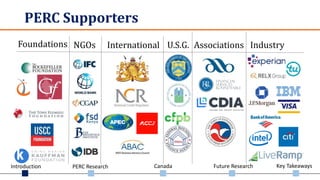
PERC Supporters
Foundations NGOs International U.S.G. Associations Industry
Introduction PERC Research Canada Future Research Key Takeaways
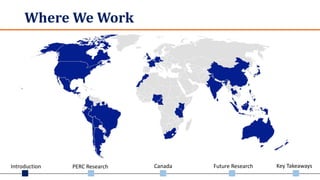
Where We Work
Introduction PERC Research Canada Future Research Key Takeaways
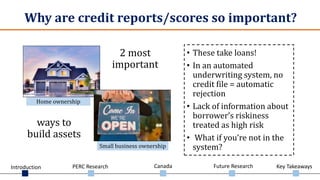
Why are credit reports/scores so important?
• These take loans!
• In an automated
underwriting system, no
credit file = automatic
rejection
• Lack of information about
borrower’s riskiness
treated as high risk
• What if you’re not in the
system?
2 most
important
Small business ownership
Home ownership
ways to
build assets
Introduction PERC Research Canada Future Research Key Takeaways
Problem: Credit Invisibility
• Not everyone has a credit report
(no-file) or enough information
in their report (thin-file)
• Unable to access credit at
mainstream, affordable rates
• No way to build assets
• Must access credit through
predatory lenders debt trap
• Current system is unfair &
unforgiving
• Negative non-financial payment
information gets reported but
positive info does not
• Effectively a blacklist
• Low awareness of who is
reporting & what difficult for
consumers to build credit
OUR RESEARCH
• Credit invisible population
• Solution: more data
• Specifically, proven payment data
• PPD helps both individuals & small businesses
• Credit deserts
Introduction PERC Research Canada Future Research Key Takeaways
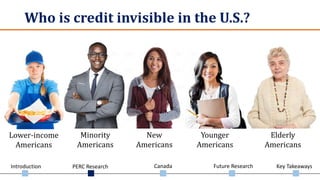
Who is credit invisible in the U.S.?
Lower-income
Americans
Minority
Americans
New
Americans
Younger
Americans
Elderly
Americans
Introduction PERC Research Canada Future Research Key Takeaways
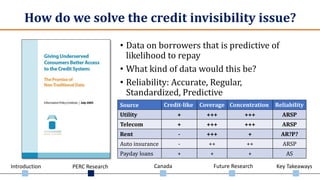
How do we solve the credit invisibility issue?
• Data on borrowers that is predictive of
likelihood to repay
• What kind of data would this be?
• Reliability: Accurate, Regular,
Standardized, Predictive
Source Credit-like Coverage Concentration Reliability
Utility + +++ +++ ARSP
Telecom + +++ +++ ARSP
Rent - +++ + AR?P?
Auto insurance - ++ ++ ARSP
Payday loans + + + AS
Introduction PERC Research Canada Future Research Key Takeaways
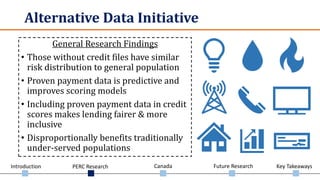
Alternative Data Initiative
General Research Findings
• Those without credit files have similar
risk distribution to general population
• Proven payment data is predictive and
improves scoring models
• Including proven payment data in credit
scores makes lending fairer & more
inclusive
• Disproportionally benefits traditionally
under-served populations
Introduction PERC Research Canada Future Research Key Takeaways
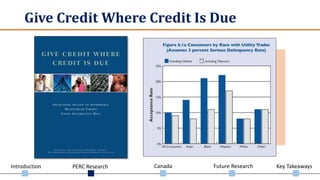
Give Credit Where Credit Is Due
Introduction PERC Research Canada Future Research Key Takeaways
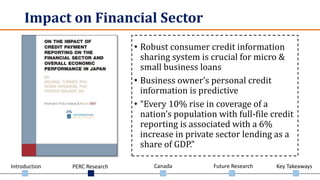
Impact on Financial Sector
• Robust consumer credit information
sharing system is crucial for micro &
small business loans
• Business owner’s personal credit
information is predictive
• “Every 10% rise in coverage of a
nation’s population with full-file credit
reporting is associated with a 6%
increase in private sector lending as a
share of GDP.”
Introduction PERC Research Canada Future Research Key Takeaways
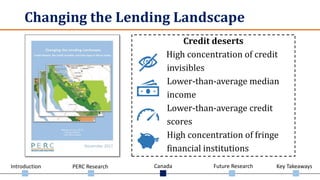
Changing the Lending Landscape
Credit deserts
High concentration of credit
invisibles
Lower-than-average median
income
Lower-than-average credit
scores
High concentration of fringe
financial institutions
Introduction PERC Research Canada Future Research Key Takeaways
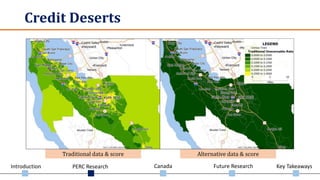
Alternative data & scoreTraditional data & score
Credit Deserts
CANADA
• Current situation in Canada
• Methodology
• Data Limitations
• Credit invisibility by province
• Credit invisibility by income bracket
• Credit invisibility in Indigenous communities
• Credit invisibility in New Canadians
• Credit desert maps
Introduction PERC Research Canada Future Research Key Takeaways
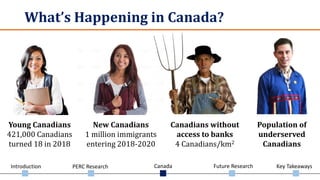
What’s Happening in Canada?
Young Canadians
421,000 Canadians
turned 18 in 2018
New Canadians
1 million immigrants
entering 2018-2020
Canadians without
access to banks
4 Canadians/km2
Population of
underserved
Canadians
Introduction PERC Research Canada Future Research Key Takeaways
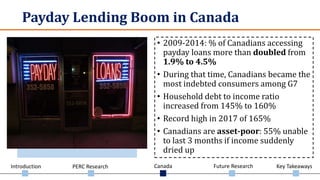
Payday Lending Boom in Canada
• 2009-2014: % of Canadians accessing
payday loans more than doubled from
1.9% to 4.5%
• During that time, Canadians became the
most indebted consumers among G7
• Household debt to income ratio
increased from 145% to 160%
• Record high in 2017 of 165%
• Canadians are asset-poor: 55% unable
to last 3 months if income suddenly
dried up
Introduction PERC Research Canada Future Research Key Takeaways
Methodology
• Forward Sortation Area (first 3 digits of postal
code)
• # of consumer files in FSA with positive
CreditVision risk score
• # of consumer files in FSA with thin file (0-2
tradelines & positive CreditVision risk score)
• # of consumer files in FSA with thick file (3+
tradelines & positive CreditVision risk score)
• Append with sociodemographic data from
2016 Census
Introduction PERC Research Canada Future Research Key Takeaways
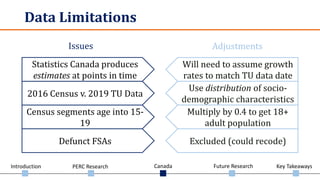
Data Limitations
Will need to assume growth
rates to match TU data date
Statistics Canada produces
estimates at points in time
2016 Census v. 2019 TU Data
Use distribution of socio-
demographic characteristics
Defunct FSAs Excluded (could recode)
Census segments age into 15-
19
Multiply by 0.4 to get 18+
adult population
Issues Adjustments
Introduction PERC Research Canada Future Research Key Takeaways
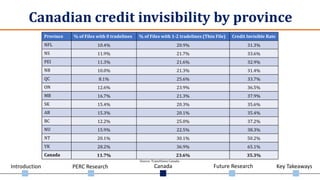
Canadian credit invisibility by province
Province % of Files with 0 tradelines % of Files with 1-2 tradelines (Thin File) Credit Invisible Rate
NFL 10.4% 20.9% 31.3%
NS 11.9% 21.7% 33.6%
PEI 11.3% 21.6% 32.9%
NB 10.0% 21.3% 31.4%
QC 8.1% 25.6% 33.7%
ON 12.6% 23.9% 36.5%
MB 16.7% 21.3% 37.9%
SK 15.4% 20.3% 35.6%
AB 15.3% 20.1% 35.4%
BC 12.2% 25.0% 37.2%
NU 15.9% 22.5% 38.3%
NT 20.1% 30.1% 50.2%
YK 28.2% 36.9% 65.1%
Canada 11.7% 23.6% 35.3%
Source: TransUnion Canada
Introduction PERC Research Canada Future Research Key Takeaways
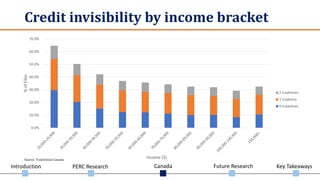
Credit invisibility by income bracket
0.0%
10.0%
20.0%
30.0%
40.0%
50.0%
60.0%
70.0%
%ofFiles
Income ($)
2 tradelines
1 tradeline
0 tradelines
Source: TransUnion Canada
Introduction PERC Research Canada Future Research Key Takeaways
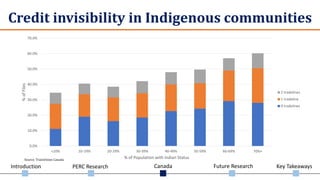
Credit invisibility in Indigenous communities
0.0%
10.0%
20.0%
30.0%
40.0%
50.0%
60.0%
70.0%
<10% 10-19% 20-29% 30-39% 40-49% 50-59% 60-69% 70%+
%ofFiles
% of Population with Indian Status
2 tradelines
1 tradeline
0 tradelines
Source: TransUnion Canada
Introduction PERC Research Canada Future Research Key Takeaways
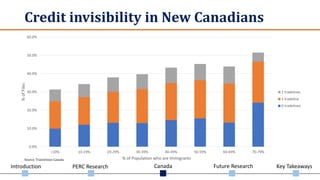
Credit invisibility in New Canadians
0.0%
10.0%
20.0%
30.0%
40.0%
50.0%
60.0%
<10% 10-19% 20-29% 30-39% 40-49% 50-59% 60-69% 70-79%
%ofFiles
% of Population who are Immigrants
2 tradelines
1 tradeline
0 tradelines
Source: TransUnion Canada
Introduction PERC Research Canada Future Research Key Takeaways
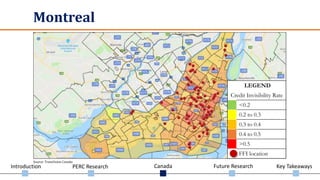
Montreal
lLEGEND
Credit Invisibility Rate
<0.2
0.2 to 0.3
0.3 to 0.4
0.4 to 0.5
>0.5
FFI location
Source: TransUnion Canada
Introduction PERC Research Canada Future Research Key Takeaways
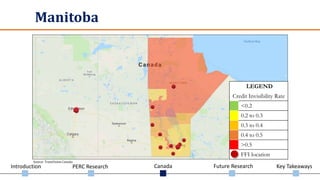
Manitoba
lLEGEND
Credit Invisibility Rate
<0.2
0.2 to 0.3
0.3 to 0.4
0.4 to 0.5
>0.5
FFI location
Source: TransUnion Canada
Introduction PERC Research Canada Future Research Key Takeaways
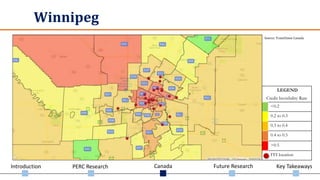
Winnipeg
lLEGEND
Credit Invisibility Rate
<0.2
0.2 to 0.3
0.3 to 0.4
0.4 to 0.5
>0.5
FFI location
Source: TransUnion Canada
Introduction PERC Research Canada Future Research Key Takeaways
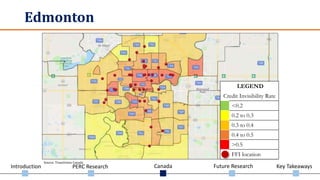
Edmonton
lLEGEND
Credit Invisibility Rate
<0.2
0.2 to 0.3
0.3 to 0.4
0.4 to 0.5
>0.5
FFI location
Source: TransUnion Canada
Introduction PERC Research Canada Future Research Key Takeaways
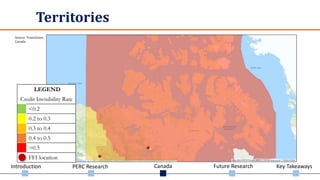
Territories
lLEGEND
Credit Invisibility Rate
<0.2
0.2 to 0.3
0.3 to 0.4
0.4 to 0.5
>0.5
FFI location
Source: TransUnion
Canada
Introduction PERC Research Canada Future Research Key Takeaways
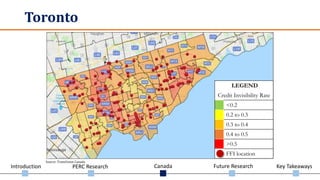
Toronto
lLEGEND
Credit Invisibility Rate
<0.2
0.2 to 0.3
0.3 to 0.4
0.4 to 0.5
>0.5
FFI location
Source: TransUnion Canada
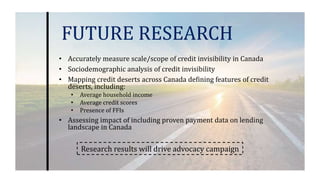
FUTURE RESEARCH
• Accurately measure scale/scope of credit invisibility in Canada
• Sociodemographic analysis of credit invisibility
• Mapping credit deserts across Canada defining features of credit
deserts, including:
• Average household income
• Average credit scores
• Presence of FFIs
• Assessing impact of including proven payment data on lending
landscape in Canada
Research results will drive advocacy campaign
Introduction PERC Research Canada Future Research Key Takeaways
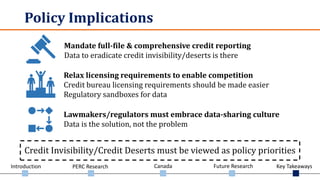
Policy Implications
Credit Invisibility/Credit Deserts must be viewed as policy priorities
Mandate full-file & comprehensive credit reporting
Data to eradicate credit invisibility/deserts is there
Relax licensing requirements to enable competition
Credit bureau licensing requirements should be made easier
Regulatory sandboxes for data
Lawmakers/regulators must embrace data-sharing culture
Data is the solution, not the problem
Introduction PERC Research Canada Future Research Key Takeaways
Thank you for listening!
PERC Canada
800 Rene Levesque Blvd, #425
Montreal, QC H3B 1X9
www.perccanada.ca | www.perc.net
+1 (438) 800-1556 | moore@perccanada.ca

Credit Invisibility in Canada

  • 2.
    INTRODUCTION: • About PERC •Our supporters • Where we work • Importance of credit information • The problem of credit invisibility
  • 3.
    Introduction PERC ResearchCanada Future Research Key Takeaways About Us PERC Canada is a non-profit, non-partisan policy research and development institution dedicating to increasing financial inclusion through information solutions
  • 4.
    Introduction PERC ResearchCanada Future Research Key Takeaways PERC Supporters Foundations NGOs International U.S.G. Associations Industry
  • 5.
    Introduction PERC ResearchCanada Future Research Key Takeaways Where We Work
  • 6.
    Introduction PERC ResearchCanada Future Research Key Takeaways Why are credit reports/scores so important? • These take loans! • In an automated underwriting system, no credit file = automatic rejection • Lack of information about borrower’s riskiness treated as high risk • What if you’re not in the system? 2 most important Small business ownership Home ownership ways to build assets
  • 7.
    Introduction PERC ResearchCanada Future Research Key Takeaways Problem: Credit Invisibility • Not everyone has a credit report (no-file) or enough information in their report (thin-file) • Unable to access credit at mainstream, affordable rates • No way to build assets • Must access credit through predatory lenders debt trap • Current system is unfair & unforgiving • Negative non-financial payment information gets reported but positive info does not • Effectively a blacklist • Low awareness of who is reporting & what difficult for consumers to build credit
  • 8.
    OUR RESEARCH • Creditinvisible population • Solution: more data • Specifically, proven payment data • PPD helps both individuals & small businesses • Credit deserts
  • 9.
    Introduction PERC ResearchCanada Future Research Key Takeaways Who is credit invisible in the U.S.? Lower-income Americans Minority Americans New Americans Younger Americans Elderly Americans
  • 10.
    Introduction PERC ResearchCanada Future Research Key Takeaways How do we solve the credit invisibility issue? • Data on borrowers that is predictive of likelihood to repay • What kind of data would this be? • Reliability: Accurate, Regular, Standardized, Predictive Source Credit-like Coverage Concentration Reliability Utility + +++ +++ ARSP Telecom + +++ +++ ARSP Rent - +++ + AR?P? Auto insurance - ++ ++ ARSP Payday loans + + + AS
  • 11.
    Introduction PERC ResearchCanada Future Research Key Takeaways Alternative Data Initiative General Research Findings • Those without credit files have similar risk distribution to general population • Proven payment data is predictive and improves scoring models • Including proven payment data in credit scores makes lending fairer & more inclusive • Disproportionally benefits traditionally under-served populations
  • 12.
    Introduction PERC ResearchCanada Future Research Key Takeaways Give Credit Where Credit Is Due
  • 13.
    Introduction PERC ResearchCanada Future Research Key Takeaways Impact on Financial Sector • Robust consumer credit information sharing system is crucial for micro & small business loans • Business owner’s personal credit information is predictive • “Every 10% rise in coverage of a nation’s population with full-file credit reporting is associated with a 6% increase in private sector lending as a share of GDP.”
  • 14.
    Introduction PERC ResearchCanada Future Research Key Takeaways Changing the Lending Landscape Credit deserts High concentration of credit invisibles Lower-than-average median income Lower-than-average credit scores High concentration of fringe financial institutions
  • 15.
    Introduction PERC ResearchCanada Future Research Key Takeaways Alternative data & scoreTraditional data & score Credit Deserts
  • 16.
    CANADA • Current situationin Canada • Methodology • Data Limitations • Credit invisibility by province • Credit invisibility by income bracket • Credit invisibility in Indigenous communities • Credit invisibility in New Canadians • Credit desert maps
  • 17.
    Introduction PERC ResearchCanada Future Research Key Takeaways What’s Happening in Canada? Young Canadians 421,000 Canadians turned 18 in 2018 New Canadians 1 million immigrants entering 2018-2020 Canadians without access to banks 4 Canadians/km2 Population of underserved Canadians
  • 18.
    Introduction PERC ResearchCanada Future Research Key Takeaways Payday Lending Boom in Canada • 2009-2014: % of Canadians accessing payday loans more than doubled from 1.9% to 4.5% • During that time, Canadians became the most indebted consumers among G7 • Household debt to income ratio increased from 145% to 160% • Record high in 2017 of 165% • Canadians are asset-poor: 55% unable to last 3 months if income suddenly dried up
  • 19.
    Introduction PERC ResearchCanada Future Research Key Takeaways Methodology • Forward Sortation Area (first 3 digits of postal code) • # of consumer files in FSA with positive CreditVision risk score • # of consumer files in FSA with thin file (0-2 tradelines & positive CreditVision risk score) • # of consumer files in FSA with thick file (3+ tradelines & positive CreditVision risk score) • Append with sociodemographic data from 2016 Census
  • 20.
    Introduction PERC ResearchCanada Future Research Key Takeaways Data Limitations Will need to assume growth rates to match TU data date Statistics Canada produces estimates at points in time 2016 Census v. 2019 TU Data Use distribution of socio- demographic characteristics Defunct FSAs Excluded (could recode) Census segments age into 15- 19 Multiply by 0.4 to get 18+ adult population Issues Adjustments
  • 21.
    Introduction PERC ResearchCanada Future Research Key Takeaways Canadian credit invisibility by province Province % of Files with 0 tradelines % of Files with 1-2 tradelines (Thin File) Credit Invisible Rate NFL 10.4% 20.9% 31.3% NS 11.9% 21.7% 33.6% PEI 11.3% 21.6% 32.9% NB 10.0% 21.3% 31.4% QC 8.1% 25.6% 33.7% ON 12.6% 23.9% 36.5% MB 16.7% 21.3% 37.9% SK 15.4% 20.3% 35.6% AB 15.3% 20.1% 35.4% BC 12.2% 25.0% 37.2% NU 15.9% 22.5% 38.3% NT 20.1% 30.1% 50.2% YK 28.2% 36.9% 65.1% Canada 11.7% 23.6% 35.3% Source: TransUnion Canada
  • 22.
    Introduction PERC ResearchCanada Future Research Key Takeaways Credit invisibility by income bracket 0.0% 10.0% 20.0% 30.0% 40.0% 50.0% 60.0% 70.0% %ofFiles Income ($) 2 tradelines 1 tradeline 0 tradelines Source: TransUnion Canada
  • 23.
    Introduction PERC ResearchCanada Future Research Key Takeaways Credit invisibility in Indigenous communities 0.0% 10.0% 20.0% 30.0% 40.0% 50.0% 60.0% 70.0% <10% 10-19% 20-29% 30-39% 40-49% 50-59% 60-69% 70%+ %ofFiles % of Population with Indian Status 2 tradelines 1 tradeline 0 tradelines Source: TransUnion Canada
  • 24.
    Introduction PERC ResearchCanada Future Research Key Takeaways Credit invisibility in New Canadians 0.0% 10.0% 20.0% 30.0% 40.0% 50.0% 60.0% <10% 10-19% 20-29% 30-39% 40-49% 50-59% 60-69% 70-79% %ofFiles % of Population who are Immigrants 2 tradelines 1 tradeline 0 tradelines Source: TransUnion Canada
  • 25.
    Introduction PERC ResearchCanada Future Research Key Takeaways Montreal lLEGEND Credit Invisibility Rate <0.2 0.2 to 0.3 0.3 to 0.4 0.4 to 0.5 >0.5 FFI location Source: TransUnion Canada
  • 26.
    Introduction PERC ResearchCanada Future Research Key Takeaways Manitoba lLEGEND Credit Invisibility Rate <0.2 0.2 to 0.3 0.3 to 0.4 0.4 to 0.5 >0.5 FFI location Source: TransUnion Canada
  • 27.
    Introduction PERC ResearchCanada Future Research Key Takeaways Winnipeg lLEGEND Credit Invisibility Rate <0.2 0.2 to 0.3 0.3 to 0.4 0.4 to 0.5 >0.5 FFI location Source: TransUnion Canada
  • 28.
    Introduction PERC ResearchCanada Future Research Key Takeaways Edmonton lLEGEND Credit Invisibility Rate <0.2 0.2 to 0.3 0.3 to 0.4 0.4 to 0.5 >0.5 FFI location Source: TransUnion Canada
  • 29.
    Introduction PERC ResearchCanada Future Research Key Takeaways Territories lLEGEND Credit Invisibility Rate <0.2 0.2 to 0.3 0.3 to 0.4 0.4 to 0.5 >0.5 FFI location Source: TransUnion Canada
  • 30.
    Introduction PERC ResearchCanada Future Research Key Takeaways Toronto lLEGEND Credit Invisibility Rate <0.2 0.2 to 0.3 0.3 to 0.4 0.4 to 0.5 >0.5 FFI location Source: TransUnion Canada
  • 31.
    FUTURE RESEARCH • Accuratelymeasure scale/scope of credit invisibility in Canada • Sociodemographic analysis of credit invisibility • Mapping credit deserts across Canada defining features of credit deserts, including: • Average household income • Average credit scores • Presence of FFIs • Assessing impact of including proven payment data on lending landscape in Canada Research results will drive advocacy campaign
  • 32.
    Introduction PERC ResearchCanada Future Research Key Takeaways Policy Implications Credit Invisibility/Credit Deserts must be viewed as policy priorities Mandate full-file & comprehensive credit reporting Data to eradicate credit invisibility/deserts is there Relax licensing requirements to enable competition Credit bureau licensing requirements should be made easier Regulatory sandboxes for data Lawmakers/regulators must embrace data-sharing culture Data is the solution, not the problem
  • 33.
    Introduction PERC ResearchCanada Future Research Key Takeaways Thank you for listening! PERC Canada 800 Rene Levesque Blvd, #425 Montreal, QC H3B 1X9 www.perccanada.ca | www.perc.net +1 (438) 800-1556 | moore@perccanada.ca