WE’RE ALL CONNECTED: THE
POWER OF THE SOCIAL MEDIA
ECOSYSTEM.
Hanna, Rohm, & Crittenden (2011).
Presented by Kelly Tang and Pad Kane
#NHsmtp
Consider the following statements: true or false?
• Brand managers own and orchestrate their brands.
• Phones are for making phone calls.
• The Web is for finding information.
• Companies use marketing communications to control their
message.
• Consumers purchase products promoted by marketers
• Providing a forum for customers to talk is dangerous and
risky.
Marketing Myths Revealed
• Active consumers vs. Passive consumers
• “Consumers increasingly use digital media not just to
research products and services, but to engage the
companies they buy from, as well as other consumers
who may have valuable insights.” (Garretson, 2008).
• Web 2.0 interactive model (consumers are simultaneously
the initiators and recipients of information exchanges)
• Social media has fundamentally altered marketing’s
ecosystem of influence.
Empowered Customers (Mangold & Faulds, 2009)
• Social media = consumer-generated media
• Social media enables companies to talk to their
customers, and it also enables customers to talk to one
another (extension of traditional word-of-mouth).
• “Consumers are in control, they have greater access to
information and greater command over media
consumption than ever before.” (Vollmer & Precourt,
2008, Always On).
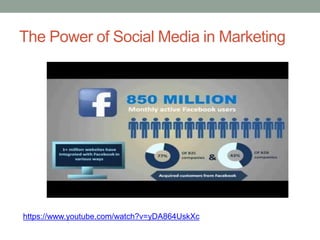
The Power of Social Media in Marketing
https://www.youtube.com/watch?v=yDA864UskXc
Mobile
• Mobile is rewriting the rules of social media marketing.
• 40% of cellphone users use social media on their phone
(Pew Research Center, 2014). Time spent on mobile is
greater than desktop (Smart Insights, 2015).
• Accessible.
• Location-based richness.
• Mobile commerce (4 out of 5 people use their mobile
phones to shop, e.g., Apple Pay)
• Ability to capture the moment.
• In-app advertisements
Growing Brand’s Marketing Spheres of
Influence
• From bystander to hunter to participant
• Digital marketing is not only about reach, it’s about
“true marketing exchange”.
Growing Brand’s Marketing Spheres of
Influence
1. Know (Really Know) Your Target Audience And What
Drives Them
2. Exude Credibility: If they trust you, they’ll communicate
about you!
3. Be Trustworthy
4. Create Emotion
5. Deliver Value
6. Engage In Your Space
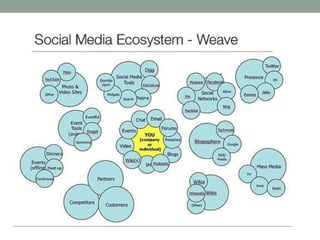
The Social Media Marketing Ecosystem
• Three media types: owned media (e.g., company
website), paid media (e.g., advertising), earned media
(e.g., word of mouth)
• Five types of social behaviors: Creators, critics,
collectors, joiners, and spectators.
• Which type of participant are you?
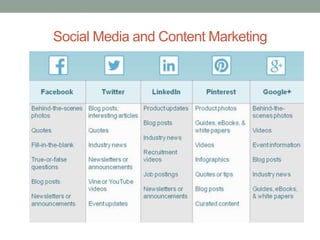
Social Media and Content Marketing
Case Study: the 2010 Grammy Awards
• Social media campaign to increase engagement among
fans
• Challenge: how to reach 18-49 demographic, since the
show’s viewership was skewed toward an older female
demographic.
• We’re all fans social media ecosystem
“We’re all fans” Grammys Experience
• https://www.youtube.com/watch?v=VEFgSV36vnA
• https://www.youtube.com/watch?v=91cJHVr0O6I
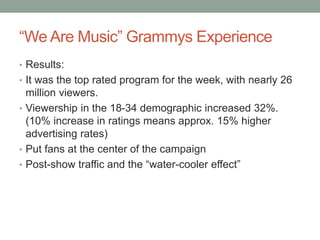
“We Are Music” Grammys Experience
• Results:
• It was the top rated program for the week, with nearly 26
million viewers.
• Viewership in the 18-34 demographic increased 32%.
(10% increase in ratings means approx. 15% higher
advertising rates)
• Put fans at the center of the campaign
• Post-show traffic and the “water-cooler effect”
Leverage of Social Media Sites to
Promote Brands
https://www.youtube.com/watch?v=ZUG9qYTJMsI
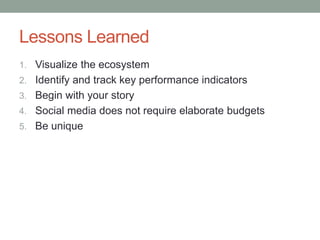
Lessons Learned
1. Visualize the ecosystem
2. Identify and track key performance indicators
3. Begin with your story
4. Social media does not require elaborate budgets
5. Be unique
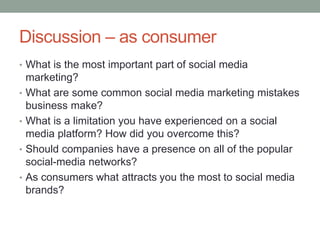
Discussion – as consumer
• What is the most important part of social media
marketing?
• What are some common social media marketing mistakes
business make?
• What is a limitation you have experienced on a social
media platform? How did you overcome this?
• Should companies have a presence on all of the popular
social-media networks?
• As consumers what attracts you the most to social media
brands?
Discussion – as social media strategist
• Imagine you work at Herbal Essences, and you have a
new hair product targeting the elderly, how would you
promote the product? Which social media platforms would
be the most beneficial?
• Image you are promoting a new product called Apple
band, which allows users to transport to their destination
at the click of the button. How would you promote the
product on social media?
Reference
• Hanna, R., Rohm, A., Crittenden, V. (2011). We’re all
connected: the power of the social media ecosystem. Business
Horizons, 54, 265-273.
• Mangold, W., & Faulds, D. (2009). Social media: the new
hybrid element of the promotion mix. Business Horizons, 52,
357-365.
• http://www.business2community.com/branding/11-steps-grow-
brands-marketing-sphere-influence-
01063124#x9xBtvJSjP1CJWqS.97
• https://www.youtube.com/watch?v=yDA864UskXc
• http://mashable.com/2010/01/25/grammys-
2010/#4shKc37Gxsqa
• http://www.forbes.com/sites/mashable/2011/01/14/the-2011-
grammy-awards-social-media-campaign-an-inside-look/
• http://blogs.constantcontact.com/social-media-strategy/

Social media ecosystem presentation

  • 1.
    WE’RE ALL CONNECTED:THE POWER OF THE SOCIAL MEDIA ECOSYSTEM. Hanna, Rohm, & Crittenden (2011). Presented by Kelly Tang and Pad Kane #NHsmtp
  • 2.
    Consider the followingstatements: true or false? • Brand managers own and orchestrate their brands. • Phones are for making phone calls. • The Web is for finding information. • Companies use marketing communications to control their message. • Consumers purchase products promoted by marketers • Providing a forum for customers to talk is dangerous and risky.
  • 3.
    Marketing Myths Revealed •Active consumers vs. Passive consumers • “Consumers increasingly use digital media not just to research products and services, but to engage the companies they buy from, as well as other consumers who may have valuable insights.” (Garretson, 2008). • Web 2.0 interactive model (consumers are simultaneously the initiators and recipients of information exchanges) • Social media has fundamentally altered marketing’s ecosystem of influence.
  • 4.
    Empowered Customers (Mangold& Faulds, 2009) • Social media = consumer-generated media • Social media enables companies to talk to their customers, and it also enables customers to talk to one another (extension of traditional word-of-mouth). • “Consumers are in control, they have greater access to information and greater command over media consumption than ever before.” (Vollmer & Precourt, 2008, Always On).
  • 5.
    The Power ofSocial Media in Marketing https://www.youtube.com/watch?v=yDA864UskXc
  • 7.
    Mobile • Mobile isrewriting the rules of social media marketing. • 40% of cellphone users use social media on their phone (Pew Research Center, 2014). Time spent on mobile is greater than desktop (Smart Insights, 2015). • Accessible. • Location-based richness. • Mobile commerce (4 out of 5 people use their mobile phones to shop, e.g., Apple Pay) • Ability to capture the moment. • In-app advertisements
  • 8.
    Growing Brand’s MarketingSpheres of Influence • From bystander to hunter to participant • Digital marketing is not only about reach, it’s about “true marketing exchange”.
  • 9.
    Growing Brand’s MarketingSpheres of Influence 1. Know (Really Know) Your Target Audience And What Drives Them 2. Exude Credibility: If they trust you, they’ll communicate about you! 3. Be Trustworthy 4. Create Emotion 5. Deliver Value 6. Engage In Your Space
  • 12.
    The Social MediaMarketing Ecosystem • Three media types: owned media (e.g., company website), paid media (e.g., advertising), earned media (e.g., word of mouth) • Five types of social behaviors: Creators, critics, collectors, joiners, and spectators. • Which type of participant are you?
  • 13.
    Social Media andContent Marketing
  • 14.
    Case Study: the2010 Grammy Awards • Social media campaign to increase engagement among fans • Challenge: how to reach 18-49 demographic, since the show’s viewership was skewed toward an older female demographic. • We’re all fans social media ecosystem
  • 15.
    “We’re all fans”Grammys Experience • https://www.youtube.com/watch?v=VEFgSV36vnA • https://www.youtube.com/watch?v=91cJHVr0O6I
  • 16.
    “We Are Music”Grammys Experience • Results: • It was the top rated program for the week, with nearly 26 million viewers. • Viewership in the 18-34 demographic increased 32%. (10% increase in ratings means approx. 15% higher advertising rates) • Put fans at the center of the campaign • Post-show traffic and the “water-cooler effect”
  • 17.
    Leverage of SocialMedia Sites to Promote Brands https://www.youtube.com/watch?v=ZUG9qYTJMsI
  • 18.
    Lessons Learned 1. Visualizethe ecosystem 2. Identify and track key performance indicators 3. Begin with your story 4. Social media does not require elaborate budgets 5. Be unique
  • 19.
    Discussion – asconsumer • What is the most important part of social media marketing? • What are some common social media marketing mistakes business make? • What is a limitation you have experienced on a social media platform? How did you overcome this? • Should companies have a presence on all of the popular social-media networks? • As consumers what attracts you the most to social media brands?
  • 20.
    Discussion – associal media strategist • Imagine you work at Herbal Essences, and you have a new hair product targeting the elderly, how would you promote the product? Which social media platforms would be the most beneficial? • Image you are promoting a new product called Apple band, which allows users to transport to their destination at the click of the button. How would you promote the product on social media?
  • 21.
    Reference • Hanna, R.,Rohm, A., Crittenden, V. (2011). We’re all connected: the power of the social media ecosystem. Business Horizons, 54, 265-273. • Mangold, W., & Faulds, D. (2009). Social media: the new hybrid element of the promotion mix. Business Horizons, 52, 357-365. • http://www.business2community.com/branding/11-steps-grow- brands-marketing-sphere-influence- 01063124#x9xBtvJSjP1CJWqS.97 • https://www.youtube.com/watch?v=yDA864UskXc • http://mashable.com/2010/01/25/grammys- 2010/#4shKc37Gxsqa • http://www.forbes.com/sites/mashable/2011/01/14/the-2011- grammy-awards-social-media-campaign-an-inside-look/ • http://blogs.constantcontact.com/social-media-strategy/

Editor's Notes

  • #3 Traditional media is all about reach, while social media marketing is about influence and engagement.
  • #4 Traditional media: one way communication, passive consumers Digital media: two way communication, active consumers. Consumers can talk to brands directly and can also talk to other consumers.
  • #5 Conventional marketing wisdom has long held that a dissatisfied customer tells ten people. But that is out of date. In the new age of social media, he or she has the tools to tell 10 million consumers virtually overnight. --- Gillin (2007) The New Influencers Consumers’ ability to communicate with one another limits the amount of control companies have over the content and dissemination of information. Companies need to adapt to this new communication model, the digital media ecosystem.
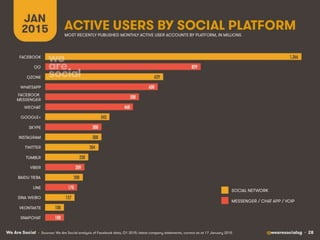
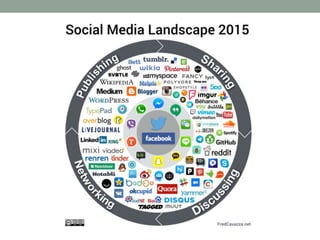
  • #7 Platforms for influence – Top global social media MAU – source: we are social
  • #13 Owned media (controlled by the marketer) Paid media (bought by the marketer) Earned media (not controlled or bought by the marketer) Creators (publish, maintain, upload) Critics (comment, rate) Collectors (save, share) Joiners (connect, unite) Spectators (read)
  • #14 t’s important that your social networks aren’t just a place for you to blast information out to your audience. People connect with you on different networks for different reasons. The best way to figure out what type of content your audience is most interested in is to do tests. Keep an eye on your key engagement metrics (likes, comments, shares, retweets, clicks, etc). These provide insight into which type of content is working, what’s not, and what you could be doing differently to improve your strategy. Stuck for content ideas? This cheat sheet can help.
  • #18 People love to see original video content that is fun and sharable. It shouldn’t be so obviously promotional from the start. People should want to share it simply because it is amazing! This video content ultimately connects to all the other social media platforms you are working with and benefits strategy and marketing as a whole. It might even go viral. Dollar Shave Club is a great example of video content that went viral thanks to excellent social media marketing!
  • #19 Need to be familiar with three types of media, owned, paid, and earned, and five types of social influences, creators, critics, collectors, joiners, and spectators. A company should conceptualize and develop its own version of the social media ecosystem. What to measure? Need to have quantifiable goals! Brand affinity (e.g., sales), and also sales conversion which indicates brand lift and brand engagement. The story can be a new product, a new service, a new relationship, or an overall theme (the Grammy Awards theme was We’re all fans). Social media is about users and being connected to other users; it is not about significant investments in expensive production and media. You need to be clear about what is owned and what is available for free, and take advantage of them. People can be easily bored by the huge amount of information on social media. You need to bring a hint of “uniqueness” and “authenticity” and customize user engagement.