Introduction Data and Analysis Networks Method and Findings Conclusion
Modeling the Impact of R & Python Packages:
Dependency and Contributor Networks
Gizem Korkmaz1
Claire Kelling2
Carol Robbins3
Sallie Keller1
1
Biocomplexity Institute, University of Virginia
2
Penn State University
3
National Science Foundation
2019 Women in Data Science Conference
Charlottesville, March 29, 2018
1 / 18
Introduction Data and Analysis Networks Method and Findings Conclusion
Introduction
• Open Source Software (OSS) is a computer software with its
source code made available with a license in which the copyright
holder provides the rights to study, change, and distribute the
software to anyone and for any purpose [Open Source Initiative,
1998].
• within and outside of the private sector
• universities (e.g., Stanford, MIT, UC-Berkeley), business (e.g.,
Microsoft, Google), government research institutions (e.g., Sandia
National Lab), nonprofits, and individuals
• Examples include Linux, Apache, Python, and R.
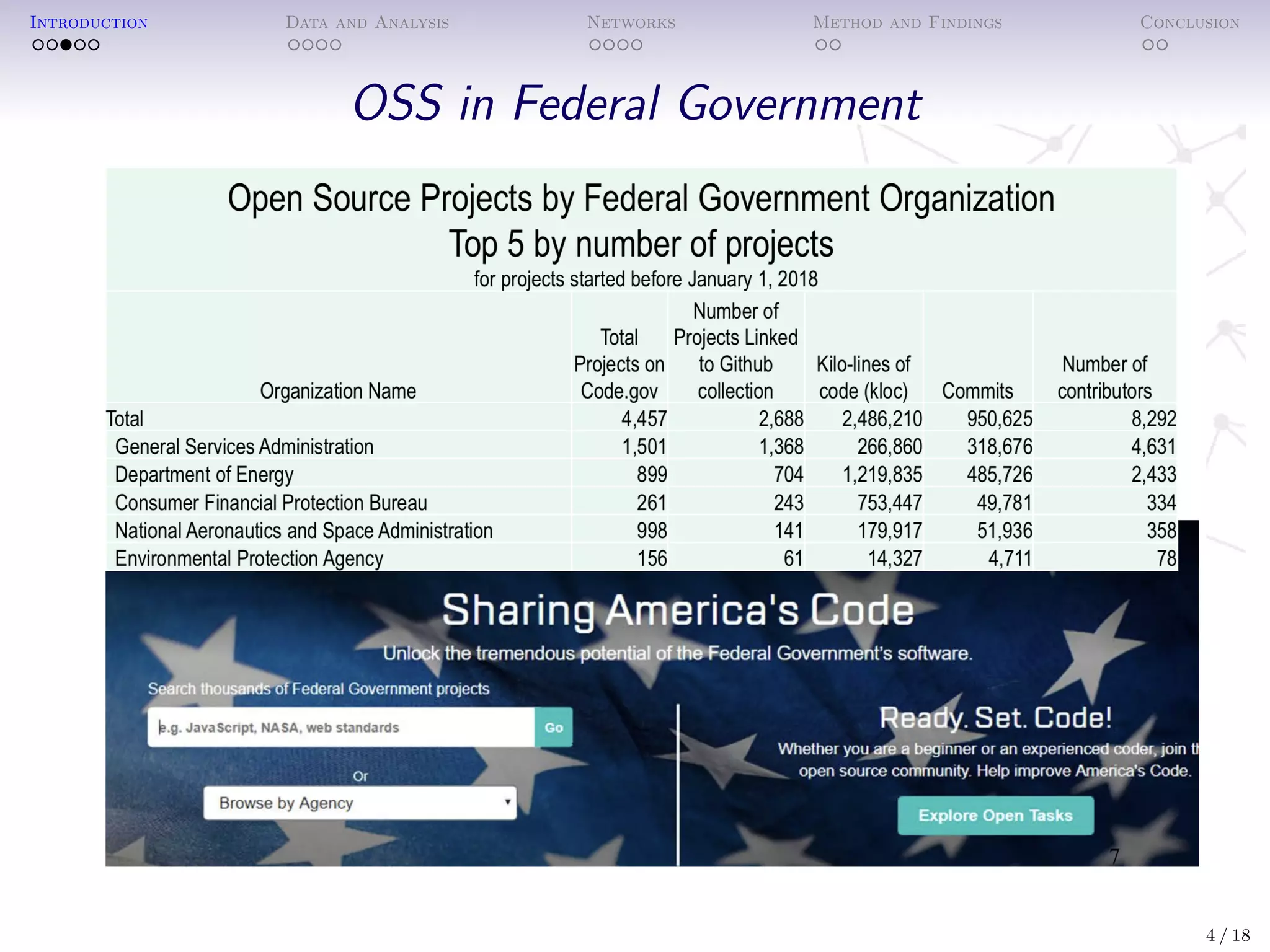
• Public funding for OSS is not fully accounted!
2 / 18
Introduction Data and Analysis Networks Method and Findings Conclusion
Introduction
Ways to Measure the Scope and Impact of Open Source Software
• Cost of Software Package Creation
• Identify number of people involved each package’s development;
• Estimate time spent on software development;
• Use average compensation for computer programmers;
• Estimate intermediate inputs based on BEA (Bureau Economic
Analysis) and OECD (Organisation for Economic Co-operation and
Development) methodologies.
*The National Bureau of Economic Research (NBER) Conference: Big Data for
21st Century Economics. Bethesda, March 2019.
*International Monetary Fund (IMF) Statistical Forum on Measuring Economic
Welfare in the Digital Age: What and How? Washington D.C., Nov. 2018.
*The International Association for Research in Income and Wealth (IARIW): The
Digital Economy: Conceptual and Measurement Issues. Copenhagen, Aug. 2018.
3 / 18
Introduction Data and Analysis Networks Method and Findings Conclusion
OSS in Federal Government
4 / 18
Introduction Data and Analysis Networks Method and Findings Conclusion
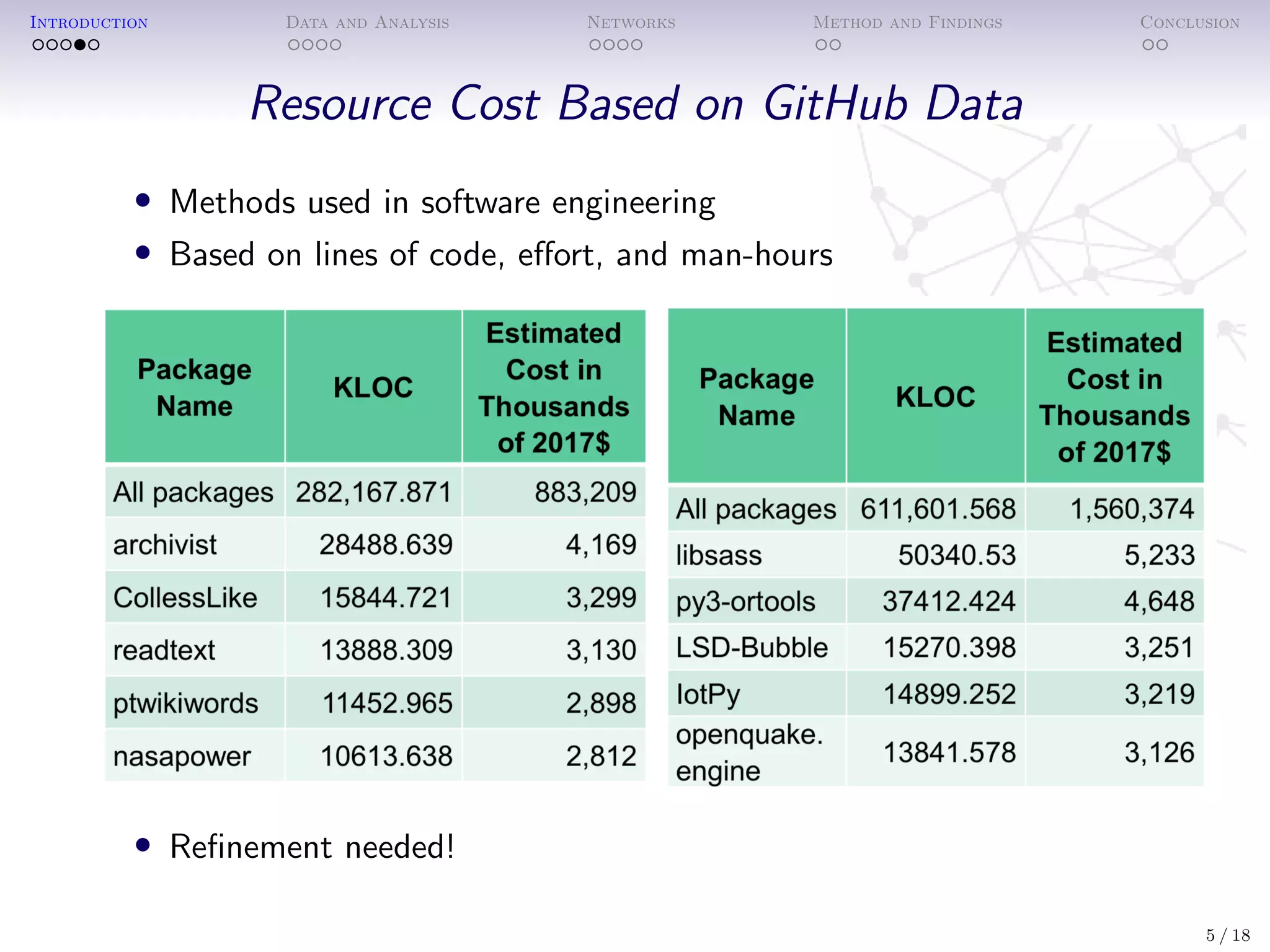
Resource Cost Based on GitHub Data
• Methods used in software engineering
• Based on lines of code, effort, and man-hours
• Refinement needed!
5 / 18
Introduction Data and Analysis Networks Method and Findings Conclusion
In this paper...
• Focus on relative package impact (value) of R and Python
packages using methods from bibliometrics and patents
• Counts
• Downloads
• Citations
• Reuse in other packages (dependencies)
• Goal is to identify the factors that affect the impact, measured by
downloads and citations
• Collect publicly available information on R and Python packages
• Generate dependency and contributor networks of OSS
“ecosystem”
• Develop statistical models to estimate the impact using
• structural properties of the dependency and contributor networks.
• author and package attributes
*Preliminary version appeared in Proceedings of the 2018 IEEE/ACM
International Conference on Advances in Social Network Analysis and Mining
(ASONAM). pp. 511-514. IEEE.
6 / 18
Introduction Data and Analysis Networks Method and Findings Conclusion
Data Source
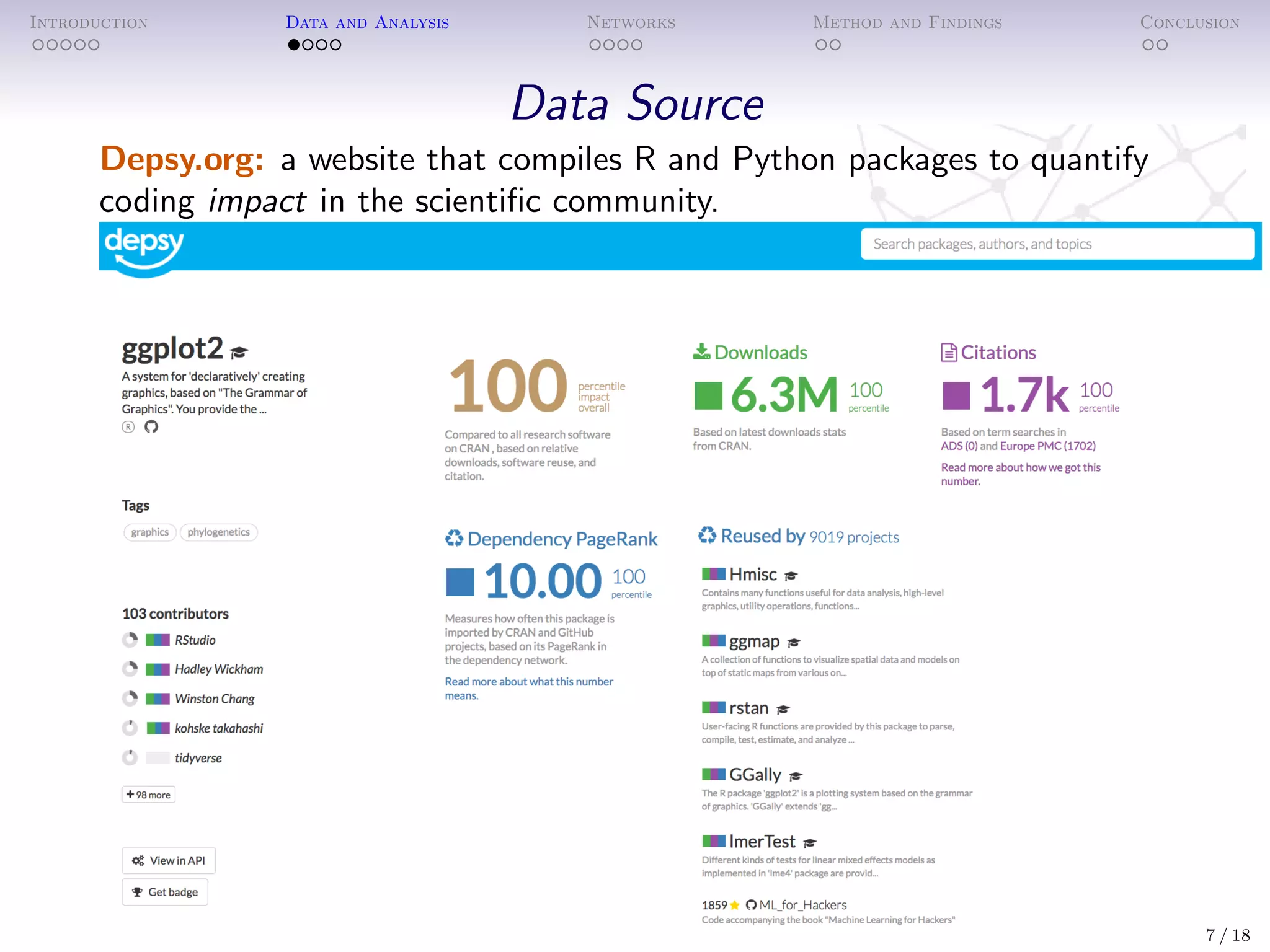
Depsy.org: a website that compiles R and Python packages to quantify
coding impact in the scientific community.
7 / 18
Introduction Data and Analysis Networks Method and Findings Conclusion
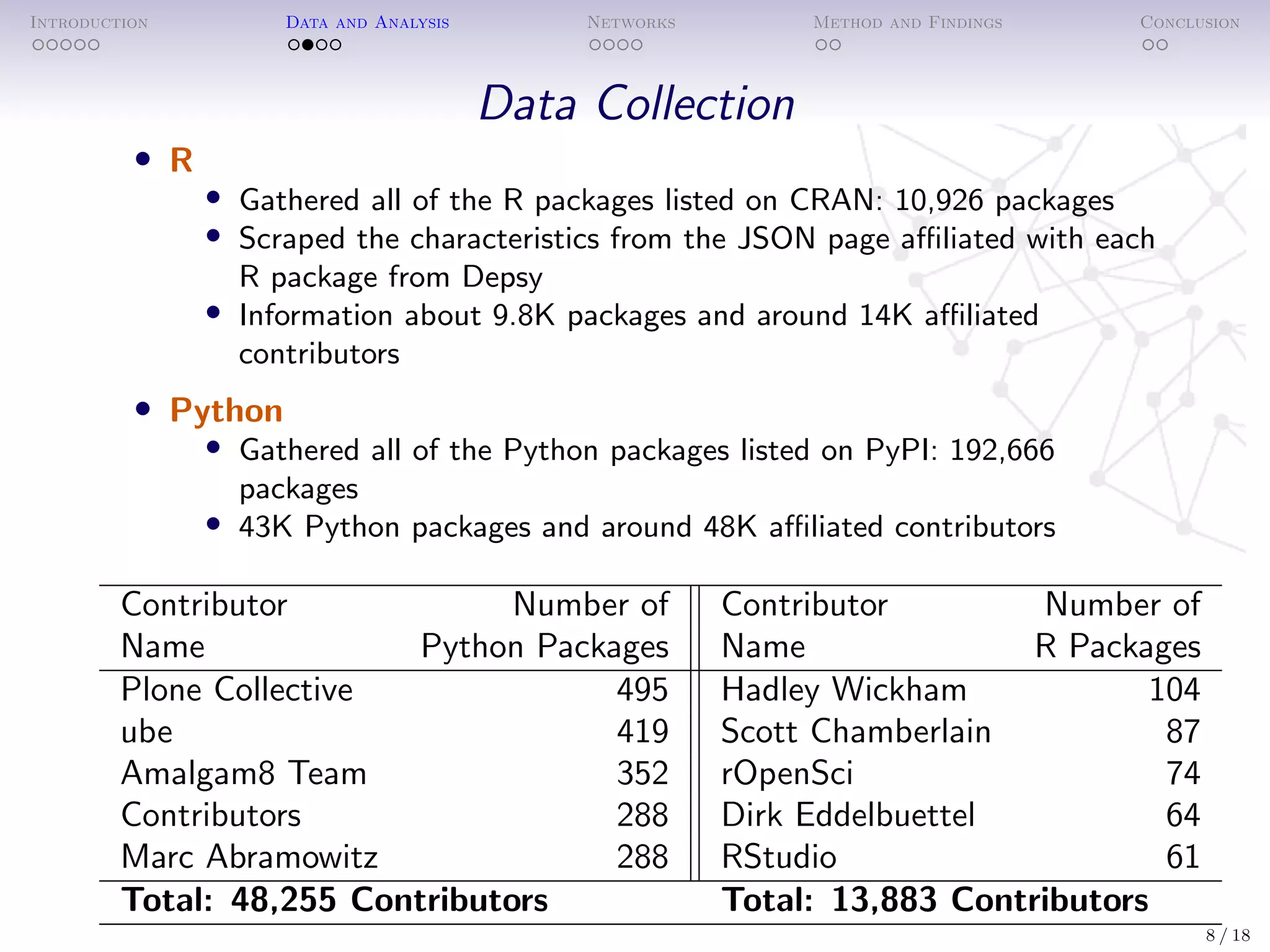
Data Collection
• R
• Gathered all of the R packages listed on CRAN: 10,926 packages
• Scraped the characteristics from the JSON page affiliated with each
R package from Depsy
• Information about 9.8K packages and around 14K affiliated
contributors
• Python
• Gathered all of the Python packages listed on PyPI: 192,666
packages
• 43K Python packages and around 48K affiliated contributors
Contributor Number of Contributor Number of
Name Python Packages Name R Packages
Plone Collective 495 Hadley Wickham 104
ube 419 Scott Chamberlain 87
Amalgam8 Team 352 rOpenSci 74
Contributors 288 Dirk Eddelbuettel 64
Marc Abramowitz 288 RStudio 61
Total: 48,255 Contributors Total: 13,883 Contributors
8 / 18
Introduction Data and Analysis Networks Method and Findings Conclusion
Analysis
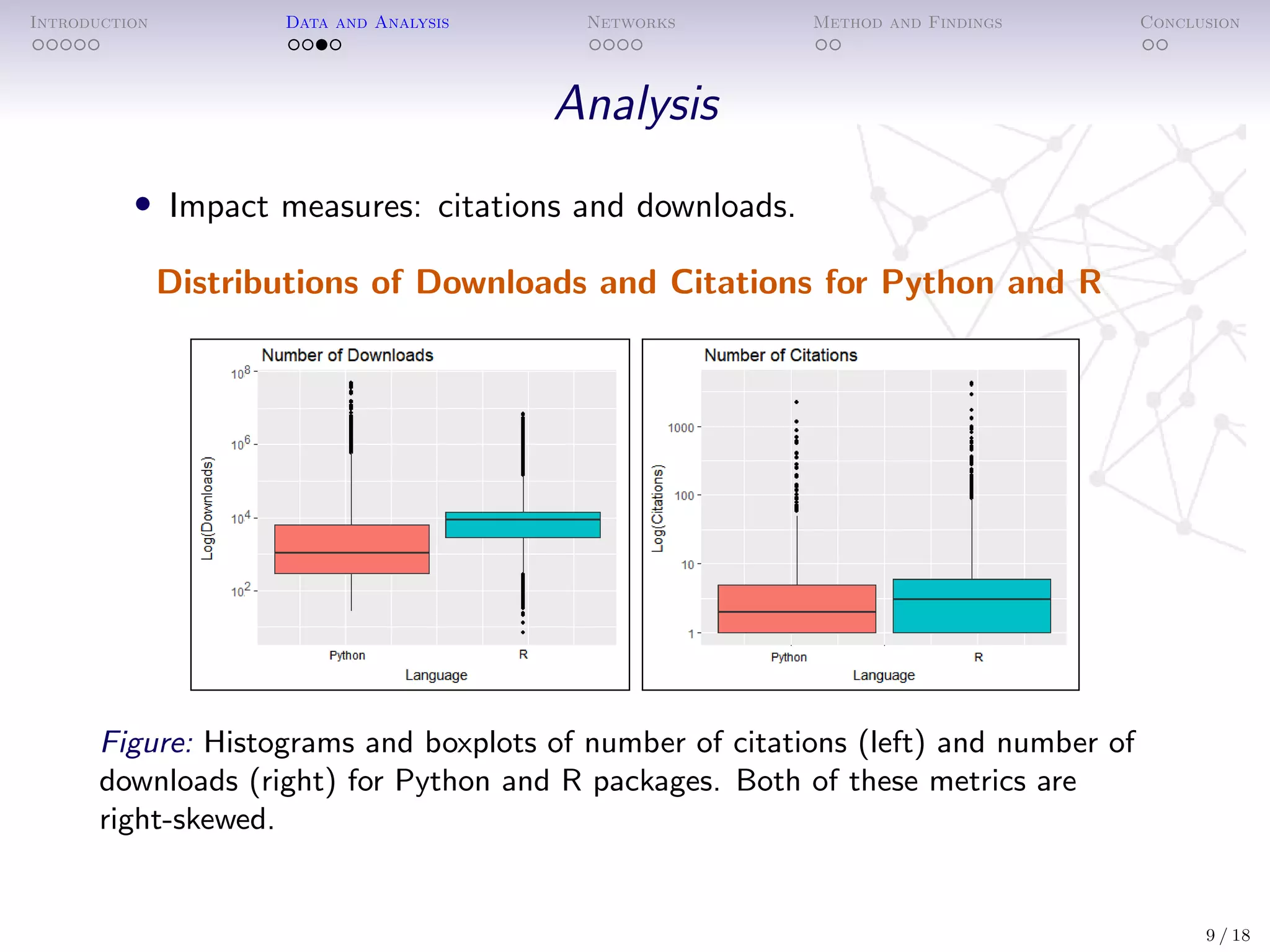
• Impact measures: citations and downloads.
Distributions of Downloads and Citations for Python and R
Figure: Histograms and boxplots of number of citations (left) and number of
downloads (right) for Python and R packages. Both of these metrics are
right-skewed.
9 / 18
Introduction Data and Analysis Networks Method and Findings Conclusion
Analysis
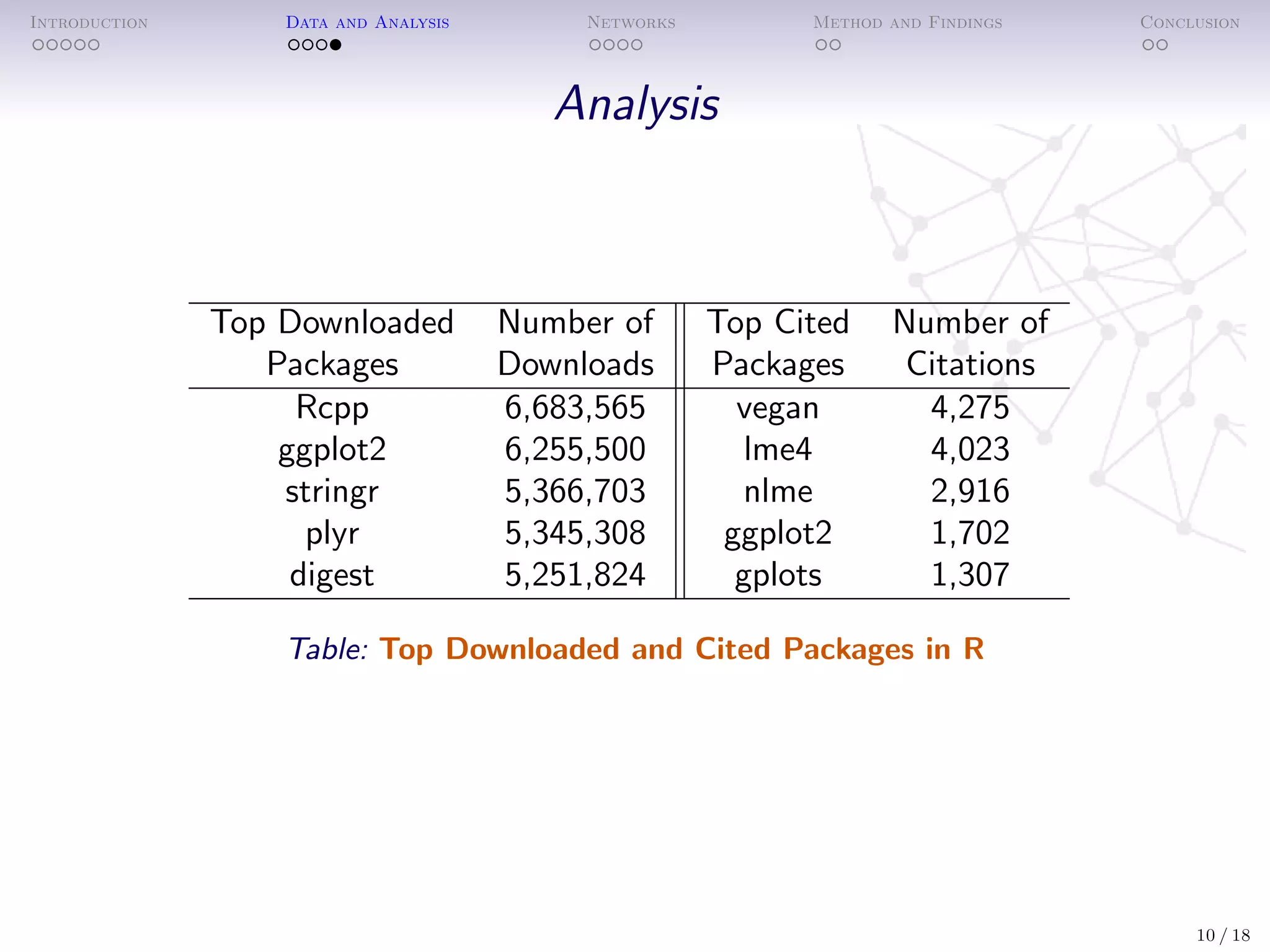
Top Downloaded Number of Top Cited Number of
Packages Downloads Packages Citations
Rcpp 6,683,565 vegan 4,275
ggplot2 6,255,500 lme4 4,023
stringr 5,366,703 nlme 2,916
plyr 5,345,308 ggplot2 1,702
digest 5,251,824 gplots 1,307
Table: Top Downloaded and Cited Packages in R
10 / 18
Introduction Data and Analysis Networks Method and Findings Conclusion
Dependency Network
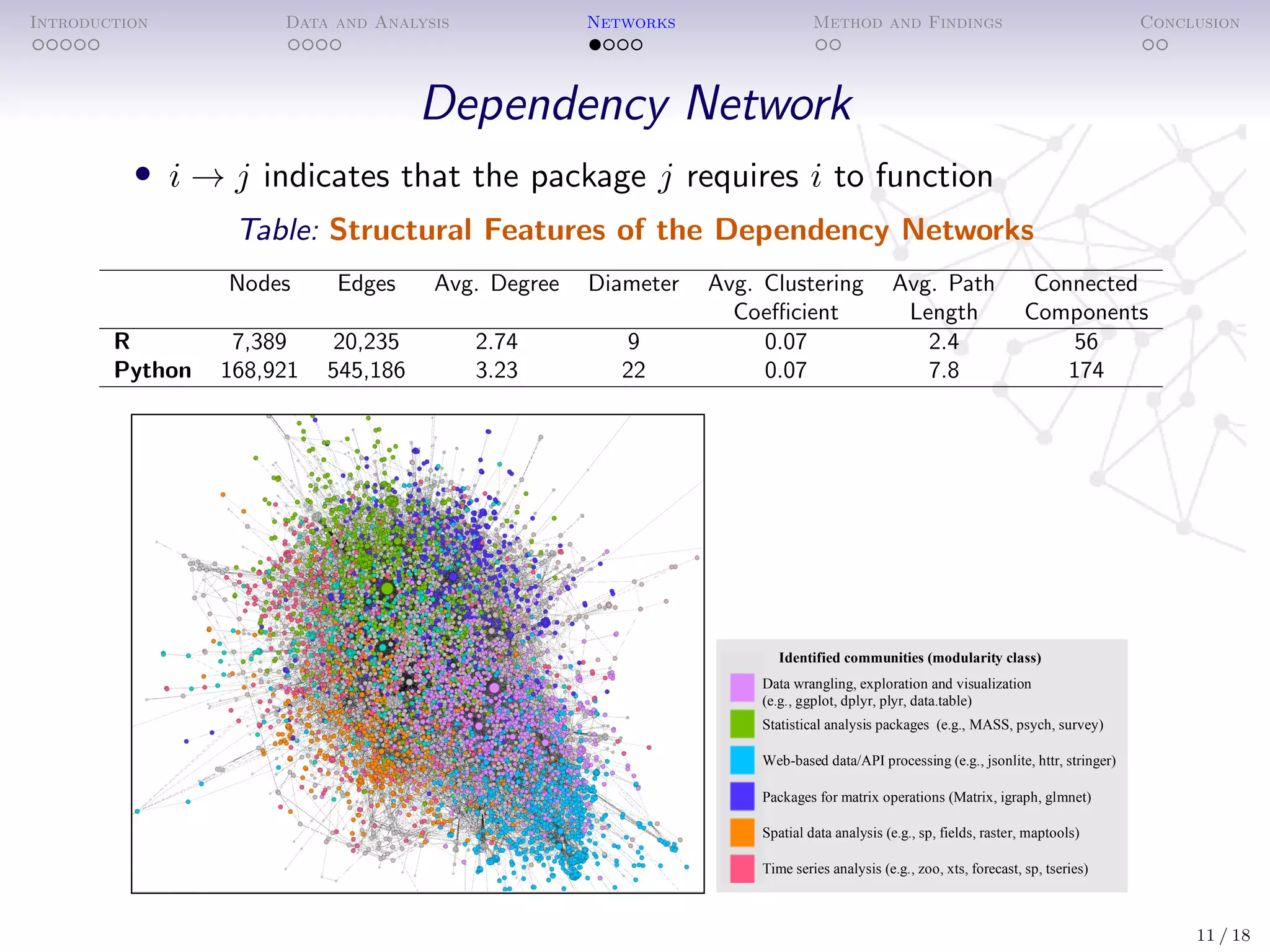
• i → j indicates that the package j requires i to function
Table: Structural Features of the Dependency Networks
Nodes Edges Avg. Degree Diameter Avg. Clustering Avg. Path Connected
Coefficient Length Components
R 7,389 20,235 2.74 9 0.07 2.4 56
Python 168,921 545,186 3.23 22 0.07 7.8 174
Identified communities (modularity class)
Data wrangling, exploration and visualization
(e.g., ggplot, dplyr, plyr, data.table)
Statistical analysis packages (e.g., MASS, psych, survey)
Web-based data/API processing (e.g., jsonlite, httr, stringer)
Packages for matrix operations (Matrix, igraph, glmnet)
Spatial data analysis (e.g., sp, fields, raster, maptools)
Time series analysis (e.g., zoo, xts, forecast, sp, tseries)
11 / 18
Introduction Data and Analysis Networks Method and Findings Conclusion
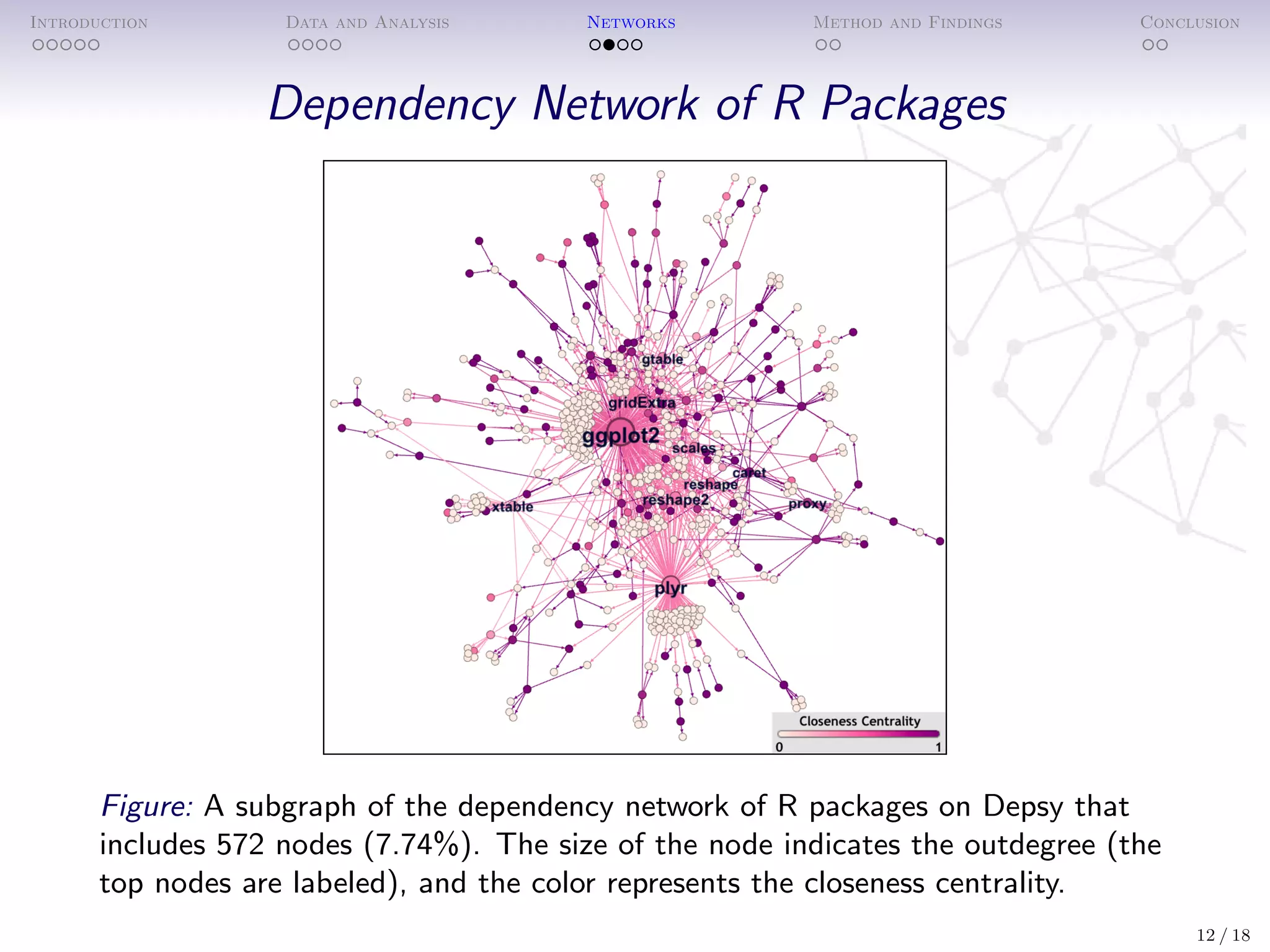
Dependency Network of R Packages
Figure: A subgraph of the dependency network of R packages on Depsy that
includes 572 nodes (7.74%). The size of the node indicates the outdegree (the
top nodes are labeled), and the color represents the closeness centrality.
12 / 18
Introduction Data and Analysis Networks Method and Findings Conclusion
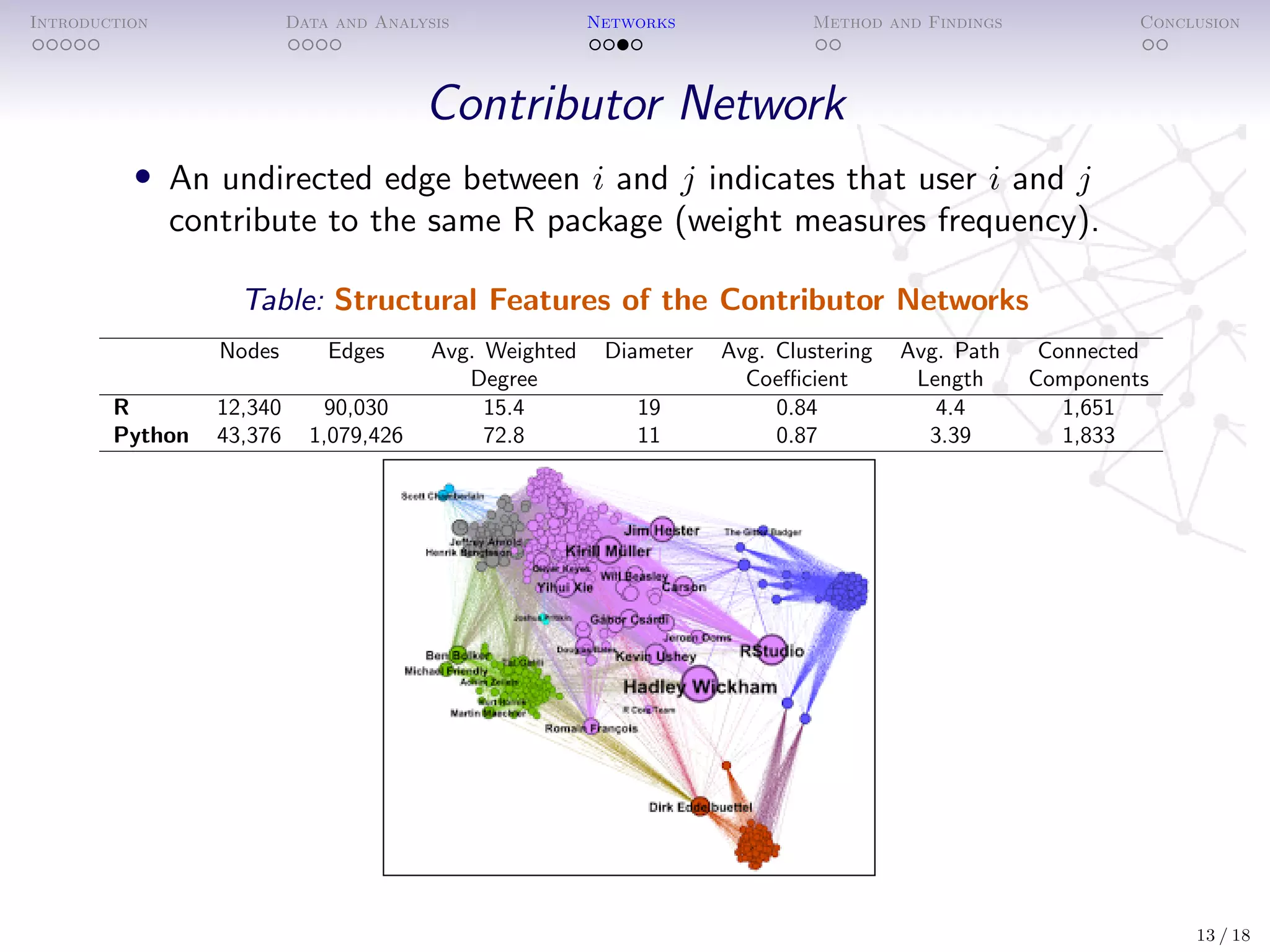
Contributor Network
• An undirected edge between i and j indicates that user i and j
contribute to the same R package (weight measures frequency).
Table: Structural Features of the Contributor Networks
Nodes Edges Avg. Weighted Diameter Avg. Clustering Avg. Path Connected
Degree Coefficient Length Components
R 12,340 90,030 15.4 19 0.84 4.4 1,651
Python 43,376 1,079,426 72.8 11 0.87 3.39 1,833
13 / 18
Introduction Data and Analysis Networks Method and Findings Conclusion
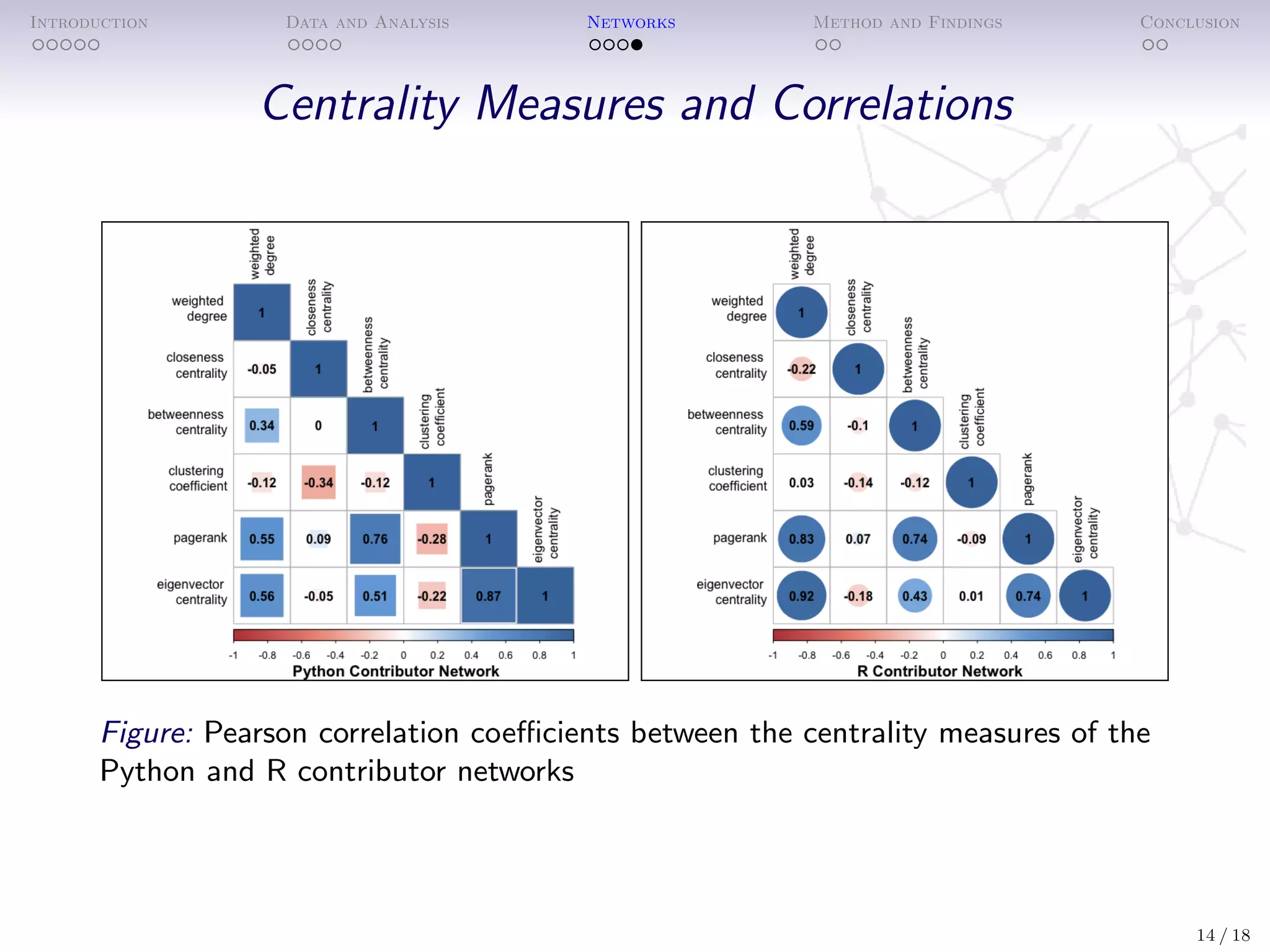
Centrality Measures and Correlations
Figure: Pearson correlation coefficients between the centrality measures of the
Python and R contributor networks
14 / 18
Introduction Data and Analysis Networks Method and Findings Conclusion
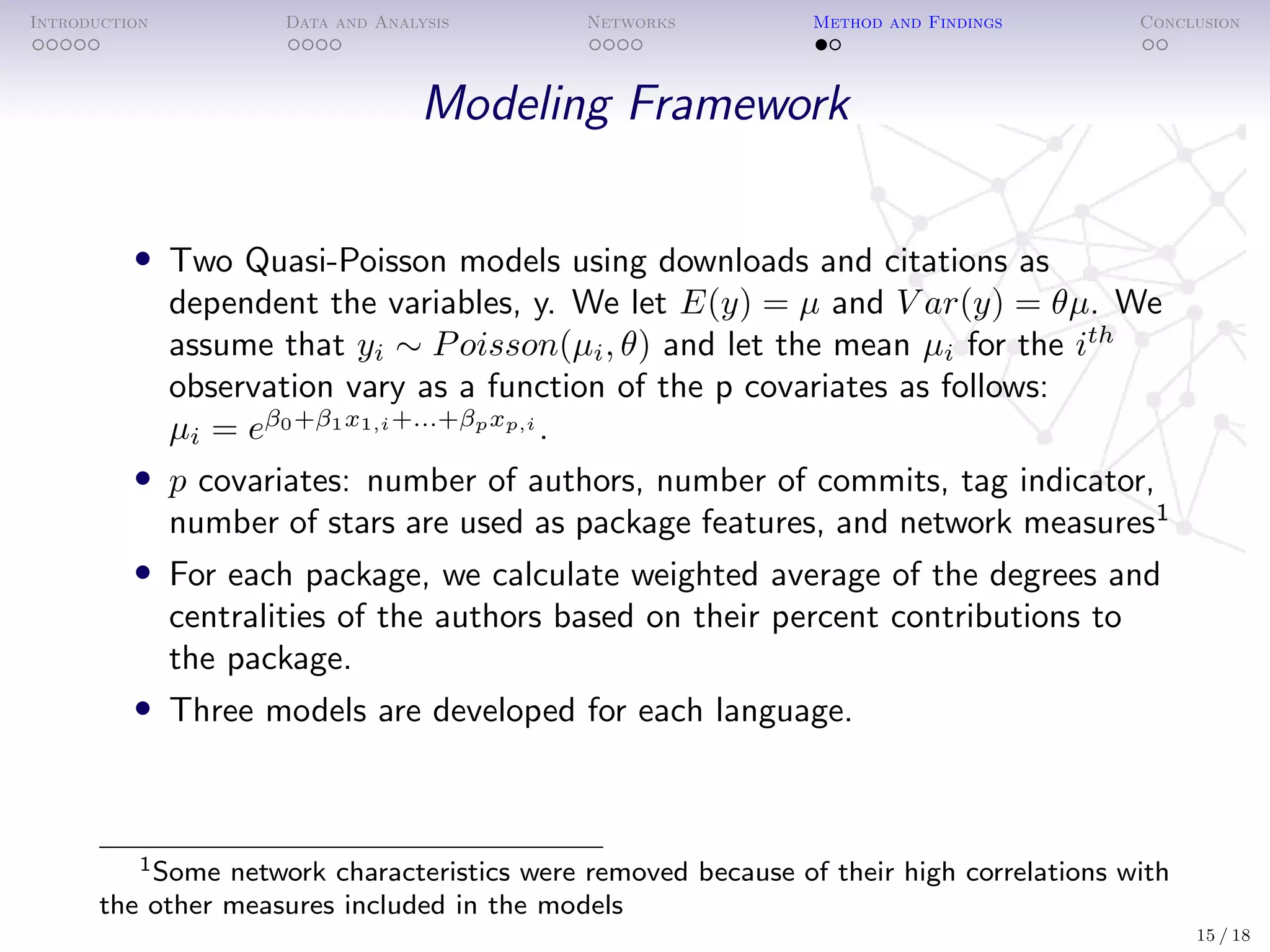
Modeling Framework
• Two Quasi-Poisson models using downloads and citations as
dependent the variables, y. We let E(y) = µ and V ar(y) = θµ. We
assume that yi ∼ Poisson(µi, θ) and let the mean µi for the ith
observation vary as a function of the p covariates as follows:
µi = eβ0+β1x1,i+...+βpxp,i
.
• p covariates: number of authors, number of commits, tag indicator,
number of stars are used as package features, and network measures1
• For each package, we calculate weighted average of the degrees and
centralities of the authors based on their percent contributions to
the package.
• Three models are developed for each language.
1Some network characteristics were removed because of their high correlations with
the other measures included in the models
15 / 18
Introduction Data and Analysis Networks Method and Findings Conclusion
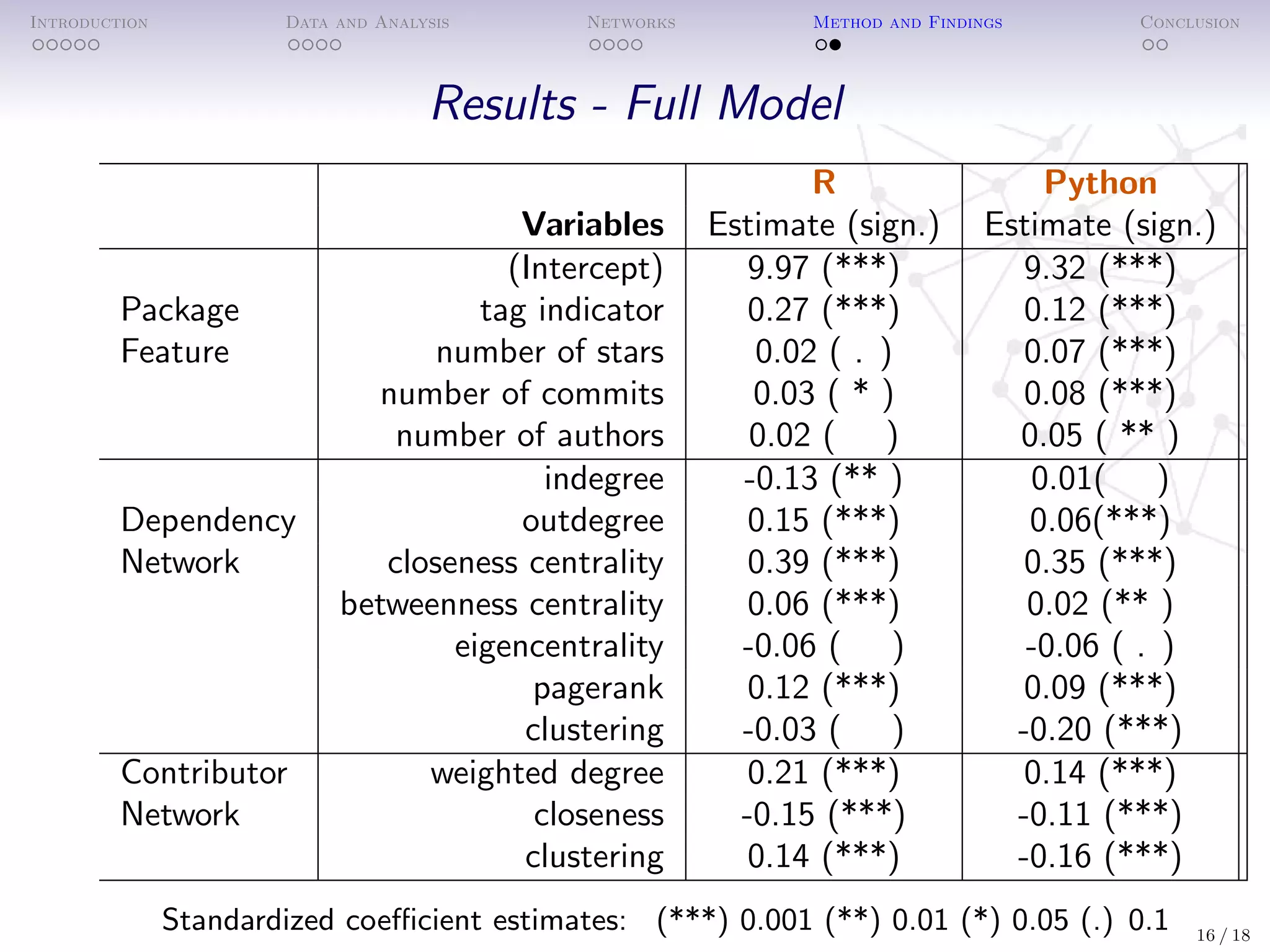
Results - Full Model
R Python
Variables Estimate (sign.) Estimate (sign.)
(Intercept) 9.97 (***) 9.32 (***)
Package tag indicator 0.27 (***) 0.12 (***)
Feature number of stars 0.02 ( . ) 0.07 (***)
number of commits 0.03 ( * ) 0.08 (***)
number of authors 0.02 ( ) 0.05 ( ** )
indegree -0.13 (** ) 0.01( )
Dependency outdegree 0.15 (***) 0.06(***)
Network closeness centrality 0.39 (***) 0.35 (***)
betweenness centrality 0.06 (***) 0.02 (** )
eigencentrality -0.06 ( ) -0.06 ( . )
pagerank 0.12 (***) 0.09 (***)
clustering -0.03 ( ) -0.20 (***)
Contributor weighted degree 0.21 (***) 0.14 (***)
Network closeness -0.15 (***) -0.11 (***)
clustering 0.14 (***) -0.16 (***)
Standardized coefficient estimates: (***) 0.001 (**) 0.01 (*) 0.05 (.) 0.1 16 / 18
Introduction Data and Analysis Networks Method and Findings Conclusion
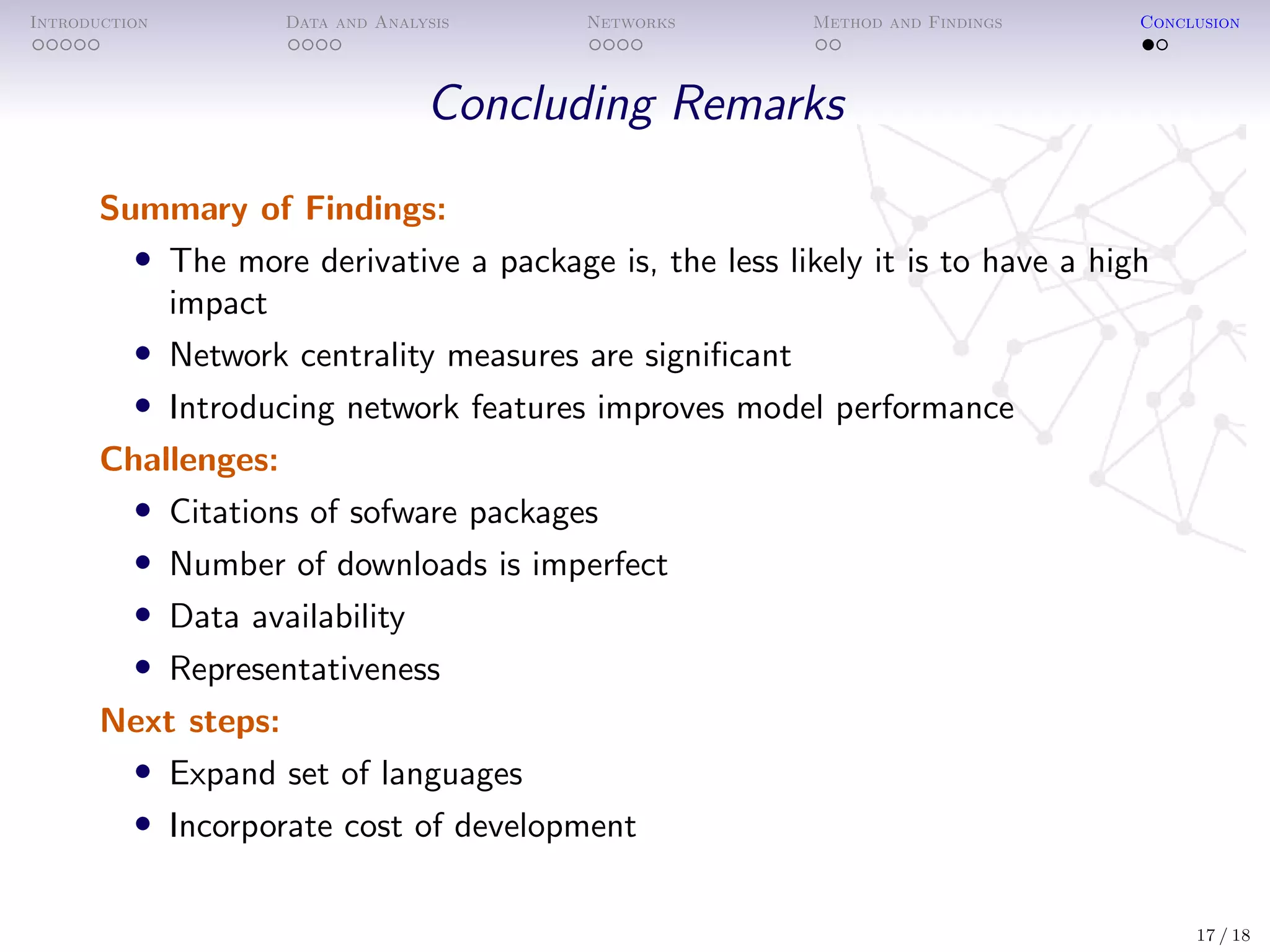
Concluding Remarks
Summary of Findings:
• The more derivative a package is, the less likely it is to have a high
impact
• Network centrality measures are significant
• Introducing network features improves model performance
Challenges:
• Citations of sofware packages
• Number of downloads is imperfect
• Data availability
• Representativeness
Next steps:
• Expand set of languages
• Incorporate cost of development
17 / 18
Introduction Data and Analysis Networks Method and Findings Conclusion
Thank you!
• Questions/Feedback?
• Contact:
Gizem Korkmaz (gkorkmaz@virginia.edu)
Research Associate Professor
Social and Decision Analytics Division (SDAD)
Biocomplexity Institute – University of Virginia
*This material is based on work supported by U.S. Department of
Agriculture (58-3AEU-7-0074) and the National Science Foundation
under IGERT Grant DGE-1144860, Big Data Social Science.
18 / 18

Modeling the Impact of R & Python Packages: Dependency and Contributor Networks

  • 1.
    Introduction Data andAnalysis Networks Method and Findings Conclusion Modeling the Impact of R & Python Packages: Dependency and Contributor Networks Gizem Korkmaz1 Claire Kelling2 Carol Robbins3 Sallie Keller1 1 Biocomplexity Institute, University of Virginia 2 Penn State University 3 National Science Foundation 2019 Women in Data Science Conference Charlottesville, March 29, 2018 1 / 18
  • 2.
    Introduction Data andAnalysis Networks Method and Findings Conclusion Introduction • Open Source Software (OSS) is a computer software with its source code made available with a license in which the copyright holder provides the rights to study, change, and distribute the software to anyone and for any purpose [Open Source Initiative, 1998]. • within and outside of the private sector • universities (e.g., Stanford, MIT, UC-Berkeley), business (e.g., Microsoft, Google), government research institutions (e.g., Sandia National Lab), nonprofits, and individuals • Examples include Linux, Apache, Python, and R. • Public funding for OSS is not fully accounted! 2 / 18
  • 3.
    Introduction Data andAnalysis Networks Method and Findings Conclusion Introduction Ways to Measure the Scope and Impact of Open Source Software • Cost of Software Package Creation • Identify number of people involved each package’s development; • Estimate time spent on software development; • Use average compensation for computer programmers; • Estimate intermediate inputs based on BEA (Bureau Economic Analysis) and OECD (Organisation for Economic Co-operation and Development) methodologies. *The National Bureau of Economic Research (NBER) Conference: Big Data for 21st Century Economics. Bethesda, March 2019. *International Monetary Fund (IMF) Statistical Forum on Measuring Economic Welfare in the Digital Age: What and How? Washington D.C., Nov. 2018. *The International Association for Research in Income and Wealth (IARIW): The Digital Economy: Conceptual and Measurement Issues. Copenhagen, Aug. 2018. 3 / 18
  • 4.
    Introduction Data andAnalysis Networks Method and Findings Conclusion OSS in Federal Government 4 / 18
  • 5.
    Introduction Data andAnalysis Networks Method and Findings Conclusion Resource Cost Based on GitHub Data • Methods used in software engineering • Based on lines of code, effort, and man-hours • Refinement needed! 5 / 18
  • 6.
    Introduction Data andAnalysis Networks Method and Findings Conclusion In this paper... • Focus on relative package impact (value) of R and Python packages using methods from bibliometrics and patents • Counts • Downloads • Citations • Reuse in other packages (dependencies) • Goal is to identify the factors that affect the impact, measured by downloads and citations • Collect publicly available information on R and Python packages • Generate dependency and contributor networks of OSS “ecosystem” • Develop statistical models to estimate the impact using • structural properties of the dependency and contributor networks. • author and package attributes *Preliminary version appeared in Proceedings of the 2018 IEEE/ACM International Conference on Advances in Social Network Analysis and Mining (ASONAM). pp. 511-514. IEEE. 6 / 18
  • 7.
    Introduction Data andAnalysis Networks Method and Findings Conclusion Data Source Depsy.org: a website that compiles R and Python packages to quantify coding impact in the scientific community. 7 / 18
  • 8.
    Introduction Data andAnalysis Networks Method and Findings Conclusion Data Collection • R • Gathered all of the R packages listed on CRAN: 10,926 packages • Scraped the characteristics from the JSON page affiliated with each R package from Depsy • Information about 9.8K packages and around 14K affiliated contributors • Python • Gathered all of the Python packages listed on PyPI: 192,666 packages • 43K Python packages and around 48K affiliated contributors Contributor Number of Contributor Number of Name Python Packages Name R Packages Plone Collective 495 Hadley Wickham 104 ube 419 Scott Chamberlain 87 Amalgam8 Team 352 rOpenSci 74 Contributors 288 Dirk Eddelbuettel 64 Marc Abramowitz 288 RStudio 61 Total: 48,255 Contributors Total: 13,883 Contributors 8 / 18
  • 9.
    Introduction Data andAnalysis Networks Method and Findings Conclusion Analysis • Impact measures: citations and downloads. Distributions of Downloads and Citations for Python and R Figure: Histograms and boxplots of number of citations (left) and number of downloads (right) for Python and R packages. Both of these metrics are right-skewed. 9 / 18
  • 10.
    Introduction Data andAnalysis Networks Method and Findings Conclusion Analysis Top Downloaded Number of Top Cited Number of Packages Downloads Packages Citations Rcpp 6,683,565 vegan 4,275 ggplot2 6,255,500 lme4 4,023 stringr 5,366,703 nlme 2,916 plyr 5,345,308 ggplot2 1,702 digest 5,251,824 gplots 1,307 Table: Top Downloaded and Cited Packages in R 10 / 18
  • 11.
    Introduction Data andAnalysis Networks Method and Findings Conclusion Dependency Network • i → j indicates that the package j requires i to function Table: Structural Features of the Dependency Networks Nodes Edges Avg. Degree Diameter Avg. Clustering Avg. Path Connected Coefficient Length Components R 7,389 20,235 2.74 9 0.07 2.4 56 Python 168,921 545,186 3.23 22 0.07 7.8 174 Identified communities (modularity class) Data wrangling, exploration and visualization (e.g., ggplot, dplyr, plyr, data.table) Statistical analysis packages (e.g., MASS, psych, survey) Web-based data/API processing (e.g., jsonlite, httr, stringer) Packages for matrix operations (Matrix, igraph, glmnet) Spatial data analysis (e.g., sp, fields, raster, maptools) Time series analysis (e.g., zoo, xts, forecast, sp, tseries) 11 / 18
  • 12.
    Introduction Data andAnalysis Networks Method and Findings Conclusion Dependency Network of R Packages Figure: A subgraph of the dependency network of R packages on Depsy that includes 572 nodes (7.74%). The size of the node indicates the outdegree (the top nodes are labeled), and the color represents the closeness centrality. 12 / 18
  • 13.
    Introduction Data andAnalysis Networks Method and Findings Conclusion Contributor Network • An undirected edge between i and j indicates that user i and j contribute to the same R package (weight measures frequency). Table: Structural Features of the Contributor Networks Nodes Edges Avg. Weighted Diameter Avg. Clustering Avg. Path Connected Degree Coefficient Length Components R 12,340 90,030 15.4 19 0.84 4.4 1,651 Python 43,376 1,079,426 72.8 11 0.87 3.39 1,833 13 / 18
  • 14.
    Introduction Data andAnalysis Networks Method and Findings Conclusion Centrality Measures and Correlations Figure: Pearson correlation coefficients between the centrality measures of the Python and R contributor networks 14 / 18
  • 15.
    Introduction Data andAnalysis Networks Method and Findings Conclusion Modeling Framework • Two Quasi-Poisson models using downloads and citations as dependent the variables, y. We let E(y) = µ and V ar(y) = θµ. We assume that yi ∼ Poisson(µi, θ) and let the mean µi for the ith observation vary as a function of the p covariates as follows: µi = eβ0+β1x1,i+...+βpxp,i . • p covariates: number of authors, number of commits, tag indicator, number of stars are used as package features, and network measures1 • For each package, we calculate weighted average of the degrees and centralities of the authors based on their percent contributions to the package. • Three models are developed for each language. 1Some network characteristics were removed because of their high correlations with the other measures included in the models 15 / 18
  • 16.
    Introduction Data andAnalysis Networks Method and Findings Conclusion Results - Full Model R Python Variables Estimate (sign.) Estimate (sign.) (Intercept) 9.97 (***) 9.32 (***) Package tag indicator 0.27 (***) 0.12 (***) Feature number of stars 0.02 ( . ) 0.07 (***) number of commits 0.03 ( * ) 0.08 (***) number of authors 0.02 ( ) 0.05 ( ** ) indegree -0.13 (** ) 0.01( ) Dependency outdegree 0.15 (***) 0.06(***) Network closeness centrality 0.39 (***) 0.35 (***) betweenness centrality 0.06 (***) 0.02 (** ) eigencentrality -0.06 ( ) -0.06 ( . ) pagerank 0.12 (***) 0.09 (***) clustering -0.03 ( ) -0.20 (***) Contributor weighted degree 0.21 (***) 0.14 (***) Network closeness -0.15 (***) -0.11 (***) clustering 0.14 (***) -0.16 (***) Standardized coefficient estimates: (***) 0.001 (**) 0.01 (*) 0.05 (.) 0.1 16 / 18
  • 17.
    Introduction Data andAnalysis Networks Method and Findings Conclusion Concluding Remarks Summary of Findings: • The more derivative a package is, the less likely it is to have a high impact • Network centrality measures are significant • Introducing network features improves model performance Challenges: • Citations of sofware packages • Number of downloads is imperfect • Data availability • Representativeness Next steps: • Expand set of languages • Incorporate cost of development 17 / 18
  • 18.
    Introduction Data andAnalysis Networks Method and Findings Conclusion Thank you! • Questions/Feedback? • Contact: Gizem Korkmaz (gkorkmaz@virginia.edu) Research Associate Professor Social and Decision Analytics Division (SDAD) Biocomplexity Institute – University of Virginia *This material is based on work supported by U.S. Department of Agriculture (58-3AEU-7-0074) and the National Science Foundation under IGERT Grant DGE-1144860, Big Data Social Science. 18 / 18