IB Extended Essay 
Formatting Requirements 
prepared by: MPI Librarians - 30 Aug. 2013
Parts of the Extended Essay 
● Title Page 
● Abstract 
● Contents Page 
● Introduction 
● Body (development/methods/results) 
● Conclusion 
● References and Bibliography (Works Cited) 
● Appendices
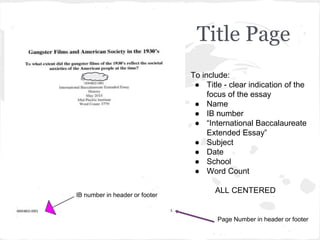
Title Page 
To include: 
● Title - clear indication of the 
focus of the essay 
● Name 
● IB number 
● “International Baccalaureate 
Extended Essay” 
● Subject 
● Date 
● School 
● Word Count 
ALL CENTERED 
Page Number in header or footer 
IB number in header or footer
Abstract 
What is an abstract? 
ab-stract (n.) a summary of ideas
Abstract 
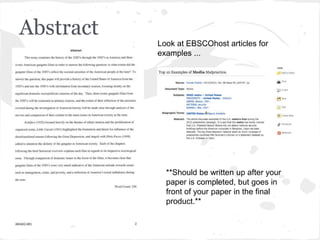
Look at EBSCOhost articles for 
examples ... 
**Should be written up after your 
paper is completed, but goes in 
front of your paper in the final 
product.**
Abstract 
● Normally written last 
○ State clearly: research question, 
scope of investigation, conclusion 
of essay 
● No more than 300 words 
● Placed right after title page
Contents Page 
http://macmost.com/creating-a-table-of-contents- 
in-pages.html
Contents Page 
Remember: 
● Start your paper BEFORE you make 
the table of contents 
● Make sure your cursor is on the page
Introduction
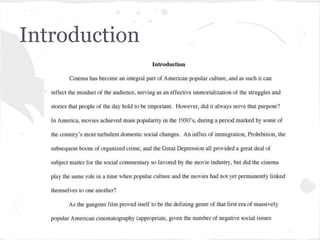
Introduction 
● Written after main body is complete 
● Introduces the topic 
○ Tells reader what to expect 
● Enables the reader to comprehend the 
significance of your research question 
○ Include your research questions
Body (development/methods/results) 
Typed double-spaced 
and 12 pt font
Body (development/methods/results) 
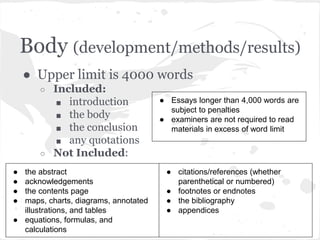
● Upper limit is 4000 words 
○ Included: 
■ introduction 
■ the body 
■ the conclusion 
■ any quotations 
○ Not Included: 
● the abstract 
● acknowledgements 
● the contents page 
● maps, charts, diagrams, annotated 
illustrations, and tables 
● equations, formulas, and 
calculations 
● Essays longer than 4,000 words are 
subject to penalties 
● examiners are not required to read 
materials in excess of word limit 
● citations/references (whether 
parenthetical or numbered) 
● footnotes or endnotes 
● the bibliography 
● appendices
Conclusion 
What is a conclusion? 
● NOT a summary 
● consistent with your thesis 
● How have you supported 
your thesis and answered 
the research question?
References, Citations, 
Bibliography 
● References 
○ You must include references in your body 
○ Anytime you refer to someone else’ work - 
a book you read, a website you used, an 
interview - that is a reference. 
○ ALL references MUST be cited
References, Citations, 
Bibliography 
● Citations 
○ quick way to refer the reader from a 
reference to the bibliography 
For example: 
Winnie the Pooh lived in the Hundred Acre 
Wood and loved honey (Milne, 6).
References, Citation, 
Bibliography 
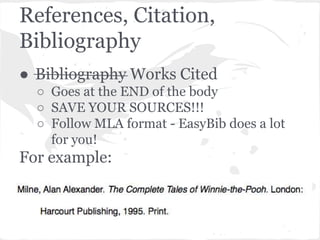
● Bibliography Works Cited 
○ Goes at the END of the body 
○ SAVE YOUR SOURCES!!! 
○ Follow MLA format - EasyBib does a lot 
for you! 
For example:
Appendices 
What is an appendix? 
● A collection of supplementary materials, 
usually appearing at the end of a report, 
proposal, or book. http://www.thefreedictionary.com/appendix
Footnotes and Endnotes 
MLA discourages extensive use of explanatory notes. 
However, MLA allow you to use endnotes or footnotes for 
bibliographic notes, which refer to other publications your 
readers may consult. The following are some examples: 
1. See Blackmur, especially chapters 3 and 
4, for an insightful analysis of this trend. 
2. On the problems related to repressed 
memory recovery, see Wollens 120-35; for a 
contrasting view, see Pyle 43; Johnson, Hull, 
Snyder 21-35; Krieg 78-91. 
http://owl.english.purdue.edu/owl/resource/747/04/
Good Luck Completing Your 
Extended Essay 
If you have any questions, please 
contact librarians or refer to this 
presentation

IB Extended Essay Requirements

  • 1.
    IB Extended Essay Formatting Requirements prepared by: MPI Librarians - 30 Aug. 2013
  • 2.
    Parts of theExtended Essay ● Title Page ● Abstract ● Contents Page ● Introduction ● Body (development/methods/results) ● Conclusion ● References and Bibliography (Works Cited) ● Appendices
  • 3.
    Title Page Toinclude: ● Title - clear indication of the focus of the essay ● Name ● IB number ● “International Baccalaureate Extended Essay” ● Subject ● Date ● School ● Word Count ALL CENTERED Page Number in header or footer IB number in header or footer
  • 4.
    Abstract What isan abstract? ab-stract (n.) a summary of ideas
  • 5.
    Abstract Look atEBSCOhost articles for examples ... **Should be written up after your paper is completed, but goes in front of your paper in the final product.**
  • 6.
    Abstract ● Normallywritten last ○ State clearly: research question, scope of investigation, conclusion of essay ● No more than 300 words ● Placed right after title page
  • 7.
  • 8.
    Contents Page Remember: ● Start your paper BEFORE you make the table of contents ● Make sure your cursor is on the page
  • 9.
  • 10.
    Introduction ● Writtenafter main body is complete ● Introduces the topic ○ Tells reader what to expect ● Enables the reader to comprehend the significance of your research question ○ Include your research questions
  • 11.
    Body (development/methods/results) Typeddouble-spaced and 12 pt font
  • 12.
    Body (development/methods/results) ●Upper limit is 4000 words ○ Included: ■ introduction ■ the body ■ the conclusion ■ any quotations ○ Not Included: ● the abstract ● acknowledgements ● the contents page ● maps, charts, diagrams, annotated illustrations, and tables ● equations, formulas, and calculations ● Essays longer than 4,000 words are subject to penalties ● examiners are not required to read materials in excess of word limit ● citations/references (whether parenthetical or numbered) ● footnotes or endnotes ● the bibliography ● appendices
  • 13.
    Conclusion What isa conclusion? ● NOT a summary ● consistent with your thesis ● How have you supported your thesis and answered the research question?
  • 14.
    References, Citations, Bibliography ● References ○ You must include references in your body ○ Anytime you refer to someone else’ work - a book you read, a website you used, an interview - that is a reference. ○ ALL references MUST be cited
  • 15.
    References, Citations, Bibliography ● Citations ○ quick way to refer the reader from a reference to the bibliography For example: Winnie the Pooh lived in the Hundred Acre Wood and loved honey (Milne, 6).
  • 16.
    References, Citation, Bibliography ● Bibliography Works Cited ○ Goes at the END of the body ○ SAVE YOUR SOURCES!!! ○ Follow MLA format - EasyBib does a lot for you! For example:
  • 17.
    Appendices What isan appendix? ● A collection of supplementary materials, usually appearing at the end of a report, proposal, or book. http://www.thefreedictionary.com/appendix
  • 18.
    Footnotes and Endnotes MLA discourages extensive use of explanatory notes. However, MLA allow you to use endnotes or footnotes for bibliographic notes, which refer to other publications your readers may consult. The following are some examples: 1. See Blackmur, especially chapters 3 and 4, for an insightful analysis of this trend. 2. On the problems related to repressed memory recovery, see Wollens 120-35; for a contrasting view, see Pyle 43; Johnson, Hull, Snyder 21-35; Krieg 78-91. http://owl.english.purdue.edu/owl/resource/747/04/
  • 19.
    Good Luck CompletingYour Extended Essay If you have any questions, please contact librarians or refer to this presentation