1
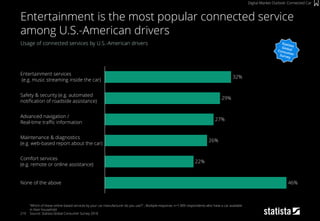
2
Digital technologies simplify our lives and open doors to
unprecedented business opportunities. Innovative
companies disrupt traditional industries and challenge
their incumbents. This transformative power involves both
opportunities and risks – for all of us. Regardless of
whether we are eager or reluctant: We have to keep pace,
otherwise we will be left behind.
For the second time now, Statista has compiled the most
relevant and recent data on the entire digital economy – a
comprehensive overview of one of the hottest topics of our
time. Since accurate data is a critical factor to decision-
making processes in business, we have gathered a set of
stunning facts, which are meant to inform and also to
entertain.
For the first time, our 2018 version features data from the
biggest market research project Statista has ever
conducted: The Global Consumer Survey. These insights
clarify to what extent people love, adopt, or avoid the
digital world.
The Digital Economy Compass presents facts about what
we consider the industries’ most relevant topics and
trends at the moment.
In the first part, we cover global trends: Is voice control
going to replace smartphones and touch-controlled
devices? How do digital giants like Google, Amazon or
Tencent actually make money? What role does social
media play? How can vertical platforms form new markets?
– to mention only a few of our key issues.
The second part covers all relevant digital markets, their
sizes, and business models.
The result of our research is more than 200 slides on the
global digital economy. In addition, we also provide a
printer-friendly version of our slide deck.
We are convinced that you will enjoy reading our
Digital Economy Compass.
Dr. Friedrich Schwandt (CEO)
Download your printer-friendly version here:
www.statista.io/decprinter
3
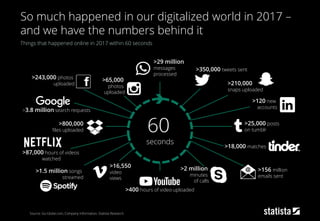
Things that happened online in 2017 within 60 seconds
Source: Go-Globe.com, Company Information, Statista Research
So much happened in our digitalized world in 2017 –
and we have the numbers behind it
>243,000 photos
uploaded
>3.8 million search requests
>800,000
files uploaded
>87,000 hours of videos
watched
>65,000
photos
uploaded
>29 million
messages
processed
>1.5 million songs
streamed
>16,550
video
views
>400 hours of video uploaded
>2 million
minutes
of calls
>156 million
emails sent
>18,000 matches
>25,000 posts
on tumblr
>120 new
accounts
>210,000
snaps uploaded
>350,000 tweets sent
60
seconds
4
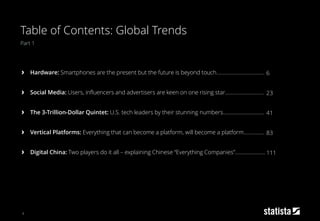
Part 1
Table of Contents: Global Trends
› Hardware: Smartphones are the present but the future is beyond touch……………………………..
› Social Media: Users, influencers and advertisers are keen on one rising star………………..……..
› The 3-Trillion-Dollar Quintet: U.S. tech leaders by their stunning numbers…………………………
› Vertical Platforms: Everything that can become a platform, will become a platform……………
› Digital China: Two players do it all – explaining Chinese “Everything Companies”………………….
6
23
41
83
111
5
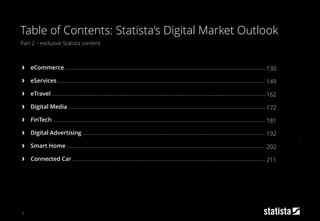
Part 2 – exclusive Statista content
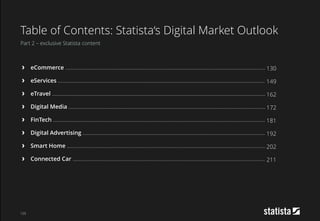
Table of Contents: Statista‘s Digital Market Outlook
› eCommerce ………………………………………………………………………………………………………………………………..
› eServices …………………………….……………………………………………………………………………………………………...
› eTravel …………………………………………………………………………………………………………………………………………
› Digital Media ………………………………………………………………………………………………………………………………
› FinTech ………………………………………………………………………………………………………………………………………..
› Digital Advertising …………………………..………………………………………………………………………….................
› Smart Home ……………………………………………………………………………………………………………………………….
› Connected Car …........................................................................................................................................
130
149
162
172
181
192
202
211
Hardware
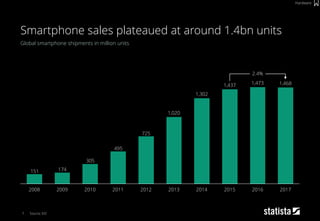
In 2017, more than 3.5 billion people were connected to the
internet – thanks to mobile devices. However, the stunning
rise of smartphones is coming to an end. The number of
shipments remained practically unchanged between 2016
and 2017: 1,472 million vs. 1,473 million.
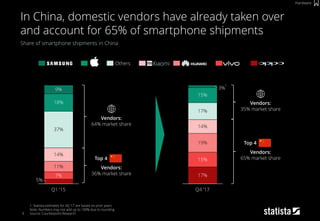
Most devices were sold in China, which accounted for about
one in three smartphone purchases. As the Chinese market
has constantly been growing over the past years, incumbent
manufacturers like Samsung and Apple face a huge threat:
Chinese producers, who are rapidly expanding their share
in the home market. The top 4 vendors (Xiaomi, Oppo, Vivo
and Huawei) together accounted for 67% of the domestic
smartphone market in Q4, 2017.
Next to smartphones, more and more other mobile devices
are equipped with a permanent internet connection, like
smartwatches or fitness trackers. When integrated with a
smartphone, a complete ecosystem emerges, which makes
it possible to be online at all times.
Manufacturers have already found the next big hit in the
hardware market, which goes one step beyond touch
control: smart speakers. Although the market is still small,
customers are eager for these new devices, and mass
market adoption is only a matter of time.
Smartphones are the present but the future is beyond touch
Global Trend
7
Global smartphone shipments in million units
Source: IDC
Smartphone sales plateaued at around 1.4bn units
Hardware
725
495
305
174151
2017
1,468
20162008 2009
1,473
2015
2.4%
20142012 2013
1,302
1,020
2010
1,437
2011
8
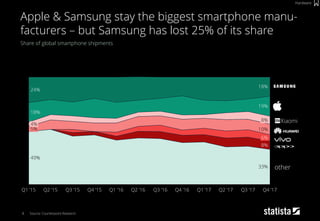
Share of global smartphone shipments
Source: Counterpoint Research
Apple & Samsung stay the biggest smartphone manu-
facturers – but Samsung has lost 25% of its share
Hardware
Q3 ’17
18%
Q4 ’16
18%
Q1 ’16Q1 ’15 Q3 ’16Q3 ’15 Q4 ’15Q2 ’15
5%
Q2 ’16
4%
33%
49%
24%
19%
Q4 ’17
8%
10%
6%
8%
Q1 ’17 Q2 ’17
other
9
Share of smartphone shipments in China
1: Statista estimates for 4Q ’17 are based on prior years
Note: Numbers may not add up to 100% due to rounding
Source: Counterpoint Research
In China, domestic vendors have already taken over
and account for 65% of smartphone shipments
Hardware
15%
19%
Q4 ’17
17%
14%
17%
15%
3%
Samsung OppoVivoHuaweiXiaomiOthersApple
Vendors:
65% market share
Vendors:
35% market share
Top 4
Q1 ’15
5%
11%
37%
18%
9%
7%
14%
Vendors:
64% market share
Vendors:
36% market share
Top 4
1
+13%1
504.7
63.9
48.2
2021
21.7
Body-worn camera
48.8
58.7
28.3
1.6
67.2
206.0
81.0
Wristband
Head-mounted display
22.3
5.6
347.5
Other fitness monitors
2018
168.0
Smartwatch
Sports watch
31.0
Bluetooth headset
10
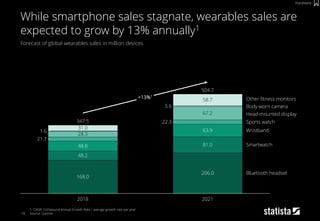
Forecast of global wearables sales in million devices
1: CAGR: Compound Annual Growth Rate / average growth rate per year
Source: Gartner
While smartphone sales stagnate, wearables sales are
expected to grow by 13% annually1
Hardware
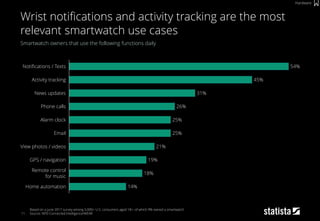
GPS / navigation
Phone calls
Activity tracking
26%
Notifications / Texts
News updates
Alarm clock
Email
View photos / videos
Remote control
for music
Home automation
54%
19%
45%
31%
25%
25%
21%
18%
14%
11
Smartwatch owners that use the following functions daily
Based on a June 2017 survey among 5,000+ U.S. consumers aged 18+, of which 9% owned a smartwatch
Source: NPD Connected Intelligence/WEAR
Wrist notifications and activity tracking are the most
relevant smartwatch use cases
Hardware
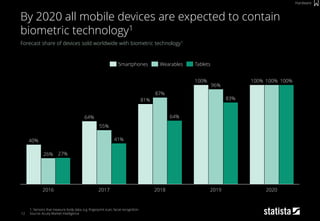
12
Forecast share of devices sold worldwide with biometric technology1
1: Sensors that measure body data, e.g. fingerprint scan, facial recognition
Source: Acuity Market Intelligence
By 2020 all mobile devices are expected to contain
biometric technology1
Hardware
64%
55%
2017
41%
2016
27%26%
40%
2019
100%
64%
87%
2020
81%
100%
83%
100% 100%
96%
2018
WearablesSmartphones Tablets
[…] We believe voice is the most
natural user interface and can really
improve the way people interact with
technology.
Dawn Brun
Public relations Senior Manager at Amazon
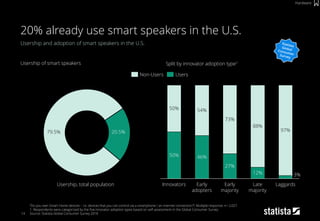
Usership of smart speakers Split by innovator adoption type1
3%
97%
50%
LaggardsInnovators
12%
73%
27%
46%
Late
majority
Early
adopters
50%
88%
54%
Early
majority
14
Usership and adoption of smart speakers in the U.S.
“Do you own Smart Home devices – i.e. devices that you can control via a smartphone / an internet connection?“; Multiple response; n= 2,027
1: Respondents were categorized by the five innovator adoption types based on self-assessment in the Global Consumer Survey
Source: Statista Global Consumer Survey 2018
20% already use smart speakers in the U.S.
Hardware
Usership, total population
UsersNon-Users
79.5% 20.5%
15
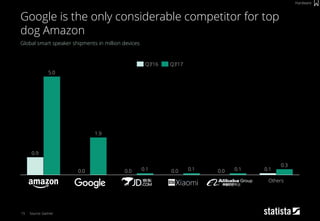
Global smart speaker shipments in million devices
Source: Gartner
Google is the only considerable competitor for top
dog Amazon
Hardware
Xiaomi
1.9
0.1
Alibaba Group
0.1
Google
0.9
Amazon
0.0
5.0
Others
0.00.00.10.0
0.3
JD.com
0.1
Q3’17Q3’16
16
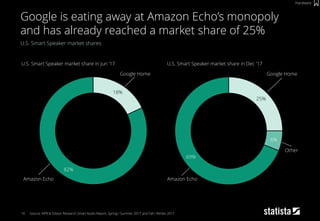
U.S. Smart Speaker market shares
Source: NPR & Edison Research Smart Audio Report, Spring / Summer 2017 and Fall / Winter 2017
Google is eating away at Amazon Echo’s monopoly
and has already reached a market share of 25%
Hardware
U.S. Smart Speaker market share in Jun ‘17
18%
82%
25%
6%
69%
U.S. Smart Speaker market share in Dec ‘17
Google Home
Amazon Echo
Google Home
Other
Amazon Echo
17
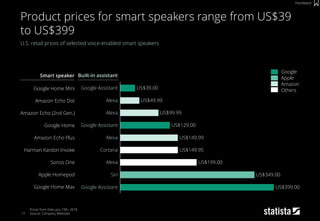
U.S. retail prices of selected voice-enabled smart speakers
Prices from February 19th, 2018
Source: Company Websites
Product prices for smart speakers range from US$39
to US$399
Hardware
US$39.00
US$49.99
Google Assistant
Alexa
US$149.99
US$99.99
Cortana
Alexa
US$129.00
US$199.00
US$149.95
Alexa
Google Assistant
Built-in assistant
Siri
Google Assistant
Alexa
US$399.00
US$349.00
Google Home Mini
Amazon Echo Dot
Amazon Echo (2nd Gen.)
Google Home
Amazon Echo Plus
Harman Kardon Invoke
Sonos One
Apple Homepod
Google Home Max
Google
Apple
Amazon
Others
Smart speaker
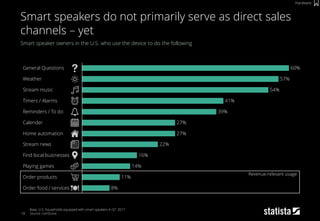
Reminders / To do
Stream news
39%
Timers / Alarms 41%
Stream music 54%
Find local businesses 16%
Order food / services 8%
14%
11%
Playing games
22%
27%
Calender
Order products
27%
Home automation
Weather 57%
General Questions 60%
18
Smart speaker owners in the U.S. who use the device to do the following
Base: U.S. households equipped with smart speakers in Q1 2017
Source: comScore
Smart speakers do not primarily serve as direct sales
channels – yet
Hardware
Revenue-relevant usage
19
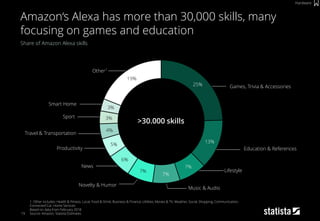
Share of Amazon Alexa skills
1: Other includes: Health & Fitness, Local, Food & Drink, Business & Finance, Utilities, Movies & TV, Weather, Social, Shopping, Communication,
Connected Car, Home Services
Based on data from February 2018
Source: Amazon, Statista Estimates
Amazon‘s Alexa has more than 30,000 skills, many
focusing on games and education
Hardware
Games, Trivia & Accessories
Education & References
Lifestyle
Novelty & Humor
Travel & Transportation
Other1
News
Productivity
Sport
Smart Home
Music & Audio
25%
13%
7%
7%
7%
6%
5%
4%
3%
3%
19%
>30.000 skills
483
165
163
135
111
89
74
73
67
65
65
62
57
46
38
38
34
4%
Shopping
4%
4%Arts & Lifestyle
4%
Food & Drink
9%Home Control
Education & References 9%
6%
Business & Finance 8%
2%
3%
3%
Music & Audio
News & Magazines 2%
Local
Movies, Photos & TV
Sports
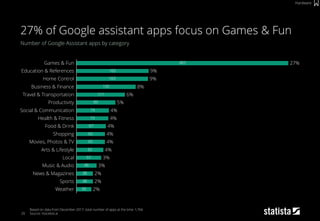
Games & Fun 27%
Weather 2%
5%
Health & Fitness
Social & Communication
4%
Productivity
Travel & Transportation
4%
20
Number of Google Assistant apps by category
Based on data from December 2017, total number of apps at the time: 1,766
Source: Voicebot.ai
27% of Google assistant apps focus on Games & Fun
Hardware
21
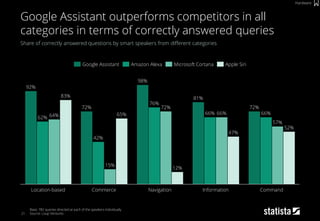
Share of correctly answered questions by smart speakers from different categories
Base: 782 queries directed at each of the speakers individually
Source: Loup Ventures
Google Assistant outperforms competitors in all
categories in terms of correctly answered queries
Hardware
52%
66%
Navigation
15%
42%
72%
76%
Location-based
83% 81%
Information
57%
47%
66% 66%
72%
12%
Command
72%
98%
Commerce
65%
92%
64%62%
Apple SiriMicrosoft CortanaAmazon AlexaGoogle Assistant
60%
In your car / vehicle
At places other than
your home / work / car
On your phone
On your television 53%
At your workplace
64%
35%
30%
22
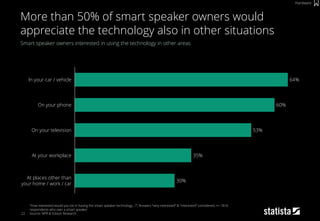
Smart speaker owners interested in using the technology in other areas
“How interested would you be in having the smart speaker technology…?”, Answers “very interested” & “interested” considered; n= 1816
respondents who own a smart speaker
Source: NPR & Edison Research
More than 50% of smart speaker owners would
appreciate the technology also in other situations
Hardware
Social Media
In 2004, Mark Zuckerberg started Facebook as a social
network for Harvard students – a very exclusive club of
people could communicate through the new service.
Fourteen years later, a whole new industry has emerged,
which changed the way we consume media, talk, chat and
stay in touch with friends.
Without doubt, Facebook is the most important player in
this field, but by far not the only one. Similar platforms have
developed, which address different kinds of purposes:
business networks, instant messaging or photo sharing.
In the past year, it was especially Snapchat and Instagram
that dominated the media: Snapchat caused a stir when
Snap Inc. announced their IPO in March 2017, which raised
expectations of shareholders as well as investors. Instagram
for its part developed into the number one platform for
influencers, with user numbers surging: It has become the
rising social media star.
We analyzed overall social media consumption and how
people really use the services. Who are the users? How
many of them actually like and share at all and how many
just get their daily news?
Users, influencers and advertisers are keen on one rising star
Global Trends
23
24
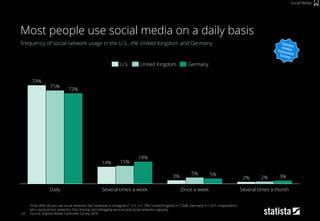
Frequency of social network usage in the U.S., the United Kingdom and Germany
“How often do you use social networks like Facebook or Instagram?”; U.S. n=1,789, United Kingdom n=1,688, Germany n=1,427; respondents
who use business networks, foto sharing, microblogging services and social networks regularly
Source: Statista Global Consumer Survey 2018
Most people use social media on a daily basis
Social Media
Several times a monthDaily
18%
3%
79%
15%
75%
Several times a week
73%
14%
2%2%
Once a week
3%
5% 5%
GermanyUnited KingdomU.S.
25
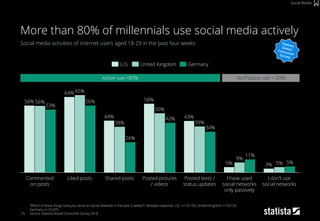
Social media activities of internet users aged 18-29 in the past four weeks
“Which of these things have you done on social networks in the past 4 weeks?”; Multiple response; U.S.: n=10,150, United Kingdom n=10,129,
Germany n=10,379
Source: Statista Global Consumer Survey 2018
More than 80% of millennials use social media actively
Social Media
3%
Posted pictures
/ videos
Commented
on posts
34%
I have used
social networks
only passively
58%
39%
56%
44%
11%
9%
38%
56%
65%
Posted texts /
status updates
43%
5%5%
Shared posts
42%
26%
Liked posts I don’t use
social networks
5%
50%
64%
56%
53%
GermanyU.S. United Kingdom
Active use >80% No/Passive use < 20%
Facebook
26
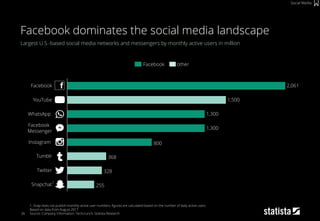
Largest U.S.-based social media networks and messengers by monthly active users in million
1: Snap does not publish monthly active user numbers; figures are calculated based on the number of daily active users
Based on data from August 2017
Source: Company Information, Techcrunch, Statista Research
Facebook dominates the social media landscape
Social Media
255
328
368
800
Snapchat
Tumblr
Instagram
Twitter
WhatsApp
Facebook
Messenger
1,300
YouTube 1,500
Facebook
1,300
2,061
1
other
There is a real value
in sharing moments that
don’t live forever.
Evan Spiegel
Founder and CEO Snap Inc.
28
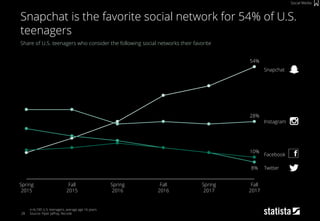
Share of U.S. teenagers who consider the following social networks their favorite
n=6,100 U.S. teenagers, average age 16 years
Source: Piper Jaffray, Recode
Snapchat is the favorite social network for 54% of U.S.
teenagers
Social Media
Snapchat
Facebook
Twitter
Instagram
Fall
2017
54%
Spring
2017
Spring
2015
28%
8%
Fall
2016
Spring
2016
10%
Fall
2015
26 30 32 35 38 40 44 48 54 61 65 68 71 75 77 80
14
18 20 23
27 29 30
34
39
46
49
52 55
57 57
60
11
13
16
18
20
24
29
36
39
39
40
42 44
47
9
6
Q4 ’17Q3 ’17
153
143
Q1 ’16Q4 ’15
159
106
Q2 ’16
122
54%
187
178
Q2 ’17
174
13%
Q3 ’16
30%
Q1 ’17
166
Q4 ’16
81
Q4 ’14
31%
71
Q2 ’15Q3 ’14
63
Q3 ’15
94
Q1 ’15
46
Q1 ’14
57
Q2 ’14
87
29
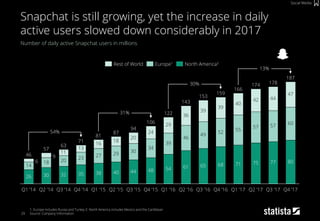
Number of daily active Snapchat users in millions
1: Europe includes Russia and Turkey 2: North America includes Mexico and the Caribbean
Source: Company Information
Snapchat is still growing, yet the increase in daily
active users slowed down considerably in 2017
Social Media
North America2Rest of World Europe1
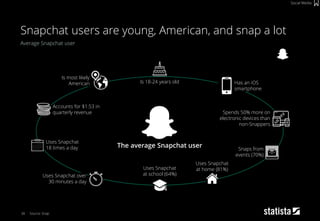
Average Snapchat user
Source: Snap
Snapchat users are young, American, and snap a lot
Social Media
Accounts for $1.53 in
quarterly revenue
Uses Snapchat
at home (81%)
Is 18-24 years old
Uses Snapchat
18 times a day
Uses Snapchat
at school (64%)Uses Snapchat over
30 minutes a day
Is most likely
American
Spends 50% more on
electronic devices than
non-Snappers
Snaps from
events (70%)
Has an iOS
smartphone
30
The average Snapchat user
31
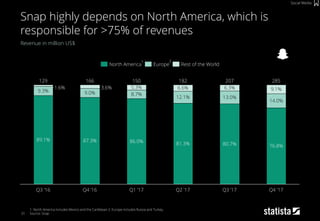
Revenue in million US$
1: North America includes Mexico and the Caribbean 2: Europe includes Russia and Turkey
Source: Snap
Snap highly depends on North America, which is
responsible for >75% of revenues
Social Media
6.6% 9.1%
Q4 ’17
6.3%
80.7%
207
76.8%81.3%
Q1 ’17
150
5.3%
Q2 ’17
14.0%
182
Q3 ’17
3.6%
89.1%
1.6%
87.3%
9.0%
Q3 ’16
129
9.3%
166
8.7%
86.0%
Q4 ’16
285
12.1% 13.0%
Rest of the WorldNorth America Europe
1 2
285
208182150166128
7239331754
-350
-443
-194-170-124-116-105-98-97-80-99
Q4 ’17Q3 ’17Q4 ’16Q2 ’15 Q4 ’15Q1 ’15 Q3 ’16 Q1 ’17Q3 ’15 Q1 ’16
-2,209
Q2 ’16 Q2 ’17
32
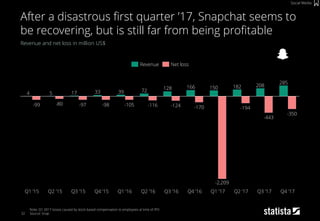
Revenue and net loss in million US$
Note: Q1 2017 losses caused by stock-based compensation to employees at time of IPO
Source: Snap
After a disastrous first quarter ’17, Snapchat seems to
be recovering, but is still far from being profitable
Social Media
Revenue Net loss
14
2
4
6
8
16
10
12
18
20
22
24
26
28
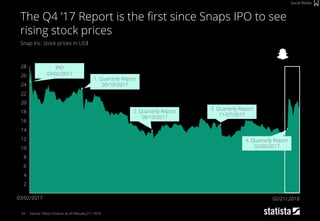
03/02/2017
33
Snap Inc. stock prices in US$
Source: Yahoo Finance, as of February 21st 2018
The Q4 ’17 Report is the first since Snaps IPO to see
rising stock prices
Social Media
02/21/.2018
1. Quarterly Report
05/10/2017
2. Quarterly Report
08/10/2017
3. Quarterly Report
11/07/2017
4. Quarterly Report
02/06/2017
IPO
03/02/2017
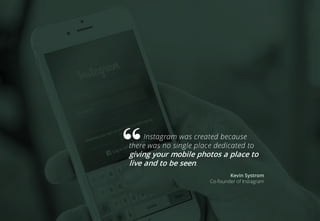
Instagram was created because
there was no single place dedicated to
giving your mobile photos a place to
live and to be seen.
Kevin Systrom
Co-founder of Instagram
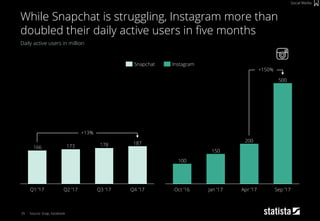
35
Daily active users in million
Source: Snap, Facebook
While Snapchat is struggling, Instagram more than
doubled their daily active users in five months
Social Media
187178173166
Q3 ’17Q2 ’17 Q4 ’17Q1 ’17
+13%
Snapchat
500
200
150
100
Oct ’16
+150%
Sep ’17Apr ’17Jan ’17
Instagram
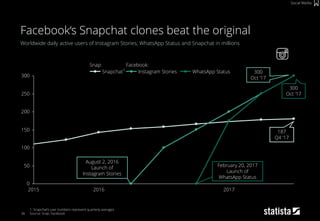
36
Worldwide daily active users of Instagram Stories, WhatsApp Status and Snapchat in millions
1: Snapchat‘s user numbers represent quarterly averages
Source: Snap, Facebook
Facebook‘s Snapchat clones beat the original
Social Media
0
50
100
150
200
250
300
20172015 2016
WhatsApp StatusInstagram StoriesSnapchat
August 2, 2016
Launch of
Instagram Stories
February 20, 2017
Launch of
WhatsApp Status
187
Q4 ‘17
300
Oct ‘17
300
Oct ‘17
1
Snap: Facebook:
37
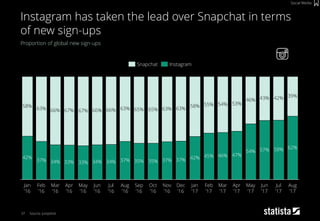
Proportion of global new sign-ups
Source: Jumpshot
Instagram has taken the lead over Snapchat in terms
of new sign-ups
Social Media
42%
37% 34% 33% 33% 34% 34% 37% 35% 35% 37% 37% 42% 45% 46% 47%
54% 57% 58% 62%
58% 63% 66% 67% 67% 66% 66% 63% 65% 65% 63% 63% 58% 55% 54% 53%
46% 43% 42% 39%
Jul
’17
Jun
’17
May
’17
Aug
’17
Apr
’17
Apr
’16
Mar
’16
Mar
’17
Jan
’16
Feb
’17
Feb
’16
Jul
’16
Dec
’16
Nov
’16
Aug
’16
Oct
’16
Jun
’16
May
’16
Jan
’17
Sep
’16
InstagramSnapchat
27.1%37.6%42.2%46.6%99.3% 70.2%
Snapchat
12.2%
1.7% 0.2%
3.2%
Twitter
1.0%0.5% 1.7%1.2%
Instagram Youtube
2.7% 0.5%
Pinterest
92.9%
Facebook
82.2%
38
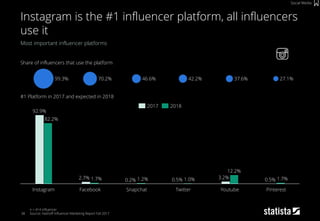
Most important influencer platforms
n = 414 influencer
Source; Hashoff Influencer Marketing Report Fall 2017
Instagram is the #1 influencer platform, all influencers
use it
Social Media
2017 2018
#1 Platform in 2017 and expected in 2018
Share of influencers that use the platform
39
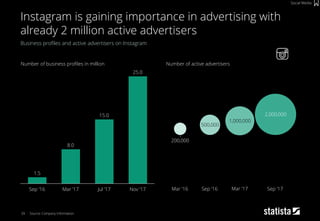
Business profiles and active advertisers on Instagram
Source: Company Information
Instagram is gaining importance in advertising with
already 2 million active advertisers
Social Media
1.5
Sep ’16
8.0
25.0
Nov ’17
15.0
Jul ’17Mar ’17
Number of business profiles in million Number of active advertisers
1,000,000
2,000,000
200,000
500,000
Mar ‘16 Sep ‘16 Mar ‘17 Sep ‘17
40
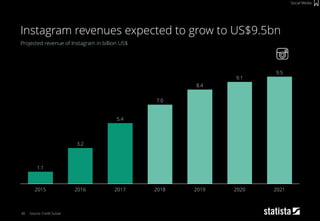
Projected revenue of Instagram in billion US$
Source: Credit Suisse
Instagram revenues expected to grow to US$9.5bn
Social Media
2018
7.0
201920162015
1.1
2020
3.2
9.5
2017
5.4
2021
9.1
8.4
The 3-Trillion-Dollar Quintet
They are the providers of the most innovative technologies
with mass market adoption, they have billions of daily active
users, combined revenues of over US$500bn and a US$3
trillion market capitalization: Apple, Google (Alphabet),
Microsoft, Amazon, and Facebook shape the digital world
like no other.
They create new services and business models and
successively expand into completely new industries. Due to
their fast scalability, the “big five” have achieved a size and
global reach that is impressive and frightening alike. Some
examples? In 2016, Google generated more digital ad
revenues than the Chinese economy spent on digital ads in
total. Apple is sitting on such a huge pile of overseas cash
that they could buy every franchise of the Top 5 U.S. sports
leagues – with a lot of money left to give to employees to
watch some games. In August 2017, Amazon announced
that about one in three U.S. internet users had become an
Amazon Prime subscriber.
We analyzed what these great companies earn their money
with. Who are their cash cows and their rising stars? After
this analysis one might ask: What would our everyday life
look like if these companies did not exist?
U.S. tech leaders by their stunning numbers
Global Trend
42
Most valuable companies by market cap in billion US$
Valuation based on data from December 31st of the respective year
Source: morningstar.com, Financial Times, Statista research
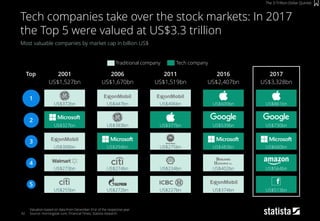
Tech companies take over the stock markets: In 2017
the Top 5 were valued at US$3.3 trillion
The 3-Trillion-Dollar Quintet
201720162001 2006 2011
Traditional company Tech company
Top
1
2
3
4
US$3,328bnUS$2,407bnUS$1,527bn US$1,670bn US$1,519bn
5
US$327bn US$383bn US$377bn US$539bn US$730bn
US$372bn US$447bn US$406bn US$609bn US$861bn
US$300bn US$294bn US$275bn US$483bn US$660bn
US$273bn US$274bn US$234bn US$402bn US$564bn
US$255bn US$272bn US$227bn US$374bn US$513bn
43
Global annual revenue development in billion US$
Note: Facebook revenues included as of 2007
Source: Company Information
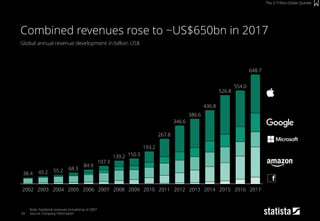
Combined revenues rose to ~US$650bn in 2017
The 3-Trillion-Dollar Quintet
648.7
554.0
267.8
526.8
386.6
150.3
193.2
346.6
2008
139.2
2017
84.9
68.3
2004 2009 20102007 2013 20142012 2015
436.8
20032002 2011
55.2
20162006
38.4
107.3
45.2
2005
+4,423%
136.0
3.9
177.9
44
Global annual revenue development from 2002 to 2017 in billion US$
Note: Facebook revenues included as of 2007
Source: Company Information
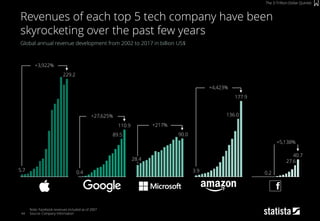
Revenues of each top 5 tech company have been
skyrocketing over the past few years
The 3-Trillion-Dollar Quintet
229.2
+3,922%
5.7
+27,625%
110.9
89.5
0.4
+5,138%
40.7
27.6
0.2
90.0
+217%
28.4
45
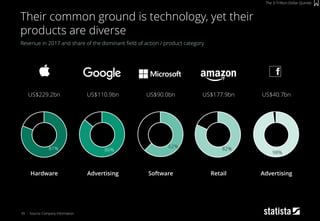
Revenue in 2017 and share of the dominant field of action / product category
Source: Company Information
Their common ground is technology, yet their
products are diverse
The 3-Trillion-Dollar Quintet
Hardware RetailAdvertising AdvertisingSoftware
81% 86% 82%
98%
62%
US$229.2bn US$177.9bnUS$110.9bn US$40.7bnUS$90.0bn
46
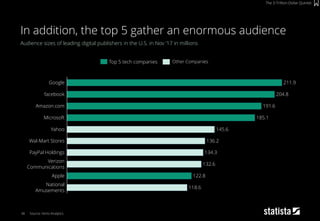
Audience sizes of leading digital publishers in the U.S. in Nov ‘17 in millions
Source: Verto Analytics
In addition, the top 5 gather an enormous audience
The 3-Trillion-Dollar Quintet
185.1Microsoft
145.6
211.9
191.6
facebook 204.8
Amazon.com
Google
National
Amusements
122.8
Verizon
Communications
132.6
134.3
118.6
Apple
PayPal Holdings
136.2Wal-Mart Stores
Yahoo
Top 5 tech companies Other Companies
47
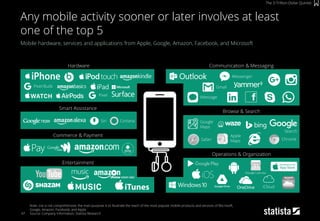
Mobile hardware, services and applications from Apple, Google, Amazon, Facebook, and Microsoft
Note: List is not comprehensive; the main purpose is to illustrate the reach of the most popular mobile products and services of Microsoft,
Google, Amazon, Facebook, and Apple
Source: Company Information, Statista Research
Any mobile activity sooner or later involves at least
one of the top 5
The 3-Trillion-Dollar Quintet
Pixel
Pixel Buds
iCloud
iMessage
Gmail
Messenger
Chrome
Google
Maps
Search
Apple
MapsSafari
Siri Cortana
Hardware
Operations & Organization
Browse & Search
Communication & Messaging
Entertainment
Commerce & Payment
Smart Assistance
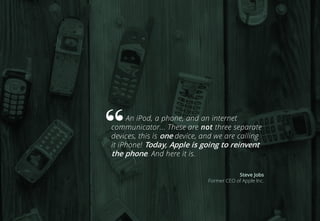
An iPod, a phone, and an internet
communicator... These are not three separate
devices, this is one device, and we are calling
it iPhone! Today, Apple is going to reinvent
the phone. And here it is.
Steve Jobs
Former CEO of Apple Inc.
49
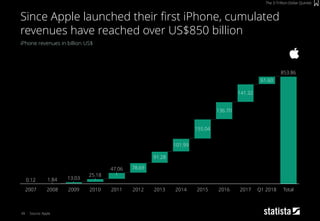
iPhone revenues in billion US$
Source: Apple
Since Apple launched their first iPhone, cumulated
revenues have reached over US$850 billion
The 3-Trillion-Dollar Quintet
0.12
2016
853.86
91.28
2011
141.32
101.99
61.60
78.69
155.04
2017
47.06
Total2012 201420132008 Q1 20182009 2015
25.18
136.70
2010
13.03
2007
1.84
50
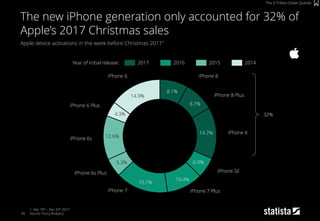
Apple device activations in the week before Christmas 20171
1: Dec 19th – Dec 25th 2017
Source: Flurry Analytics
The new iPhone generation only accounted for 32% of
Apple’s 2017 Christmas sales
The 3-Trillion-Dollar Quintet
2017 2016 2015 2014Year of initial release:
iPhone X
15.1%
10.4%
6.0%
14.7%
8.7%
8.1%
5.3%
12.6%
4.3%
14.9%
iPhone 7 iPhone 7 Plus
iPhone SE
iPhone 8 Plus
iPhone 8
iPhone 6s Plus
iPhone 6 Plus
iPhone 6
iPhone 6s
32%
66%
9%
11%
10%
4%
63%
11%
11%
10%
5%
62%
13%
11%
8%
6%
51
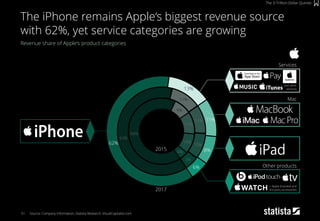
Revenue share of Apple‘s product categories
Source: Company Information, Statista Research, VisualCapitalist.com
The iPhone remains Apple‘s biggest revenue source
with 62%, yet service categories are growing
The 3-Trillion-Dollar Quintet
and other
services
Services
+ Apple branded and
3rd party accessories
Other products
Mac
2015
2017
52
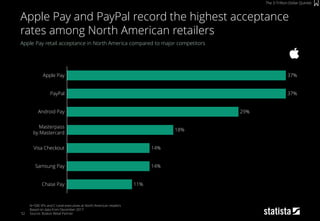
Apple Pay retail acceptance in North America compared to major competitors
N=500 VPs and C-Level executives at North American retailers
Based on data from December 2017
Source: Boston Retail Partner
Apple Pay and PayPal record the highest acceptance
rates among North American retailers
The 3-Trillion-Dollar Quintet
37%PayPal
Samsung Pay
Visa Checkout 14%
11%
14%
18%
Android Pay 29%
Masterpass
by Mastercard
Chase Pay
Apple Pay 37%
Buy some of the most famous
technology companies, e.g.
Produce 1,680
Harry Potter Movies
Buy one Bugatti
Veyron for every
of its 132,000
employees
Buy the 3.4 square-
kilometers of
New York‘s
Central Park1
Pay off the national debt of Ireland,
which amounts to US$231bn
Buy every franchise of the top five
U.S. sports leagues, with US$50bn left
53
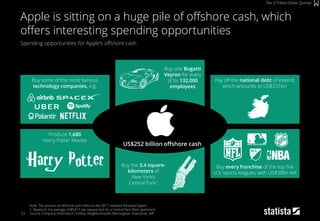
Spending opportunities for Apple‘s offshore cash
Note: The amount of offshore cash refers to the 2017 released Paradise Papers
1: Based on the average US$5,417 per square foot for a Central Park West apartment
Source: Company Information, Forbes, NeighborhoodX, Morningstar, Dow Jones, IMF
Apple is sitting on a huge pile of offshore cash, which
offers interesting spending opportunities
The 3-Trillion-Dollar Quintet
US$252 billion offshore cash
54
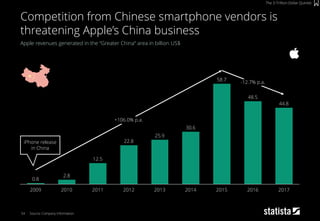
Apple revenues generated in the “Greater China“ area in billion US$
Source: Company Information
Competition from Chinese smartphone vendors is
threatening Apple’s China business
The 3-Trillion-Dollar Quintet
+106.0% p.a.
12.5
2009
58.7
20152014
0.8
-12.7% p.a.
2016
44.8
22.8
2.8
2010 2017
30.6
2011
25.9
2013
48.5
2012
iPhone release
in China
If it isn’t on Google, it doesn’t exist.
Jimmy Wales
Co-founder of Wikipedia
56
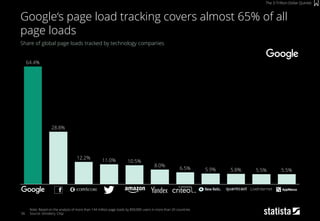
Share of global page loads tracked by technology companies
Note: Based on the analysis of more than 144 million page loads by 850,000 users in more than 20 countries
Source: Ghostery, Cliqz
Google‘s page load tracking covers almost 65% of all
page loads
The 3-Trillion-Dollar Quintet
28.8%
64.4%
Google Facebook
5.9%6.5%
Yandex
10.5%
Criteo
11.0%
8.0%
Amazon.comTwittercomScore
12.2%
LiveInternet
5.8%
New Relic
5.5%
AppNexusQuantserve
5.5%
57
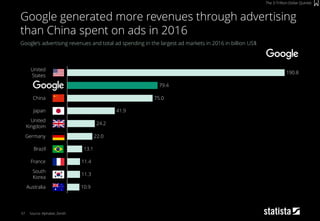
Google‘s advertising revenues and total ad spending in the largest ad markets in 2016 in billion US$
Source: Alphabet, Zenith
Google generated more revenues through advertising
than China spent on ads in 2016
The 3-Trillion-Dollar Quintet
75.0
Germany
South
Korea
Australia
41.9
United
Kingdom
France
Brazil
China
United
States
13.1
11.4
190.8
Google
11.3
79.4
10.9
24.2
22.0
Japan
90%
10%
1%
88%
11%
1%86%
13%
1%
58
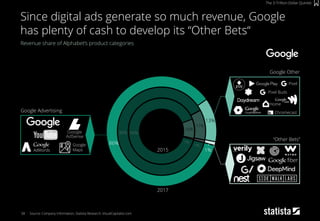
Revenue share of Alphabet‘s product categories
Source: Company Information, Statista Research, VisualCapitalist.com
Since digital ads generate so much revenue, Google
has plenty of cash to develop its “Other Bets“
The 3-Trillion-Dollar Quintet
Google Advertising
Google
Maps
“Other Bets”
Google Other
Pixel
Chromecast
Home
Pixel Buds
2015
2017
59
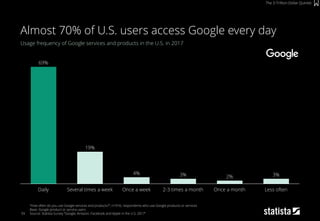
Usage frequency of Google services and products in the U.S. in 2017
“How often do you use Google services and products?”; n=916; respondents who use Google products or services
Base: Google product or service users
Source: Statista Survey “Google, Amazon, Facebook and Apple in the U.S. 2017”
Almost 70% of U.S. users access Google every day
The 3-Trillion-Dollar Quintet
Several times a weekDaily 2-3 times a monthOnce a week
19%
4%
69%
3%
Less often
3%
Once a month
2%
60
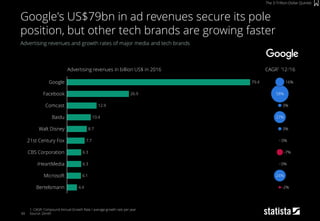
Advertising revenues and growth rates of major media and tech brands
1: CAGR: Compound Annual Growth Rate / average growth rate per year
Source: Zenith
Google's US$79bn in ad revenues secure its pole
position, but other tech brands are growing faster
The 3-Trillion-Dollar Quintet
58%
-7%
-2%
16%
3%
24%
0%
3%
0%
27%
6.3
Comcast
CBS Corporation
6.3iHeartMedia
4.4
21st Century Fox 7.7
Walt Disney 8.7
26.9Facebook
10.4
Bertelsmann
Google
12.9
79.4
Baidu
Microsoft 6.1
Advertising revenues in billion US$ in 2016 CAGR1 ’12-’16
When Paul Allen and I started
Microsoft over 30 years ago, we had big
dreams about software. We had
dreams about the impact it could have.
Bill Gates
Founder of Microsoft
62
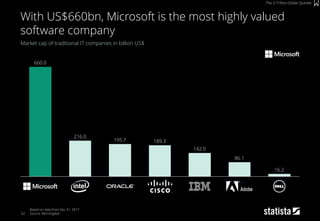
Market cap of traditional IT companies in billion US$
Based on data from Dec 31, 2017
Source: Morningstar
With US$660bn, Microsoft is the most highly valued
software company
The 3-Trillion-Dollar Quintet
86.1
16.2
142.0
IBMCisco Adobe DELLOracleIntel
216.0
660.0
195.7
Microsoft
189.3
25%
20%
10%
16%
5%
12%
5%
7%
28%
22%
11%
9%
7%
7%
9%
7%
28%
24%
10%
10%
8%
6%
5%
3%
6%
63
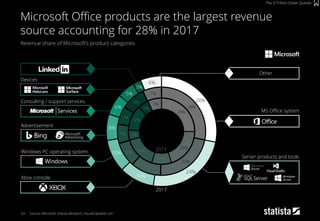
Revenue share of Microsoft’s product categories
Source: Microsoft, Statista Research, VisualCapitalist.com
Microsoft Office products are the largest revenue
source accounting for 28% in 2017
The 3-Trillion-Dollar Quintet
Server products and tools
Other
Advertisement
Devices
Consulting / support services
Xbox console
MS Office system
Windows PC operating system 2015
2017
64
Microsoft products in numbers
Based on data from January 2017
Source: Company Information
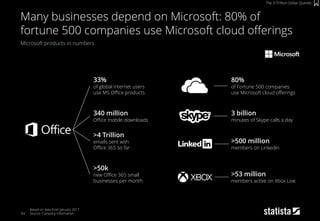
Many businesses depend on Microsoft: 80% of
fortune 500 companies use Microsoft cloud offerings
The 3-Trillion-Dollar Quintet
33%
of global internet users
use MS Office products
>50k
new Office 365 small
businesses per month
340 million
Office mobile downloads
>4 Trillion
emails sent with
Office 365 so far
3 billion
minutes of Skype calls a day
>53 million
members active on Xbox Live
>500 million
members on LinkedIn
80%
of Fortune 500 companies
use Microsoft cloud offerings
65
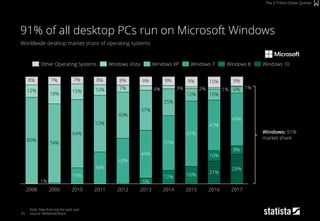
Worldwide desktop market share of operating systems
Note: Data from July for each year
Source: NetMarketShare
91% of all desktop PCs run on Microsoft Windows
The 3-Trillion-Dollar Quintet
12% 16%
10%
8%
15%
30%
42%
44%
51%
61%
47%
49%
80%
74%
64%
53%
43%
37%
25%
12% 10%
6%12%
18% 15% 10% 7%
8% 7% 7% 8% 8% 9% 8% 9% 10% 9%
28%
21%
5%1%
1%1%2%3%4%
2017201620122011201020092008 2014 20152013
Other Operating Systems Windows XPWindows Vista Windows 10Windows 8Windows 7
Windows: 91%
market share
66
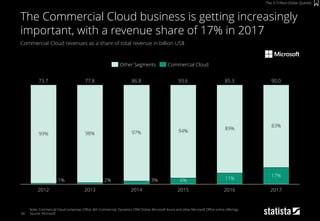
Commercial Cloud revenues as a share of total revenue in billion US$
Note: Commercial Cloud comprises Office 365 Commercial, Dynamics CRM Online, Microsoft Azure and other Microsoft Office online offerings
Source: Microsoft
The Commercial Cloud business is getting increasingly
important, with a revenue share of 17% in 2017
The 3-Trillion-Dollar Quintet
11%
17%
99% 98% 97% 94%
89%
83%
6%3%2%1%
73.7
2012
86.8 93.6
2016
85.3
20152013
90.0
2014
77.8
2017
Commercial CloudOther Segments
67
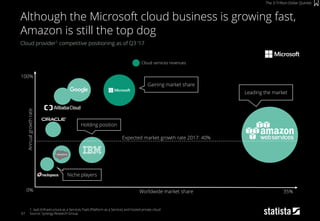
Cloud provider1 competitive positioning as of Q3 ‘17
1: IaaS (Infrastructure as a Service), PaaS (Platform as a Service), and hosted private cloud
Source: Synergy Research Group
Although the Microsoft cloud business is growing fast,
Amazon is still the top dog
The 3-Trillion-Dollar Quintet
Expected market growth rate 2017: 40%
Annualgrowthrate
35%Worldwide market share0%
Gaining market share
Leading the market
Niche players
Cloud services revenues
100%
Holding position
68
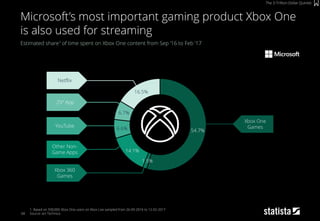
Estimated share1 of time spent on Xbox One content from Sep ‘16 to Feb ‘17
1: Based on 930,000 Xbox One users on Xbox Live sampled from 26-09-2016 to 12-02-2017
Source: ars Technica
Microsoft’s most important gaming product Xbox One
is also used for streaming
The 3-Trillion-Dollar Quintet
54.7%
1.5%
14.1%
6.6%
6.7%
16.5%
Xbox One
Games
Xbox 360
Games
Other Non-
Game Apps
YouTube
„TV“ App
Netflix
I think Amazon is the greatest start-up
and the greatest company in the world.
The way they are using new technologies is
not just disrupting retail, it's getting
ready to disrupt everything.
Mark Cuban
Founder, investor and owner of the Dallas Mavericks
70
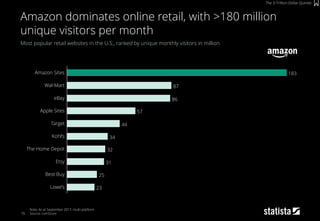
Most popular retail websites in the U.S., ranked by unique monthly visitors in million
Note: As at September 2017, multi-platform
Source: comScore
Amazon dominates online retail, with >180 million
unique visitors per month
The 3-Trillion-Dollar Quintet
23
25
31
32
34
44
57
86
87
183Amazon Sites
The Home Depot
Apple Sites
Lowe’s
Target
eBay
Best Buy
Kohl’s
Etsy
Wal-Mart
2%
7%
4%
15%
72%
2%
9%
5%
17%
67%
3%
10%
6%
18%
64%
71
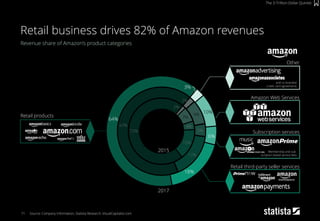
Revenue share of Amazon‘s product categories
Source: Company Information, Statista Research, VisualCapitalist.com
Retail business drives 82% of Amazon revenues
The 3-Trillion-Dollar Quintet
Retail products
Retail third-party seller services
Subscription services
Amazon Web Services
Other
and co-branded
credit card agreements
Membership and sub-
scription based service fees
2015
2017
72
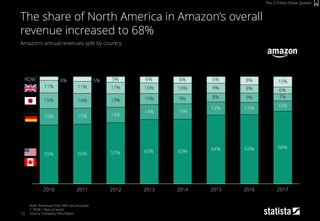
Amazon‘s annual revenues split by country
Note: Revenues from AWS are excluded
1: ROW = Rest of world
Source: Company Information
The share of North America in Amazon’s overall
revenue increased to 68%
The 3-Trillion-Dollar Quintet
55% 56% 57% 60% 60% 64% 64% 68%
15% 15% 14%
14% 14%
12% 11%
10%
15% 14% 13% 10% 9% 8% 9% 7%
11% 11% 11% 10% 10% 9% 8% 6%
5% 6% 6% 6% 8% 10%5%4%
2014 2015
ROW
201720162013201220112010
1
90
85
80
75
65
63
58
54
48
44
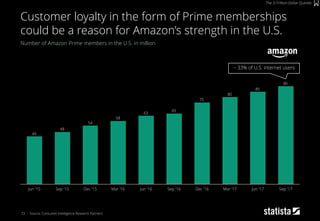
Dec ’16 Sep ’17Mar ’17 Jun ’17Sep ’16Jun ’15 Sep ’15 Jun ’16Dec ’15 Mar ’16
73
Number of Amazon Prime members in the U.S. in million
Source: Consumer Intelligence Research Partners
Customer loyalty in the form of Prime memberships
could be a reason for Amazon’s strength in the U.S.
The 3-Trillion-Dollar Quintet
~ 33% of U.S. internet users
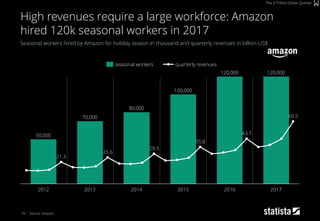
120,000120,000
100,000
2014 20162015 2017
80,000
20132012
50,000
70,000
74
Seasonal workers hired by Amazon for holiday season in thousand and quarterly revenues in billion US$
Source: Amazon
High revenues require a large workforce: Amazon
hired 120k seasonal workers in 2017
The 3-Trillion-Dollar Quintet
21.3
60.5
43.7
35.8
29.3
25.6
quarterly revenuesseasonal workers
75
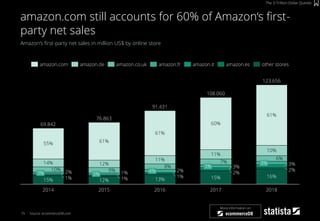
Amazon‘s first-party net sales in million US$ by online store
Source: ecommerceDB.com
amazon.com still accounts for 60% of Amazon‘s first-
party net sales
The 3-Trillion-Dollar Quintet
3%
7%
11%
60%
2016
13%
1%
2%4%
8%
91.431
15%
108.060
6%
3%
2018
3%
2%
16%
123.656
61%
10%
2017
3%
11%
61%
2015
76.863
12% 1%
1%3%
9%
12%
61%
2014
69.842
15% 1%
2%3%
10%
14%
55%
2%
other storesamazon.it amazon.esamazon.co.uk amazon.framazon.deamazon.com
More information on
Advertising works most effectively when it's in line with
what people are already trying to do. And people are trying
to communicate in a certain way on Facebook - they share
information with their friends, they learn about what their
friends are doing - so there's really a whole new opportunity
for a new type of advertising model within that.
Mark Zuckerberg
Founder and CEO of Facebook
Q2
’16
1.65
1.71
Q4
’15
1.55
Q3
’15
1.79
1.59
Q3
’16
1.86
Q1
’13
1.11
1.23
Q4
’13
1.19
Q2
’13
1.28
1.16
Q3
’13
Q1
’16
Q2
’14
1.32
Q1
’14
1.35
Q1
’15
Q4
’14
1.44
1.49
1.39
Q2
’15
Q3
’14
Q3
’17
2.01
Q4
’17
Q2
’17
1.94
Q1
’17
Q4
’16
2.07 2.11
77
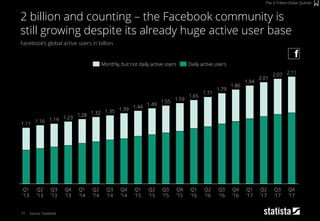
Facebook‘s global active users in billion
Source: Facebook
2 billion and counting – the Facebook community is
still growing despite its already huge active user base
The 3-Trillion-Dollar Quintet
Daily active usersMonthly, but not daily active users
78
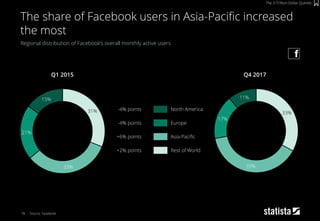
Regional distribution of Facebook’s overall monthly active users
Source: Facebook
The share of Facebook users in Asia-Pacific increased
the most
The 3-Trillion-Dollar Quintet
31%
33%
21%
15%
33%
39%
17%
11%
North America-4% points
Europe-4% points
Asia-Pacific+6% points
Rest of World+2% points
Q1 2015 Q4 2017
79
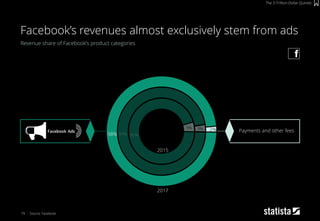
Revenue share of Facebook‘s product categories
Source: Facebook
Facebook’s revenues almost exclusively stem from ads
The 3-Trillion-Dollar Quintet
95%
5%
97%
3%
98%
2% Payments and other fees
2015
2017
80
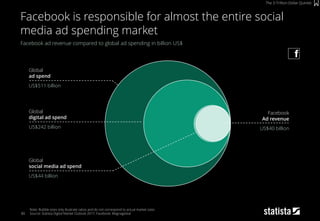
Facebook ad revenue compared to global ad spending in billion US$
Note: Bubble sizes only illustrate ratios and do not correspond to actual market sizes
Source: Statista Digital Market Outlook 2017, Facebook, Magnaglobal
Facebook is responsible for almost the entire social
media ad spending market
The 3-Trillion-Dollar Quintet
Global
ad spend
US$511 billion
Global
digital ad spend
US$242 billion
Global
social media ad spend
US$44 billion
Facebook
Ad revenue
US$40 billion
81
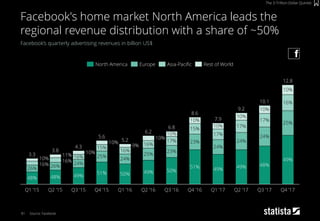
Facebook‘s quarterly advertising revenues in billion US$
Source: Facebook
Facebook's home market North America leads the
regional revenue distribution with a share of ~50%
The 3-Trillion-Dollar Quintet
10%
25%
Q3 ’17
10.1
48%
Q4 ’17
12.8
49%
16%
49%
4.3
10%
10%
Q2 ’15
48%
3.8
26%
24%
Q3 ’15
16% 24%
16%
9%
5.6
5.2
51%
15%
25%
50%
Q1 ’16Q4 ’15
16%
26%
16%
10%
48%
9.2
24%
10%
17%
Q1 ’17
49%
7.9
Q2 ’17
24%
17%
10%
10%
25%
16%
10%
6.2
6.8
49% 50%
Q2 ’16
23%
17%
3.3
Q1 ’15
11%
24%
17%
Q4 ’16
49%
8.6
51%
23%
15%
10%
10%
Q3 ’16
North America Europe Rest of WorldAsia-Pacific
82
Ad revenue of Facebook by segment in billion US$
Source: Company Information
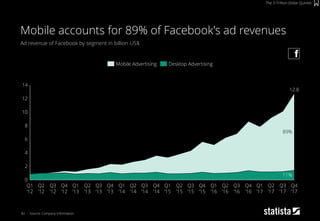
Mobile accounts for 89% of Facebook's ad revenues
The 3-Trillion-Dollar Quintet
12
10
14
6
4
8
2
0
Q1
’15
Q1
’14
Q4
’13
Q3
’13
Q3
’15
Q2
’13
Q3
’14
Q3
’16
Q4
’14
Q2
’14
89%
12.8
11%
Q2
’12
Q1
’12
Q3
’12
Q1
’13
Q4
’12
Q1
’16
Q2
’16
Q4
’15
Q2
’15
Q4
’17
Q3
’17
Q2
’17
Q1
’17
Q4
’16
Mobile Advertising Desktop Advertising
Vertical Platforms
In his famous article “Why software is eating the world”, VC
Marc Andreessen stated: “Six decades into the computer
revolution, four decades since the invention of the
microprocessor, and two decades into the rise of the modern
Internet, all of the technology required to transform industries
through software finally works and can be widely delivered at a
global scale”, a statement which has never been more true
than today.
No matter if in terms of accommodation, digital content or
transportation: Software, and in particular digital platforms
join creators and consumers in a very efficient and
convenient way. More importantly, they are scaling fast!
Spotify, Netflix, Airbnb, Uber and many other platforms have
reached critical mass in terms of connecting creators and
consumers of content. In the last five years, Spotify has
increased its number of paying subscribers from three to 70
million users, Netflix has surpassed major pay-TV providers
in paying subscribers and Airbnb increased annual guest
arrivals from three million to over 100 million.
This development has not yet come to an end. These
players are going to increase pressure on traditional offline
businesses even more – as the shift from offline to online
will continue. And those platforms sit at the digital end,
waiting for more customers to come.
Everything that can become a platform, will become a platform
Global Trends
84
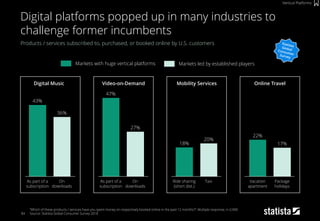
Products / services subscribed to, purchased, or booked online by U.S. customers
“Which of these products / services have you spent money on respectively booked online in the past 12 months?”; Multiple response; n=2,000
Source: Statista Global Consumer Survey 2018
Digital platforms popped up in many industries to
challenge former incumbents
Vertical Platforms
As part of a
subscription
TaxiAs part of a
subscription
On
downloads
27%
On
downloads
47%
Package
holidays
22%
18% 17%
36%
20%
43%
Vacation
apartment
Ride sharing
(short dist.)
Markets led by established playersMarkets with huge vertical platforms
Digital Music Video-on-Demand Mobility Services Online Travel
85
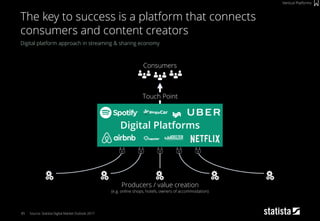
Digital platform approach in streaming & sharing economy
Source: Statista Digital Market Outlook 2017
The key to success is a platform that connects
consumers and content creators
Vertical Platforms
… … … ……
Digital Platforms
Touch Point
Consumers
Producers / value creation
(e.g. online shops, hotels, owners of accommodation)
Digital Platforms
Consumers
86
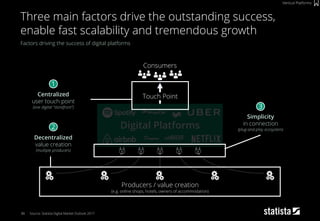
Factors driving the success of digital platforms
Source: Statista Digital Market Outlook 2017
Three main factors drive the outstanding success,
enable fast scalability and tremendous growth
Vertical Platforms
Centralized
user touch point
(one digital “storefront”)
1
Decentralized
value creation
(multiple producers)
2
Simplicity
in connection
(plug-and-play ecosystem)
Touch Point
3
… … … ……
Producers / value creation
(e.g. online shops, hotels, owners of accommodation)
[…] I don’t know where streaming will go in the future. The
analytics that we’re seeing tell us that streaming is the next
thing, and downloads are going down. I feel like with the
history of this platform, from vinyl to where we are now, it just
seems like the next logical step.
Shawn Corey Carter (Jay-Z)
Rapper, producer, CEO of Def Jam Records
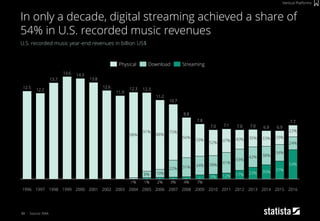
88
U.S. recorded music year-end revenues in billion US$
Source: RIAA
In only a decade, digital streaming achieved a share of
54% in U.S. recorded music revenues
Vertical Platforms
20072002
66%
2006
91%
12.2
12.6
75%
2001
98%
2%
20042003
10.7
8%
11.2
13.8
22%
2005
4%3%
88%
19991996
12.5 12.3
11.9
10%
31%
14.3
1%
1998
13.7
1997
14.6
12.3
2000
1%
2014
42%
12%
41%
34%
20112009 2010
9%
43%
52%
7%
6.9 6.9
24%
37%
38%
54%
29%
22%
33%
2013
35%
2012
17%
7.1
47%
7.8
7.0
23%
7.7
7.07.0
38%34%
59%
2008
8.8
2016
30%
2015
40%
Physical StreamingDownload
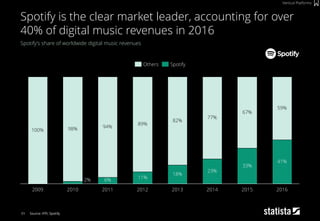
89
Spotify’s share of worldwide digital music revenues
Source: IFPI, Spotify
Spotify is the clear market leader, accounting for over
40% of digital music revenues in 2016
Vertical Platforms
11%
18%
23%
33%
41%
100% 98% 94%
89%
82%
77%
67%
59%
6%2%
2016201520142012 2013201120102009
Others Spotify
90
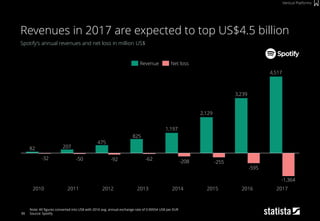
Spotify’s annual revenues and net loss in million US$
Note: All figures converted into US$ with 2016 avg. annual exchange rate of 0.90554 US$ per EUR
Source: Spotify
Revenues in 2017 are expected to top US$4.5 billion
Vertical Platforms
825
475
20782
-595
-255-208-62-92-50-32
2,129
20172013
-1,364
4,517
2016
3,239
1,197
2012 2015201420112010
Net lossRevenue
91
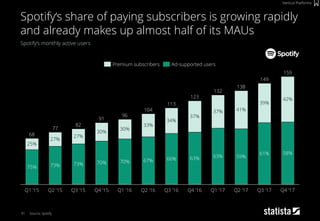
Spotify‘s monthly active users
Source: Spotify
Spotify‘s share of paying subscribers is growing rapidly
and already makes up almost half of its MAUs
Vertical Platforms
75%
68
77
25%
73%
Q2 ’15
82
70%
27%
Q3 ’15
30%
27%
Q1 ’15
73%
58%
37%
66%
Q2 ’16
132
96
Q3 ’17
41%
33%
Q4 ’16
123
67%
30%
159
61%
Q4 ’17
39%
Q2 ’17
138
59%
149
91
63%
37%
63%
42%
Q3 ’16 Q1 ’17
34%
104
Q1 ’16
70%
Q4 ’15
113
Ad-supported usersPremium subscribers
92
Paying subscribers to the biggest music streaming providers in million
Based on data from January / February 2018
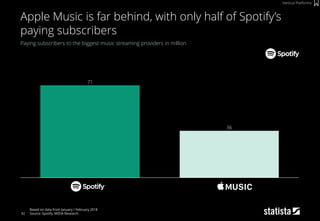
Source: Spotify, MIDiA Research
Apple Music is far behind, with only half of Spotify’s
paying subscribers
Vertical Platforms
36
71
Netflix shook it up, brought this whole new generation of
people who said, 'I watch things when I want to watch, how
I want to watch, where I want to watch, and that's
something that no one's going to ever forget.' This has changed
the game completely, and I think it's the tip of the iceberg.
Mike Colter
Actor
94
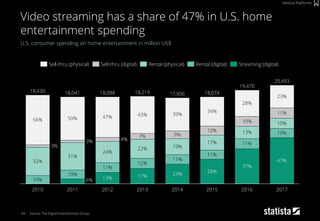
U.S. consumer spending on home entertainment in million US$
Source: The Digital Entertainment Group
Video streaming has a share of 47% in U.S. home
entertainment spending
Vertical Platforms
4%
47%
11%
24%
2011
3%
18,041
2010
10%
50%
31%
10%
56%
3%
6%
18,430
32%
19%
39%
17,906
23%
11%
9%
2013
18,219
17%
12%
22%
7%
2012
18,088
43%
13%
47%
10%
2017
10%
18,074
11%
17%
10%
28%
34%
20,493
2014
37%
23%
19,470
11%
2015
28%
11%
13%
2016
10%
Sell-thru (digital) Rental (digital)Sell-thru (physical) Rental (physical) Streaming (digital)
95
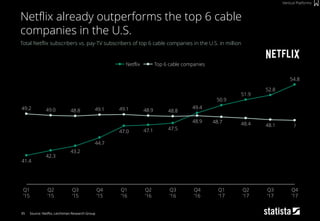
Total Netflix subscribers vs. pay-TV subscribers of top 6 cable companies in the U.S. in million
Source: Netflix, Leichtman Research Group
Netflix already outperforms the top 6 cable
companies in the U.S.
Vertical Platforms
54.8
48.7
49.2
47.0
Q1
’15
49.1
41.4
Q1
’16
50.9
48.8
49.4
Q1
’17
Q2
’15
48.1
51.9
Q4
’17
Q3
’17
Q2
’17
48.4
52.8
48.9
47.5
Q2
’16
47.1
48.9
Q3
’16
Q4
’15
42.3
Q3
’15
43.2
48.849.0
44.7
?
Q4
’16
49.1
Top 6 cable companiesNetflix
96
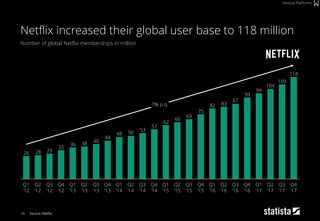
Number of global Netflix memberships in million
Source: Netflix
Netflix increased their global user base to 118 million
Vertical Platforms
118
109
104
99
94
87
8382
75
69
66
62
57
535048
44
403836
33
292826
Q1
’16
Q1
’14
Q2
’16
Q4
’16
Q4
’14
Q3
’13
Q4
’12
Q4
’15
Q3
’12
Q2
’12
Q1
’17
Q3
’16
Q3
’14
Q1
’13
Q4
’13
Q3
’15
Q2
’15
Q1
’15
Q2
’13
Q2
’14
Q1
’12
Q4
’17
Q3
’17
Q2
’17
7% p.q.
97
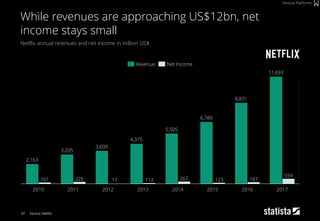
Netflix annual revenues and net income in million US$
Source: Netflix
While revenues are approaching US$12bn, net
income stays small
Vertical Platforms
559
18712326711217226161
4,375
2016 2017
8,831
11,693
6,780
20152014
5,505
3,609
2,163
20132012
3,205
20112010
Revenue Net Income
98
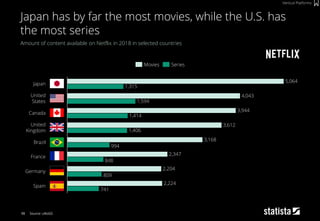
Amount of content available on Netflix in 2018 in selected countries
Source: uNoGS
Japan has by far the most movies, while the U.S. has
the most series
Vertical Platforms
741
809
848
994
United
Kingdom
3,612
1,406
Canada
3,944
Brazil
France
1,414
2,347
5,064
2,224
1,315
Spain
Japan
4,043
3,168
1,594
United
States
2,204
Germany
Movies Series
10.2
8.0
1.0
8.0
7.8
6.3
5.4
4.5
4.2
2.5
2.2
1.0
99
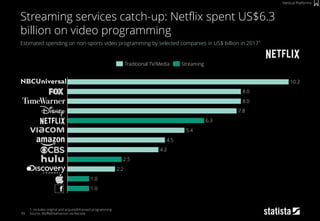
Estimated spending on non-sports video programming by selected companies in US$ billion in 20171
1: Includes original and acquired/licensed programming
Source: MoffettNathanson via Recode
Streaming services catch-up: Netflix spent US$6.3
billion on video programming
Traditional TV/Media Streaming
Vertical Platforms
The next wave of the social graph is
empowering services like Airbnb and Lyft that
give people the chance to have that physical
interaction. People are more open to that
because of Airbnb. Airbnb took couch
surfing and took an additional step.
John Zimmer
Co-founder and president of ridesharing company Lyft
101
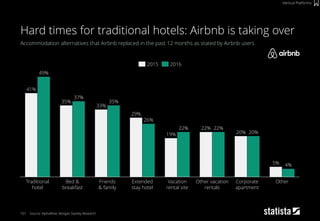
Accommodation alternatives that Airbnb replaced in the past 12 months as stated by Airbnb users
Source: AlphaWise, Morgan Stanley Research
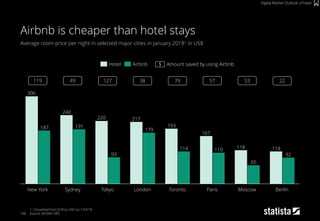
Hard times for traditional hotels: Airbnb is taking over
Vertical Platforms
Traditional
hotel
Extended
stay hotel
Bed &
breakfast
26%
Corporate
apartment
Friends
& family
Vacation
rental site
4%
Other vacation
rentals
Other
41%
49%
35%
5%
37%
33%
35%
29%
19%
22% 22%
20%
22%
20%
2015 2016
102
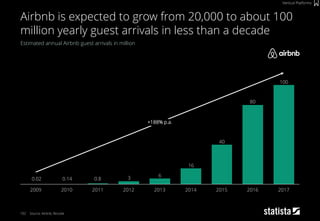
Estimated annual Airbnb guest arrivals in million
Source: Airbnb, Recode
Airbnb is expected to grow from 20,000 to about 100
million yearly guest arrivals in less than a decade
Vertical Platforms
100
80
40
16
6
3
+188% p.a.
2016 2017201520142012 20132009 20112010
0.02 0.14 0.8
103
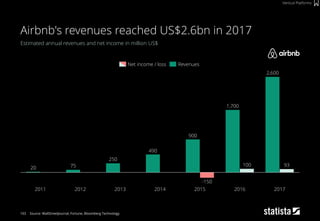
Estimated annual revenues and net income in million US$
Source: WallStreetJournal, Fortune, Bloomberg Technology
Airbnb's revenues reached US$2.6bn in 2017
Vertical Platforms
20 75
250
490
900
-150
100 93
2011 2012 2013 20172014 20162015
1,700
2,600
RevenuesNet income / loss
104
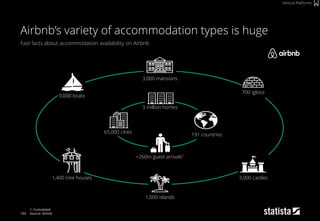
Fast facts about accommodation availability on Airbnb
1: Cumulated
Source: Airbnb
Airbnb’s variety of accommodation types is huge
Vertical Platforms
3,000 mansions
3,000 castles
1,000 islands
9,000 boats
65,000 cities
+260m guest arrivals1
191 countries
3 million homes
1,400 tree houses
700 igloos
57
83
76
89
79
86
983
793
4,500
900026 Echo Park/Silverlake
7,140
90048 West Beverly
1,637
4,530
4,980
90291 Venice
1,081
90292 Marina Del Rey
2,000
8,070
900028 Hollywood
90017 Downtown Los Angeles
1,624
7,680
105
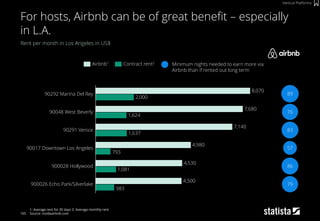
Rent per month in Los Angeles in US$
1: Average rent for 30 days 2: Average monthly rent
Source: insideairbnb.com
For hosts, Airbnb can be of great benefit – especially
in L.A.
Vertical Platforms
Contract rent2Airbnb1
Minimum nights needed to earn more via
Airbnb than if rented out long term
The internet business model
changed dramatically. You would never
have an Uber, you would never have an
Instagram – if you didn't have a connected
computer in your pocket that didn’t also
have a camera or a GPS.
Steve Mollenkopf
CEO of Qualcomm
107
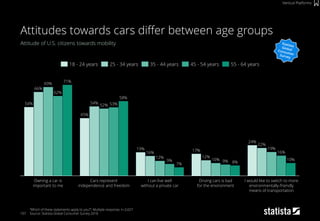
Attitude of U.S. citizens towards mobility
“Which of these statements apply to you?”; Multiple response; n=2,027
Source: Statista Global Consumer Survey 2018
Attitudes towards cars differ between age groups
Vertical Platforms
17%
I can live well
without a private car
I would like to switch to more
environmentally-friendly
means of transportation
12%
8%
10% 9%
66%
54%
69%
45%
54%
Owning a car is
important to me
Cars represent
independence and freedom
Driving cars is bad
for the environment
10%
16%16%
19%
7%
12%
9%
19%
24%
22%
71%
58%
62%
53%52%
35 - 44 years25 - 34 years 45 - 54 years 55 - 64 years18 - 24 years
108
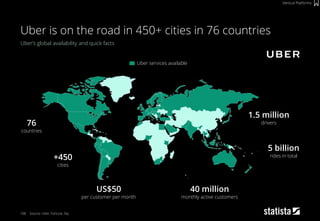
Uber’s global availability and quick facts
Source: Uber, Fortune, Sky
Uber is on the road in 450+ cities in 76 countries
Vertical Platforms
1.5 million
drivers
5 billion
rides in total
76
countries
+450
cities
40 million
monthly active customers
US$50
per customer per month
Uber services available
109
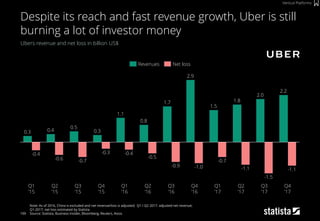
Ubers revenue and net loss in billion US$
Note: As of 2016, China is excluded and net revenue/loss is adjusted; Q1 / Q2 2017: adjusted net revenue;
Q1-2017: net loss estimated by Statista
Source: Statista, Business Insider, Bloomberg, Reuters, Axios
Despite its reach and fast revenue growth, Uber is still
burning a lot of investor money
Vertical Platforms
1.5
2.9
0.3
1.7
Q1
’16
Q3
’16
-0.5
Q2
’16
-0.4
-1.0
Q4
’16
-0.7
0.8
1.1
Q4
’15
-0.3
Q3
’15
0.4
0.5
-0.9
Q2
’15
-0.6
Q1
’15
0.3
-0.4
-1.1
2.2
2.0
Q3
’17
-1.1
Q1
’17
1.8
Q4
’17
Q2
’17
-1.5
-0.7
Revenues Net loss
110
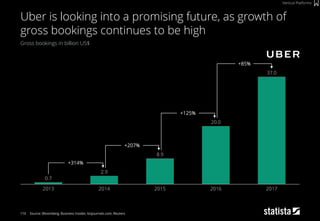
Gross bookings in billion US$
Source: Bloomberg, Business Insider, bizjournals.com, Reuters
Uber is looking into a promising future, as growth of
gross bookings continues to be high
Vertical Platforms
2013 2014
20.0
2015 2016 2017
0.7
2.9
8.9
37.0
+314%
+207%
+125%
+85%
Digital China
The digital economy in China is shaped by two major
players: the Alibaba Group and Tencent Holding.
These two companies own the digital user touchpoint for
retail, digital media, messaging, and many other services.
They have built a comprehensive digital ecosystem in order
to provide as many services as possible to their customers
from one single source.
The Alibaba Group is the country’s #1 retailer. As a platform,
they provide the infrastructure for domestic as well as
foreign merchants. They own China’s biggest brands, which
serve as a digital touchpoint to connect businesses with
customers. You want to sell to Chinese online customers
without having Alibaba on board? Good luck!
Tencent’s well-known instant messaging app WeChat is used
by almost one billion people. This is important, as many
digital services can be incorporated into WeChat: Media,
retail, location services, and payment. Thus, Tencent has
multiple sources to generate revenues in usually very small
portions.
We dive into the financials and business models and show
how Alibaba and Tencent earn their money – as this is quite
different compared to companies in Europe and the U.S.
Two players do it all – explaining Chinese “Everything Companies”
Global Trends
111
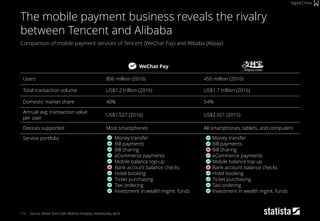
WeChat Pay
Users 806 million (2016) 450 million (2016)
Total transaction volume US$1.2 trillion (2016) US$1.7 trillion (2016)
Domestic market share 40% 54%
Annual avg. transaction value
per user
US$1,527 (2016) US$2,921 (2015)
Devices supported Most smartphones All smartphones, tablets, and computers
Service portfolio ▪ Money transfer
▪ Bill payments
▪ Bill sharing
▪ eCommerce payments
▪ Mobile balance top-up
▪ Bank account balance checks
▪ Hotel booking
▪ Ticket purchasing
▪ Taxi ordering
▪ Investment in wealth mgmt. funds
▪ Money transfer
▪ Bill payments
▪ Bill sharing
▪ eCommerce payments
▪ Mobile balance top-up
▪ Bank account balance checks
▪ Hotel booking
▪ Ticket purchasing
▪ Taxi ordering
▪ Investment in wealth mgmt. funds
112
Comparison of mobile payment services of Tencent (WeChat Pay) and Alibaba (Alipay)
Source: Better than Cash Alliance, Analysys, Aseantoday, kpcb
The mobile payment business reveals the rivalry
between Tencent and Alibaba
Digital China
If you want 10,000 new customers, you have
to build a new warehouse and this and that.
For me: two servers.
Jack Ma
Founder of the Alibaba Group
comparing offline retail and Alibaba’s business model
114
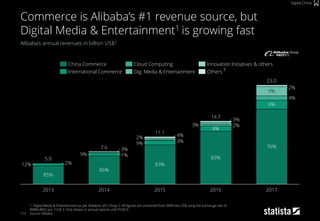
Alibaba’s annual revenues in billion US$2
1: Digital Media & Entertainment as per Alibaba’s SEC Filings 2: All figures are converted from RMB into US$ using the exchange rate of
RMB6.8832 per 1US$ 3: Only shown in annual reports until FY2014
Source: Alibaba
Commerce is Alibaba’s #1 revenue source, but
Digital Media & Entertainment1 is growing fast
Digital China
85%
2%12%
2016
83%
3%
2%
2015
83%
3%
9%
2014
8%
4%
2017
23.0
9%
76%
14.7
2%3%
3%
11.1
4%2%
9%
7.6
1%9%
2013
86%
5.0
Others
Innovation Initiatives & others
Dig. Media & Entertainment
Cloud Computing
International Commerce
China Commerce
3
115
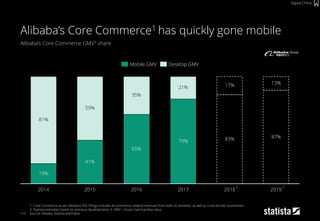
Alibaba’s Core Commerce GMV3 share
1: Core Commerce as per Alibaba’s SEC Filings includes all commerce-related revenues from both its domestic as well as cross-border businesses
2: Statista estimates based on previous developments 3: GMV = Gross merchandise value
Source: Alibaba, Statista estimates
Alibaba’s Core Commerce1 has quickly gone mobile
Digital China
19%
41%
65%
79% 83% 87%
81%
59%
35%
21%
13%17%
2016 2017 201920182014 2015
Desktop GMVMobile GMV
2 2
Buyer
Chinese Global
Seller
Chinese
Global
China Commerce
Wholesale
International Commerce
Wholesale
116
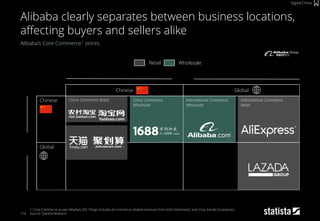
Alibaba‘s Core Commerce1 stores
1: Core Commerce as per Alibaba’s SEC Filings includes all commerce-related revenues from both itsdomestic and cross-border businesses
Source: Statista Research
Alibaba clearly separates between business locations,
affecting buyers and sellers alike
Digital China
WholesaleRetail
China Commerce Retail International Commerce
Retail
117
Alibaba‘s Core Commerce1 annual revenue in 2017
1: Core Commerce as per Alibaba’s SEC Filings includes all commerce-related revenues from both its domestic as well as cross-border
businesses
Source: Alibaba, Statista Research
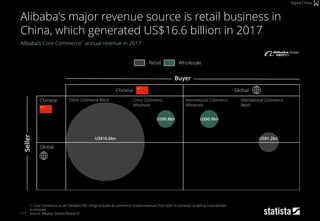
Alibaba's major revenue source is retail business in
China, which generated US$16.6 billion in 2017
Digital China
Buyer
Chinese Global
Seller
Chinese
Global
US$16.6bn
US$0.8bn US$0.9bn
US$1.2bn
International Commerce
Retail
China Commerce
Wholesale
International Commerce
Wholesale
China Commerce Retail
WholesaleRetail
118
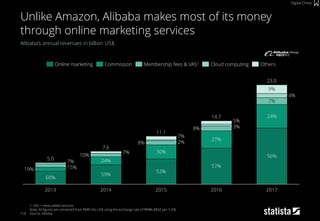
Alibaba’s annual revenues in billion US$
1: VAS = value-added services
Note: All figures are converted from RMB into US$ using the exchange rate of RMB6.8832 per 1US$
Source: Alibaba
Unlike Amazon, Alibaba makes most of its money
through online marketing services
Digital China
60%
7%
19% 15%
5%
7%
2%
27%
3%
2016
8%
14.7
57%
2015 2017
23.0
4%
56%
9%
59%
2013
10%
7%
30%
53%
7.6
7%
11.1
24%
24%
8%
2014
5.0
Cloud computingCommissionOnline marketing Membership fees & VAS1 Others
119
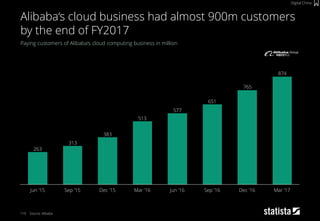
Paying customers of Alibaba‘s cloud computing business in million
Source: Alibaba
Alibaba‘s cloud business had almost 900m customers
by the end of FY2017
Digital China
874
765
651
577
513
383
313
263
Mar ’17Jun ’16Mar ’16Dec ’15Sep ’15 Dec ’16Sep ’16Jun ’15
Tencent is great at monetizing eyeballs […].
That’s their core competency. They are making
tons of money by scraping together pennies from
tiny transactions.”
Jeff Walters
Partner and Managing Director of BCG Beijing Office
121
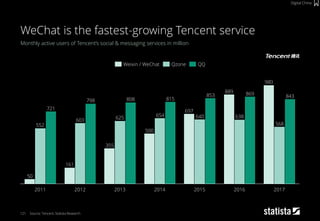
Monthly active users of Tencent‘s social & messaging services in million
Source: Tencent, Statista Research
WeChat is the fastest-growing Tencent service
Digital China
980
889
697
500
355
161
50
568
638640654
625603
552
843869853
815808798
721
20132012 20142011 201720162015
Weixin / WeChat Qzone QQ
122
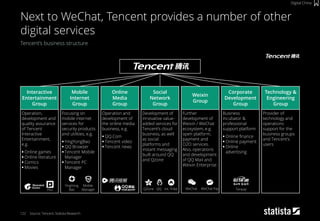
Tencent’s business structure
Source: Tencent, Statista Research
Next to WeChat, Tencent provides a number of other
digital services
Digital China
Operation,
development and
quality assurance
of Tencent
Interactive
Entertainment,
e.g.
▪ Online games
▪ Online literature
▪ Comics
▪ Movies
Interactive
Entertainment
Group
Focusing on
mobile internet
services for
security products
and utilities, e.g.
▪ YingYongBao
▪ QQ Browser
▪ Tencent Mobile
Manager
▪ Tencent PC
Manager
Mobile
Internet
Group
Operation and
development of
the online media
business, e.g.
▪ QQ.Com
▪ Tencent video
▪ Tencent news
Online
Media
Group
Development of
innovative value-
added services for
Tencent‘s cloud
business, as well
as social
platforms and
instant messaging
built around QQ
and Qzone
Social
Network
Group
Further
development of
Weixin / WeChat
ecosystem, e.g.
open platform,
payment and
O2O services.
Also, operations
and development
of QQ Mail and
Weixin Enterprise
Weixin
Group
Business
incubator &
professional
support platform
▪ Online finance
▪ Online payment
▪ Online
advertising
Corporate
Development
Group
Provider of
technology and
operations
support for the
business groups
and Tencent‘s
users
Technology &
Engineering
Group
Pitu
YingYong
Bao
Mobile
Manager QZone QQ Int. Tribe WeChat WeChat Pay Tenpay
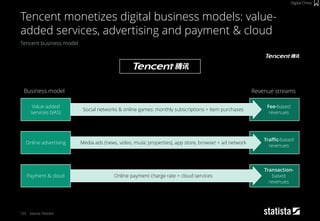
123
Tencent business model
Source: Tencent
Tencent monetizes digital business models: value-
added services, advertising and payment & cloud
Digital China
Business model
Fee-based
revenues
Value-added
services (VAS)
Social networks & online games: monthly subscriptions + item purchases
Transaction-
based
revenues
Payment & cloud Online payment charge rate + cloud services
Traffic-based
revenues
Online advertising Media ads (news, video, music properties), app store, browser + ad network
Revenue streams
124
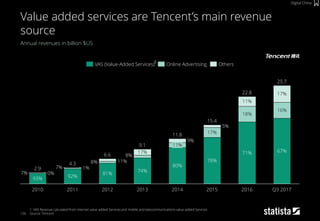
Annual revenues in billion US$
Source: Tencent
Online games contribute 43% to Tencent‘s revenue in
Q3 2017, which makes it the most important segment
Digital China
2010
52%
44%
48%
2.9
2016 Q3 2017
55%
11.8
47%
15.4
45%
2014
22.8
53%
57%
43%
2015
56%
47%
2013
53%
20122011
9.1
52%
48%
6.6
4.3
57%
43%
25.7
Online games Other
125
Public companies with most revenues from gaming in the first half of 2017 in billion US$
1: Estimated figures, as gaming revenues are not separately reporting in SEC filings
Note: Hardware sales are not included
Source: Newzoo – Global Games Market Report
Tencent is #1 in the field of online gaming
Digital China
3.0
1.1
3.2
2.9
1.0
2.1
3.4
4.3
7.4
3.0
126
Annual revenues in billion $US
1: VAS Revenue calculated from internet value-added Services and mobile and telecommunications value-added Services
Source: Tencent
Value added services are Tencent’s main revenue
source
Digital China
2014
80%
11.8
11%
20132012
17%
6.6
9%
8%
74%
9.1
71%
18%
2015 Q3 2017
11%
2016
67%
15.4
78%
5%
17%
16%
17%22.8
25.7
1%
92%
8%
81%
2.9
0%
2011
93%
2010
11%
7%
7%
4.3
Online Advertising OthersVAS (Value-Added Services)
1
127
Global eSports revenues and audience
1: Occasional viewers and enthusiasts combined 2: CAGR: Compound Annual Growth Rate / average growth rate per year
Source: Newzoo
Tencent‘s focus on games might be a smart decision
as general interest in eSports is growing
Digital China
130
194
325
493
696
941
2015 2018 20192012 20162014 2017 2020
1,187
1,488
+36%2
589
427389385
323
235204
134
201820142012 20192015 2016 20202017
+20%2
Global eSports revenues in million US$ Global eSports viewers1 in million
125
110
95
84
89
105
109
90
2010 2011 2014 Q3 20172016201520132012
128
Fee-based registered subscribers in million
1: VAS subscriptions calculated from internet value-added services and mobile and telecommunications value-added services
Source: Tencent
The increase in fee-based registered subscriptions is
fueling Tencent’s revenue growth
Digital China
1
1
1
129
Part 2 – exclusive Statista content
Table of Contents: Statista‘s Digital Market Outlook
› eCommerce ………………………………………………………………………………………………………………………………..
› eServices …………………………….……………………………………………………………………………………………………...
› eTravel …………………………………………………………………………………………………………………………………………
› Digital Media ………………………………………………………………………………………………………………………………
› FinTech ………………………………………………………………………………………………………………………………………..
› Digital Advertising …………………………..………………………………………………………………………….................
› Smart Home ……………………………………………………………………………………………………………………………….
› Connected Car …........................................................................................................................................
130
149
162
172
181
192
202
211
eCommerce
eCommerce is one of the hot topics when it comes to
digitalization and disruptive changes to traditional indus-
tries. The rising number of internet as well as smartphone
users, and the increasing time people spend online, shaped
the term “always on”. This development resulted in an ever-
increasing online market with new types of purchasing
processes appearing all over the world. At the same time,
more and more different product categories and product
ranges find their way into online trade.
Statista’s Digital Market Outlook divides the eCommerce
market into five product segments: Fashion, Electronics &
Media, Food & Personal Care, Furniture & Appliances, and
Toys, Hobby & DIY.
In 2017, the global1 eCommerce market was worth US$1.5
trillion. China was the biggest eCommerce market
worldwide, generating revenues of US$497 billion. Based on
the high annual growth rate of 14%, the market is expected
to exceed revenues of US$959 billion by 2022. The second
biggest eCommerce market is the U.S. with revenues of
US$421 billion in 2017, followed by Europe with US$330
billion. In both markets, growth rates are expected to be
significantly lower than in China, with 8-9% annually.
The steady fusion of online and offline shopping is a major
eCommerce development: Amazon’s acquisition of Whole
Foods shows their ambition to shake up the grocery
industry, while merging offline and online retail at the same
time. Many other players from both the online and offline
world move to multi-channel strategies, underlining this
trend.
Statista‘s Digital Market Outlook
130 1: Only includes countries listed in Statista‘s Digital Market Outlook
www.statista.io/ecommerce
131
Furthermore, the world’s largest retailer in terms of
revenues, Wal-Mart Inc., has embedded the digital mindset
into their corporate DNA: They changed their official name
from “Wal-Mart Stores” to “Wal-Mart”, in order to show their
effort to address all customers and abandon the apparent
focus on offline-clients.
We observe a similar development in China: eCommerce
giant Alibaba is gradually expanding towards the offline
world and opening brick-and-mortar stores. According to
Daniel Zhang, CEO of Alibaba, “[…] the future of new retail
will be a harmonious integration of online and offline, and
Hema is a prime example of this evolution that's taking
place”.
However, the Chinese eCommerce market is not at all a
“one company show”. In order to rival Alibaba, China’s
second biggest online marketplace JD.com partnered with
internet giant Tencent Holding. They invested more than
US$800 million in Vipshop, one of the leading online
discount retailers for luxury brand products.
Next to those most recent developments, we expect some
major trends to take off in the near future: mobile and
marketplaces.
Merchants increasingly understand the benefits of agile and
short-acting platforms. Hence, they develop applications
specifically designed for the mobile experience, rather than
optimizing web shops for mobile devices.
We expect marketplaces to become the best choice for
almost all product categories (with the exception of only a
few) with proven winners in terms of price or product
quality. In categories relating to personal style or taste, such
as clothing or interior design, independent players will
always have their share of the market.
Statista‘s Digital Market Outlook
f.wegener@statista.com
132
Global1 eCommerce revenue in billion US$
1: Only includes countries listed in Statista‘s Digital Market Outlook
Source: Statista Digital Market Outlook 2017
The global1 eCommerce market is expected to reach
almost US$2.5 trillion in revenues by 2022
Digital Market Outlook: eCommerce
1,728.7
394.6
290.2
1,510.6
20222019
2,508.2
2021
2,343.1
2018
1,305.3
2016 2020
2,154.5
2017
1,947.0
432.4
417.3
170.0
712.9
341.1
574.6495.7
481.2
538.4
495.7
357.1
293.9
305.8
662.3
395.4
329.2
447.1
194.5
228.7
320.2
363.2
258.7
466.3
257.4
544.9
283.4
356.4
225.1
520.3
144.0
605.9
198.9
394.6
Fashion Furniture & AppliancesElectronics & Media Toys, Hobby & DIYFood & Personal Care
133
Global1 eCommerce revenue in billion US$ and segment revenue shares in 2017
1: Only includes countries listed in Statista‘s Digital Market Outlook
Note: Percentages refer to the individual segment columns
Source: Statista Digital Market Outlook 2017
Clothing and Consumer Electronics are the biggest
categories within eCommerce
Digital Market Outlook: eCommerce
66%
417.3
Electronics &
Media
Fashion
341.1
16%
45%
13%
27%
14%
26%
56%
30%
74%
Food &
Personal Care
170.0
44%
Toys, Hobby &
DIY
357.1
21%
Furniture &
Appliances
225.1
70%
Clothing
Shoes
Bags &
Accessories
Consumer
Electronics
Books,
Movies,
Music &
Games
Food &
Beverages
Personal
Care
Furniture &
Homeware
Home
Appliances
Toys &
Baby
DIY, Pets
& Garden
Sports &
Outdoor
Hobby &
Stationery
134
Top 5 eCommerce countries by market revenue in billion US$
Source: Statista Digital Market Outlook 2017
It had already been #1 in eCommerce, but China still
grew by 24% in 2017
Digital Market Outlook: eCommerce
88.3
13%
24%
402.2
86.7
371.2
57.1
10%
11%
10%Japan
96.7
Germany
95.1United
Kingdom
China
United
States
496.8
421.1
63.4
20162017
135
Sales channels in selected consumer product categories in the U.S. in 2017
Note: The distribution channel Online refers to the purchase of physical goods in online retail. In other words, the purchase is concluded via the
internet – on a desktop PC, tablet or smartphone. The distribution channel Offline covers all purchases in stationary stores, via telesale or
mailorder (e.g. print catalogs)
Source: Statista Consumer Market Outlook 2018
The online sales share of Consumer Electronics in the
U.S. is expected to reach almost 75% by 2021
54%
74%
46%
26%
2017 2021
Consumer Electronics Apparel
Offline Online
18%
24%
82%
76%
2017 2021
Furniture
16%
27%
84%
73%
2017 2021
Digital Market Outlook: eCommerce
136
eCommerce net sales in 2016 in million US$ and market shares in %
Source: ecommerceDB.com
The German eCommerce market is highly concen-
trated – 3 stores account for almost 30% of net sales
Digital Market Outlook: eCommerce
17,958 mUS$
Long tail (Rank 101+)
37.2%
Rank 11-20
3,432 mUS$
7.1%
Rank 20-21
2,077 mUS$
4.3%
Rank 31-40
1,556 mUS$
3.2%
Rank 41-50
1,359 mUS$
2.8%
Rank 51-60
1,236 mUS$
2.6%
61-70
1,074
mUS$
2.2%
71-80
895
mUS$
1.8%
81-90
757 mUS$
1.6%
91-100
632
mUS$
1.3%
Rank 1-3
13,265 mUS$
27.4%
Rank 4-10
4,091 mUS$
8.5%
.de
.de
.de
.de
.de
.de
.de
More information on
South Korea
China
22%
Netherlands
Singapore
Belgium
United Kingdom
37%
Czech Republic
Finland
France
Denmark
22%
Norway
17%
Ireland
20%
Germany
24%
Sweden
14%
Spain
Canada
Poland
Switzerland
Austria
29%
23%
22%
22%
20%
20%
18%
18%
18%
18%
17%
16%
15%
United States
137
Online sales shares in the Apparel market in 2017
Note: The distribution channel Online refers to the purchase of physical goods in online retail. In other words, the purchase is concluded via the
internet - on a desktop PC, tablet or smartphone. The distribution channel Offline covers all purchases in stationary stores, via telesale or
mailorder (e.g. print catalogs)
Source: Statista Consumer Market Outlook 2018
In China, 37% of Apparel sales are generated online,
compared to only 18% in the U.S.
Digital Market Outlook: eCommerce
138
Payment methods offered by online stores in % and preferred payment methods of online shoppers1 in %
1 Base: Consumers aged 15 to 79 who have shopped online
Source: postnord, ecommerceDB.com
The payment methods offered by European online
stores mostly meet customer needs
Digital Market Outlook: eCommerce
1
4
3
2
4
Debit / credit card
Invoice
Cash on delivery
Direct payment
12
48
100
42
82
Paypal or similar
Offerd by stores Preferred by online shoppers
United Kingdom Germany
2
89
16
18
88
65
27
93
34
46 5
1
2
3
4
36
54
79
99
36
4
1
8
48
92
63
66
34
95
10
9
1
3
99
41
42
42
87
57
11
France Italy Spain
More information on
139
Top 5 online shops1 in 2017 by revenue in million US$
1: eCommerce net sales generated via the respective country domain only
Source: eCommerceDB.com
Amazon is the #1 online shop1 in the most relevant
European eCommerce markets
Digital Market Outlook: eCommerce
.de
723
.de 3.506
.de
1.416
9.887
937
.de.co.uk
4.320
6.019
2.907
.com
.co.uk
.co.uk 1.958
2.500.com
3.262
2.249
.fr 1.550
.com 585
.com
.fr
2.566
United Kingdom Germany France
140
eCommerce key players by business model and region
Source: Statista Digital Market Outlook 2018
Next to large all-encompassing platforms, there are
many product-specific eCommerce players
Digital Market Outlook: eCommerce
Marketplaces Online Retailers Direct Sellers
United States
China
Europe
141
Share of U.S. consumers who primarily search for / purchase a product online in %
“For which of these products do you mostly look for information online?”; Multiple response; "Which of these products do you mostly buy / order
online?“; Multiple response; "Which of these items have you bought online in the past 12 months?“; Multiple response; n=2,010
Source: Statista Global Consumer Survey 2018
Consumer Electronics, clothing, shoes and media
products are mainly searched for and bought online
Digital Market Outlook: eCommerce
0
5
10
15
20
25
30
35
40
45
50
55
60
65
70
0 5 10 15 20 25 30 35 40 45 50 55 60 65 70
Stationery &
Hobby Supplies
Shoes
Purchasedprimarilyonline
Furniture &
Household Goods
Toys &
Baby Products
Books, Movies,
Music & Games
Food & Drinks
Cosmetics &
Body Care
Clothing
Bags &
Accessories
Searched for primarily online
DIY, Garden
& Pets
Household
Appliances
Sports &
Outdoor
Consumer
Electronics
Share of U.S. consumers who ordered these items online in the past 12 months
Online search & purchase
Online search & offline purchase
Offline search & online purchase
Offline search & purchase
142
U.S. online retail sales on Thanksgiving weekend and Alibaba‘s GMV1 on Singles‘ Day in billion US$
1: GMV = Gross merchandise value
Note: Adobe retail data is based on the analysis of one trillion visits to 4,500 retail websites and 55 million stock keeping units
Source: Alibaba, Adobe Digital Insights
Alibaba’s sales on Singles’ Day dwarf Thanksgiving
weekend record sales
Digital Market Outlook: eCommerce
2017
25.3
17.8
42%
2016
2.4
Saturday
Cyber
Monday
Black Friday
2017
6.6
2.4
5.6
5.0
16.9
Thanksgiving
2.9
2016
2.2
14.6
16%
4.3
Thanksgiving weekend Singles‘ Day (Alibaba)
143
Past and forecast major U.S. chain store closures
Source: Cushman & Wakefield, Business Insider
The rise of eCommerce is increasingly going to affect
U.S. chain stores
Digital Market Outlook: eCommerce
20092007 2008
4,550
2014 2015 20162011 2012 20132010
4,150
20192017 2018
6,950
12,950
8,000
3,750 4,000
3,500 3,450
4,950
3,750
8,950
1,900
144
Devices used for online shopping
“Which of the following devices have you used for online shopping in the past 12 months?”; Multiple response; U.S.: n=2,010, UK: n= 2,011,
DE: n=2,062
Source: Statista Global Consumer Survey 2018
The U.S. has the highest mobile and voice shopping
rates
Digital Market Outlook: eCommerce
48%
45%
2%
58%
United Kingdom GermanyUnited States
37%
40%
49%
10%
27%
38%
41%
5%
Tablet Smart speakers (e.g. Amazon Echo)SmartphoneDesktop PC
145
Mobile share of U.S. eCommerce spending in Q3 2017
Source: comScore
In some categories, more than 50% of Americans
already use their mobile device for shopping
Digital Market Outlook: eCommerce
22%
33%
51%
41%
22%
14%
40%Sports & Fitness
Computer Hardware
Apparel & Accessories
13%
26%
51%
Computer Software
Books & Magazines
Jewelery & Watches
Consumer Packaged
Goods
Home & Garden
Consumer Electronics
Video Games,
Consoles & Accessories
58%Toys & Hobbies
Music, Movies & Videos
55%
146
Brand awareness by category in the U.S.
"In which of these categories do you pay particular attention to brands?”; Multiple response; n=10,150
Source: Statista Global Consumer Survey 2018
To U.S. consumers, brands matter most when it
comes to smartphones
Digital Market Outlook: eCommerce
Bags & accessories
25%Furniture & household goods
31%
18%Toys & baby products
Alcoholic drinks 36%
Cosmetics & body care 39%
Detergents & cleaning products 42%
Food & non-alcoholic drinks 42%
Household appliances 44%
Cars, motorcycles, bicycles 47%
TV & HiFi 48%
Clothing & shoes 53%
Smartphone 63%
147
Purchase decision maker by gender in the U.S.
"In which fields do you personally make purchasing decisions?”; Multiple response; "What is your gender?”, n=10,150
Source: Statista Global Consumer Survey 2018
81% of women state that it’s them who decide on
which food to buy for their households
Digital Market Outlook: eCommerce
Finance & insurance,
telecommunications & electricity
Furniture & household goods
89%
Daily consumer goods (food, drinks,
drugstore & cleaning products)
Clothing, shoes, accessories
Media
65%
Toys & baby products
Household appliances
Travels
38%
Consumer electronics
Cars, motorcycles, bicycles
81%
65%
75%
66%
53%
50%
29%
63%
79%
56%
55%
62%
64%
56%
66%
69%
64%
Female Male
148
More than 6,000 detailed store profiles
Your starting point for market analytics, benchmarking and lead generation
Easy to use
ecommerceDB.com offers a clear design and intuitive
navigation
Seamless workflow
Content can be instantly downloaded in Excel format
Daily updates
Information on online store revenues is updated on a
daily basis
ecommerceDB.com – Statista‘s eCommerce database
Web sales information
Web sales from 2014 to 2017,
growth forecast for 2018, relative
market shares, cross border and
product analytics
In-depth KPIs
Providers of logistics services,
payment methods, traffic metrics
Company information
Including information on company
revenue, contact information
(management, marketing, and
eCommerce contacts)
“Statista’s ecommerceDB contains detailed data on online stores
that is most useful for our analyses of the eCommerce market."
Michael Üreyil, Research Analyst at
EY Parthenon GmbH
Your provider of more than
6,000 detailed store profiles
> Store profile
> Customized Ranking
Digital Market Outlook: eCommerce
eServices
eServices are reaching out towards new horizons: Food
Delivery players have started to cooperate with Ride Sharing
companies to further improve customer experience and
reduce costs. The most obvious example is the cooperation
between Uber and UberEats. Yet Uber rival Ola has just
bought Foodpanda India to get into the food delivery
market as well. And Taco Bell is working with Lyft in order to
deliver their meals to their customers.
The eServices market is divided into four segments in
Statista‘s Digital Market Outlook: Event Tickets, Fitness,
Dating Services, and Food Delivery. The eServices market1
reached a revenue of US$134 billion in 2017 with Food
Delivery being the biggest segment. China has taken a
leading role with a market size of US$43 billion. This is due
to the outstanding revenue generated in the Chinese Food
Delivery segment. It is also the fastest-growing market with
a CAGR2 of 19% through to 2022. With a revenue of US$36
billion in 2017, the eServices market in Europe is smaller
compared to China, but larger than the US$31 billion U.S.
market. The low numbers in the overall U.S. eServices
market stem from a relatively weak Food Delivery segment,
which is less than half the size of its Chinese equivalent.
Next to the cooperation between Food Delivery and Ride
Sharing players, we expect an increasing integration of
social networks (e.g. Facebook) and eServices platforms and
apps. An example are ticketing platforms, where certain
online ticket providers already cooperate with social media
organizations. Fandango, for example, cooperates with
Facebook and allows users to purchase movie tickets
through the social network.
Statista‘s Digital Market Outlook
149
www.statista.io/eservices
1: Only includes countries listed in Statista‘s Digital Market Outlook 2: CAGR: Compound Annual Growth Rate / average growth rate per year
150
Event Tickets is the second largest eServices segment. The
biggest specter for event ticketing companies is probably
Amazon. There are constant rumors that Amazon is
planning to sell event tickets online. In August 2017,
Amazon was said to be seeking cooperation with U.S. venue
owners to sell event tickets. Amazon even tested the
potential of selling tickets online in the UK. However, the
latest news is that Amazon is not going to take over
Ticketmaster and Co., so event ticketing companies can
breathe a sigh of relief – for now.
In Fitness, we observe another exciting development: Fitbit,
for example, is advancing into employee health care and
coaching with its Twine Health acquisition. We believe that
fitness trackers will in the future be able to make
recommendations regarding the user’s health and predict
health conditions (e.g. heart attacks, diabetes, etc.). This
might open up possibilities for new business models in
several areas, such as the health and insurance sectors.
But not all is well in the eServices market: There are some
bad news for Tinder. The top dating app on iOs had
introduced higher subscription fees for users above 30. But
in February, courts decided that Tinder was no longer
allowed to charge different fees based on age for
discrimination reasons.
Furthermore, smartwatches will heavily impact Fitness and
Dating Services. We anticipate an increasing convergence of
smartwatches and fitness bands. Fitness trackers will
include features like measuring heart rates, making
payments, and controlling lighting. Secondly, dating apps
will be used on smartwatches to access messaging
functionalities. The new Apple Watch app “Hands-Free
Tinder”, for example, already provides a new way of swiping
through Tinder profiles: The app automatically swipes on a
profile based on the user’s heart rate.
Statista‘s Digital Market Outlook
kschreiber@statista.com
151
Global1 eServices revenue in billion US$
1: Only includes countries listed in Statista‘s Digital Market Outlook
Source: Statista Digital Market Outlook 2017
Driven by the Food Delivery segment, the global1
eServices market continues to grow
Digital Market Outlook: eServices
101.3
2017
133.9
64.9
8.3
29.1
4.5
2016
7.3
91.7
4.8
2018
5.1
9.3
38.5170.0
121.8
152.9
206.9
5.4
10.1
12.0
2021
24.7
274.9
6.1
51.3
2022
234.2
303.6
2020
43.0
182.9
210.2
33.7
2019
5.9
11.5
47.3242.4
5.6
10.9
Dating ServicesEvent Tickets Fitness Food Delivery
91.7
91%
9%
4.8
Fitness
8.3
27%
73%
Event Tickets
29.1
30%
40%
30%
Food Delivery
152
Global1 eServices revenue in billion US$ and segment revenue shares in 2017
1: Only includes countries listed in Statista‘s Digital Market Outlook
Note: Percentages refer to the individual segment columns
Source: Statista Digital Market Outlook 2017
The Online Takeaway segment dominates the global1
eServices market in terms of revenue
Digital Market Outlook: eServices
Sport Events
Music Events
Online Takeaway
Apps
Wearables
Matchmaking
55%
Online Dating
17%
Restaurant Delivery
Casual Dating
27%
Dating Services
Cinema Tickets
153
Top 5 eServices countries by market revenue in billion US$
Source: Statista Digital Market Outlook 2017
The eServices market grew in all top 5 countries by
more than 25%
Digital Market Outlook: eServices
3.5
26%
35%
31.7
7.0
24.6
4.4
25%
26%
37%Japan
4.8
Germany
8.8United
Kingdom
China
United
States
42.9
31.1
5.5
20162017
154
Selected providers of eServices
1: Founded in or after 2007
Source: Statista Digital Market Outlook 2018
The eServices landscape is highly competitive with
many different established and new players
Digital Market Outlook: eServices
Event Tickets Fitness Dating Services Food Delivery
Start-ups1
Established
players
155
Websites and apps used to purchase event tickets in the U.S.
“Which of these online providers have you bought event tickets from (website or app) in the past 12 months?”; Multiple response; n=871,
respondents who bought event tickets online
Source: Statista Global Consumer Survey 2018
Ticketmaster is the market leader in online ticketing
Digital Market Outlook: eServices
9%
4%
8%
6%
5%
6%
9%
11%
15%
25%
5%Other
156
Share of respondents who ordered meals online
“Which of these online services (website or app) have you used in the past 12 months?”; Multiple response; U.S., UK, DE, FR: n~2,000, all other
countries n~1,000
Source: Statista Global Consumer Survey 2018
Almost 80% of the Chinese order meals online,
compared to only 14% of people in Japan
Digital Market Outlook: eServices
Austria
38%
Netherlands 42%
34%
France
77%
66%
Japan
India
Nigeria
Australia
South Africa
Brazil
Mexico
China
Canada
United States
United Kingdom
39%
49%
38%
28%
64%
46%
19%
Sweden
Russia
26%
36%Germany
Turkey
49%
14%
22%
35%
157
Online food providers used by respondents in the past 12 months
“Which of these online providers of food delivery have you used in the past 12 months?”; Multiple response; U.S.: n=774, UK: n=1,532, DE:
n=750, FR: n=376; respondents who used meal orders online in the past 12 months
Source: Statista Global Consumer Survey 2018
The UK, Germany, and France all have a leading food
delivery provider in the market
Digital Market Outlook: eServices
37%
34%
39%
28%
32%
9%
16%
29%
29%
78%
8%
5%
31%
65%
44%
53%
27%
6%
11%
21%
United Kingdom Germany FranceUnited States
158
Top 5 eHealth trackers / smartwatches
“Which of these providers do you own a fitness or health tracker or a smartwatch from?”; Multiple response; U.S.: n=834, UK: n=565, DE: n=449,,
FR: n=363; respondents who use fitness trackers, smartwatches with fitness function, motion trackers or sleep tracking systems
Source: Statista Global Consumer Survey 2018
Apple, Fitbit, and Samsung dominate the market for
health trackers and smartwatches
Digital Market Outlook: eServices
20%
34%
12%
39%
44%
30%
40%
12%
21%
6%
12%
23%
9%
19%
20%
12%
18%
19%
24%
9%
United States United Kingdom Germany France
Fitbit
Fitbit Fitbit
Fitbit
159
Number of Fitbit devices sold worldwide in million
Source: Fitbit
Fitbit suffered a sales decline to 15 million devices
15,3
22,3
21,4
10,9
4,5
1,3
0,2
20122010 2011 20172014 2015 20162013
0,1
Digital Market Outlook: eServices
4.9
Garmin
Fitbit 15.4
Apple 17.7
Xiaomi 15.7
6.3
Fossil
160
Top 5 wearable device companies based on worldwide unit shipments in million in 2017
Source: IDC
With Fitbit suffering, Apple jumps to the top of the
global wearables market
Digital Market Outlook: eServices
161
Demographics of people that use Online Dating in the U.S.
“Which of these online services (website or app) have you used in the past 12 months?”; "What is your gender?“; "How old are you?“; n=464;
respondents who used online dating services in the past 12 months; "About how high is the monthly gross income that your total household
disposes of, before tax and contributions?“; n= 254 respondents who used online dating services in the past 12 months and gave information
about their income
Source: Statista Global Consumer Survey 2018
Online Dating users are young, male, and have a high
income
36%
64%
Female
Male
55-64 years
35-44 years
18-24 years
29%
25-34 years 39%
45-54 years
21%
7%
4%
30%
28%
41% High income
Medium income
Low income
Age Gender Income
Digital Market Outlook: eServices
eTravel
The mobility and travel markets have been heavily disrupted
by digital business models. And this trend is far from over:
Self-driving cars and similar innovations interfere with
processes both in commercial and personal transportation.
In Statista‘s Digital Market Outlook, the eTravel market
consists of two segments: Mobility Services and Online
Travel Booking. With revenues of US$213 billion in 2017, the
United States takes the leading role within the eTravel
market. User penetration and growth in Europe are lower,
due to concerns about private data abuse and many
growth-hampering regulations and laws. This leads to a
revenue of US$180 billion. Although the Chinese market is
even smaller, with revenues of US$113.5 billion, it is the
fastest-growing region and we expect it to overtake Europe
by 2022 in some segments.
Ride Sharing is probably the most exciting part of the
eTravel market: It is likely the most lucrative field of
application for self-driving cars and therefore a driver of
innovation. In the future, the cost of travel per mile will
probably be lower in a driverless Uber than in a private car,
even for long trips in rural areas. We also expect self-driving
cars to increase road safety, reduce traffic accidents, free up
space in cities (car parks, etc.), and reduce congestion.
Not surprisingly, many Ride Sharing companies cooperate
with automakers like General Motors, Ford, Volvo, and Tesla
to develop driverless cars. Uber, for example, is partnering
with Volvo and has acquired Otto, a start-up developing
driverless trucks. Thus far, Uber is making great progress
and already testing a self-driving fleet in Pittsburgh. Yet it is
currently still supervised by humans in the driver's seat.
Statista‘s Digital Market Outlook
162
www.statista.io/etravel
163
Profitability is another hot topic in digital markets. While
Airbnb reached full-year profitability in 2017, many other
eTravel players are still struggling. Airbnb achieved this feat
mainly thanks to its expansion towards China and the
development of new products like additional travel
experience offerings.
An example of a company that is not (yet) making profit is
Uber. 2017 was a year full of scandals for Uber, which
eventually drove CEO Travis Kalanick out of the company. In
addition to that, competition in the Ride Sharing space is
fierce: Indian ride-hail player Ola is taking up the fight
against Uber, starting with the Australian market. Didi –
Ubers Chinese competitor – is going to buy Brazil’s 99 in a
US$1bn deal to take on Uber in Latin America.
One major trend within online travel bookings is the shift
towards mobile: The overall amount of mobile searches and
bookings is increasing at a fast pace. In particular last-
minute and same-day bookings are often made on mobile
devices. Hence, hotels and online travel agencies are
investing heavily in mobile technologies to expand their
services and products within this area.
The showpiece for this trend is Hotel Tonight, a
smartphone-only same-day hotel booking app. When it
comes to mobile devices, design and usability are the most
critical factors influencing users in their decision whether or
not to book a hotel. The usability and simplicity of the Hotel
Tonight app is a model for all mobile hotel booking systems.
Another good example is the Booking Now app created by
Booking.com: After only one tap, the app retrieves all
available hotels in the immediate area. Hotels can then be
booked via a quick two-step booking process.
Statista‘s Digital Market Outlook
g.noeldeke@statista.com
164
Global1 eTravel revenue in billion US$
1: Only includes countries listed in Statista‘s Digital Market Outlook
Source: Statista Digital Market Outlook 2017
The global1 eTravel market is expected to hit
US$1 trillion in revenues by 2022
Digital Market Outlook: eTravel
306.5
655.8
2016
263.0
898.3
739.2
966.6
2017
576.1
2020
323.5
501.1
238.1
212.7
2021
612.2
388.3
2019
558.4
2022
1,025.0
701.5660.1
821.5
2018
286.2
443.1
187.8
Online Travel Booking Mobility Services
165
Global1 eTravel revenue in billion US$ and segment revenue shares in 2017
1: Only includes countries listed in Statista‘s Digital Market Outlook
Note: Percentages refer to the individual segment columns
Source: Statista Digital Market Outlook 2017
Online flight bookings is by far the largest segment in
the global1 eTravel market
Digital Market Outlook: eTravel
Mobility Services
443.1
10%
5%
Online Travel Booking
212.7
30%
55%
74%
11%
15%
Package Holiday
Hotels
Vacation
Rentals
Flights
Car Rentals
Trains & Busses
Ride Sharing
166
Top 5 eTravel countries by market revenue in billion US$
Source: Statista Digital Market Outlook 2017
The Chinese eTravel market grew by 24%, which is way
above average
Digital Market Outlook: eTravel
26.3
France
32.4
34.9
Germany
23.5
44.2
United
States 197.2
213.2
China
91.6
113.5
United
Kingdom 40.5
8%
9%
24%
12%
8%
2017 2016
167
Selected companies in the eTravel sector
1: Founded in 2007 or later
Source: Statista Digital Market Outlook 2018
The eTravel market is dominated by new players such
as Uber and Airbnb
Digital Market Outlook: eTravel
Online Travel Booking Mobility Services
Start-ups1
Established
Players
168
Average room price per night in selected major cities in January 20181 in US$
1: Converted from EUR to USD on 1/22/18
Source: AirSNA, HRS
Airbnb is cheaper than hotel stays
Digital Market Outlook: eTravel
114118
167
193
217220
240
306
92
65
110114
179
93
191187
New York TokyoSydney Toronto BerlinParis MoscowLondon
Hotel Airbnb
119 49 53127 38 79 57 22
$ Amount saved by using Airbnb
169
Share of respondents who used online providers to book accommodation in the U.S.
“From which of these online providers have you booked an accommodation – hotel or private accommodation – in the past 12 months (website
or app)”?; Multiple response; n=1,160 respondents who booked hotels, vacation apartments or houses online in the past 12 months
Source: Statista Global Consumer Survey 2018
Airbnb is the #5 platform for accommodation booking
in the U.S.
Digital Market Outlook: eTravel
2%
38%
24%
14%
34%
32%
11%
11%
15%
9%
7%
22%
5%
4%
Flipkey
wimdu
Homestay
ORBITZ
Hotwire
OneTravel
Agoda
other 11%
trivago
Airbnb
Travelocity
Booking.com
Priceline
40%
HomeAway
Expedia
Hotels.com
170
Respondents who agree that the best travel deals can be found online
“Which of these statements do you agree with?”; Multiple response; U.S., UK, DE, FR: n~2,000, all other countries n~1,000
Source: Statista Global Consumer Survey 2018
Turkey, Brazil, and South Africa are the countries
where online travel offers are most appreciated
Digital Market Outlook: eTravel
56%
Spain
France 41%
Poland 50%
United Kingdom 50%
54%
Finland
51%Sweden
Russia
57%
Japan
India
China
Australia
South Africa
Indonesia
South Korea
43%United States
63%Brazil
39%
Mexico
37%
46%
Italy
Turkey 66%
58%
57%
51%
Netherlands
44%
Canada
54%
49%
34%
60%
19%
Germany
171
Demographics of people that use Ride Sharing in the U.S.
“Which of these services have you booked online (website or app) in the past 12 months? / Ride Sharing“ n=221; "What is your gender?“; "How
old are you?“ "About how high is the monthly gross income that your total household disposes of, before tax and contributions?“; respondents
who gave information about their income
Source: Statista Global Consumer Survey 2018
Ride Sharing users are young, male, and have a high
to medium income
36%
64%
Male
Female
22%
25-34 years 50%
18-24 years
55-64 years
45-54 years 4%
2%
35-44 years 23%
Low income
High income
23%
Medium income38%
39%
Age Gender Income
Digital Market Outlook: eTravel
Digital Media
Digital Media is one of the oldest digital markets next to
eCommerce and thus the big disruption of the media
industry is already a battle of the distant past. Now the big
question is how business models adapt to a time when
customers demand all kinds of content everywhere and at
all times for little money.
The Digital Media market in Statista’s Digital Market Outlook
is segmented into Video-on-Demand, Digital Music, Video
Games, and ePublishing.
The by far biggest market in 2017 was Video Games with
US$63 billion in global1 revenue, a share of 57% of the
whole Digital Media market. The Video Games market
benefits highly from a desktop to mobile shift: Every 3rd US-
Dollar in Digital Media is generated by Mobile Games.
Video-on-Demand is the fastest-growing Digital Media
market with a CAGR2 of 7% up to 2022. Subscription-based
services are the main reason for this over-proportional
growth, whereas Pay-per-View and the Video Download
services stagnate in almost every region.
The next smaller segment is ePublishing, which is expected
to grow to US$22 billion by 2022. A growth that is mainly
driven by emerging markets.
Digital Music is the smallest segment with a size of US$14
billion in 2017. The market totally depends on Music
Streaming. This is due to the fact that Music Downloads is
one of the very few shrinking markets in the digital
economy, which underlines how mature the entire Digital
Media market is.
Statista‘s Digital Market Outlook
172
www.statista.io/digitalmedia
1: Only includes countries listed in Statista‘s Digital Market Outlook 2: CAGR: Compound Annual Growth Rate / average growth rate per year
173
The media business had to endure difficult times when
illegal distribution and downloads of digital content became
common among users. This development especially
threatened the music and video business and caused sales
to decline. With changing customer behavior and their
evolving demands, companies thus had to find new ways of
monetizing their content.
Customer requirements have become clear over time: Easy
access to a wide range of media content at any time, in any
place and at a good price. This need triggered the birth of
online streaming and lending, a trend which can especially
be observed in the rising popularity of music and video
streaming as well as mobile gaming.
Companies such as Amazon, Apple, Netflix or Spotify have
successfully responded to these needs and provide huge
content libraries and convenient purchasing models to their
customers. Some players even go a step further: For
instance, Spotify as well as Netflix consider different living
situations of customers and now offer single, family or
student licenses.
Competition remains fierce in the Digital Media market and
companies have to constantly reassess their business
strategy to be ahead of their competitors. Netflix and
Amazon for example are increasingly investing in the
production of own and exclusive series and movies to
decrease their dependency on production companies and
to increase their competitive advantage. This strategy
seems to pay off: Although Netflix has increased prices
recently, it announced another big boost in streaming
subscribers at the beginning of 2018.
In the gaming business, big companies such as Nintendo
participate in the huge and fast-growing field of Mobile
Games by releasing their content on third-party platforms,
be it in the form of own games or in cooperation with
developers as franchise partners.
Statista‘s Digital Market Outlook
t.berthelmann@statista.com
174
Global1 Digital Media revenue in billion US$
1: Only includes countries listed in Statista‘s Digital Market Outlook
Source: Statista Digital Market Outlook 2018
The global1 Digital Media market is expected to reach
a value of US$146 billion by 2022
Digital Market Outlook: Digital Media
2017
140.2
134.0
16.6
11.2
2019
101.4
15.3
10.0
12.1
19.8
14.0
20.3
21.7
127.0
2022
119.2
110.7
63.0
2016
17.8
2020
58.3
2021
145.7
22.0
12.8
23.5
14.5
78.6
18.0
2018
26.4
81.6
19.2 21.3
67.4
75.2
25.1
27.6
13.4
71.5
Video GamesDigital Music ePublishingVideo-on-Demand
175
Global1 Digital Media revenue in billion US$ and segment revenue shares in 2017
1: Only includes countries listed in Statista‘s Digital Market Outlook
Note: Percentages refer to the individual segment columns
Source: Statista Digital Market Outlook 2018
The Mobile Games segment leads global1 Digital
Media sales
Digital Market Outlook: Digital Media
19%
Video-on-Demand
74%
26%
17%
63%
19.8 16.6
21%
ePublishing
11%
63.0
18%
Digital Music
11.2
Video Games
21%
68%
61%
Pay-per-View (TVoD)
Video Streaming
(SVoD)
Video Download
(EST)
Music
Download
Music
Streaming
Download Games
Mobile Games
eBooks
Online Games
eMagazines
ePapers
176
Top 5 Digital Media countries by market revenue in billion US$
Source: Statista Digital Market Outlook 2018
China and Germany show the highest growth in Digital
Media revenues
Digital Market Outlook: Digital Media
12.8
7%
13%
18.8
5.8
37.1
3.3
7%
10%
4%Japan
13.3
Germany
6.1United
Kingdom
China
United
States
21.3
39.8
3.7
20162017
177
Selected digital media players by service and focus of value creation
Source: Statista Digital Market Outlook 2018
The Digital Media landscape is split into content
specialists and those with a diversified portfolio
Digital Market Outlook: Digital Media
VOD Digital Music Video Games ePublishing
Pure
Players
Diversified
Players
178
United States
Share of respondents who purchased online video games of selected providers
Germany United Kingdom
“Where have you spent money on online video games in the past 12 months (downloads, in-app purchases, subscriptions)?”;
Multiple response; U.S.: n=931, DE: n=453, UK: n=600 respondents who play video games regularly and spent money on downloads, in-app
purchases and subscriptions in the past 12 months
Source: Statista Global Consumer Survey 2018
Amazon is the preferred online video games provider
43%
45%
60%
35%
44%
28% 28%
31%
44%
Digital Market Outlook: Digital Media
179
United States
Share of respondents who purchased video-on-demand services of selected providers by age
Germany
“Which of these video-on-demand providers have you used in the past 12 months as a paying customer?”; Multiple response; U.S.: n=1,183,
Germany: n=708 respondents who spent money on digital video content in the past 12 months
Source: Statista Global Consumer Survey 2018
Netflix in Germany still lacks customers over 50, while
it is evenly popular among age groups in the U.S.
57%
74%
38%
77%
40%
74%
53%
78%
56%
56%
36%
18-29 years 30-49 years 50-64 years All
63%
68%
43%
63%
64%
11%
47%
66%
17%
15%
15%
11%
25%
Digital Market Outlook: Digital Media
180
Share of respondents who use the digital music services of selected providers in the U.S.
“Which of these providers have you bought music downloads or streaming services from in the past 12 months?”; Multiple response; n=1,249
respondents who spent money on digital music content in the past 12 months
Source: Statista Global Consumer Survey 2018
Amazon also tops the list of digital music services
Digital Market Outlook: Digital Media
38%
9%
4%
25%
44%
48%
32%
14%
13%
52%
FinTech
The FinTech sector shows no signs of slowing down, as
numerous start-ups continue to challenge the established
value chains in banking and financial services. Common
features of FinTech solutions are a fast transaction speed
and high levels of automation and usability for customers
and stakeholders.
The FinTech market in Statista’s Digital Market Outlook
includes the segments Digital Payments, financing platforms
for small businesses or innovative projects (Alternative
Financing), Alternative Lending for business purposes as
well as Personal Finance services, such as automated
private asset allocation and peer-to-peer money transfer.
The global1 FinTech transaction value was US$3.4 trillion in
2017 and is expected to reach US$8 trillion by 2022,
following the projected annual growth rate of 18%. While
China and the U.S. lead the FinTech market with transaction
values of over US$1 trillion, Europe is lagging behind. There
is an evolving FinTech start-up landscape in Europe, but
market dynamics and pervasion of innovative FinTech
solutions are not comparable to China or the U.S.
Thanks to the global rise of smart devices and online (and
mobile) shopping, the FinTech revolution is already in full
swing in some areas, especially in the field of Digital
Payments. Digital Payments contributed 80% to the
worldwide FinTech transaction value in 2017. They are by far
the largest FinTech segment and can be considered an
evolutionary step towards further financial services that
might even replace currently ubiquitous payment methods.
Statista‘s Digital Market Outlook
181 1: Only includes countries listed in Statista‘s Digital Market Outlook
www.statista.io/fintech
182
The most important driving force for the adoption of any
FinTech innovation are minimal entrance barriers for both
consumers and providers, as well as convenient handling,
especially for people that are not tech savvy.
Different cultural mindsets and the overall state of an
economy also play a significant role in the speed of
innovation in international comparison: While cash is still
king in cautious Germany, mobile payments in China (e.g.
Alipay and WeChatPay) have already reached offline stores
and practically replaced cash as the most frequently used
way of payment in everyday life. This is happening due to
the country’s tech-savvy population, as well as the under-
developed banking industry and a favorable regulatory
environment.
Alternative Lending is currently the second biggest FinTech
segment, accounting for US$381 billion in global transaction
value. Borrowing money from an online community instead
of going to a bank (or family members) is gaining popularity
especially in growing economies, where traditional bank
loans are less easy to get. The peer-to-peer lending sector
in China has exploded in recent years and reached
US$325billion in transaction value. It is forecast to grow
even further, at an astonishing rate of 24% per year up to
2022.
Personal Finance, including Robo-Advisors, wrote US$273
billion in transactions in 2017. As common banks often fail
to keep up with consumers’ expectations in terms of digital
technology adoption, the broad spectrum of personal
finance services that are emerging hold high disruption
potential.
Last but not the least, Alternative Financing is currently the
smallest segment with a global transaction value of US$15
billion in 2017, but it shows a promising average annual
growth rate of 33% up to 2022, as many entrepreneurs and
small business owners are starting to recognize its benefits.
Statista‘s Digital Market Outlook
k.striapunina@statista.com
183
Forecast of global1 FinTech transaction value in billion US$
1: Only includes countries listed in Statista‘s Digital Market Outlook
Source: Statista Digital Market Outlook 2017
The global1 FinTech market will grow to a striking US$8
trillion by 2022
Digital Market Outlook: FinTech
2021
1,195.3
437.2
2016 20202017 2018 2022
36.6
2019
27.9
2,311.4
1,482.2
10.1
263.9
161.4 57.2
749.0
14.6
380.6 273.9
20.6
3,265.2
502.6
3,818.9
626.5 653.8
4,381.4
4,920.5
913.4
46.4
867.5
5,411.4
978.4
2,753.7
Digital Payments Alternative Financing Personal FinanceAlternative Lending
184
Global1 FinTech transaction value in billion US$ and segment revenue shares in 2017
1: Only includes countries listed in Statista‘s Digital Market Outlook
Note: Percentages refer to the individual segment columns
Source: Statista Digital Market Outlook 2017
Digital Commerce dominates the FinTech market
Digital Market Outlook: FinTech
25%
2,753.7
45%
92%
Alternative Financing
Alternative Lending
18%
55%
77%
23%
273.9380.6
82%
Digital Payments
8%
Digital Commerce
Mobile POS Payments
Crowdfunding
Crowdinvesting
Robo-
Advisors
Crowd-
lending
(Business)
P2P Money
Transfers
Marketplace
Lending
Personal Finance
14.6
185
Top 5 FinTech countries by transaction value in billion US$
Source: Statista Digital Market Outlook 2017
The Chinese FinTech market grew by 36%
from 2016 to 2017
Digital Market Outlook: FinTech
China
159.7
135.5
Japan
843.6
151.1
Germany
United
Kingdom
1,182.3
870.8
1,039.0
185.5
104.5
117.2
United
States
36%
23%
16%
12%
12%
2017 2016
186
Selected players in the FinTech sector
Source: Digital Market Outlook 2018
The FinTech landscape is highly competitive with a lot
of different players
Digital Market Outlook: FinTech
Digital Payment Alternative Financing Alternative Lending Personal Finance
Digital Commerce CrowdFunding CrowdLending Robo-Advisors
Mobile POS Payments CrowdInvesting P2P Marketplace Lending P2P Money Transfers
187
Relevance of mobile payment methods by situation in the U.S.
"In what situations would you like to be able to pay with your smartphone (without debit / credit card or cash)?“; Multiple response; n=2,045
Source: Statista Global Consumer Survey 2018
28% of U.S. consumers would like to pay mobile at all
times
Digital Market Outlook: FinTech
14%
13%
13%
12%
9%
6%
2%
31%
All the time
In restaurants
For everyday purchases
In bars and cafés
For minor purchases
For admission tickets
For public transportation
For travel booking
For major purchases
Don’t know
Other
Don’t want to pay with
smartphone at all
28%
17%
17%
17%
188
Share of respondents who use selected mobile payment methods by brand in the U.S.
"Which of these services have you used in the past 12 months to pay in stores, restaurants or other points of sale with your smartphone?”;
Multiple response; n=2,045 respondents
Source: Statista Global Consumer Survey 2018
Apple Pay is the most popular mobile payment
method in the U.S., followed by Android Pay
Digital Market Outlook: FinTech
7%
5%
9%
10%
6%
4%
3%
11%
189
Demographics of people that use mobile payment in the U.S.
“How have you paid in stores, restaurants and other points of sale in the past 12 months?”; Multiple response; "What is your gender?“; "How old
are you?“; "About how high is the monthly gross income that your total household disposes of, before tax and contributions?“; n=435,
respondents who use mobile payment (via smartphone) at POS (past 12 months)
Source: Statista Global Consumer Survey 2018
Younger generations in the U.S. tend to use more
mobile payment than people above 45
Female
41%
Male
59%
39%
55-64 years
25-34 years
20%
8%
18-24 years
45-54 years
30%
3%
35-44 years
Medium income
42%
Low income27%
31%
High income
Age Gender Income
Digital Market Outlook: FinTech
190
Respondents who could imagine consulting a digital program (RoboAdvisor) for personal finance advice
“Which of these statements apply to you? / I could imagine consulting a digital program (RoboAdvisor) for advice on finance issues”; Multiple
response; U.S., UK, DE, FR: n~2,000, all other countries n~1,000
Source: Statista Global Consumer Survey 2018
RoboAdvisors hardly attract customers in Japan,
Colombia has the highest potential
12%
6%
Spain
15%
Finland
Netherlands
Germany
Turkey
17%
France
10%
9%
Russian Federation 10%
10%Poland
12%
9%Sweden
7%
South Africa
Nigeria
Indonesia
Morocco
South Korea
Japan
Australia
5%
17%
11%
Austria
United Kingdom
7%
6%
23%
20%
13%
11%
19%
11%
2%
18%
18%
21%
15%
Canada
Mexico
Argentina
Colombia
Brazil
China
India
Italy
United States
Digital Market Outlook: FinTech
191
Number of policies sold online in millions per year
Source: Statista Digital Market Outlook 2018
InsurTech: Motor insurance is the main driver for
growth in the online insurance sector in the U.S.
Digital Market Outlook: FinTech
19 21
67
78
91
106
121
137
13
16
20
24
28
17
19
20
21
23
24
17161412
10
126
168
146
2017 2018 2019
332
2020
2 44
191
2021 2022
214
108
LiabilityPropertyLife Health Motor
1: Only includes countries listed in Statista‘s Digital Market Outlook
Digital Advertising
Worldwide spending on Digital Advertising outreached TV-
ad spending for the first time in 2017. Considering how
great a role television used to play for generations of media
consumers, this is quite a revolutionary development, which
shows how important Digital Advertising has become.
Statista’s Digital Market Outlook segments the Digital
Advertising market according to the environment where the
ads are played. In-page ads are categorized as Banner Ads,
while in-stream ads – be it videos or text overlays – are
considered Video Advertising. Together with Social Media
Advertising, Search Advertising, and Online Classifieds,
these five segments make up the Digital Advertising market.
The dominating segment is Search Advertising with a global1
market volume of US$112 billion in 2017, making up a
market share of 45%. With keywords as an underlying basis,
Search Advertising enables marketers to reach a relevant
target group in a very simple and precise way. These
keywords can be complemented with a range of options like
location-based factors, website and audience types, or
remarketing based on user behavior.
Social networks usually work with newsfeeds, where user-
specific content and shared information are shown. This
presents an ideal advertising environment that bears
numerous opportunities for customized and personalized
user targeting. But it also makes advertisers vulnerable to
changes in algorithms, as can be seen now in shrinking
Facebook traffic after their latest update. The global Social
Media Advertising market size was about US$44 billion in
2017.
Statista‘s Digital Market Outlook
www.statista.io/digitaladvertising
192
193
Although we can observe an advancement in the field of
targeting solutions, Banner and Video Advertising still face
the challenge of reaching the right audiences, as the
advertising environment in their field is much more random
than in social networks or search engines.
This difficulty is reflected in the market sizes of both Banner
and Video Advertising: With a volume of US$47 billion,
Banner Advertising has a share of only 19% of the total
Digital Advertising market. As advertising spaces within
video players are much more limited than Banner spaces,
Video Advertising has an even smaller share of 11%,
corresponding to a market volume of US$26 billion.
Nevertheless, we believe that the development of targeting
solutions is still in an early stage and once it is in full swing,
it will have noticeable effects on the advertising market in
general and the Digital Advertising market in particular.
Furthermore, in the field of Banner Advertising, we are
observing a positive impact of native ads, which match the
environment in which they appear in terms of form and
function. In other words, these native ads appear as
paragraphs within articles in a form and style which is
similar to the content provided by the actual platform's
editorial staff.
This format works very well on smaller displays and is ideal
for advertisements on mobile devices. The proximity to
editorial contributions increases consumer engagement
and the acceptance of the ads.
Online Classifieds make the smallest contribution to overall
market revenues with US$18 billion globally in 2017.
Revenues are more or less equally distributed across
categories like automotive, recruiting or real estate.
Statista‘s Digital Market Outlook
s.buss@statista.com
194
Global1 Digital Advertising revenue in billion US$
1: Only includes countries listed in Statista‘s Digital Market Outlook
Source: Statista Digital Market Outlook 2017
The global1 Digital Advertising market is expected to
grow to almost US$400 billion by 2022
Digital Market Outlook: Digital Advertising
399.6
70.1
2021 2022
27.4
76.6
174.3
2016
16.4
95.6
21.2
36.6
42.0
211.8
58.6
71.2
36.9
281.4
348.7
2018
26.3
51.3
112.4
141.6
376.3
22.018.2
127.5
23.8
2017
47.2
165.2
67.0
25.7
154.3
42.3
51.2
56.6
20.1
63.1
51.0247.9
315.6
47.3
2019
31.5
2020
65.2
43.8
ClassifiedsSearch AdvertisingBanner Advertising Social Media AdvertisingVideo Advertising
195
Global1 Digital Advertising revenue in billion US$ and segment revenue shares in 2017
1: Only includes countries listed in Statista‘s Digital Market Outlook
Note: Percentages refer to the individual segment columns
Source: Statista Digital Market Outlook 2017
Mobile Advertising is gaining relevance in each
category of the global1 Digital Advertising market
Digital Market Outlook: Digital Advertising
Video Advertising
47%
53%
Search Advertising
112.4
19%
81%
Social Media Advertising
43.826.3
48%
52%
Banner Advertising
47.3
53%
47%
Classifieds
18.2
31%
28%
21%
21%
Banner Advertising
Desktop
Banner Advertising
Mobile
Motor
Video
Advertising
Mobile
Video
Advertising
Desktop
Search Advertising
Desktop
Search Advertising
Mobile
Social Media
Advertising
Desktop
General
Advertising
Social Media
Advertising Mobile
Real
Estate
Jobs
196
Top 5 Digital Advertising countries by market revenue in billion US$
Source: Statista Digital Market Outlook 2017
Chinese Digital Advertising revenues increased by
27% from 2016 to 2017
Digital Market Outlook: Digital Advertising
9.3
17%
27%
49.1
15.7
82.2
6.7
10%
8%
11%Japan
10.3
Germany
17.3United
Kingdom
China
United
States
62.4
96.0
7.2
20162017
197
Selected players in the digital advertising sector
Source: Digital Market Outlook 2018
Digital Advertising is still a complex business with
many players
Digital Market Outlook: Digital Advertising
Marketer /
Advertisers
Agencies and
Trading Desks
Demand Side
Platforms
Ad Networks /
Ad Exchanges
Supply Side
Platforms
Publishers
Search Engines:
Etc.
Social Networks:
Video Platforms:
198
Share of total digital advertising revenue by pricing models in 2015 and 2016
1: Cost-Per-Mille means the cost per 1,000 views / impressions
Source: IAB, PwC
Pricing model distribution stays constant
Digital Market Outlook: Digital Advertising
35%
64%
1%
Cost-Per-Mille Cost-Per-ClickHybrid
2016
33%
2%
65%
2015
1
199
Usage of search engines by brands in the U.S.
“Which search engines have you used in the past 4 weeks?” ; Multiple response; n=2,023
Source: Statista Global Consumer Survey 2018
Google’s search engine is used by 91% of Americans
Digital Market Outlook: Digital Advertising
40%
12%
14%
17%
33%
91%
1%
6%
7%
5%
Other
None of the above
200
Percentage change in number of ad formats year-over-year
Source: Mediaradar
Number of native ads increased by >70%
Digital Market Outlook: Digital Advertising
-12%
-8%
0%0%
8%
28%
74%
Direct Video Digital ProgrammaticEmail MobileNative
201
Worldwide digital and TV-ad spending in billion US$
Source: Magna Global
Spending on digital advertising has already outpaced
TV-ad spending
Digital Market Outlook: Digital Advertising
1998 2000 2002 2004 2006 2008 2010 2012 2014 2016 2018 2020 2022
TV Digital
94.5
347.7
4.8
183.4
Smart Home
Smart Home and the Internet of Things (IoT) are irrevocably
entwined and the IoT is one of the most disruptive trends at
the moment, affecting a large number of traditional
industries. The rising number of connected devices and
sensors can be controlled via smart algorithms such as
machine learning tools and together form the IoT. The use
of the IoT in the context of private households defines a
Smart Home. The possibilities to automate processes in the
domestic context are almost unlimited.
In Statista’s Digital Market Outlook we divide the Smart
Home market into the segments Control and Connectivity,
Comfort and Lighting, Security, Home Entertainment, Energy
Management, and Smart Appliances. The biggest Smart
Home market in 2017 was the U.S. with revenues of US$15
billion. Although the prospects are positive, U.S. growth
rates of an expected 16% annually are significantly lower
than the Chinese CAGR1 of 45%. But currently, the Chinese
market is still small with revenues of US$4 billion.
Devices in a Smart Home are seldom used separately.
Customers don’t want to switch devices and technologies
when controlling their home entertainment or security
systems, for example. At the same time, they like to have
access to certain services like music streaming in all life
situations, be it in their home, in the car, or on their phone.
Thus, it is necessary for companies in the Smart Home field
to work on compatibility between services across industries.
Accordingly, the Smart Home field offers revenue
opportunities for countless industries, such as insurance or
eCommerce.
Statista‘s Digital Market Outlook
202
www.statista.io/smarthome
1: CAGR: Compound Annual Growth Rate / average growth rate per year
203
The predominant use case for insurers in the context of
Smart Home are usage-based insurances. The idea is
simple: People who live responsibly should pay less to their
provider than people who are more likely to be in the need
for an insurance service. A few years ago, such usage-based
approaches were not possible, but with the introduction of
a variety of sensors, they are today. The IoT allows insurers
to identify risky and dangerous behavior and measure how
often people behave that way.
Thereby, insurance coverage becomes more accurate.
Obviously both sides benefit: Customers may benefit from
lower fees and insurance providers receive fewer claims.
The only problematic aspect that remains is data security.
This leads to slower adoption rates in countries where
privacy concerns are taken seriously, for example in
Germany.
The second big field which Smart Home technology adds an
interesting twist to is eCommerce. The recent trend towards
dash buttons and smart speakers shows how convenient it
can be for customers to re-order everyday household
goods like toilet paper or laundry care with a single click on
a button or a command to their smart speaker. Yet, this is
not the end of the line. As eCommerce players gather more
and more data on consumer purchasing behavior, it is only
a matter of time until they are able to automatically deliver
products to people’s doorsteps without them actually
having to order.
These are only a few examples of possible ways in which
Smart Home technology will possibly be integrated into a
broader context in the future.
Statista‘s Digital Market Outlook
p.huhn@statista.com
204
Global1 Smart Home revenue from 2016 to 2022 in billion US$
1: Only includes countries listed in Statista‘s Digital Market Outlook
Source: Statista Digital Market Outlook 2017
The global1 Smart Home market will more than triple,
reaching US$113 billion by 2022
Digital Market Outlook: Smart Home
22.1
5.2 6.6
10.6
14.7
61.4
16.4
2019
6.0
5.1
5.5
2.02.2
3.8
4.9
112.8
2022
9.5
11.9
32.6
14.9
78.2
2018
46.3
4.4
12.0
8.6
6.8
11.8
3.9
10.0
16.7
13.0
23.7
12.7
95.7
19.9
17.5
2020
27.6
9.8
8.1
20.2
2021
7.8
2017
5.2
33.4
3.1
6.8
2.8
23.5
8.2
9.1
7.3
2016
Home Entertainment Comfort and LightingControl and Connectivity
Smart AppliancesSecurity Energy Management
205
Global1 Smart Home revenue in billion US$ and segment revenue shares in 2017
1: Only includes countries listed in Statista‘s Digital Market Outlook Note: Percentages refer to the individual segment columns
Integrated Smart Home: A households that is equipped with a central gateway and devices from at least two Smart Home segments
Stand-alone Smart Home: An isolated application, where a central control unit is not necessary. Only devices from one Smart Home segment.
Source: Statista Digital Market Outlook 2017
Integrated Appliances are the biggest category across
all Smart Home segments in terms of global1 sales
Digital Market Outlook: Smart Home
Control and Connectivity
97%
76%
24%
9%
91%
10%
5.27.3
10%
2.8
90%
6.8
Comfort and
Lighting
3.1
Home Entertainment
90%
Security Energy
Management
Smart Appliances
8.2
93%
7%
stand-alone
3%
integratedintegratedintegrated integratedintegrated integrated
stand-
alone
stand-
alone
stand-
alone
stand-
alone
stand-alone
206
Top 5 Smart Home countries by market revenue in billion US$
Source: Statista Digital Market Outlook 2017
The Smart Home market is surging in all top 5
countries, with China showing the highest rate of 72%
Digital Market Outlook: Smart Home
1.4
29%
72%
2.2
1.3
11.9
1.3
49%
50%
46%Japan
2.0
Germany
1.9United
Kingdom
China
United
States
3.8
15.4
2.0
20162017
207
Selected players from the Smart Home sector
Source: Statista Digital Market Outlook 2018
More and more players with different backgrounds
are entering the Smart Home market
Digital Market Outlook: Smart Home
Control and
Connectivity
Comfort and
Lighting
Security Home
Entertainment
Energy
Management
Smart
Appliances
Dedicated
Smart Home
companies
Players
entering the
market from
other
industries
208
Top five smart speaker brands by country
“Which connected speaker with an integrated virtual assistant do you own?”; Multiple response; US: n=1,611, UK: n=1,818, DE: n=1,916,
FR: n=1,963
Source: Statista Global Consumer Survey 2018
Alexa devices dominate the smart speaker landscape
– Google is on the rise
Digital Market Outlook: Smart Home
1.2%
Amazon Echo 5.9%
Google Home
0.3%
Sonos One
Sony LF-S50G
0.4%
Lenovo Smart Assistant 0.5%
0.4%
Sonos One
JBL LINK-Serie
0.4%
Sony LF-S50G
Google Home 1.3%
Amazon Echo
0.5%
1.5%
Google Home
Lenovo Smart Assistant
7.7%
Amazon Echo 15.4%
2.5%
Sony LF-S50G 2.0%
Panasonic SC-GA10 2.3%
Amazon Echo 8.2%
1.2%
Google Home 3.1%
Lenovo Smart Assistant
Sony LF-S50G 0.7%
Sonos One 0.8%
Alexa Google Assistant
209
Forecast of the Smart Home share in all households in 2017
Source: Statista Digital Market Outlook 2017
Denmark is Europe’s Smart Home leader with almost
20% of overall households being smart in 2017
Digital Market Outlook: Smart Home
1%
4%
5%
7%
11%
12%
12%
15%
16%
18%
Netherlands
United Kingdom
Italy
France
Poland
Spain
Switzerland
Austria
Germany
Denmark
210
Estimated revenue for Smart Home products worldwide in billion US$
1: CAGR: Compound annual growth rate / average growth rate per year
Source: Statista Smart Home Report 2017
The market for Smart Home products is expected to
grow by 28% annually between 2017 and 2022
Digital Market Outlook: Smart Home
CAGR1:
+28%
33.4
2017
112.8
2022
Connected Car
Increasing internet penetration inevitably leads to a rise in
digital services. This development has also reached the
automotive industry. OEMs equip their cars with digital
components that are meant to increase safety and
convenience. By applying fees and collecting data, OEMs
aim at getting their slice of the revenue cake, too.
We define connected cars as vehicles that have a
permanent internet connection via an embedded SIM card1.
We divide the Connected Car market into a single-fee
hardware segment (Connected Hardware) and subscription-
based service segments (Safety & Security, Maintenance &
Diagnostics, and Infotainment).
In 2017, more than 16 million connected cars were newly
registered, which added to a total of 43 million vehicles on
the roads worldwide. Together they generated an overall
revenue of US$25 billion.
Comparing the three major car markets in the world, the
U.S., Europe and China, the U.S. showed highest revenues
and the largest stock of connected cars on national roads.
Europe was the second biggest region, but driven by recent
changes to EU legislation requiring every newly registered
car to be connected, the number of connected cars is going
to rise dramatically in the future. China lags behind Europe
and the U.S., but growth rates are the highest. This growth is
partly initiated by strong alliances between OEMs and
Chinese internet giants. BMW and Alibaba, for
example, have announced to integrate smart home
technology with every BMW sold in China from 2018 on.
Statista‘s Digital Market Outlook
211
www.statista.io/connectedcar
1: eSIM 2: CAGR: Compound Annual Growth Rate / average growth rate per year
212
Virtual assistants are a valuable tool to connect cars and
homes, but also to provide information and intelligently
assist while driving. Therefore, OEMs are currently eager to
include artificial intelligence in their cars. Ford, for example,
has already started to integrate Amazon's Alexa into their
vehicles.
The development of self-driving car technology is another
promising way of using vehicle connectivity. Some OEMs,
like Tesla or Audi, have already achieved substantial
progress in this field. Self-driving cars will be the next level
of driver-assistance technology. Thanks to intelligent hard-
and software and extensive vehicle interconnection, there
will be no more need for drivers to have the steering
control. Technology is less prone to errors, which is
expected to increase road safety. Nonetheless: As long as it
remains unclear who will be responsible in the event of an
autonomous car causing a crash due to errors or
malfunctioning, driverless vehicles will not enter the
automotive mass market. This is one issue that
governments worldwide will have to deal with in the
upcoming years.
In the future, technologically advanced cars are expected to
carry close to 200 connected sensors. Inter-connection of
components will not only take place inside cars but also
between cars and their environment – as part of the so-
called vehicle-to-everything communication. Connected cars
will share data with each other, making it possible to
optimize urban traffic management and making it a lot safer
to drive a car.
For now however, technology can only advise and assist in
the form of alerts or initiated actions. The final action still
has to be carried out by the driver, who reacts to the
received information.
Statista‘s Digital Market Outlook
d.becker@statista.com
213
Estimated global1 Connected Car revenue in billion US$
1: Only includes countries listed in Statista‘s Digital Market Outlook
Source: Statista Digital Market Outlook 2017
The global1 Connected Car market is expected to
increase five-fold by 2021
Digital Market Outlook: Connected Car
20182017 2020 20212019
37.4
1.1
1.1
71.8
0.1 0.4
1.9
1.7 2.8 5.9
49.0
0.6
14.8
9.6
0.2
2015
22.8
4.2
60.3
0.7 7.9
1.5
2016
81.6
54.3
16.1
67.7
40.8
10.3
24.9
Connected Hardware Vehicle Services Infotainment Services
214
Global1 Connected Car revenue in billion US$ and segment revenue shares in 2017
1: Only includes countries listed in Statista‘s Digital Market Outlook
Note: Percentages refer to the individual segment columns
Source: Statista Digital Market Outlook 2017
Embedded Telematics is by far the dominating
segment in the global1 Connected Car market
Digital Market Outlook: Connected Car
Vehicle ServicesConnected Hardware
75%
25%
60%
22.9
34%
6%
Infotainment Services
0.4 1.7
eCall Technology
Embedded Telematics
Advanced
Navigation
Entertainment
Comfort Services
Maintenance and
Diagnostics
84%
Safety and Security
16%
Infotainment Services
215
Top 5 Connected Car countries by market revenue in billion US$
Source: Statista Digital Market Outlook 2017
China and Japan grew by more than 60% between
2016 and 2017
Digital Market Outlook: Connected Car
1.0
41%
65%
1.8
1.3
5.8
1.9
42%
37%
69%Japan
1.7
Germany
1.9United
Kingdom
China
United
States
3.0
8.2
2.6
20162017
216
Offered sources for digital services and virtual assistants by selected automotive manufacturers
Source: Statista Digital Market Outlook 2018
Several OEMs plan on integrating virtual assistants
into their cars
Digital Market Outlook: Connected Car
OEMS
Proprie-
tary
services
Foreign
app
integration
Virtual assistants Smartphone mirroring
Available
Not available
Announced
217
Number of autonomous driving patent filings worldwide between 2010 and July 2017
Source: IW Köln; WIPO
The German company Bosch submitted more than
950 patents for the autonomous driving segment
338
339
343
362
370
380
402
439
516
958
Daimler
Google
VW
Bosch
Audi
Continental
Ford
General Motors
BMW
Toyota
218
Consumers who are likely to buy a car with new technology1 in the next 24 months in the U.S. in 2017
1: Wi-Fi, vehicle-maintenance alert system, vehicle-theft tracking, built-in entertainment system, automated emergency roadside assistance,
driver coaching tools such as speed alerts, Apple / Android compatibility, assisted-driving features or self-driving capabilities.
Source: Willis Towers Watson
Almost 80% of millennials are likely to buy a car with
new technology
Digital Market Outlook: Connected Car
36%
42%
66%
79%
19%19%
17%
12%
45%
39%
17%
9%
OlderBaby boomersGeneration XMillennials
UnlikelyLikely Neutral
219
Usage of connected services by U.S.-American drivers
“Which of these online-based services by your car manufacturer do you use?” ; Multiple response; n=1,909 respondents who have a car available
in their household
Source: Statista Global Consumer Survey 2018
Entertainment is the most popular connected service
among U.S.-American drivers
Digital Market Outlook: Connected Car
46%None of the above
26%
Entertainment services
(e.g. music streaming inside the car)
Advanced navigation /
Real-time traffic information
27%
32%
Maintenance & diagnostics
(e.g. web-based report about the car)
29%
Comfort services
(e.g. remote or online assistance)
22%
Safety & security (e.g. automated
notification of roadside assistance)
220
8 markets, 33 segments & 85 sub-segments
About Statista’s Digital Market Outlook
Imprint
Smart Home
Control and Connectivity, Comfort and
Lighting, Security, Home Entertainment,
Energy Management, Smart Appliances
eTravel
Online Travel Booking,
Mobility Services
FinTech
Digital Payments, Alternative Financing,
Alternative Lending, Personal Finance
eCommerce
Fashion, Electronics & Media,
Food & Personal Care, Furniture &
Appliances, Toys, Hobby & DIY
eServices
Event Tickets, Fitness, Dating
Services, Food Delivery
Connected Car
Connected Hardware, Vehicle Services,
Infotainment Services
Digital Advertising
Banner Ads, Video Ads, Search Ads,
Social Media Ads, Classifieds
Digital Media
Video-on-Demand, Digital Music,
Video Games, ePublishing
Exclusive part of the Statista Corporate Account
Access to more than 1,000,000 statistics and all digital markets
more information
› 50 countries and regions
› Direct access & downloads
› 7-year coverage: 2016 – 2022
› Revenue forecasts
› User count & penetration
› Comparable data
Details
221
50+ Topics & Industries
64,000+ Consumers
700+ Brands
27 Countries
Expert tool: DIY analysis, cross-tabulation, customized target groups, export to CSV
Browse the Global Consumer Survey on
www.statista.com
▪ Retail & eCommerce
▪ Digital media & marketing
▪ Cars & mobility
▪ Personal finance & FinTech
▪ Age, gender, occupation
▪ Frequency of internet usage
▪ Devices used
▪ Premium / luxury relevance
Statista Global Consumer Survey
USA | Germany | France | UK | China | India | Spain | Brazil
Nigeria | Russia | Argentina | etc.
222
MORE INFORMATION:
Market research – Market Analyses – Data Modeling
Statista Research & Analysis is a provider of comprehensive services in the
fields of market research and market analysis. Building upon our experience
as one of the world's leading statistics portals, our analyst team will support
you in the collection and evaluation of market, client and competitive
information – tailored to your individual request. Our team consists of
former top management consultants, accomplished market researchers and
business analysts.
Statista Research & Analysis
Quantitative & qualitative market research
In-depth analysis and company profiles
Data modeling for market sizing and forecasts
Research & Analysis
Niels Terfehr
Director Research & Analysis
TEL
E-MAIL
+49 40 282441 852
niels.terfehr@statista.com
Find out more on www.statista-research.com
223
Infographics – Videos – PowerPoint – Corporate Publishing – Microsites
We are an information design agency who will support and assist you along
the entire path from the brainstorming stage via the research phase to the
graphic conversion and distribution of your project. Thanks to our access to
over 18,000 sources, our team of editors and design experts will visualize
any topic for you.
Statista Content & Information Design
Editorial storytelling and processing
Professional infographics and presentations
Microsites, videos and corporate publishing
Content & Information Design
Request your introductory offer now on: www.statista-content-design.com
224
Contacts and authors
Imprint
Imprint
Released:
Imprint
Statista ▪ Johannes-Brahms-Platz 1 ▪ 20355 Hamburg ▪ +49 40 413 49 89 0 ▪ www.statista.com
Disclaimer
This study is based on survey and research data of the previously mentioned sources. The forecasts and market analyses presented were researched and prepared by Statista with great
care.
For the presented survey data, estimations and forecasts, Statista cannot assume warranty of any kind. Surveys and forecasts contain information not naturally representing a reliable basis
for decisions in individual cases and may be in need of further interpretation. Therefore, Statista is not liable for any damage arising from the use of statistics and data provided in this report.
March 2018
E-MAIL
DMO@statista.com
WEB
statista.com/outlook
Sebastian Buss
Felix Wegener
Geeske Nöldeke
Philipp Huhn
Kathrin Schreiber
Theresa Berthelmann
Ksenia Striapunina
Dennis Becker
Felix Richter
Mathias Brandt
Martin Armstrong
Niall McCarthy

Digital Economy Compass 2018

  • 1.
  • 2.
    2 Digital technologies simplifyour lives and open doors to unprecedented business opportunities. Innovative companies disrupt traditional industries and challenge their incumbents. This transformative power involves both opportunities and risks – for all of us. Regardless of whether we are eager or reluctant: We have to keep pace, otherwise we will be left behind. For the second time now, Statista has compiled the most relevant and recent data on the entire digital economy – a comprehensive overview of one of the hottest topics of our time. Since accurate data is a critical factor to decision- making processes in business, we have gathered a set of stunning facts, which are meant to inform and also to entertain. For the first time, our 2018 version features data from the biggest market research project Statista has ever conducted: The Global Consumer Survey. These insights clarify to what extent people love, adopt, or avoid the digital world. The Digital Economy Compass presents facts about what we consider the industries’ most relevant topics and trends at the moment. In the first part, we cover global trends: Is voice control going to replace smartphones and touch-controlled devices? How do digital giants like Google, Amazon or Tencent actually make money? What role does social media play? How can vertical platforms form new markets? – to mention only a few of our key issues. The second part covers all relevant digital markets, their sizes, and business models. The result of our research is more than 200 slides on the global digital economy. In addition, we also provide a printer-friendly version of our slide deck. We are convinced that you will enjoy reading our Digital Economy Compass. Dr. Friedrich Schwandt (CEO) Download your printer-friendly version here: www.statista.io/decprinter
  • 3.
    3 Things that happenedonline in 2017 within 60 seconds Source: Go-Globe.com, Company Information, Statista Research So much happened in our digitalized world in 2017 – and we have the numbers behind it >243,000 photos uploaded >3.8 million search requests >800,000 files uploaded >87,000 hours of videos watched >65,000 photos uploaded >29 million messages processed >1.5 million songs streamed >16,550 video views >400 hours of video uploaded >2 million minutes of calls >156 million emails sent >18,000 matches >25,000 posts on tumblr >120 new accounts >210,000 snaps uploaded >350,000 tweets sent 60 seconds
  • 4.
    4 Part 1 Table ofContents: Global Trends › Hardware: Smartphones are the present but the future is beyond touch…………………………….. › Social Media: Users, influencers and advertisers are keen on one rising star………………..…….. › The 3-Trillion-Dollar Quintet: U.S. tech leaders by their stunning numbers………………………… › Vertical Platforms: Everything that can become a platform, will become a platform…………… › Digital China: Two players do it all – explaining Chinese “Everything Companies”…………………. 6 23 41 83 111
  • 5.
    5 Part 2 –exclusive Statista content Table of Contents: Statista‘s Digital Market Outlook › eCommerce ……………………………………………………………………………………………………………………………….. › eServices …………………………….……………………………………………………………………………………………………... › eTravel ………………………………………………………………………………………………………………………………………… › Digital Media ……………………………………………………………………………………………………………………………… › FinTech ……………………………………………………………………………………………………………………………………….. › Digital Advertising …………………………..…………………………………………………………………………................. › Smart Home ………………………………………………………………………………………………………………………………. › Connected Car …........................................................................................................................................ 130 149 162 172 181 192 202 211
  • 6.
    Hardware In 2017, morethan 3.5 billion people were connected to the internet – thanks to mobile devices. However, the stunning rise of smartphones is coming to an end. The number of shipments remained practically unchanged between 2016 and 2017: 1,472 million vs. 1,473 million. Most devices were sold in China, which accounted for about one in three smartphone purchases. As the Chinese market has constantly been growing over the past years, incumbent manufacturers like Samsung and Apple face a huge threat: Chinese producers, who are rapidly expanding their share in the home market. The top 4 vendors (Xiaomi, Oppo, Vivo and Huawei) together accounted for 67% of the domestic smartphone market in Q4, 2017. Next to smartphones, more and more other mobile devices are equipped with a permanent internet connection, like smartwatches or fitness trackers. When integrated with a smartphone, a complete ecosystem emerges, which makes it possible to be online at all times. Manufacturers have already found the next big hit in the hardware market, which goes one step beyond touch control: smart speakers. Although the market is still small, customers are eager for these new devices, and mass market adoption is only a matter of time. Smartphones are the present but the future is beyond touch Global Trend
  • 7.
    7 Global smartphone shipmentsin million units Source: IDC Smartphone sales plateaued at around 1.4bn units Hardware 725 495 305 174151 2017 1,468 20162008 2009 1,473 2015 2.4% 20142012 2013 1,302 1,020 2010 1,437 2011
  • 8.
    8 Share of globalsmartphone shipments Source: Counterpoint Research Apple & Samsung stay the biggest smartphone manu- facturers – but Samsung has lost 25% of its share Hardware Q3 ’17 18% Q4 ’16 18% Q1 ’16Q1 ’15 Q3 ’16Q3 ’15 Q4 ’15Q2 ’15 5% Q2 ’16 4% 33% 49% 24% 19% Q4 ’17 8% 10% 6% 8% Q1 ’17 Q2 ’17 other
  • 9.
    9 Share of smartphoneshipments in China 1: Statista estimates for 4Q ’17 are based on prior years Note: Numbers may not add up to 100% due to rounding Source: Counterpoint Research In China, domestic vendors have already taken over and account for 65% of smartphone shipments Hardware 15% 19% Q4 ’17 17% 14% 17% 15% 3% Samsung OppoVivoHuaweiXiaomiOthersApple Vendors: 65% market share Vendors: 35% market share Top 4 Q1 ’15 5% 11% 37% 18% 9% 7% 14% Vendors: 64% market share Vendors: 36% market share Top 4 1
  • 10.
    +13%1 504.7 63.9 48.2 2021 21.7 Body-worn camera 48.8 58.7 28.3 1.6 67.2 206.0 81.0 Wristband Head-mounted display 22.3 5.6 347.5 Otherfitness monitors 2018 168.0 Smartwatch Sports watch 31.0 Bluetooth headset 10 Forecast of global wearables sales in million devices 1: CAGR: Compound Annual Growth Rate / average growth rate per year Source: Gartner While smartphone sales stagnate, wearables sales are expected to grow by 13% annually1 Hardware
  • 11.
    GPS / navigation Phonecalls Activity tracking 26% Notifications / Texts News updates Alarm clock Email View photos / videos Remote control for music Home automation 54% 19% 45% 31% 25% 25% 21% 18% 14% 11 Smartwatch owners that use the following functions daily Based on a June 2017 survey among 5,000+ U.S. consumers aged 18+, of which 9% owned a smartwatch Source: NPD Connected Intelligence/WEAR Wrist notifications and activity tracking are the most relevant smartwatch use cases Hardware
  • 12.
    12 Forecast share ofdevices sold worldwide with biometric technology1 1: Sensors that measure body data, e.g. fingerprint scan, facial recognition Source: Acuity Market Intelligence By 2020 all mobile devices are expected to contain biometric technology1 Hardware 64% 55% 2017 41% 2016 27%26% 40% 2019 100% 64% 87% 2020 81% 100% 83% 100% 100% 96% 2018 WearablesSmartphones Tablets
  • 13.
    […] We believevoice is the most natural user interface and can really improve the way people interact with technology. Dawn Brun Public relations Senior Manager at Amazon
  • 14.
    Usership of smartspeakers Split by innovator adoption type1 3% 97% 50% LaggardsInnovators 12% 73% 27% 46% Late majority Early adopters 50% 88% 54% Early majority 14 Usership and adoption of smart speakers in the U.S. “Do you own Smart Home devices – i.e. devices that you can control via a smartphone / an internet connection?“; Multiple response; n= 2,027 1: Respondents were categorized by the five innovator adoption types based on self-assessment in the Global Consumer Survey Source: Statista Global Consumer Survey 2018 20% already use smart speakers in the U.S. Hardware Usership, total population UsersNon-Users 79.5% 20.5%
  • 15.
    15 Global smart speakershipments in million devices Source: Gartner Google is the only considerable competitor for top dog Amazon Hardware Xiaomi 1.9 0.1 Alibaba Group 0.1 Google 0.9 Amazon 0.0 5.0 Others 0.00.00.10.0 0.3 JD.com 0.1 Q3’17Q3’16
  • 16.
    16 U.S. Smart Speakermarket shares Source: NPR & Edison Research Smart Audio Report, Spring / Summer 2017 and Fall / Winter 2017 Google is eating away at Amazon Echo’s monopoly and has already reached a market share of 25% Hardware U.S. Smart Speaker market share in Jun ‘17 18% 82% 25% 6% 69% U.S. Smart Speaker market share in Dec ‘17 Google Home Amazon Echo Google Home Other Amazon Echo
  • 17.
    17 U.S. retail pricesof selected voice-enabled smart speakers Prices from February 19th, 2018 Source: Company Websites Product prices for smart speakers range from US$39 to US$399 Hardware US$39.00 US$49.99 Google Assistant Alexa US$149.99 US$99.99 Cortana Alexa US$129.00 US$199.00 US$149.95 Alexa Google Assistant Built-in assistant Siri Google Assistant Alexa US$399.00 US$349.00 Google Home Mini Amazon Echo Dot Amazon Echo (2nd Gen.) Google Home Amazon Echo Plus Harman Kardon Invoke Sonos One Apple Homepod Google Home Max Google Apple Amazon Others Smart speaker
  • 18.
    Reminders / Todo Stream news 39% Timers / Alarms 41% Stream music 54% Find local businesses 16% Order food / services 8% 14% 11% Playing games 22% 27% Calender Order products 27% Home automation Weather 57% General Questions 60% 18 Smart speaker owners in the U.S. who use the device to do the following Base: U.S. households equipped with smart speakers in Q1 2017 Source: comScore Smart speakers do not primarily serve as direct sales channels – yet Hardware Revenue-relevant usage
  • 19.
    19 Share of AmazonAlexa skills 1: Other includes: Health & Fitness, Local, Food & Drink, Business & Finance, Utilities, Movies & TV, Weather, Social, Shopping, Communication, Connected Car, Home Services Based on data from February 2018 Source: Amazon, Statista Estimates Amazon‘s Alexa has more than 30,000 skills, many focusing on games and education Hardware Games, Trivia & Accessories Education & References Lifestyle Novelty & Humor Travel & Transportation Other1 News Productivity Sport Smart Home Music & Audio 25% 13% 7% 7% 7% 6% 5% 4% 3% 3% 19% >30.000 skills
  • 20.
    483 165 163 135 111 89 74 73 67 65 65 62 57 46 38 38 34 4% Shopping 4% 4%Arts & Lifestyle 4% Food& Drink 9%Home Control Education & References 9% 6% Business & Finance 8% 2% 3% 3% Music & Audio News & Magazines 2% Local Movies, Photos & TV Sports Games & Fun 27% Weather 2% 5% Health & Fitness Social & Communication 4% Productivity Travel & Transportation 4% 20 Number of Google Assistant apps by category Based on data from December 2017, total number of apps at the time: 1,766 Source: Voicebot.ai 27% of Google assistant apps focus on Games & Fun Hardware
  • 21.
    21 Share of correctlyanswered questions by smart speakers from different categories Base: 782 queries directed at each of the speakers individually Source: Loup Ventures Google Assistant outperforms competitors in all categories in terms of correctly answered queries Hardware 52% 66% Navigation 15% 42% 72% 76% Location-based 83% 81% Information 57% 47% 66% 66% 72% 12% Command 72% 98% Commerce 65% 92% 64%62% Apple SiriMicrosoft CortanaAmazon AlexaGoogle Assistant
  • 22.
    60% In your car/ vehicle At places other than your home / work / car On your phone On your television 53% At your workplace 64% 35% 30% 22 Smart speaker owners interested in using the technology in other areas “How interested would you be in having the smart speaker technology…?”, Answers “very interested” & “interested” considered; n= 1816 respondents who own a smart speaker Source: NPR & Edison Research More than 50% of smart speaker owners would appreciate the technology also in other situations Hardware
  • 23.
    Social Media In 2004,Mark Zuckerberg started Facebook as a social network for Harvard students – a very exclusive club of people could communicate through the new service. Fourteen years later, a whole new industry has emerged, which changed the way we consume media, talk, chat and stay in touch with friends. Without doubt, Facebook is the most important player in this field, but by far not the only one. Similar platforms have developed, which address different kinds of purposes: business networks, instant messaging or photo sharing. In the past year, it was especially Snapchat and Instagram that dominated the media: Snapchat caused a stir when Snap Inc. announced their IPO in March 2017, which raised expectations of shareholders as well as investors. Instagram for its part developed into the number one platform for influencers, with user numbers surging: It has become the rising social media star. We analyzed overall social media consumption and how people really use the services. Who are the users? How many of them actually like and share at all and how many just get their daily news? Users, influencers and advertisers are keen on one rising star Global Trends 23
  • 24.
    24 Frequency of socialnetwork usage in the U.S., the United Kingdom and Germany “How often do you use social networks like Facebook or Instagram?”; U.S. n=1,789, United Kingdom n=1,688, Germany n=1,427; respondents who use business networks, foto sharing, microblogging services and social networks regularly Source: Statista Global Consumer Survey 2018 Most people use social media on a daily basis Social Media Several times a monthDaily 18% 3% 79% 15% 75% Several times a week 73% 14% 2%2% Once a week 3% 5% 5% GermanyUnited KingdomU.S.
  • 25.
    25 Social media activitiesof internet users aged 18-29 in the past four weeks “Which of these things have you done on social networks in the past 4 weeks?”; Multiple response; U.S.: n=10,150, United Kingdom n=10,129, Germany n=10,379 Source: Statista Global Consumer Survey 2018 More than 80% of millennials use social media actively Social Media 3% Posted pictures / videos Commented on posts 34% I have used social networks only passively 58% 39% 56% 44% 11% 9% 38% 56% 65% Posted texts / status updates 43% 5%5% Shared posts 42% 26% Liked posts I don’t use social networks 5% 50% 64% 56% 53% GermanyU.S. United Kingdom Active use >80% No/Passive use < 20%
  • 26.
    Facebook 26 Largest U.S.-based socialmedia networks and messengers by monthly active users in million 1: Snap does not publish monthly active user numbers; figures are calculated based on the number of daily active users Based on data from August 2017 Source: Company Information, Techcrunch, Statista Research Facebook dominates the social media landscape Social Media 255 328 368 800 Snapchat Tumblr Instagram Twitter WhatsApp Facebook Messenger 1,300 YouTube 1,500 Facebook 1,300 2,061 1 other
  • 27.
    There is areal value in sharing moments that don’t live forever. Evan Spiegel Founder and CEO Snap Inc.
  • 28.
    28 Share of U.S.teenagers who consider the following social networks their favorite n=6,100 U.S. teenagers, average age 16 years Source: Piper Jaffray, Recode Snapchat is the favorite social network for 54% of U.S. teenagers Social Media Snapchat Facebook Twitter Instagram Fall 2017 54% Spring 2017 Spring 2015 28% 8% Fall 2016 Spring 2016 10% Fall 2015
  • 29.
    26 30 3235 38 40 44 48 54 61 65 68 71 75 77 80 14 18 20 23 27 29 30 34 39 46 49 52 55 57 57 60 11 13 16 18 20 24 29 36 39 39 40 42 44 47 9 6 Q4 ’17Q3 ’17 153 143 Q1 ’16Q4 ’15 159 106 Q2 ’16 122 54% 187 178 Q2 ’17 174 13% Q3 ’16 30% Q1 ’17 166 Q4 ’16 81 Q4 ’14 31% 71 Q2 ’15Q3 ’14 63 Q3 ’15 94 Q1 ’15 46 Q1 ’14 57 Q2 ’14 87 29 Number of daily active Snapchat users in millions 1: Europe includes Russia and Turkey 2: North America includes Mexico and the Caribbean Source: Company Information Snapchat is still growing, yet the increase in daily active users slowed down considerably in 2017 Social Media North America2Rest of World Europe1
  • 30.
    Average Snapchat user Source:Snap Snapchat users are young, American, and snap a lot Social Media Accounts for $1.53 in quarterly revenue Uses Snapchat at home (81%) Is 18-24 years old Uses Snapchat 18 times a day Uses Snapchat at school (64%)Uses Snapchat over 30 minutes a day Is most likely American Spends 50% more on electronic devices than non-Snappers Snaps from events (70%) Has an iOS smartphone 30 The average Snapchat user
  • 31.
    31 Revenue in millionUS$ 1: North America includes Mexico and the Caribbean 2: Europe includes Russia and Turkey Source: Snap Snap highly depends on North America, which is responsible for >75% of revenues Social Media 6.6% 9.1% Q4 ’17 6.3% 80.7% 207 76.8%81.3% Q1 ’17 150 5.3% Q2 ’17 14.0% 182 Q3 ’17 3.6% 89.1% 1.6% 87.3% 9.0% Q3 ’16 129 9.3% 166 8.7% 86.0% Q4 ’16 285 12.1% 13.0% Rest of the WorldNorth America Europe 1 2
  • 32.
    285 208182150166128 7239331754 -350 -443 -194-170-124-116-105-98-97-80-99 Q4 ’17Q3 ’17Q4’16Q2 ’15 Q4 ’15Q1 ’15 Q3 ’16 Q1 ’17Q3 ’15 Q1 ’16 -2,209 Q2 ’16 Q2 ’17 32 Revenue and net loss in million US$ Note: Q1 2017 losses caused by stock-based compensation to employees at time of IPO Source: Snap After a disastrous first quarter ’17, Snapchat seems to be recovering, but is still far from being profitable Social Media Revenue Net loss
  • 33.
    14 2 4 6 8 16 10 12 18 20 22 24 26 28 03/02/2017 33 Snap Inc. stockprices in US$ Source: Yahoo Finance, as of February 21st 2018 The Q4 ’17 Report is the first since Snaps IPO to see rising stock prices Social Media 02/21/.2018 1. Quarterly Report 05/10/2017 2. Quarterly Report 08/10/2017 3. Quarterly Report 11/07/2017 4. Quarterly Report 02/06/2017 IPO 03/02/2017
  • 34.
    Instagram was createdbecause there was no single place dedicated to giving your mobile photos a place to live and to be seen. Kevin Systrom Co-founder of Instagram
  • 35.
    35 Daily active usersin million Source: Snap, Facebook While Snapchat is struggling, Instagram more than doubled their daily active users in five months Social Media 187178173166 Q3 ’17Q2 ’17 Q4 ’17Q1 ’17 +13% Snapchat 500 200 150 100 Oct ’16 +150% Sep ’17Apr ’17Jan ’17 Instagram
  • 36.
    36 Worldwide daily activeusers of Instagram Stories, WhatsApp Status and Snapchat in millions 1: Snapchat‘s user numbers represent quarterly averages Source: Snap, Facebook Facebook‘s Snapchat clones beat the original Social Media 0 50 100 150 200 250 300 20172015 2016 WhatsApp StatusInstagram StoriesSnapchat August 2, 2016 Launch of Instagram Stories February 20, 2017 Launch of WhatsApp Status 187 Q4 ‘17 300 Oct ‘17 300 Oct ‘17 1 Snap: Facebook:
  • 37.
    37 Proportion of globalnew sign-ups Source: Jumpshot Instagram has taken the lead over Snapchat in terms of new sign-ups Social Media 42% 37% 34% 33% 33% 34% 34% 37% 35% 35% 37% 37% 42% 45% 46% 47% 54% 57% 58% 62% 58% 63% 66% 67% 67% 66% 66% 63% 65% 65% 63% 63% 58% 55% 54% 53% 46% 43% 42% 39% Jul ’17 Jun ’17 May ’17 Aug ’17 Apr ’17 Apr ’16 Mar ’16 Mar ’17 Jan ’16 Feb ’17 Feb ’16 Jul ’16 Dec ’16 Nov ’16 Aug ’16 Oct ’16 Jun ’16 May ’16 Jan ’17 Sep ’16 InstagramSnapchat
  • 38.
    27.1%37.6%42.2%46.6%99.3% 70.2% Snapchat 12.2% 1.7% 0.2% 3.2% Twitter 1.0%0.5%1.7%1.2% Instagram Youtube 2.7% 0.5% Pinterest 92.9% Facebook 82.2% 38 Most important influencer platforms n = 414 influencer Source; Hashoff Influencer Marketing Report Fall 2017 Instagram is the #1 influencer platform, all influencers use it Social Media 2017 2018 #1 Platform in 2017 and expected in 2018 Share of influencers that use the platform
  • 39.
    39 Business profiles andactive advertisers on Instagram Source: Company Information Instagram is gaining importance in advertising with already 2 million active advertisers Social Media 1.5 Sep ’16 8.0 25.0 Nov ’17 15.0 Jul ’17Mar ’17 Number of business profiles in million Number of active advertisers 1,000,000 2,000,000 200,000 500,000 Mar ‘16 Sep ‘16 Mar ‘17 Sep ‘17
  • 40.
    40 Projected revenue ofInstagram in billion US$ Source: Credit Suisse Instagram revenues expected to grow to US$9.5bn Social Media 2018 7.0 201920162015 1.1 2020 3.2 9.5 2017 5.4 2021 9.1 8.4
  • 41.
    The 3-Trillion-Dollar Quintet Theyare the providers of the most innovative technologies with mass market adoption, they have billions of daily active users, combined revenues of over US$500bn and a US$3 trillion market capitalization: Apple, Google (Alphabet), Microsoft, Amazon, and Facebook shape the digital world like no other. They create new services and business models and successively expand into completely new industries. Due to their fast scalability, the “big five” have achieved a size and global reach that is impressive and frightening alike. Some examples? In 2016, Google generated more digital ad revenues than the Chinese economy spent on digital ads in total. Apple is sitting on such a huge pile of overseas cash that they could buy every franchise of the Top 5 U.S. sports leagues – with a lot of money left to give to employees to watch some games. In August 2017, Amazon announced that about one in three U.S. internet users had become an Amazon Prime subscriber. We analyzed what these great companies earn their money with. Who are their cash cows and their rising stars? After this analysis one might ask: What would our everyday life look like if these companies did not exist? U.S. tech leaders by their stunning numbers Global Trend
  • 42.
    42 Most valuable companiesby market cap in billion US$ Valuation based on data from December 31st of the respective year Source: morningstar.com, Financial Times, Statista research Tech companies take over the stock markets: In 2017 the Top 5 were valued at US$3.3 trillion The 3-Trillion-Dollar Quintet 201720162001 2006 2011 Traditional company Tech company Top 1 2 3 4 US$3,328bnUS$2,407bnUS$1,527bn US$1,670bn US$1,519bn 5 US$327bn US$383bn US$377bn US$539bn US$730bn US$372bn US$447bn US$406bn US$609bn US$861bn US$300bn US$294bn US$275bn US$483bn US$660bn US$273bn US$274bn US$234bn US$402bn US$564bn US$255bn US$272bn US$227bn US$374bn US$513bn
  • 43.
    43 Global annual revenuedevelopment in billion US$ Note: Facebook revenues included as of 2007 Source: Company Information Combined revenues rose to ~US$650bn in 2017 The 3-Trillion-Dollar Quintet 648.7 554.0 267.8 526.8 386.6 150.3 193.2 346.6 2008 139.2 2017 84.9 68.3 2004 2009 20102007 2013 20142012 2015 436.8 20032002 2011 55.2 20162006 38.4 107.3 45.2 2005
  • 44.
    +4,423% 136.0 3.9 177.9 44 Global annual revenuedevelopment from 2002 to 2017 in billion US$ Note: Facebook revenues included as of 2007 Source: Company Information Revenues of each top 5 tech company have been skyrocketing over the past few years The 3-Trillion-Dollar Quintet 229.2 +3,922% 5.7 +27,625% 110.9 89.5 0.4 +5,138% 40.7 27.6 0.2 90.0 +217% 28.4
  • 45.
    45 Revenue in 2017and share of the dominant field of action / product category Source: Company Information Their common ground is technology, yet their products are diverse The 3-Trillion-Dollar Quintet Hardware RetailAdvertising AdvertisingSoftware 81% 86% 82% 98% 62% US$229.2bn US$177.9bnUS$110.9bn US$40.7bnUS$90.0bn
  • 46.
    46 Audience sizes ofleading digital publishers in the U.S. in Nov ‘17 in millions Source: Verto Analytics In addition, the top 5 gather an enormous audience The 3-Trillion-Dollar Quintet 185.1Microsoft 145.6 211.9 191.6 facebook 204.8 Amazon.com Google National Amusements 122.8 Verizon Communications 132.6 134.3 118.6 Apple PayPal Holdings 136.2Wal-Mart Stores Yahoo Top 5 tech companies Other Companies
  • 47.
    47 Mobile hardware, servicesand applications from Apple, Google, Amazon, Facebook, and Microsoft Note: List is not comprehensive; the main purpose is to illustrate the reach of the most popular mobile products and services of Microsoft, Google, Amazon, Facebook, and Apple Source: Company Information, Statista Research Any mobile activity sooner or later involves at least one of the top 5 The 3-Trillion-Dollar Quintet Pixel Pixel Buds iCloud iMessage Gmail Messenger Chrome Google Maps Search Apple MapsSafari Siri Cortana Hardware Operations & Organization Browse & Search Communication & Messaging Entertainment Commerce & Payment Smart Assistance
  • 48.
    An iPod, aphone, and an internet communicator... These are not three separate devices, this is one device, and we are calling it iPhone! Today, Apple is going to reinvent the phone. And here it is. Steve Jobs Former CEO of Apple Inc.
  • 49.
    49 iPhone revenues inbillion US$ Source: Apple Since Apple launched their first iPhone, cumulated revenues have reached over US$850 billion The 3-Trillion-Dollar Quintet 0.12 2016 853.86 91.28 2011 141.32 101.99 61.60 78.69 155.04 2017 47.06 Total2012 201420132008 Q1 20182009 2015 25.18 136.70 2010 13.03 2007 1.84
  • 50.
    50 Apple device activationsin the week before Christmas 20171 1: Dec 19th – Dec 25th 2017 Source: Flurry Analytics The new iPhone generation only accounted for 32% of Apple’s 2017 Christmas sales The 3-Trillion-Dollar Quintet 2017 2016 2015 2014Year of initial release: iPhone X 15.1% 10.4% 6.0% 14.7% 8.7% 8.1% 5.3% 12.6% 4.3% 14.9% iPhone 7 iPhone 7 Plus iPhone SE iPhone 8 Plus iPhone 8 iPhone 6s Plus iPhone 6 Plus iPhone 6 iPhone 6s 32%
  • 51.
    66% 9% 11% 10% 4% 63% 11% 11% 10% 5% 62% 13% 11% 8% 6% 51 Revenue share ofApple‘s product categories Source: Company Information, Statista Research, VisualCapitalist.com The iPhone remains Apple‘s biggest revenue source with 62%, yet service categories are growing The 3-Trillion-Dollar Quintet and other services Services + Apple branded and 3rd party accessories Other products Mac 2015 2017
  • 52.
    52 Apple Pay retailacceptance in North America compared to major competitors N=500 VPs and C-Level executives at North American retailers Based on data from December 2017 Source: Boston Retail Partner Apple Pay and PayPal record the highest acceptance rates among North American retailers The 3-Trillion-Dollar Quintet 37%PayPal Samsung Pay Visa Checkout 14% 11% 14% 18% Android Pay 29% Masterpass by Mastercard Chase Pay Apple Pay 37%
  • 53.
    Buy some ofthe most famous technology companies, e.g. Produce 1,680 Harry Potter Movies Buy one Bugatti Veyron for every of its 132,000 employees Buy the 3.4 square- kilometers of New York‘s Central Park1 Pay off the national debt of Ireland, which amounts to US$231bn Buy every franchise of the top five U.S. sports leagues, with US$50bn left 53 Spending opportunities for Apple‘s offshore cash Note: The amount of offshore cash refers to the 2017 released Paradise Papers 1: Based on the average US$5,417 per square foot for a Central Park West apartment Source: Company Information, Forbes, NeighborhoodX, Morningstar, Dow Jones, IMF Apple is sitting on a huge pile of offshore cash, which offers interesting spending opportunities The 3-Trillion-Dollar Quintet US$252 billion offshore cash
  • 54.
    54 Apple revenues generatedin the “Greater China“ area in billion US$ Source: Company Information Competition from Chinese smartphone vendors is threatening Apple’s China business The 3-Trillion-Dollar Quintet +106.0% p.a. 12.5 2009 58.7 20152014 0.8 -12.7% p.a. 2016 44.8 22.8 2.8 2010 2017 30.6 2011 25.9 2013 48.5 2012 iPhone release in China
  • 55.
    If it isn’ton Google, it doesn’t exist. Jimmy Wales Co-founder of Wikipedia
  • 56.
    56 Share of globalpage loads tracked by technology companies Note: Based on the analysis of more than 144 million page loads by 850,000 users in more than 20 countries Source: Ghostery, Cliqz Google‘s page load tracking covers almost 65% of all page loads The 3-Trillion-Dollar Quintet 28.8% 64.4% Google Facebook 5.9%6.5% Yandex 10.5% Criteo 11.0% 8.0% Amazon.comTwittercomScore 12.2% LiveInternet 5.8% New Relic 5.5% AppNexusQuantserve 5.5%
  • 57.
    57 Google‘s advertising revenuesand total ad spending in the largest ad markets in 2016 in billion US$ Source: Alphabet, Zenith Google generated more revenues through advertising than China spent on ads in 2016 The 3-Trillion-Dollar Quintet 75.0 Germany South Korea Australia 41.9 United Kingdom France Brazil China United States 13.1 11.4 190.8 Google 11.3 79.4 10.9 24.2 22.0 Japan
  • 58.
    90% 10% 1% 88% 11% 1%86% 13% 1% 58 Revenue share ofAlphabet‘s product categories Source: Company Information, Statista Research, VisualCapitalist.com Since digital ads generate so much revenue, Google has plenty of cash to develop its “Other Bets“ The 3-Trillion-Dollar Quintet Google Advertising Google Maps “Other Bets” Google Other Pixel Chromecast Home Pixel Buds 2015 2017
  • 59.
    59 Usage frequency ofGoogle services and products in the U.S. in 2017 “How often do you use Google services and products?”; n=916; respondents who use Google products or services Base: Google product or service users Source: Statista Survey “Google, Amazon, Facebook and Apple in the U.S. 2017” Almost 70% of U.S. users access Google every day The 3-Trillion-Dollar Quintet Several times a weekDaily 2-3 times a monthOnce a week 19% 4% 69% 3% Less often 3% Once a month 2%
  • 60.
    60 Advertising revenues andgrowth rates of major media and tech brands 1: CAGR: Compound Annual Growth Rate / average growth rate per year Source: Zenith Google's US$79bn in ad revenues secure its pole position, but other tech brands are growing faster The 3-Trillion-Dollar Quintet 58% -7% -2% 16% 3% 24% 0% 3% 0% 27% 6.3 Comcast CBS Corporation 6.3iHeartMedia 4.4 21st Century Fox 7.7 Walt Disney 8.7 26.9Facebook 10.4 Bertelsmann Google 12.9 79.4 Baidu Microsoft 6.1 Advertising revenues in billion US$ in 2016 CAGR1 ’12-’16
  • 61.
    When Paul Allenand I started Microsoft over 30 years ago, we had big dreams about software. We had dreams about the impact it could have. Bill Gates Founder of Microsoft
  • 62.
    62 Market cap oftraditional IT companies in billion US$ Based on data from Dec 31, 2017 Source: Morningstar With US$660bn, Microsoft is the most highly valued software company The 3-Trillion-Dollar Quintet 86.1 16.2 142.0 IBMCisco Adobe DELLOracleIntel 216.0 660.0 195.7 Microsoft 189.3
  • 63.
    25% 20% 10% 16% 5% 12% 5% 7% 28% 22% 11% 9% 7% 7% 9% 7% 28% 24% 10% 10% 8% 6% 5% 3% 6% 63 Revenue share ofMicrosoft’s product categories Source: Microsoft, Statista Research, VisualCapitalist.com Microsoft Office products are the largest revenue source accounting for 28% in 2017 The 3-Trillion-Dollar Quintet Server products and tools Other Advertisement Devices Consulting / support services Xbox console MS Office system Windows PC operating system 2015 2017
  • 64.
    64 Microsoft products innumbers Based on data from January 2017 Source: Company Information Many businesses depend on Microsoft: 80% of fortune 500 companies use Microsoft cloud offerings The 3-Trillion-Dollar Quintet 33% of global internet users use MS Office products >50k new Office 365 small businesses per month 340 million Office mobile downloads >4 Trillion emails sent with Office 365 so far 3 billion minutes of Skype calls a day >53 million members active on Xbox Live >500 million members on LinkedIn 80% of Fortune 500 companies use Microsoft cloud offerings
  • 65.
    65 Worldwide desktop marketshare of operating systems Note: Data from July for each year Source: NetMarketShare 91% of all desktop PCs run on Microsoft Windows The 3-Trillion-Dollar Quintet 12% 16% 10% 8% 15% 30% 42% 44% 51% 61% 47% 49% 80% 74% 64% 53% 43% 37% 25% 12% 10% 6%12% 18% 15% 10% 7% 8% 7% 7% 8% 8% 9% 8% 9% 10% 9% 28% 21% 5%1% 1%1%2%3%4% 2017201620122011201020092008 2014 20152013 Other Operating Systems Windows XPWindows Vista Windows 10Windows 8Windows 7 Windows: 91% market share
  • 66.
    66 Commercial Cloud revenuesas a share of total revenue in billion US$ Note: Commercial Cloud comprises Office 365 Commercial, Dynamics CRM Online, Microsoft Azure and other Microsoft Office online offerings Source: Microsoft The Commercial Cloud business is getting increasingly important, with a revenue share of 17% in 2017 The 3-Trillion-Dollar Quintet 11% 17% 99% 98% 97% 94% 89% 83% 6%3%2%1% 73.7 2012 86.8 93.6 2016 85.3 20152013 90.0 2014 77.8 2017 Commercial CloudOther Segments
  • 67.
    67 Cloud provider1 competitivepositioning as of Q3 ‘17 1: IaaS (Infrastructure as a Service), PaaS (Platform as a Service), and hosted private cloud Source: Synergy Research Group Although the Microsoft cloud business is growing fast, Amazon is still the top dog The 3-Trillion-Dollar Quintet Expected market growth rate 2017: 40% Annualgrowthrate 35%Worldwide market share0% Gaining market share Leading the market Niche players Cloud services revenues 100% Holding position
  • 68.
    68 Estimated share1 oftime spent on Xbox One content from Sep ‘16 to Feb ‘17 1: Based on 930,000 Xbox One users on Xbox Live sampled from 26-09-2016 to 12-02-2017 Source: ars Technica Microsoft’s most important gaming product Xbox One is also used for streaming The 3-Trillion-Dollar Quintet 54.7% 1.5% 14.1% 6.6% 6.7% 16.5% Xbox One Games Xbox 360 Games Other Non- Game Apps YouTube „TV“ App Netflix
  • 69.
    I think Amazonis the greatest start-up and the greatest company in the world. The way they are using new technologies is not just disrupting retail, it's getting ready to disrupt everything. Mark Cuban Founder, investor and owner of the Dallas Mavericks
  • 70.
    70 Most popular retailwebsites in the U.S., ranked by unique monthly visitors in million Note: As at September 2017, multi-platform Source: comScore Amazon dominates online retail, with >180 million unique visitors per month The 3-Trillion-Dollar Quintet 23 25 31 32 34 44 57 86 87 183Amazon Sites The Home Depot Apple Sites Lowe’s Target eBay Best Buy Kohl’s Etsy Wal-Mart
  • 71.
    2% 7% 4% 15% 72% 2% 9% 5% 17% 67% 3% 10% 6% 18% 64% 71 Revenue share ofAmazon‘s product categories Source: Company Information, Statista Research, VisualCapitalist.com Retail business drives 82% of Amazon revenues The 3-Trillion-Dollar Quintet Retail products Retail third-party seller services Subscription services Amazon Web Services Other and co-branded credit card agreements Membership and sub- scription based service fees 2015 2017
  • 72.
    72 Amazon‘s annual revenuessplit by country Note: Revenues from AWS are excluded 1: ROW = Rest of world Source: Company Information The share of North America in Amazon’s overall revenue increased to 68% The 3-Trillion-Dollar Quintet 55% 56% 57% 60% 60% 64% 64% 68% 15% 15% 14% 14% 14% 12% 11% 10% 15% 14% 13% 10% 9% 8% 9% 7% 11% 11% 11% 10% 10% 9% 8% 6% 5% 6% 6% 6% 8% 10%5%4% 2014 2015 ROW 201720162013201220112010 1
  • 73.
    90 85 80 75 65 63 58 54 48 44 Dec ’16 Sep’17Mar ’17 Jun ’17Sep ’16Jun ’15 Sep ’15 Jun ’16Dec ’15 Mar ’16 73 Number of Amazon Prime members in the U.S. in million Source: Consumer Intelligence Research Partners Customer loyalty in the form of Prime memberships could be a reason for Amazon’s strength in the U.S. The 3-Trillion-Dollar Quintet ~ 33% of U.S. internet users
  • 74.
    120,000120,000 100,000 2014 20162015 2017 80,000 20132012 50,000 70,000 74 Seasonalworkers hired by Amazon for holiday season in thousand and quarterly revenues in billion US$ Source: Amazon High revenues require a large workforce: Amazon hired 120k seasonal workers in 2017 The 3-Trillion-Dollar Quintet 21.3 60.5 43.7 35.8 29.3 25.6 quarterly revenuesseasonal workers
  • 75.
    75 Amazon‘s first-party netsales in million US$ by online store Source: ecommerceDB.com amazon.com still accounts for 60% of Amazon‘s first- party net sales The 3-Trillion-Dollar Quintet 3% 7% 11% 60% 2016 13% 1% 2%4% 8% 91.431 15% 108.060 6% 3% 2018 3% 2% 16% 123.656 61% 10% 2017 3% 11% 61% 2015 76.863 12% 1% 1%3% 9% 12% 61% 2014 69.842 15% 1% 2%3% 10% 14% 55% 2% other storesamazon.it amazon.esamazon.co.uk amazon.framazon.deamazon.com More information on
  • 76.
    Advertising works mosteffectively when it's in line with what people are already trying to do. And people are trying to communicate in a certain way on Facebook - they share information with their friends, they learn about what their friends are doing - so there's really a whole new opportunity for a new type of advertising model within that. Mark Zuckerberg Founder and CEO of Facebook
  • 77.
    Q2 ’16 1.65 1.71 Q4 ’15 1.55 Q3 ’15 1.79 1.59 Q3 ’16 1.86 Q1 ’13 1.11 1.23 Q4 ’13 1.19 Q2 ’13 1.28 1.16 Q3 ’13 Q1 ’16 Q2 ’14 1.32 Q1 ’14 1.35 Q1 ’15 Q4 ’14 1.44 1.49 1.39 Q2 ’15 Q3 ’14 Q3 ’17 2.01 Q4 ’17 Q2 ’17 1.94 Q1 ’17 Q4 ’16 2.07 2.11 77 Facebook‘s globalactive users in billion Source: Facebook 2 billion and counting – the Facebook community is still growing despite its already huge active user base The 3-Trillion-Dollar Quintet Daily active usersMonthly, but not daily active users
  • 78.
    78 Regional distribution ofFacebook’s overall monthly active users Source: Facebook The share of Facebook users in Asia-Pacific increased the most The 3-Trillion-Dollar Quintet 31% 33% 21% 15% 33% 39% 17% 11% North America-4% points Europe-4% points Asia-Pacific+6% points Rest of World+2% points Q1 2015 Q4 2017
  • 79.
    79 Revenue share ofFacebook‘s product categories Source: Facebook Facebook’s revenues almost exclusively stem from ads The 3-Trillion-Dollar Quintet 95% 5% 97% 3% 98% 2% Payments and other fees 2015 2017
  • 80.
    80 Facebook ad revenuecompared to global ad spending in billion US$ Note: Bubble sizes only illustrate ratios and do not correspond to actual market sizes Source: Statista Digital Market Outlook 2017, Facebook, Magnaglobal Facebook is responsible for almost the entire social media ad spending market The 3-Trillion-Dollar Quintet Global ad spend US$511 billion Global digital ad spend US$242 billion Global social media ad spend US$44 billion Facebook Ad revenue US$40 billion
  • 81.
    81 Facebook‘s quarterly advertisingrevenues in billion US$ Source: Facebook Facebook's home market North America leads the regional revenue distribution with a share of ~50% The 3-Trillion-Dollar Quintet 10% 25% Q3 ’17 10.1 48% Q4 ’17 12.8 49% 16% 49% 4.3 10% 10% Q2 ’15 48% 3.8 26% 24% Q3 ’15 16% 24% 16% 9% 5.6 5.2 51% 15% 25% 50% Q1 ’16Q4 ’15 16% 26% 16% 10% 48% 9.2 24% 10% 17% Q1 ’17 49% 7.9 Q2 ’17 24% 17% 10% 10% 25% 16% 10% 6.2 6.8 49% 50% Q2 ’16 23% 17% 3.3 Q1 ’15 11% 24% 17% Q4 ’16 49% 8.6 51% 23% 15% 10% 10% Q3 ’16 North America Europe Rest of WorldAsia-Pacific
  • 82.
    82 Ad revenue ofFacebook by segment in billion US$ Source: Company Information Mobile accounts for 89% of Facebook's ad revenues The 3-Trillion-Dollar Quintet 12 10 14 6 4 8 2 0 Q1 ’15 Q1 ’14 Q4 ’13 Q3 ’13 Q3 ’15 Q2 ’13 Q3 ’14 Q3 ’16 Q4 ’14 Q2 ’14 89% 12.8 11% Q2 ’12 Q1 ’12 Q3 ’12 Q1 ’13 Q4 ’12 Q1 ’16 Q2 ’16 Q4 ’15 Q2 ’15 Q4 ’17 Q3 ’17 Q2 ’17 Q1 ’17 Q4 ’16 Mobile Advertising Desktop Advertising
  • 83.
    Vertical Platforms In hisfamous article “Why software is eating the world”, VC Marc Andreessen stated: “Six decades into the computer revolution, four decades since the invention of the microprocessor, and two decades into the rise of the modern Internet, all of the technology required to transform industries through software finally works and can be widely delivered at a global scale”, a statement which has never been more true than today. No matter if in terms of accommodation, digital content or transportation: Software, and in particular digital platforms join creators and consumers in a very efficient and convenient way. More importantly, they are scaling fast! Spotify, Netflix, Airbnb, Uber and many other platforms have reached critical mass in terms of connecting creators and consumers of content. In the last five years, Spotify has increased its number of paying subscribers from three to 70 million users, Netflix has surpassed major pay-TV providers in paying subscribers and Airbnb increased annual guest arrivals from three million to over 100 million. This development has not yet come to an end. These players are going to increase pressure on traditional offline businesses even more – as the shift from offline to online will continue. And those platforms sit at the digital end, waiting for more customers to come. Everything that can become a platform, will become a platform Global Trends
  • 84.
    84 Products / servicessubscribed to, purchased, or booked online by U.S. customers “Which of these products / services have you spent money on respectively booked online in the past 12 months?”; Multiple response; n=2,000 Source: Statista Global Consumer Survey 2018 Digital platforms popped up in many industries to challenge former incumbents Vertical Platforms As part of a subscription TaxiAs part of a subscription On downloads 27% On downloads 47% Package holidays 22% 18% 17% 36% 20% 43% Vacation apartment Ride sharing (short dist.) Markets led by established playersMarkets with huge vertical platforms Digital Music Video-on-Demand Mobility Services Online Travel
  • 85.
    85 Digital platform approachin streaming & sharing economy Source: Statista Digital Market Outlook 2017 The key to success is a platform that connects consumers and content creators Vertical Platforms … … … …… Digital Platforms Touch Point Consumers Producers / value creation (e.g. online shops, hotels, owners of accommodation)
  • 86.
    Digital Platforms Consumers 86 Factors drivingthe success of digital platforms Source: Statista Digital Market Outlook 2017 Three main factors drive the outstanding success, enable fast scalability and tremendous growth Vertical Platforms Centralized user touch point (one digital “storefront”) 1 Decentralized value creation (multiple producers) 2 Simplicity in connection (plug-and-play ecosystem) Touch Point 3 … … … …… Producers / value creation (e.g. online shops, hotels, owners of accommodation)
  • 87.
    […] I don’tknow where streaming will go in the future. The analytics that we’re seeing tell us that streaming is the next thing, and downloads are going down. I feel like with the history of this platform, from vinyl to where we are now, it just seems like the next logical step. Shawn Corey Carter (Jay-Z) Rapper, producer, CEO of Def Jam Records
  • 88.
    88 U.S. recorded musicyear-end revenues in billion US$ Source: RIAA In only a decade, digital streaming achieved a share of 54% in U.S. recorded music revenues Vertical Platforms 20072002 66% 2006 91% 12.2 12.6 75% 2001 98% 2% 20042003 10.7 8% 11.2 13.8 22% 2005 4%3% 88% 19991996 12.5 12.3 11.9 10% 31% 14.3 1% 1998 13.7 1997 14.6 12.3 2000 1% 2014 42% 12% 41% 34% 20112009 2010 9% 43% 52% 7% 6.9 6.9 24% 37% 38% 54% 29% 22% 33% 2013 35% 2012 17% 7.1 47% 7.8 7.0 23% 7.7 7.07.0 38%34% 59% 2008 8.8 2016 30% 2015 40% Physical StreamingDownload
  • 89.
    89 Spotify’s share ofworldwide digital music revenues Source: IFPI, Spotify Spotify is the clear market leader, accounting for over 40% of digital music revenues in 2016 Vertical Platforms 11% 18% 23% 33% 41% 100% 98% 94% 89% 82% 77% 67% 59% 6%2% 2016201520142012 2013201120102009 Others Spotify
  • 90.
    90 Spotify’s annual revenuesand net loss in million US$ Note: All figures converted into US$ with 2016 avg. annual exchange rate of 0.90554 US$ per EUR Source: Spotify Revenues in 2017 are expected to top US$4.5 billion Vertical Platforms 825 475 20782 -595 -255-208-62-92-50-32 2,129 20172013 -1,364 4,517 2016 3,239 1,197 2012 2015201420112010 Net lossRevenue
  • 91.
    91 Spotify‘s monthly activeusers Source: Spotify Spotify‘s share of paying subscribers is growing rapidly and already makes up almost half of its MAUs Vertical Platforms 75% 68 77 25% 73% Q2 ’15 82 70% 27% Q3 ’15 30% 27% Q1 ’15 73% 58% 37% 66% Q2 ’16 132 96 Q3 ’17 41% 33% Q4 ’16 123 67% 30% 159 61% Q4 ’17 39% Q2 ’17 138 59% 149 91 63% 37% 63% 42% Q3 ’16 Q1 ’17 34% 104 Q1 ’16 70% Q4 ’15 113 Ad-supported usersPremium subscribers
  • 92.
    92 Paying subscribers tothe biggest music streaming providers in million Based on data from January / February 2018 Source: Spotify, MIDiA Research Apple Music is far behind, with only half of Spotify’s paying subscribers Vertical Platforms 36 71
  • 93.
    Netflix shook itup, brought this whole new generation of people who said, 'I watch things when I want to watch, how I want to watch, where I want to watch, and that's something that no one's going to ever forget.' This has changed the game completely, and I think it's the tip of the iceberg. Mike Colter Actor
  • 94.
    94 U.S. consumer spendingon home entertainment in million US$ Source: The Digital Entertainment Group Video streaming has a share of 47% in U.S. home entertainment spending Vertical Platforms 4% 47% 11% 24% 2011 3% 18,041 2010 10% 50% 31% 10% 56% 3% 6% 18,430 32% 19% 39% 17,906 23% 11% 9% 2013 18,219 17% 12% 22% 7% 2012 18,088 43% 13% 47% 10% 2017 10% 18,074 11% 17% 10% 28% 34% 20,493 2014 37% 23% 19,470 11% 2015 28% 11% 13% 2016 10% Sell-thru (digital) Rental (digital)Sell-thru (physical) Rental (physical) Streaming (digital)
  • 95.
    95 Total Netflix subscribersvs. pay-TV subscribers of top 6 cable companies in the U.S. in million Source: Netflix, Leichtman Research Group Netflix already outperforms the top 6 cable companies in the U.S. Vertical Platforms 54.8 48.7 49.2 47.0 Q1 ’15 49.1 41.4 Q1 ’16 50.9 48.8 49.4 Q1 ’17 Q2 ’15 48.1 51.9 Q4 ’17 Q3 ’17 Q2 ’17 48.4 52.8 48.9 47.5 Q2 ’16 47.1 48.9 Q3 ’16 Q4 ’15 42.3 Q3 ’15 43.2 48.849.0 44.7 ? Q4 ’16 49.1 Top 6 cable companiesNetflix
  • 96.
    96 Number of globalNetflix memberships in million Source: Netflix Netflix increased their global user base to 118 million Vertical Platforms 118 109 104 99 94 87 8382 75 69 66 62 57 535048 44 403836 33 292826 Q1 ’16 Q1 ’14 Q2 ’16 Q4 ’16 Q4 ’14 Q3 ’13 Q4 ’12 Q4 ’15 Q3 ’12 Q2 ’12 Q1 ’17 Q3 ’16 Q3 ’14 Q1 ’13 Q4 ’13 Q3 ’15 Q2 ’15 Q1 ’15 Q2 ’13 Q2 ’14 Q1 ’12 Q4 ’17 Q3 ’17 Q2 ’17 7% p.q.
  • 97.
    97 Netflix annual revenuesand net income in million US$ Source: Netflix While revenues are approaching US$12bn, net income stays small Vertical Platforms 559 18712326711217226161 4,375 2016 2017 8,831 11,693 6,780 20152014 5,505 3,609 2,163 20132012 3,205 20112010 Revenue Net Income
  • 98.
    98 Amount of contentavailable on Netflix in 2018 in selected countries Source: uNoGS Japan has by far the most movies, while the U.S. has the most series Vertical Platforms 741 809 848 994 United Kingdom 3,612 1,406 Canada 3,944 Brazil France 1,414 2,347 5,064 2,224 1,315 Spain Japan 4,043 3,168 1,594 United States 2,204 Germany Movies Series
  • 99.
    10.2 8.0 1.0 8.0 7.8 6.3 5.4 4.5 4.2 2.5 2.2 1.0 99 Estimated spending onnon-sports video programming by selected companies in US$ billion in 20171 1: Includes original and acquired/licensed programming Source: MoffettNathanson via Recode Streaming services catch-up: Netflix spent US$6.3 billion on video programming Traditional TV/Media Streaming Vertical Platforms
  • 100.
    The next waveof the social graph is empowering services like Airbnb and Lyft that give people the chance to have that physical interaction. People are more open to that because of Airbnb. Airbnb took couch surfing and took an additional step. John Zimmer Co-founder and president of ridesharing company Lyft
  • 101.
    101 Accommodation alternatives thatAirbnb replaced in the past 12 months as stated by Airbnb users Source: AlphaWise, Morgan Stanley Research Hard times for traditional hotels: Airbnb is taking over Vertical Platforms Traditional hotel Extended stay hotel Bed & breakfast 26% Corporate apartment Friends & family Vacation rental site 4% Other vacation rentals Other 41% 49% 35% 5% 37% 33% 35% 29% 19% 22% 22% 20% 22% 20% 2015 2016
  • 102.
    102 Estimated annual Airbnbguest arrivals in million Source: Airbnb, Recode Airbnb is expected to grow from 20,000 to about 100 million yearly guest arrivals in less than a decade Vertical Platforms 100 80 40 16 6 3 +188% p.a. 2016 2017201520142012 20132009 20112010 0.02 0.14 0.8
  • 103.
    103 Estimated annual revenuesand net income in million US$ Source: WallStreetJournal, Fortune, Bloomberg Technology Airbnb's revenues reached US$2.6bn in 2017 Vertical Platforms 20 75 250 490 900 -150 100 93 2011 2012 2013 20172014 20162015 1,700 2,600 RevenuesNet income / loss
  • 104.
    104 Fast facts aboutaccommodation availability on Airbnb 1: Cumulated Source: Airbnb Airbnb’s variety of accommodation types is huge Vertical Platforms 3,000 mansions 3,000 castles 1,000 islands 9,000 boats 65,000 cities +260m guest arrivals1 191 countries 3 million homes 1,400 tree houses 700 igloos
  • 105.
    57 83 76 89 79 86 983 793 4,500 900026 Echo Park/Silverlake 7,140 90048West Beverly 1,637 4,530 4,980 90291 Venice 1,081 90292 Marina Del Rey 2,000 8,070 900028 Hollywood 90017 Downtown Los Angeles 1,624 7,680 105 Rent per month in Los Angeles in US$ 1: Average rent for 30 days 2: Average monthly rent Source: insideairbnb.com For hosts, Airbnb can be of great benefit – especially in L.A. Vertical Platforms Contract rent2Airbnb1 Minimum nights needed to earn more via Airbnb than if rented out long term
  • 106.
    The internet businessmodel changed dramatically. You would never have an Uber, you would never have an Instagram – if you didn't have a connected computer in your pocket that didn’t also have a camera or a GPS. Steve Mollenkopf CEO of Qualcomm
  • 107.
    107 Attitude of U.S.citizens towards mobility “Which of these statements apply to you?”; Multiple response; n=2,027 Source: Statista Global Consumer Survey 2018 Attitudes towards cars differ between age groups Vertical Platforms 17% I can live well without a private car I would like to switch to more environmentally-friendly means of transportation 12% 8% 10% 9% 66% 54% 69% 45% 54% Owning a car is important to me Cars represent independence and freedom Driving cars is bad for the environment 10% 16%16% 19% 7% 12% 9% 19% 24% 22% 71% 58% 62% 53%52% 35 - 44 years25 - 34 years 45 - 54 years 55 - 64 years18 - 24 years
  • 108.
    108 Uber’s global availabilityand quick facts Source: Uber, Fortune, Sky Uber is on the road in 450+ cities in 76 countries Vertical Platforms 1.5 million drivers 5 billion rides in total 76 countries +450 cities 40 million monthly active customers US$50 per customer per month Uber services available
  • 109.
    109 Ubers revenue andnet loss in billion US$ Note: As of 2016, China is excluded and net revenue/loss is adjusted; Q1 / Q2 2017: adjusted net revenue; Q1-2017: net loss estimated by Statista Source: Statista, Business Insider, Bloomberg, Reuters, Axios Despite its reach and fast revenue growth, Uber is still burning a lot of investor money Vertical Platforms 1.5 2.9 0.3 1.7 Q1 ’16 Q3 ’16 -0.5 Q2 ’16 -0.4 -1.0 Q4 ’16 -0.7 0.8 1.1 Q4 ’15 -0.3 Q3 ’15 0.4 0.5 -0.9 Q2 ’15 -0.6 Q1 ’15 0.3 -0.4 -1.1 2.2 2.0 Q3 ’17 -1.1 Q1 ’17 1.8 Q4 ’17 Q2 ’17 -1.5 -0.7 Revenues Net loss
  • 110.
    110 Gross bookings inbillion US$ Source: Bloomberg, Business Insider, bizjournals.com, Reuters Uber is looking into a promising future, as growth of gross bookings continues to be high Vertical Platforms 2013 2014 20.0 2015 2016 2017 0.7 2.9 8.9 37.0 +314% +207% +125% +85%
  • 111.
    Digital China The digitaleconomy in China is shaped by two major players: the Alibaba Group and Tencent Holding. These two companies own the digital user touchpoint for retail, digital media, messaging, and many other services. They have built a comprehensive digital ecosystem in order to provide as many services as possible to their customers from one single source. The Alibaba Group is the country’s #1 retailer. As a platform, they provide the infrastructure for domestic as well as foreign merchants. They own China’s biggest brands, which serve as a digital touchpoint to connect businesses with customers. You want to sell to Chinese online customers without having Alibaba on board? Good luck! Tencent’s well-known instant messaging app WeChat is used by almost one billion people. This is important, as many digital services can be incorporated into WeChat: Media, retail, location services, and payment. Thus, Tencent has multiple sources to generate revenues in usually very small portions. We dive into the financials and business models and show how Alibaba and Tencent earn their money – as this is quite different compared to companies in Europe and the U.S. Two players do it all – explaining Chinese “Everything Companies” Global Trends 111
  • 112.
    WeChat Pay Users 806million (2016) 450 million (2016) Total transaction volume US$1.2 trillion (2016) US$1.7 trillion (2016) Domestic market share 40% 54% Annual avg. transaction value per user US$1,527 (2016) US$2,921 (2015) Devices supported Most smartphones All smartphones, tablets, and computers Service portfolio ▪ Money transfer ▪ Bill payments ▪ Bill sharing ▪ eCommerce payments ▪ Mobile balance top-up ▪ Bank account balance checks ▪ Hotel booking ▪ Ticket purchasing ▪ Taxi ordering ▪ Investment in wealth mgmt. funds ▪ Money transfer ▪ Bill payments ▪ Bill sharing ▪ eCommerce payments ▪ Mobile balance top-up ▪ Bank account balance checks ▪ Hotel booking ▪ Ticket purchasing ▪ Taxi ordering ▪ Investment in wealth mgmt. funds 112 Comparison of mobile payment services of Tencent (WeChat Pay) and Alibaba (Alipay) Source: Better than Cash Alliance, Analysys, Aseantoday, kpcb The mobile payment business reveals the rivalry between Tencent and Alibaba Digital China
  • 113.
    If you want10,000 new customers, you have to build a new warehouse and this and that. For me: two servers. Jack Ma Founder of the Alibaba Group comparing offline retail and Alibaba’s business model
  • 114.
    114 Alibaba’s annual revenuesin billion US$2 1: Digital Media & Entertainment as per Alibaba’s SEC Filings 2: All figures are converted from RMB into US$ using the exchange rate of RMB6.8832 per 1US$ 3: Only shown in annual reports until FY2014 Source: Alibaba Commerce is Alibaba’s #1 revenue source, but Digital Media & Entertainment1 is growing fast Digital China 85% 2%12% 2016 83% 3% 2% 2015 83% 3% 9% 2014 8% 4% 2017 23.0 9% 76% 14.7 2%3% 3% 11.1 4%2% 9% 7.6 1%9% 2013 86% 5.0 Others Innovation Initiatives & others Dig. Media & Entertainment Cloud Computing International Commerce China Commerce 3
  • 115.
    115 Alibaba’s Core CommerceGMV3 share 1: Core Commerce as per Alibaba’s SEC Filings includes all commerce-related revenues from both its domestic as well as cross-border businesses 2: Statista estimates based on previous developments 3: GMV = Gross merchandise value Source: Alibaba, Statista estimates Alibaba’s Core Commerce1 has quickly gone mobile Digital China 19% 41% 65% 79% 83% 87% 81% 59% 35% 21% 13%17% 2016 2017 201920182014 2015 Desktop GMVMobile GMV 2 2
  • 116.
    Buyer Chinese Global Seller Chinese Global China Commerce Wholesale InternationalCommerce Wholesale 116 Alibaba‘s Core Commerce1 stores 1: Core Commerce as per Alibaba’s SEC Filings includes all commerce-related revenues from both itsdomestic and cross-border businesses Source: Statista Research Alibaba clearly separates between business locations, affecting buyers and sellers alike Digital China WholesaleRetail China Commerce Retail International Commerce Retail
  • 117.
    117 Alibaba‘s Core Commerce1annual revenue in 2017 1: Core Commerce as per Alibaba’s SEC Filings includes all commerce-related revenues from both its domestic as well as cross-border businesses Source: Alibaba, Statista Research Alibaba's major revenue source is retail business in China, which generated US$16.6 billion in 2017 Digital China Buyer Chinese Global Seller Chinese Global US$16.6bn US$0.8bn US$0.9bn US$1.2bn International Commerce Retail China Commerce Wholesale International Commerce Wholesale China Commerce Retail WholesaleRetail
  • 118.
    118 Alibaba’s annual revenuesin billion US$ 1: VAS = value-added services Note: All figures are converted from RMB into US$ using the exchange rate of RMB6.8832 per 1US$ Source: Alibaba Unlike Amazon, Alibaba makes most of its money through online marketing services Digital China 60% 7% 19% 15% 5% 7% 2% 27% 3% 2016 8% 14.7 57% 2015 2017 23.0 4% 56% 9% 59% 2013 10% 7% 30% 53% 7.6 7% 11.1 24% 24% 8% 2014 5.0 Cloud computingCommissionOnline marketing Membership fees & VAS1 Others
  • 119.
    119 Paying customers ofAlibaba‘s cloud computing business in million Source: Alibaba Alibaba‘s cloud business had almost 900m customers by the end of FY2017 Digital China 874 765 651 577 513 383 313 263 Mar ’17Jun ’16Mar ’16Dec ’15Sep ’15 Dec ’16Sep ’16Jun ’15
  • 120.
    Tencent is greatat monetizing eyeballs […]. That’s their core competency. They are making tons of money by scraping together pennies from tiny transactions.” Jeff Walters Partner and Managing Director of BCG Beijing Office
  • 121.
    121 Monthly active usersof Tencent‘s social & messaging services in million Source: Tencent, Statista Research WeChat is the fastest-growing Tencent service Digital China 980 889 697 500 355 161 50 568 638640654 625603 552 843869853 815808798 721 20132012 20142011 201720162015 Weixin / WeChat Qzone QQ
  • 122.
    122 Tencent’s business structure Source:Tencent, Statista Research Next to WeChat, Tencent provides a number of other digital services Digital China Operation, development and quality assurance of Tencent Interactive Entertainment, e.g. ▪ Online games ▪ Online literature ▪ Comics ▪ Movies Interactive Entertainment Group Focusing on mobile internet services for security products and utilities, e.g. ▪ YingYongBao ▪ QQ Browser ▪ Tencent Mobile Manager ▪ Tencent PC Manager Mobile Internet Group Operation and development of the online media business, e.g. ▪ QQ.Com ▪ Tencent video ▪ Tencent news Online Media Group Development of innovative value- added services for Tencent‘s cloud business, as well as social platforms and instant messaging built around QQ and Qzone Social Network Group Further development of Weixin / WeChat ecosystem, e.g. open platform, payment and O2O services. Also, operations and development of QQ Mail and Weixin Enterprise Weixin Group Business incubator & professional support platform ▪ Online finance ▪ Online payment ▪ Online advertising Corporate Development Group Provider of technology and operations support for the business groups and Tencent‘s users Technology & Engineering Group Pitu YingYong Bao Mobile Manager QZone QQ Int. Tribe WeChat WeChat Pay Tenpay
  • 123.
    123 Tencent business model Source:Tencent Tencent monetizes digital business models: value- added services, advertising and payment & cloud Digital China Business model Fee-based revenues Value-added services (VAS) Social networks & online games: monthly subscriptions + item purchases Transaction- based revenues Payment & cloud Online payment charge rate + cloud services Traffic-based revenues Online advertising Media ads (news, video, music properties), app store, browser + ad network Revenue streams
  • 124.
    124 Annual revenues inbillion US$ Source: Tencent Online games contribute 43% to Tencent‘s revenue in Q3 2017, which makes it the most important segment Digital China 2010 52% 44% 48% 2.9 2016 Q3 2017 55% 11.8 47% 15.4 45% 2014 22.8 53% 57% 43% 2015 56% 47% 2013 53% 20122011 9.1 52% 48% 6.6 4.3 57% 43% 25.7 Online games Other
  • 125.
    125 Public companies withmost revenues from gaming in the first half of 2017 in billion US$ 1: Estimated figures, as gaming revenues are not separately reporting in SEC filings Note: Hardware sales are not included Source: Newzoo – Global Games Market Report Tencent is #1 in the field of online gaming Digital China 3.0 1.1 3.2 2.9 1.0 2.1 3.4 4.3 7.4 3.0
  • 126.
    126 Annual revenues inbillion $US 1: VAS Revenue calculated from internet value-added Services and mobile and telecommunications value-added Services Source: Tencent Value added services are Tencent’s main revenue source Digital China 2014 80% 11.8 11% 20132012 17% 6.6 9% 8% 74% 9.1 71% 18% 2015 Q3 2017 11% 2016 67% 15.4 78% 5% 17% 16% 17%22.8 25.7 1% 92% 8% 81% 2.9 0% 2011 93% 2010 11% 7% 7% 4.3 Online Advertising OthersVAS (Value-Added Services) 1
  • 127.
    127 Global eSports revenuesand audience 1: Occasional viewers and enthusiasts combined 2: CAGR: Compound Annual Growth Rate / average growth rate per year Source: Newzoo Tencent‘s focus on games might be a smart decision as general interest in eSports is growing Digital China 130 194 325 493 696 941 2015 2018 20192012 20162014 2017 2020 1,187 1,488 +36%2 589 427389385 323 235204 134 201820142012 20192015 2016 20202017 +20%2 Global eSports revenues in million US$ Global eSports viewers1 in million
  • 128.
    125 110 95 84 89 105 109 90 2010 2011 2014Q3 20172016201520132012 128 Fee-based registered subscribers in million 1: VAS subscriptions calculated from internet value-added services and mobile and telecommunications value-added services Source: Tencent The increase in fee-based registered subscriptions is fueling Tencent’s revenue growth Digital China 1 1 1
  • 129.
    129 Part 2 –exclusive Statista content Table of Contents: Statista‘s Digital Market Outlook › eCommerce ……………………………………………………………………………………………………………………………….. › eServices …………………………….……………………………………………………………………………………………………... › eTravel ………………………………………………………………………………………………………………………………………… › Digital Media ……………………………………………………………………………………………………………………………… › FinTech ……………………………………………………………………………………………………………………………………….. › Digital Advertising …………………………..…………………………………………………………………………................. › Smart Home ………………………………………………………………………………………………………………………………. › Connected Car …........................................................................................................................................ 130 149 162 172 181 192 202 211
  • 130.
    eCommerce eCommerce is oneof the hot topics when it comes to digitalization and disruptive changes to traditional indus- tries. The rising number of internet as well as smartphone users, and the increasing time people spend online, shaped the term “always on”. This development resulted in an ever- increasing online market with new types of purchasing processes appearing all over the world. At the same time, more and more different product categories and product ranges find their way into online trade. Statista’s Digital Market Outlook divides the eCommerce market into five product segments: Fashion, Electronics & Media, Food & Personal Care, Furniture & Appliances, and Toys, Hobby & DIY. In 2017, the global1 eCommerce market was worth US$1.5 trillion. China was the biggest eCommerce market worldwide, generating revenues of US$497 billion. Based on the high annual growth rate of 14%, the market is expected to exceed revenues of US$959 billion by 2022. The second biggest eCommerce market is the U.S. with revenues of US$421 billion in 2017, followed by Europe with US$330 billion. In both markets, growth rates are expected to be significantly lower than in China, with 8-9% annually. The steady fusion of online and offline shopping is a major eCommerce development: Amazon’s acquisition of Whole Foods shows their ambition to shake up the grocery industry, while merging offline and online retail at the same time. Many other players from both the online and offline world move to multi-channel strategies, underlining this trend. Statista‘s Digital Market Outlook 130 1: Only includes countries listed in Statista‘s Digital Market Outlook www.statista.io/ecommerce
  • 131.
    131 Furthermore, the world’slargest retailer in terms of revenues, Wal-Mart Inc., has embedded the digital mindset into their corporate DNA: They changed their official name from “Wal-Mart Stores” to “Wal-Mart”, in order to show their effort to address all customers and abandon the apparent focus on offline-clients. We observe a similar development in China: eCommerce giant Alibaba is gradually expanding towards the offline world and opening brick-and-mortar stores. According to Daniel Zhang, CEO of Alibaba, “[…] the future of new retail will be a harmonious integration of online and offline, and Hema is a prime example of this evolution that's taking place”. However, the Chinese eCommerce market is not at all a “one company show”. In order to rival Alibaba, China’s second biggest online marketplace JD.com partnered with internet giant Tencent Holding. They invested more than US$800 million in Vipshop, one of the leading online discount retailers for luxury brand products. Next to those most recent developments, we expect some major trends to take off in the near future: mobile and marketplaces. Merchants increasingly understand the benefits of agile and short-acting platforms. Hence, they develop applications specifically designed for the mobile experience, rather than optimizing web shops for mobile devices. We expect marketplaces to become the best choice for almost all product categories (with the exception of only a few) with proven winners in terms of price or product quality. In categories relating to personal style or taste, such as clothing or interior design, independent players will always have their share of the market. Statista‘s Digital Market Outlook f.wegener@statista.com
  • 132.
    132 Global1 eCommerce revenuein billion US$ 1: Only includes countries listed in Statista‘s Digital Market Outlook Source: Statista Digital Market Outlook 2017 The global1 eCommerce market is expected to reach almost US$2.5 trillion in revenues by 2022 Digital Market Outlook: eCommerce 1,728.7 394.6 290.2 1,510.6 20222019 2,508.2 2021 2,343.1 2018 1,305.3 2016 2020 2,154.5 2017 1,947.0 432.4 417.3 170.0 712.9 341.1 574.6495.7 481.2 538.4 495.7 357.1 293.9 305.8 662.3 395.4 329.2 447.1 194.5 228.7 320.2 363.2 258.7 466.3 257.4 544.9 283.4 356.4 225.1 520.3 144.0 605.9 198.9 394.6 Fashion Furniture & AppliancesElectronics & Media Toys, Hobby & DIYFood & Personal Care
  • 133.
    133 Global1 eCommerce revenuein billion US$ and segment revenue shares in 2017 1: Only includes countries listed in Statista‘s Digital Market Outlook Note: Percentages refer to the individual segment columns Source: Statista Digital Market Outlook 2017 Clothing and Consumer Electronics are the biggest categories within eCommerce Digital Market Outlook: eCommerce 66% 417.3 Electronics & Media Fashion 341.1 16% 45% 13% 27% 14% 26% 56% 30% 74% Food & Personal Care 170.0 44% Toys, Hobby & DIY 357.1 21% Furniture & Appliances 225.1 70% Clothing Shoes Bags & Accessories Consumer Electronics Books, Movies, Music & Games Food & Beverages Personal Care Furniture & Homeware Home Appliances Toys & Baby DIY, Pets & Garden Sports & Outdoor Hobby & Stationery
  • 134.
    134 Top 5 eCommercecountries by market revenue in billion US$ Source: Statista Digital Market Outlook 2017 It had already been #1 in eCommerce, but China still grew by 24% in 2017 Digital Market Outlook: eCommerce 88.3 13% 24% 402.2 86.7 371.2 57.1 10% 11% 10%Japan 96.7 Germany 95.1United Kingdom China United States 496.8 421.1 63.4 20162017
  • 135.
    135 Sales channels inselected consumer product categories in the U.S. in 2017 Note: The distribution channel Online refers to the purchase of physical goods in online retail. In other words, the purchase is concluded via the internet – on a desktop PC, tablet or smartphone. The distribution channel Offline covers all purchases in stationary stores, via telesale or mailorder (e.g. print catalogs) Source: Statista Consumer Market Outlook 2018 The online sales share of Consumer Electronics in the U.S. is expected to reach almost 75% by 2021 54% 74% 46% 26% 2017 2021 Consumer Electronics Apparel Offline Online 18% 24% 82% 76% 2017 2021 Furniture 16% 27% 84% 73% 2017 2021 Digital Market Outlook: eCommerce
  • 136.
    136 eCommerce net salesin 2016 in million US$ and market shares in % Source: ecommerceDB.com The German eCommerce market is highly concen- trated – 3 stores account for almost 30% of net sales Digital Market Outlook: eCommerce 17,958 mUS$ Long tail (Rank 101+) 37.2% Rank 11-20 3,432 mUS$ 7.1% Rank 20-21 2,077 mUS$ 4.3% Rank 31-40 1,556 mUS$ 3.2% Rank 41-50 1,359 mUS$ 2.8% Rank 51-60 1,236 mUS$ 2.6% 61-70 1,074 mUS$ 2.2% 71-80 895 mUS$ 1.8% 81-90 757 mUS$ 1.6% 91-100 632 mUS$ 1.3% Rank 1-3 13,265 mUS$ 27.4% Rank 4-10 4,091 mUS$ 8.5% .de .de .de .de .de .de .de More information on
  • 137.
    South Korea China 22% Netherlands Singapore Belgium United Kingdom 37% CzechRepublic Finland France Denmark 22% Norway 17% Ireland 20% Germany 24% Sweden 14% Spain Canada Poland Switzerland Austria 29% 23% 22% 22% 20% 20% 18% 18% 18% 18% 17% 16% 15% United States 137 Online sales shares in the Apparel market in 2017 Note: The distribution channel Online refers to the purchase of physical goods in online retail. In other words, the purchase is concluded via the internet - on a desktop PC, tablet or smartphone. The distribution channel Offline covers all purchases in stationary stores, via telesale or mailorder (e.g. print catalogs) Source: Statista Consumer Market Outlook 2018 In China, 37% of Apparel sales are generated online, compared to only 18% in the U.S. Digital Market Outlook: eCommerce
  • 138.
    138 Payment methods offeredby online stores in % and preferred payment methods of online shoppers1 in % 1 Base: Consumers aged 15 to 79 who have shopped online Source: postnord, ecommerceDB.com The payment methods offered by European online stores mostly meet customer needs Digital Market Outlook: eCommerce 1 4 3 2 4 Debit / credit card Invoice Cash on delivery Direct payment 12 48 100 42 82 Paypal or similar Offerd by stores Preferred by online shoppers United Kingdom Germany 2 89 16 18 88 65 27 93 34 46 5 1 2 3 4 36 54 79 99 36 4 1 8 48 92 63 66 34 95 10 9 1 3 99 41 42 42 87 57 11 France Italy Spain More information on
  • 139.
    139 Top 5 onlineshops1 in 2017 by revenue in million US$ 1: eCommerce net sales generated via the respective country domain only Source: eCommerceDB.com Amazon is the #1 online shop1 in the most relevant European eCommerce markets Digital Market Outlook: eCommerce .de 723 .de 3.506 .de 1.416 9.887 937 .de.co.uk 4.320 6.019 2.907 .com .co.uk .co.uk 1.958 2.500.com 3.262 2.249 .fr 1.550 .com 585 .com .fr 2.566 United Kingdom Germany France
  • 140.
    140 eCommerce key playersby business model and region Source: Statista Digital Market Outlook 2018 Next to large all-encompassing platforms, there are many product-specific eCommerce players Digital Market Outlook: eCommerce Marketplaces Online Retailers Direct Sellers United States China Europe
  • 141.
    141 Share of U.S.consumers who primarily search for / purchase a product online in % “For which of these products do you mostly look for information online?”; Multiple response; "Which of these products do you mostly buy / order online?“; Multiple response; "Which of these items have you bought online in the past 12 months?“; Multiple response; n=2,010 Source: Statista Global Consumer Survey 2018 Consumer Electronics, clothing, shoes and media products are mainly searched for and bought online Digital Market Outlook: eCommerce 0 5 10 15 20 25 30 35 40 45 50 55 60 65 70 0 5 10 15 20 25 30 35 40 45 50 55 60 65 70 Stationery & Hobby Supplies Shoes Purchasedprimarilyonline Furniture & Household Goods Toys & Baby Products Books, Movies, Music & Games Food & Drinks Cosmetics & Body Care Clothing Bags & Accessories Searched for primarily online DIY, Garden & Pets Household Appliances Sports & Outdoor Consumer Electronics Share of U.S. consumers who ordered these items online in the past 12 months Online search & purchase Online search & offline purchase Offline search & online purchase Offline search & purchase
  • 142.
    142 U.S. online retailsales on Thanksgiving weekend and Alibaba‘s GMV1 on Singles‘ Day in billion US$ 1: GMV = Gross merchandise value Note: Adobe retail data is based on the analysis of one trillion visits to 4,500 retail websites and 55 million stock keeping units Source: Alibaba, Adobe Digital Insights Alibaba’s sales on Singles’ Day dwarf Thanksgiving weekend record sales Digital Market Outlook: eCommerce 2017 25.3 17.8 42% 2016 2.4 Saturday Cyber Monday Black Friday 2017 6.6 2.4 5.6 5.0 16.9 Thanksgiving 2.9 2016 2.2 14.6 16% 4.3 Thanksgiving weekend Singles‘ Day (Alibaba)
  • 143.
    143 Past and forecastmajor U.S. chain store closures Source: Cushman & Wakefield, Business Insider The rise of eCommerce is increasingly going to affect U.S. chain stores Digital Market Outlook: eCommerce 20092007 2008 4,550 2014 2015 20162011 2012 20132010 4,150 20192017 2018 6,950 12,950 8,000 3,750 4,000 3,500 3,450 4,950 3,750 8,950 1,900
  • 144.
    144 Devices used foronline shopping “Which of the following devices have you used for online shopping in the past 12 months?”; Multiple response; U.S.: n=2,010, UK: n= 2,011, DE: n=2,062 Source: Statista Global Consumer Survey 2018 The U.S. has the highest mobile and voice shopping rates Digital Market Outlook: eCommerce 48% 45% 2% 58% United Kingdom GermanyUnited States 37% 40% 49% 10% 27% 38% 41% 5% Tablet Smart speakers (e.g. Amazon Echo)SmartphoneDesktop PC
  • 145.
    145 Mobile share ofU.S. eCommerce spending in Q3 2017 Source: comScore In some categories, more than 50% of Americans already use their mobile device for shopping Digital Market Outlook: eCommerce 22% 33% 51% 41% 22% 14% 40%Sports & Fitness Computer Hardware Apparel & Accessories 13% 26% 51% Computer Software Books & Magazines Jewelery & Watches Consumer Packaged Goods Home & Garden Consumer Electronics Video Games, Consoles & Accessories 58%Toys & Hobbies Music, Movies & Videos 55%
  • 146.
    146 Brand awareness bycategory in the U.S. "In which of these categories do you pay particular attention to brands?”; Multiple response; n=10,150 Source: Statista Global Consumer Survey 2018 To U.S. consumers, brands matter most when it comes to smartphones Digital Market Outlook: eCommerce Bags & accessories 25%Furniture & household goods 31% 18%Toys & baby products Alcoholic drinks 36% Cosmetics & body care 39% Detergents & cleaning products 42% Food & non-alcoholic drinks 42% Household appliances 44% Cars, motorcycles, bicycles 47% TV & HiFi 48% Clothing & shoes 53% Smartphone 63%
  • 147.
    147 Purchase decision makerby gender in the U.S. "In which fields do you personally make purchasing decisions?”; Multiple response; "What is your gender?”, n=10,150 Source: Statista Global Consumer Survey 2018 81% of women state that it’s them who decide on which food to buy for their households Digital Market Outlook: eCommerce Finance & insurance, telecommunications & electricity Furniture & household goods 89% Daily consumer goods (food, drinks, drugstore & cleaning products) Clothing, shoes, accessories Media 65% Toys & baby products Household appliances Travels 38% Consumer electronics Cars, motorcycles, bicycles 81% 65% 75% 66% 53% 50% 29% 63% 79% 56% 55% 62% 64% 56% 66% 69% 64% Female Male
  • 148.
    148 More than 6,000detailed store profiles Your starting point for market analytics, benchmarking and lead generation Easy to use ecommerceDB.com offers a clear design and intuitive navigation Seamless workflow Content can be instantly downloaded in Excel format Daily updates Information on online store revenues is updated on a daily basis ecommerceDB.com – Statista‘s eCommerce database Web sales information Web sales from 2014 to 2017, growth forecast for 2018, relative market shares, cross border and product analytics In-depth KPIs Providers of logistics services, payment methods, traffic metrics Company information Including information on company revenue, contact information (management, marketing, and eCommerce contacts) “Statista’s ecommerceDB contains detailed data on online stores that is most useful for our analyses of the eCommerce market." Michael Üreyil, Research Analyst at EY Parthenon GmbH Your provider of more than 6,000 detailed store profiles > Store profile > Customized Ranking Digital Market Outlook: eCommerce
  • 149.
    eServices eServices are reachingout towards new horizons: Food Delivery players have started to cooperate with Ride Sharing companies to further improve customer experience and reduce costs. The most obvious example is the cooperation between Uber and UberEats. Yet Uber rival Ola has just bought Foodpanda India to get into the food delivery market as well. And Taco Bell is working with Lyft in order to deliver their meals to their customers. The eServices market is divided into four segments in Statista‘s Digital Market Outlook: Event Tickets, Fitness, Dating Services, and Food Delivery. The eServices market1 reached a revenue of US$134 billion in 2017 with Food Delivery being the biggest segment. China has taken a leading role with a market size of US$43 billion. This is due to the outstanding revenue generated in the Chinese Food Delivery segment. It is also the fastest-growing market with a CAGR2 of 19% through to 2022. With a revenue of US$36 billion in 2017, the eServices market in Europe is smaller compared to China, but larger than the US$31 billion U.S. market. The low numbers in the overall U.S. eServices market stem from a relatively weak Food Delivery segment, which is less than half the size of its Chinese equivalent. Next to the cooperation between Food Delivery and Ride Sharing players, we expect an increasing integration of social networks (e.g. Facebook) and eServices platforms and apps. An example are ticketing platforms, where certain online ticket providers already cooperate with social media organizations. Fandango, for example, cooperates with Facebook and allows users to purchase movie tickets through the social network. Statista‘s Digital Market Outlook 149 www.statista.io/eservices 1: Only includes countries listed in Statista‘s Digital Market Outlook 2: CAGR: Compound Annual Growth Rate / average growth rate per year
  • 150.
    150 Event Tickets isthe second largest eServices segment. The biggest specter for event ticketing companies is probably Amazon. There are constant rumors that Amazon is planning to sell event tickets online. In August 2017, Amazon was said to be seeking cooperation with U.S. venue owners to sell event tickets. Amazon even tested the potential of selling tickets online in the UK. However, the latest news is that Amazon is not going to take over Ticketmaster and Co., so event ticketing companies can breathe a sigh of relief – for now. In Fitness, we observe another exciting development: Fitbit, for example, is advancing into employee health care and coaching with its Twine Health acquisition. We believe that fitness trackers will in the future be able to make recommendations regarding the user’s health and predict health conditions (e.g. heart attacks, diabetes, etc.). This might open up possibilities for new business models in several areas, such as the health and insurance sectors. But not all is well in the eServices market: There are some bad news for Tinder. The top dating app on iOs had introduced higher subscription fees for users above 30. But in February, courts decided that Tinder was no longer allowed to charge different fees based on age for discrimination reasons. Furthermore, smartwatches will heavily impact Fitness and Dating Services. We anticipate an increasing convergence of smartwatches and fitness bands. Fitness trackers will include features like measuring heart rates, making payments, and controlling lighting. Secondly, dating apps will be used on smartwatches to access messaging functionalities. The new Apple Watch app “Hands-Free Tinder”, for example, already provides a new way of swiping through Tinder profiles: The app automatically swipes on a profile based on the user’s heart rate. Statista‘s Digital Market Outlook kschreiber@statista.com
  • 151.
    151 Global1 eServices revenuein billion US$ 1: Only includes countries listed in Statista‘s Digital Market Outlook Source: Statista Digital Market Outlook 2017 Driven by the Food Delivery segment, the global1 eServices market continues to grow Digital Market Outlook: eServices 101.3 2017 133.9 64.9 8.3 29.1 4.5 2016 7.3 91.7 4.8 2018 5.1 9.3 38.5170.0 121.8 152.9 206.9 5.4 10.1 12.0 2021 24.7 274.9 6.1 51.3 2022 234.2 303.6 2020 43.0 182.9 210.2 33.7 2019 5.9 11.5 47.3242.4 5.6 10.9 Dating ServicesEvent Tickets Fitness Food Delivery
  • 152.
    91.7 91% 9% 4.8 Fitness 8.3 27% 73% Event Tickets 29.1 30% 40% 30% Food Delivery 152 Global1eServices revenue in billion US$ and segment revenue shares in 2017 1: Only includes countries listed in Statista‘s Digital Market Outlook Note: Percentages refer to the individual segment columns Source: Statista Digital Market Outlook 2017 The Online Takeaway segment dominates the global1 eServices market in terms of revenue Digital Market Outlook: eServices Sport Events Music Events Online Takeaway Apps Wearables Matchmaking 55% Online Dating 17% Restaurant Delivery Casual Dating 27% Dating Services Cinema Tickets
  • 153.
    153 Top 5 eServicescountries by market revenue in billion US$ Source: Statista Digital Market Outlook 2017 The eServices market grew in all top 5 countries by more than 25% Digital Market Outlook: eServices 3.5 26% 35% 31.7 7.0 24.6 4.4 25% 26% 37%Japan 4.8 Germany 8.8United Kingdom China United States 42.9 31.1 5.5 20162017
  • 154.
    154 Selected providers ofeServices 1: Founded in or after 2007 Source: Statista Digital Market Outlook 2018 The eServices landscape is highly competitive with many different established and new players Digital Market Outlook: eServices Event Tickets Fitness Dating Services Food Delivery Start-ups1 Established players
  • 155.
    155 Websites and appsused to purchase event tickets in the U.S. “Which of these online providers have you bought event tickets from (website or app) in the past 12 months?”; Multiple response; n=871, respondents who bought event tickets online Source: Statista Global Consumer Survey 2018 Ticketmaster is the market leader in online ticketing Digital Market Outlook: eServices 9% 4% 8% 6% 5% 6% 9% 11% 15% 25% 5%Other
  • 156.
    156 Share of respondentswho ordered meals online “Which of these online services (website or app) have you used in the past 12 months?”; Multiple response; U.S., UK, DE, FR: n~2,000, all other countries n~1,000 Source: Statista Global Consumer Survey 2018 Almost 80% of the Chinese order meals online, compared to only 14% of people in Japan Digital Market Outlook: eServices Austria 38% Netherlands 42% 34% France 77% 66% Japan India Nigeria Australia South Africa Brazil Mexico China Canada United States United Kingdom 39% 49% 38% 28% 64% 46% 19% Sweden Russia 26% 36%Germany Turkey 49% 14% 22% 35%
  • 157.
    157 Online food providersused by respondents in the past 12 months “Which of these online providers of food delivery have you used in the past 12 months?”; Multiple response; U.S.: n=774, UK: n=1,532, DE: n=750, FR: n=376; respondents who used meal orders online in the past 12 months Source: Statista Global Consumer Survey 2018 The UK, Germany, and France all have a leading food delivery provider in the market Digital Market Outlook: eServices 37% 34% 39% 28% 32% 9% 16% 29% 29% 78% 8% 5% 31% 65% 44% 53% 27% 6% 11% 21% United Kingdom Germany FranceUnited States
  • 158.
    158 Top 5 eHealthtrackers / smartwatches “Which of these providers do you own a fitness or health tracker or a smartwatch from?”; Multiple response; U.S.: n=834, UK: n=565, DE: n=449,, FR: n=363; respondents who use fitness trackers, smartwatches with fitness function, motion trackers or sleep tracking systems Source: Statista Global Consumer Survey 2018 Apple, Fitbit, and Samsung dominate the market for health trackers and smartwatches Digital Market Outlook: eServices 20% 34% 12% 39% 44% 30% 40% 12% 21% 6% 12% 23% 9% 19% 20% 12% 18% 19% 24% 9% United States United Kingdom Germany France Fitbit Fitbit Fitbit Fitbit
  • 159.
    159 Number of Fitbitdevices sold worldwide in million Source: Fitbit Fitbit suffered a sales decline to 15 million devices 15,3 22,3 21,4 10,9 4,5 1,3 0,2 20122010 2011 20172014 2015 20162013 0,1 Digital Market Outlook: eServices
  • 160.
    4.9 Garmin Fitbit 15.4 Apple 17.7 Xiaomi15.7 6.3 Fossil 160 Top 5 wearable device companies based on worldwide unit shipments in million in 2017 Source: IDC With Fitbit suffering, Apple jumps to the top of the global wearables market Digital Market Outlook: eServices
  • 161.
    161 Demographics of peoplethat use Online Dating in the U.S. “Which of these online services (website or app) have you used in the past 12 months?”; "What is your gender?“; "How old are you?“; n=464; respondents who used online dating services in the past 12 months; "About how high is the monthly gross income that your total household disposes of, before tax and contributions?“; n= 254 respondents who used online dating services in the past 12 months and gave information about their income Source: Statista Global Consumer Survey 2018 Online Dating users are young, male, and have a high income 36% 64% Female Male 55-64 years 35-44 years 18-24 years 29% 25-34 years 39% 45-54 years 21% 7% 4% 30% 28% 41% High income Medium income Low income Age Gender Income Digital Market Outlook: eServices
  • 162.
    eTravel The mobility andtravel markets have been heavily disrupted by digital business models. And this trend is far from over: Self-driving cars and similar innovations interfere with processes both in commercial and personal transportation. In Statista‘s Digital Market Outlook, the eTravel market consists of two segments: Mobility Services and Online Travel Booking. With revenues of US$213 billion in 2017, the United States takes the leading role within the eTravel market. User penetration and growth in Europe are lower, due to concerns about private data abuse and many growth-hampering regulations and laws. This leads to a revenue of US$180 billion. Although the Chinese market is even smaller, with revenues of US$113.5 billion, it is the fastest-growing region and we expect it to overtake Europe by 2022 in some segments. Ride Sharing is probably the most exciting part of the eTravel market: It is likely the most lucrative field of application for self-driving cars and therefore a driver of innovation. In the future, the cost of travel per mile will probably be lower in a driverless Uber than in a private car, even for long trips in rural areas. We also expect self-driving cars to increase road safety, reduce traffic accidents, free up space in cities (car parks, etc.), and reduce congestion. Not surprisingly, many Ride Sharing companies cooperate with automakers like General Motors, Ford, Volvo, and Tesla to develop driverless cars. Uber, for example, is partnering with Volvo and has acquired Otto, a start-up developing driverless trucks. Thus far, Uber is making great progress and already testing a self-driving fleet in Pittsburgh. Yet it is currently still supervised by humans in the driver's seat. Statista‘s Digital Market Outlook 162 www.statista.io/etravel
  • 163.
    163 Profitability is anotherhot topic in digital markets. While Airbnb reached full-year profitability in 2017, many other eTravel players are still struggling. Airbnb achieved this feat mainly thanks to its expansion towards China and the development of new products like additional travel experience offerings. An example of a company that is not (yet) making profit is Uber. 2017 was a year full of scandals for Uber, which eventually drove CEO Travis Kalanick out of the company. In addition to that, competition in the Ride Sharing space is fierce: Indian ride-hail player Ola is taking up the fight against Uber, starting with the Australian market. Didi – Ubers Chinese competitor – is going to buy Brazil’s 99 in a US$1bn deal to take on Uber in Latin America. One major trend within online travel bookings is the shift towards mobile: The overall amount of mobile searches and bookings is increasing at a fast pace. In particular last- minute and same-day bookings are often made on mobile devices. Hence, hotels and online travel agencies are investing heavily in mobile technologies to expand their services and products within this area. The showpiece for this trend is Hotel Tonight, a smartphone-only same-day hotel booking app. When it comes to mobile devices, design and usability are the most critical factors influencing users in their decision whether or not to book a hotel. The usability and simplicity of the Hotel Tonight app is a model for all mobile hotel booking systems. Another good example is the Booking Now app created by Booking.com: After only one tap, the app retrieves all available hotels in the immediate area. Hotels can then be booked via a quick two-step booking process. Statista‘s Digital Market Outlook g.noeldeke@statista.com
  • 164.
    164 Global1 eTravel revenuein billion US$ 1: Only includes countries listed in Statista‘s Digital Market Outlook Source: Statista Digital Market Outlook 2017 The global1 eTravel market is expected to hit US$1 trillion in revenues by 2022 Digital Market Outlook: eTravel 306.5 655.8 2016 263.0 898.3 739.2 966.6 2017 576.1 2020 323.5 501.1 238.1 212.7 2021 612.2 388.3 2019 558.4 2022 1,025.0 701.5660.1 821.5 2018 286.2 443.1 187.8 Online Travel Booking Mobility Services
  • 165.
    165 Global1 eTravel revenuein billion US$ and segment revenue shares in 2017 1: Only includes countries listed in Statista‘s Digital Market Outlook Note: Percentages refer to the individual segment columns Source: Statista Digital Market Outlook 2017 Online flight bookings is by far the largest segment in the global1 eTravel market Digital Market Outlook: eTravel Mobility Services 443.1 10% 5% Online Travel Booking 212.7 30% 55% 74% 11% 15% Package Holiday Hotels Vacation Rentals Flights Car Rentals Trains & Busses Ride Sharing
  • 166.
    166 Top 5 eTravelcountries by market revenue in billion US$ Source: Statista Digital Market Outlook 2017 The Chinese eTravel market grew by 24%, which is way above average Digital Market Outlook: eTravel 26.3 France 32.4 34.9 Germany 23.5 44.2 United States 197.2 213.2 China 91.6 113.5 United Kingdom 40.5 8% 9% 24% 12% 8% 2017 2016
  • 167.
    167 Selected companies inthe eTravel sector 1: Founded in 2007 or later Source: Statista Digital Market Outlook 2018 The eTravel market is dominated by new players such as Uber and Airbnb Digital Market Outlook: eTravel Online Travel Booking Mobility Services Start-ups1 Established Players
  • 168.
    168 Average room priceper night in selected major cities in January 20181 in US$ 1: Converted from EUR to USD on 1/22/18 Source: AirSNA, HRS Airbnb is cheaper than hotel stays Digital Market Outlook: eTravel 114118 167 193 217220 240 306 92 65 110114 179 93 191187 New York TokyoSydney Toronto BerlinParis MoscowLondon Hotel Airbnb 119 49 53127 38 79 57 22 $ Amount saved by using Airbnb
  • 169.
    169 Share of respondentswho used online providers to book accommodation in the U.S. “From which of these online providers have you booked an accommodation – hotel or private accommodation – in the past 12 months (website or app)”?; Multiple response; n=1,160 respondents who booked hotels, vacation apartments or houses online in the past 12 months Source: Statista Global Consumer Survey 2018 Airbnb is the #5 platform for accommodation booking in the U.S. Digital Market Outlook: eTravel 2% 38% 24% 14% 34% 32% 11% 11% 15% 9% 7% 22% 5% 4% Flipkey wimdu Homestay ORBITZ Hotwire OneTravel Agoda other 11% trivago Airbnb Travelocity Booking.com Priceline 40% HomeAway Expedia Hotels.com
  • 170.
    170 Respondents who agreethat the best travel deals can be found online “Which of these statements do you agree with?”; Multiple response; U.S., UK, DE, FR: n~2,000, all other countries n~1,000 Source: Statista Global Consumer Survey 2018 Turkey, Brazil, and South Africa are the countries where online travel offers are most appreciated Digital Market Outlook: eTravel 56% Spain France 41% Poland 50% United Kingdom 50% 54% Finland 51%Sweden Russia 57% Japan India China Australia South Africa Indonesia South Korea 43%United States 63%Brazil 39% Mexico 37% 46% Italy Turkey 66% 58% 57% 51% Netherlands 44% Canada 54% 49% 34% 60% 19% Germany
  • 171.
    171 Demographics of peoplethat use Ride Sharing in the U.S. “Which of these services have you booked online (website or app) in the past 12 months? / Ride Sharing“ n=221; "What is your gender?“; "How old are you?“ "About how high is the monthly gross income that your total household disposes of, before tax and contributions?“; respondents who gave information about their income Source: Statista Global Consumer Survey 2018 Ride Sharing users are young, male, and have a high to medium income 36% 64% Male Female 22% 25-34 years 50% 18-24 years 55-64 years 45-54 years 4% 2% 35-44 years 23% Low income High income 23% Medium income38% 39% Age Gender Income Digital Market Outlook: eTravel
  • 172.
    Digital Media Digital Mediais one of the oldest digital markets next to eCommerce and thus the big disruption of the media industry is already a battle of the distant past. Now the big question is how business models adapt to a time when customers demand all kinds of content everywhere and at all times for little money. The Digital Media market in Statista’s Digital Market Outlook is segmented into Video-on-Demand, Digital Music, Video Games, and ePublishing. The by far biggest market in 2017 was Video Games with US$63 billion in global1 revenue, a share of 57% of the whole Digital Media market. The Video Games market benefits highly from a desktop to mobile shift: Every 3rd US- Dollar in Digital Media is generated by Mobile Games. Video-on-Demand is the fastest-growing Digital Media market with a CAGR2 of 7% up to 2022. Subscription-based services are the main reason for this over-proportional growth, whereas Pay-per-View and the Video Download services stagnate in almost every region. The next smaller segment is ePublishing, which is expected to grow to US$22 billion by 2022. A growth that is mainly driven by emerging markets. Digital Music is the smallest segment with a size of US$14 billion in 2017. The market totally depends on Music Streaming. This is due to the fact that Music Downloads is one of the very few shrinking markets in the digital economy, which underlines how mature the entire Digital Media market is. Statista‘s Digital Market Outlook 172 www.statista.io/digitalmedia 1: Only includes countries listed in Statista‘s Digital Market Outlook 2: CAGR: Compound Annual Growth Rate / average growth rate per year
  • 173.
    173 The media businesshad to endure difficult times when illegal distribution and downloads of digital content became common among users. This development especially threatened the music and video business and caused sales to decline. With changing customer behavior and their evolving demands, companies thus had to find new ways of monetizing their content. Customer requirements have become clear over time: Easy access to a wide range of media content at any time, in any place and at a good price. This need triggered the birth of online streaming and lending, a trend which can especially be observed in the rising popularity of music and video streaming as well as mobile gaming. Companies such as Amazon, Apple, Netflix or Spotify have successfully responded to these needs and provide huge content libraries and convenient purchasing models to their customers. Some players even go a step further: For instance, Spotify as well as Netflix consider different living situations of customers and now offer single, family or student licenses. Competition remains fierce in the Digital Media market and companies have to constantly reassess their business strategy to be ahead of their competitors. Netflix and Amazon for example are increasingly investing in the production of own and exclusive series and movies to decrease their dependency on production companies and to increase their competitive advantage. This strategy seems to pay off: Although Netflix has increased prices recently, it announced another big boost in streaming subscribers at the beginning of 2018. In the gaming business, big companies such as Nintendo participate in the huge and fast-growing field of Mobile Games by releasing their content on third-party platforms, be it in the form of own games or in cooperation with developers as franchise partners. Statista‘s Digital Market Outlook t.berthelmann@statista.com
  • 174.
    174 Global1 Digital Mediarevenue in billion US$ 1: Only includes countries listed in Statista‘s Digital Market Outlook Source: Statista Digital Market Outlook 2018 The global1 Digital Media market is expected to reach a value of US$146 billion by 2022 Digital Market Outlook: Digital Media 2017 140.2 134.0 16.6 11.2 2019 101.4 15.3 10.0 12.1 19.8 14.0 20.3 21.7 127.0 2022 119.2 110.7 63.0 2016 17.8 2020 58.3 2021 145.7 22.0 12.8 23.5 14.5 78.6 18.0 2018 26.4 81.6 19.2 21.3 67.4 75.2 25.1 27.6 13.4 71.5 Video GamesDigital Music ePublishingVideo-on-Demand
  • 175.
    175 Global1 Digital Mediarevenue in billion US$ and segment revenue shares in 2017 1: Only includes countries listed in Statista‘s Digital Market Outlook Note: Percentages refer to the individual segment columns Source: Statista Digital Market Outlook 2018 The Mobile Games segment leads global1 Digital Media sales Digital Market Outlook: Digital Media 19% Video-on-Demand 74% 26% 17% 63% 19.8 16.6 21% ePublishing 11% 63.0 18% Digital Music 11.2 Video Games 21% 68% 61% Pay-per-View (TVoD) Video Streaming (SVoD) Video Download (EST) Music Download Music Streaming Download Games Mobile Games eBooks Online Games eMagazines ePapers
  • 176.
    176 Top 5 DigitalMedia countries by market revenue in billion US$ Source: Statista Digital Market Outlook 2018 China and Germany show the highest growth in Digital Media revenues Digital Market Outlook: Digital Media 12.8 7% 13% 18.8 5.8 37.1 3.3 7% 10% 4%Japan 13.3 Germany 6.1United Kingdom China United States 21.3 39.8 3.7 20162017
  • 177.
    177 Selected digital mediaplayers by service and focus of value creation Source: Statista Digital Market Outlook 2018 The Digital Media landscape is split into content specialists and those with a diversified portfolio Digital Market Outlook: Digital Media VOD Digital Music Video Games ePublishing Pure Players Diversified Players
  • 178.
    178 United States Share ofrespondents who purchased online video games of selected providers Germany United Kingdom “Where have you spent money on online video games in the past 12 months (downloads, in-app purchases, subscriptions)?”; Multiple response; U.S.: n=931, DE: n=453, UK: n=600 respondents who play video games regularly and spent money on downloads, in-app purchases and subscriptions in the past 12 months Source: Statista Global Consumer Survey 2018 Amazon is the preferred online video games provider 43% 45% 60% 35% 44% 28% 28% 31% 44% Digital Market Outlook: Digital Media
  • 179.
    179 United States Share ofrespondents who purchased video-on-demand services of selected providers by age Germany “Which of these video-on-demand providers have you used in the past 12 months as a paying customer?”; Multiple response; U.S.: n=1,183, Germany: n=708 respondents who spent money on digital video content in the past 12 months Source: Statista Global Consumer Survey 2018 Netflix in Germany still lacks customers over 50, while it is evenly popular among age groups in the U.S. 57% 74% 38% 77% 40% 74% 53% 78% 56% 56% 36% 18-29 years 30-49 years 50-64 years All 63% 68% 43% 63% 64% 11% 47% 66% 17% 15% 15% 11% 25% Digital Market Outlook: Digital Media
  • 180.
    180 Share of respondentswho use the digital music services of selected providers in the U.S. “Which of these providers have you bought music downloads or streaming services from in the past 12 months?”; Multiple response; n=1,249 respondents who spent money on digital music content in the past 12 months Source: Statista Global Consumer Survey 2018 Amazon also tops the list of digital music services Digital Market Outlook: Digital Media 38% 9% 4% 25% 44% 48% 32% 14% 13% 52%
  • 181.
    FinTech The FinTech sectorshows no signs of slowing down, as numerous start-ups continue to challenge the established value chains in banking and financial services. Common features of FinTech solutions are a fast transaction speed and high levels of automation and usability for customers and stakeholders. The FinTech market in Statista’s Digital Market Outlook includes the segments Digital Payments, financing platforms for small businesses or innovative projects (Alternative Financing), Alternative Lending for business purposes as well as Personal Finance services, such as automated private asset allocation and peer-to-peer money transfer. The global1 FinTech transaction value was US$3.4 trillion in 2017 and is expected to reach US$8 trillion by 2022, following the projected annual growth rate of 18%. While China and the U.S. lead the FinTech market with transaction values of over US$1 trillion, Europe is lagging behind. There is an evolving FinTech start-up landscape in Europe, but market dynamics and pervasion of innovative FinTech solutions are not comparable to China or the U.S. Thanks to the global rise of smart devices and online (and mobile) shopping, the FinTech revolution is already in full swing in some areas, especially in the field of Digital Payments. Digital Payments contributed 80% to the worldwide FinTech transaction value in 2017. They are by far the largest FinTech segment and can be considered an evolutionary step towards further financial services that might even replace currently ubiquitous payment methods. Statista‘s Digital Market Outlook 181 1: Only includes countries listed in Statista‘s Digital Market Outlook www.statista.io/fintech
  • 182.
    182 The most importantdriving force for the adoption of any FinTech innovation are minimal entrance barriers for both consumers and providers, as well as convenient handling, especially for people that are not tech savvy. Different cultural mindsets and the overall state of an economy also play a significant role in the speed of innovation in international comparison: While cash is still king in cautious Germany, mobile payments in China (e.g. Alipay and WeChatPay) have already reached offline stores and practically replaced cash as the most frequently used way of payment in everyday life. This is happening due to the country’s tech-savvy population, as well as the under- developed banking industry and a favorable regulatory environment. Alternative Lending is currently the second biggest FinTech segment, accounting for US$381 billion in global transaction value. Borrowing money from an online community instead of going to a bank (or family members) is gaining popularity especially in growing economies, where traditional bank loans are less easy to get. The peer-to-peer lending sector in China has exploded in recent years and reached US$325billion in transaction value. It is forecast to grow even further, at an astonishing rate of 24% per year up to 2022. Personal Finance, including Robo-Advisors, wrote US$273 billion in transactions in 2017. As common banks often fail to keep up with consumers’ expectations in terms of digital technology adoption, the broad spectrum of personal finance services that are emerging hold high disruption potential. Last but not the least, Alternative Financing is currently the smallest segment with a global transaction value of US$15 billion in 2017, but it shows a promising average annual growth rate of 33% up to 2022, as many entrepreneurs and small business owners are starting to recognize its benefits. Statista‘s Digital Market Outlook k.striapunina@statista.com
  • 183.
    183 Forecast of global1FinTech transaction value in billion US$ 1: Only includes countries listed in Statista‘s Digital Market Outlook Source: Statista Digital Market Outlook 2017 The global1 FinTech market will grow to a striking US$8 trillion by 2022 Digital Market Outlook: FinTech 2021 1,195.3 437.2 2016 20202017 2018 2022 36.6 2019 27.9 2,311.4 1,482.2 10.1 263.9 161.4 57.2 749.0 14.6 380.6 273.9 20.6 3,265.2 502.6 3,818.9 626.5 653.8 4,381.4 4,920.5 913.4 46.4 867.5 5,411.4 978.4 2,753.7 Digital Payments Alternative Financing Personal FinanceAlternative Lending
  • 184.
    184 Global1 FinTech transactionvalue in billion US$ and segment revenue shares in 2017 1: Only includes countries listed in Statista‘s Digital Market Outlook Note: Percentages refer to the individual segment columns Source: Statista Digital Market Outlook 2017 Digital Commerce dominates the FinTech market Digital Market Outlook: FinTech 25% 2,753.7 45% 92% Alternative Financing Alternative Lending 18% 55% 77% 23% 273.9380.6 82% Digital Payments 8% Digital Commerce Mobile POS Payments Crowdfunding Crowdinvesting Robo- Advisors Crowd- lending (Business) P2P Money Transfers Marketplace Lending Personal Finance 14.6
  • 185.
    185 Top 5 FinTechcountries by transaction value in billion US$ Source: Statista Digital Market Outlook 2017 The Chinese FinTech market grew by 36% from 2016 to 2017 Digital Market Outlook: FinTech China 159.7 135.5 Japan 843.6 151.1 Germany United Kingdom 1,182.3 870.8 1,039.0 185.5 104.5 117.2 United States 36% 23% 16% 12% 12% 2017 2016
  • 186.
    186 Selected players inthe FinTech sector Source: Digital Market Outlook 2018 The FinTech landscape is highly competitive with a lot of different players Digital Market Outlook: FinTech Digital Payment Alternative Financing Alternative Lending Personal Finance Digital Commerce CrowdFunding CrowdLending Robo-Advisors Mobile POS Payments CrowdInvesting P2P Marketplace Lending P2P Money Transfers
  • 187.
    187 Relevance of mobilepayment methods by situation in the U.S. "In what situations would you like to be able to pay with your smartphone (without debit / credit card or cash)?“; Multiple response; n=2,045 Source: Statista Global Consumer Survey 2018 28% of U.S. consumers would like to pay mobile at all times Digital Market Outlook: FinTech 14% 13% 13% 12% 9% 6% 2% 31% All the time In restaurants For everyday purchases In bars and cafés For minor purchases For admission tickets For public transportation For travel booking For major purchases Don’t know Other Don’t want to pay with smartphone at all 28% 17% 17% 17%
  • 188.
    188 Share of respondentswho use selected mobile payment methods by brand in the U.S. "Which of these services have you used in the past 12 months to pay in stores, restaurants or other points of sale with your smartphone?”; Multiple response; n=2,045 respondents Source: Statista Global Consumer Survey 2018 Apple Pay is the most popular mobile payment method in the U.S., followed by Android Pay Digital Market Outlook: FinTech 7% 5% 9% 10% 6% 4% 3% 11%
  • 189.
    189 Demographics of peoplethat use mobile payment in the U.S. “How have you paid in stores, restaurants and other points of sale in the past 12 months?”; Multiple response; "What is your gender?“; "How old are you?“; "About how high is the monthly gross income that your total household disposes of, before tax and contributions?“; n=435, respondents who use mobile payment (via smartphone) at POS (past 12 months) Source: Statista Global Consumer Survey 2018 Younger generations in the U.S. tend to use more mobile payment than people above 45 Female 41% Male 59% 39% 55-64 years 25-34 years 20% 8% 18-24 years 45-54 years 30% 3% 35-44 years Medium income 42% Low income27% 31% High income Age Gender Income Digital Market Outlook: FinTech
  • 190.
    190 Respondents who couldimagine consulting a digital program (RoboAdvisor) for personal finance advice “Which of these statements apply to you? / I could imagine consulting a digital program (RoboAdvisor) for advice on finance issues”; Multiple response; U.S., UK, DE, FR: n~2,000, all other countries n~1,000 Source: Statista Global Consumer Survey 2018 RoboAdvisors hardly attract customers in Japan, Colombia has the highest potential 12% 6% Spain 15% Finland Netherlands Germany Turkey 17% France 10% 9% Russian Federation 10% 10%Poland 12% 9%Sweden 7% South Africa Nigeria Indonesia Morocco South Korea Japan Australia 5% 17% 11% Austria United Kingdom 7% 6% 23% 20% 13% 11% 19% 11% 2% 18% 18% 21% 15% Canada Mexico Argentina Colombia Brazil China India Italy United States Digital Market Outlook: FinTech
  • 191.
    191 Number of policiessold online in millions per year Source: Statista Digital Market Outlook 2018 InsurTech: Motor insurance is the main driver for growth in the online insurance sector in the U.S. Digital Market Outlook: FinTech 19 21 67 78 91 106 121 137 13 16 20 24 28 17 19 20 21 23 24 17161412 10 126 168 146 2017 2018 2019 332 2020 2 44 191 2021 2022 214 108 LiabilityPropertyLife Health Motor
  • 192.
    1: Only includescountries listed in Statista‘s Digital Market Outlook Digital Advertising Worldwide spending on Digital Advertising outreached TV- ad spending for the first time in 2017. Considering how great a role television used to play for generations of media consumers, this is quite a revolutionary development, which shows how important Digital Advertising has become. Statista’s Digital Market Outlook segments the Digital Advertising market according to the environment where the ads are played. In-page ads are categorized as Banner Ads, while in-stream ads – be it videos or text overlays – are considered Video Advertising. Together with Social Media Advertising, Search Advertising, and Online Classifieds, these five segments make up the Digital Advertising market. The dominating segment is Search Advertising with a global1 market volume of US$112 billion in 2017, making up a market share of 45%. With keywords as an underlying basis, Search Advertising enables marketers to reach a relevant target group in a very simple and precise way. These keywords can be complemented with a range of options like location-based factors, website and audience types, or remarketing based on user behavior. Social networks usually work with newsfeeds, where user- specific content and shared information are shown. This presents an ideal advertising environment that bears numerous opportunities for customized and personalized user targeting. But it also makes advertisers vulnerable to changes in algorithms, as can be seen now in shrinking Facebook traffic after their latest update. The global Social Media Advertising market size was about US$44 billion in 2017. Statista‘s Digital Market Outlook www.statista.io/digitaladvertising 192
  • 193.
    193 Although we canobserve an advancement in the field of targeting solutions, Banner and Video Advertising still face the challenge of reaching the right audiences, as the advertising environment in their field is much more random than in social networks or search engines. This difficulty is reflected in the market sizes of both Banner and Video Advertising: With a volume of US$47 billion, Banner Advertising has a share of only 19% of the total Digital Advertising market. As advertising spaces within video players are much more limited than Banner spaces, Video Advertising has an even smaller share of 11%, corresponding to a market volume of US$26 billion. Nevertheless, we believe that the development of targeting solutions is still in an early stage and once it is in full swing, it will have noticeable effects on the advertising market in general and the Digital Advertising market in particular. Furthermore, in the field of Banner Advertising, we are observing a positive impact of native ads, which match the environment in which they appear in terms of form and function. In other words, these native ads appear as paragraphs within articles in a form and style which is similar to the content provided by the actual platform's editorial staff. This format works very well on smaller displays and is ideal for advertisements on mobile devices. The proximity to editorial contributions increases consumer engagement and the acceptance of the ads. Online Classifieds make the smallest contribution to overall market revenues with US$18 billion globally in 2017. Revenues are more or less equally distributed across categories like automotive, recruiting or real estate. Statista‘s Digital Market Outlook s.buss@statista.com
  • 194.
    194 Global1 Digital Advertisingrevenue in billion US$ 1: Only includes countries listed in Statista‘s Digital Market Outlook Source: Statista Digital Market Outlook 2017 The global1 Digital Advertising market is expected to grow to almost US$400 billion by 2022 Digital Market Outlook: Digital Advertising 399.6 70.1 2021 2022 27.4 76.6 174.3 2016 16.4 95.6 21.2 36.6 42.0 211.8 58.6 71.2 36.9 281.4 348.7 2018 26.3 51.3 112.4 141.6 376.3 22.018.2 127.5 23.8 2017 47.2 165.2 67.0 25.7 154.3 42.3 51.2 56.6 20.1 63.1 51.0247.9 315.6 47.3 2019 31.5 2020 65.2 43.8 ClassifiedsSearch AdvertisingBanner Advertising Social Media AdvertisingVideo Advertising
  • 195.
    195 Global1 Digital Advertisingrevenue in billion US$ and segment revenue shares in 2017 1: Only includes countries listed in Statista‘s Digital Market Outlook Note: Percentages refer to the individual segment columns Source: Statista Digital Market Outlook 2017 Mobile Advertising is gaining relevance in each category of the global1 Digital Advertising market Digital Market Outlook: Digital Advertising Video Advertising 47% 53% Search Advertising 112.4 19% 81% Social Media Advertising 43.826.3 48% 52% Banner Advertising 47.3 53% 47% Classifieds 18.2 31% 28% 21% 21% Banner Advertising Desktop Banner Advertising Mobile Motor Video Advertising Mobile Video Advertising Desktop Search Advertising Desktop Search Advertising Mobile Social Media Advertising Desktop General Advertising Social Media Advertising Mobile Real Estate Jobs
  • 196.
    196 Top 5 DigitalAdvertising countries by market revenue in billion US$ Source: Statista Digital Market Outlook 2017 Chinese Digital Advertising revenues increased by 27% from 2016 to 2017 Digital Market Outlook: Digital Advertising 9.3 17% 27% 49.1 15.7 82.2 6.7 10% 8% 11%Japan 10.3 Germany 17.3United Kingdom China United States 62.4 96.0 7.2 20162017
  • 197.
    197 Selected players inthe digital advertising sector Source: Digital Market Outlook 2018 Digital Advertising is still a complex business with many players Digital Market Outlook: Digital Advertising Marketer / Advertisers Agencies and Trading Desks Demand Side Platforms Ad Networks / Ad Exchanges Supply Side Platforms Publishers Search Engines: Etc. Social Networks: Video Platforms:
  • 198.
    198 Share of totaldigital advertising revenue by pricing models in 2015 and 2016 1: Cost-Per-Mille means the cost per 1,000 views / impressions Source: IAB, PwC Pricing model distribution stays constant Digital Market Outlook: Digital Advertising 35% 64% 1% Cost-Per-Mille Cost-Per-ClickHybrid 2016 33% 2% 65% 2015 1
  • 199.
    199 Usage of searchengines by brands in the U.S. “Which search engines have you used in the past 4 weeks?” ; Multiple response; n=2,023 Source: Statista Global Consumer Survey 2018 Google’s search engine is used by 91% of Americans Digital Market Outlook: Digital Advertising 40% 12% 14% 17% 33% 91% 1% 6% 7% 5% Other None of the above
  • 200.
    200 Percentage change innumber of ad formats year-over-year Source: Mediaradar Number of native ads increased by >70% Digital Market Outlook: Digital Advertising -12% -8% 0%0% 8% 28% 74% Direct Video Digital ProgrammaticEmail MobileNative
  • 201.
    201 Worldwide digital andTV-ad spending in billion US$ Source: Magna Global Spending on digital advertising has already outpaced TV-ad spending Digital Market Outlook: Digital Advertising 1998 2000 2002 2004 2006 2008 2010 2012 2014 2016 2018 2020 2022 TV Digital 94.5 347.7 4.8 183.4
  • 202.
    Smart Home Smart Homeand the Internet of Things (IoT) are irrevocably entwined and the IoT is one of the most disruptive trends at the moment, affecting a large number of traditional industries. The rising number of connected devices and sensors can be controlled via smart algorithms such as machine learning tools and together form the IoT. The use of the IoT in the context of private households defines a Smart Home. The possibilities to automate processes in the domestic context are almost unlimited. In Statista’s Digital Market Outlook we divide the Smart Home market into the segments Control and Connectivity, Comfort and Lighting, Security, Home Entertainment, Energy Management, and Smart Appliances. The biggest Smart Home market in 2017 was the U.S. with revenues of US$15 billion. Although the prospects are positive, U.S. growth rates of an expected 16% annually are significantly lower than the Chinese CAGR1 of 45%. But currently, the Chinese market is still small with revenues of US$4 billion. Devices in a Smart Home are seldom used separately. Customers don’t want to switch devices and technologies when controlling their home entertainment or security systems, for example. At the same time, they like to have access to certain services like music streaming in all life situations, be it in their home, in the car, or on their phone. Thus, it is necessary for companies in the Smart Home field to work on compatibility between services across industries. Accordingly, the Smart Home field offers revenue opportunities for countless industries, such as insurance or eCommerce. Statista‘s Digital Market Outlook 202 www.statista.io/smarthome 1: CAGR: Compound Annual Growth Rate / average growth rate per year
  • 203.
    203 The predominant usecase for insurers in the context of Smart Home are usage-based insurances. The idea is simple: People who live responsibly should pay less to their provider than people who are more likely to be in the need for an insurance service. A few years ago, such usage-based approaches were not possible, but with the introduction of a variety of sensors, they are today. The IoT allows insurers to identify risky and dangerous behavior and measure how often people behave that way. Thereby, insurance coverage becomes more accurate. Obviously both sides benefit: Customers may benefit from lower fees and insurance providers receive fewer claims. The only problematic aspect that remains is data security. This leads to slower adoption rates in countries where privacy concerns are taken seriously, for example in Germany. The second big field which Smart Home technology adds an interesting twist to is eCommerce. The recent trend towards dash buttons and smart speakers shows how convenient it can be for customers to re-order everyday household goods like toilet paper or laundry care with a single click on a button or a command to their smart speaker. Yet, this is not the end of the line. As eCommerce players gather more and more data on consumer purchasing behavior, it is only a matter of time until they are able to automatically deliver products to people’s doorsteps without them actually having to order. These are only a few examples of possible ways in which Smart Home technology will possibly be integrated into a broader context in the future. Statista‘s Digital Market Outlook p.huhn@statista.com
  • 204.
    204 Global1 Smart Homerevenue from 2016 to 2022 in billion US$ 1: Only includes countries listed in Statista‘s Digital Market Outlook Source: Statista Digital Market Outlook 2017 The global1 Smart Home market will more than triple, reaching US$113 billion by 2022 Digital Market Outlook: Smart Home 22.1 5.2 6.6 10.6 14.7 61.4 16.4 2019 6.0 5.1 5.5 2.02.2 3.8 4.9 112.8 2022 9.5 11.9 32.6 14.9 78.2 2018 46.3 4.4 12.0 8.6 6.8 11.8 3.9 10.0 16.7 13.0 23.7 12.7 95.7 19.9 17.5 2020 27.6 9.8 8.1 20.2 2021 7.8 2017 5.2 33.4 3.1 6.8 2.8 23.5 8.2 9.1 7.3 2016 Home Entertainment Comfort and LightingControl and Connectivity Smart AppliancesSecurity Energy Management
  • 205.
    205 Global1 Smart Homerevenue in billion US$ and segment revenue shares in 2017 1: Only includes countries listed in Statista‘s Digital Market Outlook Note: Percentages refer to the individual segment columns Integrated Smart Home: A households that is equipped with a central gateway and devices from at least two Smart Home segments Stand-alone Smart Home: An isolated application, where a central control unit is not necessary. Only devices from one Smart Home segment. Source: Statista Digital Market Outlook 2017 Integrated Appliances are the biggest category across all Smart Home segments in terms of global1 sales Digital Market Outlook: Smart Home Control and Connectivity 97% 76% 24% 9% 91% 10% 5.27.3 10% 2.8 90% 6.8 Comfort and Lighting 3.1 Home Entertainment 90% Security Energy Management Smart Appliances 8.2 93% 7% stand-alone 3% integratedintegratedintegrated integratedintegrated integrated stand- alone stand- alone stand- alone stand- alone stand-alone
  • 206.
    206 Top 5 SmartHome countries by market revenue in billion US$ Source: Statista Digital Market Outlook 2017 The Smart Home market is surging in all top 5 countries, with China showing the highest rate of 72% Digital Market Outlook: Smart Home 1.4 29% 72% 2.2 1.3 11.9 1.3 49% 50% 46%Japan 2.0 Germany 1.9United Kingdom China United States 3.8 15.4 2.0 20162017
  • 207.
    207 Selected players fromthe Smart Home sector Source: Statista Digital Market Outlook 2018 More and more players with different backgrounds are entering the Smart Home market Digital Market Outlook: Smart Home Control and Connectivity Comfort and Lighting Security Home Entertainment Energy Management Smart Appliances Dedicated Smart Home companies Players entering the market from other industries
  • 208.
    208 Top five smartspeaker brands by country “Which connected speaker with an integrated virtual assistant do you own?”; Multiple response; US: n=1,611, UK: n=1,818, DE: n=1,916, FR: n=1,963 Source: Statista Global Consumer Survey 2018 Alexa devices dominate the smart speaker landscape – Google is on the rise Digital Market Outlook: Smart Home 1.2% Amazon Echo 5.9% Google Home 0.3% Sonos One Sony LF-S50G 0.4% Lenovo Smart Assistant 0.5% 0.4% Sonos One JBL LINK-Serie 0.4% Sony LF-S50G Google Home 1.3% Amazon Echo 0.5% 1.5% Google Home Lenovo Smart Assistant 7.7% Amazon Echo 15.4% 2.5% Sony LF-S50G 2.0% Panasonic SC-GA10 2.3% Amazon Echo 8.2% 1.2% Google Home 3.1% Lenovo Smart Assistant Sony LF-S50G 0.7% Sonos One 0.8% Alexa Google Assistant
  • 209.
    209 Forecast of theSmart Home share in all households in 2017 Source: Statista Digital Market Outlook 2017 Denmark is Europe’s Smart Home leader with almost 20% of overall households being smart in 2017 Digital Market Outlook: Smart Home 1% 4% 5% 7% 11% 12% 12% 15% 16% 18% Netherlands United Kingdom Italy France Poland Spain Switzerland Austria Germany Denmark
  • 210.
    210 Estimated revenue forSmart Home products worldwide in billion US$ 1: CAGR: Compound annual growth rate / average growth rate per year Source: Statista Smart Home Report 2017 The market for Smart Home products is expected to grow by 28% annually between 2017 and 2022 Digital Market Outlook: Smart Home CAGR1: +28% 33.4 2017 112.8 2022
  • 211.
    Connected Car Increasing internetpenetration inevitably leads to a rise in digital services. This development has also reached the automotive industry. OEMs equip their cars with digital components that are meant to increase safety and convenience. By applying fees and collecting data, OEMs aim at getting their slice of the revenue cake, too. We define connected cars as vehicles that have a permanent internet connection via an embedded SIM card1. We divide the Connected Car market into a single-fee hardware segment (Connected Hardware) and subscription- based service segments (Safety & Security, Maintenance & Diagnostics, and Infotainment). In 2017, more than 16 million connected cars were newly registered, which added to a total of 43 million vehicles on the roads worldwide. Together they generated an overall revenue of US$25 billion. Comparing the three major car markets in the world, the U.S., Europe and China, the U.S. showed highest revenues and the largest stock of connected cars on national roads. Europe was the second biggest region, but driven by recent changes to EU legislation requiring every newly registered car to be connected, the number of connected cars is going to rise dramatically in the future. China lags behind Europe and the U.S., but growth rates are the highest. This growth is partly initiated by strong alliances between OEMs and Chinese internet giants. BMW and Alibaba, for example, have announced to integrate smart home technology with every BMW sold in China from 2018 on. Statista‘s Digital Market Outlook 211 www.statista.io/connectedcar 1: eSIM 2: CAGR: Compound Annual Growth Rate / average growth rate per year
  • 212.
    212 Virtual assistants area valuable tool to connect cars and homes, but also to provide information and intelligently assist while driving. Therefore, OEMs are currently eager to include artificial intelligence in their cars. Ford, for example, has already started to integrate Amazon's Alexa into their vehicles. The development of self-driving car technology is another promising way of using vehicle connectivity. Some OEMs, like Tesla or Audi, have already achieved substantial progress in this field. Self-driving cars will be the next level of driver-assistance technology. Thanks to intelligent hard- and software and extensive vehicle interconnection, there will be no more need for drivers to have the steering control. Technology is less prone to errors, which is expected to increase road safety. Nonetheless: As long as it remains unclear who will be responsible in the event of an autonomous car causing a crash due to errors or malfunctioning, driverless vehicles will not enter the automotive mass market. This is one issue that governments worldwide will have to deal with in the upcoming years. In the future, technologically advanced cars are expected to carry close to 200 connected sensors. Inter-connection of components will not only take place inside cars but also between cars and their environment – as part of the so- called vehicle-to-everything communication. Connected cars will share data with each other, making it possible to optimize urban traffic management and making it a lot safer to drive a car. For now however, technology can only advise and assist in the form of alerts or initiated actions. The final action still has to be carried out by the driver, who reacts to the received information. Statista‘s Digital Market Outlook d.becker@statista.com
  • 213.
    213 Estimated global1 ConnectedCar revenue in billion US$ 1: Only includes countries listed in Statista‘s Digital Market Outlook Source: Statista Digital Market Outlook 2017 The global1 Connected Car market is expected to increase five-fold by 2021 Digital Market Outlook: Connected Car 20182017 2020 20212019 37.4 1.1 1.1 71.8 0.1 0.4 1.9 1.7 2.8 5.9 49.0 0.6 14.8 9.6 0.2 2015 22.8 4.2 60.3 0.7 7.9 1.5 2016 81.6 54.3 16.1 67.7 40.8 10.3 24.9 Connected Hardware Vehicle Services Infotainment Services
  • 214.
    214 Global1 Connected Carrevenue in billion US$ and segment revenue shares in 2017 1: Only includes countries listed in Statista‘s Digital Market Outlook Note: Percentages refer to the individual segment columns Source: Statista Digital Market Outlook 2017 Embedded Telematics is by far the dominating segment in the global1 Connected Car market Digital Market Outlook: Connected Car Vehicle ServicesConnected Hardware 75% 25% 60% 22.9 34% 6% Infotainment Services 0.4 1.7 eCall Technology Embedded Telematics Advanced Navigation Entertainment Comfort Services Maintenance and Diagnostics 84% Safety and Security 16% Infotainment Services
  • 215.
    215 Top 5 ConnectedCar countries by market revenue in billion US$ Source: Statista Digital Market Outlook 2017 China and Japan grew by more than 60% between 2016 and 2017 Digital Market Outlook: Connected Car 1.0 41% 65% 1.8 1.3 5.8 1.9 42% 37% 69%Japan 1.7 Germany 1.9United Kingdom China United States 3.0 8.2 2.6 20162017
  • 216.
    216 Offered sources fordigital services and virtual assistants by selected automotive manufacturers Source: Statista Digital Market Outlook 2018 Several OEMs plan on integrating virtual assistants into their cars Digital Market Outlook: Connected Car OEMS Proprie- tary services Foreign app integration Virtual assistants Smartphone mirroring Available Not available Announced
  • 217.
    217 Number of autonomousdriving patent filings worldwide between 2010 and July 2017 Source: IW Köln; WIPO The German company Bosch submitted more than 950 patents for the autonomous driving segment 338 339 343 362 370 380 402 439 516 958 Daimler Google VW Bosch Audi Continental Ford General Motors BMW Toyota
  • 218.
    218 Consumers who arelikely to buy a car with new technology1 in the next 24 months in the U.S. in 2017 1: Wi-Fi, vehicle-maintenance alert system, vehicle-theft tracking, built-in entertainment system, automated emergency roadside assistance, driver coaching tools such as speed alerts, Apple / Android compatibility, assisted-driving features or self-driving capabilities. Source: Willis Towers Watson Almost 80% of millennials are likely to buy a car with new technology Digital Market Outlook: Connected Car 36% 42% 66% 79% 19%19% 17% 12% 45% 39% 17% 9% OlderBaby boomersGeneration XMillennials UnlikelyLikely Neutral
  • 219.
    219 Usage of connectedservices by U.S.-American drivers “Which of these online-based services by your car manufacturer do you use?” ; Multiple response; n=1,909 respondents who have a car available in their household Source: Statista Global Consumer Survey 2018 Entertainment is the most popular connected service among U.S.-American drivers Digital Market Outlook: Connected Car 46%None of the above 26% Entertainment services (e.g. music streaming inside the car) Advanced navigation / Real-time traffic information 27% 32% Maintenance & diagnostics (e.g. web-based report about the car) 29% Comfort services (e.g. remote or online assistance) 22% Safety & security (e.g. automated notification of roadside assistance)
  • 220.
    220 8 markets, 33segments & 85 sub-segments About Statista’s Digital Market Outlook Imprint Smart Home Control and Connectivity, Comfort and Lighting, Security, Home Entertainment, Energy Management, Smart Appliances eTravel Online Travel Booking, Mobility Services FinTech Digital Payments, Alternative Financing, Alternative Lending, Personal Finance eCommerce Fashion, Electronics & Media, Food & Personal Care, Furniture & Appliances, Toys, Hobby & DIY eServices Event Tickets, Fitness, Dating Services, Food Delivery Connected Car Connected Hardware, Vehicle Services, Infotainment Services Digital Advertising Banner Ads, Video Ads, Search Ads, Social Media Ads, Classifieds Digital Media Video-on-Demand, Digital Music, Video Games, ePublishing Exclusive part of the Statista Corporate Account Access to more than 1,000,000 statistics and all digital markets more information › 50 countries and regions › Direct access & downloads › 7-year coverage: 2016 – 2022 › Revenue forecasts › User count & penetration › Comparable data Details
  • 221.
    221 50+ Topics &Industries 64,000+ Consumers 700+ Brands 27 Countries Expert tool: DIY analysis, cross-tabulation, customized target groups, export to CSV Browse the Global Consumer Survey on www.statista.com ▪ Retail & eCommerce ▪ Digital media & marketing ▪ Cars & mobility ▪ Personal finance & FinTech ▪ Age, gender, occupation ▪ Frequency of internet usage ▪ Devices used ▪ Premium / luxury relevance Statista Global Consumer Survey USA | Germany | France | UK | China | India | Spain | Brazil Nigeria | Russia | Argentina | etc.
  • 222.
    222 MORE INFORMATION: Market research– Market Analyses – Data Modeling Statista Research & Analysis is a provider of comprehensive services in the fields of market research and market analysis. Building upon our experience as one of the world's leading statistics portals, our analyst team will support you in the collection and evaluation of market, client and competitive information – tailored to your individual request. Our team consists of former top management consultants, accomplished market researchers and business analysts. Statista Research & Analysis Quantitative & qualitative market research In-depth analysis and company profiles Data modeling for market sizing and forecasts Research & Analysis Niels Terfehr Director Research & Analysis TEL E-MAIL +49 40 282441 852 niels.terfehr@statista.com Find out more on www.statista-research.com
  • 223.
    223 Infographics – Videos– PowerPoint – Corporate Publishing – Microsites We are an information design agency who will support and assist you along the entire path from the brainstorming stage via the research phase to the graphic conversion and distribution of your project. Thanks to our access to over 18,000 sources, our team of editors and design experts will visualize any topic for you. Statista Content & Information Design Editorial storytelling and processing Professional infographics and presentations Microsites, videos and corporate publishing Content & Information Design Request your introductory offer now on: www.statista-content-design.com
  • 224.
    224 Contacts and authors Imprint Imprint Released: Imprint Statista▪ Johannes-Brahms-Platz 1 ▪ 20355 Hamburg ▪ +49 40 413 49 89 0 ▪ www.statista.com Disclaimer This study is based on survey and research data of the previously mentioned sources. The forecasts and market analyses presented were researched and prepared by Statista with great care. For the presented survey data, estimations and forecasts, Statista cannot assume warranty of any kind. Surveys and forecasts contain information not naturally representing a reliable basis for decisions in individual cases and may be in need of further interpretation. Therefore, Statista is not liable for any damage arising from the use of statistics and data provided in this report. March 2018 E-MAIL DMO@statista.com WEB statista.com/outlook Sebastian Buss Felix Wegener Geeske Nöldeke Philipp Huhn Kathrin Schreiber Theresa Berthelmann Ksenia Striapunina Dennis Becker Felix Richter Mathias Brandt Martin Armstrong Niall McCarthy