CMV
UPDATE
Few solid facts about
cytomegalovirus (CMV)
Infection & New
development from France
for Indian Gynaecologists &
public to know
Dr Sharda Jain
CMV is a common herpesvirus that can infect
people of all ages, including pregnant women.
CMV is not the same as HSV (herpes simplex
virus), although they belong to the same viral
family.
PREVALENCE
Emery, Vincent & Lazzarotto, Tiziana. (2017).
Cytomegalovirus in pregnancy and the neonate.
Lets be clear of Definitions
Primary
Infection for the first time during pregnancy
Risk of Vertical Transmission is more
Risk of baby born with symptoms is 3.9-5.2.%.
Non Primary Infections
Reactivationof the latent virus
Reinfection with a new strain of virus
Risk of vertical transmission is less
Risk of baby born with symptoms is 1-2 %.
Fowler KB, Stagno S, Pass RF, Britt WJ, Boll TJ, Alford CA. The outcome of congenital 507 cytomegalovirus infection in relation to
maternal antibody status. N Engl J Med 1992;326(10):663–7.
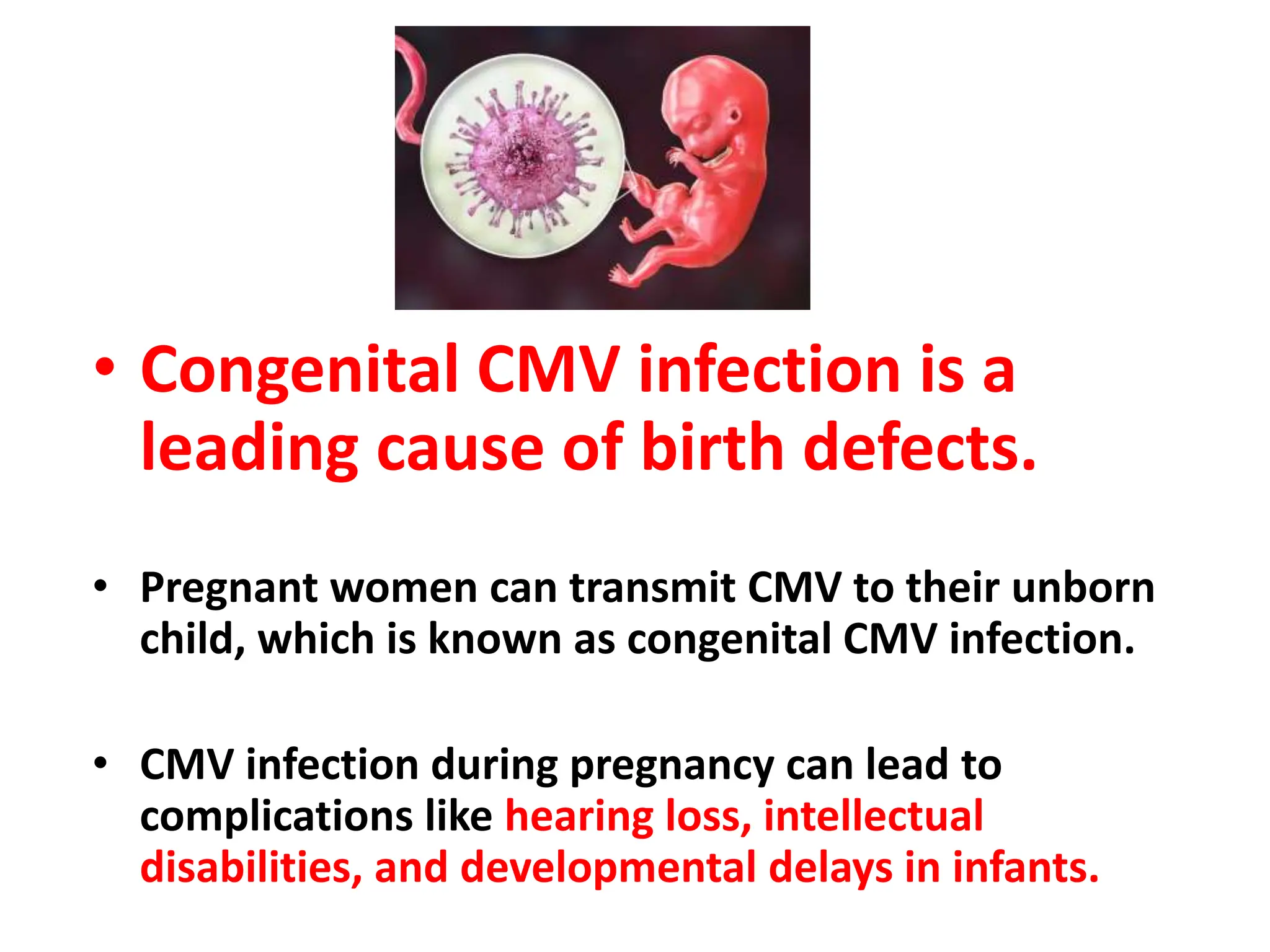
• Congenital CMV infection is a
leading cause of birth defects.
• Pregnant women can transmit CMV to their unborn
child, which is known as congenital CMV infection.
• CMV infection during pregnancy can lead to
complications like hearing loss, intellectual
disabilities, and developmental delays in infants.
Remember
CMV : Major cause of non genetic
sensorineural hearing loss and a
cause of neurodevelopmental
abnormalities
Liveborn infants
• High Income countries : 0.5%
• Low and Middle Income countries
: 1.5%
Kenneson A, Cannon MJ. Review and meta-analysis of the epidemiology of congenital 482
cytomegalovirus (CMV) infection. Reviews in Medical Virology 2007;17(4):253–76.
Primary Infection
Cytomegalovirus#
Likelihood of vertical transmission
after maternal primary infection
Likelihood of severe symptoms at
birth in an infected fetus after
maternal primary
infection
Preconception 0-10% Negligible
Periconception (< 4-11 week before
LMP)
25-45% 70%
First trimester 25-45% 20%
Second trimester 45% 5%
Third trimester 47-78% Negligible
)
Adapted from: Khalil A, Sotiriadis A, Chaoui R, da Silva Costa F, D’Antonio F, Heath PT, Jones C, Malinger G, Odibo A,
Prefumo F, Salomon LJ, Wood S, Ville Y. ISUOG Practice Guidelines: role of ultrasound in congenital infection.
Ultrasound Obstet Gynecol 2020. DOI: 10.1002/uog.21991
PLEASE NOTE
Hearing and neurological sequalae are similar in infants following
Primary and non primary infections
50-60% of infants with CMV are born to mothers with non-primary
infection
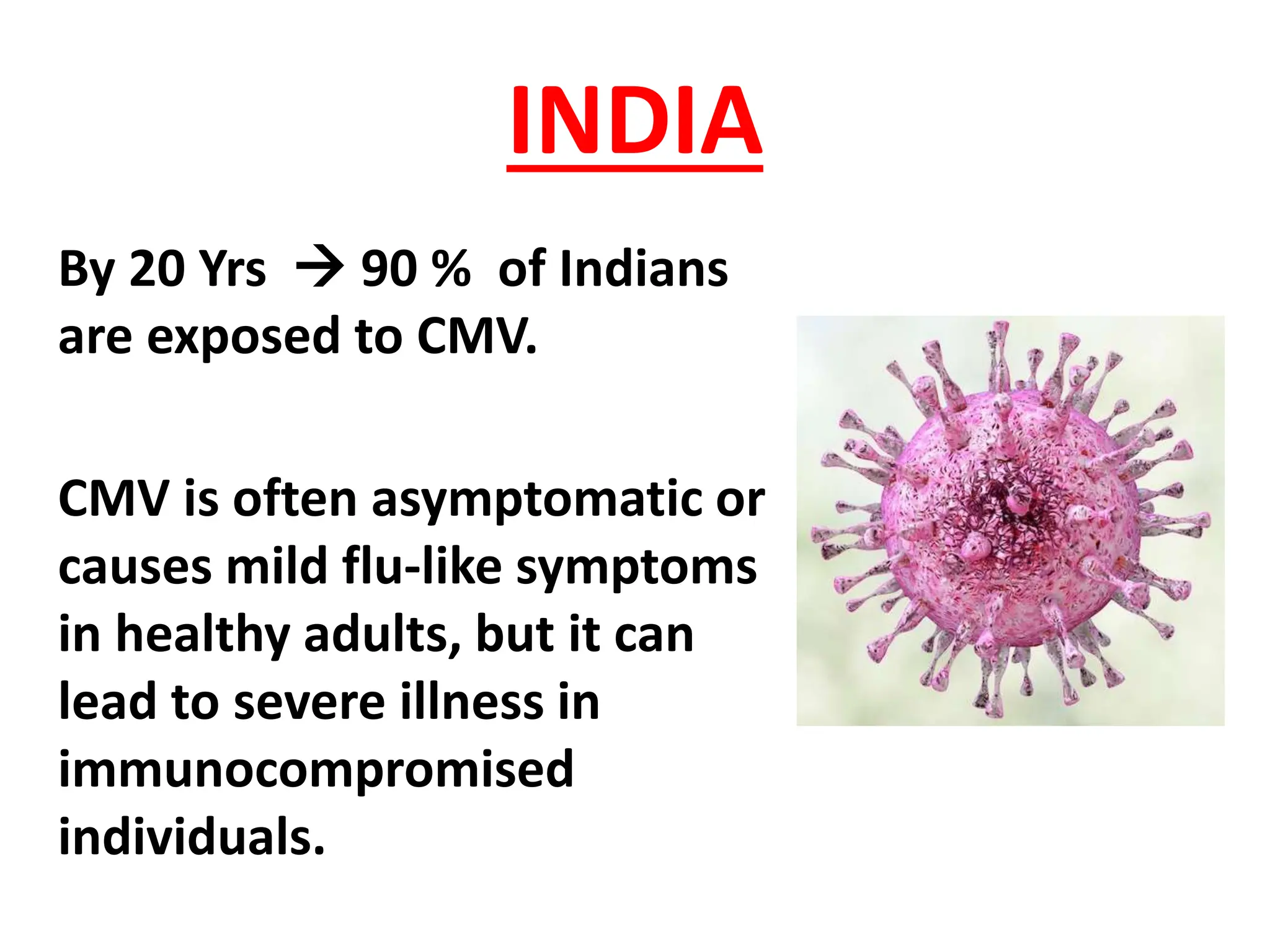
INDIA
By 20 Yrs  90 % of Indians
are exposed to CMV.
CMV is often asymptomatic or
causes mild flu-like symptoms
in healthy adults, but it can
lead to severe illness in
immunocompromised
individuals.
Diagnosis for CMV based
on Maternal History /USG
findings
• Maternal History (only seen in about a 10% of cases )
• mild fever
• joint aches
• asthenia, myalgia,
• flu-like syndrome.
• Lymphocytosis greater than 40%
• elevated liver enzymes
• Majority are asymptomatic
Clinical Features
Hepatomegaly Splenomegaly Echogenic bowel
Ultrasound findings
CMV
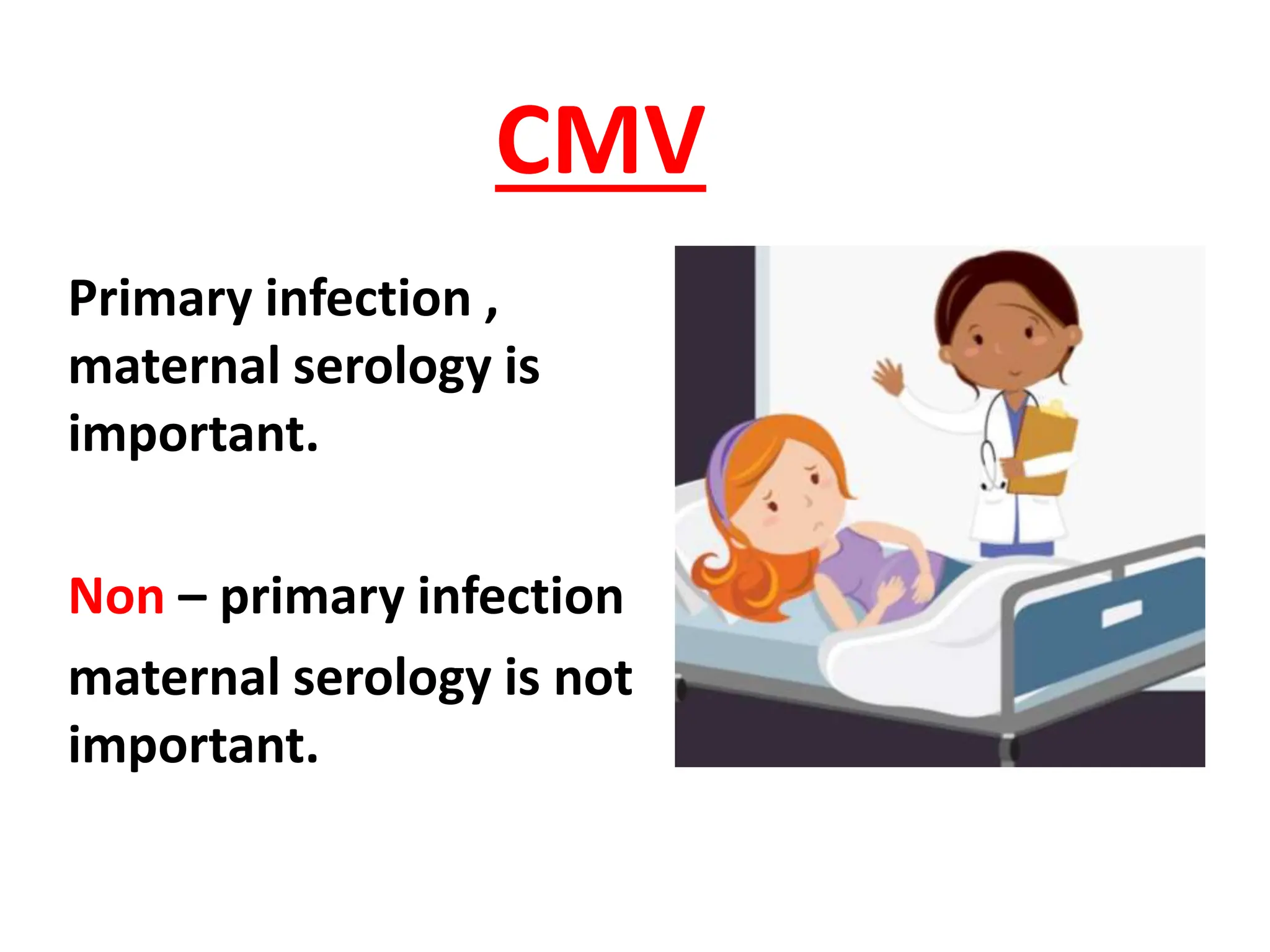
Primary infection ,
maternal serology is
important.
Non – primary infection
maternal serology is not
important.
Diagnosis
• Primary Infection:Maternal serology is reliable
• The appearance of CMV-specific IgG in a woman who was previously
seronegative.
• The detection of CMV IgM antibody with low IgG avidity
• Non –Primary infections :Maternal serology is not reliable
• IgM may persist for several months after primary infection
• Cross-reactivity of IgM with another virus
• A rise in IgG levels may not confirm non-primary infection as this may be due to
nonspecific polyclonal stimulation of the immune system
IGM may persist for several
months after primary infection.
Timing of infection is
difficult to ascertain
Diagnostic test for non primary is
PCR -CMV
Routine prenatal testing does not typically
screen for CMV, so it's important to discuss
potential risk factors and symptoms with
pregnant patients.
Management
• Antiviral medications may be considered for
pregnant women who are at high risk for
transmitting CMV to the fetus.
• Gynecologists can educate pregnant patients
about the risks of CMV and preventive
measures.
• CMV can be transmitted through bodily fluids
such as saliva, urine, and breast milk.
• Infection control measures, such as good hand
hygiene, can help prevent CMV transmission to
pregnant women.
• There is no vaccine for CMV, so prevention is
key.
Early detection and monitoring of CMV in
pregnant women are crucial to providing
appropriate care & decrease Neonatal Sequele
New developments in CMV
-Europe
EXPERTS Found
Significant neonatal sequalae only tend to develop
following first trimester CMV infections
• If given In-utero medical Therapy
(valacyclovir )
has been shown to be effective in preventing
serious neonatal sequalae except HEARING loss
Which could easily handled by ENT Surgeons
New developments in CMV
- France
France experts requested that
Gynecologists can discuss the potential risks
of CMV and benefits of Anti-viral therapy
for mothers who have CMV.
• Women considering pregnancy should
undergo CMV antibody IGM testing to
assess their risk.
• Not possible to test for all PREGNANT
Patients in india
What would we could do differently in PRIVATE
practice in INDIA ?
Maternal serology IgG /IgM /IgG Avidity
We anticipate that the risk of fetus affected is low
( India has high seroprevalence)
Treat all patients as primary CMV unless otherwise proven
Medical Therapy --VELACYCLOVIR
FU in a Fetal Medicine EXPERTS
Should we be do screening at Booking ?
• No Indian Guidelines in INDIA
• NO Newborn screening programmes in place .
• 87% of CMV infected fetuses are
undetectable at birth
Fowler KB, Boppana SB. Congenital cytomegalovirus (CMV) infection
and hearing deficit
. J 535 Clin Virol 2006;35(2):226–31.
CMV reactivation can occur in
immunocompromised pregnant women
and may require antiviral therapy.
• CMV infection can be managed with supportive
viral therapy –VELACYCLOVIR.
• care and close monitoring during pregnancy.
• Do counselling that close follow up is needed by
Fetal Medicine Experts .
• ENT specialist take care of Hearing loss which is
invariably present at BIRTH.
Pregnant women who are diagnosed with CMV
should work closely with their Fetal Medicine
healthcare providers to ensure the best NEONATAL
outcomes for their pregnancies.
For the Public:
• Cytomegalovirus (CMV) is a common virus
that can infect people of all ages.
• CMV is typically harmless in healthy , often
causing no symptoms.
• CMV can be transmitted through close
contact, especially with young children who
may carry the virus.
Pregnant women should be aware of the potential risks of CMV
infection and practice good hand hygiene to reduce the risk of
transmission.
There is no vaccine for CMV, so it's important for pregnant
women and those planning to become pregnant to be informed
about the virus and its potential bad effects on pregnancy
Gynecologists can discuss the potential
risks and benefits of breastfeeding for
mothers who have CMV.
CMV UPDATE Few solid facts  about cytomegalovirus (CMV) Infection & New development from France for Indian Gynaecologists & public  to know :Dr Sharda Jain

CMV UPDATE Few solid facts about cytomegalovirus (CMV) Infection & New development from France for Indian Gynaecologists & public to know :Dr Sharda Jain

  • 1.
    CMV UPDATE Few solid factsabout cytomegalovirus (CMV) Infection & New development from France for Indian Gynaecologists & public to know Dr Sharda Jain
  • 2.
    CMV is acommon herpesvirus that can infect people of all ages, including pregnant women. CMV is not the same as HSV (herpes simplex virus), although they belong to the same viral family.
  • 3.
    PREVALENCE Emery, Vincent &Lazzarotto, Tiziana. (2017). Cytomegalovirus in pregnancy and the neonate.
  • 4.
    Lets be clearof Definitions Primary Infection for the first time during pregnancy Risk of Vertical Transmission is more Risk of baby born with symptoms is 3.9-5.2.%. Non Primary Infections Reactivationof the latent virus Reinfection with a new strain of virus Risk of vertical transmission is less Risk of baby born with symptoms is 1-2 %. Fowler KB, Stagno S, Pass RF, Britt WJ, Boll TJ, Alford CA. The outcome of congenital 507 cytomegalovirus infection in relation to maternal antibody status. N Engl J Med 1992;326(10):663–7.
  • 5.
    • Congenital CMVinfection is a leading cause of birth defects. • Pregnant women can transmit CMV to their unborn child, which is known as congenital CMV infection. • CMV infection during pregnancy can lead to complications like hearing loss, intellectual disabilities, and developmental delays in infants.
  • 6.
    Remember CMV : Majorcause of non genetic sensorineural hearing loss and a cause of neurodevelopmental abnormalities Liveborn infants • High Income countries : 0.5% • Low and Middle Income countries : 1.5% Kenneson A, Cannon MJ. Review and meta-analysis of the epidemiology of congenital 482 cytomegalovirus (CMV) infection. Reviews in Medical Virology 2007;17(4):253–76.
  • 7.
    Primary Infection Cytomegalovirus# Likelihood ofvertical transmission after maternal primary infection Likelihood of severe symptoms at birth in an infected fetus after maternal primary infection Preconception 0-10% Negligible Periconception (< 4-11 week before LMP) 25-45% 70% First trimester 25-45% 20% Second trimester 45% 5% Third trimester 47-78% Negligible ) Adapted from: Khalil A, Sotiriadis A, Chaoui R, da Silva Costa F, D’Antonio F, Heath PT, Jones C, Malinger G, Odibo A, Prefumo F, Salomon LJ, Wood S, Ville Y. ISUOG Practice Guidelines: role of ultrasound in congenital infection. Ultrasound Obstet Gynecol 2020. DOI: 10.1002/uog.21991
  • 8.
    PLEASE NOTE Hearing andneurological sequalae are similar in infants following Primary and non primary infections 50-60% of infants with CMV are born to mothers with non-primary infection
  • 9.
    INDIA By 20 Yrs 90 % of Indians are exposed to CMV. CMV is often asymptomatic or causes mild flu-like symptoms in healthy adults, but it can lead to severe illness in immunocompromised individuals.
  • 10.
    Diagnosis for CMVbased on Maternal History /USG findings
  • 11.
    • Maternal History(only seen in about a 10% of cases ) • mild fever • joint aches • asthenia, myalgia, • flu-like syndrome. • Lymphocytosis greater than 40% • elevated liver enzymes • Majority are asymptomatic Clinical Features
  • 12.
    Hepatomegaly Splenomegaly Echogenicbowel Ultrasound findings
  • 13.
    CMV Primary infection , maternalserology is important. Non – primary infection maternal serology is not important.
  • 14.
    Diagnosis • Primary Infection:Maternalserology is reliable • The appearance of CMV-specific IgG in a woman who was previously seronegative. • The detection of CMV IgM antibody with low IgG avidity • Non –Primary infections :Maternal serology is not reliable • IgM may persist for several months after primary infection • Cross-reactivity of IgM with another virus • A rise in IgG levels may not confirm non-primary infection as this may be due to nonspecific polyclonal stimulation of the immune system
  • 15.
    IGM may persistfor several months after primary infection. Timing of infection is difficult to ascertain Diagnostic test for non primary is PCR -CMV
  • 16.
    Routine prenatal testingdoes not typically screen for CMV, so it's important to discuss potential risk factors and symptoms with pregnant patients.
  • 17.
    Management • Antiviral medicationsmay be considered for pregnant women who are at high risk for transmitting CMV to the fetus. • Gynecologists can educate pregnant patients about the risks of CMV and preventive measures.
  • 18.
    • CMV canbe transmitted through bodily fluids such as saliva, urine, and breast milk. • Infection control measures, such as good hand hygiene, can help prevent CMV transmission to pregnant women. • There is no vaccine for CMV, so prevention is key.
  • 19.
    Early detection andmonitoring of CMV in pregnant women are crucial to providing appropriate care & decrease Neonatal Sequele
  • 20.
  • 21.
    EXPERTS Found Significant neonatalsequalae only tend to develop following first trimester CMV infections • If given In-utero medical Therapy (valacyclovir ) has been shown to be effective in preventing serious neonatal sequalae except HEARING loss Which could easily handled by ENT Surgeons New developments in CMV - France
  • 22.
    France experts requestedthat Gynecologists can discuss the potential risks of CMV and benefits of Anti-viral therapy for mothers who have CMV.
  • 23.
    • Women consideringpregnancy should undergo CMV antibody IGM testing to assess their risk. • Not possible to test for all PREGNANT Patients in india
  • 24.
    What would wecould do differently in PRIVATE practice in INDIA ? Maternal serology IgG /IgM /IgG Avidity We anticipate that the risk of fetus affected is low ( India has high seroprevalence) Treat all patients as primary CMV unless otherwise proven Medical Therapy --VELACYCLOVIR FU in a Fetal Medicine EXPERTS
  • 25.
    Should we bedo screening at Booking ? • No Indian Guidelines in INDIA • NO Newborn screening programmes in place . • 87% of CMV infected fetuses are undetectable at birth Fowler KB, Boppana SB. Congenital cytomegalovirus (CMV) infection and hearing deficit . J 535 Clin Virol 2006;35(2):226–31.
  • 26.
    CMV reactivation canoccur in immunocompromised pregnant women and may require antiviral therapy.
  • 27.
    • CMV infectioncan be managed with supportive viral therapy –VELACYCLOVIR. • care and close monitoring during pregnancy. • Do counselling that close follow up is needed by Fetal Medicine Experts . • ENT specialist take care of Hearing loss which is invariably present at BIRTH.
  • 28.
    Pregnant women whoare diagnosed with CMV should work closely with their Fetal Medicine healthcare providers to ensure the best NEONATAL outcomes for their pregnancies.
  • 29.
  • 30.
    • Cytomegalovirus (CMV)is a common virus that can infect people of all ages. • CMV is typically harmless in healthy , often causing no symptoms. • CMV can be transmitted through close contact, especially with young children who may carry the virus.
  • 31.
    Pregnant women shouldbe aware of the potential risks of CMV infection and practice good hand hygiene to reduce the risk of transmission. There is no vaccine for CMV, so it's important for pregnant women and those planning to become pregnant to be informed about the virus and its potential bad effects on pregnancy
  • 32.
    Gynecologists can discussthe potential risks and benefits of breastfeeding for mothers who have CMV.

Editor's Notes

  • #8 But even 3rd trimester should be followed up for SNHL and neurodevelopmental outcomes
  • #25 Session: 294. Late Breaker Oral Abstract Session 2 Saturday, October 5, 2019: 2:35 PM Background. Cytomegalovirus (CMV) is the most common cause of congenital infection in humans. The highest risk of fetal injury follows a maternal primary infection early in pregnancy. Despite the potential for severe fetal injury, to date there are no proven means to prevent viral transmission. Valacyclovir is an antiviral drug proven effective in decreasing the risk for CMV infection among transplant recipients. Valacyclovir is safe for use in pregnancy, and concentrates in the amniotic fluid without accumulating. A dose of 8 g/day creates therapeutic drug levels in the amniotic fluid and fetal blood. Methods. This is a randomized, double-blind, placebo-controlled study compris- ing pregnant women with serologic evidence of primary CMV infection during the periconceptional period and first trimester. After informed consent, patients were ran- domly assigned to a treatment group (8 g/day of Valacyclovir) or control group (pla- cebo). Treatment was initiated at the time of serological detection, and continued until amniocentesis. The primary endpoint was the rate of vertical transmission of CMV— determined by amniotic fluid CMV PCR. Secondary endpoints included evidence of symptomatic congenital CMV infection—in utero or postnatally. Results. One hundred women were recruited, 90 were included in the data analy- sis; 45 patients received Valacyclovir and 45 placebo. There were 2 twin pregnancies, and therefore 92 amniocentesis. Amongst the Valacyclovir group, 5 (11.1%) amniocentesis were positive for CMV, compared with 14 (29.8%) in the placebo group (P GLMM = 0.03), corresponding with an odds ratio of 0.29 (95% CI: 0.09–0.90) for vertical CMV trans- mission. Amongst patients infected during the first trimester, a positive amniocentesis for CMV was significantly (P = 0.02) less likely in the Valacyclovir arm (2/19) compared with placebo (11/23). No significant differences (P = 0.91) in CMV-positive amniocentesis were observed between study arms amongst patients infected periconceptionally. Conclusion. Valacyclovir at a dose of 8 g/day is effective in reducing the rate of fetal CMV infection following early maternal primary infection during pregnancy. The drug reduces the rate of fetal infection by 71%. Disclosures. All authors: No reported disclosur