© 2020 Cengage Learning®. May not be scanned, copied or duplicated, or posted to a publicly accessible website, in whole or in part.
CHAPTER
13
Planning for
the Harvest
© 2020 Cengage Learning®. May not be scanned, copied or duplicated, or posted to a publicly accessible website, in whole or in part.
LEARNING OBJECTIVES
By studying this chapter, you should be able to…
13-1 Explain the importance of having a harvest, or exit,
plan.
13-2 Describe the options available for harvesting.
13-3 Explain the issues in valuing a firm that is being
harvested and deciding on the method of payment.
13-4 Provide advice on developing an effective harvest
plan.
© 2020 Cengage Learning®. May not be scanned, copied or duplicated, or posted to a publicly accessible website, in whole or in part.
13-1 THE IMPORTANCE
OF THE HARVEST
• Harvesting (exiting) – The process used by
entrepreneurs and investors to reap the value
of their investment in a business when they
leave it.
• Harvesting is about more than merely selling
and leaving a business.
• It involves capturing value (cash flows), reducing
risk, and creating future options.
• A firm’s appeal to investors is driven, in part,
by the availability of harvest options.
© 2020 Cengage Learning®. May not be scanned, copied or duplicated, or posted to a publicly accessible website, in whole or in part.
13-2 METHODS OF
HARVESTING A BUSINESS
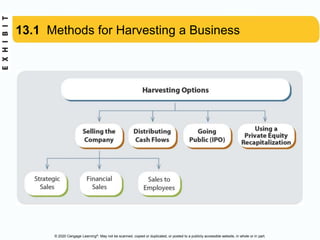
• There are four basic ways to harvest an
investment in a privately owned company:
1. Sell the firm.
2. Distribute the cash flows generated by the business
to its owners instead of reinvesting the cash.
3. Offer stock to the public through an initial public
offering (IPO).
4. Use a private equity recapitalization.
© 2020 Cengage Learning®. May not be scanned, copied or duplicated, or posted to a publicly accessible website, in whole or in part.
13.1 Methods for Harvesting a Business
© 2020 Cengage Learning®. May not be scanned, copied or duplicated, or posted to a publicly accessible website, in whole or in part.
13-2a Selling the Firm (slide 1 of 8)
• In any harvest strategy, the financial questions
associated with the sale of a firm include how to value
the firm and how to structure the payment for the
business.
• Most frequently, an entrepreneur’s motivation for
selling a company relates to retirement and estate
planning and a desire to diversify investments.
• Potential buyers for a company can come from several
places, including customers, suppliers, employees,
friends and family, and even a competitor.
© 2020 Cengage Learning®. May not be scanned, copied or duplicated, or posted to a publicly accessible website, in whole or in part.
13-2a Selling the Firm (slide 2 of 8)
• A owner may also want to use a business broker.
• Business broker – A professional who assists in the buying
and selling of a business.
• In addition to finding possible buyers, a business broker can
provide valuable guidance to the selling entrepreneur and help
facilitate the negotiations.
• Brokers can, however, be relatively expensive, charging 5 to 10
percent of the selling price.
• In the search for potential buyers, it is essential that
the selling entrepreneur understand the different types
of buyers, which include:
• Strategic buyers.
• Financial buyers.
• Employees.
© 2020 Cengage Learning®. May not be scanned, copied or duplicated, or posted to a publicly accessible website, in whole or in part.
13-2a Selling the Firm (slide 3 of 8)
SALES TO STRATEGIC BUYERS
• Usually, a strategic buyer is a firm in a similar line of
business in a different market or in need of new
products and services to sell to existing customers.
• Another possibility is a buyer in an unrelated business
that wants to acquire a seller’s strengths to help the
buyer’s existing business.
• Strategic buyers value a business, in large part, based
on the mutual advantages they think they can create
by combining the acquired firm with another business.
• Since the value of a business to a buyer is derived from both
its stand-alone characteristics and its synergies, strategic
buyers may pay a higher price than would other buyers.
© 2020 Cengage Learning®. May not be scanned, copied or duplicated, or posted to a publicly accessible website, in whole or in part.
13-2a Selling the Firm (slide 4 of 8)
SALES TO FINANCIAL BUYERS
• Unlike strategic buyers, financial buyers look primarily
to a firm’s stand-alone, cash-generating potential as its
source of value.
• A financial buyer hopes to increase future sales
growth, reduce costs, or both.
• Leveraged buyout (LBO) – A purchase heavily
financed with debt, where the future cash flows of the
target company are expected to be sufficient to meet
debt repayments.
• The LBO has sometimes been called a bust-up LBO.
• Bust-up LBO – A leveraged buyout involving the purchase of a
company with the intent of selling off its assets.
© 2020 Cengage Learning®. May not be scanned, copied or duplicated, or posted to a publicly accessible website, in whole or in part.
13-2a Selling the Firm (slide 5 of 8)
• Because buyers rely heavily on debt to finance the
acquisition, the acquired company must have the
following characteristics:
1. Steady earnings over time.
2. Attractive growth rates.
3. An effective management team already in place.
4. Assets that can be used as collateral on the debt.
• More recently, the bust-up LBO has been replaced by
the build-up LBO.
• Build-up LBO – A leveraged buyout involving the purchase of
a group of similar companies with the intent of making the
firms into one larger company for eventual sale or to be taken
public.
© 2020 Cengage Learning®. May not be scanned, copied or duplicated, or posted to a publicly accessible website, in whole or in part.
13-2a Selling the Firm (slide 6 of 8)
• Sometimes, the selling firm’s own management
initiates an LBO to buy the business from the
entrepreneur—in which case the arrangement is
referred to as a management buyout (MBO).
• Management buyout (MBO) – A leveraged buyout in which
the firm’s top managers become significant shareholders in
the acquired firm.
© 2020 Cengage Learning®. May not be scanned, copied or duplicated, or posted to a publicly accessible website, in whole or in part.
13-2a Selling the Firm (slide 7 of 8)
SALES TO EMPLOYEES
• Employee stock ownership plans (ESOPs) – A trust
fund that uses employee retirement contributions to
buy stock in the employer’s company.
• An owner can sell all or part of his or her stock to the
ESOP and still retain a management position with the
firm, thereby effectively maintaining control of the
business.
• A reason frequently given for selling to employees is to
create an incentive for them to work harder.
• However, selling all or part of a firm to employees works only if
the company’s employees have an owner’s mentality—that is,
they do not think in “9-to-5” terms.
© 2020 Cengage Learning®. May not be scanned, copied or duplicated, or posted to a publicly accessible website, in whole or in part.
13-2a Selling the Firm (slide 8 of 8)
• It can sometimes be difficult for buyers to get
financing from traditional sources.
• As a result, seller financing has become more
prevalent.
• Seller financing – Financing in which the seller accepts a
note (in lieu of cash) from a buyer in partial payment for a
business.
© 2020 Cengage Learning®. May not be scanned, copied or duplicated, or posted to a publicly accessible website, in whole or in part.
13-2b Distributing the
Firm’s Cash Flows (slide 1 of 2)
• The orderly withdrawal of an owner’s investment in the
form of the firm’s cash flows can be achieved by simply
stopping the firm’s growth and slowly withdrawing cash
from the business.
• Harvesting by slowly withdrawing a firm’s cash from
the business has two important advantages:
1. The owners can retain control of the business while they
harvest their investment.
2. They don’t have to look for a buyer or incur the expenses
associated with consummating a sale.
© 2020 Cengage Learning®. May not be scanned, copied or duplicated, or posted to a publicly accessible website, in whole or in part.
13-2b Distributing the
Firm’s Cash Flows (slide 2 of 2)
• There are also disadvantages:
1. Reducing investment when a firm faces valuable growth
opportunities could leave the firm unable to sustain its
competitive advantage.
2. There may be tax disadvantages to an orderly liquidation,
compared with other harvest methods.
• Double taxation – Taxation of income that occurs twice—first as
corporate earnings and then as stockholder dividends.
3. For the entrepreneur who is simply tired of day-to-day
operations, siphoning off the cash flows over time may require
too much patience.
© 2020 Cengage Learning®. May not be scanned, copied or duplicated, or posted to a publicly accessible website, in whole or in part.
13-2c Initial Public Offering (IPO)
(slide 1 of 2)
• Initial public offering (IPO) – The first sale of shares of a
company’s stock to the public.
• An IPO requires registering the stock issue with the Securities and
Exchange Commission (SEC) and adhering to blue sky laws that
govern the public offering at a state level.
• The purpose of these federal and state laws is to ensure adequate
disclosure to investors and to prevent fraud.
• Businesses intending to conduct an IPO must file a detailed
registration statement with the SEC, including in-depth financial,
management, and operational information.
THE COSTS OF MANAGING AN IPO
• Running a publicly traded company includes significant ongoing
costs associated with reporting its financial results to investors
and to the SEC.
© 2020 Cengage Learning®. May not be scanned, copied or duplicated, or posted to a publicly accessible website, in whole or in part.
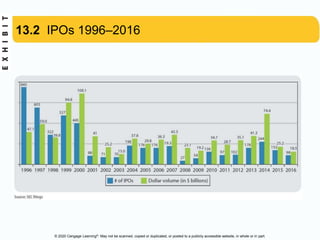
13.2 IPOs 1996–2016
© 2020 Cengage Learning®. May not be scanned, copied or duplicated, or posted to a publicly accessible website, in whole or in part.
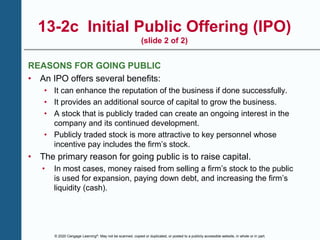
13-2c Initial Public Offering (IPO)
(slide 2 of 2)
REASONS FOR GOING PUBLIC
• An IPO offers several benefits:
• It can enhance the reputation of the business if done successfully.
• It provides an additional source of capital to grow the business.
• A stock that is publicly traded can create an ongoing interest in the
company and its continued development.
• Publicly traded stock is more attractive to key personnel whose
incentive pay includes the firm’s stock.
• The primary reason for going public is to raise capital.
• In most cases, money raised from selling a firm’s stock to the public
is used for expansion, paying down debt, and increasing the firm’s
liquidity (cash).
© 2020 Cengage Learning®. May not be scanned, copied or duplicated, or posted to a publicly accessible website, in whole or in part.
13-2d Private Equity
Recapitalization
• Private equity recapitalization – Provision of debt
and equity by private equity investors that allows an
entrepreneur to cash out part of his or her investment.
• Private equity investors offer two key advantages that
public investors do not:
• Immediacy.
• With private equity, an entrepreneur can sell most of her or his stock
immediately, an option not available when a firm is taken public.
• Flexibility.
• Private equity investors can be more flexible in structuring their
investment to meet an entrepreneur’s needs.
• A private equity recap is particularly effective for
family-owned businesses that need to transfer
ownership to the next generation.
© 2020 Cengage Learning®. May not be scanned, copied or duplicated, or posted to a publicly accessible website, in whole or in part.
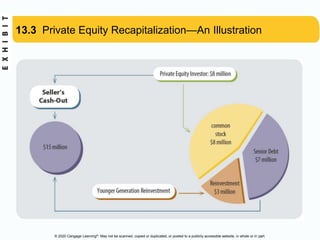
13.3 Private Equity Recapitalization—An Illustration
© 2020 Cengage Learning®. May not be scanned, copied or duplicated, or posted to a publicly accessible website, in whole or in part.
13-3 FIRM VALUATION AND
PAYMENT METHODS
• As a firm moves toward the harvest, two issues
are of primary importance:
1. The harvest value (the firm’s selling price).
2. The method of payment when a firm is sold.
© 2020 Cengage Learning®. May not be scanned, copied or duplicated, or posted to a publicly accessible website, in whole or in part.
13-3a The Harvest Value
• Value is created when a firm’s return on
invested capital is greater than the investors’
opportunity cost of funds.
• Opportunity cost of funds – The rate of return that
could be earned on another investment of similar
risk.
• If a seller has grown the venture to the point of
diminishing returns, the firm will have greater
value in the hands of new owners who can
take it to the next level.
© 2020 Cengage Learning®. May not be scanned, copied or duplicated, or posted to a publicly accessible website, in whole or in part.
13-3b The Method of Payment
• The seller can be paid in cash or in the stock of
the acquiring firm.
• Cash is generally preferred over stock.
• Entrepreneurs who accept stock in payment are frequently
disappointed, as they are unable to affect the value of the
stock once they have sold the firm.
© 2020 Cengage Learning®. May not be scanned, copied or duplicated, or posted to a publicly accessible website, in whole or in part.
13-4 DEVELOPING AN
EFFECTIVE HARVEST PLAN
• More times that not, owners who harvest their
businesses are disappointed with the process
and the outcome.
• Suggestions for crafting an effective exit
strategy include the following:
• Anticipate the harvest.
• Expect both emotional and cultural conflict.
• Get good advice.
• Understand what motivates you.
© 2020 Cengage Learning®. May not be scanned, copied or duplicated, or posted to a publicly accessible website, in whole or in part.
13-4a Anticipate the Harvest
• Entrepreneurs frequently do not appreciate the
difficulty of selling or exiting a company.
• Harvesting, whether through a sale or a stock offering, takes a
lot of time and energy on the part of the firm’s management
team and can be very distracting from day-to-day affairs.
• Investors are always concerned about how to exit, and
entrepreneurs need to have a similar mindset.
• Entrepreneurs are advised to have a harvest plan in
place two or three years ahead of their exit so that they
can correctly position their companies.
© 2020 Cengage Learning®. May not be scanned, copied or duplicated, or posted to a publicly accessible website, in whole or in part.
13-4b Expect Conflict—
Emotional and Cultural
• Having purchased other companies does not prepare
entrepreneurs for the sale of their own company.
• One very real difference between selling and buying
comes from the entrepreneur’s personal ties to the
business that he or she helped create.
• A buyer can be quite unemotional and detached, while a seller
is likely to be much more concerned about nonfinancial
considerations.
• Entrepreneurs who plan to stay with a business after a
sale can become disillusioned quickly and end up
leaving prematurely.
• An entrepreneur who stays with the company should expect
culture conflict.
© 2020 Cengage Learning®. May not be scanned, copied or duplicated, or posted to a publicly accessible website, in whole or in part.
13-4c Get Good Advice
• Getting good advice is essential, from both
experienced professionals and those who have
personally been through a harvest.
© 2020 Cengage Learning®. May not be scanned, copied or duplicated, or posted to a publicly accessible website, in whole or in part.
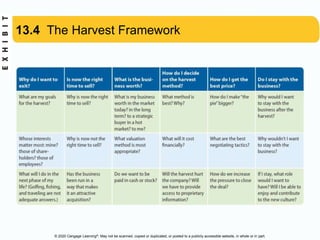
13-4d Understand
What Motivates You
• Entrepreneurs must carefully consider their
motives for exiting and their plans for after the
harvest.
© 2020 Cengage Learning®. May not be scanned, copied or duplicated, or posted to a publicly accessible website, in whole or in part.
13.4 The Harvest Framework
© 2020 Cengage Learning®. May not be scanned, copied or duplicated, or posted to a publicly accessible website, in whole or in part.
13-4e What’s Next?
• Purpose-driven entrepreneurs should find
other things to bring meaning to their life after
the exit.
© 2020 Cengage Learning®. May not be scanned, copied or duplicated, or posted to a publicly accessible website, in whole or in part.
Key Terms
build-up LBO
business broker
bust-up LBO
double taxation
employee stock ownership plan
(ESOP)
harvesting (exiting)
initial public offering (IPO)
leveraged buyout (LBO)
management buyout (MBO)
opportunity cost of funds
private equity recapitalization
seller financing

Small Business Management Chapter 13 PowerPoint

  • 1.
    © 2020 CengageLearning®. May not be scanned, copied or duplicated, or posted to a publicly accessible website, in whole or in part. CHAPTER 13 Planning for the Harvest
  • 2.
    © 2020 CengageLearning®. May not be scanned, copied or duplicated, or posted to a publicly accessible website, in whole or in part. LEARNING OBJECTIVES By studying this chapter, you should be able to… 13-1 Explain the importance of having a harvest, or exit, plan. 13-2 Describe the options available for harvesting. 13-3 Explain the issues in valuing a firm that is being harvested and deciding on the method of payment. 13-4 Provide advice on developing an effective harvest plan.
  • 3.
    © 2020 CengageLearning®. May not be scanned, copied or duplicated, or posted to a publicly accessible website, in whole or in part. 13-1 THE IMPORTANCE OF THE HARVEST • Harvesting (exiting) – The process used by entrepreneurs and investors to reap the value of their investment in a business when they leave it. • Harvesting is about more than merely selling and leaving a business. • It involves capturing value (cash flows), reducing risk, and creating future options. • A firm’s appeal to investors is driven, in part, by the availability of harvest options.
  • 4.
    © 2020 CengageLearning®. May not be scanned, copied or duplicated, or posted to a publicly accessible website, in whole or in part. 13-2 METHODS OF HARVESTING A BUSINESS • There are four basic ways to harvest an investment in a privately owned company: 1. Sell the firm. 2. Distribute the cash flows generated by the business to its owners instead of reinvesting the cash. 3. Offer stock to the public through an initial public offering (IPO). 4. Use a private equity recapitalization.
  • 5.
    © 2020 CengageLearning®. May not be scanned, copied or duplicated, or posted to a publicly accessible website, in whole or in part. 13.1 Methods for Harvesting a Business
  • 6.
    © 2020 CengageLearning®. May not be scanned, copied or duplicated, or posted to a publicly accessible website, in whole or in part. 13-2a Selling the Firm (slide 1 of 8) • In any harvest strategy, the financial questions associated with the sale of a firm include how to value the firm and how to structure the payment for the business. • Most frequently, an entrepreneur’s motivation for selling a company relates to retirement and estate planning and a desire to diversify investments. • Potential buyers for a company can come from several places, including customers, suppliers, employees, friends and family, and even a competitor.
  • 7.
    © 2020 CengageLearning®. May not be scanned, copied or duplicated, or posted to a publicly accessible website, in whole or in part. 13-2a Selling the Firm (slide 2 of 8) • A owner may also want to use a business broker. • Business broker – A professional who assists in the buying and selling of a business. • In addition to finding possible buyers, a business broker can provide valuable guidance to the selling entrepreneur and help facilitate the negotiations. • Brokers can, however, be relatively expensive, charging 5 to 10 percent of the selling price. • In the search for potential buyers, it is essential that the selling entrepreneur understand the different types of buyers, which include: • Strategic buyers. • Financial buyers. • Employees.
  • 8.
    © 2020 CengageLearning®. May not be scanned, copied or duplicated, or posted to a publicly accessible website, in whole or in part. 13-2a Selling the Firm (slide 3 of 8) SALES TO STRATEGIC BUYERS • Usually, a strategic buyer is a firm in a similar line of business in a different market or in need of new products and services to sell to existing customers. • Another possibility is a buyer in an unrelated business that wants to acquire a seller’s strengths to help the buyer’s existing business. • Strategic buyers value a business, in large part, based on the mutual advantages they think they can create by combining the acquired firm with another business. • Since the value of a business to a buyer is derived from both its stand-alone characteristics and its synergies, strategic buyers may pay a higher price than would other buyers.
  • 9.
    © 2020 CengageLearning®. May not be scanned, copied or duplicated, or posted to a publicly accessible website, in whole or in part. 13-2a Selling the Firm (slide 4 of 8) SALES TO FINANCIAL BUYERS • Unlike strategic buyers, financial buyers look primarily to a firm’s stand-alone, cash-generating potential as its source of value. • A financial buyer hopes to increase future sales growth, reduce costs, or both. • Leveraged buyout (LBO) – A purchase heavily financed with debt, where the future cash flows of the target company are expected to be sufficient to meet debt repayments. • The LBO has sometimes been called a bust-up LBO. • Bust-up LBO – A leveraged buyout involving the purchase of a company with the intent of selling off its assets.
  • 10.
    © 2020 CengageLearning®. May not be scanned, copied or duplicated, or posted to a publicly accessible website, in whole or in part. 13-2a Selling the Firm (slide 5 of 8) • Because buyers rely heavily on debt to finance the acquisition, the acquired company must have the following characteristics: 1. Steady earnings over time. 2. Attractive growth rates. 3. An effective management team already in place. 4. Assets that can be used as collateral on the debt. • More recently, the bust-up LBO has been replaced by the build-up LBO. • Build-up LBO – A leveraged buyout involving the purchase of a group of similar companies with the intent of making the firms into one larger company for eventual sale or to be taken public.
  • 11.
    © 2020 CengageLearning®. May not be scanned, copied or duplicated, or posted to a publicly accessible website, in whole or in part. 13-2a Selling the Firm (slide 6 of 8) • Sometimes, the selling firm’s own management initiates an LBO to buy the business from the entrepreneur—in which case the arrangement is referred to as a management buyout (MBO). • Management buyout (MBO) – A leveraged buyout in which the firm’s top managers become significant shareholders in the acquired firm.
  • 12.
    © 2020 CengageLearning®. May not be scanned, copied or duplicated, or posted to a publicly accessible website, in whole or in part. 13-2a Selling the Firm (slide 7 of 8) SALES TO EMPLOYEES • Employee stock ownership plans (ESOPs) – A trust fund that uses employee retirement contributions to buy stock in the employer’s company. • An owner can sell all or part of his or her stock to the ESOP and still retain a management position with the firm, thereby effectively maintaining control of the business. • A reason frequently given for selling to employees is to create an incentive for them to work harder. • However, selling all or part of a firm to employees works only if the company’s employees have an owner’s mentality—that is, they do not think in “9-to-5” terms.
  • 13.
    © 2020 CengageLearning®. May not be scanned, copied or duplicated, or posted to a publicly accessible website, in whole or in part. 13-2a Selling the Firm (slide 8 of 8) • It can sometimes be difficult for buyers to get financing from traditional sources. • As a result, seller financing has become more prevalent. • Seller financing – Financing in which the seller accepts a note (in lieu of cash) from a buyer in partial payment for a business.
  • 14.
    © 2020 CengageLearning®. May not be scanned, copied or duplicated, or posted to a publicly accessible website, in whole or in part. 13-2b Distributing the Firm’s Cash Flows (slide 1 of 2) • The orderly withdrawal of an owner’s investment in the form of the firm’s cash flows can be achieved by simply stopping the firm’s growth and slowly withdrawing cash from the business. • Harvesting by slowly withdrawing a firm’s cash from the business has two important advantages: 1. The owners can retain control of the business while they harvest their investment. 2. They don’t have to look for a buyer or incur the expenses associated with consummating a sale.
  • 15.
    © 2020 CengageLearning®. May not be scanned, copied or duplicated, or posted to a publicly accessible website, in whole or in part. 13-2b Distributing the Firm’s Cash Flows (slide 2 of 2) • There are also disadvantages: 1. Reducing investment when a firm faces valuable growth opportunities could leave the firm unable to sustain its competitive advantage. 2. There may be tax disadvantages to an orderly liquidation, compared with other harvest methods. • Double taxation – Taxation of income that occurs twice—first as corporate earnings and then as stockholder dividends. 3. For the entrepreneur who is simply tired of day-to-day operations, siphoning off the cash flows over time may require too much patience.
  • 16.
    © 2020 CengageLearning®. May not be scanned, copied or duplicated, or posted to a publicly accessible website, in whole or in part. 13-2c Initial Public Offering (IPO) (slide 1 of 2) • Initial public offering (IPO) – The first sale of shares of a company’s stock to the public. • An IPO requires registering the stock issue with the Securities and Exchange Commission (SEC) and adhering to blue sky laws that govern the public offering at a state level. • The purpose of these federal and state laws is to ensure adequate disclosure to investors and to prevent fraud. • Businesses intending to conduct an IPO must file a detailed registration statement with the SEC, including in-depth financial, management, and operational information. THE COSTS OF MANAGING AN IPO • Running a publicly traded company includes significant ongoing costs associated with reporting its financial results to investors and to the SEC.
  • 17.
    © 2020 CengageLearning®. May not be scanned, copied or duplicated, or posted to a publicly accessible website, in whole or in part. 13.2 IPOs 1996–2016
  • 18.
    © 2020 CengageLearning®. May not be scanned, copied or duplicated, or posted to a publicly accessible website, in whole or in part. 13-2c Initial Public Offering (IPO) (slide 2 of 2) REASONS FOR GOING PUBLIC • An IPO offers several benefits: • It can enhance the reputation of the business if done successfully. • It provides an additional source of capital to grow the business. • A stock that is publicly traded can create an ongoing interest in the company and its continued development. • Publicly traded stock is more attractive to key personnel whose incentive pay includes the firm’s stock. • The primary reason for going public is to raise capital. • In most cases, money raised from selling a firm’s stock to the public is used for expansion, paying down debt, and increasing the firm’s liquidity (cash).
  • 19.
    © 2020 CengageLearning®. May not be scanned, copied or duplicated, or posted to a publicly accessible website, in whole or in part. 13-2d Private Equity Recapitalization • Private equity recapitalization – Provision of debt and equity by private equity investors that allows an entrepreneur to cash out part of his or her investment. • Private equity investors offer two key advantages that public investors do not: • Immediacy. • With private equity, an entrepreneur can sell most of her or his stock immediately, an option not available when a firm is taken public. • Flexibility. • Private equity investors can be more flexible in structuring their investment to meet an entrepreneur’s needs. • A private equity recap is particularly effective for family-owned businesses that need to transfer ownership to the next generation.
  • 20.
    © 2020 CengageLearning®. May not be scanned, copied or duplicated, or posted to a publicly accessible website, in whole or in part. 13.3 Private Equity Recapitalization—An Illustration
  • 21.
    © 2020 CengageLearning®. May not be scanned, copied or duplicated, or posted to a publicly accessible website, in whole or in part. 13-3 FIRM VALUATION AND PAYMENT METHODS • As a firm moves toward the harvest, two issues are of primary importance: 1. The harvest value (the firm’s selling price). 2. The method of payment when a firm is sold.
  • 22.
    © 2020 CengageLearning®. May not be scanned, copied or duplicated, or posted to a publicly accessible website, in whole or in part. 13-3a The Harvest Value • Value is created when a firm’s return on invested capital is greater than the investors’ opportunity cost of funds. • Opportunity cost of funds – The rate of return that could be earned on another investment of similar risk. • If a seller has grown the venture to the point of diminishing returns, the firm will have greater value in the hands of new owners who can take it to the next level.
  • 23.
    © 2020 CengageLearning®. May not be scanned, copied or duplicated, or posted to a publicly accessible website, in whole or in part. 13-3b The Method of Payment • The seller can be paid in cash or in the stock of the acquiring firm. • Cash is generally preferred over stock. • Entrepreneurs who accept stock in payment are frequently disappointed, as they are unable to affect the value of the stock once they have sold the firm.
  • 24.
    © 2020 CengageLearning®. May not be scanned, copied or duplicated, or posted to a publicly accessible website, in whole or in part. 13-4 DEVELOPING AN EFFECTIVE HARVEST PLAN • More times that not, owners who harvest their businesses are disappointed with the process and the outcome. • Suggestions for crafting an effective exit strategy include the following: • Anticipate the harvest. • Expect both emotional and cultural conflict. • Get good advice. • Understand what motivates you.
  • 25.
    © 2020 CengageLearning®. May not be scanned, copied or duplicated, or posted to a publicly accessible website, in whole or in part. 13-4a Anticipate the Harvest • Entrepreneurs frequently do not appreciate the difficulty of selling or exiting a company. • Harvesting, whether through a sale or a stock offering, takes a lot of time and energy on the part of the firm’s management team and can be very distracting from day-to-day affairs. • Investors are always concerned about how to exit, and entrepreneurs need to have a similar mindset. • Entrepreneurs are advised to have a harvest plan in place two or three years ahead of their exit so that they can correctly position their companies.
  • 26.
    © 2020 CengageLearning®. May not be scanned, copied or duplicated, or posted to a publicly accessible website, in whole or in part. 13-4b Expect Conflict— Emotional and Cultural • Having purchased other companies does not prepare entrepreneurs for the sale of their own company. • One very real difference between selling and buying comes from the entrepreneur’s personal ties to the business that he or she helped create. • A buyer can be quite unemotional and detached, while a seller is likely to be much more concerned about nonfinancial considerations. • Entrepreneurs who plan to stay with a business after a sale can become disillusioned quickly and end up leaving prematurely. • An entrepreneur who stays with the company should expect culture conflict.
  • 27.
    © 2020 CengageLearning®. May not be scanned, copied or duplicated, or posted to a publicly accessible website, in whole or in part. 13-4c Get Good Advice • Getting good advice is essential, from both experienced professionals and those who have personally been through a harvest.
  • 28.
    © 2020 CengageLearning®. May not be scanned, copied or duplicated, or posted to a publicly accessible website, in whole or in part. 13-4d Understand What Motivates You • Entrepreneurs must carefully consider their motives for exiting and their plans for after the harvest.
  • 29.
    © 2020 CengageLearning®. May not be scanned, copied or duplicated, or posted to a publicly accessible website, in whole or in part. 13.4 The Harvest Framework
  • 30.
    © 2020 CengageLearning®. May not be scanned, copied or duplicated, or posted to a publicly accessible website, in whole or in part. 13-4e What’s Next? • Purpose-driven entrepreneurs should find other things to bring meaning to their life after the exit.
  • 31.
    © 2020 CengageLearning®. May not be scanned, copied or duplicated, or posted to a publicly accessible website, in whole or in part. Key Terms build-up LBO business broker bust-up LBO double taxation employee stock ownership plan (ESOP) harvesting (exiting) initial public offering (IPO) leveraged buyout (LBO) management buyout (MBO) opportunity cost of funds private equity recapitalization seller financing