1-0 1-0
Chapter-1
INTRODUCTION TO FINANCAIAL
MANAGEMENT
By
Lt.Dr.S.Packiaraji
0
1-1 1-1
1
Key Concepts and Skills
• Know the basic types of financial
management decisions and the role of
the financial manager
• Know the financial implications of the
different forms of business organization
• Know the goal of financial management
• Understand the conflicts of interest that
can arise between owners and
managers
1-2 1-2
2
Chapter Outline
• Finance: A Quick Look
• Business Finance and The Financial
Manager
• Forms of Business Organization
• The Goal of Financial Management
• The Agency Problem and Control of the
Corporation
• Financial Markets and the Corporation
1-3 1-3
3
Basic Areas Of Finance
• Corporate finance
• Investments
• Financial institutions
• International finance
1-4 1-4
4
Investments
• Work with financial assets such as
stocks and bonds
• Value of financial assets, risk versus
return, and asset allocation
• Job opportunities
– Stockbroker or financial advisor
– Portfolio manager
– Security analyst
1-5 1-5
5
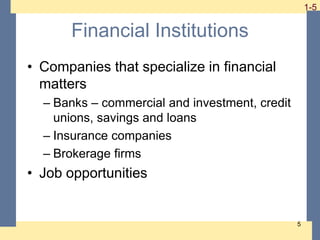
Financial Institutions
• Companies that specialize in financial
matters
– Banks – commercial and investment, credit
unions, savings and loans
– Insurance companies
– Brokerage firms
• Job opportunities
1-6 1-6
6
International Finance
• This is an area of specialization within each of
the areas discussed so far
• It may allow you to work in other countries or
at least travel on a regular basis
• Need to be familiar with exchange rates and
political risk
• Need to understand the customs of other
countries; speaking a foreign language
fluently is also helpful
1-7 1-7
7
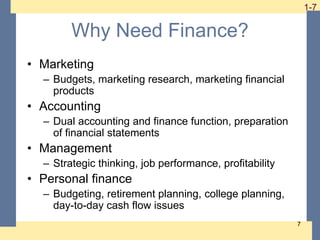
Why Need Finance?
• Marketing
– Budgets, marketing research, marketing financial
products
• Accounting
– Dual accounting and finance function, preparation
of financial statements
• Management
– Strategic thinking, job performance, profitability
• Personal finance
– Budgeting, retirement planning, college planning,
day-to-day cash flow issues
1-8 1-8
8
Business Finance
• Some important questions that are
answered using finance
– What long-term investments should the firm
take on?
– Where will we get the long-term financing to
pay for the investments?
– How will we manage the everyday financial
activities of the firm?
1-9 1-9
9
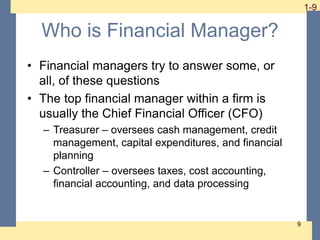
Who is Financial Manager?
• Financial managers try to answer some, or
all, of these questions
• The top financial manager within a firm is
usually the Chief Financial Officer (CFO)
– Treasurer – oversees cash management, credit
management, capital expenditures, and financial
planning
– Controller – oversees taxes, cost accounting,
financial accounting, and data processing
1-10
1-10
10
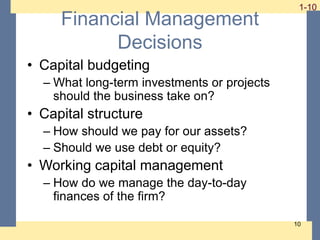
Financial Management
Decisions
• Capital budgeting
– What long-term investments or projects
should the business take on?
• Capital structure
– How should we pay for our assets?
– Should we use debt or equity?
• Working capital management
– How do we manage the day-to-day
finances of the firm?
1-11
1-11
11
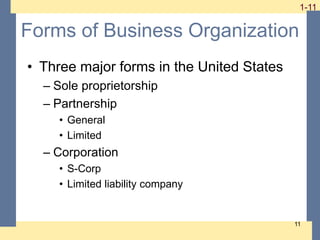
Forms of Business Organization
• Three major forms in the United States
– Sole proprietorship
– Partnership
• General
• Limited
– Corporation
• S-Corp
• Limited liability company
1-12
1-12
12
Sole Proprietorship
• Advantages
– Easiest to start
– Least regulated
– Single owner keeps
all of the profits
– Taxed once as
personal income
• Disadvantages
– Limited to life of owner
– Equity capital limited to
owner’s personal
wealth
– Unlimited liability
– Difficult to sell
ownership interest
1-13
1-13
13
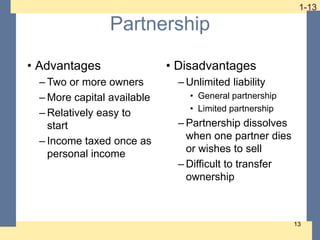
Partnership
• Advantages
– Two or more owners
– More capital available
– Relatively easy to
start
– Income taxed once as
personal income
• Disadvantages
– Unlimited liability
• General partnership
• Limited partnership
– Partnership dissolves
when one partner dies
or wishes to sell
– Difficult to transfer
ownership
1-14
1-14
14
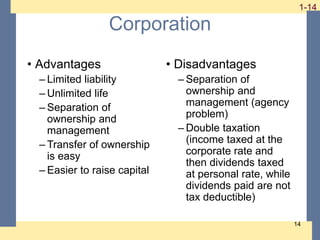
Corporation
• Advantages
– Limited liability
– Unlimited life
– Separation of
ownership and
management
– Transfer of ownership
is easy
– Easier to raise capital
• Disadvantages
– Separation of
ownership and
management (agency
problem)
– Double taxation
(income taxed at the
corporate rate and
then dividends taxed
at personal rate, while
dividends paid are not
tax deductible)
1-15
1-15
15
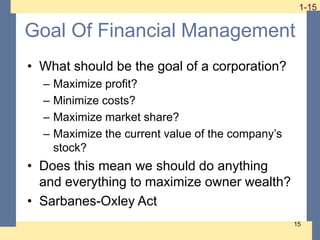
Goal Of Financial Management
• What should be the goal of a corporation?
– Maximize profit?
– Minimize costs?
– Maximize market share?
– Maximize the current value of the company’s
stock?
• Does this mean we should do anything
and everything to maximize owner wealth?
• Sarbanes-Oxley Act
1-16
1-16
16
The Agency Problem
• Agency relationship
– Principal hires an agent to represent its
interests
– Stockholders (principals) hire managers
(agents) to run the company
• Agency problem
– Conflict of interest between principal and
agent
• Management goals and agency costs
1-17
1-17
17
Managing Managers
• Managerial compensation
– Incentives can be used to align management and
stockholder interests
– The incentives need to be structured carefully to
make sure that they achieve their goal
• Corporate control
– The threat of a takeover may result in better
management
• Other stakeholders
1-18
1-18
18
Example: Work the Web
• The Internet provides a wealth of
information about individual companies
• One excellent site is finance.yahoo.com
• Click on the Web surfer to go to the site,
choose a company and see what
information you can find!
1-19
1-19
19
Figure 1.2
1-20
1-20
20
Financial Markets
• Cash flows to the firm
• Primary vs. secondary markets
– Dealer vs. auction markets
– Listed vs. over-the-counter securities
• NYSE
• NASDAQ

Financial Management 1.ppt

  • 1.
    1-0 1-0 Chapter-1 INTRODUCTION TOFINANCAIAL MANAGEMENT By Lt.Dr.S.Packiaraji 0
  • 2.
    1-1 1-1 1 Key Conceptsand Skills • Know the basic types of financial management decisions and the role of the financial manager • Know the financial implications of the different forms of business organization • Know the goal of financial management • Understand the conflicts of interest that can arise between owners and managers
  • 3.
    1-2 1-2 2 Chapter Outline •Finance: A Quick Look • Business Finance and The Financial Manager • Forms of Business Organization • The Goal of Financial Management • The Agency Problem and Control of the Corporation • Financial Markets and the Corporation
  • 4.
    1-3 1-3 3 Basic AreasOf Finance • Corporate finance • Investments • Financial institutions • International finance
  • 5.
    1-4 1-4 4 Investments • Workwith financial assets such as stocks and bonds • Value of financial assets, risk versus return, and asset allocation • Job opportunities – Stockbroker or financial advisor – Portfolio manager – Security analyst
  • 6.
    1-5 1-5 5 Financial Institutions •Companies that specialize in financial matters – Banks – commercial and investment, credit unions, savings and loans – Insurance companies – Brokerage firms • Job opportunities
  • 7.
    1-6 1-6 6 International Finance •This is an area of specialization within each of the areas discussed so far • It may allow you to work in other countries or at least travel on a regular basis • Need to be familiar with exchange rates and political risk • Need to understand the customs of other countries; speaking a foreign language fluently is also helpful
  • 8.
    1-7 1-7 7 Why NeedFinance? • Marketing – Budgets, marketing research, marketing financial products • Accounting – Dual accounting and finance function, preparation of financial statements • Management – Strategic thinking, job performance, profitability • Personal finance – Budgeting, retirement planning, college planning, day-to-day cash flow issues
  • 9.
    1-8 1-8 8 Business Finance •Some important questions that are answered using finance – What long-term investments should the firm take on? – Where will we get the long-term financing to pay for the investments? – How will we manage the everyday financial activities of the firm?
  • 10.
    1-9 1-9 9 Who isFinancial Manager? • Financial managers try to answer some, or all, of these questions • The top financial manager within a firm is usually the Chief Financial Officer (CFO) – Treasurer – oversees cash management, credit management, capital expenditures, and financial planning – Controller – oversees taxes, cost accounting, financial accounting, and data processing
  • 11.
    1-10 1-10 10 Financial Management Decisions • Capitalbudgeting – What long-term investments or projects should the business take on? • Capital structure – How should we pay for our assets? – Should we use debt or equity? • Working capital management – How do we manage the day-to-day finances of the firm?
  • 12.
    1-11 1-11 11 Forms of BusinessOrganization • Three major forms in the United States – Sole proprietorship – Partnership • General • Limited – Corporation • S-Corp • Limited liability company
  • 13.
    1-12 1-12 12 Sole Proprietorship • Advantages –Easiest to start – Least regulated – Single owner keeps all of the profits – Taxed once as personal income • Disadvantages – Limited to life of owner – Equity capital limited to owner’s personal wealth – Unlimited liability – Difficult to sell ownership interest
  • 14.
    1-13 1-13 13 Partnership • Advantages – Twoor more owners – More capital available – Relatively easy to start – Income taxed once as personal income • Disadvantages – Unlimited liability • General partnership • Limited partnership – Partnership dissolves when one partner dies or wishes to sell – Difficult to transfer ownership
  • 15.
    1-14 1-14 14 Corporation • Advantages – Limitedliability – Unlimited life – Separation of ownership and management – Transfer of ownership is easy – Easier to raise capital • Disadvantages – Separation of ownership and management (agency problem) – Double taxation (income taxed at the corporate rate and then dividends taxed at personal rate, while dividends paid are not tax deductible)
  • 16.
    1-15 1-15 15 Goal Of FinancialManagement • What should be the goal of a corporation? – Maximize profit? – Minimize costs? – Maximize market share? – Maximize the current value of the company’s stock? • Does this mean we should do anything and everything to maximize owner wealth? • Sarbanes-Oxley Act
  • 17.
    1-16 1-16 16 The Agency Problem •Agency relationship – Principal hires an agent to represent its interests – Stockholders (principals) hire managers (agents) to run the company • Agency problem – Conflict of interest between principal and agent • Management goals and agency costs
  • 18.
    1-17 1-17 17 Managing Managers • Managerialcompensation – Incentives can be used to align management and stockholder interests – The incentives need to be structured carefully to make sure that they achieve their goal • Corporate control – The threat of a takeover may result in better management • Other stakeholders
  • 19.
    1-18 1-18 18 Example: Work theWeb • The Internet provides a wealth of information about individual companies • One excellent site is finance.yahoo.com • Click on the Web surfer to go to the site, choose a company and see what information you can find!
  • 20.
  • 21.
    1-20 1-20 20 Financial Markets • Cashflows to the firm • Primary vs. secondary markets – Dealer vs. auction markets – Listed vs. over-the-counter securities • NYSE • NASDAQ