PRESENT
VEGETABLE
DISHES
• Presentation of prepared vegetable dishes
• Factors to consider in plating vegetable dishes
-LCSM
1. Good preparation and cooking techniques –
Proper cutting and cooking of vegetables
2. Professional Skills
Ability to perform according to required standards
3. Visual Sense
Effective food presentation depends on the
understanding of techniques involving balance,
arrangement, and garniture.
Essential Factors of Food
Presentation
-LCSM
Balance
Select foods and garnishes that offer variety and
contrast. This should be applied to colors, shapes,
textures and flavors.
Portion size
Match portion sizes and plates
Balance the portion sizes of the items on the plate
Arrangement on the plate
Many chefs display their creativity in plating
presentations. One important thing is to keep in mind
the convenience and comfort of the diner when plating.
PLATING STYLES
WITH
VEGETABLE
DISHES
Classic arrangement
PLATING STYLES WITH
VEGETABLES DISHESClassic
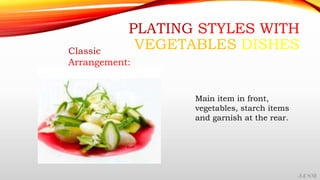
Arrangement:
Main item in front,
vegetables, starch items
and garnish at the rear.
PLATING STYLES WITH
VEGETABLES DISHESClassic
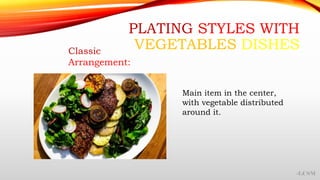
Arrangement:
Main item in the center,
with vegetable distributed
around it.
PLATING STYLES WITH
VEGETABLES DISHESClassic
Arrangement:
Main item in the center
with neat piles of
vegetables carefully
arranged around.
PLATING STYLES WITH
VEGETABLES DISHESClassic
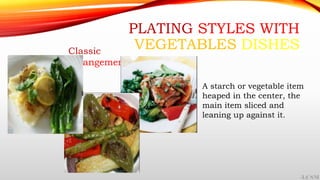
Arrangement:
A starch or vegetable item
heaped in the center, the
main item sliced and
leaning up against it.
GUIDELINES IN
PLATING
GUIDELINES IN
PLATING
1. Keep food off the rim of the plate.
2. Arrange the items for the convenience of the customer.
3. Keep space between items, unless, they are stacked on one another.
4. Maintain unity.
5. Make every component count.
6. Add sauce or gravy attractively on plate.
7. Keep it simple.
CREATIVE
PRESENTATION
TECHNIQUES
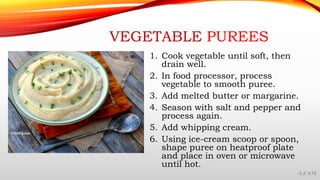
VEGETABLE PUREES
1. Cook vegetable until soft, then
drain well.
2. In food processor, process
vegetable to smooth puree.
3. Add melted butter or margarine.
4. Season with salt and pepper and
process again.
5. Add whipping cream.
6. Using ice-cream scoop or spoon,
shape puree on heatproof plate
and place in oven or microwave
until hot.
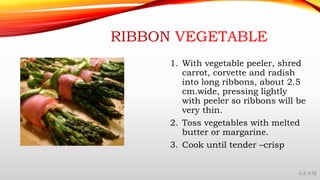
RIBBON VEGETABLE
1. With vegetable peeler, shred
carrot, corvette and radish
into long ribbons, about 2.5
cm.wide, pressing lightly
with peeler so ribbons will be
very thin.
2. Toss vegetables with melted
butter or margarine.
3. Cook until tender –crisp
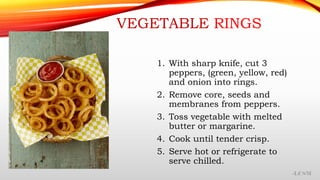
VEGETABLE RINGS
1. With sharp knife, cut 3
peppers, (green, yellow, red)
and onion into rings.
2. Remove core, seeds and
membranes from peppers.
3. Toss vegetable with melted
butter or margarine.
4. Cook until tender crisp.
5. Serve hot or refrigerate to
serve chilled.

Present Vegetable Dishes

  • 1.
    PRESENT VEGETABLE DISHES • Presentation ofprepared vegetable dishes • Factors to consider in plating vegetable dishes -LCSM
  • 2.
    1. Good preparationand cooking techniques – Proper cutting and cooking of vegetables 2. Professional Skills Ability to perform according to required standards 3. Visual Sense Effective food presentation depends on the understanding of techniques involving balance, arrangement, and garniture. Essential Factors of Food Presentation -LCSM
  • 3.
    Balance Select foods andgarnishes that offer variety and contrast. This should be applied to colors, shapes, textures and flavors. Portion size Match portion sizes and plates Balance the portion sizes of the items on the plate Arrangement on the plate Many chefs display their creativity in plating presentations. One important thing is to keep in mind the convenience and comfort of the diner when plating.
  • 4.
  • 5.
    PLATING STYLES WITH VEGETABLESDISHESClassic Arrangement: Main item in front, vegetables, starch items and garnish at the rear.
  • 6.
    PLATING STYLES WITH VEGETABLESDISHESClassic Arrangement: Main item in the center, with vegetable distributed around it.
  • 7.
    PLATING STYLES WITH VEGETABLESDISHESClassic Arrangement: Main item in the center with neat piles of vegetables carefully arranged around.
  • 8.
    PLATING STYLES WITH VEGETABLESDISHESClassic Arrangement: A starch or vegetable item heaped in the center, the main item sliced and leaning up against it.
  • 9.
  • 10.
    GUIDELINES IN PLATING 1. Keepfood off the rim of the plate. 2. Arrange the items for the convenience of the customer. 3. Keep space between items, unless, they are stacked on one another. 4. Maintain unity. 5. Make every component count. 6. Add sauce or gravy attractively on plate. 7. Keep it simple.
  • 11.
  • 12.
    VEGETABLE PUREES 1. Cookvegetable until soft, then drain well. 2. In food processor, process vegetable to smooth puree. 3. Add melted butter or margarine. 4. Season with salt and pepper and process again. 5. Add whipping cream. 6. Using ice-cream scoop or spoon, shape puree on heatproof plate and place in oven or microwave until hot.
  • 13.
    RIBBON VEGETABLE 1. Withvegetable peeler, shred carrot, corvette and radish into long ribbons, about 2.5 cm.wide, pressing lightly with peeler so ribbons will be very thin. 2. Toss vegetables with melted butter or margarine. 3. Cook until tender –crisp
  • 14.
    VEGETABLE RINGS 1. Withsharp knife, cut 3 peppers, (green, yellow, red) and onion into rings. 2. Remove core, seeds and membranes from peppers. 3. Toss vegetable with melted butter or margarine. 4. Cook until tender crisp. 5. Serve hot or refrigerate to serve chilled.

Editor's Notes

  • #7 Pan Seared Denver Steak with Spring Vegetables
  • #11 Guidelines in Plating 1. Keep food off the rim of the plate.  Select a plate large enough to hold food without hanging off the edge. 2. Arrange the items for the convenience of the customer.  Always arrange the best side of food on plate to avoid letting the diner rearrange them before eating. 3. Keep space between items, unless, they are stacked on one another.  Arrange vegetable on plate, that every item should be identifiable. 4. Maintain unity.  Create a center of attention and relate everything to it. 5. Make every component count.  Garnishes are not added just for color, but sometimes they areneeded to balance a plate by providing an additional element. 6. Add sauce or gravy attractively on plate.  Pour sauce around or under the dish or covering only a part ofthe dish. Always think of the sauce as part of the overall designof the plate. 7. Keep it simple.  Avoid making food too elaborate.