Lens on Development
LIDC'S GLOBAL DEVELOPMENT PHOTOGRAPHY COMPETITION:
THE SHORTLIST THE SHORTLIST
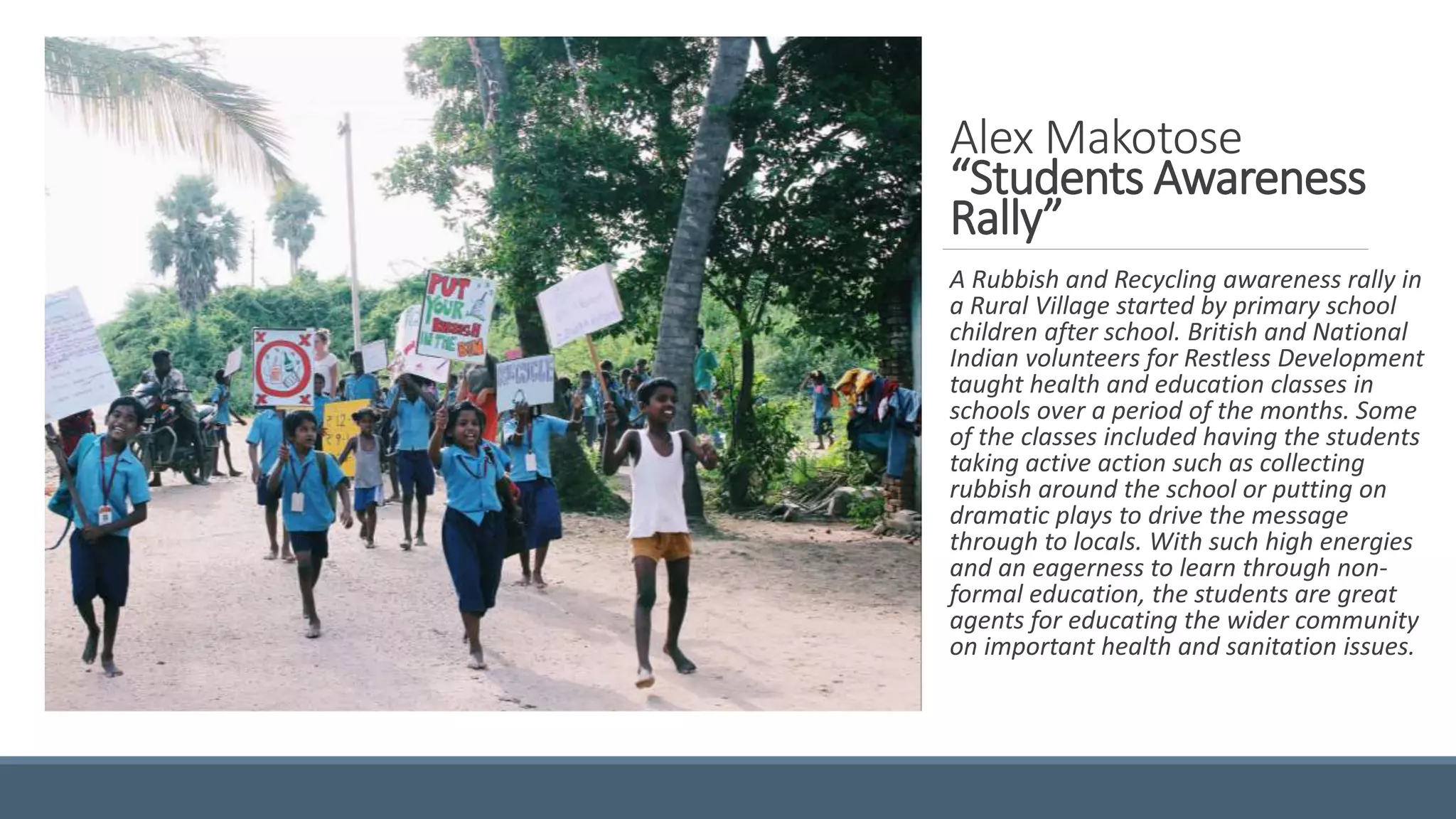
Alex Makotose
“Students Awareness
Rally”
A Rubbish and Recycling awareness rally in
a Rural Village started by primary school
children after school. British and National
Indian volunteers for Restless Development
taught health and education classes in
schools over a period of the months. Some
of the classes included having the students
taking active action such as collecting
rubbish around the school or putting on
dramatic plays to drive the message
through to locals. With such high energies
and an eagerness to learn through non-
formal education, the students are great
agents for educating the wider community
on important health and sanitation issues.
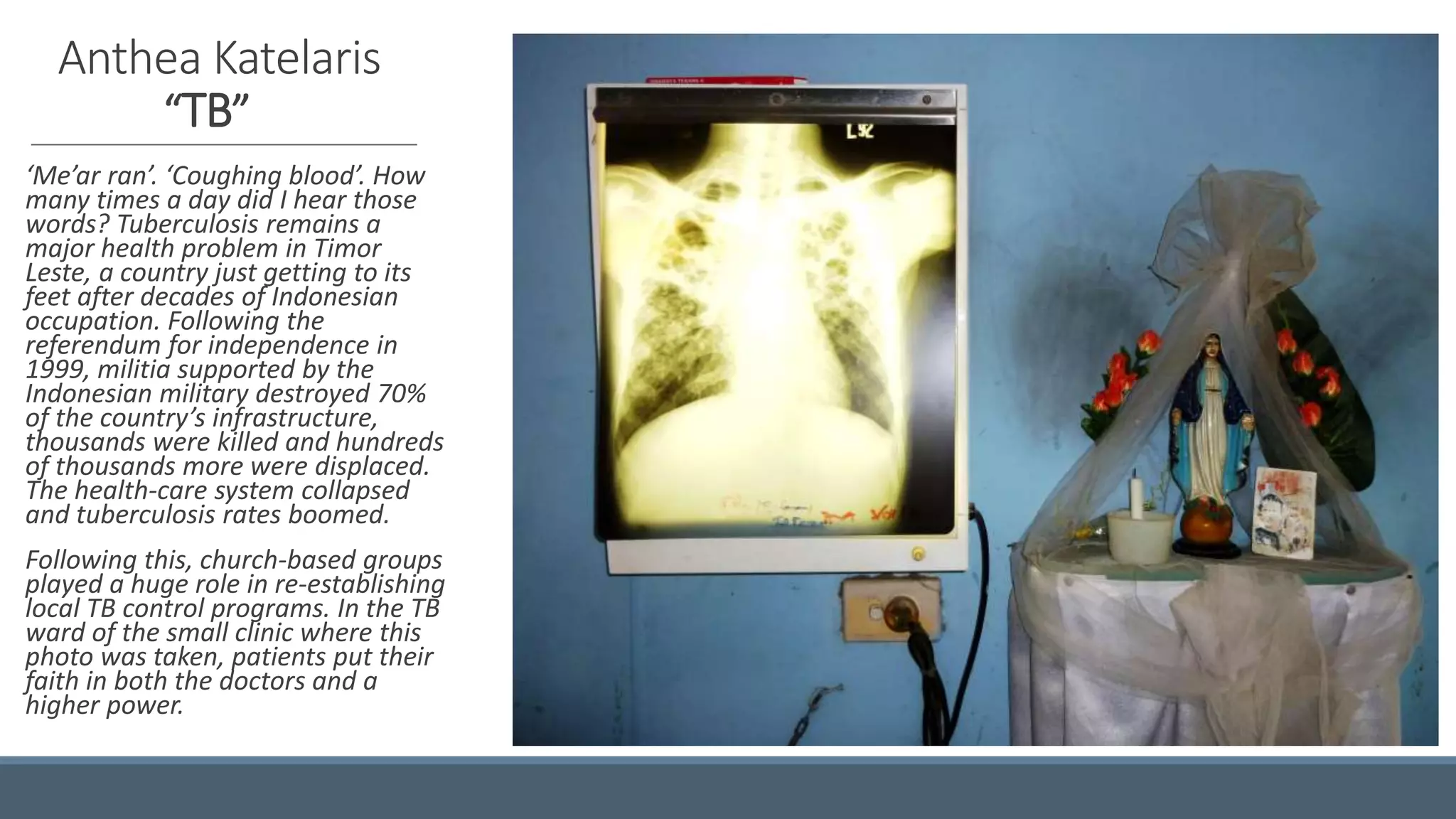
Anthea Katelaris
“TB”
‘Me’ar ran’. ‘Coughing blood’. How
many times a day did I hear those
words? Tuberculosis remains a
major health problem in Timor
Leste, a country just getting to its
feet after decades of Indonesian
occupation. Following the
referendum for independence in
1999, militia supported by the
Indonesian military destroyed 70%
of the country’s infrastructure,
thousands were killed and hundreds
of thousands more were displaced.
The health-care system collapsed
and tuberculosis rates boomed.
Following this, church-based groups
played a huge role in re-establishing
local TB control programs. In the TB
ward of the small clinic where this
photo was taken, patients put their
faith in both the doctors and a
higher power.
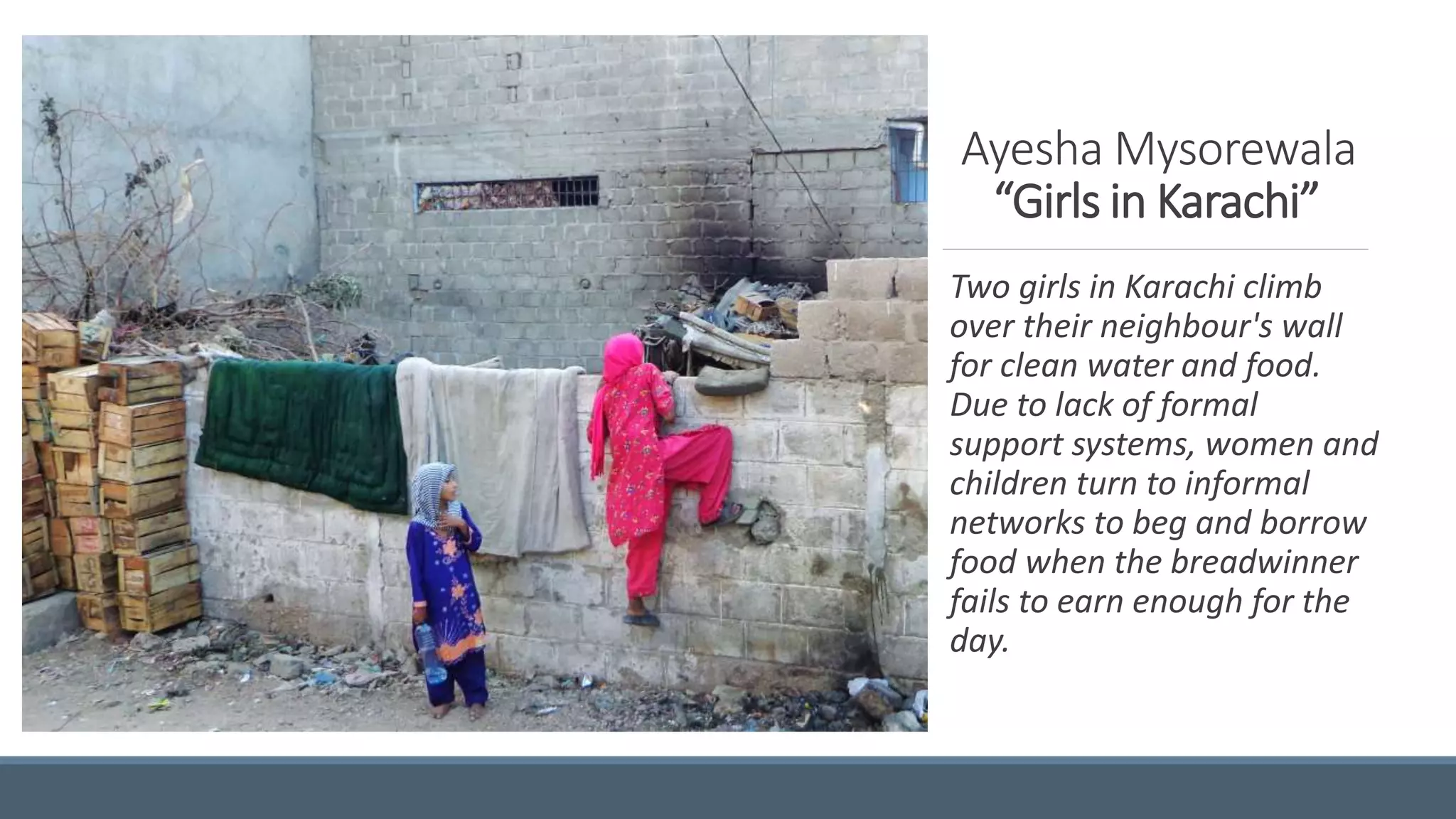
Ayesha Mysorewala
“Girls in Karachi”
Two girls in Karachi climb
over their neighbour's wall
for clean water and food.
Due to lack of formal
support systems, women and
children turn to informal
networks to beg and borrow
food when the breadwinner
fails to earn enough for the
day.
Feyzi Ismail
“The Road to
Dolakha”
This photograph was taken on the road
to Dolakha, an earthquake-affected
district in northern Nepal, on 14 June
2016 during a research trip. It depicts a
group of older women who set up a
road blockade to protest an unjust
ruling by the district court over a local
land dispute, in which the court sided
with a wealthy landowner, who
arbitrarily turned what was previously
common land into private land. The
blockade last for hours, in defiance of
the local police. The women agreed to
withdraw when the Chief District Officer
agreed to investigate and re-open the
case. The scene is significant because it
exemplifies what are real issues in
Nepal today - on the one hand, women
taking things into their own hands and,
on the other, the state's continued
neglect of the poor and marginalised.
Heather Cooper
“Kangaroo Mother Care”
This man is the father of twins, born premature, each weighing
less than 1.5 kg. He is holding his son in the ‘Kangaroo Mother
Care’ position. Kangaroo care is the practice of holding an infant
in skin-to-skin contact. This method promotes the health and well-
being of preterm infants by providing thermal control, protection
from infection, appropriate stimulation and a nurturing
environment.
Most obviously, he is promoting child health and SDG3. But I
believe this photo also depicts women’s equality. Caring for the
infant is typically the mother’s responsibility, often with help from
an aunt, grandmother, or other women. Men are infrequently in
the Special Care Unit (place for sick newborns) at Jinja Hospital
and do not typically practice KMC. The look of pride on his face
shows not only a special moment between father and son, but
also a man breaking stereotypes and challenging typical practices
in a male-dominated culture.
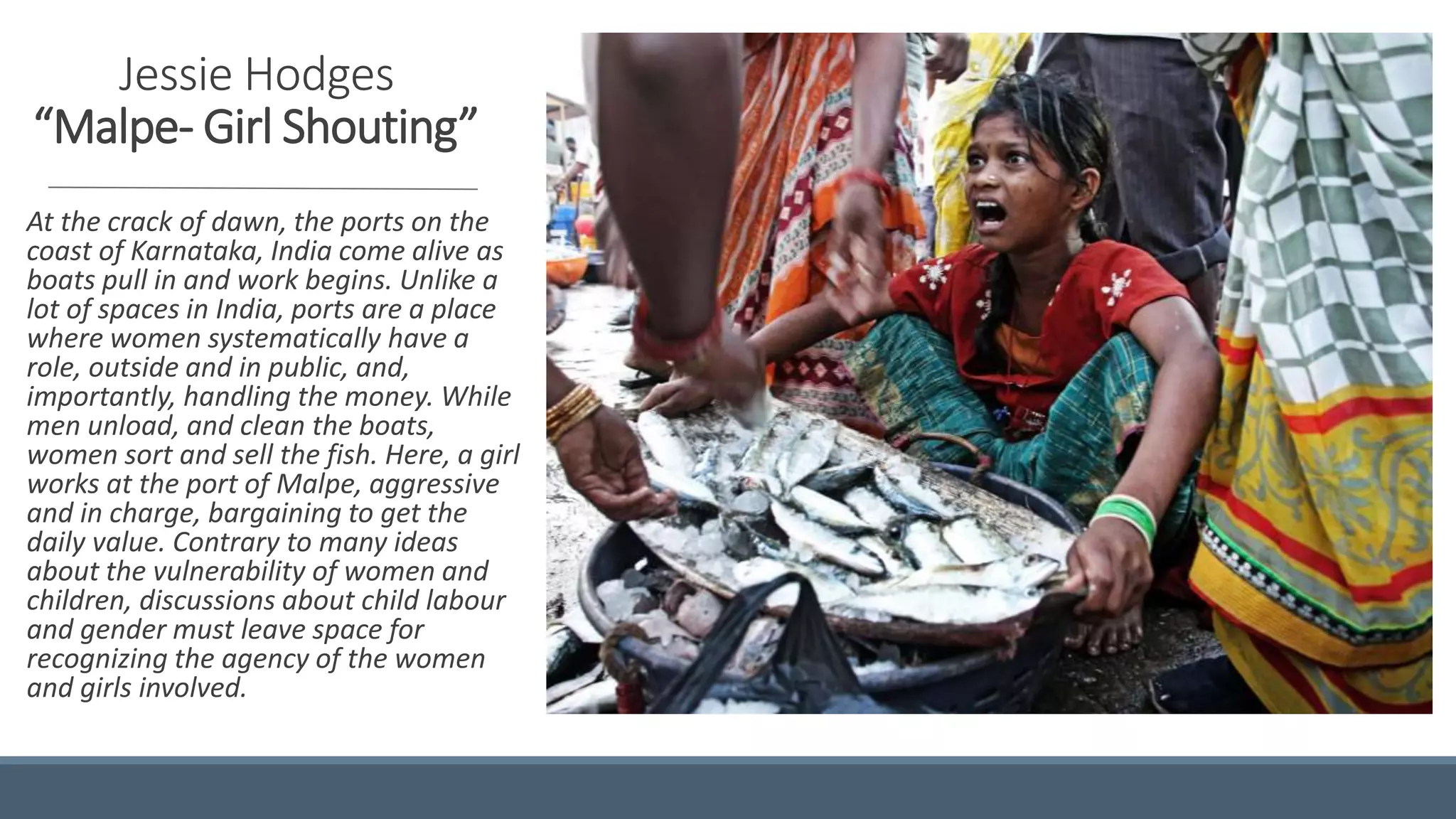
Jessie Hodges
“Malpe- Girl Shouting”
At the crack of dawn, the ports on the
coast of Karnataka, India come alive as
boats pull in and work begins. Unlike a
lot of spaces in India, ports are a place
where women systematically have a
role, outside and in public, and,
importantly, handling the money. While
men unload, and clean the boats,
women sort and sell the fish. Here, a girl
works at the port of Malpe, aggressive
and in charge, bargaining to get the
daily value. Contrary to many ideas
about the vulnerability of women and
children, discussions about child labour
and gender must leave space for
recognizing the agency of the women
and girls involved.
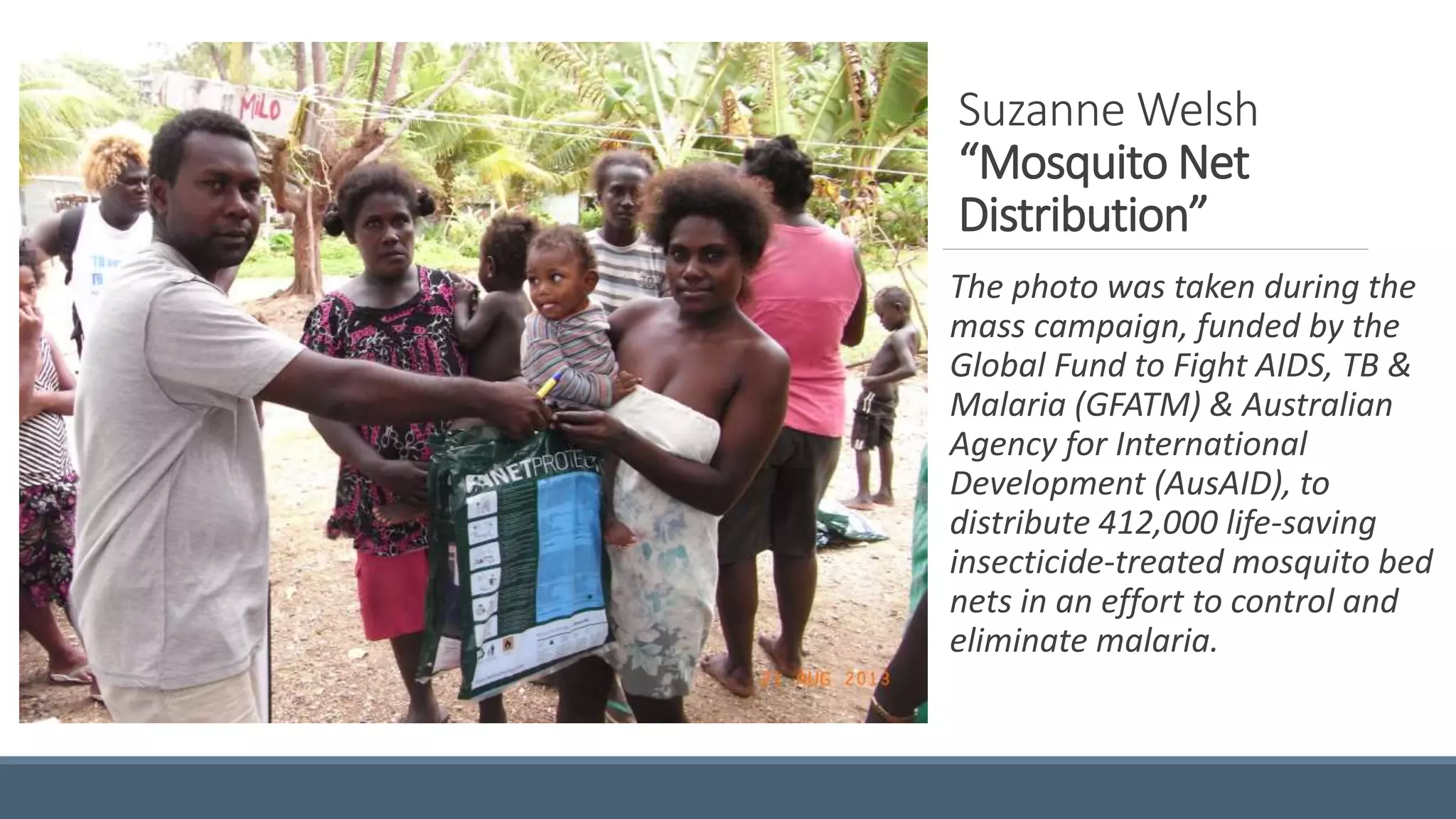
Suzanne Welsh
“Mosquito Net
Distribution”
The photo was taken during the
mass campaign, funded by the
Global Fund to Fight AIDS, TB &
Malaria (GFATM) & Australian
Agency for International
Development (AusAID), to
distribute 412,000 life-saving
insecticide-treated mosquito bed
nets in an effort to control and
eliminate malaria.
Tim Malcomson
“Child Labour”
For children (and especially girls) there is never a neat
progression from informal mining back to primary school.
Addressing family and community poverty and the
intergenerational organisation to manage this in one of the
world’s poorest regions is complicated. Although these girls
are now attending the local primary school (according to
local village leaders), when not at school, the girls
nevertheless carry heavy rocks down the mountainside to be
broken up for the road building and construction sectors.
Beyond policy frameworks, implicated in barriers to change
are the family's need to include children as wage earners,
cultural lines drawn in often different levels of children’s
participation in the family economy and children’s culturally
situated agency and mobility.
This photo shows a girl and her friends carrying heavy rocks
down the mountainside to be broken up for road building
and construction. The family earnings are based on the
amount of rock moved by all family members. Younger girls
and boys will typically receive pocket money from this.
Yeongseong Choe
“Man Taking a Nap in a
T Trash Pile”
This photo was taken in the Lokanthali
at Kathmandu, Nepal and relates to
SDGs goal such as Sustainable Cities
and Communities'​ and ​'​Climate Action​'
etc​. A ​Man taking a nap in a trash pi​le​
in this photo. There is no regular wastes
disposal facility at this site, just burning
rubbish every other day. Also, this area
is also right next to the second largest
slum​​ in Kathmandu, to one's surprise,
this place is the best playground for
squatters' children. Unfortunately, the
government of Nepal has not taken any
action regarding this urban areas’
waste management so far, recycling
issues either.
Zipporah Gene
“Khlong Toey Slum”
I wrote an article about local
charitable organisations in the
Bangkok metropolitan area and as
part of my research, I went around to
see exactly who they support.
Khlong Toey is Bangkok’s largest slum.
Nestled in between the central
Bangkok’s financial hub and its major
port facilities, it is a place that
shouldn’t be. This shanty town is vast,
housing around 100,000 people.
Surrounded by wealth, it is a constant
reminder why we need to work
together to reduce inequalities.
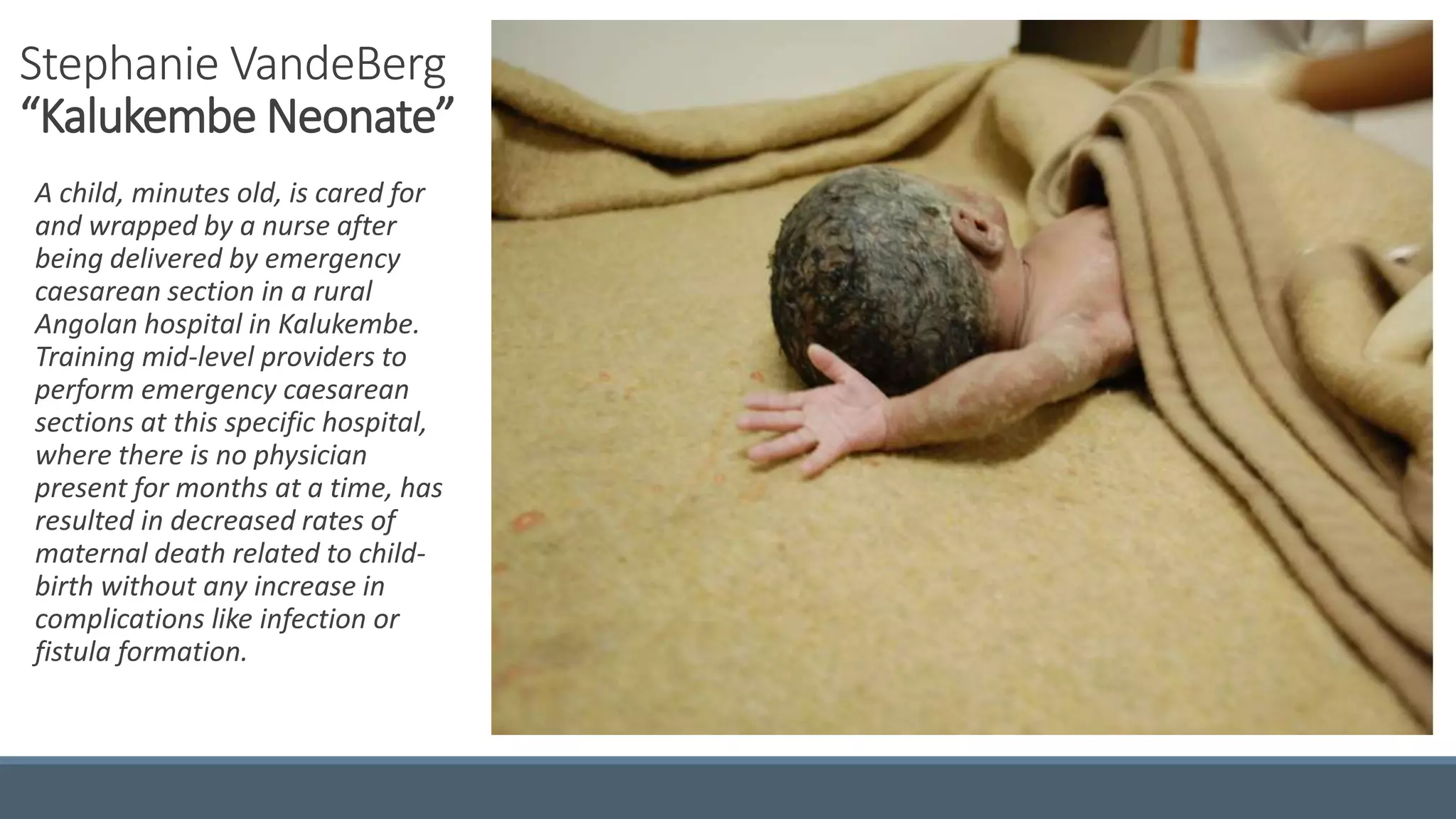
Stephanie VandeBerg
“Kalukembe Neonate”
A child, minutes old, is cared for
and wrapped by a nurse after
being delivered by emergency
caesarean section in a rural
Angolan hospital in Kalukembe.
Training mid-level providers to
perform emergency caesarean
sections at this specific hospital,
where there is no physician
present for months at a time, has
resulted in decreased rates of
maternal death related to child-
birth without any increase in
complications like infection or
fistula formation.

Lens on Development

  • 1.
    Lens on Development LIDC'SGLOBAL DEVELOPMENT PHOTOGRAPHY COMPETITION: THE SHORTLIST THE SHORTLIST
  • 2.
    Alex Makotose “Students Awareness Rally” ARubbish and Recycling awareness rally in a Rural Village started by primary school children after school. British and National Indian volunteers for Restless Development taught health and education classes in schools over a period of the months. Some of the classes included having the students taking active action such as collecting rubbish around the school or putting on dramatic plays to drive the message through to locals. With such high energies and an eagerness to learn through non- formal education, the students are great agents for educating the wider community on important health and sanitation issues.
  • 3.
    Anthea Katelaris “TB” ‘Me’ar ran’.‘Coughing blood’. How many times a day did I hear those words? Tuberculosis remains a major health problem in Timor Leste, a country just getting to its feet after decades of Indonesian occupation. Following the referendum for independence in 1999, militia supported by the Indonesian military destroyed 70% of the country’s infrastructure, thousands were killed and hundreds of thousands more were displaced. The health-care system collapsed and tuberculosis rates boomed. Following this, church-based groups played a huge role in re-establishing local TB control programs. In the TB ward of the small clinic where this photo was taken, patients put their faith in both the doctors and a higher power.
  • 4.
    Ayesha Mysorewala “Girls inKarachi” Two girls in Karachi climb over their neighbour's wall for clean water and food. Due to lack of formal support systems, women and children turn to informal networks to beg and borrow food when the breadwinner fails to earn enough for the day.
  • 5.
    Feyzi Ismail “The Roadto Dolakha” This photograph was taken on the road to Dolakha, an earthquake-affected district in northern Nepal, on 14 June 2016 during a research trip. It depicts a group of older women who set up a road blockade to protest an unjust ruling by the district court over a local land dispute, in which the court sided with a wealthy landowner, who arbitrarily turned what was previously common land into private land. The blockade last for hours, in defiance of the local police. The women agreed to withdraw when the Chief District Officer agreed to investigate and re-open the case. The scene is significant because it exemplifies what are real issues in Nepal today - on the one hand, women taking things into their own hands and, on the other, the state's continued neglect of the poor and marginalised.
  • 6.
    Heather Cooper “Kangaroo MotherCare” This man is the father of twins, born premature, each weighing less than 1.5 kg. He is holding his son in the ‘Kangaroo Mother Care’ position. Kangaroo care is the practice of holding an infant in skin-to-skin contact. This method promotes the health and well- being of preterm infants by providing thermal control, protection from infection, appropriate stimulation and a nurturing environment. Most obviously, he is promoting child health and SDG3. But I believe this photo also depicts women’s equality. Caring for the infant is typically the mother’s responsibility, often with help from an aunt, grandmother, or other women. Men are infrequently in the Special Care Unit (place for sick newborns) at Jinja Hospital and do not typically practice KMC. The look of pride on his face shows not only a special moment between father and son, but also a man breaking stereotypes and challenging typical practices in a male-dominated culture.
  • 7.
    Jessie Hodges “Malpe- GirlShouting” At the crack of dawn, the ports on the coast of Karnataka, India come alive as boats pull in and work begins. Unlike a lot of spaces in India, ports are a place where women systematically have a role, outside and in public, and, importantly, handling the money. While men unload, and clean the boats, women sort and sell the fish. Here, a girl works at the port of Malpe, aggressive and in charge, bargaining to get the daily value. Contrary to many ideas about the vulnerability of women and children, discussions about child labour and gender must leave space for recognizing the agency of the women and girls involved.
  • 8.
    Suzanne Welsh “Mosquito Net Distribution” Thephoto was taken during the mass campaign, funded by the Global Fund to Fight AIDS, TB & Malaria (GFATM) & Australian Agency for International Development (AusAID), to distribute 412,000 life-saving insecticide-treated mosquito bed nets in an effort to control and eliminate malaria.
  • 9.
    Tim Malcomson “Child Labour” Forchildren (and especially girls) there is never a neat progression from informal mining back to primary school. Addressing family and community poverty and the intergenerational organisation to manage this in one of the world’s poorest regions is complicated. Although these girls are now attending the local primary school (according to local village leaders), when not at school, the girls nevertheless carry heavy rocks down the mountainside to be broken up for the road building and construction sectors. Beyond policy frameworks, implicated in barriers to change are the family's need to include children as wage earners, cultural lines drawn in often different levels of children’s participation in the family economy and children’s culturally situated agency and mobility. This photo shows a girl and her friends carrying heavy rocks down the mountainside to be broken up for road building and construction. The family earnings are based on the amount of rock moved by all family members. Younger girls and boys will typically receive pocket money from this.
  • 10.
    Yeongseong Choe “Man Takinga Nap in a T Trash Pile” This photo was taken in the Lokanthali at Kathmandu, Nepal and relates to SDGs goal such as Sustainable Cities and Communities'​ and ​'​Climate Action​' etc​. A ​Man taking a nap in a trash pi​le​ in this photo. There is no regular wastes disposal facility at this site, just burning rubbish every other day. Also, this area is also right next to the second largest slum​​ in Kathmandu, to one's surprise, this place is the best playground for squatters' children. Unfortunately, the government of Nepal has not taken any action regarding this urban areas’ waste management so far, recycling issues either.
  • 11.
    Zipporah Gene “Khlong ToeySlum” I wrote an article about local charitable organisations in the Bangkok metropolitan area and as part of my research, I went around to see exactly who they support. Khlong Toey is Bangkok’s largest slum. Nestled in between the central Bangkok’s financial hub and its major port facilities, it is a place that shouldn’t be. This shanty town is vast, housing around 100,000 people. Surrounded by wealth, it is a constant reminder why we need to work together to reduce inequalities.
  • 12.
    Stephanie VandeBerg “Kalukembe Neonate” Achild, minutes old, is cared for and wrapped by a nurse after being delivered by emergency caesarean section in a rural Angolan hospital in Kalukembe. Training mid-level providers to perform emergency caesarean sections at this specific hospital, where there is no physician present for months at a time, has resulted in decreased rates of maternal death related to child- birth without any increase in complications like infection or fistula formation.