DIGESTIVE SYSTEM
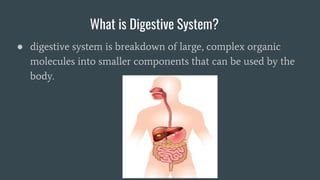
What is Digestive System?
● digestive system is breakdown of large, complex organic
molecules into smaller components that can be used by the
body.
Mouth
● Mouth ingests food
● Teeth masticates food into small pieces to increase surface
area for digestion.
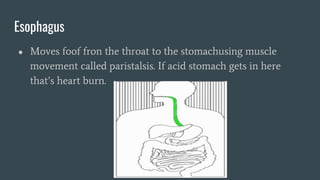
Esophagus
● Moves foof fron the throat to the stomachusing muscle
movement called paristalsis. If acid stomach gets in here
that’s heart burn.
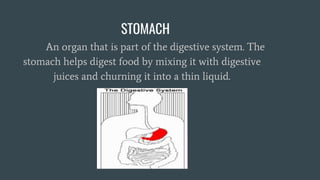
An organ that is part of the digestive system. The
stomach helps digest food by mixing it with digestive
juices and churning it into a thin liquid.
STOMACH
WHAT HAPPENS DURING BREATHING AND SWALLOWING?
● This automatically induces violent coughing to
force the food particles or water and out to
prevent choking.
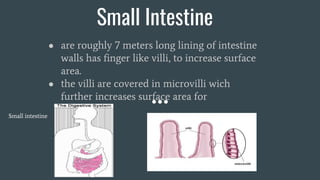
Small Intestine
● are roughly 7 meters long lining of intestine
walls has finger like villi, to increase surface
area.
● the villi are covered in microvilli wich
further increases surface area for
absorption.
Small intestine
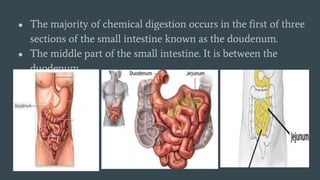
● The majority of chemical digestion occurs in the first of three
sections of the small intestine known as the doudenum.
● The middle part of the small intestine. It is between the
duodenum
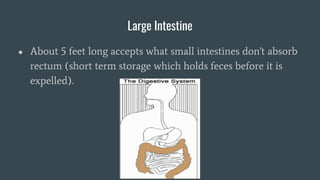
Large Intestine
● About 5 feet long accepts what small intestines don't absorb
rectum (short term storage which holds feces before it is
expelled).
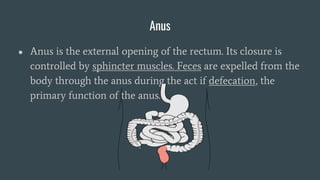
Anus
● Anus is the external opening of the rectum. Its closure is
controlled by sphincter muscles. Feces are expelled from the
body through the anus during the act if defecation, the
primary function of the anus.
Conclusion
● The digestive sysytem starts working as soon as the food
touches the lips and is ingested. The various organs work
together to run this machinery.
● The nerves and hormones control the actions of the internal
organs.
><THE END><
THANK YOU AND GOD BLESS <3

DIGESTIVE SYSTEM.pptx

  • 1.
  • 3.
    What is DigestiveSystem? ● digestive system is breakdown of large, complex organic molecules into smaller components that can be used by the body.
  • 4.
    Mouth ● Mouth ingestsfood ● Teeth masticates food into small pieces to increase surface area for digestion.
  • 5.
    Esophagus ● Moves fooffron the throat to the stomachusing muscle movement called paristalsis. If acid stomach gets in here that’s heart burn.
  • 6.
    An organ thatis part of the digestive system. The stomach helps digest food by mixing it with digestive juices and churning it into a thin liquid. STOMACH
  • 7.
    WHAT HAPPENS DURINGBREATHING AND SWALLOWING?
  • 8.
    ● This automaticallyinduces violent coughing to force the food particles or water and out to prevent choking.
  • 9.
    Small Intestine ● areroughly 7 meters long lining of intestine walls has finger like villi, to increase surface area. ● the villi are covered in microvilli wich further increases surface area for absorption. Small intestine
  • 10.
    ● The majorityof chemical digestion occurs in the first of three sections of the small intestine known as the doudenum. ● The middle part of the small intestine. It is between the duodenum
  • 11.
    Large Intestine ● About5 feet long accepts what small intestines don't absorb rectum (short term storage which holds feces before it is expelled).
  • 12.
    Anus ● Anus isthe external opening of the rectum. Its closure is controlled by sphincter muscles. Feces are expelled from the body through the anus during the act if defecation, the primary function of the anus.
  • 13.
    Conclusion ● The digestivesysytem starts working as soon as the food touches the lips and is ingested. The various organs work together to run this machinery. ● The nerves and hormones control the actions of the internal organs.
  • 14.
  • 15.
    THANK YOU ANDGOD BLESS <3