LOOPS
PREPARED BY: KRISHNSRAJ MISHRA
SUBJECT: COMPUTRE SCIENCE
STANDARD: 11-A(SCIENCE)
TOPIC: LOOPS
CONTENTS
O LOOP STATEMENTS
O PARTS OF LOOPS
O TYPES OF LOOPS
O WHILE LOOPS
O FOR LOOPS
O DO WHILE LOOPS
O NESTED LOOPS
O JUMP STATEMENTS
LOOP STATEMENTS
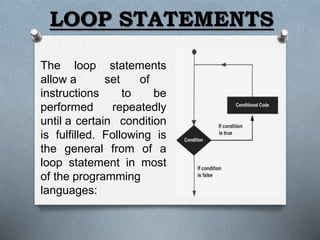
The loop statements
allow a set of
instructions to be
performed repeatedly
until a certain condition
is fulfilled. Following is
the general from of a
loop statement in most
of the programming
languages:
PARTS OF A LOOP
OInitialization Expression(s) initialize(s)
the loop variables in the beginning of the
loop.
OTest Expression decides whether the
loop will be executed (if test expression is
true) or not (if test expression is false).
OUpdate Expression(s) update(s) the
values of loop variables after every
iteration of the loop.
OThe Body-of-the-Loop contains
statements to be executed repeatedly.
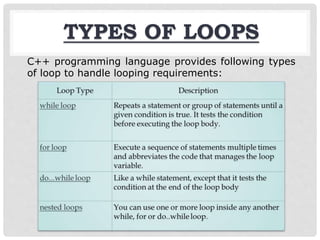
TYPES OF LOOPS
C++ programming language provides following types
of loop to handle looping requirements:
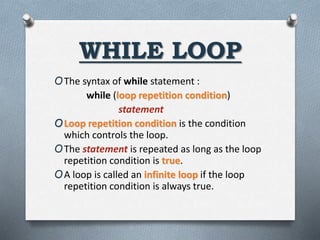
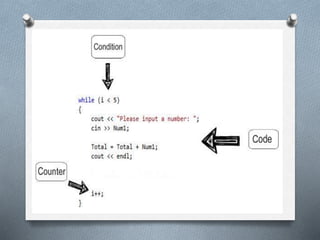
WHILE LOOP
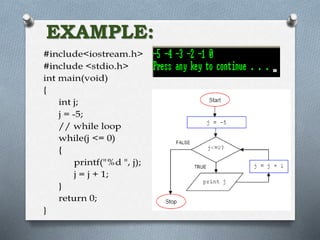
OThe syntax of while statement :
while (loop repetition condition)
statement
OLoop repetition condition is the condition
which controls the loop.
OThe statement is repeated as long as the loop
repetition condition is true.
OA loop is called an infinite loop if the loop
repetition condition is always true.
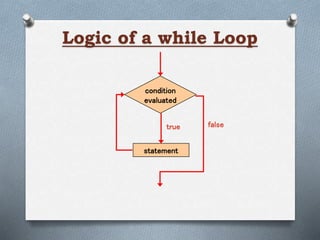
Logic of a while Loop
condition
evaluated
false
statement
true
EXAMPLE:
FOR LOOP
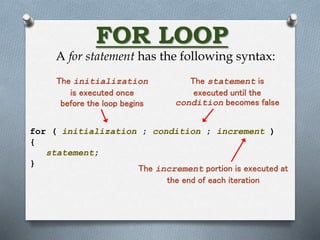
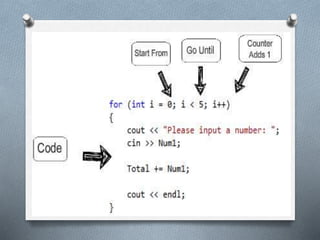
A for statement has the following syntax:
The initialization
is executed once
before the loop begins
for ( initialization ; condition ; increment )
{
statement;
}
The statement is
executed until the
condition becomes false
The increment portion is executed at
the end of each iteration
The statement is
executed until the
condition becomes false
The initialization
is executed once
before the loop begins
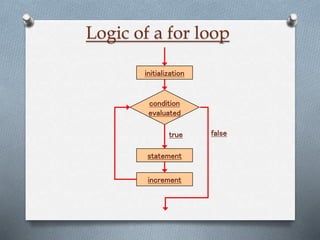
Logic of a for loop
statement
true
condition
evaluated
false
increment
initialization
EXAMPLE:
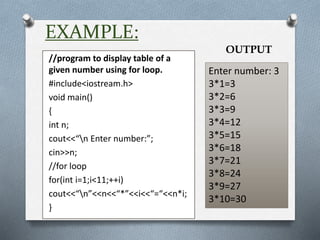
//program to display table of a
given number using for loop.
#include<iostream.h>
void main()
{
int n;
cout<<“n Enter number:”;
cin>>n;
//for loop
for(int i=1;i<11;++i)
cout<<“n”<<n<<“*”<<i<<“=“<<n*i;
}
Enter number: 3
3*1=3
3*2=6
3*3=9
3*4=12
3*5=15
3*6=18
3*7=21
3*8=24
3*9=27
3*10=30
OUTPUT
THE FOR LOOP VARIATIONS
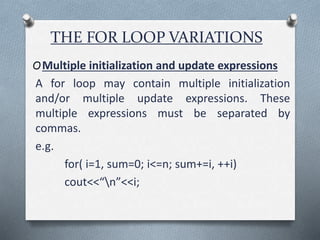
OMultiple initialization and update expressions
A for loop may contain multiple initialization
and/or multiple update expressions. These
multiple expressions must be separated by
commas.
e.g.
for( i=1, sum=0; i<=n; sum+=i, ++i)
cout<<“n”<<i;
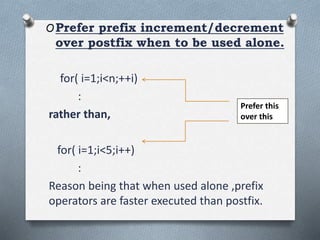
OPrefer prefix increment/decrement
over postfix when to be used alone.
for( i=1;i<n;++i)
:
rather than,
for( i=1;i<5;i++)
:
Reason being that when used alone ,prefix
operators are faster executed than postfix.
Prefer this
over this
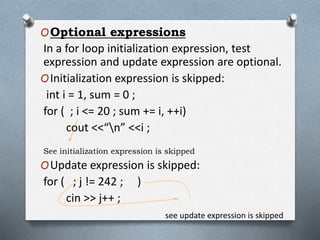
OOptional expressions
In a for loop initialization expression, test
expression and update expression are optional.
OInitialization expression is skipped:
int i = 1, sum = 0 ;
for ( ; i <= 20 ; sum += i, ++i)
cout <<“n” <<i ;
See initialization expression is skipped
OUpdate expression is skipped:
for ( ; j != 242 ; )
cin >> j++ ;
see update expression is skipped
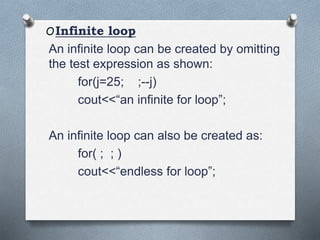
OInfinite loop
An infinite loop can be created by omitting
the test expression as shown:
for(j=25; ;--j)
cout<<“an infinite for loop”;
An infinite loop can also be created as:
for( ; ; )
cout<<“endless for loop”;
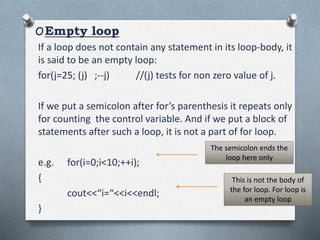
OEmpty loop
If a loop does not contain any statement in its loop-body, it
is said to be an empty loop:
for(j=25; (j) ;--j) //(j) tests for non zero value of j.
If we put a semicolon after for’s parenthesis it repeats only
for counting the control variable. And if we put a block of
statements after such a loop, it is not a part of for loop.
e.g. for(i=0;i<10;++i);
{
cout<<“i=“<<i<<endl;
}
The semicolon ends the
loop here only
This is not the body of
the for loop. For loop is
an empty loop
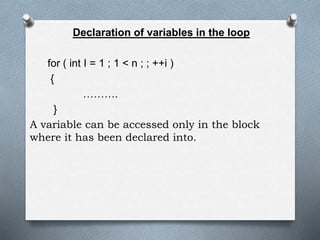
Declaration of variables in the loop
for ( int I = 1 ; 1 < n ; ; ++i )
{
……….
}
A variable can be accessed only in the block
where it has been declared into.
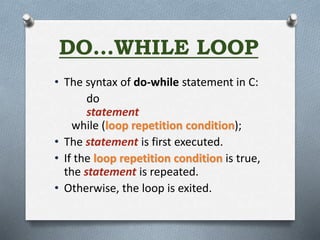
DO…WHILE LOOP
• The syntax of do-while statement in C:
do
statement
while (loop repetition condition);
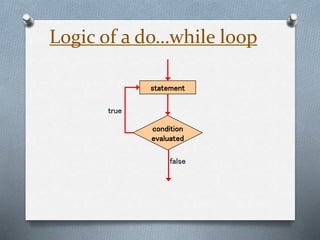
• The statement is first executed.
• If the loop repetition condition is true,
the statement is repeated.
• Otherwise, the loop is exited.
Logic of a do…while loop
true
condition
evaluated
statement
false
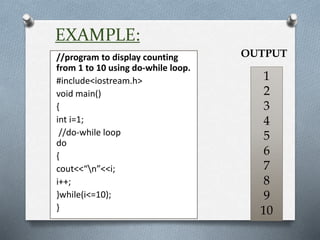
EXAMPLE:
//program to display counting
from 1 to 10 using do-while loop.
#include<iostream.h>
void main()
{
int i=1;
//do-while loop
do
{
cout<<“n”<<i;
i++;
}while(i<=10);
}
1
2
3
4
5
6
7
8
9
10
OUTPUT
NESTED LOOPS
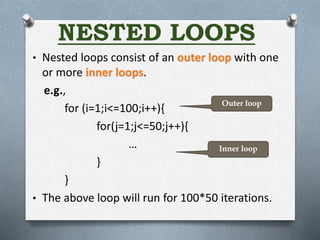
• Nested loops consist of an outer loop with one
or more inner loops.
e.g.,
for (i=1;i<=100;i++){
for(j=1;j<=50;j++){
…
}
}
• The above loop will run for 100*50 iterations.
Inner loop
Outer loop
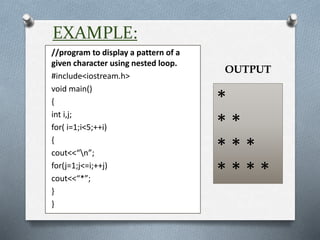
EXAMPLE:
//program to display a pattern of a
given character using nested loop.
#include<iostream.h>
void main()
{
int i,j;
for( i=1;i<5;++i)
{
cout<<“n”;
for(j=1;j<=i;++j)
cout<<“*”;
}
}
*
* *
* * *
* * * *
OUTPUT
COMPARISION OF
LOOPS
The for loop is appropriate when
you know in advance how many
times the loop will be executed.
The other two loops while and
do-while loops are more suitable
in the situations where it is not
known before-hand when the
loop will terminate.
JUMP STATEMENTS
1. The goto statement
• A goto statement can transfer the program control
anywhere in the program.
• The target destination is marked by a label.
• The target label and goto must appear in the same
statement.
• The syntax of goto statement is:
goto label;
…
label:
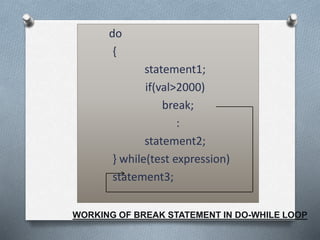
2. The break statement
• The break statement enables a program to skip
over part of the code.
• A break statement terminates the smallest
enclosing while, do-while and for statements.
• A break statement skips the rest of the loop
and jumps over to the statement following the
loop.
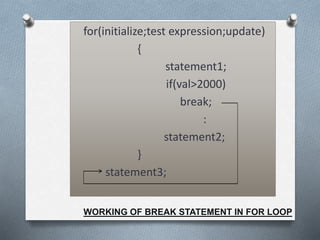
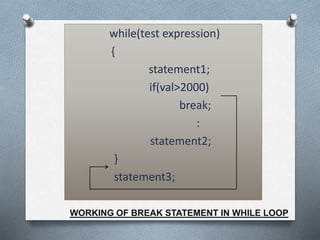
The following figures explains the working of a
break statement :
for(initialize;test expression;update)
{
statement1;
if(val>2000)
break;
:
statement2;
}
statement3;
WORKING OF BREAK STATEMENT IN FOR LOOP
while(test expression)
{
statement1;
if(val>2000)
break;
:
statement2;
}
statement3;
WORKING OF BREAK STATEMENT IN WHILE LOOP
do
{
statement1;
if(val>2000)
break;
:
statement2;
} while(test expression)
statement3;
WORKING OF BREAK STATEMENT IN DO-WHILE LOOP
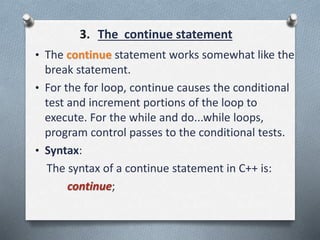
3. The continue statement
• The continue statement works somewhat like the
break statement.
• For the for loop, continue causes the conditional
test and increment portions of the loop to
execute. For the while and do...while loops,
program control passes to the conditional tests.
• Syntax:
The syntax of a continue statement in C++ is:
continue;
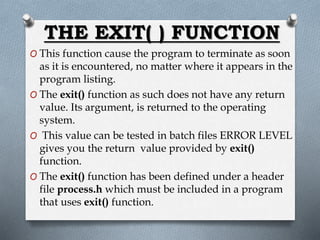
THE EXIT( ) FUNCTION
O This function cause the program to terminate as soon
as it is encountered, no matter where it appears in the
program listing.
O The exit() function as such does not have any return
value. Its argument, is returned to the operating
system.
O This value can be tested in batch files ERROR LEVEL
gives you the return value provided by exit()
function.
O The exit() function has been defined under a header
file process.h which must be included in a program
that uses exit() function.
Thank You……..

Loops IN COMPUTER SCIENCE STANDARD 11 BY KR

  • 1.
    LOOPS PREPARED BY: KRISHNSRAJMISHRA SUBJECT: COMPUTRE SCIENCE STANDARD: 11-A(SCIENCE) TOPIC: LOOPS
  • 2.
    CONTENTS O LOOP STATEMENTS OPARTS OF LOOPS O TYPES OF LOOPS O WHILE LOOPS O FOR LOOPS O DO WHILE LOOPS O NESTED LOOPS O JUMP STATEMENTS
  • 3.
    LOOP STATEMENTS The loopstatements allow a set of instructions to be performed repeatedly until a certain condition is fulfilled. Following is the general from of a loop statement in most of the programming languages:
  • 4.
    PARTS OF ALOOP OInitialization Expression(s) initialize(s) the loop variables in the beginning of the loop. OTest Expression decides whether the loop will be executed (if test expression is true) or not (if test expression is false). OUpdate Expression(s) update(s) the values of loop variables after every iteration of the loop. OThe Body-of-the-Loop contains statements to be executed repeatedly.
  • 5.
    TYPES OF LOOPS C++programming language provides following types of loop to handle looping requirements:
  • 6.
    WHILE LOOP OThe syntaxof while statement : while (loop repetition condition) statement OLoop repetition condition is the condition which controls the loop. OThe statement is repeated as long as the loop repetition condition is true. OA loop is called an infinite loop if the loop repetition condition is always true.
  • 8.
    Logic of awhile Loop condition evaluated false statement true
  • 9.
  • 10.
    FOR LOOP A forstatement has the following syntax: The initialization is executed once before the loop begins for ( initialization ; condition ; increment ) { statement; } The statement is executed until the condition becomes false The increment portion is executed at the end of each iteration The statement is executed until the condition becomes false The initialization is executed once before the loop begins
  • 12.
    Logic of afor loop statement true condition evaluated false increment initialization
  • 13.
    EXAMPLE: //program to displaytable of a given number using for loop. #include<iostream.h> void main() { int n; cout<<“n Enter number:”; cin>>n; //for loop for(int i=1;i<11;++i) cout<<“n”<<n<<“*”<<i<<“=“<<n*i; } Enter number: 3 3*1=3 3*2=6 3*3=9 3*4=12 3*5=15 3*6=18 3*7=21 3*8=24 3*9=27 3*10=30 OUTPUT
  • 14.
    THE FOR LOOPVARIATIONS OMultiple initialization and update expressions A for loop may contain multiple initialization and/or multiple update expressions. These multiple expressions must be separated by commas. e.g. for( i=1, sum=0; i<=n; sum+=i, ++i) cout<<“n”<<i;
  • 15.
    OPrefer prefix increment/decrement overpostfix when to be used alone. for( i=1;i<n;++i) : rather than, for( i=1;i<5;i++) : Reason being that when used alone ,prefix operators are faster executed than postfix. Prefer this over this
  • 16.
    OOptional expressions In afor loop initialization expression, test expression and update expression are optional. OInitialization expression is skipped: int i = 1, sum = 0 ; for ( ; i <= 20 ; sum += i, ++i) cout <<“n” <<i ; See initialization expression is skipped OUpdate expression is skipped: for ( ; j != 242 ; ) cin >> j++ ; see update expression is skipped
  • 17.
    OInfinite loop An infiniteloop can be created by omitting the test expression as shown: for(j=25; ;--j) cout<<“an infinite for loop”; An infinite loop can also be created as: for( ; ; ) cout<<“endless for loop”;
  • 18.
    OEmpty loop If aloop does not contain any statement in its loop-body, it is said to be an empty loop: for(j=25; (j) ;--j) //(j) tests for non zero value of j. If we put a semicolon after for’s parenthesis it repeats only for counting the control variable. And if we put a block of statements after such a loop, it is not a part of for loop. e.g. for(i=0;i<10;++i); { cout<<“i=“<<i<<endl; } The semicolon ends the loop here only This is not the body of the for loop. For loop is an empty loop
  • 19.
    Declaration of variablesin the loop for ( int I = 1 ; 1 < n ; ; ++i ) { ………. } A variable can be accessed only in the block where it has been declared into.
  • 20.
    DO…WHILE LOOP • Thesyntax of do-while statement in C: do statement while (loop repetition condition); • The statement is first executed. • If the loop repetition condition is true, the statement is repeated. • Otherwise, the loop is exited.
  • 21.
    Logic of ado…while loop true condition evaluated statement false
  • 22.
    EXAMPLE: //program to displaycounting from 1 to 10 using do-while loop. #include<iostream.h> void main() { int i=1; //do-while loop do { cout<<“n”<<i; i++; }while(i<=10); } 1 2 3 4 5 6 7 8 9 10 OUTPUT
  • 23.
    NESTED LOOPS • Nestedloops consist of an outer loop with one or more inner loops. e.g., for (i=1;i<=100;i++){ for(j=1;j<=50;j++){ … } } • The above loop will run for 100*50 iterations. Inner loop Outer loop
  • 24.
    EXAMPLE: //program to displaya pattern of a given character using nested loop. #include<iostream.h> void main() { int i,j; for( i=1;i<5;++i) { cout<<“n”; for(j=1;j<=i;++j) cout<<“*”; } } * * * * * * * * * * OUTPUT
  • 25.
    COMPARISION OF LOOPS The forloop is appropriate when you know in advance how many times the loop will be executed. The other two loops while and do-while loops are more suitable in the situations where it is not known before-hand when the loop will terminate.
  • 26.
    JUMP STATEMENTS 1. Thegoto statement • A goto statement can transfer the program control anywhere in the program. • The target destination is marked by a label. • The target label and goto must appear in the same statement. • The syntax of goto statement is: goto label; … label:
  • 27.
    2. The breakstatement • The break statement enables a program to skip over part of the code. • A break statement terminates the smallest enclosing while, do-while and for statements. • A break statement skips the rest of the loop and jumps over to the statement following the loop. The following figures explains the working of a break statement :
  • 28.
  • 29.
  • 30.
  • 31.
    3. The continuestatement • The continue statement works somewhat like the break statement. • For the for loop, continue causes the conditional test and increment portions of the loop to execute. For the while and do...while loops, program control passes to the conditional tests. • Syntax: The syntax of a continue statement in C++ is: continue;
  • 32.
    THE EXIT( )FUNCTION O This function cause the program to terminate as soon as it is encountered, no matter where it appears in the program listing. O The exit() function as such does not have any return value. Its argument, is returned to the operating system. O This value can be tested in batch files ERROR LEVEL gives you the return value provided by exit() function. O The exit() function has been defined under a header file process.h which must be included in a program that uses exit() function.
  • 33.