BUSINESS PROCESS
OUTSOURCING AND
GOVERNMENT SUPPORT
TO BPO IN INDIA
Made and Drafted By-
KRISHNKANT CHATURVEDI
Gwalior (MP), INDIA
Email: krishna.chaturvedi37@gmail.com
1KRISHNKANT CHATURVEDI
What is BPO?
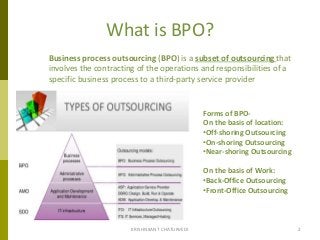
Business process outsourcing (BPO) is a subset of outsourcing that
involves the contracting of the operations and responsibilities of a
specific business process to a third-party service provider
Forms of BPO-
On the basis of location:
•Off-shoring Outsourcing
•On-shoring Outsourcing
•Near-shoring Outsourcing
On the basis of Work:
•Back-Office Outsourcing
•Front-Office Outsourcing
2KRISHNKANT CHATURVEDI
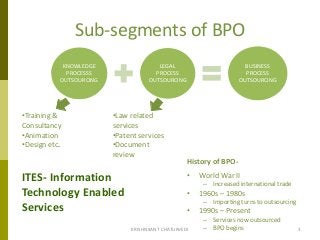
Sub-segments of BPO
KNOWLEDGE
PROCESSS
OUTSOURCING
LEGAL
PROCESS
OUTSOURCING
BUSINESS
PROCESS
OUTSOURCING
•Training &
Consultancy
•Animation
•Design etc.
•Law related
services
•Patent services
•Document
review
• World War II
– Increased international trade
• 1960s – 1980s
– Importing turns to outsourcing
• 1990s – Present
– Services now outsourced
– BPO begins
History of BPO-
ITES- Information
Technology Enabled
Services
3KRISHNKANT CHATURVEDI
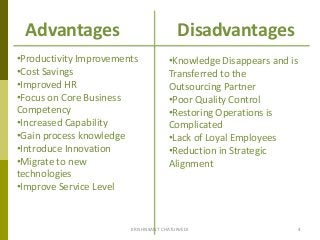
Advantages Disadvantages
•Productivity Improvements
•Cost Savings
•Improved HR
•Focus on Core Business
Competency
•Increased Capability
•Gain process knowledge
•Introduce Innovation
•Migrate to new
technologies
•Improve Service Level
•Knowledge Disappears and is
Transferred to the
Outsourcing Partner
•Poor Quality Control
•Restoring Operations is
Complicated
•Lack of Loyal Employees
•Reduction in Strategic
Alignment
4KRISHNKANT CHATURVEDI
Government's Support to the BPO Sector in India
Recognizing the growing importance of the business process outsourcing, the Government
of India has introduced various policy concessions and initiatives to accelerate the
growth of the IT-enabled outsourcing market. Spearheaded by associations such as
National Association of Software and Service Companies (NASSCOM), the Indian
software and services industry has also taken various steps to ensure that India
becomes the global hub for IT-enabled outsourcing in the future. Some of the steps
take by the Government and industry for the ITES/BPO sectors are as follows:
# In May 2002, the Government of India has accepted the recommendations of NASSCOM
and removed certain procedural bottlenecks that were hampering the growth of the
Indian call center industry.
# The Government of India (Central Board of Direct Taxes - CBDT) has allowed total income
tax exemption on the export of IT enabled outsourcing services under Sections 10A/10B
of the Income Tax Act, 1961. These IT enabled products or services are:
i. Back-office Operations
ii. Call Centres
iii. Content Development or Animation
iv. Data Processing
v. Engineering & Design services
vi. Geographic Information System Services
5KRISHNKANT CHATURVEDI
vii. Human Resource Services
viii. Insurance Claim Processing
ix. Legal Database
x. Medical Transcription
xi. Payroll
xii. Remote Maintenance
xiii. Revenue Accounting
xiv. Support Centres; and
xv. Web-site services
# Foreign Direct Investment (FDI) for 100 percent of the equity has been permitted
in BPO companies.
# Permission of duty-free imports of capital goods (under the Export Promotion of
Capital Goods scheme) for BPO companies.
# The Government has promoted several Software Technology Parks (STPs) which
provide ready-to-plug IT and telecom infrastructure. STPs also allow single-window
clearance for all regulatory compliance issues. Currently, several STPs have been
established across India covering most of the major towns/cities
#The Narendra Modi government is contemplating to introduce a new policy that
will help BPO (Business Process Outsourcing) units set up base in smaller towns,
especially in the North-Eastern India
#Govt. to offer subsidy of up to 50% of capital expenditure or Rs 1 lakh/seat,
whichever is lower 6KRISHNKANT CHATURVEDI
7KRISHNKANT CHATURVEDI

Business Process Outsourcing (BPO) and Government support to BPO in India

  • 1.
    BUSINESS PROCESS OUTSOURCING AND GOVERNMENTSUPPORT TO BPO IN INDIA Made and Drafted By- KRISHNKANT CHATURVEDI Gwalior (MP), INDIA Email: krishna.chaturvedi37@gmail.com 1KRISHNKANT CHATURVEDI
  • 2.
    What is BPO? Businessprocess outsourcing (BPO) is a subset of outsourcing that involves the contracting of the operations and responsibilities of a specific business process to a third-party service provider Forms of BPO- On the basis of location: •Off-shoring Outsourcing •On-shoring Outsourcing •Near-shoring Outsourcing On the basis of Work: •Back-Office Outsourcing •Front-Office Outsourcing 2KRISHNKANT CHATURVEDI
  • 3.
    Sub-segments of BPO KNOWLEDGE PROCESSS OUTSOURCING LEGAL PROCESS OUTSOURCING BUSINESS PROCESS OUTSOURCING •Training& Consultancy •Animation •Design etc. •Law related services •Patent services •Document review • World War II – Increased international trade • 1960s – 1980s – Importing turns to outsourcing • 1990s – Present – Services now outsourced – BPO begins History of BPO- ITES- Information Technology Enabled Services 3KRISHNKANT CHATURVEDI
  • 4.
    Advantages Disadvantages •Productivity Improvements •CostSavings •Improved HR •Focus on Core Business Competency •Increased Capability •Gain process knowledge •Introduce Innovation •Migrate to new technologies •Improve Service Level •Knowledge Disappears and is Transferred to the Outsourcing Partner •Poor Quality Control •Restoring Operations is Complicated •Lack of Loyal Employees •Reduction in Strategic Alignment 4KRISHNKANT CHATURVEDI
  • 5.
    Government's Support tothe BPO Sector in India Recognizing the growing importance of the business process outsourcing, the Government of India has introduced various policy concessions and initiatives to accelerate the growth of the IT-enabled outsourcing market. Spearheaded by associations such as National Association of Software and Service Companies (NASSCOM), the Indian software and services industry has also taken various steps to ensure that India becomes the global hub for IT-enabled outsourcing in the future. Some of the steps take by the Government and industry for the ITES/BPO sectors are as follows: # In May 2002, the Government of India has accepted the recommendations of NASSCOM and removed certain procedural bottlenecks that were hampering the growth of the Indian call center industry. # The Government of India (Central Board of Direct Taxes - CBDT) has allowed total income tax exemption on the export of IT enabled outsourcing services under Sections 10A/10B of the Income Tax Act, 1961. These IT enabled products or services are: i. Back-office Operations ii. Call Centres iii. Content Development or Animation iv. Data Processing v. Engineering & Design services vi. Geographic Information System Services 5KRISHNKANT CHATURVEDI
  • 6.
    vii. Human ResourceServices viii. Insurance Claim Processing ix. Legal Database x. Medical Transcription xi. Payroll xii. Remote Maintenance xiii. Revenue Accounting xiv. Support Centres; and xv. Web-site services # Foreign Direct Investment (FDI) for 100 percent of the equity has been permitted in BPO companies. # Permission of duty-free imports of capital goods (under the Export Promotion of Capital Goods scheme) for BPO companies. # The Government has promoted several Software Technology Parks (STPs) which provide ready-to-plug IT and telecom infrastructure. STPs also allow single-window clearance for all regulatory compliance issues. Currently, several STPs have been established across India covering most of the major towns/cities #The Narendra Modi government is contemplating to introduce a new policy that will help BPO (Business Process Outsourcing) units set up base in smaller towns, especially in the North-Eastern India #Govt. to offer subsidy of up to 50% of capital expenditure or Rs 1 lakh/seat, whichever is lower 6KRISHNKANT CHATURVEDI
  • 7.