Kate Ervin City of Dayton Planning & CD
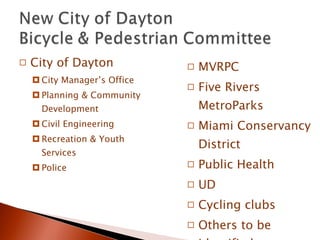
City of Dayton City Manager’s Office Planning & Community Development Civil Engineering Recreation & Youth Services Police  MVRPC Five Rivers MetroParks Miami Conservancy District Public Health UD Cycling clubs Others to be identified


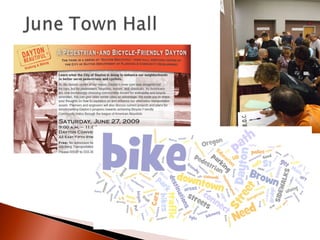
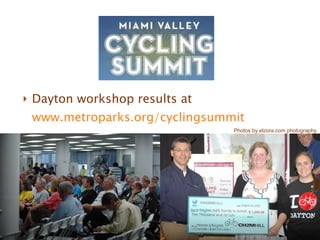
Dayton workshop results at  www.metroparks.org/cyclingsummit   Photos by elzora.com photography
 
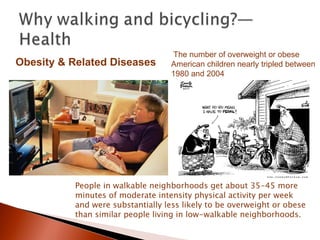
People in walkable neighborhoods get about 35-45 more minutes of moderate intensity physical activity per week and were substantially less likely to be overweight or obese than similar people living in low-walkable neighborhoods. The number of overweight or obese American children nearly tripled between 1980 and 2004 Obesity & Related Diseases
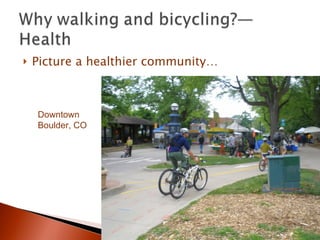
Picture a healthier community… Downtown Boulder, CO
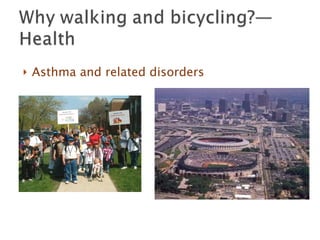
Asthma and related disorders
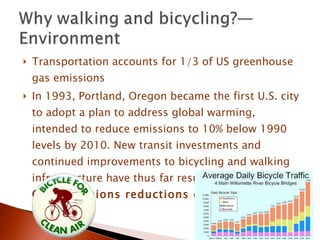
Transportation accounts for 1/3 of US greenhouse gas emissions In 1993, Portland, Oregon became the first U.S. city to adopt a plan to address global warming, intended to reduce emissions to 10% below 1990 levels by 2010. New transit investments and continued improvements to bicycling and walking infrastructure have thus far resulted in  per capita CO2 emissions reductions of 12.5 percent. 1
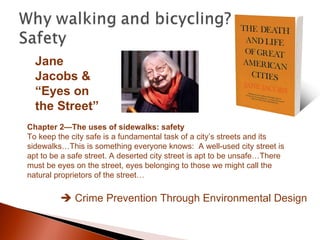
   Crime Prevention Through Environmental Design Jane Jacobs & “ Eyes on the Street” Chapter 2—The uses of sidewalks: safety To keep the city safe is a fundamental task of a city’s streets and its sidewalks…This is something everyone knows:  A well-used city street is apt to be a safe street. A deserted city street is apt to be unsafe…There must be eyes on the street, eyes belonging to those we might call the natural proprietors of the street…
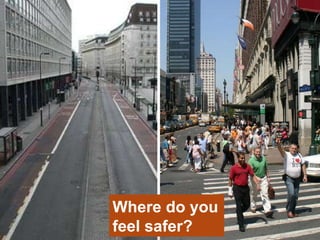
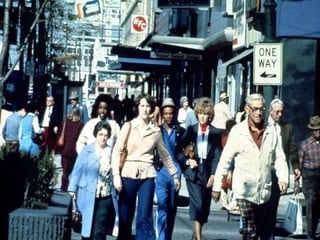
Where do you feel safer?
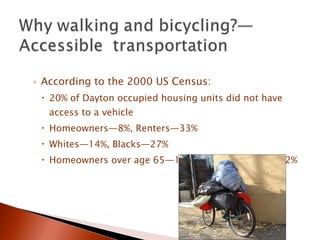
According to the 2000 US Census: 20% of Dayton occupied housing units did not have access to a vehicle Homeowners—8%, Renters—33% Whites—14%, Blacks—27% Homeowners over age 65—18%, Renters over 65—52%
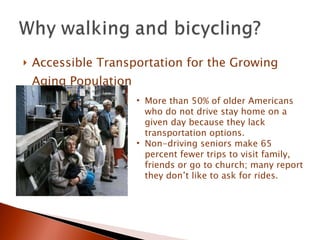
Accessible Transportation for the Growing Aging Population More than 50% of older Americans who do not drive stay home on a given day because they lack transportation options.   Non-driving seniors make 65 percent fewer trips to visit family, friends or go to church; many report they don’t like to ask for rides.  
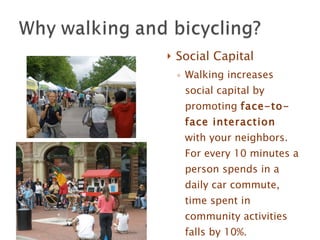
Social Capital Walking increases social capital by promoting  face-to-face interaction  with your neighbors. For every 10 minutes a person spends in a daily car commute, time spent in community activities falls by 10%. Sightline Institute
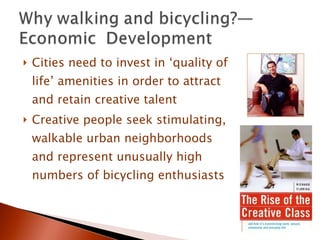
Cities need to invest in ‘quality of life’ amenities in order to attract and retain creative talent Creative people seek stimulating, walkable urban neighborhoods and represent unusually high numbers of bicycling enthusiasts
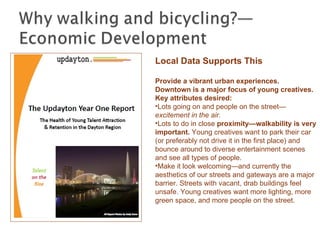
Local Data Supports This Provide a vibrant urban experiences. Downtown is a major focus of young creatives. Key attributes desired:  Lots going on and people on the street— excitement in the air.  Lots to do in close  proximity—walkability is very important.  Young creatives want to park their car (or preferably not drive it in the first place) and bounce around to diverse entertainment scenes and see all types of people.  Make it look welcoming—and currently the aesthetics of our streets and gateways are a major barrier. Streets with vacant, drab buildings feel unsafe. Young creatives want more lighting, more green space, and more people on the street.
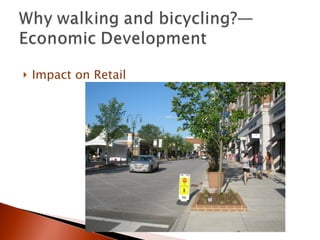
Impact on Retail
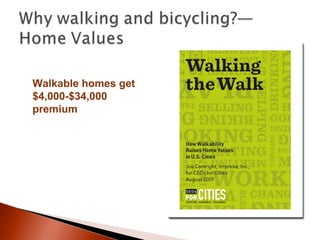
Walkable homes get $4,000-$34,000 premium
In summary, if we care about: Healthy people A healthy environment Public safety Senior-citizens Affordable transportation Economic development … then we need get our neighbors walking and bicycling!!!
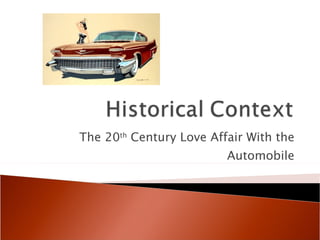
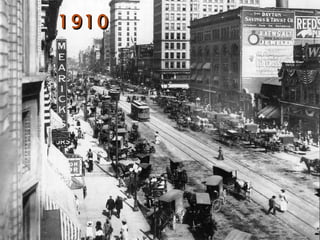
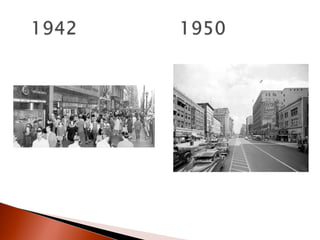
The 20 th  Century Love Affair With the Automobile
1910


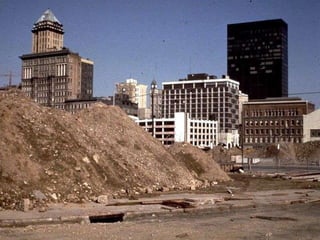
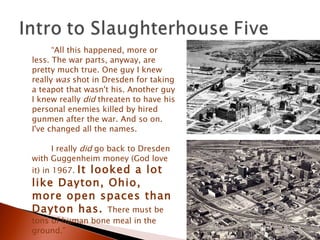
“ All this happened, more or less. The war parts, anyway, are pretty much true. One guy I knew really  was  shot in Dresden for taking a teapot that wasn't his. Another guy I knew really  did  threaten to have his personal enemies killed by hired gunmen after the war. And so on. I've changed all the names.  I really  did  go back to Dresden with Guggenheim money (God love it) in 1967.  It looked a lot like Dayton, Ohio, more open spaces than Dayton has.  There must be tons of human bone meal in the ground.”
Into the 21 st  Century
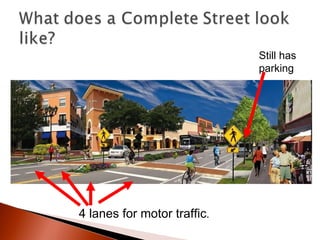
Complete streets are designed and operated to enable safe access for all users.  Pedestrians, bicyclists, motorists and transit riders of all ages and abilities must be able to safely move along and across a complete street.
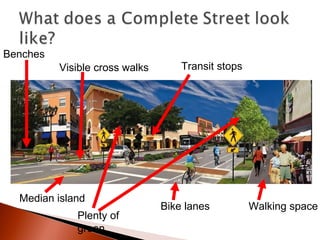
Median island Bike lanes Walking space Transit stops Visible cross walks Plenty of green Benches
4 lanes for motor traffic .  Still has parking
Ordinance or Law “ Roadway projects shall accommodate all users of the transportation system, including pedestrians, bicyclists, users of mass transit, people with disabilities, the elderly, motorists, freight providers, emergency responders, and adjacent land users.”   -  Bloomington, IN Each County road and street must be designed so that the safety and convenience of all users…- including pedestrians, bicyclists, transit users, automobile drivers commercial vehicles and freight haulers, and emergency service vehicles – is accommodated.  Each road and street must facilitate multi-modal use and assure that all users can travel safely in the public right of way. - Montgomery County, Maryland
 
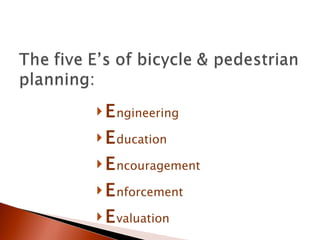
E ngineering E ducation E ncouragement E nforcement E valuation
Education Encouragement Enforcement Evaluation
The biggest single factor influencing physical activity around the world is accessibility to sidewalks.  SDSU in American Journal of Preventative Medicine, June 2009
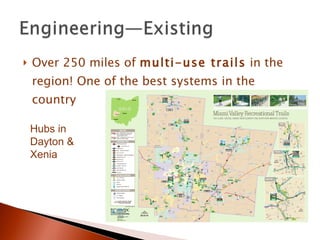
Over 250 miles of  multi-use trails  in the region! One of the best systems in the country Hubs in Dayton & Xenia
 
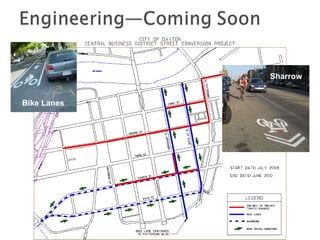
Downtown Dayton Bike Lanes & Sharrows Sharrow Bike Lanes
 
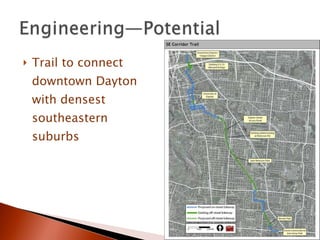
Trail to connect downtown Dayton with densest southeastern suburbs
 
Engineering Encouragement Enforcement Evaluation
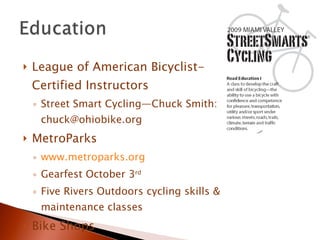
League of American Bicyclist-Certified Instructors Street Smart Cycling—Chuck Smith: chuck@ohiobike.org MetroParks www.metroparks.org Gearfest October 3 rd Five Rivers Outdoors cycling skills & maintenance classes Bike Shops Safe Routes to Schools
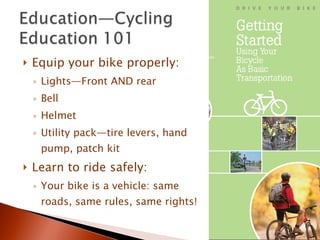
Equip your bike properly: Lights—Front AND rear Bell Helmet Utility pack—tire levers, hand pump, patch kit Learn to ride safely: Your bike is a vehicle: same roads, same rules, same rights!
Engineering Education Enforcement Evaluation
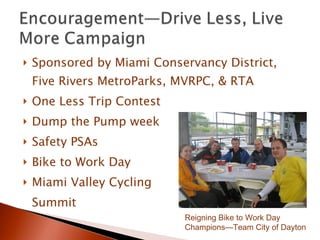
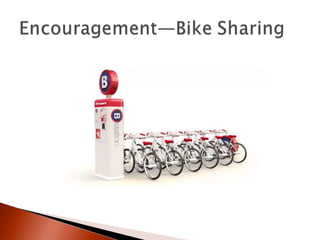
Sponsored by Miami Conservancy District, Five Rivers MetroParks, MVRPC, & RTA One Less Trip Contest Dump the Pump week Safety PSAs Bike to Work Day Miami Valley Cycling  Summit Reigning Bike to Work Day  Champions—Team City of Dayton
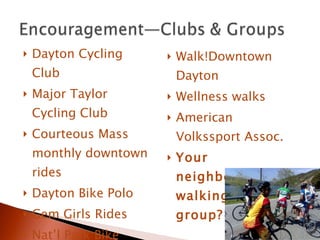
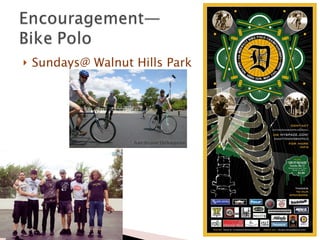
Dayton Cycling Club Major Taylor Cycling Club Courteous Mass monthly downtown rides Dayton Bike Polo Gem Girls Rides Nat’l Park Bike Tours Walk!Downtown Dayton Wellness walks American Volkssport Assoc. Your neighborhood walking/cycling group?
New pedestrian & bicycle advocacy group 1 st  Meeting Wednesday, September 30, 7PM Brixx—500 E First St Contact: Todd Dungan, todddungan13@hotmail.com


Rush hour downtown, First Friday of every month More info: google it, or  [email_address]
Sundays@ Walnut Hills Park
Permit to install a bike rack in the public right-of-way:  [email_address]
 
 
Engineering Education Encouragement Evaluation
 
Engineering Education Encouragement Enforcement


How do we mobilize  your  community?
Alliance for Biking and Walking:  www.peoplepoweredmovement.org   Kate Ervin, City of Dayton Department of Planning & Community Development,  [email_address] ,  333-3863

Neighborhood Conference Ervin

  • 1.
    Kate Ervin Cityof Dayton Planning & CD
  • 2.
    City of DaytonCity Manager’s Office Planning & Community Development Civil Engineering Recreation & Youth Services Police MVRPC Five Rivers MetroParks Miami Conservancy District Public Health UD Cycling clubs Others to be identified
  • 3.
  • 4.
  • 5.
  • 6.
  • 7.
  • 8.
    Dayton workshop resultsat www.metroparks.org/cyclingsummit Photos by elzora.com photography
  • 9.
  • 10.
    People in walkableneighborhoods get about 35-45 more minutes of moderate intensity physical activity per week and were substantially less likely to be overweight or obese than similar people living in low-walkable neighborhoods. The number of overweight or obese American children nearly tripled between 1980 and 2004 Obesity & Related Diseases
  • 11.
    Picture a healthiercommunity… Downtown Boulder, CO
  • 12.
  • 13.
    Transportation accounts for1/3 of US greenhouse gas emissions In 1993, Portland, Oregon became the first U.S. city to adopt a plan to address global warming, intended to reduce emissions to 10% below 1990 levels by 2010. New transit investments and continued improvements to bicycling and walking infrastructure have thus far resulted in per capita CO2 emissions reductions of 12.5 percent. 1
  • 14.
    Crime Prevention Through Environmental Design Jane Jacobs & “ Eyes on the Street” Chapter 2—The uses of sidewalks: safety To keep the city safe is a fundamental task of a city’s streets and its sidewalks…This is something everyone knows: A well-used city street is apt to be a safe street. A deserted city street is apt to be unsafe…There must be eyes on the street, eyes belonging to those we might call the natural proprietors of the street…
  • 15.
    Where do youfeel safer?
  • 16.
    According to the2000 US Census: 20% of Dayton occupied housing units did not have access to a vehicle Homeowners—8%, Renters—33% Whites—14%, Blacks—27% Homeowners over age 65—18%, Renters over 65—52%
  • 17.
    Accessible Transportation forthe Growing Aging Population More than 50% of older Americans who do not drive stay home on a given day because they lack transportation options.  Non-driving seniors make 65 percent fewer trips to visit family, friends or go to church; many report they don’t like to ask for rides.  
  • 18.
    Social Capital Walkingincreases social capital by promoting face-to-face interaction with your neighbors. For every 10 minutes a person spends in a daily car commute, time spent in community activities falls by 10%. Sightline Institute
  • 19.
    Cities need toinvest in ‘quality of life’ amenities in order to attract and retain creative talent Creative people seek stimulating, walkable urban neighborhoods and represent unusually high numbers of bicycling enthusiasts
  • 20.
    Local Data SupportsThis Provide a vibrant urban experiences. Downtown is a major focus of young creatives. Key attributes desired: Lots going on and people on the street— excitement in the air. Lots to do in close proximity—walkability is very important. Young creatives want to park their car (or preferably not drive it in the first place) and bounce around to diverse entertainment scenes and see all types of people. Make it look welcoming—and currently the aesthetics of our streets and gateways are a major barrier. Streets with vacant, drab buildings feel unsafe. Young creatives want more lighting, more green space, and more people on the street.
  • 21.
  • 22.
    Walkable homes get$4,000-$34,000 premium
  • 23.
    In summary, ifwe care about: Healthy people A healthy environment Public safety Senior-citizens Affordable transportation Economic development … then we need get our neighbors walking and bicycling!!!
  • 24.
    The 20 th Century Love Affair With the Automobile
  • 25.
  • 26.
  • 27.
  • 28.
  • 29.
    “ All thishappened, more or less. The war parts, anyway, are pretty much true. One guy I knew really was shot in Dresden for taking a teapot that wasn't his. Another guy I knew really did threaten to have his personal enemies killed by hired gunmen after the war. And so on. I've changed all the names. I really did go back to Dresden with Guggenheim money (God love it) in 1967. It looked a lot like Dayton, Ohio, more open spaces than Dayton has. There must be tons of human bone meal in the ground.”
  • 30.
    Into the 21st Century
  • 31.
    Complete streets aredesigned and operated to enable safe access for all users. Pedestrians, bicyclists, motorists and transit riders of all ages and abilities must be able to safely move along and across a complete street.
  • 32.
    Median island Bikelanes Walking space Transit stops Visible cross walks Plenty of green Benches
  • 33.
    4 lanes formotor traffic . Still has parking
  • 34.
    Ordinance or Law“ Roadway projects shall accommodate all users of the transportation system, including pedestrians, bicyclists, users of mass transit, people with disabilities, the elderly, motorists, freight providers, emergency responders, and adjacent land users.” - Bloomington, IN Each County road and street must be designed so that the safety and convenience of all users…- including pedestrians, bicyclists, transit users, automobile drivers commercial vehicles and freight haulers, and emergency service vehicles – is accommodated. Each road and street must facilitate multi-modal use and assure that all users can travel safely in the public right of way. - Montgomery County, Maryland
  • 35.
  • 36.
    E ngineering Education E ncouragement E nforcement E valuation
  • 37.
  • 38.
    The biggest singlefactor influencing physical activity around the world is accessibility to sidewalks. SDSU in American Journal of Preventative Medicine, June 2009

  • 39.
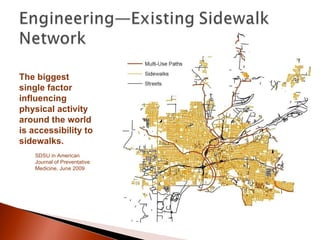
    Over 250 milesof multi-use trails in the region! One of the best systems in the country Hubs in Dayton & Xenia
  • 40.
  • 41.
    Downtown Dayton BikeLanes & Sharrows Sharrow Bike Lanes
  • 42.
  • 43.
    Trail to connectdowntown Dayton with densest southeastern suburbs
  • 44.
  • 45.
  • 46.
    League of AmericanBicyclist-Certified Instructors Street Smart Cycling—Chuck Smith: chuck@ohiobike.org MetroParks www.metroparks.org Gearfest October 3 rd Five Rivers Outdoors cycling skills & maintenance classes Bike Shops Safe Routes to Schools
  • 47.
    Equip your bikeproperly: Lights—Front AND rear Bell Helmet Utility pack—tire levers, hand pump, patch kit Learn to ride safely: Your bike is a vehicle: same roads, same rules, same rights!
  • 48.
  • 49.
    Sponsored by MiamiConservancy District, Five Rivers MetroParks, MVRPC, & RTA One Less Trip Contest Dump the Pump week Safety PSAs Bike to Work Day Miami Valley Cycling Summit Reigning Bike to Work Day Champions—Team City of Dayton
  • 50.
    Dayton Cycling ClubMajor Taylor Cycling Club Courteous Mass monthly downtown rides Dayton Bike Polo Gem Girls Rides Nat’l Park Bike Tours Walk!Downtown Dayton Wellness walks American Volkssport Assoc. Your neighborhood walking/cycling group?
  • 51.
    New pedestrian &bicycle advocacy group 1 st Meeting Wednesday, September 30, 7PM Brixx—500 E First St Contact: Todd Dungan, todddungan13@hotmail.com
  • 52.
  • 53.
  • 54.
  • 55.
    Rush hour downtown,First Friday of every month More info: google it, or [email_address]
  • 56.
  • 57.
    Permit to installa bike rack in the public right-of-way: [email_address]
  • 58.
  • 59.
  • 60.
  • 61.
  • 62.
  • 63.
  • 64.
  • 65.
  • 66.
  • 67.
  • 68.
    How do wemobilize your community?
  • 69.
    Alliance for Bikingand Walking: www.peoplepoweredmovement.org Kate Ervin, City of Dayton Department of Planning & Community Development, [email_address] , 333-3863