Handouts on Rapid
Analysis of Innovation
Response to COVID-19
Pandemic in Kenya
July 2020
Background
• In January 2020, the World Health Organization confirmed that a novel coronavirus was the cause of a respiratory illness in a cluster in Wuhan,
China. Since then, the virus has spread all over the world and the year 2020 has become synonymous with this spread and the global response to it.
• Africa has not been spared, with the continent recording its first case in February 2020. This global pandemic has continued its devastation in Africa.
By the end of June 2020, the situation in our three focus countries were as follows: Kenya (over 6,000 cases and 144 deaths), Nigeria (over 25,000
cases and over 570 deaths) and South Africa (over 150,000 cases and more than 2,650 deaths). This has led to many within the national innovation
ecosystems in the three countries to look for ways to address the impacts of the pandemic.
• In order to track the impact of the pandemic, AfriLabs and the KTN Global Alliance worked together to deliver a rapid analysis of innovation response
to COVID-19 pandemic in Africa, with focus on Kenya, Nigeria and South Africa. The aim of the analysis was to inform the UK’s Department for
International Development (DFID) and the KTN Global Alliance on how to render effective support to innovation systems in Africa to respond to the
COVID-19 pandemic, as well as to provide lessons and best practices to strengthen the innovation response to future crises.
• The overall study objective was to provide rapid analysis that:
 Identify the challenges and impact from the COVID-19 pandemic in Kenya, South Africa and Nigeria, and the corresponding innovation
responses;
 Inform immediate and medium-term support to increase resiliency of the innovation systems to the COVID-19 pandemic;
 Draw lessons and effective practices to strengthen the innovation response to future crises.
• This study, collected new evidence and data on the different dimensions to the impact of COVID-19. The challenges innovations faced were explored,
innovations response to the pandemic was evaluated, and finally some of the key focus areas and areas of opportunity for future growth of innovation
on the continent were considered.
The information below highlights the findings for Kenya as well as some recommendations towards greater
resilience in the innovation ecosystem in years to come.
Success and Failure in Innovation Responses to the COVID-19 Pandemic in
Kenya
What can we learn from examples of success and failure in innovation responses to the Covid-19 pandemic?
KEY FACTORS FOR SUCCESS WHERE
COORDINATION AND COLLABORATION
WERE STRONGEST
• Strong communication process
• Proper policies
• Stakeholder buy in
• Trust for collaboration
• Awareness creation and information sharing
KEY DRIVERS OF FRAGMENTED AND
SILOED WORKING RELATIONSHIP
• Corruption
• Lack of innovation within the existing systems
• Poor communication
• Lack of trust
• Lack of structures to collaborate effectively
• Lack of precedent
• Insufficient funding
Breakdown of stakeholder response
"... there's mutual benefit. Okay. Yeah.
So, each party benefits from each of the
relationships. so I would say that
makes the collaboration move
sustainably.” - Stakeholder, female-
Kenya
"The government of Kenya, did put
measures that also enhanced the uptick
of some of our solutions, like the
cashless payments.” - Stakeholder,
male-Kenya
Innovations Response to the COVID-19 Pandemic in Kenya
Who is doing what both locally and internationally in response to the Covid-19 pandemic and what can be done to support
greater coordination?
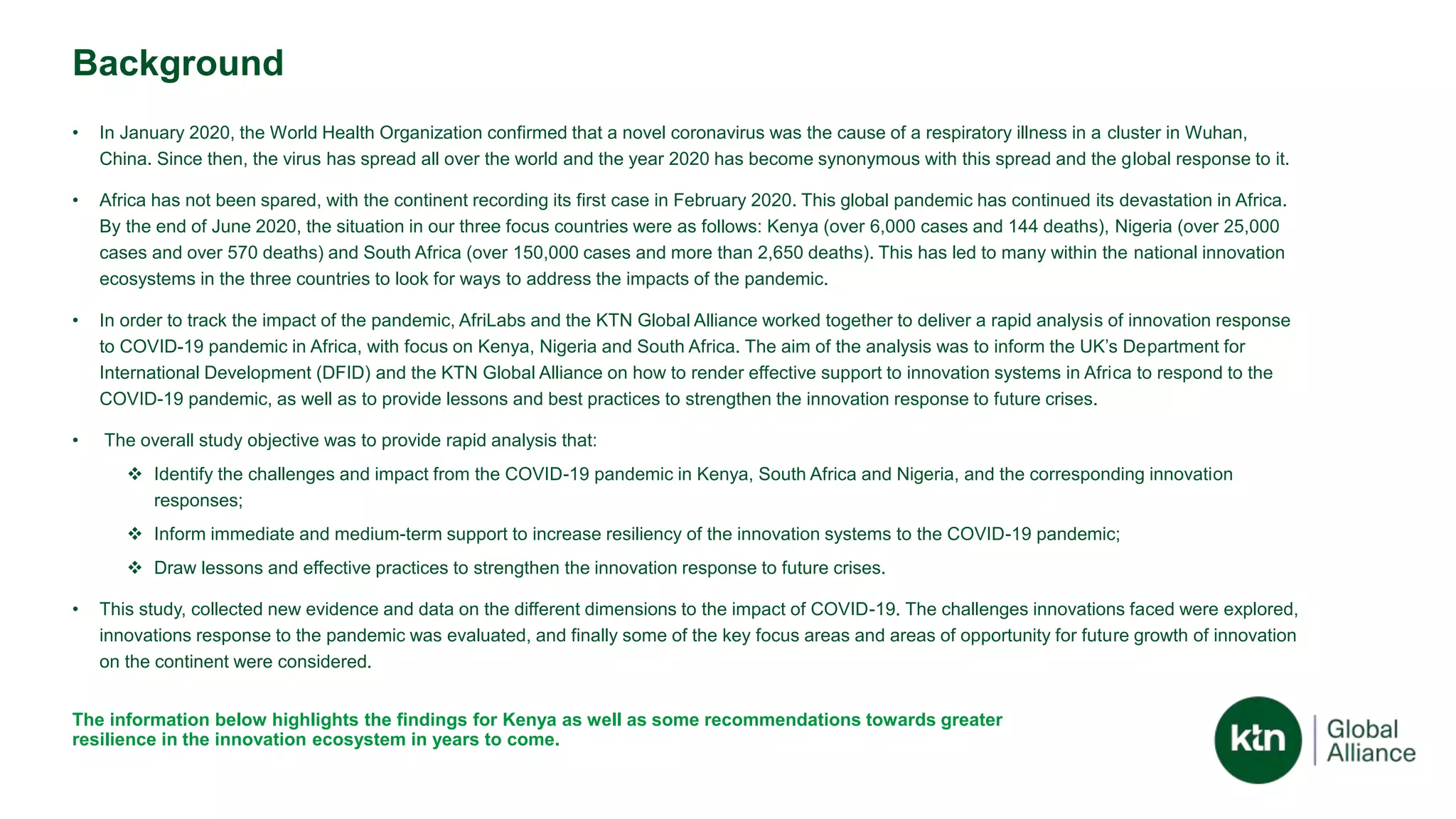
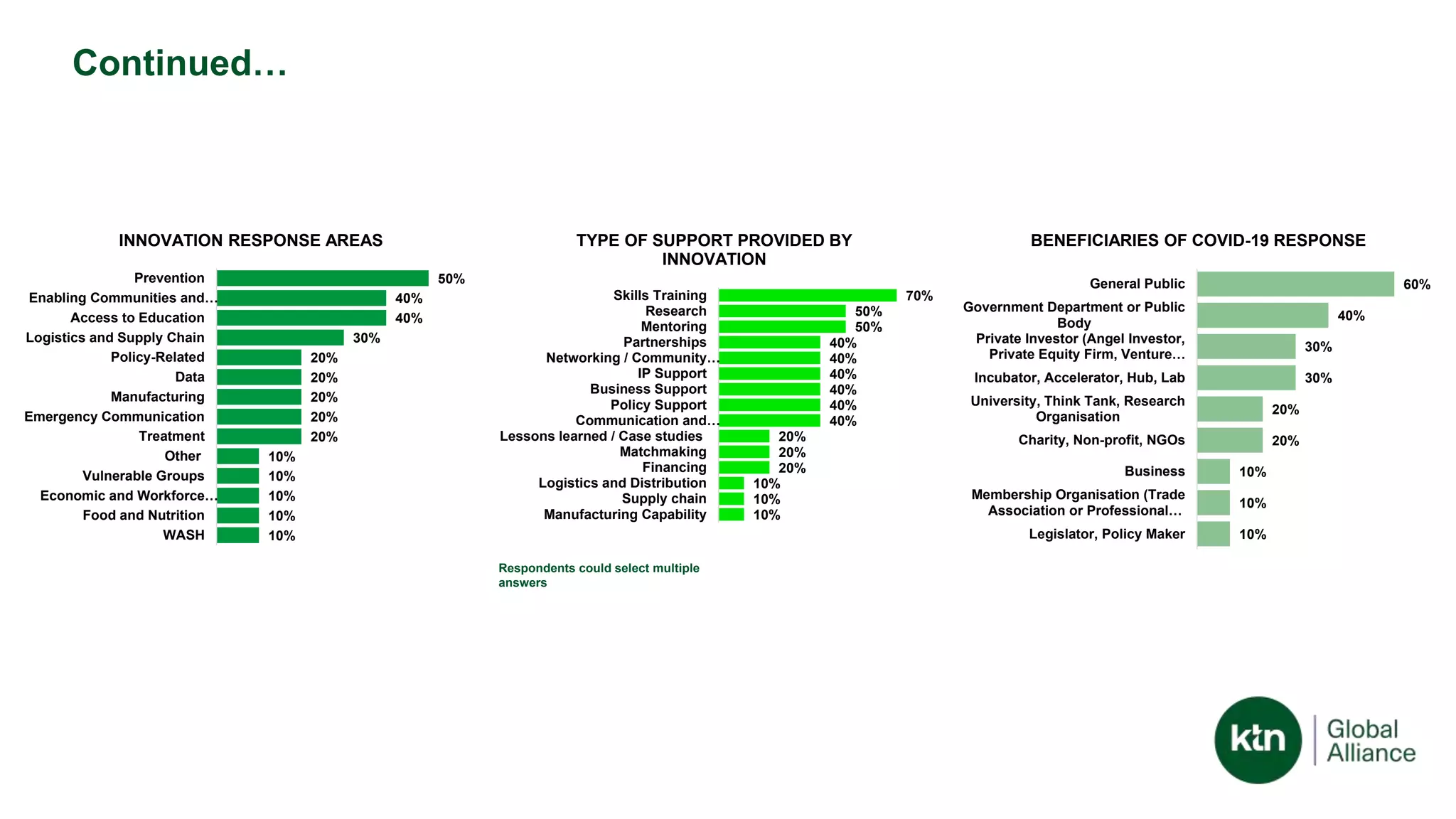
In Kenya, most innovations response areas to COVID-19 were around Prevention, Enabling Communities & connection and Education against the
pandemic and majority of them seemed to focus their support on Training, Research and Mentoring of which the main benefactors’ were general public
and Public organisations. This has resulted in an under-served business environment which still requires a lot of financial and business (guidance and
advice) assistance.
• The top three response areas among innovations to the COVID-19 pandemic in Kenya were towards Prevention (50%), Enabling Communities and
connection, and Access to Education (40% individually).
• The main type of support provided by innovations in Kenya were Skills Training (70%), Research, Mentoring (50% respectively) and Partnerships
(40%) among others.
• Then, the major clients/customers/beneficiaries of innovations response were General Public (60%), Government Department or Public Body (40%)
and Private Investor (Angel Investors, Private Equity Firm, Venture Capitalist), as well as Incubators, Accelerator, Hub, Lab (40% individually).
Continued…
10%
10%
10%
10%
10%
20%
20%
20%
20%
20%
30%
40%
40%
50%
WASH
Food and Nutrition
Economic and Workforce…
Vulnerable Groups
Other
Treatment
Emergency Communication
Manufacturing
Data
Policy-Related
Logistics and Supply Chain
Access to Education
Enabling Communities and…
Prevention
INNOVATION RESPONSE AREAS
10%
10%
10%
20%
20%
20%
40%
40%
40%
40%
40%
40%
50%
50%
70%
Manufacturing Capability
Supply chain
Logistics and Distribution
Financing
Matchmaking
Lessons learned / Case studies
Communication and…
Policy Support
Business Support
IP Support
Networking / Community…
Partnerships
Mentoring
Research
Skills Training
TYPE OF SUPPORT PROVIDED BY
INNOVATION
10%
10%
10%
20%
20%
30%
30%
40%
60%
Legislator, Policy Maker
Membership Organisation (Trade
Association or Professional…
Business
Charity, Non-profit, NGOs
University, Think Tank, Research
Organisation
Incubator, Accelerator, Hub, Lab
Private Investor (Angel Investor,
Private Equity Firm, Venture…
Government Department or Public
Body
General Public
BENEFICIARIES OF COVID-19 RESPONSE
Respondents could select multiple
answers
Impact of Covid-19 on Kenya
What are the consequences of the Covid-19 pandemic for the innovation ecosystems within each country?
Overview
• Kenya was hit hard by the Covid-19 pandemic, resulting in a nationwide lockdown for months.
• Enormous effort went into healthcare, ensuring large scale testing and treatment through existing, and purpose built infrastructure.
• Large scale economic support was also made available, focusing on the supporting the basic needs of the poorest.
• Businesses that could provide their services digitally continued operations whilst the rest was brought to a complete stand still.
• Some major organizations closed down for good, whilst many others lay off staff out of necessity and in an effort to safe their overall businesses.
• The tourism and entertainment industries were some of those that were impacted the most.
• SME and innovation funding was rerouted to food supply for the poor.
Continued…
Education
• The education sector was closed completely and resumed digitally (through e-learning) where possible.
• Government launched schooling via television and radio programs.
• Private schools and affluent schools were able to continue following a remarkable transition to distance learning.
• However, the greater majority of schools were not as successful as they were affected by the “digital dived” in Kenya where major parts of society
lacks digital skills and access to internet and affordable data.
Financial Services
• Stanbic Bank Kenya announced a loan holiday for SMEs and its personal banking customers to cushion them against the economic disruptions
caused by the Coronavirus disease (COVID-19).
• In a remarkable show of sense of responsibility, the bank indicated that it will continue being at the forefront of delivering wholesome solutions to
entrepreneurs directly and through strategic alliances and partnerships, financial literacy and mentorship programmes; enhancing business and
management skills, constant innovation that delivers solutions attuned to the needs of enterprise and operation models that ensures entrepreneurs
can conveniently access financial services any time anywhere in Kenya.
Manufacturing
• Many private manufacturers turned their attention to producing medical supplies to assist in curbing the pandemic.
• A number of funds were made available to support those that manufactured PPE and medical supplies.
Strength and Challenges from the COVID-19 Pandemic in Kenya
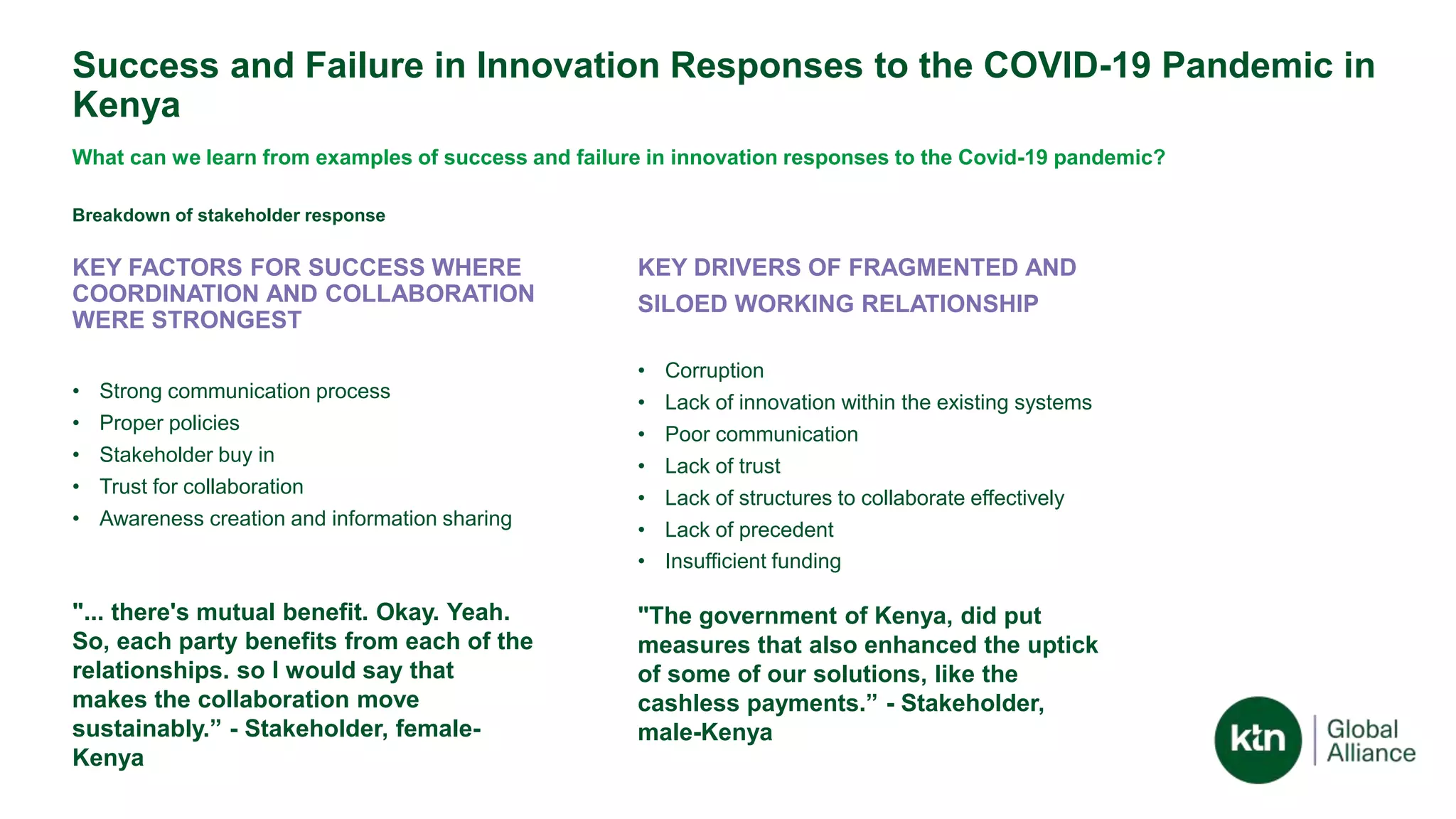
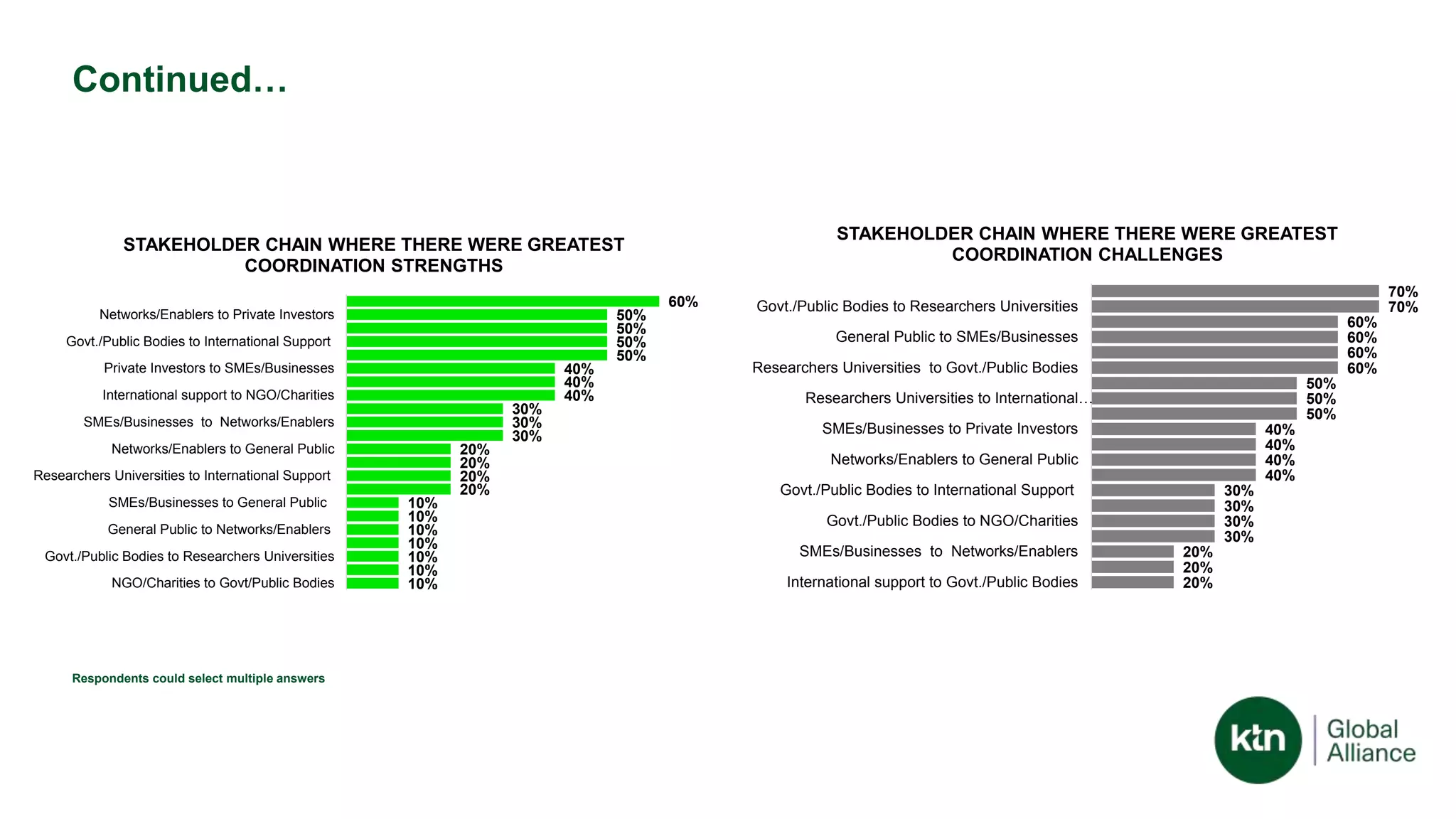
Remarkably, the connection between private investors and SME’s scored in Kenya is fairly high on the list of strengths and challenges, pointing out that
funding was to of mind for many and that there were mixed results in accessing such funding. The challenges list also clearly designates that the SME’s
and businesses did not experience the required relationship to (and subsequently the required support from) government. It is with this in mind that the
recommendation would be for greater formal coordination and improved business support (both financial and non-financial) be established in the Kenya
eco-system.
• The most greatest coordination strength among innovations were found between ‘International support to Govt./Public Bodies (60%)’,
‘Networks/Enablers to Private Investors’, ‘Private Investors to Networks/Enablers’, ‘Govt./Public Bodies to International Support’, ‘NGO/Charities to
International Support’ (50% separately).
• Whereas, the greatest challenges encountered by innovations occurred among ‘Govt./Public Bodies to Networks/Enablers’, ‘Govt./Public Bodies to
Researchers Universities’ (70% respectively), ‘Researchers Universities to Govt./Public Bodies’, ‘SMEs/Businesses to General Public’, ‘General
Public to SMEs/Businesses’, ‘Networks/Enablers to Govt./Public Bodies’ (60% separately)
Continued…
20%
20%
20%
30%
30%
30%
30%
40%
40%
40%
40%
50%
50%
50%
60%
60%
60%
60%
70%
70%
International support to Govt./Public Bodies
SMEs/Businesses to Networks/Enablers
Govt./Public Bodies to NGO/Charities
Govt./Public Bodies to International Support
Networks/Enablers to General Public
SMEs/Businesses to Private Investors
Researchers Universities to International…
Researchers Universities to Govt./Public Bodies
General Public to SMEs/Businesses
Govt./Public Bodies to Researchers Universities
STAKEHOLDER CHAIN WHERE THERE WERE GREATEST
COORDINATION CHALLENGES
10%
10%
10%
10%
10%
10%
10%
20%
20%
20%
20%
30%
30%
30%
40%
40%
40%
50%
50%
50%
50%
60%
NGO/Charities to Govt/Public Bodies
Govt./Public Bodies to Researchers Universities
General Public to Networks/Enablers
SMEs/Businesses to General Public
Researchers Universities to International Support
Networks/Enablers to General Public
SMEs/Businesses to Networks/Enablers
International support to NGO/Charities
Private Investors to SMEs/Businesses
Govt./Public Bodies to International Support
Networks/Enablers to Private Investors
STAKEHOLDER CHAIN WHERE THERE WERE GREATEST
COORDINATION STRENGTHS
Respondents could select multiple answers
Useful Directions for Future Research and Analysis in Kenya
Finding from the rapid analysis has shown that future research and analysis should:
• Focus on understanding whether the financial aid reaches the intended recipients (which percentage). Furthermore, determining how to ensure that
the financial aid results in starting scalable innovations for Kenya, the African continent and beyond.
• Provide insights and guidance to small businesses searching for ways to cope with the operational stress generated by COVID-19. This will also be a
useful resource for business support organizations and policymakers assisting SME’s in these efforts.
• Gain insights and understanding into ways to rapidly grow the digital literacy amongst the Kenyan people.
• Consider ways to improve the infrastructure and access to affordable data for critical sectors such as education and health and wellness and in doing
so, assist in the strive towards the 4th Industrial Revolution in Kenya.
• Other key focus areas for future resilience from qualitative research include building a strong collaboration among innovations, emergency
preparedness, robust data to support surveillance systems, business coaching and mentorship and government policy reviews.
Recommendations for International Collaboration and Support to
Strengthen the Support of the Innovation Ecosystems
What would be useful directions for future research, analysis and support?
Resilience is as much a tool for persisting during a crisis as it is
for thriving and now more than ever, programme design and
intervention strategies for players of the innovation ecosystem
must be intended at assisting them build resilience in the
immediate to long-term. Providing the innovation eco-system
with these recommendations would assist in achieving such
resilience
RECOMMENDATIONS
• Access to flexible financing support
• Business support and virtual advisors
• Digital literacy and access to
affordable data
• Resilience through targeted policy
design
• Identify and facilitate value-driven
partnerships
Recommendations for DFID’s Support
• Support Kenyan governments to shape policy in ways that facilitate continuation of existing stakeholders activities or new COVID-related innovation.
• Collaboration with local stakeholders in Kenya with the capacity for demographic outreach to share information on potential opportunities for
investment/funding.
• Launch interventions that engage and reward key stakeholders in Kenya. These can be innovation challenges developed in consultation with
stakeholders, and aimed at specific industries for SMEs and entrepreneurs to participate in.
• Ensure procurement processes are inclusive bearing in mind the maturity of local ecosystems in Kenya, the need to grow capacity of local ESOs and
the value of local, on the ground knowledge.
• Invest in understanding the local landscapes in Kenya and offering complementary interventions rather than repetitive ones.
• Partner with connectivity providers (large telecommunications companies) to target specific sectors to increase connectivity.
• The cost of internet connectivity in Kenya can also be lowered by increasing demand for it. Communities will use the internet to access relevant
content.
• Across all partnerships in Kenya, it is important to keep strict control over the finances with a high level of accountability. This will ensure that the
money reaches the intended cause and achieves the desired outcomes without being diluted as it trickles through the different (often expensive)
channels.
Funding Source and Future Resilience Enablers
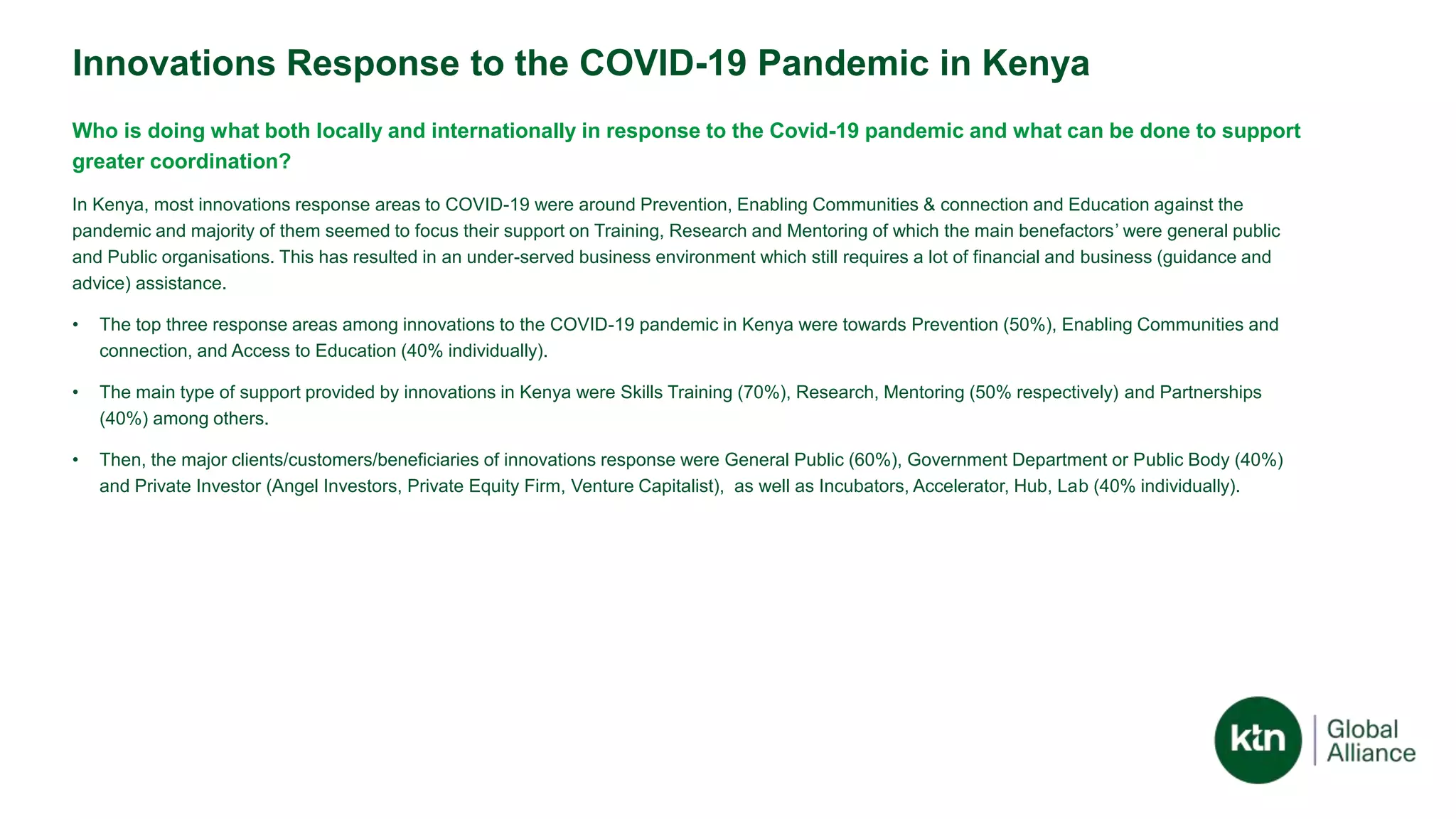
Decisively, the key informants discussion showed that the Kenya eco-system requires some funding, especially for early start-up phases.
• Vast majority (80%) of the innovations depends on their Internal Budget to fund their response to COVID-19 pandemic in Kenya, followed by
International Aids (40%), among others.
• All the innovations assessed would like to be inform of any funding opportunities that may arise in the future.
KEY FOCUS AREAS FOR FUTURE
RESILIENCE
• Investment in Digital Space
• Emergency Health Infrastructure
• Promoting Meaningful Engagement
• Access to Flexible Financing Support
• Business Coaching
• Business Mentorship
• Government Policy Reviews
(from qualitative research)
Would you like to be
informed of any future
funding opportunities, should
they arise?
NO
0%YES
100 %
10%
10%
20%
30%
40%
80%
Loan
Other
External private investment
Government grant
International Aid
Internal budget
SOURCES OF FUNDING

Rapid Analysis of Innovation Response to COVID-19 Pandemic in Kenya

  • 1.
    Handouts on Rapid Analysisof Innovation Response to COVID-19 Pandemic in Kenya July 2020
  • 2.
    Background • In January2020, the World Health Organization confirmed that a novel coronavirus was the cause of a respiratory illness in a cluster in Wuhan, China. Since then, the virus has spread all over the world and the year 2020 has become synonymous with this spread and the global response to it. • Africa has not been spared, with the continent recording its first case in February 2020. This global pandemic has continued its devastation in Africa. By the end of June 2020, the situation in our three focus countries were as follows: Kenya (over 6,000 cases and 144 deaths), Nigeria (over 25,000 cases and over 570 deaths) and South Africa (over 150,000 cases and more than 2,650 deaths). This has led to many within the national innovation ecosystems in the three countries to look for ways to address the impacts of the pandemic. • In order to track the impact of the pandemic, AfriLabs and the KTN Global Alliance worked together to deliver a rapid analysis of innovation response to COVID-19 pandemic in Africa, with focus on Kenya, Nigeria and South Africa. The aim of the analysis was to inform the UK’s Department for International Development (DFID) and the KTN Global Alliance on how to render effective support to innovation systems in Africa to respond to the COVID-19 pandemic, as well as to provide lessons and best practices to strengthen the innovation response to future crises. • The overall study objective was to provide rapid analysis that:  Identify the challenges and impact from the COVID-19 pandemic in Kenya, South Africa and Nigeria, and the corresponding innovation responses;  Inform immediate and medium-term support to increase resiliency of the innovation systems to the COVID-19 pandemic;  Draw lessons and effective practices to strengthen the innovation response to future crises. • This study, collected new evidence and data on the different dimensions to the impact of COVID-19. The challenges innovations faced were explored, innovations response to the pandemic was evaluated, and finally some of the key focus areas and areas of opportunity for future growth of innovation on the continent were considered. The information below highlights the findings for Kenya as well as some recommendations towards greater resilience in the innovation ecosystem in years to come.
  • 3.
    Success and Failurein Innovation Responses to the COVID-19 Pandemic in Kenya What can we learn from examples of success and failure in innovation responses to the Covid-19 pandemic? KEY FACTORS FOR SUCCESS WHERE COORDINATION AND COLLABORATION WERE STRONGEST • Strong communication process • Proper policies • Stakeholder buy in • Trust for collaboration • Awareness creation and information sharing KEY DRIVERS OF FRAGMENTED AND SILOED WORKING RELATIONSHIP • Corruption • Lack of innovation within the existing systems • Poor communication • Lack of trust • Lack of structures to collaborate effectively • Lack of precedent • Insufficient funding Breakdown of stakeholder response "... there's mutual benefit. Okay. Yeah. So, each party benefits from each of the relationships. so I would say that makes the collaboration move sustainably.” - Stakeholder, female- Kenya "The government of Kenya, did put measures that also enhanced the uptick of some of our solutions, like the cashless payments.” - Stakeholder, male-Kenya
  • 4.
    Innovations Response tothe COVID-19 Pandemic in Kenya Who is doing what both locally and internationally in response to the Covid-19 pandemic and what can be done to support greater coordination? In Kenya, most innovations response areas to COVID-19 were around Prevention, Enabling Communities & connection and Education against the pandemic and majority of them seemed to focus their support on Training, Research and Mentoring of which the main benefactors’ were general public and Public organisations. This has resulted in an under-served business environment which still requires a lot of financial and business (guidance and advice) assistance. • The top three response areas among innovations to the COVID-19 pandemic in Kenya were towards Prevention (50%), Enabling Communities and connection, and Access to Education (40% individually). • The main type of support provided by innovations in Kenya were Skills Training (70%), Research, Mentoring (50% respectively) and Partnerships (40%) among others. • Then, the major clients/customers/beneficiaries of innovations response were General Public (60%), Government Department or Public Body (40%) and Private Investor (Angel Investors, Private Equity Firm, Venture Capitalist), as well as Incubators, Accelerator, Hub, Lab (40% individually).
  • 5.
    Continued… 10% 10% 10% 10% 10% 20% 20% 20% 20% 20% 30% 40% 40% 50% WASH Food and Nutrition Economicand Workforce… Vulnerable Groups Other Treatment Emergency Communication Manufacturing Data Policy-Related Logistics and Supply Chain Access to Education Enabling Communities and… Prevention INNOVATION RESPONSE AREAS 10% 10% 10% 20% 20% 20% 40% 40% 40% 40% 40% 40% 50% 50% 70% Manufacturing Capability Supply chain Logistics and Distribution Financing Matchmaking Lessons learned / Case studies Communication and… Policy Support Business Support IP Support Networking / Community… Partnerships Mentoring Research Skills Training TYPE OF SUPPORT PROVIDED BY INNOVATION 10% 10% 10% 20% 20% 30% 30% 40% 60% Legislator, Policy Maker Membership Organisation (Trade Association or Professional… Business Charity, Non-profit, NGOs University, Think Tank, Research Organisation Incubator, Accelerator, Hub, Lab Private Investor (Angel Investor, Private Equity Firm, Venture… Government Department or Public Body General Public BENEFICIARIES OF COVID-19 RESPONSE Respondents could select multiple answers
  • 6.
    Impact of Covid-19on Kenya What are the consequences of the Covid-19 pandemic for the innovation ecosystems within each country? Overview • Kenya was hit hard by the Covid-19 pandemic, resulting in a nationwide lockdown for months. • Enormous effort went into healthcare, ensuring large scale testing and treatment through existing, and purpose built infrastructure. • Large scale economic support was also made available, focusing on the supporting the basic needs of the poorest. • Businesses that could provide their services digitally continued operations whilst the rest was brought to a complete stand still. • Some major organizations closed down for good, whilst many others lay off staff out of necessity and in an effort to safe their overall businesses. • The tourism and entertainment industries were some of those that were impacted the most. • SME and innovation funding was rerouted to food supply for the poor.
  • 7.
    Continued… Education • The educationsector was closed completely and resumed digitally (through e-learning) where possible. • Government launched schooling via television and radio programs. • Private schools and affluent schools were able to continue following a remarkable transition to distance learning. • However, the greater majority of schools were not as successful as they were affected by the “digital dived” in Kenya where major parts of society lacks digital skills and access to internet and affordable data. Financial Services • Stanbic Bank Kenya announced a loan holiday for SMEs and its personal banking customers to cushion them against the economic disruptions caused by the Coronavirus disease (COVID-19). • In a remarkable show of sense of responsibility, the bank indicated that it will continue being at the forefront of delivering wholesome solutions to entrepreneurs directly and through strategic alliances and partnerships, financial literacy and mentorship programmes; enhancing business and management skills, constant innovation that delivers solutions attuned to the needs of enterprise and operation models that ensures entrepreneurs can conveniently access financial services any time anywhere in Kenya. Manufacturing • Many private manufacturers turned their attention to producing medical supplies to assist in curbing the pandemic. • A number of funds were made available to support those that manufactured PPE and medical supplies.
  • 8.
    Strength and Challengesfrom the COVID-19 Pandemic in Kenya Remarkably, the connection between private investors and SME’s scored in Kenya is fairly high on the list of strengths and challenges, pointing out that funding was to of mind for many and that there were mixed results in accessing such funding. The challenges list also clearly designates that the SME’s and businesses did not experience the required relationship to (and subsequently the required support from) government. It is with this in mind that the recommendation would be for greater formal coordination and improved business support (both financial and non-financial) be established in the Kenya eco-system. • The most greatest coordination strength among innovations were found between ‘International support to Govt./Public Bodies (60%)’, ‘Networks/Enablers to Private Investors’, ‘Private Investors to Networks/Enablers’, ‘Govt./Public Bodies to International Support’, ‘NGO/Charities to International Support’ (50% separately). • Whereas, the greatest challenges encountered by innovations occurred among ‘Govt./Public Bodies to Networks/Enablers’, ‘Govt./Public Bodies to Researchers Universities’ (70% respectively), ‘Researchers Universities to Govt./Public Bodies’, ‘SMEs/Businesses to General Public’, ‘General Public to SMEs/Businesses’, ‘Networks/Enablers to Govt./Public Bodies’ (60% separately)
  • 9.
    Continued… 20% 20% 20% 30% 30% 30% 30% 40% 40% 40% 40% 50% 50% 50% 60% 60% 60% 60% 70% 70% International support toGovt./Public Bodies SMEs/Businesses to Networks/Enablers Govt./Public Bodies to NGO/Charities Govt./Public Bodies to International Support Networks/Enablers to General Public SMEs/Businesses to Private Investors Researchers Universities to International… Researchers Universities to Govt./Public Bodies General Public to SMEs/Businesses Govt./Public Bodies to Researchers Universities STAKEHOLDER CHAIN WHERE THERE WERE GREATEST COORDINATION CHALLENGES 10% 10% 10% 10% 10% 10% 10% 20% 20% 20% 20% 30% 30% 30% 40% 40% 40% 50% 50% 50% 50% 60% NGO/Charities to Govt/Public Bodies Govt./Public Bodies to Researchers Universities General Public to Networks/Enablers SMEs/Businesses to General Public Researchers Universities to International Support Networks/Enablers to General Public SMEs/Businesses to Networks/Enablers International support to NGO/Charities Private Investors to SMEs/Businesses Govt./Public Bodies to International Support Networks/Enablers to Private Investors STAKEHOLDER CHAIN WHERE THERE WERE GREATEST COORDINATION STRENGTHS Respondents could select multiple answers
  • 10.
    Useful Directions forFuture Research and Analysis in Kenya Finding from the rapid analysis has shown that future research and analysis should: • Focus on understanding whether the financial aid reaches the intended recipients (which percentage). Furthermore, determining how to ensure that the financial aid results in starting scalable innovations for Kenya, the African continent and beyond. • Provide insights and guidance to small businesses searching for ways to cope with the operational stress generated by COVID-19. This will also be a useful resource for business support organizations and policymakers assisting SME’s in these efforts. • Gain insights and understanding into ways to rapidly grow the digital literacy amongst the Kenyan people. • Consider ways to improve the infrastructure and access to affordable data for critical sectors such as education and health and wellness and in doing so, assist in the strive towards the 4th Industrial Revolution in Kenya. • Other key focus areas for future resilience from qualitative research include building a strong collaboration among innovations, emergency preparedness, robust data to support surveillance systems, business coaching and mentorship and government policy reviews.
  • 11.
    Recommendations for InternationalCollaboration and Support to Strengthen the Support of the Innovation Ecosystems What would be useful directions for future research, analysis and support? Resilience is as much a tool for persisting during a crisis as it is for thriving and now more than ever, programme design and intervention strategies for players of the innovation ecosystem must be intended at assisting them build resilience in the immediate to long-term. Providing the innovation eco-system with these recommendations would assist in achieving such resilience RECOMMENDATIONS • Access to flexible financing support • Business support and virtual advisors • Digital literacy and access to affordable data • Resilience through targeted policy design • Identify and facilitate value-driven partnerships
  • 12.
    Recommendations for DFID’sSupport • Support Kenyan governments to shape policy in ways that facilitate continuation of existing stakeholders activities or new COVID-related innovation. • Collaboration with local stakeholders in Kenya with the capacity for demographic outreach to share information on potential opportunities for investment/funding. • Launch interventions that engage and reward key stakeholders in Kenya. These can be innovation challenges developed in consultation with stakeholders, and aimed at specific industries for SMEs and entrepreneurs to participate in. • Ensure procurement processes are inclusive bearing in mind the maturity of local ecosystems in Kenya, the need to grow capacity of local ESOs and the value of local, on the ground knowledge. • Invest in understanding the local landscapes in Kenya and offering complementary interventions rather than repetitive ones. • Partner with connectivity providers (large telecommunications companies) to target specific sectors to increase connectivity. • The cost of internet connectivity in Kenya can also be lowered by increasing demand for it. Communities will use the internet to access relevant content. • Across all partnerships in Kenya, it is important to keep strict control over the finances with a high level of accountability. This will ensure that the money reaches the intended cause and achieves the desired outcomes without being diluted as it trickles through the different (often expensive) channels.
  • 13.
    Funding Source andFuture Resilience Enablers Decisively, the key informants discussion showed that the Kenya eco-system requires some funding, especially for early start-up phases. • Vast majority (80%) of the innovations depends on their Internal Budget to fund their response to COVID-19 pandemic in Kenya, followed by International Aids (40%), among others. • All the innovations assessed would like to be inform of any funding opportunities that may arise in the future. KEY FOCUS AREAS FOR FUTURE RESILIENCE • Investment in Digital Space • Emergency Health Infrastructure • Promoting Meaningful Engagement • Access to Flexible Financing Support • Business Coaching • Business Mentorship • Government Policy Reviews (from qualitative research) Would you like to be informed of any future funding opportunities, should they arise? NO 0%YES 100 % 10% 10% 20% 30% 40% 80% Loan Other External private investment Government grant International Aid Internal budget SOURCES OF FUNDING