OSHA Respirator Fit Test
Protocol
New Protocols
• The new protocols are the modified ambient aerosol condensation
nuclei counter (CNC) quantitative fit testing protocol for full-facepiece
and half-mask elastomeric respirators, and the modified ambient
aerosol CNC quantitative fit testing protocol for filtering facepiece
respirators.
• Both protocols are variations of the original OSHA-approved ambient
aerosol CNC protocol, but have fewer test exercises, shorter exercise
duration, and a more streamlined sampling sequence.
6 Protocols
• These two quantitative methods add to the four existing in Appendix
A of OSHA’s Respiratory Protection Standard, which contains
mandatory respirator fit-testing protocols that employers must
choose from to protect employees from hazardous airborne
contaminants.
• The rule does not require employers in general industries, shipyard
employment, and construction to update or replace their current fit
testing methods, and does not impose additional costs.
• The rule becomes effective September 26, 2019.
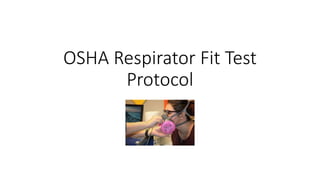
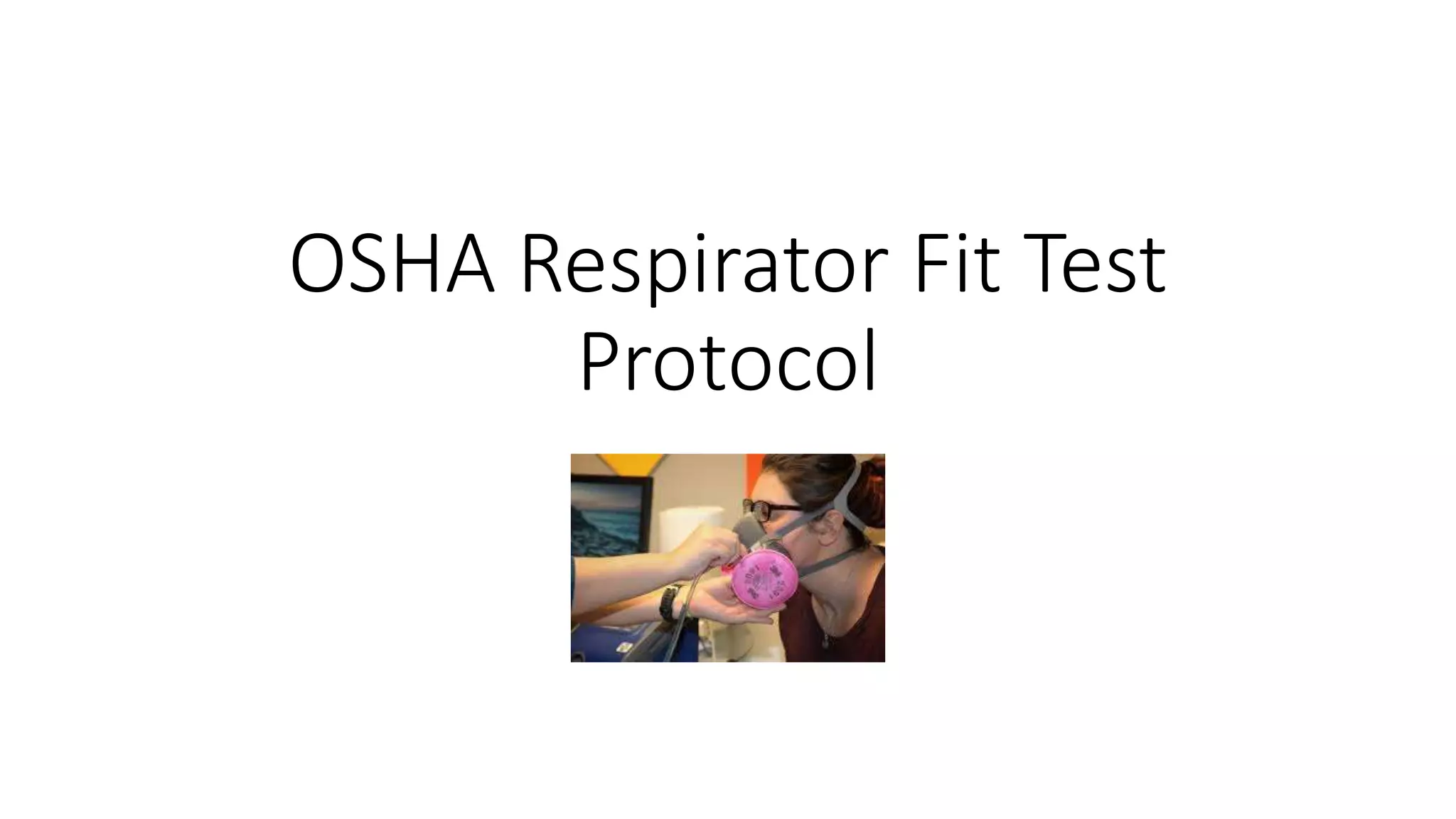
Ambient aerosol condensation nuclei counter
(CNC) quantitative fit testing protocol
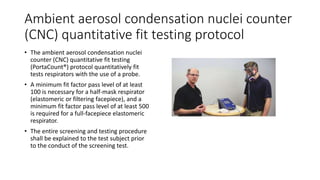
• The ambient aerosol condensation nuclei
counter (CNC) quantitative fit testing
(PortaCount®) protocol quantitatively fit
tests respirators with the use of a probe.
• A minimum fit factor pass level of at least
100 is necessary for a half-mask respirator
(elastomeric or filtering facepiece), and a
minimum fit factor pass level of at least 500
is required for a full-facepiece elastomeric
respirator.
• The entire screening and testing procedure
shall be explained to the test subject prior
to the conduct of the screening test.
Ambient aerosol condensation nuclei counter
(CNC) quantitative fit testing protocol
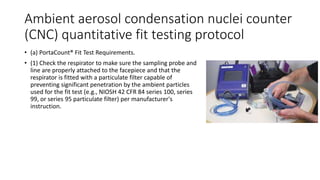
• (a) PortaCount® Fit Test Requirements.
• (1) Check the respirator to make sure the sampling probe and
line are properly attached to the facepiece and that the
respirator is fitted with a particulate filter capable of
preventing significant penetration by the ambient particles
used for the fit test (e.g., NIOSH 42 CFR 84 series 100, series
99, or series 95 particulate filter) per manufacturer's
instruction.
Ambient aerosol condensation nuclei counter
(CNC) quantitative fit testing protocol
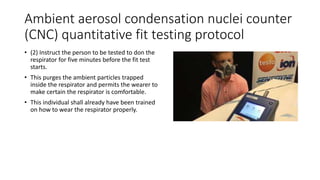
• (2) Instruct the person to be tested to don the
respirator for five minutes before the fit test
starts.
• This purges the ambient particles trapped
inside the respirator and permits the wearer to
make certain the respirator is comfortable.
• This individual shall already have been trained
on how to wear the respirator properly.
Ambient aerosol condensation nuclei counter
(CNC) quantitative fit testing protocol
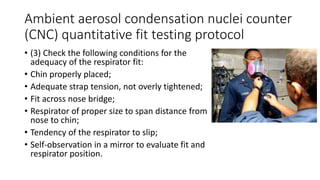
• (3) Check the following conditions for the
adequacy of the respirator fit:
• Chin properly placed;
• Adequate strap tension, not overly tightened;
• Fit across nose bridge;
• Respirator of proper size to span distance from
nose to chin;
• Tendency of the respirator to slip;
• Self-observation in a mirror to evaluate fit and
respirator position.
Ambient aerosol condensation nuclei counter
(CNC) quantitative fit testing protocol
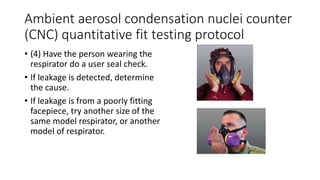
• (4) Have the person wearing the
respirator do a user seal check.
• If leakage is detected, determine
the cause.
• If leakage is from a poorly fitting
facepiece, try another size of the
same model respirator, or another
model of respirator.
Ambient aerosol condensation nuclei counter
(CNC) quantitative fit testing protocol
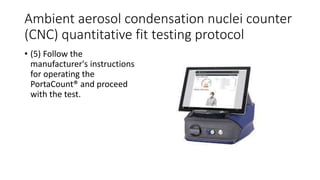
• (5) Follow the
manufacturer's instructions
for operating the
PortaCount® and proceed
with the test.
Ambient aerosol condensation nuclei counter
(CNC) quantitative fit testing protocol
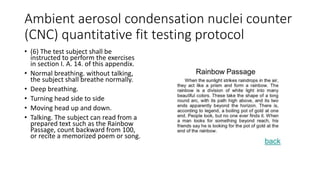
• (6) The test subject shall be
instructed to perform the exercises
in section I. A. 14. of this appendix.
• Normal breathing. without talking,
the subject shall breathe normally.
• Deep breathing.
• Turning head side to side
• Moving head up and down.
• Talking. The subject can read from a
prepared text such as the Rainbow
Passage, count backward from 100,
or recite a memorized poem or song.
Ambient aerosol condensation nuclei counter
(CNC) quantitative fit testing protocol
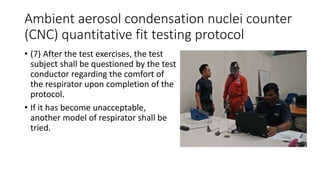
• (7) After the test exercises, the test
subject shall be questioned by the test
conductor regarding the comfort of
the respirator upon completion of the
protocol.
• If it has become unacceptable,
another model of respirator shall be
tried.
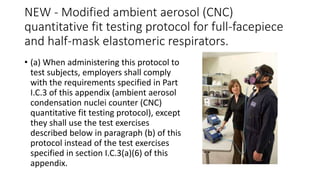
NEW - Modified ambient aerosol (CNC)
quantitative fit testing protocol for full-facepiece
and half-mask elastomeric respirators.
• (a) When administering this protocol to
test subjects, employers shall comply
with the requirements specified in Part
I.C.3 of this appendix (ambient aerosol
condensation nuclei counter (CNC)
quantitative fit testing protocol), except
they shall use the test exercises
described below in paragraph (b) of this
protocol instead of the test exercises
specified in section I.C.3(a)(6) of this
appendix.
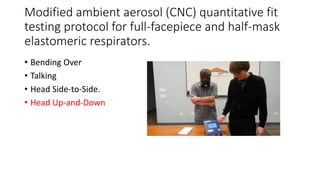
Modified ambient aerosol (CNC) quantitative fit
testing protocol for full-facepiece and half-mask
elastomeric respirators.
• Bending Over
• Talking
• Head Side-to-Side.
• Head Up-and-Down
NEW - Modified ambient aerosol condensation
nuclei counter (CNC) quantitative fit testing
protocol for full-facepiece and half-mask
elastomeric respirators.
• Bending Over
• Jogging in place
• Head Side-to-Side.
• Head Up-and-Down

Osha respirator fit test protocol 2019

  • 1.
    OSHA Respirator FitTest Protocol
  • 2.
    New Protocols • Thenew protocols are the modified ambient aerosol condensation nuclei counter (CNC) quantitative fit testing protocol for full-facepiece and half-mask elastomeric respirators, and the modified ambient aerosol CNC quantitative fit testing protocol for filtering facepiece respirators. • Both protocols are variations of the original OSHA-approved ambient aerosol CNC protocol, but have fewer test exercises, shorter exercise duration, and a more streamlined sampling sequence.
  • 3.
    6 Protocols • Thesetwo quantitative methods add to the four existing in Appendix A of OSHA’s Respiratory Protection Standard, which contains mandatory respirator fit-testing protocols that employers must choose from to protect employees from hazardous airborne contaminants. • The rule does not require employers in general industries, shipyard employment, and construction to update or replace their current fit testing methods, and does not impose additional costs. • The rule becomes effective September 26, 2019.
  • 4.
    Ambient aerosol condensationnuclei counter (CNC) quantitative fit testing protocol • The ambient aerosol condensation nuclei counter (CNC) quantitative fit testing (PortaCount®) protocol quantitatively fit tests respirators with the use of a probe. • A minimum fit factor pass level of at least 100 is necessary for a half-mask respirator (elastomeric or filtering facepiece), and a minimum fit factor pass level of at least 500 is required for a full-facepiece elastomeric respirator. • The entire screening and testing procedure shall be explained to the test subject prior to the conduct of the screening test.
  • 5.
    Ambient aerosol condensationnuclei counter (CNC) quantitative fit testing protocol • (a) PortaCount® Fit Test Requirements. • (1) Check the respirator to make sure the sampling probe and line are properly attached to the facepiece and that the respirator is fitted with a particulate filter capable of preventing significant penetration by the ambient particles used for the fit test (e.g., NIOSH 42 CFR 84 series 100, series 99, or series 95 particulate filter) per manufacturer's instruction.
  • 6.
    Ambient aerosol condensationnuclei counter (CNC) quantitative fit testing protocol • (2) Instruct the person to be tested to don the respirator for five minutes before the fit test starts. • This purges the ambient particles trapped inside the respirator and permits the wearer to make certain the respirator is comfortable. • This individual shall already have been trained on how to wear the respirator properly.
  • 7.
    Ambient aerosol condensationnuclei counter (CNC) quantitative fit testing protocol • (3) Check the following conditions for the adequacy of the respirator fit: • Chin properly placed; • Adequate strap tension, not overly tightened; • Fit across nose bridge; • Respirator of proper size to span distance from nose to chin; • Tendency of the respirator to slip; • Self-observation in a mirror to evaluate fit and respirator position.
  • 8.
    Ambient aerosol condensationnuclei counter (CNC) quantitative fit testing protocol • (4) Have the person wearing the respirator do a user seal check. • If leakage is detected, determine the cause. • If leakage is from a poorly fitting facepiece, try another size of the same model respirator, or another model of respirator.
  • 9.
    Ambient aerosol condensationnuclei counter (CNC) quantitative fit testing protocol • (5) Follow the manufacturer's instructions for operating the PortaCount® and proceed with the test.
  • 10.
    Ambient aerosol condensationnuclei counter (CNC) quantitative fit testing protocol • (6) The test subject shall be instructed to perform the exercises in section I. A. 14. of this appendix. • Normal breathing. without talking, the subject shall breathe normally. • Deep breathing. • Turning head side to side • Moving head up and down. • Talking. The subject can read from a prepared text such as the Rainbow Passage, count backward from 100, or recite a memorized poem or song.
  • 11.
    Ambient aerosol condensationnuclei counter (CNC) quantitative fit testing protocol • (7) After the test exercises, the test subject shall be questioned by the test conductor regarding the comfort of the respirator upon completion of the protocol. • If it has become unacceptable, another model of respirator shall be tried.
  • 12.
    NEW - Modifiedambient aerosol (CNC) quantitative fit testing protocol for full-facepiece and half-mask elastomeric respirators. • (a) When administering this protocol to test subjects, employers shall comply with the requirements specified in Part I.C.3 of this appendix (ambient aerosol condensation nuclei counter (CNC) quantitative fit testing protocol), except they shall use the test exercises described below in paragraph (b) of this protocol instead of the test exercises specified in section I.C.3(a)(6) of this appendix.
  • 13.
    Modified ambient aerosol(CNC) quantitative fit testing protocol for full-facepiece and half-mask elastomeric respirators. • Bending Over • Talking • Head Side-to-Side. • Head Up-and-Down
  • 14.
    NEW - Modifiedambient aerosol condensation nuclei counter (CNC) quantitative fit testing protocol for full-facepiece and half-mask elastomeric respirators. • Bending Over • Jogging in place • Head Side-to-Side. • Head Up-and-Down