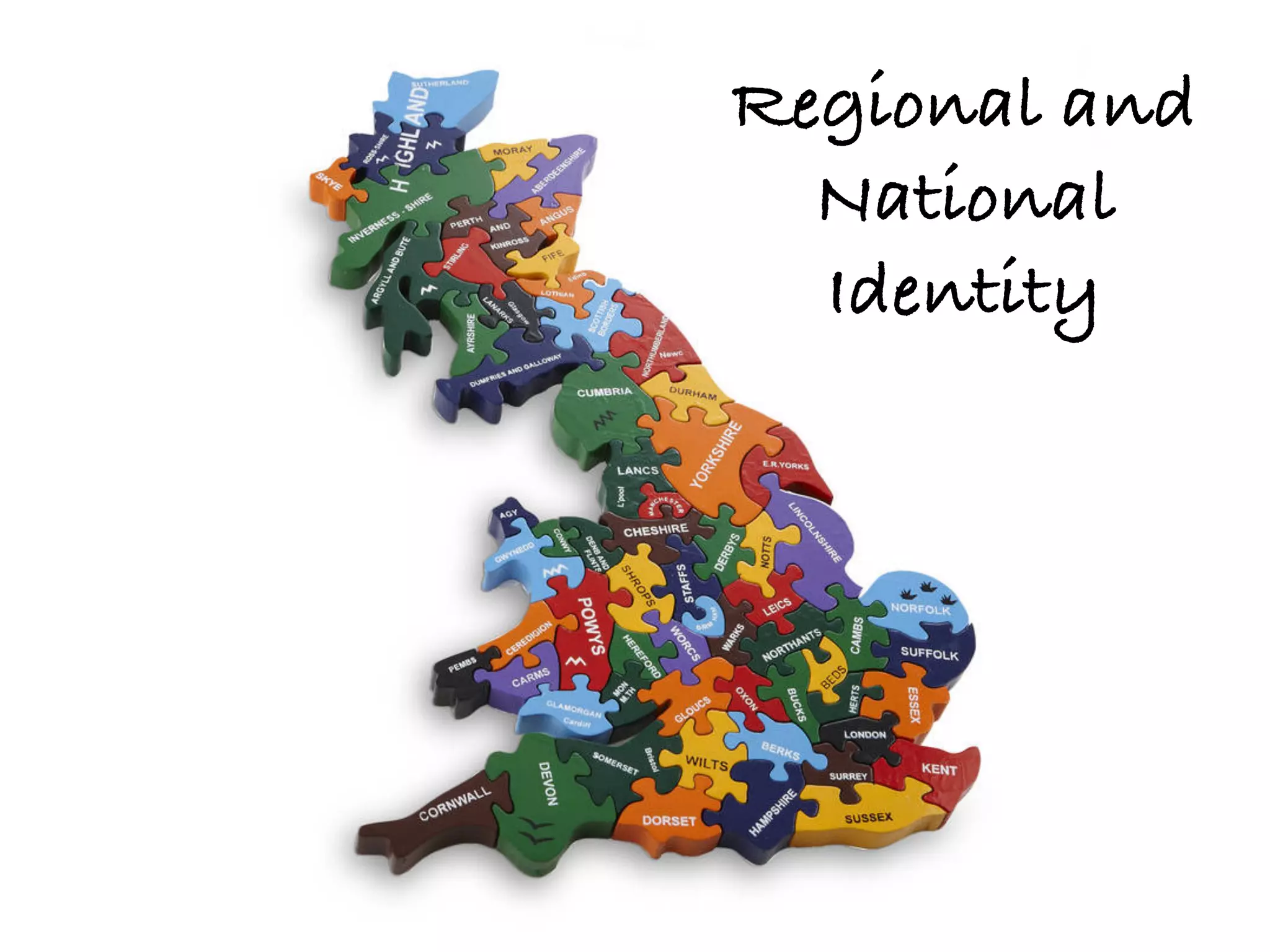
Regional and
National
Identity
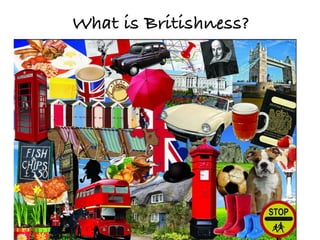
What is Britishness?
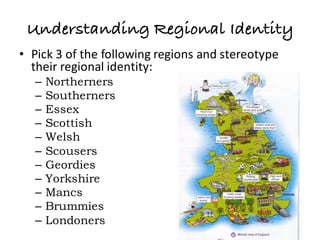
Understanding Regional Identity
• Pick	3	of	the	following	regions	and	stereotype	
their	regional	identity:
– Northerners
– Southerners
– Essex
– Scottish
– Welsh
– Scousers
– Geordies
– Yorkshire
– Mancs
– Brummies
– Londoners
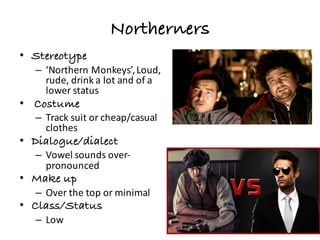
Northerners
• Stereotype
– ‘Northern	Monkeys’,	Loud,	
rude,	drink	a	lot	and	of	a	
lower	status
• Costume
– Track	suit	or	cheap/casual	
clothes
• Dialogue/dialect
– Vowel	sounds	over-
pronounced
• Make up
– Over	the	top	or	minimal
• Class/Status
– Low
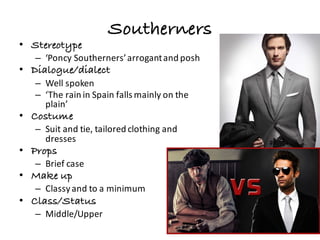
Southerners
• Stereotype
– ‘Poncy Southerners’	arrogant	and	posh
• Dialogue/dialect
– Well	spoken	
– ‘The	rain	in	Spain	falls	mainly	on	the	
plain’
• Costume
– Suit	and	tie,	tailored	clothing	and	
dresses
• Props
– Brief	case
• Make up
– Classy	and	to	a	minimum
• Class/Status
– Middle/Upper
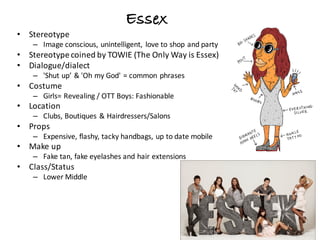
Essex
• Stereotype
– Image	conscious,	unintelligent,	 love	to	shop	and	party
• Stereotype	coined	by	TOWIE	(The	Only	Way	is	Essex)
• Dialogue/dialect
– 'Shut	up’	&	'Oh	my	God'	=	common	phrases	
• Costume
– Girls=	Revealing	/	OTT	Boys:	Fashionable
• Location
– Clubs,	Boutiques	&	Hairdressers/Salons
• Props
– Expensive,	flashy,	tacky	handbags,	up	to	date	mobile
• Make	up
– Fake	tan,	fake	eyelashes	and	hair	extensions
• Class/Status
– Lower	Middle
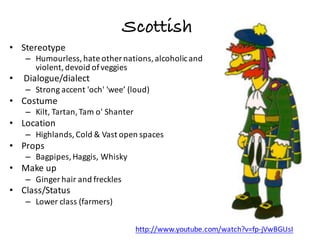
Scottish
• Stereotype
– Humourless,	hate	other	nations,	alcoholic	and	
violent,	devoid	of	veggies
• Dialogue/dialect
– Strong	accent	'och'	'wee’	(loud)
• Costume
– Kilt,	Tartan,	Tam	o'	Shanter
• Location
– Highlands,	Cold	&	Vast	open	spaces
• Props
– Bagpipes,	Haggis,	Whisky
• Make	up
– Ginger	hair	and	freckles
• Class/Status
– Lower	class	(farmers)
http://www.youtube.com/watch?v=fp-jVwBGUsI
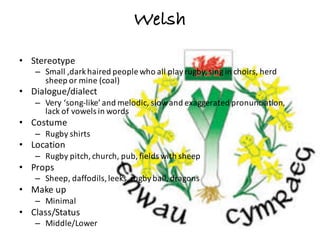
Welsh
• Stereotype
– Small	,dark	haired	people	who	all	play	rugby,	sing	in	choirs,	herd	
sheep	or	mine	(coal)
• Dialogue/dialect
– Very	‘song-like’	and	melodic,	slow	and	exaggerated	pronunciation,	
lack	of	vowels	in	words
• Costume
– Rugby	shirts
• Location
– Rugby	pitch,	church,	pub,	fields	with	sheep
• Props
– Sheep,	daffodils,	leeks,	rugby	ball,	dragons
• Make	up
– Minimal
• Class/Status
– Middle/Lower
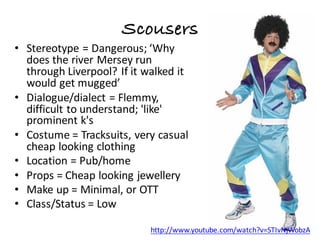
Scousers
• Stereotype	=	Dangerous;	‘Why	
does	the	river	Mersey	run	
through	Liverpool?	If	it	walked	it	
would	get	mugged’
• Dialogue/dialect	=	Flemmy,	
difficult	to	understand;	'like'	
prominent	k's
• Costume	=	Tracksuits,	very	casual	
cheap	looking	clothing
• Location	=	Pub/home
• Props	=	Cheap	looking	jewellery
• Make	up	=	Minimal,	or	OTT	
• Class/Status	=	Low
http://www.youtube.com/watch?v=STIvNjWobzA
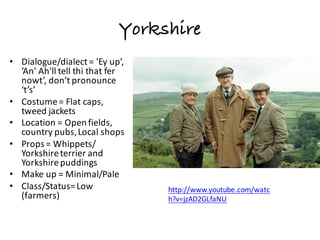
Yorkshire
• Dialogue/dialect	=	'Ey up’,	
‘An'	Ah'll tell	thi that	fer
nowt’,	don’t	pronounce	
‘t’s’
• Costume	=	Flat	caps,	
tweed	jackets
• Location	=	Open	fields,	
country	pubs,	Local	shops
• Props	=	Whippets/	
Yorkshire	terrier	and	
Yorkshire	puddings
• Make	up	=	Minimal/Pale	
• Class/Status=	Low	
(farmers)
http://www.youtube.com/watc
h?v=jzAD2GLfaNU
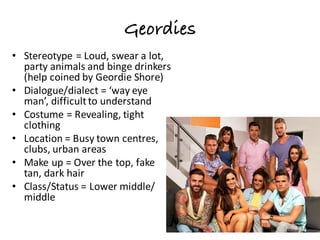
Geordies
• Stereotype	=	Loud,	swear	a	lot,	
party	animals	and	binge	drinkers	
(help	coined	by	Geordie	Shore)
• Dialogue/dialect	=	‘way	eye	
man’,	difficult	to	understand
• Costume	=	Revealing,	tight	
clothing
• Location	=	Busy	town	centres,	
clubs,	urban	areas
• Make	up	=	Over	the	top,	fake	
tan,	dark	hair
• Class/Status	=	Lower	middle/	
middle
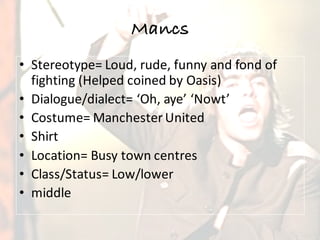
Mancs
• Stereotype=	Loud,	rude,	funny	and	fond	of	
fighting	(Helped	coined	by	Oasis)
• Dialogue/dialect=	‘Oh,	aye’	‘Nowt’
• Costume=	Manchester	United	
• Shirt
• Location=	Busy	town	centres
• Class/Status=	Low/lower	
• middle
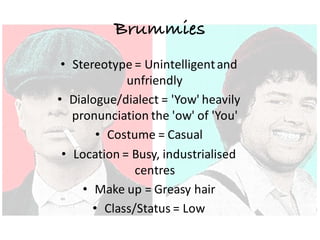
Brummies
• Stereotype	=	Unintelligent	and	
unfriendly
• Dialogue/dialect	=	'Yow'	heavily	
pronunciation	the	'ow'	of	'You'	
• Costume	=	Casual
• Location	=	Busy,	industrialised	
centres
• Make	up	=	Greasy	hair
• Class/Status	=	Low
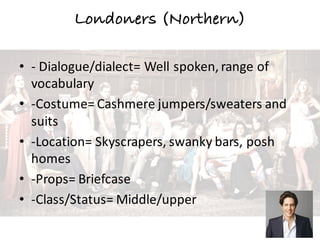
Londoners (Northern)
• - Dialogue/dialect=	Well	spoken,	range	of	
vocabulary
• -Costume=	Cashmere	jumpers/sweaters	and	
suits
• -Location=	Skyscrapers,	swanky	bars,	posh	
homes
• -Props=	Briefcase
• -Class/Status=	Middle/upper
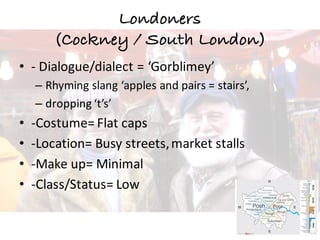
Londoners
(Cockney / South London)
• - Dialogue/dialect	=	‘Gorblimey’
– Rhyming	slang	‘apples	and	pairs	=	stairs’,	
– dropping	‘t’s’
• -Costume=	Flat	caps
• -Location=	Busy	streets,	market	stalls
• -Make	up=	Minimal
• -Class/Status=	Low
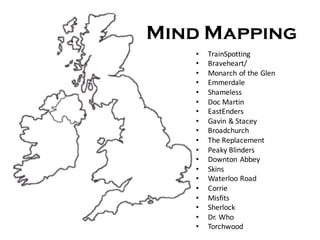
Mind Mapping
• TrainSpotting
• Braveheart/
• Monarch	of	the	Glen	
• Emmerdale
• Shameless
• Doc	Martin	
• EastEnders	
• Gavin	&	Stacey
• Broadchurch
• The	Replacement
• Peaky	Blinders
• Downton	Abbey
• Skins
• Waterloo	Road
• Corrie
• Misfits
• Sherlock
• Dr. Who
• Torchwood
TEXTUAL Analysis
1.	Cinematography
2.	Mise-en-Scene
Characters	&													
Costume,	Props,				
Setting/Location
3.	Editing
4.	Sound
Diegetic	Sound				
(Dialect,	
Colloquialisms)
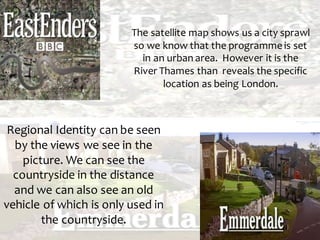
The satellite map shows us a city sprawl
so we know that the programme is set
in an urban area. However it is the
River Thames than reveals the specific
location as being London.
Regional Identity can be seen
by the views we see in the
picture. We can see the
countryside in the distance
and we can also see an old
vehicle of which is only used in
the countryside.
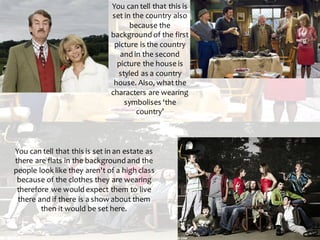
You can tell that this is
set in the country also
because the
background of the first
picture is the country
and in the second
picture the house is
styled as a country
house. Also, whatthe
characters are wearing
symbolises ‘the
country’
You can tell that this is set in an estate as
there are flats in the background and the
people look like they aren't of a high class
because of the clothes they are wearing
therefore we would expect them to live
there and if there is a show about them
then it would be set here.
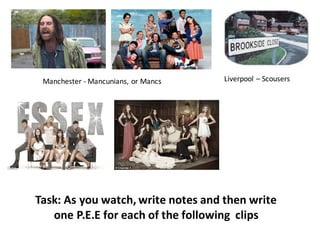
Manchester	- Mancunians,	or	Mancs Liverpool	– Scousers
Task:	As	you	watch,	write	notes	and	then	write	
one	P.E.E	for	each	of	the	following		clips
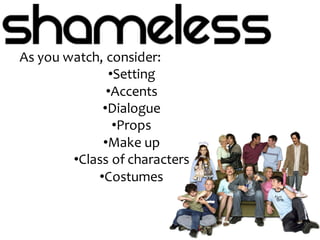
As you watch, consider:
•Setting
•Accents
•Dialogue
•Props
•Make up
•Class of characters
•Costumes
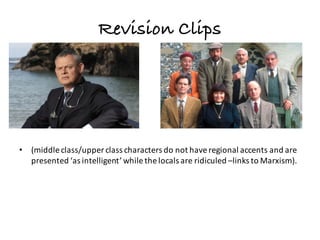
Revision Clips
• (middle	class/upper	class	characters	do	not	have	regional	accents	and	are	
presented	‘as	intelligent’	while	the	locals	are	ridiculed	–links	to	Marxism).
Key Theorists
• Theorist	Andrew	Higson	(1998)	writes;	“Identity	is	generally	understood	 to	be	the	
shared	identity	of	naturalized	inhabitants	of	a	particular	political-geographic	space	
– this	can	be	a	particular	nation	or	region.”	
• Benedict	Anderson	(1983)	maintains	that	the	media	play	a	vital	role	in	constructing	
a	national/regional	identity	as	in	reality	the	nation	is	too	big	for	everyone	to	know	
each	other	yet	they	often	have	shared	values	;	“The	unification	of	people	in	the	
modern	world	is	achieved	not	by	military	but	by	cultural	means,	in	particular	the	
media	system	enables	people	(of	a	nation	or	region)	to	feel	part	of	a	coherent,	
meaningful	 and	homogenous	 community.”
Higson	(1998)	claims	that	many	TV	dramas	(such	as	
Eastenders,	Corrie	etc.)	demonstrate	the	
importance	of	community	and	patriarchal	values;	
“Social	and	cultural	differences	seem	less	significant	
when	shared.	The	common	purpose	pulls	the	
individual	characters	of	the	drama	together,	forges	
them	into	an	organic,	self-functioning	community	
and	ensures	that	each	person	has	a	clear	role	in	the	
community.	This	small,	self-contained	functional	
community	can	then	be	read	as	standing	for	the	
nation,	which	is	thereby	imagined	as	a	consensual	
gathering	together	of	the	diverse	interests	of	
individuals	who	make	up	that	community.”
Higson (1998)	and	Corrigan	(1992)	argues	that	TV	drama	does	
not	always	present	communities	like	this,	“Identity	is	fluid,	
unstable	and	contingent	on	circumstances”	(Corrigan	1992)	
“Allegiances	are	forever	being	made,	unmade	and	remade;	
community	cannot	be	taken	for	granted;	they	are	insecure	
and	often	self-destructive…Tension	of	race,	gender,	sexuality,	
the	family	and	generations	represent	not	simply	as	
multicultural	but	in	disarray”(Higson 1998).
• In	short,	as	Higson summarised;	“Images	of	social	and	cultural	
disturbance	and	fragmentation	are	more	prominent	than	images	of	
consensual	community”	this	obviously	paints	a	slightly	negative	
image	of	multicultural	Britain.	
• Higson goes	onto	argue	that	TV	drama	has	to	find	ways	of	
representing	hybrid	identities	in	multicultural	Britain;	“As	Britain	
becomes	visibly	multicultural,	so	the	makers	of	media	texts	have	
attempted	to	deal	with	plurality,	to	find	space	in	representation	for	
cultural	minorities,	ethnic	or	otherwise.	In	doing	so,	the	cultural	
boundaries	of	the	nation	have	been	redefined,	and	a	wider,	more	
extended	and	hybrid	national	‘community’	imagined.”
Constructing	images	of	
Regional/National	identity:
• According	to	Higson (1989)	there	are	two	ways	in	
which	the	process	of	constructing	images	of	
national/regional	identity	should	be	understood;	“The	
first	involves	an	inward	looking	process,	defining	the	
nation	in	terms	of	its	own	cultural	history.	The	second	
is	a	more	outward-looking	process,	defining	the	nation	
in	terms	of	its	difference	from	others.”
In	other	words,	stereotypes	play	a	large	role	in	constructing	
images	of	identity	and	these	can	either	reaffirm	notions	of	a	
nation	(historic/culture)	or	contradict	them.	For	example,	as	
Higson (1998)	states;	“Film	like	Trainspotting	(1995)	deal	with	
quite	specific	cultural	traditions,	including	working	class	
traditions,	youth	traditions,	all	of	which	can	be	subsumed	under	
the	umbrella	term	Britishness.”	In	other	words,	Trainspotting	
taps	into	traditional	stereotypes	of	Scotland	while	illustrating	
what	these	stereotypes	mean	to	working	class	youths	(social-
realist	interpretation).	Interestingly,	this	film	changed	the	way	
this	film	represented	Scotland	changed	outward	perceptions	of	
the	nations	(negatively).
Higson also	argues	that;	“Representations	of	
national/regional	identity	are	constructed	as	the	
narrative	of	the	text	unfolds,	as	characters	are	
pitted	against	one	another,	so	a	sense	of	identity	
emerges…but	at	the	same	time	producers	often	
resort	to	stereotyping	as	a	means	of	establishing	
character	and	identity.”
• Higson	goes	on	to	say;	“Stereotyping	is	a	form	of	shorthand,	a	way	
of	establishing	character	by	adopting	recognisable	and	well	
established	conventions	of	representation…the	stereotype	reduces	
characters	to	the	most	basic	form	and	attempts	to	naturalise	them	
and	the	more	widely	recognisable	they	become	the	more	readily	
they	are	accepted.	Except	that	if	a	stereotype	becomes	more	widely	
recognisable	it	becomes	comic”.	
• Higson	adds;	“No	wonder	then	that	a	particular	characterization	
may	be	criticised	for	being	stereotypical,	meaning	it	lacks	a	realistic	
dimension,	it	fails	to	match	up	to	the	reality	of	identity.”
• As	Higson points	out,	it	is	always	important	to	
analyse: “Identities	and	alliances,	in	particular	
relating	to	class,	ethnicity,	religion,	class	and	
gender.”	In	other	words,	how	does	a	certain	
region	seem	to	view	these	things	and	what	does	
it	imply	the	producer	wants	you	to	think	about	
this	region	and	its	views.
In	terms	of	regional	identity,	it	is	again	important	to	
remember	Medhurt – think	about	who	the	dominant	
producers	are	because	it	is	often	the	case	they	stereotype	
those	‘not	like	them’	(working	class	‘Cornish	Carrot	
Crunchers’	etc.).	Also,	it	is	worth	noting	that	if	middle	
class	white	men	appear	in	regional	TV	dramas	(e.g.	Dr	
Martin/Vicar	of	Dibley)	they	are	usually	made	out	to	be	
educated	and	reasonable	unlike	the	locals.

Regional Identity